
Posting every day is not a strategy. A strategy gives activity a purpose—awareness, community, leads, traffic, sales, or stronger customer relationships. Each goal needs different content, platforms, cadence, and KPIs.
A strong plan usually includes audience research, measurable goals, platform choice, content pillars, formats, a publishing schedule, engagement, analytics, and optimization. It keeps you from posting only because a trend appeared.
AI and automation can help create visuals, draft captions, schedule posts, suggest times, and manage several networks. Technology works best when it supports a defined plan. Bibby executes create–caption–schedule on Facebook, Instagram, LinkedIn, YouTube, and TikTok. It does not replace strategy, run ads, or report Insights.
In simple terms, the strategy is the roadmap: where you want to go, how you will get there, and which results show you are moving.
What Is a Social Media Strategy?
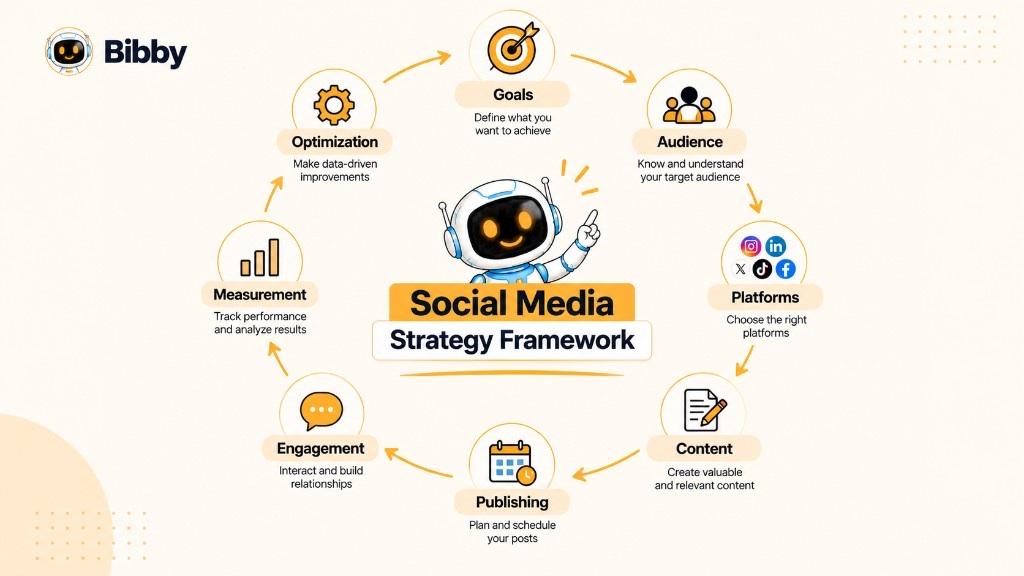
A social media strategy is a structured way to use social platforms toward defined goals. It connects audience, objectives, channels, content, schedule, engagement, and metrics into one plan.
Instead of “What should we post today?”, start with: Who are we trying to reach? What should they do? Which platforms help? What content earns attention? How will we know it worked?
A software company chasing B2B leads may emphasize LinkedIn with education, customer stories, and product explainers. A fashion brand may lean on Instagram and TikTok with short-form video, creator posts, and product showcases. The plan changes because audience, journey, and platform behavior change.
The strategy can cover organic and paid work. Organic includes posts, videos, carousels, Stories, and community replies. Paid can include sponsored posts, ads, and retargeting—those live in ads tools. Bibby does not run ads or pixels.
What Does a Social Media Strategy Include?
- Goals — what social should help the business achieve
- Target audience — who the content should reach
- Platforms — which networks matter
- Content — topics, themes, and pillars
- Formats — images, carousels, video, Stories, text, or other
- Schedule — how often and when
- Engagement — how you will interact
- Campaigns — promotions that support larger goals
- Measurement — KPIs that define success
- Optimization — what changes after you see data
Goals shape audience and platforms. Audience shapes content. Content affects engagement and conversions. Data improves the next cycle.
Social Media Strategy Is More Than a Content Calendar
A content calendar is useful. It is not the whole strategy.
The calendar says what publishes and when. The strategy says why, for whom, which objective it supports, and how you will judge it.
Calendar: *Monday — Instagram carousel on productivity tips.*
Strategy: *Reach professionals interested in productivity, build authority, earn saves and shares, and move interested people to the website.*
Why Does a Social Media Strategy Matter?
Without one, social becomes create, publish, check likes, repeat. Activity is not the same as results.
A written plan helps you decide where time goes, what to create, whom to prioritize, and which numbers matter. When a topic or format works, you can reuse the reason. When it fails, you change the plan instead of repeating it.
Is a Social Media Strategy the Same for Every Platform?
No. Each network has its own audience, formats, and culture.
The campaign objective and brand message can stay consistent. A long industry insight may fit LinkedIn; the same idea can become a short video for TikTok or Instagram and a visual explainer for Facebook. That beats identical posts everywhere.
Social Media Strategy in the Age of AI
AI can assist with ideas, images, captions, repurposing, scheduling, and—in analytics products—pattern spotting. Automation can cut busywork across several accounts.
It does not remove the need for purpose, audience, brand direction, and measurable objectives. The useful pairing is strategy supported by technology, not strategy versus automation.
In Simple Terms
Who are you trying to reach? What do you want to achieve? Where will you reach them? What will you share? How will you measure and improve?
When those answers connect, social is a coordinated channel—not a stream of one-off posts.
Why Is a Social Media Strategy Important?
Accounts on many platforms do not guarantee results. Without direction, teams post inconsistently, talk to the wrong people, repeat the same assets, or chase vanity metrics.
A strategy turns activity into purposeful marketing: what to create, where it goes, and how to improve.
Gives Your Content a Clear Direction
Every piece should have a job—educate, build trust, or invite a visit or purchase. That cuts random posts.
Helps You Reach the Right Audience
A large follower count is weak if those people will not buy or engage. Start with interests, problems, habits, and platforms. B2B tech may prioritize LinkedIn decision-makers; a lifestyle brand may prioritize Instagram and TikTok.
Creates Consistency Across Platforms
Voice, visuals, themes, cadence, and core messages can stay recognizable. Consistency is not identical assets everywhere—it is one brand adapted to each format.
Makes Content Creation More Efficient
Pillars, campaigns, formats, and a calendar reduce daily invention. One report, story, webinar, or launch can become several platform-specific pieces. AI can draft captions and visuals; you still review.
Improves Audience Engagement
Social is not only broadcast. Plan how you will handle comments, messages, questions, and reviews. Community work stays human. Listening and mention tools are separate from Bibby.
Supports Lead Generation and Sales
Social can move people from discovery to research to action: visit, newsletter, download, demo, message, trial, or purchase. Follower growth is not the end goal.
Makes Performance Measurable
Define success first. One brand may need reach; another needs leads, traffic, purchases, or retention. Useful numbers include reach, impressions, engagement rate, shares, saves, views, clicks, CTR, leads, conversions, and revenue. Review them in Insights or analytics—not in Bibby.
Helps You Spend Time and Budget More Effectively
Not every network or format deserves the same investment. Focus on channels and topics that match audience and goals. Cut what consumes resources without outcomes.
Makes It Easier to Adapt to Change
Features, behavior, formats, and the algorithm move. Review the plan with data. If short-form video beats static posts, shift production. If a network no longer reaches the audience, change its role.
Builds a More Sustainable Presence
A strategy replaces improvisation with a repeatable system: goal, audience, content, place, and evaluation. It turns posting into a process.
What Are the Key Elements of a Social Media Strategy?
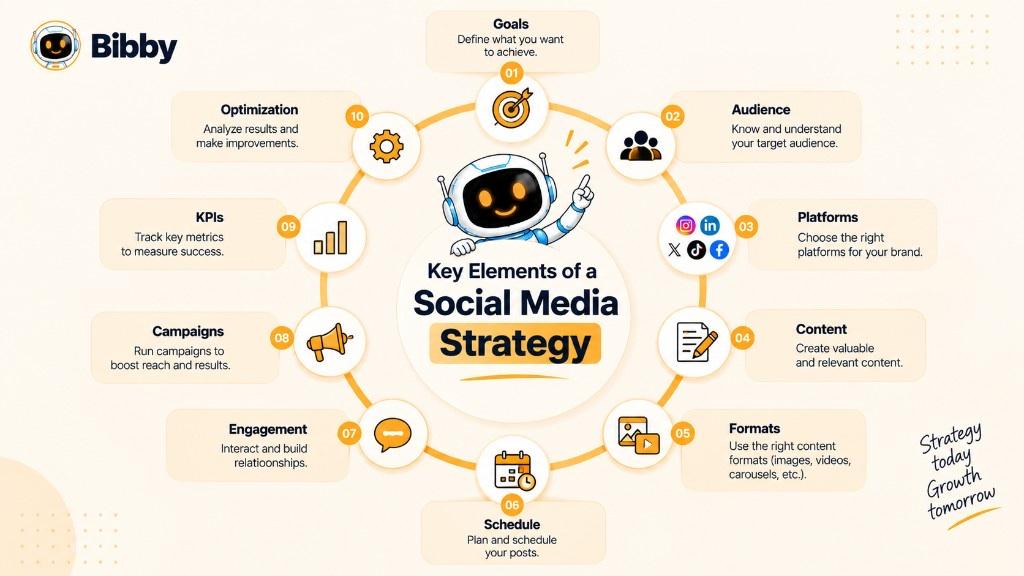
There is no one plan for every startup, shop, B2B team, or creator. The building blocks are similar.
1. Clear Social Media Goals
Connect social to a business outcome. Prefer “increase qualified LinkedIn traffic 20% this quarter” over “grow LinkedIn.” Common goals: awareness, relevant audience, leads, traffic, sales, community, engagement, app downloads, support, thought leadership.
2. Target Audience
Age, location, role, industry, interests, pain points, buying behavior, content preferences, platforms, and journey stage. Reach the right people, not the largest crowd. A persona can help, but real customer evidence is better than a stereotype.
3. Social Media Platform Selection
You do not need every network.
- Facebook — communities, broad reach, many formats (ads live in Meta’s tools)
- Instagram — images, carousels, Stories, Reels
- LinkedIn — B2B, professional content, thought leadership
- TikTok — short-form discovery video
- YouTube — short- and long-form video, search-driven views
Two or three well-run channels often beat six thin ones. Pinterest or X may matter for some audiences; Bibby does not publish there.
4. Content Strategy
Topics, themes, messages, and pillars: education, insights, product, customer stories, behind-the-scenes, entertainment, inspiration, UGC, news, offers. Pillars add structure without making every post identical.
5. Content Formats
Images, carousels, short- and long-form video, Stories, Reels, text, polls, infographics, livestreams, UGC. Match format to platform, audience, and message.
6. Publishing Schedule
Frequency, days, times, campaign dates, launches, seasons. There is no universal best time. Pick a rhythm you can keep. Scheduling tools queue work; AI can suggest times. That is not a reach guarantee.
7. Community Engagement
Comments, DMs, mentions, questions, reviews, and relevant conversations. Engagement can turn an audience into a community and reveal needs.
8. Social Media Campaigns
Coordinated sequences for launches, seasons, events, awareness, leads, education, or features. Campaigns should sit inside the broader plan, not as isolated bursts.
9. Analytics and KPIs
| Goal | Relevant KPIs |
|---|---|
| Brand awareness | Reach, impressions, follower growth |
| Engagement | Comments, shares, saves, engagement rate |
| Website traffic | Clicks, CTR, sessions |
| Lead generation | Leads, conversion rate, cost per lead |
| Sales | Purchases, revenue, conversion rate |
| Video | Views, watch time, completion |
| Community | Mentions, replies, interactions |
Thousands of views mean little if the audience will never buy. Measure in Insights, CRM, or ads tools.
10. Optimization
Create → Publish → Measure → Learn → Optimize → Create better. Carousels may earn more saves; one platform may produce better leads; education may beat promotions. You do not need a perfect plan on day one—you need a system that learns.
Goals → Audience → Platforms → Content → Publishing → Engagement → Measurement → Optimization
Social Media Strategy vs. Social Media Plan
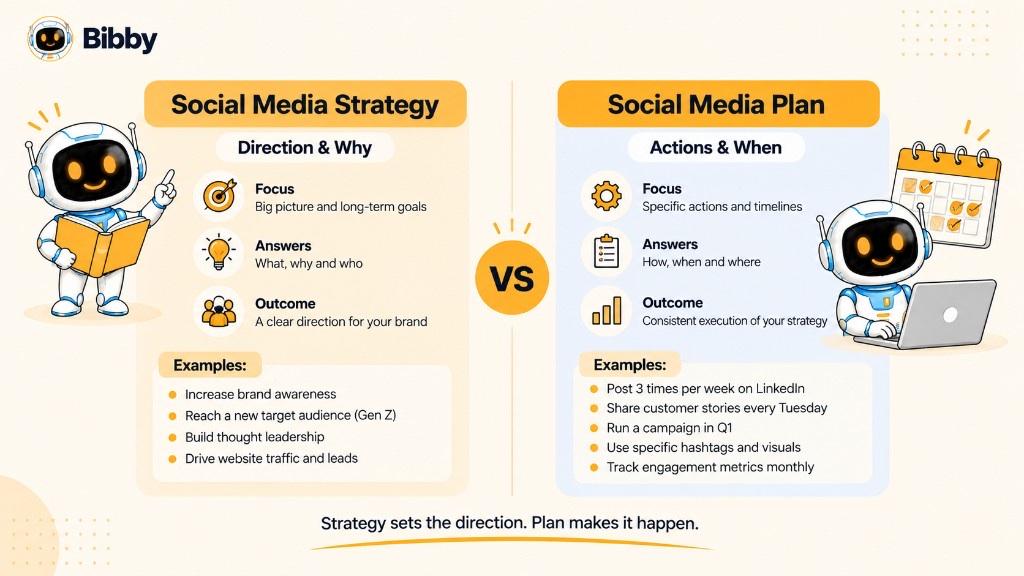
Strategy explains why and what. The plan focuses on how and when.
Strategy might say LinkedIn builds B2B thought leadership and qualified leads. The plan lists posts, topics, dates, formats, campaigns, and CTAs.
| Strategy | Plan |
|---|---|
| Overall direction | Specific actions |
| Goals and approach | Execution |
| Why and what | How and when |
| Audience and platforms | What publishes where |
| Pillars and messaging | Individual pieces |
| KPIs | Tracking planned work |
| Longer-term | A period or campaign |
A calendar is often part of the plan, not a substitute for strategy.
Example: a fitness brand’s strategy is trust via education, workouts, stories, and demos on Instagram and YouTube. The plan is Monday carousel, Tuesday YouTube workout, Wednesday Reel, Friday customer story, Sunday Q&A.
Business goals → Strategy → Plan → Content → Publishing → Measurement → Optimization
You can swap a post without changing the whole strategy. Build strategy first so you do not invent reasons after the assets exist.
Define goals → Research audience → Choose platforms → Build strategy → Create plan → Create content → Schedule → Measure → Optimize
Social Media Strategy vs. Social Media Marketing Strategy
People use the terms interchangeably. Scope differs.
A social media strategy can include content, community, customer relationships, support, and brand communication. A social media marketing strategy emphasizes marketing outcomes: awareness, traffic, leads, conversions, revenue, and ROI. It may mix organic and paid.
| Broader social strategy | Marketing-focused strategy |
|---|---|
| How you use social overall | Marketing outcomes |
| Community and relationships | Acquisition and conversion |
| Brand and communication | Marketing objectives |
| Organic social | Organic and paid |
| Wide social outcomes | Traffic, leads, conversions, revenue |
They should work together. Ecommerce launch: the broader plan builds a recognizable brand and community; the marketing layer drives product-page traffic and purchases during the window. Paid and retargeting stay in ads products.
Business strategy → Marketing strategy → Social strategy → Social marketing activities
A content strategy sits underneath: what you will say to support those goals. Creating posts is not the entire social strategy.
Types of Social Media Strategies
1. Brand Awareness
Recognition and familiarity: education, short video, stories, shareable graphics, insights, entertainment, collaborations. KPIs: reach, impressions, follower growth, views, mentions, shares.
2. Lead Generation
Turn attention into inquiries: education, magnets, webinars, case studies, demos, lead forms, landing pages, direct CTAs. KPIs: leads, conversion rate, CPL, qualified leads.
3. Sales and Conversion
Demos, testimonials, reviews, comparisons, offers, UGC, shopping features on the platform. KPIs: conversions, purchases, revenue, conversion rate, ROAS when ads are involved. Last-click can hide social’s role. Bibby does not add product tags or checkout.
4. Community Building
Discussions, polls, UGC, challenges, spotlights, live sessions, replies. KPIs: comments, replies, shares, mentions, repeat engagement—not raw follower count.
5. Content Marketing
Useful or entertaining work: how-tos, carousels, insights, tutorials, research, checklists, case studies. Goals may mix awareness, engagement, traffic, and leads.
6. Customer Engagement
Two-way replies to comments, DMs, reviews, and mentions. KPIs: response time, interactions, sentiment (in a listening or support tool), repeat engagement.
7. Influencer Marketing
Creators introduce the brand. Relevance and credibility can beat follower count. KPIs: reach, engagement, referral traffic, conversions, campaign ROI in finance or ads tools.
8. Social Commerce
Discovery to purchase via showcases, shoppable posts on the network, reviews, demos, UGC. KPIs: product clicks, carts, purchases. Bibby does not host catalogs or checkout.
9. Customer Support
Guidelines, FAQs, escalation, response-time targets, DM and public-comment rules. Recurring issues become content ideas.
10. Thought Leadership
Opinions, analysis, research, case studies, lessons. LinkedIn is often central for B2B. KPIs: relevant engagement, shares, profile visits, inbound inquiries, qualified leads.
11. Growth
Visibility via consistent content, short video, collabs, community, paid promotion. Quality and business relevance beat raw follower growth.
Most brands combine types. SaaS: thought leadership + content + leads + community. Ecommerce: awareness + influencers + commerce + engagement. Start from the business objective.
Business goal → Audience → Platform → Content → Action → KPI
How to Create a Social Media Strategy Step by Step
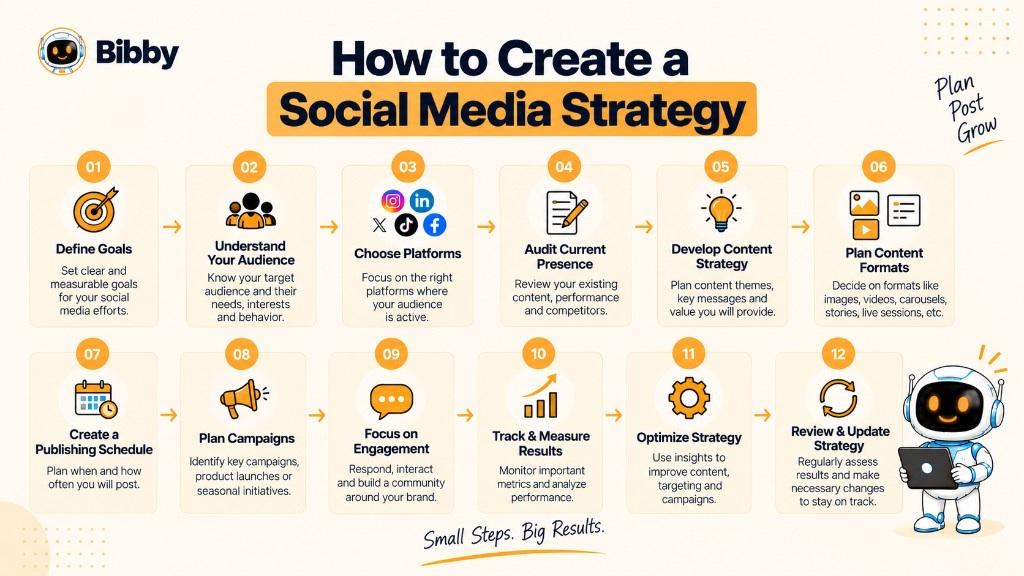
Step 1: Define Goals
Tie social to the business. Make targets measurable: “raise average Instagram engagement rate 15% in three months,” not “get more engagement.”
Step 2: Identify the Audience
Go past demographics: problems, influences, content habits, platforms, objections. Use customers, site analytics, Insights, surveys, reviews, and competitors.
Step 3: Audit Existing Accounts
Growth, engagement, reach, traffic, conversions, best and worst content, cadence, demographics, brand consistency. Note what to stop. A quiet LinkedIn with better leads can beat a busy Instagram.
Step 4: Choose Platforms
Audience + goals + platform strengths + resources. Facebook, Instagram, LinkedIn, TikTok, and YouTube cover most Bibby workflows. Pinterest can matter for visual discovery; it is not a Bibby publish channel.
Step 5: Define Content Pillars
Example marketing firm: education, insights, client stories, culture, services. Ecommerce: product education, customers, usage ideas, trends, promotions. Balance educate, trust, entertain, convert.
Step 6: Choose Formats
Do not pick a format only because it is trendy. A tutorial may need video; a stat list may need a carousel; an opinion may need a LinkedIn text post.
Step 7: Build a Content Calendar
Topic, pillar, platform, format, caption, asset, CTA, date, time, campaign, status. Leave room for timely posts.
Step 8: Create and Repurpose
One report can become a LinkedIn post, Instagram carousel, TikTok, YouTube video, Facebook summary, and Stories—adapted, not copied.
Step 9: Schedule and Automate
Queue captions, variations, and dates. Bibby can upload or generate visuals, pick a posting style, draft captions, and schedule on Facebook, Instagram, LinkedIn, YouTube, and TikTok. Automation removes busywork so people can do strategy, craft, and replies.
Step 10: Monitor Performance
Match metrics to goals. 50,000 views can lose to 5,000 views and 20 qualified leads. Numbers live in Insights, ads, or CRM.
Step 11: Test, Learn, Optimize
Topics, hooks, visuals, formats, CTAs, cadence, times. Use A/B tests when you can. Look for repeatable patterns, not one spike.
Step 12: Review and Update
Monthly or quarterly: Did we hit goals? Which platforms and formats earned outcomes? Did the audience change? What do we stop?
Goal → Audience → Platform → Content → Publish → Measure → Learn → Optimize
Social Media Strategy Examples
Example 1: Small Business — Coffee Shop
Goal: Local awareness and foot traffic. Audience: Nearby residents, students, professionals. Platforms: Instagram and Facebook. Pillars: New drinks, behind-the-scenes, customers, staff, events, coffee education, offers. Formats: Reels, photos, Stories, UGC. Week: Monday drink Reel, Wednesday BTS Story, Friday customer photo, Saturday offer, Sunday tip. KPIs: Local reach, profile visits, engagement, directions or clicks, in-store visits.
Example 2: SaaS — Project Management
Goal: Qualified B2B leads and authority. Audience: Founders and ops/project leads. Platforms: LinkedIn and YouTube. Journey: Education → problem awareness → product education → case study → demo or trial. KPIs: Qualified leads, traffic, demos, trials, relevant engagement.
Example 3: Ecommerce — Skincare
Goal: Discovery and online sales. Platforms: Instagram, TikTok, Facebook, YouTube. Journey: Discover → learn → evaluate → trust → purchase → share. KPIs: Product-page visits, clicks, carts, purchases, CAC—in shop and ads analytics, not Bibby.
Example 4: Personal Brand — Consultant
Goal: Authority and inbound work. Platforms: LinkedIn and YouTube. Formula: Teach → share experience → lesson → conversation. KPIs: Relevant growth, profile visits, inquiries, qualified opportunities.
Example 5: B2B Enterprise
Goal: Authority and qualified leads. Audience: CIO/CTO and ops. Platforms: LinkedIn and YouTube. Path: Industry problem → education → insight → solution → case study → conversion. KPIs: Qualified traffic, target-account engagement, demos, opportunities, influenced revenue.
Example 6: Startup — Productivity App
Goal: Awareness and early users. Platforms: TikTok, Instagram, LinkedIn, YouTube. Use social as feedback: which feature, which frustration. Loop: audience → product → content → audience. KPIs: Reach, engaged users, signups, trials.
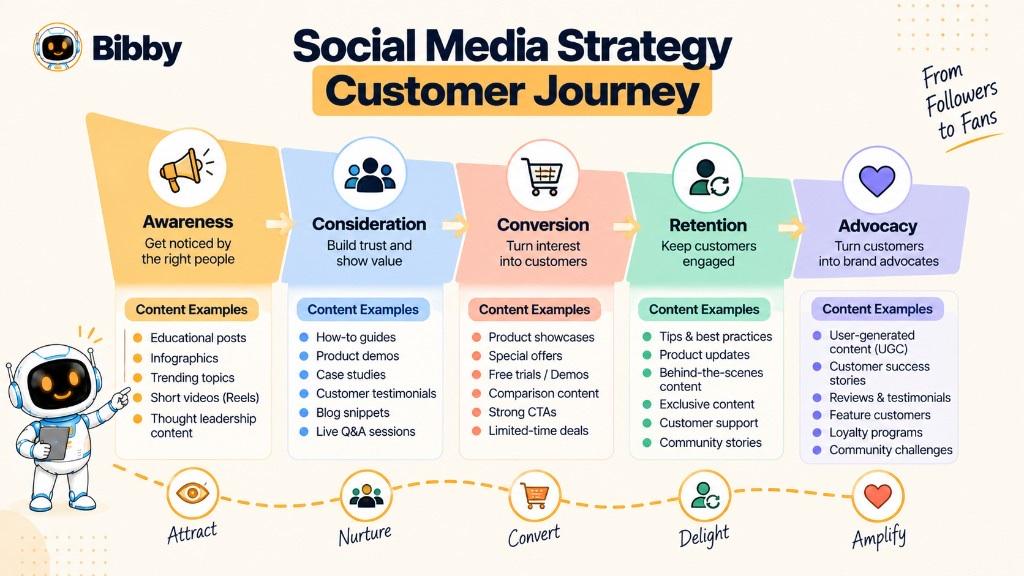
Copy the reasoning, not the posting grid. Map content to the journey: awareness, consideration, conversion, retention, advocacy.
Bibby can then run the execution layer—create, caption, schedule—once the framework exists.
Social Media Strategy by Platform
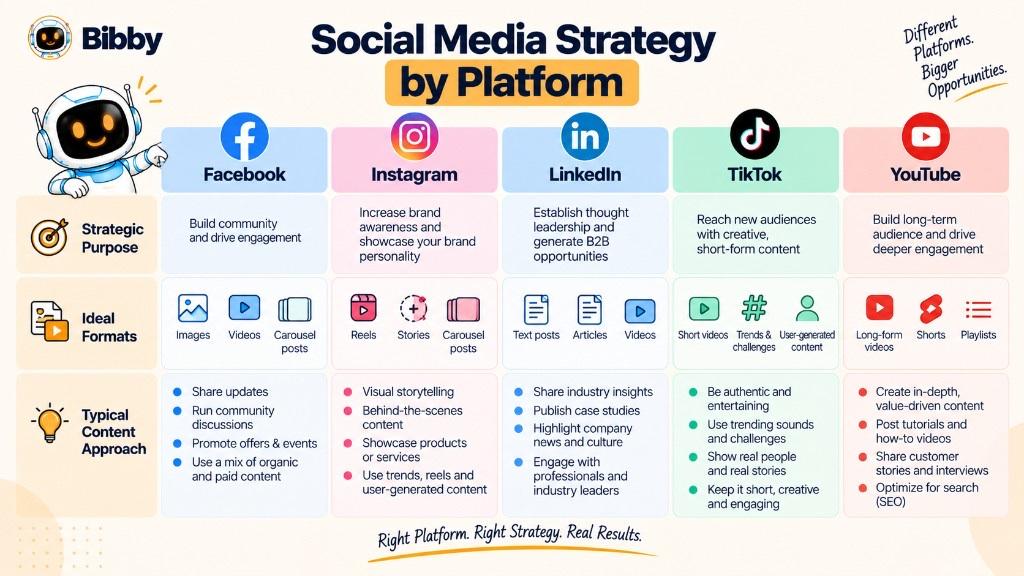
Keep the brand message; change the execution.
Education, images, short and longer video, Stories, community, testimonials, events. Mix useful posts with promotions. KPIs: reach, engagement, shares, clicks, views, conversions (in Meta tools when paid).
Feed, carousels, Reels, Stories, product content, UGC, creators. Carousels for steps; Reels for hooks; Stories for frequent, informal updates. KPIs: reach, engagement rate, saves, shares, profile visits, clicks.
Insights, thought leadership, case studies, research, education, customer stories. Avoid a sales brochure on every post. Structure: Insight → explanation → example → takeaway → conversation. KPIs: relevant comments, shares, profile visits, qualified leads.
TikTok
Hooks in the first seconds: question, surprise, problem, result. Education, demos, tutorials, BTS, creators, problem–solution. Trends should serve the brand, not become the whole plan. KPIs: views, watch time, completion, shares, profile visits.
YouTube
Tutorials, explainers, reviews, webinars, case studies, Shorts. Long videos can keep working via search. Pattern: short-form discovery → long-form education → site or product. KPIs: views, watch time, retention, subscribers, clicks.
Should You Post the Same Content Everywhere?
Not as identical copies. One AI-in-marketing report can become LinkedIn analysis, an Instagram carousel, a TikTok on the surprising finding, a YouTube deep dive, and a Facebook summary with a link.
Choose platforms by audience, goal, what you can create well, resources, and data. A smaller channel with better leads can beat a large, empty following.
Core idea → create → adapt → schedule → review Insights per platform → optimize
Automate the repetitive steps. Keep strategy and creative decisions intentional.
Social Media Strategy Metrics and KPIs
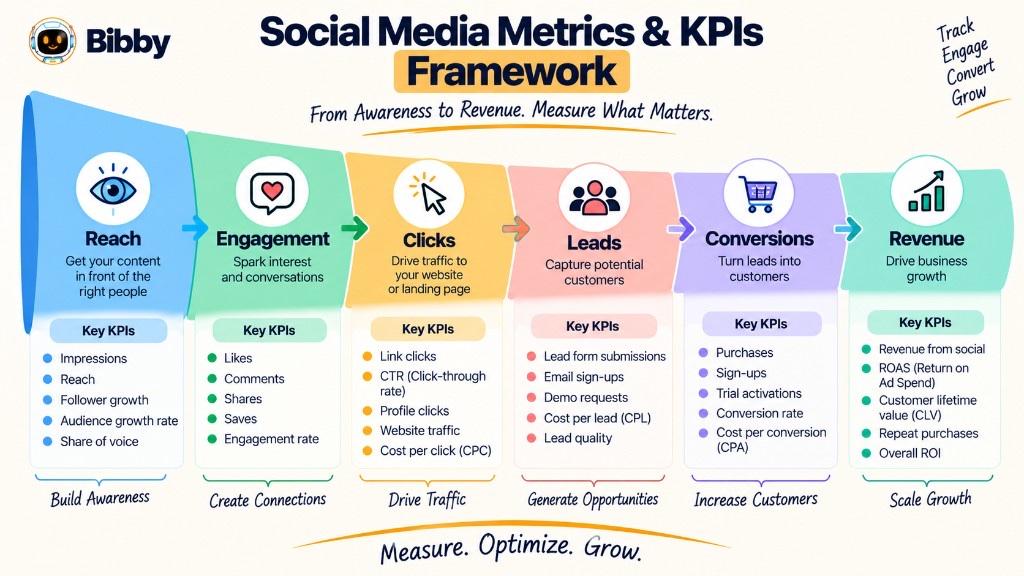
A metric is any data point. A KPI is the metric you chose to judge a goal. Impressions can still be useful when the KPI is qualified leads—they are not the score.
Metrics to Know
Reach — unique people who saw the content. High reach at the wrong audience is weak.
Impressions — displays; one person can add several.
Engagement rate — interactions relative to audience or exposure. Context beats raw likes.
Comments and shares — conversation and word of mouth. Ten thoughtful comments can beat hundreds of empty ones.
Saves — useful for tutorials, checklists, carousels.
Video views — pair with watch time, retention, completion.
Website clicks and CTR — movement off-platform; also watch what happens after the click.
Leads and conversion rate — separate total from qualified.
Follower growth — awareness context, not the finish line.
Revenue and Social Media ROI — when attribution supports it. Include ads, production, software, time, agencies, creators. Calculate in finance or ads tools.
| Goal | Primary KPIs | Supporting |
|---|---|---|
| Awareness | Reach, impressions | Follower growth, views |
| Engagement | Engagement rate | Comments, shares, saves |
| Traffic | Clicks, CTR | Reach |
| Leads | Qualified leads, conversion rate | Landing-page visits |
| Sales | Purchases, revenue | Conversion rate |
| Video | Watch time, retention | Views, shares |
| Support | Response time, resolution | Messages, sentiment |
| Paid | Conversions, CPA, ROAS | CTR, CPC |
Goal determines the KPI. Baseline → targets → consistent definitions → compare platforms, formats, campaigns, periods → find patterns → change the plan.
Avoid judging only vanity metrics. A million-view video with zero qualified leads can lose to a smaller educational post with 25 inquiries.
Ask: What worked? What did not? What do we do differently? Review in Insights or analytics. Bibby does not produce that dashboard.
How AI Is Changing Social Media Strategy
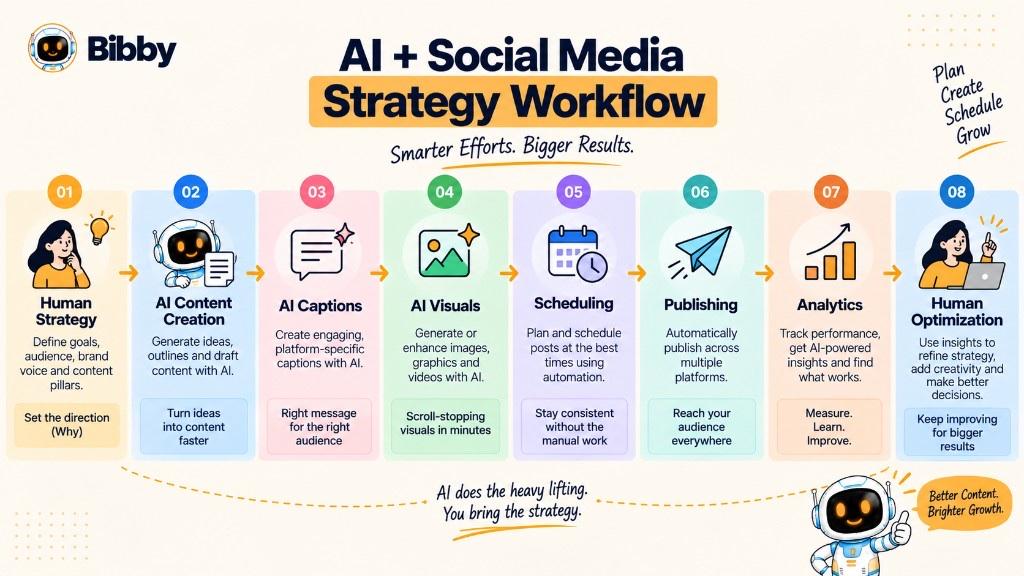
AI can speed create → publish → measure → learn → optimize. It does not write the destination.
It can draft ideas, hooks, captions, variations, scripts, and CTAs; generate or vary visuals inside a brand kit; suggest times; help repurpose one idea across formats; and, in analytics products, surface patterns. Review for voice, accuracy, and claims.
Campaign objectives and offers still come from marketing judgment. Chat can start a brand kit, campaign, posts, or caption regenerations in Bibby—that is workflow, not strategy on autopilot.
Human strategy + AI assistance + automation = scalable execution. Humans own positioning, who matters, differentiation, and accountability.
1. Objective → 2. Audience → 3. Strategy → 4. AI-assisted create → 5. Schedule → 6. Analyze in Insights → 7. Optimize
When publishing gets faster, advantage shifts to audience understanding, distinctive ideas, and knowing what to do with the data.
Social Media Strategy and Automation
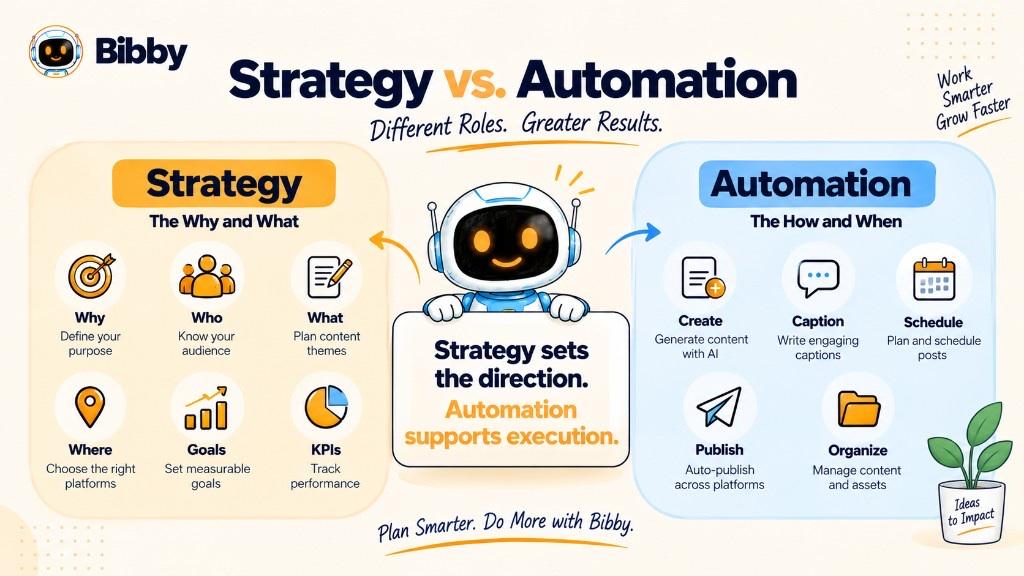
Strategy decides what should happen. Automation helps it happen consistently.
Without a plan, automation just publishes more. With a plan, it protects cadence and frees time for creative and community work.
Automation can cover scheduling, publishing, caption drafts, variations, campaigns, and multi-platform queues. Some tools also monitor or analyze; Bibby does not listen or replace Insights.
Example: the strategy says educational posts three times a week on LinkedIn, Instagram, and Facebook. Automation prepares, captions, dates, publishes, then you review Insights.
What Can Be Automated
Scheduling, caption drafts, light repurposing, multi-platform publishing (adapted, not identical), AI-suggested times, campaign sequences, connected create→schedule workflows.
What Should Not Be Fully Automated
Who to reach, what to stand for, which messages matter, brand voice, sensitive complaints and crises, and whether to jump on breaking news.
| Strategy | Automation |
|---|---|
| Direction and goals | Repeatable execution |
| Audience and platforms | Publishing and drafts |
| Content approach and KPIs | Workflow and calendar |
| Judgment | Machinery |
Plan → Create → Automate → Measure → Learn → Improve
Faster publishing makes strategy more important: you still decide which of those 100 posts are worth making.
How Bibby Helps Execute a Social Media Strategy
The plan only pays off if you can run it. Bibby is the execution layer, not the strategist.
- Upload or generate visuals — your files or AI images inside the brand direction you set
- Posting style — promotional, educational, or conversational so captions have context
- AI captions — drafts you edit
- Schedule — Facebook, Instagram, LinkedIn, YouTube, TikTok at chosen or AI-optimized times
- Formats — images, carousels, videos, Stories
- Campaigns — announcement → education → demo → proof → offer → follow-up
- Brand kit and chat — kit, campaign, posts, caption regenerations
Example strategy: *Educational posts three times a week on LinkedIn and Instagram for awareness and engagement.* Bibby helps: create or upload → style → caption → platforms → schedule → publish. You still reply and read Insights.
Strategy: Who → Why → What → Where → Goals → KPIs
Bibby: Create → Caption → Organize → Schedule → Publish
Then: Measure → Learn → Optimize (in Insights or analytics)
Common Social Media Strategy Mistakes
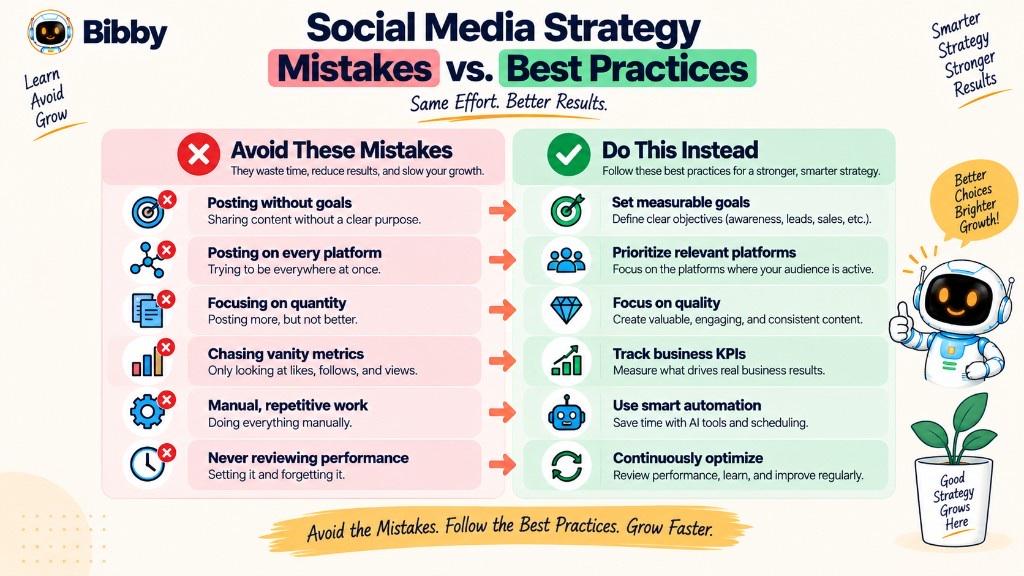
- Posting with no goal — ask what the post is for
- Every platform — thin presence, weak replies
- Only promotions — mix education, stories, community
- Ignoring the audience — “what do they need?” not only “what do we want to say?”
- Identical posts everywhere
- Calendar mistaken for strategy
- Quantity over quality
- Every trend — only if it fits brand and goal
- Vanity metrics only
- Ignoring comments and DMs
- No repurposing system
- Ignoring data — preference is not proof
- Automating without review — outdated offers, wrong tone
- Never updating the plan
Before you publish: Goal, audience, platform, value, action, KPI, what we will learn.
Social Media Strategy Best Practices
- Business goal → social goal → content objective → KPI
- Build around audience needs (sales calls, support, reviews, comments)
- Prioritize platforms you can run well
- Use clear pillars
- Match content to the journey
- Adapt, do not blindly duplicate
- Use a sustainable calendar
- Batch research, writing, design, and scheduling
- Give winning ideas a second life
- Human direction → AI assist → human review → automated publish
- Automate repetitive queue work
- Plan engagement, not only posts
- Track the chain: reach → engagement → clicks → leads → conversions → revenue
- Change one variable at a time when you test
- Review monthly for tactics, quarterly for direction—look for patterns, not one bad post
Why / Who / Where / What / When / How / Did it work?
Plan → Create → Publish → Engage → Measure → Learn → Optimize
Conclusion
A social media strategy is the decision layer behind the feed: goals, audience, platforms, content, cadence, engagement, and measurement. A calendar executes it. Automation and Bibby can create, caption, campaign, and schedule on Facebook, Instagram, LinkedIn, YouTube, and TikTok. They do not choose the destination or report KPIs.
Remember:
- Strategy answers who, what, where, why, and how you will know.
- A plan and calendar are execution, not the strategy itself.
- Adapt by platform; do not paste one post everywhere.
- Measure the KPIs that match the goal in Insights or analytics.
- AI speeds the workflow; people own judgment and replies.
Next terms: content pillars, content calendar, scheduling, and automation. Create a Bibby account when the plan is clear and you want a faster create-and-schedule loop—then check results where the numbers actually live.