
Conversion rate is the percentage of people who complete a desired action after visiting a website, viewing an ad, interacting with social media content, or entering a marketing funnel. The desired action can be anything from making a purchase or signing up for a service to downloading an app, submitting a form, or booking a demo.
The basic conversion rate formula is (Number of conversions ÷ Total number of visitors or users) × 100. For example, if 1,000 people visit a landing page and 50 of them sign up, the conversion rate is 5%.
Conversion rate is an important digital marketing metric because it shows how effectively your traffic and marketing efforts turn attention into meaningful actions. Businesses use it to evaluate campaigns, landing pages, websites, advertisements, email marketing, and social media performance, and to identify opportunities for conversion rate optimization (CRO).
What Is Conversion Rate?
A conversion can mean different things depending on the business and campaign goal. For an ecommerce store, a conversion may be a completed purchase. For a SaaS company, it could be a free-trial signup or paid subscription. For a service business, it might be a contact form submission, phone call, or appointment booking. On social media, a conversion could be a website visit, lead, signup, purchase, or another action generated from a social media campaign.
The basic conversion rate formula is:
Conversion Rate = (Number of Conversions ÷ Total Number of Visitors or Users) × 100
For example, suppose 5,000 people visit an ecommerce website and 150 of them make a purchase. The conversion rate would be:
(150 ÷ 5,000) × 100 = 3%
So, the website has a 3% conversion rate for purchases.
Conversion rate should always be evaluated in context. A higher conversion rate is not automatically better if the conversions are low-quality or if the wrong action is being measured. Businesses should define what counts as a conversion, identify the right audience, and measure the metric against relevant goals.
In social media marketing, conversion rate can help marketers understand whether their content and campaigns are moving people beyond likes, comments, and views toward meaningful business actions. Consistent content, relevant messaging, strong calls to action, and effective campaign management can all influence the journey from social media interaction to conversion.
What Is a Conversion?
A conversion is a desired action completed by a user after interacting with a website, advertisement, social media post, email, app, or other marketing channel. The action is considered a conversion because it moves the user closer to a business or marketing goal.
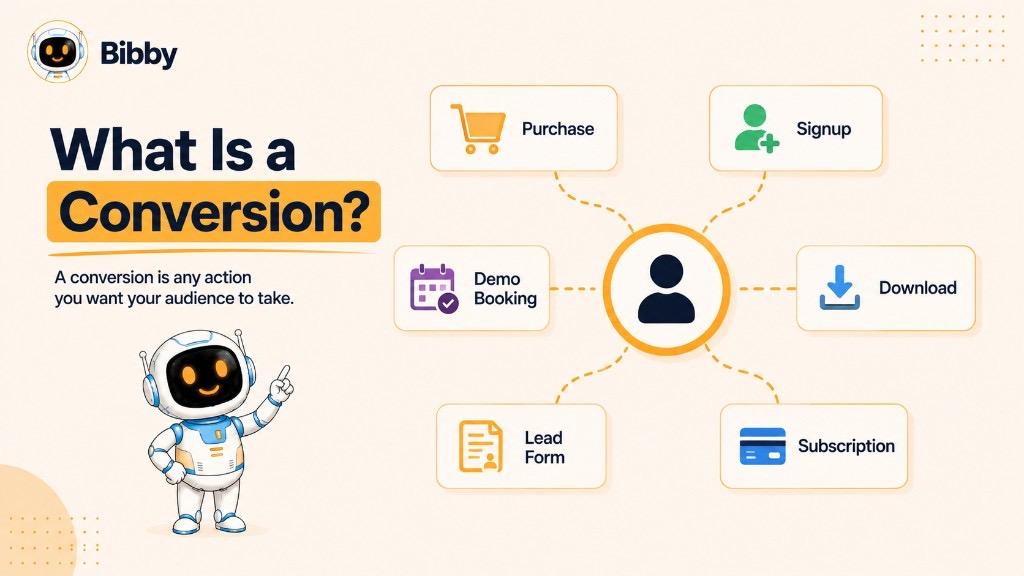
A conversion does not always mean making a purchase. What counts as a conversion depends on what a business wants users to do.
For example, conversions can include:
- Making a purchase
- Signing up for an account
- Starting a free trial
- Filling out a contact form
- Booking a consultation or demo
- Downloading an ebook or guide
- Installing a mobile app
- Subscribing to an email newsletter
- Registering for an event
- Requesting a quote
- Making a phone call
- Completing a subscription
- Clicking a specific call-to-action
Macro Conversions vs. Micro Conversions
Conversions are often divided into macro conversions and micro conversions.
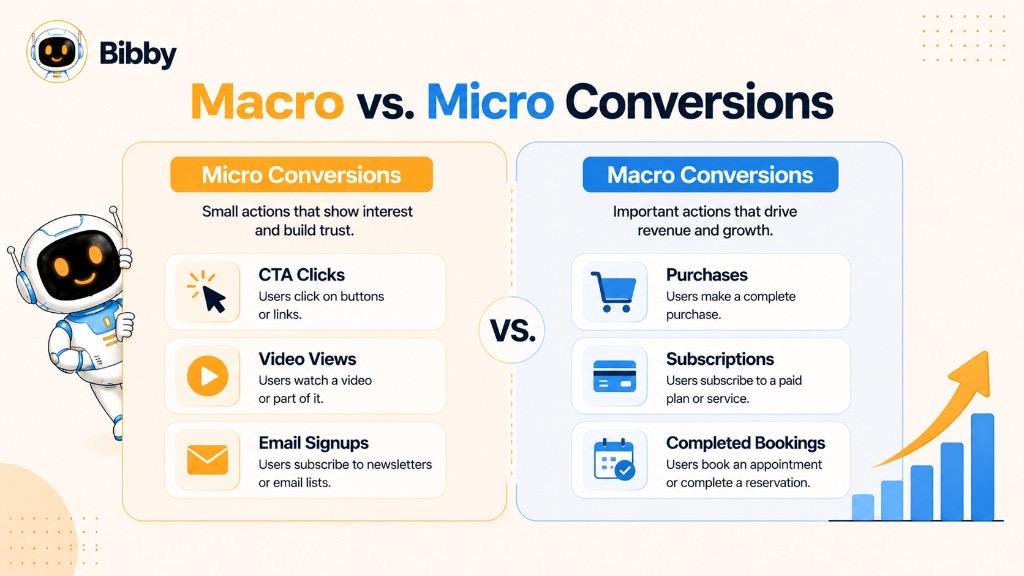
Macro conversions are major actions that directly contribute to a business objective. A completed purchase, paid subscription, or signed contract are common examples.
Micro conversions are smaller actions that indicate interest or progress toward a larger goal. These might include watching a product video, clicking a CTA, creating an account, adding an item to a cart, or signing up for an email list.
For example, an ecommerce customer might first view a product, then add it to their cart, begin checkout, and finally complete the purchase. The purchase is the macro conversion, while the earlier actions can be treated as micro conversions.
Understanding what qualifies as a conversion is important because the conversion rate is only meaningful when the business clearly defines which action is being measured. A website measuring newsletter signups will have a different conversion rate from one measuring completed purchases, even if both receive the same amount of traffic.
How to Calculate Conversion Rate
Calculating conversion rate is straightforward. You need two numbers: the number of conversions and the total number of visitors, users, clicks, or other relevant opportunities to convert.
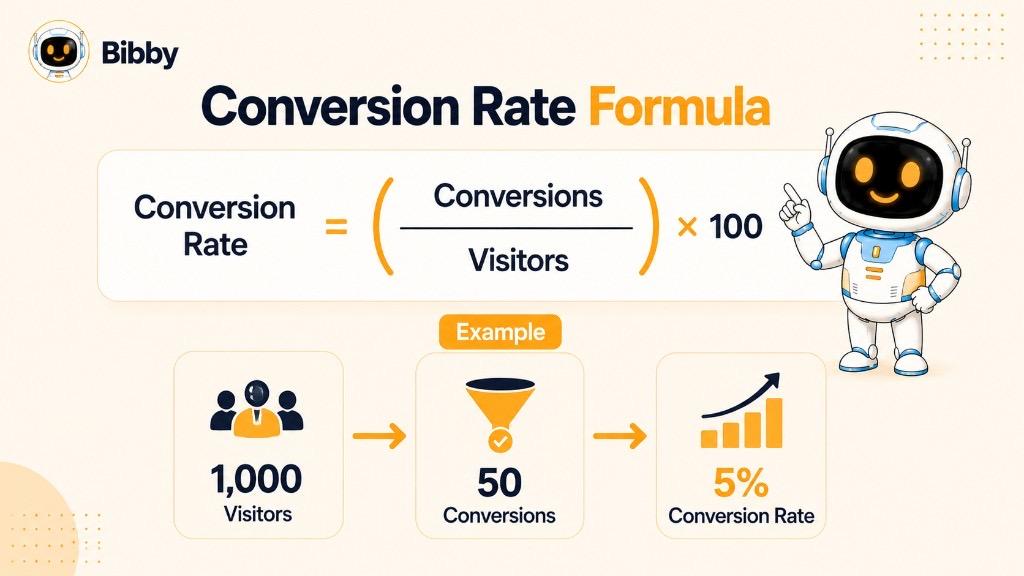
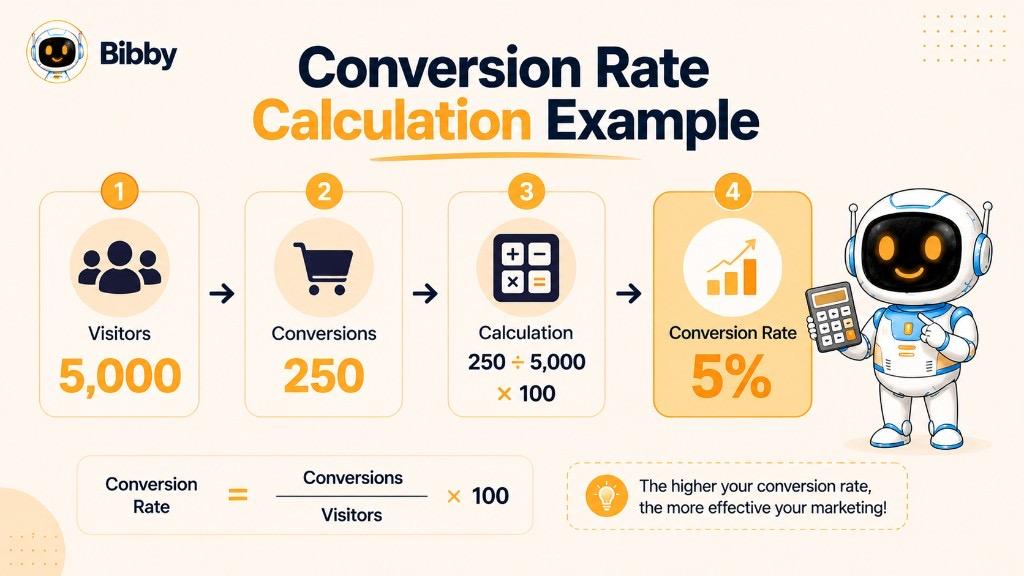
The standard formula is:
Conversion Rate = (Number of Conversions ÷ Total Number of Visitors) × 100
For example, if a landing page receives 2,000 visitors and 100 visitors submit a form, the conversion rate is:
(100 ÷ 2,000) × 100 = 5%
The landing page therefore has a 5% conversion rate.
Conversion Rate Formula Explained
Each part of the formula has a specific purpose:
- Number of conversions: The number of people who completed the desired action.
- Total visitors or users: The total number of people who had the opportunity to complete that action.
- × 100: Converts the result into a percentage.
The denominator can vary depending on what you are measuring. For example, a marketer may calculate a website conversion rate based on visitors, while a social media campaign may measure conversions against clicks or another clearly defined audience.
Conversion Rate Examples
Consider an online store with 10,000 website visitors in a month. If 300 visitors make a purchase, the conversion rate is:
(300 ÷ 10,000) × 100 = 3%
Now consider a social media campaign that generates 4,000 website clicks and 200 signups. Its signup conversion rate would be:
(200 ÷ 4,000) × 100 = 5%
These examples show why it is important to clearly define both the conversion and the population being measured. A conversion rate calculated from website visitors should not be directly compared with one calculated from ad clicks unless the measurement methods are consistent.
Why Accurate Conversion Rate Calculation Matters
Conversion rate gives marketers a percentage that can be compared across campaigns, landing pages, channels, or time periods. Instead of looking only at the number of conversions, businesses can evaluate how efficiently their available traffic is producing the desired outcome.
For example, Campaign A may generate 500 conversions from 50,000 visitors, while Campaign B generates 300 conversions from 10,000 visitors.
Campaign A:
500 ÷ 50,000 × 100 = 1%
Campaign B:
300 ÷ 10,000 × 100 = 3%
Although Campaign A generated more total conversions, Campaign B has the higher conversion rate. This distinction can help marketers identify which campaigns are converting traffic more efficiently.
Conversion Rate Examples
Conversion rate can be used to measure many different actions across digital marketing. The calculation remains the same, but the conversion event changes depending on the business goal.
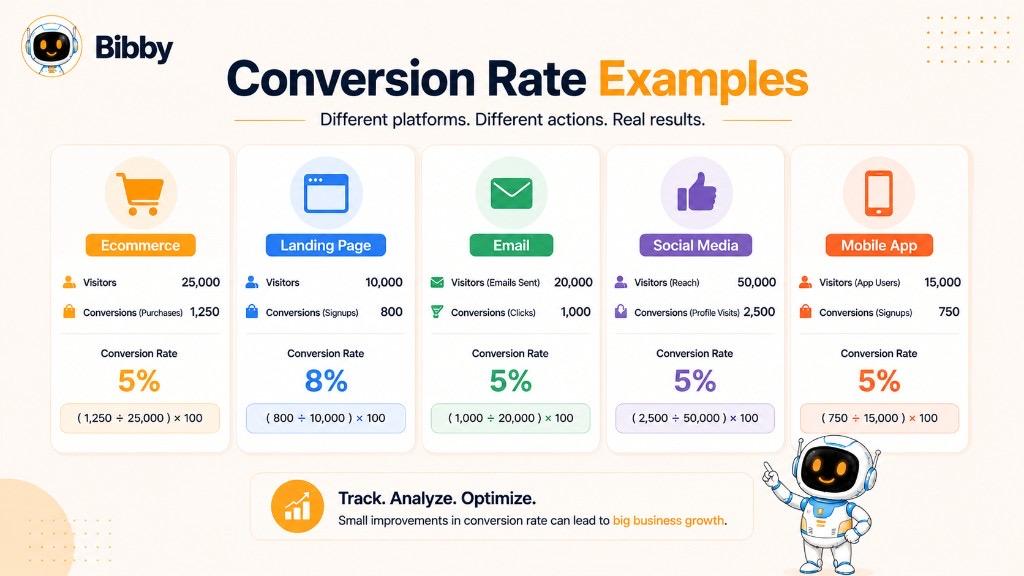
Ecommerce Conversion Rate Example
An online store receives 20,000 visitors in one month and generates 600 purchases.
Conversion Rate = (600 ÷ 20,000) × 100 = 3%
The ecommerce website has a 3% purchase conversion rate.
Landing Page Conversion Rate Example
A SaaS company sends 5,000 visitors to a landing page promoting a free trial. Of those visitors, 250 sign up.
Conversion Rate = (250 ÷ 5,000) × 100 = 5%
The landing page has a 5% signup conversion rate.
Lead Generation Conversion Rate Example
A service company receives 2,500 website visitors and 75 people submit a contact form.
Conversion Rate = (75 ÷ 2,500) × 100 = 3%
The website's lead conversion rate is 3%.
Email Marketing Conversion Rate Example
A company sends an email campaign to 10,000 subscribers. After clicking through to the website, 400 subscribers complete the desired action.
If the business measures conversions against the total recipients:
Conversion Rate = (400 ÷ 10,000) × 100 = 4%
However, marketers should clearly state what they are using as the denominator. A rate based on email recipients is different from a rate based only on email clicks.
Social Media Conversion Rate Example
A brand publishes a social media campaign that generates 8,000 clicks to its website. Of those visitors, 320 complete a purchase.
Conversion Rate = (320 ÷ 8,000) × 100 = 4%
The campaign produces a 4% conversion rate based on website clicks.
App Conversion Rate Example
Suppose 5,000 people install a mobile app and 500 of them purchase a premium subscription.
Conversion Rate = (500 ÷ 5,000) × 100 = 10%
The app has a 10% subscription conversion rate based on installations.
Why the Conversion Definition Matters
These examples highlight an important point: there is no single conversion rate that applies to every marketing activity. A business must first define the action it considers a conversion and then choose a consistent denominator for calculating the rate.
For example, a marketer could measure:
- Visitors who make a purchase
- Visitors who submit a lead form
- Ad clicks that result in signups
- Social media traffic that generates sales
- Email recipients who complete an offer
- App users who become paying customers
Keeping the conversion event and measurement method consistent makes conversion rate data much more useful for evaluating marketing performance.
Why Is Conversion Rate Important?
Conversion rate is important because it shows how effectively your marketing traffic turns into meaningful actions. Traffic, impressions, clicks, and followers can tell you how many people are seeing or interacting with your marketing, but conversion rate helps reveal what happens after that attention.
For example, a website may receive 50,000 visitors but generate only 250 purchases. Another website may receive 10,000 visitors and generate 500 purchases. Looking at traffic alone makes the first website appear stronger, but conversion rate tells a different story.
Conversion rate helps businesses:
- Measure marketing effectiveness: Understand whether campaigns are producing the desired results.
- Evaluate website and landing pages: Identify pages that successfully turn visitors into leads or customers.
- Compare campaigns: Determine which campaigns generate conversions more efficiently.
- Improve marketing decisions: Use performance data to decide where to invest time and budget.
- Identify problems: A low conversion rate can indicate issues with the offer, messaging, audience, user experience, or customer journey.
- Measure optimization efforts: Track whether changes to content, design, CTAs, or offers improve results.
- Understand customer behavior: See which channels and campaigns are more effective at moving users toward a desired action.
Conversion Rate vs. Traffic
More traffic does not necessarily mean more conversions.
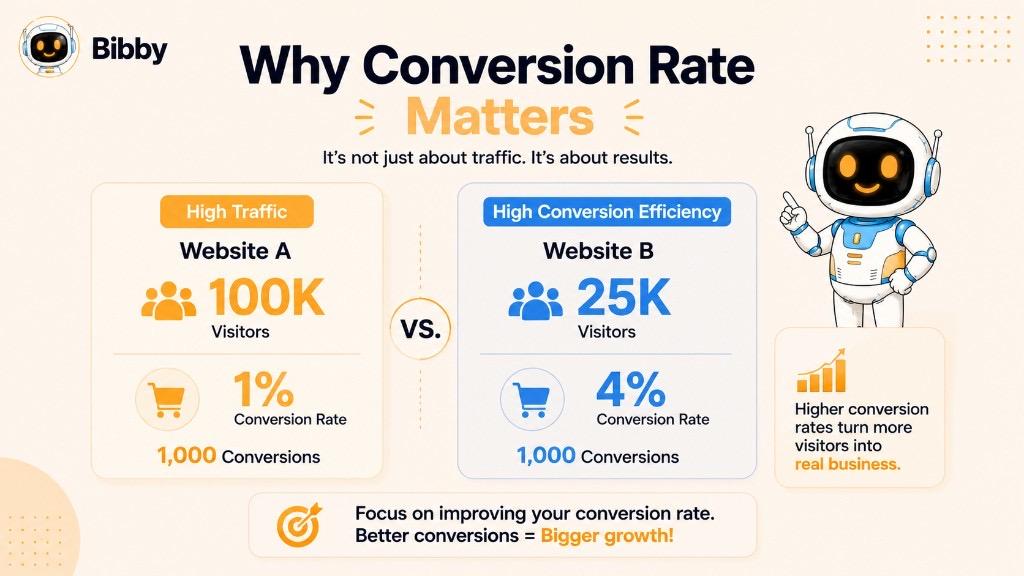
Imagine two websites:
Website A
- 100,000 visitors
- 1,000 conversions
- 1% conversion rate
Website B
- 25,000 visitors
- 1,000 conversions
- 4% conversion rate
Both websites generate the same number of conversions, but Website B converts its available traffic more efficiently.
This is why businesses should look beyond traffic volume and evaluate what percentage of their audience actually takes the desired action.
Conversion Rate Helps With Marketing Optimization
Conversion rate also provides a useful baseline for testing improvements. If a landing page converts at 2%, marketers can experiment with different headlines, offers, layouts, calls to action, forms, or content and then measure whether the conversion rate changes.
The goal is not simply to chase a higher percentage. The goal is to generate more valuable conversions from relevant users while maintaining a sustainable acquisition cost and a positive business outcome.
For social media marketers, conversion rate can also help connect content activity with business results. Likes, comments, views, and shares are useful engagement signals, but conversions help answer a more important question: Did the social media activity lead people to take the action the business wanted?
Conversion Rate in Digital Marketing
Conversion rate in digital marketing measures the percentage of people who complete a desired action after interacting with a digital marketing channel, campaign, or asset. It can be used across websites, search engines, social media, email, paid advertising, mobile apps, and landing pages.
The conversion being measured depends on the campaign objective. A business may consider a purchase, signup, lead submission, app installation, demo booking, or subscription a conversion.
Website Conversion Rate
Website conversion rate measures how many website visitors complete a desired action.
For example, if 10,000 people visit a website and 400 submit a contact form:
(400 ÷ 10,000) × 100 = 4%
The website's conversion rate is 4% for that particular action.
Landing Page Conversion Rate
Landing pages are often designed around a single goal, such as collecting leads, promoting a product, or encouraging free-trial registrations.
If 2,000 people visit a landing page and 120 sign up for a free trial:
(120 ÷ 2,000) × 100 = 6%
The landing page has a 6% conversion rate.
Email Marketing Conversion Rate
Email marketers can use conversion rate to measure how many recipients complete a desired action after receiving a campaign.
Depending on the measurement approach, marketers may calculate the rate using total recipients or users who clicked through to the destination.
For example, an email campaign sent to 20,000 recipients generates 500 purchases:
(500 ÷ 20,000) × 100 = 2.5%
The important point is to clearly define the denominator and use the same methodology when comparing campaigns.
Paid Advertising Conversion Rate
Paid advertising platforms can track whether users who interact with advertisements eventually complete a desired action.
A conversion might be:
- Purchasing a product
- Submitting a lead form
- Signing up for a service
- Downloading an app
- Booking a demo
- Starting a free trial
For example, if an advertising campaign generates 5,000 clicks and 250 conversions:
(250 ÷ 5,000) × 100 = 5%
This gives the campaign a 5% conversion rate based on clicks.
Search Marketing Conversion Rate
Search marketing can generate traffic from users who are actively looking for information, products, or services. Conversion rate can help businesses evaluate whether that traffic produces meaningful outcomes.
Marketers can analyze conversion rates across different keywords, search campaigns, landing pages, devices, and audience segments to understand where valuable traffic is coming from.
Social Media Conversion Rate
Social media conversion rate measures how effectively social media traffic or campaigns generate a desired action. Depending on the campaign, the conversion could be a purchase, lead, signup, download, booking, or website action.
For businesses using multiple social platforms, conversion data can help identify which campaigns and content strategies are contributing to measurable business outcomes rather than focusing only on engagement metrics.
Mobile App Conversion Rate
Mobile apps can also use conversion rate to measure actions such as:
- Account registrations
- Free-trial activations
- Purchases
- Subscription upgrades
- Feature adoption
- Referral actions
For example, an app may track how many newly registered users eventually become paying subscribers.
Why Conversion Rate Matters in Digital Marketing
Conversion rate helps connect marketing activity with outcomes. A campaign may generate thousands of impressions and clicks, but those numbers do not necessarily indicate whether the campaign achieved its business objective.
By tracking conversion rate alongside metrics such as traffic, engagement, click-through rate, cost per conversion, and revenue, marketers can build a clearer picture of campaign performance.
The most useful approach is to define the conversion before launching the campaign, track it consistently, and analyze the results in the context of the audience, channel, offer, and business goal.
Conversion Rate in Social Media Marketing
Social media conversion rate measures the percentage of people who complete a desired action after interacting with a social media campaign, post, advertisement, profile, or link. It helps businesses understand whether their social media activity is generating meaningful business outcomes beyond likes, comments, views, and followers.
A social media conversion could be a purchase, lead submission, website signup, app download, booking, free-trial registration, or another action defined by the campaign.
How to Calculate Social Media Conversion Rate
A basic formula is:
Social Media Conversion Rate = (Number of Conversions ÷ Number of Relevant Users or Visitors) × 100
For example, suppose a social media campaign generates 10,000 clicks to a website and 400 people complete a purchase.
(400 ÷ 10,000) × 100 = 4%
The campaign has a 4% conversion rate based on clicks.
The exact calculation can vary depending on what you are measuring. A marketer might calculate conversions from social media clicks, website sessions originating from social media, or another clearly defined audience. The important thing is to define the measurement consistently.
What Counts as a Social Media Conversion?
A conversion depends on the objective of the campaign. Common social media conversions include:
- Making a purchase
- Signing up for a service
- Submitting a lead form
- Booking an appointment
- Requesting a quote
- Downloading an app
- Starting a free trial
- Registering for an event
- Visiting a product page
- Subscribing to an email list
- Sending a business inquiry
For example, a fashion brand may define a purchase as its primary conversion, while a B2B software company may consider booking a product demo a conversion.
Social Media Engagement vs. Conversion
Engagement and conversions are related, but they measure different things.
Engagement measures interactions such as:
- Likes
- Comments
- Shares
- Saves
- Video views
- Profile visits
Conversion measures whether users complete a predefined business or marketing action.
A post can receive thousands of likes but generate very few website visits or sales. Another post may receive less engagement but generate a significant number of qualified leads.
This is why social media marketers should evaluate engagement and conversion together rather than assuming that high engagement automatically means strong business performance.
Factors That Can Affect Social Media Conversion Rate
Several factors can influence whether someone moves from social media interaction to conversion.
Content relevance: Content that matches the audience's interests and needs is more likely to generate meaningful actions.
Call to action: A clear CTA tells users what to do next, whether that means visiting a website, signing up, buying a product, or booking a call.
Offer: The value and relevance of the offer can strongly influence conversion behavior.
Visual quality: Strong images, videos, carousels, and other visual formats can help capture attention and communicate an offer.
Audience targeting: Reaching people who are likely to need the product or service is generally more valuable than simply maximizing impressions. Better audience targeting often improves conversion efficiency.
Landing page experience: A social media campaign may generate clicks, but a confusing or slow landing page can prevent those visitors from converting.
Consistency: Regular and relevant social media publishing can help businesses maintain visibility and keep their audience engaged over time.
Improving Social Media Conversion Rate
Businesses can experiment with different content formats, messaging, CTAs, offers, posting schedules, and landing pages to determine what produces better results.
Consistent publishing also matters because maintaining multiple social media channels manually can involve repeatedly creating content, writing captions, scheduling posts, and adapting content for different platforms.
Tools such as Bibby can streamline these repetitive parts of social media management. Businesses can upload an image or generate one with AI, choose a posting style, generate captions, create campaigns, and schedule content across platforms such as Facebook, Instagram, LinkedIn, YouTube, and TikTok at AI-optimized times. Bibby's chat interface also allows users to manage tasks such as creating posts, building campaigns, creating a brand kit, and regenerating captions through conversation.
Automation does not guarantee a higher conversion rate, but it can make it easier to maintain a consistent publishing workflow, giving marketers more time to focus on strategy, audience research, offers, and conversion optimization.
How Social Media Content Affects Conversion Rate
Social media content can influence conversion rate by shaping what people see, how they perceive a brand, and whether they decide to take the next step. A post may introduce someone to a business, build trust, answer a question, demonstrate a product, or direct an interested user to a landing page.
However, social media content does not operate in isolation. Conversion depends on the entire journey from the initial interaction to the final action.
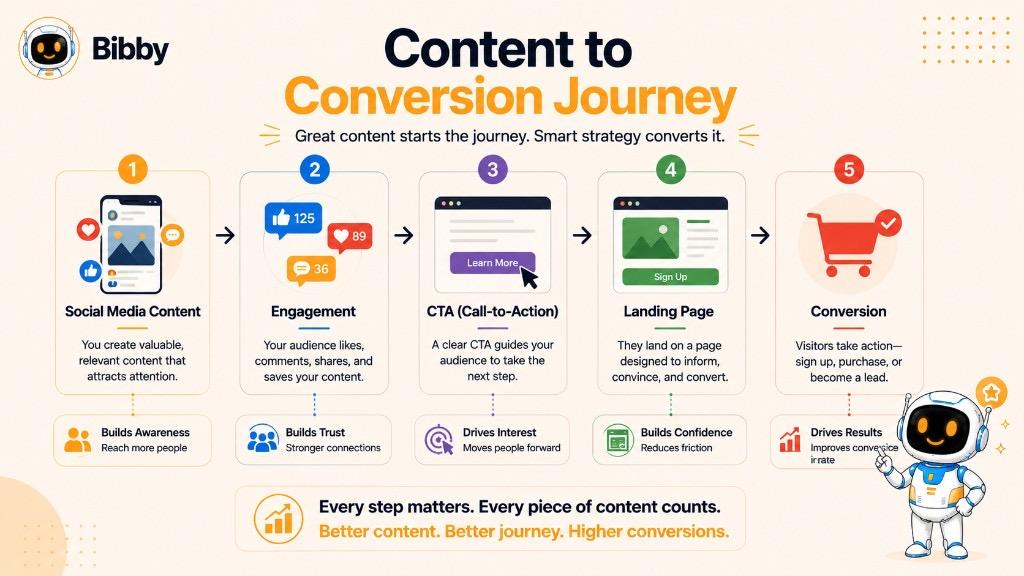
Create Content for a Clear Goal
Every piece of content does not need to generate a direct sale. Different posts can support different stages of the customer journey.
For example:
- Educational content can build awareness and answer customer questions.
- Product-focused content can explain features and benefits.
- Testimonials and reviews can build trust.
- Demonstration videos can show how a product works.
- Promotional content can encourage immediate action.
- Case studies can help potential customers evaluate a solution.
- Lead-generation posts can encourage users to submit their information.
Defining the purpose of the content makes it easier to select the appropriate conversion and measure its performance.
Use Clear Calls to Action
A call to action (CTA) tells the audience what to do next.
Examples include:
- Shop Now
- Start a Free Trial
- Book a Demo
- Download the Guide
- Get a Quote
- Learn More
- Sign Up
- Contact Us
A clear CTA can reduce uncertainty and create a more direct path between social media content and the desired action.
Match Content With Audience Intent
Not every social media user is ready to buy immediately. Some may be discovering a problem, while others may already be comparing solutions.
Content should reflect different levels of intent.
Someone discovering a problem may respond better to educational content. Someone evaluating products may want comparisons, demonstrations, or customer stories. Someone ready to purchase may respond better to a clear offer and direct CTA.
Matching content with audience intent can make the journey from social media interaction to conversion more relevant.
Maintain Consistent Branding
Consistent branding can make social media content easier to recognize and can create a more cohesive experience when users move from a social platform to a website or landing page.
Consistency can include:
- Brand colors
- Visual style
- Logo usage
- Tone of voice
- Messaging
- Content themes
- Design elements
When the social media experience and destination page feel disconnected, users may become uncertain about whether they are interacting with the same business.
Use Different Content Formats
Different audiences respond differently to content formats. Businesses can experiment with:
- Single-image posts
- Carousels
- Short-form videos
- Stories
- Educational graphics
- Product demonstrations
- Customer testimonials
- Tutorials
- Behind-the-scenes content
Testing different formats can reveal which types of content generate stronger engagement and downstream actions for a particular audience.
Publish Consistently
Consistency gives businesses more opportunities to reach their audience and communicate their value proposition.
Managing multiple platforms manually can make consistency difficult. Marketers may need to create content, write captions, resize or adapt creative assets, select publishing times, and schedule posts separately for each platform.
A social media automation platform such as Bibby can simplify this workflow. Users can upload or generate content with AI, select a posting style, generate captions, create campaigns, and schedule content at AI-optimized times across selected social platforms.
The goal of automation is not to replace marketing strategy. Instead, it can reduce repetitive publishing work so marketers can spend more time on content quality, audience research, campaign strategy, and conversion optimization.
Measure What Happens After the Click
Strong social media engagement does not necessarily translate into conversions. Marketers should track what happens after users interact with content.
Useful metrics can include:
- Click-through rate
- Website sessions
- Leads
- Signups
- Purchases
- Cost per conversion
- Conversion rate
- Revenue
- Return on ad spend
Looking at the complete journey helps businesses understand whether their social media content is simply attracting attention or contributing to measurable business outcomes.
Ultimately, improving social media conversion rate is less about finding one perfect post and more about building a consistent system of relevant content, clear messaging, strong CTAs, effective landing pages, and continuous measurement and optimization.
What Is a Good Conversion Rate?
There is no single conversion rate that can be considered good for every business, website, campaign, or industry. A conversion rate should always be evaluated in context because the expected result can vary significantly depending on the type of conversion, audience, traffic source, product, offer, and marketing channel.
For example, a visitor purchasing a low-cost product and a visitor booking a consultation for a high-value B2B service represent very different conversion opportunities. Comparing their conversion rates directly would not provide much useful insight.
What Determines a Good Conversion Rate?
Several factors can influence whether a conversion rate is strong for a particular campaign.
Industry: Conversion behavior varies across industries and business models.
Conversion type: A newsletter signup, product purchase, demo booking, and paid subscription have different levels of commitment.
Traffic source: Visitors from high-intent search queries may behave differently from people discovering a brand through social media.
Audience: Returning customers, existing subscribers, and first-time visitors can have very different conversion behavior.
Offer: Discounts, free trials, limited-time offers, and high-value resources can affect conversion rates.
Product or service price: Higher-priced products generally involve a longer decision-making process than lower-priced purchases.
Landing page experience: Page speed, design, messaging, trust signals, forms, and CTAs can all influence whether visitors convert.
Why Conversion Rate Benchmarks Can Be Misleading
It is tempting to search for an "average conversion rate" and use that number as a target. However, broad benchmarks can sometimes create the wrong expectations.
Consider two businesses:
Business A
- 20,000 visitors
- 600 purchases
- 3% conversion rate
Business B
- 5,000 visitors
- 300 purchases
- 6% conversion rate
Business B has a higher conversion rate, but the two businesses may have completely different products, audiences, prices, traffic sources, and customer journeys.
Instead of focusing exclusively on an industry-wide benchmark, businesses can often learn more by comparing their current conversion rate against their own historical performance.
How to Set a Conversion Rate Goal
A practical conversion rate goal should be based on measurable business objectives and historical data.
Businesses can:
- Establish a current conversion rate baseline.
- Identify pages or campaigns with weaker performance.
- Analyze where users are dropping out of the funnel.
- Test improvements.
- Measure the results.
- Set incremental improvement targets.
For example, if a landing page currently converts at 2.5%, a business might first aim to improve it to 3% rather than choosing an arbitrary industry benchmark.
Is a Higher Conversion Rate Always Better?
Not necessarily.
A higher conversion rate can be valuable, but businesses should also consider conversion quality, customer acquisition cost, revenue, retention, and profitability.
For example, a campaign might generate a large number of inexpensive leads but very few qualified customers. Another campaign might produce fewer leads but generate substantially more revenue.
Therefore, conversion rate should be treated as one important performance metric rather than the only measure of marketing success.
The most useful conversion rate is one that is tied to a clearly defined business goal and analyzed alongside the metrics that determine the quality and value of those conversions.
Factors That Affect Conversion Rate
Conversion rate is influenced by many factors across the customer journey. A low conversion rate does not necessarily mean that a marketing campaign is unsuccessful. It may indicate a problem with the audience, offer, messaging, website experience, or the path users take before completing the desired action.
Understanding these factors can help marketers identify where improvements are most likely to have an impact.
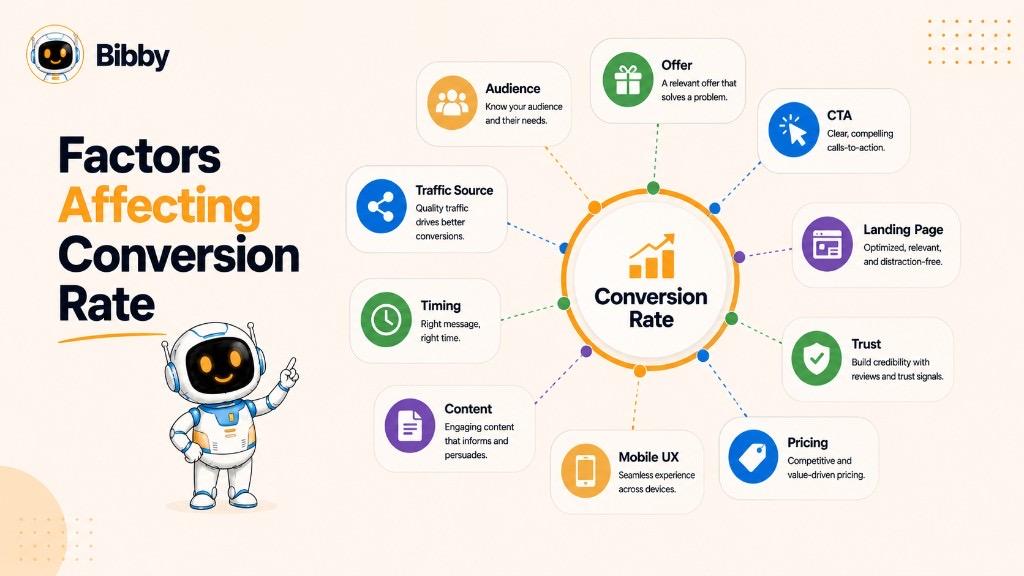
1. Audience Quality
The people reaching your website or social media campaign have a major influence on conversion rate. Traffic from people who have a genuine interest in your product or service is generally more valuable than traffic generated from a poorly targeted audience.
For example, an advertisement shown to people actively looking for a particular solution may have a different conversion rate from an advertisement shown to a broad audience with little purchase intent. Better audience targeting often improves results.
2. Offer
The offer gives users a reason to take action.
An offer could include:
- A product
- A service
- A free trial
- A discount
- A consultation
- An ebook
- A webinar
- A downloadable resource
Even strong marketing may struggle to generate conversions if the offer does not provide enough value or does not match the audience's needs.
3. Value Proposition
A value proposition explains why someone should choose a product, service, or brand.
If visitors cannot quickly understand what you offer, who it is for, and why it matters, they may leave without converting.
A strong value proposition should communicate the core benefit clearly rather than forcing users to search through a page to understand the offer.
4. Call to Action
A call to action guides users toward the desired next step.
Weak, unclear, or overly complicated CTAs can create friction. A clear CTA such as Start Free Trial, Book a Demo, or Get a Quote can make the intended action easier to understand.
5. Landing Page Experience
The landing page is often where the final conversion happens.
Factors such as:
- Page layout
- Headlines
- Images
- Copy
- Forms
- CTA placement
- Navigation
- Trust signals
- Page speed
can influence conversion behavior.
The messaging on the landing page should also match the message that brought the visitor there. A user who clicks an advertisement for a specific offer should not arrive on a page that provides an unrelated experience.
6. Website Performance
Slow-loading pages, broken links, technical errors, confusing navigation, and poor mobile experiences can create friction.
Even users with strong purchase intent may abandon a website if completing the desired action becomes difficult.
7. Mobile Experience
A significant portion of digital activity happens on mobile devices. A page that looks good on a desktop computer but is difficult to use on a smartphone can lose potential conversions.
Businesses should make sure that:
- Text is easy to read
- Buttons are easy to tap
- Forms are simple to complete
- Pages load efficiently
- Images display correctly
- Checkout works smoothly
8. Trust and Social Proof
People are more likely to take action when they feel confident about the business and its offer.
Trust signals can include:
- Customer reviews
- Testimonials
- Case studies
- Ratings
- Client logos
- Guarantees
- Security information
- Clear contact details
For unfamiliar brands, social proof can play an important role in reducing uncertainty.
9. Pricing
Price can directly affect conversion behavior, particularly when customers can easily compare alternatives.
However, a lower price does not automatically produce a higher conversion rate. The perceived value of the product, quality of the offer, positioning, and customer's willingness to pay also matter.
10. Traffic Source
Conversion rates can vary significantly between traffic sources.
For example, users arriving from:
- Organic search
- Paid search
- Social media
- Referral websites
- Direct traffic
- Display advertising
may have different levels of awareness and purchase intent.
Analyzing conversion rates by traffic source can help businesses understand which channels are generating the most valuable visitors.
11. Content Quality
Content helps users understand a product, solve a problem, evaluate an option, and decide whether to take action.
High-quality content can support conversions by answering questions, addressing objections, demonstrating expertise, and communicating benefits clearly.
For social media campaigns, this can include educational posts, product demonstrations, customer stories, videos, carousels, and other content formats.
12. Timing
The timing of an offer or marketing message can influence conversion behavior.
A user may be interested in a product but not ready to purchase immediately. Seasonal demand, promotional periods, product launches, and audience activity patterns can all affect performance.
This is particularly relevant to social media marketing, where the timing and consistency of publishing can influence how often content reaches an active audience.
13. Customer Journey
Conversion rarely happens because of one isolated interaction. A user may discover a brand through social media, visit its website later, read reviews, compare alternatives, and eventually make a purchase.
Understanding this journey helps marketers identify where users are dropping out and which touchpoints are contributing to conversions.
14. Friction
Every unnecessary step can create another opportunity for a user to abandon the process.
Examples of friction include:
- Long forms
- Complicated checkout processes
- Too many required fields
- Unclear pricing
- Forced account creation
- Confusing navigation
- Too many pop-ups
- Unexpected costs
Reducing unnecessary friction can make it easier for interested users to complete the desired action.
15. Consistency Across Marketing Channels
A consistent experience across advertisements, social media, landing pages, websites, and email can make the customer journey easier to understand.
For example, if a social media post promotes one offer but the linked landing page presents a completely different message, users may hesitate or leave.
Maintaining consistent messaging, branding, offers, and CTAs can help create a more connected path from awareness to conversion.
Ultimately, conversion rate is rarely controlled by one factor. It is the result of multiple elements working together, from audience targeting and content to offers, website experience, trust, timing, and the final conversion process.
How to Improve Conversion Rate
Improving conversion rate is the process of making it easier and more compelling for the right users to complete a desired action. Instead of simply trying to increase traffic, businesses can optimize the experience that happens before, during, and after a visitor reaches the conversion point.
There is no single conversion rate optimization technique that works for every business. The best approach is to identify where users are dropping off, test specific changes, and measure the results.
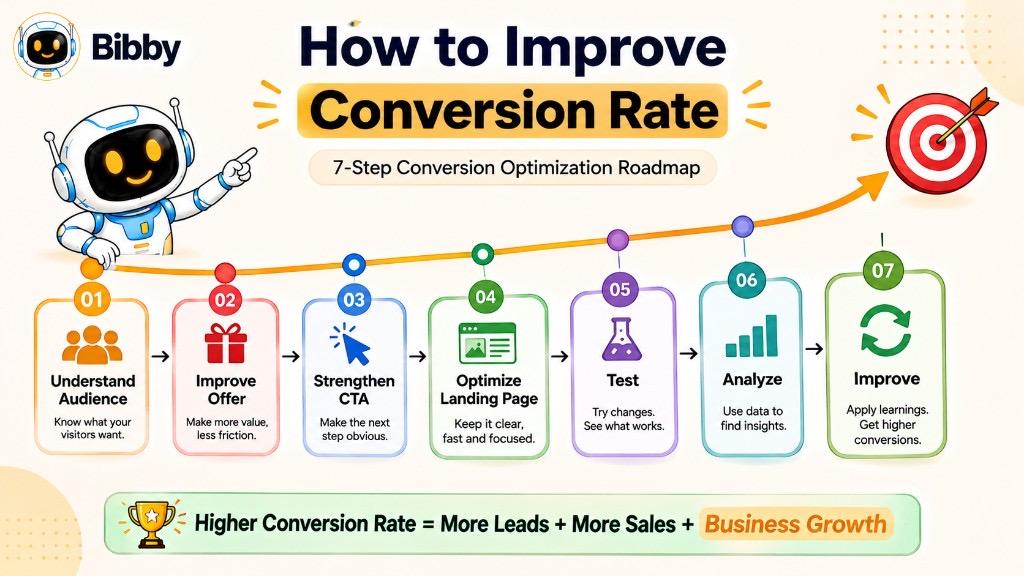
1. Understand Your Audience
Start by understanding who you want to convert.
Analyze:
- Customer needs
- Pain points
- Buying behavior
- Common questions
- Objections
- Purchase intent
- Preferred content
- Traffic sources
The better you understand your audience, the easier it becomes to create relevant offers, messaging, and content.
2. Improve Your Value Proposition
Your value proposition should quickly explain what you offer and why someone should care.
Instead of focusing only on product features, communicate the outcome or benefit the customer can expect.
For example, rather than simply describing a tool as a "social media scheduling platform," messaging could explain how it helps businesses manage content, automate repetitive publishing tasks, and maintain a consistent presence across multiple platforms.
3. Create Clear Calls to Action
Make the next step obvious.
A CTA should tell users exactly what you want them to do, such as:
- Start Free Trial
- Book a Demo
- Get a Quote
- Download Now
- Subscribe
- Buy Now
- Learn More
Avoid giving users too many competing actions when the page has one primary conversion goal.
4. Optimize Landing Pages
A landing page should support the action you want visitors to take.
Test elements such as:
- Headlines
- Subheadings
- Images
- Videos
- CTA buttons
- Forms
- Testimonials
- Product information
- Page layout
- Pricing
- Trust signals
Keep the page focused on the visitor's needs and the specific offer that brought them there.
5. Reduce Friction
Make the conversion process as straightforward as possible.
For example, if a lead form requires 15 fields when only five are necessary, reducing the number of fields may make the process easier for users.
Look for unnecessary steps throughout the customer journey, including registration, checkout, booking, downloads, and contact forms.
6. Improve Mobile Experience
Test your website and landing pages on smartphones and tablets.
Make sure:
- Buttons are easy to tap.
- Text is readable.
- Forms are simple.
- Images load correctly.
- Pages load quickly.
- Navigation is easy.
- Checkout works properly.
A poor mobile experience can create unnecessary barriers for users who are ready to convert.
7. Add Trust Signals
If users are uncertain about your business, they may hesitate to take action.
Consider adding:
- Customer reviews
- Testimonials
- Case studies
- Ratings
- Client logos
- Product demonstrations
- Guarantees
- Security information
- Transparent pricing
Trust signals can help reduce perceived risk and give potential customers more confidence.
8. Create Better Content
Content can help users understand your offer and overcome objections.
Depending on your audience, useful content may include:
- Educational articles
- Tutorials
- Product comparisons
- Case studies
- Videos
- Carousels
- FAQs
- Customer stories
- Demonstrations
For social media, businesses can use different content formats to educate audiences, demonstrate value, build trust, and encourage users to visit a website or take another desired action.
9. Maintain Consistent Social Media Content
Social media can contribute to the conversion journey by keeping your brand visible and providing multiple opportunities for people to discover your products or services.
However, managing several platforms manually can become repetitive. Marketers may need to create content, generate captions, select posting times, build campaigns, and schedule posts across multiple networks.
A social media automation platform such as Bibby can help streamline this workflow. Users can upload an image or generate one with AI, choose a posting style, generate captions, create campaigns, and schedule content at AI-optimized times across platforms such as Facebook, Instagram, LinkedIn, YouTube, and TikTok.
Bibby also provides a chat-based interface where users can manage social media tasks conversationally, including creating brand kits, campaigns, posts, and regenerating captions.
Automation itself does not guarantee a higher conversion rate. Its value is in reducing repetitive work and helping businesses maintain a more consistent publishing process, allowing marketers to spend more time on strategy, creative testing, audience research, and conversion optimization.
10. Use A/B Testing
A/B testing involves comparing two versions of an element to determine which performs better.
You could test:
- Headlines
- CTA text
- Button placement
- Images
- Videos
- Offers
- Form length
- Landing page layouts
- Ad copy
Change one meaningful variable at a time where practical so you can better understand what caused the performance difference.
11. Analyze Conversion Data
Conversion rate should not be viewed in isolation.
Analyze it alongside metrics such as:
- Traffic
- Click-through rate
- Engagement
- Cost per conversion
- Customer acquisition cost
- Revenue
- Average order value
- Return on ad spend
- Customer lifetime value
Segmenting the data by device, campaign, audience, location, traffic source, or landing page can also reveal patterns hidden inside the overall conversion rate.
12. Continuously Test and Improve
Conversion optimization is not a one-time task. Customer behavior, competition, offers, platforms, and market conditions change over time.
A practical optimization cycle is:
Measure → Identify a problem → Form a hypothesis → Make a change → Test → Analyze → Improve
By following this process consistently, businesses can make data-informed improvements rather than relying entirely on assumptions.
The ultimate goal is not simply to achieve a higher percentage. It is to increase the number and quality of valuable conversions while creating a better experience for the people moving through the customer journey.
What Is Conversion Rate Optimization (CRO)?
Conversion Rate Optimization (CRO) is the process of improving a website, landing page, marketing campaign, funnel, or user experience to increase the percentage of users who complete a desired action.
The desired action could be a purchase, signup, form submission, demo booking, free-trial registration, download, or another business-defined conversion.
While conversion rate tells you how many users are converting, CRO focuses on how you can improve that percentage.
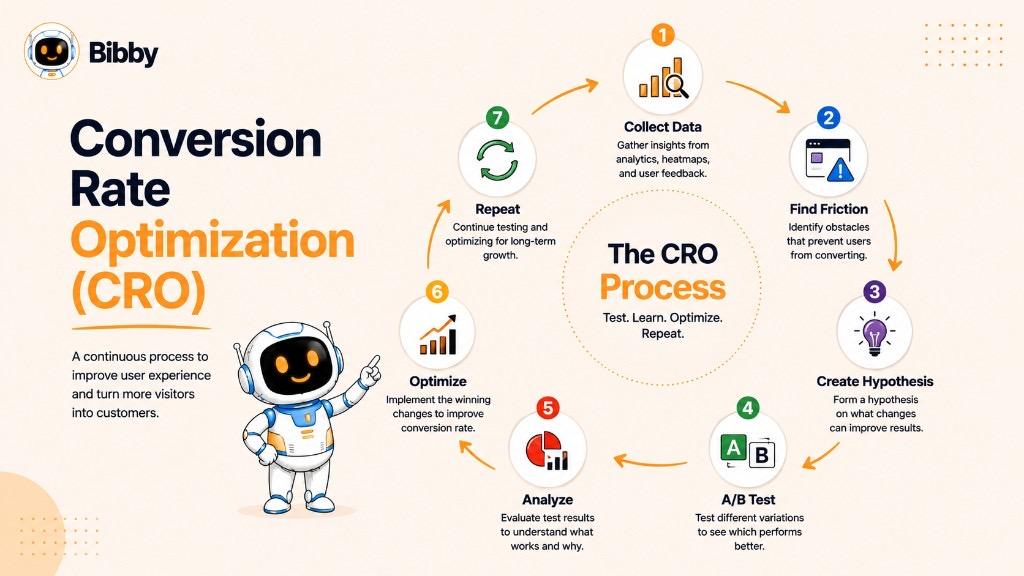
For example, if 10,000 people visit a landing page and 300 sign up, the conversion rate is 3%. Through CRO, a business might test a new headline, simplify the signup form, improve the CTA, add testimonials, or change the offer to determine whether more visitors can be converted.
How Does Conversion Rate Optimization Work?
CRO generally involves a continuous process of analyzing user behavior, identifying problems, testing improvements, and measuring the results.
A typical CRO process looks like this:
Collect Data → Identify Friction → Create a Hypothesis → Test Changes → Measure Results → Implement Improvements
The process can be applied to individual pages as well as entire customer journeys.
Common CRO Techniques
#### A/B Testing
A/B testing compares two versions of a page, CTA, headline, offer, or other element to determine which performs better.
For example, a business might compare two CTA buttons:
Version A: Start Your Free Trial
Version B: Try It Free
The version that produces better results can then be evaluated for wider use.
#### Landing Page Optimization
Marketers can improve landing pages by testing headlines, copy, images, forms, CTAs, testimonials, pricing information, and page structure.
#### Form Optimization
Long or complicated forms can create friction. Reducing unnecessary fields or simplifying the submission process may make it easier for users to complete the desired action.
#### CTA Optimization
Testing different CTA wording, placement, design, and surrounding content can help marketers understand what encourages users to take action.
#### User Experience Optimization
Navigation, page speed, mobile usability, checkout processes, and other UX elements can influence whether users complete a conversion.
#### Offer Testing
Businesses can experiment with different offers, such as discounts, free trials, consultations, bundles, bonuses, or educational resources, to understand what provides the most value to their audience.
Conversion Rate vs. Conversion Rate Optimization
The two terms are closely related but mean different things.
Conversion Rate: Measures the percentage of users who complete a desired action.
Conversion Rate Optimization: The ongoing process of improving the percentage of users who complete that action.
In simple terms:
Conversion rate tells you where you are. CRO helps you figure out how to improve.
Why CRO Matters
CRO can help businesses get more value from their existing traffic. Instead of relying only on acquiring additional visitors, businesses can investigate whether their current traffic is being converted effectively.
For example, increasing website traffic from 10,000 to 20,000 visitors may require additional advertising, content, or acquisition costs. Improving the conversion rate of the existing 10,000 visitors may provide another path to increasing conversions.
However, CRO should not focus only on maximizing the percentage. A successful optimization should ideally produce valuable conversions, not simply more low-quality actions.
This is why effective CRO combines quantitative data, user behavior, testing, and an understanding of the customer's needs and business objectives.
Conversion Rate vs. Other Marketing Metrics
Conversion rate is an important digital marketing metric, but it is only one part of the performance picture. Metrics such as click-through rate (CTR), engagement rate, bounce rate, cost per conversion, and return on ad spend (ROAS) measure different stages or outcomes of the marketing journey.
Understanding the differences helps marketers avoid confusing attention and engagement with actual business results.
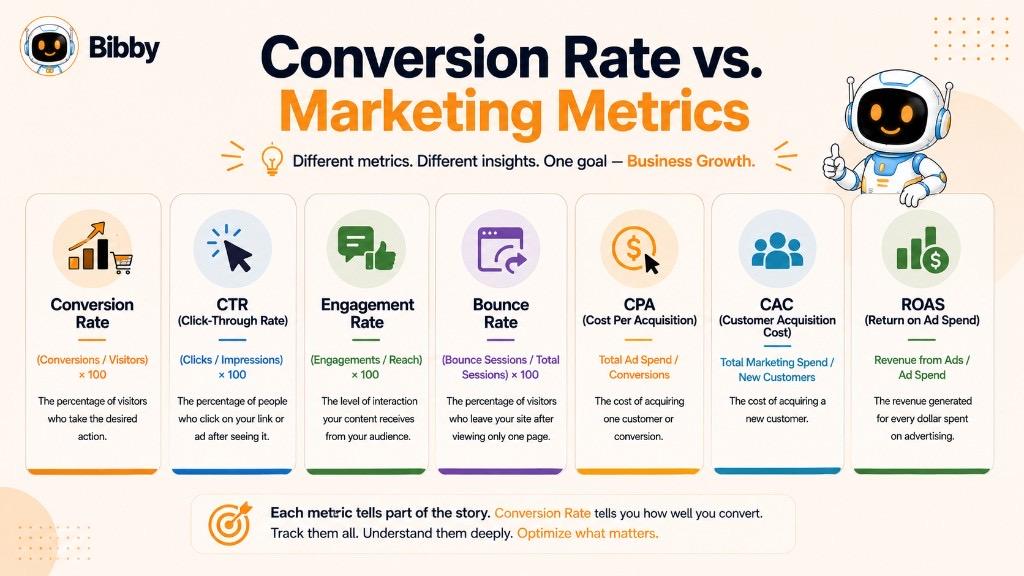
| Metric | What It Measures | Example |
|---|---|---|
| Conversion Rate | Percentage of users who complete a desired action | 100 conversions from 2,000 visitors = 5% |
| Click-Through Rate (CTR) | Percentage of people who click a link or ad after seeing it | 100 clicks from 5,000 impressions = 2% |
| Engagement Rate | Level of interaction with content | Likes, comments, shares, saves, etc. |
| Bounce Rate | Percentage of visits that end without the desired level of engagement | Visitors leaving without continuing |
| Cost Per Conversion | Average amount spent to generate a conversion | $20 spent per lead |
| Customer Acquisition Cost (CAC) | Average cost of acquiring a customer | $100 to acquire one customer |
| Return on Ad Spend (ROAS) | Revenue generated relative to advertising spend | $4 revenue for every $1 spent |
Conversion Rate vs. Click-Through Rate
Click-through rate measures how many people click after seeing a link, advertisement, or other clickable element.
Conversion rate measures how many people complete the desired action after reaching the relevant stage of the journey.
For example:
- 10,000 people see an advertisement.
- 500 click the advertisement.
- 50 complete a purchase.
The CTR is:
500 ÷ 10,000 × 100 = 5%
The conversion rate based on clicks is:
50 ÷ 500 × 100 = 10%
A campaign can therefore have a high CTR but a low conversion rate if the landing page, offer, or customer experience does not persuade visitors to take the next step.
Conversion Rate vs. Engagement Rate
Engagement rate measures interactions with content, such as likes, comments, shares, saves, or other forms of audience interaction.
Conversion rate measures whether users complete a predefined business action.
A social media post could receive thousands of likes but generate very few website signups. Another post might receive relatively little engagement but generate several qualified leads.
Both metrics can be useful, but they answer different questions.
Engagement rate: Are people interacting with the content?
Conversion rate: Are people completing the desired action?
Conversion Rate vs. Bounce Rate
Bounce rate provides information about how users interact with a website or page, while conversion rate focuses on the completion of a defined goal.
A high bounce rate may indicate that visitors are not finding what they expected, but it does not automatically mean that the page has a poor conversion rate. Similarly, a low bounce rate does not guarantee strong conversions.
These metrics should be interpreted alongside the page's purpose and user behavior.
Conversion Rate vs. Cost Per Conversion
Conversion rate tells you how efficiently users are completing an action.
Cost per conversion tells you how much it costs to generate that action.
For example, two advertising campaigns might have the same conversion rate but very different costs because their traffic costs differ.
Looking at both metrics gives marketers a better understanding of campaign efficiency.
Conversion Rate vs. ROAS
Return on ad spend (ROAS) measures the revenue generated from advertising relative to the amount spent.
Conversion rate tells you how many users completed the desired action, while ROAS helps determine the financial return from advertising expenditure.
A campaign can have a strong conversion rate but poor ROAS if the conversions generate little revenue or the advertising costs are very high.
Why You Should Track Multiple Metrics
No single marketing metric can explain the entire customer journey.
A marketer might analyze the journey as:
Impressions → Clicks → Website Visits → Conversions → Revenue
Different metrics help evaluate different stages of this journey.
For social media marketing, for example, reach and impressions can show how widely content is distributed, engagement rate can show how audiences interact with it, CTR can show whether people click, and conversion rate can show whether those users complete the desired action.
Using these metrics together provides a more complete view of marketing performance than focusing on any one number in isolation.
Conversion Rate Across Marketing Channels
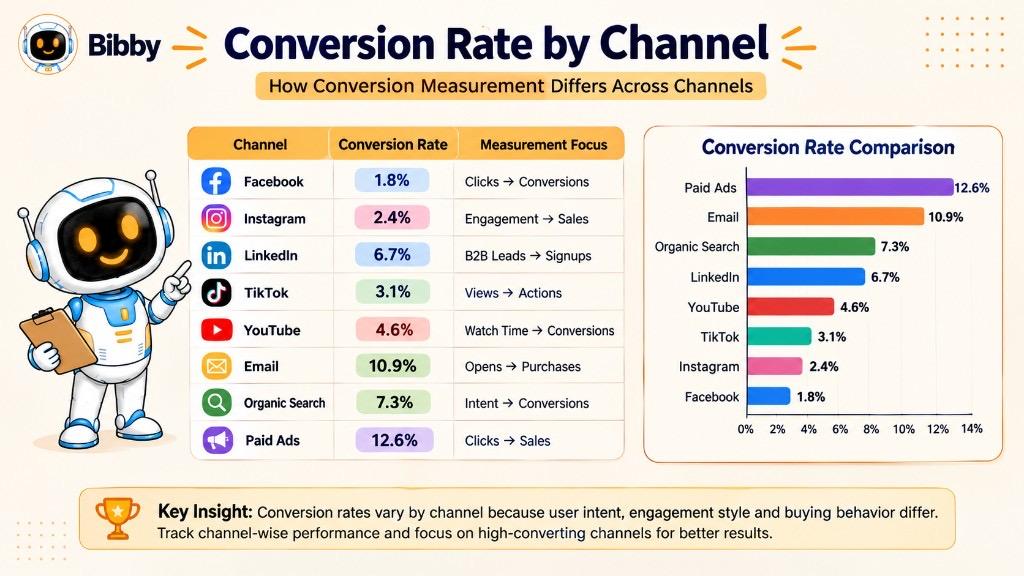
Conversion rate can be measured across almost every digital marketing channel. The formula remains broadly similar, but the conversion event, audience, and measurement method can change depending on the channel.
Comparing conversion rates across channels can help marketers understand where their most valuable traffic and customers are coming from.
Facebook Conversion Rate
Facebook campaigns can generate conversions such as purchases, leads, registrations, app installations, and website actions.
A business can track how many people who interacted with a Facebook campaign eventually completed the desired action. The appropriate denominator should be clearly defined, such as ad clicks or website sessions originating from Facebook.
Instagram Conversion Rate
Instagram conversion rate can help businesses evaluate whether their posts, Stories, Reels, advertisements, and other content generate meaningful actions.
For example, an ecommerce brand might measure purchases generated after users click an Instagram product link.
Other conversions can include:
- Website visits
- Product page views
- Signups
- Lead submissions
- Purchases
- Bookings
LinkedIn Conversion Rate
LinkedIn is widely used for B2B marketing, lead generation, recruitment, and professional services.
A B2B company might define a conversion as:
- Downloading a report
- Submitting a lead form
- Booking a demo
- Requesting a consultation
- Signing up for a webinar
Conversion rate can help marketers determine whether LinkedIn campaigns are generating meaningful business actions rather than simply impressions or engagement.
TikTok Conversion Rate
TikTok campaigns can generate awareness as well as direct actions. Depending on the campaign objective, marketers may track purchases, signups, app installations, website visits, or other conversions.
Short-form video content can be used to capture attention and then guide interested viewers toward a specific action.
YouTube Conversion Rate
YouTube can influence conversions through video advertisements, product demonstrations, tutorials, reviews, educational content, and calls to action.
A conversion might occur after someone watches a video and:
- Visits a website
- Signs up
- Purchases a product
- Books a demo
- Downloads an app
Because users may interact with multiple marketing channels before converting, businesses should consider the broader customer journey when evaluating YouTube performance.
Google Ads Conversion Rate
Google Ads can target people based on searches, interests, and other signals. Conversion rate can help advertisers determine how effectively ad clicks produce the desired action.
For example, if a campaign receives 2,000 clicks and generates 100 leads:
(100 ÷ 2,000) × 100 = 5%
The campaign has a 5% conversion rate based on clicks.
Email Marketing Conversion Rate
Email campaigns can drive users toward purchases, registrations, downloads, bookings, or other actions.
Marketers should distinguish between metrics such as open rate, click-through rate, and conversion rate. Someone opening an email is not necessarily a conversion, and someone clicking a link does not necessarily complete the desired action.
Organic Search Conversion Rate
Organic search traffic comes from unpaid search engine results. Conversion rate can help businesses understand whether visitors arriving through search engines are completing valuable actions.
Marketers can analyze conversion rates by:
- Search query
- Landing page
- Device
- Location
- New vs. returning visitors
- Content topic
This can reveal which types of organic traffic are most valuable.
Why Channel-Specific Conversion Rates Matter
A business may find that one channel generates a large amount of traffic while another produces fewer visitors but a higher percentage of conversions.
For example:
| Channel | Visitors/Clicks | Conversions | Conversion Rate |
|---|---|---|---|
| Social Media | 10,000 | 300 | 3% |
| Organic Search | 5,000 | 250 | 5% |
| 2,000 | 160 | 8% | |
| Paid Ads | 8,000 | 320 | 4% |
This does not automatically mean that email is the best channel. Businesses should also consider traffic costs, conversion quality, revenue, customer lifetime value, and the role each channel plays in the overall customer journey.
For businesses managing multiple social platforms, maintaining consistent content and campaigns can also become operationally demanding. Tools such as Bibby can help centralize social media content creation, caption generation, campaign creation, and scheduling across Facebook, Instagram, LinkedIn, YouTube, and TikTok, making it easier to maintain a consistent publishing workflow while marketers focus on measuring and improving performance.
How to Track Conversion Rate
Tracking conversion rate starts with defining exactly what you want users to do. Once the conversion event is clear, you can measure how many people complete that action and compare the result with the relevant audience or traffic source.
A reliable conversion tracking process helps businesses understand which campaigns, channels, pages, and content contribute to meaningful results.
1. Define Your Conversion
First, decide what counts as a conversion.
Depending on your business, this could be:
- A purchase
- Lead form submission
- Free-trial signup
- Demo booking
- Newsletter subscription
- App installation
- Account registration
- Quote request
- Download
- Appointment booking
Avoid tracking too many unrelated actions under one conversion goal. Each important action can have its own conversion metric.
2. Identify the Relevant Audience
Determine what group of users should be included in the calculation.
For example, you might measure:
- All website visitors
- Visitors to a specific landing page
- Visitors from social media
- Ad clicks
- Email recipients
- App users
- Returning customers
The denominator should match the conversion you are measuring and remain consistent when making comparisons.
3. Set Up Conversion Tracking
Digital analytics and advertising platforms can be configured to record specific actions.
For a website, businesses can track events such as purchases, form submissions, button clicks, registrations, and other actions.
For social media campaigns, tracking can help connect traffic and interactions from individual platforms or campaigns with actions completed on the destination website or app.
4. Calculate the Conversion Rate
Once you have the necessary data, apply the standard formula:
Conversion Rate = (Number of Conversions ÷ Relevant Users or Visitors) × 100
For example:
- 5,000 relevant visitors
- 200 conversions
(200 ÷ 5,000) × 100 = 4%
The conversion rate is 4%.
5. Track Conversion Rate by Traffic Source
Looking only at the overall conversion rate can hide important differences.
Break down performance by sources such as:
This can help identify which channels are producing the most valuable traffic.
6. Track Conversion Rate by Campaign
Campaign-level tracking can provide even more detail.
For example, a social media marketer could compare:
- Product promotion campaign
- Educational content campaign
- Lead-generation campaign
- Seasonal campaign
- Brand awareness campaign
A campaign that generates fewer clicks may still be more valuable if it produces a higher percentage of qualified conversions.
7. Track Different Devices
Conversion behavior can vary between desktop, mobile, and tablet users.
If mobile visitors convert at a much lower rate than desktop visitors, this could indicate a problem with the mobile experience, page speed, navigation, forms, or checkout process.
Device-level analysis can therefore reveal optimization opportunities that an overall conversion rate may hide.
8. Analyze Conversion Funnels
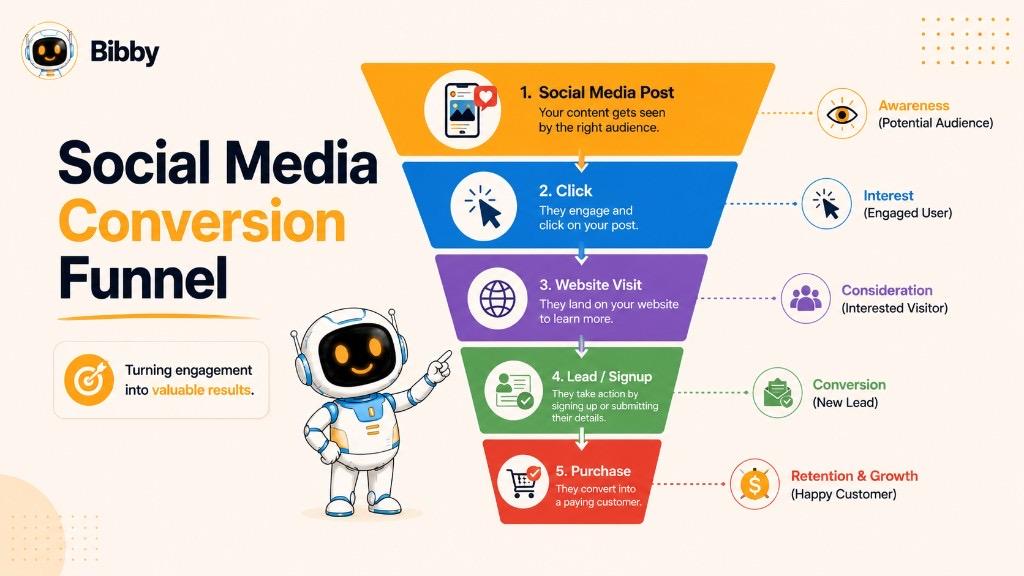
A funnel shows the stages users move through before completing a conversion.
For example:
Social Media Post → Website Visit → Product Page → Add to Cart → Checkout → Purchase
If many users reach the product page but very few begin checkout, that stage deserves closer investigation.
Funnel analysis can help marketers identify where users are dropping out.
9. Compare Conversion Rate Over Time
Track conversion rate across relevant time periods to identify changes and trends.
You might compare:
- Week over week
- Month over month
- Quarter over quarter
- Before and after a campaign
- Before and after a website change
- Before and after an A/B test
Seasonality and changes in traffic sources should also be considered before assuming that a change in conversion rate was caused by a specific optimization.
10. Connect Conversion Rate With Business Results
A conversion is only valuable when it contributes to the business objective.
For this reason, conversion rate should be analyzed alongside metrics such as:
- Revenue
- Customer acquisition cost
- Cost per conversion
- Average order value
- Customer lifetime value
- Return on ad spend
- Lead quality
For example, increasing the number of leads may look positive, but if those leads rarely become customers, the business may need to optimize for lead quality rather than lead volume.
Tracking Conversion Rate for Social Media
Social media marketers can track the journey from content exposure to the desired business action.
A simplified measurement path could look like:
Social Media Content → Click → Website Visit → Conversion
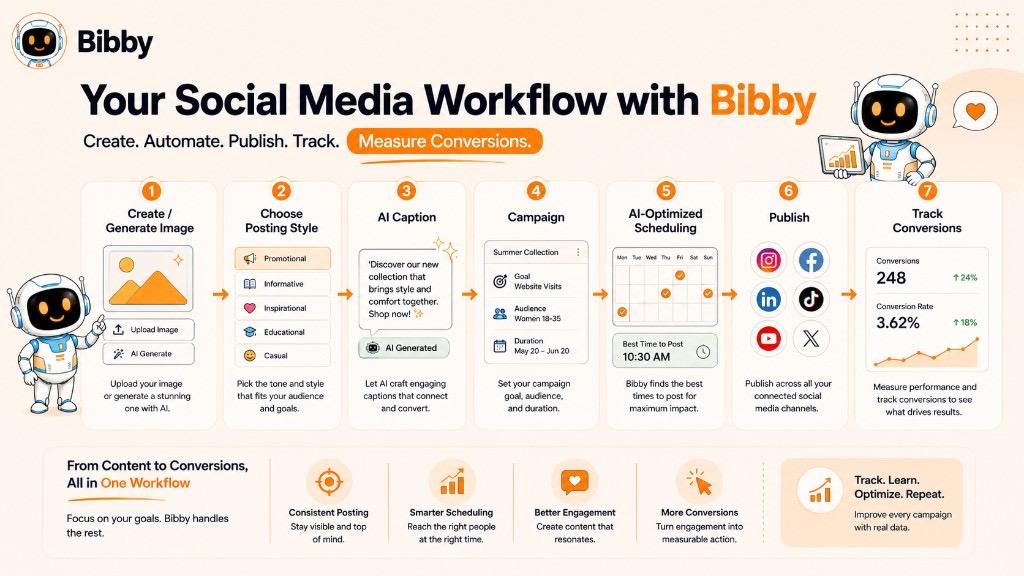
Tools such as Bibby can help organize the publishing side of this process by allowing marketers to create content, generate captions, build campaigns, and schedule posts across multiple social platforms. This can make it easier to maintain a consistent social media workflow while analytics platforms handle conversion measurement.
The key is to keep the roles separate: social media automation helps manage and distribute content, while analytics and tracking systems measure what users do after interacting with that content.
Why Consistent Tracking Matters
Conversion rate becomes much more useful when it is measured consistently. Changing the conversion definition, denominator, tracking method, or attribution model can make comparisons misleading.
A good tracking system therefore starts with a clear question:
What action matters to the business, and how do we reliably measure the users who complete it?
Once that foundation is established, conversion rate becomes a practical metric for identifying opportunities, evaluating campaigns, and improving the customer journey.
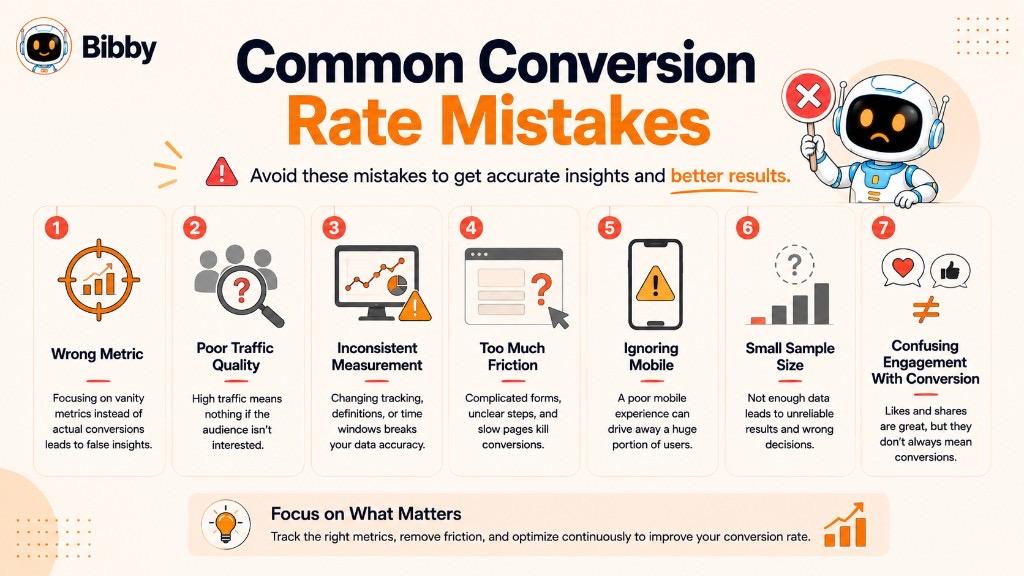
Common Conversion Rate Mistakes
Conversion rate is a useful metric, but it can easily be misunderstood or used incorrectly. A percentage by itself does not explain why users convert, why they leave, or whether the conversions are valuable to the business.
Avoiding common measurement and optimization mistakes can make conversion data much more useful.
1. Measuring the Wrong Conversion
One of the biggest mistakes is tracking an action that does not represent the actual business goal.
For example, a business may celebrate a high number of newsletter signups even though its primary objective is generating qualified sales leads.
Define the desired business outcome first, then choose the conversion that best represents it.
2. Using an Inconsistent Denominator
A conversion rate is only meaningful when you know what the conversions are being compared against.
For example:
Conversions ÷ Website Visitors
and
Conversions ÷ Ad Clicks
produce different rates.
Neither is necessarily wrong, but they measure different things. Problems arise when marketers compare them as though they were calculated using the same methodology.
3. Comparing Unrelated Conversion Rates
A 5% conversion rate for newsletter subscriptions cannot automatically be compared with a 5% conversion rate for $10,000 software purchases.
The conversion type, audience intent, price, funnel length, and customer journey can all be different.
Conversion rates should be compared between reasonably similar campaigns, pages, audiences, or periods.
4. Focusing Only on the Percentage
A high conversion rate does not always mean a campaign is successful.
Suppose one campaign generates:
- 100 visitors
- 10 conversions
- 10% conversion rate
Another generates:
- 10,000 visitors
- 500 conversions
- 5% conversion rate
The second campaign has a lower conversion rate but produces substantially more conversions.
Businesses should consider conversion rate alongside volume, cost, revenue, and conversion quality.
5. Ignoring Traffic Quality
Not all visitors have the same intent.
A large amount of low-intent traffic may produce a lower conversion rate than a smaller amount of highly relevant traffic.
Instead of simply trying to maximize the percentage, analyze where the traffic comes from and whether those users are actually relevant to the offer.
6. Treating Engagement as Conversion
This is particularly common in social media marketing.
Likes, comments, shares, saves, and views are useful engagement signals, but they are not automatically conversions.
A post can receive thousands of interactions without generating a single purchase or lead.
Marketers should distinguish between:
Engagement: How people interact with content.
Conversion: Whether people complete the defined business action.
7. Ignoring the Customer Journey
Conversion rarely depends on a single interaction.
A customer might:
See a social post → Visit the website → Read an article → Return later → Compare products → Make a purchase
If marketers evaluate only the final interaction, they may overlook the contribution of earlier touchpoints.
Understanding the broader customer journey can provide a more complete view of conversion performance.
8. Making Decisions From Too Little Data
A sudden increase or decrease in conversion rate does not always indicate a meaningful trend.
Small sample sizes can produce large percentage swings.
For example, if 2 out of 20 visitors convert, the conversion rate is 10%. If one additional person converts, the rate becomes 15%.
With a larger sample, individual conversions have a smaller effect on the overall percentage.
9. Changing Too Many Things at Once
If you change the headline, CTA, images, offer, landing page design, and pricing simultaneously, it can become difficult to determine what caused the change in performance.
Where practical, test specific variables systematically with A/B testing so you can learn which changes influence conversion behavior.
10. Optimizing Only for More Conversions
More conversions are not always better if they are low quality.
For example, a lead-generation campaign could increase the number of form submissions by offering an attractive incentive, but the resulting leads may have little interest in purchasing.
A strong optimization strategy should consider:
- Conversion volume
- Conversion rate
- Lead quality
- Revenue
- Customer acquisition cost
- Customer lifetime value
11. Ignoring Mobile Users
A landing page may convert well on desktop but perform poorly on mobile devices.
Always examine conversion performance by device and investigate significant differences.
12. Forgetting to Test the Complete Funnel
Improving one part of the customer journey may not improve the overall conversion rate.
For example, increasing ad clicks is not necessarily useful if the landing page fails to convert those visitors.
A complete funnel might look like:
Impression → Click → Landing Page → Signup → Purchase
Each stage can create friction, so conversion optimization should consider the entire journey rather than one isolated element.
13. Assuming Automation Automatically Increases Conversion Rate
Automation can make marketing workflows more efficient, but it does not guarantee better conversion performance.
For example, automating social media publishing can help a business maintain a consistent posting schedule, but conversion still depends on factors such as audience relevance, content quality, offers, messaging, landing pages, and the overall customer experience.
Tools such as Bibby can help automate repetitive social media tasks, including content creation workflows, caption generation, campaign creation, and scheduling. The actual conversion performance should still be measured using appropriate analytics and conversion tracking.
14. Ignoring Conversion Quality
A conversion should be evaluated based on what happens afterward.
A signup that never becomes an active customer may be less valuable than a smaller number of highly qualified signups.
For this reason, businesses should connect conversion data with downstream outcomes such as purchases, retained customers, revenue, and customer lifetime value whenever possible.
The best conversion strategy is not simply about making the percentage look impressive. It is about measuring the right action, using consistent data, understanding user intent, and improving the parts of the customer journey that create genuine business value.
Key Takeaways
- Conversion rate is the percentage of users who complete a desired action out of the total number of people who had the opportunity to take that action.
- The standard formula is (Number of Conversions ÷ Total Visitors or Users) × 100—always define both the conversion event and the denominator consistently.
- A conversion can be a purchase, signup, lead, download, booking, or any business-defined action; macro and micro conversions measure different stages of the journey.
- Conversion rate matters because it shows how effectively traffic turns into meaningful actions—not just impressions, clicks, or engagement.
- Click-through rate, engagement rate, cost per conversion, and ROAS measure different stages of the marketing funnel and should be tracked alongside conversion rate.
- Conversion Rate Optimization (CRO) is the ongoing process of improving the percentage of users who convert through A/B testing, landing page improvements, CTA optimization, and friction reduction.
- Social media conversion rate depends on content relevance, clear CTAs, audience targeting, landing page experience, and consistent publishing across multiple platforms.
- Bibby can help maintain consistent social media content—generating visuals, writing captions, and scheduling at AI-optimized times—while analytics platforms measure what happens after the click.
- Avoid common mistakes such as measuring the wrong conversion, using inconsistent denominators, treating engagement as conversion, and optimizing for volume without considering conversion quality.
- The goal is not simply a higher percentage—it is to increase the number and quality of valuable conversions while creating a better customer experience.