

If you want to understand ROI, the key is knowing what it means, how to calculate it, and how to apply it to marketing and social media. This guide breaks down the ROI formula, explains real-world examples, and shows how businesses can use ROI to evaluate social media performance.
Let’s start with the fundamentals of ROI and how the metric works.
What Is ROI (Return on Investment)?
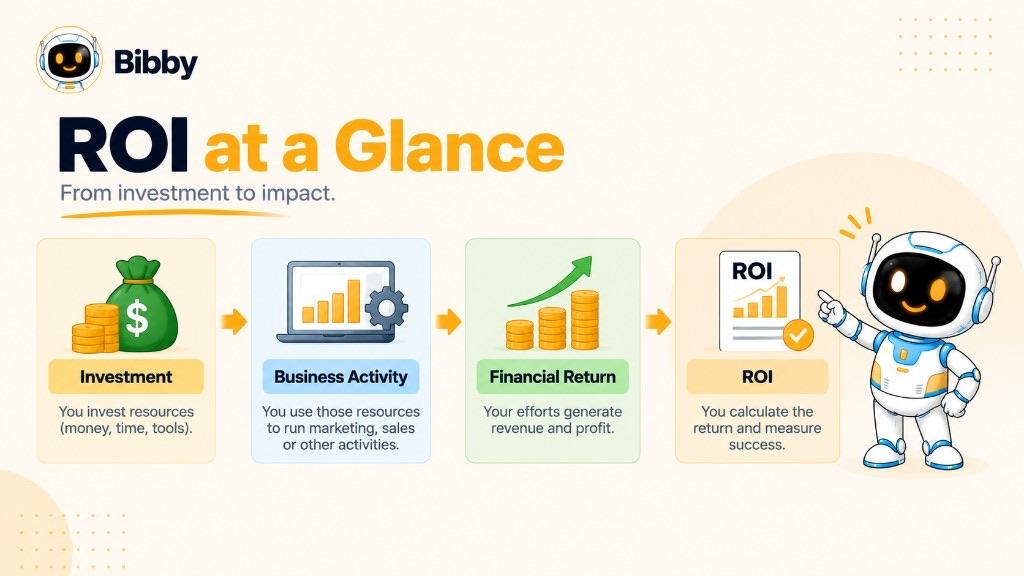
ROI (Return on Investment) is a financial metric used to measure the profitability of an investment relative to its cost. It shows how much return an investment generated compared with the amount of money put into it, usually expressed as a percentage.
In simple terms, ROI answers a basic business question: “Was this investment worth the money we spent?” A positive ROI means the investment generated a return greater than its cost, while a negative ROI means the investment lost money.
ROI can be used to evaluate many types of investments, including marketing campaigns, advertising, software, equipment, business projects, and social media activities. By comparing ROI across different investments, businesses can identify which activities are generating stronger financial returns and make more informed decisions about where to allocate their resources.
For social media, ROI can help businesses move beyond surface-level metrics such as likes, comments, and followers and focus on the financial outcomes generated by their social media efforts. Those platform numbers live in native analytics—not in Bibby.
ROI Formula
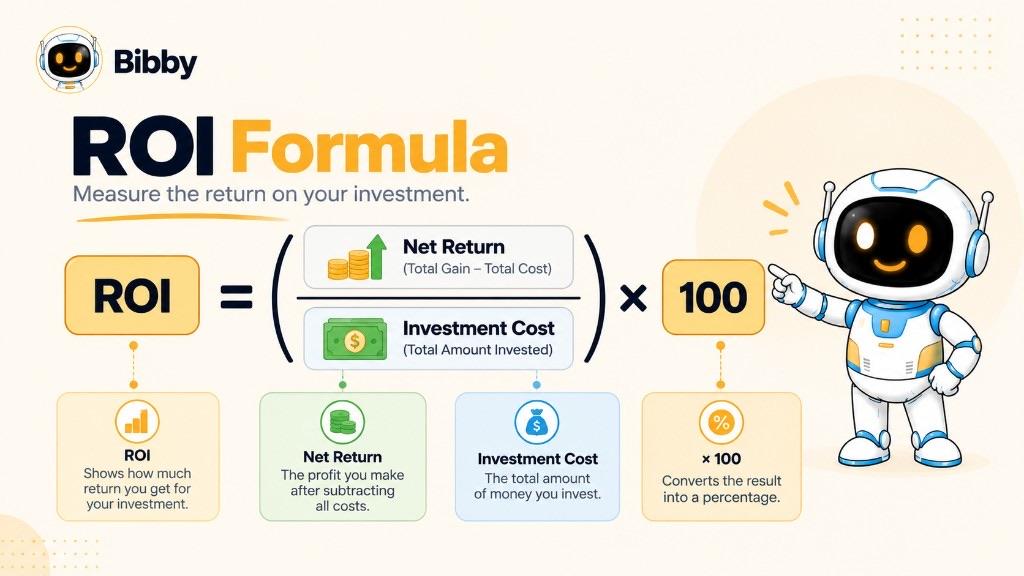
The standard ROI formula measures the net return from an investment against the original cost of that investment.
Both formulas express the same basic idea: compare what you gained from an investment with what you spent to make that investment.
What does each part of the ROI formula mean?
- Net Return: The amount earned from the investment after applicable costs have been deducted.
- Investment Gain: The total financial value generated by the investment.
- Investment Cost: The amount spent to make the investment.
- 100: Converts the result into a percentage.
For example, if a business invests $1,000 and generates $1,500 in total value, the net return is $500.
ROI = ($500 ÷ $1,000) × 100 = 50%
The result is a 50% ROI, meaning the investment generated a return equal to half of its original cost in profit.
When calculating ROI, it is important to use consistent definitions of both return and cost. Including only some of the investment expenses can make ROI appear higher than it actually is, while attributing revenue incorrectly can produce an equally misleading result.
How to Calculate ROI
Calculating ROI requires just a few steps, but the accuracy of the result depends on correctly identifying the investment cost and the financial return.
Step 1: Determine the investment cost
Start by calculating how much you invested. Depending on the situation, this could include the purchase price, marketing spend, employee costs, software expenses, production costs, or other costs directly associated with the investment.
Step 2: Determine the financial return
Next, identify the financial value generated by the investment. Use a consistent definition of return—for example, profit generated after applicable costs or revenue, if you are specifically measuring revenue-based performance.
Step 3: Calculate the net return
Subtract the investment cost from the investment gain.
Net Return = Investment Gain − Investment Cost
Step 4: Divide the net return by the investment cost
Take the net return and divide it by the original investment cost.
Step 5: Multiply by 100
Multiply the result by 100 to express ROI as a percentage.
ROI calculation example
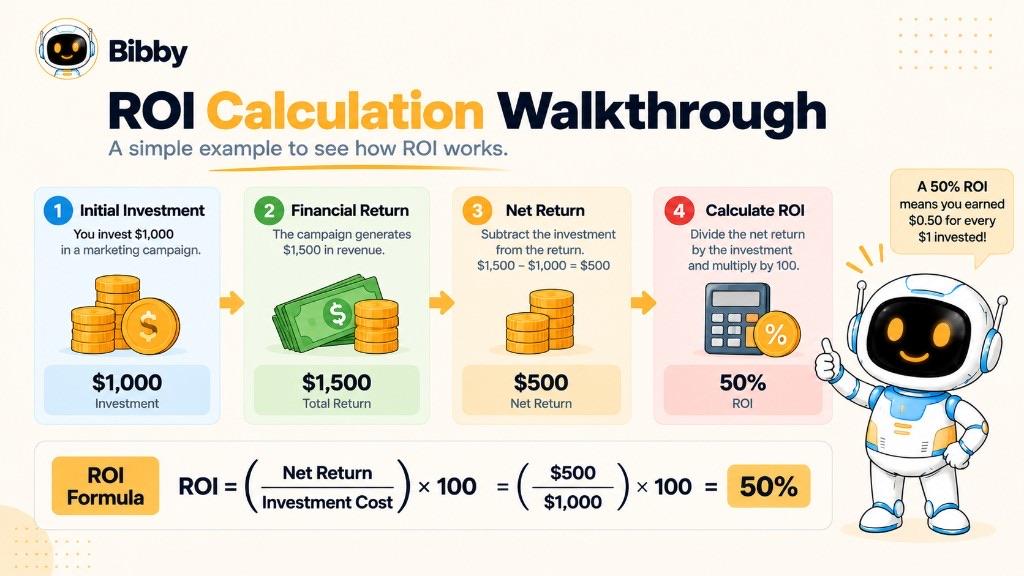
Suppose a business invests $1,000 in a marketing campaign and generates $1,500 in return.
Net Return = $1,500 − $1,000 = $500
ROI = ($500 ÷ $1,000) × 100 = 50%
The campaign therefore has an ROI of 50%.
A positive ROI indicates that the investment generated more than it cost, while a negative ROI indicates that the investment did not recover its initial cost. However, ROI should always be interpreted alongside factors such as the time period, investment risk, and how accurately the return can be attributed to the investment.
ROI Example
A simple example makes ROI easier to understand. The same formula can produce a positive, zero, or negative ROI depending on how much return an investment generates.
Example 1: Positive ROI
A company invests $2,000 in a marketing campaign and generates $3,000 in return.
Net Return = $3,000 − $2,000 = $1,000
ROI = ($1,000 ÷ $2,000) × 100 = 50%
The investment has a 50% ROI, meaning it generated $1 in net return for every $2 invested.
Example 2: Zero ROI
A company invests $2,000 and generates exactly $2,000 in return.
Net Return = $2,000 − $2,000 = $0
ROI = ($0 ÷ $2,000) × 100 = 0%
A 0% ROI means the investment broke even based on the costs and returns included in the calculation.
Example 3: Negative ROI
A company invests $2,000 but generates only $1,500 in return.
Net Return = $1,500 − $2,000 = −$500
ROI = (−$500 ÷ $2,000) × 100 = −25%
The investment has a −25% ROI, meaning the company lost 25% of the amount invested.
Example 4: Social media ROI
Suppose a business spends $1,000 on social media activities, including content production, advertising, and management. Those activities generate $1,800 in attributable financial return.
Net Return = $1,800 − $1,000 = $800
ROI = ($800 ÷ $1,000) × 100 = 80%
The social media investment therefore produces an 80% ROI under these assumptions.
The important point is that the calculation is only as reliable as the numbers behind it. Businesses should account for relevant costs and use a reasonable attribution method when determining how much financial return came from a particular investment.
What Does ROI Mean?
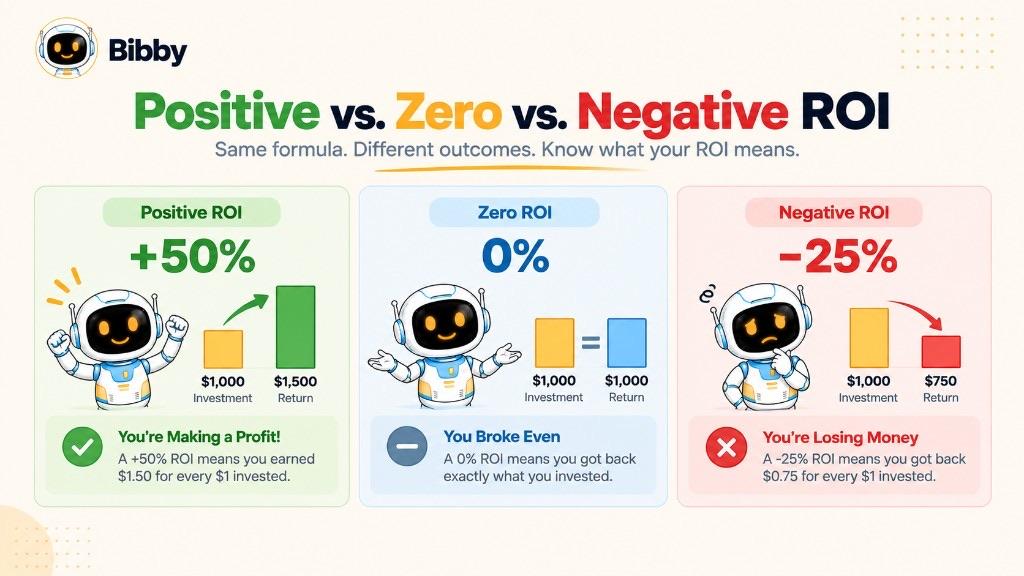
ROI tells you how efficiently an investment generated a financial return relative to its cost. Because ROI is usually expressed as a percentage, it makes it easier to compare the relative performance of different investments.
Here’s how to interpret the result:
- Positive ROI: The investment generated more return than its cost.
- 0% ROI: The investment broke even.
- Negative ROI: The investment generated less return than its cost.
- Higher ROI: Generally indicates a stronger financial return relative to the amount invested, when comparing similar investments.
For example, a 50% ROI means the investment generated a net return equal to 50% of the original investment. If a business invested $10,000, a 50% ROI represents a $5,000 net return, assuming the calculation includes the relevant costs.
It is important not to interpret ROI in isolation. A 100% ROI is not automatically better than a 50% ROI if the investments have different levels of risk, different time periods, different scales, or different costs.
ROI is therefore most useful when it is compared with a relevant benchmark, previous performance, or alternative investment. For businesses, the goal is not simply to achieve the highest percentage possible, but to understand which investments generate meaningful financial returns efficiently.
What Is a Good ROI?
There is no universal ROI percentage that qualifies as “good.” A good ROI depends on the type of investment, industry, level of risk, time period, business objectives, and the alternatives available.
For example, a 20% ROI might be excellent for one investment but disappointing for another. Comparing the percentage against a relevant benchmark is usually more useful than judging it on its own.
When evaluating whether an ROI is good, businesses should consider:
- Industry benchmarks: Compare performance with similar investments or businesses.
- Risk: Higher-risk investments may require higher returns to be worthwhile.
- Time period: A 30% ROI achieved in one month is very different from 30% achieved over five years.
- Investment size: ROI measures relative performance, so it should be considered alongside the actual amount of profit generated.
- Business goals: An investment designed for long-term growth may have a different acceptable ROI than a short-term revenue campaign.
- Opportunity cost: Consider what the same resources could have generated elsewhere.
For social media and marketing, businesses should also consider whether the ROI is based on reliable attribution and whether all relevant costs have been included.
Rather than asking only, “What is a good ROI?”, a better question is: “Is this ROI strong compared with our goals, benchmarks, costs, risks, and alternative investments?”
That context makes ROI a much more useful decision-making metric.
ROI in Social Media
Social media ROI measures the financial return generated by social media activities compared with the cost of those activities. It helps businesses determine whether their social media efforts are contributing meaningful financial value.
Social media can require significant investment, including:
- Content creation and design
- Social media advertising
- Social media management
- Employee or agency time
- Photography and video production
- Social media software and tools
- Influencer or creator partnerships
The return can include measurable financial outcomes such as:
- Direct sales
- Attributable revenue
- Qualified leads with a measurable monetary value
- Customer acquisitions
- Conversions that can reasonably be connected to social media activity
A common mistake is to treat likes, comments, followers, impressions, or reach as ROI. These are important social media performance metrics, but they are not financial returns by themselves. They can indicate audience engagement or potential business value, but ROI requires a connection between the investment and a measurable financial outcome.
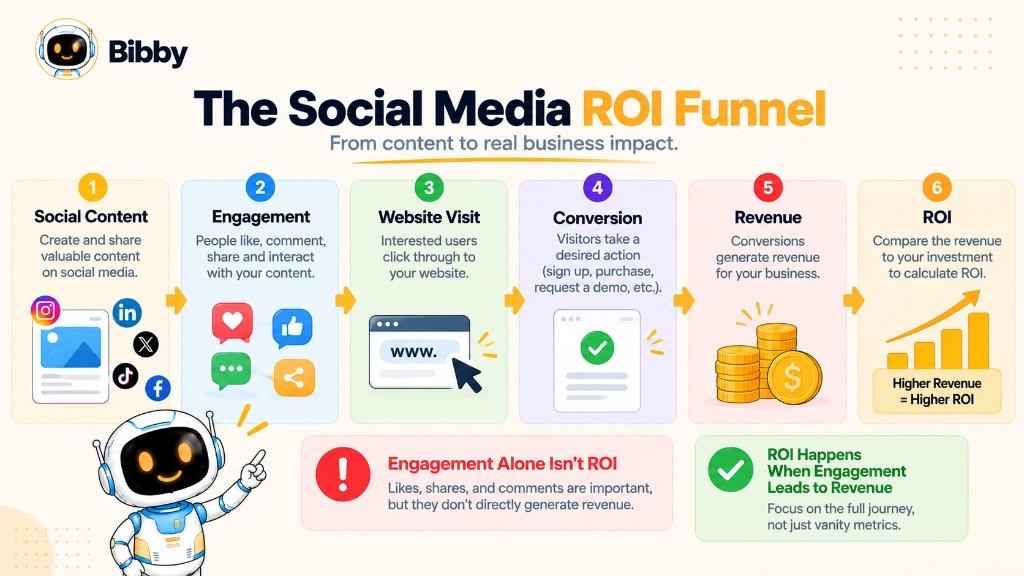
For example, if a business spends $2,000 creating and promoting social media content and generates $3,000 in attributable financial return, the net return is $1,000.
Social Media ROI = ($1,000 ÷ $2,000) × 100 = 50%
However, measuring social media ROI can be more complicated than the formula suggests. Customers may interact with a brand across multiple social platforms and other marketing channels before making a purchase. This makes attribution—determining which activities contributed to the final conversion—an important part of calculating social media ROI accurately.
How to Calculate Social Media ROI
To calculate social media ROI, compare the financial return attributable to your social media activities with the total cost of those activities.
Social media ROI formula
Social Media ROI = [(Financial Return − Social Media Investment) ÷ Social Media Investment] × 100
The formula is straightforward. The difficult part is accurately determining what should be counted as the investment and how much financial return can reasonably be attributed to social media.
1. Calculate your social media investment

Start by adding the relevant costs associated with your social media activities. Depending on your business, this may include:
- Social media advertising spend
- Content creation costs
- Design, photography, and video production
- Social media management costs
- Employee or freelancer time
- Agency fees
- Social media software and tools
- Influencer or creator fees
For example, if a company spends $1,000 on advertising, $500 on content production, and $500 on management, its total social media investment is $2,000.
2. Measure the financial return
Next, determine the financial value generated by those activities. This might be attributable sales revenue, profit, customer acquisitions, or another monetary outcome appropriate to the business.
For example, suppose the social media activity generates $3,000 in attributable financial return.
3. Calculate net return
Subtract the social media investment from the financial return:
$3,000 − $2,000 = $1,000
4. Calculate social media ROI
Now apply the formula:
ROI = ($1,000 ÷ $2,000) × 100 = 50%
The social media activity therefore has a 50% ROI under these assumptions.
Why attribution matters
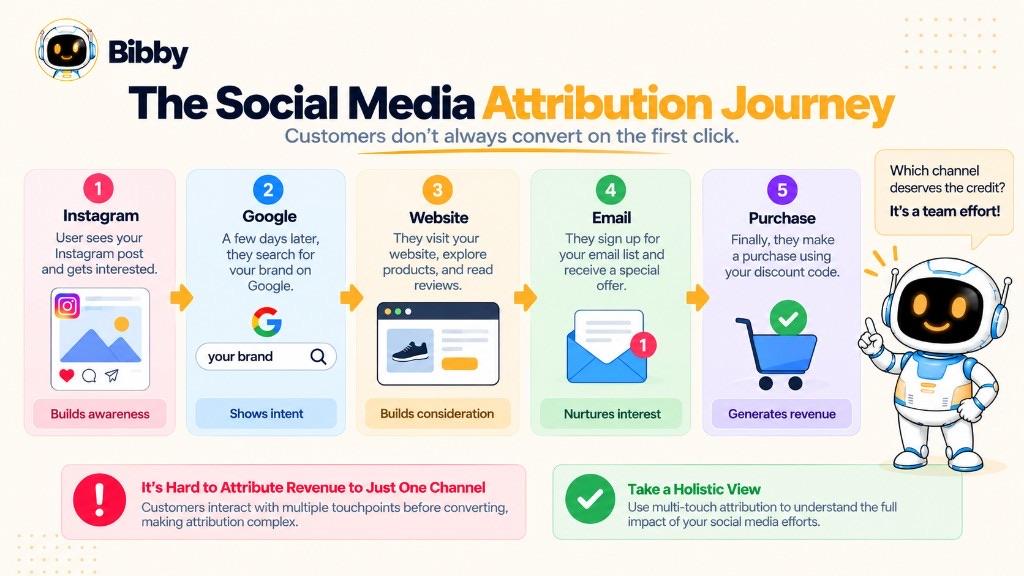
Social media ROI becomes harder to measure when a customer interacts with several marketing channels before converting. Someone might discover a business through Instagram, visit its website through Google, receive an email, and then make a purchase later.
Businesses therefore need a consistent attribution approach when assigning financial returns to social media. Without one, ROI calculations can overstate or understate the actual contribution of social media.
For the most useful measurement, track social media costs and conversions consistently, use appropriate analytics and attribution methods, and compare ROI over comparable time periods.
ROI vs. ROAS
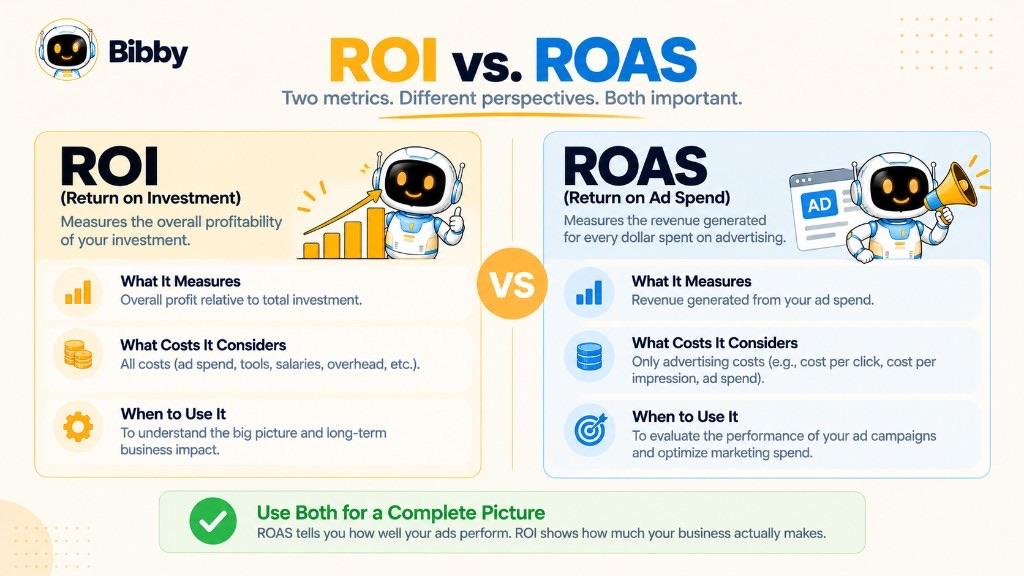
ROI and ROAS are both used to evaluate financial performance, but they measure different things. ROI (Return on Investment) measures profitability relative to the total investment, while ROAS (Return on Ad Spend) measures revenue generated relative to advertising spend.
| Metric | What it measures | Common use |
|---|---|---|
| ROI | Net return relative to the investment cost | Measuring overall profitability |
| ROAS | Revenue relative to advertising spend | Measuring advertising efficiency |
ROI
ROI takes the costs associated with an investment into account and measures the resulting net return.
ROI = (Net Return ÷ Investment Cost) × 100
It is useful when you want to understand whether an investment was profitable after considering its relevant costs.
ROAS
ROAS focuses specifically on advertising spend and typically measures how much revenue an ad campaign generated for every unit of currency spent on advertising.
ROAS = Revenue from Ads ÷ Advertising Spend
For example, if a business spends $1,000 on advertising and generates $4,000 in attributed revenue:
ROAS = $4,000 ÷ $1,000 = 4×
This can also be expressed as 400% ROAS.
Why ROI and ROAS can tell different stories
Suppose that same $1,000 advertising campaign generates $4,000 in revenue, but the business has $3,000 in additional costs associated with producing and fulfilling those sales.
ROAS would still be 4×, because it only considers advertising spend.
ROI could be much lower because it considers the broader costs and the actual net return.
This is why ROAS can be useful for evaluating ad efficiency, while ROI is generally more useful for evaluating overall financial profitability.
For social media marketing, businesses may use both metrics: ROAS to assess paid advertising performance and ROI to understand the broader financial return of their social media investment. Both reports come from ads or analytics tools—not from Bibby.
ROI vs. Profit
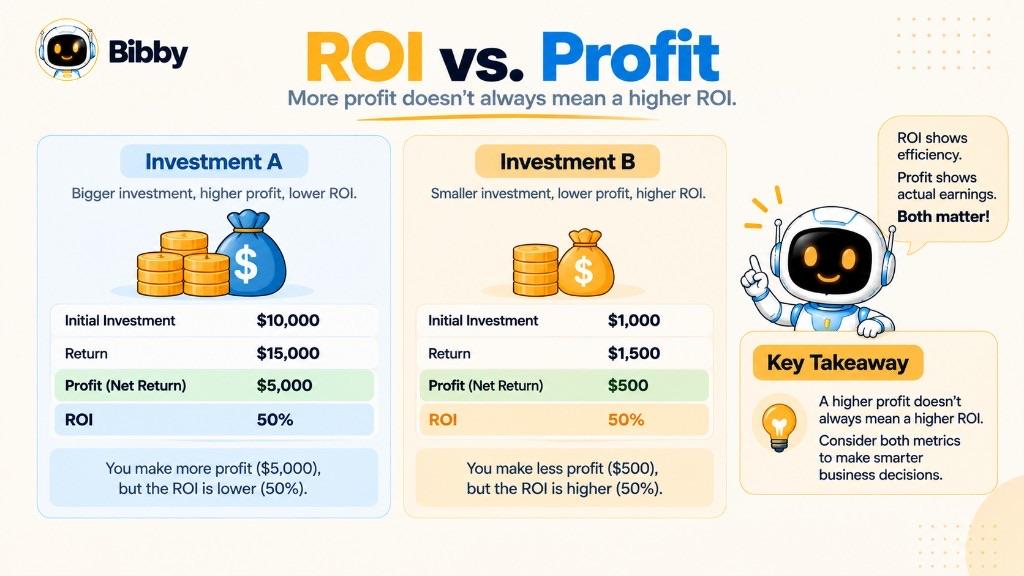
ROI and profit are closely related, but they answer different questions.
Profit is the amount of money an investment generates after costs. ROI measures that return relative to the amount invested.
For example, imagine two investments:
- Investment A: $10,000 invested and $2,000 profit
- Investment B: $1,000 invested and $500 profit
Investment A generates more absolute profit: $2,000 compared with $500.
However, the ROI tells a different story:
Investment A ROI = ($2,000 ÷ $10,000) × 100 = 20%
Investment B ROI = ($500 ÷ $1,000) × 100 = 50%
Investment B produces less total profit, but it generates a higher return relative to the amount invested.
Why the distinction matters
Profit is useful when determining how much money an investment actually generated. ROI is useful when evaluating the efficiency of the investment and comparing investments of different sizes.
Businesses often need both metrics to make good decisions. A campaign with a high ROI may not generate enough total profit to have a significant impact on the business, while a campaign with a lower ROI may generate substantial profit because the investment is much larger.
The same principle applies to social media. Looking only at ROI can hide the scale of the financial outcome, while looking only at profit can make a smaller, highly efficient opportunity appear less attractive.
Using ROI and profit together provides a more complete picture of investment performance.
Why ROI Matters for Businesses
ROI gives businesses a way to connect investments with financial outcomes. Instead of evaluating an activity only by how much attention or activity it generates, businesses can use ROI to understand whether the resources invested are producing a worthwhile financial return.
ROI can help businesses:
- Compare investments: Evaluate the relative financial efficiency of different projects, campaigns, or channels.
- Allocate budgets: Direct more resources toward investments that consistently produce stronger returns.
- Evaluate campaigns: Determine whether marketing and advertising activities are generating sufficient financial value.
- Identify underperforming activities: Find investments that generate weak or negative returns and investigate what needs to change.
- Support financial decisions: Provide a measurable basis for deciding whether to continue, reduce, or increase spending.
- Track performance over time: Compare investment performance across different periods using a consistent calculation.
For social media, ROI can help businesses look beyond metrics such as reach, impressions, followers, and engagement. Those metrics can show whether content is attracting and engaging an audience, but ROI helps answer a different question: Is the financial value generated by these activities worth the resources invested in them?
ROI should not be treated as the only measure of success. Some social media activities may support brand awareness, customer relationships, or future demand without producing an immediately measurable financial return. Businesses should therefore interpret ROI alongside other relevant performance metrics and business objectives.
Used in the right context, ROI is less about finding a single “good” number and more about understanding which investments create the most valuable outcomes for the resources they consume.
How Businesses Measure Social Media ROI
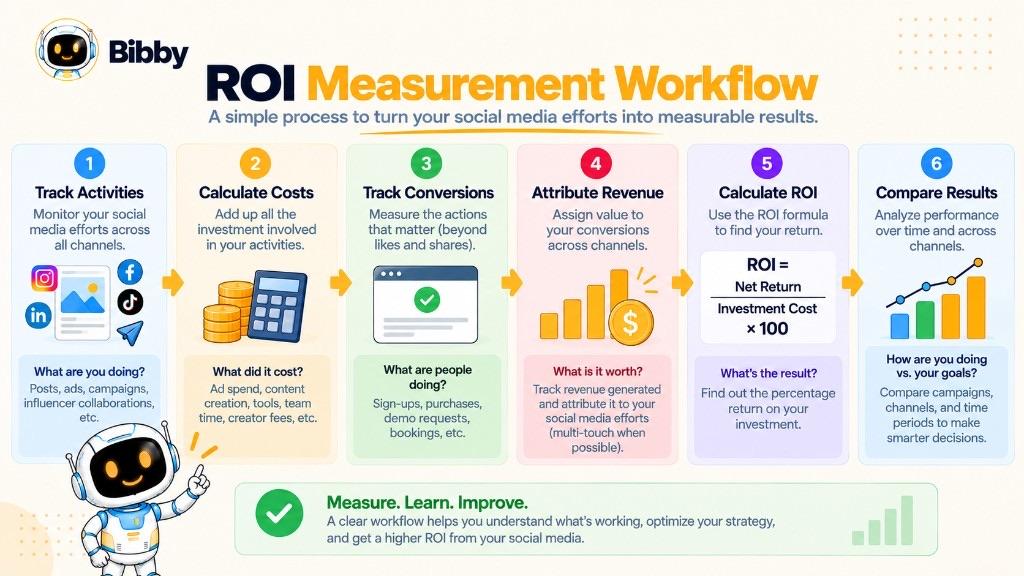
Measuring social media ROI requires more than checking platform analytics. Businesses need to connect social media activity, investment costs, measurable outcomes, and financial value in a consistent way.
A practical measurement process looks like this:
Social media activity → Costs → Conversions → Attribution → Financial value → ROI
1. Track social media activities
Start by recording what you are doing across your social channels. This may include organic posts, paid campaigns, videos, carousels, stories, influencer collaborations, and other campaigns.
2. Track the associated costs
Record the resources required to produce and manage those activities. Depending on the business, this can include advertising spend, content production, employee time, agency fees, software, and creator costs.
3. Track conversions
Identify the business outcomes that matter. Depending on your goals, these might include purchases, leads, registrations, booked calls, subscriptions, or other measurable conversions.
4. Connect conversions to social media
Use an appropriate attribution method to determine how social media contributed to those outcomes. Common tools include website analytics, UTM parameters, CRM data, conversion tracking, and platform reporting.
5. Assign financial value
Translate measurable outcomes into a monetary value where appropriate. For example, an ecommerce purchase may have a directly measurable revenue value, while a lead may require an estimated value based on historical conversion rates.
6. Calculate ROI
Once costs and financial returns have been established, apply the ROI formula:
ROI = [(Financial Return − Investment Cost) ÷ Investment Cost] × 100
7. Compare results over time
A single ROI figure rarely tells the whole story. Compare results across campaigns, channels, audiences, and time periods to identify patterns and determine where investment is producing the strongest returns.
The quality of your ROI measurement ultimately depends on the quality of your tracking and attribution. If costs are missing or conversions are incorrectly attributed, the resulting ROI can give a misleading picture of social media performance.
How Social Media Automation Can Support ROI
Social media automation does not automatically increase ROI, but it can help businesses improve the efficiency of their social media operations. By reducing repetitive work and making content management more efficient, automation can potentially lower the costs associated with maintaining a consistent social media presence.
For example, social media automation can help businesses:
- Schedule posts across multiple social platforms
- Reduce repetitive publishing and administrative work
- Create captions with AI assistance
- Repurpose content for different platforms
- Organize and manage campaigns
- Maintain a consistent publishing schedule
- Manage multiple content formats and channels from one workflow
These efficiencies matter because operating costs are part of the investment side of ROI. If a business can achieve similar or better social media outcomes while spending fewer resources on manual tasks, its overall return relative to its investment may improve.
Bibby brings these capabilities into a single social media workflow. Businesses can upload or generate visual content with AI, choose a posting style, generate captions, schedule content at AI-optimized times, and manage posts across platforms such as Facebook, Instagram, LinkedIn, YouTube, and TikTok.
Bibby also provides a chat-based interface for managing social media workflows, including tasks such as creating brand kits, building campaigns, creating posts, and regenerating captions.
However, automation should be evaluated as an efficiency tool, not as a guarantee of financial returns. The actual ROI of social media still depends on factors such as content quality, audience, offer, distribution, conversion rates, costs, and accurate attribution.
The most useful approach is to measure the financial outcomes generated by social media while also tracking how much time and money your workflow requires to produce those outcomes.
Common Mistakes When Measuring ROI
ROI is easy to calculate mathematically, but calculating it accurately requires careful decisions about costs, returns, attribution, and time periods. A misleading input can produce a misleading ROI, even when the formula itself is correct.
1. Confusing revenue with profit
Revenue is the money generated from sales, while profit is what remains after relevant costs are accounted for. Using revenue as the return when you actually intend to measure profitability can make an investment appear more successful than it is.
2. Ignoring relevant costs
Businesses sometimes count advertising spend but overlook other investment costs, such as content production, employee time, agency fees, software, or creative expenses. Decide which costs belong in the calculation and apply that definition consistently.
3. Treating engagement as financial return
Likes, comments, shares, followers, impressions, and reach can be valuable performance indicators, but they are not automatically financial returns. ROI requires a measurable financial outcome or a defensible monetary value assigned to an outcome.
4. Ignoring attribution
A customer may discover a business through Instagram but convert later after visiting Google or receiving an email. Giving 100% of the resulting revenue to social media without considering the customer journey can overstate social media ROI.
5. Comparing different time periods
A 50% ROI generated in one month is not necessarily equivalent to a 50% ROI generated over three years. Always consider the time required to generate the return when comparing investments.
6. Comparing investments without considering scale
A small investment can produce a very high ROI while generating relatively little absolute profit. A larger investment may have a lower ROI but contribute substantially more profit to the business.
7. Focusing on ROI alone
ROI is an important financial metric, but it does not capture every form of business value. Brand awareness, customer relationships, audience growth, and long-term demand may be difficult to attribute to a specific investment immediately.
The goal is not simply to produce the highest possible ROI percentage. The goal is to calculate ROI consistently and use it alongside other business metrics to make better investment decisions.
Conclusion
ROI (Return on Investment) is a financial metric that helps businesses understand whether an investment is generating a worthwhile return relative to its cost. The basic formula is simple, but accurate ROI measurement depends on using complete cost data, reliable financial returns, and appropriate attribution.
For social media, ROI can help businesses connect their content, campaigns, advertising, and management costs with measurable financial outcomes. It should also be considered alongside metrics such as engagement, conversions, ROAS, and profit rather than treated as the only measure of success.
If you’re ready to put these concepts into practice, the next step is learning how to measure social media ROI—including what to track, how to attribute conversions, and how to determine which social media activities are actually contributing to business growth.