
CPM (Cost Per Mille) is a digital advertising metric that tells you how much it costs to generate 1,000 impressions of an advertisement. The word *mille* means “thousand,” so CPM is also commonly described as cost per thousand impressions.
For example, if you spend $50 on an advertising campaign and your ads receive 20,000 impressions, your CPM is $2.50. This means you paid an average of $2.50 for every 1,000 times your ads were displayed.
CPM is widely used in social media advertising, including campaigns on Facebook, Instagram, LinkedIn, YouTube, and TikTok. It is particularly useful when the goal is to increase brand awareness, reach a target audience, or get more visibility rather than directly generate clicks or conversions.
Understanding CPM can help marketers determine whether they are paying efficiently for audience exposure. However, CPM should not be viewed on its own. Metrics such as CTR, CPC, CPA, conversions, reach, and ROAS can provide a more complete picture of advertising performance.
In this section, you will learn:
- What CPM means and how the CPM formula works
- What factors influence CPM and what makes a good CPM
- Practical ways to reduce CPM and improve campaign performance
First, let's look at exactly what CPM means and why it matters to digital marketers.
What Does CPM Mean?
CPM stands for Cost Per Mille, where “mille” is the Latin word for thousand. In digital advertising, CPM represents the amount an advertiser pays, on average, to have an ad displayed 1,000 times.
An impression is counted each time an advertisement is displayed to a user. An impression does not necessarily mean that the person clicked the ad, watched the entire video, or took any action. It simply represents an opportunity for the ad to be seen.
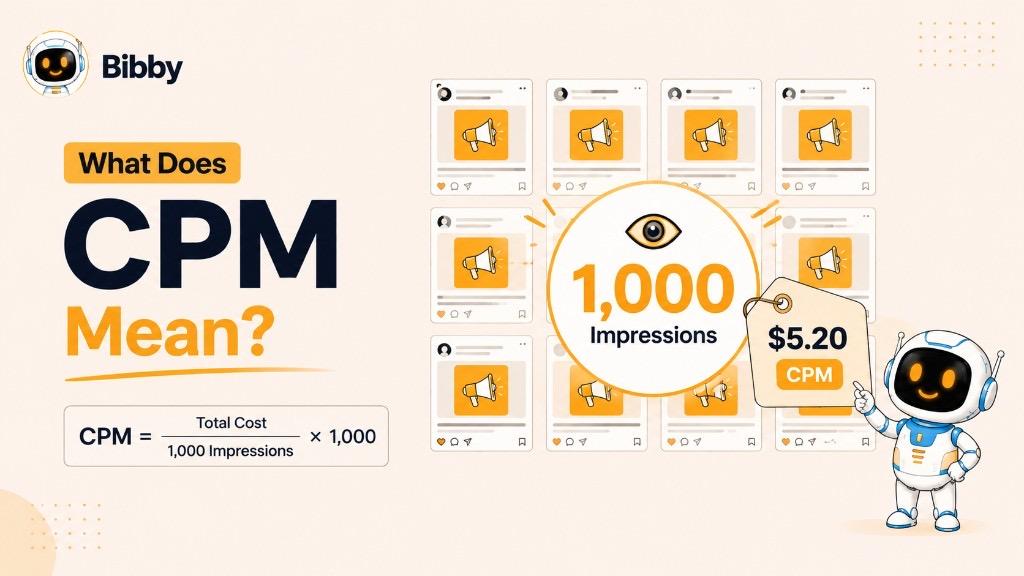
For example, imagine a business spends $100 on a social media advertising campaign and receives 50,000 impressions. Its CPM would be:
($100 ÷ 50,000) × 1,000 = $2 CPM
In other words, the advertiser paid an average of $2 for every 1,000 ad impressions.
Why Is CPM Measured Per 1,000 Impressions?
Advertising campaigns can generate thousands or even millions of impressions. Measuring the cost of every individual impression would make campaign costs difficult to compare. Using a standard unit of 1,000 impressions makes it easier for marketers to evaluate and compare advertising costs.
For example:
- Campaign A: $3 CPM
- Campaign B: $5 CPM
- Campaign C: $8 CPM
At a basic level, Campaign A is generating impressions at the lowest cost. However, that does not automatically make it the best-performing campaign. A higher-CPM campaign may deliver a better audience, higher engagement, more clicks, or more conversions.
CPM in Social Media Marketing
CPM is especially common in paid social media advertising. Platforms can use CPM as one of the metrics advertisers monitor when evaluating campaigns designed to reach or expose content to a specific audience.
Marketers may compare CPM across different:
- Audiences
- Campaigns
- Ad creatives
- Locations
- Platforms
- Placements
- Campaign objectives
- Time periods
This makes CPM useful for understanding how much an advertiser is paying for visibility and whether the cost of reaching a particular audience is changing over time.
However, CPM only tells part of the story. A campaign can have a low CPM but generate very few clicks or conversions. For that reason, marketers typically evaluate CPM alongside other metrics such as CTR, CPC, CPA, conversion rate, reach, and ROAS.
CPM Formula
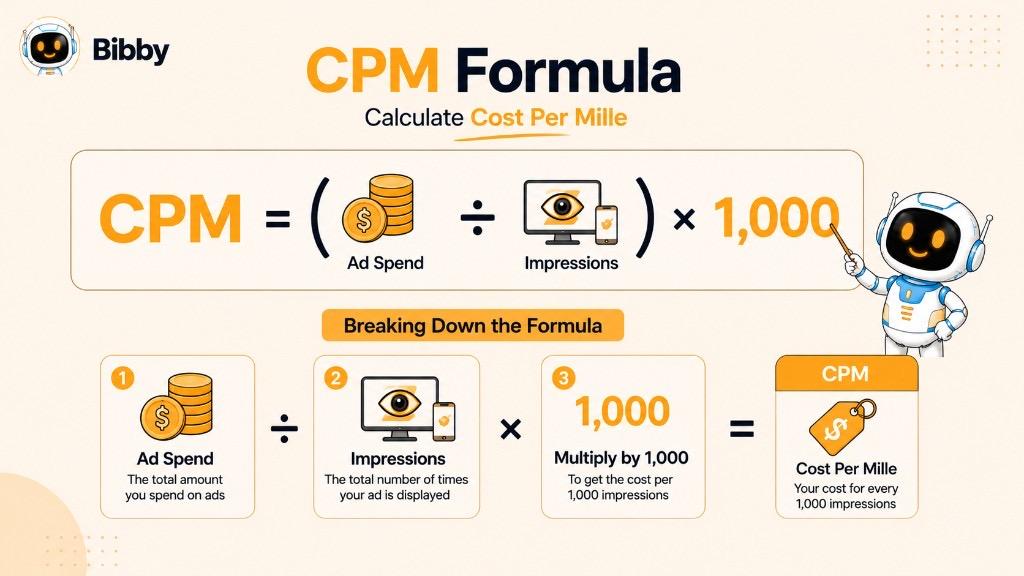
The CPM formula is straightforward. You divide the total advertising cost by the total number of impressions, then multiply the result by 1,000.
CPM = (Total Advertising Cost ÷ Total Impressions) × 1,000
CPM Calculation Example
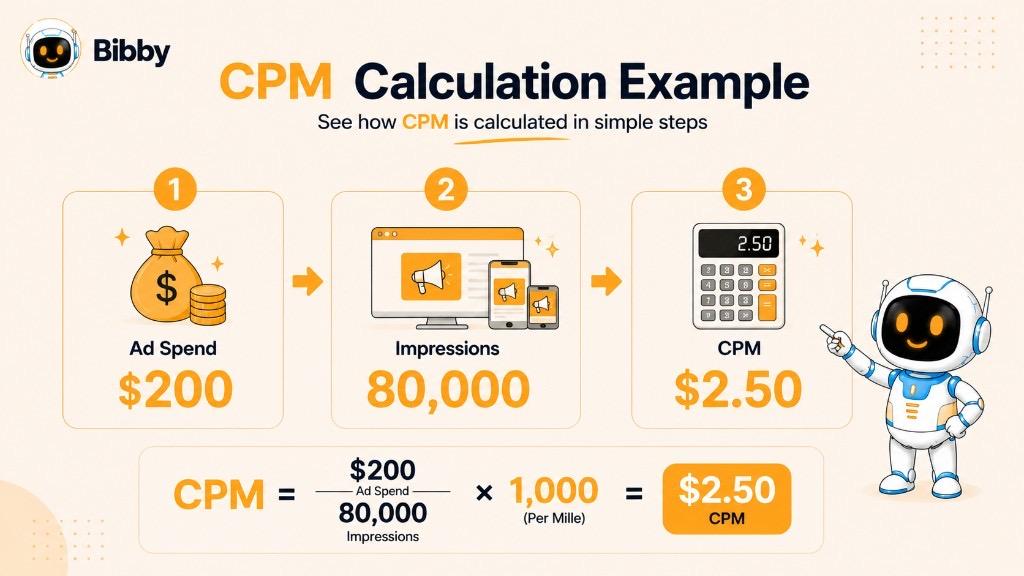
Suppose a company spends $200 on a social media advertising campaign and its ads receive 80,000 impressions.
Using the formula:
CPM = ($200 ÷ 80,000) × 1,000
CPM = $2.50
The campaign has a $2.50 CPM, meaning the advertiser paid an average of $2.50 for every 1,000 impressions.
How to Calculate CPM From Impressions and Ad Spend
You can calculate CPM whenever you know two basic numbers:
- Total advertising spend
- Total impressions
For example:
| Advertising Spend | Impressions | CPM |
|---|---|---|
| $50 | 10,000 | $5 |
| $100 | 25,000 | $4 |
| $150 | 50,000 | $3 |
| $500 | 100,000 | $5 |
The formula remains the same regardless of the campaign size.
How to Calculate Advertising Cost From CPM
You can also work backward when you know the CPM and expected impressions.
Advertising Cost = (CPM × Impressions) ÷ 1,000
For example, if your CPM is $4 and your campaign generates 100,000 impressions:
Advertising Cost = ($4 × 100,000) ÷ 1,000
Advertising Cost = $400
So, a $4 CPM with 100,000 impressions represents approximately $400 in advertising spend.
What Does a $10 CPM Mean?
A $10 CPM means that an advertiser is paying an average of $10 for every 1,000 impressions.
It does not mean the advertiser is paying $10 every time someone clicks the ad, and it does not necessarily mean 1,000 different people saw the advertisement. The same person can generate multiple impressions.
This distinction is important when interpreting CPM alongside reach, frequency, clicks, and conversions.
CPM Is an Average, Not a Fixed Price
CPM should generally be understood as an average cost rather than a fixed price for exactly 1,000 impressions. Advertising platforms use auction systems and campaign costs can fluctuate based on factors such as audience demand, competition, targeting, placement, creative performance, geography, and seasonality.
As a result, CPM can change throughout a campaign even when the advertiser does not change the budget.
How Does CPM Work in Digital Advertising?
CPM is used to measure the cost of getting an advertisement in front of an audience. When an advertiser runs a campaign, the advertising platform delivers the ad to users who match the campaign's targeting and eligibility criteria. Each time the ad is displayed, it can contribute to the campaign's total impressions.
The advertiser can then use the number of impressions and advertising spend to determine the CPM.
For example, if a campaign spends $300 and generates 100,000 impressions:
CPM = ($300 ÷ 100,000) × 1,000 = $3
The campaign therefore has a $3 CPM.
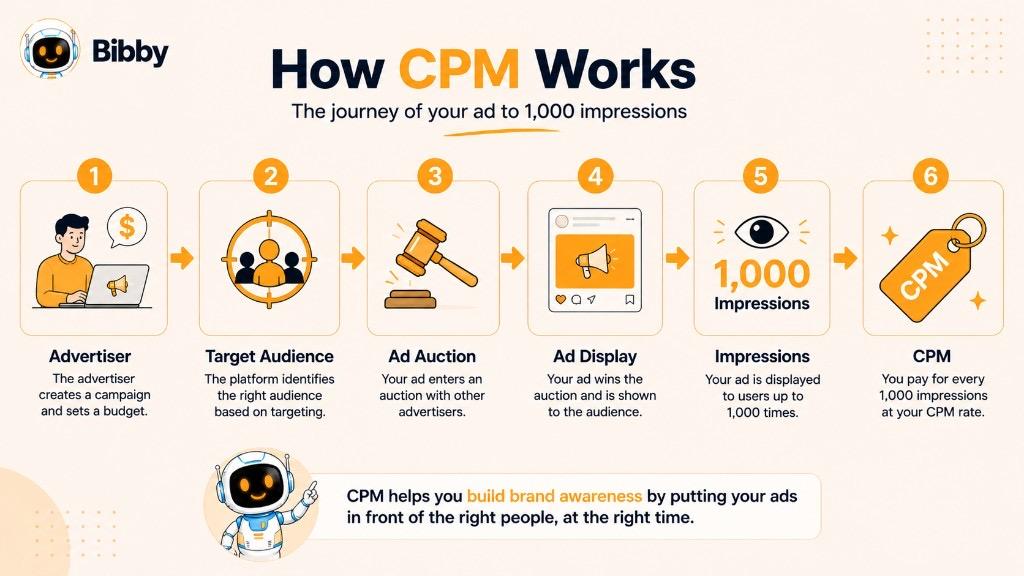
How a CPM Campaign Typically Works
Although the exact advertising system varies between platforms, the process generally looks like this:
1. Create an advertising campaign
The advertiser chooses a campaign objective, budget, audience, placements, creative, and other settings.
2. Define the target audience
The advertiser may target users based on factors such as location, demographics, interests, behaviors, or other available audience signals.
3. Enter the ad auction
The advertising platform determines which eligible ads are shown to users. Competition for a particular audience can influence the cost of advertising.
4. The advertisement is displayed
When the ad is shown, an impression can be recorded.
5. Impressions accumulate
As the campaign continues, the total number of impressions increases.
6. CPM is measured
The advertiser can evaluate how much the campaign is spending relative to the number of impressions it generates.
Does a CPM Impression Mean Someone Saw the Ad?
Not necessarily in the sense of actively noticing or engaging with it.
An impression generally represents an ad being served or displayed, depending on the platform and its measurement methodology. It does not mean that the user clicked the advertisement, read every word, watched the entire video, or remembered the brand.
This is why CPM is primarily a measure of paid exposure, rather than engagement or conversion.
For example, an advertisement could generate:
- 100,000 impressions
- 45,000 people reached
- 2,000 clicks
- 500 conversions
The CPM only describes the cost associated with the impressions. The other metrics provide additional information about what happened after the ad was delivered.
Why CPM Can Change During a Campaign
CPM is not necessarily constant throughout an advertising campaign. It can increase or decrease as market conditions and campaign performance change.
Common factors include:
- Competition for the target audience
- Audience size
- Geographic targeting
- Ad placement
- Campaign objective
- Creative quality
- Seasonality
- Time of day
- Industry demand
- Changes in advertiser demand
For instance, advertising costs may become more competitive during major shopping periods when many businesses are targeting similar audiences.
CPM and Advertising Objectives
CPM can be particularly useful when a campaign focuses on awareness and exposure. An advertiser interested in getting its brand or message in front of as many relevant people as possible may pay close attention to the cost of generating impressions.
However, advertisers focused on traffic, leads, sales, or other actions need to look beyond CPM. A campaign with an inexpensive CPM can still perform poorly if the audience does not engage with the advertisement or take the desired action.
That is why CPM is best viewed as one piece of the advertising performance puzzle, rather than a complete measure of campaign success.
CPM Example for Social Media
CPM is widely used in social media advertising to understand how much a business is paying to generate impressions. The calculation is the same whether the campaign runs on Facebook, Instagram, LinkedIn, YouTube, TikTok, or another advertising platform.

Example: Instagram Advertising Campaign
Suppose an online clothing brand launches an Instagram advertising campaign to increase awareness of its new collection.
The campaign generates:
- Ad spend: $150
- Impressions: 50,000
- Reach: 35,000 people
The CPM can be calculated using the standard formula:
CPM = ($150 ÷ 50,000) × 1,000
CPM = $3
The campaign therefore has a $3 CPM.
This means the brand spent an average of $3 for every 1,000 impressions generated by its advertising campaign.
However, the campaign generated 50,000 impressions but reached only 35,000 people. This is because some users may have seen the advertisement more than once.
What Else Should the Brand Measure?
Looking at CPM alone would not tell the brand whether the campaign was successful.
Suppose the same campaign also generated:
The brand can now evaluate the campaign from several angles.
The CPM tells the brand how much it paid for exposure. The CTR shows how often people clicked after seeing the ad. CPC shows the average cost of those clicks, while purchases reveal whether the campaign actually generated the desired business outcome.
This is why marketers often evaluate CPM together with CTR, CPC, conversion rate, CPA, and ROAS.
Another Simple Example
Imagine two businesses run social media campaigns:
| Campaign | Ad Spend | Impressions | CPM |
|---|---|---|---|
| Campaign A | $100 | 50,000 | $2 |
| Campaign B | $100 | 20,000 | $5 |
Campaign A has a lower CPM and generated more impressions from the same advertising budget.
At first glance, Campaign A appears more efficient at generating exposure. But this does not automatically mean it is the better campaign.
If Campaign B generated substantially more qualified leads or sales, its higher CPM could still be justified by stronger business results.
CPM Should Be Evaluated in Context
A low CPM can be useful when the goal is to maximize affordable exposure to a relevant audience. However, marketers should avoid treating CPM as a standalone success metric.
For social media campaigns, the bigger question is not simply:
“How low is my CPM?”
It is:
“Am I getting valuable exposure to the right audience at a cost that makes sense for my campaign objective?”
That distinction helps marketers avoid optimizing for cheap impressions while overlooking engagement, traffic, leads, or revenue.
Why Is CPM Important for Social Media Marketing?
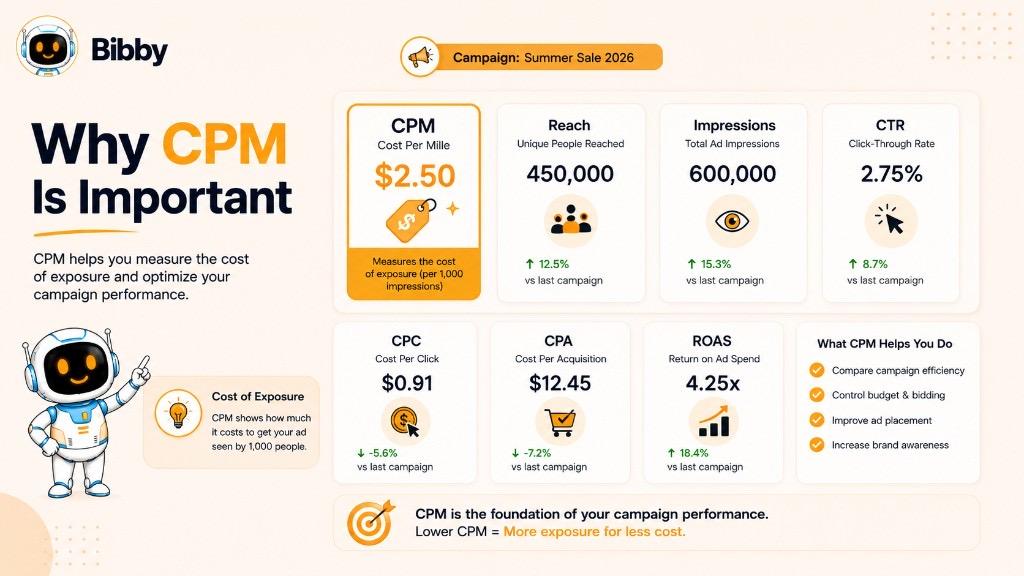
CPM is important because it helps marketers understand the cost of reaching an audience through paid advertising. When a business spends money to promote its content, CPM provides a standardized way to measure how much that exposure costs.
This is especially useful for campaigns focused on brand awareness, visibility, audience reach, and content exposure.
1. Measure the Cost of Advertising Exposure
CPM gives marketers a clear view of how much they are paying to generate impressions.
For example, a $4 CPM means that an advertiser is spending an average of $4 for every 1,000 impressions. This makes it easier to monitor advertising costs as a campaign runs.
2. Compare Different Campaigns
Marketers can compare CPM across campaigns to identify differences in advertising costs.
For example:
- Campaign A: $3 CPM
- Campaign B: $5 CPM
- Campaign C: $7 CPM
The campaigns may be targeting different audiences or using different creatives, so the CPM difference can provide a starting point for further analysis.
However, marketers should compare campaigns with similar objectives and audiences whenever possible.
3. Evaluate Brand Awareness Campaigns
CPM is particularly relevant when the main objective is to increase brand visibility.
If a company wants its brand, product, or message to appear in front of a large number of relevant users, CPM can help measure the cost of generating that exposure.
For awareness campaigns, a marketer may care more about impressions and reach than immediate clicks or purchases.
4. Identify Changes in Advertising Costs
Tracking CPM over time can help marketers identify changes in the cost of reaching their audience.
If CPM suddenly increases, marketers can investigate potential causes such as:
- Increased competition
- Audience saturation
- Seasonal demand
- Changes in targeting
- Creative fatigue
- Different ad placements
- Changes in campaign objectives
A rising CPM does not automatically mean something is wrong, but it can be a useful signal that deserves investigation.
5. Help Allocate Advertising Budgets
CPM can also help marketers understand where their advertising budget is generating the most exposure.
For example, if two comparable campaigns are targeting similar audiences and one consistently generates impressions at a lower cost, the marketer may investigate whether more budget should be allocated to that campaign.
Budget decisions should still consider other performance metrics, especially when the ultimate goal is leads, sales, or revenue.
6. Understand Audience Competition
The cost of advertising can vary depending on how many advertisers are competing for the same audience.
A highly desirable audience may attract significant advertising demand, potentially increasing costs. CPM can therefore provide marketers with a useful indicator of how expensive it is to generate exposure within a particular campaign environment.
7. Evaluate Creative and Audience Performance
CPM can sometimes provide clues about how different combinations of audience targeting and creative are performing.
For example, if one audience segment consistently produces a much higher CPM than another, marketers can investigate whether audience competition, targeting restrictions, or other campaign factors are contributing to the difference.
However, CPM should not be used to judge creative quality by itself. Metrics such as CTR, engagement, conversions, and CPA can provide additional context.
CPM Is Important, But It Is Not the Whole Story
CPM answers an important question:
How much am I paying for 1,000 impressions?
It does not answer:
- How many people clicked?
- How many people engaged?
- How many leads were generated?
- How many purchases occurred?
- How much revenue did the campaign generate?
For that reason, CPM works best as part of a broader social media advertising measurement strategy.
A campaign with a low CPM can still fail to produce meaningful business results, while a campaign with a higher CPM can be highly profitable if it reaches the right audience and generates strong conversions.
The goal is not always to achieve the lowest possible CPM. The goal is to achieve an efficient cost for valuable exposure that supports the campaign's objective.
CPM Across Social Media Platforms
CPM is used across many social media advertising platforms, including Facebook, Instagram, LinkedIn, YouTube, and TikTok. While the basic CPM concept remains the same, advertising costs can vary significantly between platforms.
There is no universal CPM that applies to every platform. Costs can change based on factors such as audience, location, industry, campaign objective, ad format, competition, seasonality, and placement.

Facebook CPM
Facebook CPM measures the average cost of generating 1,000 impressions from Facebook advertising.
Businesses may use CPM when running campaigns designed to increase brand awareness, introduce products, promote content, or reach a specific audience.
Facebook CPM can vary considerably between campaigns because advertisers may target different audiences and use different campaign objectives and placements.
For example, a campaign targeting a broad consumer audience may have a very different CPM from a campaign targeting a highly specific professional or interest-based audience.
Instagram CPM
Instagram CPM measures the cost of generating 1,000 impressions from Instagram advertising.
Because Instagram is heavily focused on visual content, businesses commonly use images, carousels, Stories, Reels, and video ads to reach their audiences.
Instagram CPM can be influenced by factors such as:
- Audience competition
- Ad format
- Placement
- Creative quality
- Targeting
- Campaign objective
- Geographic market
- Seasonality
A lower CPM may indicate that impressions are being generated at a lower cost, but marketers should still examine engagement, clicks, conversions, and other campaign metrics.
LinkedIn CPM
LinkedIn CPM measures the cost associated with generating 1,000 impressions from LinkedIn advertising.
LinkedIn is particularly relevant for B2B marketing, professional services, recruiting, enterprise software, and other campaigns where professional audiences are important.
The cost of reaching a highly specific professional audience can differ from the cost of reaching a broad consumer audience. Factors such as job title, industry, company size, seniority, location, and audience competition can influence campaign costs.
For B2B advertisers, CPM should be evaluated alongside metrics such as lead quality, cost per lead, conversion rate, and pipeline value.
YouTube CPM
YouTube uses impression-based advertising metrics for measuring the cost of delivering advertising exposure. CPM can be particularly relevant when marketers use video advertising to build awareness or reach a specific audience.
YouTube campaigns may involve different video advertising formats and buying methods, so advertisers should pay attention to the specific campaign setup and the metrics provided by the platform.
For video campaigns, CPM should not be considered in isolation. Metrics such as views, view rate, watch time, clicks, conversions, and other campaign-specific measurements can provide additional insight into performance.
TikTok CPM
TikTok CPM measures the average cost associated with generating 1,000 ad impressions on the platform.
TikTok's short-form video environment makes creative style, audience behavior, and content relevance particularly important considerations for advertisers.
CPM can vary depending on factors such as:
- Target audience
- Geographic location
- Campaign objective
- Creative
- Competition
- Placement
- Time period
A campaign with a low CPM may generate inexpensive exposure, but marketers should also determine whether those impressions are producing meaningful engagement or business results.
Why CPM Varies Between Platforms
It is tempting to compare CPM numbers directly across Facebook, Instagram, LinkedIn, YouTube, and TikTok. However, such comparisons can be misleading.
Each platform has a different:
- User base
- Advertising ecosystem
- Auction environment
- Audience targeting system
- Content format
- Campaign structure
- Level of advertiser competition
A $5 CPM on one platform does not necessarily represent the same advertising opportunity as a $5 CPM on another platform.
The quality and relevance of the audience matter just as much as the price of the impressions.
Should You Choose a Platform Based on CPM?
Not necessarily.
A platform with a lower CPM may provide cheaper exposure, but another platform with a higher CPM could generate better leads, stronger engagement, or more revenue.
Instead of asking which platform has the lowest CPM, marketers should ask:
Which platform delivers the best results for my specific audience and campaign objective?
CPM is useful for answering the cost-of-exposure question, but metrics such as CTR, CPC, CPA, conversion rate, ROAS, and revenue help determine whether that exposure is actually valuable.
What Is a Good CPM?
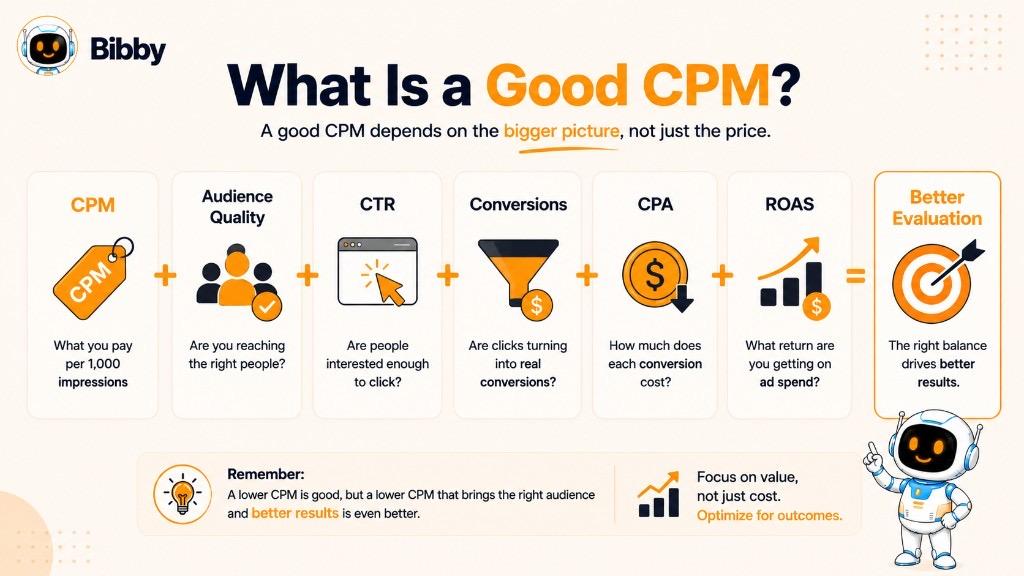
There is no single CPM that can be considered “good” for every advertising campaign. A CPM that is excellent for one business may be expensive for another because advertising costs depend on the audience, platform, industry, location, campaign objective, competition, and other factors.
Instead of focusing on a universal CPM benchmark, marketers should compare their CPM against similar campaigns and the results those campaigns generate.
What Determines Whether a CPM Is Good?
Several factors can influence whether a CPM is considered efficient.
Industry: Some industries have more competition for advertising audiences than others.
Audience: A highly specific or valuable audience can cost more to reach than a broad audience.
Location: Advertising costs can vary significantly between countries, regions, and markets.
Platform: CPM can differ between Facebook, Instagram, LinkedIn, YouTube, TikTok, and other advertising platforms.
Campaign objective: Awareness, traffic, engagement, lead generation, and conversion campaigns may have different cost characteristics.
Ad format: Image, carousel, video, Story, and other formats can perform differently.
Seasonality: Advertising demand can increase during holidays, major shopping periods, and other competitive seasons.
Creative performance: The relevance and quality of an advertisement can influence how efficiently it reaches its intended audience.
Is a Lower CPM Always Better?
No.
A lower CPM means you are generating impressions at a lower average cost, but cheap impressions are not necessarily valuable impressions.
For example:
Campaign A
- CPM: $2
- CTR: 0.3%
- Conversions: 5
Campaign B
- CPM: $6
- CTR: 2%
- Conversions: 40
Campaign A has the lower CPM, but Campaign B may be much more valuable to the business because it generates substantially more engagement and conversions.
This is why CPM should be evaluated alongside the metrics that matter most to the campaign objective.
How to Evaluate Your CPM
Instead of asking whether your CPM is universally “good,” compare it with:
- Your previous campaigns
- Similar audiences
- Similar campaign objectives
- Similar ad formats
- Similar geographic markets
- Your CTR and CPC
- Your conversion rate
- Your CPA
- Your ROAS
For example, if your CPM increases from $4 to $6 but your conversion rate doubles, the higher CPM may not be a problem. The campaign could actually be producing better business results.
A Better Question Than “What Is a Good CPM?”
The better question is:
“Is my CPM efficient for the audience I am reaching and the results I want to achieve?”
For an awareness campaign, a marketer may prioritize affordable impressions and relevant reach. For a lead-generation or sales campaign, CPM is only one part of the equation.
Ultimately, a good CPM is one that helps you reach a relevant audience efficiently while supporting the broader objective of your advertising campaign.
Factors That Affect CPM
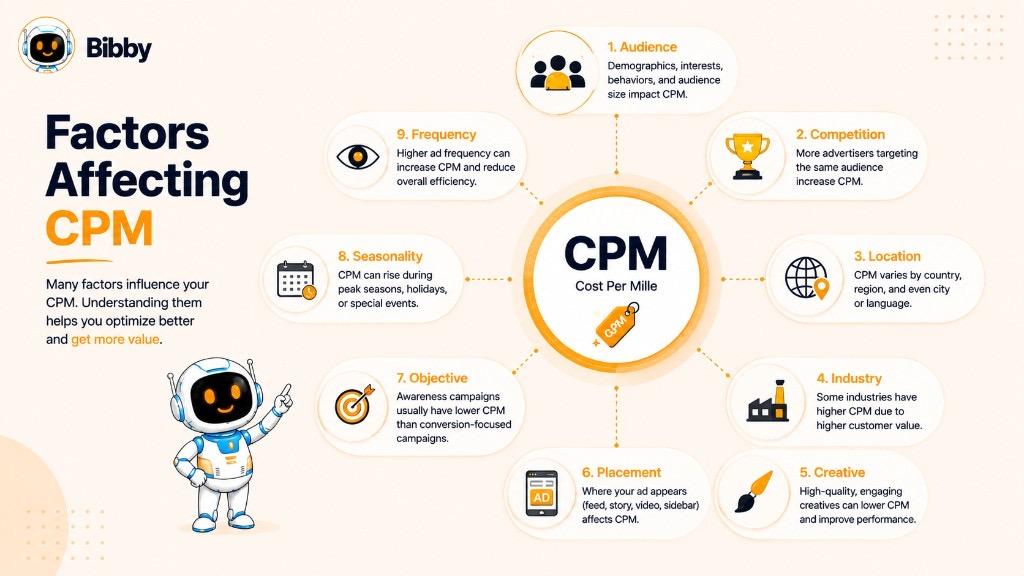
CPM can change significantly from one advertising campaign to another. Even when a business uses the same platform and advertising budget, its CPM may increase or decrease as the audience, competition, creative, campaign objective, and market conditions change.
Understanding these factors helps marketers interpret CPM rather than treating it as a fixed advertising price.
1. Audience Competition
Competition is one of the major factors that can influence advertising costs. When many advertisers want to reach the same audience, the cost of generating impressions can increase.
For example, a highly valuable audience of business decision-makers may attract more advertiser demand than a broad audience, potentially resulting in a higher CPM.
2. Target Audience
The audience you choose can have a significant effect on CPM.
Highly specific targeting can make an audience more expensive to reach, particularly when many advertisers are competing for the same users.
Audience size, demographics, interests, behaviors, professional characteristics, and other targeting criteria can all affect campaign costs.
3. Geographic Location
CPM can vary between countries, regions, and cities.
Advertising to users in a competitive market may cost more than reaching an audience in a less competitive market. This means CPM comparisons should account for geography.
A CPM that looks high in one market may be normal for that market, while the same CPM could be relatively expensive in another.
4. Campaign Objective
The objective selected for an advertising campaign can influence how the platform delivers ads and which users are prioritized.
For example, campaigns focused on awareness may be optimized differently from campaigns designed to generate website traffic, leads, or conversions.
As a result, CPM should ideally be compared between campaigns with similar objectives.
5. Ad Placement
Different placements can have different levels of advertiser competition and audience availability.
For example, placements across feeds, Stories, short-form video environments, search-related surfaces, or other inventory may produce different CPMs.
Comparing placements can help marketers understand where they are getting efficient exposure.
6. Ad Format
The format of an advertisement can also influence its cost and performance.
Common formats include:
- Single-image ads
- Carousel ads
- Video ads
- Stories
- Short-form video
- Sponsored content
- Display-style advertisements
The format itself does not guarantee a low or high CPM. Its interaction with audience demand, placement, creative quality, and campaign objective matters.
7. Creative Quality and Relevance
Advertising platforms aim to deliver content that is relevant to users. Creative performance can therefore influence how efficiently an advertisement reaches its intended audience.
If an advertisement consistently receives poor engagement or does not resonate with the target audience, marketers may need to test new creative concepts.
However, CPM should not be used as the only measure of creative quality. CTR, engagement, conversion rate, and other metrics provide additional context.
8. Seasonality
Advertising demand changes throughout the year.
During major shopping seasons, holidays, events, and other high-demand periods, more businesses may compete for advertising inventory. This can increase the cost of reaching certain audiences.
A campaign's CPM may therefore be higher during a competitive period than during a quieter period.
9. Audience Size
Extremely narrow audiences can sometimes create greater competition for limited inventory.
On the other hand, simply making an audience larger does not guarantee a lower CPM or better performance. The goal is to reach an audience that is sufficiently large while remaining relevant to the campaign.
10. Ad Frequency
Frequency represents how often users are exposed to an advertisement on average.
If the same audience repeatedly sees an ad, marketers may begin to see changes in campaign performance. High frequency can sometimes be associated with audience saturation or creative fatigue.
Monitoring frequency alongside CPM can help identify whether an audience is being exposed to the same creative too often.
11. Industry
Different industries can experience different levels of advertising competition.
For example, industries with high customer value or strong advertiser demand may compete aggressively for specific audiences. This can affect the cost of generating impressions.
Industry benchmarks can therefore provide useful context, but they should not be treated as universal rules.
12. Time and Market Conditions
CPM can change over time as audience behavior, advertiser demand, platform dynamics, and market conditions change.
A campaign launched today may not have the same CPM several months later, even if the targeting and budget remain similar.
For this reason, marketers should monitor their own campaign data and compare performance across relevant time periods.
The Key Takeaway
There is rarely one reason behind a high or low CPM. It is usually the result of several factors working together.
When CPM changes, marketers should examine the broader campaign context, including audience, competition, location, objective, placement, creative, frequency, seasonality, CTR, conversions, and overall campaign performance.
That approach provides a much more useful picture than looking at CPM as a standalone number.
High CPM vs. Low CPM
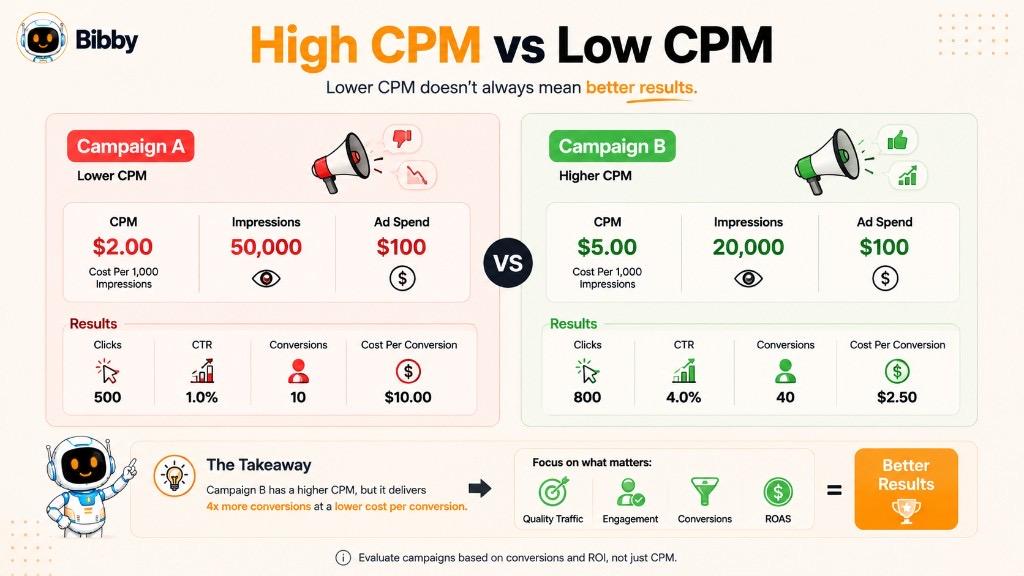
A high or low CPM simply tells you how much an advertiser is paying, on average, to generate 1,000 impressions. It does not automatically tell you whether a campaign is successful or unsuccessful.
A low CPM means an advertiser is generating impressions at a lower average cost, while a high CPM means the cost of generating those impressions is higher.
Low CPM
A lower CPM can be beneficial when the campaign's goal is to generate as much relevant exposure as possible within a limited budget.
For example, if two similar campaigns reach comparable audiences and one generates impressions at a significantly lower CPM, it may be more efficient at producing exposure.
However, a low CPM does not guarantee quality results.
A campaign could generate inexpensive impressions but receive:
- Low click-through rates
- Low engagement
- Poor-quality traffic
- Few leads
- Few conversions
- Low revenue
In this situation, the campaign may be inexpensive to expose but ineffective from a business perspective.
High CPM
A higher CPM means the advertiser is paying more, on average, for every 1,000 impressions.
This can happen because of:
- Strong competition for the audience
- Highly specific targeting
- An expensive geographic market
- Seasonal advertising demand
- Campaign characteristics
- Audience saturation
- Ad placement
- Industry competition
A high CPM is not necessarily a problem if the campaign produces valuable results.
For example, a B2B company may accept a higher CPM if its advertising reaches highly relevant decision-makers and generates qualified leads.
Low CPM vs. High CPM Example
Consider two social media campaigns:
| Metric | Campaign A | Campaign B |
|---|---|---|
| Ad spend | $100 | $100 |
| Impressions | 50,000 | 20,000 |
| CPM | $2 | $5 |
| Clicks | 250 | 800 |
| Conversions | 5 | 30 |
Campaign A has the lower CPM and generates more impressions.
However, Campaign B produces significantly more clicks and conversions.
If the business's primary objective is generating customers, Campaign B may be the better campaign despite its higher CPM.
What Should Marketers Optimize?
The answer depends on the campaign objective.
For an awareness campaign, CPM can be an important efficiency metric because the advertiser wants affordable exposure to a relevant audience.
For a traffic campaign, metrics such as CTR and CPC become more important.
For a lead-generation campaign, marketers should pay close attention to leads, conversion rate, CPL, and lead quality.
For a sales campaign, CPA, conversion rate, revenue, and ROAS may matter more than CPM.
Don't Optimize CPM in Isolation
The goal should not always be to achieve the lowest possible CPM.
Instead, marketers should look for a healthy balance between:
Cost → Audience Quality → Engagement → Conversions → Revenue
A higher CPM can be acceptable when it produces better-quality results. Similarly, a low CPM can be a warning sign if the impressions are not reaching the right audience or contributing to the campaign's objective.
The most useful CPM comparison is therefore not simply high vs. low, but cost vs. value.
CPM vs. CPC
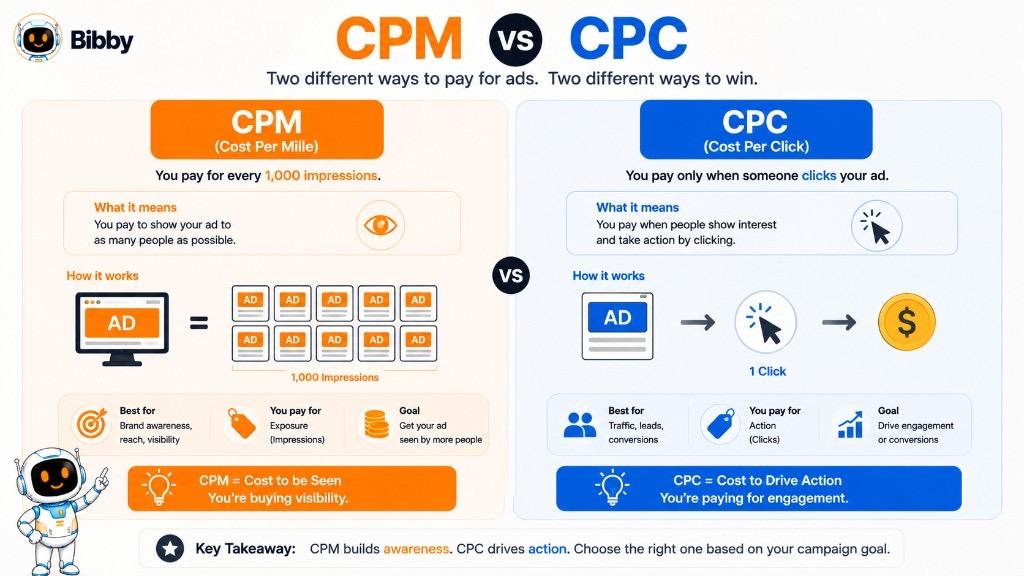
CPM and CPC are two different digital advertising metrics that measure different types of costs. CPM measures the cost of generating 1,000 impressions, while CPC measures the average cost of generating a click.
Understanding the difference is important because an advertiser can have a low CPM but a high CPC, or a high CPM but a low CPC.
What Is CPM?
CPM stands for Cost Per Mille.
It measures the average cost for every 1,000 impressions.
CPM = (Advertising Cost ÷ Impressions) × 1,000
CPM is commonly useful when the primary goal is to generate visibility, awareness, and exposure.
What Is CPC?
CPC stands for Cost Per Click.
It measures the average amount an advertiser pays for each click generated by an advertisement.
CPC = Advertising Cost ÷ Number of Clicks
CPC is particularly useful when the goal is to drive traffic to a website, landing page, app, or other destination.
CPM vs. CPC at a Glance
| Metric | CPM | CPC |
|---|---|---|
| Full form | Cost Per Mille | Cost Per Click |
| Measures | Cost per 1,000 impressions | Cost per click |
| Focus | Exposure | Traffic |
| Formula | Cost ÷ impressions × 1,000 | Cost ÷ clicks |
| Useful for | Awareness campaigns | Traffic campaigns |
| Requires clicks? | No | Yes |
CPM and CPC Example
Suppose an advertiser spends $100 and generates:
- 50,000 impressions
- 1,000 clicks
The CPM would be:
($100 ÷ 50,000) × 1,000 = $2
The CPC would be:
$100 ÷ 1,000 = $0.10
So the campaign has a $2 CPM and a $0.10 CPC.
The two metrics describe different parts of the same campaign.
CPM tells the advertiser how much the exposure cost, while CPC tells the advertiser how much the generated traffic cost.
Which Is Better: CPM or CPC?
Neither metric is universally better.
The right metric depends on what the campaign is trying to achieve.
If the goal is to increase brand awareness and visibility, CPM may be more relevant.
If the goal is to generate website traffic or clicks, CPC may be more useful.
For campaigns focused on leads or sales, marketers should also evaluate metrics such as CPA, conversion rate, revenue, and ROAS.
Why You Should Look at Both
Looking at CPM and CPC together can reveal useful information about campaign performance.
For example, a campaign may have a low CPM but a high CPC because users are not clicking the advertisements frequently.
Another campaign may have a higher CPM but a lower CPC because the ads generate strong engagement and clicks.
This is why marketers should avoid optimizing advertising campaigns around a single metric.
CPM answers: “How much am I paying for 1,000 impressions?”
CPC answers: “How much am I paying for each click?”
Both can be useful, but they answer different questions.
CPM vs. CPA
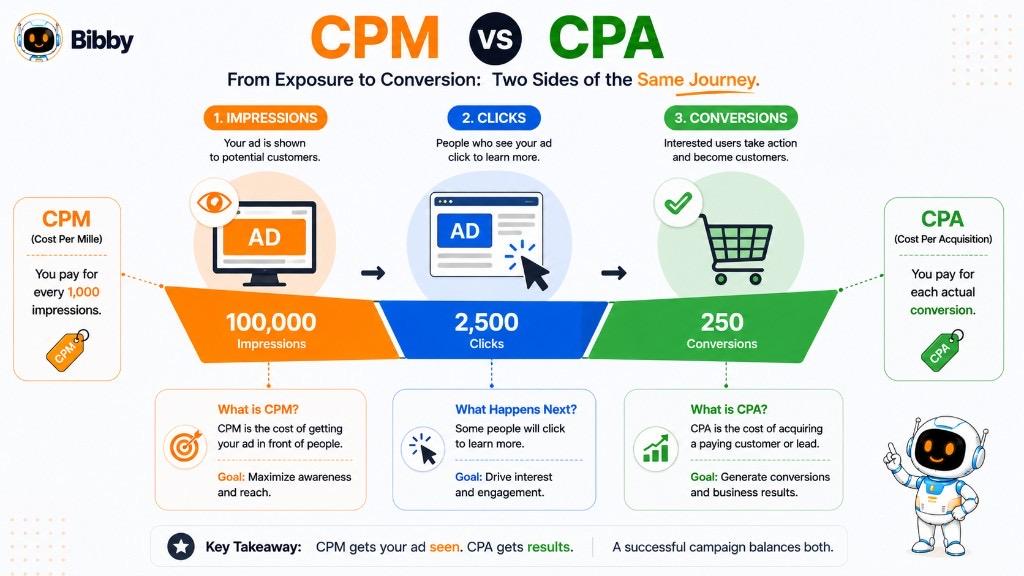
CPM and CPA measure two very different aspects of digital advertising performance. CPM measures the cost of generating 1,000 impressions, while CPA measures the average cost of generating a specific acquisition or conversion.
In simple terms, CPM focuses on exposure, while CPA focuses on results.
What Is CPM?
CPM stands for Cost Per Mille, or cost per 1,000 impressions.
CPM = (Advertising Cost ÷ Impressions) × 1,000
It is commonly used to understand how much an advertiser is paying to get an advertisement in front of an audience.
CPM can be particularly useful for campaigns focused on:
- Brand awareness
- Visibility
- Audience exposure
- Reach
- Content promotion
What Is CPA?
CPA stands for Cost Per Acquisition or Cost Per Action, depending on the advertising platform and campaign context.
It measures how much an advertiser spends, on average, to generate a desired action or acquisition.
CPA = Advertising Cost ÷ Number of Conversions
A conversion could be:
- A purchase
- A completed registration
- A lead
- An app installation
- A subscription
- A form submission
- Another defined campaign action
The specific conversion depends on how the advertiser has configured the campaign.
CPM vs. CPA at a Glance
| Metric | CPM | CPA |
|---|---|---|
| Full form | Cost Per Mille | Cost Per Acquisition/Action |
| Measures | Cost per 1,000 impressions | Cost per conversion/action |
| Primary focus | Exposure | Results |
| Formula | Cost ÷ impressions × 1,000 | Cost ÷ conversions |
| Useful for | Awareness | Lead generation, sales, conversions |
| Requires a conversion? | No | Yes |
CPM and CPA Example
Suppose a business spends $500 on a social media advertising campaign.
The campaign generates:
- 100,000 impressions
- 50 conversions
The CPM is:
($500 ÷ 100,000) × 1,000 = $5
The CPA is:
$500 ÷ 50 = $10
The campaign therefore has a $5 CPM and a $10 CPA.
These metrics tell two different stories.
The CPM shows that the business spent an average of $5 for every 1,000 impressions. The CPA shows that it spent an average of $10 for each conversion.
Which Metric Matters More?
That depends on the campaign objective.
For a campaign designed primarily to build awareness, CPM can be an important metric.
For a campaign designed to generate leads, sales, registrations, or other conversions, CPA may be more directly connected to the business goal.
For example, a company launching a new brand may care about efficiently generating millions of relevant impressions. A company running an e-commerce campaign may care much more about how much it costs to generate each purchase.
A Low CPM Does Not Guarantee a Low CPA
This is an important distinction.
A campaign can generate inexpensive impressions but fail to generate conversions.
For example:
Campaign A
- CPM: $2
- CPA: $40
Campaign B
- CPM: $6
- CPA: $15
Campaign A has the lower CPM, but Campaign B generates conversions at a much lower cost.
If the campaign's primary objective is sales, Campaign B may be the stronger performer despite its higher CPM.
Use CPM and CPA Together
CPM and CPA can provide complementary information.
CPM tells you about the cost of exposure.
CPA tells you about the cost of achieving the desired action.
Looking at both can help marketers understand whether a campaign is efficiently moving from impressions to meaningful business outcomes.
For conversion-focused campaigns, marketers should also consider CTR, CPC, conversion rate, revenue, and ROAS to understand the complete customer journey.
Ultimately, CPM helps answer:
“How much does it cost to generate exposure?”
CPA helps answer:
“How much does it cost to generate a conversion?”
CPM vs. CTR
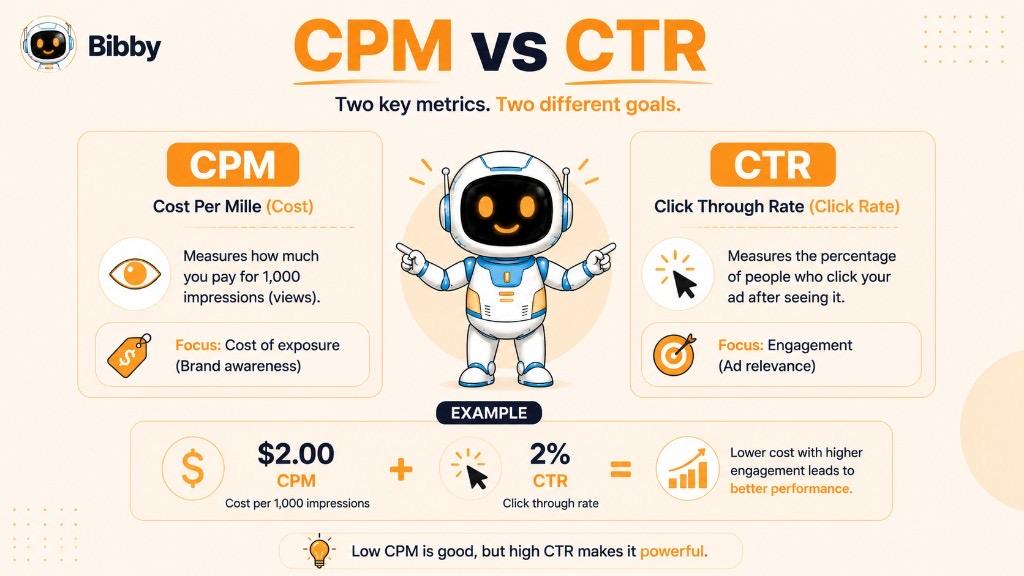
CPM and CTR measure different aspects of advertising performance. CPM measures the cost of generating 1,000 impressions, while CTR measures the percentage of impressions that result in clicks.
In simple terms, CPM measures the cost of exposure, while CTR measures how often people click after seeing an advertisement.
What Is CPM?
CPM stands for Cost Per Mille, meaning the cost per 1,000 impressions.
CPM = (Advertising Cost ÷ Impressions) × 1,000
For example, if an advertiser spends $50 and receives 25,000 impressions:
CPM = ($50 ÷ 25,000) × 1,000 = $2
The advertiser has a $2 CPM.
What Is CTR?
CTR stands for Click-Through Rate.
It measures the percentage of impressions that resulted in clicks.
CTR = (Clicks ÷ Impressions) × 100
For example, if an advertisement receives 25,000 impressions and 500 clicks:
CTR = (500 ÷ 25,000) × 100 = 2%
The advertisement has a 2% CTR.
CPM vs. CTR at a Glance
| Metric | CPM | CTR |
|---|---|---|
| Full form | Cost Per Mille | Click-Through Rate |
| Measures | Cost of impressions | Percentage of clicks |
| Focus | Advertising cost | User response |
| Formula | Cost ÷ impressions × 1,000 | Clicks ÷ impressions × 100 |
| Expressed as | Currency | Percentage |
| Useful for | Measuring exposure cost | Measuring click engagement |
CPM and CTR Example
Imagine a social media campaign generates:
- $100 in advertising spend
- 50,000 impressions
- 1,000 clicks
The CPM is:
($100 ÷ 50,000) × 1,000 = $2
The CTR is:
(1,000 ÷ 50,000) × 100 = 2%
The campaign therefore has a $2 CPM and a 2% CTR.
The CPM tells you how much the advertising exposure cost. The CTR tells you how frequently people clicked after being exposed to the advertisement.
Can You Have a Low CPM and Low CTR?
Yes.
A campaign might generate a large number of inexpensive impressions but very few clicks.
For example:
- CPM: $2
- CTR: 0.3%
This could indicate that the campaign is generating affordable exposure but that the advertisement is not motivating many users to click.
Possible factors could include:
- Weak creative
- Poor audience relevance
- Unclear messaging
- Weak call to action
- Low purchase intent
These factors should be investigated rather than assuming the CPM itself is the problem.
Can You Have a High CPM and High CTR?
Yes.
A campaign targeting a highly valuable or competitive audience might have a higher CPM but also generate strong engagement.
For example:
- CPM: $8
- CTR: 3%
The higher CPM means exposure costs more, but the high CTR indicates that a larger proportion of impressions are resulting in clicks.
Whether the campaign is successful depends on what happens after those clicks, including conversions and revenue.
Why CPM and CTR Should Be Evaluated Together
Looking at CPM alone tells you about the cost of exposure.
Looking at CTR alone tells you about click behavior.
Looking at both provides a better understanding of how efficiently an advertisement is being delivered and how users are responding to it.
For example:
Low CPM + Low CTR
Affordable exposure, but potentially weak engagement.
High CPM + High CTR
More expensive exposure, but potentially stronger audience response.
Low CPM + High CTR
Potentially efficient exposure and strong engagement.
High CPM + Low CTR
Expensive exposure with weak click response, which may require further investigation.
These combinations are not definitive diagnoses, but they provide useful signals for campaign analysis.
CPM and CTR Are Not Conversion Metrics
Neither CPM nor CTR tells you whether an advertising campaign generated revenue.
A user may click an advertisement without purchasing anything. Similarly, an advertisement may generate many impressions without generating clicks.
For conversion-focused campaigns, marketers should also examine CPC, conversion rate, CPA, revenue, and ROAS.
Together, these metrics help marketers understand the journey from:
Impression → Click → Conversion → Revenue
CPM measures the cost at the first stage of that journey, while CTR helps measure the transition from an impression to a click.
CPM vs. Reach
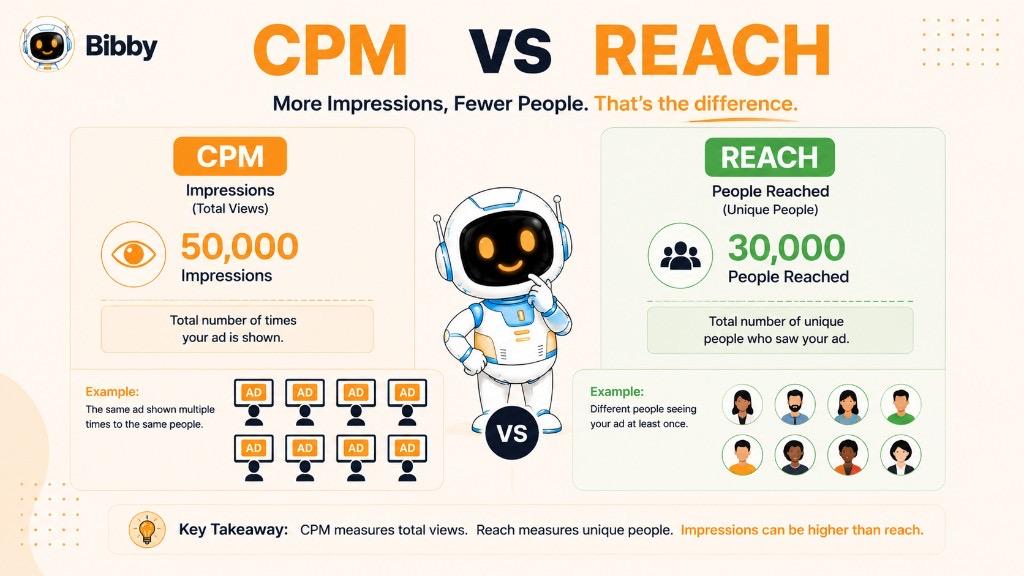
CPM and reach measure two different things. CPM measures the cost of generating 1,000 impressions, while reach measures the number of unique people or accounts who were exposed to an advertisement or piece of content.
The easiest way to remember the difference is:
CPM = Cost of impressions
Reach = Number of unique people reached
What Is CPM?
CPM stands for Cost Per Mille and represents the average cost of generating 1,000 impressions.
CPM = (Advertising Cost ÷ Impressions) × 1,000
For example, if a campaign spends $100 and generates 50,000 impressions:
CPM = ($100 ÷ 50,000) × 1,000 = $2
The campaign has a $2 CPM.
What Is Reach?
Reach represents the number of unique users or accounts who were exposed to the content or advertisement, according to the platform's measurement system.
For example, a campaign might generate:
- 50,000 impressions
- 30,000 people reached
This means the advertisement generated 50,000 total impressions while reaching 30,000 unique people.
The difference exists because the same person can see an advertisement more than once.
CPM vs. Reach at a Glance
| Metric | CPM | Reach |
|---|---|---|
| Measures | Cost per 1,000 impressions | Unique people/accounts reached |
| Focus | Cost | Audience size |
| Includes repeated exposure? | Yes, through impressions | No, intended to represent unique exposure |
| Expressed as | Currency | Number of people/accounts |
| Main use | Measuring exposure cost | Measuring audience coverage |
Impressions vs. Reach
Understanding the difference between impressions and reach is essential when interpreting CPM.
Impressions represent the total number of times content or an advertisement is displayed.
Reach represents the number of unique people or accounts exposed to it.
For example:
100,000 impressions + 40,000 reach
does not mean 100,000 different people saw the advertisement. Some of those 40,000 people may have seen it multiple times.
Why Does the Difference Matter?
Suppose two campaigns both generate 100,000 impressions.
Campaign A
- Reach: 90,000
- Impressions: 100,000
Campaign B
- Reach: 30,000
- Impressions: 100,000
Both campaigns generated the same number of impressions, but they distributed those impressions differently.
Campaign A reached a much larger unique audience, while Campaign B generated more repeated exposure among a smaller audience.
Which one is better depends on the campaign objective.
For a campaign focused on introducing a brand to new people, broader reach may be valuable. For a campaign designed to reinforce a message among an existing audience, repeated exposure may be useful.
How Frequency Connects CPM and Reach
Frequency represents the average number of times each person in the reached audience was exposed to an advertisement.
A simplified calculation is:
Frequency = Impressions ÷ Reach
For example:
100,000 impressions ÷ 40,000 reach = 2.5 frequency
This means the campaign generated an average of approximately 2.5 impressions per person reached.
Frequency provides useful context when analyzing CPM and reach together.
Can a Low CPM Still Have Poor Reach?
Yes.
A campaign can generate impressions at a relatively low cost while reaching a smaller unique audience multiple times.
This is why marketers should not assume that a low CPM automatically means the campaign is reaching more people.
Similarly, a higher CPM may still be acceptable if the campaign is efficiently reaching a highly relevant audience.
CPM, Reach, and Impressions Work Together
These metrics answer different questions:
CPM: How much did the exposure cost?
Impressions: How many times was the advertisement displayed?
Reach: How many unique people or accounts were exposed?
Frequency: How often were those people exposed on average?
Looking at all four metrics together gives marketers a much clearer picture of how an advertising campaign is distributing its exposure.
For social media campaigns, this broader view is often more useful than judging performance based on CPM alone.
CPM vs. CPC vs. CPA vs. CTR
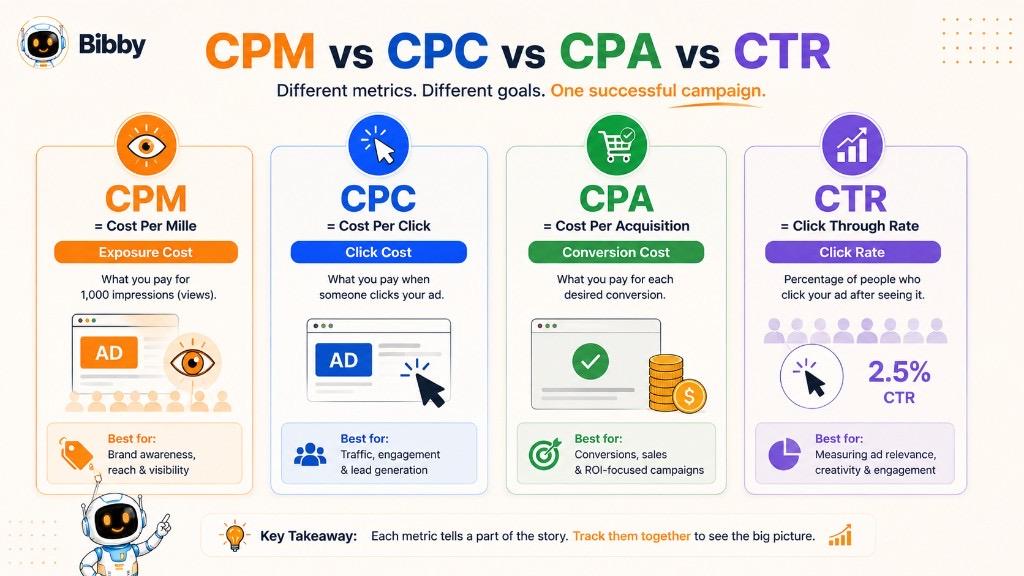
CPM, CPC, CPA, and CTR are some of the most commonly used metrics in digital advertising. Although they are often discussed together, each one measures a different part of campaign performance.
Understanding the difference helps marketers choose the right metric for their campaign objective instead of relying on a single number.
CPM
CPM stands for Cost Per Mille, or cost per 1,000 impressions.
Formula:
CPM = (Advertising Cost ÷ Impressions) × 1,000
CPM measures the cost of generating advertising exposure.
It is particularly useful for campaigns focused on:
- Brand awareness
- Visibility
- Audience exposure
- Reach
- Content promotion
CPC
CPC stands for Cost Per Click.
It measures the average amount paid for each click generated by an advertisement.
Formula:
CPC = Advertising Cost ÷ Clicks
CPC is useful when the campaign is designed to drive traffic to a website, landing page, app, product page, or another destination.
CPA
CPA stands for Cost Per Acquisition or Cost Per Action.
It measures the average cost of generating a defined conversion or action.
Formula:
CPA = Advertising Cost ÷ Conversions
Depending on the campaign, a conversion might be a purchase, lead, registration, app installation, subscription, or another desired action.
CPA is particularly useful for campaigns focused on measurable business outcomes.
CTR
CTR stands for Click-Through Rate.
It measures the percentage of impressions that resulted in clicks.
Formula:
CTR = (Clicks ÷ Impressions) × 100
Unlike CPM, CPC, and CPA, CTR is expressed as a percentage rather than a currency value.
CTR helps marketers understand how effectively an advertisement encourages users to click.
CPM vs. CPC vs. CPA vs. CTR at a Glance
| Metric | Full Form | Measures | Formula | Usually Useful For |
|---|---|---|---|---|
| CPM | Cost Per Mille | Cost per 1,000 impressions | Cost ÷ impressions × 1,000 | Awareness and exposure |
| CPC | Cost Per Click | Cost per click | Cost ÷ clicks | Traffic |
| CPA | Cost Per Acquisition/Action | Cost per conversion | Cost ÷ conversions | Leads and conversions |
| CTR | Click-Through Rate | Percentage of impressions producing clicks | Clicks ÷ impressions × 100 | Engagement and ad response |
A Simple Campaign Example
Imagine a business spends $500 on a social media advertising campaign and generates:
- 100,000 impressions
- 2,000 clicks
- 100 conversions
The campaign metrics would be:
CPM:
($500 ÷ 100,000) × 1,000 = $5
CPC:
$500 ÷ 2,000 = $0.25
CTR:
(2,000 ÷ 100,000) × 100 = 2%
CPA:
$500 ÷ 100 = $5
So the campaign has:
Each number describes a different stage of the advertising journey.
How These Metrics Connect
These metrics can be viewed as a sequence:
Impressions → Clicks → Conversions
CPM helps measure the cost of generating the initial exposure.
CTR helps measure how frequently people click after seeing the advertisement.
CPC shows the average cost of generating those clicks.
CPA measures the average cost of turning advertising spend into the desired conversions.
This creates a more complete picture of campaign performance.
Which Metric Should You Focus On?
The most important metric depends on the campaign objective.
For brand awareness:
CPM, reach, impressions, and frequency may be particularly important.
For website traffic:
CTR and CPC can provide useful insight into traffic generation.
For lead generation:
CPA, conversion rate, lead quality, and CPC can be important.
For e-commerce sales:
CPA, conversion value, revenue, and ROAS are often more closely connected to business performance.
There is no single metric that can determine whether every advertising campaign is successful.
Why You Shouldn't Optimize Only for CPM
A low CPM can mean that you are generating impressions cheaply, but it does not tell you whether those impressions are valuable.
For example, a campaign could have a very low CPM but produce almost no clicks or conversions. Another campaign could have a higher CPM while generating highly qualified traffic and significantly more sales.
The same principle applies to CPC, CPA, and CTR. Each metric provides a useful piece of information, but none tells the entire story by itself.
For this reason, marketers should evaluate advertising metrics according to the campaign objective, audience quality, and final business outcome.
A strong analysis looks beyond individual numbers and asks whether the campaign is efficiently moving users from exposure to engagement and, ultimately, to meaningful results.
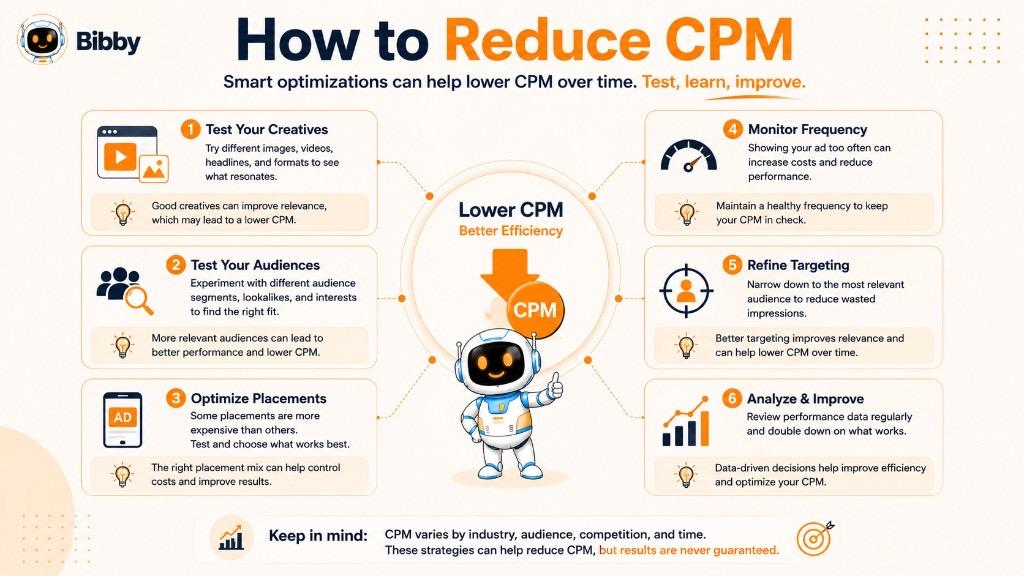
How to Reduce CPM
A high CPM can indicate that your advertising exposure is becoming more expensive, but the solution is not always to simply chase the lowest possible number. The goal should be to reduce unnecessary advertising costs while continuing to reach a relevant and valuable audience.
Several strategies can help marketers improve CPM efficiency.
1. Improve Your Ad Creative
Your creative is one of the first things users encounter. Testing stronger images, videos, headlines, messaging, and calls to action can help improve how audiences respond to your advertisements.
Instead of repeatedly using the same creative, test different concepts and formats to identify what resonates with your audience.
2. Test Different Audiences
Your target audience can have a significant effect on CPM.
Test different audience segments to determine whether some groups are more expensive to reach than others.
You might compare:
- Broad audiences
- Interest-based audiences
- Demographic segments
- Geographic audiences
- Retargeting audiences
- Lookalike or similar audiences, where available
The objective should be to find an audience that balances relevance, scale, and advertising cost.
3. Avoid Unnecessarily Narrow Targeting
Highly restrictive targeting can reduce the amount of available advertising inventory and increase competition for a small audience.
If your targeting is too narrow, consider testing a broader but still relevant audience.
However, broader targeting is not automatically better. The audience still needs to align with the campaign objective and potential customer profile.
4. Test Ad Placements
Different advertising placements can have different costs and performance characteristics.
Test available placements to determine where your campaigns generate useful exposure efficiently.
Rather than choosing placements solely because they have the lowest CPM, compare CPM with metrics such as CTR, CPC, conversions, CPA, and overall campaign value.
5. Refresh Ad Creative Regularly
Repeatedly showing the same advertisement to the same audience can lead to creative fatigue.
As users see an advertisement multiple times, engagement may change and campaign efficiency can decline.
Refreshing creative can help keep the content relevant and provide the platform with new material to test.
6. Improve Audience Relevance
Advertising to people who have little interest in your product can result in poor campaign performance.
Review your targeting and make sure your message matches the audience you are trying to reach.
For example, an advertisement for enterprise software should be designed and targeted differently from an advertisement for a consumer product.
Better audience-message alignment can improve overall campaign efficiency.
7. Test Different Campaign Objectives
Advertising platforms can optimize campaigns differently depending on the selected objective.
If your campaign objective does not match what you actually want users to do, the campaign may not deliver the type of results you need.
Before changing the objective simply to reduce CPM, make sure it aligns with the real purpose of the campaign.
8. Monitor Frequency
A rising frequency can indicate that the same users are seeing an advertisement repeatedly.
If frequency becomes too high for your particular campaign, consider testing new creative or expanding the audience.
The appropriate frequency depends on the campaign, audience, message, and objective, so there is no universal number that is automatically too high.
9. Consider Timing and Seasonality
Advertising costs can change based on market demand.
If your campaign is flexible, testing different periods may help identify times when your target audience can be reached more efficiently.
However, campaigns tied to specific events, launches, holidays, or seasonal demand may need to run during higher-cost periods regardless of CPM.
10. Compare Performance, Not Just CPM
One of the most important ways to improve CPM efficiency is to stop treating CPM as the only goal.
Compare CPM with:
A campaign with a slightly higher CPM may deliver much better results than a campaign with a lower CPM.
Don't Sacrifice Audience Quality to Lower CPM
It can be tempting to make targeting broader or change campaign settings simply to obtain a lower CPM.
That approach can backfire if the cheaper impressions are less relevant to your business.
The objective should be:
Lower unnecessary cost + relevant audience + strong creative + meaningful results
rather than:
Lowest possible CPM at any cost
A good advertising strategy focuses on the value generated by the impressions, not simply the price of those impressions.
CPM in Organic Social Media
CPM is primarily a paid advertising metric because it relates advertising spend to the number of impressions generated. Organic social media posts do not normally have a traditional CPM because there is no direct media cost associated with each impression.
For example, if a business publishes an organic Instagram post and it receives 20,000 impressions, there is no advertising spend to divide by those impressions. Therefore, the post does not have a traditional paid-media CPM.
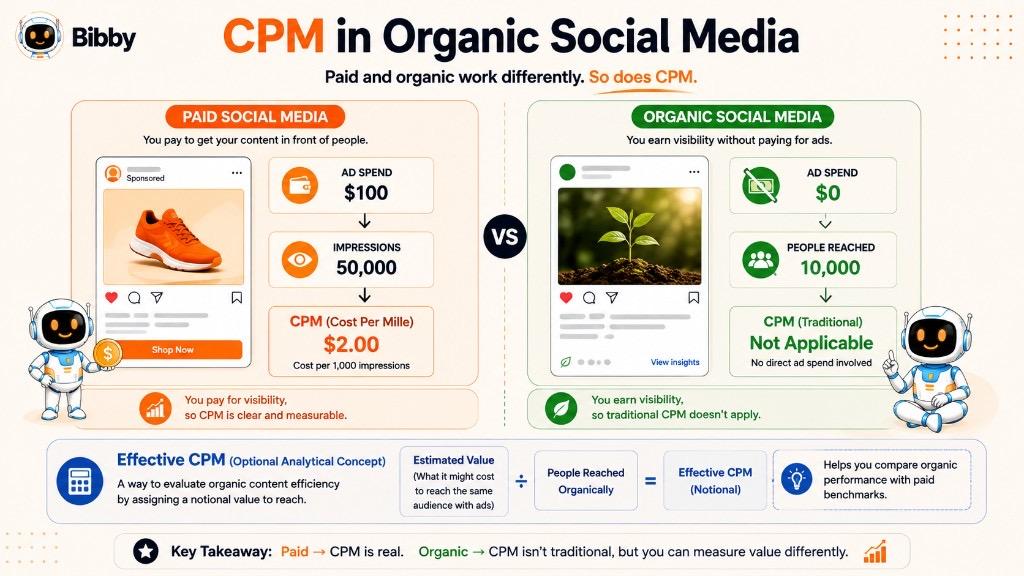
However, marketers can calculate an effective CPM for organic content by assigning a cost to the resources used to create and distribute that content.
What Is Effective CPM?
Effective CPM can be used to estimate the cost of generating 1,000 organic impressions.
A simplified formula is:
Effective CPM = (Content Cost ÷ Organic Impressions) × 1,000
For example, suppose a business spends $200 on creating and promoting an organic content campaign through internal resources and receives 100,000 organic impressions.
Effective CPM = ($200 ÷ 100,000) × 1,000
Effective CPM = $2
This means the estimated cost of generating 1,000 organic impressions is $2 based on the assigned content cost.
Paid CPM vs. Organic Effective CPM
The two concepts should not be treated as identical.
| Metric | Paid CPM | Organic Effective CPM |
|---|---|---|
| Based on | Advertising spend | Assigned content/production cost |
| Measures | Cost of paid impressions | Estimated cost of organic exposure |
| Standard advertising metric | Yes | No |
| Common use | Paid social advertising | Internal content analysis |
| Calculation | Ad spend ÷ impressions × 1,000 | Content cost ÷ impressions × 1,000 |
Paid CPM is a standard advertising metric reported or derived from paid campaign data. Effective CPM for organic content is an analytical calculation that depends on how a business assigns costs to content production.
Why Marketers Might Calculate Organic CPM
Businesses that invest heavily in content creation may want to understand how efficiently their content generates exposure.
For example, a company could compare the estimated cost efficiency of:
- Blog content
- Social media posts
- Videos
- Carousels
- Infographics
- User-generated content
- Other organic content formats
This can help marketers understand which content investments generate the most exposure.
However, impressions should not be the only measurement.
A piece of content that generates fewer impressions but produces strong engagement, leads, or sales may be more valuable than content that generates a large number of inexpensive impressions.
CPM and Social Media Automation
Social media automation can help businesses produce and distribute content consistently, but automation itself does not determine the CPM of a paid advertising campaign.
For example, a social media automation platform can help a business:
- Create content
- Generate captions
- Schedule posts
- Maintain a content calendar
- Publish across multiple platforms
- Organize campaigns
- Repurpose content
These activities support the broader social media workflow, while CPM remains a metric used primarily to evaluate paid advertising exposure.
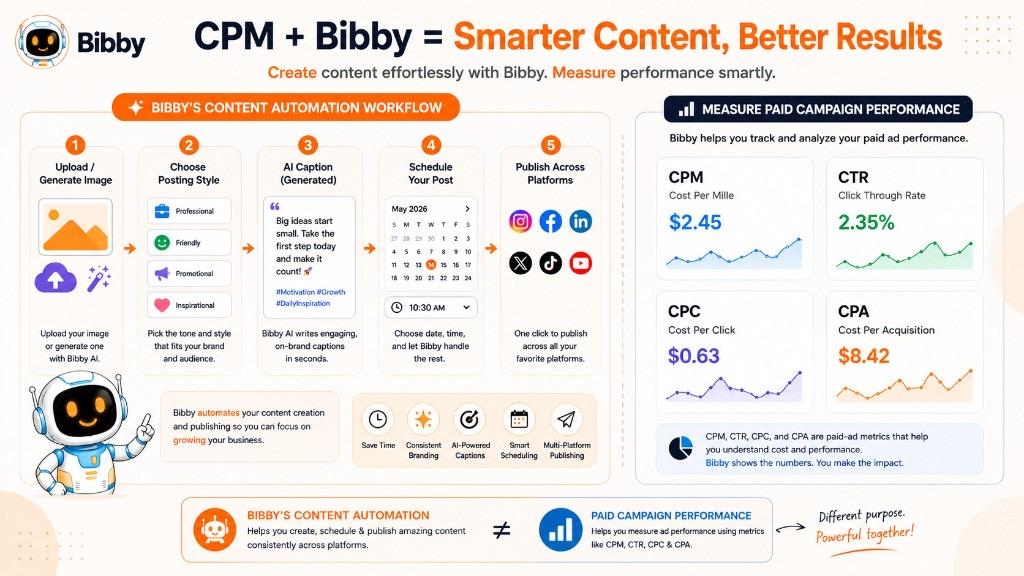
With Bibby, marketers can create or generate social media content, use AI to create captions, organize campaigns, and schedule content across platforms such as Facebook, Instagram, LinkedIn, YouTube, and TikTok. This can help maintain a consistent organic publishing workflow while paid campaigns are measured separately using metrics such as CPM, CPC, CTR, CPA, and ROAS.
Don't Confuse Organic Impressions With Paid Impressions
An important distinction is whether an impression came from paid distribution or organic distribution.
If a business pays to promote an advertisement, the associated advertising spend can be used to calculate CPM.
If a business publishes a regular organic post without paying for distribution, there is no traditional paid CPM attached to those impressions.
Keeping this distinction clear helps marketers avoid mixing paid advertising performance with organic social media performance.
Ultimately, CPM is most useful when analyzing paid media efficiency, while organic content should be evaluated using a broader combination of metrics such as reach, impressions, engagement, shares, saves, clicks, leads, and conversions.
CPM and Content Strategy
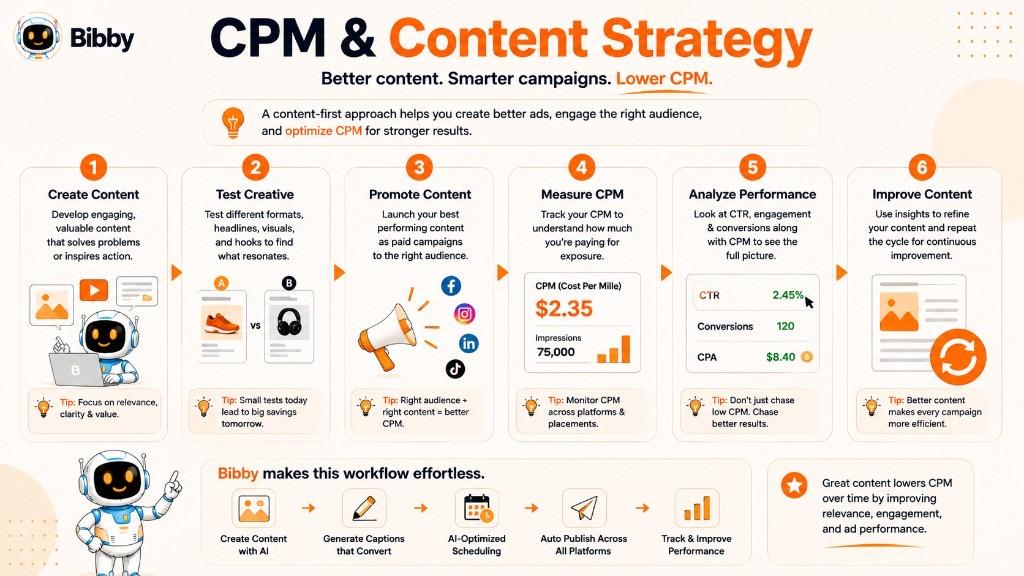
CPM can provide useful insights when planning and optimizing a broader social media content strategy. While CPM is primarily a paid advertising metric, the information it provides can help marketers understand the cost of reaching specific audiences and make better decisions about where to invest their advertising budget.
However, CPM should be treated as one input into content and campaign planning rather than the sole measure of content quality.
Use CPM to Understand Audience Costs
Different audiences can have different advertising costs.
For example, a business might discover that one audience segment consistently produces a lower CPM while another costs significantly more to reach.
This information can help marketers investigate:
- Which audiences are more competitive
- Which segments are more expensive to reach
- Which audiences generate stronger engagement
- Which audiences produce better conversions
- Where additional testing may be worthwhile
A lower CPM can indicate inexpensive exposure, but marketers should still determine whether the audience is relevant and valuable.
Use CPM Alongside Content Performance
CPM becomes more useful when combined with the performance of the content being promoted.
For example:
Content A
- CPM: $3
- CTR: 0.5%
- Low conversion rate
Content B
- CPM: $5
- CTR: 2%
- Strong conversion rate
Content A generates cheaper impressions, but Content B may produce substantially better business results.
This type of comparison can help marketers identify content that is worth promoting even when its exposure costs are somewhat higher.
Identify Content That Deserves More Testing
If a particular creative consistently generates strong engagement and favorable campaign results, marketers may decide to test variations of that creative with different audiences.
For example, a business could experiment with:
- Different headlines
- Different images
- Short-form videos
- Carousels
- Different calls to action
- Different content angles
- Different audience segments
CPM can be monitored alongside CTR, CPC, conversions, and other metrics to determine which combinations perform best.
Don't Create Content Solely to Lower CPM
A common mistake is to treat a low CPM as the ultimate goal.
Content should first be created for a specific audience and purpose.
A piece of content may generate inexpensive impressions but fail to communicate the brand message or motivate users to take action.
Instead, marketers should aim to create content that is:
- Relevant
- Useful
- Engaging
- Consistent with the brand
- Appropriate for the platform
- Aligned with the campaign objective
CPM can then help measure how efficiently that content is being distributed through paid advertising.
CPM Can Inform Paid Content Promotion
Businesses often have more organic content ideas than they have budget to promote.
CPM can become one factor when deciding which content to test with paid distribution.
For example, a marketer might identify several posts that already perform well organically, then test selected variations through paid campaigns.
The marketer can compare CPM alongside engagement, CTR, CPC, conversions, and other results to determine whether paid promotion is generating worthwhile additional exposure.
Connect Paid and Organic Social Media Workflows
Paid advertising and organic social media serve different purposes, but they can support each other.
Organic content can help businesses:
- Build a consistent presence
- Educate their audience
- Strengthen brand recognition
- Test content ideas
- Maintain engagement
Paid advertising can help businesses:
- Reach targeted audiences
- Scale content distribution
- Generate additional exposure
- Promote specific campaigns
- Support lead-generation or sales objectives
A social media automation platform such as Bibby can help manage the organic publishing workflow by allowing marketers to create content, generate captions, organize campaigns, and schedule posts across multiple social platforms.
This allows marketers to spend less time handling repetitive publishing tasks and more time analyzing performance metrics such as CPM, CTR, CPC, CPA, conversions, and ROAS.
Use CPM as a Signal, Not a Verdict
A change in CPM should prompt a question rather than an immediate decision.
If CPM rises, ask:
“Why did the cost of exposure increase?”
If CPM falls, ask:
“Did the cheaper exposure produce valuable results?”
This approach prevents marketers from optimizing for a single metric while ignoring the larger objective.
The strongest content strategy connects creative quality, audience relevance, distribution cost, engagement, conversions, and business outcomes.
CPM helps measure one important part of that equation: the cost of generating advertising exposure.
Common CPM Mistakes
CPM is a simple metric to calculate, but it is easy to misinterpret. Marketers sometimes focus too heavily on CPM or compare numbers without considering the audience, campaign objective, or business outcome.
Here are some of the most common CPM mistakes to avoid.
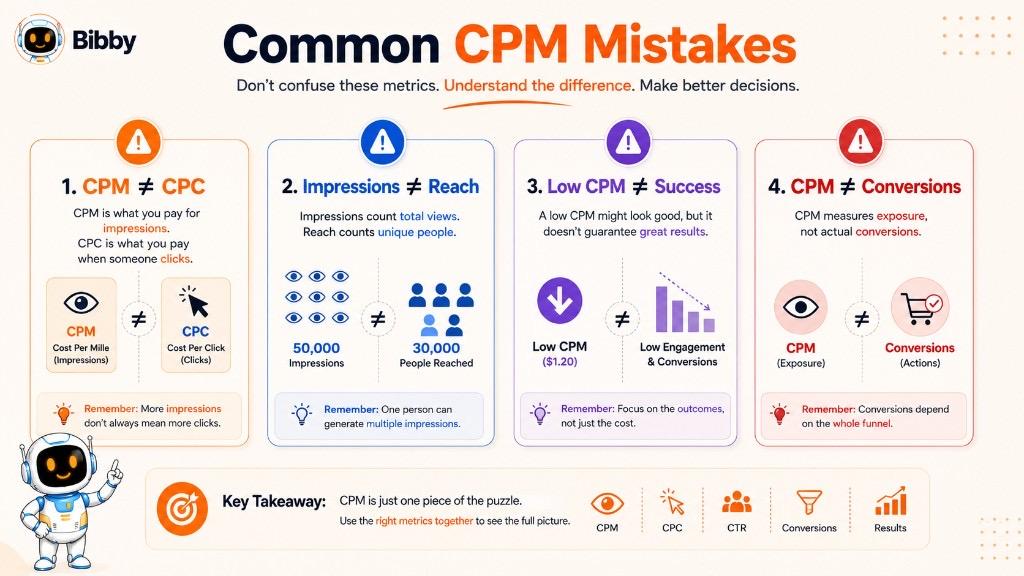
1. Assuming a Lower CPM Is Always Better
A lower CPM means you are paying less for 1,000 impressions, but it does not guarantee better campaign performance.
Cheap impressions are only valuable when they reach a relevant audience and contribute to the campaign objective.
Always evaluate CPM alongside metrics such as CTR, CPC, conversions, CPA, and ROAS.
2. Confusing Impressions With Reach
Impressions and reach are not the same thing.
Impressions represent the total number of times an advertisement is displayed.
Reach represents the number of unique people or accounts exposed to the content, according to the platform's measurement system.
For example, 100,000 impressions do not necessarily mean 100,000 different people saw the advertisement.
3. Assuming CPM Measures Clicks
CPM measures the cost of impressions, not clicks.
If you want to understand the cost of generating clicks, look at CPC.
If you want to understand how frequently users click after seeing an advertisement, look at CTR.
4. Treating CPM as a Conversion Metric
CPM does not tell you how many people purchased a product, submitted a form, installed an app, or completed another desired action.
A campaign can have an excellent CPM and still generate very few conversions.
For conversion-focused campaigns, examine metrics such as conversion rate, CPA, conversion value, and ROAS.
5. Comparing CPM Across Unrelated Campaigns
Comparing CPM between completely different campaigns can lead to misleading conclusions.
For example, a campaign targeting a broad consumer audience should not automatically be compared with a campaign targeting a highly specialized B2B audience.
Consider differences in:
- Audience
- Location
- Platform
- Campaign objective
- Ad format
- Placement
- Industry
- Time period
Whenever possible, compare campaigns with similar characteristics.
6. Ignoring Seasonality
Advertising costs can change throughout the year.
Major holidays, shopping events, product launches, and other periods of high advertiser demand can affect campaign costs.
A higher CPM during a competitive period does not necessarily mean campaign performance has deteriorated.
7. Using Outdated CPM Benchmarks
There is no permanent CPM benchmark that applies to every business or platform.
Advertising environments change, and CPM can vary based on market conditions, audience demand, competition, and campaign setup.
Use current, relevant data and prioritize your own historical campaign performance over generic benchmarks.
8. Optimizing Only for CPM
Trying to reduce CPM at all costs can lead marketers toward the wrong decisions.
For example, expanding an audience may lower CPM but reduce audience relevance. Changing placements may reduce CPM but also reduce conversions.
Optimization should focus on the campaign objective, not just the cheapest possible impressions.
9. Ignoring Frequency
A campaign can generate a large number of impressions without reaching many additional people.
If the same audience repeatedly sees an advertisement, frequency can increase.
Looking at CPM together with reach and frequency helps marketers understand whether impressions are coming from broader audience exposure or repeated exposure to the same users.
10. Forgetting the Business Outcome
Ultimately, advertising exists to support a business objective.
Depending on the campaign, that objective could be:
- Brand awareness
- Website traffic
- Leads
- App installs
- Purchases
- Subscriptions
- Revenue
CPM can help measure the cost of exposure, but it does not determine whether the campaign achieved its business goal.
The Best Way to Use CPM
The most effective approach is to treat CPM as one part of a larger performance picture.
Instead of asking only:
“Is my CPM low?”
ask:
“Am I reaching the right audience at an efficient cost, and is that exposure helping me achieve my campaign objective?”
That question leads to much better advertising decisions than optimizing a single metric in isolation.
Key Takeaways
- CPM (Cost Per Mille) measures the average cost of generating 1,000 impressions—you calculate it by dividing total advertising cost by total impressions, then multiplying by 1,000.
- A good CPM depends on your campaign objective, audience, industry, platform, and conversion performance—not a universal benchmark.
- Evaluate CPM alongside click-through rate (CTR), CPC, conversion rate, CPA, reach, frequency, and return on ad spend (ROAS) rather than treating it as the only measure of success.
- Reducing CPM can stretch your budget further, but the cheapest impressions aren't always the most valuable—focus on relevant audience targeting, strong creative, and meaningful engagement.
- Your social media content strategy and organic performance can inform paid creative, creating a feedback loop between content, engagement, and paid advertising efficiency.
- Bibby can streamline the content workflow that supports smarter campaigns—generating visuals, writing captions, and scheduling at AI-optimized times across multiple platforms.
- Once you understand CPM, explore how CPC, CTR, CPA, conversion rate, and ROAS work together for a clearer picture of campaign profitability.