
Reach is a social media metric that measures the number of unique users who have seen your content.
If you want to understand how far your social media content actually travels, reach is one of the most useful metrics to track. It tells you how many different people your content reached, while helping you distinguish audience exposure from total views or impressions.
In this guide, you will learn:
- What reach means and how it is calculated
- How reach differs from impressions, views, and engagement
- How to increase your social media reach effectively
Let’s start by looking at exactly what reach means on social media.
What Does Reach Mean on Social Media?
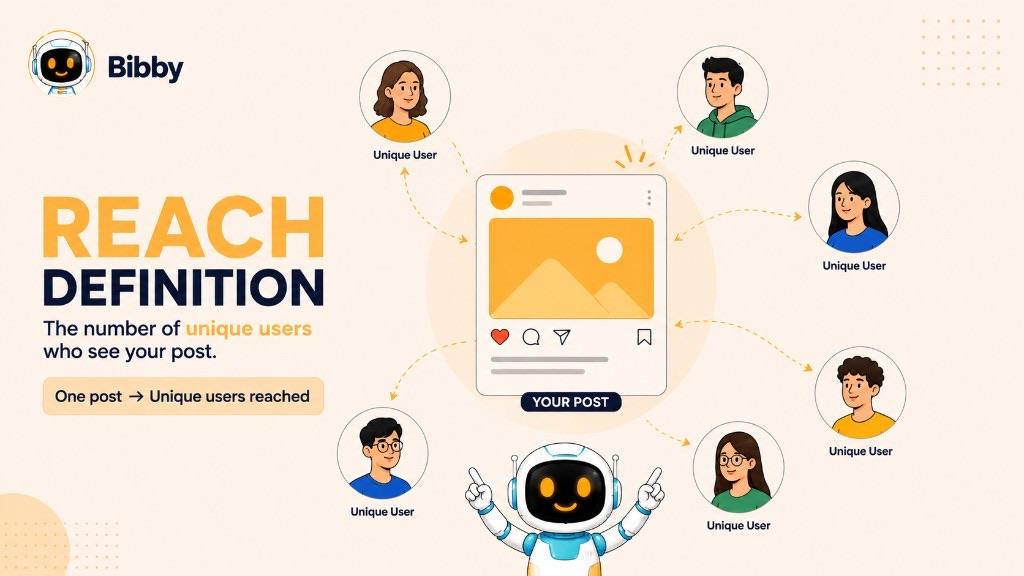
Reach is the number of unique users who see your social media content at least once. In simple terms, it tells you how many different people your content was exposed to, rather than how many total times it was displayed.
For example, if 10,000 different people see an Instagram post, its reach is 10,000. If some of those people see the same post several times, they generally still count as one person in the reach figure.
This makes reach useful for understanding the size of the audience your content actually reached. A post with high reach has been exposed to a larger group of people, while a post with low reach has been shown to a smaller audience.
However, reach does not tell you whether people liked, commented on, shared, saved, or clicked your content. It measures exposure, not audience response. To understand how people responded, you need to look at engagement and other performance metrics alongside reach.
Reach can also come from different sources, including your existing followers, recommendations, shares, search, and paid promotion. The exact way reach is measured and reported can vary between social media platforms.
How Is Social Media Reach Calculated?
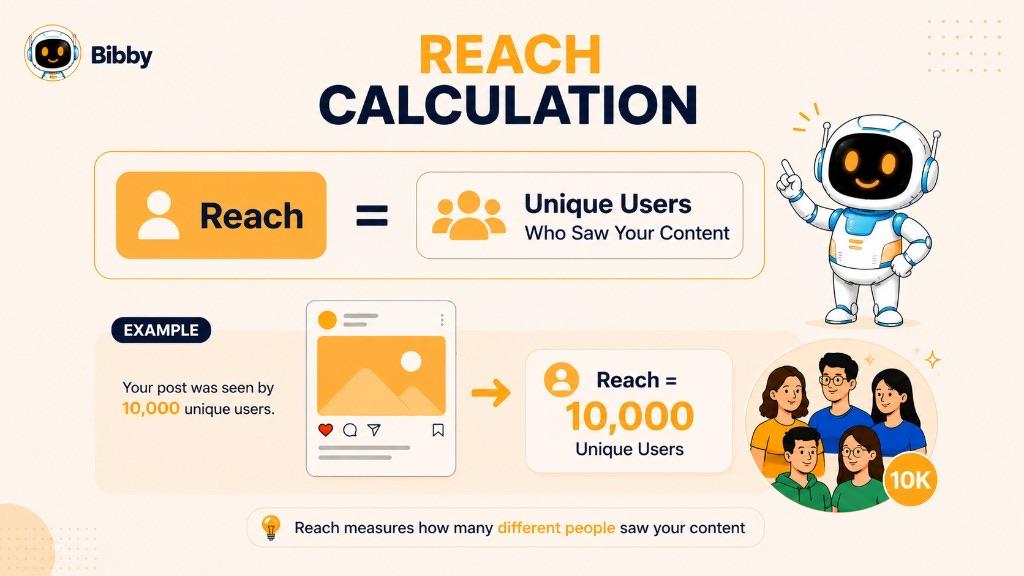
Social media reach is calculated by counting the unique users who were exposed to your content during a specific period or through a specific piece of content.
The basic concept is:
Reach = Number of unique users who saw your content
For example, suppose 5,000 people see your post. If 1,000 of those people see it again later, your reach remains approximately 5,000 because those repeat exposures come from the same users.
This is why reach is different from simply counting views or impressions. Adding every time your content appears would measure total exposure, not the number of unique people exposed to it.
What Can Affect Your Reach Calculation?
The reach reported by a social media platform can depend on several factors, including:
- Time period: Reach can be reported for a specific post, campaign, or date range.
- Content format: Posts, videos, Stories, carousels, and other formats may have different reporting methods.
- Distribution: Content can reach followers as well as people who discover it through recommendations, shares, search, or other distribution channels.
- Paid promotion: Promoted content can reach additional users through advertising.
- Platform measurement: Each social network can use its own definitions and measurement systems.
Because of these differences, reach figures should generally be compared within the same platform and under similar conditions rather than assuming that the metric means exactly the same thing everywhere.
The most important point is simple: reach focuses on people, while impressions and views focus on exposures or plays. Understanding that distinction makes your social media analytics much easier to interpret.
Reach vs. Impressions: What’s the Difference?
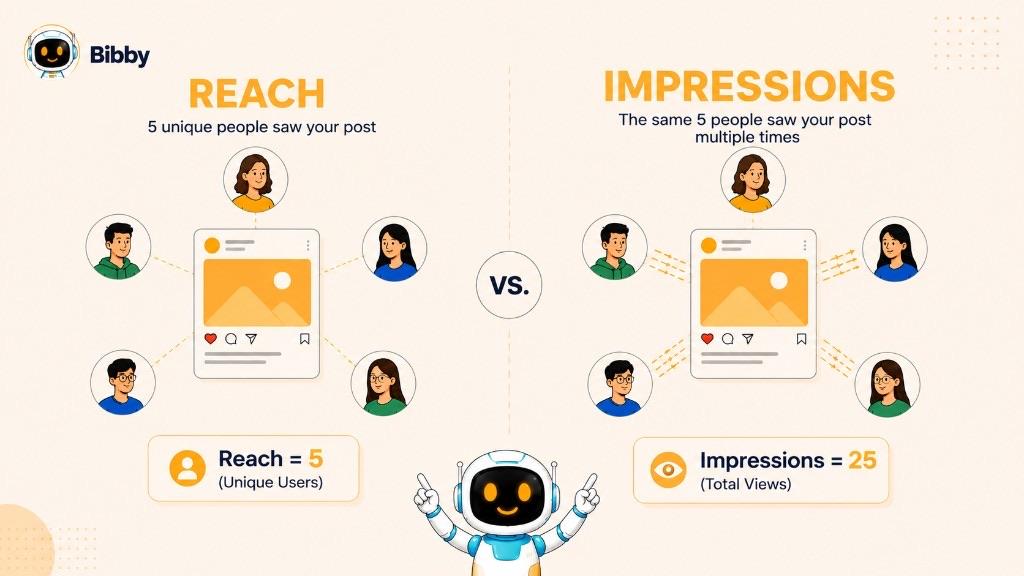
Reach and impressions both measure how much exposure your social media content receives, but they answer different questions.
Reach tells you how many unique users saw your content. Impressions tell you how many total times your content was displayed.
| Metric | What it measures | Repeat exposure counted? | Example |
|---|---|---|---|
| Reach | Unique users exposed to content | Generally no | 10,000 |
| Impressions | Total content displays | Yes | 25,000 |
For example, imagine you publish a post that is seen by 10,000 unique users. If those users collectively see the post 25,000 times, the post can have a reach of 10,000 and 25,000 impressions.
The difference becomes important when evaluating how widely your content is being distributed. Reach tells you the size of the audience exposed to your content, while impressions show how frequently the content was displayed to that audience.
How Do Reach and Impressions Work Together?
Looking at both metrics can reveal more than either metric alone.
You can estimate average exposure frequency with:
Average Frequency = Impressions ÷ Reach
Using the example above:
25,000 ÷ 10,000 = 2.5
This means the content generated an average of 2.5 impressions per person reached.
A high reach with relatively few impressions can indicate that your content is being exposed broadly without much repeated exposure. A lower reach with substantially higher impressions can indicate that a smaller audience is seeing the content multiple times.
Neither situation is automatically better. The right balance depends on your objective. Awareness campaigns may prioritize reaching more unique people, while campaigns designed to reinforce a message may benefit from repeated exposure.
For that reason, reach and impressions should be analyzed together rather than treating one metric as a universal measure of social media success.
Reach vs. Engagement: What’s the Difference?
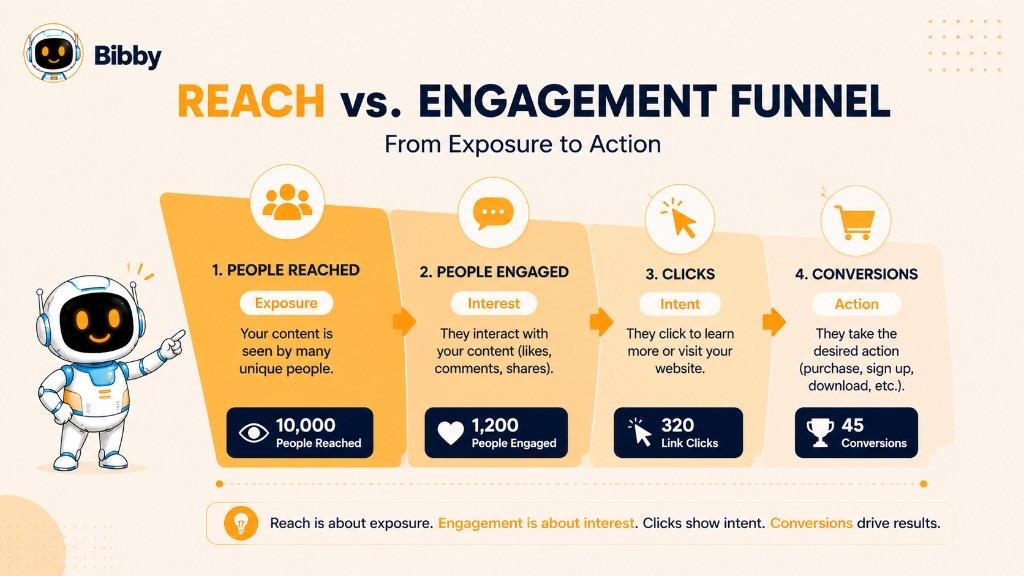
Reach measures how many unique users saw your content, while engagement measures how users interacted with it.
Someone can see your post without liking, commenting, sharing, saving, clicking, or taking any other measurable action. That person contributes to your reach but may not contribute to your engagement.
| Metric | What it measures | Example |
|---|---|---|
| Reach | Unique users who saw the content | 10,000 |
| Engagement | Interactions with the content | 800 |
For example, if 10,000 unique users see a post and it receives 800 combined likes, comments, shares, and saves, the post has a reach of 10,000 and 800 recorded interactions.
Why Does the Difference Matter?
Reach helps you understand distribution. It tells you how many people your content managed to get in front of.
Engagement helps you understand response. It gives you insight into whether people found the content interesting, useful, entertaining, or relevant enough to interact with.
This means a post can have:
- High reach and low engagement: Many people saw it, but relatively few interacted.
- Low reach and high engagement: A smaller audience saw it, but the content resonated strongly with them.
- High reach and high engagement: The content reached a broad audience and generated significant interaction.
- Low reach and low engagement: The content had limited distribution and generated little response.
For a complete picture of content performance, look at reach alongside engagement, impressions, clicks, conversions, and other metrics relevant to your goal.
Reach tells you how far your content traveled. Engagement tells you what people did after seeing it.
What Are the Different Types of Social Media Reach?
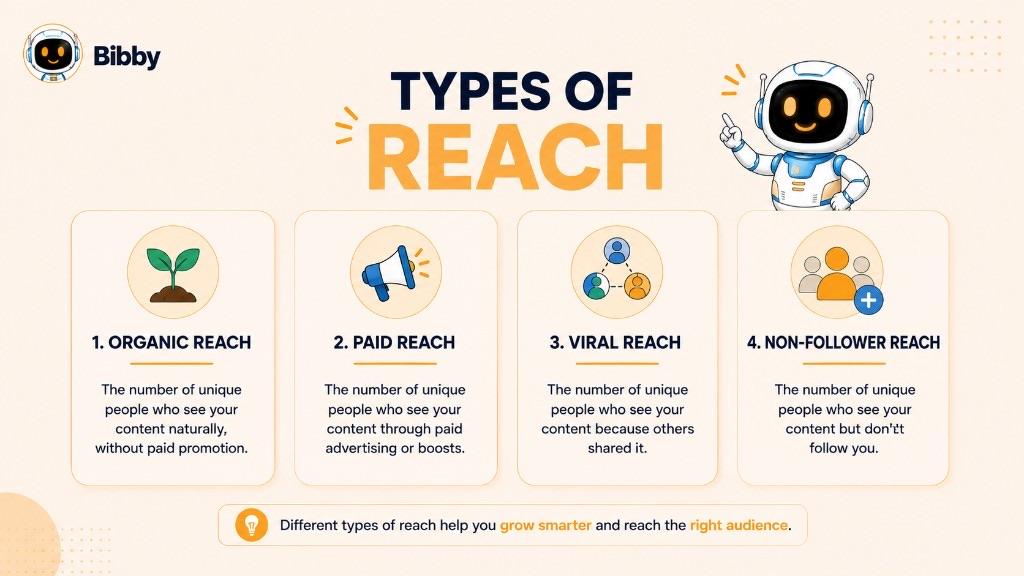
Social media reach can come from different distribution sources. The terminology varies between platforms, but reach is commonly discussed in terms of organic, paid, and viral distribution.
Organic Reach
Organic reach is the number of unique users who see your content through unpaid distribution.
For example, someone might see your post because they follow your account, visit your profile, discover your content through a platform's recommendations, or encounter it after someone shares it.
Organic reach depends on factors such as your audience, content, platform algorithms, engagement, and how your content is distributed.
Paid Reach
Paid reach is the number of unique users who see your content as a result of paid advertising or promotion.
Instead of relying entirely on organic distribution, businesses can pay a platform to show content to a selected audience. Paid reach can therefore help brands expose content to users beyond their existing organic audience.
Paid reach is particularly useful for campaigns focused on objectives such as awareness, traffic, lead generation, or conversions. Paid social campaigns and organic posts should generally be analyzed separately so you know where exposure is coming from.
Viral Reach
Viral reach refers to additional exposure generated when people share, repost, recommend, or otherwise distribute your content to their own networks.
For example, a post published by a brand may initially reach its followers. If those followers share the post, the content can subsequently be exposed to people who do not follow the brand.
Viral distribution can significantly expand the audience for a piece of content without requiring the brand to pay for every additional impression. Viral content is not guaranteed, and not every share produces a large extra audience.
Post-Level and Account-Level Reach
Reach can also be considered at different levels.
Post-level reach refers to the unique users exposed to a particular piece of content, such as a post, video, carousel, or Story.
Account-level reach refers to the unique users reached by an account's content over a defined period.
These measurements answer different questions. Post-level reach helps you identify which individual content performs well, while account-level reach gives you a broader view of how effectively your social media presence is reaching an audience.
Because platforms define and report these categories differently, always check the specific platform's analytics terminology when comparing reach figures.
How Is Reach Measured on Different Social Media Platforms?
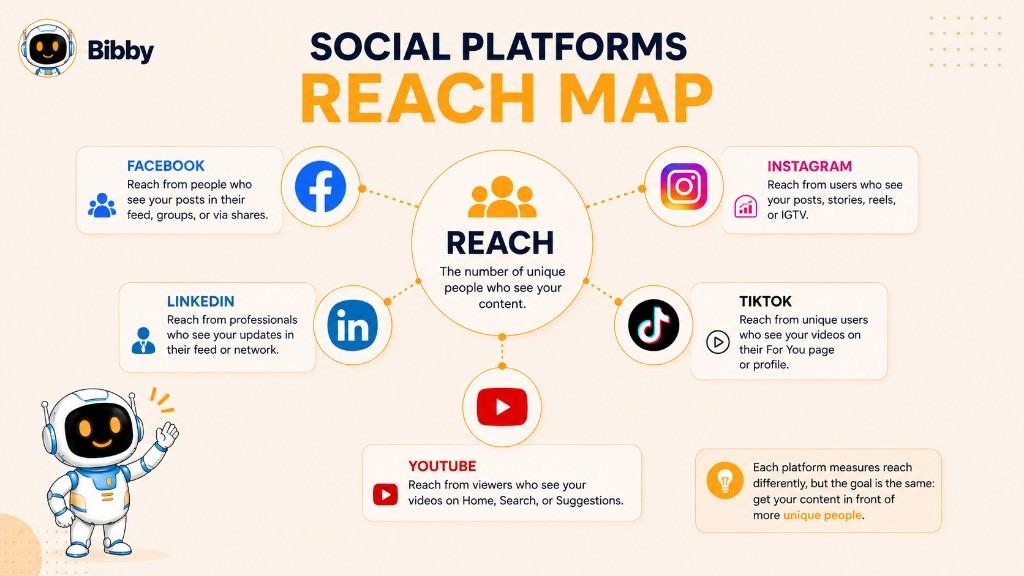
The meaning of reach is broadly consistent across social networks: it refers to the number of unique users exposed to your content. However, the way each platform measures, labels, and reports audience exposure can differ.
That means you should avoid treating a reach figure from one platform as directly equivalent to a similarly sized figure from another.
Facebook Reach
On Facebook, reach generally refers to the number of people who saw content associated with a Page, post, or advertising campaign.
Facebook analytics can separate different sources of distribution, including organic and paid exposure. This can help businesses understand whether content is reaching people naturally or through advertising.
Instagram Reach
Instagram commonly reports reach in terms of accounts reached. This can help you understand how many unique accounts were exposed to your content.
Reach can be analyzed across different Instagram formats, including posts, carousels, Reels, and Stories. Looking at reach by format can help identify which types of content are expanding your audience most effectively.
LinkedIn Reach
LinkedIn provides metrics such as impressions to help measure content distribution. Depending on the analytics view and feature being used, the platform may not present reach in exactly the same way as other social networks.
When evaluating LinkedIn content, avoid automatically treating impressions as unique people. Use the platform's available audience and analytics data to determine how broadly content was actually distributed.
TikTok Reach
TikTok content can be distributed beyond an account's existing followers through recommendation systems and other discovery surfaces, including the For You Page.
Because TikTok content can accumulate multiple views from the same user, video views should not automatically be interpreted as reach. When analyzing audience size, use the platform's available unique-viewer or audience metrics where applicable.
YouTube Reach
YouTube provides several metrics for understanding content exposure, including impressions and unique viewers.
Impressions measure how often eligible thumbnails are shown, while unique viewers estimate the number of individual viewers who watched your content during a selected period. This makes it important to distinguish exposure metrics from actual audience size when analyzing YouTube performance.
Why Platform Differences Matter
The same content strategy can produce very different reach numbers across Facebook, Instagram, LinkedIn, TikTok, and YouTube.
When comparing performance, consider:
- The platform's definition of each metric
- The content format being measured
- The reporting period
- Organic versus paid distribution
- Whether the metric represents unique users, views, or impressions
The safest approach is to compare performance over time within the same platform first, then use cross-platform comparisons only when the underlying metrics are genuinely comparable.
What Is a Good Reach on Social Media?
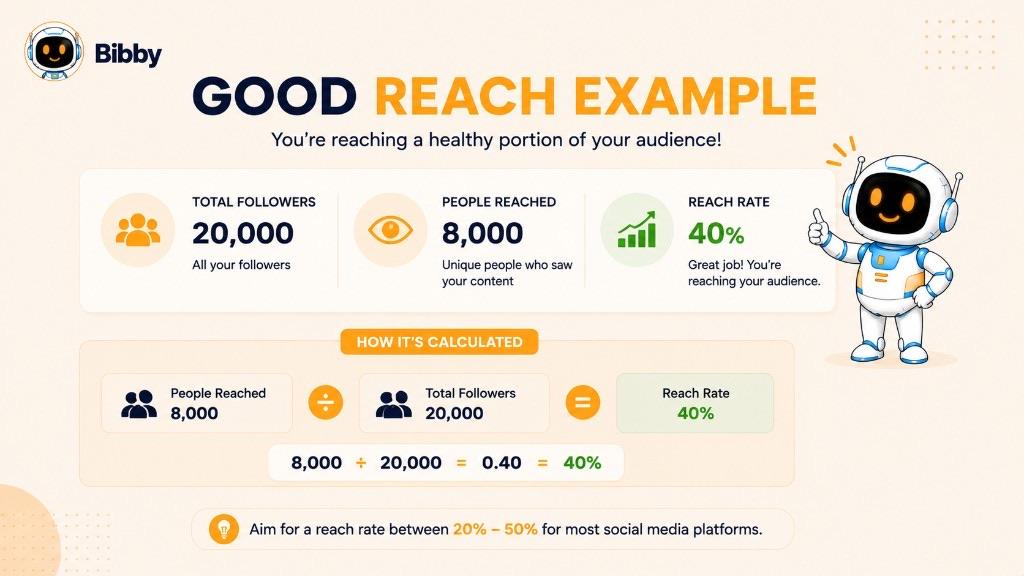
There is no single reach number that qualifies as “good” for every social media account. A useful reach depends on your audience size, platform, content type, industry, distribution method, and campaign objective.
For example, reaching 10,000 people could be excellent for a small account but relatively low for a large established brand. Comparing raw reach numbers without considering account size can therefore be misleading.
One useful way to put reach into context is reach rate.
How to Calculate Reach Rate
Reach Rate = (Reach ÷ Number of Followers) × 100
For example, if an account has 20,000 followers and a post reaches 8,000 unique users:
8,000 ÷ 20,000 × 100 = 40% reach rate
This gives you a more meaningful way to evaluate how much of your existing audience a piece of content reached.
However, reach rate should not be treated as a universal performance score either. Content can reach people who do not follow your account, particularly when platforms recommend content through discovery features or when content is shared.
What Should You Compare?
Instead of asking whether your reach is objectively “good,” compare your results against your own historical performance.
Look at:
- Average reach: Is your content reaching more or fewer people over time?
- Reach rate: What percentage of your existing audience is being reached?
- Non-follower reach: Is your content attracting exposure beyond your existing audience?
- Content format: Which formats consistently generate the most reach?
- Engagement: Does increased reach also produce meaningful interactions?
- Conversions: Does broader exposure contribute to your actual business goals?
A strong reach is ultimately one that supports your objective. If your goal is brand awareness, reaching more relevant people may be the priority. If your goal is sales or leads, a smaller but highly relevant audience can be more valuable than a large amount of low-quality exposure.
Why Is Social Media Reach Important?
Social media reach helps you understand how widely your content is being distributed. It shows whether your posts are reaching a small portion of your audience or expanding their exposure to a much larger group of people.
For businesses and creators, this makes reach particularly useful for measuring awareness and content distribution.
1. Reach Shows Your Potential Audience Exposure
The more unique users your content reaches, the more people have had an opportunity to discover your brand, message, product, or idea.
This is especially important when your objective is to increase brand awareness or introduce your business to new audiences.
2. Reach Helps Evaluate Content Distribution
A post can be excellent but still have limited impact if very few people see it.
Tracking reach across your content can help you identify which topics, formats, and publishing approaches consistently receive broader distribution.
3. Reach Helps You Discover New Audiences
When content reaches people who do not already follow your account, it can create opportunities for audience growth.
Shares, recommendations, search, discovery features, and other forms of distribution can expose your content to users outside your existing follower base.
4. Reach Provides Context for Engagement
Engagement numbers become easier to interpret when you know how many people were exposed to the content.
For example, 500 likes on content that reached 1,000 people tells a very different story from 500 likes on content that reached 100,000 people.
That is why reach should be considered alongside engagement rate and other engagement metrics rather than viewed in isolation.
5. Reach Helps Measure Awareness Campaigns
For campaigns designed primarily to get a message in front of as many relevant people as possible, reach can be a particularly useful metric.
However, high reach does not automatically mean a campaign was successful. If the ultimate goal is leads, sales, website traffic, or another conversion, those outcomes should also be measured.
Reach Is Important, But It Isn't the Whole Story
Reach answers one important question:
“How many unique people saw our content?”
It does not answer whether those people cared about it, interacted with it, remembered it, visited your website, or became customers.
For a complete view of social media performance, analyze reach together with impressions, engagement, clicks, conversions, and other metrics connected to your specific goals.
What Factors Affect Social Media Reach?
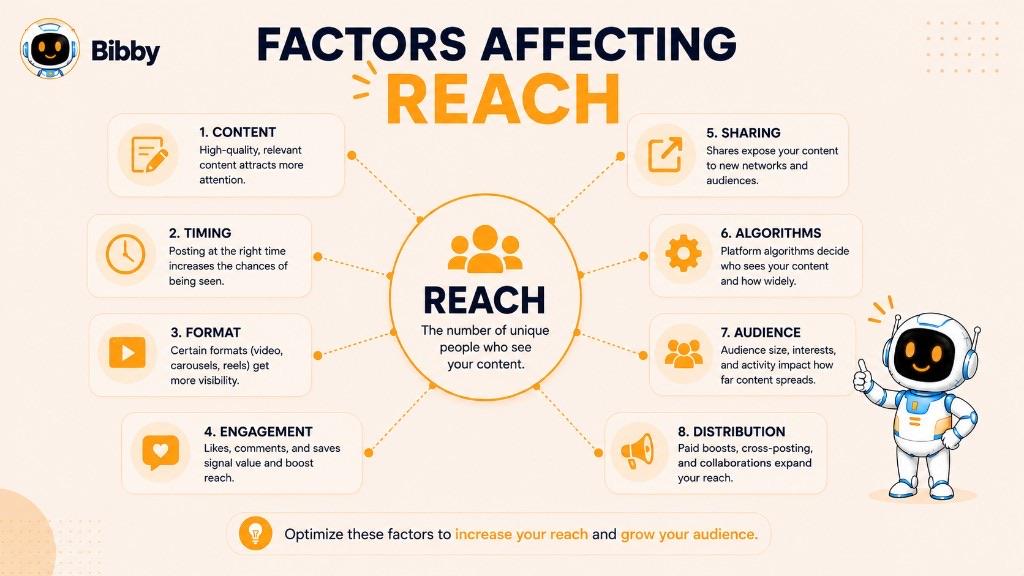
Social media reach is influenced by a combination of content quality, audience behavior, platform distribution, timing, and publishing strategy. No single factor guarantees higher reach, and the importance of each factor can vary between platforms.
Understanding these factors can help you identify why some content reaches thousands of people while other posts receive limited exposure.
Content Quality and Relevance
People are more likely to watch, read, share, save, or interact with content that is relevant and useful to them.
Content that consistently satisfies your audience's interests can generate stronger distribution signals and create more opportunities for additional users to discover it.
Engagement and Sharing
Interactions can influence how content continues to circulate on many social platforms.
Shares and reposts can be particularly valuable because they can expose your content to people outside your existing audience. Comments, saves, likes, and other interactions can also provide signals about how audiences respond to your content.
However, engagement does not guarantee increased reach. Platforms use complex distribution systems, and the relationship between engagement and reach differs by network and content type.
Content Format
Different formats can perform differently depending on the platform and audience.
Images, carousels, short-form videos, long-form videos, Stories, and other formats each provide different ways to capture attention and distribute content.
Testing multiple formats can help you discover which ones generate the strongest reach for your particular audience.
Posting Time
When you publish can affect how quickly your audience discovers and interacts with your content.
Publishing when your audience is active can give content an opportunity to generate early exposure and engagement. However, there is no universally best posting time for every account.
Your own audience data is generally more useful than a generic “best time to post” recommendation.
Posting Consistency
Consistent publishing gives you more opportunities to distribute content and learn which topics and formats work best.
Consistency does not mean posting as frequently as possible. Publishing low-quality content simply to increase volume can be less effective than maintaining a sustainable schedule with content that provides value.
Platform Algorithms and Recommendations
Social networks use ranking and recommendation systems to determine which content appears in users' feeds and discovery surfaces.
These systems can consider factors such as relevance, user behavior, content characteristics, and interactions. Because these systems change over time, tactics that improve reach on one platform may not produce the same results on another.
Audience Size and Behavior
Your existing audience provides an initial distribution opportunity, but follower count does not determine reach.
Two accounts with the same number of followers can have very different reach because their audiences may differ in activity, interests, location, and responsiveness to content.
Search and Discovery
Some social platforms allow users to discover content through search, recommendations, hashtags, trending topics, or other discovery features.
Optimizing content around topics your target audience is actively interested in can create additional opportunities to reach people who do not already follow you.
Paid Promotion
Advertising can expand the number of unique users exposed to your content beyond what organic distribution may achieve.
Paid and organic reach should generally be analyzed separately because they represent different distribution strategies and involve different costs.
Cross-Platform Distribution
Publishing relevant content across multiple platforms can create additional opportunities to reach your audience.
However, simply copying the same post everywhere is not always the best approach. Adapting the creative, caption, format, and message to each platform can make the content more relevant to its audience.
Ultimately, improving reach is less about finding one secret tactic and more about creating useful content, distributing it consistently, learning from performance data, and adapting your strategy over time.
How to Increase Social Media Reach
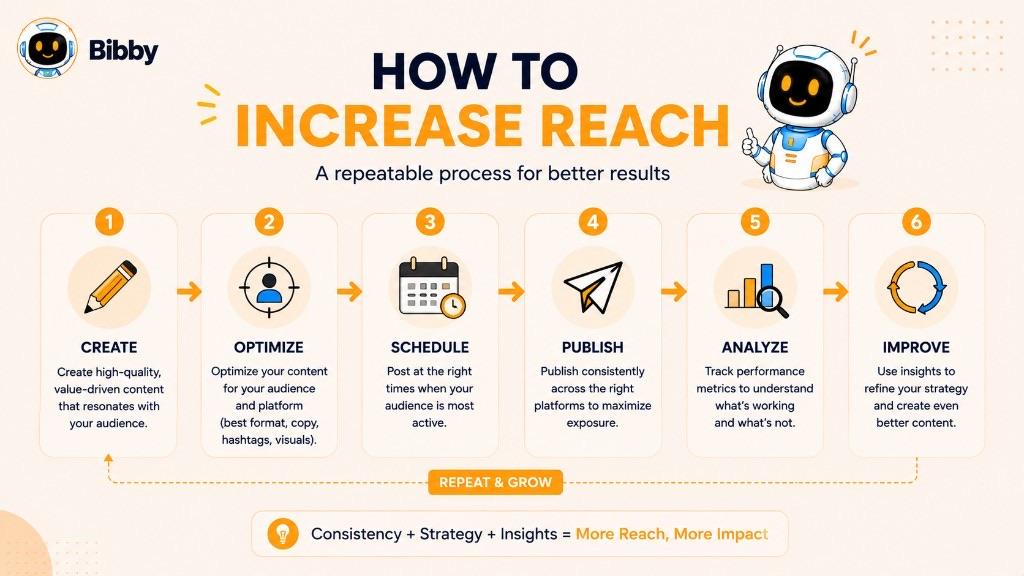
Increasing social media reach is primarily about getting your content in front of more relevant people. There is no single tactic that works for every account, so the most effective approach is to consistently create valuable content, test different distribution strategies, and use your performance data to improve over time.
1. Create Content Worth Sharing
Content that people find genuinely useful, entertaining, educational, or relatable has more opportunities to travel beyond your existing audience.
Focus on creating content that answers questions, solves problems, teaches something useful, provides a fresh perspective, or gives people a reason to share it with others.
2. Use Multiple Content Formats
Experiment with formats such as:
- Images
- Carousels
- Short-form videos
- Long-form videos
- Stories
- Educational posts
- Product demonstrations
Different formats can perform differently across platforms and audiences. Tracking reach by format can reveal which types of content are most effective for your account.
3. Improve Your Hooks and Captions
People decide quickly whether content deserves their attention.
Use a clear opening that communicates why someone should keep reading or watching. Captions should add context, provide value, or encourage meaningful interaction rather than simply repeating what is already visible in the creative.
4. Encourage Meaningful Sharing
Shares can introduce your content to audiences you could not reach through your followers alone.
Instead of using generic engagement bait, create content that people naturally want to send to colleagues, friends, customers, or communities because it is useful or relevant to them.
5. Publish When Your Audience Is Active
Timing can influence how quickly your content gets initial exposure.
Rather than relying exclusively on generic “best time to post” charts, examine when your own audience is active and test different publishing times. Over time, your performance data can reveal patterns specific to your account.
6. Maintain a Consistent Publishing Schedule
A sustainable publishing schedule gives you more opportunities to reach your audience and identify what works.
The goal isn't to publish as much as possible. Instead, establish a schedule you can maintain while keeping the quality and relevance of your content high.
7. Repurpose Your Best Content
If a topic already performs well, consider adapting the underlying idea into other formats or for other platforms.
For example, a successful educational post could become a carousel, short video, Story, or LinkedIn post. Repurposing allows you to extend the life of useful ideas without starting from scratch every time.
8. Optimize Content for Each Platform
Avoid assuming that content that performs well on one social network will automatically perform well everywhere.
Adapt your:
- Format
- Caption length
- Hook
- Visual style
- Call to action
- Video length
- Publishing approach
Platform-specific optimization can make your content more relevant to the people you're trying to reach.
9. Analyze Your Highest-Reach Content
Look beyond individual posts and identify patterns across your content.
Ask:
- Which topics generate the most reach?
- Which formats reach the most people?
- Which posts attract non-followers?
- Which publishing times perform best?
- Which posts generate the most shares?
- Is increasing reach also producing meaningful engagement?
Then use those findings to guide your next content decisions.
10. Use Social Media Automation to Publish Consistently
Maintaining a consistent presence across multiple platforms can become time-consuming when every post requires separate content creation, caption writing, and scheduling.
A social media automation tool such as Bibby can streamline that workflow. You can upload an image or video, generate creative with AI, choose a posting style, automatically generate captions, and schedule content across selected platforms at AI-optimized times.
Bibby also supports different content formats, including images, carousels, videos, and Stories, while its chat interface lets you manage tasks such as creating brand kits, campaigns, posts, and caption variations through conversation.
Automation doesn't replace a good content strategy. It also does not guarantee higher reach. Instead, it reduces the repetitive work involved in executing a strategy, giving you more opportunities to publish consistently, test what works, and review native analytics over time.
How to Calculate Reach Rate
Reach rate measures the percentage of your audience that your content reached during a specific period. It can provide more context than raw reach because it considers the size of your existing audience.
A simple way to calculate it is:
Reach Rate = (Reach ÷ Number of Followers) × 100
For example, suppose your account has 50,000 followers and a post reaches 15,000 unique users.
15,000 ÷ 50,000 × 100 = 30%
Your post therefore reached 30% of your follower count.
Why Is Reach Rate Useful?
Raw reach can be difficult to compare between accounts of different sizes. Reaching 10,000 people means something very different for an account with 12,000 followers than for an account with 500,000 followers.
Reach rate provides a normalized figure that can make comparisons within an account more meaningful.
It can also help you track changes over time. If your follower count grows while your average reach stays flat, your reach rate may decline. That can indicate that your content isn't reaching your growing audience at the same rate.
Is Reach Rate the Same as Engagement Rate?
No.
Reach rate measures audience exposure, while engagement rate measures audience interaction.
For example:
- Followers: 50,000
- Reach: 15,000
- Engagements: 1,200
The reach rate tells you how much of your follower base was reached. An engagement-rate calculation tells you how people interacted with the content, depending on the engagement-rate formula being used.
Both metrics can be useful, but they answer different questions.
An Important Limitation
Reach rate should not be interpreted as the percentage of your total audience that saw your content in every situation.
Content can reach non-followers through recommendations, shares, search, discovery features, and paid distribution. As a result, reach can sometimes exceed your follower count.
The formula is therefore most useful as a contextual comparison, particularly when you're tracking your own content performance over time.
For the most accurate analysis, always consider reach alongside impressions, engagement, follower growth, and the specific goals of your social media strategy.
How to Analyze Reach in Your Social Media Strategy
Tracking reach is only useful when you use the data to make better content and distribution decisions. Instead of asking whether a single reach number is “good” or “bad,” look for patterns that reveal what is helping your content reach more of the right audience.
A simple approach is to measure, compare, identify patterns, act, and measure again.
1. Measure Your Reach
Start by recording the metrics that provide context around reach, such as:
- Reach
- Reach rate
- Impressions
- Engagement
- Shares and saves
- Follower growth
- Clicks or conversions, when relevant
Looking at these metrics together gives you a more complete picture of content performance. Use each platform's native analytics for these numbers.
2. Compare Content Performance
Compare reach across different:
- Topics
- Content formats
- Platforms
- Publishing times
- Campaigns
- Audience segments
For example, you might discover that educational carousels consistently reach more people than promotional posts. That insight can influence what you create next.
3. Look for Non-Follower Reach
One particularly useful question is:
“How much of my content is reaching people who don't already follow me?”
Strong non-follower distribution can indicate that your content is being discovered through recommendations, shares, search, or other distribution channels.
If your reach is almost entirely limited to your existing audience, look for opportunities to create content with broader discovery and sharing potential.
4. Identify Your Highest-Reach Content
Don't only look at your average reach. Find the posts that significantly outperform your normal results.
Then investigate what they have in common.
Look for patterns in:
- Subject matter
- Hook
- Format
- Visual style
- Caption
- Length
- Publishing time
- Shareability
The goal isn't to copy a successful post exactly. It's to understand why the underlying idea may have resonated with your audience.
5. Compare Reach With Engagement
High reach isn't automatically a sign of successful content.
A post may reach 100,000 people but generate very little meaningful interaction. Another post may reach 10,000 people and produce substantially more comments, saves, shares, clicks, or conversions.
Analyzing reach together with engagement helps you distinguish between broad distribution and meaningful audience response.
6. Connect Reach to Business Outcomes
The most valuable reach is not necessarily the largest reach. It's reach among people who are relevant to your goals.
If your objective is brand awareness, broad exposure may be the primary goal.
If your objective is lead generation or sales, you should also examine metrics such as clicks, leads, conversions, and revenue.
This prevents your social media strategy from becoming focused on a single vanity metric.
7. Turn Insights Into Experiments
Once you identify patterns, turn them into specific tests.
For example:
- Test two different publishing times.
- Compare carousels with single-image posts.
- Test educational content against promotional content.
- Experiment with different hooks.
- Repurpose a high-performing topic into another format.
- Compare distribution across different platforms.
Make one meaningful change at a time when possible, then monitor the results.
8. Repeat the Process
Social media performance changes as audiences, platforms, trends, and content strategies evolve.
Review your reach regularly, identify new patterns, and adjust your publishing strategy accordingly.
The objective isn't simply to maximize reach. It's to consistently increase your ability to reach the right people with content they find valuable, then turn that attention into meaningful engagement and business results.
Common Mistakes When Measuring Social Media Reach
Reach is a straightforward metric, but it is easy to misunderstand when it's viewed without context. Avoiding a few common mistakes can make your social media reporting much more accurate.
1. Confusing Reach With Impressions
Reach measures unique users, while impressions measure total content displays.
If a post has 10,000 reach and 30,000 impressions, you should not report that as 30,000 people reached. The 30,000 figure includes multiple exposures to some users.
2. Treating Views as Unique People
A view does not necessarily represent a unique user.
The same person may watch or view content multiple times. Therefore, you should use the platform's unique-audience metric when you want to understand how many different people were exposed to your content.
3. Assuming High Reach Means Successful Content
High reach tells you that content was distributed widely. It doesn't tell you whether the audience found it useful or whether it produced business results.
A complete evaluation should consider engagement, clicks, conversions, or other metrics related to your objective.
4. Comparing Raw Reach Between Different-Sized Accounts
An account with one million followers will naturally have a very different distribution potential from an account with 10,000 followers.
Instead of comparing raw reach alone, consider metrics such as reach rate and compare performance against each account's historical results.
5. Ignoring Non-Follower Reach
If you only look at your follower count, you can miss an important part of content distribution.
Content can reach people who don't follow your account through recommendations, shares, search, discovery features, and paid promotion.
Tracking non-follower exposure can help you understand whether your content is expanding beyond your existing audience.
6. Mixing Organic and Paid Reach Without Context
Organic and paid distribution work differently.
If a post's reach increased because you promoted it with advertising, that result shouldn't necessarily be compared directly with an organically distributed post.
Separate the two when evaluating your content strategy so you know where your exposure is coming from.
7. Judging Performance From a Single Post
One post can perform unusually well or poorly for many reasons.
Instead of making strategic decisions from one result, look at trends across multiple posts and a consistent period. This gives you a more reliable picture of your typical reach.
8. Using the Same Benchmark for Every Platform
Reach is not reported identically across Facebook, Instagram, LinkedIn, TikTok, and YouTube.
Differences in audience behavior, content formats, recommendation systems, and analytics definitions can make direct comparisons misleading.
Compare like with like whenever possible, and pay attention to how each platform defines the metric.
9. Focusing on Reach Without Considering Audience Quality
More reach isn't always better if the additional audience is irrelevant to your business.
A smaller audience that closely matches your target customers may be more valuable than a much larger audience with little interest in what you offer.
The goal should be meaningful reach, not reach at any cost.
Social Media Reach Example
Imagine a small business publishes a carousel on Instagram to promote a new product.
After several days, the post reports:
- Reach: 12,000 accounts
- Impressions: 28,000
- Likes: 900
- Comments: 75
- Shares: 150
- Saves: 200
What Does This Data Tell Us?
The post reached 12,000 unique accounts. That means approximately 12,000 different accounts were exposed to the carousel.
The post generated 28,000 impressions, meaning it was displayed approximately 28,000 times in total. Because impressions are higher than reach, some accounts saw the content more than once.
We can estimate the average exposure frequency as:
28,000 ÷ 12,000 = 2.33
So, the content generated approximately 2.33 impressions per account reached.
The engagement data provides another layer of context. The post generated 900 likes, 75 comments, 150 shares, and 200 saves, indicating that people didn't simply see the content—they also interacted with it.
What Should the Business Do Next?
Rather than concluding that the post was successful simply because it reached 12,000 accounts, the business should investigate why it performed well.
It could compare this post with previous content and ask:
- Did this carousel reach more people than typical posts?
- Did it reach more non-followers?
- Did shares contribute to additional distribution?
- Was the topic particularly relevant to the audience?
- Did the carousel format outperform single-image posts?
- Was the publishing time different?
- Did the increased reach result in more website visits, leads, or sales?
This turns reach from a number on an analytics dashboard into a useful strategic signal.
The key lesson: reach tells you how many unique people saw the content, while impressions and engagement help explain what happened after and around that exposure.
How Bibby Can Help You Improve Social Media Reach
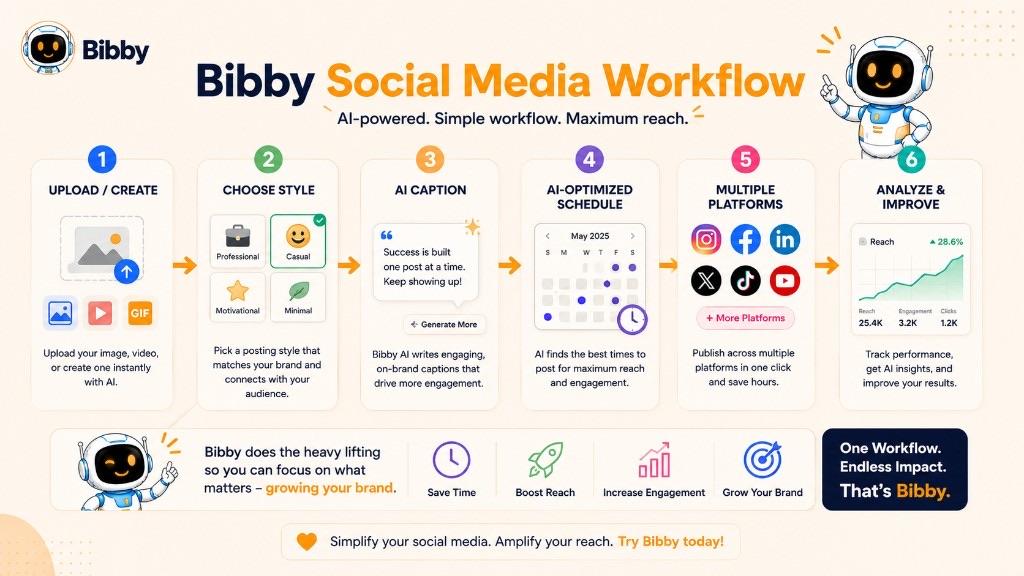
Understanding reach is the first step. Improving it requires consistently creating useful content, publishing it across the right channels, and learning from what performs best.
That workflow can become difficult when you manage multiple social platforms manually. Bibby brings content creation, caption generation, scheduling, and social media management into one workflow.
With Bibby, you can:
- Upload your content: Start with your own images or videos.
- Generate creative with AI: Create visual content when you don't have an asset ready.
- Choose your posting style: Set the direction for the content you want to publish.
- Generate captions automatically: Let AI create captions based on your content and selected style.
- Schedule across platforms: Plan content for Facebook, Instagram, LinkedIn, YouTube, and TikTok from one place.
- Use AI-optimized publishing times: Schedule content at times selected to help you publish when your audience is more likely to be active.
- Publish multiple formats: Manage images, carousels, videos, Stories, and other supported content types.
- Manage social media through chat: Use Bibby's chat interface to create posts, build campaigns, create a brand kit, regenerate captions, and manage other social media tasks through conversation.
The goal isn't to chase reach by publishing as much content as possible. A stronger strategy is to create content your audience values, distribute it consistently, measure the results in native analytics, and use those insights to improve what you publish next.
Bibby helps simplify the repetitive parts of that process so you can spend more time developing the content and strategy that earns meaningful attention. It does not buy ads, guarantee reach, or replace each platform's analytics dashboard.
Key Takeaways
Reach counts unique people who saw your content. Impressions count displays. Views count plays. Engagement counts interactions.
- Compare reach over time on the same platform before treating numbers as equivalent across networks.
- Put reach in context with reach rate, non-follower exposure, and your actual business goal.
- Organic reach and paid reach are different distribution sources—keep them separate in reporting.
Continue with related dictionary entries on impressions, engagement, engagement rate, organic reach, paid reach, and brand awareness—or browse the social media dictionary. Then start a free Bibby trial to create, caption, and schedule content across your channels.