
Impressions measure how many times your content is displayed on a screen, making them a fundamental metric for understanding content visibility across social media and digital marketing.
If you're trying to understand what impressions mean, how they differ from reach, or whether your impression count is good, the key is to remember that impressions measure total exposure—not unique people or engagement. Understanding this distinction helps you interpret social media analytics more accurately and make better content distribution decisions.
Let's start with the exact meaning of an impression and why this metric matters.
In this article, you will learn:
- What impressions measure (and what they do not)
- How impressions differ from reach, views, and engagement
- How platforms calculate and report impressions
- How to track, interpret, and increase impression counts
What Are Impressions?
Impressions are the total number of times your content is displayed on a screen, regardless of whether someone clicks, likes, comments, or otherwise interacts with it. In social media marketing, impressions are used to measure how often a post, video, advertisement, or other piece of content is shown to users.
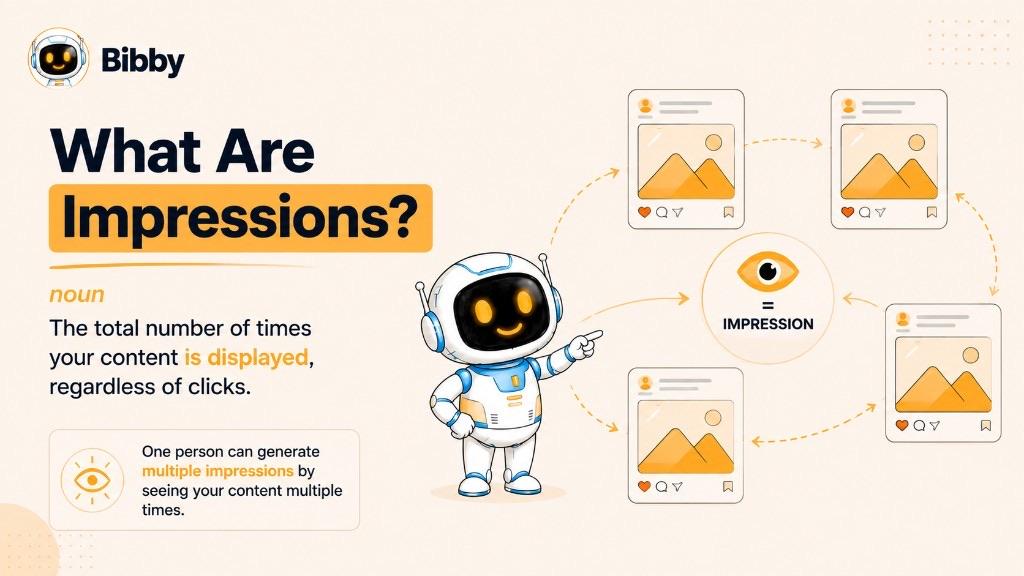
An important detail is that impressions are not the same as the number of people who saw your content. The same person can generate multiple impressions if your content is displayed to them more than once.
For example, if your Instagram post is displayed 1,000 times and some people see it more than once, your post can have 1,000 impressions even though fewer than 1,000 unique people saw it.
In simple terms:
Impressions = total content displays
This makes impressions primarily a visibility and exposure metric. It can tell you how widely and frequently your content is being displayed, but it does not tell you by itself whether people found the content useful, clicked it, engaged with it, or became customers.
Because different platforms can use different measurement methodologies, the precise way an impression is counted may vary between platforms. This is especially important when comparing impressions across Facebook, Instagram, LinkedIn, TikTok, and YouTube.
What Do Impressions Mean on Social Media?
On social media, impressions represent the total number of times your content is displayed to users. Every time your content appears in a location where it can be counted as an impression, it contributes to the overall impression count according to that platform's measurement rules.
For example, if a post receives 5,000 impressions, it means the content was displayed 5,000 times. It does not necessarily mean that 5,000 different people saw it.
This distinction makes impressions particularly useful for understanding content visibility and distribution. A growing impression count can indicate that your content is being surfaced more frequently, reaching more opportunities for exposure, or being shown repeatedly to an existing audience.
Why Social Media Impressions Matter
Impressions can help you:
- Measure how visible your content is
- Compare content distribution over time
- Identify posts receiving unusually high exposure
- Understand how frequently content may be displayed
- Evaluate the visibility component of a social media campaign
However, impressions should not be treated as a standalone measure of success. A post can generate thousands of impressions without producing meaningful engagement, website traffic, leads, or sales.
For a more complete picture, compare impressions with metrics such as reach, engagement, clicks, and conversions. Together, these metrics can help you understand not only how often your content was displayed, but also what happened after people encountered it.
The exact definition and reporting of impressions can also vary by platform, so comparing impression numbers across different social networks should be done carefully.
Impressions vs. Reach: What's the Difference?
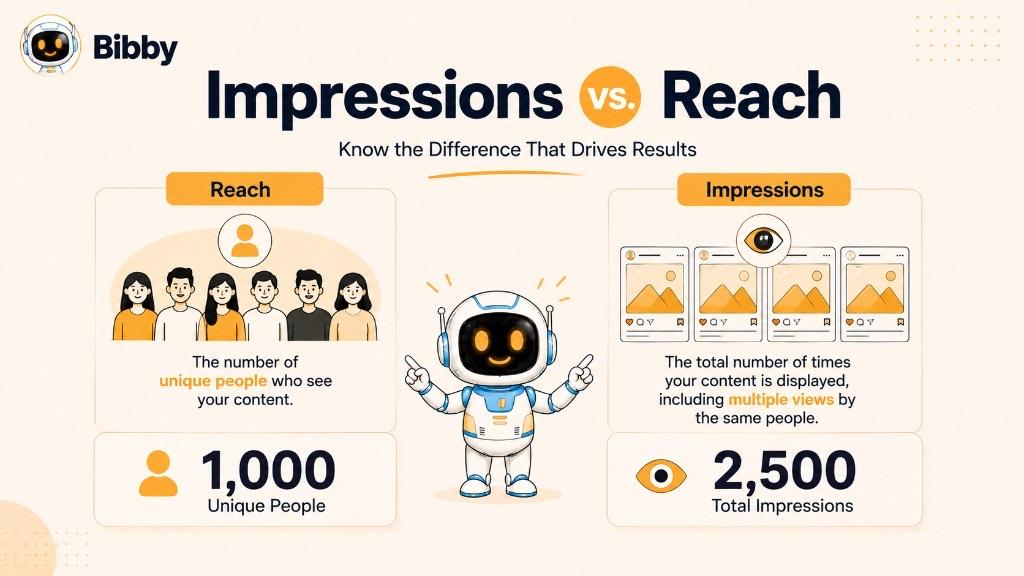
Impressions measure the total number of times your content is displayed, while reach measures the number of unique people or accounts exposed to that content.
The key difference is total exposure versus unique exposure. One person can contribute multiple impressions if they encounter the same content more than once, but they generally contribute only once to reach for that content during the measurement period.
| Metric | What it measures |
|---|---|
| Impressions | Total number of times content is displayed |
| Reach | Number of unique people or accounts reached |
Example of Impressions vs. Reach
Imagine you publish a social media post that is displayed to 1,000 people. If some of those people see the post multiple times, your results might look like this:
- Reach: 1,000
- Impressions: 2,500
The 2,500 impressions mean the content was displayed 2,500 times, while the reach of 1,000 indicates that the exposure came from 1,000 unique people or accounts, according to the platform's reporting methodology.
Why the Difference Matters
Comparing impressions with reach can provide insight into how frequently your audience is being exposed to your content.
If impressions are substantially higher than reach, your content may be receiving repeated exposure among the same audience. If impressions and reach are relatively close, there may be less repeated exposure.
Neither situation is automatically good or bad. The ideal relationship depends on your objective. For example, a brand-awareness campaign may benefit from repeated exposure, while a campaign focused on reaching new audiences may prioritize expanding organic reach or paid reach.
For this reason, impressions and reach should be analyzed together rather than treated as interchangeable metrics.
How Are Impressions Calculated?
At its simplest, impressions are calculated by counting the number of times your content is displayed according to the platform's measurement rules.
Impressions Formula
A simple way to understand the metric is:
Impressions = Total number of counted content displays
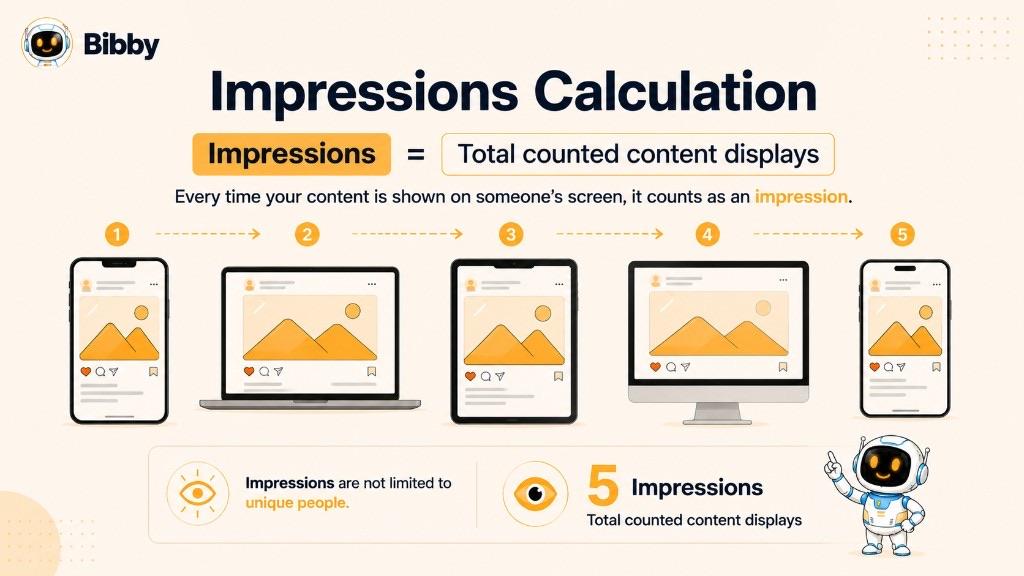
For example, if a social media post is displayed 750 times, it can generate 750 impressions. If it is displayed another 250 times later, the total becomes 1,000 impressions.
The people responsible for those impressions do not have to be unique. If the same person encounters your content multiple times, those repeated displays can contribute multiple impressions.
Impressions Example
Suppose you publish a post and it receives the following exposure:
- 400 displays from one group of users
- 350 additional displays from other users
- 250 repeated displays to people who have already encountered the post
The post could report 1,000 impressions, even though the number of unique people reached is lower.
This is why impressions should not be interpreted as a direct count of people who saw your content.
Do All Platforms Calculate Impressions the Same Way?
Not necessarily. Social media platforms can have different definitions, measurement systems, and reporting methodologies for impressions. A metric labeled "impressions" on one platform should therefore not automatically be assumed to be calculated exactly the same way on another.
This is particularly important when comparing analytics across platforms such as Facebook, Instagram, LinkedIn, TikTok, and YouTube.
For meaningful analysis, use impressions primarily to evaluate visibility and exposure trends within the same platform and reporting framework, while considering reach, engagement, clicks, and conversions to understand the broader performance of your content.
What Is a Good Number of Impressions?
There is no universal number of impressions that is considered good. A healthy impression count depends on factors such as your audience size, platform, industry, content format, posting frequency, campaign objective, and whether your distribution is organic or paid.
For example, 10,000 impressions could be excellent for a small account but relatively low for a large established brand. Comparing your impressions with another account without considering these differences can therefore be misleading.
What Should You Compare Impressions Against?
Instead of focusing on a single impression number, look at how your impressions change over time and how they relate to other metrics.
Useful comparisons include:
- Impressions vs. reach: Shows how frequently content is being displayed relative to unique exposure.
- Impressions vs. engagement: Helps you understand whether visibility is generating interactions.
- Impressions vs. clicks: Shows whether exposure is translating into traffic.
- Impressions vs. conversions: Connects content visibility with business outcomes.
- Impressions over time: Reveals whether your content distribution is growing or declining.
Should Impressions Increase Over Time?
Generally, increasing impressions can indicate that your content is receiving more exposure, but more impressions do not automatically mean better performance.
For example, a post might generate significantly more impressions because it was displayed repeatedly, while producing little additional engagement or revenue. Another post might receive fewer impressions but generate substantially more clicks, leads, or sales.
The right benchmark is therefore not simply "How many impressions did I get?" but "Are my impressions improving relative to my goals and producing meaningful results?"
For the most useful analysis, track impressions alongside reach, engagement, clicks, and conversions rather than evaluating the metric in isolation.
Why Are Impressions Important?
Impressions are important because they provide a simple way to measure how frequently your content is being displayed. While impressions do not tell you whether someone engaged with or purchased from your content, they help you understand the visibility your content is receiving.
1. Measure Content Visibility
Impressions give you an indication of how often your posts, videos, advertisements, or other content are being displayed. Tracking this metric over time can help you determine whether your content is gaining or losing exposure.
2. Understand Content Distribution
A high impression count can indicate that a piece of content is being distributed extensively or shown repeatedly to an audience. Comparing impressions across posts can help identify which content receives more visibility.
3. Identify Trends
Looking at impressions over a consistent period can reveal changes in your content's distribution. A sustained increase may indicate that your publishing strategy is generating more exposure, while a decline can signal that your distribution or content strategy needs closer examination.
4. Evaluate Campaign Visibility
For social media campaigns and advertising, impressions can help measure the amount of exposure generated by your campaign. This makes the metric particularly useful when the objective is brand awareness or visibility. Advertisers often pair impression volume with CPM (cost per thousand impressions).
5. Understand Audience Frequency
When analyzed alongside reach, impressions can provide insight into how frequently content is being displayed to the same audience. This can be useful when evaluating whether your strategy is focused primarily on reaching new people or generating repeated exposure.
Impressions Are Not a Complete Performance Metric
Despite their usefulness, impressions should never be treated as a standalone measure of marketing success.
A post can generate a large number of impressions while receiving very little engagement. Conversely, a post with fewer impressions may generate significant clicks, comments, shares, leads, or sales.
For this reason, impressions are most valuable when analyzed alongside reach, engagement, clicks, conversions, and other KPIs that reflect your specific marketing objective.
Impressions vs. Engagement
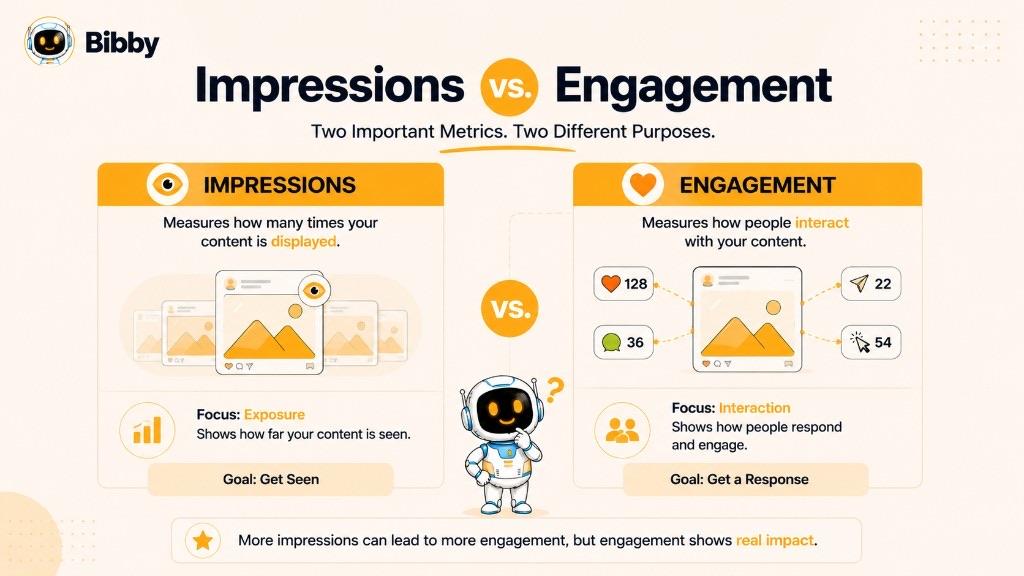
Impressions measure how many times content is displayed, while engagement measures how people interact with that content. The two metrics answer different questions and should not be treated as interchangeable.
If impressions answer “How often was my content displayed?”, engagement answers “What did people do after encountering it?”
What Counts as Engagement?
Depending on the platform and content type, engagement can include actions such as:
- Likes or reactions
- Comments
- Shares or reposts
- Saves
- Clicks
- Replies
- Other interactions defined by the platform
For example, a post could receive 20,000 impressions but only 200 engagements. That tells you the post received substantial exposure, but a relatively small portion of that exposure resulted in measurable interaction.
On the other hand, a post with 5,000 impressions and 500 engagements may have generated less overall exposure but significantly stronger interaction. Engagement rate puts those interactions in context of reach or impressions.
Why Compare Impressions and Engagement?
Looking at both metrics gives you a better understanding of content performance.
High impressions + high engagement: Your content is receiving exposure and generating meaningful interaction.
High impressions + low engagement: Your content is being displayed frequently, but the audience may not be responding strongly.
Low impressions + high engagement: Your content may resonate with the people who see it, but it may need broader distribution.
These patterns can help you decide whether to focus on increasing distribution, improving content, or both.
Ultimately, impressions tell you about visibility, while engagement tells you about interaction. Neither metric alone provides a complete picture of social media performance, so they should be evaluated together with metrics such as reach, clicks, and conversions.
Impressions vs. Views: What's the Difference?
Impressions measure how many times content is displayed, while views generally measure how many times content is viewed according to a platform's specific definition. The two metrics can therefore represent different stages of audience exposure.
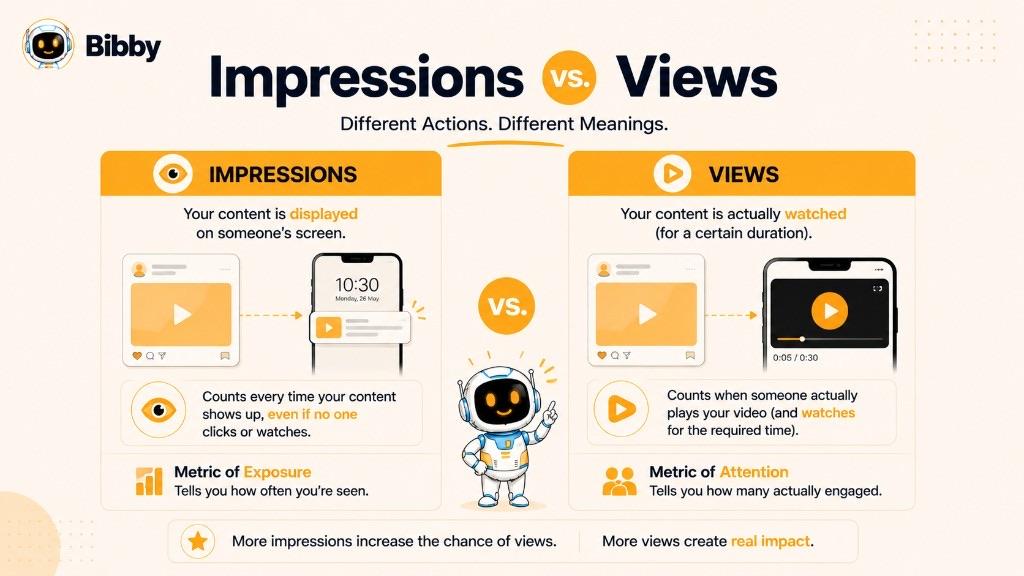
For example, a video thumbnail being displayed in a feed may contribute to an impression, while a person actually watching the video may contribute to a view. The exact definitions and counting rules depend on the platform and content type.
Impressions vs. Views at a Glance
| Metric | What it generally measures |
|---|---|
| Impressions | How many times content was displayed |
| Views | How many times content was viewed under the platform's definition |
The distinction is particularly important for video content. A video can receive many impressions without generating the same number of views because being shown is not necessarily the same as being watched.
Why the Difference Matters
If your content receives a high number of impressions but relatively few views, the content is getting exposure but may not be converting that exposure into actual viewing behavior.
For example:
- 100,000 impressions can indicate substantial content exposure.
- 10,000 views can indicate that a smaller portion of that exposure resulted in a counted view.
This does not automatically mean the content performed poorly. The relationship between impressions and views can depend on the platform, placement, content format, audience, and how each metric is defined.
Platform Definitions Can Differ
One important consideration is that “impression” and “view” are not universal measurements across every social network. Each platform can establish its own rules for what qualifies as an impression or a view.
YouTube, for example, has a specific impressions metric associated with how often thumbnails are shown on certain YouTube surfaces. That metric should not simply be interpreted as equivalent to video views.
When analyzing performance, always use the platform's own definitions and compare impressions with views, watch time, engagement, and other relevant metrics to understand the complete picture.
What Increases Impressions on Social Media?
Social media impressions increase when your content is displayed more frequently and distributed to more opportunities for exposure. The factors that influence distribution vary by platform, audience, content format, and whether the content is organic or paid.
Several factors can contribute to higher impressions.
1. Consistent Publishing
Publishing consistently gives your audience and the platform more content opportunities to distribute. A consistent content calendar can also help you identify which topics, formats, and posting patterns generate the most visibility.
Consistency does not mean publishing low-quality content simply to increase volume. The goal is to maintain a reliable publishing rhythm while keeping the content useful and relevant.
2. Engaging Content
Content that generates meaningful interactions can receive additional exposure, depending on the platform's distribution system. Posts that encourage people to comment, share, save, or otherwise interact can create more opportunities for visibility.
3. Choosing the Right Content Formats
Different platforms support multiple formats, including images, carousels, videos, and Stories. Testing different formats can help you discover which types of content receive stronger distribution from your audience.
4. Publishing at Effective Times
The timing of a post can affect how quickly your audience encounters it. Testing different publishing times—and using resources such as best time to post guidance—can help identify when your audience is most likely to be active.
5. Increasing Content Distribution
Publishing across relevant platforms can create additional opportunities for exposure. A single idea can often be adapted into multiple platform-appropriate formats rather than being limited to one channel.
6. Creating Shareable Content
Content that people find useful, entertaining, educational, or relevant may be more likely to generate shares or other forms of distribution. Sharing can expose your content to audiences beyond your existing followers.
7. Using Paid Promotion
Paid social campaigns and boosted posts can increase the number of times content is displayed by putting it in front of a targeted audience. This can be useful when organic distribution alone is insufficient to achieve a campaign's visibility objective.
8. Learning From Your Analytics
Your existing performance data can reveal which topics, formats, posting frequencies, and publishing times generate stronger impressions. Instead of guessing what will work, use those patterns to inform future content decisions.
Ultimately, increasing impressions is less about chasing a single metric and more about creating useful content, distributing it consistently, testing what works, and using analytics to improve your strategy over time.
How to Increase Impressions on Social Media
If your goal is to increase social media impressions, focus on creating more opportunities for your content to be discovered and displayed while continuously improving what you publish.
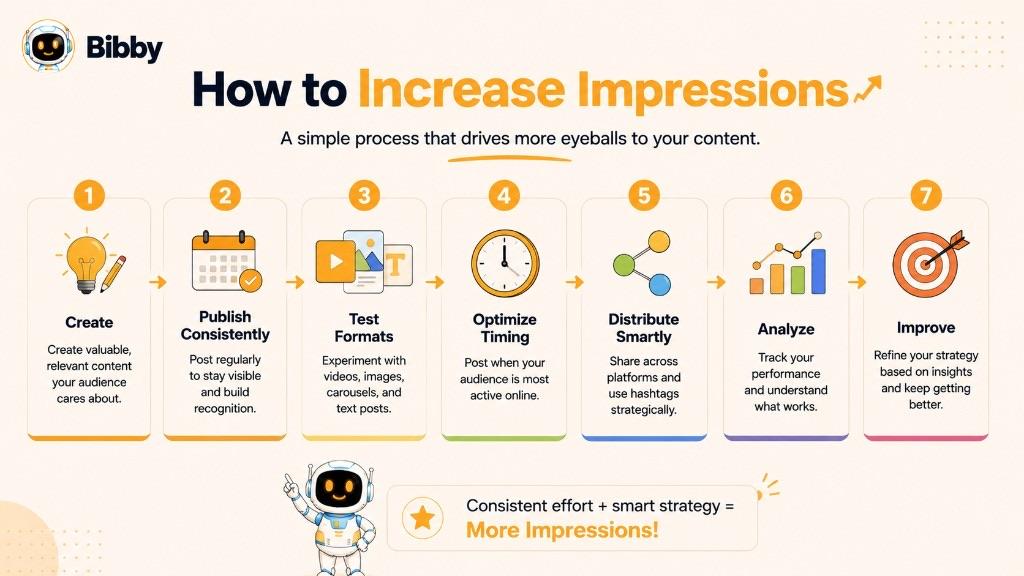
1. Publish Consistently
A consistent publishing schedule gives you more opportunities to generate impressions. Rather than posting randomly, establish a sustainable cadence and maintain it long enough to identify meaningful performance patterns.
2. Test Different Content Formats
Experiment with formats such as images, carousels, videos, and stories. Different formats can perform differently depending on the platform and audience, so testing can reveal where your content receives the strongest distribution.
3. Improve Your Content
Higher impressions are useful, but sustainable growth starts with content people actually want to see. Focus on useful, entertaining, educational, or relevant topics that give your audience a reason to stop, interact, or share.
4. Experiment With Posting Times
Test different publishing times instead of assuming there is one universally optimal time to post. Compare your impression data across different time periods and adjust your schedule based on your audience and historical performance.
5. Repurpose Strong Content
When a topic performs well, look for ways to develop it into additional content. A successful post could become a carousel, short video, story, or adapted version for another platform.
Repurposing can increase the number of opportunities your ideas have to generate impressions without requiring you to create every piece of content from scratch.
6. Distribute Content Across Relevant Platforms
If your audience uses multiple social networks, consider adapting your content for each relevant platform. Publishing across Facebook, Instagram, LinkedIn, TikTok, or YouTube can expand the number of places where your content can be discovered.
The content should still be adapted to the expectations and format of each platform rather than copied blindly everywhere.
7. Encourage Sharing and Interaction
Create content that naturally invites conversation, saves, shares, or other meaningful interactions. When people interact with and share content, it can create additional opportunities for exposure.
Avoid relying on engagement bait. The strongest approach is to make the content itself useful enough that people genuinely want to interact with it.
8. Analyze Your Impression Data
Regularly review which posts generate the most impressions and look for patterns in:
- Topics
- Formats
- Posting times
- Platforms
- Publishing frequency
- Audience response
Use those findings to inform your next content cycle. Native insights on each platform remain the source of truth for impression counts.
Automate the Repetitive Work
Increasing impressions often requires consistent publishing across multiple platforms, which can become time-consuming when done manually. A social media automation tool like Bibby can help streamline content creation, caption generation, scheduling, and multi-platform publishing so you can spend more time improving the strategy behind your content.
With Bibby, you can upload an image or generate media with AI, choose a posting style, let AI create the caption, and schedule content across selected platforms at AI-optimized times.
The goal is not simply to generate more impressions. The goal is to build a repeatable publishing system that increases visibility while producing content your audience actually values.
How to Track Impressions
You can track impressions through the analytics or insights dashboard provided by the social media platform where your content is published. The exact location and terminology can vary by platform, but the basic process is similar.
1. Open Your Analytics
Go to the analytics, insights, or reporting section of your social media account. Business and creator accounts typically provide more detailed performance data than personal accounts.
2. Choose a Reporting Period
Select the time period you want to analyze, such as the last 7 days, 30 days, or a specific campaign period.
Using consistent reporting periods makes it easier to identify trends and compare performance over time.
3. Find the Impressions Metric
Look for impressions within your account, content, or campaign analytics. Depending on the platform, impressions may be presented at the account, post, campaign, or advertising level.
4. Compare Impressions With Other Metrics
Avoid evaluating impressions on their own. Compare them with related metrics such as:
- Reach — how many unique people or accounts were reached
- Engagement — how people interacted with the content
- Clicks — how many people clicked
- Views — how many times content was viewed under the platform's definition
- Conversions — how many people completed a desired action
- CTR — how efficiently impressions produced clicks
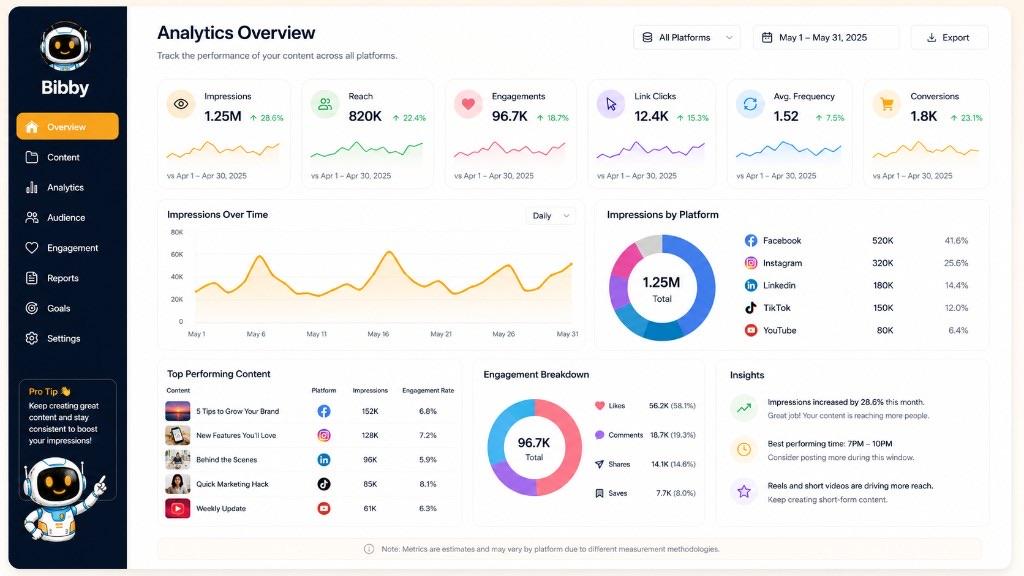
These comparisons help explain what your impression number actually means. Review the actual counts in each platform's native insights; combined totals across networks are not always measured the same way.
5. Look for Trends
A single post's impression count provides limited information. Look at your performance across multiple posts and time periods to identify patterns.
For example, you may discover that:
- Video content consistently generates more impressions than static images.
- Certain topics receive significantly more exposure.
- Posting at particular times produces stronger distribution.
- One platform generates substantially more impressions than another.
These patterns can help you make more informed content and scheduling decisions.
Track Impressions Across Multiple Platforms
If you publish content across several social networks, keep in mind that impressions are not necessarily measured identically on every platform. Facebook, Instagram, LinkedIn, TikTok, and YouTube can use different definitions and reporting methodologies.
For that reason, avoid treating a combined impression total as a perfectly standardized measurement across platforms. Instead, analyze trends within each platform and use the appropriate platform-specific metrics to evaluate performance.
A centralized publishing workflow can make this easier by bringing creation and scheduling into one place, so you spend less time hopping between apps to publish—and more time reviewing each platform's native impression data.
Impressions Across Social Media Platforms
The meaning of impressions is broadly similar across social networks: it describes content exposure or the number of times content is counted as being displayed. However, each platform can use its own measurement methodology, so impression data should not automatically be compared as if every network measures it in exactly the same way.
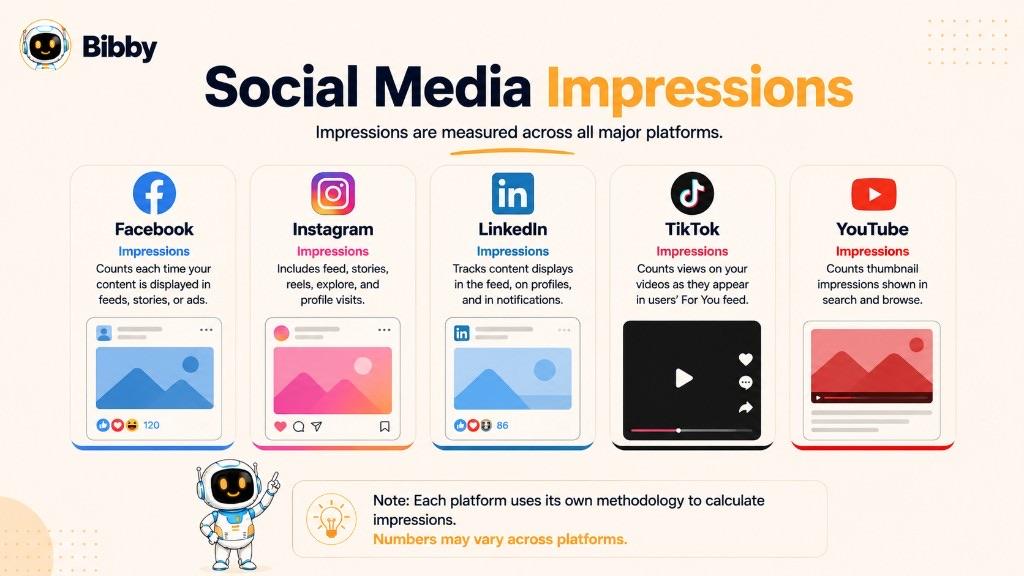
Facebook Impressions
On Facebook, impressions can be used to understand how frequently content or advertising is displayed. Marketers can use impression data alongside metrics such as reach and engagement to evaluate content visibility and distribution.
Instagram Impressions
Instagram impressions indicate the number of times content is counted as displayed. They can help marketers understand how much exposure posts and other content receive, particularly when analyzed alongside reach and engagement.
Because one person can encounter content multiple times, Instagram impressions can be higher than the number of unique accounts reached.
LinkedIn Impressions
LinkedIn uses impressions to report exposure for content such as posts. For businesses and professionals, this metric can help evaluate the visibility of thought leadership, company updates, educational content, and other posts.
Comparing impressions across different posts can reveal which topics and formats are receiving greater distribution.
TikTok Impressions
For TikTok content, exposure and video-view metrics should not automatically be treated as identical. A piece of content can receive opportunities for exposure without every exposure resulting in a counted view.
When analyzing TikTok performance, consider impressions or exposure-related metrics alongside views, engagement, watch behavior, and other available analytics.
YouTube Impressions
YouTube has a particularly important distinction around impressions. In YouTube Analytics, impressions refer to the number of times a video's thumbnail is shown to viewers on certain YouTube surfaces.
This means YouTube impressions should not be interpreted as the number of times the video itself was watched. YouTube provides other metrics, such as views and watch time, to measure viewing behavior.
Why Platform Differences Matter
Although the word impressions appears across multiple social platforms, the underlying measurement can differ.
When comparing performance:
- Check the platform's definition of the metric.
- Compare similar content and reporting periods.
- Analyze impressions alongside reach, engagement, views, and clicks.
- Focus on trends within each platform rather than assuming every impression is measured identically.
Understanding these differences prevents misleading comparisons and gives you a more accurate picture of how your content is being distributed across your social media channels.
Key Takeaways
Impressions measure the total number of times your content is displayed, making them an important metric for understanding visibility and exposure. But impressions are not the same as reach, views, or engagement, and a high impression count does not automatically mean your content is performing well.
The most useful way to interpret impressions is to analyze them alongside reach, engagement, clicks, conversions, and frequency. Tracking these metrics together gives you a clearer picture of whether increased visibility is actually contributing to your social media goals.
The most important points to remember are:
- Impressions = total displays, not unique people.
- Reach counts unique exposure; impressions count total exposure.
- Views measure watching (or the platform's view definition), not mere display.
- Engagement measures interaction after content is shown.
- There is no universal “good” impression number.
- Platform definitions differ—especially on YouTube, where impressions often mean thumbnail shows.
- Frequency ≈ impressions ÷ reach describes average repeated exposure.
- Both organic posts and paid ads can generate impressions.
If you're ready to go beyond individual metrics, the next step is to understand how reach, engagement, impressions, and other social media metrics work together to measure overall content performance.
With Bibby, you can create images, carousels, videos, and Stories, generate captions, and schedule posts across Facebook, Instagram, LinkedIn, YouTube, and TikTok—then review impression counts in each platform's analytics.
Continue learning with related dictionary entries on reach, engagement, engagement rate, CTR, CPM, organic reach, and brand awareness—or browse the social media dictionary. Then start a free Bibby trial to create, caption, and schedule content across your channels.