
Organic reach is the number of unique people who see your social media content without you paying for advertising or boosted distribution. When you publish a post, Reel, video, carousel, Story, or other content and people discover it naturally through their feeds, recommendations, searches, shares, or other unpaid distribution, those users contribute to your organic reach.
For example, if you publish an Instagram carousel and 4,000 unique people see it without the post being promoted, the content has an organic reach of 4,000. The same principle applies across platforms such as Facebook, Instagram, LinkedIn, YouTube, and TikTok, although each platform uses different systems to decide which content gets shown to users.
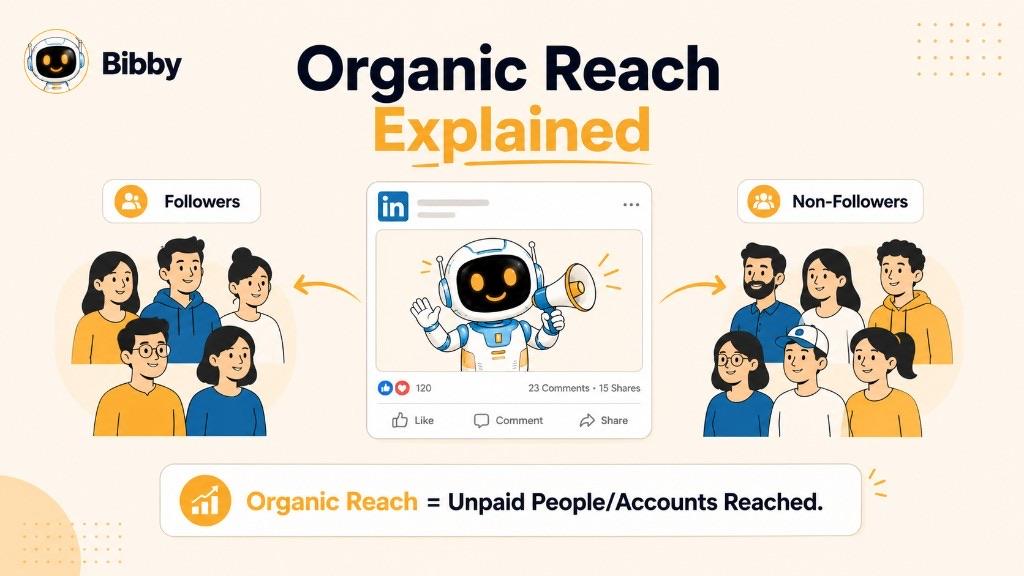
Organic reach is more than a follower-count game. A page with 10,000 followers may reach only a portion of its audience with a particular post, while a highly relevant or engaging piece of content can reach people who do not follow the account at all. Content relevance, audience behavior, engagement, format, timing, consistency, and each platform's distribution and recommendation systems can all influence how far content travels organically.
This makes organic reach an important social media metric for businesses, creators, marketers, and brands. It helps show whether content is being discovered naturally and whether a social media strategy is generating visibility without relying entirely on paid advertising. Understanding how organic reach works also makes it easier to decide what content to create, when to publish it, and which posts are worth repurposing or promoting.
In this guide, we'll explain how organic reach works, how it differs from impressions and paid reach, what affects it, how to measure it, why it can decline, and practical ways to improve it across different social media platforms.
Organic Reach at a Glance
Organic reach becomes easier to understand when you compare it with the other social media metrics that appear alongside it in analytics dashboards. The table below summarizes the most important terms.
| Term | Definition |
|---|---|
| Organic reach | The number of unique people who see your content through unpaid distribution. |
| Paid reach | The number of unique people who see your content as a result of paid advertising or promotion. |
| Impressions | The total number of times your content is displayed, including multiple displays to the same person. |
| Engagement | Actions people take on your content, such as likes, comments, shares, saves, clicks, or other platform-specific interactions. |
| Engagement rate | The percentage of an audience that interacts with your content based on a defined calculation method. |
| Follower reach | The number of followers who see your content. |
| Non-follower reach | The number of people who see your content without following your account. |
| Organic impressions | The total number of times your content is displayed through unpaid distribution. |
The key difference
The simplest way to remember the relationship is:
Reach = how many unique people saw your content.
Impressions = how many times your content was displayed.
Engagement = what people did with your content.
For example, suppose you publish a LinkedIn post that reaches 5,000 unique people and generates 7,500 impressions. The reach is 5,000, while the impressions are 7,500 because some people viewed the post more than once.
If those users generate 400 likes, comments, reposts, clicks, or other interactions, those actions contribute to the post's engagement.
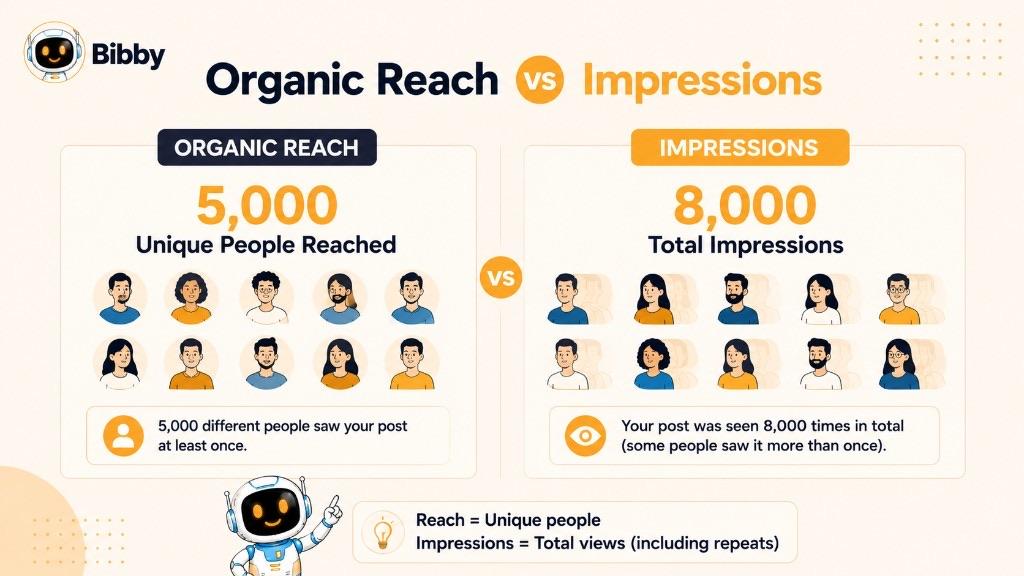
Organic reach focuses specifically on the unpaid portion of content distribution. That distinction becomes particularly important when a business uses both organic content and paid advertising, because total reach can otherwise hide where the audience exposure actually came from.
Why these metrics should be viewed together
Organic reach on its own does not tell the complete story. A post may reach thousands of people but generate little engagement, while another post may reach a smaller audience but produce substantial shares, saves, comments, or clicks.
Looking at reach alongside impressions and engagement gives you a clearer picture of how your content is performing:
Content published → Organic distribution → Reach → Engagement → Further distribution
The exact signals and terminology vary by platform, but the underlying idea remains useful: organic reach measures unpaid exposure, while engagement helps you understand what happens after people encounter the content.
How Does Organic Reach Work?
Organic reach starts when you publish content without paying to promote it. However, publishing a post does not mean that every follower will automatically see it. Social platforms decide which content to distribute and which users are most likely to find it relevant.
Although every platform has its own recommendation and ranking systems, organic distribution generally follows a process like this:
Publish content → Initial distribution → Audience response → Further distribution → Organic reach
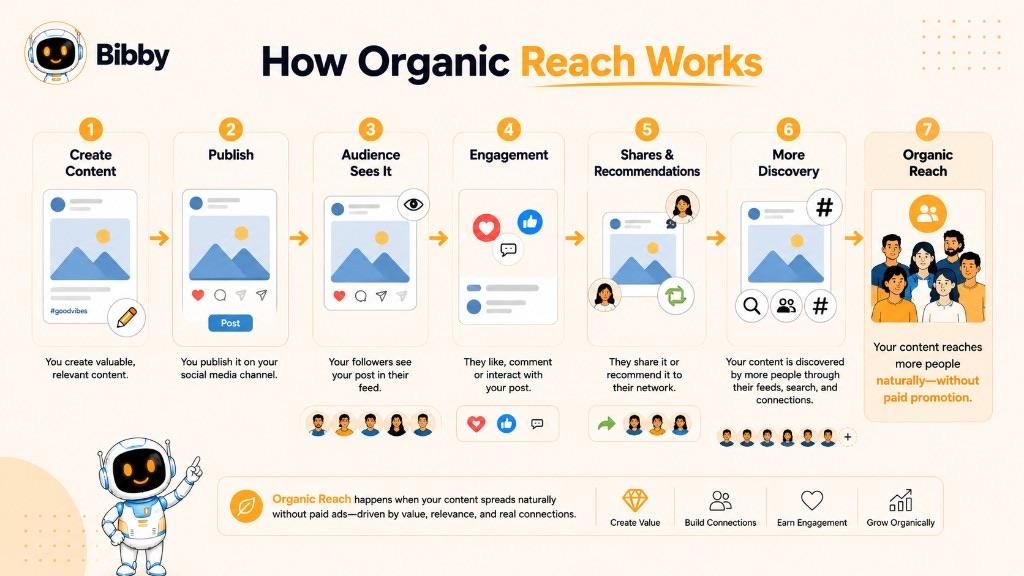
You publish content
The process begins when you publish an image, carousel, video, Story, text post, Reel, Short, or another type of social media content.
At this point, the content becomes eligible for organic distribution. Your followers may see it in their feeds, while recommendation systems may also make it available to people who do not follow your account.
Publishing itself, however, does not guarantee a specific amount of reach.
The platform evaluates the content
Social platforms use different ranking and recommendation systems to determine which content should appear to which users.
Depending on the platform and content format, signals can include:
- The user's previous interactions with similar content
- How relevant the content appears to the user
- Early engagement
- Watch time or viewing behavior for video
- Shares, saves, comments, and other interactions
- The relationship between the creator and audience
- Content format
- Recency
- Previous audience behavior
The exact algorithms are different across Facebook, Instagram, LinkedIn, YouTube, TikTok, and other platforms. There is also no single public formula that guarantees a specific level of organic reach.
The content reaches an initial audience
A platform may first show content to a portion of an account's existing audience or to users it predicts may be interested in it.
This initial exposure gives the platform information about how people respond to the content.
For example, a new post might receive views from some followers shortly after publication. If people spend time with the post, comment, share it, save it, or otherwise interact with it, those signals can provide additional information about its relevance.
Audience behavior can influence further distribution
When content generates meaningful audience response, the platform may continue distributing it to additional users.
This is one reason a post can sometimes reach people who have never followed the account.
Consider a simple example:
A LinkedIn post is published to an account's existing audience. Several people find it useful and repost it. Their networks then see the post, creating additional unpaid exposure.
The original publisher did not pay for that additional distribution, so those new users contribute to the content's organic reach.
The content may reach non-followers
Organic reach is not limited to existing followers.
Depending on the platform and content type, users can discover content through:
- Recommendations
- Explore or discovery surfaces
- Search
- Shares and reposts
- Hashtags or topics
- Suggested content
- Friends or connections
- Platform-specific recommendation feeds
This is particularly important for brands and creators because organic distribution can introduce content to potential audiences before they ever follow the account.
Reach eventually slows down
Most social posts do not continue gaining exposure at the same rate forever.
As the most relevant audience has already encountered the content, its distribution may slow. Interest can also decline as the content becomes less timely or newer content competes for users' attention.
A post might therefore experience rapid growth shortly after publication and then settle into a much slower rate of additional reach.
Organic reach is not simply follower count
Having more followers can provide a larger potential audience, but follower count does not equal organic reach.
An account with 100,000 followers does not automatically reach all 100,000 people with every post. Likewise, content from a smaller account can sometimes reach a much larger audience when it receives strong distribution beyond its existing followers.
This is why audience relevance, content quality, distribution, and user behavior are more useful concepts for understanding organic reach than follower count alone.
A simple example of organic distribution
Imagine a business publishes a carousel about a common problem faced by its target customers.
- The business publishes the carousel without paid promotion.
- Some followers see it in their feeds.
- Several users save and share the post.
- Their activity creates additional opportunities for the content to be discovered.
- The platform recommends the content to other potentially interested users.
- People who do not follow the business see the carousel.
- The number of unique people exposed to the content increases.
All of this unpaid exposure contributes to the post's organic reach.
The important takeaway is that organic reach is the result of content being distributed to people naturally through a platform's ecosystem, rather than exposure purchased through advertising.
Organic Reach vs Impressions
Organic reach and organic impressions are related, but they measure different things. Organic reach counts the number of unique people who see your content without paid promotion, while organic impressions count the total number of times that content is displayed through unpaid distribution.
The distinction matters because one person can see the same post more than once.
What is organic reach?
Organic reach measures unique users or accounts reached through unpaid distribution.
For example, if 3,000 different people see your Instagram post organically, the post has an organic reach of 3,000.
Each person is generally counted once toward reach, even if they encounter the content multiple times, although the exact reporting methodology can vary by platform.
What are organic impressions?
Organic impressions measure the total number of times content is displayed through unpaid distribution.
If the same person sees your post three times, those multiple displays can contribute to impressions even though they represent only one person in reach.
For example:
- 3,000 unique people see a post
- Some users see it more than once
- The post generates 4,500 total unpaid displays
In this example:
Organic reach = 3,000
Organic impressions = 4,500
Why are impressions often higher than reach?
The difference comes from repeated exposure.
Imagine five people see a post:
- Person A sees it once
- Person B sees it twice
- Person C sees it three times
- Person D sees it once
- Person E sees it twice
The content reached 5 unique people, but generated 9 total impressions.
This is why impressions can be higher than reach.
A high impression count can indicate that people are encountering content multiple times, but it does not automatically mean the content performed well. You need to consider other metrics, such as engagement, clicks, watch time, shares, saves, or conversions, depending on the content and business objective.
Organic Reach vs Organic Impressions
| Metric | What it measures | Example |
|---|---|---|
| Organic reach | Unique people who saw the content without paid promotion | 3,000 |
| Organic impressions | Total unpaid displays of the content | 4,500 |
| Organic engagement | Interactions generated from unpaid exposure | 320 |
| Organic engagement rate | Engagement relative to a defined audience or reach | Depends on calculation |
Why both metrics matter
Organic reach helps answer:
“How many different people did my content reach?”
Organic impressions help answer:
“How many total times was my content displayed?”
Together, they provide a better picture of content distribution.
For example, suppose two posts both reach 5,000 people:
- Post A: 5,200 impressions
- Post B: 11,000 impressions
Both posts reached the same number of unique people, but Post B generated considerably more total exposure. That could happen because some users encountered the content multiple times.
However, you should not automatically conclude that Post B is better. A stronger analysis would also examine engagement, shares, saves, clicks, video retention, conversions, and other relevant outcomes.
Reach and impressions across social platforms
The basic distinction is consistent across social media, but platforms may define and report these metrics differently. Some platforms may use different terminology, reporting windows, or methodologies.
This is particularly important when comparing performance between Facebook, Instagram, LinkedIn, YouTube, TikTok, and other platforms.
For that reason, avoid treating a reach number from one platform as directly equivalent to the same number from another platform without checking how each platform defines the metric.
The simple way to remember the difference
Reach = people.
Impressions = displays.
If 10,000 unique people see your content once, your reach could be 10,000 and your impressions could also be close to 10,000.
If those same 10,000 people collectively see the content multiple times, your reach can remain 10,000 while impressions increase substantially.
Understanding this difference is essential when evaluating organic social media performance, because it prevents you from confusing repeated exposure with a larger unique audience.
Organic Reach vs Paid Reach
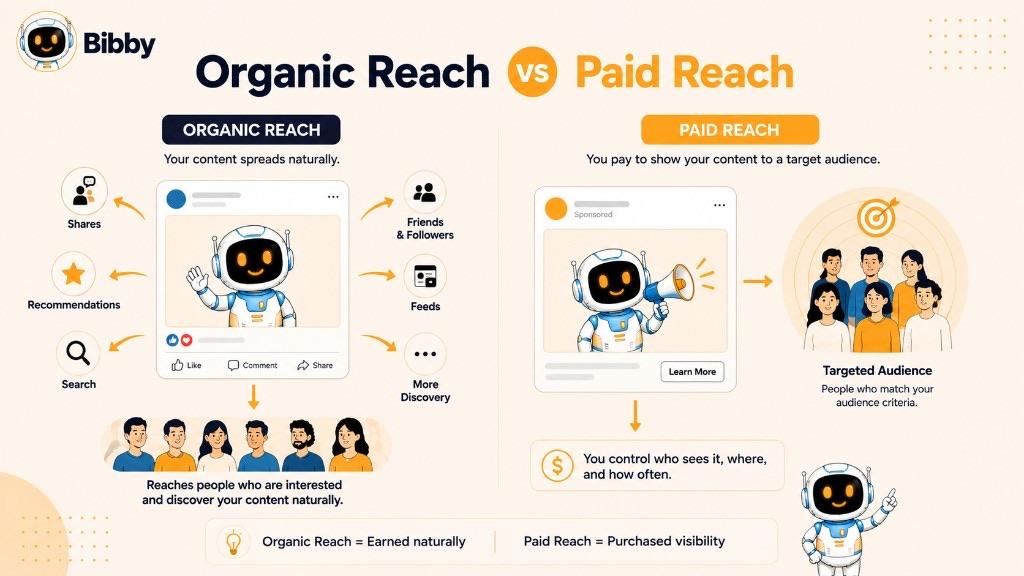
Organic reach is the number of unique people who see your content through unpaid distribution, while paid reach is the number of unique people who see your content because you paid a platform to distribute it. Both can increase the visibility of your social media content, but they work differently and serve different strategic purposes.
The simplest distinction is:
Organic reach is earned through content distribution and audience behavior. Paid reach is purchased through advertising.
For example, when you publish an Instagram Reel and people discover it naturally through their feeds, recommendations, shares, or other unpaid sources, that exposure contributes to organic reach. If you promote the same Reel as an advertisement and it is shown to people because of your advertising campaign, that exposure contributes to paid reach.
What is organic reach?
Organic reach comes from unpaid content distribution.
A business, creator, or organization publishes content and allows the platform's distribution and recommendation systems to determine who sees it. Existing followers may encounter the content, while non-followers may discover it through recommendations, shares, search, or other platform features.
Organic reach can therefore extend beyond an account's existing audience without requiring advertising spend.
What is paid reach?
Paid reach comes from advertising.
A business pays a platform to distribute content or an advertisement to a selected audience. Depending on the platform and campaign objective, advertisers may be able to define audiences using characteristics such as demographics, interests, behaviors, locations, or other available targeting options.
Paid distribution gives marketers greater control over who is eligible to see the content and how much budget is available for distribution.
Organic Reach vs Paid Reach: Key Differences
| Factor | Organic Reach | Paid Reach |
|---|---|---|
| Distribution | Unpaid platform distribution | Paid advertising distribution |
| Direct media cost | No advertising spend required | Requires advertising budget |
| Audience control | Primarily determined by platform distribution and audience behavior | Greater control through advertising targeting |
| Predictability | Can fluctuate significantly | Generally more controllable with budget and targeting |
| Discovery | Can come from feeds, recommendations, search, shares, and other unpaid sources | Primarily generated through advertising delivery |
| Longevity | Content can continue receiving exposure after publication | Distribution generally depends on campaign delivery and budget |
| Best suited for | Community building, content discovery, long-term visibility | Targeted reach, campaigns, acquisition, and scalable exposure |
| Optimization | Content and audience strategy | Creative, targeting, bidding, budget, and campaign optimization |
Is organic reach free?
Organic reach does not require you to pay the platform for each impression or user reached.
However, organic does not mean cost-free.
Businesses may invest considerable resources in:
- Content creation
- Graphic design
- Video production
- Copywriting
- Social media management
- Community management
- Analytics
- Strategy
- Scheduling and publishing
So while there may be no direct advertising charge for organic distribution, generating consistent organic content still requires time, people, tools, and resources.
Is paid reach better than organic reach?
Neither is universally better.
The right approach depends on your objective.
Organic reach can be valuable when you want to:
- Build an audience over time
- Establish brand authority
- Develop community relationships
- Test content ideas
- Generate ongoing visibility
- Understand what topics resonate with your audience
- Reduce dependence on paid advertising
Paid reach can be valuable when you want to:
- Reach a specific audience quickly
- Promote a product or offer
- Support a launch
- Generate leads
- Drive website traffic
- Scale exposure for proven content
- Reach audiences outside your existing organic distribution
The strongest social media strategies often use both rather than treating them as competing approaches.
Can organic and paid reach work together?
Yes. Organic and paid distribution can complement each other.
A common strategy is to publish content organically, analyze how the audience responds, and then use paid promotion to increase exposure for content that supports a specific campaign objective.
For example:
- A company publishes several educational posts organically.
- One post generates unusually strong engagement and shares.
- The company identifies the topic as a potential winner.
- The company adapts or promotes the content through a paid campaign.
- Paid distribution introduces the content to a targeted audience at greater scale.
This approach allows organic content to provide useful feedback before additional advertising resources are allocated.
Organic reach does not guarantee unlimited visibility
One common misconception is that organic content should eventually reach everyone who follows an account.
That is not how modern social platforms generally work.
A platform's feed and recommendation systems select content for users based on a variety of signals. As a result, an account can have a large follower base while individual posts reach only a fraction of those followers organically.
Likewise, content from a smaller account can sometimes reach a much larger audience when it receives substantial recommendation, sharing, or other unpaid distribution.
The role of content quality
Paid distribution can put content in front of a targeted audience, but organic distribution depends heavily on whether people find the content relevant enough to continue consuming or interacting with it.
This creates an important strategic difference:
Paid reach can buy additional exposure. Organic reach must earn continued attention.
That does not mean organic content needs to go viral to be successful. For many businesses, reaching a smaller but highly relevant audience can be more valuable than generating a large number of low-quality impressions.
Organic Reach vs Paid Reach: Which Should a Business Use?
For most businesses, the answer is both, but for different jobs.
Use organic social media to build a consistent presence, develop relationships, test ideas, educate the audience, and create long-term visibility.
Use paid social media when you need controlled distribution, targeted exposure, campaign scale, or a specific marketing outcome.
The two approaches work best when they are connected to the same overall content and marketing strategy.
Organic reach builds opportunities for discovery. Paid reach provides additional control over distribution. The goal is not to choose one forever, but to understand where each fits into your social media strategy.
Why Is Organic Reach Important?
Organic reach matters because it shows how far your content can travel through unpaid distribution. For businesses and creators, it provides an indication of whether content is being discovered, consumed, shared, and distributed naturally rather than relying entirely on advertising.
A strong organic reach strategy can support brand awareness, audience growth, engagement, content discovery, and long-term social media visibility. It can also help businesses learn which topics and formats deserve more attention before investing additional resources in paid campaigns.
It increases brand visibility
Every person who discovers your content organically is another opportunity for your brand to become recognizable.
Someone may encounter a post through their feed, a recommendation, a share from another user, a search result, or another unpaid discovery mechanism. They may not follow your account yet, but that first interaction can introduce them to your brand.
Over time, repeated organic exposure can help build familiarity with your:
- Brand
- Products or services
- Expertise
- Content style
- Point of view
- Value proposition
Organic reach therefore contributes to the broader process of building brand awareness.
It helps you reach people beyond your followers
Organic reach is not necessarily limited to your existing audience.
When content is recommended, shared, reposted, searched for, or otherwise distributed beyond your follower base, it can reach people who have never interacted with your account before.
This is particularly valuable for newer brands and creators because organic distribution can create opportunities for audience growth without requiring every new person to be acquired through advertising.
For example, a useful LinkedIn post may be reposted by one professional and subsequently discovered by people in that person's network. The original account can gain additional visibility without paying for those individual exposures.
It helps build an audience over time
Organic reach can create a pathway from discovery to followership.
A person might first encounter a single post, then visit the account, consume additional content, and eventually become a follower or customer.
The journey can look like:
Organic reach → Content interaction → Profile visit → Follow → Continued engagement → Potential customer
Not everyone will follow or purchase, but increasing relevant organic exposure creates more opportunities for these actions to occur.
It helps identify content that resonates
Organic performance can act as a form of content feedback.
Suppose a company publishes content across several topics. One topic consistently generates stronger reach, shares, saves, comments, or watch time than the others.
That performance provides a useful signal.
The company can then investigate:
- Why did this topic perform well?
- Which format worked?
- Was the hook stronger?
- Did the content solve a specific problem?
- Did people share it with others?
- Was the topic particularly relevant to the audience?
These insights can influence future content planning.
It can reduce dependence on paid advertising
Paid advertising can be an effective way to scale distribution, but relying entirely on advertising can make social visibility heavily dependent on budget.
A healthy organic content strategy provides another source of exposure.
When a business consistently produces content that attracts relevant audiences without paid distribution, it can build an audience and content library that continue generating value beyond individual advertising campaigns.
This does not mean businesses should eliminate paid social advertising. Instead, organic and paid strategies can perform different roles within the same marketing system.
It supports community building
Organic social media is particularly useful for creating two-way communication.
People can:
- Comment on posts
- Ask questions
- Share experiences
- Respond to Stories
- Repost content
- Tag colleagues or friends
- Participate in discussions
These interactions can help transform a social media account from a broadcasting channel into an active community.
For brands, that relationship can be valuable even when the immediate result is not a click or purchase.
It can generate valuable social proof
When people publicly interact with content, those interactions can provide social proof for other users discovering the post.
For example, a potential customer may encounter a business post and notice that other users have thoughtfully commented, shared the content, or discussed the topic.
Organic engagement does not automatically equal trust or conversions, but genuine audience interaction can contribute to the credibility surrounding a brand.
It creates opportunities for content repurposing
High-performing organic content can become a source of ideas for future content.
A successful post might be transformed into:
- A carousel
- A short-form video
- A Story
- A longer educational post
- A LinkedIn article
- A YouTube video
- A newsletter topic
- A new campaign
This creates a feedback loop:
Create → Publish → Measure → Identify winners → Repurpose → Publish again
Instead of constantly starting from a blank page, businesses can use real audience response to guide their content pipeline.
It helps validate ideas before paid promotion
Organic performance can also help marketers evaluate content before putting advertising budget behind it.
For example, if an educational post receives strong engagement and generates meaningful conversations, the company may decide that the topic is worth developing into a broader campaign.
This does not mean organic performance should be the only criterion for deciding what to promote. Campaign objectives, audience fit, conversion potential, creative quality, and business goals also matter.
Organic reach is not the same as business success
A high organic reach number can be useful, but reach alone is not a measure of marketing success.
A post reaching 100,000 irrelevant users may create less business value than a post reaching 5,000 highly relevant potential customers.
Depending on the objective, you may also need to evaluate:
- Engagement
- Shares
- Saves
- Comments
- Clicks
- Website traffic
- Leads
- Conversions
- Follower growth
- Video watch time
- Customer actions
The most useful question is therefore not simply:
“How many people did we reach?”
It is:
“Did we reach the right people, and what did they do after seeing the content?”
Why organic reach matters for social media strategy
Organic reach gives marketers a way to understand how content performs when distribution is not directly purchased.
It can help reveal what audiences care about, which formats deserve more attention, which topics generate conversation, and where opportunities for content growth exist.
For this reason, organic reach should be treated as one part of a broader social media measurement system, rather than a standalone success metric.
The strongest strategy combines organic reach with engagement, audience quality, content performance, and business outcomes to understand whether social media activity is actually moving the organization forward.
What Affects Organic Reach on Social Media?
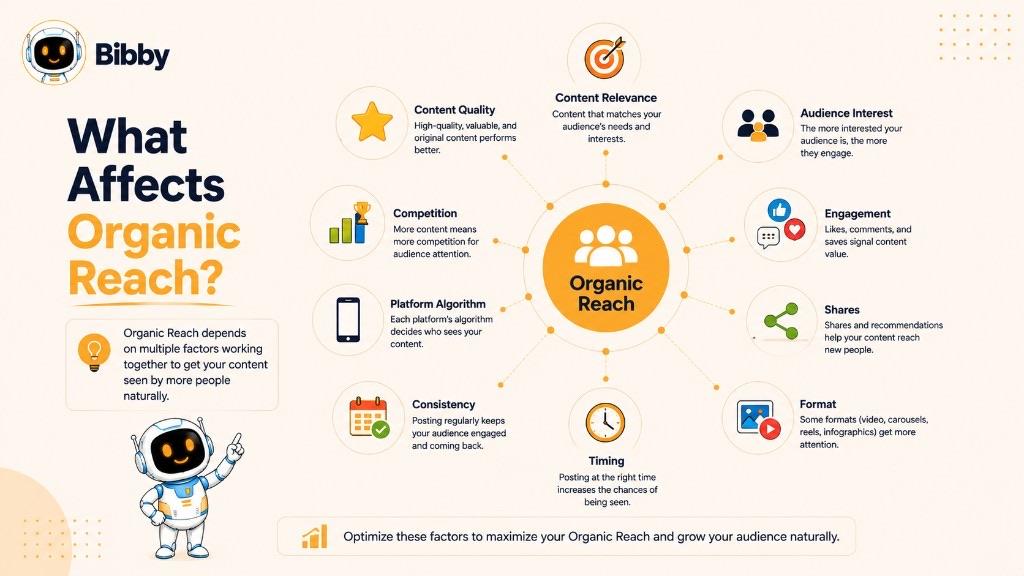
Organic reach is influenced by multiple factors, and there is no single setting or tactic that guarantees a specific number of people will see a post. Social platforms use their own ranking and recommendation systems to decide which content to show, to whom, and when.
The factors that influence distribution can also differ between Facebook, Instagram, LinkedIn, YouTube, TikTok, and other platforms. However, several broad factors consistently matter when evaluating organic reach.
Content relevance
Relevance is one of the foundations of organic distribution.
Social platforms want users to encounter content that matches their interests and behavior. If your content consistently addresses topics that matter to your target audience, it has a better opportunity to attract attention and continued interaction.
Relevance can come from:
- The topic of the content
- The audience's previous interests
- The creator's subject area
- User interactions with similar content
- The language and context of the post
- The relationship between the audience and account
For businesses, this means creating content for a clearly defined audience is generally more useful than trying to make every post appeal to everyone.
Engagement quality
Engagement can provide platforms with information about how audiences respond to content.
However, not all interactions communicate the same thing, and there is no universal rule that says a particular engagement automatically increases reach.
Depending on the platform and format, useful signals can include:
- Comments
- Shares
- Saves
- Reposts
- Likes or reactions
- Clicks
- Replies
- Video viewing behavior
Meaningful actions such as sharing useful information with other people can create additional opportunities for organic distribution.
The important distinction is that engagement is not the same as reach. Engagement describes audience actions, while reach describes how many unique people were exposed to the content.
Content format
The format you choose can influence how content is distributed and consumed.
Different platforms prioritize or support different formats, including:
- Images
- Carousels
- Short-form videos
- Long-form videos
- Stories
- Text posts
- Live content
A format that performs well on one platform may not produce the same results on another.
For example, short-form video may be particularly important for discovery on some platforms, while text-based expertise can perform strongly in professional networks.
The best approach is to match the format to both the platform and the audience's preferred way of consuming information.
Posting consistency
Consistent publishing gives an account more opportunities to reach its audience and generate useful performance data.
However, posting more frequently does not automatically produce more organic reach.
Publishing low-quality content repeatedly can overwhelm an audience and consume resources without improving performance.
A sustainable schedule is usually more useful than an aggressive publishing volume that cannot be maintained.
Consistency also allows marketers to identify patterns over time. With enough content, it becomes easier to determine which topics, formats, and approaches are producing meaningful results.
Audience behavior
Organic reach is strongly connected to what audiences actually do.
If users consistently stop to consume your content, interact with it, share it, save it, or otherwise respond to it, those behaviors can provide signals about its relevance.
Audience behavior can also explain why the same account can experience very different reach from one post to another.
A highly relevant post may outperform a more polished post simply because it addresses a problem the audience currently cares about.
Posting time
When you publish content can influence its initial opportunity for exposure.
If your target audience is active around the time a post is published, the content may have more opportunities to receive early attention.
However, there is no universal best time to post that works for every account.
The ideal timing depends on factors such as:
- Audience location
- Audience habits
- Platform
- Industry
- Content format
- Historical performance
- Time zone
- Day of the week
Instead of relying entirely on generic “best time to post” charts, businesses can test different publishing windows and use their own analytics to identify useful patterns.
Account and content history
Previous content performance can provide context for future distribution.
An account that consistently publishes content relevant to a particular audience may develop a recognizable content identity within a platform's ecosystem.
Likewise, previous interactions between users and an account can influence what content those users are likely to encounter.
This does not mean one successful post guarantees that future posts will perform well. Each piece of content still has to earn audience attention.
Content freshness
Social feeds are constantly changing.
New posts compete with existing content for users' attention, and some types of content are particularly time-sensitive.
For example, a post responding to a breaking industry development may have strong relevance for a short period but become less useful as the topic changes.
Publishing relevant content at an appropriate time can therefore matter, especially for timely conversations.
Platform algorithm and recommendation systems
Every major social platform has its own systems for ranking, recommending, and distributing content.
Instagram, Facebook, LinkedIn, YouTube, and TikTok do not use one universal algorithm.
Their systems can consider different signals depending on the surface and content type.
This is why a strategy that performs well on Instagram should not simply be copied word-for-word onto LinkedIn or TikTok.
Instead, content should be adapted to the expectations and behavior of each platform.
Shares and other forms of secondary distribution
When users share, repost, or send content to other people, the content can gain additional opportunities for unpaid exposure.
This can create a distribution chain:
Original post → User interaction → Share/repost → New audience → Additional reach
For brands, highly shareable content can therefore create organic discovery beyond the account's existing followers.
Useful content, original insights, practical advice, entertaining material, and strong opinions can all encourage sharing when they are relevant to the audience.
Competition for attention
Your content is not distributed in an empty environment.
Every user's feed contains content from numerous accounts, creators, brands, communities, and recommendations.
This means organic reach is partly a competition for limited audience attention.
Even if your content is good, users may have limited time to consume it.
Strong hooks, clear communication, useful information, appropriate formatting, and audience relevance can help content compete more effectively for that attention.
Audience size and audience quality
Follower count can affect the size of the potential audience, but it does not determine organic reach by itself.
A large audience that rarely interacts with your content may provide less useful distribution than a smaller audience that is highly relevant and engaged.
This is why businesses should focus on audience quality and relevance, not simply accumulating followers.
Content quality and usefulness
Quality is difficult to reduce to one metric, but audiences usually respond more positively when content provides a clear reason to pay attention.
Useful content may:
- Solve a problem
- Answer a question
- Explain something clearly
- Provide original insight
- Entertain
- Teach a practical skill
- Help someone make a decision
- Present information in a convenient format
The goal is not to create content that looks perfect. The goal is to create content that gives the intended audience a reason to stop, consume, and potentially share it.
Why organic reach changes from post to post
Organic reach naturally fluctuates.
Two posts from the same account can have completely different results because they may differ in:
- Topic
- Audience relevance
- Format
- Timing
- Competition
- Early audience response
- Distribution opportunities
- Current platform conditions
A single low-reach post therefore does not necessarily indicate that an account has a problem.
A better approach is to evaluate performance across multiple posts and look for patterns.
The bigger picture
Organic reach is best understood as the outcome of content, audience, platform, and timing working together.
A useful mental model is:
Relevant content + appropriate format + audience interest + consistent publishing + effective distribution = greater opportunity for organic reach
No formula guarantees viral performance. The objective is to create repeatable conditions in which useful content has a strong opportunity to be discovered and shared naturally.
How to Increase Organic Reach on Social Media
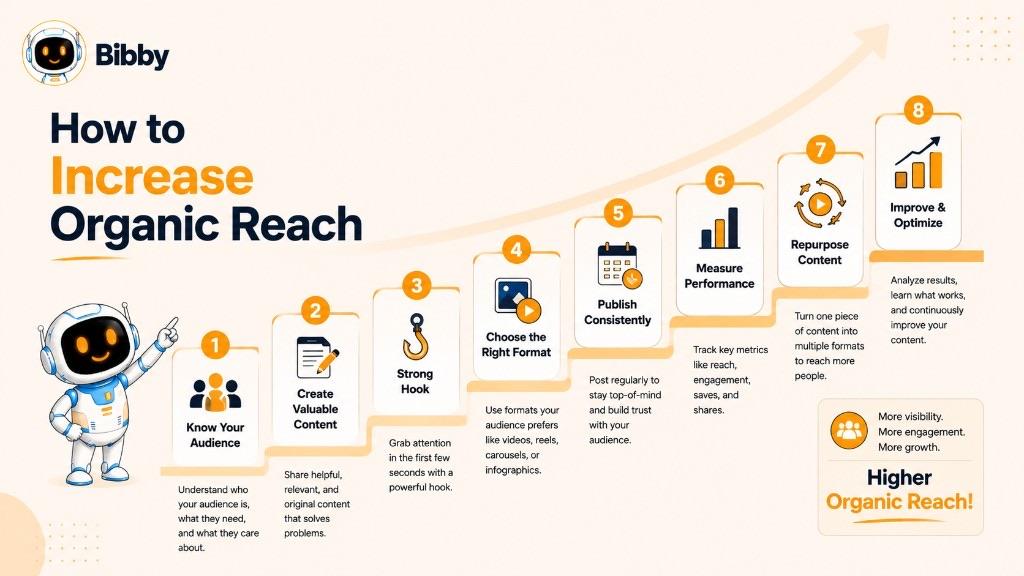
Increasing organic reach is not about finding one secret algorithm trick. A more sustainable approach is to create content that is relevant to a specific audience, publish it consistently, use formats suited to each platform, encourage meaningful interaction, and use performance data to improve future content.
You cannot guarantee that a post will reach a particular number of people organically. However, you can improve the conditions that give useful content more opportunities to be discovered.
1. Create content for a specific audience
The more clearly you understand who your content is for, the easier it becomes to create posts that people actually want to consume.
Instead of creating content for “everyone,” define the audience you want to attract.
Consider:
- Their problems
- Their goals
- Their questions
- Their interests
- Their level of expertise
- Their preferred content formats
- The language they use to describe their problems
For example, a software company targeting startup founders should create content around the challenges founders actually face rather than publishing generic technology updates.
Relevant content gives people a stronger reason to stop scrolling and pay attention.
2. Create content people want to share
Sharing can expose your content to people beyond your existing audience.
Create content that someone would naturally want to send to a colleague, friend, customer, or community.
Useful shareable formats include:
- Practical checklists
- Original insights
- Industry statistics
- Step-by-step guides
- Templates
- Tutorials
- Strong opinions
- Educational carousels
- Useful resources
- Problem-solving content
A good test is:
Would someone get enough value from this post to send it to another person?
If the answer is yes, the content has a stronger opportunity to generate secondary distribution.
3. Use strong hooks
People encounter enormous amounts of content on social platforms. Your opening needs to communicate quickly why the content deserves attention.
A strong hook can:
- Identify a problem
- Ask a relevant question
- Challenge an assumption
- Present an unexpected insight
- Promise a useful explanation
- Highlight a common mistake
- Introduce a specific result
For example, instead of beginning a post with:
“Social media marketing is important for businesses.”
You could begin with:
“Your social media posts may not have a reach problem. They may have a relevance problem.”
The second opening creates a reason to continue reading.
4. Choose the right content format
Different audiences consume information differently, and each social platform has its own content ecosystem.
Test formats such as:
- Carousels
- Images
- Short-form videos
- Long-form videos
- Stories
- Text posts
- Educational graphics
- Live content
Do not assume that one format will perform equally well everywhere.
Instead, adapt the presentation to the platform and audience.
5. Adapt content for each platform
Cross-platform publishing can save time, but simply copying the exact same post everywhere is not always the best strategy.
A single idea can be adapted into different formats.
For example:
One idea
→ Instagram carousel
→ LinkedIn educational post
→ TikTok video
→ YouTube Short
→ Facebook post
The underlying idea remains consistent, while the hook, caption, format, length, and presentation can be adapted to each platform.
This allows businesses to increase their content opportunities without requiring an entirely new idea for every channel.
6. Publish consistently
Consistency creates more opportunities to reach your audience and collect performance data.
A consistent publishing schedule can also make content production more manageable because your team knows what needs to be created and when it needs to be published.
However, consistency should not be confused with publishing as frequently as possible.
More posts do not automatically mean more organic reach.
A sustainable schedule that allows you to maintain content quality is generally more useful than publishing large amounts of low-value content.
7. Test different posting times
Publishing time can influence the initial opportunity for audience exposure.
If your audience is active when content goes live, the post may have more opportunities to receive early attention.
But there is no universal posting time that guarantees maximum organic reach.
Test different:
- Days
- Times
- Time zones
- Content formats
Then compare the results using your own audience and platform analytics.
This turns posting time from a guess into an experiment.
8. Write captions that add value
Captions should give users a reason to read, respond, save, or share the content.
Depending on the platform and format, an effective caption might:
- Explain the context
- Expand on the visual
- Tell a short story
- Provide additional information
- Ask a meaningful question
- Give actionable advice
- Include a clear next step
Avoid adding unnecessary words simply to make a caption longer.
The objective is usefulness and clarity, not caption length.
9. Encourage meaningful interaction
If you want people to interact with your content, give them something worth responding to.
Instead of generic prompts such as “Agree?” or “Thoughts?”, ask questions connected to the subject.
For example:
“Which part of your content workflow takes the most time: creating posts, writing captions, or scheduling?”
Specific questions can make it easier for people to contribute meaningful responses.
10. Respond to your audience
Organic social media is not only about publishing.
Responding to comments and participating in relevant conversations can help build relationships with your audience.
It can also reveal questions and problems that can become future content topics.
For example, if several people ask the same question in the comments of a post, that question could become:
- A follow-up post
- A carousel
- A short video
- An FAQ
- A tutorial
- A longer article
Your audience can therefore become a source of content ideas.
11. Repurpose content that performs well
You do not need to reinvent your content strategy every day.
If a particular topic performs well, investigate why and explore other ways to present the same underlying idea.
A successful LinkedIn post could become an Instagram carousel. A popular video could become several short clips. A frequently asked question could become a series of educational posts.
Repurposing can increase the number of opportunities for an idea to reach relevant audiences.
However, repurposing should involve adaptation rather than blindly publishing identical content everywhere.
12. Analyze more than likes
Likes are easy to notice, but they do not tell the entire story.
When evaluating organic reach, consider metrics such as:
- Reach
- Impressions
- Shares
- Saves
- Comments
- Clicks
- Profile visits
- Follower growth
- Video views
- Watch time
- Audience retention
- Conversions
The most useful metrics depend on your objective.
For example, an educational post may be successful because people save it, while a product announcement may be more valuable because it generates website visits or leads.
13. Identify patterns in high-performing content
Do not only ask:
“Which post got the most reach?”
Ask:
“What do our highest-performing posts have in common?”
Look for patterns in:
- Topics
- Hooks
- Formats
- Content length
- Publishing times
- Visual styles
- Audience segments
- Calls to action
- Engagement patterns
If several successful posts share a particular characteristic, that insight can influence your next content cycle.
14. Build content around real audience questions
Questions are powerful sources of organic content ideas because they already represent something your audience wants to understand.
Look at:
- Comments
- Customer questions
- Sales conversations
- Search queries
- Community discussions
- Support requests
- Industry conversations
Then turn recurring questions into useful content.
For example:
Audience question:
“How often should a business post on LinkedIn?”
Content opportunity:
A practical guide explaining how to choose a sustainable LinkedIn publishing frequency.
This approach creates content around existing demand rather than guessing what the audience might want.
15. Use automation to maintain consistency
Social media automation can reduce the operational work involved in creating and publishing content.
Tools such as Bibby can help organize a publishing workflow by allowing marketers to upload or generate content, select a posting style, generate captions, choose platforms, and schedule content.
Automation does not guarantee organic reach, but it can make it easier to:
- Maintain a consistent publishing schedule
- Test different publishing times
- Manage multiple platforms
- Repurpose content
- Organize campaigns
- Reduce repetitive publishing tasks
The strategic work still matters: deciding what to publish, understanding the audience, reviewing performance, and improving the content.
16. Keep experimenting
Organic reach is dynamic.
Audience preferences change. Platforms evolve. New formats appear. Competitors publish new content. Your own audience also changes over time.
That means a strategy that worked six months ago may not produce the same results today.
Treat organic reach as an ongoing optimization process:
Create → Publish → Measure → Learn → Improve → Republish
The objective is not to discover one permanent formula. It is to develop a repeatable system for learning what your audience responds to.
The key to increasing organic reach
The most sustainable way to improve organic reach is to combine audience relevance, useful content, appropriate formats, consistent publishing, meaningful engagement, experimentation, and performance analysis.
Automation can make the execution of that process easier, but the foundation remains the same: create content people genuinely want to see, then use real audience behavior to make the next piece of content better.
Organic Reach on Different Social Media Platforms
Organic reach exists across virtually every major social platform, but the way content gets discovered and distributed is different from one network to another. A strategy that works on Instagram may not produce the same results on LinkedIn, YouTube, Facebook, or TikTok.
The core principle remains the same: organic reach comes from unpaid distribution, but each platform has its own audience behavior, content formats, recommendation systems, and ranking signals.
Organic Reach on Facebook
On Facebook, organic reach can come from people's feeds, shares, groups, recommendations, search, and interactions with Pages or profiles.
For businesses, organic reach can be influenced by factors such as:
- How relevant the content is to the audience
- User interactions
- Shares and comments
- Content format
- Video viewing behavior
- Relationships between users and Pages
- Freshness of content
- Distribution through groups and communities
Facebook organic reach can extend beyond existing followers when people share content with their own networks or when Facebook recommends content to additional users.
Example: A local business publishes a useful post explaining how to choose the right service. Customers share it with friends, creating additional unpaid exposure beyond the business's existing audience.
For Facebook, content designed for conversation and sharing can be particularly useful because interaction can create additional opportunities for discovery.
Organic Reach on Instagram
Instagram organic reach can come from several surfaces, including the Feed, Stories, Explore, Reels, search, shares, and recommendations.
A post can therefore reach:
- Existing followers
- People who interact with the account
- People discovering content through recommendations
- Users searching for relevant content
- People who receive or share the content
Instagram also supports multiple content formats, and each can serve a different purpose.
Feed posts can help maintain a consistent presence with an existing audience.
Carousels can provide educational or step-by-step information in a highly consumable format.
Reels can create opportunities for broader discovery.
Stories can support ongoing interaction with an existing audience.
Because Instagram's different surfaces work differently, businesses should evaluate organic reach by content format rather than assuming that every post should perform in the same way.
Organic Reach on LinkedIn
LinkedIn organic reach is particularly relevant for professionals, B2B companies, founders, consultants, recruiters, and industry experts.
Content can be discovered through:
- The main feed
- Connections
- Followers
- Reposts
- Search
- Professional conversations
- Recommendations
Relevant and useful professional content can travel beyond the original creator's immediate network when people engage with or share it.
For example, a founder publishes a detailed post explaining a common problem in their industry. A few professionals find the insight valuable and repost it. Their networks then gain an opportunity to discover the original content.
For LinkedIn, useful content can include:
- Industry insights
- Original research
- Practical advice
- Case studies
- Professional experiences
- Data analysis
- Educational content
- Expert perspectives
The strongest approach is usually to prioritize relevance and expertise rather than trying to maximize generic engagement.
Organic Reach on YouTube
YouTube operates somewhat differently from feed-first social networks because content discovery can occur through YouTube Search, recommendations, Browse features, Suggested Videos, Shorts, subscriptions, and other discovery surfaces.
Organic reach on YouTube can therefore depend heavily on whether the platform predicts that viewers will find a video useful or interesting.
Important performance concepts can include:
- Click-through rate
- Watch time
- Audience retention
- Viewer satisfaction
- Repeat viewing
- Search relevance
- Topic interest
For example, a tutorial may continue attracting organic viewers long after publication because people discover it through search or recommendations.
This gives YouTube a particularly important relationship between content quality, discoverability, and long-term organic distribution.
A video's organic performance should therefore not be judged only by its first few hours or days.
Organic Reach on TikTok
TikTok places significant emphasis on content discovery through recommendation-driven experiences, particularly the For You feed.
A TikTok video can reach people who do not follow the creator.
Factors that can influence distribution may include:
- Viewer interactions
- Viewing behavior
- Completion
- Rewatching
- Shares
- Comments
- Content relevance
- User interests
- Video information and context
This creates opportunities for relatively small accounts to receive significant organic exposure when their content connects strongly with the right audience.
However, high reach is not guaranteed simply because a video is short or uses a popular trend.
The underlying content still needs to give viewers a reason to watch.
Why the Same Content Can Have Different Organic Reach on Each Platform
Publishing the same idea across multiple platforms does not guarantee the same level of organic reach.
Consider a single topic:
“How AI is changing social media marketing.”
It could become:
- An Instagram carousel
- A LinkedIn thought-leadership post
- A TikTok explainer
- A YouTube video
- A Facebook educational post
The underlying idea is identical, but the presentation can be completely different.
Each platform has different:
- Audience expectations
- Content formats
- Discovery mechanisms
- User behavior
- Consumption patterns
- Recommendation systems
This is why effective cross-platform publishing is usually about content adaptation, not simply content duplication.
Which Platform Has the Highest Organic Reach?
There is no universal platform that consistently provides the highest organic reach for every business.
The answer depends on:
- Industry
- Audience
- Content format
- Account history
- Content quality
- Audience behavior
- Platform
- Business objective
A B2B software company may find LinkedIn highly valuable for reaching relevant professionals, while a consumer brand may discover stronger opportunities through Instagram or TikTok.
Likewise, an educational business may generate significant long-term organic discovery through YouTube Search.
The most useful question is therefore not:
“Which platform has the highest organic reach?”
It is:
“Which platform gives my content the best opportunity to reach the audience I actually want?”
How to Improve Organic Reach Across Multiple Platforms
A cross-platform organic strategy should combine one core content idea with platform-specific execution.
A practical workflow is:
Research one audience problem → Create the core idea → Adapt it for each platform → Schedule consistently → Measure performance → Identify winners → Repurpose successful ideas
This approach allows businesses to maintain a presence across multiple networks without treating every platform as identical.
Tools such as Bibby can support the operational side of this workflow by allowing users to manage content, generate captions, organize campaigns, and schedule posts across platforms from one workflow.
The objective, however, remains the same regardless of the tool: create relevant content, publish consistently, learn from audience behavior, and improve the next content cycle.
How Is Organic Reach Measured?
Organic reach is measured by counting the unique people or accounts that saw your content through unpaid distribution. Social media platforms typically provide reach and related performance data through their built-in analytics or insights dashboards, although the exact terminology and calculation methodology can differ between platforms.
The important distinction is that organic reach measures unique exposure, not the total number of times content was displayed.
For example, if 5,000 unique users see a post without paid promotion, its organic reach is 5,000. If some of those users see the same content multiple times, the number of impressions can be higher than the reach.
Organic reach in social media analytics
Depending on the platform, analytics may provide information about:
- Reach
- Impressions
- Engagement
- Engagement rate
- Views
- Watch time
- Shares
- Saves
- Comments
- Clicks
- Follower growth
- Profile visits
- Website activity
Not every platform reports every metric in the same way.
This means you should always consider the platform's own definitions when comparing performance across networks.
Organic reach vs total reach
When an account uses both organic publishing and paid advertising, it is important to distinguish between organic reach, paid reach, and total reach.
A simplified way to think about them is:
Organic reach: People reached through unpaid distribution.
Paid reach: People reached through paid advertising or promotion.
Total reach: The overall unique audience reached, subject to the platform's reporting methodology.
The numbers should not always be added together manually because the same person may be exposed through more than one distribution source.
Organic reach by content
Measuring organic reach at the individual post level can help identify which content earns the most unpaid exposure.
For example:
| Content | Organic Reach | Shares | Saves | Comments |
|---|---|---|---|---|
| Educational carousel | 8,200 | 190 | 420 | 85 |
| Product announcement | 4,100 | 35 | 70 | 28 |
| Industry insight | 12,600 | 310 | 180 | 140 |
| Short-form video | 18,400 | 520 | 240 | 210 |
The highest-reach post is not necessarily the most valuable post.
A product announcement might generate fewer people reached but produce significantly more qualified website traffic or sales.
For this reason, organic reach should be interpreted alongside metrics that reflect the purpose of the content.
Organic reach by content format
Comparing reach across formats can reveal useful patterns.
For example, a business might discover that:
- Carousels generate strong saves
- Short videos generate broader discovery
- Text posts generate conversations
- Stories generate interaction with existing followers
These patterns can help shape future content planning.
However, comparisons should be made over a meaningful number of posts rather than relying on one unusually successful or unsuccessful piece of content.
Organic reach by platform
If you publish across several social networks, measure each platform separately.
For example:
| Platform | Organic Reach | Primary Discovery Opportunity |
|---|---|---|
| 8,000 | Feed, shares, groups, recommendations | |
| 15,000 | Feed, Reels, Explore, recommendations | |
| 7,500 | Feed, network distribution, reposts | |
| YouTube | 22,000 | Search, recommendations, Browse, Suggested Videos |
| TikTok | 31,000 | Recommendation-driven discovery |
These figures are illustrative rather than benchmarks.
A direct comparison between platforms can be misleading because each network has different audiences, definitions, recommendation systems, and content formats.
The more useful comparison is often how your own content performs within each platform over time.
Organic reach rate
Some marketers calculate an organic reach rate to understand how much of an account's follower base was reached by a post.
A commonly used simplified calculation is:
Organic Reach Rate = (Organic Reach ÷ Total Followers) × 100
For example, if an account has 20,000 followers and a post reaches 4,000 people organically:
4,000 ÷ 20,000 × 100 = 20%
The resulting organic reach rate is 20%.
However, this calculation should be treated as a useful comparison metric rather than a universal industry standard.
A post can also reach people who do not follow the account, so follower-based reach rate does not represent the entire potential audience.
How often should you measure organic reach?
For individual posts, reviewing performance after enough time has passed for meaningful distribution can be more useful than judging a post immediately after publication.
For overall strategy, analyze organic reach regularly and look for trends across:
- Weeks
- Months
- Content formats
- Topics
- Platforms
- Audience segments
The goal is to identify patterns rather than obsess over every individual fluctuation.
What should you do if organic reach drops?
A decline in organic reach does not automatically mean that something is wrong.
First, compare the change against your historical data.
Ask:
- Did the content topic change?
- Did the format change?
- Did publishing frequency change?
- Did audience behavior change?
- Did engagement change?
- Did the platform introduce distribution changes?
- Are competitors producing more content around the same topic?
- Is the decline affecting every post or only certain formats?
Looking at several posts can help distinguish a temporary fluctuation from a broader performance trend.
Reach is only one part of the measurement picture
Organic reach tells you how many unique people were exposed to your content, but it does not explain what happened afterward.
A more complete measurement framework might look like:
Reach → Engagement → Traffic → Leads → Conversions
For awareness campaigns, reach may be particularly important.
For educational content, saves, shares, watch time, or profile visits may provide additional insight.
For lead-generation content, clicks and conversions may matter more than raw reach.
The best measurement system therefore connects organic reach to the objective of the content, rather than treating a large reach number as the ultimate goal.
The practical takeaway
To measure organic reach effectively, track the unique audience reached through unpaid distribution and evaluate it alongside impressions, engagement, content format, platform, and business outcomes.
Rather than asking only whether reach increased or decreased, look for repeatable patterns in what content reaches the right audience and produces meaningful actions. That information can then guide your next content and publishing decisions.
How to Calculate Organic Reach Rate
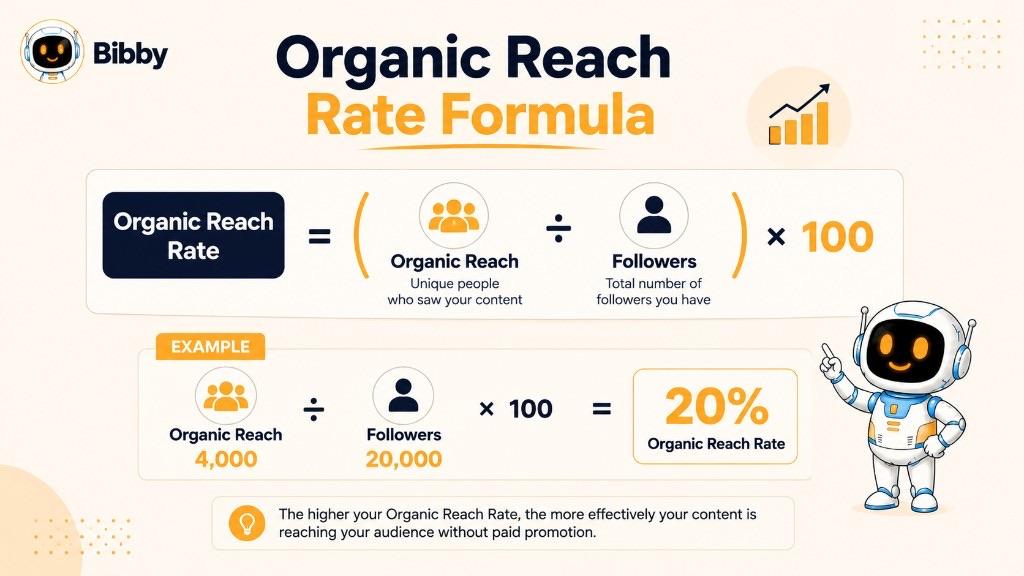
Organic reach rate measures the percentage of an account's followers who were reached by a piece of content through unpaid distribution. It can help you compare the organic distribution of posts relative to the size of your existing audience.
A commonly used calculation is:
Organic Reach Rate Formula
Organic Reach Rate = (Organic Reach ÷ Total Followers) × 100
For example, imagine a LinkedIn page has 20,000 followers and a post reaches 4,000 people organically.
The calculation would be:
(4,000 ÷ 20,000) × 100 = 20%
The post therefore has an organic reach rate of 20% based on this follower-based calculation.
Organic Reach Rate Example
Consider three posts published by the same account:
| Post | Followers | Organic Reach | Organic Reach Rate |
|---|---|---|---|
| Post A | 20,000 | 2,000 | 10% |
| Post B | 20,000 | 4,000 | 20% |
| Post C | 20,000 | 7,000 | 35% |
Using the formula above, Post C generated the highest organic reach relative to the account's follower count.
This can help identify which content generated broader unpaid distribution within the account's audience.
Is organic reach rate the same as engagement rate?
No.
Organic reach rate measures how much of an audience was reached.
Engagement rate measures the proportion of people or audience members who interacted with the content, depending on the calculation method being used.
For example, a post could have:
- 20% organic reach rate
- 8% engagement rate
These metrics answer different questions.
Organic reach rate asks:
“How many people did we reach?”
Engagement rate asks:
“How many people interacted with the content?”
Looking at both can provide more context about content performance.
Is there a good organic reach rate?
There is no universal organic reach rate that can be considered good for every account.
A reasonable rate can vary significantly depending on:
- Platform
- Account size
- Industry
- Audience quality
- Content format
- Content topic
- Posting frequency
- Audience behavior
- Distribution system
- How the metric is calculated
An account with a small, highly engaged audience may produce a very different reach rate from a large enterprise account.
For this reason, your own historical performance is often a more useful comparison point than an arbitrary industry-wide percentage.
Why follower-based organic reach rate has limitations
The formula is useful, but it should not be interpreted as a complete measure of organic performance.
One major limitation is that organic reach can include people who do not follow the account.
For example, suppose an account has 10,000 followers but one post reaches 15,000 people organically.
Using the follower-based formula:
(15,000 ÷ 10,000) × 100 = 150%
That does not mean anything is wrong. It simply indicates that the content reached more unique people than the account's follower count.
This can happen when content is discovered through recommendations, shares, search, reposts, or other distribution mechanisms.
Why the formula should be used for comparisons
Organic reach rate becomes most useful when you use it consistently.
For example, a business could track the metric across several months:
| Month | Average Organic Reach | Followers | Approx. Reach Rate |
|---|---|---|---|
| January | 2,800 | 20,000 | 14% |
| February | 3,400 | 20,500 | 16.6% |
| March | 4,100 | 21,000 | 19.5% |
The trend can provide a useful signal that organic distribution is improving relative to the account's growing audience.
However, changes in platform reporting or calculation methodology can affect comparisons, so historical data should always be interpreted in context.
Should you optimize for organic reach rate?
Organic reach rate is useful, but it should not become the only goal.
Optimizing purely for reach can encourage content designed to generate attention without producing meaningful business value.
Instead, consider organic reach alongside:
- Engagement
- Shares
- Saves
- Comments
- Clicks
- Profile visits
- Follower growth
- Website traffic
- Leads
- Conversions
- Video watch time
For example, a post reaching 50,000 people but generating no qualified interest may be less valuable than a post reaching 8,000 highly relevant potential customers and generating substantial engagement or leads.
A better way to interpret organic reach rate
Think of organic reach rate as a distribution indicator, not a complete performance score.
It can help answer:
“How effectively did this content reach the account's existing audience relative to its follower base?”
Then combine that information with engagement and business metrics to answer the more important question:
“Did that reach create meaningful value?”
Used this way, organic reach rate becomes a useful part of a broader social media analytics framework rather than a standalone vanity metric.
Why Is My Organic Reach So Low?
A low organic reach does not necessarily mean that your account is being penalized or that the platform is deliberately hiding your content. Organic reach can vary from post to post because of audience interest, content relevance, format, timing, competition, engagement, and changes to platform distribution systems.
Before changing your entire social media strategy, look for patterns across multiple posts rather than judging your account based on one low-performing publication.
Your content may not be relevant enough to your audience
One of the most common reasons for low organic reach is a mismatch between what you publish and what your audience wants to consume.
You may have a large follower count, but if your content does not address their current interests, problems, or expectations, fewer people may interact with it.
Review your recent content and ask:
- Who is this post actually for?
- What problem does it solve?
- Is the topic relevant to the audience?
- Does the content provide a clear reason to pay attention?
- Is the subject too broad or generic?
A smaller audience that strongly identifies with your content can often be more valuable than a large but disconnected follower base.
Your audience may be less active
Audience behavior changes over time.
People may:
- Use a platform less frequently
- Follow more accounts
- Change their interests
- Become less interested in a topic
- Shift to different content formats
- Become less responsive to promotional content
If your audience's behavior changes, your organic reach can change with it.
Look at your analytics over several weeks or months rather than assuming that a short-term decline represents a permanent problem.
Your content may be inconsistent
If you publish sporadically, you have fewer opportunities to reach your audience and collect performance data.
Inconsistency can also make it harder to understand which topics and formats are actually working.
However, consistency does not mean publishing constantly.
A better approach is to establish a sustainable publishing rhythm that your team can maintain without sacrificing content quality.
Your content may not generate meaningful interactions
If people repeatedly scroll past your content without interacting with it, the platform may receive fewer signals indicating that the content is relevant or useful.
This does not mean that every post needs to generate huge engagement.
Instead, examine whether your content is producing the types of actions that matter for your audience and objective, such as:
- Shares
- Saves
- Comments
- Replies
- Clicks
- Watch time
- Profile visits
The important question is not simply whether a post received likes, but whether people found it valuable enough to do something with it.
You may be relying on the wrong content format
A topic can perform differently depending on how it is presented.
For example, an educational concept might work well as:
- An Instagram carousel
- A LinkedIn text post
- A YouTube tutorial
- A TikTok explainer
- A Facebook video
If one format repeatedly underperforms, test another format before abandoning the underlying topic.
At the same time, avoid assuming that a particular format is universally superior. Your own audience data is more useful than generic claims about which format “the algorithm loves.”
Your posting time may not match your audience
Timing can affect the opportunity for content to receive early exposure.
If you consistently publish when your target audience is less active, your content may have fewer opportunities to gain initial attention.
Instead of relying on a generic “best time to post,” compare different publishing windows using your own analytics.
Test:
- Different days
- Different times
- Different time zones
- Different content types
Then look for patterns across multiple posts.
Your audience may be too broad
A broad audience can make it difficult to consistently create highly relevant content.
For example, a software company attempting to create content for founders, developers, students, marketers, designers, and enterprise executives at the same time may produce content that feels too generic for everyone.
Narrowing your content around specific audience segments can make your messaging more relevant.
Your content may be too promotional
People generally use social platforms for a mixture of entertainment, information, communication, and discovery.
If almost every post asks people to buy something, book a call, visit a website, or sign up for a product, the content may provide less value to users who are not immediately ready to purchase.
A balanced content strategy can include:
- Educational content
- Practical advice
- Industry insights
- Original perspectives
- Customer stories
- Product education
- Behind-the-scenes content
- Community-focused posts
Promotional content still has a place, but it does not need to dominate the publishing schedule.
You may not be adapting content to each platform
Publishing identical content everywhere can reduce the opportunity to take advantage of each platform's unique audience behavior and format.
The same idea can be adapted rather than copied.
For example:
Core idea:
“How businesses can use AI to save time on social media.”
Could become:
- LinkedIn: detailed professional insight
- Instagram: educational carousel
- TikTok: short explainer
- YouTube: in-depth tutorial
- Facebook: discussion-oriented post
The content idea remains consistent while the execution changes.
Your content is competing for limited attention
Every social platform contains enormous amounts of content.
Your post is competing with:
- Other creators
- Competitors
- Friends and connections
- News
- Recommendations
- Communities
- Advertisements
- Trending content
Even high-quality content can experience lower reach when audience attention is fragmented.
This makes clarity, relevance, strong hooks, and useful content increasingly important.
The platform may have changed its distribution system
Social platforms continuously adjust their products and recommendation systems.
A change can affect how content is distributed or how different formats perform.
If you notice that your reach changes across many posts at approximately the same time, investigate whether there has been a broader platform change rather than immediately assuming that your content strategy is the problem.
Your follower count may not represent your active audience
A large follower count does not guarantee a large active audience.
Some followers may:
- No longer use the platform
- Have followed many other accounts
- Have lost interest in your topic
- Rarely interact with your content
- Be outside your current target audience
This is why audience quality is often more meaningful than audience quantity.
You may be measuring the wrong thing
A drop in organic reach can look alarming when viewed in isolation.
But suppose your reach falls by 15% while:
- Shares increase
- Saves increase
- Website clicks increase
- Qualified leads increase
In that situation, the lower reach may not represent a meaningful decline in business performance.
Always connect reach with the objective of the content.
Does low organic reach mean you are shadowbanned?
Not necessarily.
The term “shadowban” is frequently used to describe situations where users believe their content is being deliberately hidden. However, a decline in reach can have many ordinary explanations, including changes in audience behavior, content performance, platform distribution, or competition.
Before concluding that your account has been restricted, examine your analytics and check whether there is a documented platform notification or policy issue.
What should you do when organic reach drops?
Instead of immediately changing everything, use a structured diagnostic process:
1. Compare recent posts with historical performance.
2. Identify whether the decline affects every format or only certain formats.
3. Compare topics and audience segments.
4. Review engagement, shares, saves, clicks, and watch behavior.
5. Check whether publishing frequency or timing changed.
6. Look for platform-level changes.
7. Test new topics, formats, hooks, and publishing windows.
8. Measure the results over multiple posts.
This turns a vague “reach problem” into a measurable content optimization problem.
The key takeaway
Low organic reach is rarely solved by one universal trick.
The better approach is to identify where distribution is weakening and then test the relevant variable. The problem could be content relevance, audience quality, format, timing, consistency, engagement, or simply normal platform fluctuation.
Treat organic reach as a metric to investigate rather than a score that determines whether your entire social media strategy is working.
Does Posting Consistently Increase Organic Reach?
Posting consistently can create more opportunities for organic reach, but consistency alone does not guarantee higher reach. Publishing on a regular schedule gives your audience more opportunities to discover your content and gives you more data to understand what works. However, posting more frequently does not automatically make every post reach more people.
The goal should be consistent, relevant publishing, not simply publishing as often as possible.
Why consistency can help organic reach
Every piece of content creates another opportunity for discovery.
If you publish one useful post each week, you have four primary publishing opportunities in a month. If you publish three useful posts each week, you have considerably more opportunities to introduce ideas to your audience.
More importantly, consistent publishing creates more opportunities to learn.
You can compare:
- Topics
- Content formats
- Hooks
- Captions
- Publishing times
- Engagement
- Reach
- Shares
- Saves
- Clicks
Over time, these patterns can reveal what your audience responds to.
Does posting every day increase organic reach?
Not necessarily.
There is no universal rule that publishing every day will produce greater organic reach than publishing three times a week, twice a week, or another sustainable frequency.
The appropriate frequency depends on:
- Platform
- Audience
- Industry
- Content format
- Available resources
- Content quality
- Audience expectations
- Marketing objectives
For one brand, daily short-form content may be sustainable and effective. For another, publishing fewer high-quality educational posts may produce better results.
The important factor is whether your publishing schedule allows you to consistently create content that people find useful.
Quality matters more than volume
Increasing publishing frequency can backfire if it causes content quality to decline.
For example, a company might move from three carefully planned posts per week to three posts every day. If the additional posts are repetitive, poorly researched, overly promotional, or irrelevant to the audience, the increased volume may not create meaningful additional reach.
A better principle is:
Increase publishing opportunities without sacrificing relevance or quality.
Consistency helps build audience expectations
A predictable publishing rhythm can make your social presence easier for an audience to follow.
If people regularly encounter useful content from an account, they have more opportunities to become familiar with the brand and its subject matter.
Consistency can be particularly useful for:
- Educational creators
- B2B companies
- Personal brands
- Publishers
- Media organizations
- Ecommerce brands
- Service businesses
The schedule does not need to be rigid. The goal is to establish a sustainable pattern rather than disappear for long periods and then publish a large volume of content at once.
Consistency creates better performance data
One of the less obvious benefits of consistent publishing is that it creates a larger dataset for decision-making.
Imagine a business publishes only two posts per month.
If one post performs poorly and another performs exceptionally well, it may be difficult to determine why.
With a larger and more consistent publishing sample, the business can begin identifying patterns.
For example:
Month 1: Educational carousels perform strongly.
Month 2: Short videos generate greater discovery.
Month 3: Industry-specific posts generate more shares.
These observations can inform future content planning.
Consistency therefore supports continuous content experimentation.
Consistency does not mean posting at exactly the same time
A publishing schedule can be consistent without requiring every post to go live at precisely the same minute.
For example, a business might decide to publish:
- Three times per week
- During weekday business hours
- With different formats across different days
It can then test specific time windows within that structure.
The objective is to create enough regularity to measure performance while remaining flexible enough to learn from the data.
Should you use a content calendar?
A content calendar can make consistent publishing easier.
It can help organize:
- Content topics
- Campaigns
- Publishing dates
- Platforms
- Formats
- Captions
- Visual assets
- Calls to action
- Content status
Without an organized workflow, maintaining consistency across multiple platforms can become difficult, particularly for businesses managing dozens of posts each month.
How scheduling supports consistency
Scheduling allows content to be prepared in advance and published automatically at selected times.
This can reduce the operational problem of having to manually publish every post.
For example, instead of creating and publishing content every morning, a marketing team can prepare a batch of content and schedule it across the upcoming week.
This does not improve organic reach by itself. Rather, it makes consistent execution easier, giving the strategy a better chance of being followed.
Can AI and automation help with consistent publishing?
Yes.
AI and automation can reduce some of the repetitive work involved in maintaining a publishing schedule.
For example, a social media workflow can use AI to assist with:
- Caption generation
- Content variations
- Image creation
- Content organization
- Campaign planning
- Scheduling
- Platform-specific publishing
Bibby is designed around this type of workflow. Users can upload or generate visual content, select a posting style, generate captions, choose social platforms, and schedule content for different dates and publishing times.
Bibby's chat interface can also be used to manage tasks such as creating brand kits, building campaigns, creating posts, and regenerating captions.
The important distinction is that automation supports consistency; it does not replace content strategy.
You still need to decide:
- Who you are trying to reach
- What you want to communicate
- Which topics matter
- Which content deserves to be published
- How performance should be evaluated
How to create a sustainable posting schedule
A practical approach is to start with a frequency your team can maintain.
For example:
Step 1: Choose the platforms that matter most.
Step 2: Define a realistic weekly publishing frequency.
Step 3: Establish several content pillars.
Step 4: Assign formats to those content pillars.
Step 5: Prepare content in batches where possible.
Step 6: Schedule upcoming posts.
Step 7: Review performance regularly.
Step 8: Adjust the schedule based on audience response.
This creates a system rather than relying on daily motivation to publish something.
How long does it take to see the impact of consistency?
There is no universal timeframe.
Organic reach can change quickly for individual posts, while meaningful content trends may require weeks or months of consistent publishing to identify.
Avoid judging a new publishing strategy after only a handful of posts.
Instead, establish a baseline, publish consistently, and compare performance over a meaningful period.
The right way to think about consistency
Consistency should be viewed as an opportunity multiplier, not an algorithm shortcut.
More high-quality publishing opportunities can create:
More content → More audience interactions → More performance data → More learning → Better future content
But the cycle only works when the content remains relevant.
The objective is therefore not:
“How can I post as much as possible?”
It is:
“How can I consistently publish content that my target audience has a reason to consume?”
That distinction is at the heart of sustainable organic reach.
Can Social Media Automation Improve Organic Reach?
Social media automation cannot directly guarantee higher organic reach, but it can make the activities that support organic growth more consistent, organized, and scalable. Automation can help with content scheduling, publishing, caption creation, content organization, repurposing, and workflow management, while the quality and relevance of the content still determine whether audiences want to engage with it.
The distinction is important:
Automation improves execution. It does not manufacture audience interest.
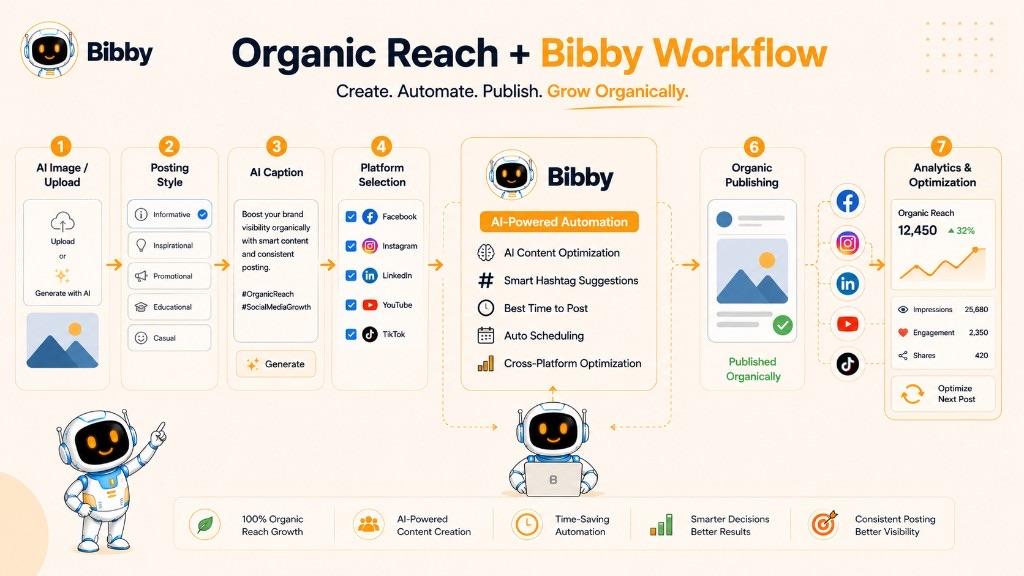
How automation can support organic reach
A strong organic strategy requires repeated execution. Someone needs to create content, write captions, prepare visuals, choose platforms, schedule posts, review performance, and continually improve the content strategy.
Doing all of this manually can become difficult as the number of platforms and posts increases.
Automation can reduce some of that repetitive operational work.
For example:
Content idea → Creation → Caption → Platform adaptation → Scheduling → Publishing → Measurement → Optimization
A streamlined workflow makes it easier to repeat this cycle consistently.
Automation helps maintain publishing consistency
One of the biggest practical advantages of automation is reducing the friction between having content ready and actually publishing it.
Without scheduling, a business may create a post but forget to publish it, become busy with other work, or miss its intended publishing window.
With automation, content can be prepared ahead of time and scheduled for future publication.
This can help businesses maintain a more predictable publishing rhythm.
Consistency does not automatically increase organic reach, but it creates more opportunities for content to be discovered and gives marketers more performance data to analyze.
Automation can help test publishing times
Testing different publishing times manually can become tedious when managing multiple platforms.
Scheduling tools can make experimentation easier by allowing marketers to plan posts for different dates and times.
For example, a business could test:
- Morning publishing
- Afternoon publishing
- Evening publishing
- Different weekdays
- Different time zones
The resulting performance can then be compared against historical data.
This is more useful than assuming that a generic “best time to post” applies to every audience.
Automation makes multi-platform publishing easier
Managing Facebook, Instagram, LinkedIn, YouTube, and TikTok separately can create a significant amount of repetitive work.
Automation can centralize parts of that workflow.
A single content idea can be adapted for multiple platforms and scheduled according to the publishing requirements of each network.
For example:
One content idea
→ Instagram carousel
→ Facebook post
→ LinkedIn post
→ TikTok video
→ YouTube Short
This creates more opportunities for the same underlying idea to reach relevant audiences.
However, effective automation should not mean blindly duplicating identical content everywhere.
Automation can support content repurposing
A successful piece of content can become the foundation for additional content.
For example:
High-performing LinkedIn post
→ Instagram carousel
→ Short-form video
→ Facebook post
→ YouTube explanation
→ Follow-up post
Repurposing allows businesses to extend the useful life of ideas that have already demonstrated audience interest.
Automation can make the organizational and publishing side of this process easier.
AI can reduce content creation friction
Modern social media automation tools increasingly combine automation with AI.
AI can assist with tasks such as:
- Generating captions
- Creating content variations
- Producing images
- Brainstorming content ideas
- Adapting messaging
- Organizing campaigns
This can reduce the time required to move from an idea to a publishable piece of content.
However, AI-generated content still needs human review.
A caption that is grammatically correct but irrelevant to the audience will not become valuable simply because it was generated automatically.
Automation can help maintain a content pipeline
Organic reach benefits from having a consistent supply of relevant content.
A content pipeline can organize the process from idea to publication:
Ideas → Drafts → Assets → Captions → Review → Scheduled → Published → Analyzed
Automation can reduce the manual coordination required between these stages.
This becomes increasingly valuable when a business manages multiple brands, campaigns, platforms, or content formats.
Automation can make performance-based iteration easier
Organic reach should not be treated as a one-time publishing activity.
The strongest workflows create a feedback loop:
Publish → Measure → Learn → Improve → Publish again
Suppose a business discovers that educational carousel posts consistently generate more saves and shares than promotional graphics.
That information can influence future content production.
Automation makes it easier to schedule additional content while the marketer focuses on interpreting the data and deciding what should happen next.
How Bibby supports organic social media workflows
Bibby combines social media publishing, AI assistance, and automation into a single workflow.
Users can upload an image or generate one with AI, select a posting style, and have captions generated automatically. Content can then be scheduled across selected platforms, including Facebook, Instagram, LinkedIn, YouTube, and TikTok.
Bibby also supports different content formats, including:
- Images
- Carousels
- Videos
- Stories
Its chat interface adds another way to manage social media workflows. Users can interact with Bibby conversationally to perform tasks such as:
- Creating a brand kit
- Creating a campaign
- Creating posts
- Regenerating captions
- Managing content
This can reduce the amount of manual work required to maintain an active publishing system.
What automation cannot do
Automation has clear limits.
It cannot guarantee:
- Viral reach
- High engagement
- Audience loyalty
- More followers
- More sales
- Algorithmic recommendations
- Content relevance
A scheduled post can still perform poorly.
The platform, audience, topic, creative quality, timing, competition, and many other factors influence organic distribution.
Automation should therefore be viewed as an execution layer, not an organic reach shortcut.
Automation vs artificial engagement
There is also an important distinction between legitimate social media automation and artificial engagement.
Legitimate automation can help you:
- Schedule your own content
- Organize campaigns
- Generate captions
- Manage publishing workflows
- Repurpose content
- Review performance in native analytics
Artificial engagement attempts to manipulate social metrics through practices such as fake accounts, purchased followers, or automated interactions designed to create the appearance of popularity.
These are fundamentally different activities.
The goal of automation should be to make genuine content creation and publishing easier, not to manufacture audience activity.
The best way to use automation for organic growth
A useful model is:
Human strategy + AI assistance + automation + audience feedback
Humans define the brand, audience, goals, and creative direction.
AI can accelerate parts of the content workflow.
Automation can handle repetitive publishing and organization.
Audience data then tells you what to improve.
This creates a sustainable system where technology reduces operational workload while humans remain responsible for the strategic and creative decisions.
The key takeaway
Social media automation does not create organic reach by itself. Instead, it can make it easier to publish consistently, test content and timing, manage multiple platforms, repurpose successful ideas, and learn from performance data.
The strongest approach is to use automation to remove repetitive work while keeping audience relevance, content quality, creativity, and strategic decision-making at the center of the organic social media process.
Common Organic Reach Mistakes
Improving organic reach is not simply about publishing more content. Many businesses reduce their own opportunities for organic distribution by focusing on the wrong metrics, publishing content without a clear audience, or treating every social platform the same.
Understanding these mistakes can help you build a more sustainable organic social media strategy.
1. Focusing only on follower count
A large follower count does not automatically produce high organic reach.
An account can have thousands or millions of followers while only a portion of those followers actively consume its content.
Follower count is therefore a potential audience indicator, not a guarantee of distribution.
Instead of focusing only on gaining followers, pay attention to whether your content reaches relevant people and generates meaningful actions.
2. Publishing content without knowing the audience
Generic content often struggles to create strong audience interest.
If you do not know:
- Who you are targeting
- What they care about
- What problems they have
- What questions they ask
- What type of content they consume
it becomes difficult to consistently create relevant posts.
Start with the audience rather than starting with the publishing calendar.
3. Treating every platform the same
Copying the exact same content across Facebook, Instagram, LinkedIn, YouTube, and TikTok may save time, but it can limit the effectiveness of the content.
Each platform has different:
- Content formats
- User behavior
- Discovery mechanisms
- Audience expectations
- Consumption patterns
A better approach is to reuse the idea while adapting the content for the platform.
4. Publishing only promotional content
A social media account that constantly promotes its products can become less useful to its audience.
If every post says “Buy now,” “Book a demo,” or “Sign up today,” there may be little reason for users to engage with the content unless they are already ready to purchase.
Balance promotional posts with:
- Educational content
- Industry insights
- Tutorials
- Practical advice
- Original opinions
- Customer stories
- Product education
- Behind-the-scenes content
- Community-focused posts
Promotional content still has a place, but it does not need to dominate the publishing schedule.
5. Chasing viral trends without relevance
A trending sound, topic, hashtag, or format does not automatically make content valuable.
If a trend has no connection to your audience or brand, participating in it simply for exposure can attract irrelevant attention.
Use trends selectively when they naturally support your message.
6. Using clickbait that does not deliver
A strong hook can increase attention, but misleading users can damage trust.
If your opening promises something the content does not deliver, people may leave quickly or become less likely to engage with future content.
The best hooks create curiosity and then fulfill the promise. Avoid clickbait that overpromises.
7. Assuming more posts always mean more reach
Publishing more frequently does not automatically produce more organic reach.
Increasing volume can even become counterproductive when it causes:
- Lower content quality
- Repetitive topics
- Audience fatigue
- Poor planning
- Weak captions
- Reduced creativity
Focus on sustainable consistency rather than maximum publishing volume.
8. Ignoring content quality
Automation and AI can make publishing easier, but they do not make irrelevant content valuable.
A post can be perfectly formatted, scheduled on time, and grammatically correct while still providing little value.
Before publishing, ask:
Would my target audience actually want to see this?
If the answer is unclear, improve the idea before worrying about distribution.
9. Obsessing over likes
Likes are easy to see, which makes them tempting to use as the primary performance metric.
But depending on the content objective, other actions may be more meaningful.
A post with fewer likes but significantly more shares, saves, clicks, or qualified leads may be more valuable to a business.
Evaluate organic reach together with the metrics that matter to your objective.
10. Giving up after a few low-performing posts
Organic performance fluctuates.
One post can reach 1,000 people while another reaches 20,000, even when both are published by the same account.
Do not completely abandon a strategy based on a tiny sample.
Instead, analyze multiple posts and identify patterns.
11. Never experimenting
Using the exact same topic, format, hook, and publishing schedule indefinitely can make it difficult to discover new opportunities.
Test variables such as:
- Topics
- Formats
- Hooks
- Captions
- Visual styles
- Publishing times
- Calls to action
Treat content as an ongoing experiment.
12. Ignoring shares and saves
Likes indicate a reaction, but shares and saves can provide additional information about the usefulness of content.
A practical tutorial, checklist, statistic, or educational carousel may generate fewer likes than an entertaining post while receiving significantly more saves and shares.
If your goal is broader organic distribution, understand which types of content your audience naturally wants to pass along.
13. Publishing without a content system
Creating every post from scratch at the last minute makes consistent publishing difficult.
Without a system, businesses can experience:
- Missed publishing dates
- Repetitive content
- Poor platform coordination
- Inconsistent messaging
- Unused content ideas
- Last-minute caption writing
A content calendar and organized publishing workflow can reduce these problems.
14. Automating without reviewing
Automation is useful for repetitive tasks, but scheduled content should still be reviewed.
Before publishing, check:
- Caption accuracy
- Visual quality
- Links
- Platform formatting
- Brand consistency
- Timing
- Context
- Calls to action
Automation should reduce operational work, not eliminate quality control.
15. Believing there is one “algorithm hack”
Social platforms evolve continuously.
There is no permanent trick that guarantees organic reach.
Strategies based on shortcuts can become ineffective when audience behavior or platform systems change.
Build your strategy around principles that remain useful:
Relevance → Value → Consistency → Measurement → Improvement
16. Buying followers or engagement
Artificial followers and engagement may increase visible numbers without creating a genuine audience.
A large number of inactive or irrelevant followers can make it harder to understand your actual audience and may distort performance analysis.
Organic growth should focus on attracting people who have a genuine reason to follow and interact with your content.
17. Ignoring analytics
Publishing without measuring results means you are repeatedly making decisions without feedback.
At minimum, review:
- Organic reach
- Engagement
- Shares
- Saves
- Clicks
- Video views
- Watch time
- Follower growth
Use these results to determine what deserves more attention in your next content cycle.
The biggest mistake
The biggest organic reach mistake is treating reach as something you can force rather than something you can earn opportunities for.
You control the quality of your strategy, content, publishing process, and experimentation.
You do not control exactly how many people a platform will distribute every individual post to.
The goal is to consistently create conditions in which relevant content has a strong opportunity to be discovered, consumed, shared, and remembered.
Organic Reach Best Practices
The most effective organic reach strategies focus on creating content that is genuinely useful to a defined audience and building a repeatable publishing system around it. Instead of trying to manipulate platform algorithms, use audience behavior and performance data to continuously improve your content.
Here are the most practical organic reach best practices to follow.
1. Prioritize relevance over volume
Create content that directly connects with the interests, problems, and goals of your target audience.
Publishing ten irrelevant posts is unlikely to be more valuable than publishing three highly relevant ones.
Before creating content, ask:
Who is this for, and why would they care?
If you cannot answer that clearly, refine the idea.
2. Create content with a clear purpose
Every post should have a reason for existing.
Your content might be designed to:
- Educate
- Entertain
- Inspire
- Start a conversation
- Build authority
- Generate awareness
- Drive website traffic
- Support a campaign
- Generate leads
- Strengthen a community
A clear purpose makes it easier to choose the appropriate format and measure whether the content succeeded.
3. Build around content pillars
Develop several recurring themes that your audience associates with your brand.
For example, a social media automation company might create content around:
- Social media marketing
- Content strategy
- AI
- Social media automation
- Platform-specific tactics
- Productivity
- Industry trends
- Product education
Content pillars provide structure while still leaving room for experimentation.
4. Make the first seconds count
Whether someone encounters a video, carousel, image, or text post, the opening needs to communicate value quickly.
Use hooks that:
- Identify a problem
- Challenge an assumption
- Create curiosity
- Introduce a useful insight
- Ask a relevant question
- Promise a practical solution
Avoid misleading hooks simply for attention.
A strong hook should lead naturally into valuable content.
5. Make content easy to consume
People often consume social content quickly.
Use:
- Short paragraphs
- Clear headings
- Visual hierarchy
- Concise explanations
- Strong opening statements
- Readable graphics
- Structured carousels
- Captions that complement the content
The easier content is to understand, the less cognitive effort the audience needs to invest.
6. Create content worth saving or sharing
If you want to expand organic distribution, create material people have a reason to pass along.
Consider publishing:
- Checklists
- Tutorials
- Templates
- Frameworks
- Original research
- Statistics
- Industry insights
- Practical guides
- Educational carousels
- Problem-solving content
Ask yourself:
“Would my audience send this to someone else?”
That question can improve content quality considerably.
7. Adapt content to each platform
A single idea can be distributed across multiple networks without turning every post into an identical copy.
For example:
One idea:
“How to create a social media content calendar.”
Could become:
- Instagram carousel
- LinkedIn educational post
- YouTube tutorial
- TikTok explainer
- Facebook checklist
This approach combines efficiency with platform-specific execution.
8. Maintain a sustainable publishing schedule
Choose a publishing frequency that you can maintain consistently.
A sustainable schedule is better than a short burst of excessive publishing followed by weeks of inactivity.
Your schedule should account for:
- Team capacity
- Content production time
- Number of platforms
- Content formats
- Campaign requirements
- Audience expectations
Consistency should support quality, not compete with it.
9. Test different formats
Do not assume that your audience prefers one format forever.
Experiment with:
- Images
- Carousels
- Short videos
- Long-form videos
- Stories
- Text posts
- Educational graphics
- Live content
Measure how different formats affect reach and meaningful engagement.
10. Use your own analytics to determine timing
Generic “best time to post” recommendations can provide a starting point, but your audience may behave differently.
Test different publishing windows and examine:
- Reach
- Engagement
- Shares
- Saves
- Clicks
- Video performance
Over time, your own data can reveal useful publishing patterns.
11. Respond to comments and conversations
Social media is not only a publishing channel.
Participating in conversations can strengthen relationships with your audience and reveal new content opportunities.
If someone asks a useful question, consider turning that question into future content.
One comment can become:
Comment → Follow-up post → Carousel → Video → FAQ
This creates a natural content feedback loop.
12. Repurpose your strongest ideas
Do not abandon a useful idea simply because you have already published it once.
If a topic performs well, consider presenting it in another format or from another angle.
For example:
High-performing post
→ Detailed article
→ Carousel
→ Short video
→ Story
→ LinkedIn post
→ Follow-up discussion
Repurposing can increase the number of opportunities for a strong idea to reach relevant audiences.
13. Use AI to accelerate creation, not replace strategy
AI can help with repetitive creative tasks such as:
- Brainstorming
- Caption generation
- Content variations
- Visual creation
- Repurposing
- Content organization
But AI output should still be reviewed for accuracy, originality, brand voice, and audience relevance.
The strongest workflow combines human strategy with AI-assisted execution.
14. Automate repetitive publishing tasks
Manual publishing across several social networks can consume significant time.
A social media automation platform can help manage:
- Content scheduling
- Caption generation
- Multi-platform publishing
- Campaign organization
- Content calendars
- Content repurposing
Bibby is designed to support this type of workflow. Users can upload visual content or generate images with AI, choose a posting style, generate captions, select platforms, and schedule content for future dates and AI-optimized publishing times.
Bibby's conversational interface can also help users manage social media tasks through chat, including creating brand kits, campaigns, posts, and caption variations.
The benefit is operational efficiency. Automation gives marketers more time to focus on strategy, creativity, audience research, and performance analysis.
15. Review performance regularly
Do not wait until the end of the year to evaluate organic performance.
Review content regularly and identify:
- Top-performing topics
- Best formats
- Strongest hooks
- Highest-share posts
- Most-saved content
- Best publishing windows
- Highest-converting content
Then use those findings to influence your next content cycle.
16. Compare trends rather than individual posts
A single viral post can distort your perception of performance.
Instead of asking:
“Did this post perform well?”
also ask:
“Is this type of post consistently outperforming our average?”
Look at groups of posts and longer-term trends.
This provides a more reliable picture of organic performance.
17. Focus on relevant reach
Maximum reach is not always the objective.
Imagine two posts:
Post A: Reaches 100,000 random users.
Post B: Reaches 15,000 people who closely match your target customers and generates meaningful conversations and leads.
Post B may create substantially more business value.
The best organic reach strategy therefore optimizes for relevant exposure, not simply the largest possible number.
18. Keep experimenting
Social media is constantly changing.
Continue testing:
- New formats
- New topics
- New hooks
- New creative styles
- New publishing times
- New content series
- New audience segments
Document the results so experiments become accumulated knowledge rather than isolated attempts.
A practical organic reach checklist
Before publishing a post, ask:
Audience
- Is this relevant to my target audience?
Value
- Does it teach, solve, entertain, inform, or otherwise provide a reason to pay attention?
Format
- Is this format appropriate for the platform?
Hook
- Does the opening make the value clear?
Quality
- Is the content accurate, clear, useful, and visually understandable?
Distribution
- Is it scheduled for an appropriate publishing window?
Measurement
- Do I know which metric will determine whether this post succeeded?
If the answer to these questions is consistently yes, you have a much stronger foundation for sustainable organic reach.
The principle behind organic reach best practices
There is no single organic reach tactic that works forever.
The strongest strategy is a continuous system:
Create useful content → Publish consistently → Measure behavior → Identify patterns → Improve → Repeat
Automation can make the execution of this cycle faster and easier, but the fundamental advantage still comes from understanding your audience and creating content they genuinely want to consume.
Related Metrics to Organic Reach
Organic reach is only one part of social media measurement. To understand whether your content is actually performing well, it should be evaluated alongside metrics such as impressions, engagement, shares, saves, clicks, views, watch time, follower growth, and conversions.
These metrics answer different questions about what happens after content is published.
1. Impressions
Impressions represent the number of times content is displayed or served, according to the platform's measurement methodology.
The key difference is:
Reach = unique accounts or people reached
Impressions = total displays or exposures
One person can generate multiple impressions, so impressions can be higher than reach.
For example, if 5,000 people see a post and some of them see it more than once, the post may record:
5,000 reach + 7,500 impressions
The exact reporting methodology varies by platform.
2. Paid Reach
Paid reach refers to the audience reached through paid promotion or advertising.
Organic reach and paid reach are therefore different distribution sources.
A business may receive:
- Organic reach from normal publishing
- Paid reach from advertising
- Additional exposure through sharing and recommendations
Separating these sources helps marketers understand whether content is generating unpaid distribution or requires advertising investment to reach its audience.
3. Total Reach
Total reach represents the overall audience reached through the applicable distribution sources, subject to the platform's reporting methodology.
It can include both organic and paid exposure.
Because the same person may encounter content through multiple sources, marketers should not assume that organic reach plus paid reach will always equal total reach exactly.
4. Engagement
Engagement refers to actions people take in response to content.
Depending on the platform, these actions can include:
- Likes
- Reactions
- Comments
- Shares
- Saves
- Reposts
- Replies
- Clicks
Engagement helps indicate how people responded after encountering the content.
A post can therefore have high reach but low engagement, or modest reach with a highly engaged audience.
5. Engagement Rate
Engagement rate measures engagement relative to a chosen denominator.
Different platforms and marketers may calculate it differently.
Common approaches may use:
- Reach
- Impressions
- Followers
- Views
- Engagements
For example, a simplified reach-based calculation is:
Engagement Rate = Total Engagements ÷ Reach × 100
Because definitions vary, always identify which formula and denominator are being used when comparing engagement rates.
6. Shares
Shares measure how often users distribute content to other people or networks through the platform's sharing mechanisms.
Shares can be particularly useful when evaluating content designed for organic discovery.
A person sharing a post can create additional opportunities for people outside the original audience to encounter it.
For this reason, shareability is often an important consideration when developing content intended to expand organic reach.
7. Saves
Saves indicate that users saved content for later access, where the platform provides this functionality.
High save activity can be a useful signal that content has practical or reference value.
Content that often generates saves includes:
- Checklists
- Tutorials
- Guides
- Tips
- Frameworks
- Educational carousels
- Reference material
Saves do not automatically guarantee additional reach, but they can help marketers understand whether content is providing lasting value to the audience.
8. Comments
Comments represent direct audience responses to content.
Comments can provide qualitative information that reach and impressions cannot.
For example, comments can reveal:
- Questions
- Objections
- Opinions
- Customer problems
- Requests for additional information
- Areas of confusion
These conversations can also become sources of future content ideas.
9. Click-Through Rate
Click-through rate (CTR) measures how often people click a link or call to action relative to the selected denominator.
A common calculation is:
CTR = Clicks ÷ Impressions × 100
However, platforms and marketers may use different denominators.
CTR becomes particularly important when the objective of organic content is to drive traffic to:
- A website
- Blog
- Product page
- Landing page
- App
- Signup page
A post can have moderate organic reach but an excellent CTR if the audience is highly relevant.
10. Video Views
Video views measure video consumption according to the platform's definition of a view.
A “view” does not necessarily mean that someone watched the entire video.
Each platform can have its own rules for counting views, so video-view numbers should not automatically be compared across networks.
11. Watch Time
Watch time measures the amount of time viewers spend watching video content.
It can provide more context than raw view counts because two videos with the same number of views can have very different viewing behavior.
For example:
Video A: 50,000 views with low average viewing duration.
Video B: 30,000 views with substantially longer viewing duration.
The second video may demonstrate stronger viewer retention despite having fewer total views.
12. Audience Retention
Audience retention indicates how much of a video people continue watching over time.
It can help identify where viewers stop watching.
If many viewers leave during the first few seconds, the opening may need improvement.
If viewers consistently watch most of the video, the content may be successfully maintaining attention.
Retention is particularly relevant for video-focused platforms.
13. Follower Growth
Follower growth measures changes in the number of people following an account over a particular period.
Organic reach and follower growth are related but different.
A post can generate substantial organic reach without producing many new followers.
Conversely, highly relevant content can generate new followers even if its total reach is relatively modest.
Tracking both metrics helps determine whether content is expanding the audience as well as reaching it.
14. Profile Visits
Profile visits indicate how many people visit an account's profile after encountering content, where the platform provides this metric.
A high number of profile visits can indicate that content successfully created enough interest for people to learn more about the account.
This can be especially relevant for:
- Creators
- Founders
- Consultants
- Personal brands
- Businesses
- Service providers
15. Website Traffic
Organic social content can generate traffic beyond the social platform.
Track visits coming from social networks to determine whether content is moving people from:
Social discovery → Website → Product page → Signup
Website analytics can provide additional information about what happens after the click.
16. Leads
For businesses, leads can be more meaningful than reach.
A social post may generate:
- Contact form submissions
- Demo requests
- Newsletter signups
- Consultation requests
- Trial registrations
- Direct inquiries
This is why a post with lower reach can sometimes outperform a viral post from a business perspective.
17. Conversion Rate
Conversion rate measures the percentage of users who complete a desired action.
Depending on the campaign, that action could be:
- Purchasing a product
- Starting a trial
- Registering for an event
- Downloading a resource
- Submitting a form
- Booking a consultation
A simple calculation is:
Conversion Rate = Conversions ÷ Relevant Visitors or Users × 100
The exact denominator should match the conversion being measured.
18. Cost Per Result
Cost-based metrics are generally associated with paid campaigns rather than organic reach.
For example:
Cost Per Click = Advertising Spend ÷ Clicks
Organic content does not require a media spend for distribution, but businesses still incur production and operational costs.
This creates an important distinction:
Organic does not necessarily mean cost-free.
Content creation, design, video production, software, employees, and strategy all require resources.
19. Virality or Share Rate
Some marketers use metrics such as share rate to understand how frequently audiences distribute content.
A simplified calculation might be:
Share Rate = Shares ÷ Reach × 100
However, this is not a universal industry-standard formula, and platforms may report sharing metrics differently.
It can nevertheless be useful for comparing your own content over time.
20. Social Referral Traffic
Social referral traffic measures website visitors arriving from social platforms.
This helps connect social media activity with website behavior.
For example:
Instagram → Website → Product page → Signup
Tracking this journey can reveal whether organic social content is contributing to broader marketing goals.
How These Metrics Work Together
No single social media metric provides a complete picture.
A useful measurement framework is:
Organic Reach
↓
How many unique people encountered the content?
Engagement
↓
How did they respond?
Shares & Saves
↓
Did they find enough value to keep or distribute it?
Clicks & Profile Visits
↓
Did the content create additional interest?
Website Traffic
↓
Did people move beyond the platform?
Leads & Conversions
↓
Did the activity contribute to a business outcome?
This creates a more complete view of social media performance.
A practical example
Imagine an Instagram post produces:
- 25,000 organic reach
- 32,000 impressions
- 1,500 engagements
- 400 saves
- 250 shares
- 800 profile visits
- 300 website clicks
- 15 leads
Looking only at organic reach tells you that 25,000 accounts were reached.
Looking at the entire sequence tells a much more useful story:
25,000 people reached → 1,500 engagements → 650 saves/shares → 800 profile visits → 300 website clicks → 15 leads
The metrics become meaningful when they are interpreted as part of the same audience journey.
Which metrics should you prioritize?
The right metrics depend on your objective.
| Goal | Useful Metrics |
|---|---|
| Brand awareness | Organic reach, impressions |
| Audience engagement | Comments, shares, saves, engagement rate |
| Video discovery | Views, watch time, retention |
| Community building | Comments, replies, follower growth |
| Website traffic | Clicks, CTR, referral traffic |
| Lead generation | Leads, conversion rate |
| Sales | Conversions, revenue |
| Content optimization | Reach, engagement, shares, saves, retention |
The important principle is:
Measure the metric that reflects what you actually want the content to accomplish.
Organic reach is valuable because it tells you how widely content was distributed without paid promotion. But its real significance becomes clearer when combined with the actions and outcomes that follow that exposure.
Key Takeaway
Organic reach is the number of unique people or accounts who see your social media content through unpaid distribution. It is one of the most useful metrics for understanding how far your content travels without relying on advertising.
Organic reach is influenced by factors such as content relevance, audience interest, content format, engagement, sharing, publishing consistency, timing, platform behavior, and the overall quality of the content.
There is no universal formula or algorithm trick that guarantees higher organic reach. The most sustainable approach is to create content for a clearly defined audience, publish consistently, adapt content to each platform, measure performance, and continuously improve based on audience behavior.
It is also important to distinguish organic reach from related metrics:
- Organic reach: How many unique people or accounts encountered your content without paid promotion.
- Impressions: How many times the content was displayed or served.
- Paid reach: How many people were reached through paid promotion.
- Engagement: How people interacted with the content.
- Engagement rate: Engagement relative to a defined audience or exposure measure.
- Conversions: Whether social media activity contributed to a desired business outcome.
A high organic reach does not automatically mean that a post was successful. Reaching the right audience can be more valuable than reaching the largest possible audience.
The simplest way to improve organic reach
Think of organic reach as a continuous cycle:
Understand your audience
↓
Create valuable content
↓
Publish consistently
↓
Encourage meaningful interaction
↓
Measure organic performance
↓
Identify what works
↓
Repurpose successful ideas
↓
Improve your next content
↓
Repeat
Social media automation can make this process easier to execute at scale. Tools such as Bibby can help streamline content creation, AI-assisted caption generation, campaign management, multi-platform publishing, and scheduling.
The technology handles repetitive work. Your audience determines whether the content deserves attention.
Ultimately, organic reach should not be treated as a number to chase at all costs. It is a signal that helps you understand how effectively your content is being distributed without paid promotion.
Create content people genuinely want to see, make it easy to discover and share, publish consistently, and use the resulting data to make the next piece of content better. Explore more terms in the social media dictionary, or start publishing with Bibby.