
Paid social is the use of paid advertising on social media platforms to reach a targeted audience and achieve marketing goals such as brand awareness, website traffic, engagement, leads, or sales. Instead of relying only on the unpaid reach of regular social media posts, businesses invest a budget to distribute their content or advertisements to specific audiences on platforms such as Facebook, Instagram, LinkedIn, TikTok, and YouTube.
Paid social can include sponsored posts, image and video ads, carousel ads, story ads, lead generation campaigns, retargeting campaigns, and other platform-specific advertising formats. Advertisers can typically choose an objective, define an audience, set a budget, select placements, launch the campaign, and measure results using metrics such as reach, impressions, clicks, conversions, cost per click (CPC), cost per acquisition (CPA), and return on ad spend (ROAS).
The key difference between paid social and organic social is distribution. Organic social depends on unpaid publishing and the reach generated through followers, engagement, sharing, and platform algorithms. Paid social uses advertising spend to extend distribution and reach selected audiences more deliberately.
In simple terms, organic social builds an ongoing presence, while paid social uses advertising to put a message in front of a chosen audience. Both can work together as part of a broader social media marketing strategy.
What Is Paid Social?
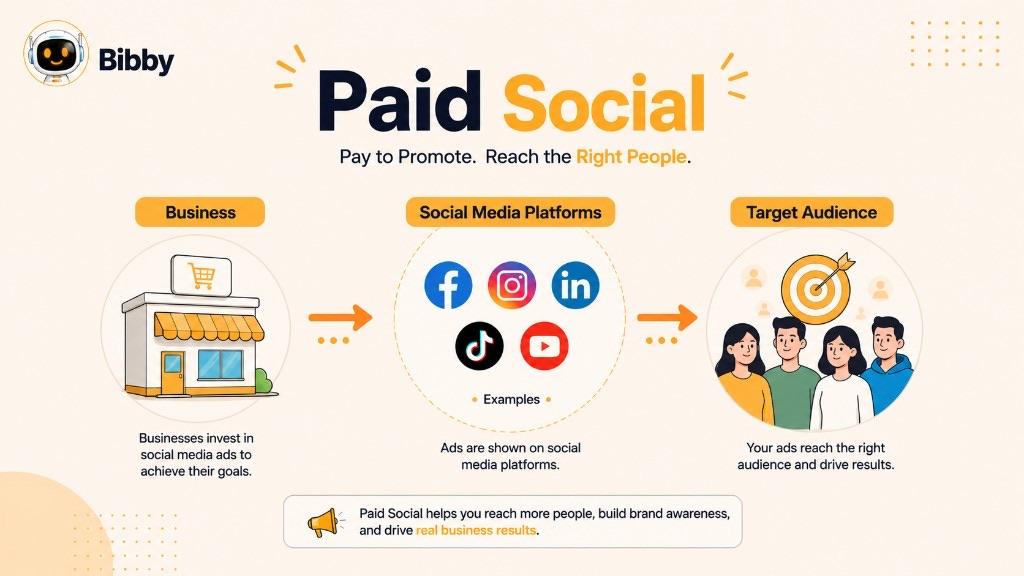
Paid social refers to paid promotion on social media platforms where businesses, creators, or organizations spend money to distribute content or advertisements to a selected audience. Unlike an ordinary social media post, which is published without paying the platform for distribution, paid social uses an advertising budget to increase visibility, reach specific users, or encourage a measurable action.
For example, a business may create an Instagram ad promoting a new product and pay to show it to people within a particular age group, location, or interest category. A B2B company might run a LinkedIn campaign targeting professionals in specific industries or job roles. An ecommerce brand could use retargeting to show an advertisement to people who previously visited its website.
Paid social is therefore broader than simply “paying to boost a post.” It can involve an entire advertising campaign with a defined objective, audience, creative, budget, placement, and measurement strategy.
What Does Paid Social Include?
Depending on the platform and campaign objective, paid social can include:
- Sponsored posts: Existing social content promoted to a larger or more targeted audience.
- Image ads: Visual advertisements designed to communicate an offer, product, or message.
- Video ads: Short- or long-form videos distributed through paid placements.
- Carousel ads: Multiple images or videos that users can browse within one advertisement.
- Story ads: Vertical advertisements displayed within social media Stories.
- Lead generation ads: Ads designed to collect information from potential customers.
- Retargeting ads: Advertisements shown to people who have previously interacted with a business, website, app, or content.
- Shopping and product ads: Ads designed to showcase products and encourage purchases.
- Short-form video ads: Paid placements integrated into discovery-focused video experiences.
The exact formats, targeting options, and campaign objectives vary between social platforms.
Why Do Businesses Use Paid Social?
The biggest advantage of paid social is controlled distribution. A business does not have to wait for an organic post to reach enough people. Instead, it can allocate a budget and use the platform's advertising system to reach audiences based on available targeting signals.
Businesses commonly use paid social to:
- Increase brand awareness
- Reach new audiences
- Promote products or services
- Drive website traffic
- Generate leads
- Increase engagement
- Retarget previous visitors or customers
- Drive app installs
- Generate ecommerce sales
- Support product launches and campaigns
Paid social can also provide measurable performance data, allowing advertisers to compare audiences, creatives, campaigns, and outcomes.
Paid Social in Simple Terms
Think of social media content as having two distribution paths:
Organic social: You publish the content and the platform determines how much unpaid distribution it receives.
Paid social: You allocate an advertising budget and the platform distributes the advertisement according to the campaign's objective, audience, bidding, placements, and other factors.
This is why paid social is a part of social media marketing, but social media marketing is not limited to paid social. Social media marketing can also include organic content, community management, influencer marketing, social listening, content strategy, and other activities.
The important distinction is that paid social adds advertising spend and deliberate paid distribution to the social media equation.
How Does Paid Social Work?
Paid social works by combining an advertising objective, a defined audience, creative content, a budget, and a social media platform's ad delivery system. The platform then distributes the advertisement to users who are more likely to match the campaign objective or take the desired action.
While every platform has its own advertising interface and targeting options, the basic process is broadly similar.
1. Define the Campaign Objective
The first step is deciding what the paid social campaign needs to accomplish.
A business might want to:
- Increase brand awareness
- Reach more potential customers
- Drive traffic to a website
- Generate engagement
- Collect leads
- Increase app installs
- Generate conversions
- Drive product sales
The objective matters because advertising platforms use it to determine how they should optimize delivery.
For example, a campaign designed to generate website traffic should not necessarily be evaluated using the same criteria as a campaign designed to generate purchases.
2. Choose the Target Audience
Next, the advertiser identifies who should see the advertisement.
Depending on the platform, targeting can use signals such as:
- Location
- Age and demographics
- Interests
- Behaviors
- Professional characteristics
- Previous interactions
- Website activity
- Customer data
- Similar or lookalike audiences
This is one of the defining characteristics of paid social. Instead of publishing a message and hoping the right people discover it, advertisers can use available audience signals to make distribution more intentional. Audience targeting happens in the ads platform, not in a publishing scheduler.
3. Create the Ad Creative
The advertiser then creates the content that users will see.
Paid social creative can include:
- Images
- Videos
- Carousels
- Stories
- Short-form videos
- Product presentations
- Lead-generation formats
- Other platform-specific formats
The creative usually combines a visual, message, value proposition, and call to action.
For example, an ecommerce company might use a short product video with a promotional message and a Shop Now call to action. A software company might use a carousel explaining its product's benefits and direct users to a demo page.
Creative quality can have a significant influence on campaign performance because the advertisement still needs to earn attention before the audience can take action.
4. Set the Budget
The advertiser determines how much money to allocate to the campaign.
Common budget approaches include:
- Daily budget: A planned amount for ongoing daily delivery.
- Lifetime budget: A total amount allocated across a defined campaign period.
The actual cost of reaching users can vary depending on factors such as audience competition, platform, geography, campaign objective, seasonality, creative performance, and bidding conditions.
There is therefore no universal price for paid social.
5. Select Placements
Social platforms can provide different locations where advertisements may appear.
Depending on the platform, placements can include:
- Main feeds
- Stories
- Reels or short-form video environments
- Search or discovery areas
- Video placements
- Other platform-specific locations
Advertisers may choose placements manually or allow the platform to distribute ads across eligible placements according to its optimization system.
6. The Platform Delivers the Advertisement
Once the campaign is submitted, the platform's advertising system determines when and where the ad is shown.
Social advertising generally operates through an ad auction, where multiple advertisers may compete for opportunities to reach users. The platform considers factors such as the advertiser's bid or budget strategy, expected performance, relevance, and other platform-specific signals when determining ad delivery.
This means an advertiser cannot simply assume that spending more money automatically guarantees better results.
The advertisement still needs to perform well with the intended audience.
7. Measure the Results
After the campaign begins running, advertisers monitor performance using metrics such as:
- Reach
- Impressions
- Clicks
- Click-through rate (CTR)
- Cost per click (CPC)
- Cost per thousand impressions (CPM)
- Conversions
- Cost per acquisition (CPA)
- Return on ad spend (ROAS)
The most important metric depends on the campaign objective.
For example, a brand-awareness campaign may focus heavily on paid reach and impressions, while an ecommerce campaign may care more about purchases, CPA, and ROAS.
Review those numbers in native ads reporting. Scheduling tools do not replace that dashboard.
8. Test and Optimize
Paid social is rarely a set-it-and-forget-it activity.
Advertisers can test different:
- Audiences
- Images
- Videos
- Headlines
- Offers
- Calls to action
- Placements
- Campaign objectives
- Landing pages
If one creative generates stronger results than another, the advertiser may allocate more budget toward the stronger variation. If an audience produces expensive conversions, the campaign may need to be adjusted or paused.
This creates a continuous cycle:
Objective → Audience → Creative → Budget → Distribution → Measurement → Optimization
That cycle is at the heart of paid social advertising.
Paid Social vs Organic Social
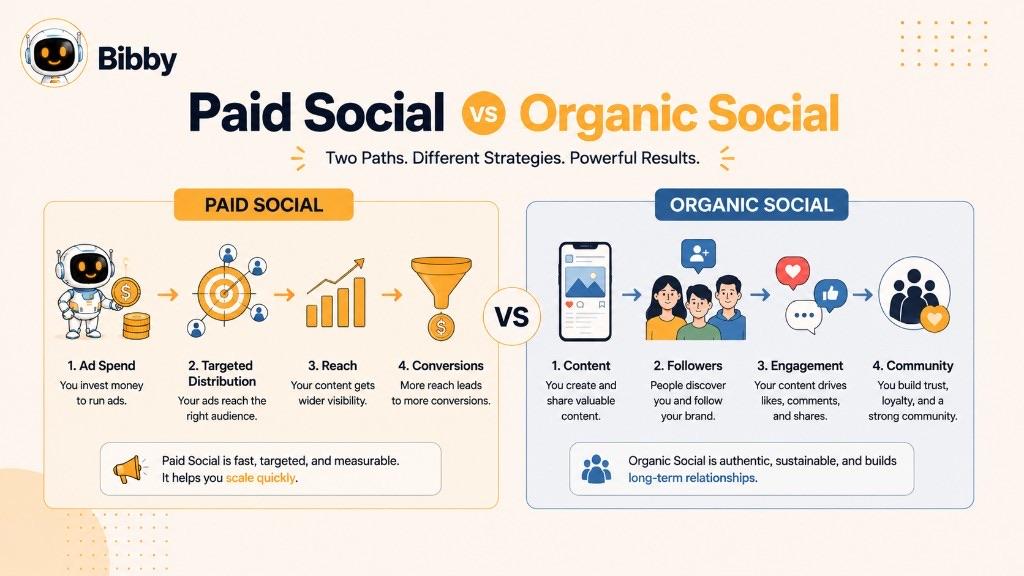
Paid social and organic social both help businesses build a presence on social media, but they differ primarily in how content is distributed. Paid social uses an advertising budget to reach selected audiences, while organic social relies on unpaid distribution through followers, sharing, engagement, search, recommendations, and platform algorithms.
The two approaches are not necessarily competitors. In practice, many businesses use paid and organic social together. Organic content can help establish a consistent brand presence and community, while paid campaigns can extend reach, target specific audiences, and support defined marketing objectives.
Paid Social vs Organic Social: Key Differences
| Factor | Paid Social | Organic Social |
|---|---|---|
| Distribution | Uses paid advertising to distribute content | Relies on unpaid distribution |
| Budget | Requires an advertising budget | No direct payment is required for publishing |
| Audience | Can use advertising targeting options | Primarily reaches followers and users reached through platform distribution |
| Reach | Can expand reach through paid delivery | Reach depends on followers, engagement, sharing, discovery, and algorithms |
| Campaign objectives | Often built around specific advertising goals | Usually supports broader content and community goals |
| Content | Ads, sponsored posts, videos, carousels, Stories, and other formats | Posts, videos, carousels, Stories, conversations, and other content |
| Measurement | Often includes advertising metrics such as CPC, CPM, CPA, and ROAS | Often focuses on engagement, reach, followers, shares, and other organic metrics |
| Speed | Can accelerate distribution once a campaign is active | Audience growth and reach can take more time |
| Targeting | More deliberate audience targeting is available | Less control over who receives each individual post |
| Primary role | Paid distribution and campaign performance | Consistent presence, content, and community building |
What Is Organic Social?
Organic social refers to social media content published without paying the platform to distribute it as an advertisement.
Examples include:
- Regular Instagram posts
- LinkedIn posts
- Facebook posts
- TikTok videos
- YouTube content
- Stories
- Carousels
- Educational content
- Community conversations
The content can still reach people beyond a brand's existing followers through recommendations, shares, search, hashtags, and platform algorithms. However, the business does not directly purchase that distribution as advertising. Organic reach is the unique unpaid audience for that content.
What Is Paid Social?
Paid social involves paying a social media platform to distribute an advertisement or promoted content to an audience.
For example, a company could create an Instagram campaign targeting potential customers in a specific location and demographic group. The company sets its advertising budget and campaign objective, and Instagram distributes the advertisement through eligible placements.
This makes paid social particularly useful when a business needs to reach a defined audience, promote an offer, generate leads, drive traffic, or increase conversions.
Which Is Better: Paid Social or Organic Social?
There is no universal winner.
Organic social is valuable for building an ongoing brand presence and relationship with an audience. Paid social is valuable when a business wants additional distribution, audience targeting, or campaign-driven results.
For many businesses, the strongest approach is to combine them.
For example, a company might publish educational content organically, identify which topics and creative formats receive strong engagement, and then develop paid campaigns around relevant products, offers, or high-performing content.
The relationship can look like this:
Organic content → Audience engagement → Identify strong content → Paid promotion → Targeted reach → Measure results → Create better content
This also means paid social does not replace the need for consistent organic content. A brand running advertisements still needs a recognizable voice, useful content, strong creative assets, and an active social presence.
Can Organic Content Become Paid Social?
Yes. On platforms that support promoting existing posts, an organic post can sometimes be turned into a paid promotion.
However, the two should still be evaluated differently.
An organic post might succeed because it generates discussion, shares, or community engagement. A paid campaign might need to generate clicks, leads, purchases, or another defined conversion.
The same piece of content can therefore have different goals depending on how it is distributed.
For businesses managing both sides of social media, maintaining a consistent content workflow becomes especially important. Tools such as Bibby can help organize the organic content side by creating captions, generating or preparing visual content, scheduling posts, and managing content across multiple social platforms, while paid campaigns can be managed separately through each platform's advertising system.
Paid and Organic Social Work Best as a System
The most effective social media strategy does not necessarily treat paid and organic as two separate worlds.
Organic social can provide the content and relationship layer, while paid social can provide an additional distribution and targeting layer.
Together, they can help a business maintain a consistent social presence while using advertising selectively when additional reach or specific campaign outcomes are needed.
Paid Social Examples
Paid social can look very different depending on the business, platform, audience, and campaign objective. A local business may use paid social to generate inquiries, an ecommerce brand may use it to drive purchases, while a B2B company may use it to generate qualified leads.
The common factor is that the business pays a social media platform to distribute its content or advertisement to a selected audience.
Example 1: Instagram Product Advertising
Imagine a clothing brand launching a new collection.
The brand creates a short video showing its new products and runs it as a paid Instagram advertisement. Instead of relying only on its followers to discover the post, the brand can use available advertising options to reach people who are likely to be interested in its products.
The campaign might be designed to drive product-page visits, engagement, add-to-cart actions, or purchases. The brand can then evaluate performance using metrics such as reach, impressions, clicks, conversions, cost per acquisition, and return on ad spend.
Why this is paid social: The brand is paying for the distribution of the advertisement rather than relying exclusively on organic Instagram reach.
Example 2: LinkedIn Lead Generation
Consider a software company selling an enterprise solution to businesses.
The company publishes a report about an important industry problem and creates a LinkedIn advertisement promoting it. The campaign is designed to reach professionals who may be relevant to the company's target market.
The advertisement could direct users to a landing page where they can download the report or submit their information through a lead-generation form.
The campaign's success might be measured by impressions, click-through rate, leads, cost per lead, lead quality, and sales opportunities.
Why this is paid social: The company is purchasing targeted distribution on LinkedIn to reach potential business customers.
Example 3: Facebook Retargeting
Suppose someone visits an ecommerce website, views a product, but leaves without purchasing it.
The business can use a retargeting campaign to show relevant advertisements to eligible users who previously interacted with the website. That often depends on a tracking pixel or similar conversion setup in the ads platform.
The goal could be to bring the potential customer back to the website and encourage them to complete the purchase.
Why this is paid social: The business is using paid advertising to reconnect with an audience based on previous interaction.
Example 4: TikTok Paid Video Campaign
A consumer brand launches a new product and creates several short-form videos demonstrating how it works.
The brand can distribute those videos through a paid TikTok campaign to reach relevant audiences beyond its existing followers, focusing on awareness, video views, website traffic, product discovery, or conversions.
Why this is paid social: The videos are being distributed through TikTok's paid advertising system rather than only through organic posting.
Example 5: YouTube Video Advertising
A technology company wants to introduce its new software product to potential customers.
It creates a 30-second product video and uses paid YouTube advertising to reach relevant viewers. Performance can be evaluated using reach, impressions, video views, view rate, clicks, conversions, and cost per conversion.
Why this is paid social: YouTube is a social and video platform where businesses can purchase advertising placements to distribute content to selected audiences.
Example 6: Promoting a Webinar
A B2B company is hosting a free webinar about AI adoption.
It creates a carousel or video advertisement explaining what attendees will learn and promotes it through paid social campaigns. The primary goal is lead generation or event registration, rather than simply maximizing impressions.
This example shows why the campaign objective matters. The same social platform can be used for awareness, traffic, engagement, leads, or conversions depending on how the campaign is structured.
Example 7: Local Business Promotion
A restaurant opening a new location could run a paid social campaign targeting people within a relevant geographic area, featuring food photography, a promotional offer, opening information, location details, and a call to action.
This is still paid social even though the campaign is highly local. The defining characteristic is paid distribution through a social platform, not the size of the business or its audience.
What These Paid Social Examples Have in Common
Although these campaigns are different, they follow the same basic structure:
Business goal → Target audience → Creative → Advertising budget → Paid distribution → Measurement
The creative format can change from an image to a video or carousel. The platform can change from Instagram to LinkedIn or TikTok. But the underlying principle remains the same: a business uses advertising spend to distribute a message to an audience in pursuit of a defined marketing objective.
Paid Social Platforms
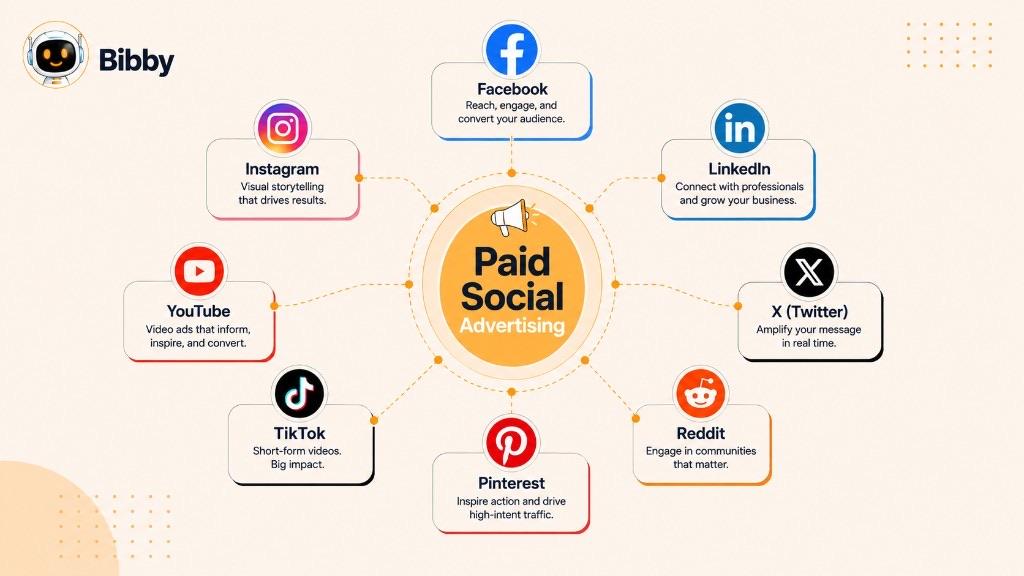
Paid social is available across many social and digital content platforms, but each platform has a different audience, content environment, targeting system, advertising format, and campaign strength. The right platform therefore depends on who you want to reach, what you are promoting, and what you want the audience to do.
Facebook and Instagram
Facebook and Instagram are part of Meta's advertising ecosystem and are among the most widely used platforms for paid social campaigns.
Businesses can use paid campaigns to promote products, services, content, events, apps, and offers. Depending on the campaign setup, advertisers can work with image ads, video ads, carousel ads, Stories, Reels, shopping formats, and lead-generation formats.
Facebook can be useful for reaching broad consumer audiences and specific interest or behavior-based segments, while Instagram is particularly suited to visual content, products, creators, and short-form media.
Best suited for: Consumer brands, ecommerce, local businesses, content promotion, lead generation, and broad audience campaigns.
LinkedIn is particularly relevant to B2B paid social advertising because its professional environment allows businesses to reach audiences based on professional characteristics.
Companies can use paid LinkedIn campaigns to promote B2B software, professional services, industry reports, webinars, events, whitepapers, and enterprise solutions.
Best suited for: B2B marketing, professional services, enterprise products, recruitment-related campaigns, lead generation, and thought-leadership promotion.
TikTok
TikTok has made short-form video an important part of modern paid social advertising. Brands can use paid campaigns to distribute vertical video content and reach audiences within TikTok's discovery-oriented environment.
The creative approach is particularly important on TikTok. Advertisements often perform better when they fit naturally into the platform's fast-moving, mobile-first content experience rather than looking like traditional television commercials.
Best suited for: Consumer brands, ecommerce, entertainment, lifestyle products, younger audiences, and short-form video campaigns.
YouTube
YouTube combines video content with a large advertising ecosystem. Businesses can use paid YouTube campaigns to promote product demonstrations, brand videos, tutorials, explainer videos, product launches, testimonials, and educational content.
Best suited for: Video-first campaigns, product demonstrations, education, brand awareness, entertainment, and businesses that can communicate effectively through video.
Pinterest can be useful for brands whose products or ideas naturally fit visual discovery and planning—home, fashion, food, travel, beauty, weddings, DIY, and lifestyle products.
Best suited for: Visual products, ecommerce, lifestyle brands, inspiration-driven purchases, and discovery-focused campaigns.
Snapchat
Snapchat offers advertising opportunities within a highly visual, mobile-first environment.
Best suited for: Consumer brands, mobile-first campaigns, entertainment, lifestyle products, and audiences that actively use short-form visual communication.
Reddit conversations are organized around communities and topics. Businesses can use paid advertising to reach audiences based on relevant interests and communities.
Best suited for: Niche products, technology, gaming, specialist interests, communities, and discussion-driven marketing.
X
X provides paid advertising opportunities for businesses that want to promote content within a real-time, conversation-focused environment.
Best suited for: Real-time marketing, technology, media, entertainment, industry discussions, and conversation-driven campaigns.
How Do You Choose the Right Paid Social Platform?
There is no universally best paid social platform. The right choice depends on the relationship between your audience, content, objective, and budget.
| If your goal is... | Platforms worth considering |
|---|---|
| Broad consumer reach | Facebook, Instagram |
| Visual product promotion | Instagram, Pinterest, TikTok |
| B2B lead generation | |
| Short-form video | TikTok, Instagram, YouTube |
| Long-form video | YouTube |
| Niche communities | |
| Real-time conversations | X |
| Local consumer promotion | Facebook, Instagram |
| Ecommerce discovery | Instagram, TikTok, Pinterest |
This table is a starting point, not a universal ranking. A brand might use LinkedIn for B2B lead generation, Instagram for visual brand content, TikTok for short-form video, and YouTube for product education. Running campaigns on more platforms does not automatically produce better results.
The key question is not “Which platform is the best?” It is: “Which platform gives my business the best opportunity to reach the right audience with the right message for the right objective?”
Paid Social Campaign Objectives
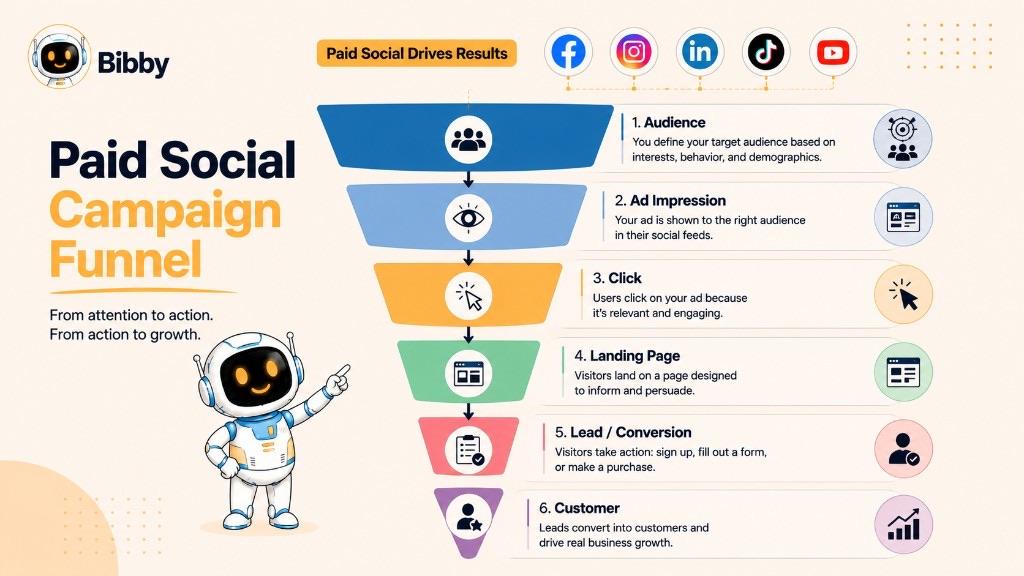
A paid social campaign objective defines what you want your advertising campaign to accomplish. It influences how a campaign is structured, which users the platform may prioritize, and which metrics should be used to evaluate performance.
For example, a campaign designed to maximize awareness should not be judged in exactly the same way as a campaign designed to generate purchases. The objective and the measurement framework need to match.
Brand Awareness
Awareness campaigns introduce a business, product, service, or message to relevant audiences. Common metrics can include reach, impressions, frequency, video views, and brand-related engagement.
Best for: New products, brand launches, market expansion, and increasing visibility.
Reach
Reach-focused campaigns aim to expose an advertisement to as many relevant unique users as possible. One person can generate multiple impressions, while reach counts unique people.
Best for: Broad awareness, announcements, local promotions, and campaigns where maximizing unique exposure is important.
Website Traffic
Traffic campaigns encourage users to visit a website, landing page, blog, or product page. Important metrics may include link clicks, CTR, CPC, landing-page visits, and traffic quality. Inexpensive clicks are not automatically successful if visitors are not relevant.
Best for: Content promotion, product pages, landing pages, articles, and consideration-stage campaigns.
Engagement
Engagement campaigns encourage likes, comments, shares, saves, video interactions, and other platform-specific actions.
Best for: Content amplification, community interaction, social proof, and increasing visibility around important posts.
Lead Generation
Lead-generation campaigns collect information from potential customers via a website form or a native lead form. Useful metrics include number of leads, cost per lead, lead conversion rate, lead quality, and qualified opportunities. A low-cost lead is not necessarily a valuable lead.
Best for: B2B companies, professional services, software, education, events, and longer sales cycles.
Conversions
Conversion campaigns are designed around a specific action: signup, registration, demo request, download, purchase, subscription, or form completion.
Best for: Performance marketing campaigns where the business wants users to complete a measurable action.
Sales
Sales-focused campaigns drive purchases or other revenue-generating actions. Important metrics can include purchases, revenue, conversion rate, CPA, average order value, and ROAS.
Best for: Ecommerce, retail, subscriptions, and businesses with measurable online transactions.
App Promotion
Businesses with mobile applications can optimize toward app installs, registrations, purchases, in-app actions, or re-engagement.
Best for: Mobile apps, games, subscription applications, and businesses with meaningful in-app actions.
Why Campaign Objectives Matter
Choosing an objective establishes what the campaign is trying to optimize for. Campaign A (reach as many relevant people as possible) and Campaign B (generate purchases) can use the same product image but should be judged differently.
One of the most common paid social mistakes is optimizing for a metric that does not represent the actual business goal.
A simple framework is:
Awareness → Interest → Traffic → Leads → Conversions → Sales
Not every customer journey follows this exact sequence. Before launching, define the objective first, then select audience, creative, budget, and measurement around that objective.
How Does Paid Social Target Audiences?
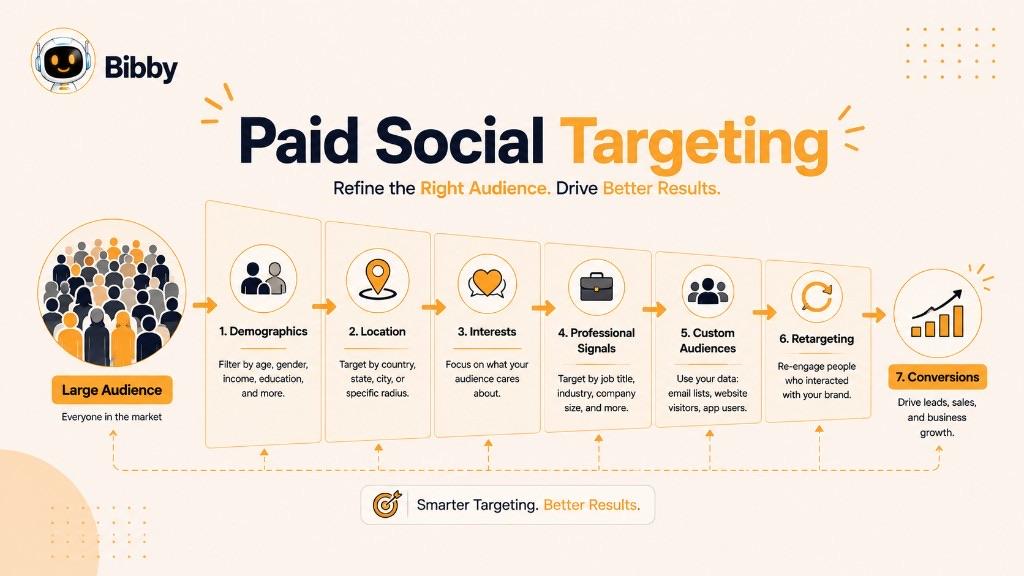
Audience targeting is one of the defining features of paid social advertising. The exact options vary by platform, account setup, region, privacy rules, and campaign type.
Demographic Targeting
Advertisers may define audiences using age, gender where available, language, education, and other demographic signals. A demographic profile does not necessarily mean someone is interested in a particular product.
Geographic Targeting
Campaigns can focus on countries, regions, cities, or areas around a location. Geographic targeting is particularly useful for local businesses, regional services, events, franchises, and location-specific offers.
Interest and Behavior Targeting
Some platforms provide targeting based on interests, activities, or other behavioral signals. An assumed interest does not guarantee that someone is currently ready to buy.
Professional and Business Targeting
B2B campaigns may use job roles, industries, company characteristics, professional interests, or seniority. LinkedIn is particularly relevant here.
Custom Audiences
Custom audiences use eligible existing customer or interaction data—customers, website visitors, app users, content interactors, customer lists, or previous leads—subject to platform rules and privacy requirements.
Lookalike or Similar Audiences
Some platforms help advertisers find new users who share characteristics with an existing audience. Terminology and mechanics differ, so lookalike audience should be understood as a general paid social concept rather than one identical feature everywhere.
Retargeting
Retargeting focuses on people who have already interacted with a business. It depends on available data, tracking implementation, user consent, platform policies, and privacy restrictions.
Broad Audience Targeting
Paid social does not always require extremely narrow audiences. In some situations, relatively broad parameters plus a clear conversion goal let the platform's delivery system identify users more likely to convert. An audience that is too narrow may limit delivery.
How Do Advertisers Choose the Right Audience?
The best audience is not necessarily the smallest audience. Balance audience relevance + sufficient scale + campaign objective + available data.
A useful framework is:
New audience → Engaged audience → Website visitors → Leads/customers → Retargeting
Even a well-selected audience can respond poorly to an irrelevant offer or weak creative. Successful targeting matches the right audience with the right message, creative, offer, and campaign objective.
How Is Paid Social Measured?
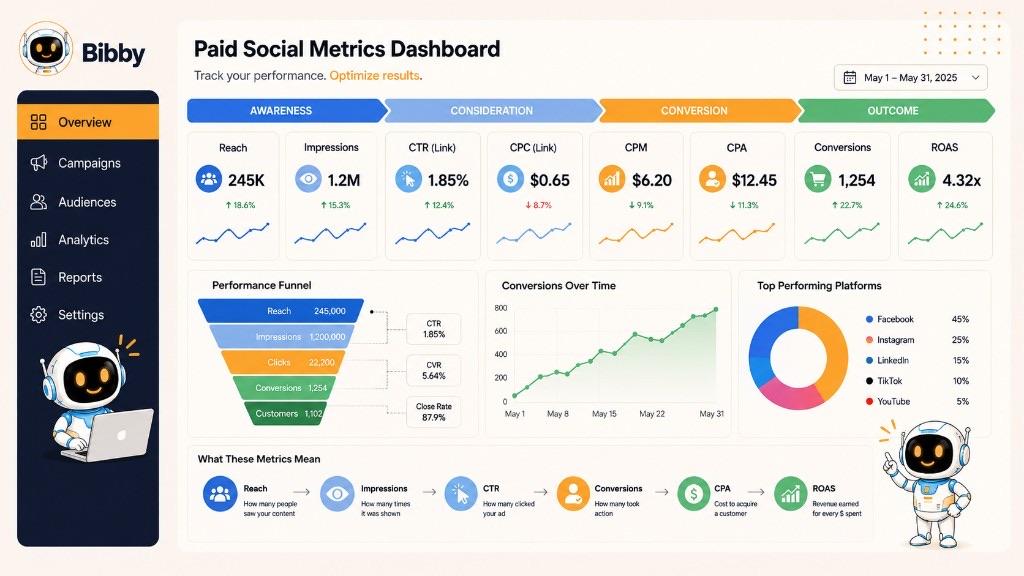
Paid social performance is measured by comparing what the campaign achieved against the objective, audience, and amount spent. The most important metric depends on the goal.
Paid Social Metrics at a Glance
| Metric | What It Measures | Common Use |
|---|---|---|
| Reach | Number of unique users exposed to an ad | Awareness |
| Impressions | Total number of times an ad was displayed | Exposure |
| Frequency | Average number of times users were exposed to an ad | Awareness and ad fatigue |
| CTR | Percentage of impressions that resulted in clicks | Traffic |
| CPC | Average cost associated with a click | Traffic efficiency |
| CPM | Cost per 1,000 impressions | Reach and awareness |
| Engagement | Interactions with an advertisement or content | Engagement |
| Conversions | Desired actions completed | Performance campaigns |
| CPA | Cost associated with acquiring a conversion | Lead generation and sales |
| ROAS | Revenue generated relative to advertising spend | Ecommerce and revenue campaigns |
Reach counts unique users. Impressions count total displays. Frequency = Impressions ÷ Reach. If 10,000 people generate 15,000 impressions, frequency is 1.5.
CTR = Clicks ÷ Impressions × 100. A high CTR does not automatically mean a campaign is profitable.
CPC = Advertising Spend ÷ Clicks. CPM = Advertising Spend ÷ Impressions × 1,000.
A conversion is a desired action (purchase, signup, lead, demo, registration, app install, subscription, download). CPA = Advertising Spend ÷ Conversions.
ROAS = Revenue Attributed to Ads ÷ Advertising Spend. Spending $2,000 and attributing $8,000 in revenue is 4x ROAS. ROAS is not profit—product costs, salaries, fees, and fulfillment still matter.
Which Paid Social Metrics Matter Most?
| Campaign Goal | Metrics to Watch |
|---|---|
| Brand awareness | Reach, impressions, frequency |
| Traffic | Clicks, CTR, CPC, landing-page visits |
| Engagement | Engagements, engagement rate |
| Lead generation | Leads, CPL/CPA, lead quality |
| Conversions | Conversion rate, CPA, conversions |
| Ecommerce sales | Purchases, revenue, CPA, ROAS |
| Video awareness | Reach, impressions, video-view metrics |
Measure the business outcome, not just the easiest number to increase. Campaign objectives, tracking, creative, targeting, and business outcomes should be evaluated together in native ads analytics.
How Much Does Paid Social Cost?
There is no fixed price for paid social advertising. Cost depends on platform, target audience, campaign objective, industry, location, competition, creative quality, bidding strategy, seasonality, and conversion performance.
What Determines Paid Social Cost?
Platform: Reaching an audience on LinkedIn can cost a different amount than on TikTok or Instagram.
Target audience: Competitive audiences may cost more. A smaller audience is not automatically cheaper.
Campaign objective: Impression campaigns may be evaluated using CPM; traffic campaigns using CPC; sales campaigns using CPA and ROAS. The cheapest campaign is not necessarily the most effective.
Industry and geography: Competitive categories and major markets can change auction dynamics.
Creative quality: Irrelevant or repetitive creative can perform poorly even with appropriate targeting.
Common Paid Social Pricing Metrics
CPM evaluates the cost of paid exposure. CPC is relevant when traffic matters. CPA is closer to performance. Cost per lead can be more meaningful than CPC for B2B if clicks do not produce qualified prospects. ROAS compares attributed revenue with spend and should not be confused with profit.
Is Paid Social Expensive?
Paid social can be inexpensive to test but expensive to scale if the campaign does not produce meaningful results. The better question is: “How much does it cost to achieve my specific business objective?”
There is no universal starting budget. A practical approach is to test audience, creative, offer, and objective without unnecessary risk, then gradually increase spending:
Test → Measure → Identify winners → Improve → Scale → Measure again
Treat paid social as an investment. The goal is not the lowest-cost advertising. The goal is efficient, sustainable customer acquisition at a cost the business can support.
How to Create a Paid Social Strategy
A paid social strategy connects the business goal, target audience, offer, creative, platform, budget, measurement, and optimization process.
Objective → Audience → Offer → Creative → Platform → Budget → Launch → Measure → Optimize → Scale
1. Define the Business Objective
Start with a specific result. “Get more visibility” is less useful than “generate qualified demo requests from potential customers.”
2. Identify the Target Audience
Consider who needs the product, what problem they have, where they are, whether they already know the brand, and which journey stage they occupy: New prospects → Engaged users → Website visitors → Leads → Existing customers.
3. Develop the Offer
Give the audience a reason to act: product, trial, discount, consultation, demo, webinar, resource, feature, or promotion. Answer: Why should this person care about this advertisement right now?
4. Choose the Right Creative
Use a structure such as Hook → Problem or desire → Value proposition → Proof or context → Call to action. Test multiple variations (hooks, images, videos, CTAs) instead of one ad.
5. Select the Right Platform
Choose based on audience and objective, not popularity. One well-executed platform can outperform several poorly managed campaigns.
6. Set the Budget
Reflect objective, audience size, customer value, expected conversion rate, sales cycle, competition, and testing needs. Increasing budget before understanding campaign economics can scale waste.
7. Launch the Campaign
Align objective, audience, offer, creative, landing page, tracking, and budget. If the ad promises one thing and the landing page another, you lose people after the click.
8. Measure Performance
Use metrics connected to the original objective. Avoid judging a campaign using a single metric in isolation.
9. Test and Optimize
Change variables in a structured way. Changing audience, creative, offer, landing page, budget, and objective all at once makes results hard to interpret.
10. Scale What Works
Increase budget, expand audience, introduce new creative, or add a platform only after consistent performance. Treat scaling as an extension of testing, not simply turning up spend.
A Simple Paid Social Strategy Example
A SaaS company generating demos: Objective: qualified demo requests → Audience: business decision-makers → Offer: free demonstration → Creative: short product video → Platform: LinkedIn → Measurement: leads, qualified leads, CPA → Scale combinations that stay profitable.
Don't start with the advertisement. Start with the objective.
What Makes a Good Paid Social Ad?
A good paid social ad communicates a relevant message to the right audience and gives them a clear reason to take the desired action.
1. A Strong Hook
Earn attention early. Example: “Still spending hours creating social media posts every week?” instead of a generic company introduction.
2. Relevant Visuals
Product photography, short-form video, demonstration, illustration, carousel, UGC-style content, or brand graphics should support the message.
3. A Clear Value Proposition
Weak: “Social media management software.” Stronger: “Create, caption, and schedule your social content from one workflow.”
4. A Relevant Message
Speak to a specific audience. B2B may emphasize productivity; ecommerce may emphasize product benefits or offer; local businesses may emphasize location or promotion.
5. Strong Branding
Logo, colors, type, voice, and product presentation should make the brand identifiable without overwhelming the message.
6. A Clear Call to Action
Learn More, Shop Now, Sign Up, Get Started, Book a Demo, Download, Register, or Contact Us—matched to the objective.
7. Platform-Native Creative
Match aspect ratio, duration, text placement, captions, and conventions. Mobile-first design matters: readable text, strong hierarchy, captions when video relies on speech.
8. Multiple Creative Variations
Test problem-focused vs benefit-focused messages rather than treating one ad as the final answer.
9. Ad-to-Landing-Page Consistency
If the ad promises a free strategy, the landing page must deliver it. Keep message, offer, branding, value proposition, and CTA aligned.
A useful framework is Hook → Problem → Value → Proof → CTA. Effective creative brings together relevant audience + strong creative + clear message + valuable offer + appropriate platform + clear CTA.
Common Paid Social Mistakes
1. Targeting Everyone
Broad targeting can work when the platform can optimize, but it should not mean irrelevant targeting.
2. Using One Creative Repeatedly
Ads can lose effectiveness as frequency rises. Test visuals, hooks, headlines, offers, CTAs, formats, and messaging.
3. Optimizing for the Wrong Objective
Thousands of clicks with few sales is a failure if the goal is revenue.
4. Ignoring the Landing Page
Slow, confusing, inconsistent, or non-mobile pages waste paid traffic.
5. Measuring Clicks Instead of Business Outcomes
High CTR and low CPC can still produce poor results. Look at conversions, CPA, revenue, lead quality, and ROAS.
6. Scaling Before Finding a Winning Campaign
Test → Measure → Improve → Validate → Scale. Scaling a weak campaign makes the weakness more expensive.
7. Testing Too Many Variables at Once
If you change everything simultaneously, you cannot tell what caused the change.
8. Ignoring Audience Saturation
Watch frequency alongside CTR, conversions, and CPA. Refresh creative when fatigue appears.
9. Focusing Only on Short-Term Results
Awareness campaigns should not be judged only on immediate purchases. Consider Awareness → Consideration → Conversion → Retention.
10. Treating Every Platform the Same
An Instagram winner is not automatically a LinkedIn or TikTok winner. Adapt creative.
11. Ignoring Tracking and Attribution
Without tracking website actions, leads, purchases, or app events, conversion campaigns cannot be optimized honestly. Attribution is imperfect as privacy rules evolve.
12. Expecting Paid Social to Fix a Weak Offer
Advertising increases distribution. It cannot make an unattractive offer compelling.
The biggest mistake is treating paid social as simply “paying to get more reach.” A successful campaign needs business objective + audience + offer + creative + platform + budget + measurement.
Paid Social vs Paid Media
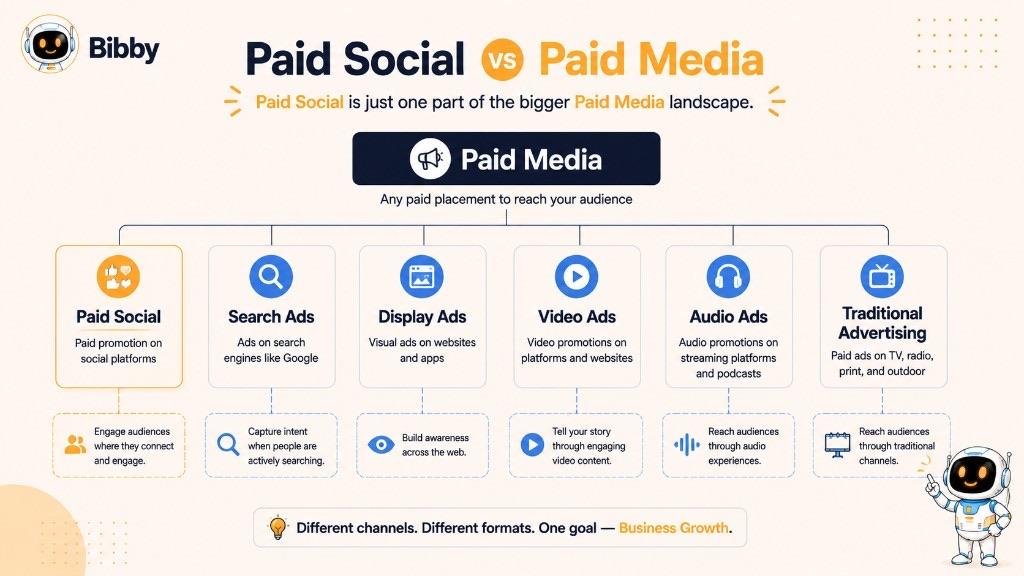
Paid social is a type of paid media, but paid media is a much broader category. Paid media includes social advertising, search advertising, display, video, sponsored content, paid influencer placements, digital audio, TV, radio, print, and outdoor.
Paid social is the portion that takes place on social platforms: Facebook, Instagram, LinkedIn, TikTok, YouTube, Pinterest, Reddit, X, and similar.
| Factor | Paid Social | Paid Media |
|---|---|---|
| Definition | Paid advertising on social platforms | Broader category of paid promotion |
| Scope | A specific part of paid media | Includes social and non-social channels |
| Platforms | Facebook, Instagram, LinkedIn, TikTok, YouTube, etc. | Search engines, social platforms, websites, TV, radio, print, and more |
| Audience targeting | Often uses social platform audience signals | Depends on the media channel |
| Example | Instagram product advertisement | Google search ad or television commercial |
All paid social is paid media, but not all paid media is paid social.
Someone searching for software may have strong purchase intent. Someone seeing a social ad while scrolling may be earlier in the journey. Plan budgets accordingly.
Paid Social vs Social Media Marketing
Paid social is one part of social media marketing, not the entire discipline. Social media marketing also includes organic content, community management, strategy, content creation, influencer marketing, social listening, analytics, audience engagement, scheduling, and brand building.
| Factor | Paid Social | Social Media Marketing |
|---|---|---|
| Scope | Specific area of social media marketing | Broader discipline |
| Payment | Uses advertising spend | Can include paid and unpaid activities |
| Primary focus | Paid distribution and advertising outcomes | Overall social media presence and business objectives |
| Measurement | Often CPC, CPM, CTR, CPA, conversions, ROAS | Can include engagement, reach, followers, traffic, leads, conversions, brand metrics, and more |
Social Media Marketing can include organic social, paid social, content creation, community management, influencer marketing, social listening, and analytics. A business can have an active social strategy without running ads.
Social media marketing does not always include paid social. Combining both can still create a more complete system:
Organic content → Audience response → Identify useful topics → Develop paid creative → Reach targeted audiences → Measure results → Improve future content
Where Does Bibby Fit?
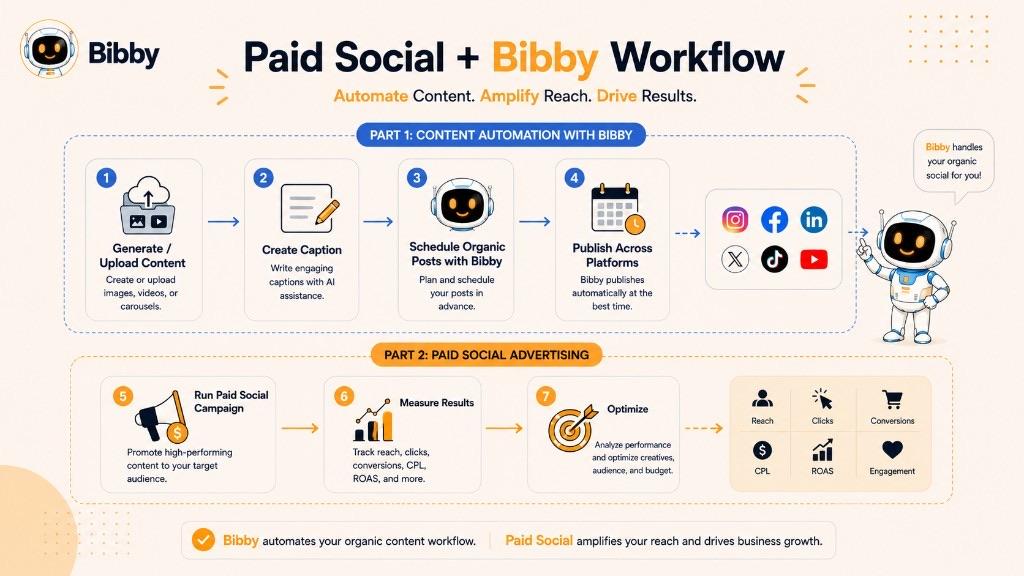
Managing social media marketing requires a consistent flow of content. Bibby is designed around the social content creation and scheduling workflow: upload or generate visuals, create captions, select posting styles, schedule content, and manage posts across platforms. Chat can be used to create a brand kit, campaigns, posts, and caption variations.
Bibby is not the advertising layer. Paid social handles paid distribution in native ads managers, while Bibby can help keep organic publishing consistent.
Social media marketing is the overall strategy. Paid social is the paid advertising component of that strategy.
Managing Social Content Alongside Paid Social
Running ads does not mean a business can stop publishing. Someone who discovers a company through an ad may visit its profiles to see whether it is active, what it offers, and how people engage.
Paid social: Use advertising spend to distribute ads and pursue campaign objectives.
Organic social: Publish consistently to maintain presence, educate, and encourage engagement.
Keep brand consistency across ads and organic posts (logo, colors, type, voice, positioning) without making every post identical.
Paid campaigns can reveal audience interests, creative preferences, and offers. Organic content can reveal topics that naturally generate engagement. Do not assume an organic winner automatically becomes a successful ad.
A product campaign might need Instagram Reels, carousels, and Stories; LinkedIn educational posts; Facebook image and video; TikTok short-form; and a YouTube demonstration. Creating all of that manually is repetitive. Automation can complement paid social on the organic and scheduling side.
A Simple Paid + Organic Workflow
- Define the campaign goal.
- Create paid creative for the objective and audience (in the ads platform).
- Maintain organic publishing throughout the campaign.
- Analyze paid and organic response.
- Identify useful topics, messages, and formats.
- Develop new content.
- Schedule consistently.
Paid social should not replace consistent social content. It is one layer of a broader system.
Paid Social Best Practices
- Start with a clear objective. Don't optimize for clicks when your real goal is sales.
- Know your audience—every targeting decision should have a reason.
- Match creative to the platform.
- Make the first seconds count.
- Keep the message focused (one primary idea per creative).
- Test multiple variations without changing five variables at once.
- Give the campaign enough data to learn before major decisions.
- Monitor frequency and creative fatigue.
- Optimize for business outcomes, not vanity metrics.
- Track conversions properly before launching performance campaigns.
- Align the advertisement with the landing page.
- Control budget; scale only when economics hold.
- Use retargeting strategically with different messages by journey stage.
- Refresh creative regularly.
- Compare performance at campaign, ad set, audience, creative, and placement level—and ignore tiny samples.
Paid Social Best-Practice Checklist
- Is the objective clearly defined?
- Is the audience relevant?
- Does the offer solve a meaningful problem?
- Does the creative fit the platform?
- Is the message immediately understandable?
- Is there a clear CTA?
- Is conversion tracking configured?
- Does the landing page match the advertisement?
- Is the budget appropriate for testing?
- Do we have multiple creative variations?
- Do we know which metrics define success?
Don't optimize the advertisement in isolation. Optimize the entire journey from audience to action.
Paid Social Glossary: Key Terms to Know
| Term | Simple Meaning |
|---|---|
| Paid social | Paid advertising on social platforms |
| Organic social | Unpaid content and unpaid distribution |
| Paid media | Broader category of paid marketing |
| Campaign | Advertising initiative with a defined objective |
| Ad set / ad group | Level where audience, budget, or placements may be set |
| Ad creative | Visual and messaging elements of an ad |
| Target audience | People the campaign is designed to reach |
| Custom audience | Audience built from eligible existing data |
| Lookalike audience | Platform-generated audience similar to a source audience |
| Retargeting | Advertising to eligible previous visitors/interactors |
| Reach | Unique users exposed |
| Impressions | Total ad displays |
| Frequency | Average exposure per reached user (impressions ÷ reach) |
| CTR | Percentage of impressions producing clicks |
| CPC | Average cost per click |
| CPM | Cost per 1,000 impressions |
| CPA | Average cost per acquisition |
| CPL | Average cost per lead |
| Conversion | Desired user action |
| ROAS | Revenue relative to ad spend |
| ROI | Broader return vs overall investment cost |
| CTA | Prompt telling users what to do next |
| Landing page | Page users reach after clicking |
| Ad auction | How platforms allocate impressions among advertisers |
| Ad placement | Where an ad can appear (feed, Stories, Reels, video) |
| Attribution | How credit for a conversion is assigned |
| Creative fatigue | Declining effectiveness from repeated exposure |
| Conversion tracking | Measurement of desired actions after ads |
ROAS vs ROI: ROAS compares attributed revenue to ad spend. ROI considers return relative to overall cost. A campaign can have positive ROAS without positive overall ROI.
10,000 impressions tells you about exposure. 500 clicks tells you about traffic. 50 leads tells you about a desired action. 10 customers tells you more about business results. $5,000 in revenue from $1,000 in advertising spend is a way to evaluate efficiency through ROAS.
Paid Social: Key Takeaways
Paid social is one of the most important ways businesses can use social platforms to reach audiences beyond existing followers. Effective paid social is not simply “boosting a post.” It is a structured process that connects targeting, creative, objectives, budget, measurement, and optimization.
- Paid social is paid advertising on social platforms—images, video, carousels, Stories, Reels, lead ads, product ads, retargeting, and sponsored content.
- Paid social is part of paid media, alongside search, display, video, audio, and traditional ads.
- Paid social and organic social are different. Organic maintains presence; paid buys distribution. Use both when it fits the business.
- Start with the objective before choosing a platform or creative.
- Audience matters as much as creative. Targeting can use demographics, geography, interests, professional signals, first-party data, retargeting, and lookalikes—subject to platform rules.
- Creative is a major performance variable: hook, relevant visual, clear value, focused message, CTA.
- There is no universal cost. Use CPM, CPC, CPL, CPA, and ROAS to judge efficiency.
- Measure outcomes, not just activity. High reach is not automatically high revenue.
- Optimize continuously: Launch → Measure → Learn → Optimize → Scale.
- Paid social does not replace content. Ads still benefit from an active, recognizable profile.
- Automation can support the organic workflow. Bibby can create, caption, and schedule posts; ads, pixels, bidding, and ROAS stay in native ads managers.
The Paid Social Formula
Right Audience + Right Message + Right Creative + Right Offer + Right Platform + Right Measurement
Final Definition
Paid social is the practice of paying social media platforms to distribute advertisements or promoted content to selected audiences in order to achieve a defined marketing or business objective.
Those objectives can include brand awareness, reach, engagement, website traffic, lead generation, conversions, app promotion, and sales.
A successful paid social strategy brings together:
Objective → Audience → Offer → Creative → Platform → Budget → Measurement → Optimization
Understanding that chain is the key to treating paid social as a complete marketing channel, rather than simply paying to boost a post. Explore more terms in the social media dictionary, or start publishing with Bibby.