
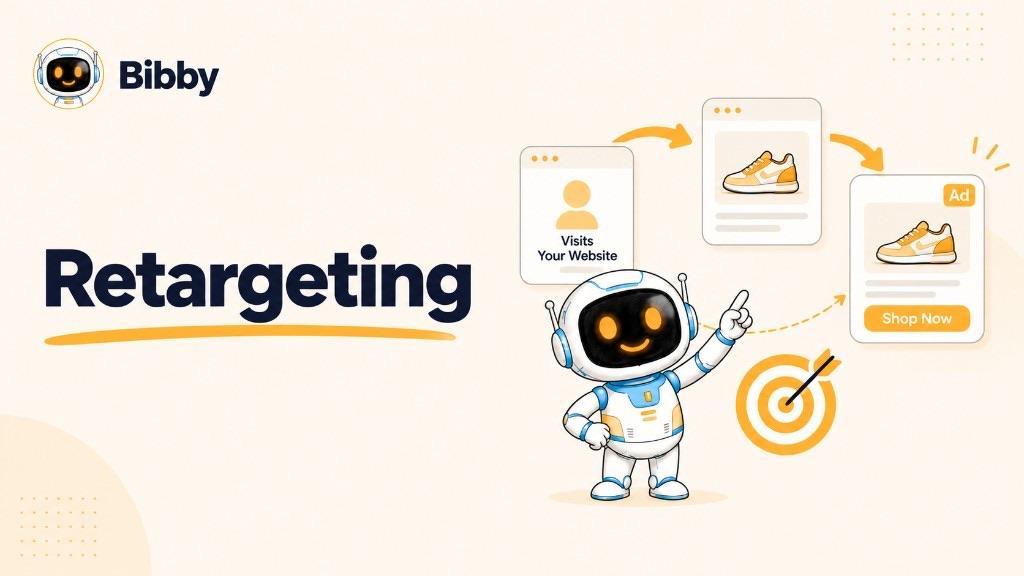
Retargeting can be used across websites, search engines, social media platforms, and other digital advertising channels. Common applications include product retargeting, cart-abandonment campaigns, website visitor retargeting, and social media retargeting.
In simple terms, retargeting means advertising to people who have already shown interest in your brand but have not yet converted.
What Is Retargeting?
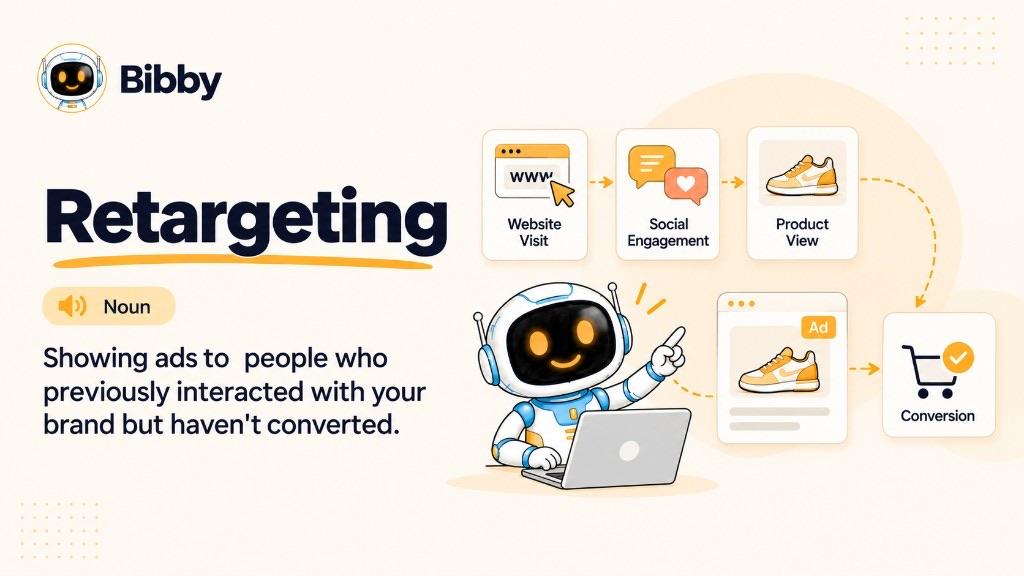
Retargeting is a digital advertising technique used to reach people who have previously interacted with a business but have not completed a desired action, such as making a purchase, submitting a form, signing up for a service, or booking a demo. Instead of showing ads only to people who have never encountered the brand, retargeting focuses on audiences that have already demonstrated some level of interest.
A person can become part of a retargeting audience after visiting a website, viewing a product, adding an item to a shopping cart, engaging with social media content, watching a video, or interacting with a previous advertisement. Depending on the advertising platform and campaign setup, marketers can then show these users relevant follow-up ads.
For example, imagine someone visits a website selling running shoes and spends several minutes looking at a particular pair. They leave without buying. Later, they may see an advertisement featuring that pair of shoes while browsing another website or using a social media platform. The advertisement is designed to bring the potential customer back to the brand. This is retargeting.
Retargeting Meaning
The meaning of retargeting is simple: targeting someone again after they have already interacted with your brand. The word combines “re” with “targeting,” reflecting the idea of reaching an existing prospect again rather than finding an entirely new audience.
Retargeting is commonly used throughout the customer journey. A business might retarget someone who viewed a product with a purchase-focused ad, while someone who visited a pricing page could receive an advertisement encouraging them to request a demo.
What Is Retargeting in Digital Marketing?
In digital marketing, retargeting is primarily used to reconnect advertising campaigns with previously engaged audiences. It can help businesses remain visible to potential customers who may need additional time, information, or motivation before converting.
Retargeting is different from ordinary prospecting. Prospecting generally focuses on reaching potential customers who have not previously interacted with the brand, while retargeting focuses on people who have already shown interest.
The strategy can be particularly valuable because digital customers rarely convert after their first interaction. Someone may compare products, leave a website, postpone a purchase, or simply become distracted. Retargeting gives marketers another opportunity to reach that person with a relevant message.
How Does Retargeting Work?
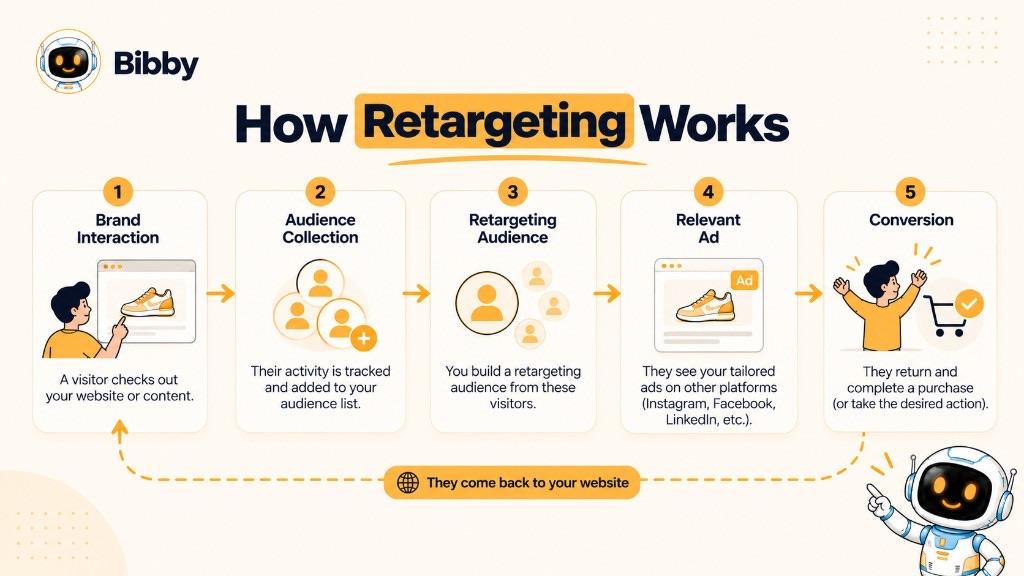
Retargeting works by identifying people who have already interacted with a brand, placing them into relevant audience groups, and showing them follow-up advertisements as they continue browsing online. The exact technology varies by advertising platform, but the underlying process is straightforward: interaction → audience → retargeting ad → return visit → conversion.
A tracking pixel, cookies, platform identifiers, conversion events, and first-party data can all contribute to those audience signals. Privacy rules, browser restrictions, platform policies, and consent requirements can affect what information can be collected and how it can be used.
1. A User Interacts With Your Brand
The process starts when someone interacts with a business online. This could happen when a person visits a website, views a product, reads a page, watches a video, clicks an advertisement, submits part of a form, or engages with social media content.
Not every interaction indicates the same level of purchase intent. Someone who visits a homepage may be less likely to convert immediately than someone who visits a pricing page or adds a product to their shopping cart.
2. The Interaction Is Recorded
Advertising and analytics systems can record qualifying interactions through technologies such as tracking pixels, cookies, platform identifiers, conversion events, and first-party data.
For example, a website may use a tracking mechanism to identify that a visitor viewed a particular product. Advertising platforms can use eligible signals to help determine whether that person belongs to an audience that can receive a retargeting campaign.
Privacy rules, browser restrictions, platform policies, and consent requirements can affect what information can be collected and how it can be used.
3. The User Is Added to a Retargeting Audience
Once qualifying behavior is identified, marketers can create or use an audience based on that interaction.
Common retargeting audiences include:
- Website visitors
- Product viewers
- Cart abandoners
- Pricing-page visitors
- Lead-form visitors
- Video viewers
- Social media engagers
- Previous customers
Audience segmentation allows advertisers to create different messages for people at different stages of the customer journey.
4. The User Sees a Retargeting Ad
When a person in an eligible audience encounters an advertising placement where the campaign can reach them, the advertising platform may deliver a retargeting ad.
The message can be tailored to the person's previous interaction. Someone who viewed a product might see that product again, while someone who abandoned a shopping cart might see an advertisement encouraging them to complete their purchase.
Retargeting ads can appear across supported websites, apps, search environments, and social media platforms, depending on the advertising network and campaign configuration.
5. The User Returns and Converts
The final goal is to encourage the person to return and complete a desired action. A conversion could be a purchase, lead submission, registration, subscription, app installation, demo request, or another business-defined goal.
If the person converts, marketers can typically exclude them from certain retargeting audiences or move them into another audience segment. This helps prevent customers from continuing to receive advertisements designed for people who have not yet converted.
A Simple Retargeting Example
Consider an online software company:
Website visit → Pricing page viewed → Visitor leaves → Retargeting audience → Ad promoting a free demo → Visitor returns → Demo requested
The important point is that the advertisement is not being shown randomly. It is part of a campaign designed to reconnect with someone who has already demonstrated interest.
Retargeting in One Simple Flow
1. Interaction
A person interacts with the brand.
2. Tracking or audience signal
A qualifying interaction is recorded according to the platform's available data and privacy requirements.
3. Audience creation
The person becomes part of an eligible retargeting audience.
4. Advertisement
The person is shown a relevant follow-up ad.
5. Conversion
The person returns and completes the desired action.
This process makes retargeting different from simply showing the same advertisement to everyone. The strategy uses previous interactions to make subsequent advertising more relevant to a specific audience.
Retargeting Example
The easiest way to understand retargeting is to look at what happens after a person interacts with a brand but leaves without converting. Rather than letting that potential customer disappear from the marketing funnel, a business can use retargeting to reconnect with them through relevant advertising.
Example of E-commerce Retargeting
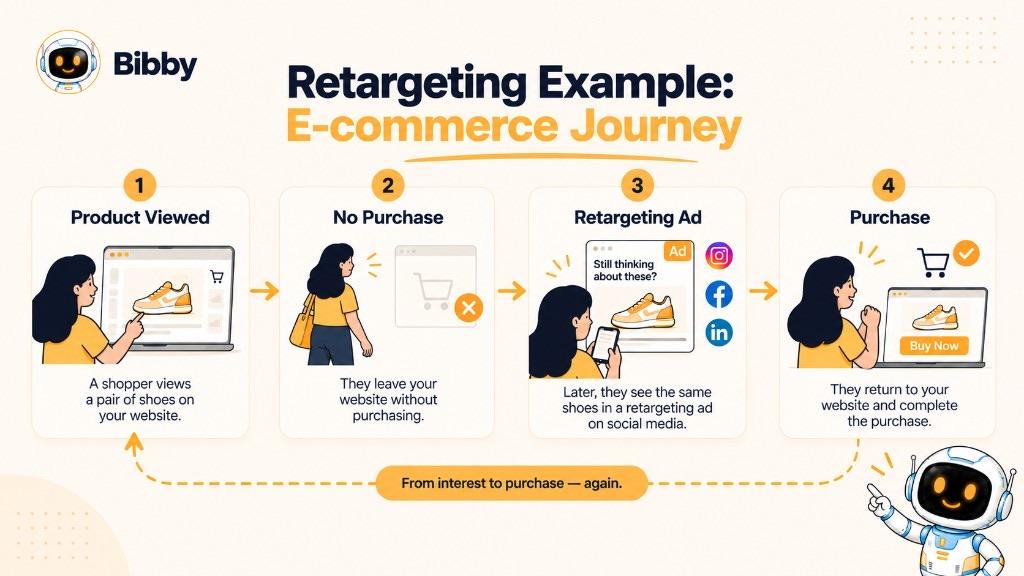
Imagine someone visits an online clothing store and searches for running shoes. They click on a particular pair, look at the product images and specifications, but leave the website without making a purchase.
Later, while browsing another website or social media platform, they see an advertisement featuring the same running shoes.
The advertisement reminds the person about a product they were already interested in and gives them an opportunity to return to the store. If they click the ad, revisit the product page, and purchase the shoes, the campaign has successfully brought a previously interested visitor back toward conversion.
The journey looks like this:
Product viewed → No purchase → Retargeting audience → Product ad → Website return → Purchase
Example of B2B Retargeting
Retargeting is also useful for business-to-business companies.
Suppose a potential customer visits a software company's website and spends time reading its pricing page. They are interested in the product but aren't ready to request a demo.
The company can use an appropriate retargeting campaign to show that visitor an advertisement highlighting a free demo, product features, customer results, or another relevant reason to return.
The objective isn't necessarily to make an immediate sale. It may be to move the prospect to the next stage of the buying journey.
The journey could look like:
Pricing page visit → No demo request → Retargeting audience → Demo-focused ad → Website return → Demo request
Example of Cart-Abandonment Retargeting
Cart abandonment is another common retargeting use case.
A customer adds several products to an online shopping cart but leaves before completing checkout. A business can create an audience for qualifying cart abandoners and use relevant advertising to encourage them to return.
For instance, the customer might later see an advertisement reminding them about the products they left behind. Depending on the campaign, the advertiser could also promote an incentive such as free shipping or a limited-time offer.
The journey becomes:
Add to cart → Leave checkout → Retargeting ad → Return to checkout → Purchase
Example of Social Media Retargeting
Retargeting can also involve people who have previously interacted with a brand through social media or other digital touchpoints supported by an advertising platform.
For example, someone watches a company's video content or interacts with its social content but doesn't visit the website or complete a conversion. Where the platform and campaign setup support the relevant audience, the business may use that engagement to build an audience for subsequent advertising.
The follow-up advertisement could introduce a product, promote a landing page, encourage a sign-up, or provide additional information.
Example of Content Retargeting
Not every retargeting campaign needs to promote a product immediately.
Imagine a person reads a blog post about social media marketing but doesn't sign up for the company's newsletter or try its software. The company could later use eligible advertising audiences to promote a related guide, webinar, free trial, or product resource.
This approach can be useful when the customer journey requires several interactions before a conversion.
Example of Retargeting for a SaaS Business
Consider a SaaS company offering social media management software.
A visitor lands on the website, explores the product features, reads about AI-powered content creation, and then leaves without starting a trial.
The company could retarget that visitor with an advertisement emphasizing the product's ability to generate content, schedule posts, manage campaigns, or simplify social media workflows.
If the visitor returns and starts a free trial, the retargeting campaign has helped move an interested prospect closer to conversion.
For a social media automation platform such as Bibby, retargeting could form part of a broader marketing strategy alongside consistently publishing organic content, educational posts, videos, carousels, and campaigns across social platforms. The ads themselves would still be built and measured in the advertising platform—not in Bibby.
Why These Examples Matter
All of these examples follow the same fundamental principle:
Someone interacts with a brand → They don't convert → They become eligible for a relevant audience → They see a follow-up advertisement → They return → They may convert.
The interaction can be different from one business to another, but the central idea remains the same. Retargeting focuses advertising efforts on people who have already demonstrated some level of interest rather than treating every user as a completely new prospect.
Types of Retargeting
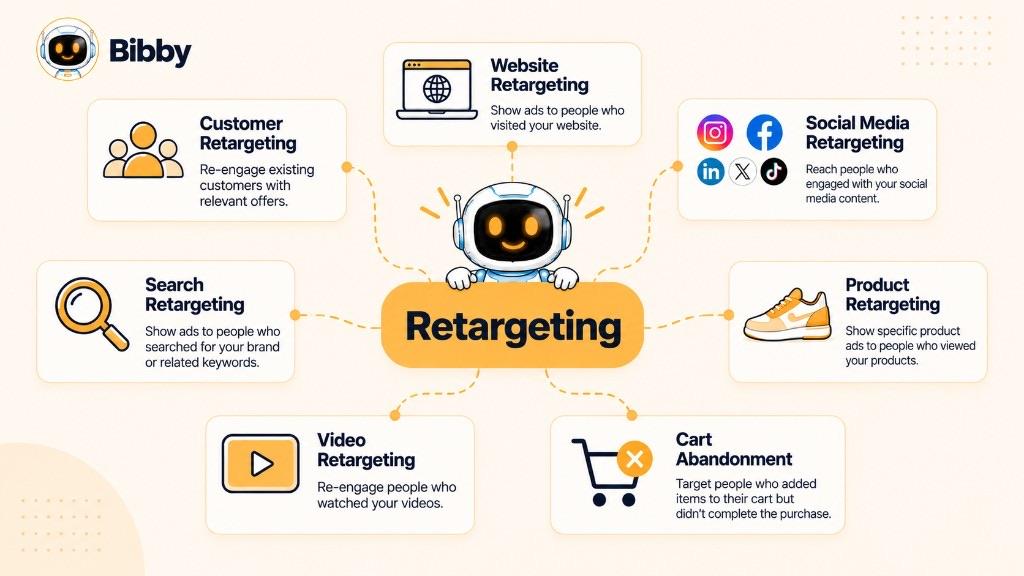
Retargeting can take several forms depending on where the previous interaction happened, what the person did, and which advertising channel is being used. Some campaigns focus on website visitors, while others target people who viewed products, abandoned a cart, watched a video, or interacted with social media content.
Understanding the different types of retargeting helps marketers choose an audience and message that match the customer's position in the buying journey.
Website Retargeting
Website retargeting targets people who have previously visited a website but did not complete a desired action.
For example, a person may visit a service page, read several sections, and leave without submitting a contact form. The business can use an eligible audience to show that visitor follow-up advertising on supported advertising networks.
Website retargeting is one of the most common forms of retargeting because a website visit provides a direct signal that someone has already encountered the brand.
Search Retargeting
Search retargeting uses advertising to reach people based on relevant search behavior or audience signals associated with their online activity.
It is important to distinguish search retargeting from traditional website retargeting. Website retargeting generally focuses on people who have already visited or interacted with a particular brand, whereas search-based targeting can be used to reach people based on relevant search intent or behavior.
For marketers, this distinction matters because previous brand interaction and general search intent are not necessarily the same signal.
Social Media Retargeting
Social media retargeting allows businesses to reconnect with audiences through social advertising platforms when those audiences meet the platform's requirements.
Depending on the platform and available data, audiences may be based on interactions such as:
- Website visits
- Social media engagement
- Video views
- Advertisement interactions
- Lead-form activity
- Other qualifying events
A business could, for example, reach people who previously interacted with its content and show them a follow-up advertisement designed to encourage a website visit or conversion.
Social media retargeting is particularly useful when a business uses social platforms as part of a larger customer acquisition and conversion strategy.
Email Retargeting
Email retargeting involves re-engaging people based on previous email interactions or customer data, although the exact implementation varies between marketing and advertising platforms.
For example, a business might identify subscribers who clicked an email about a particular product but did not purchase. The company can then use appropriate marketing or advertising channels to provide additional information or encourage the person to return.
Email-based re-engagement and paid retargeting are sometimes grouped together under the broader idea of remarketing, so the terminology can vary between marketers and platforms.
Product Retargeting
Product retargeting focuses on users who have previously viewed or interacted with specific products.
An e-commerce store can use this approach to show relevant advertisements featuring products that a visitor previously viewed. Some campaigns can also promote related products or alternatives based on the person's browsing behavior.
For example:
Product viewed → No purchase → Product retargeting ad → Product page revisit → Purchase
The goal is to reconnect the advertisement with an existing product interest rather than introducing an entirely unfamiliar product.
Cart-Abandonment Retargeting
Cart-abandonment retargeting targets people who added products to their shopping cart but did not complete checkout.
These users can represent a relatively high-intent audience because they have already taken a step beyond simply viewing a product.
A campaign might remind them about the items they left behind or provide another relevant reason to complete the purchase.
However, advertisers should consider timing and frequency carefully. Showing the same message too often can create ad fatigue and negatively affect the customer experience.
Video Retargeting
Video retargeting focuses on people who have previously watched or interacted with video content, where the relevant platform supports those audience capabilities.
For example, a company could create a follow-up campaign for people who watched a significant portion of an educational video but did not visit its website or complete another desired action.
The follow-up advertisement can build on the original content instead of starting the conversation from scratch.
Engagement-Based Retargeting
Engagement-based retargeting focuses on people who have interacted with a brand's digital content.
Depending on the platform, qualifying interactions might include:
- Clicking an advertisement
- Watching a video
- Engaging with social content
- Visiting a profile
- Interacting with a lead form
- Taking another measurable action
This type of audience can be useful for brands that receive significant engagement before users eventually convert.
Customer Retargeting
Retargeting does not have to be limited to people who have never purchased.
Existing customers can also become part of carefully designed audiences for goals such as:
- Cross-selling
- Upselling
- Promoting complementary products
- Encouraging repeat purchases
- Introducing new products
For example, a customer who purchased a laptop could later be shown an advertisement for compatible accessories.
However, customer retargeting should use a different message from campaigns designed to convert first-time visitors. A previous customer already has a relationship with the brand, so the advertising objective can be different.
Retargeting Based on Customer Journey Stage
Another useful way to categorize retargeting is by where someone is in the customer journey.
A business could create separate audiences for:
Awareness: People who interacted with content.
Consideration: People who visited product, service, or pricing pages.
High intent: People who started a checkout process or lead form.
Conversion: People who completed the desired action and should generally be excluded from acquisition-focused retargeting campaigns.
This segmentation allows marketers to create more relevant messages instead of showing the same advertisement to every previous visitor.
Choosing the Right Type of Retargeting
The best type of retargeting depends on the previous interaction and the campaign objective. A product viewer may need a product-focused message, while a pricing-page visitor may respond better to a demo or consultation offer.
The central principle is simple: the more closely the retargeting message matches the user's previous interaction and current stage in the customer journey, the more relevant the advertising experience can be.
What Are Retargeting Ads?
Retargeting ads are advertisements shown to people who have previously interacted with a brand, website, product, or other qualifying digital content but have not yet completed the desired action. Unlike ads designed primarily to reach new audiences, retargeting ads focus on reconnecting with people who already have some familiarity with the business.
The advertisement is usually designed around the person's previous interaction. Someone who viewed a product might see that product again, while someone who visited a pricing page could receive an advertisement encouraging them to request a demo.
For example, imagine a person visits an online store and looks at a pair of headphones but leaves without purchasing. Later, an advertisement featuring those headphones appears while the person is browsing a supported website or social platform. The ad is intended to bring the visitor back to the store.
Common Retargeting Ad Examples
Retargeting ads can take many forms depending on the audience, business model, and campaign objective.
Product reminder ads: Show users products they previously viewed.
Cart-abandonment ads: Remind users about products they added to their cart but didn't purchase.
Offer ads: Present an incentive, promotion, or special offer to an eligible audience.
Free-trial ads: Encourage previous website visitors to start a trial of a software product or service.
Demo ads: Invite users who showed interest in a B2B product to schedule a demonstration.
Content ads: Promote useful guides, webinars, videos, or other resources to people who previously engaged with the brand.
Related-product ads: Recommend complementary or alternative products based on previous interactions.
How Retargeting Ads Differ From Regular Ads
The primary difference is audience intent.
A conventional prospecting advertisement may target people based on demographics, interests, behaviors, keywords, contextual signals, or other audience characteristics. The person may have never interacted with the advertiser.
A retargeting ad, by contrast, is designed for an audience that has already had a qualifying interaction with the brand or its digital properties.
| Regular Prospecting Ads | Retargeting Ads |
|---|---|
| Primarily reaches potential new customers | Reaches previously engaged audiences |
| May introduce the brand for the first time | Builds on an existing interaction |
| Often focuses on awareness or acquisition | Often focuses on re-engagement or conversion |
| Can use broad targeting signals | Uses qualifying previous interactions or audience signals |
The two approaches are not competitors. Many digital advertising strategies use prospecting to attract new audiences and retargeting to re-engage people who have already shown interest.
What Makes a Retargeting Ad Effective?
A retargeting ad should provide a logical next step based on what the audience has already done.
For example, someone who only read an introductory article may not need a hard sales message. A person who visited a pricing page may be further along in the buying journey and could be ready for a demo or purchase-focused message.
Effective retargeting campaigns commonly consider:
- Relevance: The ad relates to the user's previous interaction.
- Timing: The advertisement reaches the audience at an appropriate point in the customer journey.
- Frequency: Users are not exposed to the same message excessively.
- Creative variety: Different advertisements can reduce ad fatigue.
- Clear CTA: The user understands what to do next.
- Audience segmentation: Different user behaviors receive appropriately different messages.
- Conversion tracking: The advertiser can evaluate whether the campaign is achieving its objective.
Retargeting Ads and Conversion
Retargeting ads are often used to support conversions because they focus on people who have already demonstrated some interest. However, seeing a retargeting ad does not guarantee that someone will convert.
Campaign performance depends on factors such as audience quality, creative, offer, landing-page experience, timing, frequency, competition, and the product itself.
For this reason, retargeting should be viewed as one component of a broader digital marketing strategy rather than a guaranteed shortcut to more conversions.
In simple terms, a retargeting ad is a follow-up advertisement designed to reconnect with someone who has already interacted with a brand and encourage them to take the next step.
What Is a Retargeting Audience?
A retargeting audience is a group of people who have previously interacted with a brand or its digital content and meet the criteria for receiving follow-up advertising. Instead of targeting a completely new audience, marketers use previous interactions as signals to identify people who may still be interested in a product, service, or offer.
For example, a business might create a retargeting audience containing people who visited its website during the past 30 days but did not make a purchase. The business can then show relevant advertisements to qualifying members of that audience.
The exact audience options available depend on the advertising platform, tracking setup, privacy requirements, and data available to the advertiser.
Common Retargeting Audience Segments
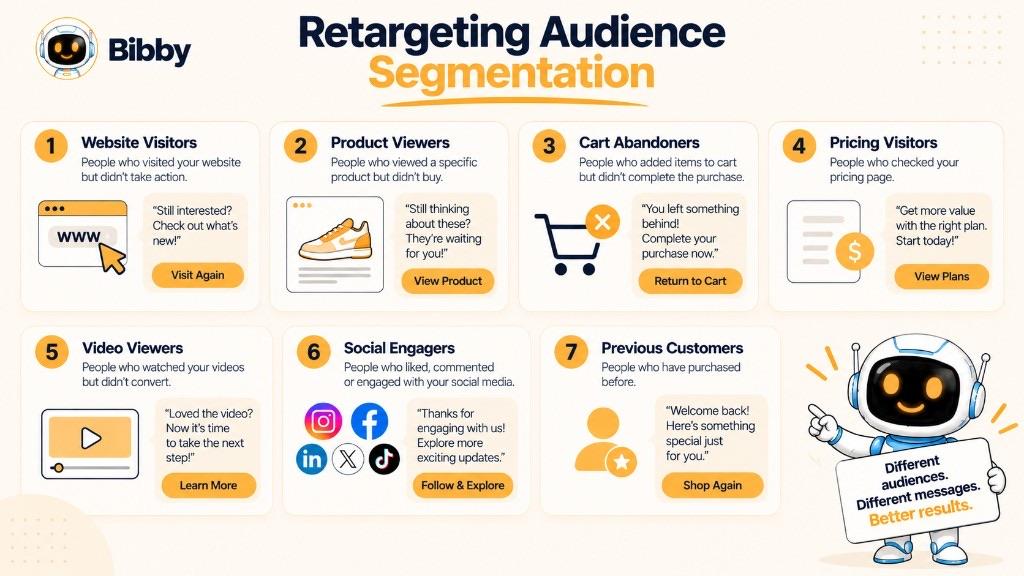
Retargeting audiences can be divided into smaller groups based on what people previously did. This segmentation allows advertisers to deliver messages that are more relevant to each audience.
#### Website Visitors
This audience includes people who previously visited a website but did not complete the desired action.
A business could further divide website visitors based on the pages they viewed, how recently they visited, or other available signals.
#### Product Viewers
Product viewers have visited or interacted with specific product pages.
For an e-commerce business, this audience can be particularly useful because the advertisement can focus on products the person has already demonstrated interest in.
#### Cart Abandoners
Cart abandoners are people who added products to a shopping cart but did not complete the purchase.
Because these users have already taken a high-intent action, advertisers may create a dedicated audience and use messaging designed to encourage them to return.
#### Pricing-Page Visitors
For SaaS and B2B businesses, pricing-page visitors can represent an audience with stronger commercial intent.
A company could create follow-up advertising focused on a free trial, product demonstration, consultation, or another appropriate next step.
#### Lead-Form Visitors
Businesses can create audiences around people who interacted with lead-generation experiences but did not complete the process.
The follow-up message can address potential friction or provide additional information that helps the person continue their journey.
#### Video Viewers
Video engagement can provide another audience signal where the advertising platform supports it.
For example, marketers might create separate audiences based on people who watched a particular percentage of a video and then use a follow-up advertisement to move them toward another action.
#### Social Media Engagers
People who interact with a brand's social media content may also qualify for certain retargeting audiences, depending on the platform and available audience features.
Interactions can include actions such as viewing content, engaging with a post, watching a video, or interacting with an advertisement.
#### Previous Customers
Existing customers can also be used in carefully designed audience strategies.
Instead of trying to convince them to make their first purchase, a campaign could promote complementary products, new releases, upgrades, or repeat purchases.
Why Retargeting Audience Segmentation Matters
Not every person who interacts with a brand has the same level of intent.
Someone who visits a homepage for a few seconds is different from someone who spends several minutes comparing products. A product viewer is different from a cart abandoner, and a first-time visitor is different from an existing customer.
Treating all of these people as one audience can result in generic advertising.
Segmentation allows marketers to create different campaigns for different behaviors. For example:
Homepage visitor → Educational message
Product viewer → Product-focused message
Pricing-page visitor → Demo or trial message
Cart abandoner → Purchase reminder
Existing customer → Cross-sell or repeat-purchase message
This approach can make retargeting campaigns more relevant and reduce the risk of showing users advertisements that do not match their current stage in the customer journey.
Retargeting Audience Duration
Retargeting audiences can also be organized by how recently someone interacted with the brand.
A marketer might separate users into groups such as:
- Recently visited
- Visited within the past few weeks
- Visited within the past few months
- Previously purchased
The appropriate timeframe depends on the product, buying cycle, audience, and advertising platform.
A person shopping for an inexpensive consumer product may make a decision quickly, while someone evaluating enterprise software may need weeks or months. Therefore, there is no universal retargeting audience duration that works for every business.
Excluding Converted Users
Audience exclusions are an important part of retargeting.
If someone has already completed the desired action, continuing to show them an advertisement designed specifically for non-converters may waste budget and create a poor customer experience.
For example, after someone purchases a product, the advertiser might remove them from a campaign designed to drive that first purchase and place them into a separate customer audience.
This creates a more structured advertising journey:
Visitor → Interested prospect → High-intent prospect → Customer → Existing customer
Retargeting Audience vs. Target Audience
A target audience is the broader group of people a business wants to reach with its marketing.
A retargeting audience is a more specific group consisting of people who have already had a qualifying interaction with the brand or its digital properties.
For example, a company's target audience might be small-business owners interested in social media marketing. Its retargeting audience could be small-business owners from that broader market who have already visited the company's website.
In simple terms, a retargeting audience is a previously engaged segment of a broader target market.
What Is Social Media Retargeting?
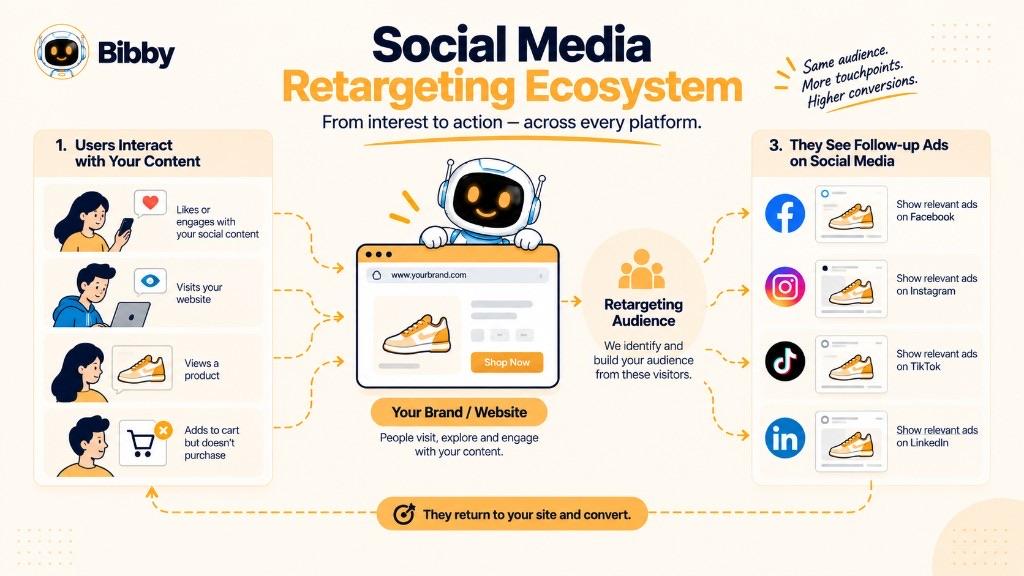
Social media retargeting is the practice of showing follow-up advertisements on social media platforms to people who have previously interacted with a brand, its website, advertisements, or social content and meet the requirements for a retargeting audience.
Instead of using social media advertising only to reach new potential customers, businesses can use retargeting to reconnect with people who already know something about the brand. The objective may be to encourage a purchase, generate a lead, start a free trial, request a demo, visit a website, or complete another desired action.
For example, someone might visit a company's website after seeing an Instagram post but leave without signing up. If the business has the appropriate audience and tracking setup, that person may later be eligible to see a follow-up advertisement on a supported social media platform.
How Social Media Retargeting Works
The basic process is:
User interaction → Audience signal → Retargeting audience → Social media ad → Return visit → Conversion
A business first identifies an interaction that can be used to build an eligible audience. Depending on the platform and its available features, this could involve a website visit, advertisement interaction, video engagement, social media interaction, or another measurable event.
The business then creates an appropriate audience and designs an advertisement based on the user's previous interaction.
When eligible members of that audience use the relevant social platform, they may be shown the retargeting advertisement.
Facebook and Instagram Retargeting
Facebook and Instagram are commonly used for social advertising and can support retargeting strategies through the audience and advertising capabilities available within Meta's ecosystem.
A business might create audiences around qualifying website visitors, customer actions, or interactions with its content and then use appropriate advertisements to reconnect with those users.
For example, an online retailer could retarget people who viewed a product but didn't purchase it. The follow-up advertisement could highlight the product, a related product, or another relevant offer.
The exact audience capabilities and tracking options can change over time, so advertisers should follow the current requirements and policies of the platform they use.
TikTok Retargeting
TikTok can also be incorporated into retargeting strategies where its available advertising and audience features support the desired campaign.
A business might use qualifying website activity or interactions with TikTok content to create an audience for a subsequent advertising campaign.
For example, someone who interacted with a brand's video could later receive an advertisement encouraging them to explore the company's website or a particular product.
The goal is to continue an existing customer journey rather than introduce the brand to a completely unfamiliar person.
LinkedIn Retargeting
LinkedIn retargeting can be useful for B2B businesses that want to reconnect with professional audiences who have previously interacted with their digital properties or advertising campaigns.
For example, a software company could reach eligible website visitors with follow-up advertising promoting a product demonstration, downloadable resource, consultation, or free trial.
B2B purchasing decisions can involve multiple interactions, making retargeting useful as part of a longer customer journey.
Social Media Retargeting vs. Organic Social Media
Social media retargeting should not be confused with ordinary organic social media marketing.
Organic social media involves publishing content that audiences can discover and engage with without paying for each individual ad impression.
Social media retargeting is a paid advertising strategy that uses eligible audience signals to show advertisements to previously engaged users.
The two can work together.
For example, a company might publish educational content organically to build awareness, use social media automation to maintain a consistent publishing schedule, and then use paid retargeting campaigns to reconnect with eligible users who have demonstrated stronger interest.
Retargeting and Social Media Automation
Social media automation and retargeting serve different purposes but can fit into the same broader marketing strategy.
A social media automation platform such as Bibby can help businesses create and schedule social media content across platforms, generate captions, organize campaigns, maintain brand assets, and manage publishing workflows. This can help keep a brand's organic social presence active while paid advertising campaigns handle specific audience and conversion objectives.
For example, a business could use Bibby to consistently publish educational posts, videos, carousels, and other social content, while separately using its advertising platform to retarget eligible users who have interacted with the brand.
The distinction is important:
Bibby and social media automation → Create, manage, and schedule social content
Retargeting → Re-engage eligible audiences through advertising
Using both as complementary parts of a marketing strategy can help connect content, audience engagement, and paid acquisition.
Why Social Media Retargeting Matters
Social media users often interact with a brand without converting immediately. They may watch a video, visit a website, compare products, save an idea, or simply postpone their decision.
Social media retargeting gives businesses another opportunity to reach eligible users after that initial interaction.
However, retargeting is not automatically effective simply because an audience has interacted with a brand. Campaign performance depends on factors such as audience quality, relevance, creative, timing, frequency, offer, landing-page experience, and measurement.
The most effective approach is usually to treat retargeting as part of the broader customer journey rather than as a standalone advertising tactic.
Retargeting vs. Remarketing
Retargeting and remarketing are closely related digital marketing concepts, and the terms are sometimes used interchangeably. Both involve reconnecting with people who have already interacted with a business rather than focusing exclusively on completely new prospects.
The main difference is often how the terms are used. Retargeting commonly refers to paid advertising shown to previously engaged audiences, while remarketing is often used as a broader term for re-engaging existing prospects or customers through channels such as email, advertising, and customer databases.
However, there is no universal industry rule that separates the two terms perfectly. Different advertising platforms and marketers may use them differently.
Retargeting vs. Remarketing: Key Differences
| Retargeting | Remarketing |
|---|---|
| Commonly associated with paid advertising | Often used as a broader customer re-engagement term |
| Frequently focuses on showing ads to previously engaged users | Can involve email, CRM-based communication, advertising, and other channels |
| Often uses audience and behavioral signals | Can use customer lists, previous interactions, and relationship data |
| Common goal is to bring potential customers back | Can focus on re-engagement, retention, repeat purchases, or conversion |
| Frequently discussed in the context of digital ad platforms | Can cover multiple marketing channels |
What Is Retargeting?
Retargeting generally means using advertising to reconnect with people who have previously interacted with a brand.
For example, a person visits an online store, views a product, and leaves without purchasing. The business can create an eligible audience of previous visitors and show relevant advertisements to qualifying users later.
The focus is often on paid advertising and audience re-engagement.
What Is Remarketing?
Remarketing generally refers to efforts to reconnect with people who already have a relationship or previous interaction with a business.
This can include:
- Email follow-ups
- Customer re-engagement
- Product recommendations
- Promotional messages
- Paid advertising
- Communications based on customer data
For example, a business could send an email to a customer who previously purchased a product and recommend a complementary product. That is commonly described as remarketing.
Is Retargeting the Same as Remarketing?
Not always, but there is significant overlap.
In everyday digital marketing discussions, many marketers use retargeting and remarketing to describe essentially the same activity: reaching people who have already interacted with a brand.
A more specific distinction is sometimes made between the two:
Retargeting = primarily paid advertising to previously engaged audiences
Remarketing = broader re-engagement across advertising, email, CRM, and other channels
Neither definition should be treated as an absolute rule because terminology varies between companies, marketers, and platforms.
Retargeting and Remarketing Example
Consider an online software company whose visitor reads its pricing page but does not sign up.
The company could use retargeting to show that visitor a paid advertisement encouraging them to start a free trial.
The company could also use remarketing more broadly by sending an eligible email, offering educational content, or following up through another customer communication channel.
Both strategies are based on the same underlying idea: the person has already interacted with the business, so the next marketing message can build on that existing relationship.
Retargeting vs. Remarketing vs. Prospecting
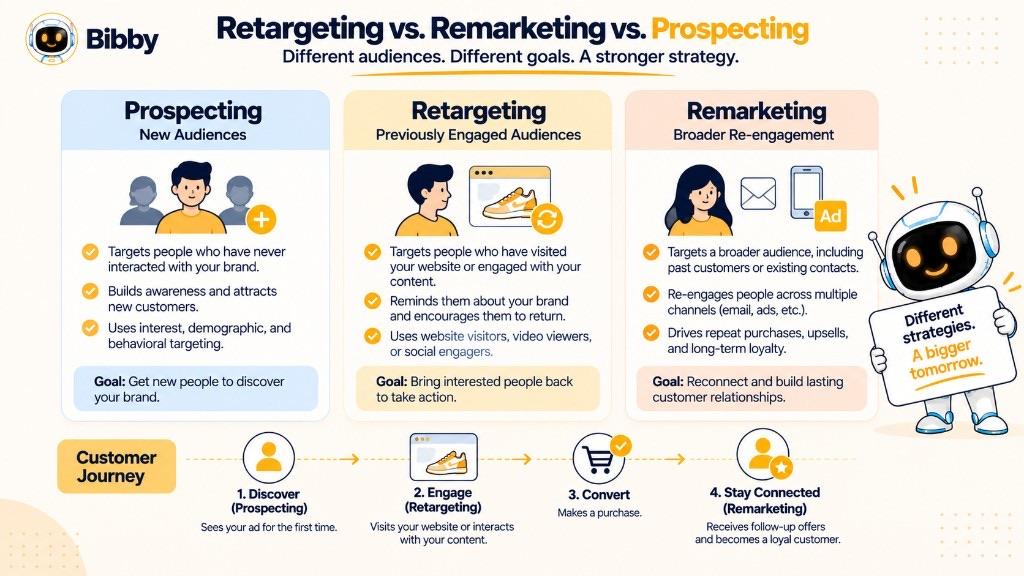
These concepts become easier to understand when compared with prospecting.
Prospecting: Reach people who may be interested but have not necessarily interacted with the brand.
Retargeting: Re-engage people who have previously interacted with the brand through paid advertising.
Remarketing: Re-engage previous prospects or customers through advertising and other marketing channels.
A complete digital marketing strategy can use all three.
Prospecting → New audience
Retargeting → Previously engaged audience
Remarketing → Existing relationship
Why the Difference Matters
Understanding the terminology helps marketers communicate their strategy more precisely.
Someone who has never heard of a business may need an awareness-focused advertisement. Someone who viewed a product may need a reminder or additional information. An existing customer may be better suited to an upsell, cross-sell, or repeat-purchase campaign.
The more clearly a business understands these audience relationships, the easier it becomes to create relevant marketing messages.
In simple terms, retargeting is usually associated with paid ads aimed at previously engaged users, while remarketing is a broader concept that can include multiple ways of re-engaging existing prospects and customers. The terms overlap, and their exact meanings can vary by context.
How to Create a Retargeting Strategy
A retargeting strategy is a structured plan for reconnecting with people who have already interacted with a brand and encouraging them to take a relevant next step. A good strategy does more than repeatedly show the same advertisement. It considers the user's previous behavior, stage in the customer journey, advertising message, timing, and conversion goal.
Here is a practical framework for creating a retargeting strategy.
1. Define the Conversion Goal
Start by deciding what you want the retargeting campaign to accomplish.
The goal could be:
- Generate a purchase
- Recover abandoned carts
- Generate leads
- Increase demo requests
- Encourage free-trial signups
- Promote a subscription
- Drive another website action
- Encourage repeat purchases
The conversion goal determines which audiences you should build and what message your advertisements should communicate.
2. Identify High-Intent Audiences
Not every previous visitor has the same level of interest.
A person who briefly visited your homepage may have less purchase intent than someone who viewed a product several times, visited the pricing page, or started checkout.
Identify the interactions that indicate stronger intent and prioritize those audiences where appropriate.
For example:
Homepage visitor → Lower intent
Product viewer → Moderate intent
Pricing-page visitor → Higher intent
Cart abandoner → Very high purchase intent
The exact intent level varies by business, but this framework can help marketers think beyond treating every visitor as one audience.
3. Segment Your Audience
Create separate audience groups based on meaningful differences in user behavior.
For example, an e-commerce company might create:
- Product viewers
- Cart abandoners
- Recent website visitors
- Previous customers
A SaaS company might use:
- Blog readers
- Feature-page visitors
- Pricing-page visitors
- Trial abandoners
- Existing customers
Audience segmentation allows each group to receive a message that better matches its previous interaction.
4. Create Relevant Ad Creative
Retargeting advertisements should give people a reason to continue their journey.
The creative might include:
- A product they previously viewed
- A key product benefit
- Customer testimonials
- Educational information
- A free trial
- A demo invitation
- A relevant promotion
- A complementary product
For example, someone who viewed a specific product could receive an advertisement focused on that product rather than a generic advertisement introducing the entire brand.
5. Match the Message to the Customer Journey
The advertisement should reflect what the audience already knows.
Someone who has only interacted with educational content may need more information before receiving a strong purchase message. Someone who has reached checkout may need a much more direct reminder.
A useful progression could be:
Content interaction → Educational message
Product interaction → Product-focused message
Pricing interaction → Trial or demo message
Checkout interaction → Purchase reminder
The goal is to move the person naturally toward the next stage instead of repeatedly asking for the same action.
6. Set Frequency and Budget Controls
Retargeting can become counterproductive if people see the same advertisement too frequently.
Set appropriate campaign controls around:
- Budget
- Audience size
- Ad frequency
- Campaign duration
- Audience membership duration
- Creative rotation
The appropriate settings depend on the business, advertising platform, product, and buying cycle.
For products with a short purchase cycle, a shorter retargeting window may make sense. For expensive products or B2B services, customers may require considerably more time to make a decision.
7. Exclude People Who Already Converted
Conversion exclusions are an important part of a retargeting strategy.
If someone has already completed the desired action, continuing to show them an advertisement designed to generate that same conversion can waste advertising budget.
For example, after a customer purchases a product, they could be excluded from a first-purchase campaign and placed into a separate audience for cross-selling or repeat purchases.
This creates a cleaner customer journey:
Prospect → High-intent visitor → Converter → Customer
8. Measure Campaign Performance
Use relevant performance metrics to understand whether the campaign is achieving its objective.
Common metrics include:
- Click-through rate (CTR)
- Conversion rate
- Cost per acquisition (CPA)
- Return on ad spend (ROAS)
- Cost per click (CPC)
- Conversion volume
- Revenue
- Frequency
Don't evaluate a retargeting campaign using clicks alone. A campaign can generate a high CTR without producing meaningful business results.
The most important metrics should ultimately connect the advertising activity to the campaign's original conversion goal.
9. Test and Optimize
Retargeting should be treated as an ongoing optimization process.
Test different variables such as:
- Ad creative
- Headlines
- Calls to action
- Offers
- Audience segments
- Landing pages
- Retargeting windows
- Frequency
- Ad formats
For example, an e-commerce business could compare a product reminder against an advertisement highlighting a limited-time offer. A SaaS company could compare a feature-focused message against a free-trial message.
Use the results to determine which combinations produce better outcomes rather than assuming one approach will work for every audience. A/B testing can help compare those combinations in the ads platform.
Build Retargeting Around the Customer Journey
The strongest retargeting strategies are usually connected to the broader customer journey rather than operating as isolated advertising campaigns.
A simple framework is:
Attract → Engage → Retarget → Convert → Retain
Organic content, paid prospecting, social media, email, website experiences, and retargeting can all contribute to different stages of this journey.
For businesses using social media as part of their acquisition strategy, consistent publishing can also help create more opportunities for people to discover and interact with the brand. Tools such as Bibby can help manage the content side of that workflow by creating and scheduling posts, captions, campaigns, and other social media content across supported platforms.
Retargeting then serves a different role: reconnecting with eligible audiences through advertising based on their previous interactions.
Ultimately, a good retargeting strategy is not about showing more ads to the same people. It is about showing the right message to the right previously engaged audience at the right stage of the customer journey.
Benefits of Retargeting
Retargeting can help businesses reconnect with people who have already demonstrated interest in their products, services, or content. Because these audiences have had a previous interaction with the brand, retargeting can provide a more focused approach than advertising exclusively to people who have never encountered the business.
However, retargeting is not a guaranteed way to increase sales or reduce advertising costs. Its effectiveness depends on factors such as audience quality, campaign setup, creative, timing, frequency, offer, landing-page experience, and the overall customer journey.
Reaches Warm Audiences
One of the main benefits of retargeting is its ability to reach audiences that already know the brand.
A previous website visit, product view, content interaction, or other qualifying action can indicate that a person has already developed some awareness or interest.
This gives advertisers an opportunity to continue the conversation rather than starting from zero with every impression.
Keeps Your Brand Top of Mind
Potential customers often do not convert during their first interaction with a business. They may be researching alternatives, comparing prices, waiting for the right time to purchase, or simply become distracted.
Retargeting can help keep a brand visible during this decision-making period.
For example, someone researching project-management software may visit several websites before choosing a product. A relevant retargeting campaign can help a business remain part of that person's consideration process.
Improves Ad Relevance
Retargeting can use previous interactions to create more contextually relevant advertising.
Instead of showing the same generic advertisement to everyone, marketers can create different messages for different audience segments.
For example:
Product viewer → Product-focused advertisement
Cart abandoner → Purchase reminder
Pricing-page visitor → Demo or trial message
Existing customer → Complementary product
Greater relevance can make the advertising experience more aligned with what the user has already shown interest in.
Supports Conversions
Retargeting is often used to encourage people to complete an action they previously considered but did not finish.
Depending on the business, this could mean:
- Completing a purchase
- Requesting a demo
- Starting a free trial
- Submitting a lead form
- Registering for an event
- Completing an application
- Subscribing to a service
The strategy is particularly useful when customers require multiple interactions before making a decision.
Helps Recover Lost Opportunities
A large percentage of website visitors leave without converting. Retargeting provides a way to reconnect with eligible visitors after they leave.
For e-commerce businesses, this could include people who viewed products or abandoned their carts.
For service businesses, it could involve people who visited a service page but did not submit an inquiry.
For SaaS companies, it could include visitors who explored product or pricing pages without starting a trial.
Retargeting does not guarantee that these users will return, but it creates another opportunity to reach them.
Can Improve Advertising Efficiency
Because retargeting focuses on previously engaged audiences, it can sometimes be more efficient than broad acquisition campaigns.
However, this should not be interpreted as a universal rule. Retargeting audiences are often smaller than prospecting audiences, and campaign performance can vary significantly.
A business should evaluate efficiency using meaningful metrics such as conversion rate, cost per acquisition, revenue, and return on ad spend rather than assuming that a retargeting campaign is successful simply because it receives clicks.
Supports Different Stages of the Customer Journey
Retargeting can be adapted to different stages of the buying process.
A person who has only consumed educational content may need additional information, while someone who has viewed a pricing page may be closer to making a decision.
This allows businesses to build campaigns around different levels of intent.
For example:
Awareness → Educational content
Consideration → Product or service information
High intent → Trial, demo, or purchase message
Existing customer → Upsell, cross-sell, or repeat-purchase message
This makes retargeting more flexible than using one advertisement for every previously engaged user.
Enables Audience Segmentation
Retargeting campaigns can divide users into meaningful groups based on their previous behavior.
Segmentation can help advertisers distinguish between:
- Recent and older visitors
- Product viewers and cart abandoners
- New prospects and existing customers
- High-intent and low-intent visitors
- Different products or service interests
These distinctions can help marketers create more relevant campaigns and allocate budgets more deliberately.
Helps Connect Marketing Channels
Retargeting can also work alongside other marketing activities.
A business might attract a new audience through search, social media, content marketing, or paid advertising. Once people interact with the brand, retargeting can become part of the next stage of the customer journey.
For businesses that rely heavily on social media, consistent organic content can support awareness and engagement while paid retargeting campaigns focus on eligible audiences with specific conversion goals.
Social media automation platforms such as Bibby can support the organic side of this workflow by helping businesses create, manage, and schedule content across supported social platforms. Retargeting, meanwhile, remains a paid advertising activity handled through the relevant advertising platform.
Provides Opportunities for More Personalized Messaging
Retargeting allows businesses to tailor advertising messages based on previous interactions.
A visitor who looked at one product can receive a different message from someone who browsed several categories. A previous customer can receive an advertisement for a complementary product rather than an advertisement asking them to make their first purchase.
This level of segmentation can make campaigns more purposeful and reduce the need for one-size-fits-all advertising.
Key Takeaway
The central benefit of retargeting is re-engagement. It gives businesses another opportunity to reach people who have already shown interest and guide them toward an appropriate next action.
When combined with accurate audience segmentation, relevant creative, sensible frequency controls, and reliable measurement, retargeting can become a useful component of a broader digital advertising strategy.
Challenges of Retargeting
Retargeting can be an effective way to reconnect with previously engaged audiences, but it also comes with limitations. A campaign can perform poorly when the audience is too small, advertisements are shown too frequently, tracking is incomplete, or the message does not match the user's stage in the customer journey.
Understanding these challenges is important because retargeting is not simply a matter of showing an advertisement to everyone who has visited a website.
Small Audience Sizes
Retargeting depends on people having a previous interaction with the brand or meeting another qualifying audience condition. As a result, a new or low-traffic business may not have enough users to create a large retargeting audience.
A small audience can limit campaign reach and make it difficult to gather enough data for meaningful optimization.
This is one reason businesses often combine retargeting with prospecting and other customer-acquisition strategies.
Ad Fatigue
One of the most common problems with retargeting is ad fatigue.
Because retargeting audiences are often smaller than prospecting audiences, the same users may see an advertisement repeatedly. Over time, the creative can become less effective or annoying.
Ad fatigue can be reduced by:
- Rotating creative
- Testing different messages
- Controlling frequency
- Refreshing advertisements
- Segmenting audiences
- Adjusting campaign duration
The objective is to remain visible without overwhelming the audience.
Overexposure
Retargeting can become counterproductive when a user sees an advertisement far more often than necessary.
For example, someone who viewed a product once may continue seeing the same advertisement long after they have lost interest. Excessive exposure can create a poor customer experience and consume advertising budget without producing additional value.
Frequency controls and audience-duration settings can help manage this problem.
Privacy and Data Restrictions
Retargeting relies on information about previous user interactions, which makes privacy an important consideration.
Changes in privacy regulations, browser behavior, consent requirements, platform policies, and tracking technologies can affect how audiences are created and measured.
Advertisers need to understand the requirements of the markets and platforms in which they operate and use data in accordance with applicable rules.
Tracking Limitations
Modern advertising environments can make tracking less complete than it once was.
Users may reject cookies or tracking permissions, browsers may restrict certain tracking technologies, devices can fragment the customer journey, and advertising platforms may have different measurement capabilities.
As a result, an advertiser's retargeting audience may not represent every person who actually interacted with the business.
Poor Audience Segmentation
Treating every previous visitor as the same audience can reduce the relevance of a retargeting campaign.
Consider the difference between:
- Someone who briefly visited the homepage
- Someone who viewed a product
- Someone who visited the pricing page
- Someone who started checkout
- Someone who already purchased
Showing all of these people the same advertisement ignores important differences in intent.
Better segmentation allows marketers to adapt the message to the user's previous behavior.
Irrelevant Advertising
Retargeting is only useful when the advertisement makes sense for the audience.
Suppose someone visited a product page because they were researching an item but later decided that it wasn't suitable for them. Showing that same product repeatedly may not encourage conversion.
Retargeting creative should therefore consider the user's likely needs rather than simply repeating the last thing they viewed.
Outdated Messaging
Timing matters in retargeting.
A person may have interacted with a business weeks or months ago. If the advertisement still promotes an outdated price, discontinued product, expired promotion, or old campaign message, it can damage the customer's experience.
Advertisers should regularly review their creative and audience settings to ensure that campaigns remain current.
Attribution Challenges
It can be difficult to determine exactly how much credit a retargeting advertisement deserves for a conversion.
A person who sees a retargeting ad may have already intended to purchase. They might also interact with organic social content, search for the brand, receive an email, or visit the website directly before converting.
If the retargeting advertisement receives attribution for the conversion, that does not necessarily mean the advertisement caused the entire outcome.
This is why marketers should look beyond basic attribution reports when evaluating campaign performance and consider broader measurement approaches where appropriate.
Rising Advertising Costs
Retargeting does not guarantee low advertising costs.
Competition for advertising inventory, audience size, campaign quality, industry economics, creative performance, and platform dynamics can all affect costs.
A small audience can also create challenges. If several advertisers compete for the same high-intent users, the cost of reaching those users may increase.
Audience Overlap
A person can belong to multiple audiences simultaneously.
For example, the same user might be:
- A website visitor
- A product viewer
- A video viewer
- A social media engager
- A cart abandoner
Without careful campaign organization, multiple campaigns may compete for the same person or deliver overlapping messages.
Audience exclusions and clear campaign structures can help reduce unnecessary overlap.
Retargeting Does Not Replace Good Marketing
Perhaps the most important limitation is that retargeting cannot fix fundamental problems elsewhere in the customer journey.
If a product is poorly positioned, the landing page is confusing, the checkout process is difficult, or the offer is not compelling, repeatedly showing advertisements to the same users may not solve the underlying problem.
Retargeting works best when it supports a strong overall marketing experience.
A useful way to think about it is:
Good product + Relevant message + Strong landing page + Appropriate audience + Effective retargeting = Better opportunity for conversion
Retargeting is a tool for re-engagement, not a substitute for product quality, customer experience, or a well-designed marketing strategy.
Retargeting Best Practices
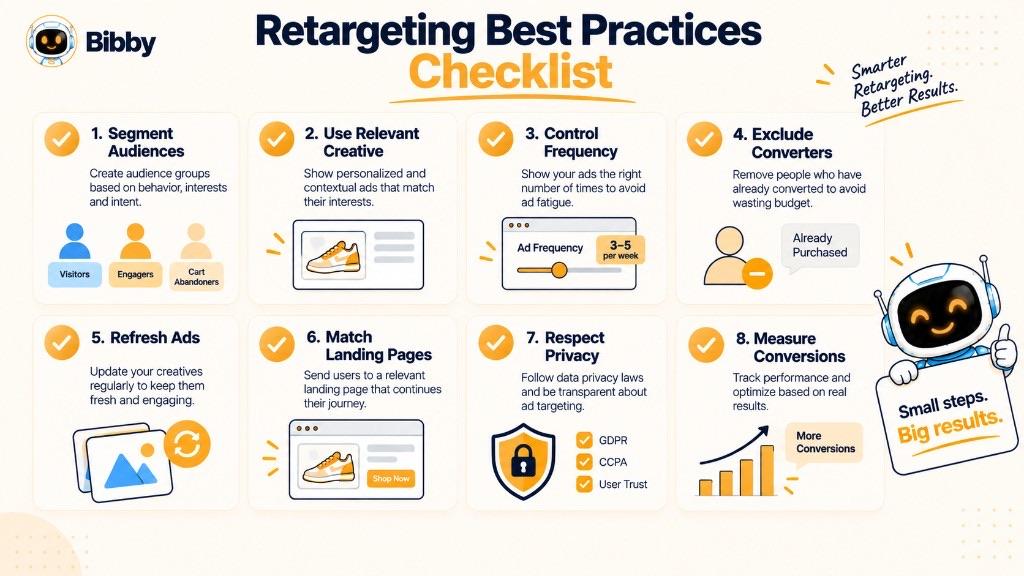
A successful retargeting campaign requires more than identifying previous website visitors and showing them advertisements. The best campaigns use relevant audience segments, appropriate messaging, sensible frequency limits, and continuous measurement.
The following retargeting best practices can help businesses build campaigns that are more relevant and easier to manage.
Segment Your Audiences
Avoid treating every previous visitor as one audience.
Separate users according to meaningful interactions, such as:
- Website visitors
- Product viewers
- Cart abandoners
- Pricing-page visitors
- Lead-form users
- Video viewers
- Previous customers
Different behaviors can indicate different levels of intent, so each audience may require a different message.
Use Relevant Creative
Retargeting advertisements should reflect what the audience already knows about your brand.
If someone viewed a specific product, showing that product again may make sense. If someone visited a pricing page, a message about a free trial, consultation, or product demonstration may be more appropriate.
The advertisement should feel like the next step in the conversation, not a completely unrelated sales pitch.
Match the Ad to the Customer Journey
Consider what the user has already done before deciding what to show next.
Someone who has only read an educational article may need more information. Someone who has visited a product page may be ready for a stronger commercial message. Someone who abandoned checkout may need a reminder to complete the purchase.
A simple framework is:
Content interaction → Educational message
Product interaction → Product message
High-intent action → Conversion-focused message
Control Ad Frequency
Showing the same advertisement too many times can cause ad fatigue and negatively affect the user experience.
Monitor how frequently people see your advertisements and adjust campaign settings when exposure becomes excessive.
Frequency should be considered alongside the product's buying cycle. A person purchasing an inexpensive product may need a shorter decision period than someone evaluating an expensive B2B service.
Refresh Your Creative
Even a strong advertisement can lose effectiveness when an audience sees it repeatedly.
Regularly test new:
- Images
- Videos
- Headlines
- Offers
- Calls to action
- Value propositions
Creative rotation can help maintain audience attention and give marketers more information about which messages resonate with different segments.
Exclude Recent Converters
Once someone completes the desired conversion, consider excluding them from campaigns designed to generate that same conversion.
For example, someone who has purchased a product does not generally need to continue seeing advertisements telling them to make their first purchase.
Instead, they could enter a separate customer campaign promoting:
- Complementary products
- Upgrades
- New products
- Repeat purchases
- Loyalty offers
This can make the overall advertising journey more logical.
Use Appropriate Retargeting Windows
The amount of time someone remains in a retargeting audience should reflect the business and buying cycle.
A consumer buying a low-cost product may make a decision within days, while an enterprise software purchase could involve weeks or months of research.
Consider factors such as:
- Product price
- Purchase frequency
- Sales-cycle length
- Audience intent
- Previous interaction
- Campaign objective
There is no single retargeting window that is ideal for every business.
Align Landing Pages With Ads
The experience should remain consistent after someone clicks a retargeting advertisement.
If the advertisement promotes a specific product, the landing page should make it easy to find and evaluate that product. If the advertisement promotes a demo, the landing experience should make requesting the demo straightforward.
A disconnect between advertisement and landing page can create unnecessary friction.
Test Different Offers
Different audience segments may respond to different incentives.
Depending on the business, advertisers might test:
- Free trials
- Product demonstrations
- Discounts
- Free shipping
- Educational resources
- Consultations
- Product comparisons
- Limited-time promotions
However, an incentive should be used because it supports the marketing objective, not simply because it makes the advertisement more attractive.
Respect Privacy and Platform Requirements
Retargeting involves audience and behavioral data, so privacy should be part of campaign planning.
Businesses should understand the applicable privacy requirements, consent expectations, data-use rules, and advertising policies for the markets and platforms they operate on.
Tracking capabilities can also vary between browsers, devices, regions, and advertising platforms, so advertisers should avoid assuming that every previous interaction will be available for retargeting.
Monitor Performance Beyond Clicks
Clicks can provide useful information, but they are not the ultimate measure of a retargeting campaign.
Monitor metrics that connect the campaign to its actual objective, such as:
- Conversions
- Conversion rate
- Cost per acquisition
- Revenue
- Return on ad spend
- Qualified leads
- Trial signups
A campaign with many clicks but few meaningful conversions may not be delivering the desired business outcome.
Test Incrementality Where Possible
Retargeting audiences can already have a high level of intent. Some people may have converted even without seeing the advertisement.
For that reason, marketers should be careful when interpreting attribution data.
Where resources and campaign conditions allow, experiments such as holdout or control groups can provide additional insight into whether retargeting is generating incremental conversions rather than simply receiving credit for conversions that would have happened anyway.
Coordinate Retargeting With Other Marketing Activities
Retargeting should fit into the broader marketing strategy.
A business might use:
Organic content → Build awareness
Prospecting → Reach new audiences
Retargeting → Re-engage previous visitors
Email or CRM marketing → Continue customer communication
Conversion campaigns → Generate the desired action
For businesses that rely on social media, consistent organic publishing can support the awareness and engagement stages. A platform such as Bibby can help manage that content workflow by creating and scheduling posts, captions, campaigns, and other social media content across supported platforms.
Bibby's role is different from paid retargeting. Social media automation helps businesses consistently publish and manage content, while retargeting uses advertising to reconnect with eligible previously engaged audiences.
Review and Optimize Regularly
Retargeting campaigns should not simply be launched and forgotten.
Review performance regularly and look for:
- Audience segments that perform differently
- Creative that is losing effectiveness
- Excessive frequency
- Poor-performing placements
- Conversion trends
- Changes in acquisition costs
- Audience overlap
- Opportunities for new tests
The goal is continuous improvement rather than assuming that one campaign structure will work indefinitely.
Key Takeaway
The strongest retargeting campaigns focus on relevance rather than repetition.
Segment audiences based on meaningful behavior, show appropriate messages, control frequency, exclude converters when necessary, maintain fresh creative, respect privacy requirements, and measure actual business outcomes.
Retargeting works best when it feels like a logical continuation of the customer's journey rather than an advertisement following the user around the internet.
How Is Retargeting Measured?
Retargeting campaigns are measured by evaluating whether they achieve their intended business objectives. Depending on the campaign, the goal might be generating purchases, leads, free-trial signups, demo requests, registrations, or another conversion.
Common advertising metrics such as clicks and impressions can show how users interact with an advertisement, but they do not tell the complete story. A strong measurement approach connects advertising activity with meaningful outcomes. Those reports live in the advertising platform—not in Bibby.
Click-Through Rate (CTR)
Click-through rate (CTR) measures the percentage of ad impressions that result in clicks.
A higher CTR can indicate that an advertisement is attracting attention or that its message is relevant to the audience. However, CTR alone does not demonstrate that a retargeting campaign is generating valuable conversions.
For example, an advertisement may receive many clicks but produce very few purchases or leads.
Conversion Rate
Conversion rate measures the percentage of users who complete a desired action after interacting with the campaign or reaching the relevant conversion experience.
Depending on the business, a conversion might be:
- A purchase
- Lead submission
- Demo request
- Free-trial signup
- Registration
- Subscription
- Booking
Conversion rate is particularly useful when evaluating whether retargeting audiences are taking the action the campaign was designed to encourage.
Cost Per Acquisition (CPA)
Cost per acquisition (CPA) measures how much advertising spend is associated with acquiring a conversion.
A lower CPA can indicate greater efficiency, but it should always be considered alongside conversion quality and customer value.
For example, generating inexpensive leads is not necessarily beneficial if those leads rarely become customers.
Return on Ad Spend (ROAS)
Return on ad spend (ROAS) compares revenue attributed to advertising with the amount spent on the campaign.
A simplified calculation is:
ROAS = Revenue attributed to advertising ÷ Advertising spend
For example, if a campaign spends $1,000 and receives $4,000 in attributed revenue, its ROAS is 4.
ROAS can be useful for evaluating revenue-focused campaigns, but attributed revenue does not automatically mean the advertisements caused every reported conversion.
Cost Per Click (CPC)
Cost per click (CPC) measures the average amount spent for each click generated by an advertisement.
CPC can help advertisers understand traffic costs, but it is generally a supporting metric rather than the final measure of campaign success.
A campaign with an inexpensive CPC may still perform poorly if those clicks do not lead to valuable actions.
Impressions
Impressions represent the number of times an advertisement is displayed.
This metric helps advertisers understand campaign reach and delivery volume.
Impressions are especially useful when considered alongside frequency, clicks, conversions, and audience size.
Frequency
Frequency represents the average number of times a person in an audience is exposed to an advertisement.
Frequency is particularly important in retargeting because audiences can be relatively small.
A very high frequency may indicate that users are repeatedly seeing the same advertisements, which can contribute to ad fatigue.
Conversion Volume
Conversion volume shows how many desired actions a campaign generates.
For example, an advertiser may track:
- 150 purchases
- 75 qualified leads
- 40 demo requests
- 300 trial registrations
Conversion volume should be considered alongside the cost of generating those conversions and their business value.
Revenue
For e-commerce and other revenue-focused businesses, revenue can provide a direct connection between advertising activity and business outcomes.
However, revenue should be evaluated carefully because multiple marketing channels can influence the same customer before a purchase occurs.
View-Through Conversions
Some advertising platforms report view-through conversions, which are conversions associated with users who saw an advertisement but did not necessarily click it before converting.
This can provide additional information about campaign exposure, but the metric should be interpreted carefully because seeing an advertisement does not necessarily mean the advertisement caused the conversion.
Attribution vs. Incrementality
One of the most important concepts in retargeting measurement is the difference between attribution and incrementality.
Attribution asks:
Which marketing touchpoint receives credit for the conversion?
Incrementality asks:
Did the marketing activity actually cause additional conversions that would not have happened otherwise?
This distinction matters because retargeting audiences can contain people who are already highly interested in a product.
For example, someone may visit a website, decide to purchase later, and then happen to see a retargeting advertisement before returning directly to the website and completing the purchase.
An attribution system might give the retargeting campaign credit for that conversion. However, that does not necessarily prove that the advertisement caused the purchase.
Where appropriate, marketers can use experiments, control groups, or other measurement techniques to better understand incremental impact.
Measuring Retargeting by Campaign Objective
The most useful metrics depend on what the campaign is designed to achieve.
| Campaign Objective | Important Metrics |
|---|---|
| E-commerce purchase | Revenue, conversions, CPA, ROAS, conversion rate |
| Lead generation | Qualified leads, CPA, conversion rate |
| Free-trial acquisition | Trial signups, CPA, conversion rate |
| Demo generation | Demo requests, qualified opportunities, CPA |
| Brand re-engagement | Reach, frequency, engagement, return visits |
| Repeat purchases | Revenue, repeat conversions, customer value |
This prevents marketers from judging every retargeting campaign using the same measurement framework.
What Makes a Retargeting Campaign Successful?
A successful retargeting campaign should be evaluated against its original objective rather than a single metric.
For example, if the goal is generating profitable purchases, a high CTR is not enough. The campaign should ultimately be assessed based on conversions, acquisition costs, revenue, profitability, and the degree to which the campaign generated incremental value.
The broader lesson is simple: measure retargeting based on business outcomes, not just advertising activity.
Retargeting vs. Other Advertising Approaches
Retargeting is one part of a broader digital advertising strategy. While retargeting focuses on people who have already interacted with a brand, other approaches are designed to reach new audiences or target people based on interests, behaviors, search intent, context, or other signals.
Understanding these differences helps marketers decide when retargeting makes sense and when another advertising approach may be more appropriate.
Retargeting vs. Prospecting
The most important distinction is between retargeting and prospecting.
Retargeting focuses on people who have previously interacted with a brand or its digital properties and meet the requirements for a qualifying audience.
Prospecting focuses on finding and reaching potential new customers who may be interested in a product or service but have not necessarily interacted with the brand before.
For example, a clothing company could use prospecting to introduce its brand to people who may be interested in fitness apparel. It could then use retargeting to reconnect with people who visited its website or viewed specific products.
| Retargeting | Prospecting |
|---|---|
| Previously engaged audiences | Potential new audiences |
| Builds on an existing interaction | Establishes initial awareness |
| Often focuses on re-engagement and conversion | Often focuses on discovery and acquisition |
| Audience is generally narrower | Audience can be considerably broader |
| Uses qualifying previous interactions or audience signals | Uses targeting signals to identify potential prospects |
The two approaches often work together:
Prospecting → New visitor → Retargeting → Conversion
Retargeting vs. Remarketing
Retargeting and remarketing overlap significantly.
Retargeting is commonly used to describe paid advertising aimed at people who have previously interacted with a brand.
Remarketing can be used as a broader term for re-engaging previous prospects or customers through channels such as email, advertising, customer databases, and other marketing activities.
The terminology is not completely standardized, so some marketers and platforms use the two terms interchangeably.
For a detailed comparison, see the Retargeting vs. Remarketing section above.
Retargeting vs. Behavioral Targeting
Behavioral targeting uses information about a person's online behavior to help determine which advertisements or content they may be shown.
Retargeting is more specifically associated with reconnecting with people who have already interacted with a particular brand or digital property.
For example, a business might retarget someone who previously visited its website.
Behavioral targeting, depending on the implementation, can involve broader behavioral signals and does not necessarily require a previous interaction with that specific advertiser.
The distinction is therefore primarily about the relationship between the user and the advertiser.
Retargeting vs. Contextual Targeting
Contextual targeting selects advertising placements based on the content or context of the environment in which the advertisement appears.
For example, an advertisement for running shoes might appear alongside an article about marathon training because the content is relevant to the product.
Retargeting works differently. The advertisement is selected based on the user's previous interaction or qualifying audience signal rather than simply the content they are currently viewing.
These approaches can also complement each other within a broader advertising strategy.
Retargeting vs. Interest-Based Targeting
Interest-based targeting attempts to reach people who have demonstrated or are inferred to have an interest in a particular topic, category, product, or activity.
For example, a business selling photography equipment might target people who are interested in photography.
Retargeting is narrower in one important respect: the audience has already had a qualifying interaction with the advertiser or its digital properties.
A person can therefore be interested in photography without ever visiting a particular camera retailer's website. That person may be suitable for prospecting or interest-based targeting, while someone who already visited that retailer's website may qualify for retargeting.
Retargeting vs. Lookalike or Similar Audiences
Lookalike or similar-audience strategies are designed to help advertisers find new people who share characteristics or signals with an existing audience.
Retargeting, by contrast, focuses on people who are already part of an eligible previously engaged audience.
For example:
Existing customers → Source audience → Similar audience → New prospects
versus:
Website visitors → Retargeting audience → Follow-up advertisement
This makes lookalike-style targeting more closely related to prospecting, while retargeting is focused on re-engagement.
Retargeting vs. Paid Social Advertising
Paid social advertising is a broad category that includes many different types of campaigns.
A paid social campaign can target:
- New prospects
- Existing customers
- Website visitors
- Content engagers
- Interest-based audiences
- Similar audiences
- Other eligible segments
Retargeting is therefore a type of audience strategy that can be used within paid social advertising, rather than a completely separate advertising channel.
For example, a company could run one paid social campaign to reach new prospects and another to retarget eligible website visitors.
Retargeting vs. Organic Social Media
Retargeting and organic social media have different purposes.
Organic social media involves publishing and distributing content without paying for each ad impression.
Retargeting involves paid advertising directed toward eligible previously engaged audiences.
A business can use both as part of the same customer journey.
For example:
Organic social content → Audience engagement → Website visit → Retargeting → Conversion
Social media automation platforms such as Bibby can support the organic content side by helping businesses create, organize, and schedule posts, captions, campaigns, videos, carousels, and other social media content.
Retargeting remains a paid advertising activity conducted through the appropriate advertising platform.
Choosing Between Retargeting and Other Approaches
The right advertising approach depends on the audience and objective.
Use prospecting when the goal is to find new potential customers.
Use retargeting when the goal is to reconnect with people who have already demonstrated interest.
Use contextual targeting when the content surrounding the advertisement is an important relevance signal.
Use behavioral or interest-based targeting when broader user signals can help identify potential prospects.
Use customer re-engagement or remarketing when the objective involves an existing customer relationship and multiple marketing channels.
In practice, businesses do not have to choose only one approach. A mature digital advertising strategy can combine multiple targeting methods throughout the customer journey.
The Bigger Picture
Retargeting works best when viewed as one component of the marketing funnel rather than as a replacement for other forms of advertising.
A simplified journey might look like:
Prospecting → Awareness → Website interaction → Retargeting → Conversion → Customer retention
Each stage has a different purpose. Prospecting helps introduce the brand to new audiences, while retargeting helps reconnect with people who have already shown interest.
The key distinction is therefore straightforward: retargeting focuses on re-engaging an existing audience, while many other advertising approaches focus on finding or reaching potential customers who have not previously interacted with the brand.
Retargeting: Key Takeaway
Retargeting is a digital advertising strategy that helps businesses reconnect with people who have previously interacted with their brand but have not yet completed a desired action. Instead of focusing only on new prospects, retargeting gives businesses another opportunity to engage people who have already shown some level of interest.
A typical retargeting journey looks like this:
Brand interaction → Retargeting audience → Relevant advertisement → Return visit → Conversion
Retargeting can be used for website visitors, product viewers, cart abandoners, video viewers, social media engagers, leads, and other eligible audiences. The advertising message can then be adapted to the user's previous interaction and stage in the customer journey.
The strategy can support goals such as increasing purchases, recovering abandoned carts, generating leads, encouraging free-trial signups, increasing demo requests, and driving repeat purchases. However, retargeting is not a guaranteed path to conversion. Audience quality, creative, timing, frequency, landing-page experience, privacy requirements, and measurement all influence campaign performance.
It is also important to distinguish retargeting from related concepts. Prospecting focuses primarily on reaching new potential customers, while retargeting focuses on re-engaging previously engaged audiences. Remarketing is a closely related term that can describe a broader range of customer re-engagement activities.
For businesses that rely on social media, retargeting can complement organic content and social media automation. Tools such as Bibby can help businesses create and schedule consistent social media content, while paid retargeting campaigns can separately reconnect with eligible audiences who have interacted with the brand.
In simple terms, retargeting means giving previously engaged people another relevant opportunity to interact, return, and convert.