
A lookalike audience is a targeting option that helps advertisers find new people who share relevant characteristics, behaviors, or signals with an existing audience. Instead of targeting only the customers or users a business already knows, a lookalike audience uses that existing group as a source to help identify similar potential customers.
For example, an e-commerce brand could use its existing purchasers as a source audience. The advertising platform can then identify new users who resemble those purchasers and make them available for an acquisition campaign. The goal is simple: use what you already know about valuable customers to discover more people who may be interested in your business.
Lookalike audiences are commonly associated with paid social advertising and customer acquisition. Depending on the platform, the source audience may come from customers, website visitors, leads, app users, content engagers, or other eligible audience data. The exact signals, audience controls, and terminology can vary between advertising platforms.
A lookalike audience is different from a custom audience. A custom audience generally allows marketers to reach people already represented in their available audience data, while a lookalike audience is designed to help expand beyond that original group.
In this guide, you'll learn what a lookalike audience means, how lookalike targeting works, what makes a good source audience, how 1% lookalike audiences differ from broader audience sizes, and how lookalike audiences compare with custom, broad, and interest-based audience targeting.
What Does “Lookalike Audience” Mean?
A lookalike audience is a group of potential customers identified by an advertising platform because they share relevant characteristics, behaviors, or other available signals with an existing audience.
The existing audience is called the source audience. It provides the starting point for finding new people who may have similar characteristics to the people a business already knows.
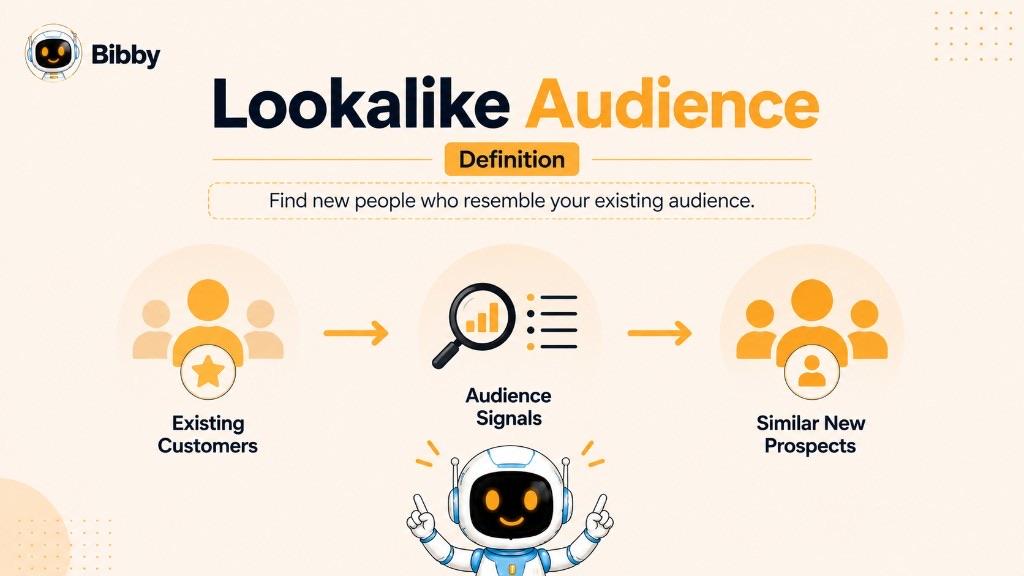
For example, imagine a clothing brand has customers who previously purchased premium products. Rather than showing acquisition ads only to those existing customers, the brand could use an eligible customer group as a source and create a lookalike audience to help reach new people who resemble that customer group.
What Can a Lookalike Audience Be Based On?
The source audience can vary depending on the advertising platform and the data available to the advertiser. It may include people such as:
- Existing customers
- Purchasers
- High-value customers
- Website visitors
- Leads
- App users
- People who engaged with social media content
- Video viewers
- People who completed specific conversions
- Other eligible first-party or platform-based audiences
The platform then uses available signals associated with that source to build or identify the new audience.
Lookalike Audience in Simple Terms
The easiest way to understand the concept is:
Existing audience → Find similar people → Reach new potential customers
A lookalike audience therefore sits between customer data and audience expansion. It takes something a business already knows and uses it to help discover people it does not know yet.
One important point is that a lookalike audience is a targeting mechanism, not a guarantee of performance. A person may resemble existing customers without becoming a customer themselves. Campaign results can also depend on the quality of the source audience, advertising creative, offer, landing page, campaign objective, and the platform's available signals.
The exact way lookalike audiences are created and controlled differs across platforms. Features, audience-size controls, eligibility requirements, and available data can change over time, so marketers should treat the underlying concept as consistent while recognizing that implementation is platform-specific.
How Does a Lookalike Audience Work?
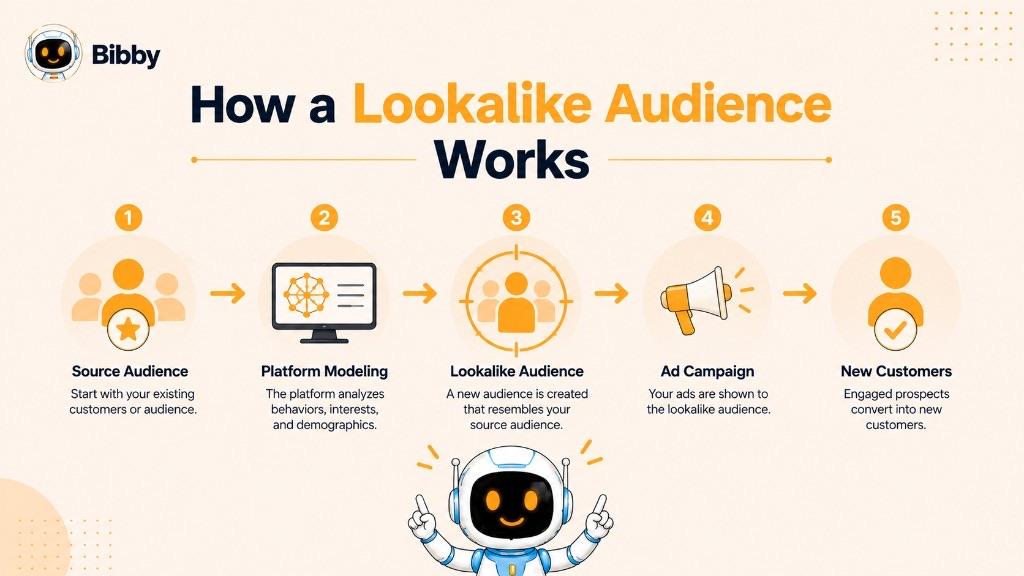
A lookalike audience works by using an existing source audience as a starting point for finding new people who share relevant characteristics or behaviors with that group. The advertising platform analyzes the signals available from the source audience and uses its audience-modeling system to identify potential users who are similar.
1. Choose a Source Audience
First, you select an existing audience that represents the type of people you want to reach more of. Depending on the platform and available data, that might include existing customers, purchasers, website visitors, leads, app users, social media engagers, video viewers, converters, or other eligible groups.
The source matters because it gives the platform the signals from which the lookalike audience is developed.
2. The Platform Analyzes the Source Audience
The advertising platform examines the information and signals it can use from the source audience. These can include patterns related to characteristics, interests, behaviors, engagement, conversions, and other available data. The specific signals and modeling methods are generally platform-dependent and may not be publicly disclosed in detail.
The goal is to understand what the people in the source audience have in common.
3. Similar Users Are Identified
The platform then uses its audience-modeling capabilities to identify other users who appear sufficiently similar to the source audience.
These people do not have to be existing customers or people who have previously interacted with your business. That is what makes a lookalike audience useful for prospecting and audience expansion.
Source: Existing purchasers → Platform analyzes: Available customer signals → Modeling: Identifies similar users → Result: New potential audience
The resulting audience is therefore an inference based on similarity, rather than a list of people who are known to be customers.
4. Select the Available Audience Settings
Some advertising platforms provide controls that influence the size or composition of a lookalike audience. Depending on the platform, these may include geographic location or audience-size percentages.
A smaller audience may generally prioritize closer similarity to the source, while a larger audience can provide greater reach at the expense of being broader.
For example, marketers may encounter terms such as 1% lookalike audience, 5% lookalike audience, or 10% lookalike audience on platforms that provide percentage-based controls. These percentages should not be treated as universal measurements across every advertising platform.
5. Use the Audience in an Advertising Campaign
Once created, the lookalike audience can be used as part of an advertising campaign where the platform supports that targeting option. The advertiser can then measure how the audience performs against the campaign objective.
Relevant metrics may include click-through rate (CTR), cost per click (CPC), conversion rate, cost per acquisition (CPA), leads, purchases, customer acquisition cost, return on ad spend (ROAS), ROI, and revenue or customer value. Track these in the advertising platform and your website analytics—not as a Bibby dashboard.
This final step is important because similarity does not automatically mean buying intent. A lookalike audience can help identify promising prospects, but the campaign still needs relevant creative, messaging, an appropriate offer, and a strong conversion experience.
Lookalike Audience Workflow
The complete process can be summarized as:
Existing customers or users → Source audience → Audience analysis → Similarity modeling → Lookalike audience → Advertising campaign → New prospects → Conversions
The core idea is straightforward: instead of manually guessing who your next customers might be, a platform uses an existing audience as a signal for discovering new potential customers.
What Is a Source Audience for a Lookalike Audience?
A source audience is the existing group of people that an advertising platform uses as the basis for creating a lookalike audience. It is sometimes also called a seed audience.
The source audience gives the platform a set of signals to use when identifying new people who may be similar. In simple terms, it answers the question: “Similar to whom?”
For example, if a business wants to find more people like its existing customers, those customers can serve as the source audience.
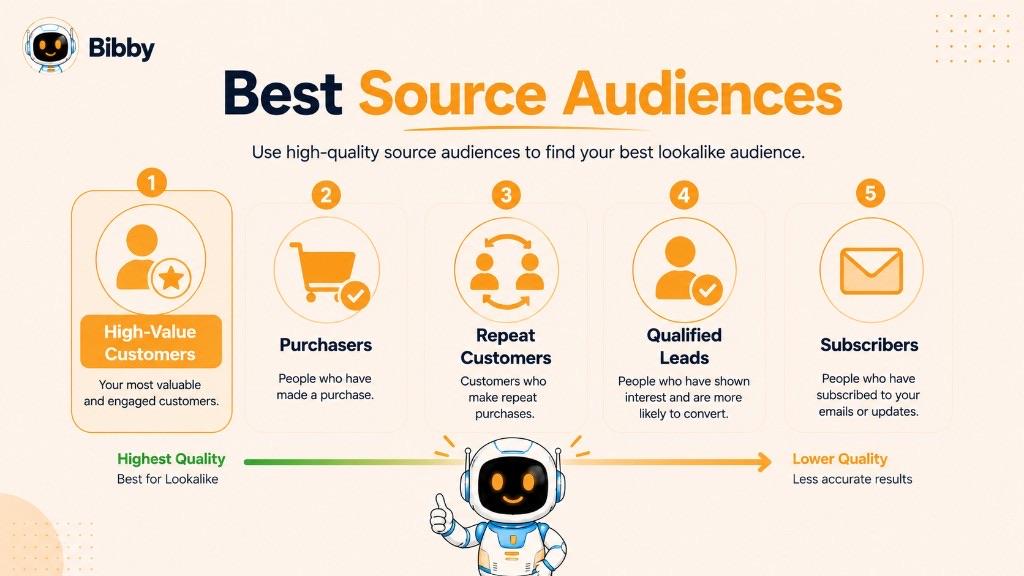
The ranking in that graphic is a conceptual quality spectrum, not a universal rule. The best source is the one that most closely represents the outcome you want to reproduce. Paying subscribers can be the right source for a subscription campaign even if they are not your highest-revenue purchasers.
Common Source Audiences
The exact audience types available depend on the advertising platform, but a source audience may be built from groups such as:
- Existing customers: People who have already purchased from the business.
- High-value customers: Customers who generate particularly high revenue or have other valuable behaviors.
- Website visitors: People who have visited a business's website (often via a pixel or similar tracking, where permitted).
- Leads: People who have submitted forms or otherwise expressed interest.
- App users: People who have interacted with a mobile application.
- Purchasers: Users who completed a specific purchase or conversion event.
- Social media engagers: People who interacted with eligible social content or accounts.
- Video viewers: People who watched eligible video content.
- Converters: People who completed a particular action that matters to the campaign.
The platform may impose requirements around audience size, data quality, eligibility, geographic availability, or other factors.
Why Does the Source Audience Matter?
The quality and relevance of the source audience can have a major impact on the usefulness of the resulting lookalike audience.
Consider two possible sources for an online store:
Source A: 50,000 people who visited the website once.
Source B: 5,000 recent customers who made substantial purchases.
The larger audience is not automatically the better source. If the goal is to acquire customers similar to the brand's most valuable buyers, the second audience may provide a more relevant signal.
A lookalike audience can only be as strategically useful as the audience you choose to model it from.
Source Audience vs Lookalike Audience
| Source audience | Lookalike audience |
|---|---|
| Existing audience | New potential audience |
| Provides the modeling signal | Is created or identified from that signal |
| May contain existing customers or users | Designed to find similar people |
| Used as the starting point | Used for audience expansion |
| Represents people you already know | Helps discover people you may not know |
For example: 5,000 existing purchasers → source audience. New users who resemble those purchasers → lookalike audience.
The source audience is the input. The lookalike audience is the prospecting output.
Should You Always Use Your Entire Customer List?
Not necessarily. A business may have different customer groups with very different characteristics. Someone who purchased a low-cost product once may not represent the same customer profile as someone who purchases repeatedly or generates substantial lifetime value.
Marketers may consider whether the source should represent all customers, recent customers, repeat customers, high-value customers, customers who purchased a particular product, customers who completed a specific conversion, or another strategically relevant segment.
The best source depends on what kind of customer the campaign is trying to acquire.
Source Audience and First-Party Data
Source audiences are also closely related to first-party data—information a business collects through its own interactions with customers and users, such as customer records, website interactions, purchases, and leads.
Using relevant first-party signals can help businesses build audience strategies around people who have already demonstrated some relationship with the brand, rather than relying entirely on manually selected demographic or interest categories.
Data availability and permitted uses depend on the advertising platform, applicable privacy rules, and the way the data was collected.
Source audience = the people the platform learns from.
Lookalike audience = the new people the platform identifies as similar.
Lookalike Audience Example
Imagine an online clothing store has collected data from thousands of customers. The business now wants to find new customers who are likely to be interested in its products, rather than repeatedly advertising to people who have already purchased.
Example: E-Commerce Brand
Suppose the clothing brand has 20,000 existing customers, 8,000 recent purchasers, 2,000 repeat customers, and 500 high-value customers.
The business could select an appropriate group as its source audience. For an acquisition campaign focused on valuable customers, it might make more sense to use high-value or repeat purchasers rather than everyone who has ever visited the website.
Existing high-value customers → Source audience → Platform analyzes available signals → Similar users identified → Lookalike audience → Acquisition campaign → New potential customers
The people in the resulting lookalike audience are not necessarily existing customers. They are new prospects who the platform considers sufficiently similar to the source audience according to its available data and modeling.
Example: SaaS Company
A SaaS company that wants to increase paid subscriptions could use an eligible group of existing paying customers as its source audience instead of creating an audience based only on broad interests.
Source audience: Paying customers. Goal: Acquire more subscribers. Lookalike audience: New users similar to the source. Campaign: Subscription acquisition.
The company could then evaluate whether the resulting audience generates qualified signups, paid conversions, and sustainable customer acquisition costs.
Example: Mobile App
A mobile app company may have thousands of users, but not all users are equally valuable. Some install and never return; some become active users; some purchase a subscription.
If the goal is to acquire more subscribers, the source audience should represent users who have demonstrated the behavior most closely connected to that goal:
Existing subscribers → Source audience → Similar users → Acquisition campaign → New subscribers
The source audience should reflect the outcome you want to reproduce.
Example: Content Creator or Media Brand
A creator or media company could use eligible engagement data as a source where the platform supports it—for example people who regularly engage with video content. The objective might be awareness, new followers, website traffic, or another measurable goal.
An engaged viewer is not necessarily equivalent to a paying customer. The source should match the campaign objective.
The Key Lesson From Lookalike Audience Examples
A lookalike audience is not simply “find random people who might like my business.” It is closer to: “Here is a group of people who already matter to my business. Help me find new people who resemble them.”
If you build a lookalike from people who merely visited a page once, you are asking the platform to find people similar to casual visitors. If you build one from people who completed a valuable conversion, you are giving it a very different starting signal.
The best source therefore depends on who you want more of and what you want those people to do.
Why Do Marketers Use Lookalike Audiences?
Marketers use lookalike audiences primarily to expand beyond an existing audience and discover new potential customers who resemble people they already know are relevant to the business.
Instead of manually trying to predict every characteristic of a potential customer, advertisers can use an existing audience as a source and allow the advertising platform to identify similar users.
Reach New Potential Customers
A business may already have a strong customer base but still need to reach people who have never interacted with the brand. A lookalike audience can help bridge that gap, which makes lookalikes particularly relevant to customer acquisition and prospecting.
Use Existing Customer Data
Businesses often have valuable information about people who have already purchased, subscribed, registered, or otherwise converted. A lookalike audience allows that existing audience to become a starting point for finding new prospects.
Existing purchasers → Source audience → Similar prospects → Acquisition campaign
The quality of this strategy depends heavily on the relevance and quality of the source audience.
Improve Audience Discovery
Traditional audience targeting can require marketers to decide which demographics, interests, behaviors, or other targeting options might describe their ideal customer.
Lookalike targeting approaches the problem differently. Rather than starting entirely with assumptions about the customer, the marketer starts with people who have already demonstrated a relevant behavior and asks the platform to find others who resemble them.
Scale Customer Acquisition
A business may reach a point where its existing audience is too small to support continued growth. A lookalike audience can help transform known customers, visitors, or leads into signals for discovering prospects within a much larger potential market—moving from known audiences to scalable prospecting.
Build Campaigns Around Valuable Customers
Not every customer has the same value. When the platform supports appropriate source-audience options, marketers can consider building their audience strategy around a more valuable or relevant customer segment:
High-value customers → Source audience → Lookalike audience → Acquisition campaign
The objective is not simply to find *more people*. It is to find more people who resemble a strategically important group.
Lookalike Audiences Can Reduce Manual Guesswork
Lookalike targeting shifts some of the audience-discovery work from manual selection to platform-based modeling. That does not eliminate the marketer's role. Marketers still need to decide which source to use, what campaign objective to pursue, which geographic market to target, what creative and offer to present, how to measure success, and whether the audience is actually producing valuable results.
Lookalike Audiences Are Not a Shortcut to Guaranteed Conversions
A lookalike audience can improve the process of finding relevant prospects, but similarity does not guarantee that someone will click, sign up, purchase, or become a long-term customer.
Campaign performance can still depend on audience quality, creative quality, messaging, offer, landing page, campaign objective, conversion experience, market conditions, and platform optimization.
In simple terms: marketers use lookalike audiences to turn an existing group of valuable users into a signal for finding new potential customers at scale.
Lookalike Audience vs Custom Audience
Lookalike audiences and custom audiences serve different purposes. A custom audience is generally used to reach people who are already represented in an advertiser's available audience data, while a lookalike audience is designed to help find new people who resemble a source audience.
Custom audience = people you already know. Lookalike audience = new people who resemble people you already know.
| Feature | Lookalike audience | Custom audience |
|---|---|---|
| Primary purpose | Find new potential customers | Reach an existing audience |
| Starting point | A source audience | Existing user or customer data |
| Audience relationship | Similar to the source audience | Already connected to the business |
| Common use | Prospecting and acquisition | Retargeting, re-engagement, or customer targeting |
| Example | People similar to previous purchasers | Previous purchasers or website visitors |
| Main objective | Audience expansion | Reaching known users |
What Is a Custom Audience?
A custom audience is an audience created from people who already have some identifiable relationship with a business or its available data—existing customers, website visitors, app users, leads, people who interacted with content, purchasers, or other eligible user groups.
For example, an online store could create an audience of people who visited product pages but did not purchase, then use that audience for a retargeting campaign. The people in that audience are already known through an eligible interaction or data source.
What Is a Lookalike Audience?
A lookalike audience starts with an existing source audience and attempts to identify new people who resemble that source audience.
Custom audience: 10,000 existing purchasers.
Lookalike audience: New users who the advertising platform identifies as similar to those purchasers.
When Should You Use a Custom Audience?
Custom audiences can be useful when you specifically want to reach people who already have a relationship with your business: retargeting website visitors, re-engaging previous customers, reaching existing leads, promoting another product to existing customers, encouraging abandoned visitors to return, or creating exclusion audiences for acquisition campaigns.
The objective is re-engagement, rather than discovering an entirely new audience.
When Should You Use a Lookalike Audience?
Lookalike audiences are more closely associated with prospecting and audience expansion: finding new potential customers, expanding beyond the existing customer base, scaling an acquisition campaign, discovering users similar to valuable customers, or building prospecting campaigns around existing conversion data.
Can You Use Both?
Yes. Custom and lookalike audiences can serve complementary roles.
Existing customers → Source audience → Lookalike audience → New prospects → Conversions
At the same time, a custom audience could re-engage people who have already visited the website:
Website visitors → Custom audience → Retargeting campaign → Conversion
The two audience types are not necessarily competing strategies. They can address different stages of the customer journey.
Custom audience: “Reach these people.” Lookalike audience: “Find more people like these people.”
Lookalike Audience vs Broad Targeting
Lookalike targeting and broad targeting both help advertisers reach potential customers, but they start from very different approaches. A lookalike audience uses an existing source audience as a signal for finding similar people. Broad targeting gives the advertising platform more freedom to identify potential customers without requiring the campaign to be built around a specific lookalike source.
Marketers sometimes treat a lookalike audience as simply another form of broad targeting. It is not.
| Feature | Lookalike audience | Broad targeting |
|---|---|---|
| Starting point | Existing source audience | Broad campaign parameters |
| Audience signal | Similarity to a source audience | Platform targeting and optimization signals |
| Main purpose | Find people similar to an existing audience | Give the platform wider prospecting freedom |
| Data requirement | Requires an eligible source audience | Does not necessarily require a lookalike source |
| Marketer control | More defined around the source | Generally fewer audience restrictions |
| Potential reach | Depends on platform settings | Often designed for broader reach |
| Best suited to | Audience expansion from known users | Broad prospecting and algorithmic discovery |
How Lookalike Targeting Works
With a lookalike audience, the advertiser starts with a group of people who are already relevant to the business:
Existing purchasers → Source audience → Platform modeling → Similar users → Lookalike audience
The advertiser is giving the platform a reference point for the type of person it wants to reach.
How Broad Targeting Works
Broad targeting takes a less restrictive approach. Rather than telling the platform to find people who resemble a particular source audience, the advertiser may provide broader campaign parameters such as geographic location, age or other available demographic controls, campaign objective, conversion event, budget, and creative.
The platform can then use its available signals and optimization systems to determine which users are most likely to respond. The central idea is fewer predefined audience restrictions and greater reliance on platform optimization.
Which Gives You More Control?
Lookalike audiences generally provide a clearer audience reference point because the campaign begins with a defined source audience. Broad targeting generally gives the platform more freedom to determine who should see the ads.
Lookalike targeting: More defined audience signal → potentially narrower discovery.
Broad targeting: Less predefined audience restriction → potentially wider discovery.
Neither approach is automatically better.
When Should You Use Lookalike Targeting?
A lookalike audience may make sense when you have a meaningful source audience and want to find new people who resemble it—especially when you have useful customer data, the source represents valuable users, you want to expand beyond existing customers, you want prospecting informed by existing customer signals, or you want to test different audience sources.
When Might Broad Targeting Be Better?
Broad targeting can be useful when you want to give the platform greater flexibility: limited source-audience data, a strong conversion signal for optimization, a need to maximize audience discovery, a desire to avoid overly restrictive targeting, or a test of algorithmic prospecting against more defined audiences.
A highly specific audience can eventually become difficult to scale if the available pool is limited. Broad targeting can potentially give the platform access to a much larger pool. Lookalike audiences can also be adjusted toward greater reach where the platform provides audience-size controls.
More similarity ↔ more reach
That relationship is not a guarantee of performance. A broader audience can sometimes produce better results if the platform has enough useful signals and conversion data to optimize effectively.
Lookalike targeting says: “Find new people who resemble this valuable audience.”
Broad targeting says: “Here are my campaign requirements. Find promising people within a broad eligible pool.”
Evaluate both using business outcomes such as qualified leads, purchases, CPA, customer value, or ROAS, rather than assuming that a particular audience strategy will always win.
Lookalike Audience vs Interest-Based Targeting
Lookalike audience targeting and interest-based targeting use different ways to identify potential customers. A lookalike audience starts with an existing source audience and looks for new people who resemble it. Interest-based targeting starts with selected interests, topics, behaviors, or other available targeting categories that an advertiser believes are relevant to the ideal customer.
Lookalike targeting: “Find people similar to these existing users.”
Interest targeting: “Find people associated with these interests or characteristics.”
| Feature | Lookalike audience | Interest-based targeting |
|---|---|---|
| Starting point | Existing source audience | Selected interests or targeting categories |
| Main signal | Similarity to an existing audience | Relevant interests or available audience attributes |
| Requires existing audience data? | Generally yes | Not necessarily |
| Main use | Prospecting and audience expansion | Prospecting around known interests |
| Audience discovery | Model-based | Category-based |
| Marketer input | Source audience | Interests, behaviors, demographics, or similar controls |
| Key advantage | Uses existing audience as a reference | Gives marketers a direct way to define a potential audience |
How Lookalike Targeting Differs
With a lookalike audience, the marketer does not necessarily need to define every characteristic of the ideal customer manually. Instead, the advertiser provides a source audience:
Existing customers → Source audience → Platform modeling → Similar prospects
This can be useful when a business already has a meaningful customer or conversion base and wants to expand its reach.
How Interest-Based Targeting Differs
Interest-based targeting takes a more explicit approach. A marketer might decide that potential customers are interested in particular topics, products, hobbies, industries, content categories, activities, brands, or other available interest or behavioral signals.
For example, a fitness business might attempt to reach people associated with interests related to fitness, running, or strength training where those options are available. The marketer is defining the audience using known or assumed characteristics.
Which Requires More Existing Data?
Lookalike audiences generally require an eligible source audience. Without a meaningful source, there is little for the platform to use as the basis for similarity modeling.
Interest-based targeting does not necessarily require an existing customer list or conversion audience. A business can potentially begin with relevant targeting categories even when it has limited first-party audience data.
Which Gives Marketers More Direct Control?
Interest-based targeting can provide more direct control over the characteristics the marketer wants to target because the marketer selects the available categories.
Lookalike targeting provides a different kind of control. Instead of manually defining every characteristic, the marketer controls the source audience and lets the platform determine which new users are sufficiently similar.
Interest targeting: Define characteristics → Find people matching them.
Lookalike targeting: Define valuable audience → Find people resembling them.
Example: E-Commerce Business
Suppose a company sells premium running shoes.
With interest-based targeting, the advertiser might target available categories related to running, fitness, athletics, or similar topics.
With lookalike targeting, the advertiser could use an eligible audience of existing purchasers as the source and ask the platform to find new users who resemble those customers.
Interest targeting says: “We believe these interests describe our potential customers.”
Lookalike targeting says: “We know these people are relevant. Find more people who resemble them.”
Can You Use Both?
Depending on the platform and campaign setup, marketers may test different audience strategies rather than treating them as mutually exclusive—for example a lookalike based on existing purchasers versus an interest-based audience—then compare KPIs such as cost per acquisition, conversion rate, qualified leads, purchase volume, revenue, and ROAS.
Which One Is Better?
There is no universal winner. A lookalike audience may be particularly useful when a business has high-quality customer or conversion data. Interest-based targeting may be useful when the business has limited first-party audience data or a strong understanding of the interests associated with its potential customers.
Both can become less effective if the underlying audience assumptions are poor. A lookalike can inherit weaknesses from an irrelevant source, while interest targeting can suffer when selected interests do not accurately represent purchase intent.
Lookalike audience: Existing audience → Similar people.
Interest-based targeting: Selected interests → Relevant people.
A lookalike audience is primarily a data-informed audience expansion strategy. Interest-based targeting is primarily a manually defined audience discovery strategy.
What Platforms Support Lookalike Audiences?
Lookalike audiences are most commonly associated with social media advertising platforms, where advertisers can use an existing audience as a source for finding new potential customers. The feature is not identical everywhere. Platforms may use different names, audience-building methods, eligibility requirements, controls, and privacy rules.
The core idea remains the same:
Existing audience → Platform modeling → Similar potential audience → Advertising campaign
Meta Lookalike Audiences
Meta Platforms is one of the best-known platforms associated with lookalike audience targeting. Within Meta's advertising ecosystem, marketers can use eligible audience sources to help find people who are similar to an existing audience. This can be relevant to advertising across properties such as Facebook and Instagram, depending on the campaign and available targeting options.
Common source audiences can include groups based on customer data, website activity, app activity, or engagement, subject to Meta's current requirements and available features.
Meta's specific audience controls and requirements can change, so advertisers should check the current platform documentation when setting up a campaign.
LinkedIn Lookalike Audiences
LinkedIn has also offered audience-expansion capabilities designed to help advertisers reach people who resemble an existing audience. This can be particularly relevant for B2B marketers because LinkedIn advertising can incorporate professional characteristics and business-related audience signals.
The available functionality, terminology, and eligibility requirements should be checked against LinkedIn's current advertising capabilities before launching a campaign.
TikTok Lookalike Audiences
TikTok also provides audience-targeting and audience-expansion capabilities within its advertising ecosystem. Advertisers can use eligible source audiences to help identify new users who are similar to people who have already interacted with a business or completed relevant actions.
TikTok Ads Manager documentation describes creating a lookalike audience from an existing custom audience and then selecting settings such as location and audience size. Options to omit or contain the source audience may also be documented. Always confirm the current Ads Manager help articles before you build a campaign.
Are Lookalike Audiences the Same on Every Platform?
No. The concept of a lookalike audience is broadly consistent, but the implementation is platform-specific.
Different platforms may vary in what can be used as a source, minimum audience requirements, geographic availability, audience-size controls, targeting options, data-matching processes, privacy restrictions, campaign eligibility, terminology, and optimization and delivery systems.
Lookalike Audiences vs Similar Audience Features
Some advertising platforms may use terminology other than “lookalike audience” for similar audience-expansion functionality, such as similar audiences, audience expansion, similar segments, predictive audiences, or modeled audiences.
These features can serve related purposes, but they should not automatically be treated as technically identical.
Why Platform Differences Matter
The same source audience can potentially produce different results across different platforms because each platform has its own user base, data signals, advertising ecosystem, optimization system, audience inventory, campaign objectives, and privacy framework.
For example, a source audience made up of B2B decision-makers may behave differently on a professional network than on a primarily entertainment-focused social platform.
For marketers, the important question is not simply *“Does this platform have lookalike audiences?”* but: “What source audiences can I use, how does this platform define similarity, and how can I test the resulting audience against my campaign objective?”
How to Create a Lookalike Audience
Creating a lookalike audience generally involves choosing an existing source audience, selecting the available audience settings, and allowing the advertising platform to identify new people who resemble that source.
The exact process varies by platform. Audience requirements, available source types, geographic controls, audience-size settings, and terminology can change, so the steps below describe the general process rather than a universal platform-specific setup.
Step 1: Define Your Campaign Objective
Start by deciding what you want the new audience to help you accomplish: generate leads, increase purchases, acquire subscribers, drive app installs, increase registrations, generate website conversions, or expand brand awareness.
If your goal is to acquire paying customers, a source based on relevant purchasers may be more meaningful than one based on people who simply visited your homepage.
Step 2: Choose a Source Audience
Select the audience you want the platform to use as the basis for finding similar users: existing customers, customer lists, purchasers, website visitors, leads, app users, content engagers, video viewers, conversion audiences, or other custom or first-party audiences.
If you want to find more customers like your best customers, your source should ideally provide a meaningful representation of those customers.
Step 3: Check the Source Audience Quality
Before creating the lookalike, evaluate whether the source audience is actually useful:
- Does this audience represent the customers I want more of?
- Is the data recent enough to be relevant?
- Does it contain enough meaningful users for the platform?
- Are the people in the audience connected to my campaign objective?
- Is the audience too broad or mixed?
- Does it contain low-value users that could weaken the signal?
Recent repeat purchasers may provide a more strategically useful signal for a customer-acquisition campaign than a much larger audience of people who visited a website once.
Step 4: Create the Lookalike Audience
Once you have an eligible source, use the platform's audience-management tools to create the lookalike audience. The workflow commonly resembles:
Audience Manager → Create audience → Lookalike audience → Select source
The terminology and interface will differ between advertising platforms.
Step 5: Choose the Available Audience Settings
Some platforms allow advertisers to control how closely the new audience should resemble the source or how broadly it should reach. One commonly encountered approach is a percentage-based audience size, such as 1%, 5%, or 10%.
The general concept is a trade-off between similarity and scale. A narrower audience may focus more heavily on people similar to the source, while a broader audience can provide access to more potential users.
Other available settings may include location, language, device, placement, audience size, and inclusion or exclusion of the source audience. Not every platform provides all of these controls.
Step 6: Decide Whether to Include or Exclude the Source Audience
If the objective is new customer acquisition, you may want to exclude existing customers so that the acquisition budget is focused on new prospects. Some platforms provide explicit controls to omit or contain the source audience when creating a lookalike.
Step 7: Apply the Lookalike Audience to Your Campaign
Once the audience has been created and is available, apply it to the appropriate advertising campaign or ad group. You still need to consider ad creative, copy, offer, campaign objective, budget, bidding strategy, landing page, conversion event, geographic targeting, and exclusions.
A strong audience cannot compensate indefinitely for an irrelevant offer or poor creative.
Step 8: Measure the Results
After the campaign runs, evaluate whether the lookalike audience is actually helping you achieve the business objective. Useful metrics can include click-through rate, cost per click, conversion rate, cost per lead, cost per acquisition, purchases, customer acquisition cost, revenue, return on ad spend, customer quality, and customer lifetime value.
An audience generating inexpensive clicks but very few qualified leads may not be performing well, even if its CTR looks impressive.
Step 9: Test Different Source Audiences
You do not necessarily have to create only one lookalike audience. If the platform supports it, you can test different source audiences against one another:
Lookalike A: All purchasers. Lookalike B: Repeat purchasers. Lookalike C: High-value purchasers.
This approach can reveal an important difference between audience size and audience quality.
A Simple Lookalike Audience Creation Workflow
Define goal → Choose source audience → Check source quality → Create lookalike → Set available audience controls → Include/exclude source where appropriate → Launch campaign → Measure results → Test and refine
Creating a Lookalike Audience Is Not the Same as Creating a Campaign
A common misunderstanding is to treat audience creation and campaign creation as the same thing. They are separate steps.
A lookalike audience determines *who you may want to reach*.
The campaign determines how you try to reach them, including the objective, creative, budget, bidding, placement, and conversion experience.
Even a highly relevant lookalike audience can perform poorly if the campaign itself is poorly designed.
What Is a 1% Lookalike Audience?
A 1% lookalike audience is a lookalike audience setting used by some advertising platforms to create a relatively smaller audience that is more closely focused on people similar to the selected source audience.
The exact meaning of the percentage depends on the advertising platform, but the basic idea is a trade-off between audience similarity and audience size.
When a platform provides percentage-based lookalike controls, you might encounter options such as a 1% lookalike audience, 5% lookalike audience, or 10% lookalike audience. Generally, a smaller percentage represents a more narrowly defined audience, while a larger percentage expands the potential reach.
How Does a 1% Lookalike Audience Work?
Suppose you have an eligible source audience made up of your existing customers. You create a lookalike audience and select a relatively narrow audience size. The platform then uses its available signals and modeling systems to identify people who are considered similar to the source audience within the selected audience range.
Existing customers → Source audience → Similarity modeling → 1% lookalike audience → New potential customers
The people in the resulting audience are not copies of your existing customers. They are new users identified according to the platform's definition of similarity.
1% vs 5% vs 10% Lookalike Audience
| Audience size | General concept | Potential trade-off |
|---|---|---|
| 1% | Smaller, more closely focused audience | Less reach |
| 5% | Broader audience | More reach, potentially less similarity |
| 10% | Much broader audience | Maximum scale among these options, potentially less similarity |
These are conceptual differences, not performance guarantees. A 1% audience will not automatically generate a lower CPA, higher conversion rate, or better ROAS.
Is a 1% Lookalike Audience Better?
Not necessarily. A narrower lookalike can make sense when the priority is finding people who are more closely aligned with the source audience. A broader audience can make more sense when the priority is scale and the platform has enough signals to optimize effectively.
Goal: Maximum similarity — you might start by testing a narrower audience.
Goal: Maximum prospecting scale — you might test a broader audience.
The correct decision should ultimately be based on campaign performance rather than the assumption that a particular percentage is always superior.
When Should You Test a 1% Lookalike Audience?
A narrower lookalike can be worth testing when you have a strong source audience, your source represents valuable customers, you want to prioritize similarity, your potential market is large enough, and you want to compare audience quality against broader targeting.
When Should You Test a Larger Lookalike?
A broader audience may be worth testing when the narrow audience is too small, you need additional reach, the campaign has strong conversion signals, the market is large, or you want to give the platform more room to discover potential customers.
One Important Limitation
Do not assume that 1% means “the best 1% of people.” The percentage is an audience-size or similarity control within the platform's particular lookalike system. It does not mean those users are guaranteed to be the highest-value prospects, nor that they are ranked from “best” to “worst” customers.
Likewise, a 10% audience is not necessarily poor quality. It simply represents a broader approach to audience expansion.
Smaller audience → More focused similarity → Less potential reach
Larger audience → Broader similarity → More potential reach
Because platforms can change how their audience systems work, always check the current platform-specific definition before interpreting a particular percentage as a universal rule.
What Makes a Good Lookalike Audience?
A good lookalike audience starts with a good source audience. The platform can help identify people who resemble that source, but it cannot magically turn an irrelevant or low-quality source into a perfect customer pool.
The most useful lookalike audiences are generally built around people who are meaningfully connected to the campaign objective.
1. Start With a Relevant Source Audience
Your source audience should represent the type of people you actually want to acquire.
Want more buyers? Start with relevant buyers.
Want more subscribers? Start with relevant subscribers.
Want more qualified leads? Start with relevant leads.
Want more app users? Start with users who demonstrate valuable app behavior.
2. Prioritize Customer Quality Over Audience Size
A common mistake is assuming that the biggest possible source audience is automatically the best.
Imagine two source audiences: 100,000 people who visited a website once versus 10,000 people who became paying customers. If the campaign's objective is acquiring paying customers, the second may provide a more relevant starting signal despite being much smaller.
The important question is not “How many people are in my source?” It is “How well does this source represent the people I want more of?”
3. Use Recent and Relevant Signals
Someone who purchased several years ago may not represent the current customer as closely as someone who purchased recently. Where the platform and audience setup allow it, marketers should consider the recency and relevance of their source data.
Older data is not automatically useless. Its value depends on the business, product lifecycle, purchase frequency, and campaign objective.
4. Match the Source to the Campaign Objective
Website visitors demonstrate interest. Product viewers demonstrate deeper interest. Leads demonstrate consideration. Purchasers demonstrate conversion. Repeat purchasers demonstrate continued customer value.
If the objective is customer acquisition, these audiences are not interchangeable. A source should be selected based on the behavior you want the new audience to resemble.
5. Avoid Mixing Unrelated Audiences
A source audience should have a reasonably coherent purpose. Combining one-time visitors, existing customers, newsletter subscribers, job applicants, and customer-support users into one broad source may contain people with very different relationships with the business.
6. Consider High-Value Customers
Not every conversion has the same economic value. When the platform supports appropriate audience sources, test groups such as all purchasers, repeat purchasers, and high-value purchasers separately.
7. Make Sure the Source Is Large Enough for the Platform
Advertising platforms can impose their own requirements: minimum audience sizes, eligible source types, geographic requirements, data restrictions, account or campaign eligibility, and privacy requirements. A source audience that is strategically excellent may still be unusable if it does not meet the platform's current requirements.
8. Respect Data Quality and Privacy
Marketers should ensure that source data was collected appropriately, meets applicable privacy requirements, is eligible for the intended advertising use, is sufficiently accurate, is not unnecessarily outdated, and complies with the platform's policies.
Privacy changes can also affect how audience matching and targeting work.
9. Test More Than One Source
| Source audience | Potential question |
|---|---|
| All purchasers | Can we find more customers generally? |
| Recent purchasers | Does recent behavior produce better prospects? |
| Repeat purchasers | Can we find more loyal customers? |
| High-value customers | Can we acquire customers with greater value? |
| Qualified leads | Can we find more prospects similar to our strongest leads? |
The goal is not to create dozens of audiences for the sake of creating them. It is to identify which source provides the most useful signal for the campaign.
10. Judge the Audience by Business Results
A lookalike audience can look impressive inside an advertising dashboard and still produce mediocre business results. Evaluate it against qualified leads, purchases, conversion rate, cost per acquisition, customer acquisition cost, revenue, ROAS, average order value, and customer lifetime value.
What Is the Best Source Audience?
There is no universally best source audience. The strongest source is generally the one that most closely represents the valuable outcome you want to reproduce.
For an e-commerce business, that might be high-value purchasers. For a SaaS company, paying or retained customers. For a lead-generation business, qualified leads rather than every form submission. For an app, users who complete a valuable in-app action rather than everyone who installs.
Don't build a lookalike audience around everyone you have. Build it around the people you want more of.
Benefits of Lookalike Audience Targeting
Lookalike audience targeting can help businesses expand their advertising reach by using an existing audience as a signal for discovering new potential customers. The benefits depend on the quality of the source audience, the advertising platform, and the campaign itself.
1. Expand Beyond Your Existing Customers
Your existing customers represent only a fraction of the people who could potentially buy from your business. A lookalike audience can help identify new users who resemble an existing audience without requiring those users to have previously interacted with your brand.
2. Use Existing Customer Signals
Instead of starting from a blank page and asking “Who might be interested in our product?”, the advertiser can start with “These people have already shown us that they are valuable. Help us find more people who resemble them.”
3. Discover New Potential Customers
The advertiser supplies a source audience, while the platform uses its available data and modeling systems to identify potential users who resemble that group. This can help businesses discover prospects that might not have been obvious through traditional interest or demographic targeting.
4. Support Customer Acquisition at Scale
A relatively small number of existing customers can potentially become the source for identifying a much larger pool of prospective users—moving from known customer relationships to scalable prospecting.
5. Build Targeting Around Valuable Customers
Instead of modeling from every user, a marketer may choose an eligible audience representing repeat purchasers, high-value customers, recent customers, subscribers, qualified leads, or users who completed an important conversion.
6. Reduce Dependence on Manual Interest Research
The marketer can use an existing audience as the reference point and allow the platform to handle much of the similarity-based discovery. Marketers still need to choose the source carefully and evaluate the results.
7. Support Prospecting Campaigns
Retargeting: Reach people who already interacted with the business.
Lookalike prospecting: Find new people who resemble a relevant existing audience.
8. Enable Audience Testing
If a platform supports multiple lookalike audiences, marketers can test purchaser-based, repeat-customer, high-value-customer, and lead-based lookalikes, then compare results using meaningful business metrics.
9. Potentially Improve Audience Relevance
A company selling enterprise software may get very different prospects by modeling from its existing enterprise customers than by targeting a broad collection of general business interests. Relevance is not guaranteed.
10. Work Across Different Types of Businesses
Lookalike audiences are not limited to e-commerce. They can potentially support acquisition strategies for SaaS, mobile apps, online retailers, subscription businesses, service businesses, media companies, education businesses, B2B companies, digital products, and other advertisers with eligible audience sources.
The biggest advantage is turning known customers into a discovery signal: know your valuable customers → build an appropriate source audience → find similar prospects → test acquisition → measure real business outcomes.
Lookalike targeting should not be treated as a guaranteed performance shortcut. Creative quality, offer, campaign setup, conversion experience, and platform conditions still influence the final result.
Limitations of Lookalike Audiences
Lookalike audiences can be useful for audience expansion, but they are not a guarantee of better advertising performance. Understanding the limitations helps marketers use lookalike targeting as a testing and acquisition strategy rather than treating it as a magic audience button.
1. Lookalike Audiences Depend on the Source Audience
If the source is poorly chosen, the resulting audience may not represent the customers you actually want to acquire. A lookalike from everyone who visited a website can include casual visitors, existing customers, competitors, job seekers, researchers, accidental clicks, and people who never intended to purchase.
Weak source → potentially weak signal.
2. Similarity Does Not Mean Purchase Intent
Someone can resemble your existing customers without wanting your product. A lookalike identifies users based on available signals and the platform's modeling system. It does not establish that every person has genuine purchase intent, budget, timing, or awareness.
Treat a lookalike as a prospecting tool, not a list of guaranteed buyers.
3. Platform Modeling Is Not Fully Transparent
Advertisers generally do not receive a complete explanation of every signal used, how signals are weighted, how similarity is calculated, why a particular user qualifies, or how the model changes over time. They have to evaluate the audience through available campaign data and business outcomes.
4. Performance Can Vary by Market
Audience size, customer behavior, purchasing power, competition, cultural differences, and platform adoption can all vary by geography. Geographic availability and platform-specific audience requirements can also affect what can be created.
5. Privacy Changes Can Affect Audience Targeting
Changes to tracking, cookies, mobile identifiers, data sharing, consent requirements, platform policies, and audience matching can affect how advertisers build and use audiences. Do not assume that a lookalike-audience workflow will remain technically identical forever.
6. Lookalike Audiences Can Become Too Broad
When marketers prioritize reach, they may select a broader lookalike. This can increase the potential pool of users, but it can also move the audience farther from the characteristics represented by the source.
7. Audience Size Does Not Equal Audience Quality
A large lookalike audience can look attractive because it offers significant reach. More people do not automatically mean more valuable customers. Evaluate audiences based on qualified outcomes, not simply potential reach.
8. Creative Still Matters
A highly relevant audience cannot compensate for weak messaging, poor visual quality, an unclear value proposition, an irrelevant offer, or weak calls to action.
Audience + Creative + Offer + Conversion Experience = Campaign Performance
9. Landing Pages Still Matter
A lookalike audience may successfully bring qualified prospects to a website, but a confusing or slow landing page can prevent those prospects from converting. A poor conversion rate could come from audience quality, ad creative, offer, landing page, pricing, checkout experience, conversion tracking, or campaign optimization.
10. Lookalike Audiences Can Overlap With Other Targeting
A person might simultaneously be in an interest-based audience, a lookalike audience, a website-visitor audience, an existing-customer audience, and a broad targeting pool. Understand campaign structure and use appropriate exclusions or testing methods where the platform supports them.
11. A Small or Low-Quality Source Can Limit Usefulness
A new company with only a handful of customers may have very little information from which to build a reliable audience signal. In such cases, marketers may need to rely on other prospecting approaches while they build first-party audience data.
12. Results Can Change Over Time
Even if a lookalike audience performs well today, performance can change because of audience saturation, competition, customer behavior, creative fatigue, platform algorithm updates, seasonal demand, pricing or offers, or changes in available data signals.
What Lookalike Audiences Cannot Do
A lookalike audience cannot guarantee that every person is an ideal customer, that every person has purchase intent, that every user resembles the source equally, that the audience will outperform broad targeting, that the campaign will produce a lower CPA or higher ROAS, or that the audience will remain equally effective forever.
Its role is narrower: use an existing audience as a signal to help discover new, potentially relevant people.
The biggest mistake is treating a lookalike audience as the final answer to “Who should I advertise to?” It is better understood as a data-informed hypothesis: people who resemble this valuable audience may also be promising prospects. The campaign then tests that hypothesis.
A lookalike audience gives you a smarter starting point, not a crystal ball.
Are Lookalike Audiences Still Effective?
Yes, lookalike audiences can still be an effective audience-expansion strategy, but they are not automatically the best targeting option for every campaign.
Their effectiveness depends on the quality of the source audience, the advertising platform, available data signals, campaign objective, creative, offer, and the quality of the conversion experience. Modern advertising platforms also increasingly use their own machine-learning systems to discover and optimize toward potential customers, which means marketers should evaluate lookalikes alongside broader prospecting approaches rather than assuming they will always win.
Why Lookalike Audiences Can Still Be Useful
The fundamental idea remains valuable: existing customer signals → find similar prospects → test acquisition. This can be particularly useful when the source audience represents high-quality customers rather than simply large numbers of low-intent users.
Lookalike Audiences Are Not the Same as They Were Years Ago
Platforms have introduced increasingly sophisticated machine-learning systems, conversion optimization, automated targeting, audience expansion, predictive modeling, creative optimization, and automated bidding. Advertisers may have more ways to let the platform discover potential customers without manually defining a highly specific audience.
The strategic question is no longer simply “Should I use a lookalike audience?” It is: “Does a lookalike source provide a useful signal that improves acquisition compared with broader or alternative targeting?”
Source Quality Matters More Than Ever
A lookalike from everyone who visited a website gives the platform a very different signal from a lookalike from customers who repeatedly purchased high-value products. Customer quality can matter more than audience quantity.
Lookalike vs Broad Targeting
Neither approach is universally superior. A strong lookalike audience may provide a valuable signal. A broad campaign may discover customers that a manually constructed lookalike misses. The only reliable way to determine which works better for a particular business is to test and measure.
When Lookalike Audiences May Work Well
Lookalike targeting may be particularly useful when you have a meaningful source audience, the source represents valuable customers, your customer data is relevant to the campaign objective, you have enough market size to expand, you want to test customer-based prospecting, you want to compare different source audiences, and your platform supports an appropriate lookalike capability.
When Lookalike Audiences May Be Less Useful
They may be less useful when the source is very small, contains mostly low-intent users, customer behavior is highly inconsistent, the market is extremely small, the source does not represent the desired customer, broad platform optimization already performs strongly, the audience becomes saturated, or the campaign has weak creative or conversion infrastructure.
How to Know If a Lookalike Audience Is Effective
Don't judge the audience simply by its size or estimated reach. Compare conversion rate, cost per acquisition, cost per qualified lead, purchases, revenue, ROAS, customer acquisition cost, average order value, customer quality, and customer lifetime value.
A lookalike campaign that produces a lower CPC but also produces customers with lower average order values is not necessarily the better audience. Ask: “Did this audience help us acquire valuable customers efficiently?”
A Practical Testing Framework
Test A: Lookalike based on purchasers.
Test B: Lookalike based on high-value purchasers.
Test C: Broad prospecting.
Test D: Relevant interest-based targeting, where applicable.
Then compare the results using the same core business metrics.
Lookalike Audiences and AI
The rise of AI and machine learning does not make lookalike audiences irrelevant. Lookalike audiences themselves rely on platform modeling, while modern advertising systems can also use machine learning to optimize delivery.
The marketer's role increasingly becomes: provide high-quality signals, define the business objective, create strong creative, give the platform enough room to optimize where appropriate, measure actual customer outcomes, and test different strategies.
So, Are Lookalike Audiences Worth Testing?
Yes. But don't assume that a lookalike audience will automatically outperform broad targeting, interest targeting, or other prospecting methods. Treat the lookalike as a testable audience strategy.
Lookalike audiences are not obsolete. They are one audience-expansion tool within a much larger ecosystem of algorithmic advertising and customer acquisition.
Lookalike Audience Best Practices
A lookalike audience works best when it is treated as a data-driven prospecting strategy, not a shortcut to guaranteed conversions.
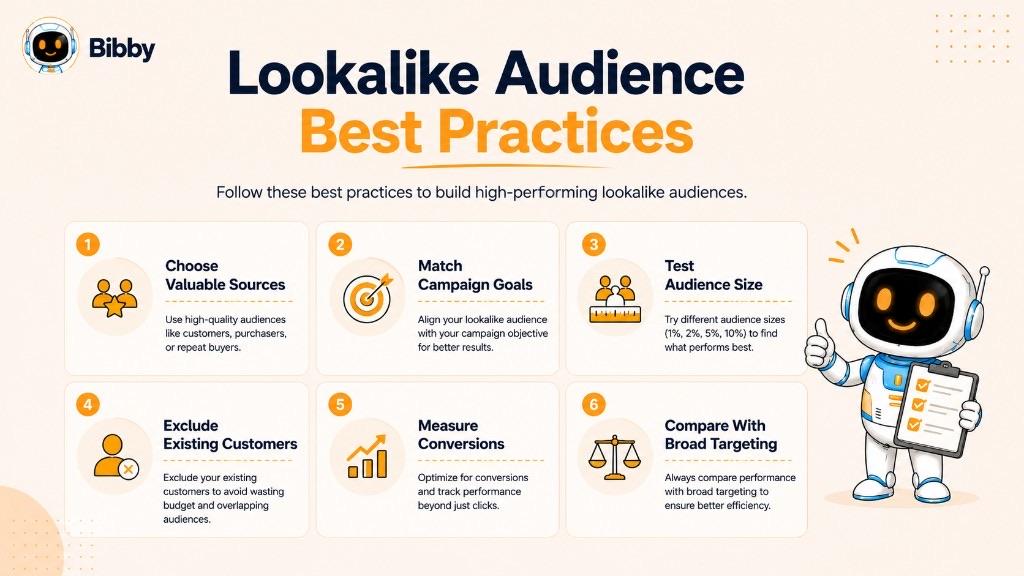
Exclusions and broad-targeting comparisons depend on the campaign. Exclude existing customers when the goal is new acquisition and the platform supports it. Compare lookalikes with broad targeting when you can run a fair test—not because one method always wins.
1. Start With Your Best Customers
The first question should not be “How can I create the biggest lookalike audience?” It should be: “Which existing people best represent the customers I want more of?”
If the platform supports the relevant source, consider recent purchasers, repeat customers, high-value customers, paying subscribers, qualified leads, or users who completed an important conversion.
2. Match the Source Audience to the Campaign Goal
Goal: More purchases → consider a relevant purchaser audience.
Goal: More qualified leads → consider a relevant qualified-lead audience.
Goal: More subscriptions → consider users who completed a subscription or another meaningful conversion.
Goal: More app engagement → consider users who demonstrate valuable in-app behavior.
3. Don't Assume the Largest Source Is the Best Source
Evaluate your source based on relevance, customer quality, recency, conversion behavior, business value, and consistency. The objective is to provide a useful signal, not simply a large number.
4. Keep Your Source Audience Relevant
Avoid combining unrelated user groups simply to increase the audience size.
5. Test Different Source Audiences
Don't assume that your first source is automatically the best one. Compare lookalikes from all purchasers, recent purchasers, repeat purchasers, high-value purchasers, and qualified leads where the platform allows it.
6. Test Audience Sizes
If the advertising platform provides different lookalike audience-size settings, test them rather than assuming that the narrowest audience will always perform best.
7. Don't Ignore Broad Targeting
A lookalike audience should not automatically replace broad prospecting. Where practical, compare lookalike targeting, broad targeting, interest-based targeting, and other available prospecting approaches.
8. Use Strong Creative
Your ad still needs a clear value proposition, relevant visuals, strong messaging, an appropriate offer, and a clear call to action. A lookalike audience contains potentially relevant people, not guaranteed buyers.
9. Align Creative With the Customer You Are Modeling
If your source audience represents high-value customers, your creative should communicate why the product is valuable to the type of customer you want to attract. Think of the campaign as a chain:
Source audience → Targeting → Creative → Offer → Landing page → Conversion
10. Measure Business Outcomes
Don't judge a lookalike audience only by reach, impressions, clicks, or CTR. Pay attention to qualified leads, purchases, conversion rate, CPA, customer acquisition cost, revenue, ROAS, average order value, and customer lifetime value.
11. Give the Audience Enough Time and Data to Evaluate
Avoid making major decisions based on extremely limited information. Campaign performance can fluctuate because of budget, competition, seasonality, creative fatigue, conversion volume, market conditions, and platform optimization.
12. Refresh Your Source Audience When Appropriate
A source audience built from very old activity may not represent the current customer profile, particularly for businesses with rapidly changing products, markets, or purchasing behavior.
13. Use Exclusions Strategically
If your objective is acquiring new customers, you may want to exclude existing customers from the campaign where the platform supports this setup. An existing-customer campaign may intentionally include current customers, so exclusions should be based on strategy rather than applied automatically.
14. Respect Privacy and Platform Policies
Before creating an audience, verify that the data can legally and appropriately be used for the intended purpose, the source complies with the platform's requirements, required permissions or consent are in place where applicable, and the audience does not violate advertising policies.
15. Compare Customer Quality, Not Just Acquisition Cost
Suppose two lookalike audiences produce a $20 CPA with low-value customers versus a $25 CPA with high-value customers. The cheaper acquisition is not always the most profitable. If your business tracks customer value, consider repeat purchases, retention, lifetime value, revenue per customer, and subscription duration.
A Simple Lookalike Audience Best-Practice Checklist
- Is my source audience relevant?
- Does it represent the customers I actually want more of?
- Is the source data sufficiently recent and useful?
- Does it meet the platform's requirements?
- Have I considered testing another source?
- Have I considered testing different audience sizes?
- Is my creative aligned with the target customer?
- Am I measuring conversions rather than just clicks?
- Should existing customers be excluded?
- Am I comparing the results with broad or other prospecting strategies?
- Am I evaluating customer quality as well as acquisition cost?
Build your lookalike audience around the people you value most, then let real campaign data determine how useful that audience actually is.
Common Lookalike Audience Mistakes
Most mistakes happen before the lookalike is created, particularly when marketers choose the wrong source audience or judge the resulting audience using the wrong metrics.
1. Using Any Available Audience as the Source
Having an audience does not mean it is a good lookalike source. If the goal is to acquire paying customers, a source based on casual visitors may be less relevant than an eligible audience of purchasers.
Better approach: Choose a source based on the campaign's desired outcome.
2. Prioritizing Audience Size Over Audience Quality
100,000 casual visitors versus 10,000 high-value customers. If the campaign is designed to acquire high-value customers, the smaller source may be strategically more relevant.
3. Building a Lookalike From Low-Intent Users
Someone who viewed a page, watched a few seconds of a video, clicked an ad, or visited a website once may be very different from someone who purchased, became a subscriber, submitted a qualified lead, or made repeat purchases.
If you model casual visitors, you are essentially asking for more people like casual visitors.
4. Assuming Similar Means Identical
A lookalike audience does not consist of carbon copies of the source audience. Don't expect existing customer = lookalike customer. Think: existing customer → relevant signals → similar prospect.
5. Assuming a Lookalike Guarantees Better Performance
A lookalike should be tested, not treated as a guaranteed upgrade. Creative, messaging, offer, landing page, conversion tracking, competition, budget, and platform optimization can all affect results.
6. Ignoring the Campaign Objective
The mistake is creating a source first and deciding what it means later. Instead: campaign objective → desired customer behavior → appropriate source → lookalike audience.
7. Treating 1% as Automatically Better Than 5% or 10%
A smaller audience can provide a more concentrated similarity range, but it also provides less potential reach. Test rather than assume.
8. Ignoring Broad Targeting
Modern advertising platforms can use their own optimization systems to discover potential customers with relatively broad targeting. If broad targeting produces better customers at a better cost, there is little strategic value in keeping a lookalike simply because it sounds more sophisticated.
9. Focusing Only on Clicks
High CTR + low purchase rate = potentially poor acquisition. Evaluate leads, qualified leads, purchases, conversion rate, CPA, revenue, ROAS, and customer value.
10. Blaming the Audience for Poor Creative
Is the message clear? Does the creative communicate the product's value? Is the offer compelling? Does the ad match the landing page? Is the call to action clear? A strong audience paired with weak creative can still produce weak results.
11. Forgetting About Existing-Customer Exclusions
If the objective is new customer acquisition, existing customers may not need to receive the same acquisition ads. Where the platform supports appropriate exclusions, marketers can consider excluding existing customers from prospecting campaigns.
12. Creating Too Many Audiences Without a Clear Testing Plan
Start with a small number of strategically meaningful tests—for example a high-value purchaser lookalike versus broad targeting—rather than ten slightly different percentages.
13. Using Outdated Source Data Without Questioning Its Relevance
Regularly ask whether the source audience still represents the customers you want to acquire, especially when your product, pricing, target market, or customer profile has changed.
14. Ignoring Privacy and Platform Requirements
Do not assume that because you possess a dataset, it can automatically be uploaded and used for audience targeting. Check current documentation before implementation.
15. Measuring the Audience in Isolation
Poor results may come from the audience, creative, offer, landing page, conversion tracking, campaign optimization, or several of these factors at once.
The biggest mistake is believing that “lookalike” means “guaranteed ideal customer.” It doesn't. Use the source carefully. Test the audience fairly. Measure business outcomes. Then let the data decide.
Lookalike Audience Examples
Lookalike audiences become easier to understand when you see how the source audience changes the type of prospecting campaign you can build.
Example 1: E-Commerce Store
Instead of creating a source from everyone who has visited the website, use an eligible audience of previous purchasers:
Existing purchasers → Source audience → Lookalike audience → Prospecting ads → New potential customers
Compare the lookalike campaign with other prospecting approaches to determine which produces the best customer-acquisition economics.
Example 2: High-Value Customer Lookalike
Create an eligible source audience representing high-value customers. The objective is to test whether people resembling the business's most valuable customer segment are more likely to become valuable customers themselves.
Example 3: SaaS Company
Website visitors, free users, trial users, leads, paying customers, and long-term subscribers represent very different levels of customer intent. Test an eligible source representing paying customers:
Paying customers → Lookalike audience → SaaS acquisition campaign → New prospects
Measure whether prospects become qualified trials, paid accounts, or retained customers.
Example 4: Mobile App
Instead of focusing exclusively on all app installers, use an eligible source based on users who completed a valuable in-app action. More installs is not necessarily the same as more valuable users.
Example 5: Lead Generation
10,000 form submissions versus 2,000 qualified leads. If the company's real objective is generating qualified opportunities, the second source may be worth testing:
Qualified leads → Lookalike → New prospects → Leads → Qualified opportunities
Example 6: Subscription Business
Test an eligible source audience representing long-term subscribers rather than everyone who started a trial. Evaluate whether new customers from that audience demonstrate stronger retention or customer value.
Example 7: Online Education Business
Course purchasers → Lookalike A. Repeat purchasers → Lookalike B. Course completers → Lookalike C. Determine which source produces the strongest acquisition results.
Example 8: Content Creator or Media Brand
A media company might have millions of video views but a much smaller group of deeply engaged users. Depending on available audience features:
Highly engaged viewers → Lookalike → New audience → Content promotion
A lookalike does not always have to be built around purchasers. The source should reflect the desired campaign behavior.
Example 9: Social Media Campaign
If the platform supports an eligible engagement-based source:
Existing engaged audience → Lookalike → New prospects → Social campaign
Example 10: Local Service Business
Instead of simply targeting a broad geographic audience, test an eligible lookalike source based on existing customers, subject to the platform's available targeting capabilities and policies.
Example 11: Repeat-Purchase Business
One-time buyers → Lookalike A. Repeat buyers → Lookalike B. High-value repeat buyers → Lookalike C. This helps answer: “Can we acquire customers who behave more like our best existing customers?”
Lookalike Audience Example: From Data to Customer
Existing customer data → Select valuable customer segment → Create eligible source audience → Build lookalike audience → Launch prospecting campaign → Reach new potential customers → Generate conversions → Measure customer quality → Refine source and targeting
Despite differences between e-commerce, SaaS, apps, B2B, education, subscriptions, and services, the underlying strategy remains the same:
Start with people who demonstrate something valuable → use them as the source → find new prospects who resemble them → measure whether those prospects create similar business value.
How to Measure Lookalike Audience Performance
Creating a lookalike audience is only the beginning. Evaluate the lookalike against the campaign objective and business outcome, rather than judging it solely by reach, clicks, or audience size. Use the advertising platform's reporting and your website or CRM analytics.
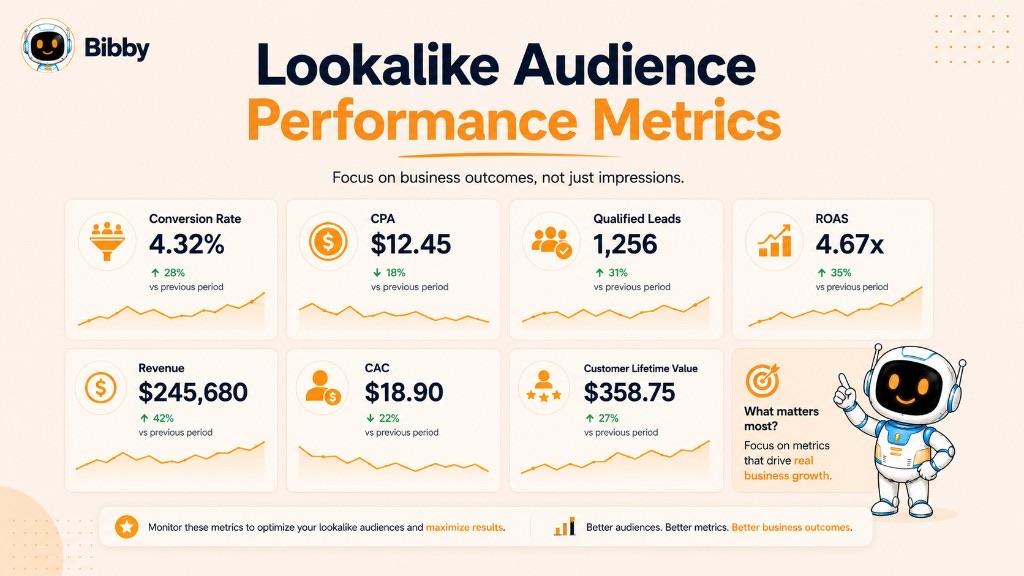
1. Start With the Campaign Goal
- E-commerce: Purchases and revenue
- Lead generation: Qualified leads
- SaaS: Paid subscriptions or valuable trials
- Mobile apps: Valuable in-app actions
- Subscription businesses: New subscribers and retention
- Brand campaigns: Reach, engagement, or other appropriate awareness metrics
2. Measure Conversion Rate
Conversion rate tells you how frequently people complete the desired action, depending on how the platform defines and reports the metric. Consider it alongside cost and customer value.
3. Track Cost Per Acquisition
CPA = Advertising spend ÷ Number of acquisitions
For example: $5,000 ad spend ÷ 250 purchases = $20 CPA. A lower CPA can be positive, but it does not automatically mean the audience is more profitable.
4. Measure Cost Per Qualified Lead
For B2B and lead-generation campaigns, not every lead has equal value. A lookalike at $40 per lead with 40% qualification can beat a broad audience at $30 per lead with 10% qualification.
5. Measure Return on Ad Spend
ROAS = Revenue attributed to advertising ÷ Advertising spend
For example: $20,000 revenue ÷ $5,000 ad spend = 4× ROAS.
6. Measure Customer Acquisition Cost
CPA and customer acquisition cost are not always interchangeable. If your business has multiple steps between a conversion and becoming a genuine customer, calculate the actual cost of acquiring a customer along the full path: ad → lead → sales qualification → customer.
7. Look at Customer Quality
Ask what kind of customers you are acquiring: average order value, repeat purchases, retention, subscription duration, revenue per customer, refund rates, and customer lifetime value.
8. Compare Against a Control or Alternative Audience
| Audience | CPA | Conversion rate | ROAS |
|---|---|---|---|
| Lookalike A | $24 | 3.4% | 4.2× |
| Lookalike B | $29 | 3.0% | 3.8× |
| Broad | $26 | 3.2% | 4.0× |
In this hypothetical example, Lookalike A has the strongest combination of acquisition efficiency and return.
9. Monitor Click-Through Rate, But Don't Stop There
Use CTR as a diagnostic metric, not necessarily as the final measure of audience quality. High CTR is not the same as high conversion rate.
10. Watch Frequency and Audience Saturation
If the same people repeatedly see your ads, performance can eventually change. Monitor frequency where the platform provides the metric, along with declining CTR, rising CPA, falling conversion rate, or increasing creative fatigue.
11. Separate New Customers From Existing Customers
If your objective is acquisition, distinguish between new customers and existing customers where your measurement setup allows it. Appropriate exclusions and measurement practices can make this distinction clearer.
12. Give the Test Enough Data
Avoid declaring a winner after a tiny number of conversions. Two purchases versus one purchase is not enough to confidently conclude that one strategy is superior.
13. Compare the Entire Funnel
Impression → Click → Landing-page visit → Lead or product interaction → Conversion → Customer → Repeat purchase / retention
Excellent CTR with a weak conversion rate could indicate that the audience or creative generates interest but the offer or landing page fails to convert that interest.
14. Use Incrementality When Possible
Attribution data can tell you which conversions are associated with advertising, but it does not always answer whether advertising actually caused additional conversions. Where a business has the appropriate tools and sufficient scale, incrementality or lift testing can provide stronger evidence.
A Simple Lookalike Audience Measurement Framework
1. Did it reach the intended audience? → 2. Did people engage? → 3. Did they convert? → 4. Did they become valuable customers? → 5. Was the acquisition profitable?
| Campaign goal | Primary metrics |
|---|---|
| E-commerce | Purchases, CPA, revenue, ROAS |
| Lead generation | Qualified leads, cost per qualified lead |
| SaaS | Paid conversions, CAC, retention, LTV |
| Mobile app | Valuable in-app actions, CAC, retention |
| Subscription | New subscribers, CAC, retention, LTV |
| Awareness | Reach, frequency, appropriate awareness metrics |
Don't measure a lookalike audience by how impressive it looks in the audience builder. Measure it by what happens after the audience enters the campaign.
Lookalike Audience vs Retargeting
Lookalike audiences and retargeting serve opposite sides of the customer-acquisition funnel. A lookalike audience is generally used to find new prospects who resemble an existing audience, while retargeting is used to reconnect with people who have already interacted with your business.
Lookalike audience = Find new people similar to known users
Retargeting = Reach known users again
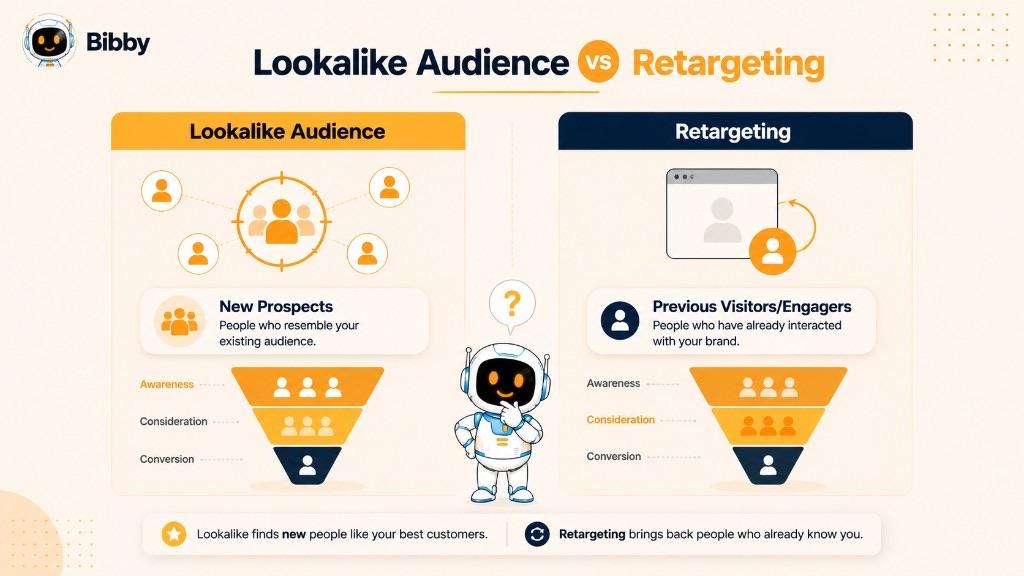
| Feature | Lookalike audience | Retargeting |
|---|---|---|
| Primary purpose | Audience expansion | Re-engagement |
| Audience | New potential prospects | People who already interacted with the business |
| Starting signal | Existing source audience | Previous interaction or engagement |
| Funnel stage | Usually prospecting | Usually consideration or conversion |
| Typical goal | Acquire new customers | Convert or re-engage existing prospects |
| Example audience | People similar to purchasers | Website visitors who did not purchase |
| Relationship with brand | May have no previous interaction | Already interacted with the brand |
How a Lookalike Audience Works
Existing purchasers → Source audience → Platform identifies similar prospects → Lookalike audience → Prospecting campaign
The people in the resulting audience may have no previous relationship with the brand.
How Retargeting Works
Retargeting starts with people who have already interacted with the business: visited a website, viewed a product, added an item to a cart, watched content, engaged with social content, used an app, or previously interacted with an advertisement.
Website visitor → Retargeting audience → Reminder / offer / relevant message → Return visit → Conversion
Example: E-Commerce Store
A visitor looks at a pair of shoes but leaves without purchasing. That person can potentially become part of a retargeting audience. That's retargeting.
The business has thousands of existing purchasers and uses an eligible purchaser audience as the source for a lookalike. That's lookalike targeting.
Lookalike: “Find new people like our customers.”
Retargeting: “Reach people who already interacted with us.”
Which Has Higher Conversion Potential?
Retargeting audiences can often have stronger existing purchase intent because the people have already interacted with the business. However, retargeting audiences are usually smaller, while lookalike audiences can provide much greater prospecting reach.
Retargeting → Capture existing demand
Lookalike → Create new demand opportunities
Lookalike Audience vs Retargeting Funnel
The two strategies can work together:
Existing customers → Lookalike audience → New prospects → Website / product interaction → Retargeting audience → Conversion → New customer
Should You Use Lookalike Audiences or Retargeting?
In many cases, the answer is both, because they perform different jobs.
Use lookalike targeting when your priority is finding new prospects, expanding customer acquisition, reaching people similar to an existing audience, or scaling beyond your current audience.
Use retargeting when your priority is re-engaging previous visitors, recovering abandoned purchase journeys, converting interested prospects, or encouraging previous engagers to take another action.
A Simple Full-Funnel Example
Stage 1: Lookalike prospecting — Existing paying customers → Lookalike audience → New potential users.
Stage 2: First interaction — New prospect → Visits website → Reads product information.
Stage 3: Retargeting — Website visitor → Retargeting audience → Product-focused ad.
Stage 4: Conversion — Prospect → Starts trial → Becomes customer.
Stage 5: New source data — New customers → Added to future eligible customer audience → Potential future lookalike source.
Lookalike targeting is primarily an audience expansion mechanism. Retargeting is primarily a re-engagement mechanism. One reaches outward. The other reaches back.
How Lookalike Audiences Fit Into a Social Media Marketing Strategy
A lookalike audience is most useful when it is treated as one component of a broader social media customer-acquisition strategy. It can help businesses move from an existing audience to new prospects, but it should work alongside content, creative, retargeting, conversion campaigns, and ongoing audience analysis.
Existing customers → Lookalike prospects → Social content/ads → Website or profile → Retargeting → Conversion → New customers
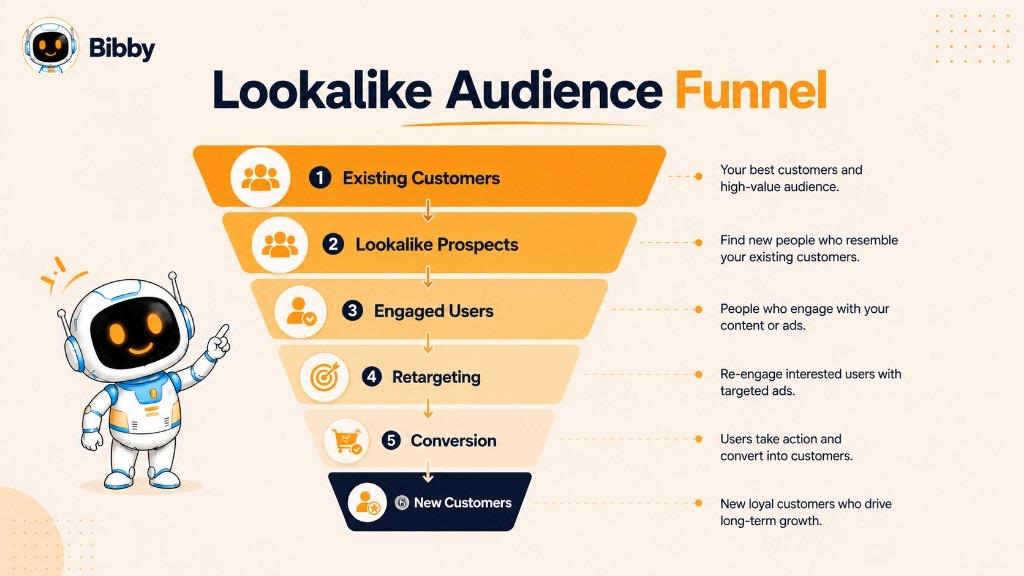
1. Use Existing Customers as a Growth Signal
Your existing customers have already demonstrated that they are willing to take an action such as purchase, subscribe, register, download, become a lead, or complete an in-app action. An eligible audience based on these users can potentially become a source for finding new prospects.
Instead of constantly asking “Who should we target next?”, you can also ask: “Who resembles the people who already value our product?”
2. Connect Lookalikes With Your Content Strategy
A lookalike audience determines who you may want to reach. Your social content determines what those people see from your brand. These should work together—product demonstrations, educational videos, customer stories, feature explainers, industry insights, or problem-solving content.
The audience gets you into the room. The content gives them a reason to stay.
3. Use Different Creative for Different Funnel Stages
A prospect who has never heard of your business should not necessarily receive the same message as someone who has already visited your website.
Lookalike prospect → Introduction / educational creative → Engaged prospect → Product-focused creative → Website visitor → Retargeting creative → High-intent prospect → Offer / conversion creative
4. Combine Lookalike Prospecting With Retargeting
Discover → Engage → Re-engage → Convert
This is often more useful than expecting the first advertisement to generate a conversion from every new prospect.
5. Build Your Source Audience Around Business Value
If your objective is revenue, your audience strategy should ultimately connect to revenue. New customer data can then potentially inform future audience strategies, subject to platform capabilities and applicable privacy requirements.
6. Test Lookalikes Against Broad Social Targeting
A sophisticated social media strategy should not automatically assume that a lookalike audience will outperform broad targeting. Use consistent campaign objectives and meaningful business metrics.
7. Match Your Creative to the Source Audience
If your source consists primarily of customers who value time savings, automation, ease of use, or cost efficiency, your prospecting creative can emphasize those customer-relevant benefits. Your creative should still be tested against real audience response.
8. Use Lookalikes as Part of a Full Social Funnel
Top of funnel: Lookalike + broad prospecting — discover new people, generate awareness, introduce the brand.
Middle of funnel: Engaged users + website visitors — build consideration, explain the product, address objections.
Bottom of funnel: High-intent retargeting audiences — convert, recover abandoned journeys, encourage the desired action.
Post-conversion: Existing customers — retain, upsell, cross-sell, encourage repeat purchases, generate advocacy.
The lookalike audience primarily supports the prospecting layer, but its output feeds the rest of the funnel.
Lookalike Audiences for Social Media Content Distribution
Depending on the platform and available campaign objectives, businesses can also use audience-expansion strategies to introduce content to new potential audiences—for example educational content → new prospects → website visit → retargeting → conversion. Select campaign objectives based on the intended outcome.
How Bibby Can Fit Into the Workflow
For a social media automation workflow, lookalike audience strategy can sit upstream and downstream of content creation.
Audience strategy → Define target customer → Lookalike prospecting campaign (in the ads platform) → Create social content → Generate captions → Schedule content → Publish across selected social channels → Analyze engagement and conversions in native analytics → Retarget engaged prospects → Acquire customers
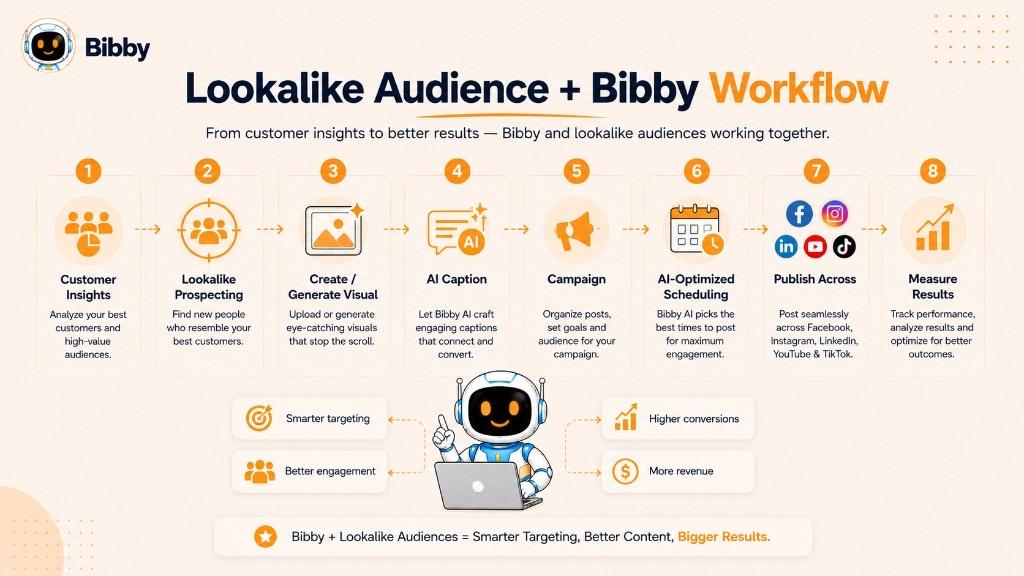
Customer insights, lookalike modeling, and conversion reporting happen in your advertising platform and website analytics. Bibby can help simplify the content-production and scheduling side of this workflow. Upload or generate visuals, select a posting style, generate AI captions, organize campaigns, and schedule images, carousels, videos, and Stories at AI-optimized times on Facebook, Instagram, LinkedIn, YouTube, and TikTok. Chat with Bibby to create a brand kit, campaigns, and posts, or regenerate captions.
Bibby handles the social content workflow. The advertising platform handles audience targeting and lookalike modeling. They solve different parts of the marketing process. Get started with Bibby when you are ready to produce and schedule the creative that sits next to your prospecting campaigns.
Lookalike Audiences and Social Media Automation
Automation becomes particularly useful when a business is running a large volume of social content across multiple campaigns, audience segments, platforms, creative formats, posting schedules, and messaging angles.
A social media automation platform can help manage the content side of the operation while audience platforms manage the advertising side:
Customer insights → Audience strategy → Lookalike prospecting → Content creation → AI-generated captions → Multi-platform scheduling → Performance measurement in ads manager and site analytics → Audience refinement → New campaign
The Strategic Role of a Lookalike Audience
A lookalike audience should ultimately answer one specific strategic question:
“Can we find new potential customers by using what we already know about valuable customers?”
If the answer is supported by campaign data, lookalike targeting can become an important part of your acquisition strategy. If another approach performs better, such as broad targeting, the strategy should evolve accordingly.
The strongest social media marketing strategy is not built around one audience type. It is built around a continuous cycle: understand customers → build useful audiences → reach new prospects → publish relevant content → retarget engaged users → convert → learn from new customers → improve the next campaign.
That is where lookalike audiences become genuinely powerful: not as a standalone targeting trick, but as a bridge between your existing customer knowledge and your next wave of potential customers.
Key Takeaways
- A lookalike audience uses an existing source audience to help find new people who share relevant characteristics or behaviors.
- It is a prospecting and expansion tool, not a list of guaranteed buyers and not the same as a custom audience or retargeting.
- Source quality usually matters more than source size. Model the customers you want more of.
- Percentage sizes such as 1%, 5%, and 10% are platform-specific similarity-versus-reach controls, not universal rankings of “best” people.
- Implementation differs across Meta, LinkedIn, TikTok, and other ecosystems. Check current documentation, privacy rules, and eligibility.
- Test lookalikes against broad and interest-based targeting. Measure qualified conversions, CPA, ROAS, and customer value—not only clicks.
- Bibby supports the content and scheduling that sits next to paid prospecting. Ads platforms create and deliver lookalike audiences.
Explore more terms in the social media dictionary, including audience targeting, paid social, and pixel.