
If you've spent even a few minutes on TikTok, you've probably heard people say, "This landed on my FYP." But what exactly does FYP (For You Page) mean, and why is it such a big deal for creators and brands?
FYP, short for For You Page, is TikTok's personalized feed of recommended videos. Instead of showing the same content to everyone, TikTok's recommendation system creates a unique experience for each user by surfacing videos that match their interests, viewing habits, and interactions. Every swipe, like, comment, share, and watch can influence what appears next.
For creators and businesses, appearing on the TikTok FYP can dramatically increase visibility because it puts content in front of people who may not already follow the account. That is why understanding how the For You Page works has become an essential part of any successful short-form video strategy.
In this article, you will learn:
- What FYP means on TikTok
- How the TikTok recommendation system works
- What influences FYP reach
- How FYP differs from going viral
- Practical ways to build a stronger short-form content strategy
FYP (For You Page) at a Glance
| Term | Meaning |
|---|---|
| Full form | For You Page |
| Platform | TikTok |
| Purpose | Personalized video recommendations |
| How it works | Based on user interests, interactions, and viewing behavior |
| Why it matters | Helps creators and brands reach new audiences |
While getting featured on the FYP isn't guaranteed, creating engaging content and maintaining a consistent publishing strategy can improve your chances of reaching the right audience. Managing that consistency becomes much easier with tools like Bibby, where you can create content, generate AI-powered captions, schedule posts at AI-optimized times, and publish across TikTok, Instagram, Facebook, LinkedIn, YouTube, and more from a single workflow.
In this guide, you'll learn what FYP means, how the TikTok recommendation system works, what influences FYP reach, common myths to avoid, and practical ways creators and businesses can build a stronger short-form content strategy.
What Does FYP Mean on TikTok?
FYP means "For You Page." It is the main personalized content feed on TikTok where users discover videos recommended specifically for them. When someone opens TikTok and starts scrolling through videos from creators they may or may not follow, they are generally browsing their For You feed.
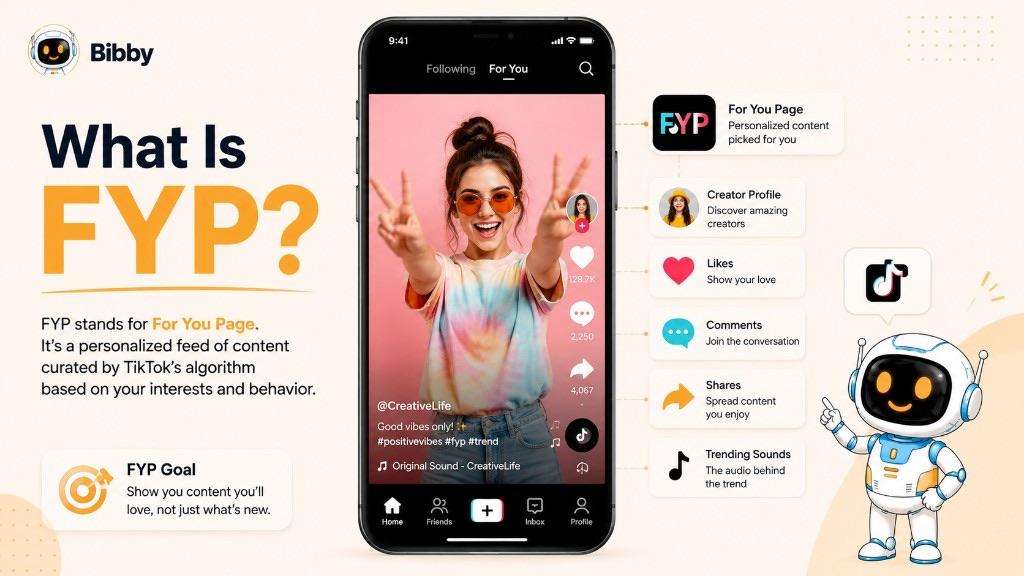
Unlike a traditional feed that only shows posts from accounts a person follows, the FYP is designed around content discovery. This means TikTok can introduce users to new creators, topics, trends, businesses, and communities based on what the platform believes they may enjoy.
For example, if you regularly watch cooking videos, interact with recipe content, and spend time watching restaurant-related videos, your FYP may gradually contain more food and cooking content. Another person using the same app could see videos about fitness, gaming, travel, technology, fashion, or completely different interests.
FYP vs. Following Feed
TikTok essentially gives users two different ways to discover content:
| FYP (For You Page) | Following feed |
|---|---|
| Personalized recommendations | Content from accounts you follow |
| Focuses on content discovery | Focuses on existing connections |
| Can show videos from unfamiliar creators | Primarily shows followed creators |
| Changes based on user behavior | More closely connected to your following list |
| Helps creators reach new audiences | Helps creators reach existing followers |
This distinction is particularly important for creators and brands. Your followers are not the only people who can discover your content. A video can reach people outside your existing audience when TikTok recommends it to users who may find it relevant or engaging.
Why Is the FYP Important?
The For You Page has become one of the biggest discovery opportunities on TikTok. A creator with a relatively small following can potentially reach a much larger audience when their content is recommended beyond their existing followers.
For businesses, this can create opportunities to:
- Increase brand awareness
- Reach new potential customers
- Generate engagement
- Grow followers
- Introduce products or services
- Participate in relevant trends
- Build an audience around a specific niche
However, FYP does not mean "viral," and there is no guaranteed trick for getting onto it. TikTok uses multiple recommendation signals to determine what content users may want to watch.
That makes the goal less about chasing a magical "#FYP" formula and more about consistently creating relevant, engaging content for a clearly defined audience.
How Does the TikTok FYP Work?
The TikTok For You Page is powered by a recommendation system that tries to predict which videos each user is most likely to enjoy. Rather than giving every person the same collection of videos, TikTok personalizes the feed based on different signals gathered from how people interact with content.
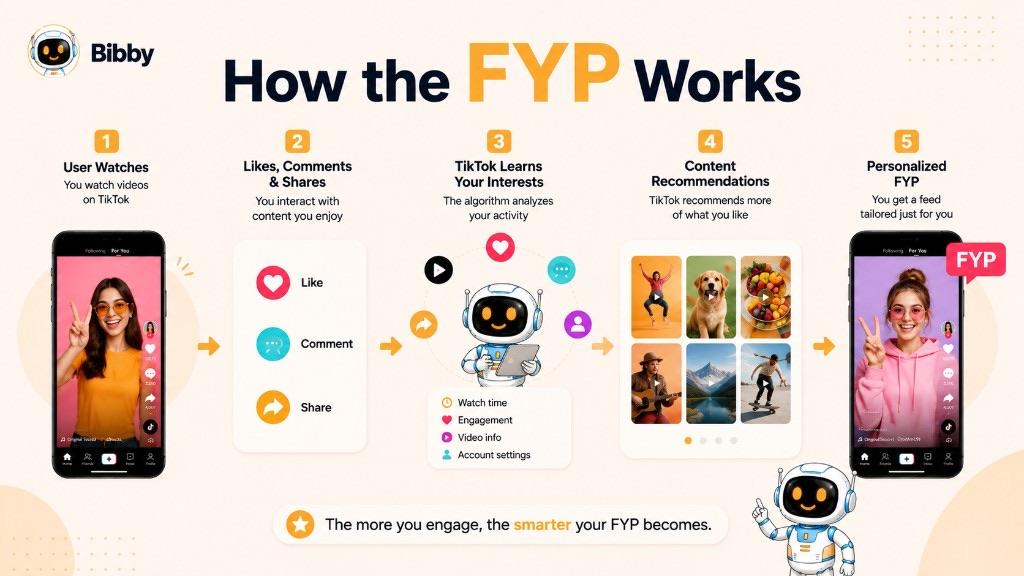
Think of the FYP as a constantly adjusting content engine. When you watch a video all the way through, skip another after a second, like a third, or share something with a friend, those actions can provide signals about your interests. Over time, the recommendations can become more relevant to your viewing habits.
TikTok considers multiple factors rather than relying on a single metric.
User Interactions
The way people interact with videos can help TikTok understand what content they find interesting.
These interactions can include:
- Likes
- Comments
- Shares
- Follows
- Favorites or saves
- Videos users choose to watch
- Videos users skip
- Accounts users interact with
For example, repeatedly engaging with videos about social media marketing may contribute to seeing more content related to marketing and business.
Watch Time and Viewing Behavior
What users do while watching a video can also provide useful signals.
Consider two videos. A user watches the first for two seconds before scrolling away but watches the second until the end and then watches it again. Those viewing patterns can provide different indications about the user's interest.
Important viewing behaviors can include:
- How long someone watches
- Whether they finish the video
- Whether they replay it
- Whether they quickly scroll past it
- Whether they continue watching similar content
This is one reason creators should think beyond simply getting someone to click on a video. Keeping the right audience interested is equally important.
Information About the Video
TikTok can also use information associated with the content to understand what a video is about.
Depending on the content and platform signals, this can include things such as:
For creators, this means making the subject of a video clear can help provide useful context about the content.
For example, a video explaining "How to Create a Social Media Content Calendar" gives TikTok and viewers a much clearer topic signal than a vague caption such as "You need to see this!"
Personalization
The most important thing to understand about the FYP is that there isn't one universal FYP.
Your For You Page is personalized to you.
Someone interested in fitness might see workout routines, nutrition content, and fitness creators. A person interested in technology might encounter smartphone reviews, AI tools, coding tutorials, and startup content.
This personalization is why the same video can perform differently among different audiences. TikTok is constantly trying to match content with viewers who are likely to find it relevant.
Content and Audience Relevance
A creator doesn't need to appeal to everyone to succeed on the FYP.
In many cases, having a clear audience and consistently creating content around relevant topics can be more useful than trying to make every video appeal to the entire TikTok community.
A fitness coach, for example, may benefit more from reaching 50,000 genuinely interested fitness viewers than from reaching 500,000 people who have no interest in fitness.
Does the TikTok FYP Use Just One Algorithm?
Not exactly. It is better to think of TikTok's recommendations as a system that evaluates many signals rather than a single secret formula that creators can crack. That system is part of the broader social media algorithm conversation, but it isn't a single switch you can flip.
There is no guaranteed combination of hashtags, posting times, video lengths, or engagement numbers that automatically puts a video on the FYP.
The recommendation system can also evolve over time. As TikTok changes its products and recommendation technology, the relative importance of different signals may change as well.
For creators, the practical lesson is straightforward: create content people genuinely want to watch, make the topic clear, understand your audience, and use performance data to improve future posts.
And once you have good content, the next challenge is keeping it organized and publishing consistently. That's where an automation workflow such as Bibby can help, from generating captions and planning campaigns to scheduling content across TikTok and other social platforms.
What Factors Influence FYP Reach?
Getting your content in front of the right people on TikTok isn't controlled by a single metric. FYP reach can be influenced by a combination of viewer behavior, content relevance, engagement, and other recommendation signals.
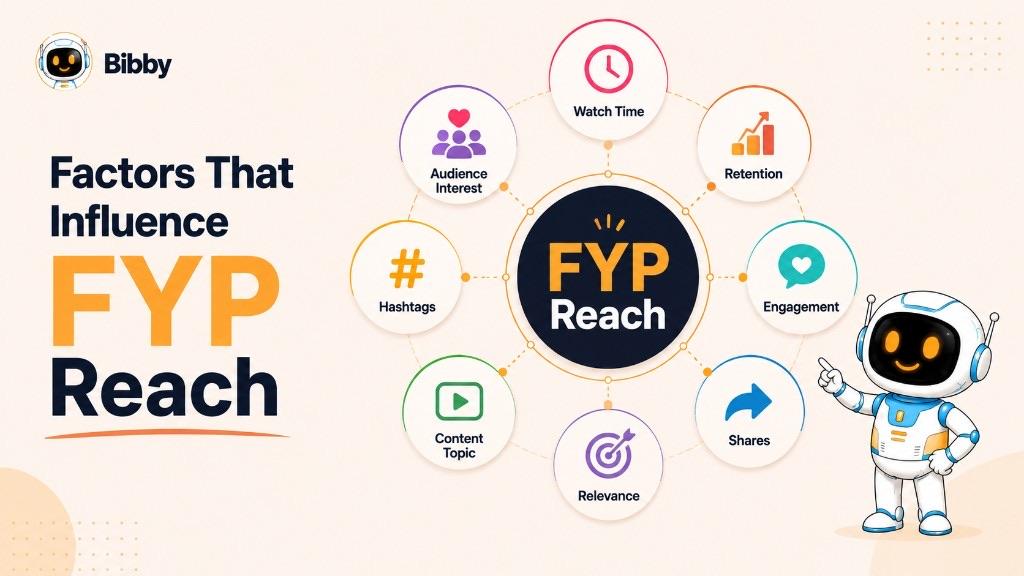
This is important because creators sometimes focus too heavily on one tactic, such as adding #FYP to every caption or posting at a specific time. These tactics alone don't guarantee that a video will receive more For You Page exposure.
Instead, think about the complete viewing experience. Does your video attract the right audience? Do people keep watching? Do they interact with it? Is the topic clear? Does the content provide something worth sharing?
Here are some of the major factors to consider.
Watch Time
Watch time refers to how long viewers spend watching your content. A video that consistently holds attention can provide stronger evidence that viewers find the content interesting.
For creators, this means the video should deliver value rather than spending too much time getting to the point.
For example, instead of beginning with a long introduction, a tutorial might immediately show the problem and promise a solution.
Completion Rate
Completion rate refers to the percentage of viewers who watch a video through to the end.
Short-form content benefits from a clear structure that encourages viewers to keep watching.
You can improve the viewing experience by:
- Starting with a strong hook
- Removing unnecessary introductions
- Keeping the message focused
- Using clear storytelling
- Creating curiosity
- Delivering the promised value
A video doesn't need to be extremely short to perform well. The better question is whether its length makes sense for the content and keeps the intended audience interested.
Rewatches
When viewers watch a video more than once, that behavior can indicate strong interest.
Rewatches can happen naturally with:
- Tutorials
- Tips
- Fast demonstrations
- Entertaining clips
- Detailed explanations
- Before-and-after content
You shouldn't create confusing content simply to force rewatches. The goal is to make something valuable enough that viewers want to watch it again.
Likes, Comments, and Shares
Engagement provides another layer of information about how audiences respond to content.
Common interactions include:
- Likes
- Comments
- Shares
- Saves or favorites
- Follows
However, not all engagement has the same meaning for every business.
A funny video may generate thousands of likes, while an educational video may generate fewer likes but significantly more saves or shares. For a business, those deeper actions may be more valuable.
Audience Relevance
One of the most important principles of FYP content is relevance.
TikTok's recommendation experience is personalized, so content needs to make sense for the people who are likely to see it.
For example, a video about accounting software may have a smaller potential audience than a general entertainment video, but reaching business owners, accountants, or finance professionals could be far more valuable for a B2B company.
Content Topic
Your topic helps establish what your video is about.
Creators should avoid making every post about a completely unrelated subject. Building recognizable content themes can help both audiences and content recommendation systems understand the type of content an account produces.
For example, a digital marketing account might consistently cover:
- SEO
- Social media marketing
- Content strategy
- AI marketing tools
- Marketing automation
This creates a clearer content identity than randomly switching between unrelated topics.
Captions and Hashtags
Captions and hashtags can provide additional context about a video.
The best approach is to use them naturally and accurately.
If you're posting a video about social media automation, relevant terms and hashtags related to social media automation make more sense than adding dozens of unrelated trending hashtags simply because they are popular.
Relevance beats hashtag stuffing.
Content Quality and Originality
People are more likely to engage with content that gives them a reason to stop scrolling.
That could mean:
- Useful information
- Entertainment
- A fresh perspective
- A compelling story
- An interesting demonstration
- A practical solution
- A relatable experience
High production quality can help, but expensive equipment isn't a requirement. A clear idea and strong execution often matter more than having a studio full of shiny gadgets.
Consistency
Consistency doesn't mean publishing as many videos as possible.
Instead, it means creating a sustainable publishing routine that allows you to regularly provide useful content to your audience.
A consistent workflow also gives creators more opportunities to test:
- Topics
- Hooks
- Formats
- Video lengths
- Posting schedules
- Content styles
Tools such as Bibby can simplify this operational side by helping creators plan content, generate captions, organize campaigns, and schedule posts across multiple social platforms.
Viewer Feedback Through Behavior
One of the most useful ways to think about the FYP is that viewers continuously provide feedback through their behavior.
If people consistently watch, engage with, save, or share a particular type of content, creators can use that information to understand what resonates with their audience.
This creates a useful cycle:
Create → Publish → Observe → Learn → Improve → Create Again
There is no guaranteed FYP formula. Instead of chasing the latest supposed "algorithm hack," creators are better served by building a repeatable content process, understanding their audience, and continuously improving based on real performance.
FYP vs. Going Viral: Are They the Same Thing?
FYP and viral content are not the same thing. Although appearing on the For You Page can help a video reach a much larger audience, simply appearing on the FYP does not automatically make a video viral.
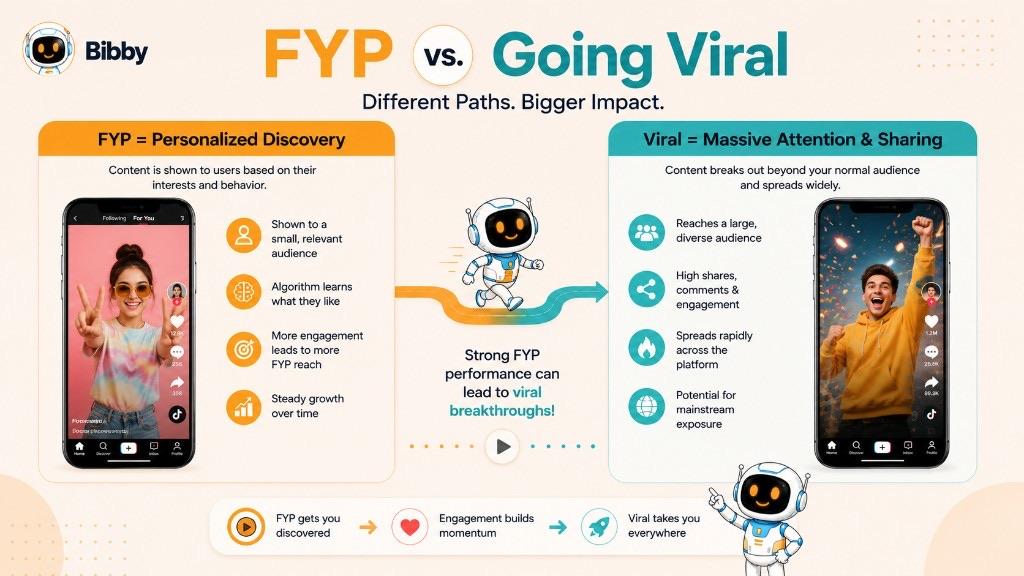
The For You Page is a recommendation feed, while virality describes unusually high levels of attention, sharing, and reach.
A video can appear on thousands of people's FYPs without becoming a viral sensation. Likewise, a video that starts receiving strong engagement and shares can gradually reach a much broader audience.
What Is the Difference Between FYP and Viral Content?
| FYP | Viral content |
|---|---|
| A personalized recommendation feed | Content that receives unusually high attention |
| Helps users discover content | Describes exceptional content performance |
| Personalized for each viewer | Can spread rapidly across large audiences |
| Can introduce users to new creators | Often generates substantial shares and discussion |
| Does not guarantee massive reach | Usually involves significantly above-average reach |
Why Does FYP Exposure Matter for Virality?
The FYP gives TikTok an important mechanism for content discovery.
Imagine a creator with 2,000 followers publishes a video. Their existing followers may see it, but the video can also be recommended to people who don't follow that creator.
If those viewers find the video interesting and continue watching, sharing, commenting, or engaging with it, the content may have opportunities to reach additional audiences.
This can create a growth cycle:
Initial audience → More relevant viewers → Engagement → Wider discovery → More viewers
But this shouldn't be interpreted as a guaranteed sequence. Not every video that reaches new viewers will continue expanding.
Can a Video Go Viral Without Having Many Followers?
Yes, follower count and individual content reach are not the same thing.
A creator with a relatively small audience can produce a video that attracts significant attention beyond their existing followers. This is one reason recommendation-driven platforms can be valuable for new creators and businesses.
Instead of relying entirely on an established follower base, creators can potentially use individual pieces of content to introduce themselves to new audiences.
Does Getting on the FYP Guarantee Viral Views?
No.
A video may receive FYP exposure but stop gaining momentum if viewers aren't interested enough to keep watching or interacting with it.
For example, suppose a video reaches 20,000 recommended viewers but most people quickly scroll past it. The video may not continue expanding.
Another video might initially reach a smaller audience but generate strong watch time, shares, and meaningful engagement. That content may have a better opportunity to continue reaching relevant viewers.
The lesson is simple:
FYP exposure creates an opportunity. Content quality determines what happens next.
FYP Is About Discovery, Not a Guaranteed Viral Button
Creators sometimes treat "getting on the FYP" as the ultimate objective. But for businesses especially, raw reach isn't always the most important outcome.
A highly relevant audience can be more valuable than a huge but unrelated audience.
For example, a SaaS company might prefer reaching 50,000 business owners who could genuinely use its product rather than reaching 500,000 viewers who have no connection to its market.
That's why a strong TikTok strategy should focus on more than chasing viral numbers. Reach, retention, engagement, audience relevance, brand awareness, and conversions can all matter.
And once creators understand that FYP exposure is an opportunity rather than a magic viral switch, the strategy becomes much more sustainable: create useful content, understand your audience, publish consistently, study what resonates, and keep improving.
How to Get on the FYP
There is no guaranteed trick for getting a video onto TikTok's For You Page, and no hashtag, posting time, or engagement tactic can promise FYP placement. The better approach is to create content that is relevant to a specific audience and gives people a reason to keep watching, interact, or share.
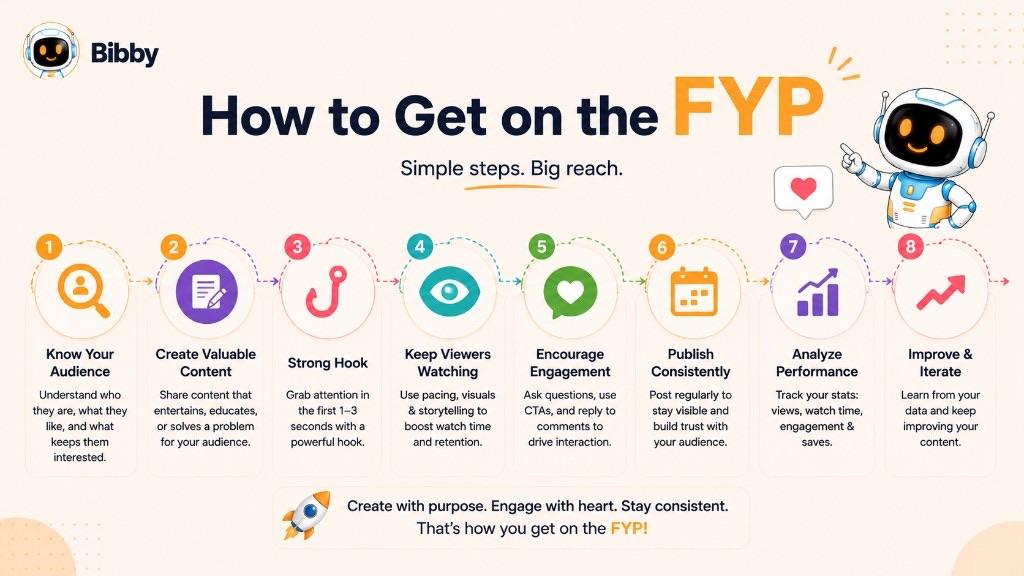
If you're wondering how to get on the FYP, focus on the fundamentals first. The following strategies can help you build content with a stronger chance of reaching relevant viewers.
Start With a Strong Hook
TikTok is a fast-moving environment. People can scroll past a video almost instantly, so the opening needs to establish a reason to continue watching.
A strong hook could:
- Ask an interesting question
- Introduce a problem
- Make a surprising statement
- Show the result first
- Promise a useful tip
- Create curiosity
For example, instead of starting a video about social media automation with a lengthy introduction, you could begin with:
"Still spending two hours every day scheduling social media posts?"
The viewer immediately understands the problem being addressed.
Give Viewers a Reason to Keep Watching
Getting someone to stop scrolling is only the beginning. Your content also needs to deliver on the promise made by the opening.
You can improve retention by:
- Removing unnecessary pauses
- Keeping the story focused
- Using visual changes
- Breaking information into clear steps
- Building curiosity
- Delivering the payoff before the video ends
Don't stretch a 15-second idea into a 60-second video simply to make it longer. The right length is the length needed to communicate the idea effectively.
Create Content for a Specific Audience
Trying to appeal to everyone can make content less useful to anyone.
Instead, identify who you want to reach.
For example:
- A fitness creator can target beginners.
- A SaaS company can create content for small businesses.
- A restaurant can create videos for local food lovers.
- A marketing consultant can target business owners and marketers.
When your content has a clear audience, it becomes easier to choose relevant topics, language, examples, and formats.
Create Content People Want to Share
Shares can help content travel beyond its initial audience.
Think about what makes someone send a video to a friend or colleague:
- "You need to try this."
- "This explains exactly what we're dealing with."
- "This is useful."
- "This is hilarious."
- "You should see this."
Educational, entertaining, relatable, surprising, and highly practical content can all have strong sharing potential.
Encourage Genuine Engagement
You can invite people into the conversation without turning every video into a desperate request for likes.
Try asking relevant questions such as:
- "Which strategy works best for you?"
- "Would you try this?"
- "What would you add to this list?"
- "Which one should I explain next?"
The goal is to create real conversation, not manufacture empty engagement.
Use Relevant Hashtags
Hashtags can help provide context about your content, but adding #FYP to a video doesn't guarantee FYP placement.
Instead, use hashtags that accurately describe your:
- Topic
- Industry
- Audience
- Content category
For a social media automation video, relevant hashtags might be more useful than a collection of unrelated trending hashtags.
Don't treat hashtags as an algorithm cheat code.
Use Trends Without Losing Your Identity
Trending sounds, formats, challenges, and content styles can provide opportunities for discovery.
But jumping onto every trend isn't necessarily a good strategy.
Before using a trend, ask:
"Does this make sense for my audience and brand?"
A trend adapted creatively to your niche is usually more valuable than copying something simply because everyone else is doing it.
For example, a software company could adapt a trending format to demonstrate a common customer problem rather than producing a completely unrelated trend video.
Make Your Topic Clear
Your video should make sense to both viewers and the platform.
Use clear:
- On-screen text
- Captions
- Descriptions
- Relevant terminology
- Appropriate hashtags
If your video is about AI social media scheduling, make that topic clear instead of hiding the subject behind a vague caption.
Clarity helps users immediately understand what they're watching and gives your content stronger contextual signals.
Post Consistently
Consistency gives you more opportunities to learn what works.
That doesn't mean you need to publish ten videos every day.
A sustainable schedule is better than creating a huge batch of content for one week and then disappearing for a month.
Create a repeatable system for:
Ideas → Creation → Captions → Scheduling → Publishing → Analysis
This is where social media automation can become useful. With Bibby, creators and businesses can upload content or generate images with AI, choose a posting style, automatically generate captions, and schedule content at AI-optimized times across TikTok and other platforms.
Study Your Performance
Don't guess what your audience likes when your content data can provide clues.
Look at metrics such as:
- Views
- Watch time
- Completion rate
- Shares
- Comments
- Likes
- Saves
- Profile visits
- Follower growth
Then compare your strongest and weakest posts.
Did your best-performing videos have a particular topic? Did they use a certain hook? Were they shorter? Did viewers share them more often?
Those patterns can help you make better decisions about future content.
Keep Improving Instead of Chasing FYP Hacks
The biggest mistake creators can make is constantly jumping from one supposed TikTok "hack" to another.
One week it's a specific hashtag. The next week it's a particular posting time. Then someone claims a certain video length is the secret.
These tactics may come and go, but the fundamentals remain useful:
Understand your audience. Create valuable content. Earn attention. Keep people watching. Encourage genuine interaction. Analyze the results. Improve your next post.
That's a much stronger long-term strategy than trying to unlock a mythical FYP button hidden somewhere behind TikTok's curtains.
Does Posting Time Affect FYP?
Posting time can influence how quickly your content gets initial attention, but there is no universal "best time to post" on TikTok that guarantees FYP reach. The ideal publishing time depends on when your particular audience is active and how they interact with your content.
This is why generic advice such as "always post at 7 PM" can be misleading. A creator whose audience is primarily in New York may have very different peak activity periods from a creator whose audience is concentrated in London, Mumbai, or Sydney.
Why Posting Time Can Matter
When you publish a video, having relevant viewers available can help the content receive its initial exposure and engagement.
For example, if most of your audience is active in the evening, publishing during that period may give your content a better opportunity to reach viewers when they're actually using TikTok.
However, posting at the right time doesn't make weak content perform well.
A perfectly timed video can still receive little engagement if viewers don't find it interesting. Likewise, a strong piece of content can continue reaching people beyond its original publishing window.
How to Find Your Best Time to Post
Instead of relying entirely on generic "best time to post" charts, look at your own audience and performance data.
Consider:
- When your audience is most active
- Where your audience is located
- Which days generate stronger engagement
- When previous videos performed well
- Whether your audience behaves differently on weekdays and weekends
You can then test different publishing windows and compare the results over time.
Does Posting at the "Perfect" Time Guarantee the FYP?
No.
Posting time is only one part of a much larger content strategy. FYP recommendations can involve multiple signals related to content and viewer behavior.
Think of timing as getting your content onto the starting line. What happens afterward still depends heavily on whether people actually want to watch and interact with it.
Should You Post at the Same Time Every Day?
Not necessarily.
A consistent publishing routine can make content management easier, but you don't need to treat one exact minute as sacred.
Your audience's behavior may change depending on:
- Day of the week
- Season
- Location
- Industry
- Holidays
- Events
- Audience habits
Testing different time windows can help you discover patterns that generic recommendations cannot.
How Bibby Helps With Social Media Scheduling
For creators managing multiple accounts, manually deciding when every post should go live can become surprisingly time-consuming.
Bibby simplifies this part of the workflow by allowing you to upload content or generate images with AI, select your preferred posting style, generate captions automatically, and schedule content at AI-optimized times.
You can schedule different content for different dates across platforms such as:
You can also manage images, carousels, videos, and Stories from the same workflow.
The important distinction is that AI-optimized scheduling does not guarantee FYP placement. Its purpose is to make the publishing process more efficient and help you maintain a consistent content schedule while you focus on creating content your audience actually wants to consume.
Ultimately, don't obsess over finding one magical posting time. Use your own audience data, test different windows, and combine smart scheduling with strong content.
Does #FYP Actually Help You Get on the FYP?
If you've spent time looking at TikTok captions, you've probably seen hashtags such as #FYP, #ForYou, and #ForYouPage. Many creators add them to their videos hoping they will increase the chances of appearing on the For You Page.
But here's the important part: using #FYP does not guarantee that your video will appear on the FYP.
The hashtag describes the destination creators are hoping to reach. It isn't a magic ticket that unlocks TikTok's recommendation system.
What Does #FYP Mean?
#FYP is simply the hashtag version of FYP, which stands for For You Page.
Creators commonly use it alongside other hashtags, particularly when publishing content they hope will reach audiences beyond their existing followers.
However, adding the hashtag doesn't automatically tell TikTok:
"Show this video to everyone."
TikTok's recommendation system considers multiple signals when determining what content to recommend to users.
Does #FYP Increase Views?
There is no guarantee that adding #FYP will increase views.
A video with #FYP can receive very little reach, while another video without it can receive significant exposure.
Why? Because the hashtag is only one piece of the content's context, while viewer behavior and content relevance are much broader considerations.
For example, imagine two videos:
Video A
- Uses #FYP
- Weak opening
- Viewers quickly scroll away
- Low engagement
- Unclear topic
Video B
- Uses relevant niche hashtags
- Strong opening
- Clear topic
- High viewer retention
- Generates shares and comments
Video B may have much stronger performance even without using #FYP.
Should You Use #FYP?
You can use #FYP if it is relevant to your content strategy, but it shouldn't be the foundation of your TikTok strategy.
Instead, prioritize hashtags that describe what your video is actually about.
For example, a video about social media automation could use hashtags related to:
- Social media marketing
- Social media automation
- Content creation
- AI marketing
- TikTok marketing
The exact hashtags should match the content and audience rather than simply chasing popular tags. A hashtag generator can help you brainstorm relevant options, but relevance still matters more than volume.
Avoid Hashtag Stuffing
Adding a huge collection of unrelated hashtags isn't a reliable way to increase FYP exposure.
Imagine posting a video about accounting software and adding hashtags for #FYP, #Viral, #Gaming, #Football, #Fashion, #Travel, and #Food.
Those hashtags don't accurately describe the content or its intended audience.
A smaller set of relevant, descriptive hashtags is generally a more sensible approach.
#FYP Is Not an FYP Hack
One of the biggest misconceptions about TikTok marketing is that there is a single hashtag or trick that guarantees recommendation.
There isn't.
The better approach is to focus on the complete content experience:
Relevant topic → Strong hook → Valuable content → Viewer retention → Meaningful engagement → Consistent publishing
Hashtags can help provide context, but they shouldn't distract from the thing that matters most: creating content people actually want to watch.
And if you're publishing consistently across multiple platforms, automation can take much of the repetitive work off your plate. Bibby lets you create or upload content, generate AI captions, organize campaigns, and schedule posts across TikTok, Instagram, Facebook, LinkedIn, and YouTube without turning your social media calendar into a spreadsheet jungle.
Common FYP Myths
The For You Page has become one of the most talked-about parts of TikTok, which has also created plenty of myths about how it works. From secret hashtags to supposedly perfect posting times, creators often hear advice that sounds convincing but isn't necessarily supported by how recommendation systems actually work.
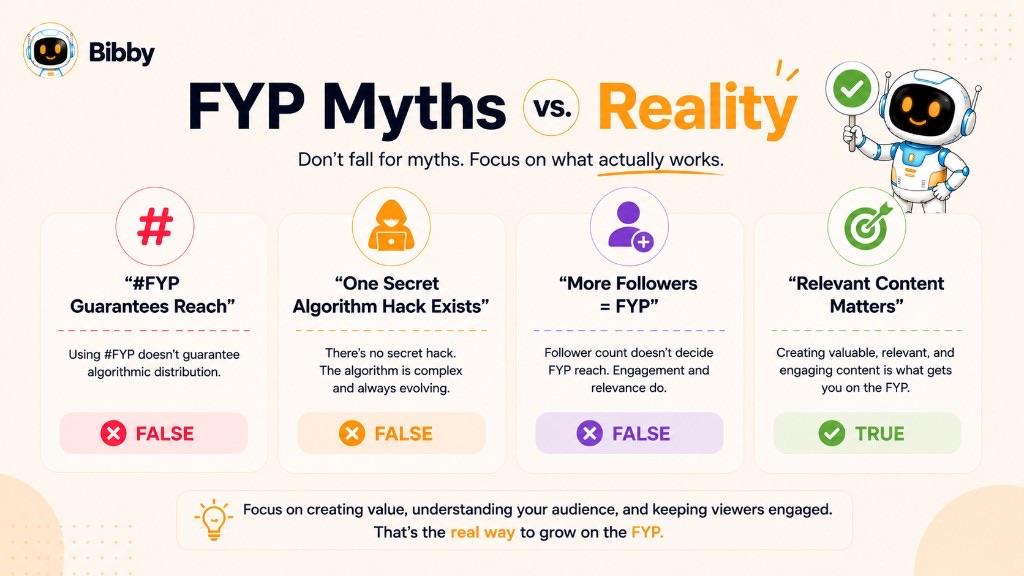
Let's separate some of the most common FYP myths from reality.
Myth 1: You Need #FYP to Get on the FYP
Reality: Adding #FYP does not guarantee FYP placement.
The hashtag is commonly used by creators, but it isn't a magic switch that tells TikTok to distribute a video more widely. Relevant content, viewer behavior, and other recommendation signals matter far more than simply adding three letters and a hashtag.
Myth 2: There Is One Secret FYP Algorithm Hack
Reality: There isn't a single trick that guarantees FYP reach.
TikTok recommendations involve multiple signals, and the platform can change how its recommendation systems work over time.
Instead of hunting for a secret formula, creators should focus on fundamentals such as:
- Audience relevance
- Strong hooks
- Watch time
- Retention
- Engagement
- Useful or entertaining content
- Consistent publishing
Myth 3: You Must Have Thousands of Followers
Reality: A large follower count is not a prerequisite for content discovery.
The FYP is designed to help users discover content beyond the accounts they already follow. This means creators with smaller audiences can still have individual videos reach people who don't already follow them.
That is one of the reasons TikTok can be particularly interesting for new creators and emerging brands.
Myth 4: Posting at One Exact Time Guarantees FYP Reach
Reality: There is no universal posting time that guarantees FYP exposure.
Your audience may be most active at a different time from another creator's audience. Location, audience habits, industry, and day of the week can all influence when people are available to watch content.
Use your own analytics and test different publishing windows rather than treating a generic "best time" as a universal rule.
Myth 5: More Posts Always Mean More FYP Views
Reality: More content creates more opportunities to learn, but quantity alone doesn't guarantee better reach.
Publishing five weak videos doesn't necessarily outperform publishing two well-planned videos.
A sustainable content strategy should prioritize quality, relevance, consistency, and learning rather than simply maximizing the number of uploads.
Myth 6: Getting on the FYP Means Your Video Is Viral
Reality: FYP exposure and virality are different concepts.
The For You Page is a recommendation feed. A video can appear there without receiving enormous amounts of attention.
Virality generally refers to content receiving unusually high levels of reach, engagement, sharing, or discussion.
FYP exposure can contribute to that growth, but it doesn't automatically produce it.
Myth 7: Every Video Should Follow the Same Formula
Reality: Different audiences respond to different content.
One video may succeed because it tells a compelling story. Another may perform well because it provides a useful tutorial. A third might succeed because it's funny, surprising, or highly relatable.
Instead of copying one format indefinitely, creators should experiment with:
- Hooks
- Topics
- Formats
- Video lengths
- Storytelling styles
- Visual approaches
- Calls to action
Then use performance data to identify what works for their specific audience.
Myth 8: Going Viral Is the Only Goal
Reality: Viral reach isn't always the most valuable outcome.
For a business, reaching the right people can be more important than reaching the largest possible number of people.
A software company, for example, may gain more business value from reaching 20,000 potential customers than from reaching 500,000 viewers who have no interest in its product.
That means a strong FYP strategy should consider more than views. Audience relevance, engagement, brand awareness, website visits, leads, and conversions can all matter.
The Bottom Line
The FYP isn't a puzzle with one hidden combination. It's better approached as a content discovery opportunity.
Create content for a specific audience, make it worth watching, understand how viewers respond, and improve your strategy over time.
And when the repetitive work of creating captions, organizing campaigns, and scheduling posts starts eating into your creative time, automation tools such as Bibby can help streamline the publishing process while you concentrate on the content itself.
Why the FYP Matters for Creators and Businesses
The For You Page (FYP) matters because it gives creators and businesses an opportunity to reach people who don't already follow them. Instead of relying entirely on an existing follower base, content can be discovered by users who may be interested in the topic, product, service, or idea being shared.
For creators, this can mean more visibility and audience growth. For businesses, it can turn TikTok into a valuable channel for brand discovery, education, community building, and customer acquisition.
Reach People Beyond Your Followers
One of the biggest advantages of recommendation-driven content is audience discovery.
A creator with a relatively small following can still publish content that reaches people outside their existing audience. This makes the FYP particularly useful for newer creators, niche experts, startups, and growing brands.
Instead of asking only:
"How many followers do I have?"
Creators can also ask:
"How many relevant people can discover my content?"
That shift is important because follower growth often starts with content reaching people who have never encountered the account before.
Increase Brand Awareness
For businesses, FYP exposure can introduce a brand to potential customers who may not have discovered it through traditional search or advertising.
A company can use short-form content to demonstrate:
- What its product does
- How its service works
- Problems it solves
- Customer experiences
- Industry knowledge
- Behind-the-scenes processes
- Product features
- Tips and tutorials
Over time, consistently useful content can help build familiarity with a brand.
Grow Your TikTok Following
When people discover a video they genuinely enjoy, they may visit the creator's profile and follow the account for more content.
This creates an important relationship between content discovery and follower growth.
A strong video can act as an introduction:
Someone discovers your video → Visits your profile → Understands what you offer → Follows your account → Becomes part of your audience
That's why creators shouldn't focus only on individual video views. Your profile, bio, content themes, and overall brand should give new visitors a reason to stick around.
Generate Engagement
FYP exposure can also create opportunities for meaningful engagement.
Depending on the content, viewers may:
- Like a video
- Comment
- Share it
- Save it
- Visit the profile
- Follow the account
- Watch other videos
For businesses, comments can be especially useful because they reveal questions, objections, preferences, and customer interests.
A comment such as "Does this work for small businesses?" isn't just engagement. It can also become the idea for your next video.
Build Authority in a Niche
The FYP isn't only useful for entertainment content.
Experts can use TikTok to educate audiences about specific subjects, including:
- Marketing
- Finance
- Technology
- Fitness
- Education
- Real estate
- Business
- Software
- Healthcare
- Travel
- Fashion
Publishing consistently around a recognizable topic can help establish a creator or company as a useful source of information within its niche.
You don't need to become the internet's encyclopedia. You just need to consistently answer questions your audience actually has.
Promote Products and Services
Businesses can also use TikTok content to demonstrate products and services naturally.
For example:
A SaaS company could show how its software solves a common workflow problem.
A restaurant could showcase how a popular dish is prepared.
A clothing brand could demonstrate multiple ways to style one product.
An app company could show a feature solving a real customer problem.
This approach allows businesses to make their products part of useful or entertaining content rather than turning every post into a traditional advertisement.
Discover What Your Audience Wants
FYP-focused content can also become a testing ground for your broader content strategy.
Suppose a business publishes videos about five different subjects and discovers that videos around one particular topic consistently receive stronger retention, shares, and comments.
That information can influence future:
- Blog content
- Social posts
- Videos
- Campaigns
- Product messaging
- Email content
- Advertising creatives
In other words, social media isn't just a distribution channel. It can also be a source of audience intelligence.
Create Opportunities for Organic Growth
Paid advertising can provide predictable distribution when managed effectively, but organic recommendation feeds offer another path to discovery.
A strong piece of content can continue attracting viewers after it is published, potentially reaching audiences beyond the creator's existing followers through organic reach.
There is no guarantee that a particular video will achieve this, but the possibility makes consistent content creation valuable.
FYP Reach Isn't the Same as Business Success
One important distinction is worth remembering:
More FYP views do not automatically mean more customers.
A video can receive enormous reach but generate little business value if the audience isn't relevant.
For example, a local accounting firm may not benefit much from millions of views from viewers who live outside its service area. A smaller audience of relevant business owners in the firm's target market could be far more valuable.
That's why businesses should look beyond vanity metrics and consider:
- Relevant reach
- Engagement
- Profile visits
- Website traffic
- Leads
- Sales
- Follower quality
- Brand awareness
The goal isn't simply to be seen by more people. It's to be seen by the right people.
How Bibby Can Help Maintain a Consistent FYP Content Strategy
Creating content is only one part of social media marketing. Keeping that content organized and publishing consistently can become a full-time administrative job.
Bibby helps simplify that workflow by bringing content creation and scheduling into one system. You can upload an image or generate one with AI, choose a posting style, have AI generate captions, and schedule content at AI-optimized times.
You can also manage:
- Images
- Carousels
- Videos
- Stories
- Campaigns
- Brand kits
- Captions
- Publishing schedules
And with Bibby's chat interface, you can manage social media through conversation, including creating campaigns, creating posts, regenerating captions, and handling other social media tasks.
The purpose isn't to promise FYP placement. No automation tool can guarantee that. Instead, Bibby helps remove repetitive publishing work so creators and businesses can spend more time creating content that is relevant, useful, and worth watching.
Ultimately, the FYP is valuable because it creates a doorway to discovery. What you do with that opportunity, however, depends on the quality of your content, your understanding of your audience, and the consistency of your overall social media strategy.
FYP for Brands and Social Media Marketers
The For You Page (FYP) isn't just useful for individual TikTok creators. It can also be a powerful discovery channel for brands, marketers, startups, and businesses that want to reach audiences beyond their existing followers.
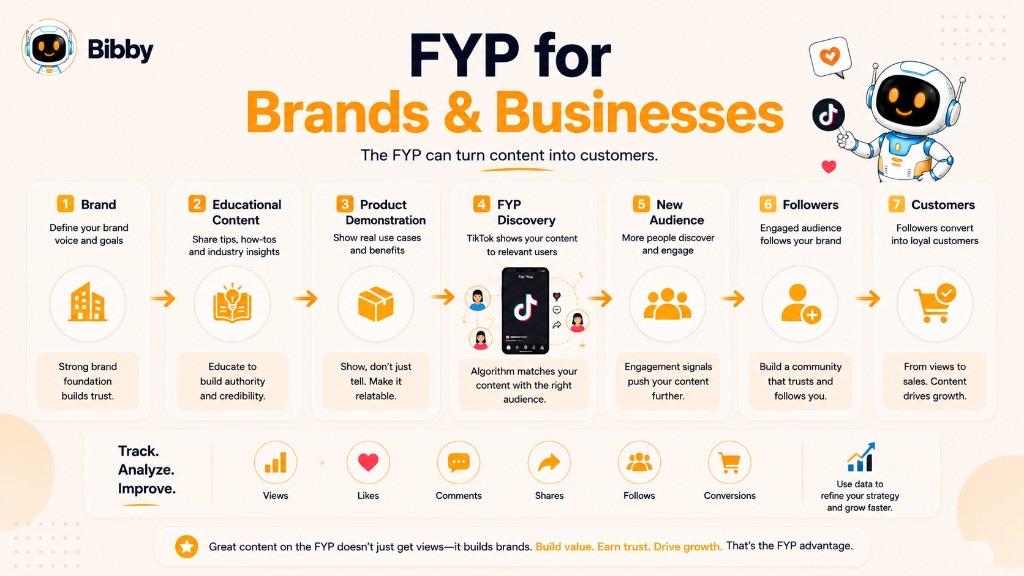
For brands, the objective shouldn't be to chase FYP views at any cost. The better strategy is to create content that is relevant to the target audience, useful or entertaining, and aligned with the brand's goals.
A TikTok video that reaches the right 10,000 people can be more valuable than one that reaches 100,000 completely irrelevant viewers.
Create Content Around Audience Interests
Start with the audience rather than the algorithm.
Ask:
- What problems does my audience have?
- What questions do they ask?
- What topics do they care about?
- What type of content do they already consume?
- What would make them stop scrolling?
- What information would they share with someone else?
For example, a social media software company could create content around:
- Social media scheduling
- Content planning
- AI marketing
- Social media productivity
- Caption writing
- Marketing automation
- Common social media mistakes
These topics naturally connect the content with the company's expertise and audience.
Use Educational Content
Educational videos can work particularly well for brands because they give viewers a reason to watch even when they aren't immediately looking to purchase something.
Examples include:
- Quick tutorials
- How-to videos
- Industry tips
- Mistake breakdowns
- Step-by-step guides
- "Did you know?" content
- Frequently asked questions
For example, an app development company could create a short video explaining three mistakes businesses make when developing a mobile app.
The video provides value first while also demonstrating the company's expertise.
Show Products in Action
Instead of constantly telling people that your product is great, show them what it can actually do.
A software company might demonstrate:
Problem → Product → Solution → Result
For example:
"Managing five social media platforms manually?"
Then demonstrate how a workflow can move from content creation to caption generation and scheduling.
Product demonstrations can make complicated software easier to understand while giving viewers a reason to explore the brand further.
Create Behind-the-Scenes Content
People don't only want polished advertisements.
Behind-the-scenes content can make brands feel more human and give audiences a look at:
- Product development
- Team activities
- Manufacturing
- Packaging
- Office culture
- Creative processes
- Customer experiences
- Day-to-day operations
For a food business, this might mean showing how a signature dish is prepared.
For a software company, it could mean showing how a new feature goes from an idea to a finished product.
Use Storytelling
A strong story can turn an ordinary topic into something people want to watch.
Brands can tell stories about:
- How the company started
- Customer problems
- Product failures and improvements
- Behind-the-scenes challenges
- Success stories
- Founder experiences
- Industry changes
The story doesn't need to be dramatic. Sometimes a simple problem → discovery → solution structure is enough.
Participate in Trends Strategically
TikTok trends can provide creative opportunities, but brands shouldn't blindly copy every trending sound or format.
Before joining a trend, consider:
Does this trend make sense for our audience?
If the answer is no, skipping it is perfectly reasonable.
A good brand adaptation takes a recognizable trend and gives it a relevant industry angle.
For example, a digital marketing company could take a popular format and use it to explain common SEO mistakes. The trend becomes the packaging, while the expertise remains the substance.
Encourage Conversations
Brands should treat TikTok as a communication channel, not just a broadcasting platform.
Ask questions that are directly connected to the content:
- "Which one would you choose?"
- "Have you experienced this?"
- "What would you add?"
- "Want part two?"
- "Which tool do you use?"
Comments can also reveal what your audience wants to learn next.
If multiple people ask the same question, you've just discovered a potential content topic.
Maintain Consistent Content Themes
Brands should avoid creating completely random content from one day to the next.
Instead, establish a few recurring content pillars.
For example, a social media automation brand might use:
| Content pillar | Example |
|---|---|
| Education | Social media tips |
| AI | AI marketing workflows |
| Product | Bibby feature demonstrations |
| Inspiration | Content strategy ideas |
| Trends | Relevant TikTok trends |
| Community | Questions and discussions |
This gives the audience a clearer understanding of what the account is about while making content planning easier.
Don't Create Content Only to Chase the FYP
This is perhaps the most important principle for brands.
If every marketing decision starts with:
"Will this go viral?"
the content strategy can quickly become disconnected from the business.
Instead, ask:
"Will this help the right audience?"
A successful brand content strategy should balance:
Reach + Relevance + Engagement + Brand Building + Business Goals
A viral video that attracts millions of viewers but has nothing to do with your business may produce impressive numbers without producing meaningful results.
How Bibby Helps Brands Stay Consistent
For brands managing multiple social channels, consistency can become difficult when every post requires separate planning, caption writing, formatting, and scheduling.
Bibby brings these tasks into a simpler workflow.
You can:
- Upload an image or generate one with AI.
- Choose your posting style.
- Let Bibby generate captions automatically.
- Schedule content at AI-optimized times.
- Publish across selected platforms.
Bibby supports content such as images, carousels, videos, and Stories, while allowing businesses to manage platforms including TikTok, Instagram, Facebook, LinkedIn, and YouTube.
The platform also includes a chat interface, allowing users to manage social media conversationally. From the chat, you can create a brand kit, create campaigns, create posts, regenerate captions, and handle other social media tasks.
That makes automation useful for the part of FYP strategy that doesn't involve the algorithm itself: maintaining a consistent, organized publishing system.
The FYP may help people discover your brand, but the content you publish is what gives them a reason to remember it.
How Social Media Automation Can Support an FYP-Focused Content Strategy
Creating content that has the potential to reach the TikTok For You Page is only one part of the process. For creators, marketers, and businesses, the bigger challenge is often managing everything that happens before and after publishing.
You need to come up with content ideas, create visuals, write captions, choose formats, schedule posts, maintain consistency, and manage multiple social platforms. When all of this is handled manually, social media management can quickly become a second job.
This is where social media automation can help.
Automation doesn't make a video go viral or guarantee FYP placement. Instead, it reduces repetitive work and creates a more consistent publishing workflow, giving creators more time to focus on the quality and relevance of their content.
What Does Social Media Automation Have to Do With the FYP?
The FYP is driven by content and audience behavior, while automation focuses on the process of managing and publishing that content.
These are two different things.
Think of the workflow as:
Create better content → Organize it → Schedule it → Publish consistently → Analyze performance → Improve future content
Automation can help with several of the operational steps in this cycle.
For example, instead of manually logging into multiple platforms every day, creating captions from scratch, and deciding when each post should go live, you can use an automation platform to streamline much of that work.
How Bibby Supports the Workflow
Bibby is designed to simplify social media management through an AI-powered workflow.
The basic process is straightforward:
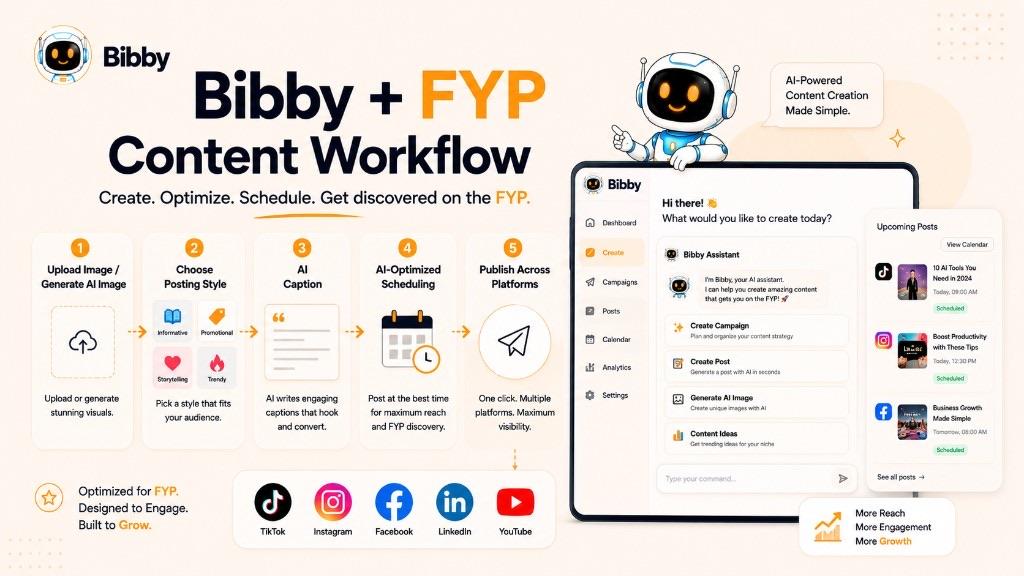
Step 1: Upload or generate your visual. Start by uploading your own image or generating an image with AI. Depending on your content strategy, you can create images, carousels, videos, and Stories. This gives you a starting point for your social content.
Step 2: Choose your posting style. Instead of manually figuring out how every post should be presented, select the posting style you want. This helps maintain a consistent voice and approach across your content.
Step 3: Let AI generate the caption. Bibby can automatically generate captions based on your content and selected posting style. This can reduce one of the most repetitive parts of social media management: staring at a blank caption box wondering whether "Happy Monday!" is really the best humanity can do. The goal isn't to remove human creativity. It's to reduce the repetitive work around it.
Step 4: Schedule your content. Once the content and caption are ready, Bibby can schedule your posts at AI-optimized times. You can plan different posts for different dates rather than manually publishing each one. This can help maintain a consistent publishing schedule while reducing the need to constantly check the clock.
Step 5: Publish across multiple platforms. Bibby allows you to manage content across platforms such as TikTok, Instagram, Facebook, LinkedIn, and YouTube. This is especially useful for businesses that repurpose content across multiple channels. A single content idea can become part of a broader distribution strategy rather than living on one platform and disappearing into the digital fog.
Bibby's Chat Interface
Bibby also goes beyond traditional scheduling with its chat-based social media management interface.
Instead of navigating through multiple menus for every task, users can interact with Bibby conversationally.
Inside the chat interface, you can perform tasks such as:
- Create a brand kit
- Create a campaign
- Create posts
- Regenerate captions
- Manage social media content
- Work with your publishing workflow
This turns social media management into more of a conversation and less of a dashboard scavenger hunt.
How Automation Helps an FYP Content Strategy
Automation can support several areas of an FYP-focused strategy.
Consistent publishing. A content calendar becomes easier to maintain when posts can be planned and scheduled in advance.
More time for content creation. Reducing repetitive scheduling and caption-writing tasks gives creators more time to work on hooks, storytelling, video ideas, audience research, and creative concepts.
Multi-platform distribution. The same campaign can be organized across TikTok, Instagram, Facebook, LinkedIn, and YouTube rather than requiring completely separate workflows.
Better organization. Campaigns, content, captions, and publishing schedules can be managed systematically instead of being scattered across spreadsheets, notes, folders, and browser tabs.
Easier experimentation. When publishing becomes easier, creators can test different topics, formats, hooks, posting schedules, and content styles. The resulting performance data can then inform future content decisions.
Automation Doesn't Replace Content Strategy
This distinction is important.
Using an automation tool doesn't mean you can create random content, schedule 100 posts, and expect the FYP to do the rest.
Automation handles execution.
Your strategy still determines:
- Who you're targeting
- What you're creating
- Why the audience should care
- What your brand stands for
- Which topics you cover
- How you measure success
The strongest workflow is therefore not:
AI → Schedule → Hope
It is:
Audience research → Content strategy → Creation → AI assistance → Scheduling → Publishing → Analysis → Improvement
A Simple FYP-Focused Workflow With Bibby
For creators and businesses, the entire process can look like this:
Audience Research
↓
Create or Generate Content
↓
Choose Posting Style
↓
AI Caption Generation
↓
AI-Optimized Scheduling
↓
Publish Across Platforms
↓
Analyze Performance
↓
Improve Future Content
This workflow helps separate the things you can control from the things you can't.
You cannot force TikTok to put a video on someone's FYP.
You can control the quality of your content, your publishing consistency, your audience targeting, your creative process, and how efficiently you manage your social media workflow.
That's where automation earns its keep.
FYP and Content Consistency
Consistency is one of the most important parts of building a sustainable social media presence. But consistency does not mean posting as frequently as possible or publishing content simply to keep a calendar full.
For an FYP-focused TikTok strategy, consistency means regularly creating and publishing content that is relevant to your audience, testing different ideas, and learning from the results.
The goal is to build a repeatable system rather than relying on occasional bursts of inspiration.
What Does Consistency Mean on TikTok?
Consistency can involve several things:
- Publishing on a regular schedule
- Maintaining recognizable content themes
- Speaking to a defined audience
- Testing different content formats
- Maintaining a consistent brand voice
- Reviewing performance regularly
For example, a marketing account might publish three useful videos every week covering SEO, social media, and AI marketing.
Another creator might publish five times a week around fitness tips and workout routines.
There isn't one perfect posting frequency for every account. A sustainable schedule is more valuable than an unrealistic one.
Why Is Consistency Important?
Regular publishing gives creators more opportunities to understand their audience.
Suppose you publish one video every three months. It becomes difficult to identify patterns because you have very little content to compare.
But if you consistently publish and analyze your results, you can begin to notice patterns such as:
- Which topics receive more views
- Which hooks hold attention
- Which videos generate shares
- Which formats produce stronger engagement
- Which subjects attract the right audience
- Which content brings profile visits or followers
This turns social media from a guessing game into an ongoing learning process.
Consistency Does Not Guarantee FYP Reach
This is an important distinction.
Posting consistently does not guarantee that your videos will appear on the FYP.
You could publish every day and still have some videos perform poorly.
That's normal.
Individual pieces of content can perform differently depending on audience interest, topic, execution, timing, and numerous other factors.
Consistency gives you more opportunities to test and improve. It isn't a guaranteed shortcut to reach.
Build Content Pillars
One effective way to maintain consistency is to create a few recurring content pillars.
For example, a social media automation brand might have:
Educational content. Tips about social media marketing and automation.
Product content. Demonstrations of features and workflows.
AI content. Ideas about using AI for content creation and marketing.
Industry content. Trends and insights relevant to marketers and businesses.
Community content. Questions, discussions, and audience-focused posts.
These pillars make it easier to generate ideas without starting from an empty page every time.
Create a Content Calendar
A content calendar gives your publishing strategy structure.
Instead of asking:
"What should I post today?"
you can plan content several days or weeks ahead.
A simple calendar could include:
| Date | Topic | Format | Platform | Status |
|---|---|---|---|---|
| Monday | Social media tip | Video | TikTok | Scheduled |
| Tuesday | AI workflow | Carousel | Draft | |
| Wednesday | Product feature | Video | TikTok + YouTube | Ready |
| Thursday | Marketing tip | Image | Scheduled | |
| Friday | Industry trend | Video | TikTok + Instagram | Draft |
This makes it easier to maintain a balanced publishing strategy.
Batch Your Content Creation
Creating content in batches can also make consistency easier.
Instead of creating one post from beginning to end every day, you could dedicate specific sessions to:
Idea generation → Content creation → Caption creation → Scheduling
For example, a business might create ten short-form videos in one production session and then schedule them across the following weeks.
This reduces the pressure to create something from scratch every morning.
Repurpose Strong Content
You don't always need a completely new idea for every platform.
A strong topic can be adapted into different formats.
For example:
- TikTok: Short video explaining the idea
- Instagram: Reel or carousel
- YouTube: Short-form video
- LinkedIn: Educational post
- Facebook: Short video or image post
The content should still be adapted to the audience and format of each platform rather than simply copying and pasting everything everywhere.
How Bibby Makes Consistency Easier
Maintaining consistency manually can become difficult when you're managing multiple platforms.
Bibby simplifies the workflow by allowing you to upload your content or generate visuals with AI, select a posting style, automatically generate captions, and schedule posts at AI-optimized times.
You can manage:
- Images
- Carousels
- Videos
- Stories
- Campaigns
- Captions
- Publishing schedules
across platforms including TikTok, Instagram, Facebook, LinkedIn, and YouTube.
Bibby's chat interface also lets you manage social media conversationally. You can create campaigns, create posts, regenerate captions, create a brand kit, and handle other tasks without jumping through a maze of separate menus.
A Better Way to Think About Consistency
Don't measure consistency only by the number of posts you publish.
A better model is:
Consistency = Regular publishing + Relevant content + Learning + Improvement
If you publish consistently but never analyze what happens, you're simply repeating the same experiment.
If you publish, learn, and improve, you're building a content system.
And that is ultimately more valuable than chasing a mythical posting streak in the hope that TikTok's FYP fairy will eventually notice you.
FYP Content Strategy: A Simple Framework
Creating content with FYP potential becomes easier when you have a repeatable process. Instead of opening TikTok every morning and wondering what to post, you can use a simple framework that takes you from audience research to content creation, publishing, analysis, and improvement.
A useful FYP content strategy can be summarized as:
Identify → Create → Hook → Retain → Engage → Schedule → Analyze → Improve
The framework doesn't guarantee FYP placement. Instead, it helps creators and businesses consistently focus on the parts of content marketing they can actually control.
Identify Your Audience
Before creating a video, determine who you want to reach.
Ask:
- Who is this content for?
- What problems do they have?
- What topics interest them?
- What questions do they ask?
- What type of content do they already watch?
- What would make them stop scrolling?
For example, a social media automation company shouldn't create every video for "everyone interested in social media."
It could focus on:
Small businesses → marketers → agencies → creators → social media managers
A clearer audience makes it easier to create relevant content.
Create Something Valuable
Once you understand your audience, create content that gives them a reason to watch.
That value could come from:
- Education
- Entertainment
- Inspiration
- Practical advice
- Storytelling
- Demonstration
- Problem-solving
- A new perspective
Not every video needs to teach something. Entertainment and emotional connection can be equally valuable.
The important question is:
"Why would someone care about this video?"
Hook the Viewer
The first part of a short-form video needs to earn attention.
A strong hook can:
- Ask a question
- Present a problem
- Reveal an unexpected fact
- Show a result
- Challenge a common belief
- Promise a useful solution
For example:
Weak:
"Today we're going to talk about social media scheduling."
Stronger:
"Still spending your entire Sunday scheduling next week's social posts?"
The second version immediately presents a recognizable problem.
Retain Attention
Once you've earned the click or stopped the scroll, keep the content moving.
Avoid unnecessary:
- Introductions
- Repetition
- Long pauses
- Off-topic explanations
Structure the video around a clear progression.
For example:
Problem → Explanation → Solution → Example → Takeaway
Every second doesn't need a fireworks display. It simply needs to move the viewer toward something worth seeing.
Encourage Meaningful Engagement
Give viewers a natural reason to participate.
You might ask:
- "Which one would you choose?"
- "Have you experienced this?"
- "What would you add?"
- "Would you try this?"
- "Want to see part two?"
The question should connect directly to the content.
Avoid forcing engagement simply for the sake of increasing numbers. Meaningful conversations are more useful than empty interaction.
Schedule Consistently
Once your content is ready, create a sustainable publishing schedule.
You can decide:
- What days to publish
- Which platforms to use
- Which content goes out first
- When different posts should be published
This is particularly useful when you're managing several social networks.
With Bibby, you can upload content or generate visuals with AI, choose a posting style, generate captions automatically, and schedule posts at AI-optimized times.
The same workflow can support publishing across TikTok, Instagram, Facebook, LinkedIn, and YouTube.
Analyze Performance
After publishing, don't immediately move on to the next post without checking what happened.
Look at metrics such as:
- Views
- Watch time
- Completion rate
- Likes
- Comments
- Shares
- Saves
- Profile visits
- Follower growth
Then compare your content.
For example:
Video A: 20,000 views, low retention
Video B: 8,000 views, high retention and shares
Video A has greater reach, but Video B may contain stronger signals about what your audience actually values.
Improve the Next Post
The final step is where the entire process becomes a strategy.
Take what you learned and apply it to the next piece of content.
If educational videos perform better, create more educational videos.
If short tutorials generate more saves, produce additional tutorials.
If certain hooks consistently retain viewers, test variations of those hooks.
This creates a continuous cycle:
Create → Measure → Learn → Improve → Create Again
The FYP Content Strategy Framework
Here's the complete process at a glance:
| Step | Goal | Key question |
|---|---|---|
| Identify | Understand your audience | Who am I creating for? |
| Create | Deliver value | Why should they care? |
| Hook | Capture attention | Why should they stop scrolling? |
| Retain | Hold attention | Why should they keep watching? |
| Engage | Start interaction | Why should they respond or share? |
| Schedule | Publish consistently | When and where should it go live? |
| Analyze | Understand performance | What worked? |
| Improve | Refine the strategy | What should I do differently next time? |
Where Bibby Fits Into the Framework
Bibby can help with the execution layer of this process.
You provide the content or generate it with AI, choose your posting style, let Bibby generate captions, and schedule your posts at AI-optimized times.
Its chat interface adds another layer of convenience, allowing you to interact with your social media workflow conversationally. You can create a brand kit, launch campaigns, create posts, regenerate captions, and manage other social media tasks directly through chat.
The strategy still comes from understanding your audience and creating content worth watching. Bibby simply helps make the operational side of that strategy faster and easier to manage.
The result is a more sustainable approach to FYP content: don't chase the algorithm blindly. Build a system that consistently produces, publishes, measures, and improves useful content.
FYP Examples: What FYP-Friendly Content Can Look Like
There is no single type of video that guarantees placement on TikTok's For You Page. Educational videos, entertaining clips, product demonstrations, tutorials, stories, and trend-based content can all appeal to different audiences.
The key is not to copy a supposed "FYP formula." Instead, create content that gives a specific audience a genuine reason to stop, watch, engage, or share.
Here are some practical examples across different industries.
Example 1: Fitness Creator
Topic: 3 Simple Exercises for Better Morning Mobility
A fitness creator could open with:
"Feeling stiff every morning? Try these three movements."
The video could then demonstrate each exercise quickly, explain what it does, and finish with a simple takeaway.
Why this approach can work
- It addresses a specific problem.
- The audience immediately understands the value.
- The content is easy to follow.
- Viewers can save it for later.
- The topic is highly relevant to a defined audience.
The goal isn't simply to get views. It's to reach people who are actually interested in fitness and mobility.
Example 2: Restaurant
Topic: How Our Signature Burger Is Made
A restaurant could create a fast-paced behind-the-scenes video showing:
Fresh ingredients → Preparation → Cooking → Assembly → Finished burger
The opening could show the finished burger before revealing how it was made.
Why this approach can work
Food is naturally visual, and the process creates a simple story that encourages viewers to keep watching until the final result.
The restaurant could also use the content to build local awareness by making the location and brand clear.
Example 3: SaaS Company
Topic: Stop Doing This Manually
A SaaS company could demonstrate a repetitive task that businesses perform manually and then show how its software simplifies the process.
For example:
Manual process → Multiple spreadsheets → Repetitive work → Automated workflow
Why this approach can work
It starts with a recognizable business problem rather than immediately launching into a product pitch.
The viewer first sees something they understand and then discovers a potential solution.
This type of content can be particularly useful for B2B brands because it combines education with product discovery.
Example 4: Fashion Brand
Topic: 3 Ways to Style One Outfit
A fashion brand could show the same item styled in three different ways.
For example:
Casual → Work → Evening
Why this approach can work
The viewer receives practical inspiration while naturally seeing the product in use.
It can also encourage saves because people may want to return to the video when deciding what to wear.
Example 5: App Development Company
Topic: 3 Mistakes Businesses Make When Building an App
An app development company could explain three common mistakes, such as:
- Building features nobody needs
- Ignoring user experience
- Treating security as an afterthought
The video could end with a simple recommendation for avoiding these mistakes.
Why this approach can work
The content demonstrates expertise without requiring the company to make the entire video a sales pitch.
It also gives potential customers a reason to follow the account for additional information.
Example 6: Digital Marketing Agency
Topic: Why Your Social Media Posts Aren't Getting Engagement
A marketing agency could explain several possible problems:
- Weak hooks
- Irrelevant content
- Inconsistent publishing
- Poor audience targeting
- Generic captions
The video could then provide one practical improvement for each issue.
Why this approach can work
It addresses a problem that the target audience already recognizes.
Instead of saying:
"We're a great digital marketing agency."
the business demonstrates expertise by helping the viewer solve a problem.
Example 7: Beauty Brand
Topic: Before-and-After Product Demonstration
A beauty brand could show how a product is used and present the final result.
The video could include:
Problem → Product → Application → Result
Why this approach can work
The visual transformation gives viewers a reason to keep watching, while the demonstration shows the product rather than simply describing it.
Example 8: Travel Creator
Topic: 5 Things I Wish I Knew Before Visiting a Destination
A travel creator could provide quick tips about:
- Transportation
- Costs
- Food
- Popular attractions
- Common mistakes
Why this approach can work
Travel content naturally combines discovery and practical information. It can also encourage saves because viewers may want to refer back to the tips when planning a trip.
Example 9: Social Media Automation Brand
Topic: Stop Scheduling Every Social Post Manually
A social media automation brand such as Bibby could demonstrate the difference between manual social media management and an automated workflow.
The video could show:
Upload content → Choose posting style → AI caption → AI-optimized scheduling → Multi-platform publishing
The content could then demonstrate how the workflow works across TikTok, Instagram, Facebook, LinkedIn, and YouTube.
Why this approach can work
It immediately communicates a recognizable problem to social media managers and businesses.
Instead of simply claiming that automation saves time, the video shows the workflow.
Bibby can then support the broader publishing process by allowing users to create or generate visuals, generate captions, schedule posts, manage campaigns, and work with their social media through its chat interface.
What Do These FYP Examples Have in Common?
Although the industries are completely different, the strongest examples share several characteristics.
They target a specific audience. The content is created for someone rather than everyone.
They address a real interest or problem. The viewer has a reason to care about the topic.
They create a clear opening. The viewer can quickly understand what the video is about.
They deliver the promised value. The content doesn't waste the viewer's time.
They encourage further action. That could mean watching another video, following the account, saving the post, sharing it, visiting a profile, or exploring a product.
They can be repeated. A good content idea shouldn't work only once.
If a fitness creator gets strong results from exercise tips, they can create dozens of variations. If a SaaS company succeeds with problem-solving videos, it can build an entire content series around customer pain points.
That's where a sustainable content strategy becomes more powerful than chasing individual viral moments.
The FYP isn't about finding one perfect video. It's about consistently creating relevant content that gives the right audience a reason to stop scrolling.
FYP Analytics: What Should Creators Track?
Getting views on the For You Page is exciting, but views alone don't tell you whether your TikTok content strategy is actually working.
A video might receive thousands of views but generate very little meaningful engagement. Another video might receive fewer views but attract the exact audience you want, generate shares, bring profile visits, or produce new customers.
That's why creators and businesses should look beyond FYP views and evaluate a broader set of performance signals.
Views
Views are the most obvious metric to look at.
They tell you how many times your content was viewed, but they don't explain why the video performed the way it did.
Use views as a starting point rather than the final measure of success.
For example:
- Video A: 100,000 views
- Video B: 20,000 views
At first glance, Video A appears to be the winner. But if Video B generates significantly more shares, profile visits, leads, or followers, it may actually be more valuable to the business.
Average Watch Time
Average watch time shows how long viewers typically spend watching your video.
This can help you understand whether your content is holding attention.
If viewers consistently leave early, consider examining:
- Your opening hook
- Video pacing
- Content relevance
- Length
- Story structure
- Whether the video delivers what the opening promised
A strong hook may get someone to stop scrolling, but the rest of the video has to earn their continued attention.
Completion Rate
Completion rate looks at how many viewers watch the video through to the end.
This can be particularly useful for short-form content.
If a large percentage of viewers complete a video, it may indicate that the content structure and length are working well for that particular audience.
Don't interpret completion rate in isolation, though. A 10-second video and a two-minute video naturally create different viewing experiences.
Rewatches
Rewatch behavior can provide another useful signal.
People may replay content because it is:
- Useful
- Entertaining
- Fast-paced
- Detailed
- Surprising
- Easy to miss on the first viewing
Tutorials and educational content can benefit particularly well from this behavior because viewers may replay a video while trying to follow the instructions.
Likes
Likes provide a simple indication that viewers enjoyed or appreciated the content.
However, likes don't tell the whole story.
A video with fewer likes can still be highly valuable if it generates strong saves, shares, comments, or conversions.
Use likes as one piece of the puzzle rather than your entire measurement system.
Comments
Comments can help reveal how people feel about your content and what questions they have.
For businesses, comments can be particularly valuable because they can uncover:
- Customer questions
- Objections
- Product requests
- Confusion
- New content ideas
- Audience opinions
For example, if multiple viewers ask:
"Does this work for small businesses?"
you've potentially found your next video topic.
Shares
Shares can be especially meaningful because someone is actively choosing to send your content to another person.
People may share content because it is:
- Useful
- Funny
- Relatable
- Educational
- Surprising
- Relevant to someone they know
A high share rate can therefore tell you that your content has value beyond the person currently watching it.
Saves or Favorites
A save can indicate that someone expects the content to be useful again later.
This can be particularly relevant for:
- Tutorials
- Checklists
- Recipes
- Travel tips
- Educational content
- How-to videos
- Product guides
For example, someone may save a video titled "5 TikTok Content Ideas for Small Businesses" because they plan to return to it later.
Profile Visits
If someone watches a video and then visits your profile, that's a stronger indication of interest in your broader content or brand.
Profile visits can help answer:
"Did this video make people curious about who created it?"
For creators and businesses, that can be an important step between content discovery and audience growth.
Follower Growth
Track whether your content is helping attract new followers.
A video that reaches a relevant audience and generates followers can have long-term value because those people may see future content as well.
However, follower growth shouldn't be treated as the only objective.
For some businesses, generating website visits, leads, or product interest may be more important than simply increasing follower numbers.
Conversion Metrics
For businesses, this is where FYP analytics become especially important.
Depending on your goals, you might track:
- Website visits
- Product page visits
- Sign-ups
- Leads
- App downloads
- Purchases
- Consultation requests
A video with 10,000 highly relevant viewers may generate more business value than one with 500,000 viewers who have no interest in the product.
FYP Analytics: A Simple Measurement Framework
Instead of focusing on one metric, divide your analytics into four categories:
| Category | Metrics |
|---|---|
| Reach | Views, audience reached |
| Retention | Watch time, completion, rewatches |
| Engagement | Likes, comments, shares, saves |
| Business impact | Profile visits, followers, traffic, leads, sales |
This gives you a more complete picture of content performance.
How to Use Analytics to Improve Your Content
Analytics become useful when they change what you do next.
Suppose you discover that:
- Tutorial videos have high completion rates.
- Short videos generate more shares.
- Product demonstrations bring more profile visits.
- Industry tips generate more comments.
You can use those patterns to shape your next content calendar.
The process becomes:
Publish → Measure → Identify patterns → Adjust → Publish again
This is much more useful than simply checking whether a video "went viral."
How Bibby Fits Into the Process
Bibby focuses primarily on simplifying the content creation and publishing workflow, including AI-assisted content creation, caption generation, campaign management, and scheduling across multiple social platforms.
You can use those capabilities to maintain a more consistent publishing process while reviewing your platform analytics to determine which topics and formats resonate with your audience.
The important principle is simple:
Automation helps you publish more efficiently. Analytics help you decide what deserves to be published next.
Together, those two pieces can create a stronger content loop without pretending that any tool can guarantee FYP reach.
FYP on TikTok vs. Recommendation Feeds on Other Platforms
FYP (For You Page) is a term most closely associated with TikTok, but the idea behind it is not unique to TikTok. Many major social platforms use recommendation systems to help users discover content from accounts they may not already follow.
The names and mechanics differ from platform to platform, but the broader idea is similar:
Show users content that the platform believes they may find relevant or interesting.
This distinction is important for creators and marketers managing multiple social channels. You shouldn't assume that a TikTok FYP strategy can simply be copied word-for-word onto Instagram, YouTube, Facebook, or LinkedIn.
TikTok FYP
TikTok's For You Page is its personalized recommendation feed.
It is designed to help users discover videos based on their interests and interactions rather than limiting discovery to accounts they already follow.
For creators, this makes TikTok particularly focused on content discovery.
A user can encounter a video from an account they've never heard of, watch it, and potentially discover more content from that creator.
Key focus: Personalized short-form video discovery
Instagram Reels Recommendations
Instagram also recommends content beyond the accounts a person follows, particularly through Reels and other recommendation surfaces.
A creator's Reel can potentially reach people who don't already follow the account.
However, Instagram is not simply "another FYP." Its recommendation systems, audience behavior, content formats, and platform ecosystem are different from TikTok's.
Instagram also combines recommendations with features such as:
- Feed
- Stories
- Reels
- Explore
- Following content
Key focus: Visual content discovery within a broader social platform
YouTube Recommendations and Shorts
YouTube has its own recommendation ecosystem, including recommendations for both long-form videos and YouTube Shorts.
YouTube recommendations can appear in different areas of the platform, and the system considers various signals to determine which content may be useful or interesting to viewers.
For Shorts creators, this creates another opportunity to reach people who aren't already subscribed.
Key focus: Video discovery across both short-form and long-form content
Facebook Recommendations
Facebook also uses recommendation systems to surface content that users may find interesting.
Recommended content can appear alongside posts from friends, pages, groups, and accounts users already interact with.
For businesses, Facebook recommendations can therefore provide another path to reaching audiences beyond an existing follower base.
Key focus: Personalized content discovery across a broad social network
LinkedIn Recommendations
LinkedIn's content experience is different because the platform is primarily centered around professional and business-oriented interactions.
Posts can still reach people beyond the creator's immediate network through LinkedIn's distribution and recommendation systems.
For businesses and professionals, content discovery can help expand:
- Professional visibility
- Industry authority
- Network growth
- Business awareness
- Thought leadership
Key focus: Professional and industry-focused content discovery
FYP vs. Other Recommendation Feeds
Here's a simplified comparison:
| Platform | Recommendation surface | Common content focus |
|---|---|---|
| TikTok | For You Page | Short-form video |
| Reels, Explore, recommendations | Visual and short-form content | |
| YouTube | Home, Shorts, recommendations | Short-form and long-form video |
| Recommended content and video surfaces | Social, video, and community content | |
| Recommended/distributed posts | Professional and business content |
The exact recommendation systems behind these platforms are more complex than this table suggests, and each platform can change how content is distributed over time.
Should You Use the Same Strategy Everywhere?
Not exactly.
The core principles can carry across platforms:
- Understand your audience
- Create relevant content
- Capture attention
- Deliver value
- Encourage meaningful engagement
- Publish consistently
- Analyze performance
- Improve over time
But the execution should be adapted to each platform.
For example, a 30-second TikTok video could become:
- TikTok: Short educational video
- Instagram: Reel
- YouTube: Short
- LinkedIn: Educational post with the key insight
- Facebook: Video with supporting context
The underlying idea remains the same, but the presentation can change based on audience expectations and platform behavior.
Why Multi-Platform Publishing Matters
For brands, relying entirely on one platform can limit your reach.
A strong content idea can often be adapted for multiple channels, allowing businesses to meet audiences where they already spend their time.
This is especially useful when the brand's audience includes different segments across TikTok, Instagram, YouTube, Facebook, and LinkedIn.
However, multi-platform publishing can also create a management problem.
Creating one piece of content is relatively simple.
Creating, captioning, organizing, scheduling, and publishing dozens of pieces of content across five platforms every month is where things start getting interesting.
How Bibby Helps With Multi-Platform Content
Bibby is designed to simplify this operational challenge.
You can upload your content or generate visuals with AI, choose a posting style, let AI generate captions, and schedule your content at AI-optimized times.
Bibby supports publishing across:
- TikTok
- YouTube
It also supports different content formats, including:
- Images
- Carousels
- Videos
- Stories
And its chat interface allows you to manage social media conversationally, including creating a brand kit, creating campaigns, creating posts, regenerating captions, and handling other social media tasks.
The important takeaway is that FYP is TikTok's terminology, not a universal name for every platform's recommendation system.
The broader concept, however, is universal: social platforms increasingly help users discover content based on relevance and predicted interest.
For marketers, that means the winning strategy isn't to copy one platform's algorithm. It's to create strong content, understand each audience, and build an efficient system for distributing and improving that content across channels.
Key Takeaways
The FYP (For You Page) is one of TikTok's most important content discovery surfaces. It gives creators, businesses, and brands an opportunity to reach people beyond their existing followers through personalized content recommendations.
But there is no secret FYP button, magic hashtag, or guaranteed posting time that will make a video take off.
A stronger approach is to focus on what you can control:
Understand your audience → Create relevant content → Build strong hooks → Keep viewers engaged → Encourage meaningful interaction → Publish consistently → Analyze performance → Improve
The #FYP hashtag alone won't guarantee exposure, and posting more frequently doesn't automatically mean more reach. Likewise, appearing on the FYP doesn't necessarily mean a video will become viral. The real goal is to create content that reaches the right people and gives them a reason to watch, engage, follow, share, or take action.
For creators and businesses managing multiple platforms, consistency can be just as challenging as content creation itself. That's where Bibby can simplify the workflow.
With Bibby, you can upload your own content or generate visuals with AI, choose a posting style, generate captions automatically, and schedule content at AI-optimized times across platforms such as TikTok, Instagram, Facebook, LinkedIn, and YouTube. You can also manage images, carousels, videos, Stories, campaigns, and brand assets from one place.
Bibby's chat interface takes this further by allowing you to manage social media conversationally. You can create a brand kit, launch a campaign, create posts, regenerate captions, and handle other social media tasks through chat.
Bibby can't guarantee that your content will land on the FYP, because no legitimate tool can promise that. What it can do is make the process of consistently creating, organizing, and publishing content considerably easier.
Ultimately, successful FYP content isn't about trying to outsmart the algorithm. It's about creating something people genuinely want to watch and building a system that helps you do that consistently.
Continue learning with related dictionary entries on the social media algorithm, Following feed, feeds, hashtags, viral content, short-form video, organic reach, and engagement—or browse the social media dictionary. Then start a free Bibby trial to create, caption, and schedule TikTok and multi-platform content across your channels.