
Your social media bio is one of the first things people notice when they visit your profile. Whether someone discovers your brand through a post, a search result, or a recommendation, your bio helps them quickly understand who you are, what you do, and why they should follow or connect with you. In just a few words, it can communicate your brand identity, build credibility, and encourage visitors to take action.
A well-written social media bio is much more than a short description. It acts as a digital introduction that can influence first impressions, attract the right audience, and even drive website traffic, inquiries, and sales. For businesses, it highlights products or services. For creators and influencers, it showcases expertise and personality. For professionals, it demonstrates skills and experience. Regardless of your niche, an effective bio helps turn profile visitors into engaged followers or customers.
Different social media platforms have different character limits and audiences, but the purpose of a bio remains the same: to explain your value clearly and encourage engagement. A strong bio often includes a brief description of what you do, a unique value proposition, relevant keywords, and a clear call to action. When updated regularly, it also reflects your latest campaigns, products, or achievements.
In this guide, you'll learn what a social media bio is, why it matters, what elements make it effective, common mistakes to avoid, practical examples, and proven tips for writing a bio that stands out across platforms like Instagram, Facebook, LinkedIn, TikTok, YouTube, and X. Whether you're creating a new profile or improving an existing one, this resource will help you craft a bio that supports your personal brand or business goals.
What Is a Social Media Bio?
A social media bio is a short description displayed on your social media profile that tells visitors who you are, what you do, and why they should connect with you. It serves as a quick introduction for individuals, businesses, brands, creators, and organizations, helping people understand your identity within seconds of visiting your profile.
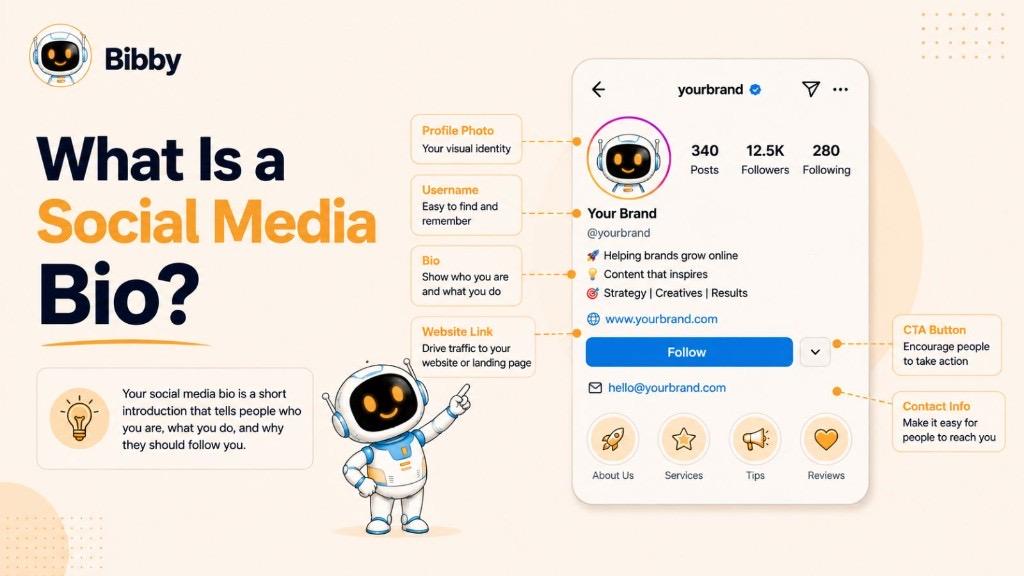
Think of your social media bio as your digital elevator pitch. Since most users spend only a few moments deciding whether to follow an account, your bio needs to communicate your value clearly and concisely. It should answer simple questions like:
- Who are you?
- What do you do?
- Who do you help?
- Why should someone follow you?
- What action should they take next?
A well-crafted bio typically combines a brief description, your unique value proposition, relevant keywords, and a call to action. Depending on the platform, it may also include a website link, contact information, hashtags, emojis, or other profile details that encourage engagement.
For businesses, a social media bio highlights products, services, or expertise while reinforcing brand identity. For creators and influencers, it showcases personality, niche, and content focus. Professionals often use their bio to summarize their experience, skills, or career goals, while nonprofits use it to communicate their mission and inspire support.
Although each platform offers different formatting options and character limits, the purpose remains consistent across all networks: to make a strong first impression and encourage meaningful interactions.
Social Media Bio Definition
A social media bio is a brief profile description that appears on a social media account, summarizing who a person, business, or organization is, what they do, and what value they offer. It often includes keywords, branding elements, and a call to action to help attract followers, build trust, and encourage engagement.
Why Is a Social Media Bio Important?
Many people think a social media bio is simply a place to write a few words about themselves. In reality, it is one of the most important elements of any social media profile because it influences how visitors perceive your account. A compelling bio can increase profile visits, improve follower growth, strengthen your brand image, and encourage users to click your website link, contact your business, or explore your content.
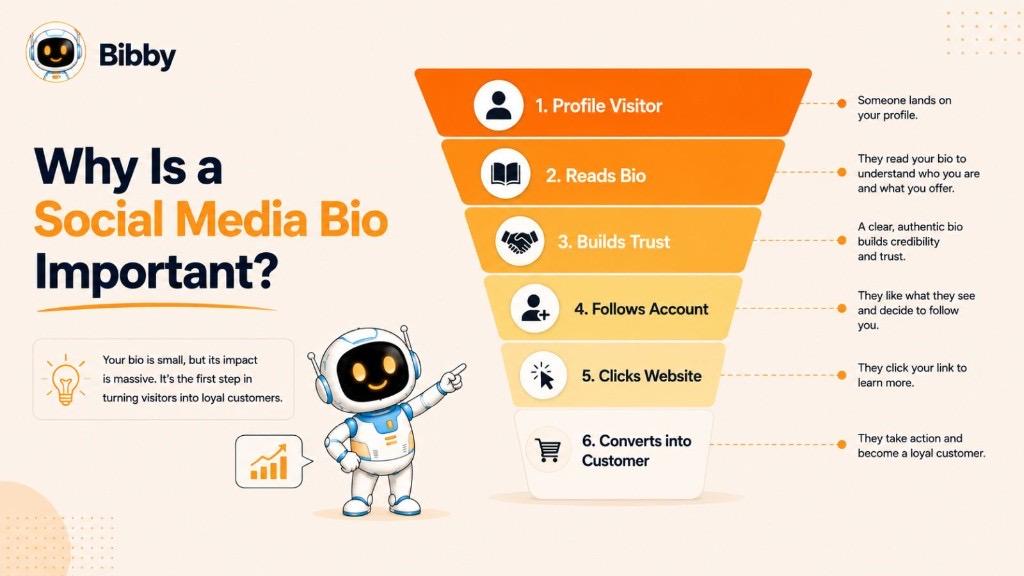
Your bio is small, but its impact is massive. It's often the first step in turning visitors into engaged followers and loyal customers. Whether you're building a personal brand, growing a startup, promoting an online store, or managing a global business, your social media bio is the foundation of your online presence. It tells your story before your audience even scrolls through your posts.
What Should a Social Media Bio Include?
A high-performing bio usually combines a few essential elements. You don't need every field on every platform, but covering the core pieces helps visitors understand your value quickly.
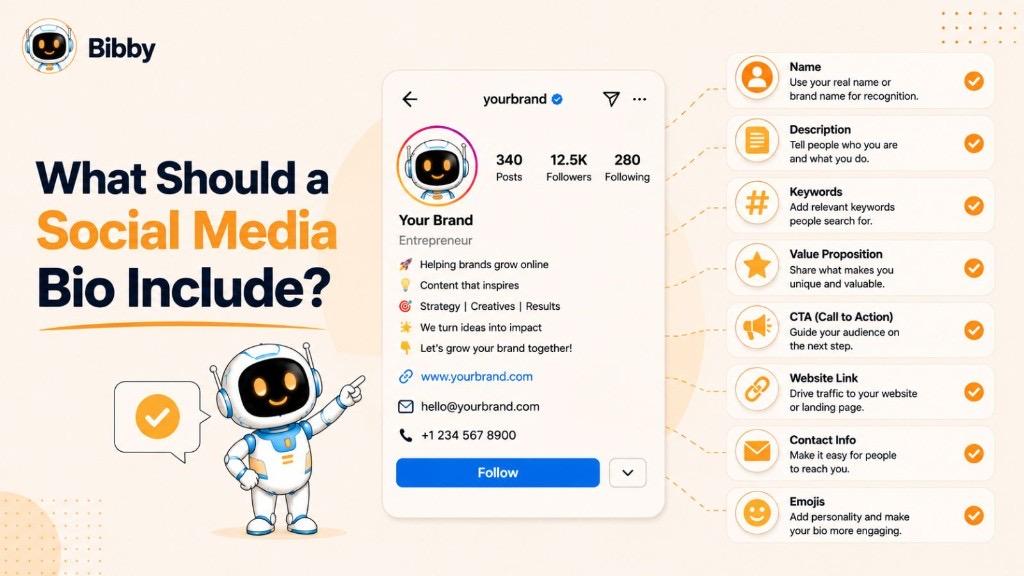
- Name or brand name — so people recognize you instantly.
- Short description — who you are and what you do.
- Relevant keywords — terms your audience searches for.
- Value proposition — what makes you useful or unique.
- Call to action — the next step you want visitors to take.
- Website or link in bio — where traffic should go.
- Contact information — when lead generation matters.
- Emojis (optional) — to add personality and improve scannability.
Social Media Bio vs. Social Media Profile
A social media bio and a social media profile are related, but they are not the same thing.
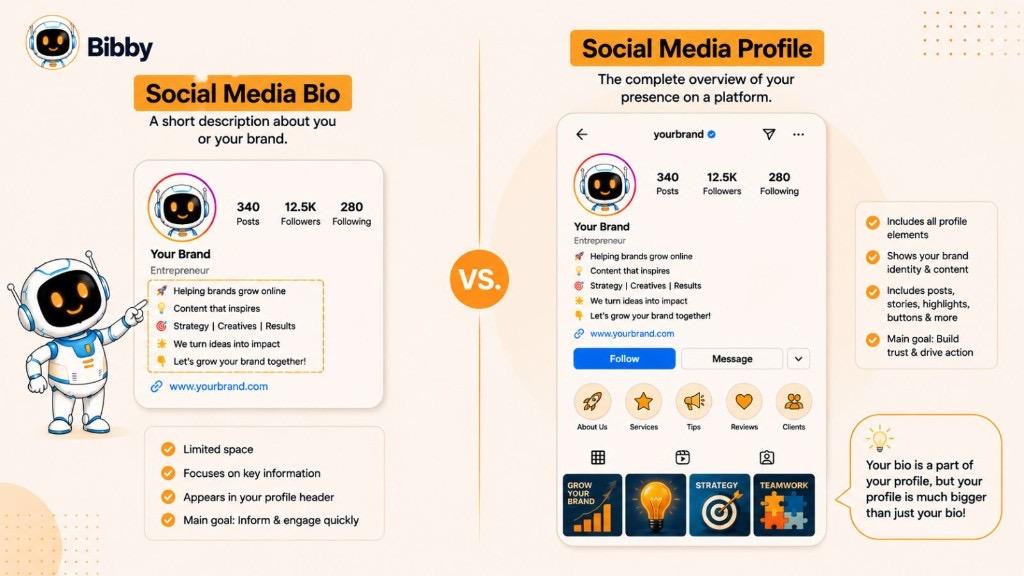
- Social media bio: A short description about you or your brand. It has limited space, focuses on key information, appears in your profile header, and aims to inform and engage quickly.
- Social media profile: The complete overview of your presence on a platform—including your bio, posts, stories, highlights, buttons, visuals, and content grid. Its goal is to build trust and drive action.
Your bio is a part of your profile, but your profile is much bigger than just your bio. A strong bio gets attention; a strong profile keeps it.
Social Media Bio Character Limits by Platform
Character limits shape how much you can say—and force clarity. Use this quick reference when writing or auditing bios across channels:
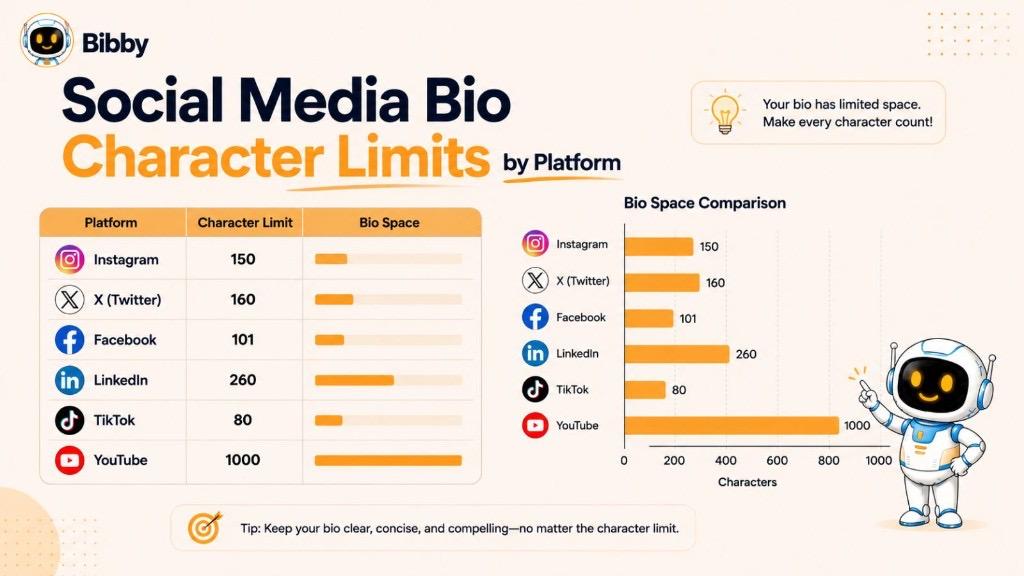
| Platform | Typical bio / about limit | Writing tip |
|---|---|---|
| About 150 characters | Lead with value + one CTA; use a link in bio for extra links | |
| X (formerly Twitter) | About 160 characters | Pair a clear pitch with keywords people search |
| About 101 characters (Page intro / short bio fields) | Emphasize who you serve and how to contact you | |
| About 220–260 characters for headline-style intros; longer About section available | Headline for role/value; About for full story | |
| TikTok | About 80 characters | Keep it short, memorable, and niche-focused |
| YouTube | Channel description up to about 1,000 characters | Explain content topics and why viewers should subscribe |
Limits can change over time, so always confirm in-app before publishing. The goal is not to fill every character—it is to communicate value as clearly as possible within the space you have.
Types of Social Media Bios
Different goals call for different bio styles. The core formula stays the same—who you are, what you do, and what to do next—but the tone and emphasis change by account type.
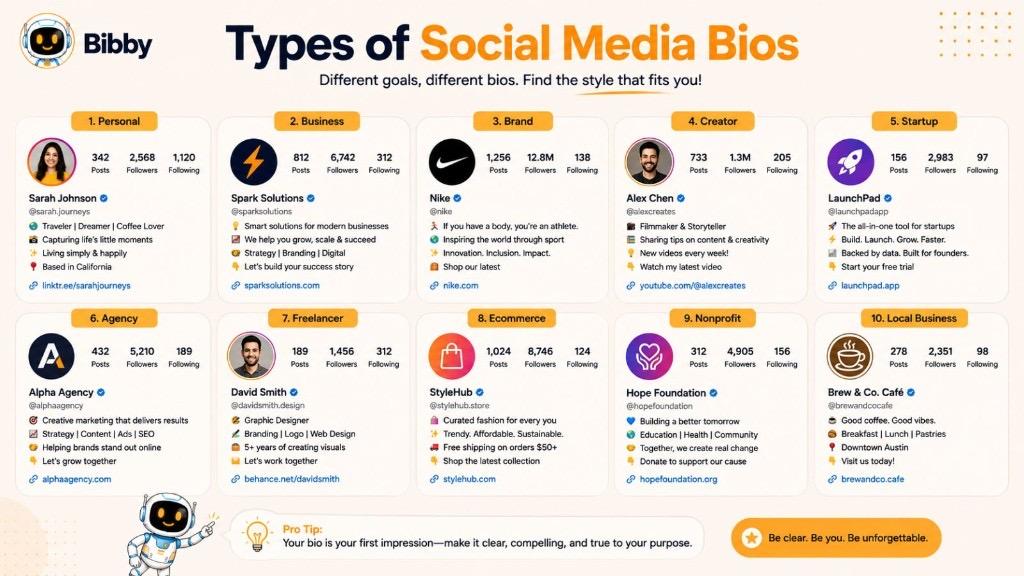
Common bio types include:
- Personal — lifestyle, interests, and personality.
- Business / brand — value proposition, services, and proof.
- Creator — content niche, posting cadence, and subscribe/watch CTAs.
- Startup — product benefit, differentiator, and trial/signup CTA.
- Agency / freelancer — services, expertise, and collaboration CTA.
- Ecommerce — offer, shipping/promo hooks, and shop CTA.
- Nonprofit — mission and donate/support CTA.
- Local business — location, offerings, and visit/order CTA.
Choose the style that matches your purpose, then keep the message clear, compelling, and true to your brand.
How to Write a Social Media Bio
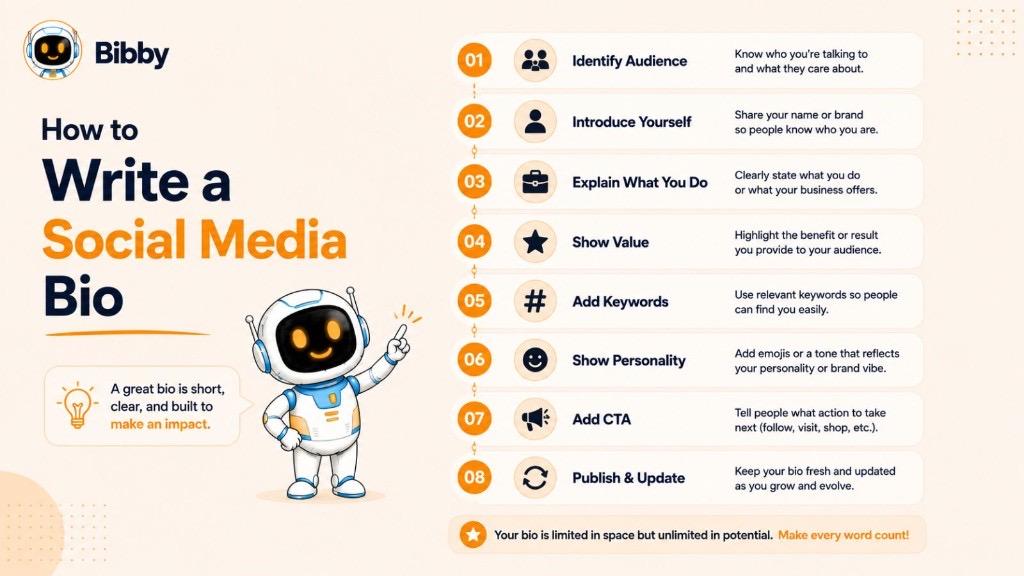
A great bio is short, clear, and built to make an impact. Use a simple writing formula, then refine it for each platform's character limit and audience.
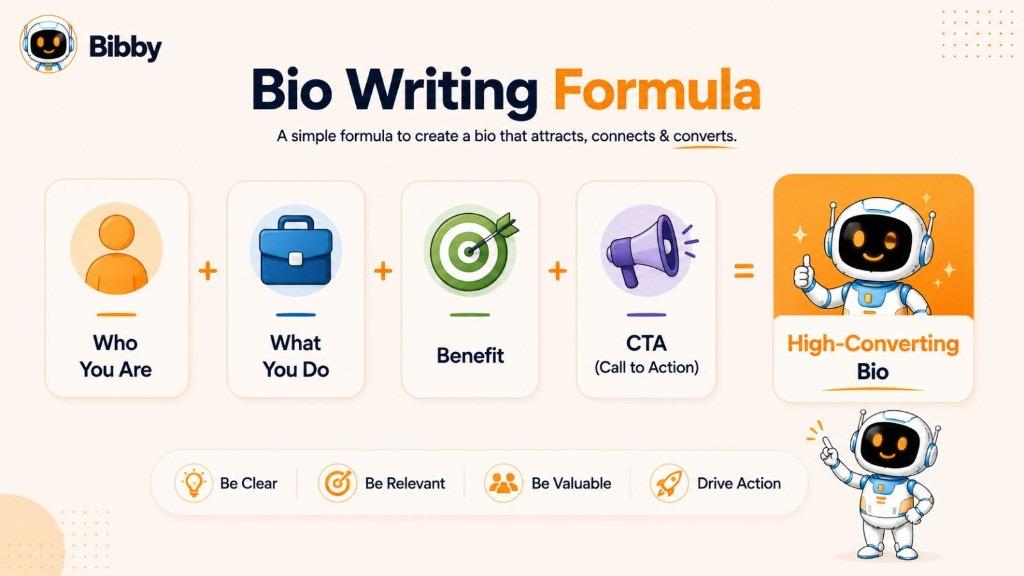
High-converting bio formula: Who you are + What you do + Benefit + CTA
Step-by-step writing process
- Identify your audience — know who you're talking to and what they care about.
- Introduce yourself — share your name or brand.
- Explain what you do — state your offer clearly.
- Show value — highlight the benefit or result you provide.
- Add keywords — include searchable terms naturally.
- Show personality — use tone or emojis that match your brand.
- Add a CTA — tell people what to do next (follow, visit, shop, book).
- Publish and update — keep your bio fresh as you grow.
Your bio is limited in space but unlimited in potential—make every word count.
Social Media Bio Examples
These examples show how to combine clarity, keywords, and a CTA without sounding spammy. Adapt the structure to your brand voice and platform limits.
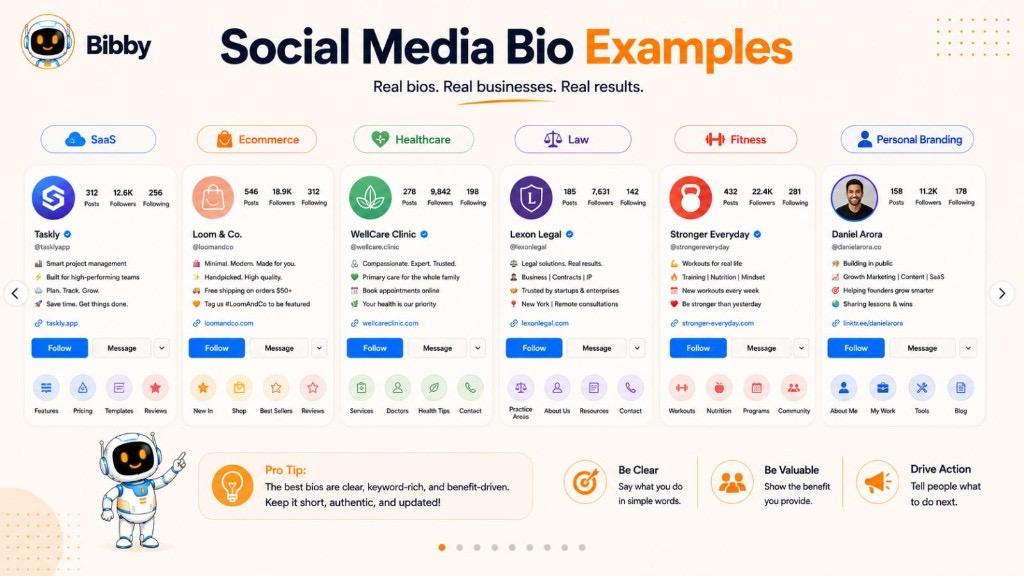
Business / SaaS example
AI-powered social media automation for growing businesses.
Save hours every week → Start free
Creator example
Daily AI marketing tips for creators & founders.
New videos every week ↓ Subscribe
Professional example
B2B content strategist helping SaaS teams grow organic traffic.
Open to collaborations · Book a call
Local business example
Neighborhood coffee · Fresh pastries · Free Wi-Fi
Open 7–10 AM · Order ahead ↓
Ecommerce example
Sustainable streetwear for everyday wear.
New drops weekly · Shop the collection ↓
Notice each example answers who you are, who you help, and what to do next—the same formula that works across Instagram, TikTok, LinkedIn, and beyond.
Best Practices for Writing a Social Media Bio
A social media bio may be short, but writing one that attracts followers and supports your business goals requires careful thought. The most effective bios combine clarity, branding, and strategy to make a strong first impression while encouraging visitors to take action.
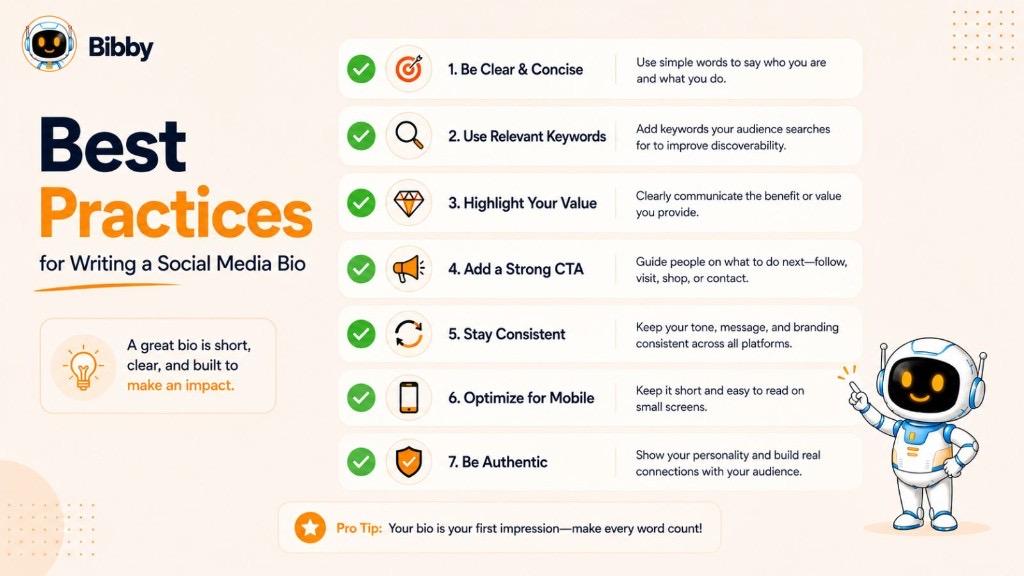
Whether you're creating a new profile or optimizing an existing one, the following best practices can help you write a social media bio that stands out across platforms.
1. Keep It Clear and Simple
One of the biggest mistakes people make is trying to say too much.
Your bio should immediately answer:
- Who are you?
- What do you do?
- Who do you help?
Avoid technical jargon, vague statements, or overly creative language that may confuse visitors.
Instead of: Empowering synergistic digital ecosystems for scalable transformation.
Write: AI-powered social media automation for growing businesses.
Simple messaging is easier to understand and more memorable.
2. Focus on Your Audience
Your bio shouldn't be entirely about your business. Instead, explain how your products, services, or content benefit the people reading it.
Think about the problems your audience wants to solve and position your bio around those solutions.
Example: Save hours every week by automating your social media with AI.
This immediately communicates value from the customer's perspective—and pairs well with clear audience targeting for the content that follows.
3. Use Relevant Keywords Naturally
Many social media platforms use profile information to help users discover accounts.
Including relevant keywords can improve your visibility while making your expertise clear.
Examples include:
- Social Media Automation
- AI Marketing
- Content Strategy
- Graphic Design
- Personal Finance
- Fitness Coaching
However, avoid turning your bio into a list of keywords. Natural language always performs better for readers.
4. Communicate Your Unique Value
Thousands of businesses may offer similar products or services.
Your bio should explain what makes you different.
Ask yourself:
- What problem do we solve?
- Why should someone choose us?
- What makes our approach unique?
Highlighting your unique value proposition helps your profile stand out.
5. Maintain a Consistent Brand Voice
Your bio should sound like the rest of your brand.
If your company uses a friendly, conversational tone, your bio should reflect that. If you're a law firm or financial consultant, a more professional tone may be appropriate.
Consistency across your website, marketing materials, and social media channels builds trust and strengthens brand awareness.
6. Include One Strong Call to Action
Don't expect visitors to guess what they should do next.
Guide them with a simple, direct CTA.
Examples include:
- Start your free trial
- Book a demo
- Visit our website
- Download the free guide
- Shop the collection
- Contact us today
A focused CTA generally performs better than presenting multiple options.
7. Make Every Word Count
Character limits mean every word should provide value.
Review your bio and remove:
- Redundant words
- Generic phrases
- Unnecessary adjectives
- Repeated information
Replacing long sentences with concise statements often makes your bio much stronger.
8. Use Emojis Thoughtfully
Emojis can improve readability and add personality, especially on visual platforms like Instagram and TikTok.
Examples:
- 📈 Growth
- 🤖 AI
- 🚀 Innovation
- 👇 Call to Action
Use them to emphasize key points rather than decorate every line. Too many emojis can distract readers and make your bio appear cluttered.
9. Add Social Proof When Possible
Trust is one of the biggest factors influencing whether someone follows your account or becomes a customer.
If space allows, include achievements that demonstrate social proof.
Examples:
- Trusted by 25,000+ businesses
- Featured in leading publications
- Award-winning agency
- Serving customers in 80+ countries
- Certified professionals
Even one credibility indicator can make your bio more persuasive.
10. Keep Information Current
Your business evolves, and your bio should evolve with it.
Review your bio whenever you:
- Launch a new product
- Add new services
- Update your branding
- Reach major milestones
- Run seasonal promotions
- Change your website or contact details
An outdated bio can confuse visitors and reduce trust.
11. Optimize for Mobile Users
Most people view social media profiles on smartphones.
Make your bio easy to read by using:
- Short sentences
- Line breaks (where supported)
- Simple formatting
- Clear calls to action
A mobile-friendly bio improves the overall user experience.
12. Customize for Each Platform
Every social network serves a different audience.
Instead of copying the same bio everywhere, adjust it to fit each platform.
For example:
- LinkedIn: Focus on professional expertise and achievements.
- Instagram: Highlight personality and include a CTA.
- TikTok: Keep it short and memorable.
- YouTube: Explain your content and encourage subscriptions.
- Facebook: Include customer-focused business information.
Your overall brand message should remain consistent while adapting to each platform's strengths.
13. Test Different Versions
Your first bio isn't necessarily your best one.
Experiment with:
- Different headlines
- New value propositions
- Alternative CTAs
- Shorter messaging
- Different keyword placements
Track metrics such as:
- Profile visits
- Website clicks
- New followers
- Lead generation
Small adjustments can produce meaningful improvements over time.
14. Align Your Bio With Your Content
Your bio should accurately represent the content visitors will see after they follow you.
For example, if your bio promises daily AI marketing tips, your captions, posts, and videos should consistently deliver AI marketing insights.
When your bio and content align, visitors are more likely to follow and stay engaged.
15. Keep It Authentic
Avoid exaggerated claims or trying to sound like every other brand.
Instead of relying on trendy buzzwords, write in a way that reflects your genuine expertise and personality.
Authentic messaging builds stronger relationships and attracts the right audience over the long term.
Best Practices Checklist
Before publishing your social media bio, make sure it follows these recommendations:
- ✓ Clearly explains who you are.
- ✓ States what you do.
- ✓ Highlights audience benefits.
- ✓ Includes relevant keywords naturally.
- ✓ Matches your brand voice.
- ✓ Uses concise, readable language.
- ✓ Contains one strong call to action.
- ✓ Includes a relevant website or landing page link.
- ✓ Uses emojis only where appropriate.
- ✓ Adds credibility through social proof.
- ✓ Is optimized for mobile reading.
- ✓ Fits the platform's audience and character limit.
- ✓ Is reviewed and updated regularly.
How AI Can Help Optimize Your Social Media Bio
Writing and updating bios across multiple social media platforms can become time-consuming, especially for businesses managing several brands or campaigns.
AI-powered tools can simplify this process by helping you:
- Generate multiple bio variations in seconds.
- Rewrite bios for different platforms.
- Maintain a consistent brand voice.
- Optimize messaging for clarity and engagement.
- Adapt bios for seasonal campaigns and product launches.
- Save time while keeping profile information up to date.
For businesses already using AI to manage their social media, integrating bio optimization into a broader content workflow ensures that profile messaging stays aligned with posts, campaigns, and overall brand positioning. Bibby can help you generate on-brand captions, organize campaigns, and publish consistently across channels so your bio promise matches what followers actually see.
Best Practices Key Takeaway
A great social media bio is clear, audience-focused, and action-oriented. By keeping your messaging concise, highlighting your unique value, using relevant keywords naturally, and maintaining consistency across platforms, you can create a bio that attracts the right audience and supports your long-term social media growth. Even though it occupies only a small section of your profile, an optimized bio can significantly influence engagement, trust, and conversions.
Common Mistakes to Avoid When Writing a Social Media Bio
Even experienced marketers and well-known brands can make mistakes when writing a social media bio. Since you have only a limited amount of space to introduce yourself, every word matters. A poorly written bio can confuse visitors, weaken your brand image, and reduce the likelihood of gaining followers or customers.
Fortunately, most of these mistakes are easy to avoid. By recognizing the most common issues, you can create a bio that is clear, professional, and effective.
1. Being Too Vague
One of the biggest mistakes is writing a bio that doesn't clearly explain what you do.
Visitors shouldn't have to guess your business, niche, or expertise.
Poor example: Making the future better.
Better example: AI-powered social media automation for businesses and creators.
Specific messaging creates a stronger first impression.
2. Trying to Say Everything
Your bio isn't your company brochure.
Attempting to include every service, achievement, and product often makes it difficult to read.
Instead, focus on your most important message and direct visitors to your website for additional details.
3. Ignoring Your Target Audience
Many bios focus entirely on the business instead of the customer.
Rather than talking only about yourself, explain how you help your audience.
Instead of: We build software.
Try: Automate your social media and save hours every week.
The second version immediately communicates value.
4. No Clear Value Proposition
If visitors can't quickly understand why they should follow you, they'll likely move on.
Your bio should answer:
- What makes you different?
- Why should someone care?
- What benefit do you provide?
Without a clear value proposition, your profile becomes forgettable.
5. Keyword Stuffing
Adding keywords can improve discoverability, but overusing them hurts readability.
Poor example: Social Media Automation | Social Media Scheduler | AI Social Media | AI Marketing | Content Marketing | Social Media Management
This looks unnatural and unprofessional.
Instead, write complete sentences that naturally incorporate relevant keywords.
6. Using Buzzwords Without Meaning
Words like innovative, revolutionary, world-class, best-in-class, and next-generation are often overused.
Instead of relying on generic marketing language, explain exactly what you do and how you help customers.
Specific messaging is far more convincing.
7. Forgetting a Call to Action
Many bios explain the business but never tell visitors what to do next.
Without a CTA, people may leave your profile without taking any action.
Examples of effective CTAs include:
- Start your free trial
- Book a consultation
- Visit our website
- Shop now
- Download our guide
A simple CTA can significantly increase engagement.
8. Writing Long, Difficult-to-Read Sentences
Social media users scan profiles quickly.
Long paragraphs reduce readability.
Keep sentences short, direct, and easy to understand. Simple language improves communication.
9. Using Too Many Emojis
Emojis can improve readability, but too many create visual clutter.
Poor example: 🚀🔥💯🎯📈⭐💥❤️👇🚀🤖✨
Instead, use only a few emojis to highlight important information.
For example:
- 🤖 AI Automation
- 📈 Business Growth
- 👇 Start Free
Less is often more.
10. Outdated Information
Many businesses forget to update their bios after rebranding, product launches, new services, website changes, promotions, or business relocations.
An outdated bio can confuse customers and reduce trust. Review your bio regularly.
11. Broken or Incorrect Links
Your bio link is one of the most valuable parts of your profile—especially when you use a link in bio page.
Common mistakes include:
- Broken URLs
- Expired landing pages
- Old campaign links
- Redirects that no longer work
Always test your links after making changes.
12. Inconsistent Branding
Your bio should match the rest of your online presence.
Inconsistencies may include:
- Different business names
- Different slogans
- Different messaging
- Different brand voice
- Outdated logos
Consistency builds recognition and professionalism. Keep your handle, name, and messaging aligned across networks.
13. Not Optimizing for Mobile Users
Most profile visitors are using smartphones.
Large blocks of text make bios harder to read.
Improve readability with short lines, clear wording, logical formatting, and a simple structure. A mobile-friendly bio creates a better user experience.
14. Copying Competitors
It's fine to learn from successful brands, but copying another company's bio rarely works.
Your bio should communicate your personality, expertise, audience, and unique value. Original messaging helps your brand stand out.
15. Ignoring Platform Differences
Using exactly the same bio everywhere isn't always the best strategy.
Each platform attracts different audiences.
For example:
- LinkedIn visitors expect professional information.
- Instagram users often appreciate creativity.
- TikTok audiences prefer concise messaging.
- YouTube viewers want to know what content they'll receive.
Adjust your bio while maintaining consistent branding.
16. Overusing Hashtags
Hashtags belong primarily in posts, not bios.
Adding too many hashtags makes your bio difficult to read.
If you use hashtags, limit them to brand hashtags, campaign hashtags, or community hashtags. Quality matters more than quantity.
17. Forgetting Contact Information
If your goal is generating leads or inquiries, make it easy for visitors to contact you.
Depending on your platform, include:
- Email address
- Phone number
- Booking link
- Business hours
- Website
The fewer steps customers need to take, the better.
18. Never Testing or Improving Your Bio
Many people write a bio once and never revisit it.
Instead, periodically evaluate profile visits, website clicks, follower growth, engagement rates, and conversion rates.
Testing different messaging, CTAs, or value propositions can lead to better results over time.
Quick Checklist: Mistakes to Avoid
Before publishing your bio, make sure you are not doing the following:
- ✗ Using vague descriptions.
- ✗ Trying to include too much information.
- ✗ Ignoring your target audience.
- ✗ Missing a clear value proposition.
- ✗ Stuffing keywords unnaturally.
- ✗ Overusing buzzwords.
- ✗ Forgetting a call to action.
- ✗ Writing long, difficult-to-read sentences.
- ✗ Filling your bio with excessive emojis.
- ✗ Leaving outdated information.
- ✗ Using broken or incorrect links.
- ✗ Creating inconsistent branding.
- ✗ Ignoring mobile readability.
- ✗ Copying competitors.
- ✗ Using identical bios across every platform.
- ✗ Overloading your bio with hashtags.
- ✗ Omitting contact details when they're important.
- ✗ Never reviewing or updating your bio.
How to Turn Mistakes Into Opportunities
Every weakness in your bio is an opportunity to improve it. A few thoughtful changes, such as clarifying your value proposition, simplifying your wording, or adding a compelling call to action, can make your profile more engaging and effective.
For businesses managing multiple social media accounts, AI-powered platforms like Bibby can also help maintain consistent, up-to-date profile messaging alongside scheduled content and ongoing marketing campaigns, reducing the risk of outdated or inconsistent bios across platforms.
Mistakes Key Takeaway
A great social media bio is often the result of avoiding common mistakes rather than adding more information. By keeping your messaging clear, audience-focused, and regularly updated, you can create a bio that builds trust, improves discoverability, and encourages visitors to become followers, leads, or customers.
Key Takeaways
A social media bio may occupy only a small section of your profile, but it has a significant impact on how people perceive your brand. It serves as your digital introduction, communicates your value, and helps visitors decide whether to follow your account, visit your website, or become a customer.
An effective bio is clear, concise, and audience-focused. It explains who you are, what you do, and why someone should connect with you, all while reflecting your brand's personality and encouraging action. Whether you're building a personal brand, running a small business, managing a growing startup, or leading an established company, investing time in writing and refining your social media bio can improve engagement, strengthen credibility, and support your broader marketing goals.
As your business evolves, your bio should evolve with it. Regular updates ensure your messaging stays aligned with your latest products, services, campaigns, and brand positioning.
Key Points to Remember
- Your bio is a digital elevator pitch—clarity beats cleverness.
- Lead with audience benefits, then reinforce with keywords and proof.
- Use one strong CTA and a working website or link in bio.
- Customize for each platform without breaking brand consistency.
- Test, refresh, and keep your bio aligned with the content you publish.
If you're managing multiple social media platforms, maintaining consistent bios and content across every account can become challenging. Bibby simplifies this process by combining AI-powered content creation, campaign management, brand kit organization, caption generation, cross-platform publishing, and intelligent scheduling into a single workflow. Instead of juggling multiple tools, you can keep your profile messaging and social media strategy aligned while saving valuable time.
Ultimately, a well-crafted social media bio is more than a profile description. It's a powerful marketing asset that helps you make a memorable first impression, attract the right audience, and build stronger connections that contribute to long-term growth. Start a free trial to put consistent, on-brand content behind the promise your bio makes.