
A handle is a unique username that identifies a person, creator, business, or brand on a social media platform. It is usually written with an @ symbol, such as @BibbySocial, and helps people find, mention, and interact with a specific account.
Your social media handle is different from your display name. While multiple accounts may have the same display name, a handle is generally unique within a platform. For example, a business might display Bibby | AI Social Media Automation as its profile name while using @BibbySocial as its handle.
Handles have become an important part of social media identity and marketing. They appear in profiles, mentions, tags, campaigns, and promotional content, making it easier for audiences to recognize and connect with an account across platforms such as Instagram, Facebook, TikTok, YouTube, LinkedIn, and X.
In this article, you will learn:
- What a social media handle is and how the @ symbol works
- How handles differ from usernames, display names, tags, and mentions
- How to choose, find, and change a handle for your brand
What Is a Handle on Social Media?
A social media handle is the unique identifier used to find and interact with an account on a social media platform. It commonly starts with the @ symbol, followed by a username, such as @BibbySocial.
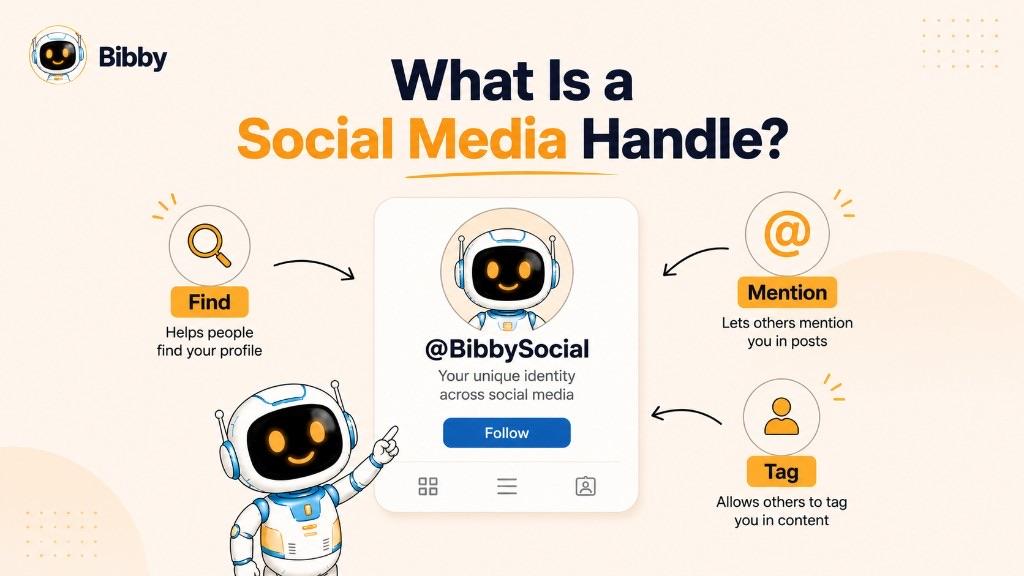
When someone searches for a handle, they can usually find the account associated with it. Handles are also used when mentioning or tagging accounts in posts, comments, captions, videos, and other social media content.
For example, if a business uses @BibbySocial as its handle, another user may mention the account by typing @BibbySocial in a supported post or comment. The mention can then direct other users to the business profile.
A handle is generally different from a display name. The display name is the name people see prominently on a profile and may not need to be unique. The handle, on the other hand, is used to distinguish one account from another within the platform. Your bio can add more context under that name.
For businesses and creators, a handle can become an important part of their digital identity. Using a recognizable and consistent handle across social networks can make a brand easier to find and remember, particularly when content is being published and managed across multiple platforms.
What Does the @ Symbol Mean in a Handle?
The @ symbol is commonly placed before a social media handle to identify a specific account. For example, @BibbySocial represents a social media account's handle, while typing the same handle in a supported post or comment can create a mention of that account.
The @ symbol makes handles easy to recognize in social media conversations. Instead of simply writing a person's or brand's name, users can reference the specific account they want to mention.
For example:
Display name: Bibby
Handle: @BibbySocial
If someone writes “Follow @BibbySocial for social media automation tips,” the handle identifies the specific account being referenced.
The exact behavior of the @ symbol varies between platforms. On some networks, using a handle in a post automatically creates a clickable mention. On others, the platform may have different rules for mentions, usernames, or tagging.
It's also worth remembering that the @ symbol and the handle are closely associated but are not always technically the same thing. The handle is the account identifier, while the @ symbol is commonly used to introduce that identifier when displaying or mentioning it.
Handle Examples on Social Media
Social media platforms use handles in slightly different ways, but the basic idea remains the same: a handle helps identify a specific account and makes it easier for people to find or mention it.
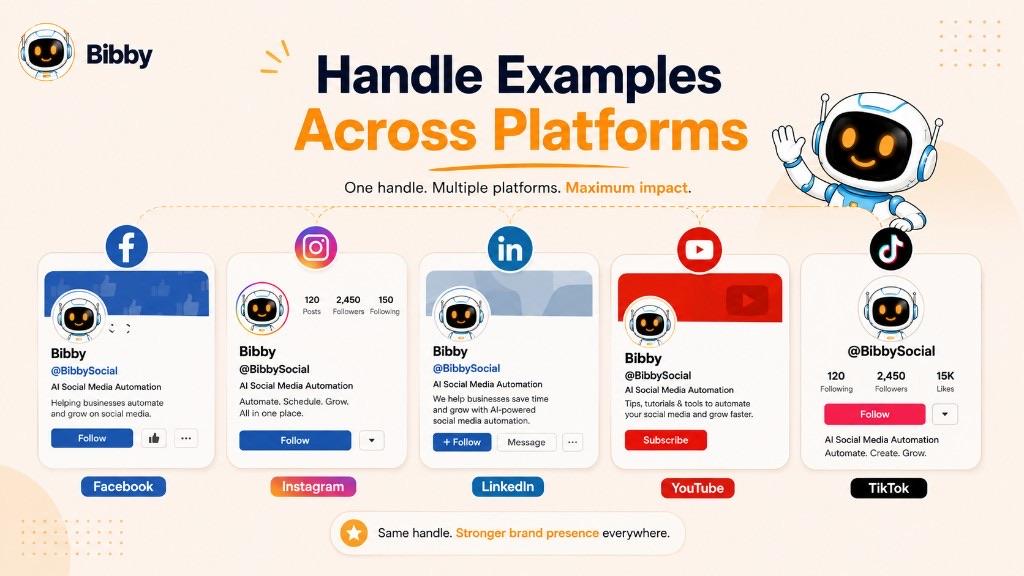
Here are a few examples:
| Platform | Example handle | Common use |
|---|---|---|
| @BibbySocial | Finding and mentioning a profile | |
| TikTok | @BibbySocial | Finding and mentioning an account |
| YouTube | @BibbySocial | Identifying and sharing a channel |
| @BibbySocial | Mentioning a person, company, or page where supported | |
| @BibbySocial | Identifying or mentioning an account or page where supported | |
| X | @BibbySocial | Finding and mentioning an account |
A brand may try to use the same handle across multiple platforms to create a consistent identity. For example, a business could use @BibbySocial on Instagram, TikTok, YouTube, and other networks if the handle is available.
However, handle availability, character limits, naming rules, and how handles are used can differ from one platform to another. A handle that is available on one social network may already belong to someone else on another.
For businesses, creators, and marketers, checking handle availability before launching a new social profile can help maintain a consistent and recognizable brand identity across social media.
How Does a Social Media Handle Work?
A social media handle acts as an account's public identifier. When you create a profile on a social platform, you typically choose or receive a username that distinguishes your account from other users.
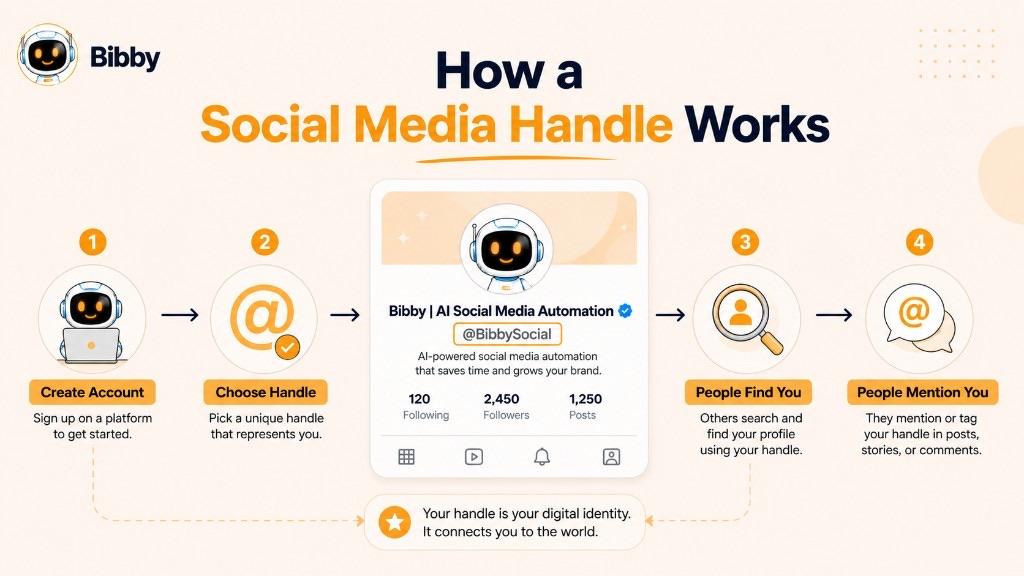
The process is straightforward:
1. Create a social media account
You first create an account on a platform such as Instagram, TikTok, YouTube, LinkedIn, Facebook, or X.
2. Choose a handle
Depending on the platform, you can select a username or handle that represents you, your business, or your brand. If the desired handle is already taken, you generally need to choose another one.
3. Your handle identifies your account
Once established, the handle becomes part of your public social media identity. People can use it to search for your profile or identify your account in conversations.
4. People can mention your handle
On platforms that support mentions, users can type your handle with the @ symbol to reference your account in a post, comment, caption, or other content.
For example:
@BibbySocial
A mention can help direct other users to the referenced profile and can encourage engagement with the account.
5. Your handle can become part of your brand
For businesses and creators, a handle is more than an account identifier. Over time, it can become part of the brand's identity. A consistent handle across social networks makes it easier for audiences to recognize and find the same business or creator on different platforms.
This becomes particularly useful when managing multiple social channels. Instead of treating every profile as a separate identity, businesses can use a consistent handle, visual identity, and messaging style across their social media presence.
Handle vs. Username: What's the Difference?
Handle and username are often used interchangeably on social media. In most everyday conversations, both refer to the identifier associated with a particular account. However, the exact terminology and functionality can vary between platforms.
A handle is typically the public identifier people use to find, mention, or reference an account. It is commonly displayed with an @ symbol, such as @BibbySocial.
A username can refer more broadly to the name used to identify an account. On some platforms, the username is effectively the same thing as the handle, while other platforms may use separate terminology or account identifiers.
| Handle | Username |
|---|---|
| Commonly displayed with an @ symbol | May or may not be displayed with @ |
| Often used for public identification | Used to identify an account |
| Commonly used in mentions | May be used as the account's login or public identifier, depending on the platform |
| Usually subject to platform-specific uniqueness rules | Rules vary by platform |
Are a Handle and Username the Same Thing?
Usually, they mean the same thing in social media conversations, but not always technically.
For example, when someone asks, "What's your Instagram handle?" they are generally asking for the account's username, such as @BibbySocial.
The distinction becomes more important when discussing a specific platform because each social network can define usernames, handles, profile names, and account identifiers differently.
For most users, the simplest way to remember it is:
Username identifies the account. A handle is the public-facing username commonly used with @ on social media.
When creating social profiles for a business, the practical goal is less about terminology and more about choosing an identifier that is recognizable, memorable, easy to spell, and consistent with your brand.
Handle vs. Display Name
A handle and a display name serve different purposes on social media, even though both appear on a profile.
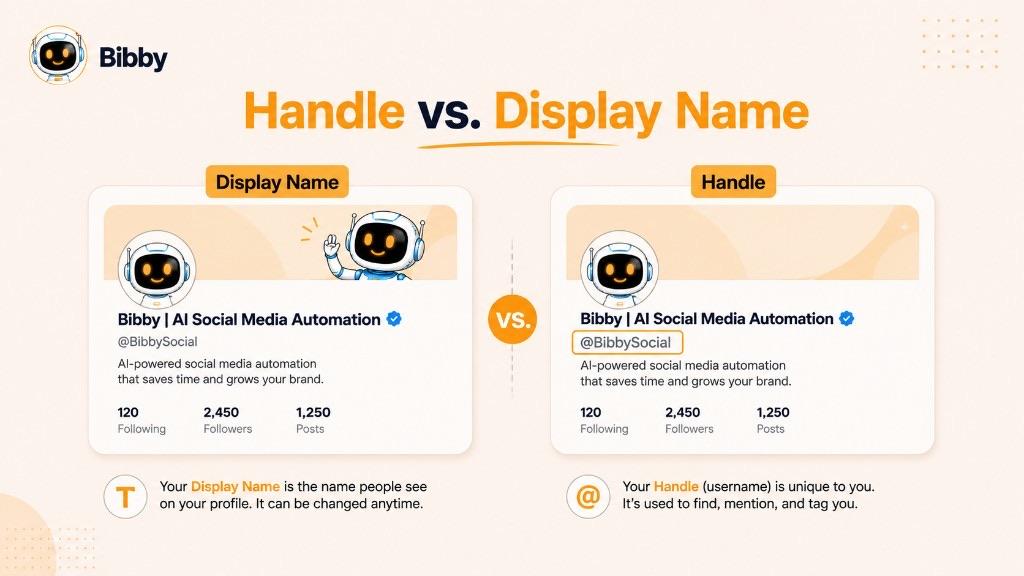
A handle is the account's unique identifier, commonly shown with an @ symbol. A display name is the name shown prominently on the profile and is primarily used to tell people who the account belongs to.
For example:
Display name: Bibby | AI Social Media Automation
Handle: @BibbySocial
The display name communicates what the brand is, while the handle gives people a specific identifier they can search for or use when mentioning the account.
| Handle | Display name |
|---|---|
| Identifies a specific account | Represents the visible profile name |
| Usually unique on a platform | Often does not need to be unique |
| Commonly uses the @ format | Usually displayed without @ |
| Used for searches and mentions | Used primarily for recognition and branding |
| Often has stricter character rules | May allow more flexible naming |
Why Does the Difference Matter?
The distinction becomes especially important for businesses managing multiple social media profiles.
A company could use the same or similar display name as another business, but its handle needs to identify the specific account. This is why businesses often try to secure a recognizable handle that closely matches their brand name.
Your display name can also provide additional context. For example, a business might use Bibby | AI Social Media Automation as its display name while keeping @BibbySocial as its shorter, easier-to-remember handle. The bio can then explain what the account does.
Together, the two elements help establish a recognizable social media identity: the display name tells people who you are, while the handle helps them find and interact with your specific account.
Why Are Social Media Handles Important?
A social media handle may look like a small part of a profile, but it can play a major role in how people discover, recognize, and interact with an account. For businesses and creators, the right handle can become a recognizable part of their online identity.
Brand Recognition
A consistent handle helps people recognize your business across different social networks. If your brand uses a similar handle on Instagram, TikTok, YouTube, LinkedIn, and other platforms, audiences can more easily connect those profiles to the same business. That consistency supports brand awareness.
Discoverability
People can search for an account using its handle. A simple, recognizable handle can make it easier for customers, followers, and potential partners to find the right profile.
Mentions and Engagement
Handles make it possible for users to mention accounts in supported posts, comments, captions, and other content. This is particularly useful when customers are talking about a business or when creators collaborate with brands.
For example, a customer might mention @BibbySocial when sharing their experience with a social media automation tool.
Cross-Platform Consistency
Businesses rarely operate on just one social network. Maintaining a consistent handle where possible creates a more unified digital presence and reduces confusion when audiences move from one platform to another.
Marketing and Campaigns
Handles can become part of social media campaigns, influencer partnerships, user-generated content initiatives, and promotional materials. A memorable handle gives audiences a simple way to identify the brand behind the campaign.
Professional Online Identity
A clear and relevant handle can make a business profile look more established and easier to remember. On the other hand, an overly complicated handle filled with unnecessary numbers, symbols, or unrelated words can make a brand harder to recognize.
Ultimately, a social media handle is more than an @username. It can function as a compact digital identity that connects your brand with its audience across the social platforms where you publish and engage.
How to Choose a Good Social Media Handle
Choosing a social media handle is worth some thought, especially for a business or creator building a long-term online presence. A good handle should be easy to recognize, simple to remember, and closely connected to the identity you want to build.
Keep It Close to Your Brand
When possible, use your business, product, personal brand, or creator name. A handle that clearly relates to your brand makes it easier for people to recognize the account.
For example, a company named Bibby could use a handle such as @BibbySocial rather than an unrelated username.
Make It Easy to Remember
Avoid unnecessarily complicated combinations of numbers, symbols, or abbreviations. Someone should be able to see your handle and reasonably remember how to type it later.
A shorter handle is often easier to use in conversations, promotional graphics, videos, and other marketing materials.
Keep It Easy to Spell
If people frequently misspell your handle, they may struggle to find your profile. Choose words that are straightforward and avoid unusual spellings unless they are an intentional part of your brand.
Aim for Cross-Platform Consistency
If you maintain profiles on multiple platforms, try to use the same handle whenever it is available.
For example:
Instagram: @BibbySocial
TikTok: @BibbySocial
YouTube: @BibbySocial
A consistent identity makes it easier for audiences to recognize your brand across different networks. However, every platform has its own naming rules and availability, so an identical handle may not always be possible.
Avoid Temporary Trends
A handle should ideally remain relevant as your brand evolves. Using a short-lived meme, trend, year, or campaign name could make the account feel outdated later.
Think About Long-Term Growth
Choose a handle that can grow with your business. If you currently offer one service but may expand into other products or markets, avoid locking your social identity into an overly narrow name.
Check Availability Before Committing
Before creating profiles, search for your preferred handle across the platforms that matter most to your audience. Also check whether the name is already strongly associated with another business, creator, or organization.
The best handle is not necessarily the cleverest one. It is the one your audience can recognize, remember, search for, and associate with your brand without having to solve a tiny username puzzle every time.
What Makes a Good Business Handle?
A business handle should make the company easy to recognize and find without creating unnecessary confusion. Unlike a temporary campaign name or personal nickname, a business handle may represent the brand for years, so it is worth choosing one that can scale with the company.
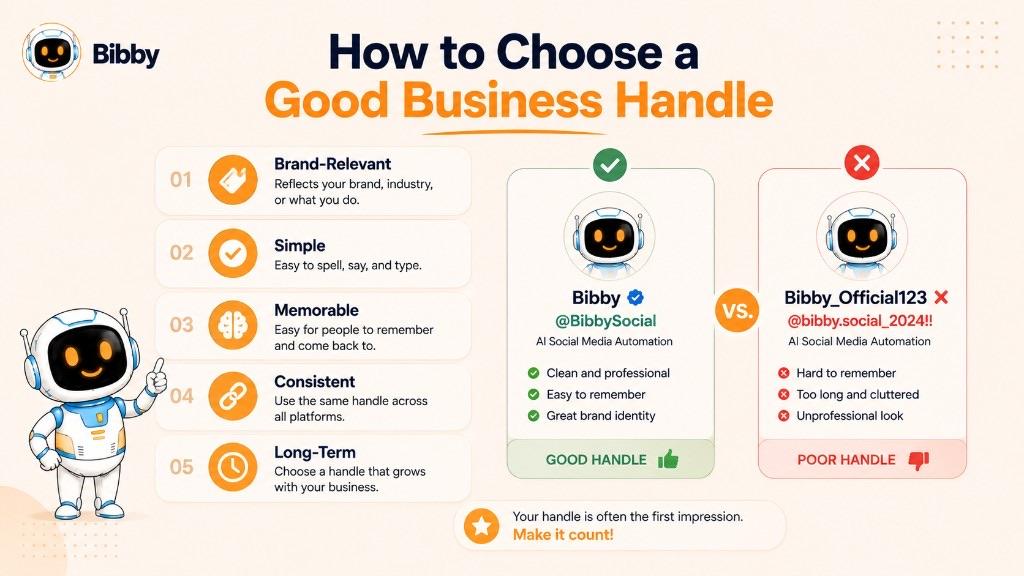
A strong business handle usually has five qualities: relevance, simplicity, consistency, memorability, and longevity.
Relevant to the Brand
The handle should have a clear connection to the company's name, product, or brand identity. When someone sees it, they should have a reasonable idea of which business it represents.
For example, @BibbySocial connects the Bibby brand with its social media focus.
Simple and Easy to Spell
Avoid unnecessarily long handles or complicated combinations of numbers and characters. A simple handle is easier to type, share verbally, place on marketing materials, and remember after someone sees it.
Consistent Across Platforms
Businesses often maintain several social media accounts. Using the same handle across major platforms can create a more unified brand presence.
If the exact handle is unavailable, choose a variation that remains recognizable and consistent rather than creating completely different names for every platform.
Memorable
A good handle should stick in someone's mind. This is particularly useful when customers discover a business through a video, advertisement, podcast, event, or other channel and later search for the company on social media.
Suitable for Long-Term Growth
Avoid building your handle around a temporary promotion, specific year, or narrow product if you expect the business to expand.
For example, a handle containing 2026 may need to be reconsidered later, while a broader brand-focused handle can remain relevant.
Easy to Use in Marketing
Your handle may appear in:
- Social media posts and captions
- Videos and graphics
- Email campaigns
- Websites
- Digital advertisements
- Influencer collaborations
- User-generated content campaigns
- Printed marketing materials
A handle that is short and recognizable works better across all these touchpoints.
Ultimately, a good business handle should feel like a digital address for your brand: distinctive enough to identify you, simple enough for people to remember, and flexible enough to remain useful as your business grows.
How to Find Your Social Media Handle
Finding your social media handle is usually straightforward. In most cases, you can locate it directly on your profile, where the platform displays your account identifier.
Look for the username associated with your profile, often shown with an @ symbol. For example, if your profile displays @BibbySocial, that is the account's handle.
You can also check your profile URL. On platforms that use handles as part of their public profile addresses, the username may appear at the end of the URL.
A Simple Way to Find Your Handle
- Open the social media platform and go to your profile.
- Look below or around your profile name for your username or handle.
- Identify the name beginning with @, if the platform uses that format.
- Copy the handle when you need to share it with someone.
- You can also copy your profile link if you want people to visit your account directly.
Keep in mind that different platforms use different terminology. Some may prominently display an @handle, while others may refer to the same or similar identifier as a username.
If you manage multiple social media accounts for a business, it can be useful to keep a record of each platform's handle. This makes it easier to maintain consistent branding when creating campaigns, publishing content, or sharing your social profiles.
Where Can You Find Your Social Media Handle?
Your social media handle is usually displayed on your profile, but its exact location and terminology can vary by platform. Some networks prominently show an @username, while others may use terms such as username or handle.
Here is where handles commonly appear across major platforms:
Your Instagram handle appears on your profile as your username, typically displayed with an `@` when referenced elsewhere.
For example:
@BibbySocial
It can also form part of your Instagram profile URL, making it another way to identify your account.
TikTok
TikTok uses the username as the account's public identifier. It is commonly displayed with an `@` symbol, such as @BibbySocial.
The username can be used when people search for or mention your account.
YouTube
YouTube has dedicated handles that begin with `@`. A channel might use a handle such as @BibbySocial, which can help people find and reference the channel.
YouTube handles are separate from the channel's display name, so the two do not necessarily have to be identical.
LinkedIn uses profile and company identifiers differently from platforms built primarily around `@usernames`. Users can still mention people, companies, and pages where supported, but the exact profile identifier and URL structure may differ.
For LinkedIn, check your profile or page URL and the account information provided by the platform rather than assuming the same handle format used on Instagram or TikTok.
Facebook uses usernames for profiles and Pages, and these can appear as part of a public profile or Page URL. Depending on the context, users may refer to this identifier as a username or handle.
For a business Page, check the Page's settings and public URL to identify the username associated with it.
X
X uses handles in the familiar `@username` format. For example, an account could use @BibbySocial.
The handle is used to identify the account and can be included in posts and replies to mention that account.
Why Check Each Platform Separately?
If you manage several social media profiles, don't assume that every platform treats handles in exactly the same way. Naming rules, character limits, availability, URLs, and terminology can differ between networks.
Before publishing a campaign or adding social profiles to marketing materials, verify the current handle on each platform. This small step can prevent incorrect usernames from spreading across websites, graphics, advertisements, and scheduled social content.
Can You Change Your Social Media Handle?
Yes, many social media platforms allow users to change their handle or username, although the process, restrictions, and consequences vary from one platform to another.
Changing a handle can be useful if you rebrand a business, update a creator name, correct an old username, or want a handle that better matches your current identity. However, an established handle should not be changed casually because people may already associate it with your brand.
Before changing it, consider where your existing handle appears. It may be included in your website, email signatures, advertisements, social media graphics, videos, campaign materials, and other marketing assets.
Why Might You Change a Handle?
Common reasons include:
- Rebranding a business
- Changing a company or product name
- Removing an outdated term
- Creating a more consistent identity across platforms
- Fixing a confusing or difficult-to-remember username
- Moving away from a personal name toward a business brand
What Should You Check Before Changing It?
First, confirm that your new handle is available and complies with the platform's current naming rules. Then check whether the old handle appears in important marketing materials or external links.
It is also worth reviewing your other social profiles. If you're changing your Instagram handle, for example, you may want to check whether the corresponding name is available on TikTok, YouTube, LinkedIn, X, and other platforms important to your brand.
Does Changing a Handle Affect Your Account?
A handle change does not necessarily mean creating a new social media account. In many cases, you can change the username while keeping your existing profile, followers, posts, and other account information.
However, the exact effects depend on the platform. Your profile URL may change, existing references to your old handle may become outdated, and people who know your previous username may temporarily have difficulty finding you.
For an established business, a handle change should therefore be treated as a branding change rather than just a username edit. Plan the transition carefully and update important references once the new handle is active.
What Happens When You Change Your Social Media Handle?
Changing a social media handle can update the public identity of your account without necessarily requiring you to create a new profile. However, the change can affect how people find and recognize your account, particularly if the old handle has been used for a long time.
The exact effects depend on the social media platform, but several things are worth considering.
Your Public Identifier Changes
Your new handle becomes the identifier people use to search for, mention, or reference your account where supported.
For example, a business changing from @OldBrand to @NewBrand will need to start promoting the new handle.
Your Profile URL May Change
Some platforms incorporate the username or handle into the public profile URL. If the handle changes, the profile link may change as well.
This means you should review links to your social profile on your website, email signatures, digital advertisements, blog posts, and other marketing materials.
People May Need Time to Recognize the New Handle
Existing followers may know your account by its previous handle. A sudden change can create temporary confusion, particularly when the new name is significantly different.
For an established brand, communicating the change can make the transition smoother.
Old Marketing Materials May Become Outdated
Your previous handle may appear in social graphics, videos, brochures, advertisements, presentations, and campaign assets.
If those materials are still being used, update them where practical so customers aren't directed toward an outdated identity.
Your Cross-Platform Branding May Need Updating
A handle change on one platform can create an inconsistent brand presence if your other social accounts continue using the old name.
For example:
Instagram: @NewBrand
TikTok: @OldBrand
YouTube: @OldBrand
If the goal is a rebrand, check whether the new handle can also be secured across your other important platforms.
Your Followers Don't Necessarily Disappear
Changing a handle is generally different from creating a new account. Depending on the platform, your existing followers and published content can remain associated with the account.
However, platform-specific rules can change, so always check the current platform guidance before making a significant change.
Plan the Change Before You Make It
For businesses, changing a handle should be part of a broader social media update. Review profile links, campaign assets, website references, branded graphics, scheduled content, and other places where the old handle appears.
A handle change can be relatively simple technically, but maintaining continuity for your audience is the real challenge.
Handle vs. Tag vs. Mention
Handle, tag, and mention are related social media terms, but they do not mean exactly the same thing.
A handle identifies an account. A mention refers to that account in social media content, usually by using its handle with the `@` symbol. A tag generally associates an account, person, or profile with content, although the exact functionality varies by platform.
A hashtag (`#topic`) categorizes content. A geotag attaches a location. A handle (`@account`) identifies a specific profile.
Handle
A handle is the account identifier itself.
Example: `@BibbySocial`
It tells people which social media account belongs to a particular person, creator, business, or brand.
Mention
A mention occurs when someone references an account using its handle in supported social media content.
Example:
Thanks to @BibbySocial for helping us automate our social media.
Here, @BibbySocial is the handle, while using it in the post is a mention.
Mentions can help bring an account into a conversation and, depending on the platform, may notify the mentioned account.
Tag
A tag generally connects an account or person directly to content, such as a photo, video, or post. The exact behavior varies considerably between platforms.
For example, a platform may allow someone to tag another account in a photo, while a mention may simply reference that account within the caption or conversation.
Quick Comparison
| Term | What it means | Example |
|---|---|---|
| Handle | The account's public identifier | @BibbySocial |
| Mention | Referencing an account using its handle | “Thanks @BibbySocial” |
| Tag | Associating an account or person with content | Tagging an account in a photo |
The terms are often used interchangeably in casual conversation, but understanding the difference is useful for social media marketers. A handle is the identity, while mentions and tags are ways that identity can be connected to social media activity.
Because each platform has its own features and terminology, always consider the specific network when explaining how tagging and mentions work.
How Handles Are Used in Social Media Marketing
A social media handle is more than a way to find an account. For businesses, creators, and marketers, it can become a recognizable part of the brand and an important tool for building conversations across social platforms.
A handle can appear in everything from everyday posts to large marketing campaigns.
Brand Mentions
Businesses can use their handle to make it easier for customers and followers to mention them in posts, comments, and conversations.
For example, a brand might encourage customers to mention @BibbySocial when sharing their experience with the product.
These mentions can help connect conversations about the brand back to its social profile.
Influencer Collaborations
Handles are especially important when brands work with influencers or creators. Campaign content can mention the participating brand or creator, making it clear who is involved in the collaboration.
A memorable handle also reduces the chance of audiences struggling to identify the correct account.
User-Generated Content
Brands often encourage customers to share photos, videos, reviews, or experiences on social media. Asking users to mention the brand's handle provides a simple way to connect that content with the business.
For example:
Share your setup and mention @BrandName.
This can help businesses discover relevant customer content and participate in conversations around their products.
Social Media Campaigns
A handle can become part of a campaign's communication strategy. Businesses may include their handle in captions, creative assets, videos, advertisements, and promotional messages so audiences know which account to follow or mention.
Cross-Platform Promotion
Businesses can include their social handles on websites, email newsletters, packaging, digital advertisements, and other marketing channels.
Using a recognizable handle across multiple networks can make the transition from one channel to another easier for customers.
Community Engagement
Handles also make it easier for businesses to participate in conversations. A company can respond to customer questions, acknowledge mentions, join relevant discussions, and interact with creators or partners using its account as part of community management.
Social Media Automation
When a business publishes content across multiple platforms, keeping its social identity consistent becomes increasingly important. A recognizable handle, consistent branding, and coordinated publishing strategy can help create a unified presence.
Tools such as Bibby can help businesses manage this broader workflow by creating content, generating captions, organizing campaigns, and scheduling posts across selected social platforms from one place.
A handle may be only a few characters long, but in social media marketing, it can serve as a small but important link between brand identity, discoverability, engagement, and community.
Handles and Social Media Automation
Managing one social media account is relatively simple. Managing several platforms at the same time is a different story. Businesses may publish the same campaign across Instagram, Facebook, TikTok, YouTube, LinkedIn, and other networks, each with its own profile, handle, content format, and publishing rules.
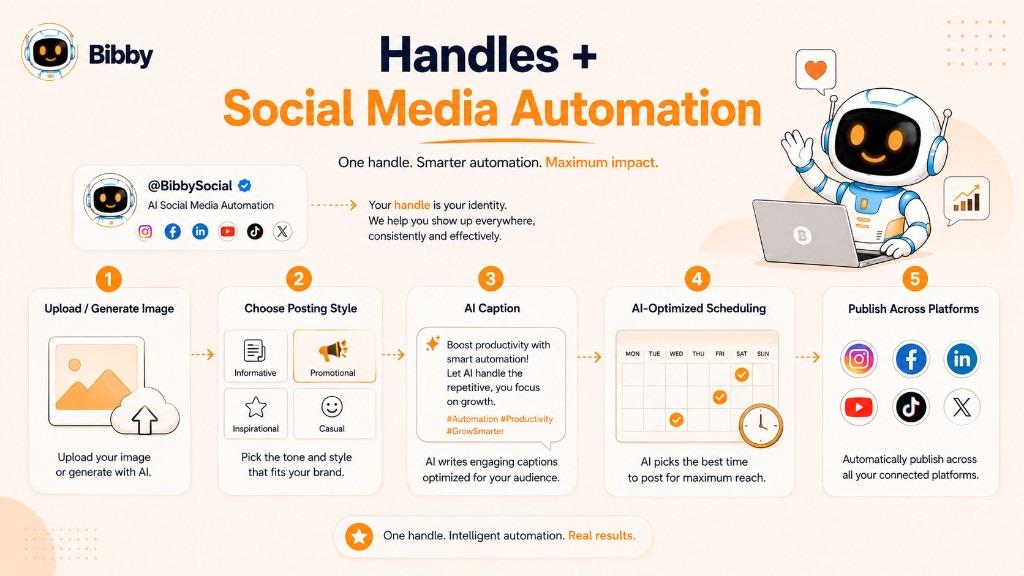
This makes keeping track of social media handles an important part of maintaining a consistent brand presence.
A handle can appear in captions, promotional graphics, campaign content, videos, customer conversations, and collaborations. When content is created and scheduled at scale, marketers need to make sure the correct brand identity is represented across each platform.
Keeping Brand Identity Consistent
A consistent handle helps audiences recognize a business across multiple networks. Social media automation can complement this consistency by bringing content planning, creation, and scheduling into a centralized workflow.
Instead of manually preparing every post for every platform, businesses can organize their content strategy in one place and adapt it for their selected channels.
Handles in Campaign Management
Handles are also useful when planning social media campaigns. A campaign may involve branded posts, creator collaborations, customer content, mentions, and promotional messages across several platforms.
Keeping the correct account identity associated with campaign content reduces the risk of publishing content under the wrong profile or using outdated branding.
Handles and Automated Publishing
When social media content is scheduled automatically, the publishing destination matters. A business may have several connected accounts, each representing a different platform or brand.
A social media automation platform can help organize these accounts alongside scheduled content, making it easier to manage a publishing workflow without repeatedly switching between different platforms.
How Bibby Fits Into the Workflow
Bibby brings social media content creation and scheduling into a single workflow. Users can upload an image or generate one with AI, choose a posting style, and let Bibby generate captions and schedule content at AI-optimized times across selected social platforms.
The platform also supports different content formats, including images, carousels, videos, and stories.
Bibby's chat interface extends this workflow further. Instead of navigating through multiple tools, users can interact with Bibby conversationally to perform tasks such as creating a brand kit, launching a campaign, creating posts, and regenerating captions.
For businesses managing multiple social profiles, this creates a more connected workflow where handles, brand identity, content creation, and publishing can be managed as parts of the same social media strategy.
How Bibby Helps Manage Social Media Across Platforms
Managing social media across several platforms can quickly become repetitive. You may need to prepare visuals, write captions, choose publishing times, adapt content for different networks, and keep track of multiple accounts and campaigns.
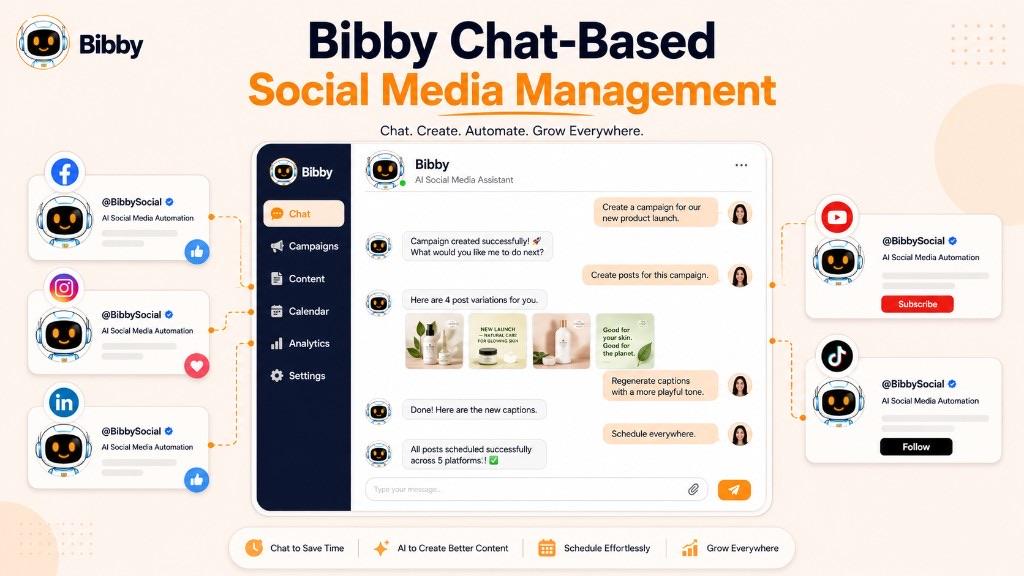
Bibby brings these tasks into a single social media automation workflow.
The process starts with your content. You can upload an image or generate one with AI, choose your preferred posting style, and let Bibby generate captions automatically. You can then schedule the content across your selected social platforms at AI-optimized times.
One Workflow for Multiple Platforms
Instead of manually publishing the same campaign across different networks, Bibby can help coordinate content across platforms such as:
- YouTube
- TikTok
The exact publishing options can vary depending on the content format and platform.
Bibby also supports multiple types of social content, including images, carousels, videos, and stories, helping businesses manage more than just traditional image posts.
Manage Social Media Through Chat
Bibby's chat interface adds another way to manage your social media workflow. You can communicate with the tool directly instead of handling every task through separate screens.
Within the chat experience, you can work on tasks such as:
- Creating a brand kit
- Creating campaigns
- Creating social posts
- Regenerating captions
- Managing other social media tasks
This conversational approach can make social media management feel less like operating a collection of disconnected tools and more like working with a centralized digital social media manager.
Why Handles Still Matter
Even when content creation and publishing are automated, your social media handles remain an important part of your brand identity. The handle tells audiences which account represents your business and connects your content to your broader social presence.
By combining consistent handles with coordinated content, automated scheduling, and unified brand assets, businesses can create a more recognizable presence across multiple social networks.
In short, your handle identifies your social account, while Bibby helps you manage the content and publishing workflow around that account.
Key Takeaways
A social media handle is the unique username that identifies an account, commonly written with an @ symbol. It is different from a display name, and it is not the same as a hashtag, geotag, mention, or photo tag.
A strong handle is recognizable, easy to spell, consistent across platforms, and built to last. Check availability before you launch, and treat a handle change as a branding update—not just a username edit.
When you publish across several networks, keep the same handle in captions, campaigns, and marketing materials. Bibby can help you create, caption, and schedule that content across Facebook, Instagram, LinkedIn, YouTube, and TikTok.
Continue learning with related dictionary entries on bios, hashtags, captions, UGC, geotags, and brand awareness—or browse the social media dictionary. Then start a free Bibby trial to create, caption, and schedule visual content across your channels.