
Engagement in social media refers to any interaction users have with your content. It includes likes, comments, shares, saves, clicks, replies, mentions, and other actions that show people are actively responding to what you publish.
Engagement is an important indicator of how your audience connects with your content. A post may reach thousands of people, but if nobody interacts with it, that reach does not necessarily mean the content resonated. On the other hand, a post with a smaller reach can generate strong engagement when it is useful, relevant, entertaining, or worth sharing.
For businesses, tracking engagement helps reveal which topics, formats, captions, and publishing strategies connect with their audience. It can also provide valuable insights for improving future social media content. However, engagement should not be viewed in isolation. Metrics such as reach, impressions, clicks, and conversions can provide additional context about overall social media performance.
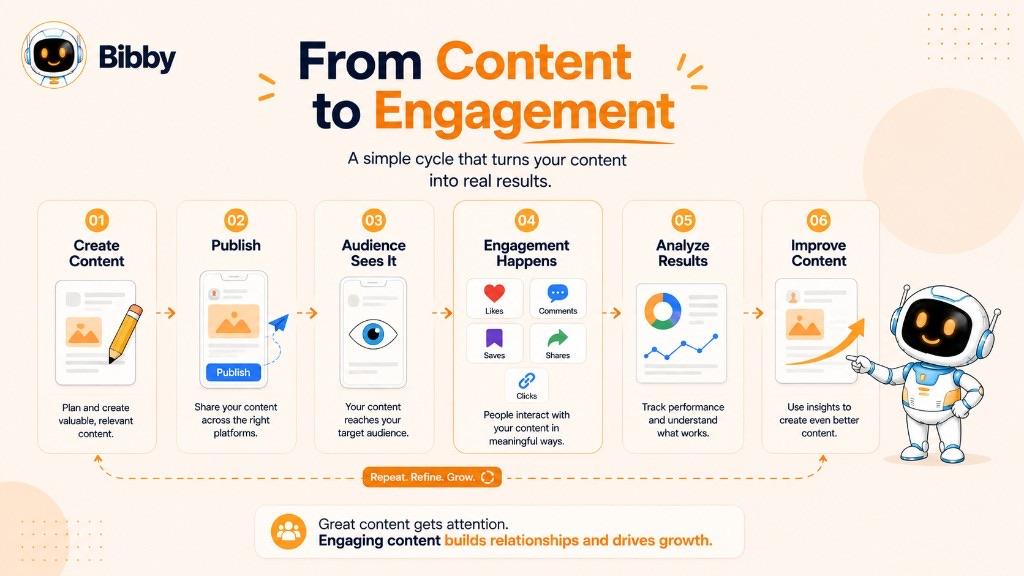
With tools such as Bibby, businesses can simplify the work behind consistent engagement. Users can create or generate content, choose a posting style, automatically generate captions, and schedule posts across platforms such as Facebook, Instagram, LinkedIn, YouTube, and TikTok. By reducing repetitive publishing tasks, automation gives social media teams more time to focus on what matters after publishing: understanding their audience and building meaningful conversations.
What Does Engagement Mean in Social Media?
Social media engagement is any action a person takes to interact with your content. It goes beyond simply seeing a post in their feed. When someone likes, comments on, shares, saves, or clicks on your content, they are showing some level of interest or response.
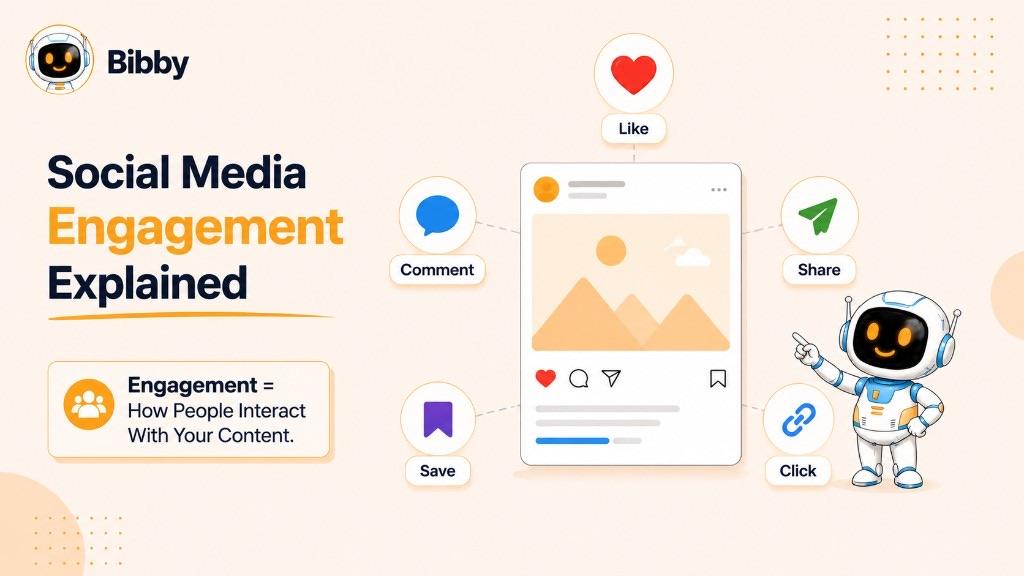
For example, if a business publishes an Instagram carousel and a follower saves it for later, that save is an engagement. If someone comments on a LinkedIn post, shares a Facebook video, clicks a link in a social media post, or replies to an Instagram Story, those actions can also count as engagement.
Engagement helps businesses understand whether their content is connecting with the people they want to reach. High engagement can indicate that a topic is relevant, a post is useful, or the content gives people a reason to respond. Low engagement, meanwhile, may suggest that the content, format, message, audience targeting, or publishing strategy needs improvement.
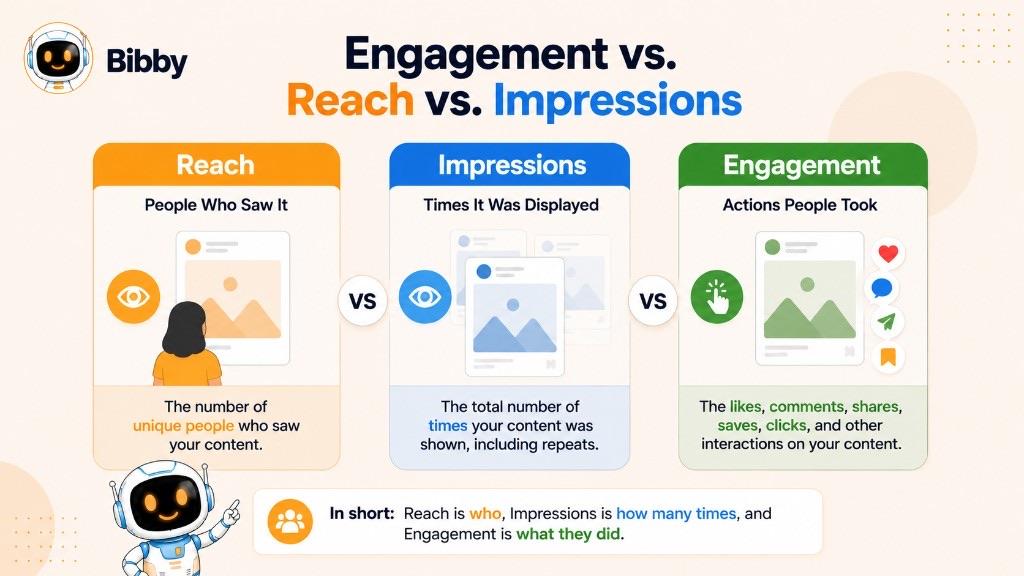
It is also important to distinguish engagement from reach and impressions. Reach tells you how many people saw your content, while impressions measure how many times it was displayed. Engagement focuses on what people actually did with that content.
Because every social media platform has its own features and analytics, the specific actions counted as engagement can vary. However, the basic idea remains the same: engagement measures how people interact with your social media content rather than simply being exposed to it.
What Counts as Social Media Engagement?
Social media engagement includes many different actions users can take after seeing your content. While likes are often the most visible form of engagement, they are only one part of the picture. A comment, share, save, click, or reply can often provide a stronger signal of active interest.
Common types of social media engagement include:
Likes and Reactions
Likes and reactions are quick ways for users to respond to content. They can indicate that someone enjoyed, agreed with, or found a post interesting.
Comments
Comments represent a more active form of interaction because users take the time to respond to the content. Questions, opinions, feedback, and discussions can all contribute to engagement.
Shares and Reposts
When users share or repost content, they are putting it in front of their own audience. Shares can be particularly valuable because they may indicate that the content is useful, entertaining, informative, or worth recommending.
Saves
A save allows users to keep content for future reference. For example, someone might save a tutorial, checklist, recipe, educational carousel, or helpful business tip.
Clicks
Clicks occur when users interact with a link, profile, button, image, or other clickable element. They can show that a person wants to explore something beyond the original post. Click-through rate (CTR) then measures how often those clicks happen relative to exposure.
Replies and Mentions
Replies create direct conversations around content, while mentions can bring a brand or creator into another user's conversation or post. Both can help indicate deeper audience interaction.
Story Interactions
Stories can generate engagement through replies, polls, questions, quizzes, stickers, link clicks, and other interactive features.
Video Interactions
Video engagement can include likes, comments, shares, saves, clicks, and other viewing-related actions. Depending on the platform and its analytics, metrics such as watch time, views, and completion can also help explain how audiences interact with video content.
The exact engagement actions and how they are reported can differ between platforms such as Facebook, Instagram, LinkedIn, YouTube, and TikTok. Therefore, when comparing engagement across platforms, it is important to understand how each platform defines and measures its metrics.
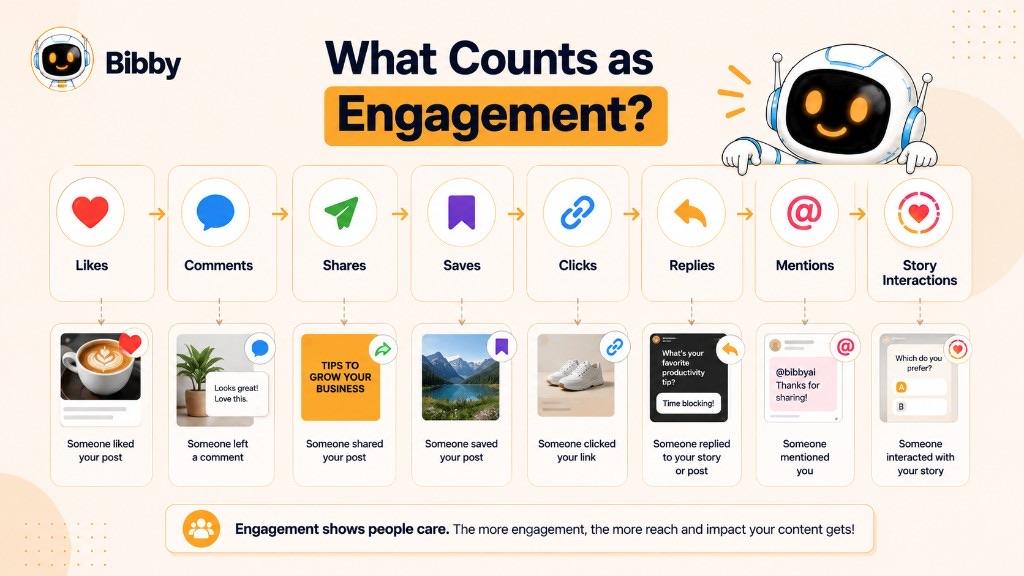
In simple terms, engagement is anything your audience does with your content that shows they are interacting with it rather than simply scrolling past it.
Examples of Social Media Engagement
Social media engagement can look different depending on the platform, content format, and action you want your audience to take. A user does not have to leave a comment for their interaction to be valuable. Even a save, share, click, or reply can provide useful information about how people respond to your content.
Here are some common examples of social media engagement:
Instagram Engagement
A business publishes a carousel explaining five social media tips. Users may like the post, leave comments, save the carousel for later, share it with friends, or click through to the business profile or website. Story polls, question stickers, replies, and link clicks can also generate engagement.
Facebook Engagement
A brand shares a product announcement on Facebook. People may react to the post, comment with questions, share it with their network, or click a link to learn more. Each action provides a different signal about how users responded to the content.
LinkedIn Engagement
A company publishes a post about an industry trend. Other users might react, comment with their opinions, repost the content, mention colleagues, or click through to a related article. Comments and reposts can be particularly useful for starting professional conversations.
TikTok Engagement
A creator publishes a short educational video. Viewers may like, comment, share, save, follow the account, or watch the video repeatedly. These interactions can help reveal whether the topic or format captured the audience's attention.
YouTube Engagement
A business uploads an educational video. Viewers can like, comment, share the video, subscribe to the channel, or click links associated with the content. Viewing behavior can also provide additional insight into how audiences consume the video.
A Simple Example
Imagine a business publishes a social media marketing carousel and receives:
- 150 likes
- 30 comments
- 45 shares
- 80 saves
- 120 link clicks
These actions represent different forms of engagement. The likes show quick reactions, comments indicate conversation, shares suggest that users found the content worth distributing, saves can indicate future value, and clicks show interest beyond the original post.
This is why engagement should not be reduced to likes alone. Looking at different types of interactions gives businesses a more complete picture of how their audience responds to their content.
Why Is Social Media Engagement Important?
Social media engagement helps businesses understand whether their content is actually connecting with their audience. A post can receive thousands of impressions, but those numbers alone do not tell you whether people found the content useful, interesting, entertaining, or worth responding to.
Engagement provides additional context by showing what people do after encountering your content.
Shows Audience Interest
When people consistently comment, share, save, or click on your content, it can indicate that your topics and messaging are relevant to them. Looking at these interactions over time can help you understand what your audience cares about.
Helps Identify High-Performing Content
Engagement data can reveal which posts perform better than others. For example, you might discover that educational carousels generate more saves, while short videos receive more shares.
These patterns can help you decide what types of content to create more often.
Encourages Conversations
Comments, replies, and mentions create opportunities for direct conversations between brands and their audiences. Responding to these interactions can make social media feel more like a two-way communication channel rather than a place where businesses simply publish advertisements. Community management is one way teams turn those interactions into ongoing relationships.
Provides Feedback
Engagement can act as a source of audience feedback. Questions in comments may reveal common problems, while repeated shares or saves can indicate that a particular topic is especially useful.
Businesses can use these insights to improve future content, products, campaigns, and messaging.
Supports Content Distribution
On some social platforms, user interactions can contribute to how content is distributed and recommended. However, there is no universal rule that a specific engagement action will automatically make a post go viral. Each platform uses its own systems and ranking signals.
Helps Measure Content Performance
Engagement gives marketers another way to evaluate content alongside metrics such as reach, impressions, clicks, and conversions. Looking at these metrics together provides a more complete view of social media performance.
Engagement Does Not Always Mean Business Success
High engagement is valuable, but it should not be treated as the ultimate goal for every campaign. A post can receive thousands of likes and comments without generating leads, sales, or website traffic.
The most useful approach is to connect engagement with the purpose of the content. If your goal is community building, comments and replies may matter most. If you want to drive website traffic, clicks may be more important. If you are promoting educational content, saves and shares can provide useful signals.
In short, engagement helps businesses understand not just how many people saw their content, but how people responded to it.
Engagement vs. Reach vs. Impressions
Engagement, reach, and impressions are closely related social media metrics, but they measure different things. Understanding the difference helps businesses interpret their content performance more accurately.
| Metric | What It Measures | Example |
|---|---|---|
| Engagement | Actions people take on your content | Likes, comments, shares, saves, clicks |
| Reach | Number of unique people who saw your content | 5,000 people saw a post |
| Impressions | Total number of times content was displayed | A post was displayed 8,000 times |
| Engagement Rate | Engagement relative to a specific audience or exposure metric | Engagement compared with reach or followers |
Engagement
Engagement measures what people do with your content. Likes, comments, shares, saves, clicks, replies, and other interactions can all contribute to engagement depending on the platform and its reporting system.
For example, if 5,000 people see a post and 300 of them interact with it, those interactions represent engagement.
Reach
Reach refers to the number of unique users who were exposed to your content.
For example, if your post reaches 5,000 people, that means approximately 5,000 individual accounts or users were included in the platform's reported reach for that content.
Reach helps answer:
How many people did my content reach?
It does not tell you how those people responded.
Impressions
Impressions represent the total number of times content was displayed. The same person can account for multiple impressions if they see the content more than once.
For example, if 5,000 people see a post but some users encounter it multiple times, the post could generate 8,000 impressions.
Impressions therefore answer:
How many times was my content displayed?
Engagement Rate
Engagement rate puts interactions into context by comparing engagement with a selected metric such as reach, followers, or impressions.
For example, two posts might receive the same number of likes, but the post that reached fewer people may have generated stronger engagement relative to its audience.
Why the Difference Matters
Consider a post with:
- 10,000 reach
- 15,000 impressions
- 600 engagements
The numbers tell three different parts of the story. The content reached 10,000 unique users, appeared 15,000 times, and generated 600 reported interactions.
Looking at these metrics together gives you a clearer picture than focusing on any single number.
In simple terms: reach tells you who saw your content, impressions tell you how often it was displayed, and engagement tells you what people did with it.
What Is Engagement Rate?
Engagement rate is a metric that measures the amount of interaction a piece of social media content receives relative to a chosen audience or exposure metric. It helps put raw engagement numbers into context.
For example, 500 engagements may sound impressive, but the meaning changes depending on whether the post reached 2,000 people or 200,000 people. Engagement rate helps make that comparison more meaningful.
There is no single engagement-rate formula that applies to every social media platform or reporting system. Marketers commonly calculate it using reach, followers, impressions, or other relevant metrics.
Engagement Rate by Reach
One common approach is to compare total engagements with the number of people reached.
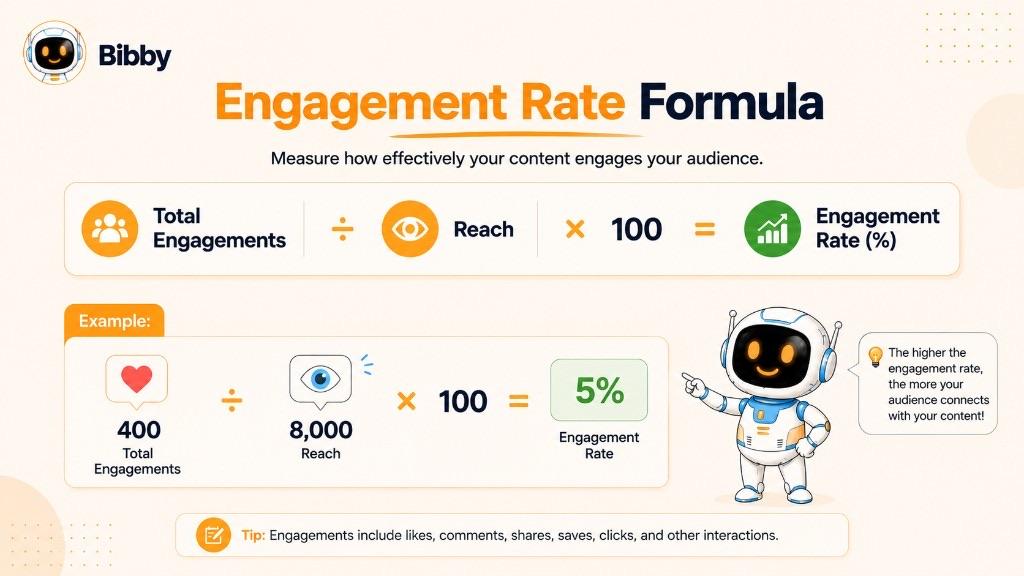
The post has an engagement rate of 5% based on reach.
Engagement Rate by Followers
Another approach compares engagement with the account's follower count.
This method can be useful when evaluating an account's content against its existing audience, although follower counts do not necessarily represent the number of people who actually saw a particular post.
Engagement Rate by Impressions
Marketers can also compare engagements with total impressions.
This can be useful when analyzing how frequently displayed content generated interactions.
Why Engagement Rate Matters
Engagement rate can help businesses compare content performance more effectively than raw engagement numbers alone.
For example, consider two posts:
Post A
- 100 engagements
- 1,000 people reached
- 10% engagement rate
Post B
- 500 engagements
- 20,000 people reached
- 2.5% engagement rate
Post B generated more total interactions, but Post A generated more engagement relative to its reach.
This does not automatically make Post A the better post. The right interpretation depends on the campaign objective and the metrics being analyzed.
Keep the Calculation Consistent
When comparing engagement rates, use the same calculation method whenever possible. Mixing a reach-based engagement rate with a follower-based rate can produce misleading comparisons.
It is also important to check how the social platform defines and reports individual engagement metrics, as these definitions and analytics features can vary.
In short, engagement rate helps answer a more useful question than “How many interactions did this post get?” It asks how much interaction the content generated relative to the audience or exposure being measured.
What Is a Good Engagement Rate?
There is no single engagement rate that can be considered “good” for every social media account. A healthy engagement rate depends on factors such as the platform, industry, audience size, content format, campaign objective, and the method used to calculate the rate.
For this reason, comparing your engagement rate with a random benchmark can sometimes create the wrong picture. A better approach is to compare your performance with relevant data from your own account and similar content.
Compare With Your Previous Performance
Your historical data is often one of the most useful benchmarks. If your engagement rate is consistently improving over several weeks or months, it may indicate that your content strategy is becoming more effective.
For example, increasing your average engagement rate from 2% to 3.5% may be a meaningful improvement even if another industry reports a different average.
Compare Similar Content
Compare posts with similar formats and objectives.
For example, compare:
- Carousel with carousel
- Video with video
- Educational post with educational post
- Promotional post with promotional post
This can reveal which content formats and topics resonate most with your audience.
Consider the Platform
Engagement behavior differs across social networks. People may interact differently with a LinkedIn thought-leadership post than with a TikTok video or Instagram carousel.
Therefore, an engagement rate should generally be evaluated within the context of the platform where it was generated.
Consider Your Objective
A post designed to start a conversation may naturally receive more comments, while an educational carousel might generate more saves and shares.
The strongest metric depends on what you wanted the content to accomplish.
For example:
- Brand awareness: Shares, reach, and video views may matter.
- Community building: Comments, replies, and mentions may be valuable.
- Educational content: Saves and shares can be useful signals.
- Traffic generation: Clicks and click-through rate may matter more.
- Sales campaigns: Conversions should be evaluated alongside engagement.
Don't Focus Only on the Percentage
A high engagement rate is useful, but the percentage alone does not tell the entire story.
A post with a very small audience might achieve a high engagement rate but generate little overall reach or business impact. Conversely, a large campaign might have a lower engagement rate while still generating thousands of meaningful interactions and valuable traffic.
The best approach is to evaluate engagement rate alongside reach, impressions, engagement volume, clicks, conversions, and campaign goals.
Ultimately, a good engagement rate is one that represents meaningful interaction from the right audience and performs well against relevant benchmarks and your own historical results.
Social Media Engagement Metrics to Track
Tracking engagement becomes more useful when you look beyond a single number. Different engagement metrics can reveal different aspects of how people respond to your content. The metrics you prioritize should depend on your platform, content type, audience, and marketing goals.
Here are some of the most important social media engagement metrics to monitor:
Likes and Reactions
Likes and reactions are quick indicators of how people respond to a post. They can help you identify content that receives positive or immediate feedback from your audience.
However, likes usually require less effort than actions such as commenting, sharing, or clicking, so they should not be treated as the only measure of content quality.
Comments
Comments can indicate deeper interaction because users take the time to respond to your content. Monitoring comments can help you identify topics that encourage discussion, questions, opinions, or feedback.
It is also useful to look at the quality of comments, not just the number. A few thoughtful responses can provide more insight than a large number of one-word replies.
Shares and Reposts
Shares and reposts show that users are distributing your content to other people. This can be a valuable signal when your goal is to create content that audiences find useful or worth passing along.
Content that consistently generates shares may reveal topics, formats, or ideas worth exploring further.
Saves
Saves can indicate that users find content useful enough to return to later. Tutorials, checklists, educational posts, guides, and reference material often provide natural opportunities for saves.
A high number of saves can therefore be a useful signal of the practical value of your content.
Clicks
Clicks measure users taking an action that moves them beyond the original content. Depending on the platform, this could include clicking a website link, profile, button, product, or other interactive element.
Clicks are particularly important when your social media strategy is designed to generate website traffic, leads, or other actions.
Click-Through Rate
Click-through rate, or CTR, measures the percentage of people who clicked a link or other designated element after being exposed to it.
CTR can help you understand whether your content and call to action successfully encourage users to take the next step.
Video Views and Watch Time
For video content, views alone may not tell the complete story. Watch time, average viewing duration, and completion behavior can provide additional insight into whether people continued consuming the content.
For example, a video may receive many views but lose most viewers within the first few seconds. Another video may receive fewer views but keep viewers watching for much longer.
Story Interactions
For platforms that support Stories, useful engagement signals can include:
- Replies
- Poll responses
- Question responses
- Sticker interactions
- Link clicks
- Other interactive actions
These metrics can help businesses understand how actively their audience participates in short-form, temporary content.
Mentions and Tags
When users mention or tag a brand, creator, or business, it can indicate that the account has become part of a broader conversation. Monitoring mentions through social listening can also help businesses discover user-generated content and opportunities to engage with their community.
Engagement Rate
Engagement rate puts interactions into context by comparing them with a selected metric such as reach, followers, or impressions. It can be especially useful when comparing content with different audience sizes.
However, always make sure you know which engagement-rate formula is being used before comparing results.
Which Metrics Should You Prioritize?
You do not necessarily need to track every available metric. Focus on the interactions that best match your objective.
For example:
| Goal | Useful Engagement Metrics |
|---|---|
| Brand awareness | Shares, reach, video views |
| Community building | Comments, replies, mentions |
| Educational content | Saves, shares, comments |
| Website traffic | Clicks, CTR |
| Video performance | Watch time, views, completion |
| Content comparison | Engagement rate, total engagements |
The goal is not to collect the largest possible pile of numbers. It is to identify which interactions tell you whether your content is achieving its purpose.
What Factors Affect Social Media Engagement?
Social media engagement is influenced by many factors, and there is rarely a single reason why one post performs better than another. The topic, format, audience, timing, platform, caption, and overall quality of the content can all affect how people respond.
Understanding these factors can help businesses identify what encourages their audience to interact.
Content Relevance
People are more likely to engage with content that relates to their interests, needs, questions, or problems. A post can be professionally designed, but if the topic is not relevant to the intended audience, it may receive little interaction.
Creating content around real audience needs can make it more useful and easier to engage with.
Content Quality
Useful, entertaining, educational, inspiring, or thought-provoking content gives people a reason to stop scrolling and interact.
Quality does not necessarily mean highly produced content. A simple post with a strong idea can generate more engagement than a polished post that offers little value.
Content Format
Different formats can encourage different types of engagement.
For example:
- Carousels can generate saves and shares.
- Videos can encourage views, comments, and shares.
- Stories can encourage replies and interactive responses.
- Text posts can encourage conversations.
- Images can generate quick reactions and shares.
Testing different formats can help reveal what your audience prefers.
Captions and Messaging
The words accompanying your content can influence whether people continue reading or decide to respond. A clear, useful, or curiosity-driven caption can give users a reason to interact.
Questions, opinions, and specific prompts can also encourage conversation when they genuinely relate to the topic.
Posting Consistency
An inconsistent publishing schedule can make it harder to maintain an active presence. Consistent publishing gives businesses more opportunities to reach their audience, test different content ideas, and learn from performance.
Consistency does not mean publishing low-quality content simply to maintain a schedule. The goal is to create a sustainable publishing rhythm.
Timing
When you publish can influence who sees your content and when they encounter it. Posting when your audience is active may provide an opportunity for early interactions.
However, there is no universally perfect posting time. Audience behavior varies by platform, location, industry, and account. Tools that identify the best time to post can help you test windows that match your audience.
Audience Understanding
Knowing your audience is fundamental to creating engaging content. Understanding their interests, challenges, preferences, and common questions can help you create posts that feel relevant rather than generic.
Calls to Action
A call to action, or CTA, tells users what they can do next. Depending on the content, you might encourage people to share an opinion, save a resource, visit a website, or explore another piece of content.
A CTA should have a clear purpose rather than being added simply to increase interaction.
Platform
Engagement behavior differs across social media platforms. What works on Instagram may not work in exactly the same way on LinkedIn, TikTok, Facebook, or YouTube.
Successful social media strategies usually adapt the content and presentation to the platform instead of treating every network identically.
Community Interaction
Engagement is not only about publishing content. Responding to comments, answering questions, participating in conversations, and acknowledging your audience can help build stronger relationships.
Social media works best as a two-way communication channel.
Content Frequency
Publishing too rarely can limit the number of opportunities you have to connect with your audience, while publishing too frequently can overwhelm followers if the content lacks value.
Finding a sustainable frequency that matches your audience and resources is generally more useful than chasing a specific number of posts.
Trends and Audience Behavior
Trending topics, cultural moments, seasonal events, and changes in audience interests can influence engagement. However, trends work best when they are relevant to the brand and its audience rather than being used simply because they are popular.
Ultimately, social media engagement comes from giving people a reason to interact. The strongest strategy combines relevant content, consistent publishing, appropriate formats, thoughtful messaging, and an understanding of what your audience actually values.
How to Increase Social Media Engagement
Increasing social media engagement is not about chasing likes or using the same viral tactic for every post. The most sustainable approach is to consistently publish content that gives your audience a reason to stop, read, watch, respond, save, share, or click.
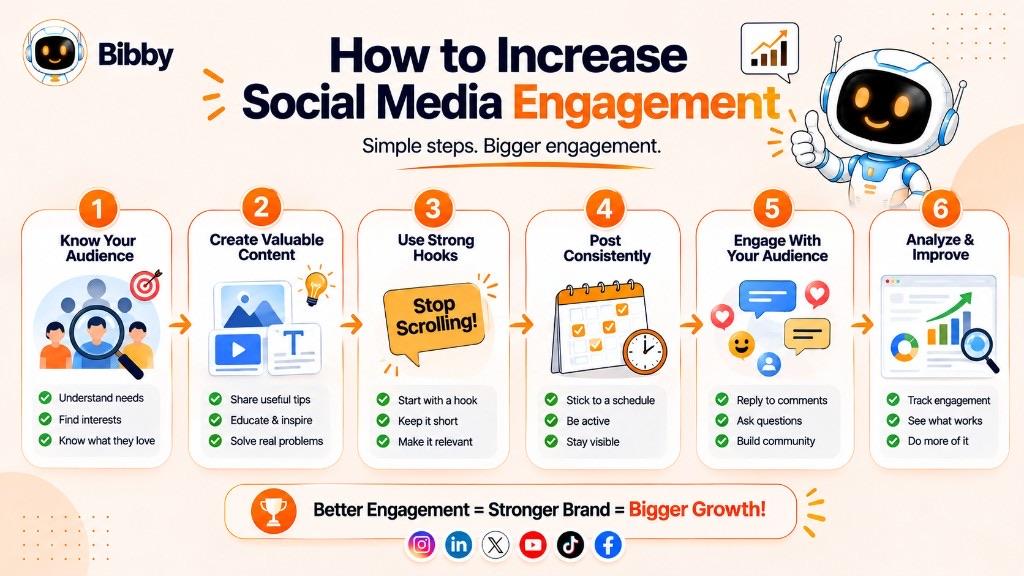
Here are practical ways to improve engagement:
Create Content Your Audience Actually Wants
Start with your audience rather than the platform. Identify their questions, problems, interests, and goals, then create content that addresses them.
For example, a software company could create tutorials, practical tips, industry insights, comparisons, and answers to common customer questions instead of publishing only promotional posts.
Use Stronger Hooks
The first line or visual element can determine whether someone stops scrolling. Use a clear problem, useful promise, surprising insight, question, or specific outcome to make the content worth exploring.
A strong hook should create genuine curiosity rather than rely on misleading clickbait.
Experiment With Different Content Formats
Different formats can produce different types of engagement. Test images, carousels, videos, Stories, text posts, and other formats available on your chosen platforms.
Pay attention to which formats generate meaningful interactions rather than assuming one format will always perform best.
Give People a Reason to Comment
If you want conversations, create opportunities for them. Ask relevant questions, invite opinions, present a choice, or encourage people to share their experiences.
Avoid forcing generic questions such as “What do you think?” onto every post. The prompt should naturally fit the content.
Create Saveable and Shareable Content
People are more likely to save or share content that they believe will be useful to themselves or someone else.
Consider creating:
- Checklists
- Tutorials
- Step-by-step guides
- Templates
- Statistics and insights
- Practical tips
- Educational carousels
- Industry resources
Respond to Your Audience
Publishing content is only one side of social media engagement. Responding to comments and questions helps turn individual interactions into conversations.
It also gives you an opportunity to learn directly from your audience and discover topics for future content.
Maintain a Consistent Publishing Schedule
Consistency gives you more opportunities to test content and build an active presence. A planned publishing schedule can also prevent long gaps between posts.
The goal should be a frequency your team can maintain without sacrificing content quality.
Test Different Publishing Times
Your audience may be more active at certain times of the day or week. Test different publishing windows and review your analytics to identify patterns.
There is no universal best time to post. What works for one audience may not work for another.
Repurpose Successful Content
If a topic performs well, you do not necessarily need to abandon it after one post. Turn the idea into different formats.
For example, one successful topic could become:
- An Instagram carousel
- A LinkedIn post
- A short video
- A Story
- A longer educational post
Repurposing lets you explore a proven topic without simply copying the same post everywhere.
Analyze What Performs Best
Look beyond individual likes. Compare comments, shares, saves, clicks, engagement rate, reach, and other relevant metrics.
Look for patterns across:
- Topics
- Formats
- Hooks
- Captions
- Posting times
- Content length
- Calls to action
Then use those insights to improve future content.
Use Social Media Automation Wisely
Consistent publishing can become difficult when you manage several platforms manually. Social media automation tools can help reduce repetitive work such as content scheduling and publishing.
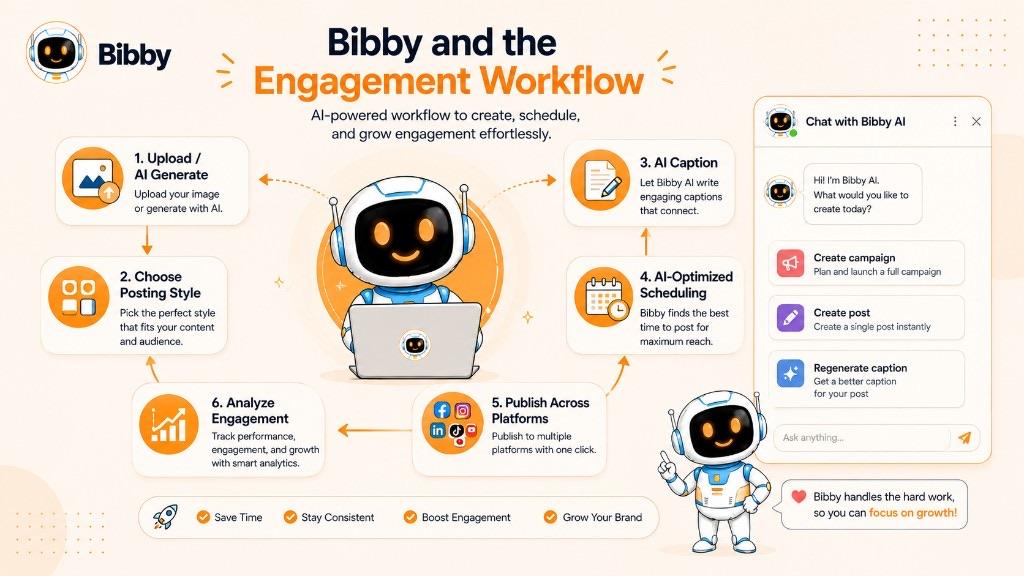
With Bibby, for example, you can upload an image or generate content with AI, choose a posting style, generate captions, and schedule content across platforms such as Facebook, Instagram, LinkedIn, YouTube, and TikTok. Its chat interface also lets you manage tasks such as creating campaigns, building a brand kit, creating posts, and regenerating captions through conversation.
Automation does not create genuine audience relationships by itself. It helps make the publishing process more manageable, giving you more time to focus on creating valuable content, analyzing results, and actually responding to your audience.
The goal of improving engagement is not to generate the biggest possible number of interactions. It is to attract meaningful interactions from the right audience and use those signals to create better content over time.
How Bibby Can Help You Create More Opportunities for Engagement
Creating engaging social media content is only one part of the process. Businesses also need to publish consistently, maintain a presence across multiple platforms, test different content formats, and learn from what their audience responds to. Managing all of this manually can quickly become time-consuming.
Bibby brings these repetitive social media tasks into one workflow, helping businesses spend less time managing the publishing process and more time focusing on their audience and content strategy.
Create or Generate Content
With Bibby, you can upload your own images or use AI to generate visual content. You can create different types of social media content, including images, carousels, videos, and Stories.
This makes it easier to experiment with different formats and discover which types of content generate meaningful interactions with your audience.
Generate Captions Automatically
Once you choose your posting style, Bibby can automatically generate captions for your content. Instead of writing every caption from scratch, you can use AI to create a starting point and refine it when needed.
You can also regenerate captions when the first version does not match the tone or message you want.
Schedule Content Across Multiple Platforms
Consistent publishing becomes more difficult when you manage several social networks separately. Bibby lets you schedule content across platforms such as Facebook, Instagram, LinkedIn, YouTube, and TikTok from one workflow.
You can also schedule content for different dates and use AI-optimized posting times as part of your publishing strategy.
Manage Social Media Through Chat
Bibby's chat interface adds another way to manage your social media workflow. Instead of navigating through multiple tools for every task, you can communicate with Bibby conversationally.
Through the chat interface, you can:
- Create a brand kit
- Create campaigns
- Create posts
- Regenerate captions
- Manage content
- Work on your social media publishing workflow
This can make social media management feel less like operating a collection of dashboards and more like working with a digital social media assistant.
Make Consistency Easier
Automation cannot guarantee higher engagement, and no scheduling tool can replace understanding your audience. However, it can remove some of the repetitive work that makes consistent publishing difficult.
By simplifying content creation, caption generation, scheduling, and campaign management, Bibby can help businesses create more opportunities to publish useful content and interact with their audience.
The bigger advantage is time. When repetitive publishing tasks take less manual effort, businesses can spend more time reviewing engagement, responding to conversations, understanding audience preferences, and improving their content strategy.
Bibby helps automate the workflow around social media publishing, while meaningful engagement still comes from creating content people genuinely want to interact with.
Engagement Across Different Social Media Platforms
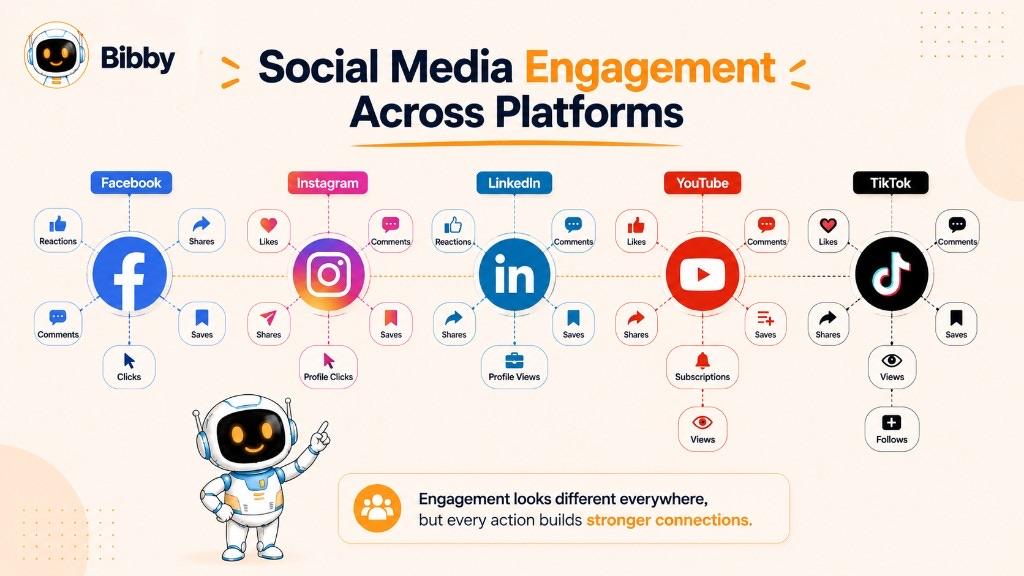
Engagement exists across virtually every major social media platform, but the way people interact with content can vary significantly. Each platform has different content formats, user behaviors, features, and analytics, so an engagement action that is important on one network may be less relevant on another.
Understanding these differences helps businesses avoid treating every social platform in exactly the same way.
Instagram Engagement
Instagram engagement can include likes, comments, shares, saves, profile interactions, Story replies, sticker interactions, and link clicks.
Visual content such as Reels, carousels, images, and Stories can create different opportunities for interaction. For example, an educational carousel may encourage users to save it, while a short video may generate more shares or comments.
Facebook Engagement
Facebook engagement can include reactions, comments, shares, link clicks, video interactions, and other actions available on posts and pages.
Shares and comments can be particularly useful for content designed to encourage conversations or reach additional audiences.
LinkedIn Engagement
LinkedIn engagement commonly includes reactions, comments, reposts, clicks, and other interactions with professional content.
Thought leadership, industry insights, educational posts, case studies, and workplace discussions can provide opportunities for users to share their perspectives or start professional conversations.
TikTok Engagement
TikTok engagement can include likes, comments, shares, saves, follows, and interactions associated with video content.
Because TikTok is heavily centered around short-form video, viewing behavior can also provide important context when evaluating how audiences respond to content.
YouTube Engagement
YouTube engagement can include likes, comments, shares, subscriptions, and other interactions with videos and channels.
For video marketers, engagement should also be considered alongside viewing-related metrics such as watch time and audience retention. A video with many views but poor retention may tell a different story from one that keeps viewers watching for a significant portion of the video.
Why Platform Differences Matter
A social media strategy should account for how audiences behave on each platform. The same piece of content may generate comments on LinkedIn, saves on Instagram, and shares on Facebook.
This does not necessarily mean one platform performed better than another. The results need to be evaluated according to the content format, audience, platform, and objective.
For businesses managing multiple social networks, this can make publishing and performance analysis more complicated. Tools such as Bibby can simplify the publishing side by allowing businesses to create and schedule different types of content across Facebook, Instagram, LinkedIn, YouTube, and TikTok from a centralized workflow.
The key is to measure engagement within the context of each platform rather than assuming that the same interaction patterns should apply everywhere.
Engagement vs. Conversion
Engagement and conversion are connected, but they represent different stages of the customer journey. Engagement measures how people interact with your content, while a conversion measures whether someone completes a desired business action.
For example, someone might comment on an Instagram post. That is engagement. If the same person clicks through to your website and purchases a product, the purchase is a conversion.
What Is Engagement?
Engagement includes actions such as:
- Likes and reactions
- Comments
- Shares and reposts
- Saves
- Clicks
- Replies
- Mentions
- Other platform-specific interactions
These actions can indicate that people are paying attention to and responding to your content.
What Is a Conversion?
A conversion happens when a user completes an action that supports a specific marketing or business objective.
Depending on the business, a conversion could be:
- Purchasing a product
- Booking a consultation
- Filling out a form
- Signing up for a newsletter
- Creating an account
- Downloading an app
- Starting a free trial
- Requesting a demo
The definition of a conversion depends on the campaign's goal.
Engagement Can Support Conversions
Engagement does not automatically lead to a sale, but it can contribute to the customer journey.
Consider this example:
Social media post → Comment → Profile visit → Website click → Free trial → Customer
The comment is engagement. The website click is another measurable interaction. The free-trial signup can be considered a conversion.
This is why businesses should avoid treating engagement as a direct replacement for conversion metrics.
High Engagement Does Not Always Mean High Conversions
A post can become highly engaging without generating meaningful business results.
For example, an entertaining video might receive thousands of likes and shares but produce very few website visits or sales. Meanwhile, a product-focused post might receive fewer interactions but generate several qualified leads.
Neither result is necessarily better without knowing the objective.
Measure Both When Appropriate
Businesses should evaluate engagement alongside conversion metrics when social media is being used to support business growth.
For example:
Awareness campaign: Reach, impressions, shares, and video views may be important.
Community campaign: Comments, replies, mentions, and shares may matter more.
Traffic campaign: Clicks and click-through rate become important.
Lead generation campaign: Form submissions, qualified leads, and conversion rate may be the primary metrics.
Sales campaign: Purchases, revenue, and return on ad spend may matter more than simple interaction volume.
The right measurement framework depends on what you want your social media activity to achieve.
Engagement tells you how people interact with your content. Conversion tells you whether those interactions or other marketing activities ultimately lead to a desired business outcome. Both can be valuable, but they answer different questions.
Common Social Media Engagement Mistakes
Getting more engagement is not simply about collecting as many likes, comments, or shares as possible. Businesses can easily misinterpret engagement data or use tactics that create short-term numbers without building meaningful relationships with their audience.
Here are some common mistakes to avoid.
Focusing Only on Likes
Likes are easy to see and understand, but they represent only one type of interaction. A post with fewer likes can still be highly valuable if it generates meaningful comments, saves, shares, clicks, or conversions.
Look at multiple engagement signals instead of using likes as your primary measure of success.
Chasing Engagement at Any Cost
Trying to maximize interactions can lead to clickbait, controversial posts, or content that attracts attention without providing meaningful value.
High engagement is not automatically good engagement. The quality, relevance, and intent behind interactions matter.
Buying Fake Engagement
Buying likes, comments, followers, or other artificial interactions can make an account appear more active without creating a genuine audience.
Fake engagement can also make performance data less useful because businesses may struggle to distinguish real audience interest from artificial activity.
Posting Without Understanding Your Audience
Creating content based on assumptions can result in posts that receive little response. Before developing a content strategy, understand your audience's interests, challenges, questions, and preferences.
The more relevant the content, the more natural the opportunity for engagement becomes.
Publishing Inconsistently
Long gaps between posts can make it difficult to maintain an active social presence and gather enough performance data to identify useful patterns.
A consistent, sustainable publishing schedule can make content planning and performance analysis easier.
Ignoring Comments
Engagement should work in both directions. Publishing a post and then ignoring the people who respond to it can result in missed opportunities for conversation and relationship building.
Respond to relevant comments and questions, particularly when they provide an opportunity to help or continue a meaningful discussion.
Using the Same Content Everywhere
Cross-posting can save time, but publishing exactly the same message across every platform may not always produce the best results.
Audience expectations and content formats differ between Instagram, LinkedIn, Facebook, TikTok, and YouTube. Adapt your messaging and presentation where necessary.
Comparing Different Engagement Rates Without Context
An engagement rate calculated by reach is not necessarily comparable with one calculated by followers or impressions.
Always check:
- Which engagement actions are included
- Which denominator is being used
- Which platform generated the data
- What period is being measured
Ignoring Other Performance Metrics
Engagement is important, but it is not the only measure of social media performance.
Depending on your goals, also consider reach, impressions, clicks, website traffic, leads, conversions, revenue, and other relevant metrics.
Treating Automation as a Replacement for Engagement
Automation can help with repetitive tasks such as content creation, caption generation, and scheduling, but it cannot replace genuine interaction with an audience.
Tools such as Bibby can make publishing more efficient, allowing businesses to spend less time managing repetitive workflows and more time reviewing performance, responding to comments, and building relationships.
The goal is not to manufacture engagement. It is to create content that earns genuine attention and gives the right audience a meaningful reason to interact.
How to Measure Engagement Effectively
Measuring engagement effectively requires more than counting likes and comments. The goal is to understand which interactions are happening, who is interacting, what content is generating those interactions, and whether those interactions support your broader marketing goals.
A structured approach makes engagement data much easier to interpret.
1. Define Your Objective
Start by deciding what you want your social media content to achieve.
If your goal is community building, comments and replies may be particularly useful. If you want to drive website traffic, clicks and click-through rate may matter more. For educational content, saves and shares can provide valuable signals.
Your objective determines which engagement metrics deserve the most attention.
2. Choose Relevant Metrics
Do not track every metric simply because it is available.
Choose metrics that directly relate to your content and objectives, such as:
- Likes and reactions
- Comments
- Shares
- Saves
- Clicks
- Replies
- Mentions
- Video views
- Watch time
- Engagement rate
The right combination will depend on your platform and strategy.
3. Establish a Baseline
Look at your historical performance before deciding whether a result is good or bad.
For example, if your posts typically receive 200 engagements and a new post receives 450, that post performed significantly above your usual level.
Your own historical data can provide a useful baseline for identifying meaningful changes.
4. Compare Similar Content
Compare content with similar characteristics rather than treating every post as an identical experiment.
You could compare:
- Video vs. video
- Carousel vs. carousel
- Educational posts vs. educational posts
- Promotional posts vs. promotional posts
- Similar campaigns
- Similar audience segments
This can help reveal which content types consistently generate stronger interactions.
5. Analyze Engagement Rate
Engagement rate can help put engagement volume into context. Depending on the method being used, engagement may be compared with reach, followers, impressions, or another relevant metric.
When monitoring engagement over time, use a consistent calculation method so that your comparisons remain meaningful.
6. Look for Patterns
Individual posts can be useful, but patterns across multiple posts are often more informative.
Look for recurring trends involving:
- Topics
- Content formats
- Hooks
- Captions
- Visual styles
- Publishing times
- Posting frequency
- Calls to action
For example, if educational carousels repeatedly generate more saves than promotional images, that may indicate an opportunity to create more educational content.
7. Measure Quality, Not Just Quantity
A large number of interactions does not always mean strong audience engagement.
Look at what people are actually doing. Are they asking questions? Sharing the content? Saving it for later? Clicking through to your website? Mentioning other people?
These actions can provide more context than a single engagement total.
8. Connect Engagement to Business Results
Finally, connect engagement data with the broader customer journey when appropriate.
Look at whether engaged users go on to:
- Visit your website
- Sign up for a service
- Download a resource
- Request a demo
- Make a purchase
- Complete another desired action
This helps you understand whether social media engagement is contributing to your actual business objectives.
9. Test, Learn, and Improve
Engagement measurement should be an ongoing process rather than a one-time report.
Use your findings to test new topics, formats, captions, publishing times, and calls to action. Then compare the results with your previous performance.
For businesses managing multiple platforms, automation tools such as Bibby can simplify the publishing side by helping create, schedule, and manage content across social networks. This can make it easier to maintain a consistent publishing workflow while you focus on analyzing results and improving your strategy.
Effective engagement measurement is ultimately about turning interactions into insights. Instead of asking only, “How many people engaged?” ask, “What did they engage with, why did they engage, and what can we learn from it?”
Key Takeaways
Engagement is one of the most useful indicators of how people interact with social media content. It goes beyond simply counting likes and includes actions such as comments, shares, saves, clicks, replies, mentions, and other platform-specific interactions.
The most important points to remember are:
- Engagement measures interaction, while reach measures exposure and impressions measure content displays.
- Likes are only one type of engagement. Comments, shares, saves, clicks, and replies can provide additional insight.
- Engagement rate puts interactions into context by comparing engagement with metrics such as reach, followers, or impressions.
- There is no universal “good” engagement rate. Performance should be evaluated against relevant benchmarks and your own historical results.
- Content relevance matters. Useful, educational, entertaining, or genuinely interesting content gives audiences more reasons to interact.
- Consistency creates more opportunities for engagement, but publishing frequently does not compensate for poor or irrelevant content.
- Engagement should be connected to your goals. Comments may matter for community building, while clicks and conversions may matter more for a traffic or sales campaign.
- Different platforms have different engagement behaviors, so results should be interpreted within the context of each network.
- Automation can simplify publishing, but meaningful engagement still depends on understanding your audience, creating valuable content, and participating in conversations.
Ultimately, social media engagement is not about collecting the biggest possible number of interactions. It is about understanding how your audience responds to your content and using those insights to create better experiences, stronger relationships, and more effective social media strategies.
Continue learning with related dictionary entries on engagement rate, reach, impressions, CTR, conversion rate, call to action, captions, and community management—or browse the social media dictionary. Then start a free Bibby trial to create, caption, and schedule posts across your channels.