
Unlike long-form video, which can spend several minutes or hours developing a topic, short-form video condenses information or entertainment into a much smaller viewing experience. Common examples include TikTok videos, Instagram Reels, YouTube Shorts, quick tutorials, product demonstrations, behind-the-scenes clips, reactions, tips, and short educational videos.
There is no single duration that defines every short-form video. The appropriate length depends on the platform, content type, audience, and purpose. What makes the format distinctive is its combination of concise storytelling, mobile-first viewing, fast pacing, strong opening hooks, and social distribution.
For creators, influencers, and businesses, short-form video has become an important way to reach audiences, build awareness, encourage engagement, and communicate ideas without requiring viewers to commit to a lengthy video. Bibby can simplify the workflow by helping you create, caption, organize, and schedule social content across multiple platforms. Native editing, sounds, and video analytics stay in each app.
What Is Short-Form Video?
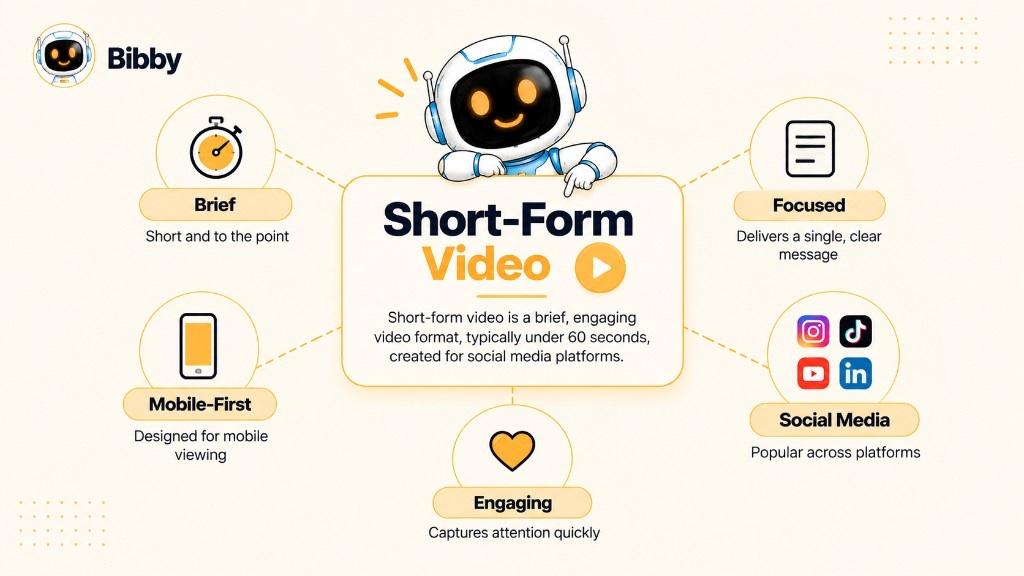
Short-form video communicates an idea, story, piece of information, or form of entertainment in a relatively brief format. It is especially common on social platforms where users continuously scroll through personalized feeds and can discover videos from accounts they do not already follow.
The defining idea is concise communication. Instead of taking several minutes to explain a topic or develop a story, the creator focuses on the most important information and delivers it efficiently. A short-form video might teach a quick skill, demonstrate a product, answer a question, share an opinion, tell a short story, or simply entertain.
These videos are generally designed around how people consume content on mobile devices. Many use vertical video, prominent on-screen text, captions, music, sound effects, quick cuts, and an attention-grabbing opening. These elements help viewers understand the purpose of the video quickly, often without additional context.
What Makes a Video Short-Form?
Length is an important characteristic, but it is not the only factor. A video can be relatively brief without being designed as short-form social content. Short-form videos are typically built around several characteristics:
- Concise storytelling: The video communicates a focused idea rather than covering a broad subject in depth.
- A strong opening: The first moments establish a question, problem, benefit, visual, or statement that encourages viewers to continue watching.
- Mobile-first presentation: Many short-form videos are created primarily for smartphone screens.
- Vertical formatting: A 9:16 aspect ratio is widely used for social short-form video.
- Fast, focused pacing: Editing often removes pauses and unnecessary information.
- Captions and on-screen text: Text reinforces the message and helps when viewers watch without sound.
- Social interaction: Videos may be designed to encourage likes, comments, shares, saves, follows, or other engagement.
- Feed-based discovery: Videos are frequently distributed through recommendation and discovery feeds, allowing content to reach people beyond an account's existing audience.
Short-Form Video Is More Than Just a Short Video
A useful distinction is that short-form video is a content format, not simply a measurement of duration.
Cutting a 20-minute interview down to 30 seconds does not automatically make the clip an effective short-form video. The clip may still feel incomplete if it depends on information from the original interview. A purpose-built short-form video is structured around the limitations and opportunities of brief viewing.
Creators therefore often design the video from the beginning around a single message. They decide what the viewer needs to know, remove unnecessary context, establish the value of watching quickly, and end once the central idea has been delivered.
This makes short-form video particularly effective for quick education, entertainment, product discovery, trend-based content, social commentary, and bite-sized storytelling.
Why Short-Form Video Works Well on Social Media
Social platforms are built around continuous content discovery. A user can move from one video to another within seconds, which creates a very different viewing environment from traditional television, cinema, or long-form platforms.
Short-form video fits naturally because the commitment required from the viewer is relatively low. A person can watch a quick tutorial while waiting for an appointment, discover a product demonstration while scrolling through Instagram, or learn a new concept from a brief educational clip.
The format also gives creators and businesses an opportunity to experiment. Instead of investing significant resources into a single long video, they can test different topics, hooks, formats, and creative approaches and use audience response to inform future content.
As a result, short-form video has become an important part of modern social media content strategies, from individual creators producing daily videos to businesses using short clips for brand awareness, education, product marketing, and community engagement.
What Does “Short-Form Video” Mean?
The term short-form video refers to brief video content created to communicate information, entertainment, or a message in a condensed format. The phrase combines two simple concepts: “short-form,” meaning concise content, and “video,” meaning content presented through moving images, usually with sound.
In practical terms, a short-form video delivers its main idea without requiring the viewer to spend a long time watching. It may last only a few seconds or several minutes, depending on the platform, audience, and purpose. The format is particularly associated with social media because platforms such as TikTok, Instagram, YouTube, and Facebook are designed around rapid content discovery and continuous scrolling.
The meaning can be understood through three core ideas:
- Brief: The content is substantially shorter and more condensed than traditional long-form video.
- Focused: The video generally revolves around one primary idea, message, story, or action.
- Designed for quick consumption: The content is structured so viewers can understand or enjoy it without a significant time commitment.
Importantly, short-form video does not have one universal time limit. A platform may impose its own technical limits, while creators may use different durations depending on what they are trying to accomplish. A 20-second product demonstration, a 45-second tutorial, and a two-minute educational clip can all function as short-form content when they are intentionally structured for concise, feed-based viewing.
The term is also closely connected to modern social formats. TikTok videos, Instagram Reels, YouTube Shorts, and Facebook Reels are among the most recognizable examples. These formats make it possible for creators, brands, and organizations to publish concise visual content and reach audiences through both followers and platform-driven discovery.
In other words, short-form video means video content that prioritizes brevity, focus, and fast consumption rather than extended viewing. Its effectiveness depends not only on how long the video is, but on how efficiently it communicates something valuable, interesting, useful, or entertaining.
How Long Is a Short-Form Video?
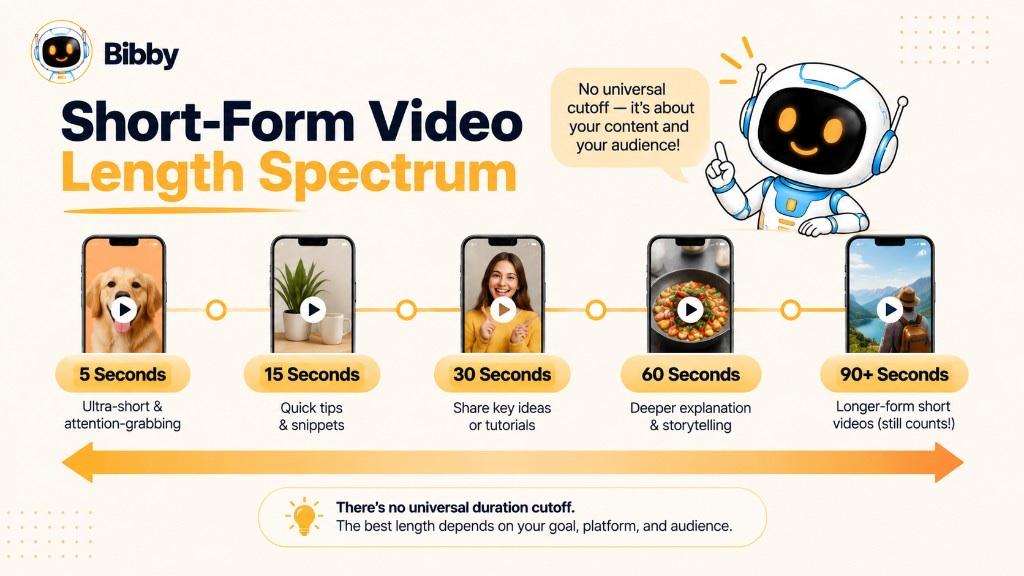
There is no universal length for a short-form video. The term describes a style of concise video content rather than a fixed duration. What qualifies as short-form can vary based on the platform, audience, content type, and how the video is intended to be consumed.
Short-form videos can range from a few seconds to several minutes. A quick 15-second tip, a 30-second product demonstration, a 60-second tutorial, and a longer social video can all be considered short-form when they are designed for concise, feed-based viewing.
The most important consideration is not simply reaching a particular number of seconds. Instead, the video should take only as much time as necessary to deliver its central idea effectively.
| Video Length | Possible Short-Form Use |
|---|---|
| 5–15 seconds | Quick joke, visual hook, reaction, product moment |
| 15–30 seconds | Tip, trend, announcement, quick demonstration |
| 30–60 seconds | Tutorial, educational point, product explanation |
| 60–90 seconds | Story, detailed tip, mini-explainer |
| 90 seconds–3 minutes | More developed educational or storytelling content |
These ranges are guidelines rather than strict definitions. A video should not be artificially shortened simply to fit a particular duration if doing so makes the message unclear. Platform duration limits also change over time—check the current publishing interface.
Is a 60-Second Video Considered Short-Form?
Yes. A 60-second video is generally considered short-form content, particularly when it is created for social feeds and structured around a concise message.
The popularity of short videos under one minute is partly because they allow creators to communicate an idea quickly. However, 60 seconds is not a universal boundary between short-form and long-form video.
A creator making a 45-second tutorial, for example, may have enough time to explain a simple technique. Another creator may need 90 seconds to explain a more complicated concept while still maintaining the characteristics of short-form content.
The goal should therefore be to use the minimum effective length, rather than simply aiming for the shortest possible video.
Can a Short-Form Video Be Longer Than 60 Seconds?
Yes. Short-form videos can be longer than 60 seconds, depending on the platform and the context in which the content is created.
Modern social platforms support a range of video durations, and platform capabilities can change over time. More importantly, audiences do not classify every video according to a universal stopwatch. A concise two-minute tutorial can still feel like short-form content when compared with a 20-minute educational video or a full-length documentary.
The distinction becomes especially useful when considering content structure.
A longer short-form video may still:
- Focus on one central topic
- Get to the point quickly
- Use a strong opening hook
- Maintain a relatively fast pace
- Avoid unnecessary background information
- Be designed primarily for social-feed consumption
- Encourage viewers to engage or discover more content
Does Shorter Always Mean Better?
No. Shorter is not automatically better.
Reducing a video from 60 seconds to 15 seconds may improve completion rates in some situations, but it can also remove information that viewers need. The ideal length depends on what the video is trying to accomplish.
A simple product reveal might work perfectly in 10 seconds. A tutorial may need 45 seconds. A story may require two minutes to establish a problem, explain what happened, and deliver a satisfying conclusion.
Creators should therefore focus on retention and value rather than duration alone. If viewers continue watching because the content remains relevant and engaging, a slightly longer video can outperform an unnecessarily compressed one.
How Should You Choose the Length of a Short-Form Video?
Start with the message rather than the timer.
Ask:
- What is the one thing the viewer should understand or remember?
- How much context is genuinely necessary?
- Can any section be removed without weakening the message?
- Does the opening immediately establish why the viewer should continue?
- Does the ending arrive naturally, or does the video feel unnecessarily extended?
For social creators and businesses, testing different lengths can also reveal what works best for a particular audience. One topic might perform well as a 20-second clip, while another may generate stronger watch time and engagement when given 90 seconds.
Ultimately, the best length is the length required to deliver the idea clearly while maintaining the viewer's attention. The format is defined more by concise, focused, social-first storytelling than by an arbitrary number of seconds.
Examples of Short-Form Videos
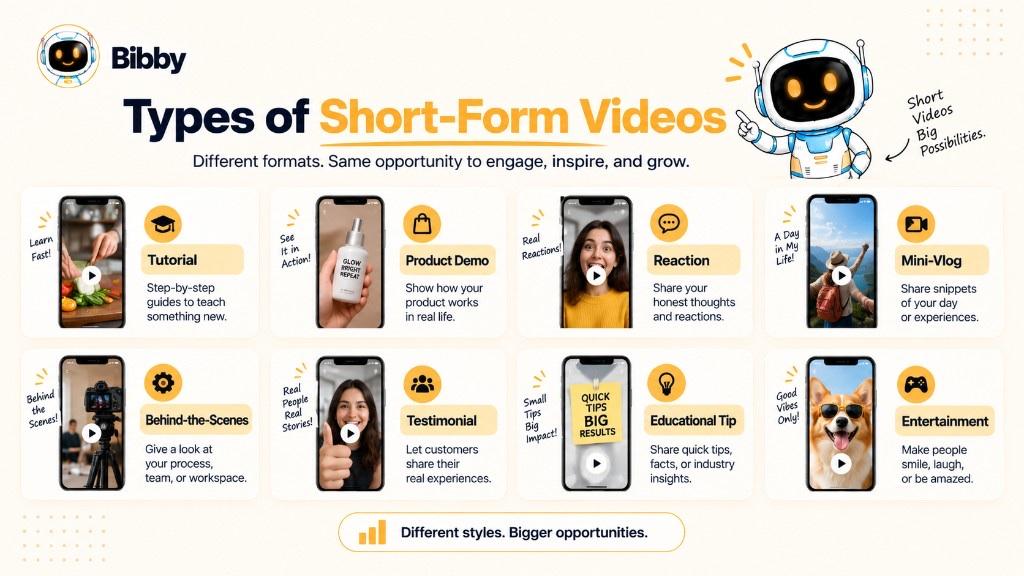
Short-form video can take many forms, from a 10-second product clip to a two-minute tutorial. The format is flexible because the same basic approach—concise storytelling designed for quick consumption—can be used for education, entertainment, marketing, personal branding, and community building.
Some of the most common examples include tutorials, product demonstrations, reactions, behind-the-scenes clips, quick tips, mini-vlogs, interviews, storytelling videos, and trend-based content.
Educational Short-Form Videos
Educational videos turn a useful piece of knowledge into a quick, easy-to-consume format. Instead of covering an entire subject, the creator usually focuses on one question, technique, fact, or lesson.
Examples include:
- Quick how-to tutorials
- Step-by-step tips
- Industry facts
- Definitions and explanations
- Common mistakes
- “Did you know?” videos
- Software or app demonstrations
- Quick answers to frequently asked questions
- Short lessons or educational series
For example, a fitness creator could demonstrate one exercise technique in 30 seconds, while a software company could show how to complete one task inside its application.
The key is to avoid trying to turn an entire course into one short video. A focused idea usually makes the content easier to understand and gives the viewer a clear reason to keep watching.
Entertainment Videos
Entertainment is one of the most recognizable uses of short-form video. These videos are primarily designed to make viewers laugh, feel surprised, relate to a situation, or simply spend a few enjoyable moments watching.
Examples include:
- Comedy sketches
- Reactions
- Challenges
- Memes
- Trend-based videos
- Short stories
- Unexpected moments
- Character-based content
- Parodies
- Satisfying or visually interesting clips
Entertainment videos do not necessarily need a complicated storyline. A strong visual idea, relatable situation, surprising ending, or clever edit can be enough.
Business and Marketing Videos
Businesses use short-form video to introduce products, explain services, answer customer questions, demonstrate features, and build familiarity with their brands.
Common examples include:
- Product demonstrations
- Feature highlights
- Customer testimonials
- Before-and-after videos
- Product comparisons
- Behind-the-scenes content
- New product announcements
- Customer questions and answers
- How-to-use videos
- Case-study snippets
- Limited-time promotions
For example, an ecommerce brand selling skincare products might create a short video demonstrating how to use a product. A software company could show one useful feature in action. A restaurant might publish a quick behind-the-scenes video showing how a popular dish is prepared.
The strongest business videos usually provide something useful or interesting rather than functioning as a traditional advertisement from beginning to end.
Creator Videos
Creators and influencers use short-form video to share their personalities, experiences, expertise, and everyday activities.
Examples include:
- Mini-vlogs
- Day-in-the-life videos
- Personal stories
- Opinions and commentary
- Q&A videos
- Respond-to-comment videos
- Recommendations
- Tutorials
- Reviews
- “Get ready with me” content
- Behind-the-scenes footage
Creator-led short-form content works particularly well when the audience feels that there is a real person behind the content.
Product Demonstration Videos
Product demonstrations can combine education, entertainment, and marketing in one short video.
A product demonstration might show:
- A problem the customer has
- The product being introduced as a solution
- The product being used
- The result or benefit
These videos help viewers understand the product without requiring them to read a lengthy description.
Behind-the-Scenes Videos
Behind-the-scenes content gives audiences a look at the people, processes, and work that normally remain outside the finished product.
Examples include how products are made, preparing for an event, packaging orders, office moments, team introductions, recording processes, product development, and setting up a workspace.
This type of video can make a brand or creator feel more accessible because it shows the process rather than only the polished final result.
Short Storytelling Videos
Short-form storytelling compresses a narrative into a small viewing window. A video might tell a customer success story, a personal experience, a surprising event, a lesson learned, a problem-and-solution story, or a brief brand story.
Even a very short story generally benefits from a simple structure: setup → development → payoff. Short-form storytelling works best when every scene contributes to the central narrative.
User-Generated Content and Testimonials
User-generated content can also take the form of short-form video. Customers may review a product, demonstrate how they use it, share their experience, or explain why they chose a particular brand.
Examples include customer reviews, unboxing videos, product experiences, testimonials, “why I bought this” videos, customer tutorials, and before-and-after experiences.
For businesses, this type of content can provide social proof while presenting a product through the customer's perspective rather than the brand's own advertising voice.
Repurposed Short-Form Videos
Existing content can also become a source of short-form video.
A business might transform:
- A podcast into several short clips
- A webinar into educational snippets
- A blog post into a series of videos
- A long YouTube video into multiple highlights
- An interview into individual quotes
- A presentation into short educational clips
Repurposing allows one original piece of content to support multiple social posts. However, simply cutting content into smaller pieces is not always enough. Each clip should make sense on its own and should be edited for the platform and audience where it will be published.
Ultimately, short-form video is a format rather than a single type of content. What connects these examples is the deliberate focus on delivering a useful or engaging idea within a concise, social-first viewing experience.
Popular Short-Form Video Platforms
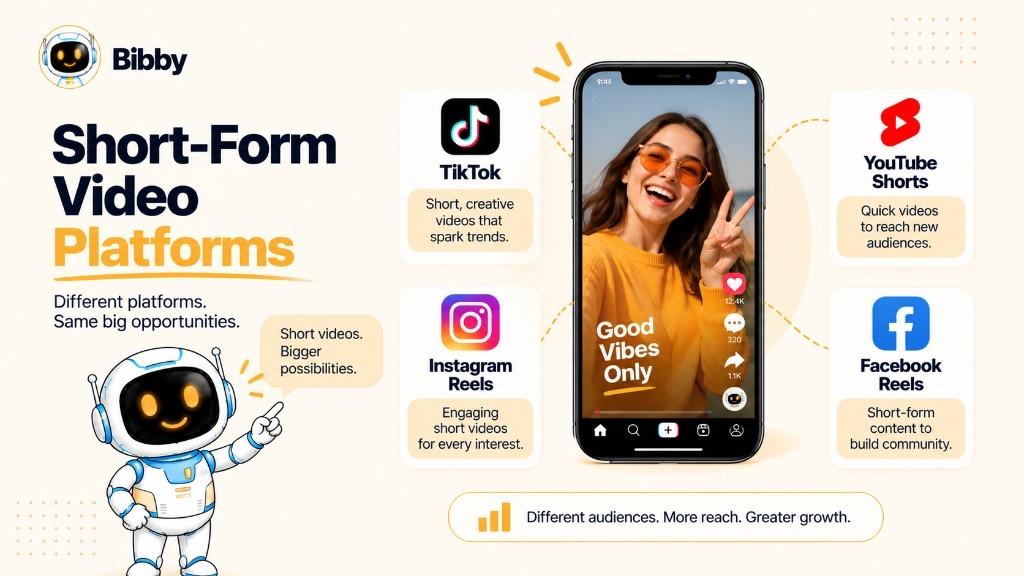
Short-form video is closely associated with social platforms that use personalized feeds and recommendation systems to help users discover video. While the exact features, audience behavior, video formats, and publishing options differ, TikTok, Instagram, YouTube, and Facebook are among the most important ecosystems.
Understanding the differences can help creators and businesses adapt the same core idea for different audiences instead of publishing identical content everywhere.
TikTok
TikTok is one of the platforms most strongly associated with short-form video. Its experience is centered around discovering videos through a personalized feed, making it possible for content to reach viewers who may not already follow the creator.
Common characteristics of TikTok content include:
- Strong opening hooks
- Vertical, mobile-first video
- Fast-paced editing
- Trending sounds and formats
- On-screen text and captions
- Creator-led storytelling
- Audience interaction through comments and other engagement features
For businesses, TikTok can be useful for reaching audiences through educational, entertaining, behind-the-scenes, and product-focused content rather than relying exclusively on traditional advertisements. Interactive formats such as a Duet can sit alongside standalone clips.
Instagram Reels
Instagram Reels is Instagram's short-form video format and is integrated into the broader Instagram experience. Reels can appear in dedicated video surfaces as well as other areas of the platform.
Instagram Reels are commonly used for tutorials, product demonstrations, lifestyle content, educational tips, entertainment, trends, brand storytelling, creator collaborations, and UGC.
Reels can be particularly useful for brands that already use Instagram for visual identity, community building, ecommerce, or creator partnerships. They differ from Stories, which are typically 24-hour updates for people who already follow the account.
YouTube Shorts
YouTube Shorts is YouTube's dedicated short-form video format. It brings short, vertical videos into the YouTube ecosystem alongside the platform's traditional long-form videos, livestreams, and other content.
A creator could use a Short to introduce a topic, share a quick tip, highlight a moment from a longer video, answer a frequently asked question, present a short educational lesson, or direct interested viewers toward deeper content.
YouTube Shorts can therefore function both as standalone short-form content and as part of a broader YouTube content strategy.
Facebook Reels
Facebook Reels brings short-form video into Facebook's social and discovery environment. Reels can be used by individual creators, communities, publishers, and businesses to share concise video content.
Businesses can use Facebook Reels for product content, educational videos, customer stories, behind-the-scenes clips, brand announcements, entertainment, and community-focused content.
Are Short-Form Videos the Same on Every Platform?
Not necessarily.
A single video can often be adapted for multiple platforms, but the best version for each platform may differ. Audiences behave differently, platform interfaces vary, and features such as captions, music, editing tools, recommendations, and publishing formats can change over time.
For example, a creator may take the same underlying idea and adjust:
- The opening hook
- Video duration
- Caption
- On-screen text
- Call to action
- Audio
- Aspect ratio or visual composition
- Publishing time
- Hashtag strategy
- Description
This approach is often more effective than treating cross-platform publishing as a simple copy-and-paste exercise.
Which Platform Is Best for Short-Form Video?
There is no single best platform for every creator or business.
The right platform depends on target audience, industry, content style, business objectives, existing audience, production resources, desired type of discovery, and conversion goals.
A creator focused on entertainment may prioritize one platform, while a B2B company may find educational short-form videos more valuable on another. Many businesses ultimately use several platforms and adapt their content to each one.
This is also where social media scheduling can become useful. Instead of manually preparing and publishing every video separately, creators and businesses can organize content and schedule it across selected platforms from a centralized workflow. Bibby supports this approach by allowing users to create social content, generate captions, and schedule supported media formats across Facebook, Instagram, LinkedIn, YouTube, and TikTok. Native recording, trending audio, and Insights stay in each app.
Short-Form Video vs. Long-Form Video
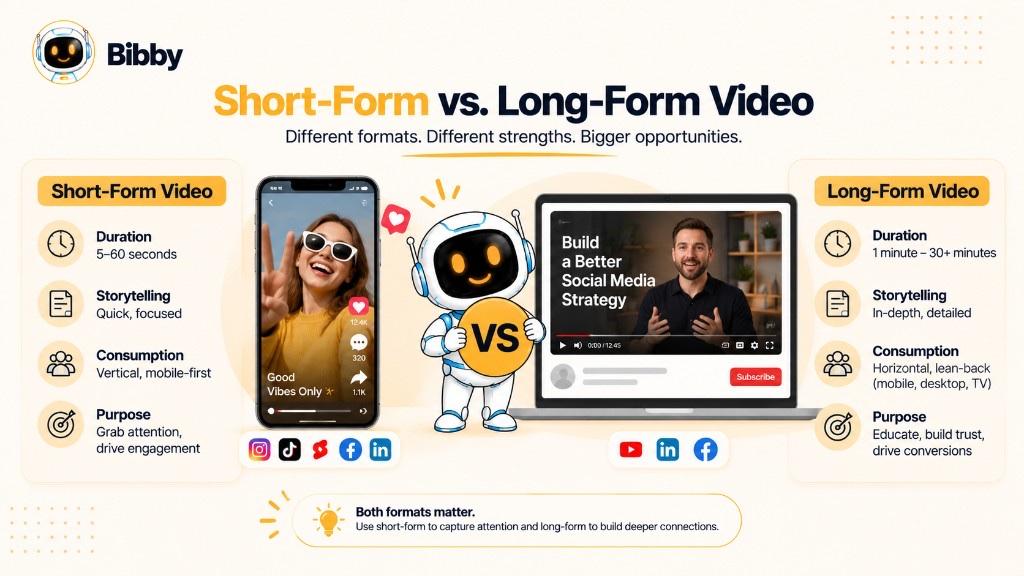
The main difference between short-form video and long-form video is how much time and attention each format requires from the viewer. Short-form video is designed to communicate an idea, story, or piece of entertainment quickly, while long-form video provides more space for detailed explanations, deeper storytelling, extended demonstrations, or comprehensive entertainment.
The distinction is not based on one universal duration. In practice, the two formats are better understood by looking at their content structure, viewing experience, and purpose.
| Factor | Short-Form Video | Long-Form Video |
|---|---|---|
| Duration | Generally brief and concise | Usually substantially longer |
| Viewing experience | Quick and easy to consume | Requires a greater time commitment |
| Content structure | Usually centered on one focused idea | Can develop multiple ideas or a complex topic |
| Storytelling | Condensed | More detailed |
| Discovery | Often strongly connected to social feeds and recommendations | Can rely on search, subscriptions, recommendations, and direct discovery |
| Production | Can be produced with relatively lightweight workflows | May require more planning, filming, editing, and production |
| Common uses | Tips, trends, tutorials, reactions, product clips | Courses, interviews, documentaries, detailed reviews, podcasts |
| Typical objective | Discovery, engagement, awareness, quick education | Depth, education, entertainment, authority, or extended viewing |
Short-Form Video: Quick and Focused
Short-form video is built around brevity and focus. The creator typically identifies one central message and removes anything that does not contribute to it.
For example, instead of producing a 15-minute tutorial explaining ten productivity techniques, a creator could produce ten separate short-form videos, with each video explaining one technique.
This structure makes short-form content particularly suitable for quick tips, product demonstrations, social trends, short tutorials, reactions, educational facts, mini-stories, brand awareness, and creator content.
Because viewers can move rapidly from one video to another, short-form content often needs a clear opening and efficient pacing.
Long-Form Video: More Room for Depth
Long-form video provides additional time to develop a subject. A creator can introduce background information, explain multiple concepts, demonstrate a process in detail, interview another person, or build a more complex narrative.
Common examples include detailed tutorials, product reviews, interviews, podcasts, webinars, online courses, documentaries, in-depth educational videos, and detailed case studies.
A software company might use a 30-second short-form video to demonstrate one feature while using a longer video to explain the entire product workflow.
Which Is Better: Short-Form or Long-Form Video?
Neither format is automatically better.
Short-form video is often better when the goal is quick discovery, attention, awareness, or concise communication. Long-form video can be more effective when the audience needs detailed information, deeper education, or extended storytelling.
A business selling a complex software product, for example, might use short-form videos to introduce individual features and attract attention, then use longer videos to provide detailed demonstrations for people who want to learn more.
This creates a content journey:
Short-form video → Discovery → Interest → Long-form content → Deeper consideration
Can Short-Form and Long-Form Video Work Together?
Yes. Using both formats can create a stronger content strategy than relying exclusively on either one.
A single topic can be developed into multiple pieces of content. A long interview, webinar, podcast, or educational video can provide the source material for several short-form clips. Those clips can then introduce the topic to new viewers while the original long-form content provides additional depth.
This approach allows creators to use short-form content for reach and discovery while using long-form content for depth and relationship building.
Short-Form vs. Long-Form: Choosing the Right Format
Choose short-form video when:
- The idea can be communicated quickly.
- You want to reach people through social discovery.
- The content is naturally concise.
- You are testing multiple content ideas.
- The goal is awareness or engagement.
- The topic works well as a focused tip, demonstration, or story.
Consider long-form video when:
- The topic requires substantial explanation.
- The viewer needs background or context.
- You are teaching a complex process.
- The content depends on detailed demonstrations.
- You want to develop a longer narrative.
- The audience is already interested enough to invest more viewing time.
The strongest content strategies do not treat short-form and long-form video as opposing formats. They use each format for what it does best, creating a system in which short-form content captures attention and long-form content provides depth.
Why Is Short-Form Video Popular?
Short-form video is popular because it fits naturally into the way people discover and consume content on modern digital platforms. A viewer can encounter a video, understand its premise within seconds, and decide whether to continue watching or move to the next piece of content. This low-friction viewing experience makes short-form video particularly well suited to mobile and social environments.
Its popularity is also driven by the combination of easy discovery, fast entertainment, visual communication, creator accessibility, and recommendation-based feeds.
Mobile-First Consumption
Most social media activity happens on smartphones, and short-form video is designed around that environment.
Vertical video fills much of a phone's screen, while concise messages are easier to consume when someone has only a few moments available. A viewer does not need to sit down for a dedicated viewing session. Short-form content can fit into small gaps throughout the day.
Fast Content Discovery
Short-form video makes it possible for users to discover content from creators and brands they have never encountered before.
Recommendation-driven feeds continuously present new videos based on a combination of platform signals and user behavior. As a result, a creator does not necessarily need a large established audience for an individual video to reach new viewers. Distribution still depends on each platform's algorithm—there is no guaranteed formula for going viral.
Low Commitment for Viewers
Starting a long video requires a relatively large commitment. Starting a short video does not.
A viewer can watch a 20-second clip almost immediately, decide whether it is useful or entertaining, and continue scrolling. This low time commitment reduces the barrier to trying unfamiliar content.
Strong Visual Communication
Video can communicate information through movement, facial expressions, demonstrations, graphics, text, music, and sound effects simultaneously.
Short-form content combines these elements into a compact format. A product can be demonstrated instead of described. A process can be shown instead of explained entirely through text. A reaction can communicate emotion almost instantly.
Easy to Experiment With
Short-form video gives creators an opportunity to test ideas quickly: different topics, opening hooks, video lengths, editing styles, narration, on-screen text, calls to action, visual formats, and educational versus entertaining approaches.
The results from these experiments can provide useful signals about what resonates with a particular audience. Review those signals in each platform's analytics.
Trends Can Accelerate Discovery
Short-form video platforms frequently develop trends around sounds, formats, challenges, editing styles, topics, and recurring concepts.
Participating in a relevant trend can give creators another way to make their content discoverable. However, trends are not automatically valuable for every account. A trend works best when it fits the creator's audience, brand, and message.
Creator-Friendly Production
Short-form video does not always require a professional studio, expensive camera equipment, or a large production team.
A smartphone, basic lighting, clear audio, and thoughtful editing can be enough to produce useful content. This lowers the production barrier and allows individuals, small businesses, and large organizations to participate in the format.
Highly Shareable Content
Short-form videos are often designed around ideas that can be understood quickly and shared easily.
A useful tip may be sent to a colleague. A funny video may be shared with a friend. A product demonstration may be forwarded to someone considering a purchase. An educational clip may be saved for later.
Shares and saves can give useful content additional opportunities to reach audiences beyond the original viewer.
Suitable for Many Types of Content
The same basic format can be used to teach, entertain, explain, demonstrate, promote, tell stories, answer questions, build communities, showcase products, share opinions, and document experiences.
Businesses Can Repurpose Existing Content
Short-form video does not always have to start from scratch.
A business can turn a webinar, podcast, interview, blog article, presentation, product demonstration, or long-form video into multiple shorter pieces of content. Each clip can focus on one useful idea and be adapted for social media.
Short-Form Video Fits the Social Media Attention Loop
The popularity of short-form video ultimately comes from how well the format fits the mechanics of modern social feeds.
Discover → Hook → Watch → Engage → Share or Continue Scrolling
The viewer can move through this cycle repeatedly with very little friction. That does not mean every short-form video will become viral. Competition is intense, and distribution depends on many factors that vary between platforms. But the format gives creators a powerful way to compete for attention in environments built around rapid content discovery.
For this reason, short-form video has evolved from a simple social media trend into a core format for content creation, audience development, brand communication, and digital marketing.
Why Is Short-Form Video Important for Social Media Marketing?
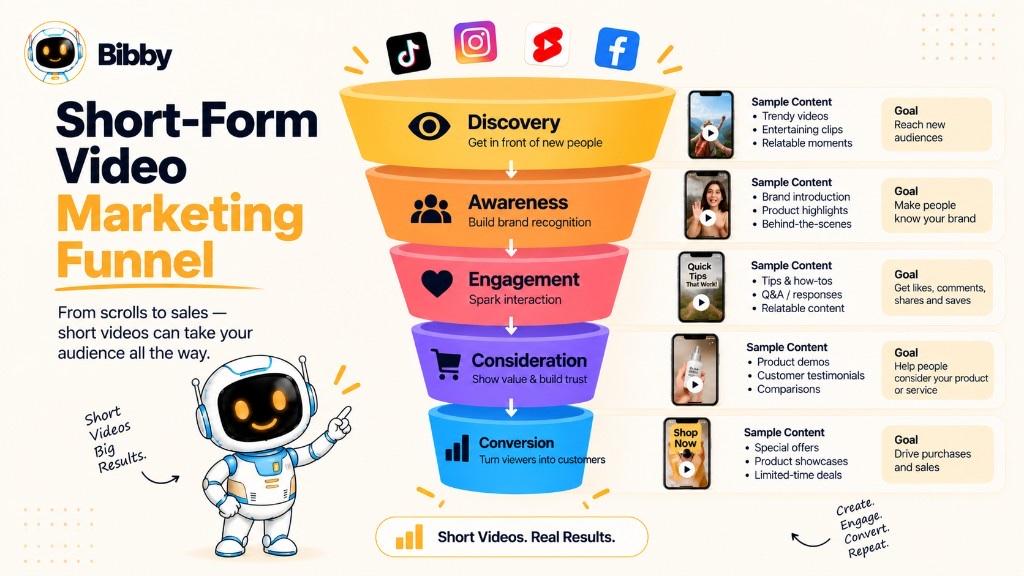
Short-form video is important for social media marketing because it gives brands a concise way to capture attention, introduce products, educate audiences, build familiarity, and encourage action. Its feed-friendly format also makes it suitable for reaching people who may not already follow a brand.
For marketers, the value is not simply that short videos can generate views. A well-planned short-form video can move someone from discovering a brand for the first time to understanding its product, engaging with its content, and eventually becoming a customer.
The format can support different stages of the marketing funnel, from awareness and discovery to consideration and conversion.
Building Brand Awareness
Short-form video can introduce a brand to people who have never interacted with it before.
A business can use concise videos to communicate what the company does, what problem it solves, who its product is for, what makes its approach different, and what customers can achieve with its product or service.
Because short-form content is commonly distributed through discovery-oriented feeds, individual videos can potentially reach audiences beyond a brand's existing followers. Organic reach is not guaranteed.
The most effective awareness videos do not necessarily try to explain the entire business. They give viewers one memorable reason to understand, remember, or explore the brand.
Increasing Audience Engagement
Short-form video provides many opportunities for interaction.
Brands can create videos that invite audiences to comment with an opinion, answer a question, share an experience, save a useful tip, share the video with someone else, or follow the account for more content.
This makes video more than a broadcast format. It can become a starting point for conversations between a business and its audience.
Explaining Products and Services
Some products are easier to understand when people can see them in action.
A short-form video can demonstrate how a product works, how to use a feature, what a product looks like, how a service solves a particular problem, what happens before and after using a product, or how the product compares with an alternative.
The video does not need to explain the entire product. Its purpose can simply be to make one benefit easier to understand.
Educating Potential Customers
Short-form video can also establish expertise before a customer is ready to buy.
A company can answer common questions, explain industry concepts, correct misconceptions, or share practical advice. This is particularly useful for businesses selling products or services that require some education before a purchase decision.
Repeated educational content can help an audience associate the brand with useful information rather than seeing every post as an advertisement.
Supporting Product Discovery
Short-form video can place products directly into content that people are already consuming.
Instead of relying exclusively on users searching for a product, marketers can use videos to introduce products through demonstrations, reviews, tutorials, comparisons, creator collaborations, user-generated content, and problem-and-solution videos.
This makes short-form video particularly useful for ecommerce and consumer brands, where seeing a product in use can influence interest.
Building Trust and Authenticity
People often want to know who is behind a company before they decide to engage with it.
Short-form video gives businesses a way to show employees, founders, customers, manufacturing processes, office culture, product development, and behind-the-scenes moments.
Authenticity does not necessarily mean producing low-quality content. It means giving audiences a realistic view of the people, expertise, products, and processes behind the brand.
Generating Traffic and Conversions
Short-form video can also support direct business objectives.
Depending on the platform and campaign, a video can encourage viewers to visit a website, explore a product, sign up for a service, download an app, join an email list, book a consultation, or make a purchase.
However, high video views should not automatically be interpreted as successful marketing. A video can reach a large audience without generating meaningful business results.
For this reason, marketers should connect short-form content to a measurable objective rather than optimizing every video exclusively for views. Track those outcomes in platform analytics and your own business tools—not as a Bibby ROI dashboard.
Benefits of Short-Form Video
Short-form video offers several advantages to social media marketers:
- Easy to consume: Viewers can understand the central message quickly.
- Strong discovery potential: Feed-based platforms can expose content to people outside an existing follower base.
- Flexible: The format works for education, entertainment, product marketing, storytelling, and community content.
- Relatively accessible production: Many videos can be created with a smartphone and basic editing tools.
- Easy to test: Marketers can experiment with different ideas, hooks, formats, and messages.
- Repurposable: Existing content can often be transformed into multiple short videos.
- Multi-platform potential: A core video concept can be adapted for several social networks.
- Useful throughout the funnel: Short-form content can support awareness, consideration, engagement, and conversion.
Limitations of Short-Form Video
Short-form video also has limitations that marketers should understand.
Limited Space for Complex Topics
Some products and services require detailed explanations. Compressing a complicated subject into 30 or 60 seconds can leave viewers with an incomplete understanding.
High Competition
The barrier to creating short-form video is relatively low, which means audiences encounter an enormous amount of content. A brand must compete not only with other businesses but also with creators, publishers, entertainers, and communities.
A Strong Hook Is Often Necessary
Viewers can scroll away almost instantly. If the opening does not establish relevance or interest, the rest of the video may never be seen.
Virality Does Not Equal Business Success
A highly viewed video may produce little revenue, while a smaller video aimed at a highly relevant audience may generate valuable leads or sales.
Marketers should therefore evaluate short-form video using metrics that correspond to their actual objectives.
Trends Can Become a Distraction
Following every popular trend can create a large volume of content without building a coherent brand. Trends should support a strategy, not replace one.
How Businesses Can Use Short-Form Video
A practical social media strategy can combine several types of short-form content rather than repeatedly publishing promotional videos.
For example, a business could build a content mix around:
Educate → Demonstrate → Engage → Humanize → Promote
An accounting company could publish quick tax tips, answer common questions, introduce its team, explain common financial mistakes, and occasionally promote its services.
An ecommerce brand could combine product demonstrations, customer testimonials, styling ideas, behind-the-scenes footage, educational content, and promotional announcements.
A software company could publish feature demonstrations, quick tutorials, workflow tips, customer use cases, industry insights, and product updates.
This approach gives audiences reasons to follow the account even when they are not actively looking to buy.
Short-Form Video and Social Media Scheduling
The challenge for many businesses is not coming up with one short-form video. It is maintaining a consistent publishing workflow across multiple platforms.
A social media scheduling tool such as Bibby can help organize that process. Users can upload an image or video, generate visual content with AI, choose a posting style, create captions, and schedule content for different dates and AI-optimized publishing times. Content can be planned across Facebook, Instagram, LinkedIn, YouTube, and TikTok from one workflow.
Bibby's chat interface also allows users to manage parts of their social media workflow conversationally, including creating a brand kit, building a campaign, creating posts, and regenerating captions.
The broader advantage is consistency: instead of treating every short-form video as a separate manual publishing task, businesses can incorporate video into a repeatable content calendar. Scheduling does not guarantee reach or replace native Insights.
Ultimately, short-form video is valuable in social media marketing because it combines concise communication with modern content discovery. When connected to a clear objective, relevant audience, and consistent publishing strategy, it can become a useful tool for building awareness, engagement, trust, and business growth.
How Does Short-Form Video Work?
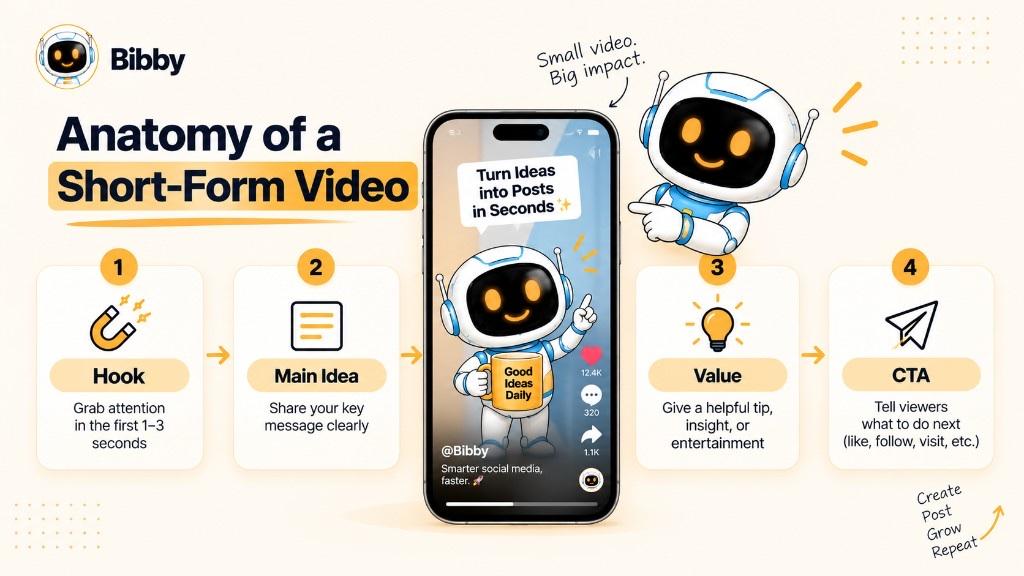
Short-form video works by combining quick attention capture, concise storytelling, visual communication, and social distribution. A viewer typically encounters a video while scrolling through a personalized feed, decides within a short period whether it is worth watching, and then either continues watching or moves to another piece of content.
Behind this simple experience is a cycle that connects the creator, viewer, and platform:
Hook → Watch → Retain → Engage → Discover More
The exact recommendation systems used by social platforms differ and can change over time, but this basic content journey helps explain how short-form videos are consumed and why certain creative decisions matter.
1. The Viewer Discovers the Video
Short-form videos are commonly encountered through recommendation and discovery surfaces rather than only through an account's existing followers.
A viewer might discover a video because they follow the creator, the platform recommends it, someone shared it, it appears in a search result, it is connected to a topic the viewer has previously engaged with, or it appears through a trend, hashtag, sound, or other discovery feature.
This means short-form content can potentially reach people who have never heard of the creator or business before.
2. The Opening Creates the First Impression
The beginning of a short-form video is especially important because viewers can leave almost immediately.
Creators often use a hook to establish why the video deserves attention. A hook could be a question, a surprising statement, a useful promise, a visual demonstration, a problem, a bold opinion, an unexpected result, or a compelling moment from the story.
The objective is not to trick the viewer into watching. The opening should accurately establish the value or subject of the content.
3. The Video Delivers One Central Idea
Once the viewer decides to continue, the video needs to deliver what the opening promised.
Strong short-form videos are often built around a single central idea. A simple structure might look like:
Problem → Explanation → Solution
Or:
Hook → Demonstration → Result
Or:
Question → Answer → Takeaway
Keeping the structure focused reduces unnecessary information and makes the content easier to follow.
4. Editing Maintains Attention
Short-form video often uses editing to maintain momentum: cuts, zooms, B-roll, on-screen text, captions, graphics, transitions, music, sound effects, and screen recordings.
The purpose is not to make every video aggressively fast-paced. Editing should support the content. A calm tutorial may need fewer cuts than an entertainment video.
5. The Viewer Continues or Leaves
As the video progresses, the viewer decides whether the content continues to deserve their attention.
This is why audience retention is an important concept. Retention describes how much of the video viewers continue watching and where they stop watching.
If many viewers leave at the same point, it may indicate that the section is too slow, the content is unclear, the opening promise was not fulfilled, the video contains unnecessary information, or the viewer has already received the information they wanted.
Retention data lives in platform analytics and can help creators identify opportunities to improve future videos.
6. Viewers Can Engage With the Content
After watching, viewers may interact with a short-form video by liking, commenting, sharing, saving, following the creator, clicking through to another destination, or taking another available action.
Different actions can represent different types of interest:
- Likes can indicate a positive reaction.
- Comments can indicate conversation or opinion.
- Shares can indicate that the viewer thinks someone else may find the content valuable or entertaining.
- Saves can indicate that the content has future reference value.
- Clicks can indicate interest beyond the video itself.
- Follows can indicate an intention to see more content from the creator.
Not every platform treats these signals identically, so creators should avoid assuming that one engagement metric universally determines distribution.
7. The Platform May Recommend the Video to More Viewers
Recommendation systems can use many different signals to determine which content to show to individual users.
These may include information about the content, the viewer's previous interactions, and how people respond to the video. The exact systems and weighting of signals vary by platform and are part of each social media algorithm.
This creates a potentially powerful loop:
A viewer watches → the viewer responds → the platform learns about relevance → the content may reach additional viewers → new viewers respond
However, there is no guaranteed formula for making a short-form video viral. A video can perform differently across platforms or audiences even when the creator uses the same content.
8. The Viewer Discovers More Content
Short-form video is not necessarily a one-video experience.
A viewer who enjoys one video may watch another video from the same creator, visit the creator's profile, follow the account, search for the topic, watch related videos, visit a website, or explore a product.
This is particularly important for businesses. The purpose of a short-form video does not always need to be completing the entire customer journey inside one clip.
A video can simply be the first step in a larger content journey.
The Short-Form Video Content Loop
The complete process can be summarized as:
Discover → Hook → Watch → Retain → Engage → Explore
For creators, this means the job of a short-form video is not merely to accumulate views. It needs to give the viewer a reason to stop, a reason to continue, and, when appropriate, a reason to take another action.
For businesses, the same process can support a broader marketing journey:
Discovery → Awareness → Interest → Consideration → Action
This is why effective short-form video combines creative decisions with a clear content strategy. A strong hook may earn the initial view, but relevant content, clear communication, and a useful next step determine whether that attention becomes meaningful engagement.
How to Create a Short-Form Video
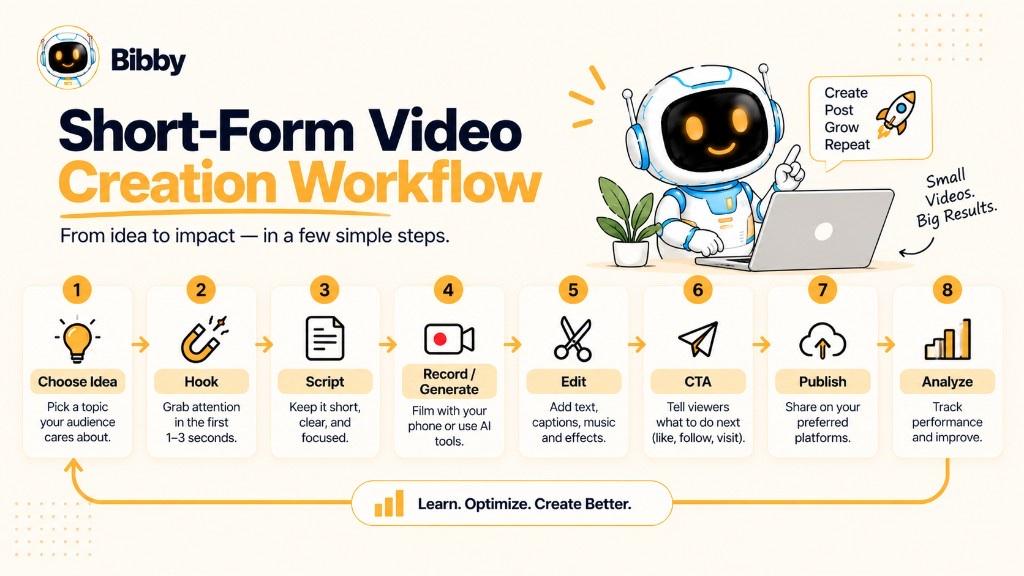
Creating a short-form video does not require a large production team or expensive equipment. A smartphone, a clear idea, suitable visuals, and basic editing can be enough.
The key is to start with the message rather than the camera. Decide what the viewer should learn, feel, or do, then build the shortest useful video around that objective.
A practical short-form video workflow looks like this:
Choose an idea → Create a hook → Write a script → Record or generate visuals → Edit → Add a call to action → Publish and analyze
1. Choose One Clear Idea
Start with one specific idea instead of trying to cover an entire subject.
A short-form video could answer one question, demonstrate one feature, explain one concept, or tell one short story.
For example, instead of creating a video titled “Everything You Need to Know About Social Media Marketing,” create a video explaining one specific topic such as how to choose the best time to publish a post.
A focused idea makes the video easier to understand and gives the viewer a clear reason to watch.
2. Create a Strong Hook
The hook is the opening that introduces the subject and gives viewers a reason to continue.
Common short-form video hooks include a question, a surprising fact, a common mistake, a specific problem, a useful promise, a strong opinion, a visual result, or a before-and-after moment.
For example:
“Your social media posts may be failing for one simple reason.”
The hook should match what the video actually delivers. A dramatic opening that promises something the video never explains may generate initial attention but can hurt the overall viewing experience.
3. Write a Short Script
A script helps keep the video focused.
A simple script can contain three parts:
Hook: Introduce the reason to watch.
Value: Explain, demonstrate, or tell the main idea.
Ending: Give the conclusion, takeaway, or next step.
Not every short-form video needs a word-for-word script. Some formats, particularly spontaneous creator content, may work better with a short outline or a few talking points.
4. Record or Generate the Visuals
Once the idea and script are ready, create the visual material.
Depending on the type of video, this could include smartphone footage, professional camera footage, screen recordings, product photography, product demonstrations, existing video clips, animations, graphics, AI-generated images or video, or user-generated content.
For social media, vertical video is commonly used because it is designed to occupy the smartphone screen efficiently.
The visual should support the message rather than simply fill the screen. If the video explains how an application works, showing the application can be more effective than displaying unrelated stock footage.
5. Edit for Mobile Viewing
Editing turns the raw material into a coherent short-form video.
Remove unnecessary pauses, repeated information, and sections that do not contribute to the central idea. Then add visual elements that make the content easier to understand: captions, on-screen text, B-roll, screen recordings, graphics, music, sound effects, transitions, and visual highlights.
Captions are particularly useful because people may encounter social videos in environments where they cannot or do not want to listen to audio.
The goal should not be to make every video extremely fast. Good editing creates an appropriate pace for the subject while keeping the viewer oriented.
6. Add a Relevant Call to Action
A call to action tells viewers what they can do next.
Depending on the purpose of the video, a CTA might ask viewers to follow the account, comment with an opinion, save the video, share it, visit a website, explore a product, watch another video, or sign up for a service.
Not every video needs an aggressive sales CTA. An educational video may simply encourage viewers to save the information, while a product video may direct interested viewers toward the product page.
7. Publish and Analyze
Creating the video is only part of the process. After publishing, review how the audience responded in each platform's Insights.
Useful metrics can include views, reach, watch time, audience retention, completion rate, likes, comments, shares, saves, profile visits, link clicks, and conversions.
The most useful metric depends on the video's objective. An awareness video may focus on reach and watch behavior, while a product-focused video may be evaluated more heavily through clicks and conversions.
Instead of judging a video solely by whether it went viral, compare its performance against similar content and look for patterns.
How to Create Short-Form Videos More Efficiently
Publishing short-form video consistently can become time-consuming when every stage is handled manually. A more efficient workflow is to create content in batches, maintain a library of ideas and assets, reuse successful concepts, and automate repetitive publishing tasks.
Bibby can help centralize parts of this social media workflow. Users can upload an image or generate visual content with AI, choose a posting style, have captions generated automatically, and schedule content for different dates and AI-optimized times across selected social platforms.
Its chat-based workflow also lets users manage social media tasks conversationally, including creating a brand kit, building campaigns, creating posts, and regenerating captions.
This can make short-form content part of a repeatable publishing system rather than a series of disconnected manual tasks. Bibby does not replace native video editors, sounds, effects, or analytics.
The most effective workflow is ultimately simple: start with one strong idea, communicate it clearly, remove everything unnecessary, publish it where the audience is active, and use the results to improve the next video.
Short-Form Video Best Practices
Creating a short-form video is easy. Creating one that consistently holds attention and supports a meaningful goal requires a more deliberate approach. The best short-form videos are usually not simply the shortest ones. They are focused, relevant, easy to understand, and structured around what the audience wants to see.
Start With the Value
Give viewers a clear reason to continue watching.
Instead of spending the opening seconds on a long introduction, establish the subject quickly. Tell viewers what they will learn, show the result they are looking for, introduce the problem, or begin the story immediately.
Keep One Primary Idea Per Video
Avoid packing multiple unrelated ideas into a single short-form video.
If a topic contains five useful points, consider creating a short series rather than forcing all five into one clip. This can make each video easier to follow and can give the audience multiple opportunities to discover your content.
Make the Opening Count
The opening should earn attention without misleading the viewer.
Useful opening approaches include asking a relevant question, showing a result first, identifying a common problem, presenting a useful insight, demonstrating something visually, or challenging a common assumption.
Avoid clickbait that promises information the video does not actually provide.
Remove Unnecessary Introductions
Phrases such as lengthy greetings, company introductions, or explanations of what the viewer is about to watch can consume valuable viewing time.
If the introduction does not help the viewer understand the subject or benefit from the content, consider removing it.
Design for Vertical Viewing
Much short-form social content is consumed vertically on smartphones.
When appropriate, create video in a vertical format and make sure important visual elements remain comfortably within the visible area. Pay attention to subject placement, text position, captions, logos, product demonstrations, screen recordings, and interface elements added by the platform.
Use Captions and On-Screen Text
Captions can improve accessibility and help viewers follow a video when audio is unavailable.
On-screen text can also emphasize key points, statistics, product features, instructions, questions, and important phrases.
Keep text large enough to read on a smartphone and avoid placing essential information where platform interface elements may cover it.
Match the Pace to the Content
Fast editing is common in short-form video, but speed should serve the message.
A tutorial may need enough time for viewers to understand each step. A comedy video may benefit from rapid cuts. A product demonstration may need a slower visual sequence so the product is easy to see.
The goal is maximum clarity with minimum unnecessary delay.
Use Visuals That Add Meaning
Every visual element should contribute to the viewer's understanding or experience.
If you are explaining a product feature, show the feature. If you are discussing a process, demonstrate it. If you are telling a story, use visuals that help establish the situation.
Make the Audio Clear
Good visuals cannot compensate for difficult-to-understand audio.
When recording spoken content, reduce background noise, keep the speaker's voice clear, avoid excessive volume changes, use music at an appropriate level, and check the final video on a smartphone before publishing.
Build a Recognizable Brand Presence
Short-form videos can be entertaining without becoming disconnected from the brand.
Consistent elements such as visual style, tone of voice, recurring formats, colors, or recognizable presenters can help audiences identify your content.
However, branding should not dominate the video. A large logo covering the screen or a lengthy promotional introduction can make useful content feel like an advertisement.
Test Different Hooks and Formats
There is rarely one perfect formula for every audience.
Test variations in hooks, topics, video lengths, presentation styles, narration, visual formats, calls to action, and educational versus entertaining content.
If one topic consistently performs well, explore variations rather than simply reproducing the exact same video.
Repurpose Strong Content
A successful idea can often become several pieces of content.
For example, one long interview might produce a short expert tip, a controversial opinion, a useful statistic, a response to a common question, a short story, and a practical takeaway.
Optimize for the Platform
Cross-posting can save time, but the exact same upload is not always the best version for every platform.
Consider adapting the caption, hook, description, call to action, editing, audio, hashtags, cover or thumbnail, and video framing.
Focus on Retention, Not Just Views
Views tell you that a video was watched, but they do not explain how effectively it held attention or whether it achieved its business objective.
Pay attention to where viewers stop watching, how much of the video people watch, whether viewers complete it, which videos generate shares and saves, whether viewers visit your profile, and whether content produces clicks or conversions. Review these in platform Insights.
Give Viewers a Reason to Take the Next Step
A short-form video should have a purpose.
If the objective is education, encourage viewers to save or explore another related topic. If the objective is community building, invite conversation. If the objective is product discovery, provide a clear path to learn more.
Publish Consistently
Consistency gives creators more opportunities to learn what works and helps businesses maintain an active social presence.
Consistency does not necessarily mean publishing several videos every day. A sustainable schedule that can be maintained over time is generally more useful than an intense publishing schedule that quickly becomes impossible to manage.
Planning content in advance and using scheduling tools can make consistency easier.
Use AI to Reduce Repetitive Work
AI can assist with several parts of the short-form content workflow, including brainstorming ideas, writing scripts, generating visuals, creating captions, repurposing content, and organizing publishing schedules.
The strongest use of AI is not to remove human judgment entirely. It is to reduce repetitive work so creators and marketers can spend more time on strategy, creativity, and audience understanding.
For example, Bibby can help automate parts of the social media workflow by allowing users to upload or generate visual content, select a posting style, generate captions, and schedule content across multiple platforms. Its conversational interface also allows users to manage tasks such as creating a brand kit, building campaigns, creating posts, and regenerating captions through chat.
Ultimately, effective short-form video comes down to a simple principle: respect the viewer's time. Give them a clear reason to watch, deliver useful or entertaining content efficiently, make the experience easy to understand, and learn from what happens after you publish.
Short-Form Video Content Ideas
Coming up with short-form video ideas consistently can be more difficult than creating the videos themselves. A reliable approach is to build content around recurring audience needs rather than waiting for inspiration to strike.
Good short-form video ideas usually do at least one of four things: teach something, entertain the audience, solve a problem, or create a reason to interact.
Educational Short-Form Video Ideas
Educational content works well when a complicated topic can be reduced to one useful takeaway.
Ideas include “3 mistakes to avoid when…,” “How to do X in 30 seconds,” quick industry tips, common misconceptions, frequently asked questions, beginner's guides, definitions of industry terms, short tutorials, useful shortcuts, “What nobody tells you about…,” before-and-after explanations, one-minute lessons, and important statistics explained simply.
For example, a social media agency could create a series explaining individual marketing concepts rather than attempting to teach an entire social media strategy in one video.
Product and Service Video Ideas
Businesses can use short-form videos to show what they sell instead of simply describing it.
Useful ideas include product demonstrations, feature walkthroughs, “how it works” videos, product comparisons, common use cases, new feature announcements, before-and-after demonstrations, product setup tutorials, frequently asked product questions, benefits explained through real examples, and customer problems with product solutions.
Engagement-Focused Video Ideas
Some videos are created primarily to encourage conversation or participation.
Ideas include asking your audience a question, “Which one would you choose?,” this-or-that comparisons, responding to a comment, answering a follower's question, sharing an unpopular opinion, asking viewers to complete a sentence, creating a prediction, inviting viewers to share their experience, or running a simple challenge.
Behind-the-Scenes Video Ideas
People are often interested in how a product, service, or piece of content comes together.
Ideas include how a product is made, preparing an order, setting up for an event, office or studio tours, introducing team members, a day in the life, product development, the content creation process, packaging, preparing for a launch, and what happens before a finished product reaches customers.
Storytelling Video Ideas
Stories can create stronger emotional or intellectual connections than straightforward promotional messages.
Short-form storytelling ideas include how the company started, a customer success story, a mistake and what you learned from it, a surprising business lesson, a challenge you overcame, the story behind a product, a memorable customer experience, “What happened when…,” a lesson from a failed experiment, or a transformation story.
User-Generated Content Ideas
Customer-created content can provide social proof while giving potential buyers a different perspective.
Ideas include customer reviews, unboxing videos, product reactions, customer tutorials, before-and-after results, “Why I chose this product,” customer use cases, video testimonials, and responses to customer videos.
Trend-Based Video Ideas
Trends can provide a framework for creating timely content.
Depending on the platform and audience, businesses and creators might adapt popular formats, relevant sounds, recurring video structures, current conversations, challenges, memes, and seasonal topics.
The important word is relevant. A trend should have a logical connection to the account's audience or subject.
Expert and Thought-Leadership Ideas
Professionals and B2B companies can use short-form video to demonstrate expertise.
Ideas include industry predictions, expert opinions, common professional mistakes, answers to client questions, lessons from experience, industry myths, data explained simply, reactions to industry developments, “What I would do if…,” practical frameworks, and lessons learned from projects.
Content Repurposing Ideas
Existing content can become a valuable source of short-form video ideas.
One longer piece of content can potentially be divided into multiple focused videos.
For example:
One webinar → multiple short clips
One podcast → expert quotes + key insights + controversial points
One blog post → tips + statistics + explanations + FAQs
One product demo → feature clips + use cases + common questions
One interview → individual answers + memorable statements + lessons
The key is to make every repurposed clip understandable without requiring the viewer to watch the original content.
A Simple Short-Form Content Idea Formula
When you are stuck for ideas, use this formula:
Audience problem + useful insight + concise presentation = short-form video idea
Start by identifying something your audience wants to know, solve, avoid, compare, or understand. Turn that subject into one focused message, then choose the presentation format that fits it.
For example:
Audience problem: “My social posts take too long to create.”
Insight: “Batching content can reduce repetitive work.”
Video: “3 steps to batch a week's social media content.”
Build Short-Form Video Ideas Into a Content System
Instead of creating every video from scratch, organize ideas into recurring content categories.
A business might use a weekly mix such as:
Monday: Educational tip
Tuesday: Product or service demonstration
Wednesday: Customer question
Thursday: Behind-the-scenes content
Friday: Industry insight or entertaining video
The exact schedule should depend on the audience and platform. The important part is creating a repeatable system that provides variety without requiring a completely new content strategy every day.
Tools such as Bibby can help turn this system into a repeatable social media workflow. Users can create campaigns, generate posts and captions, organize visual content, and schedule content for different dates and AI-optimized publishing times across selected platforms.
With a structured idea bank and a repeatable workflow, short-form video becomes less about asking “What should I post today?” and more about systematically turning audience needs, expertise, products, and existing content into useful social media content.
Short-Form Video for Businesses
Short-form video gives businesses a way to communicate with potential and existing customers without requiring every piece of content to be a traditional advertisement. A business can use a short video to answer a question, demonstrate a product, explain a problem, share expertise, introduce its team, or show how customers use its offering.
The most effective business short-form videos usually connect audience interest with a specific business objective. Instead of creating videos simply because short-form content is popular, businesses can use the format to support awareness, education, consideration, engagement, and conversion.
Common business applications include building brand awareness, demonstrating products, explaining services, answering customer questions, sharing educational content, showing customer experiences, building trust, introducing employees or founders, promoting offers and launches, generating website traffic, supporting lead generation, and repurposing existing content.
Short-Form Video for Small Businesses
Small businesses can use short-form video without investing in a large production operation. A smartphone, basic lighting, clear audio, and a useful idea can be enough.
A small business could create videos such as a quick tour of the business, product demonstrations, frequently asked customer questions, behind-the-scenes clips, staff introductions, customer testimonials, before-and-after results, how-to videos, tips related to the business's expertise, new product announcements, and local or seasonal content.
For example, a restaurant could show how a popular dish is prepared, a dentist could answer common oral-care questions, and a local clothing store could demonstrate different ways to style a product.
Short-Form Video for Ecommerce
Ecommerce brands can use short-form video to help customers understand products that they cannot physically examine before purchasing.
Useful ecommerce video formats include product demonstrations, unboxing videos, product comparisons, styling demonstrations, before-and-after content, customer testimonials, user-generated content, product tutorials, feature highlights, frequently asked questions, packaging videos, and new product launches.
Showing a product in use can communicate information that is difficult to convey through a static product image. Short-form video can also support product discovery by introducing products to audiences who were not actively searching for them.
Short-Form Video for B2B
B2B companies sometimes assume that short-form video is primarily useful for consumer brands. That is not the case.
B2B businesses can use short-form video to make specialized knowledge easier to discover and consume: expert insights, industry commentary, product demonstrations, feature explanations, common customer questions, data-driven observations, industry myths, founder perspectives, case-study highlights, professional tips, software tutorials, and responses to industry developments.
For example, a cybersecurity company could explain one common security mistake in a short video. A SaaS company could demonstrate one feature. A consulting firm could explain a common business problem and offer a practical framework for addressing it.
B2B short-form video does not need to become entertainment for entertainment's sake. Useful expertise can itself be compelling content when it is presented clearly and concisely. LinkedIn can be one useful surface for that kind of clip, alongside other channels your buyers already use.
Short-Form Video for Brand Awareness
Short-form video can introduce a company to audiences before they have a direct reason to buy.
A business might create content around its expertise, its mission, its products, its people, its customers, its industry, and common audience problems.
The objective is to make the brand recognizable and relevant over time. A single video rarely needs to explain everything about a company.
Short-Form Video for Product Education
A business can use multiple short videos to explain different aspects of a product.
For example:
Video 1: What problem does the product solve?
Video 2: How does the product work?
Video 3: How do you use the main feature?
Video 4: What common mistake should users avoid?
Video 5: How are customers using the product?
This approach breaks product education into manageable pieces and allows viewers to discover the information most relevant to them.
Short-Form Video for Customer Support
Short videos can also answer recurring customer questions.
Instead of responding to the same question repeatedly, a business can create a concise video explaining the answer and then reuse that content when appropriate.
Potential topics include how to get started, how to use a feature, shipping information, product setup, common troubleshooting steps, account questions, and frequently misunderstood features.
Short-Form Video for Recruitment
Businesses can also use short-form video to show potential employees what it is like to work at the company: employee introductions, office tours, day-in-the-life videos, team activities, behind-the-scenes content, employee interviews, company events, and workplace culture.
Short-Form Video as Part of a Larger Content Strategy
Businesses should not treat short-form video as an isolated marketing channel.
A single idea can support multiple formats:
Short-form video → social post → blog article → newsletter → long-form video
Similarly, one long-form asset can produce several short-form videos.
This creates a content ecosystem in which each format serves a different purpose. Short-form video can attract attention and introduce an idea, while longer content can provide additional detail for people who want to explore the subject further.
Automating Short-Form Content Publishing
The challenge for businesses is often consistency. Creating one video is manageable, but creating, captioning, organizing, and publishing content repeatedly across multiple social networks can consume significant time.
Bibby is designed to simplify this type of workflow. Users can upload visual content or generate it with AI, select a posting style, generate captions automatically, and schedule content at different dates and AI-optimized times across selected platforms such as Facebook, Instagram, LinkedIn, YouTube, and TikTok.
Bibby also supports different types of social media content, including images, carousels, videos, and Stories, allowing short-form video to exist alongside other formats within the same content strategy.
This allows businesses to treat short-form video as part of a repeatable social media system rather than a collection of individual publishing tasks.
Ultimately, the most valuable short-form video strategy for a business is not necessarily the one that produces the most views. It is the one that consistently reaches the right audience, communicates something useful or relevant, strengthens the brand, and contributes to a measurable business objective.
How to Measure Short-Form Video Performance
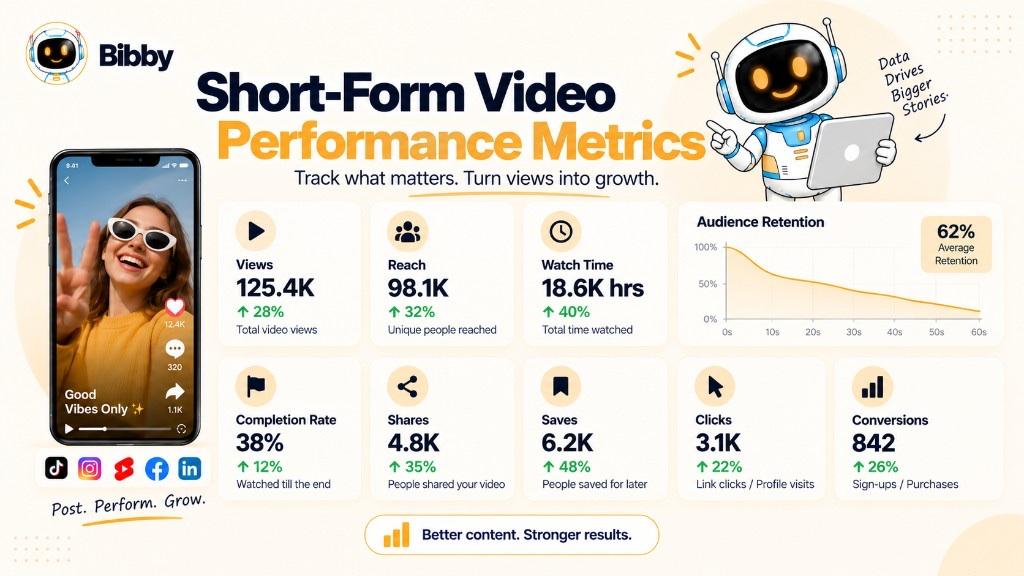
Measuring short-form video performance helps creators and businesses understand what is working, where viewers lose interest, and whether their content is achieving its intended goal. A high number of views can look impressive, but views alone do not tell the full story.
The right metrics depend on what the video is designed to accomplish. An awareness video may prioritize reach and watch behavior, while a product video may be more valuable when it generates clicks, leads, or purchases.
Review these numbers in each platform's Insights. Bibby does not replace native video analytics, ad reporting, or ROI dashboards.
The most useful approach is to evaluate short-form video using a combination of attention, engagement, and business metrics.
| Metric | What It Tells You |
|---|---|
| Views | How many times the video was viewed |
| Reach | How many unique accounts encountered the content |
| Watch time | How much total time viewers spent watching |
| Audience retention | How effectively the video holds attention throughout its duration |
| Completion rate | The proportion of viewers who watch through to the end |
| Likes | A basic signal of positive audience response |
| Comments | The amount of conversation generated |
| Shares | How often viewers distribute the content to others |
| Saves | Whether viewers consider the content useful enough to revisit |
| Profile visits | Whether the video encourages further interest in the account |
| Link clicks | Whether viewers take an action beyond the platform |
| Conversions | Whether the content contributes to a desired business result |
Views
Views indicate how many times a video has been viewed according to the platform's measurement system.
Views are useful for understanding the overall exposure of content, but they should not be treated as a complete measure of success.
A video with 100,000 views may generate very little business value if the audience is irrelevant. Meanwhile, a video with 10,000 highly relevant views could generate qualified leads or customers.
Views are therefore best considered an attention metric, not a standalone business-performance metric.
Reach
Reach refers to the number of unique accounts exposed to the content, where the platform provides that measurement.
Comparing reach with views can provide additional context. If the same people watch a video multiple times, views may be substantially higher than reach.
The exact definitions and reporting methods can vary between platforms, so marketers should use the platform's own metric definitions when analyzing performance.
Watch Time
Watch time measures how much time viewers spend watching video content.
It can help answer an important question: Did people actually spend time with the content after discovering it?
Audience Retention
Audience retention shows how viewer attention changes throughout a video.
A retention graph can reveal whether viewers leave immediately, continue through the introduction, drop off during a particular explanation, stay until the conclusion, or rewatch particular moments.
If several videos consistently lose viewers during long introductions, for example, shortening the opening may be worth testing.
Completion Rate
Completion rate measures how many viewers watch the video through to its end, according to the platform's reporting methodology.
A high completion rate can indicate that the video is appropriately structured for its audience and duration. However, a very short video may naturally have an easier time achieving completion than a longer one, so comparing videos with substantially different durations can produce misleading conclusions.
Likes, Comments, Shares, and Saves
Likes provide a simple indication of audience response. Comments can indicate that a video has encouraged people to express opinions, ask questions, or participate in a conversation. Shares can indicate that viewers found the content valuable, entertaining, relatable, or relevant enough to pass along. Saves are particularly useful for educational and practical content because they can signal reference value.
Profile Visits and Follows
If a short-form video is designed to build awareness, profile visits and follows can help indicate whether the content generated interest beyond the individual video.
Link Clicks and Conversions
For businesses using short-form video to drive traffic, link clicks can be more meaningful than engagement metrics alone.
Conversions measure whether viewers completed a desired business action such as a purchase, lead submission, app installation, signup, booking, subscription, or download.
Attribution can be complicated. Someone may discover a company through a short video, conduct additional research days later, and then convert through another channel. Businesses should therefore avoid assuming that every conversion can be attributed to one video or one interaction.
Which Short-Form Video Metrics Matter Most?
There is no single metric that matters most for every video.
A useful framework is to match the metric to the objective:
Awareness → Reach, views, watch behavior
Engagement → Comments, shares, saves, likes
Audience growth → Profile visits, follows
Traffic → Link clicks
Sales or leads → Conversions and revenue
This prevents marketers from optimizing for metrics that look impressive but do not support their actual objectives.
How to Improve Short-Form Video Performance
Use performance data to identify patterns rather than treating each video as an isolated success or failure.
If viewers leave immediately, experiment with the opening.
If viewers stay through the introduction but leave during the explanation, simplify or restructure the middle.
If viewers watch to the end but rarely take action, test a clearer or more relevant call to action.
If a particular topic consistently generates shares or saves, create additional content around that subject.
You can also compare different hooks, video lengths, topics, presentation styles, calls to action, and publishing approaches.
The objective is not to discover a permanent formula. Social audiences, platforms, and content trends change. Performance analysis is an ongoing process of testing, learning, and refining.
For businesses managing content across multiple platforms, a centralized workflow can also make performance-driven content planning easier. Bibby helps users organize social media content, generate captions, create campaigns, and schedule posts across selected platforms, allowing short-form content to become part of a consistent publishing system.
Ultimately, successful short-form video measurement goes beyond asking “How many people watched?” The more useful questions are “Did the right people watch?”, “Did they stay?”, “Did they engage?”, and “Did the video help achieve the intended goal?”
How AI Is Changing Short-Form Video Creation
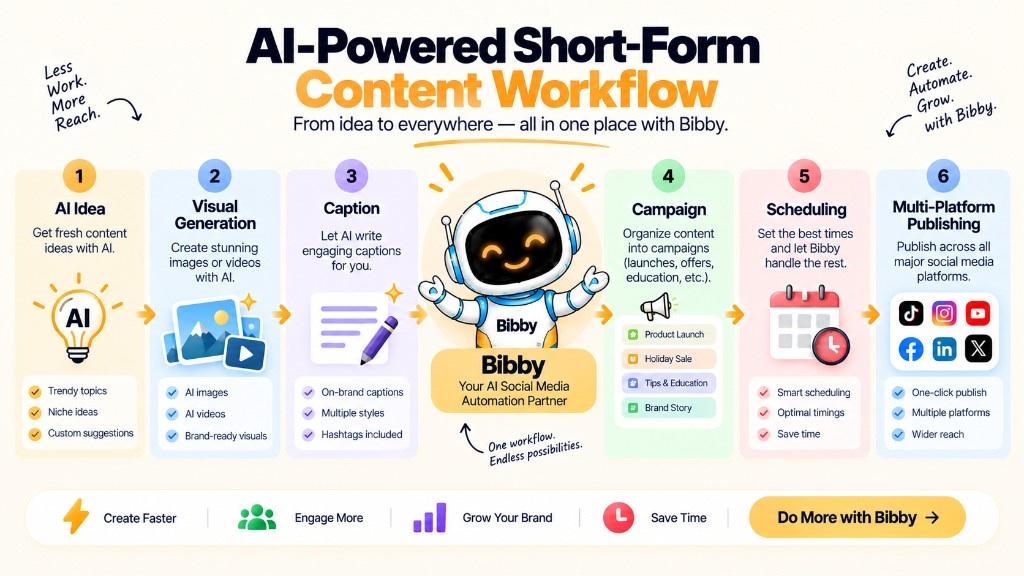
Artificial intelligence is changing how creators and businesses plan, produce, adapt, and publish short-form video. Tasks that once required separate tools or significant manual effort can increasingly be handled with AI-assisted workflows.
AI can help with everything from generating content ideas and writing scripts to creating visuals, producing captions, repurposing existing content, and organizing publishing schedules.
The biggest advantage is not simply producing videos faster. AI can reduce repetitive work, allowing creators and marketers to spend more time deciding what to say, who to say it to, and why the content matters.
AI for Short-Form Video Ideas
One of the first challenges in short-form content creation is deciding what to publish.
AI can help generate ideas based on target audience questions, industry topics, products and services, common customer problems, existing content, campaign objectives, content themes, and previous successful posts.
Human judgment remains important. An AI-generated idea may be technically interesting but irrelevant to the audience, so ideas should be evaluated before production.
AI for Scripts and Storytelling
AI can also help turn an idea into a short script.
For example, a creator can provide a topic and ask AI to structure it around Hook → Main point → Explanation → Takeaway.
AI can suggest different hooks, simplify complicated explanations, shorten scripts, or adapt the same idea for different audiences.
AI-Generated Visuals
AI image and video generation tools can create visual assets without requiring every scene to be filmed manually.
Depending on the tool and workflow, creators may use AI to produce illustrations, backgrounds, product concepts, motion graphics, supporting visuals, creative scenes, social media graphics, and video elements.
Generated visuals should still support the video's message. More visual complexity does not automatically make a short-form video more effective.
AI for Captions and On-Screen Text
Writing captions and accompanying social copy can become repetitive when publishing frequently.
AI can help generate social media captions, video titles, descriptions, hooks, on-screen text, calls to action, and hashtag suggestions.
Creators can then review and adjust the generated copy to match their brand voice and the context of the content.
AI for Content Repurposing
One of the most useful applications of AI is transforming existing content into new formats.
A long-form asset such as a podcast, webinar, interview, article, or video can provide multiple short-form content opportunities.
AI can help identify important points, interesting quotes, frequently asked questions, strong statements, educational moments, and potential video topics.
AI for Personalization
AI can also help adapt content for different audiences and platforms.
The same core message might be presented differently for new audiences, existing followers, customers, industry professionals, different geographic markets, and different social platforms.
AI for Social Media Scheduling
Creating a short-form video is only one part of social media management. Businesses also need to decide when and where to publish it.
AI-assisted scheduling can help organize content across multiple dates and platforms while reducing repetitive manual work.
Instead of opening several social networks individually and scheduling each post, businesses can manage more of the publishing workflow from a centralized system.
Create and Schedule Short-Form Social Content With Bibby
Bibby combines AI-assisted content creation with social media scheduling in a single workflow.
Users can upload an image or other visual content, generate visual content with AI, choose a posting style, and have captions generated automatically. Content can then be scheduled for different dates and AI-optimized publishing times across selected social platforms, including Facebook, Instagram, LinkedIn, YouTube, and TikTok.
Bibby also supports different types of social media content, including images, carousels, videos, and Stories, allowing short-form video to exist alongside other formats within the same content strategy.
Native recording, sounds, effects, product tags, checkout, ads, and performance reporting stay on each social platform. Scheduling is a workflow—not a distribution or analytics guarantee.
Manage Short-Form Content Through Chat
Bibby's chat interface extends the workflow beyond individual content creation tasks.
Instead of navigating through multiple separate workflows, users can manage social media tasks conversationally. Within the chat experience, users can:
- Create a brand kit
- Create a campaign
- Create posts
- Regenerate captions
- Manage content
- Build and refine social media workflows
This can make AI-assisted social media management feel less like operating a collection of separate tools and more like communicating with a digital social media manager.
For example, a business could use a conversational workflow to develop a campaign, generate several post concepts, refine captions, and organize the resulting content for scheduled publication.
AI Does Not Replace the Content Strategy
AI can make short-form video creation faster, but automation alone does not guarantee effective content.
Businesses still need to determine who their audience is, what problems they want to solve, what topics are relevant, what makes their brand different, which content formats fit their objectives, what success looks like, and how performance should influence future content.
The strongest approach is therefore AI-assisted rather than strategy-free. AI can accelerate execution, but the quality of the underlying idea and the relevance of the content still matter.
The Future of Short-Form Video Creation
As AI becomes more integrated into social media workflows, the process of moving from an idea to a published video is likely to become increasingly connected.
A future workflow can be viewed as:
Idea → Script → Visuals → Caption → Adaptation → Scheduling → Publishing → Analysis → New Ideas
Instead of treating each step as a separate task, AI can help connect them into one continuous content system.
For creators and businesses, this means the competitive advantage may increasingly come from the ability to develop better ideas and more relevant content at scale, rather than simply producing more videos.
Short-form video remains fundamentally a communication format. AI can make the production and management process faster, but the most effective videos still begin with something worth watching.
Short-Form Video: Key Takeaways
Short-form video is a concise video format designed to communicate information, entertainment, stories, or marketing messages within a relatively brief viewing experience. It is especially prominent across social platforms where users discover and consume content through mobile-first feeds.
The key points to remember are:
- Short-form video is defined by concise content, not one fixed duration. There is no universal number of seconds that applies to every platform or type of short-form video.
- The format is designed for quick consumption. Strong hooks, focused messaging, visual storytelling, captions, and efficient pacing are common characteristics.
- TikTok, Instagram Reels, YouTube Shorts, and Facebook Reels are major platforms for short-form video.
- Short-form video can serve many purposes, including education, entertainment, product demonstrations, storytelling, brand awareness, and audience engagement.
- Shorter does not automatically mean better. The ideal duration is the amount of time needed to communicate the idea clearly without unnecessary content.
- Short-form and long-form video can work together. Short videos can attract attention and introduce topics, while longer content can provide additional depth.
- Businesses can use short-form video throughout the marketing funnel, from awareness and product discovery to education, engagement, traffic, leads, and conversions.
- Performance should be measured against the video's objective. Views are useful, but watch time, retention, engagement, clicks, and conversions can provide a more complete picture. Review them in platform Insights—not as a Bibby analytics product.
- AI can simplify the short-form content workflow by helping with ideas, scripts, visuals, captions, repurposing, and publishing.
- Consistency matters. A repeatable content creation and scheduling workflow can make it easier to maintain an active presence across multiple social platforms.
For creators and businesses, the most effective short-form video strategy is not about making every video as short as possible or chasing every viral trend. It is about delivering one relevant idea clearly, earning the viewer's attention, and creating content that supports a meaningful goal.
Continue learning with related dictionary entries on Reels, long-form video, Stories, UGC, CTAs, engagement, reach, and the social media algorithm—or browse the social media dictionary. Then start a free Bibby trial to create, caption, and schedule video and other social content across your channels.