
The best time to post refers to the time of day when your social media audience is most likely to see and engage with your content. Publishing when your followers are active can increase reach, likes, comments, shares, clicks, and overall engagement. However, there isn't a single posting time that works for every account—your ideal posting schedule depends on factors like your audience, industry, platform, time zone, and content type.
While many websites publish general recommendations for the best times to post on platforms like Facebook, Instagram, LinkedIn, TikTok, and YouTube, those benchmarks are only a starting point. The most effective posting schedule is one that's tailored to your own audience and continuously optimized using real performance data.
In this guide, you'll learn what the best time to post means, why it matters, how it differs across social media platforms, and how to identify the optimal posting times for your business. If you're looking for personalized recommendations instead of generic posting charts, use Bibby's free Best Time to Post Tool to discover posting times that better match your audience and improve your social media results.
Quick Answer
Why the Best Time to Post Matters
Publishing great content is only part of a successful social media strategy. If you share a post when your audience is inactive, it may receive less engagement during the critical first few hours after publication. Posting at a time when more of your followers are online gives your content a better opportunity to be seen, interacted with, and shared.
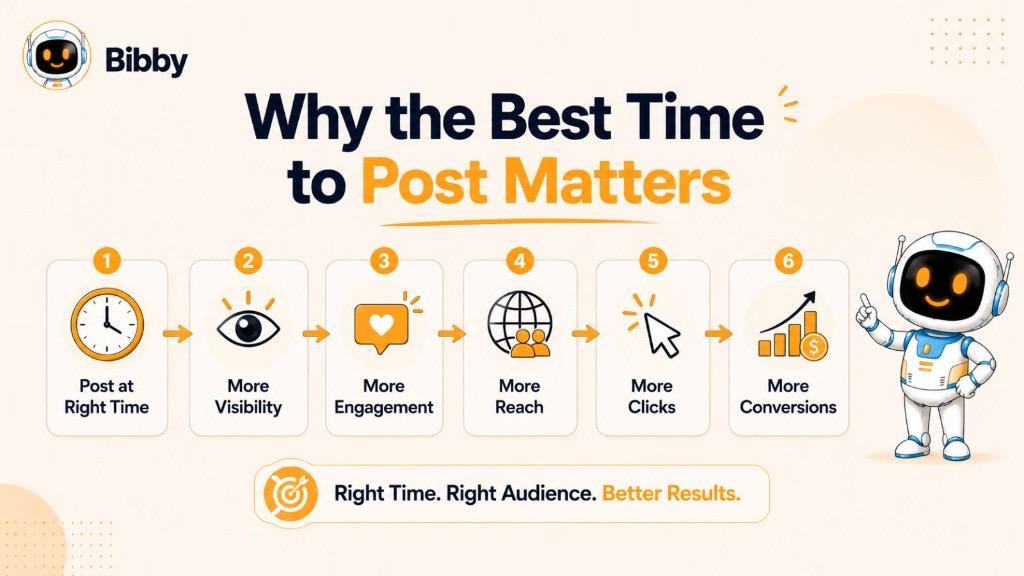
Choosing the best time to post can help you:
- Increase your content's visibility and reach.
- Generate more likes, comments, shares, and saves.
- Drive higher click-through rates to your website or landing pages.
- Improve video views and watch time.
- Boost conversions, leads, or sales from social media.
- Build consistent engagement over time.
It's important to remember that posting time is only one factor influencing performance. High-quality content, compelling visuals, relevant captions, audience targeting, and consistent publishing all play a significant role in achieving strong results. The best outcomes typically come from combining valuable content with a posting schedule that's optimized for when your audience is most active.
How the Best Time to Post Is Determined
The best time to post isn't based on a fixed schedule—it's determined by a combination of audience behavior, platform signals, and your own performance data. Understanding these factors can help you move beyond generic posting recommendations and develop a schedule that consistently delivers better results.
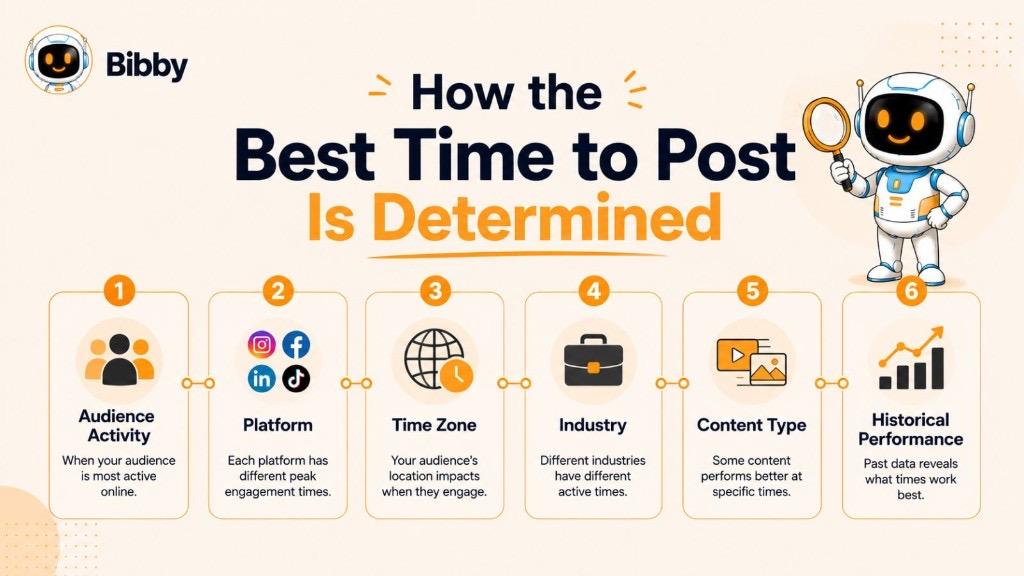
Audience Activity
The most important factor is when your followers are online. Posting shortly before or during peak activity gives your content a greater chance of being seen and engaged with while it's still fresh.
Social Media Platform
Every platform has its own algorithm and user behavior. For example, people often browse LinkedIn during the workday, while Instagram, TikTok, and Facebook usage may peak during evenings or weekends. The best posting time for one platform may not be ideal for another.
Time Zones
If your audience is spread across multiple regions, posting based solely on your local time may cause you to miss periods of high activity elsewhere. Consider where the majority of your followers are located when planning your publishing schedule.
Industry and Audience
Different industries attract different browsing habits. A B2B company may see stronger engagement during business hours, while entertainment brands, restaurants, and lifestyle creators often perform well outside of traditional working hours. Your audience's daily routine has a significant impact on when they're most likely to engage.
Content Format
The type of content you publish can also influence the best posting time. Videos, carousels, images, Stories, and Shorts may each perform differently depending on when users typically consume that format. Testing each content type separately can reveal valuable patterns.
Historical Performance
Your past posts provide some of the most valuable insights. By reviewing metrics such as impressions, engagement, clicks, watch time, and conversions, you can identify which publishing times consistently produce the strongest results. This data is often far more useful than industry-wide averages.
Because all of these factors vary from one account to another, there is no single schedule that works for everyone. Instead of relying only on general posting guides, the most effective approach is to analyze your own audience and continuously refine your posting schedule as their behavior evolves.
Best Time to Post by Platform
While there isn't a universal posting schedule that guarantees success, audience behavior varies across social media platforms. Understanding how people use each platform can help you choose better publishing times and improve your chances of reaching the right audience.
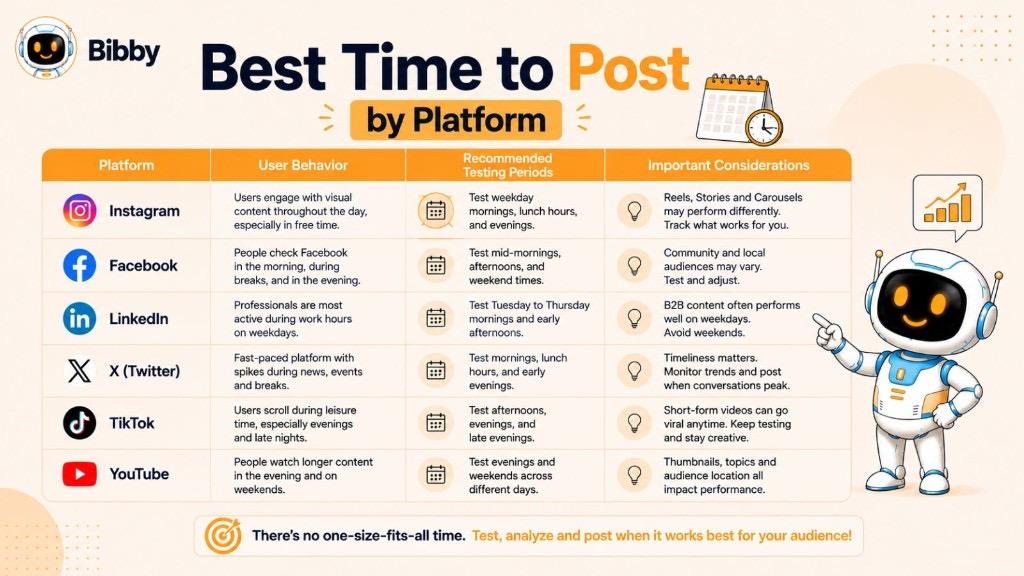
Use this overview as educational context—then validate with your analytics or generate a personalized weekly plan in Bibby's free tool.
| Platform | Typical audience patterns | What to test |
|---|---|---|
| Morning breaks, lunch, evenings; weekdays and weekends both matter | Local posts vs. brand content; weekend vs. weekday slots | |
| Breaks and after work; format-specific (Feed, Reels, Stories, carousels) | Reels vs. carousels at lunch and evening windows | |
| Workday mornings and early afternoons for many B2B audiences | Midweek AM vs. lunch for thought leadership | |
| TikTok | Afternoons, evenings, and weekends for many creators | After-work vs. late-evening Short-form windows |
| YouTube | Depends on long-form vs. Shorts; publish before peak viewing when possible | Premiere timing vs. Shorts throughout the day |
Facebook users are active throughout the day, but engagement often increases during morning breaks, lunch hours, and evenings. Businesses should experiment with weekday and weekend posting times to determine when their audience is most responsive.
Once you know your windows, schedule Facebook posts in Bibby so you stay consistent.
Instagram engagement depends heavily on content format. Feed posts, Reels, Stories, and carousels may each perform best at different times. Since many users browse Instagram during breaks and after work, testing multiple time slots can help identify when your audience is most likely to engage.
Instagram scheduling in Bibby helps you publish Feed posts and Reels when those windows hit—without posting manually every time.
LinkedIn is primarily a professional network, so engagement often aligns with the workday. Business-related content frequently performs well during weekday mornings and early afternoons, although the ideal schedule varies depending on your industry and audience.
TikTok
TikTok usage is spread throughout the day, with many users becoming more active during afternoons, evenings, and weekends. Because the platform surfaces content based on user interests rather than follower relationships alone, consistent testing is especially important.
YouTube
The best publishing time for YouTube depends on whether you're posting long-form videos or Shorts. Scheduling videos before your audience's peak viewing hours gives the platform time to process and recommend your content, while Shorts may perform well throughout the day depending on viewer behavior.
Tip: Generic "best time to post" charts can be a useful starting point, but they're based on broad trends rather than your specific audience. For more accurate recommendations, use analytics or Bibby's Best Time to Post Tool, which builds a strategist-style weekly plan from your platform, niche, and timezone.
Is There a Universal Best Time to Post?
No. There is no universal best time to post that guarantees higher engagement for every social media account. While you'll find many articles recommending specific days and hours to publish, these are based on aggregated data and may not reflect your audience's behavior.
The ideal posting time varies because every account is different. Factors that influence the best time to post include:
- Your audience's location and time zones.
- The social media platform you're using.
- Your industry or niche.
- The type of content you publish.
- How often you post.
- Changes to platform algorithms over time.
For example, a software company targeting professionals may see the highest engagement during weekday business hours, while a fitness creator might perform better with early morning or evening posts. Similarly, a local business serving one city will likely have different optimal posting times than a global brand with followers across multiple continents.
Rather than relying solely on published posting schedules, use them as a starting point and refine your strategy with your own analytics. Monitoring engagement, impressions, clicks, and conversions over time will help you identify the publishing schedule that works best for your audience.
If you want to skip the guesswork, Bibby's Best Time to Post Tool helps you identify personalized posting times so you can schedule content when your audience is most likely to engage.
Best Time to Post vs. Best Day to Post
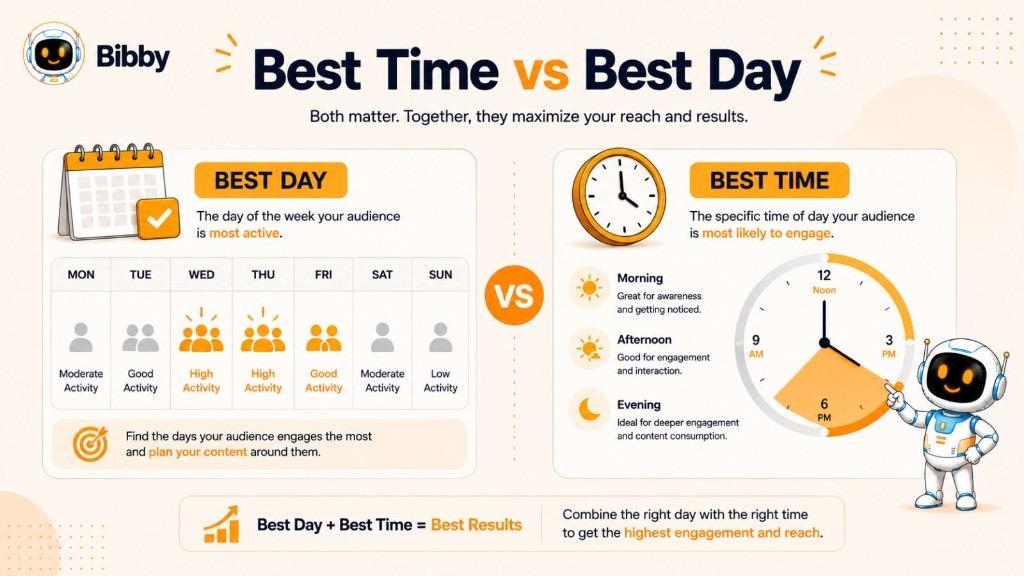
Although they're often used together, the best time to post and the best day to post are two different concepts. Understanding both can help you build a more effective social media publishing strategy.
| Best Time to Post | Best Day to Post |
|---|---|
| Refers to the hour or time of day you publish content. | Refers to the day of the week you publish content. |
| Focuses on when your audience is most active during the day. | Focuses on which days your audience is most likely to engage. |
| Helps maximize immediate reach and early engagement. | Helps identify broader weekly engagement patterns. |
| May vary by platform, audience, and content type. | May vary by industry, audience behavior, and platform trends. |
For example, your audience may be most active on Tuesdays, making it your best day to post. However, publishing at 9:00 AM might outperform posting at 6:00 PM on that same day. In this case, Tuesday is the best day, while 9:00 AM is the best time.
The most successful social media strategies consider both factors together. Instead of asking only *"What day should I post?"*, it's better to ask *"What day and what time will my audience be most likely to engage?"*
To find the optimal combination, analyze your posting history, monitor engagement trends, and experiment with different publishing schedules—or use A/B testing on timing variables when traffic allows. Over time, you'll discover the days and times that consistently produce the best results.
How to Find Your Best Time to Post
Finding the best time to post requires more than following general recommendations. The most effective approach is to analyze your own audience, test different publishing schedules, and continuously optimize based on performance.
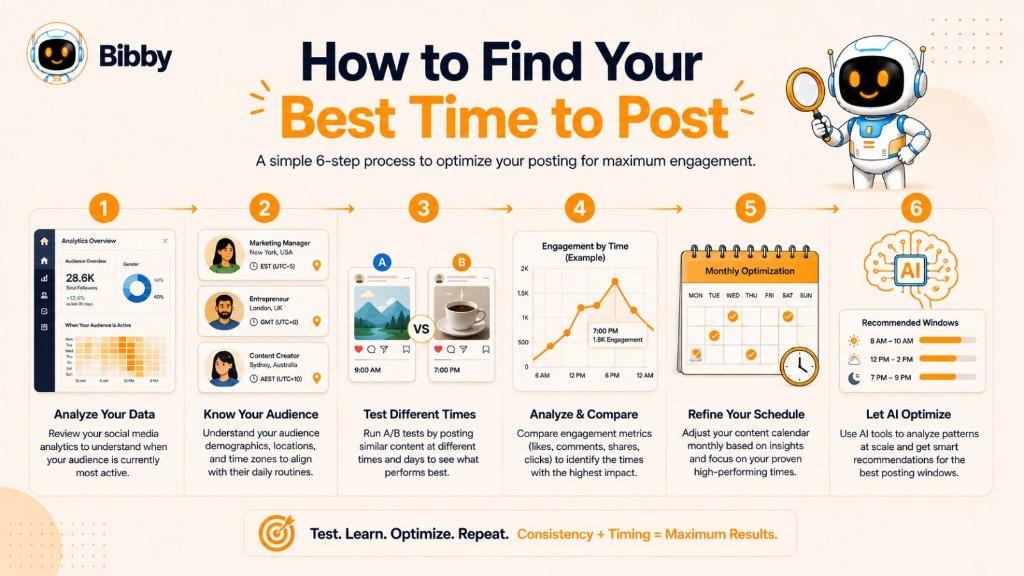
1. Review Your Social Media Analytics
Most social media platforms provide insights into when your followers are online and how your posts perform. Look for patterns in metrics such as:
- Impressions
- Reach
- Likes and reactions
- Comments
- Shares
- Saves
- Click-through rate
- Watch time
- Conversions
These metrics can reveal when your audience is most likely to engage with your content.
2. Understand Your Audience
Consider who you're trying to reach. Ask questions such as:
- Where are your followers located?
- Which time zones do they live in?
- Are they consumers or business professionals?
- When are they most likely to be using social media?
The answers can help you narrow down the most promising posting windows and improve audience targeting for paid and organic campaigns.
3. Test Different Posting Times
Experiment with publishing the same types of content at different times of the day and on different days of the week. Avoid changing too many variables at once so you can accurately measure the impact of posting time.
4. Track the Results
Record the performance of your posts over several weeks or months. Look for consistent trends rather than focusing on a single high-performing post. A reliable posting schedule is built on repeated success, not isolated results.
5. Adjust Your Schedule Regularly
Audience behavior changes over time due to seasons, holidays, platform updates, and business growth. Review your analytics regularly and update your posting schedule to reflect new trends. A living content calendar makes these adjustments easier to manage.
6. Use AI to Optimize Your Schedule
Manually analyzing social media data can be time-consuming, especially if you're publishing across multiple platforms. AI-powered tools can evaluate engagement patterns, identify high-performing publishing windows, and recommend posting times based on your audience and historical performance.
Instead of relying on generic posting charts, use Bibby's Best Time to Post Tool to discover personalized posting times for your social media accounts. Once you've identified the best schedule, you can publish or automatically schedule your posts across multiple platforms from a single place, helping you stay consistent while maximizing reach and engagement.
Use Bibby's Best Time to Post Tool
Most "best time to post" guides provide general recommendations based on large datasets. While these benchmarks can be helpful, they don't account for your unique audience, content strategy, or posting history. That's why personalized recommendations typically produce better results than one-size-fits-all schedules.
This dictionary page explains what the best time to post is and how to think about it. Bibby's Best Time to Post Tool is where you apply that knowledge—generating a platform-, niche-, and timezone-aware weekly plan you can schedule from.
With the tool, you can:
- Discover personalized posting time recommendations.
- Optimize your publishing schedule for higher engagement.
- Save time by eliminating manual testing and guesswork.
- Improve consistency across multiple social media platforms.
- Make more informed scheduling decisions using data instead of generic averages.
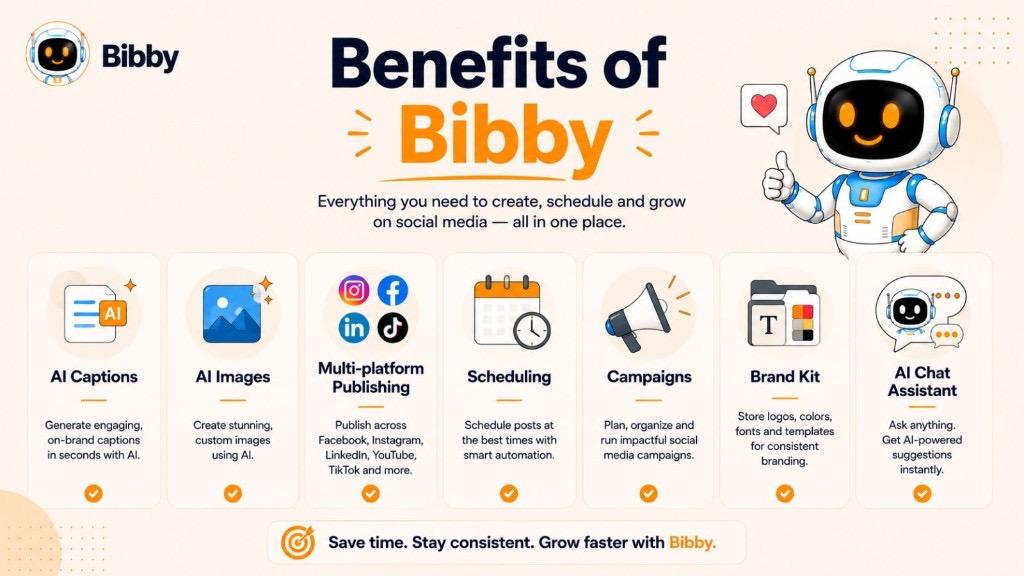
Once you've identified the ideal posting times, you can seamlessly put them into action with Bibby. Create or upload your content, generate AI-powered captions, choose your preferred posting style, and schedule posts across platforms like Facebook, Instagram, LinkedIn, TikTok, and YouTube—all from a single workspace.
Whether you're managing one brand or multiple social media accounts, combining personalized timing recommendations with automated scheduling makes it easier to publish consistently and maximize the impact of every post.
Try Bibby's Best Time to Post Tool → to discover your optimal posting schedule and start publishing with greater confidence.
Key Takeaways
- There is no universal best time to post—optimal timing depends on audience activity, platform, industry, time zones, and content format.
- Early engagement after publishing often influences how widely platforms distribute your content.
- Use industry charts as a starting point, then validate with your own analytics and ongoing tests.
- Best time (hour of day) and best day (day of week) work together; optimize both.
- AI tools and social media scheduling help you find peak windows and publish consistently without guessing.
Continue learning with related dictionary entries on engagement rate, reach, social media scheduling, content calendars, and social media strategy—then put timing into practice with the free Best Time to Post Tool or a free Bibby trial.