
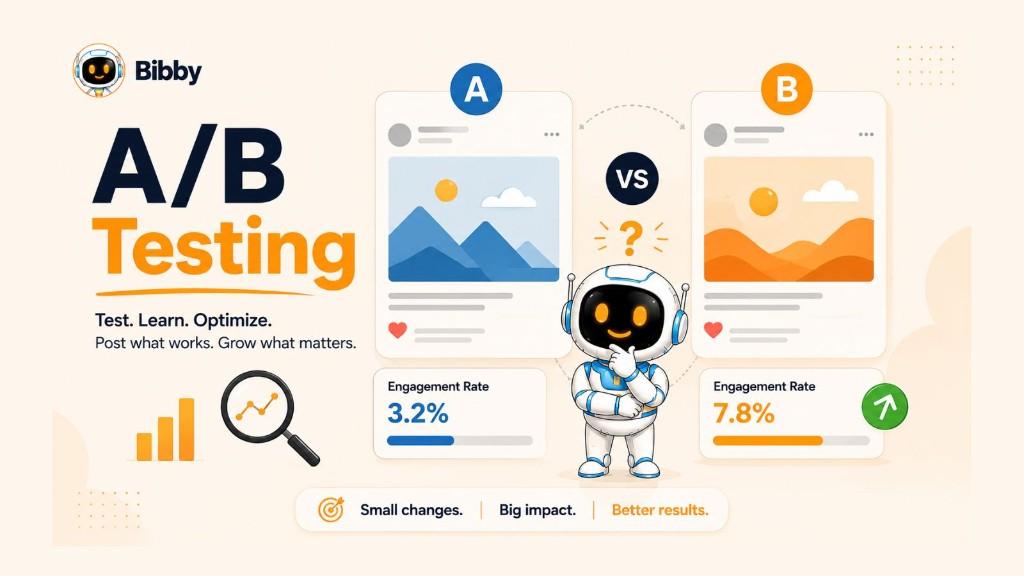
A/B testing, also known as split testing, is a method of comparing two versions of a webpage, advertisement, email, social media post, or other digital content to determine which one performs better. By showing Version A and Version B to similar audiences and measuring key metrics such as clicks, conversions, or engagement, businesses can identify the variation that delivers the best results.
Rather than relying on assumptions, A/B testing helps marketers, advertisers, and businesses make data-driven decisions that improve campaign performance, user experience, and return on investment (ROI). Whether you're optimizing a landing page, testing ad creatives, or experimenting with social media content, A/B testing is one of the most effective techniques for continuous performance improvement.
What is A/B Testing?
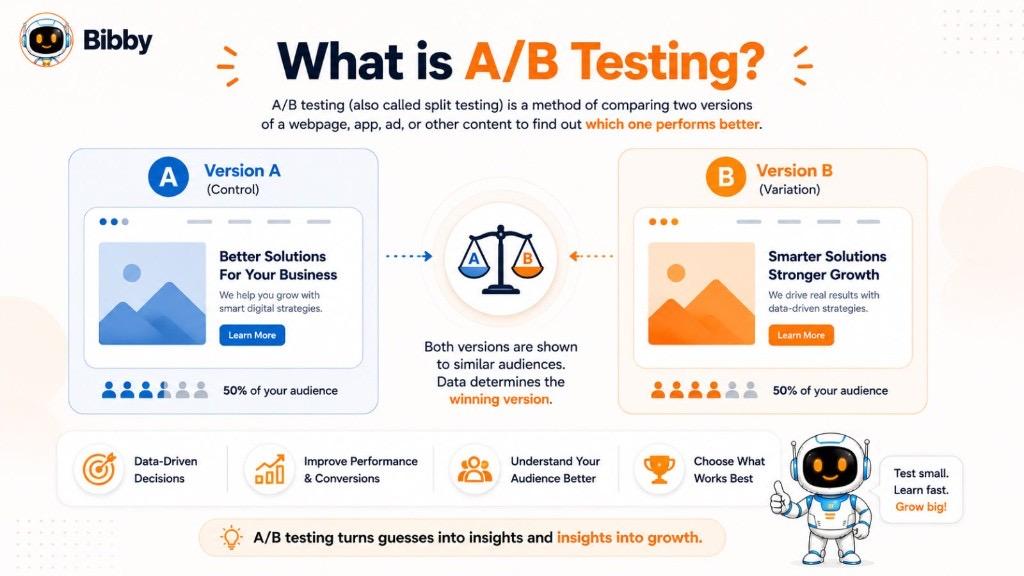
A/B testing is a testing method that compares two versions of the same digital asset to determine which one performs better based on predefined goals. The original version is typically called Version A (or the control), while the modified version is called Version B (or the variation). Both versions are shown to similar audience segments, and their performance is measured using metrics such as click-through rate (CTR), conversion rate, engagement, or revenue.
Also known as split testing, A/B testing enables marketers to make informed decisions using real user data instead of assumptions. By changing a single element—such as a headline, call-to-action (CTA), image, button color, or email subject line—you can identify which variation has the greatest impact on user behavior.
A/B testing is widely used in digital marketing, website optimization, email marketing, social media campaigns, paid advertising, and e-commerce. It helps businesses continuously improve user experience, increase conversions, and maximize the return on their marketing efforts.
Key Characteristics of A/B Testing
- Compares two versions of the same content or experience.
- Tests one variable at a time for reliable results.
- Splits the audience randomly between Version A and Version B.
- Measures performance using predefined metrics.
- Selects the winning variation based on data and statistical significance.
- Supports continuous optimization through ongoing experimentation.
How A/B Testing Works
A/B testing follows a structured process to compare two versions of the same content and determine which one performs better. By changing only one element at a time and measuring user behavior, you can identify the variation that delivers the best results.
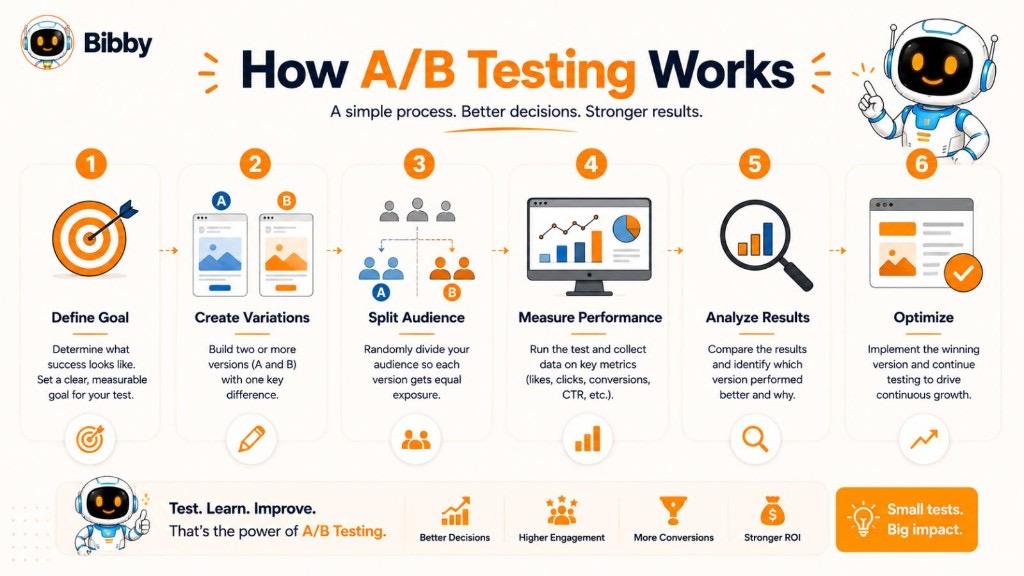
Step 1: Define Your Goal
Start by deciding what you want to improve. A clear objective helps you measure the success of your test accurately.
Common goals include:
- Increase click-through rate (CTR)
- Improve conversion rate
- Boost social media engagement
- Generate more sign-ups
- Increase sales or revenue
- Reduce bounce rate
Step 2: Create Two Variations
Develop two versions of the same content:
- Version A (Control): The original version.
- Version B (Variation): The version with one intentional change.
To produce reliable results, modify only one element at a time. For example, you might test a different headline, button text, image, CTA, or email subject line while keeping everything else unchanged.
Step 3: Split Your Audience
Randomly divide your audience into two similar groups.
- One group sees Version A.
- The other group sees Version B.
Random audience allocation helps ensure that differences in performance are caused by the tested variation rather than external factors.
Step 4: Measure Performance
Track the metrics that align with your testing goal.
Common performance metrics include:
- Click-through rate (CTR)
- Conversion rate
- Engagement rate
- Bounce rate
- Time on page
- Revenue
- Cost per acquisition (CPA)
Collect enough data before drawing conclusions to avoid making decisions based on short-term fluctuations. Bibby Growth Insights can help you compare performance across your social channels in one place.
Step 5: Analyze the Results
Compare the performance of both versions to determine whether one significantly outperformed the other. Consider factors such as sample size and statistical significance to ensure the results are reliable.
If Version B performs better, it can replace the original version. If not, keep Version A and use the insights to design your next experiment.
Step 6: Repeat and Optimize
A/B testing is an ongoing process rather than a one-time activity. Continue testing new ideas, analyzing results, and refining your content or campaigns over time. Continuous experimentation helps improve user experience, increase conversions, and maximize marketing performance.
A/B Testing Example
The easiest way to understand A/B testing is through a practical example. Imagine you want to increase the number of users who sign up for your product from a landing page. Instead of redesigning the entire page, you test one specific element—the call-to-action (CTA) button text.
Scenario
Your goal is to increase free trial sign-ups for a social media automation tool.
| Version | CTA Button Text | Visitors | Sign-ups | Conversion Rate |
|---|---|---|---|---|
| Version A (Control) | Start Your Free Trial | 5,000 | 350 | 7.0% |
| Version B (Variation) | Try Bibby Free for 14 Days | 5,000 | 475 | 9.5% |
In this example, Version B generated a higher conversion rate than Version A. Assuming the results are statistically significant, the new CTA can be implemented as the default because it encourages more visitors to sign up.
Another Social Media Example
Suppose you're promoting the same blog post on social media and want to improve engagement.
- Version A: Uses a text-only caption.
- Version B: Uses the same caption with a relevant image.
After showing both versions to similar audience groups, you compare metrics such as:
- Likes
- Comments
- Shares
- Click-through rate (CTR)
- Link clicks
If the version with the image consistently receives higher engagement and more clicks, it becomes the better-performing variation. Tools like the caption generator and post idea generator can help you produce caption and creative variations faster.
Key Takeaway
A successful A/B test changes only one variable at a time, making it easier to identify what influenced user behavior. Whether you're testing website elements, advertisements, email campaigns, or social media posts, A/B testing helps you make decisions based on real performance data rather than assumptions.
Where Is A/B Testing Used?
A/B testing is used across digital marketing and product development to improve performance through data-driven experimentation. By testing different versions of content, designs, or user experiences, businesses can identify what resonates most with their audience and make informed optimization decisions.
Website Optimization
Website owners use A/B testing to improve user experience and increase conversions. Common elements tested include:
- Headlines and subheadings
- Call-to-action (CTA) buttons
- Landing page layouts
- Images and videos
- Navigation menus
- Contact and sign-up forms
Landing Pages
Landing pages are designed to drive specific actions, making them ideal for A/B testing. Marketers often experiment with:
- Headlines
- Hero images
- CTA button text
- Form length
- Testimonials
- Pricing sections
Email Marketing
Email marketers use A/B testing to improve open rates, click-through rates, and conversions by testing:
- Subject lines
- Preview text
- Sender names
- Email copy
- CTA buttons
- Send times
Social Media Marketing
Social media managers can test different content variations to understand what drives the most engagement.
Common elements include:
- Post captions
- Images and graphics
- Video thumbnails
- Hashtags
- Posting times
- Call-to-action phrases
This helps brands publish content that consistently attracts more likes, comments, shares, and clicks across every channel you manage.
Paid Advertising
A/B testing plays a critical role in optimizing advertising campaigns across search engines and social media platforms.
Frequently tested elements include:
- Ad headlines
- Ad copy
- Images and videos
- Audience targeting
- CTA buttons
- Landing pages
Regular testing can improve click-through rates (CTR), lower cost per click (CPC) and cost per acquisition (CPA), and increase return on ad spend (ROAS).
E-commerce
Online stores use A/B testing to improve the shopping experience and increase sales by testing:
- Product page layouts
- Product images
- Pricing displays
- Discount offers
- Checkout flows
- Product recommendations
Even small changes can have a significant impact on conversion rates and average order value.
Mobile Apps
App developers use A/B testing to improve user engagement, retention, and in-app conversions by experimenting with:
- Onboarding screens
- App navigation
- Feature placement
- Push notification messages
- Subscription prompts
- In-app purchase flows
Why It Matters
Regardless of the platform, A/B testing helps businesses understand how users respond to different experiences. Instead of relying on assumptions, teams can make evidence-based decisions that improve engagement, conversions, and overall business performance.
What Can You Test in A/B Testing?
Almost any element that influences user behavior can be tested through A/B testing. The key is to test one variable at a time so you can accurately measure its impact on your desired outcome.
Below are some of the most common elements businesses test across different digital channels.
Website Elements
Testing website components can help improve user experience and increase conversions.
Common website elements include:
- Headlines and subheadings
- Call-to-action (CTA) buttons
- Button colors and sizes
- Images and banners
- Product descriptions
- Landing page layouts
- Navigation menus
- Contact and sign-up forms
- Pricing tables
- Trust badges and customer testimonials
Social Media Content
A/B testing helps identify which content formats and messaging generate the highest engagement.
You can test:
- Post captions
- Images and graphics
- Videos and reels
- Hashtags
- Posting times
- Call-to-action phrases
- Emojis
- Content formats (carousel, video, image, or text)
Pair creative tests with a hashtag generator when you want consistent, relevant tagging across variations.
Paid Advertising
Advertising platforms make it easy to compare different ad variations.
Popular elements to test include:
- Ad headlines
- Ad descriptions
- Images and videos
- Audience targeting
- CTA buttons
- Display URLs
- Ad placements
- Landing pages
Email Marketing
Email campaigns often benefit from continuous testing to improve engagement and conversions.
Common email variables include:
- Subject lines
- Preview text
- Sender name
- Email layout
- CTA buttons
- Images
- Personalization
- Send date and time
E-commerce Stores
Online retailers use A/B testing to optimize the customer journey and increase sales.
Examples include:
- Product images
- Product titles
- Pricing strategies
- Discount offers
- Product page layouts
- Checkout process
- Shipping information
- Product recommendations
Mobile Apps
Mobile app developers test features to improve user retention and in-app conversions.
Common elements include:
- Onboarding screens
- Navigation menus
- Feature placement
- Push notification messages
- Subscription prompts
- In-app purchase flows
- App icons
- User interface (UI) elements
Best Practice: Test One Change at a Time
For accurate and reliable results, change only one element in each A/B test. Testing multiple variables simultaneously makes it difficult to determine which change influenced user behavior. If you need to evaluate several elements at once, consider using multivariate testing instead.
By continuously testing and refining different elements, businesses can improve user experience, increase engagement, and achieve better marketing and conversion results over time.
Benefits of A/B Testing
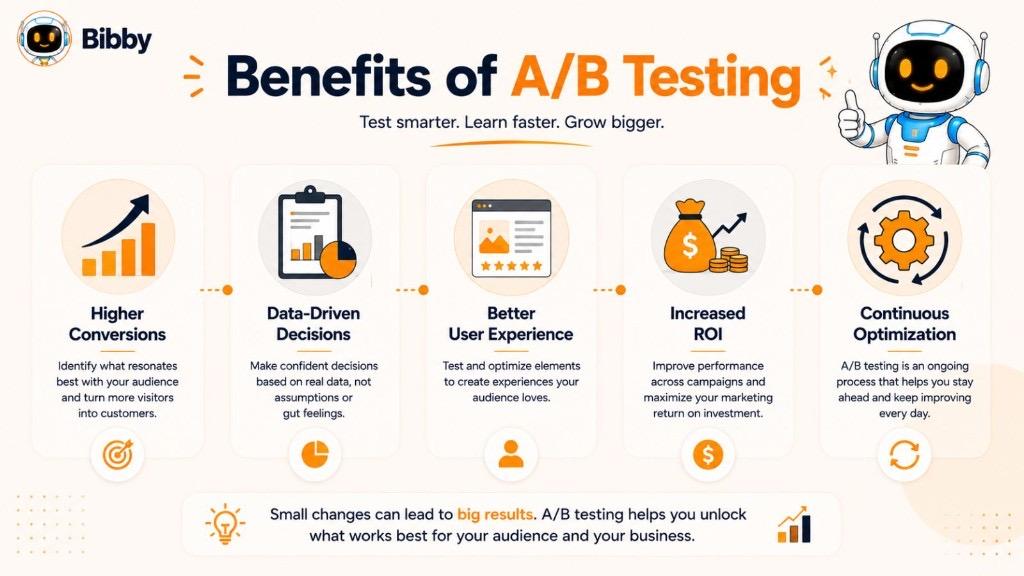
A/B testing helps businesses make smarter decisions by replacing assumptions with measurable data. Whether you're optimizing a website, email campaign, advertisement, or social media post, A/B testing provides valuable insights into what works best for your audience.
Improves Conversion Rates
One of the biggest advantages of A/B testing is its ability to increase conversion rates. By testing different versions of headlines, call-to-action (CTA) buttons, forms, or landing pages, you can identify the variation that encourages more users to take the desired action.
Enables Data-Driven Decisions
Rather than relying on opinions or guesswork, A/B testing uses real user behavior to evaluate performance. This allows marketers and businesses to make informed decisions based on measurable results.
Enhances User Experience
Testing different layouts, navigation options, and content helps create a smoother and more intuitive experience for users. A better user experience often leads to higher engagement, increased customer satisfaction, and improved retention.
Maximizes Marketing ROI
By identifying the highest-performing campaigns, businesses can allocate their marketing budget more effectively. Optimizing advertisements, email campaigns, and landing pages helps improve return on investment (ROI) while reducing wasted spending.
Increases Engagement
A/B testing helps determine which content resonates most with your audience. Whether you're experimenting with social media captions, email subject lines, or website content, you can improve metrics such as:
- Click-through rate (CTR)
- Likes and shares
- Comments
- Time on page
- Email open rates
Reduces Risk
Implementing major changes without testing can negatively affect performance. A/B testing minimizes this risk by validating ideas on a smaller audience before rolling them out to everyone.
Supports Continuous Optimization
Customer preferences and market trends change over time. Regular A/B testing allows businesses to continuously refine their websites, campaigns, and digital experiences to maintain strong performance.
Delivers Actionable Insights
Every A/B test provides valuable information about user behavior. Even when a variation doesn't outperform the original, the results help businesses better understand their audience and make more effective decisions in future experiments.
Key Benefits at a Glance
- Improves conversion rates
- Enables data-driven decision-making
- Enhances user experience (UX)
- Increases customer engagement
- Maximizes return on investment (ROI)
- Reduces marketing risks
- Optimizes campaigns continuously
- Helps businesses better understand user behavior
Limitations of A/B Testing
While A/B testing is a valuable optimization technique, it isn't a perfect solution for every situation. Understanding its limitations helps you design better experiments, interpret results accurately, and avoid common mistakes.
Requires Sufficient Traffic
A/B testing depends on collecting enough data to produce reliable results. Websites or campaigns with low traffic may take weeks or even months to reach a meaningful sample size, making it difficult to draw accurate conclusions.
Tests Only One Variable at a Time
Traditional A/B testing is most effective when only one element changes between Version A and Version B. If you want to evaluate multiple changes simultaneously, multivariate testing may be a more suitable approach.
Results Take Time
Ending a test too early can produce misleading outcomes. To ensure reliable results, A/B tests should run long enough to gather sufficient data and account for normal variations in user behavior.
External Factors Can Influence Results
Performance may be affected by factors outside the test itself, such as:
- Seasonal trends
- Holidays
- Marketing campaigns
- News or current events
- Changes in user behavior
- Traffic source differences
These variables can impact results and should be considered during analysis.
Statistical Significance Matters
A higher conversion rate doesn't always mean one version is genuinely better. Without statistical significance, performance differences may simply be due to chance. Using an adequate sample size and proper statistical analysis helps ensure trustworthy conclusions.
Limited to Measurable Metrics
A/B testing works best when success can be measured using clear metrics, such as conversions, clicks, or engagement. It is less effective for evaluating qualitative factors like brand perception, customer emotions, or long-term loyalty without additional research methods.
Continuous Testing Is Required
User preferences, technology, and market trends evolve over time. A winning variation today may not perform as well in the future, so businesses should view A/B testing as an ongoing optimization process rather than a one-time task.
Common Challenges
Businesses often face these challenges when running A/B tests:
- Insufficient website or campaign traffic
- Small sample sizes
- Testing too many changes at once
- Stopping tests before completion
- Misinterpreting data
- Ignoring external influences
- Failing to document test results
How to Overcome These Limitations
You can improve the reliability of your A/B tests by following these best practices:
- Define a clear testing objective.
- Test only one variable at a time.
- Allow tests to run until an adequate sample size is reached.
- Measure the metrics that align with your goals.
- Verify statistical significance before implementing changes.
- Repeat testing regularly as user behavior evolves.
Recognizing these limitations helps you design more effective experiments and make better data-driven decisions, ultimately improving the performance of your marketing campaigns, website, or application.
A/B Testing vs. Multivariate Testing
A/B testing and multivariate testing are both experimentation methods used to optimize websites, marketing campaigns, and digital experiences. While they share the same goal of improving performance through data-driven decisions, they differ in how many variables they test and the amount of traffic they require.
A/B testing compares two versions of a page or campaign by changing a single element, making it easier to identify what influenced the results. Multivariate testing, on the other hand, tests multiple elements and their combinations at the same time to determine which combination performs best.
Comparison Table
| Feature | A/B Testing | Multivariate Testing |
|---|---|---|
| Purpose | Compare two versions of the same content | Test multiple elements and combinations simultaneously |
| Variables Tested | One variable | Two or more variables |
| Number of Variations | Usually 2 | Multiple combinations |
| Traffic Requirement | Low to moderate | High |
| Complexity | Simple to set up and analyze | More complex to design and interpret |
| Time Required | Generally shorter | Usually longer |
| Best For | Landing pages, emails, ads, social media posts | Complex webpages with multiple design elements |
| Result | Identifies the better-performing variation | Identifies the best-performing combination of changes |
When to Use A/B Testing
Choose A/B testing when you:
- Want to test a single change.
- Have limited website traffic.
- Need quick and easy-to-understand results.
- Are optimizing headlines, CTA buttons, images, or email subject lines.
- Want to validate one hypothesis at a time.
When to Use Multivariate Testing
Choose multivariate testing when you:
- Want to test several page elements simultaneously.
- Have a high-traffic website or application.
- Need to understand how multiple changes interact with each other.
- Are optimizing complex landing pages or product pages.
- Have the resources to analyze more detailed results.
Which Method Is Better?
Neither method is universally better—the right choice depends on your goals.
If you're testing a single element and want clear, actionable insights, A/B testing is usually the best option. It's easier to implement, requires less traffic, and provides straightforward results.
If you want to optimize multiple elements at once and have enough traffic to support the experiment, multivariate testing can provide deeper insights into how different combinations influence user behavior.
For most businesses, especially small and medium-sized organizations, A/B testing is the recommended starting point because it is simpler, faster, and more practical for ongoing optimization.
A/B Testing Best Practices
Running an A/B test is straightforward, but obtaining reliable results requires careful planning and execution. Following proven best practices helps ensure your experiments produce accurate insights that can be confidently used to optimize websites, advertisements, email campaigns, and social media content.
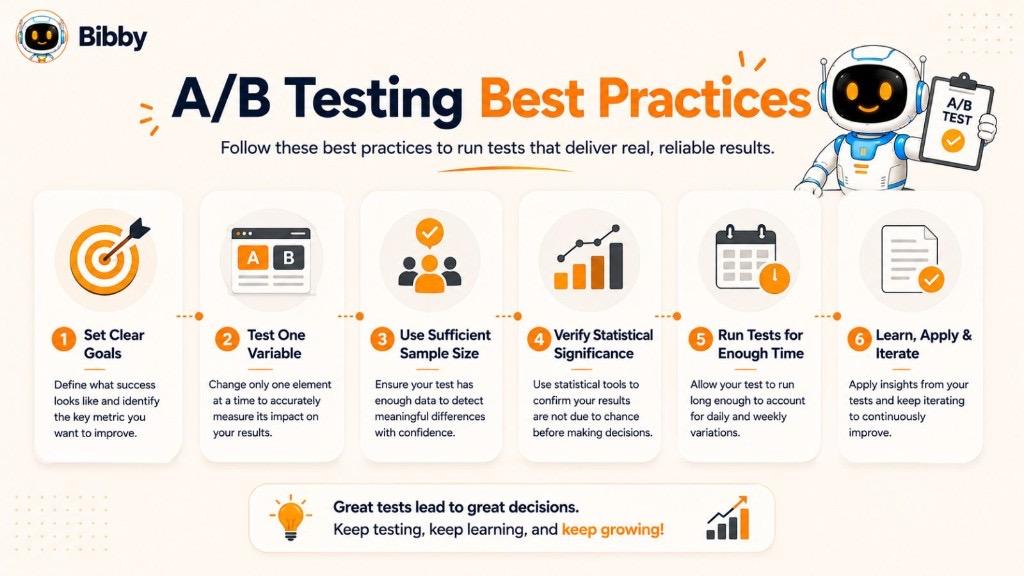
1. Set a Clear Goal
Before creating a test, define what you want to achieve. Your objective should be specific and measurable.
Examples include:
- Increase click-through rate (CTR)
- Improve conversion rate
- Generate more leads
- Boost email open rates
- Increase social media engagement
- Reduce bounce rate
A clearly defined goal helps you choose the right success metrics and evaluate the outcome objectively.
2. Test One Variable at a Time
For accurate results, change only one element between Version A and Version B.
Examples of variables include:
- Headline
- CTA button text
- Hero image
- Product description
- Email subject line
- Ad creative
Testing multiple changes in the same experiment makes it difficult to determine which change influenced the results.
3. Use a Large Enough Sample Size
Reliable conclusions require sufficient data. Running tests with too few visitors or participants increases the likelihood of misleading results.
Whenever possible, allow enough users to participate before evaluating performance.
4. Randomly Split Your Audience
Your audience should be divided randomly so that each variation is shown to comparable groups of users.
Random allocation reduces bias and ensures that performance differences are caused by the tested variation rather than audience characteristics.
5. Run the Test Long Enough
Avoid stopping an experiment as soon as one version appears to perform better.
Allow the test to run through normal traffic cycles so the results reflect consistent user behavior rather than temporary fluctuations.
6. Measure the Right Metrics
Track metrics that directly align with your testing objective.
Common performance indicators include:
- Conversion rate
- Click-through rate (CTR)
- Engagement rate
- Revenue
- Bounce rate
- Average order value
- Cost per acquisition (CPA)
Avoid focusing on vanity metrics that don't contribute to your business goals.
7. Verify Statistical Significance
Before declaring a winner, confirm that the observed difference is statistically significant.
This helps ensure the improvement is unlikely to be due to random chance and increases confidence in your decision.
8. Document Every Test
Keep a record of each experiment, including:
- Objective
- Hypothesis
- Tested variable
- Duration
- Sample size
- Results
- Key insights
Documenting experiments prevents repeated tests and helps teams build a valuable knowledge base over time.
9. Continue Testing
Optimization is an ongoing process. Consumer preferences, market trends, and user behavior change over time, so successful businesses regularly test new ideas instead of relying on past results.
Even small improvements can lead to significant gains when accumulated over multiple experiments.
Quick Checklist
Before launching an A/B test, make sure you:
- Define a clear objective.
- Test only one variable.
- Use a sufficient sample size.
- Split your audience randomly.
- Track relevant performance metrics.
- Wait for statistically significant results.
- Document your findings.
- Apply insights and keep testing.
Following these best practices helps you conduct reliable A/B tests, make data-driven decisions, and continuously improve the performance of your marketing campaigns, website, or application.
Common A/B Testing Mistakes
Even well-designed A/B tests can produce misleading results if they are not planned or executed correctly. Avoiding these common mistakes will help you collect accurate data and make better optimization decisions.
Testing Too Many Variables at Once
One of the most common mistakes is changing multiple elements in the same A/B test. For example, modifying the headline, image, and CTA button simultaneously makes it impossible to determine which change influenced the results.
Best practice: Test only one variable per experiment. If you need to evaluate multiple changes together, use multivariate testing.
Using a Small Sample Size
Drawing conclusions from a small number of visitors or users can lead to unreliable results. Random fluctuations may make one variation appear better when there's no meaningful difference.
Best practice: Wait until you have enough participants to achieve statistically significant results.
Ending the Test Too Early
It's tempting to stop a test as soon as one version starts outperforming the other. However, early results often change as more data is collected.
Best practice: Run the test for an appropriate duration and through normal traffic cycles before selecting a winner.
Not Defining a Clear Goal
Running an A/B test without a specific objective makes it difficult to measure success.
For example, are you trying to:
- Increase conversions?
- Improve click-through rates?
- Generate more sign-ups?
- Boost engagement?
Best practice: Define a single, measurable goal before launching the experiment.
Ignoring Statistical Significance
A higher conversion rate doesn't automatically mean a variation is better. Without statistical significance, the observed difference may simply be due to chance.
Best practice: Verify that your results are statistically significant before making permanent changes.
Testing During Unusual Conditions
External events can affect user behavior and distort test results.
Examples include:
- Major holidays
- Seasonal sales
- Product launches
- Viral campaigns
- Website outages
Best practice: Whenever possible, run tests during normal business periods or account for unusual events when interpreting results.
Failing to Segment the Audience
Different audience groups may behave differently. Combining all users into a single analysis can hide valuable insights.
For example, desktop and mobile users may respond differently to the same page design.
Best practice: Analyze results by relevant audience segments when appropriate.
Ignoring Previous Test Results
Many businesses repeat experiments because they don't maintain a record of past tests.
Best practice: Document each experiment, including the hypothesis, variables, duration, results, and conclusions, to build a knowledge base for future optimization.
Assuming One Winning Test Solves Everything
A successful A/B test doesn't mean optimization is complete. Customer preferences, competitors, and market trends evolve continuously.
Best practice: Treat A/B testing as an ongoing process of experimentation and improvement.
Mistakes to Avoid at a Glance
Before launching your next A/B test, avoid these common pitfalls:
- Testing multiple variables in one experiment
- Using an insufficient sample size
- Stopping the test too early
- Failing to define a clear objective
- Ignoring statistical significance
- Testing during unusual traffic periods
- Overlooking audience segmentation
- Not documenting previous experiments
- Assuming optimization is complete after one successful test
Avoiding these mistakes will help you generate more reliable insights, improve decision-making, and maximize the value of every A/B testing experiment.
Popular A/B Testing Tools
A/B testing tools help businesses create experiments, split traffic between different variations, track user behavior, and analyze results. The right tool depends on your goals, budget, and the platforms you want to optimize.
Below are some of the most widely used A/B testing tools.
Optimizely
Optimizely is a leading experimentation platform that enables businesses to run A/B tests, multivariate tests, and personalization campaigns across websites and digital products. It offers advanced targeting, analytics, and feature experimentation for organizations of all sizes.
Best for: Enterprise websites and product experimentation.
VWO (Visual Website Optimizer)
VWO is an all-in-one optimization platform that includes A/B testing, heatmaps, session recordings, surveys, and behavioral analytics. Its visual editor makes it easy to create experiments without extensive coding knowledge.
Best for: Website optimization and conversion rate optimization (CRO).
Adobe Target
Adobe Target is part of the Adobe Experience Cloud and provides powerful testing and personalization capabilities. It uses AI-powered recommendations to deliver tailored customer experiences across websites and mobile apps.
Best for: Large enterprises already using Adobe products.
Convert
Convert focuses on privacy-friendly A/B testing and personalization. It offers advanced targeting, integrations, and experimentation features while supporting compliance with data privacy regulations.
Best for: Businesses that prioritize data privacy and experimentation.
Unbounce
Unbounce is primarily a landing page builder but also includes built-in A/B testing features. Marketers can easily create multiple landing page variations and compare their performance to improve conversion rates.
Best for: Landing page optimization and lead generation.
HubSpot
HubSpot includes A/B testing capabilities for marketing emails, landing pages, and website content. It integrates seamlessly with HubSpot's CRM, making it a convenient choice for businesses already using its marketing platform.
Best for: Inbound marketing and email optimization.
Bibby
Bibby helps marketers optimize their social media strategy by automating content publishing, scheduling posts, and analyzing performance across multiple social platforms. While it isn't a dedicated website experimentation platform, marketers can use Bibby to test different content variations, posting schedules, captions, creatives, and calls to action to identify which approach generates the highest engagement and reach. Start with a free trial or explore Growth Insights to compare what performs best.
Best for: Social media content optimization and performance analysis.
How to Choose the Right A/B Testing Tool
When selecting an A/B testing solution, consider the following factors:
- Ease of use
- Website or platform compatibility
- Analytics and reporting capabilities
- Audience targeting options
- Personalization features
- Integration with existing marketing tools
- Pricing and scalability
- Customer support and documentation
The best tool is the one that aligns with your business goals, technical requirements, and available resources. Start with the features you need today and choose a platform that can scale as your experimentation program grows. Compare Bibby pricing if social content testing and automation are your priority.
Key Metrics to Track in A/B Testing
Measuring the right metrics is essential for determining whether an A/B test is successful. The metrics you track should align with your testing goal, whether it's increasing conversions, improving engagement, or generating more revenue.
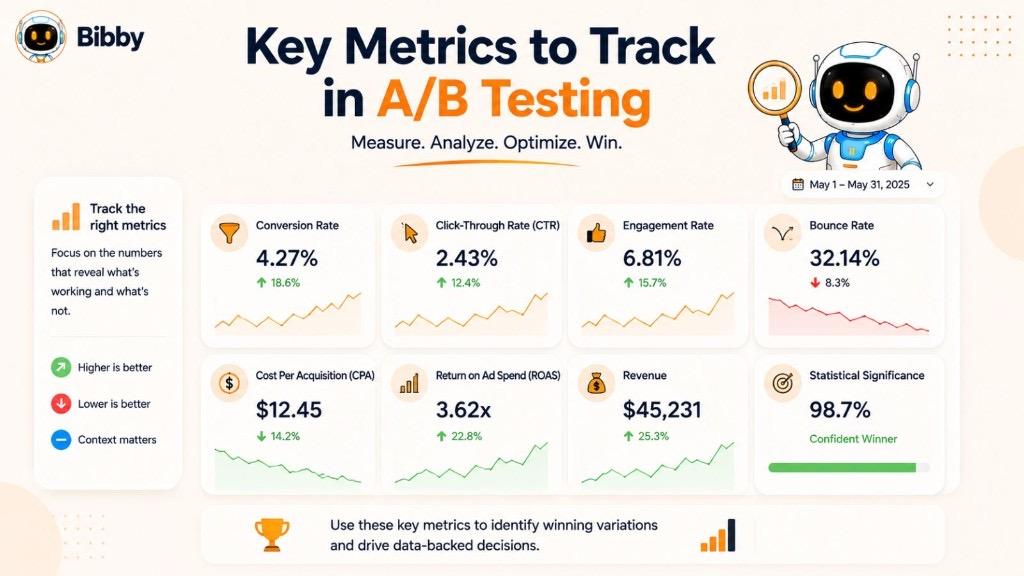
Below are some of the most important metrics used to evaluate A/B testing results.
Conversion Rate
Conversion rate measures the percentage of users who complete a desired action, such as making a purchase, signing up for a newsletter, or downloading an app. See also our glossary entry on conversion rate.
Formula:
Conversion Rate = (Conversions ÷ Total Visitors) × 100
This is one of the most commonly tracked metrics because it directly reflects how effectively a page or campaign achieves its objective.
Click-Through Rate (CTR)
Click-through rate (CTR) measures the percentage of users who click on a link, button, or advertisement after seeing it. Learn more in our CTR dictionary entry.
Formula:
CTR = (Clicks ÷ Impressions) × 100
CTR is especially useful when testing:
- Call-to-action (CTA) buttons
- Email subject lines
- Display advertisements
- Search ads
- Social media posts
Engagement Rate
Engagement rate indicates how users interact with your content.
Depending on the platform, engagement may include:
- Likes
- Comments
- Shares
- Saves
- Video views
- Link clicks
This metric is particularly important for social media campaigns and content marketing.
Bounce Rate
Bounce rate represents the percentage of visitors who leave a webpage without interacting further.
A lower bounce rate often indicates that users find the content relevant and engaging.
This metric is commonly used when testing:
- Landing pages
- Homepage layouts
- Blog pages
- Product pages
Average Time on Page
Average time on page measures how long visitors spend viewing a webpage before navigating elsewhere.
Longer session durations can indicate that users find the content valuable, although this metric should always be evaluated alongside other performance indicators.
Revenue
For e-commerce businesses, revenue is one of the most meaningful success metrics.
Instead of focusing solely on clicks or conversions, many businesses compare how much revenue each variation generates to determine the most profitable option.
Average Order Value (AOV)
Average Order Value measures how much customers spend per purchase.
Formula:
AOV = Total Revenue ÷ Number of Orders
Businesses often test product recommendations, pricing strategies, and promotional offers to increase this metric.
Cost Per Acquisition (CPA)
CPA measures the average cost of acquiring a customer or lead. Related paid metrics include cost per click (CPC).
Formula:
CPA = Total Advertising Cost ÷ Number of Conversions
Reducing CPA while maintaining or increasing conversions is a common objective in paid advertising campaigns.
Return on Ad Spend (ROAS)
ROAS evaluates how much revenue is generated for every dollar spent on advertising. Pair it with overall ROI when judging campaign efficiency.
Formula:
ROAS = Revenue from Ads ÷ Advertising Cost
This metric helps advertisers identify which ad variations deliver the highest return on investment.
Choosing the Right Metrics
Not every metric is relevant for every A/B test. Select the metrics that best support your objective.
| Testing Goal | Primary Metric |
|---|---|
| Increase sign-ups | Conversion Rate |
| Improve ad performance | Click-Through Rate (CTR) |
| Boost social media engagement | Engagement Rate |
| Reduce page abandonment | Bounce Rate |
| Increase online sales | Revenue |
| Increase purchase value | Average Order Value (AOV) |
| Lower advertising costs | Cost Per Acquisition (CPA) |
| Improve advertising profitability | Return on Ad Spend (ROAS) |
Tracking the right metrics ensures your A/B tests produce meaningful insights that support better decision-making. Rather than focusing on a single number, evaluate multiple performance indicators to understand the overall impact of each variation.