
It goes beyond counting mentions or tracking likes. Listening helps businesses understand the context, sentiment, recurring opinions, customer concerns, and emerging trends behind online conversations.
For example, a customer might post about a frustrating experience without tagging the brand. A listening approach can help identify that conversation, uncover similar feedback, and reveal whether the issue is isolated or part of a larger pattern. The same process can uncover praise, competitor weaknesses, and topics audiences care about.
This makes listening valuable across marketing, customer service, product development, public relations, and competitive research. When insights connect to publishing, you can move from observing conversations to creating timely content. Bibby can help you caption and schedule that content on supported channels—it does not collect mentions or replace a listening tool.
What Is Social Listening?
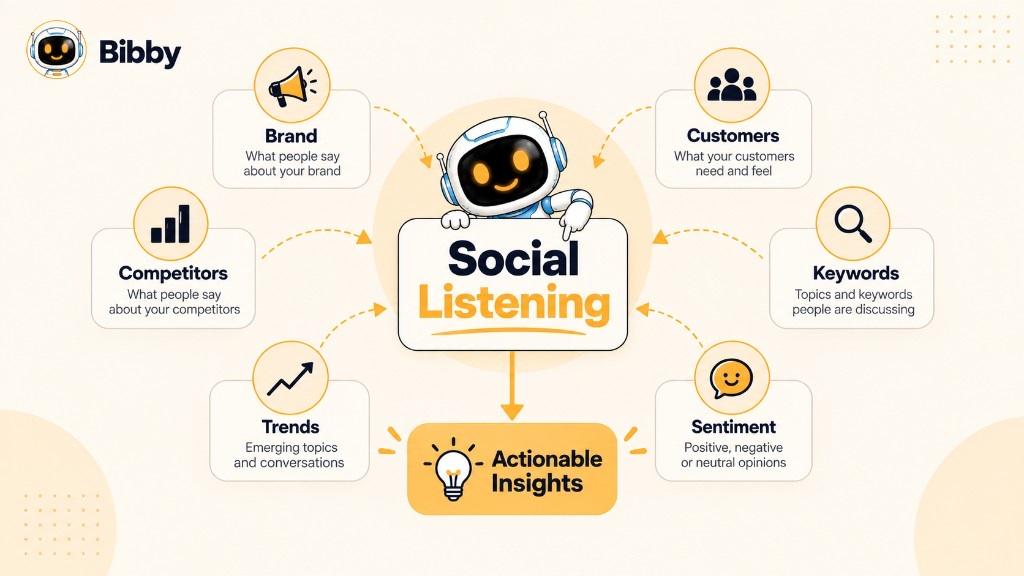
Social listening is the practice of finding, tracking, and analyzing conversations happening across social media to understand audience opinions and identify actionable insights. Businesses typically monitor mentions of their brand, products, services, competitors, industry terms, campaigns, hashtags, and other relevant keywords.
The real value comes from understanding the meaning and context behind those conversations, not from collecting mentions alone.
Imagine several customers discussing a product. Some praise its features; others complain about price or request a missing capability. Listening helps you see those recurring patterns instead of treating each post as an isolated interaction.
What Does Social Listening Involve?
A typical process can include:
- Monitoring brand mentions: Finding conversations where people discuss a company or brand.
- Tracking products and services: Understanding what customers think about specific offerings.
- Analyzing customer sentiment: Identifying whether conversations are generally positive, negative, or neutral.
- Watching competitors: Understanding how audiences talk about competing brands.
- Identifying trends: Finding topics, hashtags, or conversations that are gaining attention.
- Discovering customer pain points: Detecting recurring complaints, questions, and frustrations.
- Finding content opportunities: Identifying subjects audiences are already discussing.
- Turning insights into action: Using the information to improve marketing, customer experience, products, or strategy.
The process can range from manually reviewing conversations to using specialized software. Bibby is on the action side: AI-assisted content, captions, campaigns, and publishing—not mention collection.
Why Is It Called “Social Listening”?
The word “listening” is important. A business is not merely watching how many times its name appears online. It is attempting to understand the conversations taking place around it.
Monitoring asks: *“What are people saying about us?”*
Listening asks: *“Why are they saying it, what pattern can we find, and what should we do about it?”*
That distinction turns raw social conversations into potentially useful business intelligence.
Social Listening in Simple Terms
In simple terms, social listening means paying attention to online conversations, understanding what they reveal about your audience and market, and using those insights to make informed decisions.
It can help a business move from reacting to individual posts to recognizing the larger patterns hiding inside thousands of conversations.
Social Listening Meaning
The meaning of social listening is the practice of paying attention to conversations across social media and other online channels to understand what people think, feel, and say about a brand, product, competitor, industry, or topic. It combines monitoring, analysis, and action rather than simply collecting mentions.
In social media marketing, listening means looking beyond visible engagement such as likes, comments, and shares. A business may also want to know why customers are talking about a product, what problems they repeatedly mention, which topics are becoming popular, and how public perception is changing.
If customers repeatedly discuss delivery problems, listening can reveal that delivery is not just one complaint but a recurring experience issue.
What Does “Listening” Mean Here?
Here, listening does not literally mean listening to audio. It refers to systematically observing and interpreting digital conversations: brand and product mentions, opinions, sentiment, competitor talk, industry discussions, trending topics and hashtags, questions, campaign reactions, common themes, and changes in conversation volume.
The goal is to transform these conversations into actionable insights.
Social Listening Meaning in Marketing
For marketers, listening provides a way to understand audiences beyond surveys or forms. People discuss experiences, preferences, and frustrations naturally on Instagram, TikTok, Facebook, LinkedIn, and YouTube.
Those conversations can reveal opportunities for more relevant content, better campaigns, faster responses, trend discovery, and stronger brand positioning.
That is why listening belongs in a broader social media marketing strategy—and why the Bibby blog often treats audience insight as an input to publishing, not a substitute for it.
Social Listening vs. Simply Checking Social Media
Opening an account and reading recent comments is not necessarily social listening.
The difference is purpose and analysis. Ten comments on one post tell you what those ten people said. A listening process can examine conversations across keywords and identify broader patterns, such as a growing concern or a sudden spike around a topic.
In short, social listening means listening to the market through its online conversations, interpreting what those conversations reveal, and using the insights to guide action.
How Does Social Listening Work?
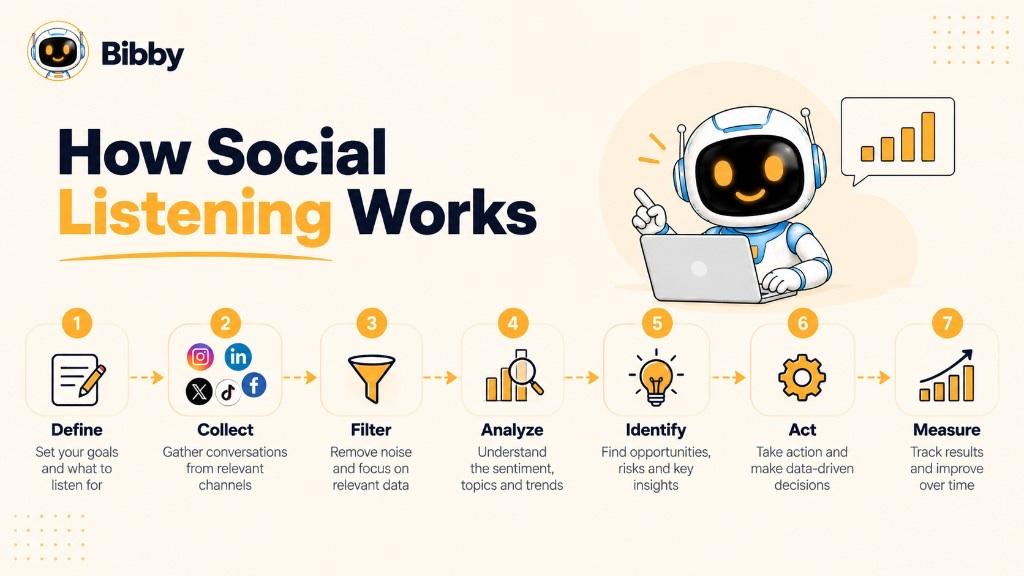
Social listening typically follows a cycle of collecting conversations, analyzing them for patterns, and turning those insights into action.
Define → Collect → Filter → Analyze → Identify → Act → Measure
1. Define What You Want to Monitor
Decide what you want to learn: brand perception, reaction to a new product, competitor talk, recurring complaints, industry topics, campaign response, or repeated customer questions.
Then create a list of relevant keywords, phrases, hashtags, product names, brand names, and competitor names.
A SaaS company might track its brand, product, competitors, and phrases such as “social media scheduling” or “social media automation.”
2. Collect Relevant Conversations
Collect public conversations from supported social channels and other sources your listening tool can access: mentions, product discussions, keyword posts, hashtags, comments, competitor mentions, industry talk, and campaign discussions.
Not every relevant conversation will tag the brand. Someone might discuss a product without using the official handle. Listening can uncover those broader conversations when the relevant data is available—and only within each platform’s terms and privacy rules.
3. Filter Out Irrelevant Conversations
Keyword monitoring can produce noise. Filter spam, duplicates, unrelated keyword uses, and low-value results so the team spends time on conversations that can actually provide insight.
4. Analyze the Conversations
Examine:
- Sentiment: Positive, negative, or neutral?
- Topics: What subjects appear most often?
- Conversation volume: Is discussion rising or falling?
- Engagement: Which conversations attract reactions?
- Common themes: The same problem, feature, benefit, or concern?
- Audience opinions: What do people appear to like or dislike?
Modern listening platforms may use AI and NLP to categorize large volumes. That analysis happens in those tools—not in Bibby.
5. Identify Patterns and Insights
Raw data becomes useful when you recognize a meaningful pattern.
Mentions up 40% is not an insight by itself. “The new feature is generating interest, but users need clearer guidance” is.
6. Take Action
The purpose is not another unused dashboard.
Depending on the insight, a company might respond to concerns, create educational content, adjust a campaign, improve a product, address reputation risk, change messaging, or research a competitor.
For social teams, that often means turning audience interests into posts, videos, carousels, or campaigns. You can draft those assets with AI content generation, try a post idea, write a caption, or schedule in Bibby on your channels.
7. Measure What Changed
If you change communication or product experience, keep monitoring conversations to see whether the issue declines.
Listen → Understand → Act → Measure → Listen again
Audience conversations change constantly, so listening works as an ongoing source of market intelligence.
Social Listening Examples
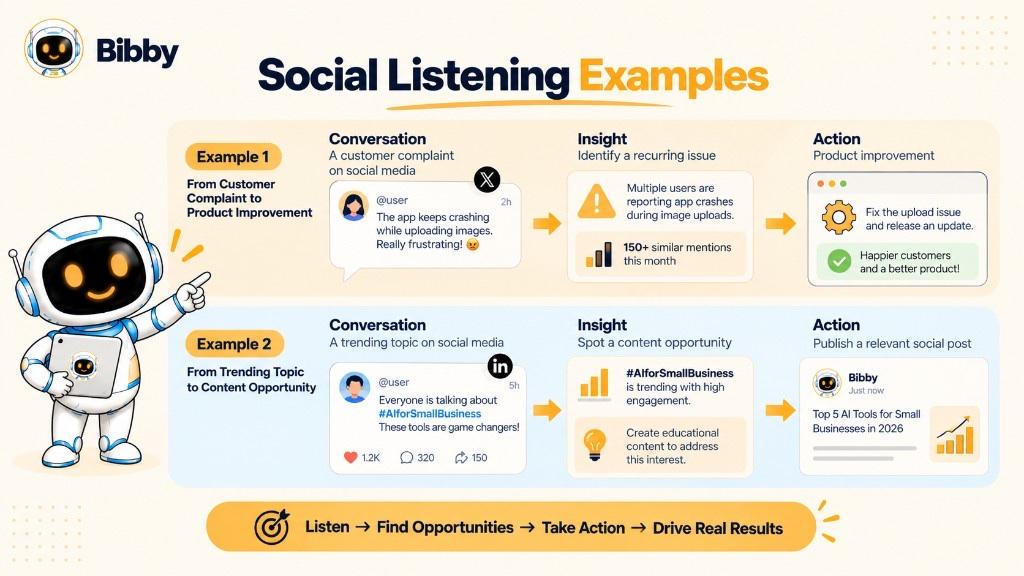
The following examples show how monitoring mentions, opinions, trends, and recurring topics can produce insights beyond basic engagement.
1. Brand Reputation
A customer posts about a poor service experience without tagging the brand. Similar stories follow. Listening can show the issue is not isolated.
Possible action: Investigate, respond to affected customers, and communicate a resolution. Community management handles the replies; listening shows the pattern.
2. Product Feedback
Several independent conversations mention the same missing feature. Product can treat that as a recurring need, not unrelated comments.
3. Competitor Analysis
Customers praise a competitor for ease of use but mention weak reporting. That is more useful than knowing the competitor has a large audience. You can examine your own positioning without copying them.
4. Marketing Campaign
A launch generates unexpected reactions. Listening can reveal which messages people discuss, whether the tone is positive or negative, and which segments engage. Adapt upcoming content around what resonates.
5. Customer Service
Many people discuss a policy change publicly instead of opening a ticket. Listening surfaces the repeated questions so you can publish a clearer explanation—perhaps a carousel or short video scheduled from Bibby.
6. Crisis Detection
Negative mentions spike within hours. That can signal a product problem, service disruption, or misunderstanding. Early detection gives more time to verify facts before you respond. Do not treat every spike as a crisis.
7. Trend Discovery
A topic related to your industry was not on the content calendar, but volume keeps growing. Research it and create useful content while the conversation is still gaining momentum. Check trending relevance first.
8. Customer Praise
Repeated praise for a feature, service, or outcome can become social proof, testimonials (with permission), or campaign messaging.
9. Content Opportunity
The same question appears across platforms. Instead of answering only one-by-one, publish an FAQ, post, or guide. Pair a hashtag plan with a publishing time that fits the channel.
Listen → identify recurring questions → create content → publish → monitor the response.
10. Product Launch
In the first weeks, customers discuss pricing, features, usability, and alternatives. Conversations can explain why people are interested, hesitant, or disappointed—not only what sold.
What These Examples Have in Common
Conversation → Pattern → Insight → Action
The value is not the number of mentions collected. It is what those conversations reveal about customers, competitors, products, and opportunities.
Why Is Social Listening Important?
Social media gives businesses a stream of opinions, questions, complaints, and industry talk. Access is not the same as usefulness. Listening helps turn scattered conversations into insights that can influence marketing, customer experience, products, and decisions.
Customers often share what they think in their own words, outside surveys. Paying attention shows not only what audiences say, but what they care about and where expectations are changing.
1. Understand Customers Better
Everyday conversations can reveal likes, frustrations, requested features, problems people are trying to solve, and why they chose one brand over another.
2. Improve Customer Experience
Recurring mentions of confusing onboarding, slow delivery, or poor support can reveal weaknesses that internal reports miss. Investigate the pattern instead of treating each complaint as isolated.
3. Detect Reputation Problems Earlier
A sudden increase in negative mentions may indicate a developing issue. Monitoring those changes gives time to investigate before a small problem becomes a much larger conversation.
4. Discover Better Content Ideas
Questions, complaints, misconceptions, and frequent topics can become posts, videos, carousels, guides, FAQs, and campaigns. Browse the resource library for execution ideas, then generate drafts with the post idea generator or carousel generator.
5. Understand Competitors
Listen beyond your own brand: what customers praise, complain about, compare, and where competitors fall short. That is competitive context—not a substitute for your own product strategy.
6. Identify Emerging Trends
Some topics start small and grow. Early awareness helps marketers and product teams decide whether a trend is relevant enough to act on.
7. Improve Products and Services
Customers highlight missing features, usability issues, unexpected benefits, pricing concerns, and new use cases. Repeated feedback can inform the roadmap. It does not replace interviews or usability tests.
8. Make Marketing More Relevant
Language, concerns, and topics from real conversations can influence messaging, creative, audience thinking, and positioning. Paid social targeting, pixels, and lookalikes stay in ad platforms—Bibby does not run ads.
9. Support Faster Decision-Making
Listening tools can organize conversations around keywords, topics, and sentiment so teams can prioritize. They do not replace human judgment.
10. Turn Social Media Into Business Intelligence
A single conversation may be a support issue. A recurring complaint may be a product opportunity. A comparison may expose a positioning gap. Listening is a bridge between social conversations and broader business decisions.
Social listening is important because it helps businesses move from simply seeing social activity to understanding the people, patterns, and opportunities behind that activity.
For social teams: Listen → Understand → Create → Act → Measure → Listen again.
Benefits of Social Listening
When businesses consistently analyze relevant conversations, they can uncover customer insights, spot market changes, improve content, and make better-informed decisions.
1. Better Understanding of Customer Needs
Customers describe problems and expectations in their own words. Listening helps you recognize recurring needs that can align products, services, and messaging.
2. Faster Identification of Customer Problems
Related conversations become easier to see as a pattern. Customer service and reputation teams can investigate sooner.
3. Improved Brand Reputation Management
Rising positive talk can show what customers appreciate. A sudden negative shift is a signal to investigate—not automatic proof of a crisis.
4. Stronger Competitor Intelligence
Praised features, complaints, pricing talk, and perception gaps can inform differentiation. Pair this with share of voice in a listening tool when you need a competitive volume view.
5. Better Content Planning
Recurring questions become educational posts. Problems become tutorials. Praise becomes social proof. That is more reliable than brainstorming alone. Keep a content calendar so insights actually get published.
6. Earlier Trend Detection
Volume and topic shifts can flag emerging discussions. An increase is not automatically valuable—check relevance, context, and staying power.
7. More Relevant Marketing Campaigns
Customer language can refine campaign themes and calls to action. Test creative; do not assume one insight is a full campaign brief.
8. Better Product and Service Decisions
Repeated requests and unexpected use cases are research signals. Listening complements surveys and interviews; it does not replace them.
9. Stronger Customer Relationships
When appropriate, answer common questions, address concerns, and recognize praise. That is community management informed by listening.
10. More Informed Business Decisions
Marketing, support, product, communications, and leadership can share the same conversation data for different decisions.
The benefits come from turning conversations into insights and insights into action. Collecting more social data is not the goal.
Social Listening vs. Social Monitoring
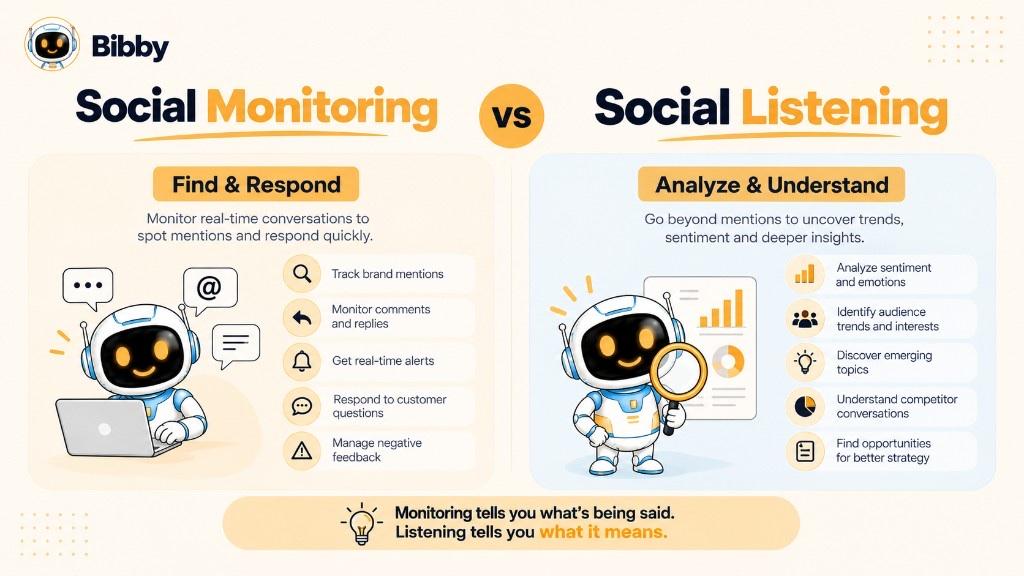
Social listening and social monitoring are closely related, but they are not the same. Monitoring generally finds and responds to individual mentions. Listening analyzes those conversations for patterns, trends, and insights.
Social monitoring tells you what is being said. Social listening helps you understand what it means and what you should do next.
| Aspect | Social Monitoring | Social Listening |
|---|---|---|
| Primary purpose | Track and respond to mentions | Understand conversations and extract insights |
| Main focus | Individual posts and interactions | Patterns across many conversations |
| Typical question | “Who mentioned us?” | “What are people saying about us and why?” |
| Approach | Often reactive | Reactive and proactive |
| Data use | Respond to conversations | Analyze conversations for decisions |
| Common outputs | Mentions, alerts, messages | Trends, sentiment, themes, insights |
| Business use | Customer response and issue handling | Marketing, product, reputation, and strategy |
What Is Social Monitoring?
Social monitoring tracks mentions, comments, messages, and other interactions so a business can identify and respond.
It is useful for customer questions, comments, direct mentions, individual complaints, and immediate campaign responses. The emphasis is what is happening right now and whether someone needs to respond.
What Is Social Listening?
Listening looks for the bigger picture: hundreds of conversations pointing to the same issue, or *why* customers discuss a competitor.
It can support customer insight, competitor analysis, reputation, trend discovery, content strategy, product research, campaign planning, and market intelligence.
A Simple Example
A restaurant receives 50 comments about delivery.
Monitoring: Identify each complaint and respond.
Listening: Most complaints involve delays at a particular time of day—an operational pattern to investigate.
Can a Business Use Both?
Yes. A practical workflow is:
Monitor → Collect → Analyze patterns → Identify insights → Respond or act → Measure
Monitoring is often the operational layer. Listening is the analytical and strategic layer.
Social Listening vs. Social Media Analytics
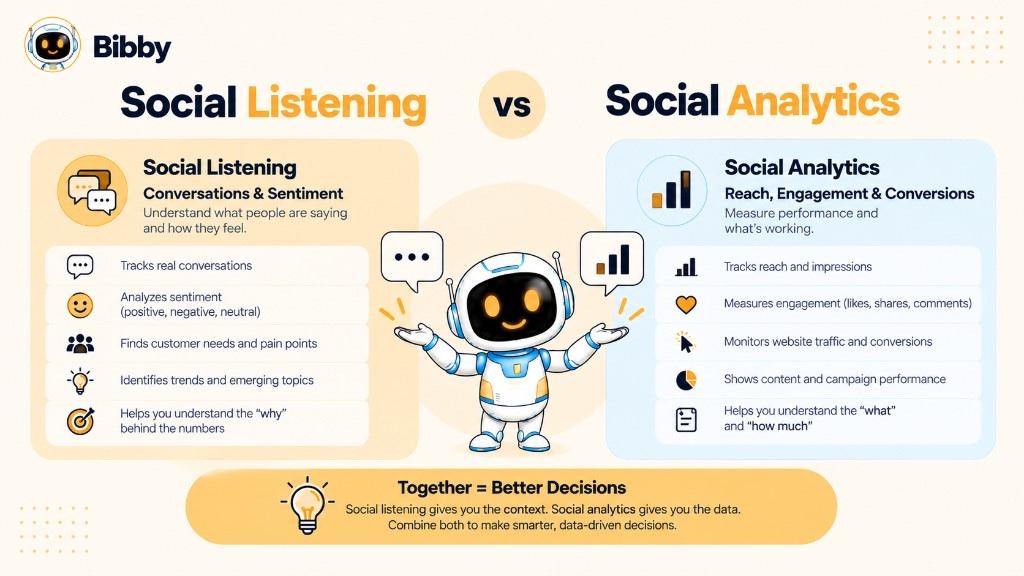
Listening and social media analytics both support decisions, but they answer different questions. Listening focuses on what people are saying. Analytics focuses on how a brand’s social activity is performing.
Analytics can show that a post received high engagement. Listening can help explain why people responded and what they said.
| Aspect | Social Listening | Social Media Analytics |
|---|---|---|
| Primary focus | Audience conversations and opinions | Social media performance |
| Main question | “What are people saying and what does it mean?” | “How is our social activity performing?” |
| Common data | Mentions, sentiment, topics, conversations | Reach, impressions, engagement, clicks, followers |
| Focus of analysis | Audience and market perception | Account and content performance |
| Typical outcome | Insights and business intelligence | Performance reports and trends |
What Does Social Media Analytics Measure?
Typical KPIs include reach, impressions, engagement rate, CTR, follower growth, video views, and conversions. These help you understand what content is performing. Review them in each platform’s Insights or an analytics product—not as a Bibby ROI dashboard.
What Does Social Listening Analyze?
Listening looks at mentions, opinions, sentiment, complaints, product feedback, competitor talk, industry topics, themes, and conversation volume. The focus is less on whether a post received 500 or 5,000 likes and more on what people are discussing.
A Simple Example
A product post gets unusually high engagement.
Analytics: 20,000 impressions, 2,000 engagements, 10% engagement rate.
Listening: Most conversations are positive, but customers keep asking whether another version will exist.
Analytics shows how the content performed. Listening helps explain what the audience wants next.
They Work Together
Analytics → What happened?
Listening → What are people saying?
Combined → What should we do next?
Educational carousels might win on engagement. Listening can show which topics people discuss most. Use both to decide the next post—then schedule it.
Listening does not replace analytics. Performance metrics still tell you whether campaigns hit objectives. Metrics alone may not explain sentiment, competitor talk, or emerging discussions.
Social Listening, Social Monitoring, and Social Analytics
These terms are often used interchangeably, but they describe different parts of social intelligence.
Monitoring finds conversations → Listening interprets conversations → Analytics measures performance.
| Concept | Main Question | Primary Focus | Typical Outcome |
|---|---|---|---|
| Social Monitoring | What is being said? | Mentions and interactions | Alerts, responses, issue identification |
| Social Listening | What does it mean? | Patterns, opinions, sentiment, trends | Insights and actionable intelligence |
| Social Analytics | How are we performing? | Content and account performance | Metrics, reports, and performance trends |
How the Three Work Together
On a product launch:
- Monitoring tracks mentions and finds pricing questions.
- Listening shows pricing is a major hesitation theme.
- Analytics shows value-explanation posts earn more clicks than purely promotional ones.
- Action: Refine messaging. Create the next posts in Bibby and publish across your channels.
Monitor → Listen → Analyze → Act → Measure
If you monitor without listening, you may answer individual complaints without seeing a pattern. If you listen without analytics, you may understand sentiment without knowing whether your content works. If you use analytics without listening, you may know which posts perform without knowing what people are actually saying.
What Can Social Listening Track?
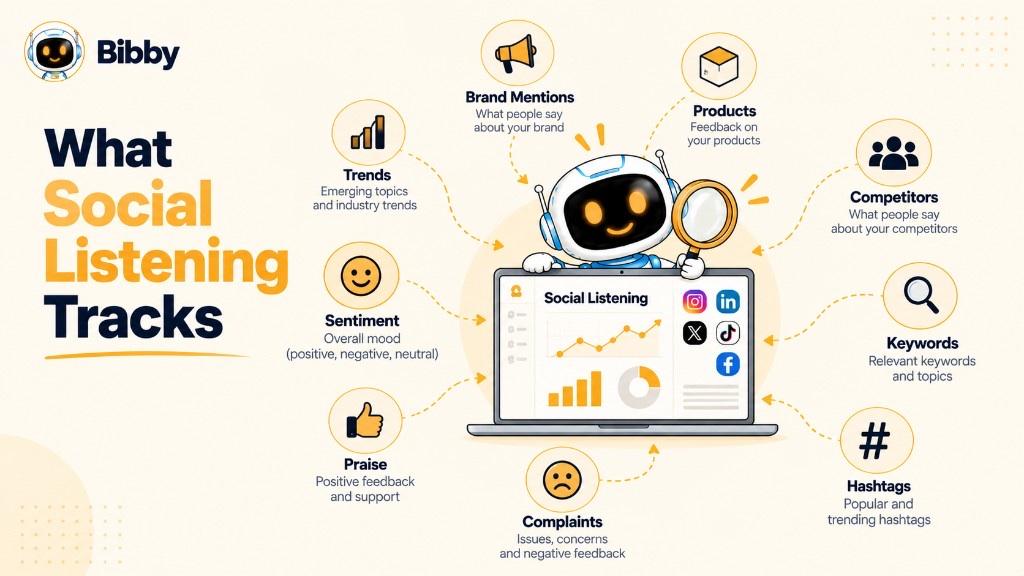
Depending on the platform and data sources, businesses can monitor conversations around brands, products, competitors, keywords, hashtags, topics, customer experiences, and industry trends. Coverage varies by tool and access.
1. Brand Mentions
Company name, products, services, brand variations, and campaign names—including mentions that never notify the official account.
2. Product and Service Mentions
New releases, features, service experiences, variations, and common questions.
3. Competitor Mentions
Names plus pricing, features, support, alternatives, reviews, and comparisons.
4. Keywords and Phrases
A social media automation company might also track “content scheduling” or “social media tools” to find category conversations when the brand is not named.
5. Hashtags
Campaign, event, product, industry, and branded hashtags. Use a hashtag generator for publishing tags—that is not the same as listening to a hashtag stream.
6. Customer Complaints
Product problems, service issues, delivery, pricing, UX, and support. One complaint may need a reply. A repeated complaint may be a larger issue.
7. Customer Praise
Features, support, pricing, ease of use, quality. Those strengths can inform future marketing.
8. Customer Sentiment
Positive, negative, or neutral. Treat sentiment scores as signals rather than absolute truth. Sarcasm, humor, and mixed opinions confuse automation.
9. Industry Conversations
Common concerns, new expectations, technologies, and shifts that can feed thought-leadership content.
10. Emerging Topics and Trends
Growing volume can be worth investigating. Not every spike is a meaningful trend.
11. Campaign Reactions
Mentions, hashtag activity, opinions, questions, and frequently discussed creative elements—qualitative context around campaign KPIs.
12. Topics and Conversation Themes
Thousands of mentions that cluster into ease of use, pricing, support, and feature requests are more useful than a total count.
What Listening Cannot Automatically Tell You
More data is not automatically a reliable insight. Check relevance, source quality, whether the sample represents customers, sentiment accuracy, whether a spike is temporary, and whether talk translates into behavior.
Listening is one source of intelligence, not a perfect map of everything an audience thinks.
Social Listening Metrics to Track
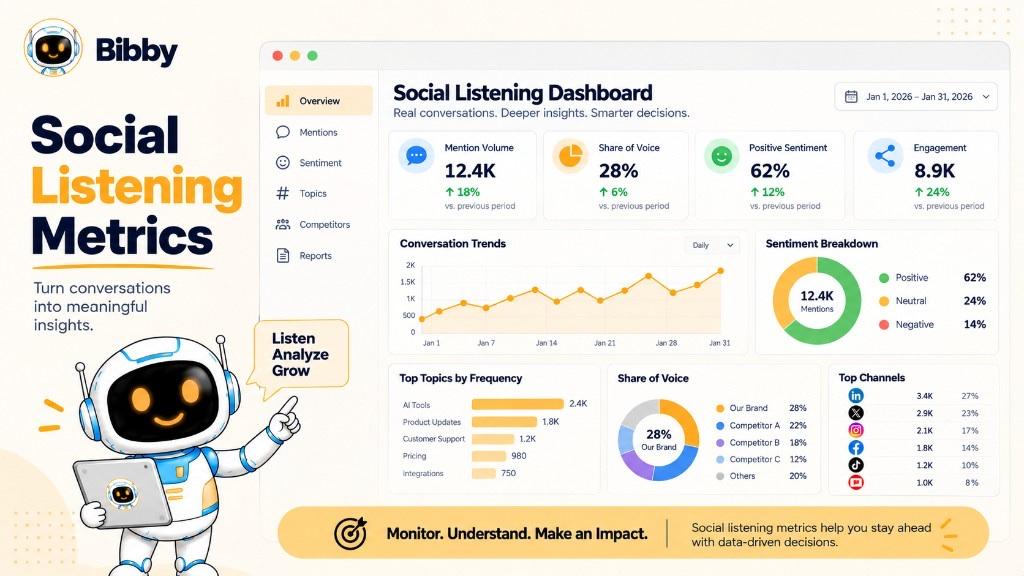
The right metrics depend on what you want to learn. Reputation work may prioritize sentiment and mention trends. Competitor work may care more about share of voice and volume.
These metrics live in listening tools. They are not vanity metrics to chase in isolation, and Bibby does not calculate them.
1. Mention Volume
How often a brand, product, competitor, keyword, or topic appears in a period. Spikes can mean a campaign, news, launch, or issue. Always pair volume with sentiment and context.
2. Share of Voice
Share of Voice = Brand Mentions ÷ Total Relevant Brand Mentions × 100
High SOV is not automatically “winning.” A negative event can inflate share. See the share of voice entry for limits.
3. Sentiment
Positive, negative, or neutral over time. A launch with rising mentions that are mostly negative is a different story than rising praise.
4. Conversation Volume Trends
Daily, weekly, and monthly patterns; pre- and post-campaign activity; long-term shifts versus one-day spikes.
5. Engagement Around Conversations
Likes, comments, shares, and replies on *mentions*—not the same as your own post engagement rate. High engagement can still be negative.
6. Reach or Potential Reach
Some tools estimate audience exposed to monitored conversations. A few influential mentions can matter more than hundreds of low-visibility ones.
7. Topic Frequency
Which subjects appear most: pricing, ease of use, integrations, support, features.
8. Conversation Themes
“Pricing” might mean “too expensive,” “love the free plan,” “want annual discounts,” or “comparing competitors.” Themes explain *what people say*.
9. Positive vs. Negative Ratio
A 70 / 20 / 10 split is a snapshot. A few influential negatives can still deserve attention.
10. Response Time
How quickly you find and handle conversations that need a reply. Fast detection does not mean every mention needs a public response.
Which Social Listening Metrics Matter Most?
There is no universal “best” list. Match metrics to the question.
| Business Objective | Useful Metrics |
|---|---|
| Brand reputation | Sentiment, mention volume, conversation trends |
| Competitor research | Share of voice, mention volume, sentiment |
| Customer experience | Complaints, themes, sentiment, response time |
| Content strategy | Topic frequency, engagement, conversation trends |
| Campaign analysis | Mention volume, sentiment, engagement, themes |
| Trend discovery | Topic growth, conversation volume, engagement |
| Product research | Feature mentions, themes, sentiment, recurring feedback |
Volume + Sentiment + Context + Trends + Themes = more meaningful insight
A 35% volume increase is useful. Knowing what caused it and whether those conversations were positive, negative, or relevant is more valuable.
How Do Businesses Use Social Listening?
Start with a specific business question, then look for evidence.
Marketing Teams
Find topics, pain points, campaign ideas, trend signals, and competitor positioning. A repeated product question can become an educational post or short-form video.
Customer Service Teams
Find public questions and complaints that never become tickets. Recurring issues can feed both replies and better help content.
Product Teams
Requested features, frustrations, comparisons, and unexpected use cases are research signals—not an automatic roadmap.
PR and Communications Teams
Watch reputation, media reactions, sentiment shifts, and potential risks. A sudden volume change deserves examination, not panic.
Sales Teams
Comparisons, capability questions, and dissatisfaction with incumbents can inform language and objections. Do not treat every mention as a buying signal.
Competitive Intelligence
Compare volume, sentiment, praised features, and complaints to evaluate positioning.
Leadership and Strategy
Which issues customers discuss, which competitors get attention, and which expectations are changing can complement other market research.
One Insight, Several Actions
If setup is repeatedly called difficult:
- Support writes clearer docs.
- Product reviews onboarding.
- Marketing publishes a walkthrough and schedules it.
- Sales updates objection handling.
- Leadership decides if onboarding is a broader issue.
Listen → Find patterns → Understand context → Decide what matters → Act → Measure
How to Build a Social Listening Strategy
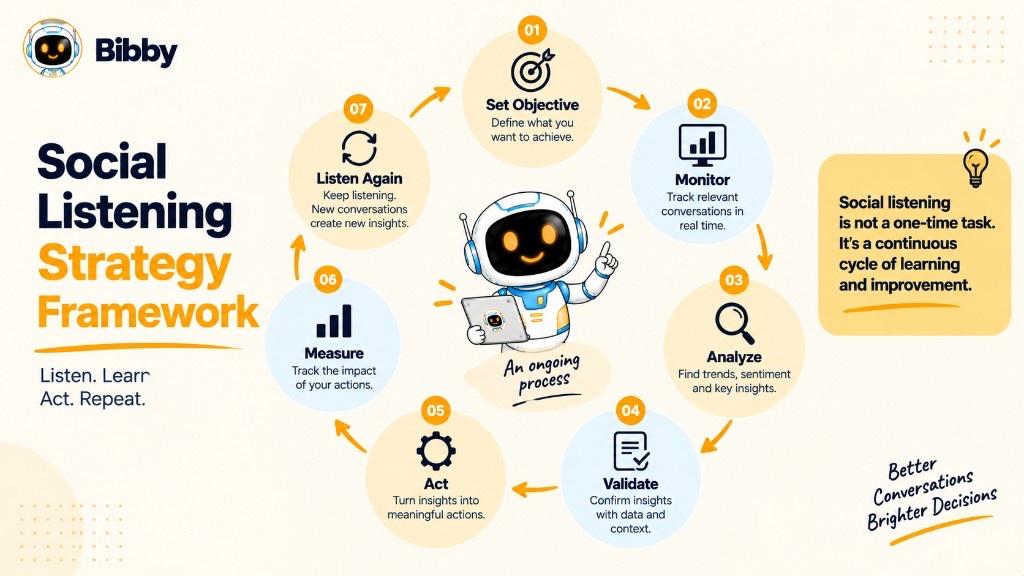
A strategy defines what to monitor, why, how you will analyze it, and what you will do with insights. Tracking a brand name alone is not enough.
Set a goal → Choose what to monitor → Collect → Analyze → Identify insights → Act → Measure
1. Set a Clear Objective
Examples: How do customers perceive us? What do they like or dislike? What do they say about competitors? Which industry topics are rising? Why are they complaining? What content topics interest them? How did a campaign land?
2. Choose What to Monitor
Brand, product, service, competitor, and campaign names; industry keywords; hashtags; features; customer problems; common questions.
3. Include Relevant Keyword Variations
Abbreviations, misspellings, alternative names, and campaign hashtags—without adding so many broad terms that the stream is unusable.
4. Monitor Competitors and the Wider Market
Your pricing complaints mean more when you can see how people describe competitor pricing.
5. Filter and Organize
Categorize by brand, product, competitor, complaint, praise, feature request, campaign, and industry topic.
6. Analyze Sentiment and Themes
Do not rely on a sentiment score alone. Read enough underlying posts to understand *why*.
7. Separate Signals From Noise
Ask: Is it relevant, repeated, from a meaningful audience, sustained, and gaining attention? Social media produces bursts that are not lasting trends.
8. Turn Findings Into Actionable Insights
Not: “10,000 mentions this month.”
Better: “Mentions rose because of the new reporting feature, but recurring questions suggest we need clearer education.”
9. Connect Insights to Publishing
Questions → educational posts
Complaints → problem-solving content
Praise → social proof
Trends → timely content (if relevant)
Competitor gaps → accurate differentiation
Campaign reactions → messaging adjustments
Then execute: generate visuals, draft captions, organize a campaign, and schedule on Facebook, Instagram, LinkedIn, YouTube, and TikTok. Compare plans if you need more seats or volume. Growth insights on Bibby are publishing-oriented—not a listening suite.
10. Measure the Results
| Objective | Possible Measures |
|---|---|
| Improve reputation | Sentiment and mention trends (listening tool) |
| Improve customer experience | Complaint themes, recurring issues |
| Improve content | Engagement, reach, topic performance (platform Insights) |
| Monitor competitors | Share of voice, conversation trends |
| Discover trends | Topic growth, conversation volume |
| Support product decisions | Feature feedback, recurring themes |
1. Define what to learn. 2. Monitor the right entities. 3. Analyze patterns. 4. Validate signal vs noise. 5. Act. 6. Measure.
What Are Social Listening Tools?
Social listening tools collect, organize, and analyze online conversations around brands, products, competitors, keywords, and topics. They process more conversation than manual searching.
Capabilities vary. Some focus on mentions and alerts. Others add sentiment, trends, competitor comparisons, reporting, and AI-assisted analysis.
Listening Tools vs. Social Media Management Tools
Listening tools understand conversations and audience insights.
Management tools help you create, publish, schedule, and review your own content.
A listening tool may answer: “What are people saying about social media automation?”
A management platform may answer: “What should we publish, when, and on which accounts?”
Bibby is a management and automation workflow: upload or generate media, posting styles, AI captions, chat-based campaigns, and AI-optimized times on supported networks. It does not crawl the web for mentions.
See free tools for one-off helpers such as the caption generator, hashtag generator, and idea generator. Those are drafting aids, not listening suites.
Features to Look For
- Platform coverage that matches your audience—not “every network on earth.”
- Keyword and Boolean search (phrases, exclusions, variations) to cut noise.
- Sentiment analysis as a directional signal, with human review.
- Competitor monitoring for volume, SOV, sentiment, and themes.
- Alerts for unusual mention or negative spikes.
- Trend detection that you still validate.
- Reporting you can share with marketing, product, support, and leadership.
- AI summaries that you still verify against source posts.
How to Choose a Tool
Ask what you must monitor, which sources matter, expected volume, need for competitors, sentiment, alerts, reporting, AI, workflow fit, and budget. A small team may need basic alerts. A large brand may need historical data and advanced reporting.
Listening in the Broader Workflow
Listen: Customers repeatedly ask about a topic.
Understand: There is an information gap.
Create: Useful content that answers it.
Publish: Across the channels you actually use.
Measure: Audience response in Insights; conversation change in the listening tool.
Bibby fits the execution side. Listening provides the insight. Automation helps turn it into consistent publishing. See pricing or start a trial when you are ready to schedule that content.
How AI Is Changing Social Listening
AI can summarize conversations, classify topics, analyze sentiment, detect unusual changes, and surface possible insights. The shift is from “How many people mentioned this?” toward “What is happening, and what deserves attention?”
Sentiment, Clustering, and Summaries
AI can handle mixed opinions (“great product, nightmare setup”), group themes such as pricing and support, and summarize a launch week. It still misreads sarcasm and slang. Humans decide what matters.
Trend and Anomaly Detection
Rising industry talk or a sudden negative spike can be flagged for investigation: product issue, viral post, news, campaign, or outage.
Natural-Language Queries
Some tools let you ask “What are customers complaining about this month?” That is a listening-product feature, not Bibby chat. Bibby chat helps you create a brand kit, campaign, posts, and captions.
Connecting Insights to Content
Conversations → analysis → content idea → create → schedule
Bibby supports the last steps with AI visuals, captions, campaigns, and scheduling. It does not analyze mention streams.
AI can answer “What patterns appear?” Humans still answer “Does this matter, and what should we do?”
How Social Listening Supports Social Media Marketing
Listening can make marketing more informed by showing what audiences discuss, ask, struggle with, and pay attention to.
Listen → Understand → Create → Publish → Measure
Use it to find topics, turn questions into education, turn pain points into helpful how-tos, evaluate trends for relevance, understand which messages resonate, and spot competitor content gaps.
Before a campaign, listen for existing language, concerns, and unanswered questions. After launch, listen to how people discuss it.
Research → Campaign → Listen → Learn → Optimize
A listening-led planner asks “What is our audience talking about, and how can we contribute something useful?” instead of only “What do we want to publish?”
Creativity and strategy still matter. Listening supplies better raw material. Then automation helps you publish consistently. Try onboarding to connect accounts when you are ready.
How to Turn Social Listening Insights Into Content
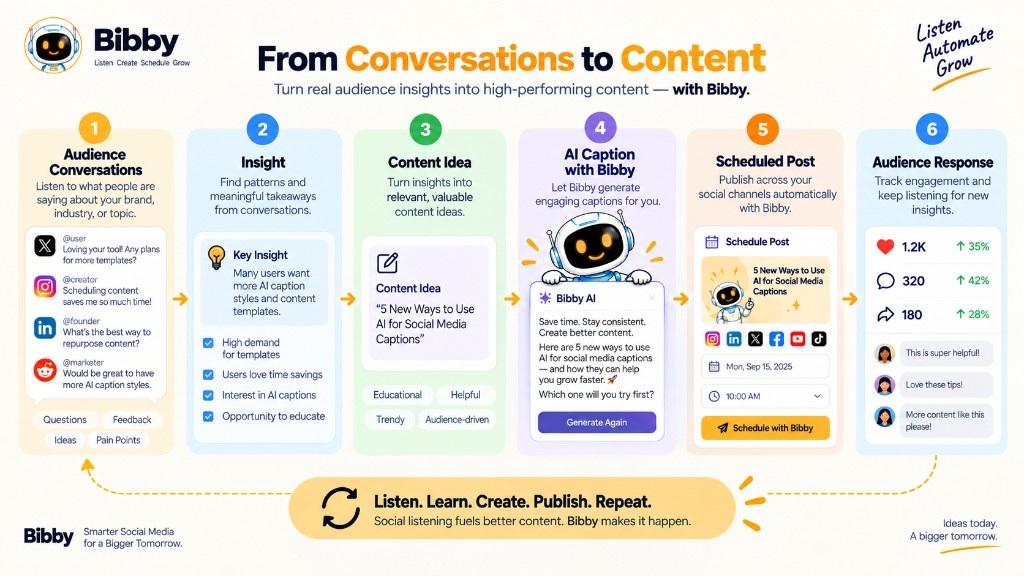
Listen → Identify an insight → Choose a format → Create → Publish → Measure
Do not turn every mention into a post. Look for patterns that reveal something useful.
| Social Listening Insight | Potential Content |
|---|---|
| Frequently asked question | FAQ, carousel, tutorial |
| Recurring customer problem | How-to post, video, guide |
| Emerging trend | Commentary, explainer (only if relevant) |
| Positive customer feedback | Testimonial, case study (social proof) |
| Product confusion | Tutorial, walkthrough |
| Competitor comparison | Accurate educational comparison |
| Industry misconception | Myth-busting post |
| Frequently discussed topic | Educational or thought-leadership content |
One insight can become a content cluster: why consistency is hard, how to batch, a scheduling workflow, common mistakes, a weekly planning carousel, and a short demo.
After you publish, keep listening. The loop is:
Listen → Opportunity → Create → Publish → Observe → Learn → Create again
Don’t create content because people are talking. Create it because their conversations reveal something your audience needs.
Social Listening: Key Takeaways
Social listening monitors and analyzes online conversations about brands, products, competitors, keywords, topics, and industries—then turns those insights into action.
It goes beyond counting mentions. The value is patterns, sentiment, customer needs, recurring problems, competitive signals, and emerging trends.
- Understand opinions and expectations
- Identify recurring complaints and product feedback
- Monitor reputation
- Research competitors
- Discover trends and content opportunities
- Improve campaigns, products, and services
Social monitoring finds the conversation.
Social listening interprets the conversation.
Social analytics measures social performance.
Action turns the insight into business value.
For marketers: Listen → Understand → Create → Publish → Measure → Listen again
Bibby helps with create, caption, campaign, and schedule on Facebook, Instagram, LinkedIn, YouTube, and TikTok. Listening, sentiment, and share of voice stay in dedicated tools.
Continue with sentiment analysis, share of voice, social media analytics, community management, engagement, social media strategy, and content calendars—or the full social media dictionary. Read more on the blog, try free tools, or start a free Bibby trial to publish the content your listening insights suggest across your channels.