
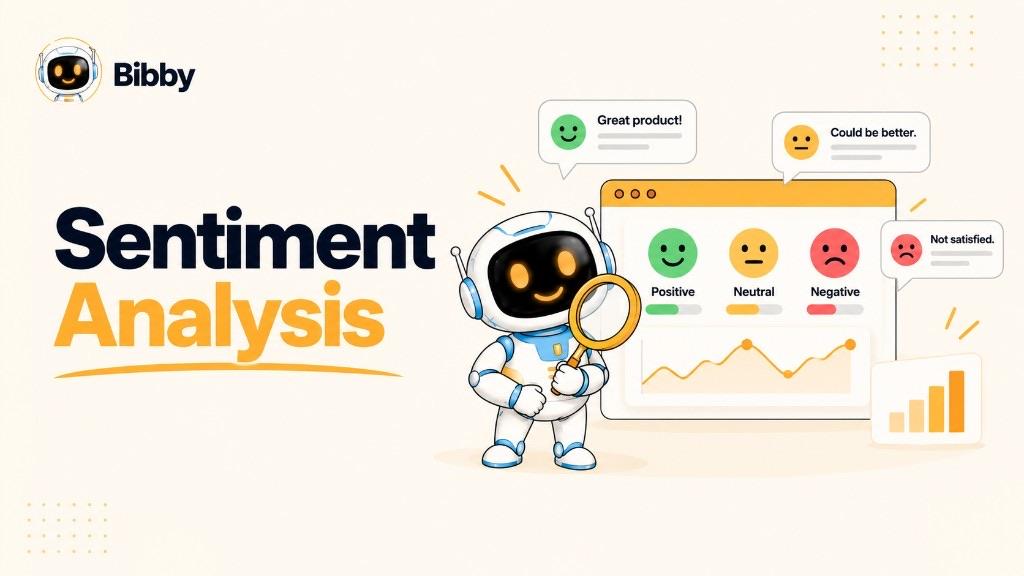
For example, a social media comment saying, “I absolutely love this new feature!” would generally be classified as positive, while “This update is frustrating and keeps crashing” would be negative. A statement such as “The company launched a new product today” would typically be considered neutral.
Sentiment analysis helps businesses understand not just what people are saying, but how they feel about it. On social media, marketers can use it to analyze audience reactions to a brand, product, campaign, or topic, identify changes in public perception, and spot positive or negative conversations that may require attention.
As social media generates enormous amounts of text every day, manually reviewing every comment or mention is impractical. Sentiment analysis automates much of this process by examining large volumes of text and identifying patterns in audience sentiment. This makes it a useful technique for social media monitoring, customer feedback analysis, brand reputation management, campaign evaluation, and content strategy.
The classification itself happens in listening or analytics tools—not in Bibby. Bibby is for creating and scheduling the next posts once you know how people are reacting.
What Is Sentiment Analysis?
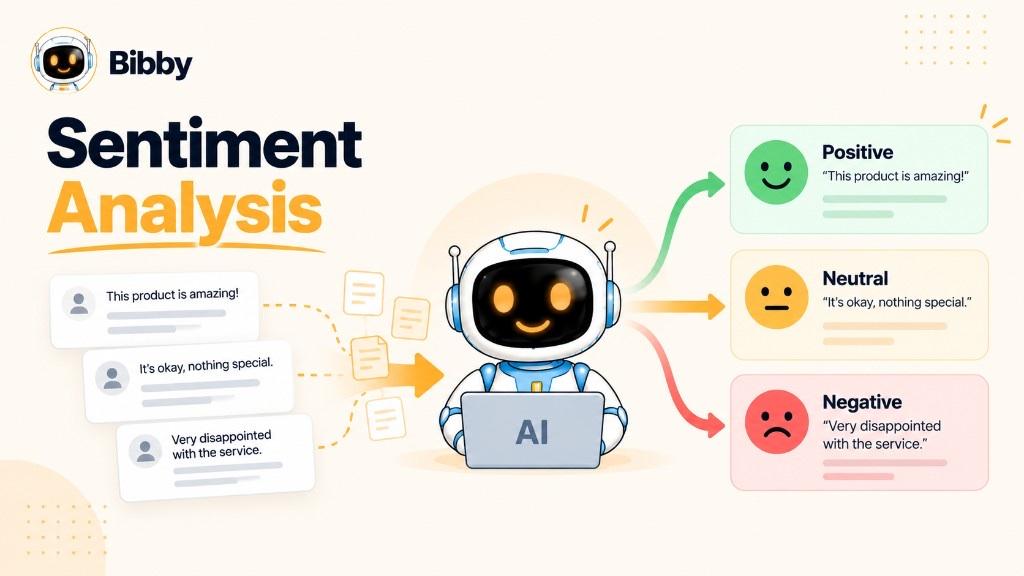
Sentiment analysis is a method of analyzing written or spoken language to identify the attitude, opinion, or emotional tone behind it. In its simplest form, it determines whether a piece of text expresses a positive, negative, or neutral sentiment.
For example, consider these three statements:
| Text | Sentiment |
|---|---|
| “I love how easy this app is to use.” | Positive |
| “The app is okay, but nothing special.” | Neutral |
| “The app keeps crashing and is frustrating to use.” | Negative |
A sentiment analysis system examines the words, phrases, context, and linguistic patterns in the text to determine the most likely sentiment. More advanced systems can go beyond basic positive, negative, and neutral classifications to identify specific emotions, sentiment intensity, or opinions about particular aspects of a product or topic.
What Does Sentiment Analysis Analyze?
Sentiment analysis can be applied to many forms of digital communication, including:
- Social media posts and comments
- Product and service reviews
- Customer feedback
- Online surveys
- Customer support conversations
- Emails and messages
- Blog comments
- Forum discussions
- News and online articles
For businesses, the value comes from turning large amounts of unstructured text into information that can be interpreted and acted upon. Instead of reading thousands of individual comments, a company can analyze the overall sentiment and identify patterns in how people are responding.
How Does Sentiment Analysis Identify Sentiment?
Traditional sentiment analysis systems often look for linguistic patterns associated with different sentiments. Modern AI-powered systems can consider context and relationships between words, making them better suited to more complicated language.
For instance, the sentence:
“The design is beautiful, but the app is painfully slow.”
contains both positive and negative opinions. A basic system might struggle to classify the overall message, while a more sophisticated system can recognize that the writer has a positive opinion about the design and a negative opinion about performance.
This is why sentiment analysis is not simply a matter of counting positive or negative words. The meaning of a sentence can change depending on context, wording, negation, sarcasm, slang, and the subject being discussed.
Why Is Sentiment Analysis Useful?
The primary purpose of sentiment analysis is to make opinions and attitudes in large collections of text easier to understand.
For example, a brand may receive 50,000 social media comments during a product launch. Reading every comment manually would take considerable time. Sentiment analysis can help categorize those conversations and reveal patterns such as:
- Most customers reacted positively to the product.
- Negative conversations increased after a particular announcement.
- Customers frequently praised one product feature.
- Complaints are concentrated around pricing or customer service.
- Overall sentiment changed after a campaign was launched.
These insights can help marketers, customer-support teams, product teams, and business leaders make more informed decisions.
Sentiment Analysis in Social Media
Social media is one of the most useful environments for sentiment analysis because people constantly express opinions about brands, products, services, events, and trends.
A marketer can use sentiment analysis to understand whether conversations surrounding a campaign are predominantly positive, negative, or neutral. It can also help identify changes in audience perception over time.
For example, if a campaign initially generates overwhelmingly positive reactions but negative sentiment suddenly increases, that change can signal that something has shifted in the audience's response.
In this way, sentiment analysis turns social media conversations into structured audience insights, helping businesses understand not only what their audience is talking about, but also the overall tone of those conversations.
How Does Sentiment Analysis Work?
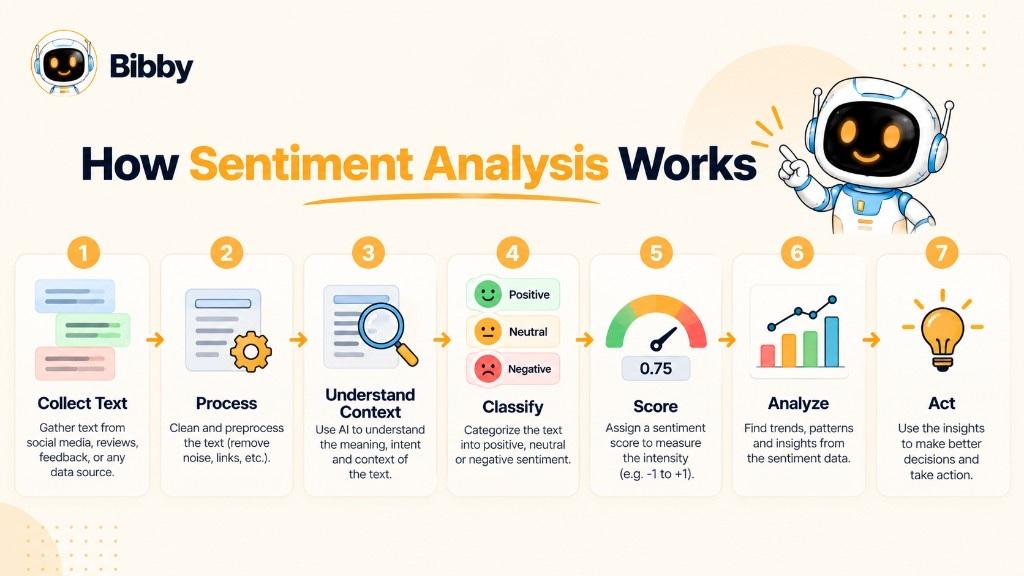
Sentiment analysis works by using natural language processing (NLP), machine learning, and AI models to examine text and determine the sentiment or opinion it expresses. The exact process varies depending on the technology being used, but most sentiment analysis systems follow a similar workflow: collect text, process it, understand its meaning, classify its sentiment, and analyze the results.
1. Collect the Text
The first step is gathering the digital text that needs to be analyzed. This text can come from almost any source where people express opinions or communicate with a business.
Common sources include:
- Social media posts
- Comments and replies
- Product reviews
- Customer feedback
- Surveys
- Customer support conversations
- Online forums
- Blogs and articles
- Messages and emails
For social media sentiment analysis, the data may come from conversations about a brand, product, campaign, competitor, or specific topic. Collect only text you are permitted to analyze under platform rules, privacy, and consent.
2. Process and Clean the Text
Raw digital text often contains information that can make analysis more difficult. A sentiment analysis system may therefore preprocess the text before attempting to understand it.
This can include:
- Removing unnecessary characters or formatting
- Identifying individual words and phrases
- Handling punctuation
- Normalizing variations in text
- Identifying relevant keywords
- Processing hashtags and mentions
- Recognizing emojis and other signals
This stage helps transform unstructured text into a format that an AI or NLP system can analyze more effectively.
3. Understand the Language and Context
The system then examines the language used in the text. Modern AI-based sentiment analysis can consider the context and relationship between words, rather than simply looking for isolated positive or negative terms.
For example:
“I thought the new update would be terrible, but it is actually fantastic.”
The word “terrible” appears in the sentence, but the overall sentiment is positive. The system needs to understand how the words relate to one another to correctly interpret the statement.
Context is particularly important when analyzing social media because users frequently use slang, abbreviations, emojis, informal language, and sarcasm.
4. Classify the Sentiment
After analyzing the text, the system assigns a sentiment classification.
The most common categories are:
- Positive: The text expresses approval, satisfaction, happiness, or another favorable opinion.
- Negative: The text expresses dissatisfaction, criticism, anger, disappointment, or another unfavorable opinion.
- Neutral: The text does not express a clearly positive or negative opinion.
Some systems use more detailed classifications, such as very positive, positive, neutral, negative, and very negative.
Advanced systems can also identify sentiment toward individual aspects of something.
For example:
“The phone looks fantastic, but the battery life is disappointing.”
The analysis could identify:
- Design: Positive
- Battery life: Negative
This approach is known as aspect-based sentiment analysis.
5. Assign a Confidence or Sentiment Score
Many sentiment analysis systems produce a score alongside the classification. The score represents how strongly the system believes the text belongs to a particular sentiment category.
For example:
| Text | Classification | Possible confidence |
|---|---|---|
| “This is absolutely amazing!” | Positive | 98% |
| “The product is fine.” | Neutral | 72% |
| “I am extremely disappointed.” | Negative | 96% |
The exact scoring method differs between tools and models, so these scores should not be treated as a universal measurement.
6. Aggregate and Analyze the Results
Analyzing individual messages is useful, but businesses often need to understand sentiment across thousands or millions of pieces of text.
The results can therefore be aggregated to identify broader patterns.
For example, a company could discover that:
- 75% of mentions are positive.
- 15% are neutral.
- 10% are negative.
- Positive sentiment increased after a campaign.
- Negative sentiment is concentrated around customer support.
- Customers frequently praise a particular product feature.
This transforms individual pieces of text into broader customer and audience insights.
7. Take Action Based on the Insights
The final step is turning sentiment data into decisions.
A marketing team might use the results to adjust messaging, refine campaigns, create content around topics generating positive reactions, or investigate recurring complaints.
A customer-support team could use negative sentiment signals to identify conversations that may require attention.
A product team could analyze customer opinions to discover which features customers like or dislike.
For social media marketers, this creates a useful feedback loop:
Publish → Collect reactions → Analyze sentiment → Identify patterns → Improve strategy → Publish again
The important point is that sentiment analysis does not simply label text as positive or negative. Its real value comes from using those classifications to understand audience perception and make better decisions.
Types of Sentiment Analysis
Sentiment analysis can be performed at different levels of detail depending on what a business wants to learn from its data. A basic system may only determine whether text is positive or negative, while more advanced systems can identify neutral sentiment, sentiment intensity, specific aspects, or individual emotions.
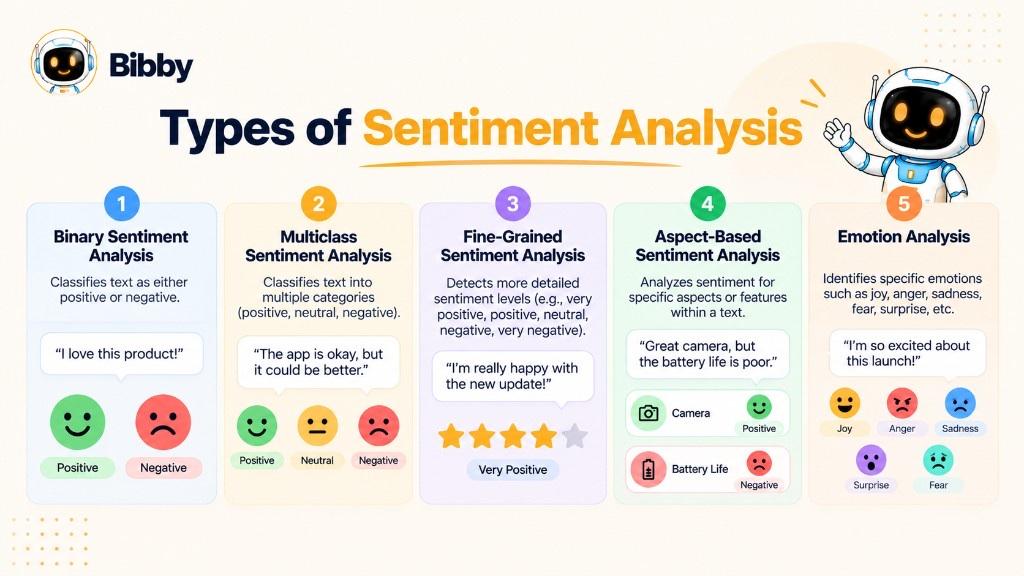
The main types of sentiment analysis include binary sentiment analysis, multiclass sentiment analysis, fine-grained sentiment analysis, aspect-based sentiment analysis, and emotion detection.
Binary Sentiment Analysis
Binary sentiment analysis classifies text into two sentiment categories, most commonly positive or negative.
For example:
- “The customer service was excellent.” → Positive
- “The customer service was terrible.” → Negative
This approach is relatively simple and can be useful when a business only needs to know whether an opinion is favorable or unfavorable.
The main limitation is that binary analysis does not normally provide a separate category for neutral statements. A comment such as “The product arrived yesterday” does not clearly express positive or negative sentiment, so forcing it into one of those categories can reduce the usefulness of the analysis.
Multiclass Sentiment Analysis
Multiclass sentiment analysis uses more than two sentiment categories. A common approach is to classify text as:
- Positive
- Neutral
- Negative
For example:
| Statement | Sentiment |
|---|---|
| “This is the best update you've released.” | Positive |
| “The update was released this morning.” | Neutral |
| “The update has made the app much worse.” | Negative |
Multiclass analysis is particularly useful for social media because many posts and comments do not express a clearly positive or negative opinion.
Fine-Grained Sentiment Analysis
Fine-grained sentiment analysis provides more detail than a simple positive, neutral, or negative classification. Instead of treating sentiment as three broad categories, it can measure different levels of sentiment intensity.
One possible classification is:
- Very positive
- Positive
- Neutral
- Negative
- Very negative
For example:
- “It's okay.” → Neutral
- “I like it.” → Positive
- “I absolutely love it!” → Very positive
- “I dislike it.” → Negative
- “This is absolutely awful.” → Very negative
This approach can help businesses distinguish between mild approval and strong enthusiasm, or between minor dissatisfaction and severe criticism.
However, the exact categories and scoring system can vary between sentiment analysis tools.
Aspect-Based Sentiment Analysis
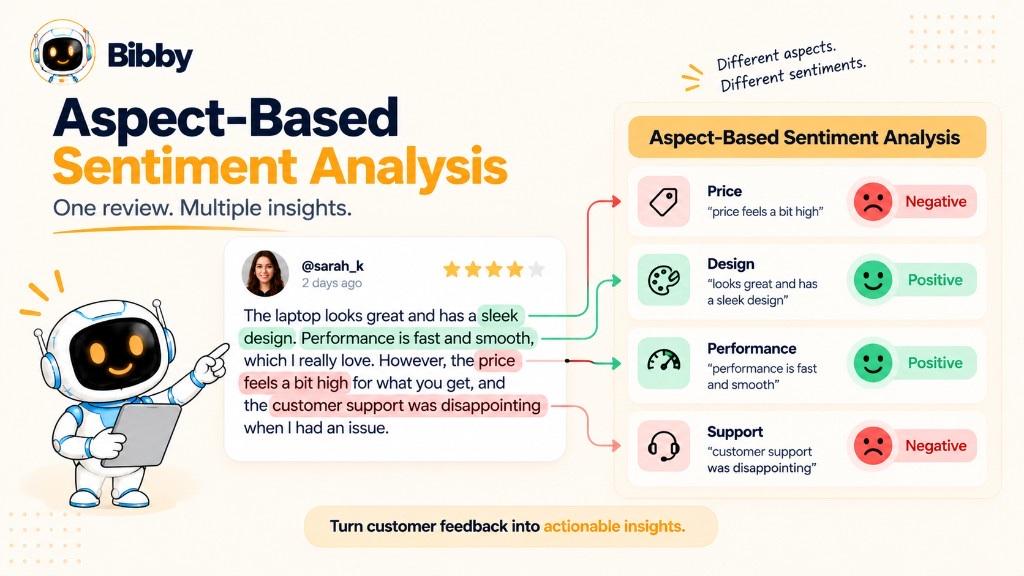
Aspect-based sentiment analysis (ABSA) analyzes sentiment toward specific aspects, features, or attributes mentioned in a piece of text.
This is especially useful when a single message contains multiple opinions.
Consider this example:
“The new phone looks fantastic, but the battery life is disappointing.”
A general sentiment classifier might label the entire statement as mixed or negative. Aspect-based analysis can provide more useful information:
| Aspect | Sentiment |
|---|---|
| Phone design | Positive |
| Battery life | Negative |
This allows businesses to understand what customers like or dislike, rather than simply knowing whether the overall review is positive or negative.
Emotion Detection
Emotion detection goes beyond determining whether text is positive or negative by attempting to identify the specific emotion expressed.
Depending on the system, possible emotions may include:
- Happiness
- Sadness
- Anger
- Fear
- Surprise
- Disappointment
- Excitement
For example:
“I can't believe you fixed this so quickly. I'm thrilled!”
The overall sentiment is positive, while the specific emotion could be interpreted as excitement or happiness.
Emotion detection and sentiment analysis are closely related, but they are not exactly the same. Sentiment analysis generally focuses on polarity or overall attitude, whereas emotion detection attempts to identify specific emotional states.
Which Type of Sentiment Analysis Should You Use?
The right approach depends on the question you are trying to answer.
If you only need to know whether customers are happy or unhappy, binary sentiment analysis may be sufficient.
If you need to distinguish positive, negative, and neutral conversations, multiclass sentiment analysis is more appropriate.
If you want to understand the strength of an opinion, fine-grained sentiment analysis can provide greater detail.
If customers discuss multiple features or characteristics in the same message, aspect-based sentiment analysis can reveal which specific aspects generate positive or negative reactions.
And if you need to understand emotions such as anger, excitement, or sadness, emotion detection may provide a deeper layer of insight.
For social media marketing, these approaches can be used individually or together to build a more complete picture of how audiences respond to brands, campaigns, products, and content.
Sentiment Analysis Examples
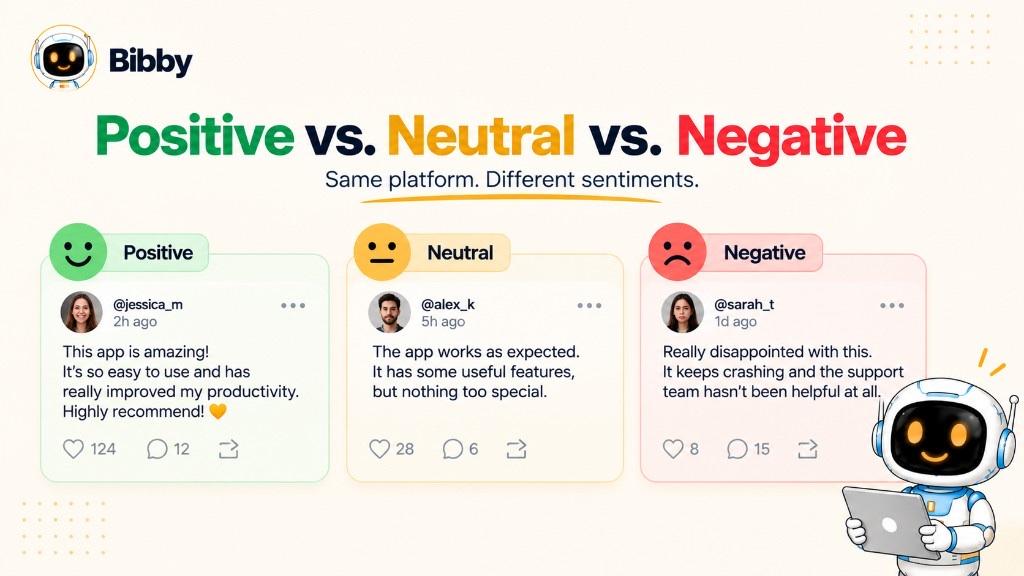
Sentiment analysis becomes easier to understand when you see how the same process works on real-world text.
Positive Sentiment Example
“I absolutely love this app. It has made managing my social media so much easier!”
Sentiment: Positive
The writer expresses clear satisfaction and enthusiasm. Words such as “love” and “easier” provide strong signals of a favorable opinion.
Negative Sentiment Example
“The app keeps crashing whenever I try to schedule a post. This is extremely frustrating.”
Sentiment: Negative
The message communicates dissatisfaction with the product. The words “crashing” and “frustrating” indicate a negative experience.
Neutral Sentiment Example
“The company published its new social media scheduling feature today.”
Sentiment: Neutral
The statement provides information without expressing a clearly positive or negative opinion.
Mixed Sentiment Example
“The new design looks fantastic, but the app is much slower than before.”
Sentiment: Mixed
This example contains both positive and negative opinions. The user likes the design but dislikes the app's performance.
A more advanced sentiment analysis system may identify the sentiment associated with each aspect separately:
- Design: Positive
- Performance: Negative
Social Media Comment Example
Consider a comment posted after a brand launches a new product:
“Finally! I've been waiting for this feature for months. It works perfectly.”
Sentiment: Positive
Now consider:
“Why did you remove the old feature? The new version is confusing and much harder to use.”
Sentiment: Negative
Customer Review Example
Imagine a customer reviewing a restaurant:
“The food was excellent and the staff were friendly, but the service was very slow.”
This is a mixed-sentiment review.
| Aspect | Sentiment |
|---|---|
| Food | Positive |
| Staff | Positive |
| Service speed | Negative |
Sarcasm Example
Sarcasm is one of the more difficult challenges for sentiment analysis.
For example:
“Great job! Another update that broke everything.”
The phrase “Great job!” appears positive when considered by itself. However, the second part of the sentence makes the writer's actual intention clear: they are criticizing the update.
Likely sentiment: Negative
Negation Example
Consider these two statements:
“I like this product.”
and
“I don't like this product.”
The second statement contains the word “like,” which is generally associated with positive sentiment. However, the word “don't” reverses the meaning.
“I like this product.” → Positive
“I don't like this product.” → Negative
Social Media Campaign Example
Imagine a company launches a new advertising campaign and receives 10,000 comments across its social media channels.
After analyzing the conversations, the company finds:
- 70% positive
- 20% neutral
- 10% negative
The numbers provide a high-level view of audience reaction. The company can then investigate the negative comments to determine what is causing dissatisfaction—for example, pricing rather than the product itself.
Why These Examples Matter
These examples show that sentiment analysis is more than simply searching for words such as “good,” “bad,” “love,” or “hate.” Real-world language contains context, sarcasm, negation, mixed opinions, slang, and different opinions about different aspects of the same subject.
Sentiment Analysis in Social Media
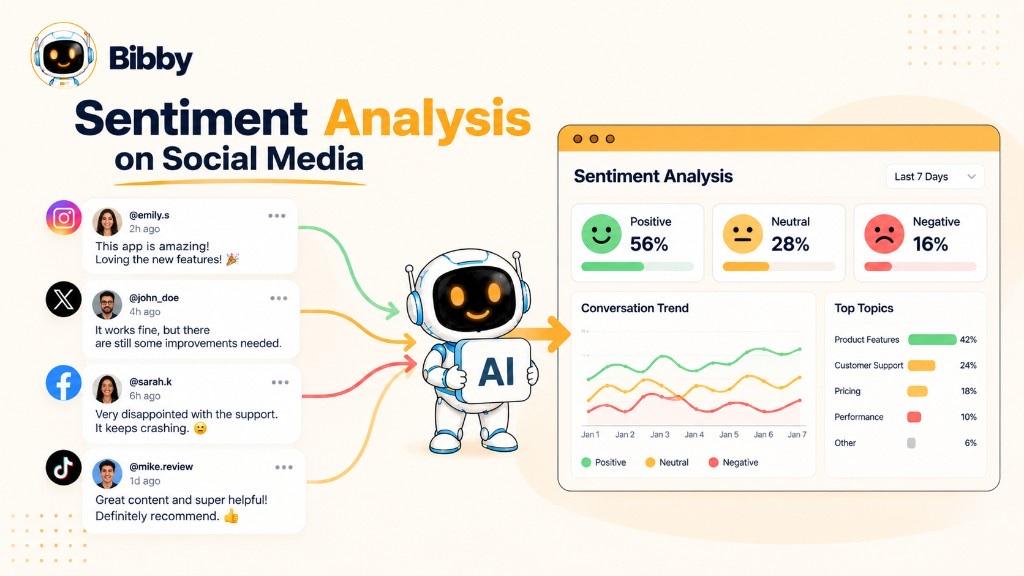
Social media sentiment analysis is the use of AI and natural language processing to analyze social media conversations and determine how people feel about a brand, product, campaign, topic, or event. Instead of manually reading thousands of posts and comments, businesses can use sentiment analysis to identify patterns in audience reactions and understand whether conversations are generally positive, negative, or neutral.
What Can Sentiment Analysis Analyze on Social Media?
Depending on the platform, data, and access available to a business or tool, sentiment analysis can be applied to different types of social media content, including:
- Posts
- Comments
- Replies
- Reviews
- Mentions
- Brand-related conversations
- Campaign discussions
- Customer feedback
- Public messages and conversations
How Social Media Sentiment Analysis Works
A typical social media sentiment analysis workflow looks like this:
Social conversations → Text analysis → Sentiment classification → Pattern identification → Marketing action
First, relevant social media text is collected. An AI or NLP system then analyzes the language and classifies the sentiment. The results can be aggregated to identify broader patterns across a campaign, brand, product, or time period.
Using Sentiment Analysis to Monitor Brand Perception
One of the most common applications is brand sentiment analysis.
People may discuss a company without directly communicating with its social media team. They might recommend the brand to friends, complain about an experience, compare it with a competitor, or respond to a campaign.
Analyzing these conversations can help businesses understand their broader online reputation.
For example:
“I've tried several scheduling tools, but this one is by far the easiest to use.”
This would generally indicate a positive perception.
Another user might say:
“The product looks promising, but customer support never responds.”
The overall sentiment may be negative or mixed, while the specific criticism is directed toward customer support.
Using Sentiment Analysis to Measure Campaign Reactions
Social media campaigns can generate thousands of reactions, making manual analysis difficult.
For example, imagine a campaign receives 20,000 public comments and mentions:
| Sentiment | Share of conversations |
|---|---|
| Positive | 68% |
| Neutral | 21% |
| Negative | 11% |
These figures provide a starting point for evaluating audience response. Marketers should also examine the topics associated with each sentiment—positive conversations might focus on creative, while negative conversations could be related to pricing.
Finding Negative Customer Feedback
Negative sentiment can be particularly valuable because it can highlight problems that require attention.
For example:
“I've tried contacting support three times and still haven't received an answer.”
A social media team could identify this as a negative customer experience and investigate it.
The goal is not simply to eliminate negative comments. Negative feedback can reveal genuine problems with products, services, customer support, pricing, communication, user experience, delivery, or marketing messages.
Identifying Positive Audience Reactions
If hundreds of users respond positively to a particular type of post, marketers can investigate what made that content effective.
Positive conversations may reveal:
- Topics audiences enjoy
- Product features customers value
- Messaging that resonates
- Content formats that encourage engagement
- Campaign concepts that generate enthusiasm
Understanding Audience Sentiment Over Time
A single sentiment measurement provides only a snapshot. Tracking sentiment over time can reveal changes in audience perception.
For example:
Before campaign → During campaign → After campaign
A business could compare sentiment across these periods to determine whether a campaign coincided with an increase or decrease in positive conversations.
Sentiment Analysis Across Social Media Platforms
Audience behavior differs from one social platform to another. A brand might therefore analyze sentiment separately across platforms such as Facebook, Instagram, LinkedIn, YouTube, and TikTok.
A campaign might receive highly positive reactions on Instagram but generate more critical discussions on another platform.
Sentiment Analysis and Social Media Strategy
Sentiment analysis becomes most useful when the insights influence what a business does next.
Marketers can use sentiment patterns to:
- Identify audience preferences.
- Investigate recurring complaints.
- Refine campaign messaging.
- Identify topics generating positive reactions.
- Adjust content strategy.
- Improve customer communication.
- Monitor changes in brand perception.
This creates a feedback loop between audience conversations and social media strategy.
Sentiment Analysis Is Not the Same as Engagement
A post can receive thousands of likes and still generate negative sentiment.
Likewise, a post with relatively little engagement may contain extremely valuable customer feedback.
Engagement helps answer:
“How much are people interacting with this content?”
Sentiment analysis helps answer:
“What is the tone or opinion behind those interactions?”
Combining both can give marketers a more complete understanding of social media performance.
The Role of AI in Social Media Sentiment Analysis
Modern AI systems can analyze language with considerably more contextual awareness than simple keyword-based approaches. They can potentially interpret factors such as negation, sentence structure, slang, emojis, and relationships between different parts of a message.
However, sentiment analysis is not infallible. Sarcasm, cultural differences, ambiguous language, mixed opinions, and rapidly changing internet slang can still make interpretation difficult.
For this reason, sentiment analysis is best treated as an insight-generation tool, not an unquestionable measurement of what every individual user feels.
Why Is Sentiment Analysis Important for Social Media Marketing?
Social media marketing is not only about how many people see, like, share, or comment on a post. Understanding how people feel about the content, brand, product, or campaign is equally important.
A campaign may generate thousands of interactions, but those interactions do not automatically mean people have a positive opinion. Sentiment analysis adds this layer of context to social media performance.
1. Understand How People Feel About Your Brand
Sentiment analysis can help marketers identify whether conversations surrounding a brand are predominantly positive, negative, or neutral.
For example:
“I've been using this service for two years and it keeps getting better.”
This indicates a positive perception.
In contrast:
“The product used to be great, but the recent changes have made it much harder to use.”
This may indicate negative sentiment and a potential change in customer perception.
2. Measure Audience Reaction to Marketing Campaigns
Campaign performance should not be measured solely by impressions or engagement.
A campaign might receive high reach, high engagement, and mostly negative comments. Without sentiment analysis, a marketer could interpret the campaign as successful based on engagement alone.
3. Find Negative Feedback Faster
Negative feedback is not necessarily bad for a business. In many cases, it can reveal problems that need to be addressed.
Sentiment analysis can help identify negative conversations within a large volume of social media activity. Human teams may still need to review individual conversations to understand the details and decide what action is appropriate.
4. Discover What Content Resonates
If educational posts consistently generate positive conversations, while certain promotional messages receive more negative reactions, this can provide a useful signal for future content planning.
5. Improve Customer Engagement
A positive comment may be an opportunity to thank the customer. A negative comment may require clarification, support, or escalation. A neutral question may simply require an informative response.
6. Identify Emerging Trends
A sudden increase in positive or negative sentiment around a particular topic may indicate that something important is happening—after a product launch, pricing change, update, policy announcement, campaign, or service disruption.
7. Monitor Brand Reputation
A company might discover that positive sentiment is frequently associated with product quality, while negative sentiment is repeatedly connected with customer support. That distinction gives the business something concrete to investigate.
8. Make Content Decisions Using Audience Insights
Sentiment data should not be the only factor behind what to publish, but it can complement metrics such as reach, engagement, conversions, clicks, and audience growth.
9. Understand the Difference Between Attention and Approval
Consider two hypothetical posts:
| Post | Engagement | Overall sentiment |
|---|---|---|
| Campaign A | Very high | Mostly negative |
| Campaign B | Moderate | Mostly positive |
Looking only at engagement might make Campaign A appear more successful. Adding sentiment tells a different story.
10. Create a Feedback Loop for Social Media Strategy
Publish content → Collect audience reactions → Analyze sentiment → Identify patterns → Adjust strategy → Publish improved content
The strongest approach is to combine sentiment analysis with other social media data and human interpretation.
Sentiment Analysis for Social Media Posts
Sentiment analysis can be applied to individual social media posts to understand the emotional tone and opinions expressed by users. Instead of looking only at how many people interacted with a post, marketers can examine whether those interactions and conversations are predominantly positive, negative, neutral, or mixed.
What Can Be Analyzed in a Social Media Post?
Depending on the platform and the data available, sentiment analysis can examine:
- Post captions
- Comments
- Replies
- Mentions
- Reviews
- Text containing brand or product references
- Campaign-related conversations
For example, a brand might publish:
“We're excited to introduce our new productivity feature. What do you think?”
The responses could include:
“This is exactly what I've been waiting for!” Positive
“Looks interesting. I'll try it later.” Neutral
“Why did you remove the old version? This is much harder to use.” Negative
Analyzing Caption Sentiment
Analyzing a brand's own captions can help maintain consistency in brand communication. For audience research, the more important signal is generally how users respond to that content.
Analyzing Comment Sentiment
Imagine a product announcement receives 5,000 comments. Sentiment analysis can help organize those comments into categories such as:
| Sentiment | Example |
|---|---|
| Positive | “This feature looks fantastic!” |
| Neutral | “When will this be available?” |
| Negative | “This update has made the app worse.” |
Analyzing Sentiment Across a Campaign
| Post | Positive | Neutral | Negative |
|---|---|---|---|
| Product announcement | 72% | 19% | 9% |
| Feature demonstration | 84% | 11% | 5% |
| Pricing announcement | 48% | 18% | 34% |
| Customer story | 89% | 8% | 3% |
| Promotional post | 63% | 22% | 15% |
The pattern could reveal that the feature demonstration and customer story generated particularly favorable reactions, while the pricing announcement attracted substantially more negative sentiment.
Analyzing Sentiment by Topic
| Topic | General sentiment |
|---|---|
| Ease of use | Mostly positive |
| Product features | Mostly positive |
| Customer service | Mixed |
| Pricing | Mostly negative |
| Performance | Mostly positive |
Using Sentiment Alongside Engagement Data
Sentiment analysis should not replace traditional social media metrics. Instead, it can complement them.
Consider these metrics:
- Impressions
- Reach
- Likes
- Comments
- Shares
- Saves
- Clicks
- Conversions
- Sentiment
A post with 10,000 comments may have generated enormous attention, but if most comments are negative, the result needs to be interpreted differently from a post with 10,000 predominantly positive comments.
Identifying Positive Posts
Suppose a company discovers that posts containing practical tips consistently receive positive comments. The team may choose to create more educational posts, tutorials, how-to content, product tips, or customer success stories.
Identifying Posts That Generate Negative Sentiment
A post may generate negative reactions because the message is unclear, customers disagree with the announcement, the product has a problem, pricing is unpopular, or the audience misunderstood the message.
The next step should be investigation, not automatically deleting or avoiding negative feedback.
Tracking Sentiment Before and After a Post
Before publication → Immediately after publication → Several days later
This can help identify whether a particular post or announcement coincided with a noticeable change in audience sentiment.
Sentiment Analysis for Different Social Platforms
The same content can produce different reactions across platforms. A campaign might receive enthusiastic responses on Instagram while generating more detailed criticism on LinkedIn.
Using Sentiment Analysis to Improve Future Posts
A marketer can use sentiment insights to ask:
- Which topics generate positive reactions?
- Which messages create confusion?
- Which product features do customers praise?
- What problems appear repeatedly?
- Which campaigns produce unfavorable reactions?
- Does audience sentiment change after a new announcement?
- Are reactions different across social platforms?
Create → Publish → Listen → Analyze sentiment → Learn → Improve → Create again
Sentiment Analysis Metrics
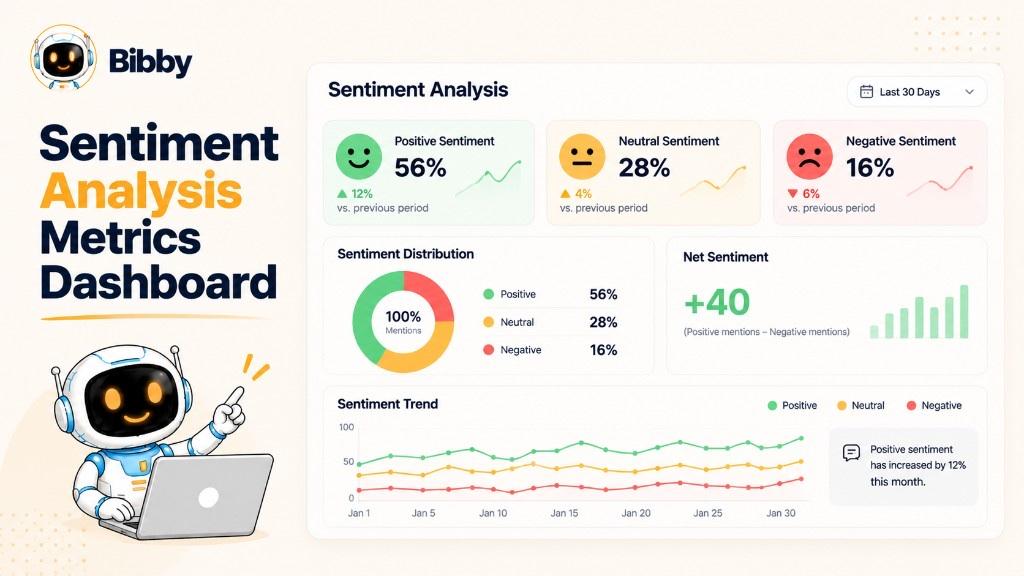
Sentiment analysis metrics help businesses turn large volumes of text into measurable insights. The exact metrics and calculations vary between platforms, so there is no single universal scoring system.
Positive Sentiment
Positive sentiment represents the share or number of analyzed conversations that express a favorable opinion. If a brand analyzes 1,000 relevant mentions and 650 are classified as positive, the positive sentiment share would be 65%.
A high percentage of positive sentiment does not automatically mean a campaign was successful. Consider it alongside reach, engagement, clicks, conversions, and conversation volume.
Negative Sentiment
If 120 out of 1,000 analyzed mentions are classified as negative, the negative sentiment share would be 12%. A rise in negative sentiment is a signal to examine the underlying conversations, not automatic proof that something has gone wrong.
Neutral Sentiment
Neutral sentiment represents text that does not contain a clearly favorable or unfavorable opinion.
For example:
“The company released its latest product update today.”
Sentiment Distribution
| Sentiment | Share |
|---|---|
| Positive | 64% |
| Neutral | 24% |
| Negative | 12% |
Sentiment distribution is especially useful when comparing campaigns, products, platforms, time periods, customer segments, or topics.
Sentiment Trend
Instead of looking at one snapshot, marketers can monitor sentiment across days, weeks, or months.
Week 1 → 62% positive
Week 2 → 67% positive
Week 3 → 71% positive
An upward trend could indicate increasingly favorable conversations, although marketers would still need to investigate the reasons.
Sentiment Volume
Volume provides important context because percentages alone can be misleading.
| Campaign | Positive sentiment | Positive mentions |
|---|---|---|
| Campaign A | 90% | 90 |
| Campaign B | 70% | 7,000 |
Campaign A has a higher positive percentage, but Campaign B generated far more positive conversations.
Net Sentiment
One commonly used calculation is:
Net Sentiment = Positive Mentions − Negative Mentions
For example, if a brand receives 70% positive mentions and 20% negative mentions, net sentiment would be 70 − 20 = +50.
Some platforms use different formulas. Check how a particular tool defines the score before comparing results.
Sentiment Score
Some AI systems assign a numerical sentiment score representing polarity, strength, probability, or confidence. These scores are model-specific and should not be assumed comparable across platforms.
Sentiment by Topic
| Topic | Positive | Negative |
|---|---|---|
| Ease of use | 82% | 8% |
| Features | 76% | 12% |
| Pricing | 41% | 44% |
| Customer support | 52% | 31% |
Sentiment by Social Platform
| Platform | Positive | Neutral | Negative |
|---|---|---|---|
| 68% | 21% | 11% | |
| 76% | 17% | 7% | |
| 61% | 27% | 12% | |
| YouTube | 64% | 20% | 16% |
Platform comparisons need care because audiences, formats, and conversation styles differ.
Why Sentiment Metrics Need Context
80% positive sentiment sounds strong, but it means something very different if only 10 people were analyzed compared with 100,000 conversations.
Interpret sentiment alongside conversation volume, engagement, reach, clicks, conversions, audience growth, campaign timing, topics, and individual examples of feedback.
Sentiment Analysis vs. Social Listening
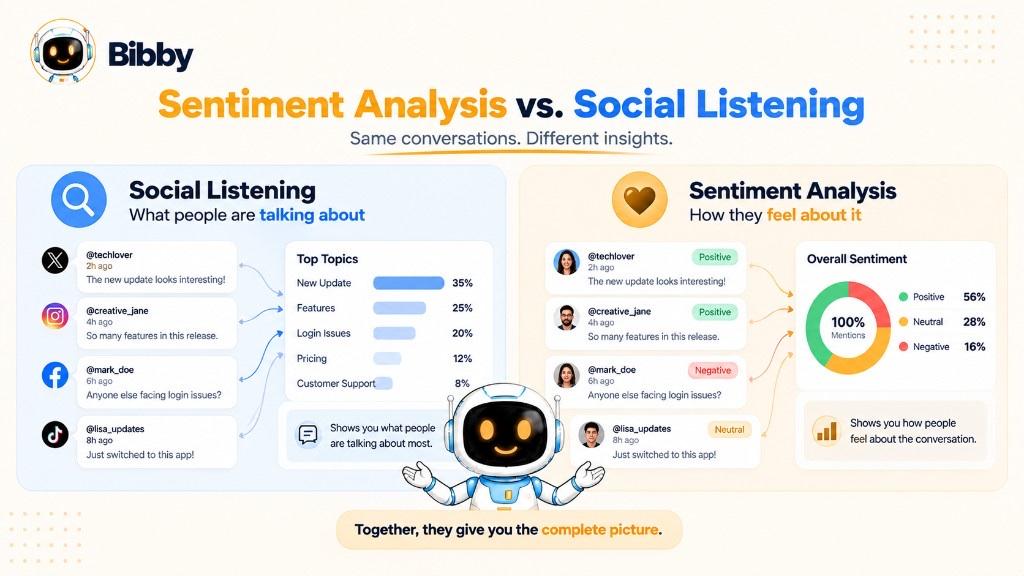
Sentiment analysis and social listening are closely related, but they are not the same thing. Sentiment analysis focuses primarily on determining the emotional tone or opinion expressed in text, while social listening is the broader practice of monitoring and analyzing conversations about a brand, product, topic, or industry.
In simple terms:
Social listening tells you what people are talking about. Sentiment analysis helps tell you how they feel about it.
Sentiment analysis can therefore be one component of a broader social listening strategy.
What Is Social Listening?
Social listening involves monitoring online conversations to discover what people are saying about a particular brand, product, topic, competitor, or industry.
A social listening strategy may track brand mentions, product mentions, keywords, hashtags, competitor conversations, industry topics, customer complaints, questions, trends, and audience discussions.
Key Difference Between Sentiment Analysis and Social Listening
| Sentiment Analysis | Social Listening |
|---|---|
| Analyzes emotional tone or opinion | Monitors broader online conversations |
| Often classifies text as positive, negative, or neutral | Tracks mentions, topics, keywords, trends, and conversations |
| Focuses on how people feel | Focuses on what people are saying and discussing |
| Can analyze sentiment within individual messages | Can analyze conversations across broader sources |
| Can be used as part of social listening | May include sentiment analysis as one analytical component |
Example of Social Listening With Sentiment Analysis
A social listening system might identify thousands of conversations containing a product name. It could reveal how many people are talking, where, which topics appear most often, and which competitors are mentioned.
Sentiment analysis can then add another layer:
- Positive conversations → 70%
- Neutral conversations → 20%
- Negative conversations → 10%
The business now has both conversation context and sentiment context.
Social Listening Is Broader Than Sentiment Analysis
A social listening workflow might look like:
Monitor conversations → Identify topics → Analyze sentiment → Find patterns → Interpret insights → Take action
Sentiment analysis represents one part of this workflow. A company could also analyze reviews, surveys, or support tickets without monitoring public social conversations.
If you want to know “Are people talking about our brand?”, social listening is relevant.
If you want to know “Are those conversations positive or negative?”, sentiment analysis is relevant.
If you want both, use them together.
Sentiment Analysis vs. Emotion Analysis
Sentiment analysis and emotion analysis both examine the feelings expressed in text, but they measure different things. Sentiment analysis generally determines whether an opinion is positive, negative, or neutral. Emotion analysis attempts to identify the specific emotion, such as happiness, anger, sadness, fear, or excitement.
Sentiment analysis asks, “Is the overall tone positive, negative, or neutral?” Emotion analysis asks, “What specific emotion is being expressed?”
Sentiment Analysis vs. Emotion Analysis: Key Differences
| Sentiment Analysis | Emotion Analysis |
|---|---|
| Measures overall sentiment | Identifies specific emotions |
| Commonly uses positive, negative, and neutral categories | May identify joy, anger, sadness, fear, surprise, and more |
| Focuses on polarity or general attitude | Focuses on emotional state |
| Useful for measuring overall audience perception | Useful for understanding the nature of emotional reactions |
Example: Positive Sentiment, Different Emotions
“I'm so excited about the launch!”
Sentiment: Positive
Emotion: Excitement
“Thank you for finally fixing the issue. I feel so relieved.”
Sentiment: Positive
Emotion: Relief
Both statements have positive sentiment, but the emotions expressed are different.
Example: Negative Sentiment, Different Emotions
“This service has been incredibly frustrating.” → Frustration
“I'm genuinely worried about what will happen to my account.” → Fear or concern
“I'm furious that nobody has responded to my messages.” → Anger
All three statements are negative, but the emotional states are different.
Which Should You Use?
Choose sentiment analysis when you primarily want to understand whether conversations are favorable, unfavorable, or neutral.
Use emotion analysis when you need more detail about the specific emotional reactions behind those conversations.
Sentiment → Overall direction of opinion
Emotion → Specific type of emotional response
Sentiment Analysis vs. Opinion Mining
Sentiment analysis and opinion mining are closely related, and the terms are sometimes used interchangeably. Sentiment analysis primarily determines the emotional polarity or tone of text, while opinion mining can involve identifying the opinions, viewpoints, attitudes, and subjects expressed within that text.
Sentiment analysis focuses on how positive or negative a statement is, while opinion mining focuses more broadly on what opinion is being expressed and what it is about.
Sentiment Analysis vs. Opinion Mining: Key Differences
| Sentiment Analysis | Opinion Mining |
|---|---|
| Focuses primarily on sentiment or polarity | Focuses more broadly on opinions and viewpoints |
| Commonly classifies text as positive, negative, or neutral | Can identify what is being discussed and what opinion is expressed |
| Answers “How does the person feel?” | Can answer “What does the person think about what?” |
| Often produces sentiment classifications or scores | Can extract subjects, aspects, opinions, and associated sentiment |
The exact terminology varies across research papers, software tools, and industries.
Example of Opinion Mining
“The phone has an excellent camera and beautiful design, but the battery doesn't last long and the price is too high.”
| Subject | Opinion | Sentiment |
|---|---|---|
| Camera | Excellent | Positive |
| Design | Beautiful | Positive |
| Battery | Doesn't last long | Negative |
| Price | Too high | Negative |
Sentiment analysis might classify the overall review as mixed or negative. Opinion mining extracts the specific subjects behind those opinions.
In some contexts, sentiment analysis is considered a component of opinion mining. In others, the two terms are used interchangeably.
Limitations of Sentiment Analysis
Sentiment analysis can process large amounts of text quickly, but it is not perfect. Human language is complex, contextual, and constantly changing.
1. Sarcasm Can Be Difficult to Detect
“Fantastic. Another update that broke the entire app.”
The word “Fantastic” normally suggests positive sentiment. The overall statement is clearly criticizing the update.
2. Context Matters
“This phone is sick.”
In one context, “sick” could describe something undesirable. In informal internet language, it could mean the phone is impressive.
3. Mixed Sentiment Can Be Difficult to Classify
“The design is beautiful, but the app is incredibly slow.”
A system that must assign only one overall label may struggle to represent both opinions accurately.
4. Slang and Internet Language Change Quickly
Social media users frequently use slang, abbreviations, acronyms, memes, informal expressions, and platform-specific language.
5. Emojis Can Have Different Meanings
“Great job 😂”
The laughing emoji could indicate genuine amusement, playful approval, or sarcasm depending on the surrounding conversation.
6. Negation Can Change the Meaning
“I like this product.” → Positive
“I don't like this product.” → Negative
7. Cultural and Linguistic Differences
Humor, sarcasm, politeness, and criticism can vary between cultural contexts. Multilingual sentiment analysis is more complicated than applying the same model to every language.
8. Domain-Specific Language Can Affect Accuracy
Words can have different meanings depending on the industry. Specialized fields may benefit from models designed for that domain.
9. Sentiment Does Not Explain the Reason
“I'm disappointed with the service.”
The sentiment is negative, but the reason could be slow delivery, poor support, product quality, pricing, or technical problems.
10. Automated Classification Can Produce Errors
No sentiment analysis system can guarantee that every classification is correct. Important business decisions should not rely on a single automated score without additional context.
11. Social Media Data Can Be Incomplete
A business may not have access to every conversation about its brand. A sentiment percentage should not automatically be interpreted as the sentiment of every person in the market.
12. High Sentiment Does Not Always Mean Business Success
People might enjoy a humorous campaign but never purchase the product. Likewise, a campaign could receive criticism while still generating sales. Sentiment is one business signal among many.
13. Sentiment Scores Can Be Misleading Without Context
90% positive sentiment immediately raises questions: How many conversations? Which platforms? What time period? How was sentiment classified? Was the data representative?
14. Human Judgment Still Matters
AI identifies patterns → Humans interpret context → Business takes action
Businesses can improve usefulness by using high-quality models, considering language and domain, analyzing sentiment alongside topics, reviewing important conversations manually, comparing sentiment with other metrics, and avoiding conclusions based on a single score.
How Accurate Is Sentiment Analysis?
The accuracy of sentiment analysis varies depending on the AI model, quality of the data, language, context, and type of text being analyzed. There is no single accuracy percentage that applies to every system or use case.
Simple statements such as “I love this product” are generally easier to classify than sarcasm, slang, mixed opinions, or ambiguous language.
What Affects Sentiment Analysis Accuracy?
- The AI or NLP model — Keyword-based systems struggle more with context than modern models.
- The quality of the data — Misspellings, slang, emojis, and mixed languages make analysis harder.
- Context — “This is just great.” could be praise or sarcasm.
- Sarcasm and humor — “Brilliant. The website is down again.”
- Mixed opinions — “I love the product, but the customer service is terrible.”
- Language and cultural differences
- Industry-specific language
How Can You Evaluate Sentiment Analysis Accuracy?
Create a sample of relevant text, have people manually classify the sentiment, and compare the automated system with those human classifications.
Common evaluation concepts include accuracy, precision, recall, F1 score, and confusion matrices.
A statement such as “this model is 95% accurate” is incomplete without knowing what data was tested, which languages were included, what categories were used, how large the test set was, and whether the data represented the intended use case.
No sentiment analysis system should be assumed to be 100% accurate across all real-world text.
Usefulness does not require perfect classification. A substantial increase in negative conversations around a product feature may be worth investigating even if the model is not correct about every individual comment.
How Businesses Use Sentiment Analysis
Businesses use sentiment analysis to understand opinions across reviews, social conversations, surveys, support messages, and other feedback.
Common applications include:
- Social media monitoring — How audiences perceive a brand, product, or campaign.
- Customer reviews — Patterns in quality, ease of use, shipping, pricing, or support.
- Customer support — Surface conversations that contain frustration for human review.
- Product feedback — What customers like or dislike about features.
- Market research — Naturally occurring digital conversations alongside surveys.
- Brand reputation management — Whether negative or positive discussions are increasing.
- Marketing campaign analysis — The tone of attention, not only the volume.
- Competitor analysis — Differences in audience perception (not a complete competitive analysis).
- Customer experience analysis — Which journey stages generate praise or frustration.
- Reputation and crisis detection — A sudden change is a signal to investigate, not a diagnosis by itself.
- Employee and internal feedback — Only with appropriate privacy and governance.
- Financial and investor sentiment — Not a standalone method for financial decisions.
- Content strategy — Which topics generate favorable reactions.
- Customer feedback prioritization — Organize volume so teams can review what matters.
A useful workflow:
Collect feedback → Analyze sentiment → Identify patterns → Investigate the underlying topics → Take action → Measure the result
Combine sentiment with customer satisfaction, sales, conversions, engagement, website analytics, support metrics, product usage, retention, and surveys. Sentiment rarely tells the complete story on its own.
How Marketers Can Use Sentiment Analysis
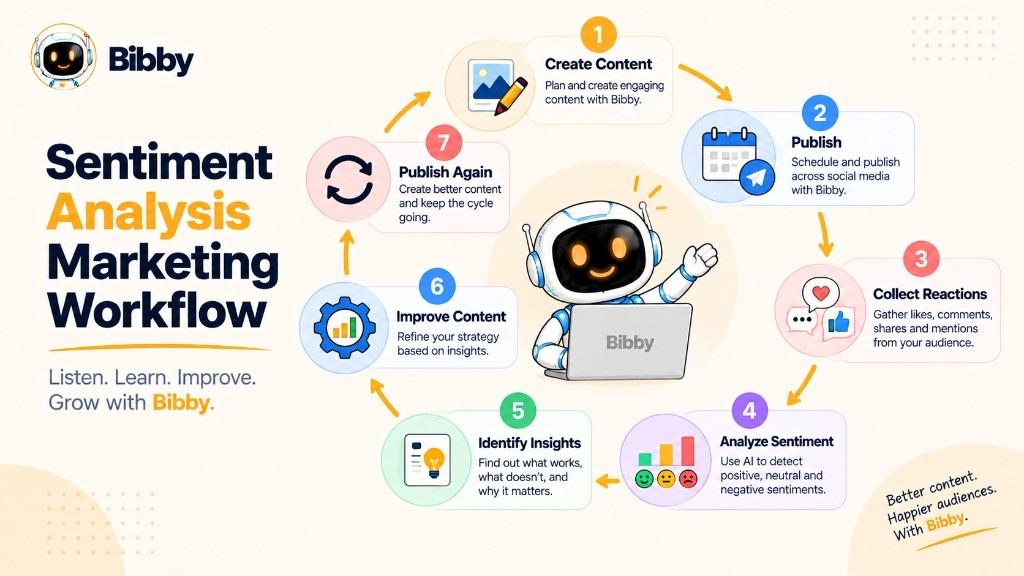
Marketers can use sentiment analysis before, during, and after a campaign to understand whether conversations are generally positive, negative, neutral, or mixed.
Practical uses include:
- Understand existing brand perception before launching.
- Analyze audience reactions after a campaign goes live.
- Identify content that resonates.
- Find problems with campaign messaging.
- Identify positive conversations that may be worth exploring as testimonials or UGC (without treating a label as automatic proof someone is a brand advocate).
- Monitor product launches before, during, and after.
- Track sentiment over weeks or months.
- Compare sentiment across social platforms.
- Use patterns as one input into a content calendar.
- Improve audience communication and community management.
- Identify emerging customer concerns.
- Measure brand sentiment after major announcements.
- Compare campaign concepts during testing.
- Combine sentiment with social media analytics.
| Metric | What it helps answer |
|---|---|
| Reach | How many people saw the content? |
| Engagement | How much did people interact? |
| Clicks | Did people take an action? |
| Conversions | Did the activity produce a desired outcome? |
| Sentiment | What was the tone of the conversation? |
Before, During, and After a Campaign
Before: Current perception, customer concerns, popular topics, positive and negative associations.
During: Audience reactions, emerging complaints, positive responses, changes in sentiment, conversation themes.
After: Overall sentiment, changes, campaign-related conversations, themes, and feedback.
How AI Is Changing Sentiment Analysis
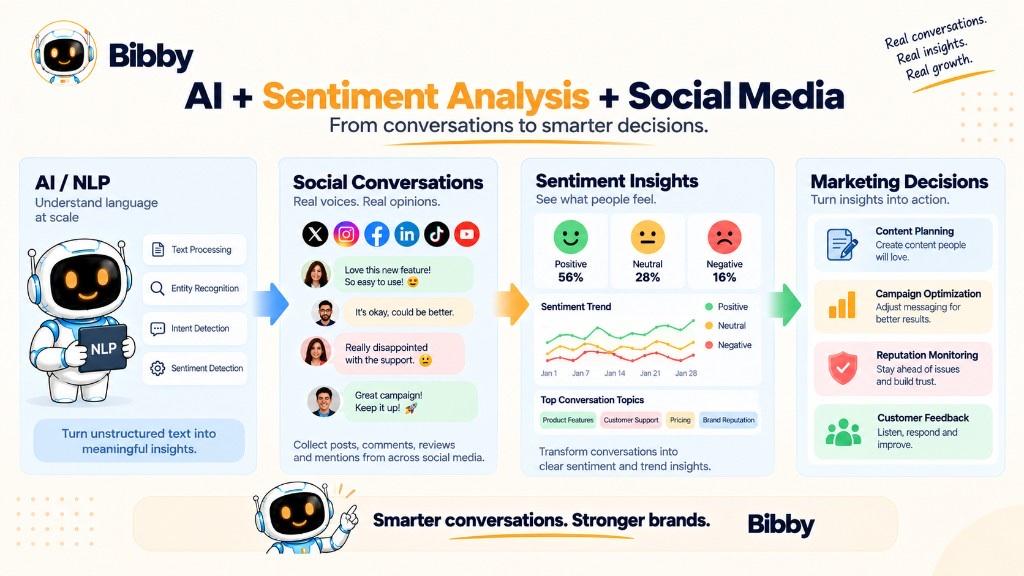
Earlier approaches often depended on predefined rules or dictionaries of positive and negative words. Modern AI systems can analyze context, relationships between words, language patterns, and broader meaning.
“I expected the update to be awful, but it turned out to be fantastic.”
A keyword-based approach could be confused by “awful.” A more context-aware system can recognize that the final opinion is positive.
AI can also support aspect-based analysis, process social signals such as hashtags and emojis, analyze large volumes of text, identify patterns across conversations, and—depending on the system—run near-real-time reviews. Large language models can sometimes help summarize *why* people are positive or negative, not only *that* they are.
Greater AI capability does not eliminate sarcasm, irony, cultural references, ambiguous language, humor, new slang, mixed sentiment, or limited context.
“Love spending my entire morning waiting for support.”
Treat AI-generated sentiment as an analysis or prediction, not an unquestionable statement of what a person feels.
AI analyzes large volumes of text → AI identifies sentiment patterns → Human reviews important findings → Business takes action
How Sentiment Analysis Can Improve Social Media Management
Sentiment analysis can make social media management more data-driven by helping marketers understand the tone and direction of audience conversations, not only publishing frequency or engagement numbers.
It can help teams:
- Understand audience response to content.
- Identify content that generates positive reactions.
- Detect negative reactions earlier.
- Improve campaign planning.
- Create more audience-centric content.
- Prioritize customer conversations for community review.
- Improve community management context.
- Compare different content formats carefully (sentiment alone cannot prove a format caused the reaction).
- Understand platform-specific audience reactions.
- Improve content repurposing.
- Support content decisions—without letting an AI system automatically decide everything a brand should publish.
- Improve brand messaging when combined with actual comment examples.
- Turn feedback into content ideas such as explainers, tutorials, or FAQs.
- Build a continuous optimization loop: Create → Publish → Listen → Analyze → Learn → Improve → Create again
Using Sentiment Insights With Publishing Tools
For teams managing social media at scale, sentiment analysis can become one input into a broader content workflow.
Bibby brings social media creation, caption generation, campaign management, and scheduling into a single workflow. Marketers can upload an image or generate one with AI, select a posting style, generate captions, and schedule content across supported social platforms. Chat with Bibby to create a brand kit, campaigns, posts, and caption variations.
Sentiment scoring itself is not part of that workflow. Analyze reactions in a listening or analytics tool, then use what you learn when you create and schedule the next posts in Bibby.
Audience conversations → Sentiment insights (in a listening tool) → Content idea → Creation and scheduling in Bibby → Audience response → New insights
Sentiment is valuable, but it should not become the only metric a social media team uses. Combine it with engagement, reach, impressions, clicks, conversions, audience growth, customer feedback, and content performance.
Sentiment helps answer:
“How are people reacting to what we are publishing or discussing?”
Engagement helps answer:
“How much are people interacting with it?”
Conversions help answer:
“Is that activity producing the desired business outcome?”
Sentiment Analysis in Social Media Marketing: Example
Consider a software company launching a new feature and promoting it across several social media platforms.
Step 1: Launch the Campaign
The campaign includes an announcement post, a product demonstration, an educational carousel, a short-form video, and a customer-focused post. Engagement data might show substantial attention. The team still needs to know whether the response was mostly positive or negative.
Step 2: Analyze Audience Conversations
| Sentiment | Share of conversations |
|---|---|
| Positive | 72% |
| Neutral | 18% |
| Negative | 10% |
The team does not stop at the percentages.
Step 3: Examine the Positive Sentiment
Customers frequently praise ease of use, time savings, the new interface, and the ability to automate repetitive tasks.
“This is exactly the feature I've been waiting for. It saves me so much time.”
Step 4: Investigate Negative Sentiment
Many negative comments are related to pricing rather than the feature itself.
“The feature looks great, but I'm not paying extra for it.”
Another group does not understand how to access the feature. That creates two issues: pricing concerns and product education concerns.
Step 5: Analyze Sentiment by Topic
| Topic | General sentiment |
|---|---|
| Ease of use | Mostly positive |
| Time savings | Mostly positive |
| Interface | Positive |
| Pricing | Mostly negative |
| Feature availability | Mixed |
| How to use the feature | Mixed |
Step 6: Analyze Sentiment by Content Type
| Content | General sentiment |
|---|---|
| Product demonstration | Highly positive |
| Educational carousel | Highly positive |
| Announcement | Positive |
| Short-form video | Positive |
| Promotional post | Mixed |
Audiences are responding particularly well to content that shows how the feature works.
Step 7–9: Adapt, Publish, and Re-Measure
The team creates tutorials, clarifies value, addresses pricing questions, and continues monitoring. Bibby can help create captions and schedule those follow-up posts. The new conversations are analyzed again in the listening tool.
An increase in positive sentiment is encouraging, but it does not automatically prove the new content caused the change. Consider audience composition, timing, exposure, and conversation volume.
The useful insight is not simply 70% positive. It is: the audience likes the feature's value proposition, but pricing and usability questions are creating negative reactions.
Publish content → Collect conversations → Analyze sentiment → Identify topics → Investigate feedback → Adjust content strategy → Publish again → Measure the response
Common Sentiment Analysis Use Cases
Sentiment analysis can be used anywhere businesses need to understand opinions in large volumes of text:
- Brand monitoring
- Social media monitoring
- Customer feedback analysis
- Product review analysis
- Customer service
- Brand reputation management
- Marketing campaign analysis
- Content strategy
- Product development
- Feature feedback
- Competitor analysis
- Market research
- Customer experience analysis
- Social media campaign monitoring
- Influencer and creator campaigns (alongside reach, engagement quality, clicks, conversions, and audience fit)
- Event and announcement monitoring
- Crisis and issue detection
- Survey analysis
- Employee feedback (with privacy and governance)
- Customer retention and churn *signals* (not a definitive prediction)
- Competitive product research
- Public opinion analysis (online conversations do not necessarily represent an entire population)
The most effective use depends on the question. Combine approaches when needed:
Sentiment + Topics → What people feel and what they are discussing
Sentiment + Engagement → The tone of audience interactions
Sentiment + Conversions → Perception versus business outcomes
Sentiment + Aspect Analysis → Which attributes drive opinions
Key Takeaway
Sentiment analysis is the process of analyzing text to determine whether the opinions or emotions expressed are positive, negative, neutral, or more specific categories of sentiment.
It uses techniques from AI, machine learning, and natural language processing (NLP) to process large amounts of text and identify patterns that would be difficult to analyze manually.
For businesses and marketers, sentiment analysis can help answer a question that engagement metrics alone cannot:
Are people reacting positively, negatively, or neutrally to what we are saying?
It can be applied to social media posts, comments, reviews, customer feedback, support conversations, surveys, and other digital text. However, it is not perfect. Sarcasm, context, slang, emojis, mixed opinions, cultural differences, and industry-specific language can make automated classification difficult. A sentiment score should be treated as a useful signal rather than an unquestionable fact.
A practical social media feedback loop looks like this:
Create → Publish → Collect reactions → Analyze sentiment → Understand the reasons → Improve → Publish again
With Bibby, marketers can manage the content side of that loop—creating or generating visuals and captions, organizing campaigns, and scheduling posts across selected social platforms. Sentiment insights from a listening or analytics tool can then help decide what to create next.
Used alongside human judgment and other marketing data, sentiment analysis can help businesses listen more effectively, respond more intelligently, and make better content and customer decisions.