
A follower is a user on social media who chooses to subscribe to an account and receive its content, such as posts, photos, videos, stories, and updates. When someone follows a brand, creator, influencer, or individual, that account becomes part of their social media network, although the platform's algorithm determines which content the follower actually sees in their feed.
Followers are an important part of building a social media presence because they represent the people who have shown an interest in an account and its content. However, follower count alone does not tell the whole story. A smaller audience of relevant and engaged followers can be more valuable to a business than thousands of inactive or unrelated accounts.
On platforms such as Facebook, Instagram, LinkedIn, TikTok, and YouTube, followers or subscribers can discover content, interact with posts, share content with others, and potentially become customers or long-term members of a brand's community. This makes follower growth, audience quality, and engagement important metrics for businesses and creators managing their social media strategy.
Consistently publishing useful content is one of the most practical ways to build and retain an audience. Social media automation tools such as Bibby can make this process easier by helping users create content, generate captions, schedule posts, and manage campaigns across multiple platforms from one workflow. Bibby's chat interface also lets users manage tasks such as creating a brand kit, building campaigns, creating posts, and regenerating captions through a simple conversation.
What Is a Follower on Social Media?
A follower on social media is a person or account that chooses to follow another account to stay connected with its content. When someone follows an account, they may see its posts, images, videos, stories, or other updates in their social media experience.
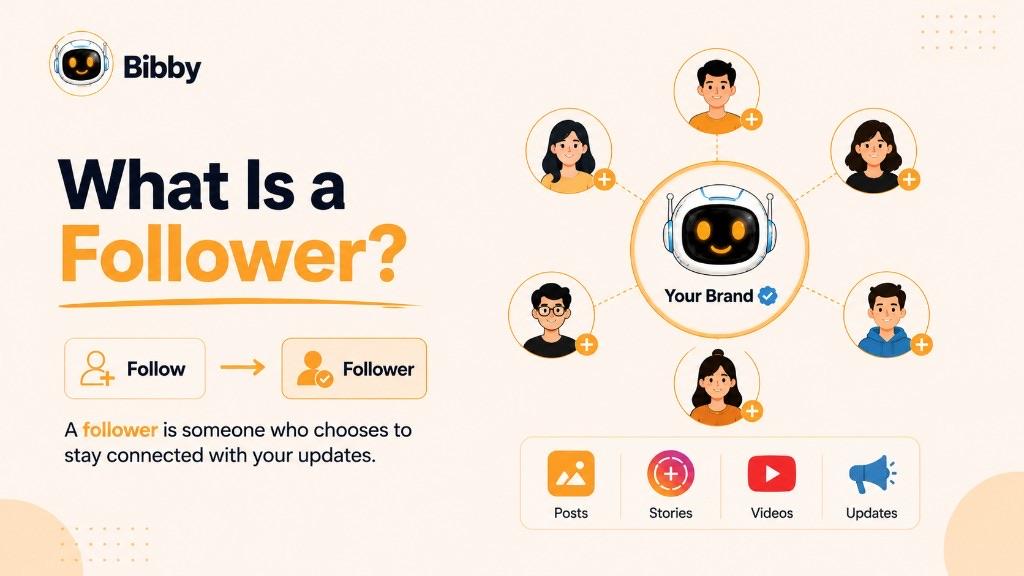
For example, if a user follows a clothing brand on Instagram, that brand's content may appear in the user's feed or recommendations. The follower can then interact with the content by liking, commenting, sharing, saving, or clicking on it.
Followers can include friends, customers, potential customers, fans, employees, industry professionals, creators, or other businesses. The type of follower an account attracts depends largely on its content, niche, audience, and social media strategy.
However, following an account does not guarantee that a user will see every piece of content it publishes. Social platforms use recommendation and feed-ranking systems to determine what content users are most likely to see based on factors such as their interests and previous interactions.
Followers on Different Social Media Platforms
The basic concept of following is similar across social networks, although each platform uses its own terminology and content distribution system.
- Facebook: Users can follow profiles, creators, pages, and businesses to receive their content in their feed.
- Instagram: Users can follow personal accounts, creators, influencers, and businesses and potentially see their posts, Reels, and Stories.
- LinkedIn: Users can follow people, companies, and organizations to stay informed about their professional content and updates.
- TikTok: Users can follow creators and accounts to receive more of their videos in their TikTok experience.
- YouTube: YouTube primarily uses the term subscriber rather than follower. Subscribers can receive updates from channels they subscribe to.
Why Do People Follow Social Media Accounts?
People follow accounts for many different reasons. They may want to:
- Keep up with friends or people they know
- Learn something useful
- Follow industry news and trends
- Discover products or services
- Watch entertaining content
- Follow creators or influencers
- Receive updates from a brand
- Find inspiration
- Participate in a community
- Stay connected with topics they care about
For businesses, understanding why people follow an account is often more useful than simply tracking how many followers it has. Creating content that consistently meets those expectations can help turn casual followers into an engaged audience.
How Do Followers Work?
The process of becoming a follower is simple. A user discovers an account, decides that its content is relevant or interesting, and taps the Follow button. The account is then added to the user's social media network.
After following an account, the user may have opportunities to see and interact with its content. However, social media platforms do not necessarily show every post to every follower. Feed and recommendation systems use various signals to decide which content appears in a user's feed or recommendations.
Here is how the follower process generally works:
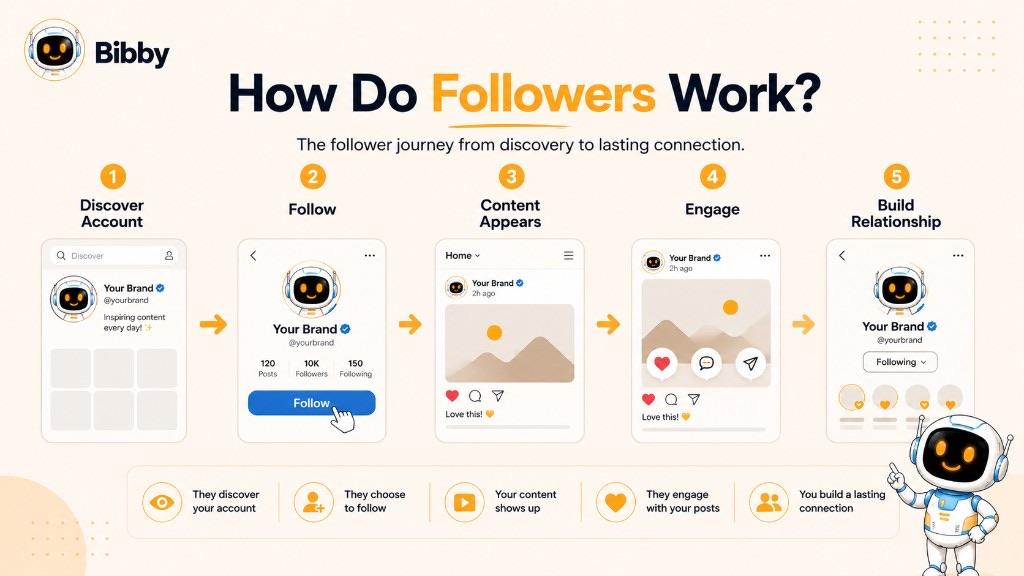
1. A User Discovers an Account
People can discover social media accounts through many sources, including:
- Search results
- Recommendations
- Explore or discovery pages
- Hashtags
- Shared posts
- Short-form videos
- Comments and conversations
- Friends and other accounts
- Social media advertising
- Links from websites and other channels
For businesses, discoverability is important because users need to find an account before they can become followers.
2. The User Follows the Account
If the user finds the account valuable or interesting, they can follow it. This creates a connection between the user and the account.
The reasons for following can vary. Someone might follow a business because they like its products, follow a creator for educational content, or follow an industry expert to keep up with professional insights.
3. The Platform Determines What Content to Show
Following an account does not mean that every post will automatically appear in the user's feed.
Social media platforms use their own ranking and recommendation systems to organize content. Factors such as previous interactions, content relevance, user behavior, and the type of content can influence what users see.
4. The Follower Sees and Interacts With Content
A follower may encounter different types of content depending on the platform and account, including:
- Image posts
- Carousels
- Videos
- Stories
- Reels and short-form videos
- Text updates
- Live content
Followers can then interact with that content through actions such as likes, comments, shares, saves, clicks, or direct messages.
5. The Relationship Can Continue Over Time
Following is not necessarily a one-time interaction. A follower may continue consuming an account's content, engaging with its posts, visiting its website, recommending the account to others, or eventually becoming a customer.
This is why businesses should focus on building an ongoing relationship with their audience, rather than treating follower count as the only measure of social media success.
Why Consistent Content Matters
A follower has chosen to connect with an account, but maintaining that relationship requires useful and consistent content. An account that rarely publishes may miss opportunities to remain visible, while an account that publishes valuable content consistently has more opportunities to engage its audience.
Tools such as Bibby can simplify this process by allowing users to create content, generate captions, schedule posts, and manage content across Facebook, Instagram, LinkedIn, YouTube, and TikTok from a single workflow. Its chat interface also allows users to manage tasks conversationally, including creating campaigns, building a brand kit, creating posts, and regenerating captions.
The goal is not simply to collect followers. The goal is to build an audience that continues to find value in what you publish.
Why Are Followers Important?
Followers are important because they represent people who have chosen to connect with a social media account. For businesses, creators, and organizations, followers can become an ongoing audience for content, announcements, educational resources, products, services, and brand stories.
However, follower count should not be treated as the only measure of social media success. The relevance of an audience, the level of engagement, and the actions followers take can be much more meaningful than a large number displayed on a profile.
Here are some of the main reasons followers matter:
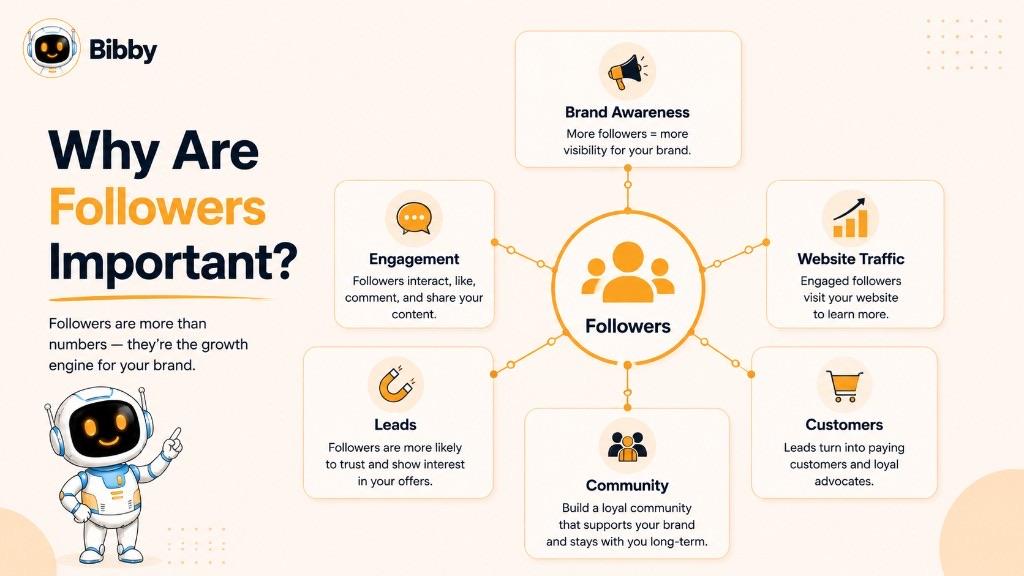
1. Followers Create a Potential Audience
Every follower represents an opportunity to reach someone with future content. When a business consistently publishes useful and relevant posts, its followers can become a recurring audience for that content.
For example, a fitness business might attract followers interested in workouts, nutrition, and wellness. Those followers may continue interacting with the business as it publishes new content.
2. Followers Can Increase Brand Awareness
A growing follower base can help a brand build recognition on social media. Followers may see the brand's content regularly and become more familiar with its products, services, personality, and expertise.
Followers can also expand awareness by sharing posts with their own networks, allowing content to reach people beyond the original audience.
3. Followers Can Support Engagement
Followers provide an initial audience for social media content. They can like, comment on, share, save, or otherwise interact with posts.
Strong engagement can help businesses understand what their audience finds useful or interesting. It can also create conversations that make a brand feel more accessible and active.
4. Followers Can Become Customers
Not every follower will become a customer, but relevant followers can represent potential prospects.
For example, someone who follows a software company because they are interested in its industry may eventually visit the company's website, sign up for a product, request a demo, or make a purchase.
This is why relevant followers are generally more valuable than followers acquired simply to increase a number.
5. Followers Can Build a Community
Social media can be more than a broadcasting channel. A strong follower base can develop into a community where people discuss ideas, ask questions, share experiences, and interact with a brand or creator.
Businesses can strengthen these relationships by responding to comments, answering questions, acknowledging their audience, and consistently publishing content that serves their community. That is part of community management.
6. Followers Provide Audience Insights
Follower behavior can help businesses understand their audience.
By reviewing social media performance, businesses can learn:
- Which topics attract the most attention
- Which content formats perform well
- What times audiences are most active
- Which posts generate conversations
- What content encourages sharing
- Which audiences are most responsive
These insights can help businesses refine their content strategy over time.
7. Followers Can Support Long-Term Social Media Growth
Social media growth is usually not about gaining followers once and stopping. It involves attracting relevant people, publishing consistently, keeping existing followers interested, and encouraging meaningful interactions.
A consistent publishing workflow can make this easier. Bibby helps businesses create and schedule social media content across platforms such as Facebook, Instagram, LinkedIn, YouTube, and TikTok. Users can upload their own media or generate images with AI, select a posting style, have captions generated automatically, and schedule content at AI-optimized times.
The important distinction is simple: followers provide potential reach, but valuable content and meaningful engagement determine how much that audience contributes to your social media presence.
Followers vs. Following
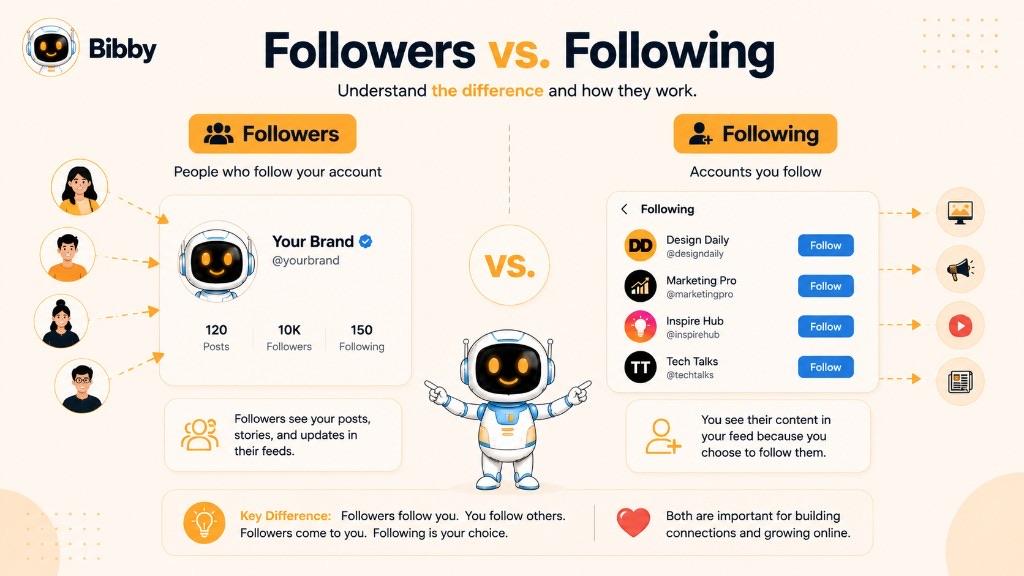
Followers and following describe two different sides of a social media relationship. Your followers are the people or accounts that follow you, while your following is the number of accounts you choose to follow.
The distinction is simple, but it can be confusing when you are new to social media.
| Followers | Following |
|---|---|
| Accounts that follow you | Accounts that you follow |
| They may see your content | You may see their content |
| Represents the size of your audience | Represents the accounts in your social network |
| Can engage with your posts | You can engage with their posts |
| Can potentially become customers or community members | Can include competitors, creators, customers, partners, or industry accounts |
What Are Followers?
Followers are users who have chosen to follow your social media account. For example, if 5,000 people follow your Instagram account, your account has 5,000 followers.
These users may encounter your posts, videos, Stories, or other content depending on the platform's feed and recommendation systems.
What Does Following Mean?
Following refers to the accounts that you have chosen to follow.
For example, if your Instagram profile follows 300 accounts, your following count is 300. Those accounts might include friends, brands, influencers, customers, competitors, or industry experts.
Simple Example
Imagine you create a social media account for a digital marketing agency.
- 10,000 followers means 10,000 accounts have chosen to follow your agency.
- 500 following means your agency account follows 500 other accounts.
The first number represents the size of your potential audience, while the second represents the accounts your profile has chosen to connect with.
Why the Difference Matters for Businesses
For businesses, follower count is often used as a basic indicator of audience size. However, the number of accounts you follow can also provide insight into how your brand participates in its social media community.
Following relevant accounts can help businesses:
- Keep up with industry trends
- Monitor competitors
- Discover content ideas
- Connect with partners
- Engage with customers
- Participate in industry conversations
- Build professional relationships
At the same time, businesses should avoid focusing exclusively on increasing their follower count. A smaller audience that genuinely cares about a brand can generate more meaningful interactions than a much larger inactive audience.
Followers, Following, and Engagement
These three concepts should not be confused:
Followers tell you how many accounts follow you.
Following tells you how many accounts you follow.
Engagement tells you how people interact with your content.
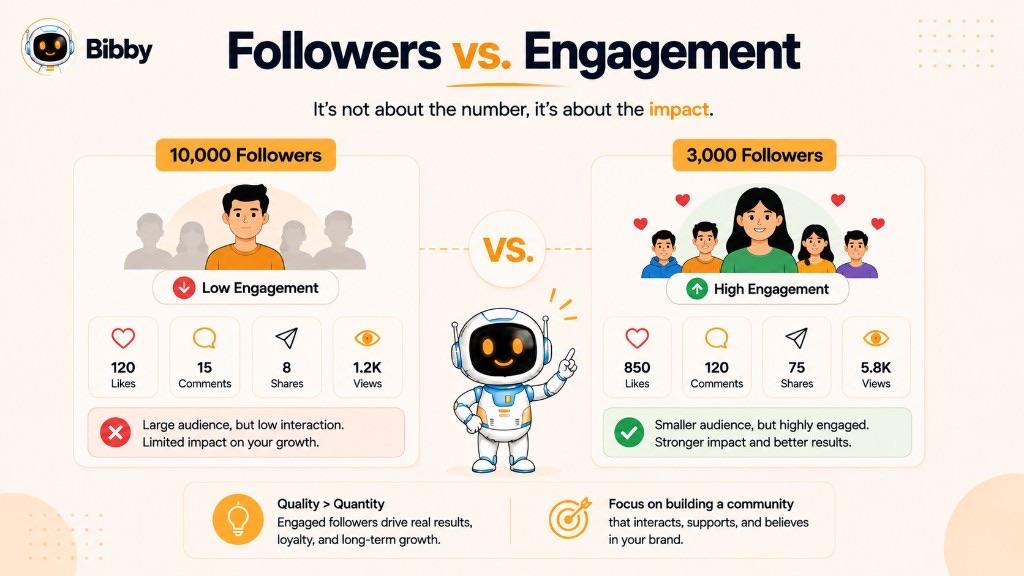
For example, an account might have 20,000 followers but receive very little engagement. Another account might have only 3,000 followers but generate frequent comments, shares, saves, and conversations.
For social media marketing, looking at all three provides a more complete picture than focusing on follower count alone.
Types of Social Media Followers
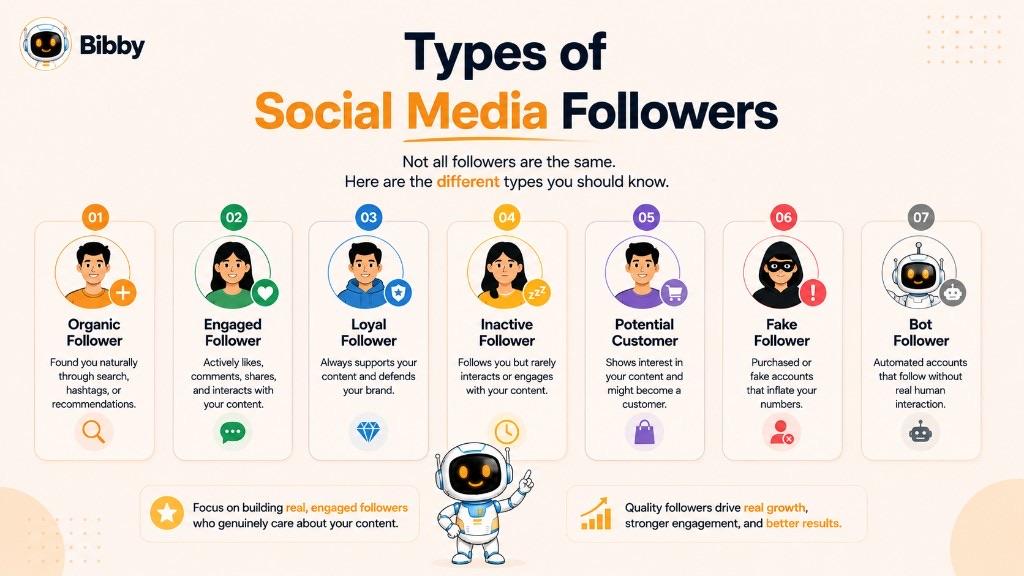
Not every follower has the same level of interest or value. Some followers actively engage with content, some may simply want occasional updates, and others may rarely interact with an account after following it.
Understanding different types of followers can help businesses and creators look beyond follower count and focus on building an audience that is genuinely interested in their content.
1. Organic Followers
Organic followers are people who discover and follow an account naturally rather than through artificial follower-generation methods.
They may find an account through:
- Search
- Recommendations
- Shared content
- Hashtags
- Valuable posts
- Videos
- Social media conversations
- Word of mouth
Organic followers are generally valuable because their decision to follow is based on genuine interest.
2. Engaged Followers
Engaged followers regularly interact with an account's content. They may like posts, leave comments, share content, save posts, respond to Stories, watch videos, or visit links.
These followers can be particularly valuable to businesses because engagement provides signals about what an audience finds useful or interesting.
For example, a follower who regularly comments on a software company's educational posts may have a stronger relationship with the brand than someone who follows the account but never interacts with its content.
3. Loyal Followers
Loyal followers consistently support an account over an extended period.
They may:
- Regularly consume content
- Recommend the brand to others
- Share posts
- Participate in discussions
- Purchase products or services
- Return to the account for new content
- Defend or advocate for the brand
Loyal followers can become an important part of a brand's online community.
4. Inactive Followers
Inactive followers have followed an account but rarely interact with its content.
There can be many reasons for inactivity. A user may have changed their interests, stopped using the platform regularly, or simply no longer find the account's content relevant.
A large number of inactive followers can make follower count less useful as a measure of actual audience engagement.
5. Potential Customer Followers
A potential customer follower is someone who follows a business because they have an interest in its products, services, or industry.
For example, someone following a web development company because they are researching app development services could eventually become a lead.
However, following a business does not automatically mean that a person intends to buy from it. Businesses still need useful content, trust-building interactions, and an effective customer journey to turn interest into action.
6. Fake Followers
Fake followers are accounts that do not represent genuine people interested in an account's content. They may be created specifically to inflate follower numbers or generated through artificial services.
Fake followers can make an account appear more popular than it actually is and can make social media performance harder to evaluate accurately.
7. Bot Followers
Bot followers are automated accounts operated by software rather than genuine users.
Some automated accounts may follow large numbers of profiles without having a genuine interest in their content. Bot activity can therefore create a misleading picture of an account's actual audience.
Why Follower Quality Matters
A social media account with 10,000 followers is not necessarily more successful than one with 2,000 followers.
Consider two hypothetical businesses:
Business A
- 10,000 followers
- Very little interaction
- Many inactive accounts
Business B
- 2,000 followers
- Frequent comments and shares
- Strong customer interaction
- Highly relevant audience
Depending on the business objective, Business B may have a much more valuable social media audience.
This is why social media strategies should focus on attracting relevant followers, creating valuable content, and encouraging genuine engagement, rather than simply maximizing the follower number.
Consistent content plays an important role in this process. With a tool such as Bibby, businesses can create and schedule images, carousels, videos, Stories, and other social media content across multiple platforms, helping them maintain an active publishing workflow without managing every post manually.
What Is a Good Follower?
A good follower is not simply someone who adds to an account's follower count. For a business or creator, a valuable follower is someone who has a genuine interest in the account, finds its content useful, and is likely to engage with or act on that content.
The value of a follower depends on the account's goals. A local restaurant may value followers who live nearby, while a B2B software company may care more about followers who work in its target industry.
Characteristics of a Valuable Follower
A relevant and valuable follower may have several of these characteristics:
- Genuine: The account represents a real person or organization.
- Relevant: The follower has an interest in the account's niche, products, services, or content.
- Engaged: They interact with posts through comments, likes, shares, saves, views, or clicks.
- Interested: They continue consuming content instead of following and immediately becoming inactive.
- Potentially valuable: They may become a customer, subscriber, partner, advocate, or member of the community.
- Responsive: They participate in conversations and respond to relevant content.
- Long-term: Their interest remains consistent rather than disappearing after a short period.
Are All Followers Equally Valuable?
No. Follower value depends heavily on relevance and behavior.
Imagine an online accounting software company has two audiences:
Audience A: 50,000 followers who have little interest in accounting software.
Audience B: 5,000 followers who are business owners, accountants, and finance professionals actively interested in the company's content.
Audience B may be significantly more valuable from a business perspective, even though it is much smaller.
This is why businesses should avoid treating follower count as a vanity scoreboard. A growing number can be encouraging, but it does not automatically translate into engagement, leads, or revenue.
What Makes a Follower Valuable to a Business?
For many businesses, the most valuable followers are people who match the company's target audience and have a genuine reason to care about its content.
For example, a fitness studio might benefit more from followers who live in its service area and are interested in fitness than from thousands of unrelated accounts from around the world.
Businesses can improve follower quality by:
- Defining their target audience
- Publishing content for specific audience needs
- Sharing useful educational or entertaining content
- Maintaining a consistent posting schedule
- Participating in relevant conversations
- Responding to comments and messages
- Analyzing which content attracts the right audience
- Avoiding artificial follower-growth tactics
Follower Quality and Content Consistency
Attracting the right followers is only the beginning. Businesses also need to give those followers a reason to stay.
Consistent, relevant content helps keep an account active and gives followers more opportunities to interact with the brand.
This is where social media automation can reduce some of the manual work. Bibby allows businesses to upload their own media or generate images with AI, choose a posting style, automatically generate captions, and schedule content across platforms such as Facebook, Instagram, LinkedIn, YouTube, and TikTok.
The objective is not to accumulate the biggest possible follower count. It is to build an authentic audience that finds ongoing value in what you publish.
Followers vs. Engagement
Followers and engagement are related, but they measure different things on social media. Followers represent the number of people or accounts that have chosen to follow an account, while engagement represents how those users interact with its content.
Understanding the difference is important because a large follower count does not automatically mean that an account has an active or interested audience.
What Is Follower Count?
Follower count is the number of accounts currently following a social media profile, page, creator, or brand.
For example, if an Instagram business account has 8,000 followers, its follower count is 8,000.
Follower count can help indicate the potential size of an account's audience, but it does not show how many followers actively see, interact with, or respond to each post.
What Is Social Media Engagement?
Social media engagement refers to actions users take in response to content.
Depending on the platform, engagement can include:
- Likes and reactions
- Comments
- Shares
- Reposts
- Saves
- Video views
- Story interactions
- Link clicks
- Profile visits
- Direct messages
These actions can provide a clearer indication of how an audience responds to content.
Why More Followers Do Not Always Mean More Engagement
Imagine two social media accounts:
Account A
- 50,000 followers
- 100 average comments and reactions per post
Account B
- 8,000 followers
- 500 average comments and reactions per post
Account A has the larger audience, but Account B may have a more active and engaged community.
There can be many reasons for this difference. Some followers may be inactive, the content may not match the audience's interests, posting may be inconsistent, or the account may have accumulated followers who are not genuinely interested in its content.
Followers Provide Potential Reach
Followers can be thought of as a potential audience. They have chosen to connect with an account, giving the account an opportunity to reach them with future content.
However, potential reach is different from actual reach.
A follower may not see a particular post because of platform algorithms, their own activity, the timing of the post, the type of content, or other factors.
Engagement Shows Audience Response
Engagement helps answer a different question:
"What are people doing with the content they see?"
If followers regularly comment, share, save, click, or respond to posts, it can indicate that the content is relevant or valuable to them.
For businesses, this information can be useful when deciding which topics, formats, and content styles to produce more often.
Should Businesses Focus on Followers or Engagement?
Ideally, businesses should track both.
Follower growth helps measure whether the potential audience is expanding.
Engagement helps measure how that audience interacts with the content.
Other metrics, such as reach, impressions, clicks, conversions, and leads, can provide additional context.
The right metrics ultimately depend on the business's goals. A brand focused on awareness may prioritize reach and audience growth, while a business generating leads may care more about clicks, conversations, and conversions.
How Consistent Publishing Can Help
Building an engaged audience usually requires more than publishing occasionally. Businesses need a consistent flow of relevant content that gives followers reasons to return and interact.
Bibby helps simplify this workflow by allowing users to upload media or generate images with AI, choose a posting style, automatically generate captions, and schedule content at AI-optimized times across selected social platforms.
Users can also manage social media through Bibby's chat interface, including creating posts and campaigns, building a brand kit, and regenerating captions.
The key takeaway is simple: followers tell you how large your potential audience is, while engagement helps show how that audience responds to your content.
How to Get More Followers
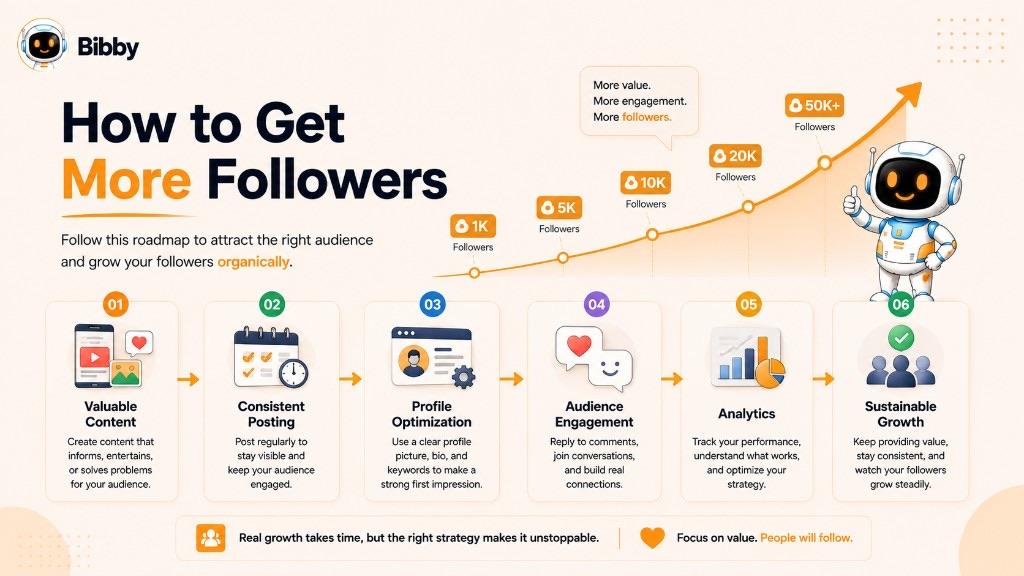
Getting more followers on social media starts with giving people a genuine reason to follow your account. There is no single tactic that works for every business or platform. Sustainable follower growth usually comes from a combination of valuable content, consistent publishing, audience engagement, strong branding, and making your account easy to discover.
The goal should not be to collect followers as quickly as possible. Instead, focus on attracting relevant followers who are genuinely interested in your content, products, services, or industry.
1. Create Content Your Audience Wants
People are more likely to follow an account when they consistently find its content useful, entertaining, educational, or inspiring.
Start by identifying the questions, problems, interests, and goals of your target audience.
Depending on your business, useful content could include:
- Educational tips
- How-to guides
- Industry insights
- Product demonstrations
- Behind-the-scenes content
- Customer stories
- Tutorials
- Short-form videos
- Infographics
- Carousels
- Frequently asked questions
The stronger the connection between your content and your audience's interests, the more reasons people have to follow.
2. Post Consistently
An account that publishes consistently has more opportunities to be discovered and stay relevant to its audience.
Consistency does not necessarily mean posting several times every day. A sustainable schedule that your team can maintain is usually more useful than publishing heavily for a short period and then disappearing.
A content calendar can help you plan:
- What to publish
- When to publish
- Which platform to use
- Which content format to choose
- Which campaign or content pillar the post belongs to
3. Optimize Your Social Media Profile
Your profile is often one of the first places a potential follower looks before deciding whether to follow you.
Make sure your profile clearly communicates:
- Who you are
- What you offer
- Who your content is for
- Why someone should follow you
- How people can contact you
- Where people can learn more
Use recognizable branding, a clear profile image, a useful bio, and relevant links.
4. Use Strong Visual Content
Visual content can help accounts capture attention in crowded social feeds.
Depending on the platform and audience, experiment with:
- Images
- Carousels
- Videos
- Stories
- Short-form videos
- Infographics
- Product visuals
- Educational graphics
The format should support the message rather than being used simply because it is popular.
5. Write Better Captions
A strong visual can attract attention, but the caption can provide context and encourage people to take action.
Good captions can:
- Explain an idea
- Tell a story
- Provide additional information
- Ask a relevant question
- Encourage discussion
- Include a useful call to action
Captions should sound natural and match the brand's voice.
6. Engage With Your Existing Audience
Follower growth is not only about attracting new people. Your existing audience can also help your account grow.
Respond to comments and messages, participate in relevant discussions, acknowledge useful contributions, and encourage conversations around your content.
When people have positive interactions with an account, they may be more likely to continue following it and recommend it to others.
7. Make Your Content Discoverable
Help potential followers find your content through relevant discovery mechanisms.
Depending on the platform, this can include:
- Relevant keywords
- Hashtags
- Search-friendly profile information
- Shareable content
- Collaborations
- Trending topics that genuinely fit your niche
- Cross-promotion
- Links from other digital channels
Avoid stuffing content with unrelated keywords or hashtags simply to attract attention.
8. Understand What Performs Best
Use analytics to identify patterns in your content.
Look at metrics such as:
- Reach
- Engagement
- Shares
- Saves
- Comments
- Video views
- Profile visits
- Link clicks
- Follower growth
If certain topics consistently attract the right audience, consider developing more content around those themes.
9. Build Content Around Different Content Pillars
Instead of repeatedly publishing the same type of post, create several content pillars that support your overall strategy.
For example, a software company might use:
- Educational content
- Product tips
- Industry trends
- Customer stories
- Company updates
This creates variety while keeping the account focused.
10. Automate Repetitive Social Media Tasks
Creating and publishing content consistently can become time-consuming when you manage multiple platforms manually.
Bibby brings much of this workflow into one place. You can upload your own image or generate an image with AI, choose your posting style, and let Bibby generate captions automatically. You can then schedule content at AI-optimized times across selected platforms, including Facebook, Instagram, LinkedIn, YouTube, and TikTok.
Bibby also supports different content formats, including images, carousels, videos, and Stories. Its chat interface allows users to manage social media tasks conversationally, such as creating a brand kit, launching a campaign, creating posts, and regenerating captions.
Automation does not guarantee follower growth. What it can do is make consistent publishing easier, giving businesses more time to focus on creating valuable content and building genuine relationships with their audience.
11. Avoid Artificial Follower Growth
Buying followers or relying on artificial engagement may increase a number on your profile, but it does not necessarily create a real audience.
Instead, focus on:
Relevant content + consistent publishing + genuine engagement + audience understanding = sustainable follower growth
The strongest follower base is not necessarily the biggest one. It is the one that contains people who actually care about what your account publishes.
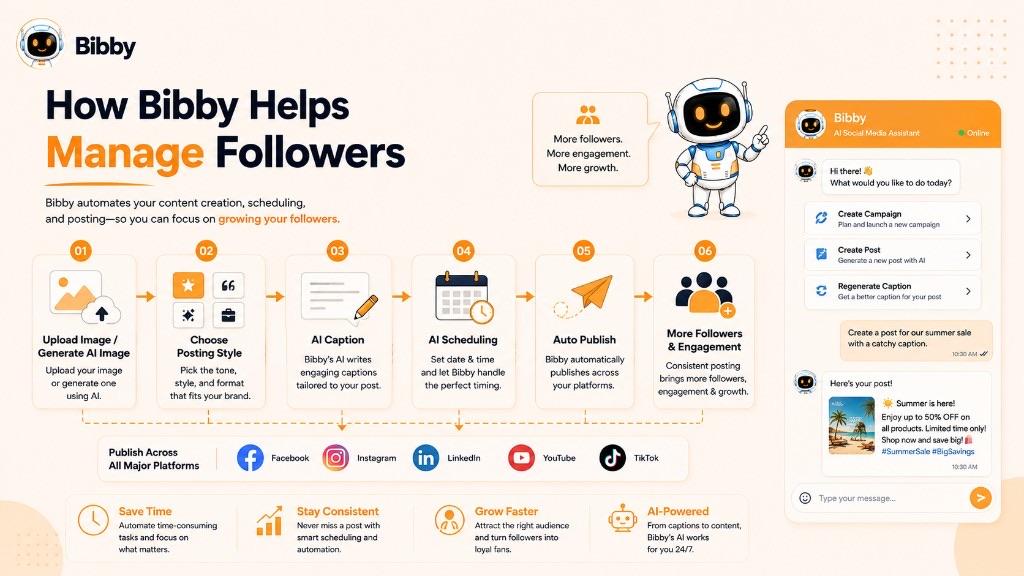
How Bibby Helps You Manage Your Followers
Growing a social media audience requires more than simply gaining new followers. Once people follow an account, businesses need to keep publishing relevant content, maintain a consistent presence, engage their audience, and manage multiple social channels efficiently.
Bibby helps simplify this process by bringing content creation, caption generation, scheduling, campaign management, and social media tasks into one workflow.
Instead of switching between different tools for every part of your social media process, you can manage much of the work through Bibby's AI-powered platform and conversational chat interface.
Create Content for Your Social Media Audience
Consistent content gives followers a reason to keep paying attention to your account.
With Bibby, you can upload your own image or generate an image with AI and then choose the posting style you want. Bibby can automatically generate a caption based on your content and selected style.
You can create different types of social media content, including:
- Images
- Carousels
- Videos
- Stories
- Other supported social media formats
This makes it easier to maintain a varied content mix instead of repeatedly publishing the same type of post.
Schedule Posts Across Multiple Platforms
Managing several social media accounts manually can quickly become repetitive.
Bibby allows you to schedule content across selected platforms, including:
- YouTube
- TikTok
You can plan your content in advance rather than creating and publishing every post individually.
Bibby's scheduling workflow also uses AI-optimized posting times to help you plan when content should be published.
Generate Captions Automatically
Writing captions for every social media post can take significant time, especially when managing multiple platforms.
Bibby can generate captions automatically based on your content and selected posting style. If the result does not match what you want, you can regenerate the caption and continue refining it.
This can help reduce repetitive caption-writing work while keeping your publishing workflow moving.
Manage Social Media Through Chat
One of Bibby's more flexible features is its chat interface.
Instead of navigating through multiple menus for every task, you can interact with Bibby conversationally to manage your social media workflow.
Inside the chat interface, you can:
- Create a brand kit
- Create campaigns
- Create posts
- Regenerate captions
- Manage content
- Work on social media tasks through conversation
This makes social media management feel less like operating a collection of separate tools and more like working with a digital social media assistant.
Build a Consistent Publishing Workflow
Consistency is important when maintaining relationships with followers. However, businesses often struggle to publish regularly because content creation, caption writing, scheduling, and platform management can consume a significant amount of time.
Bibby brings these tasks into a connected workflow:
Upload or generate an image → Choose a posting style → Generate a caption → Schedule content → Publish across selected platforms
This workflow can help businesses spend less time on repetitive publishing tasks and more time developing content that their audience actually wants to see.
Manage Multiple Content Formats
Followers do not necessarily want to see the same type of content repeatedly. A social media strategy can include a mixture of formats depending on the platform and audience.
Bibby supports workflows for content such as:
- Single-image posts
- Carousels
- Videos
- Stories
Using multiple formats can help businesses experiment with different ways of communicating with their audience.
Use Automation Without Losing the Human Strategy
Social media automation is most useful when it supports a clear content strategy rather than replacing it.
Bibby can handle repetitive parts of the workflow, such as generating captions and scheduling content, while businesses can continue deciding:
- Who they want to reach
- What topics they want to discuss
- What their brand should sound like
- Which campaigns they want to run
- What goals they want to achieve
- How they want to engage with followers
The result is a more efficient way to manage social media without treating follower growth as a numbers-only game.
Bibby's purpose is not to manufacture followers. It is to help you consistently show up for the audience you are trying to build.
Can More Followers Help a Business Grow?
Yes, more relevant followers can create more opportunities for business growth, but follower count alone does not guarantee more customers, revenue, or engagement.
A follower is someone who has chosen to connect with a social media account. This gives a business an opportunity to communicate with that person through future content. When the followers are genuinely interested in the brand, products, services, or industry, that audience can become an important part of the customer journey.
The relationship can look like this:
Relevant followers → content exposure → engagement → interest → website visits or conversations → potential customers
However, this is not an automatic process. Businesses need valuable content, consistent communication, a strong offer, and an effective path for turning interest into action.
How Followers Can Support Business Growth
1. Increasing Brand Awareness
A larger relevant audience gives a business more opportunities to introduce people to its brand.
Followers may encounter:
- Product announcements
- Educational content
- Company updates
- Industry insights
- Customer stories
- Promotions
- Behind-the-scenes content
Over time, repeated exposure can help people become more familiar with the brand.
2. Creating Opportunities for Engagement
Followers can interact with content through comments, shares, saves, reactions, clicks, and messages.
These interactions can help businesses understand what their audience cares about and create opportunities for direct conversations.
For example, a potential customer commenting on a post about a business problem may create an opportunity for the company to answer a question and continue the conversation.
3. Driving Website Traffic
Social media followers can become website visitors when content gives them a clear reason to click through.
Businesses can direct audiences toward:
- Product pages
- Service pages
- Blog articles
- Landing pages
- Sign-up forms
- App downloads
- Product demos
- Contact pages
The effectiveness of this approach depends on the relevance of the audience and the quality of the content and offer.
4. Generating Leads
For businesses that sell products or services, followers can potentially become leads.
A follower might:
- Discover a business on social media.
- Follow the account.
- Consume its content over time.
- Develop interest or trust.
- Visit the website.
- Submit an inquiry or request more information.
- Eventually become a customer.
Not every follower will complete this journey, but a relevant social audience can create more opportunities for potential customers to enter it.
5. Building Customer Relationships
Social media gives businesses a channel for maintaining relationships after someone discovers the brand.
Companies can use content to answer common questions, share useful information, introduce new products, highlight customers, and communicate their brand personality.
This can help turn social media from a simple promotional channel into an ongoing customer communication channel.
6. Encouraging Word-of-Mouth Growth
Engaged followers can share content with their own networks.
A useful post, interesting video, product recommendation, or customer story can reach people who do not currently follow the business.
This creates another potential path for audience growth:
Follower → Engagement → Share → New audience → Potential new follower
Why Follower Quality Matters More Than Follower Count
Consider two businesses:
Business A
- 100,000 followers
- Low engagement
- Little audience relevance
- Few website visits
Business B
- 10,000 followers
- Highly relevant audience
- Strong engagement
- Regular website traffic
Depending on their objectives, Business B could generate significantly more business value from its social audience.
This is why businesses should avoid setting follower count as their only social media KPI. Other metrics such as engagement, reach, clicks, leads, conversions, and revenue can provide a much clearer picture of business impact.
Can Social Media Automation Help?
Consistent publishing can make it easier for businesses to remain visible to their audience, but creating and scheduling content manually across several platforms can become time-consuming.
Bibby helps streamline this workflow. Users can upload their own media or generate images with AI, choose a posting style, have captions generated automatically, and schedule content across Facebook, Instagram, LinkedIn, YouTube, and TikTok at AI-optimized times.
Bibby also provides a chat interface where users can create campaigns, build a brand kit, create posts, regenerate captions, and manage other social media tasks through conversation.
Automation does not guarantee more followers or customers. Its value is in reducing repetitive work so businesses can maintain a consistent social media presence while focusing on content quality, audience relevance, engagement, and business goals.
Ultimately, the goal should not be to collect the largest possible number of followers. The goal is to build an audience that is relevant, engaged, and capable of contributing to long-term business growth.
How Do You Measure Follower Growth?
Follower growth measures how the number of followers on a social media account changes over time. Tracking this metric can help businesses and creators understand whether their audience is expanding, staying stable, or declining.
However, simply looking at the total follower count is not enough. A more useful analysis considers new followers, unfollows, growth rate, engagement, and audience quality.
1. Total Follower Count
The simplest follower metric is your current follower count.
For example:
- January: 5,000 followers
- February: 5,400 followers
- March: 5,900 followers
The account gained 900 followers between January and March.
Total follower count provides a quick snapshot of audience size, but it does not explain *why* the number changed or whether the new followers are relevant and engaged.
2. New Followers
New followers are the accounts that started following you during a specific period.
Tracking new followers can help you identify whether your content, campaigns, collaborations, or other activities are attracting new audiences.
For example, if a business publishes a particularly successful campaign and sees a significant increase in new followers afterward, the campaign may have contributed to audience discovery.
However, follower growth should be analyzed alongside other metrics before drawing conclusions.
3. Unfollows
An unfollow occurs when someone stops following an account.
Some level of follower loss is normal. People may unfollow accounts because their interests change, they reduce their social media usage, or they no longer find the content relevant.
A sudden increase in unfollows may be worth investigating.
Businesses can review:
- Recent content
- Posting frequency
- Changes in brand messaging
- Promotional campaigns
- Audience targeting
- Content relevance
The goal is not necessarily to eliminate every unfollow, but to understand meaningful changes in audience behavior.
4. Net Follower Growth
Net follower growth shows how many followers an account gained after accounting for unfollows.
The basic formula is:
Net Follower Growth = New Followers − Unfollows
For example:
- New followers: 800
- Unfollows: 200
- Net growth: 600 followers
This provides a more useful picture than looking only at the number of new followers.
5. Follower Growth Rate
Follower growth can also be expressed as a percentage.
A simple formula is:
Follower Growth Rate = (Net New Followers ÷ Starting Followers) × 100
For example, if an account starts a month with 10,000 followers and gains 500 net followers:
(500 ÷ 10,000) × 100 = 5%
The account experienced a 5% follower growth rate during that period.
Using percentages makes it easier to compare growth across accounts or across different time periods.
6. Engagement From Followers
Follower growth becomes more meaningful when you examine what those followers do after joining your audience.
Track metrics such as:
- Likes and reactions
- Comments
- Shares
- Saves
- Video views
- Story interactions
- Link clicks
- Profile visits
- Direct messages
If follower numbers are increasing but engagement is consistently declining, it may indicate that the growing audience is not highly relevant or active.
7. Reach and Impressions
Reach measures the number of unique users who are exposed to content, while impressions generally represent the number of times content is displayed.
These metrics help put follower count into context.
An account can reach people who do not follow it through recommendations, shares, search, advertising, or other discovery mechanisms. Likewise, not every follower will necessarily see every post.
8. Follower Quality
Follower growth should also be evaluated based on who is following you.
Ask questions such as:
- Are these followers part of the target audience?
- Are they engaging with content?
- Are they interested in the business's niche?
- Are they visiting the website?
- Are they becoming leads or customers?
- Are they staying engaged over time?
A smaller number of highly relevant followers can provide more business value than a much larger but disconnected audience.
9. Track Growth Over Time
Avoid judging follower growth from a single day or post.
Instead, compare performance across consistent periods, such as:
- Week over week
- Month over month
- Quarter over quarter
Look for patterns and connect changes in follower growth with specific activities, including content campaigns, product launches, collaborations, advertising, or changes in publishing frequency.
Use Consistent Publishing to Support Your Analysis
When businesses publish inconsistently, it can be difficult to understand what is driving follower growth.
A consistent content workflow creates a clearer basis for comparison.
Bibby can help businesses maintain that workflow by allowing them to upload media or generate images with AI, create captions automatically, choose posting styles, and schedule content across Facebook, Instagram, LinkedIn, YouTube, and TikTok.
Its chat interface can also help users create campaigns, create posts, build a brand kit, and regenerate captions without having to manage every task separately.
The important point is that follower growth is a metric, not the final goal. The strongest analysis combines follower growth with engagement, reach, audience relevance, traffic, leads, and other metrics connected to the account's objectives.
What Is Organic Follower Growth?
Organic follower growth is the process of gaining social media followers naturally, without buying followers or using artificial methods to inflate an account's audience size.
People may discover an account through its content, search, recommendations, shares, conversations, collaborations, or other legitimate channels and then decide to follow it because they find the account valuable or relevant.
Organic growth tends to focus on building an audience based on genuine interest rather than simply increasing a follower number.
How Organic Followers Find an Account
There are many ways people can discover a social media account organically.
They may find it through:
- Search results
- Recommended content
- Explore or discovery features
- Hashtags
- Shared posts
- Videos
- Comments
- Social media communities
- Collaborations
- Word-of-mouth recommendations
- Links from websites or other digital channels
- Consistent educational or entertaining content
For example, someone searching for advice about social media marketing may discover a useful post from a marketing company. If they find the content valuable, they may visit the company's profile and follow the account for future posts.
Why Organic Follower Growth Matters
Organic followers have actively chosen to connect with an account. This can make them more relevant to a business or creator than artificially generated followers.
Organic growth can help businesses build:
- A relevant audience
- Genuine engagement
- Brand awareness
- Customer relationships
- Community
- Long-term social media credibility
- Potential leads and customers
However, organic growth does not mean every follower will become an active customer. Businesses still need a strong content strategy and a clear path from social media attention to business action.
How to Grow Followers Organically
There is no single formula for organic follower growth, but several practices can support it.
#### Publish Valuable Content
Create content that solves problems, answers questions, teaches something useful, entertains the audience, or provides meaningful insights.
The more closely content matches the interests of your target audience, the stronger the reason to follow your account.
#### Maintain a Consistent Posting Schedule
Regular publishing gives potential and existing followers more opportunities to discover and interact with your content.
Consistency also helps businesses maintain an active social media presence instead of publishing sporadically.
#### Make Content Shareable
When followers find content useful or interesting, they may share it with their own networks.
A shared post can introduce your account to people who have never encountered your brand before.
#### Engage With Your Audience
Respond to comments, answer questions, participate in relevant discussions, and communicate with your community.
Social media is not only a publishing channel. Genuine interaction can help turn an audience into a community.
#### Optimize Your Profile
Make sure visitors can quickly understand:
- Who you are
- What you offer
- Who your content is for
- Why they should follow you
A clear profile photo, useful bio, recognizable branding, and relevant links can make it easier for visitors to decide whether to follow.
#### Analyze Your Content
Use social media analytics to identify which content attracts the right audience.
Pay attention to:
- Reach
- Engagement
- Shares
- Saves
- Profile visits
- Follower growth
- Link clicks
- Video views
This can help you create more content around topics and formats that resonate with your audience.
Organic vs. Paid Follower Growth
Organic and paid social media growth are different.
Organic growth happens naturally through content, discovery, engagement, recommendations, and other non-paid activities.
Paid social media marketing uses advertising to place content in front of selected audiences. Paid campaigns can increase exposure and may help businesses reach potential customers, but paid reach should not be confused with buying fake followers.
A business can use both organic content and paid advertising as part of a broader social media strategy.
Organic Growth vs. Buying Followers
Buying followers may increase the number displayed on a profile, but those accounts may not represent genuine people interested in the business.
Artificial followers can create problems such as:
- Low engagement
- Poor audience relevance
- Misleading performance data
- Difficulty understanding the real audience
- Reduced confidence in social metrics
Organic growth takes longer in many cases, but it focuses on building an audience with genuine interest.
Can Automation Support Organic Follower Growth?
Automation cannot guarantee organic follower growth. People follow accounts because they find the content or brand relevant, not simply because a post was scheduled automatically.
However, automation can make the consistency behind organic growth easier to maintain.
With Bibby, users can upload their own media or generate images with AI, choose a posting style, automatically generate captions, and schedule content across Facebook, Instagram, LinkedIn, YouTube, and TikTok.
Bibby's chat interface also allows users to manage social media tasks conversationally, including creating campaigns, creating posts, building a brand kit, and regenerating captions.
This helps reduce repetitive publishing work so businesses can spend more time on the parts automation cannot replace: understanding their audience, creating valuable ideas, building relationships, and developing a strong social media strategy.
The Goal of Organic Follower Growth
The ultimate goal is not simply to make a follower counter increase.
It is to build an audience that:
Discovers your content → finds it valuable → chooses to follow → engages with your content → develops a relationship with your brand
That audience is much more useful than a large collection of inactive or artificial accounts.
Why Buying Followers Is Usually a Bad Idea
Buying followers may seem like a quick way to make a social media account look more popular, but a larger follower number does not necessarily mean a larger or more valuable audience.
Purchased followers may not have any genuine interest in your content, products, services, or brand. Some may be inactive or automated accounts. As a result, an account can end up with a high follower count but very little meaningful engagement.
For businesses, this can make social media performance harder to understand and may undermine the purpose of building an authentic audience.
1. Purchased Followers May Not Engage
A genuine follower follows an account because they have some reason to be interested in it. Purchased followers generally do not have that relationship with the account.
They may not:
- Like posts
- Comment
- Share content
- Save posts
- Watch videos
- Visit a website
- Respond to Stories
- Become customers
This can create a noticeable gap between follower count and actual engagement.
2. It Can Distort Your Social Media Metrics
Social media analytics are most useful when they represent genuine audience behavior.
If a large percentage of followers are inactive or artificial accounts, it becomes harder to determine:
- Which content your real audience likes
- What topics generate interest
- Which posts drive engagement
- Who your target audience really is
- Whether your content strategy is working
A misleading audience can therefore make data-driven marketing decisions more difficult.
3. A Large Follower Count Does Not Guarantee Reach
Having more followers does not mean every post will automatically reach more people.
Social platforms use their own systems to determine what content users see. Actual reach can depend on factors such as content relevance, user behavior, interactions, recommendations, and other platform-specific signals.
Adding inactive accounts to your follower count does not automatically create a larger engaged audience.
4. It Can Damage Audience Quality
A strong social media audience should ideally contain people who are relevant to your brand or niche.
For example, a B2B software company would generally benefit more from a smaller audience of business owners, technology professionals, and potential customers than from thousands of unrelated accounts.
Follower quality matters because businesses ultimately want an audience that can engage with their content and potentially contribute to business goals.
5. It Can Make Engagement Look Unusually Low
Consider an account with:
- 50,000 followers
- 100 average interactions per post
The large follower count might initially look impressive, but the very low interaction relative to audience size may raise questions about audience quality.
By comparison, an account with 5,000 relevant followers and consistently strong engagement may have a healthier social media community.
Follower count should therefore be evaluated alongside engagement and other performance metrics.
6. It Can Undermine Trust
Businesses often use social media as a way to establish credibility.
If an account appears to have a large audience but receives very little genuine interaction, potential customers, partners, or collaborators may question the authenticity of that audience.
Trust is difficult to build and easy to make unnecessarily complicated.
7. It Does Not Create a Real Community
A community is built through relationships, conversations, shared interests, and repeated interactions.
Purchased followers cannot replace:
- Customer conversations
- Genuine comments
- Audience feedback
- Brand advocacy
- Recommendations
- Meaningful engagement
A smaller authentic community can be far more useful than an inflated follower count.
What Should You Do Instead?
Rather than purchasing followers, focus on attracting people who genuinely care about your content.
Useful approaches include:
- Publishing valuable content
- Maintaining a consistent schedule
- Understanding your target audience
- Creating shareable posts
- Optimizing your social profiles
- Engaging with followers
- Using relevant keywords and hashtags
- Experimenting with different content formats
- Analyzing content performance
- Collaborating with relevant creators or brands
Can Social Media Automation Help?
Automation can help with the repetitive work involved in maintaining a consistent publishing schedule, but it should not be confused with artificial follower generation.
Bibby helps businesses create and schedule genuine social media content. Users can upload their own media or generate images with AI, choose a posting style, automatically generate captions, and schedule content across Facebook, Instagram, LinkedIn, YouTube, and TikTok.
Through Bibby's chat interface, users can also create campaigns, create posts, build a brand kit, and regenerate captions through simple conversations.
The purpose is to make consistent content publishing easier, not to manufacture an audience.
The Better Approach
Instead of asking:
"How can I get the most followers?"
A stronger question is:
"How can I attract the right followers and give them a reason to stay?"
Building an authentic audience may take more time than purchasing followers, but it creates something much more valuable: people who genuinely care about your brand and what you publish.
Followers and Social Media Algorithms
Having followers does not mean that every follower will automatically see every post you publish. Modern social media platforms use algorithms and recommendation systems to organize content and decide what users are most likely to see.
These systems can consider many different signals, and each platform has its own approach. As a result, follower count and actual content reach are two different metrics.
Do All Followers See Every Post?
No.
When someone follows an account, they establish a connection with that account, but the platform may still determine how and when content is presented to them.
A follower might see a post in their feed, encounter it through a recommendation, visit the profile directly, or not see it at all.
This is one reason why an account can have thousands of followers while individual posts reach only a portion of that audience.
How Algorithms Influence Content Visibility
Social media algorithms are designed to help users discover content that is relevant to them.
Depending on the platform, content distribution can be influenced by signals such as:
- Previous interactions
- Content relevance
- User interests
- Content type
- Recency
- Viewing behavior
- Shares and other interactions
- Relationships between accounts
- Platform-specific recommendation systems
The exact signals and weighting can change over time, so businesses should avoid relying on a single permanent formula for social media visibility.
Followers vs. Reach
These two metrics are easy to confuse.
Followers represent the number of accounts that have chosen to follow you.
Reach generally represents the number of unique users who were exposed to your content.
For example, an account might have 20,000 followers but a particular post could reach a much smaller or larger number of people depending on how the platform distributes that content.
Content can also reach non-followers through recommendations, shares, search, discovery features, and other distribution mechanisms. That includes organic reach as well as paid distribution.
Why Engagement Matters
Engagement can provide useful signals about how an audience responds to content.
Depending on the platform, interactions may include:
- Likes or reactions
- Comments
- Shares
- Saves
- Clicks
- Video views
- Story interactions
- Direct messages
Content that generates meaningful interaction can have more opportunities for continued distribution, although the relationship between engagement and algorithmic reach varies by platform.
Businesses should therefore focus on creating content that people genuinely want to consume and interact with rather than trying to manipulate individual algorithm signals.
Does Posting More Automatically Increase Reach?
Not necessarily.
Publishing more content can create more opportunities to reach an audience, but quantity does not automatically equal visibility.
If an account publishes a large volume of low-quality or repetitive content, increasing posting frequency may not produce better results.
A more effective approach is to balance:
- Content quality
- Audience relevance
- Consistency
- Variety
- Platform fit
- Engagement
- Business objectives
Why Consistent Publishing Still Matters
Although posting more does not guarantee greater reach, maintaining a consistent publishing schedule can help businesses stay active and create more opportunities to connect with their audience.
The challenge is that creating, writing, formatting, and scheduling every post manually can take considerable time.
Bibby helps simplify this workflow by allowing users to upload media or generate images with AI, choose a posting style, automatically generate captions, and schedule content across Facebook, Instagram, LinkedIn, YouTube, and TikTok.
Bibby's AI-optimized scheduling can also help users plan when content should be published, while its chat interface allows them to create campaigns, create posts, build a brand kit, and regenerate captions through conversation.
Focus on the Audience, Not Just the Algorithm
Social media algorithms will continue to evolve. Strategies that work well today may need to change as platforms update their recommendation and ranking systems.
Instead of trying to chase every algorithm change, businesses can build a more durable foundation by focusing on:
- Understanding their audience
- Creating useful content
- Maintaining a recognizable brand
- Encouraging genuine interaction
- Testing different formats
- Reviewing performance data
- Publishing consistently
The best long-term strategy is not to create content solely for an algorithm. It is to create content people actually want to see, share, save, discuss, or act on.
Followers provide the potential audience. Quality content creates the reason to pay attention.
Key Takeaway
A follower is a person or account that chooses to follow another social media account and stay connected with its content. Followers can become an important audience for businesses, creators, influencers, and organizations, but follower count alone does not determine the success of a social media strategy.
The most valuable followers are generally genuine, relevant, and engaged. They are interested in what an account publishes and may interact with content, share it with others, visit a website, become customers, or contribute to an online community.
For businesses, sustainable follower growth comes from consistently creating valuable content, understanding the target audience, maintaining an active presence, and building genuine relationships. Buying followers or relying on artificial growth may increase a number on a profile, but it does not create the meaningful audience businesses need.
Social media automation can make the consistency behind this process easier. Bibby allows users to upload their own media or generate images with AI, choose a posting style, automatically generate captions, and schedule images, carousels, videos, Stories, and other content across platforms such as Facebook, Instagram, LinkedIn, YouTube, and TikTok.
With Bibby's chat interface, users can also manage social media tasks conversationally, including creating a brand kit, building campaigns, creating posts, and regenerating captions.
Ultimately, the goal is not simply to have more followers. It is to build the right audience, consistently give that audience something valuable, and turn social media connections into meaningful relationships over time.
Continue learning with related dictionary entries on following, engagement, feeds, reach, organic reach, social media algorithms, and community management—or browse the social media dictionary. Then start a free Bibby trial to create, caption, and schedule posts for the audience you are building across your channels.