
An influencer is an individual who has built an audience and can affect that audience's opinions, behaviors, preferences, or purchasing decisions through their content, expertise, personality, credibility, or relationship with their followers. Influencers are most commonly associated with social media platforms such as Instagram, TikTok, YouTube, Facebook, and LinkedIn, although influence can extend across blogs, podcasts, communities, and other digital channels.
In simple terms, an influencer is someone whose recommendations or opinions can influence what their audience thinks, buys, watches, or does.
An influencer does not necessarily need millions of followers. A person with a relatively small but highly relevant and engaged audience can have considerable influence within a specific niche. For example, a technology creator may influence followers' decisions about which smartphone to buy, while a fitness creator may influence the products, workouts, or services their audience chooses. This is why audience relevance, trust, expertise, and engagement can matter as much as follower count.
Influencers typically create content such as videos, photos, carousels, Stories, tutorials, reviews, livestreams, educational posts, and product recommendations. Some publish independently, while others collaborate with brands through sponsored content, affiliate marketing, product partnerships, or long-term ambassador relationships.
The rise of influencers has also created a major part of the modern creator economy and digital marketing landscape. Brands can work with influencers to reach highly targeted communities, while influencers can turn their content, expertise, and audience relationships into businesses.
For influencers managing multiple platforms, consistently creating, captioning, and publishing content can become a significant part of the workload. Bibby can streamline that process by helping creators generate content with AI, create captions, organize campaigns, and schedule posts across Facebook, Instagram, LinkedIn, YouTube, and TikTok from one workflow.
In this article, you will learn:
- What an influencer means and how influence works
- Types of influencers by size, niche, and platform
- How influencer marketing and monetization work
- How performance is measured—and how to manage content more efficiently
What Is an Influencer?
An influencer is a person who has developed an audience and has the ability to influence that audience's opinions, interests, behaviors, or purchasing decisions. Most influencers build this influence through social media content, but the underlying idea is broader than simply having a large number of followers.
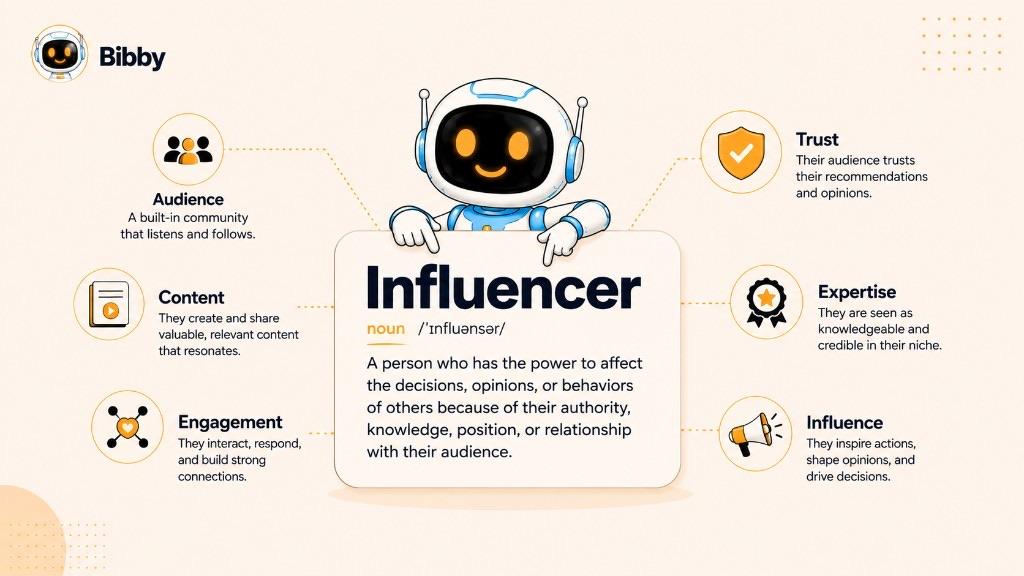
Influence comes from the relationship between a person and their audience. An influencer may be trusted because of their expertise, experience, personality, communication style, reputation, or consistent interaction with a particular community. When followers consider an influencer's recommendations credible or relevant, those recommendations can affect what products they discover, which brands they consider, what content they consume, or what actions they take.
For example, a technology influencer might review a new laptop and help followers decide whether it is worth buying. A travel influencer might introduce an audience to a destination or hotel. A finance influencer might explain investment concepts, while a LinkedIn business influencer might shape how professionals think about a particular industry trend.
What Makes Someone an Influencer?
Having a large following is not the only factor that determines whether someone is an influencer. Several characteristics contribute to a person's influence:
- Relevant audience: Their followers have a genuine interest in the subject or niche they cover.
- Credibility: The audience considers their opinions, knowledge, or experiences trustworthy.
- Consistent content: They regularly publish useful, entertaining, educational, or otherwise valuable content.
- Audience relationship: They communicate with followers and build familiarity or community over time.
- Engagement: Followers actively respond to, share, save, comment on, or otherwise interact with their content.
- Expertise or authority: They may have professional knowledge, experience, skills, or a distinctive perspective within a particular field.
- Content influence: Their recommendations or opinions can affect awareness, consideration, behavior, or purchasing decisions.
This means that follower count alone does not define influence. An account with 20,000 highly relevant followers can sometimes have more meaningful influence within a niche than an account with several million followers whose audience is broad and less connected to the subject.
How Does an Influencer Influence Their Audience?
Influencers can affect audience decisions by demonstrating a product, publishing a review, explaining a complicated topic, sharing a personal experience, comparing alternatives, recommending a service, or introducing followers to something they had not previously considered.
The influence generally develops through repeated exposure and audience interaction:
Content → Attention → Familiarity → Trust → Recommendation → Audience Action
Not every influencer directly drives purchases. Influence can also affect brand awareness, opinions, conversations, content discovery, and community behavior.
Are All Influencers Celebrities?
No. Influencers and celebrities overlap, but they are not the same thing.
A celebrity may become famous through film, television, music, sports, or another traditional media industry and later build influence on social media. An influencer, however, may build their reputation and audience primarily through digital content.
Many influencers are specialists rather than mainstream celebrities. They might focus on technology, fitness, beauty, food, gaming, education, business, travel, finance, fashion, or another specific niche.
Can Someone With a Small Following Be an Influencer?
Yes. For example, a creator with 8,000 followers focused exclusively on professional photography may have a highly relevant audience of photographers. If those followers trust the creator's equipment recommendations, tutorials, and reviews, the creator can influence decisions within that niche.
These smaller creators are often described as nano-influencers or micro-influencers, depending on the audience-size classification being used.
The key idea is simple: influence is about the ability to affect an audience, not simply the number displayed on a follower counter.
What Does Influencer Mean on Social Media?
On social media, an influencer is a person who has built an audience around their content, expertise, personality, interests, or niche and can affect the opinions, preferences, or decisions of that audience.
The term is closely connected to the idea of social influence. Instead of relying primarily on traditional advertising, influencers communicate directly with an audience through content that can feel personal, familiar, educational, entertaining, or community-driven.
An influencer might recommend a product on Instagram, demonstrate software on YouTube, discuss an industry trend on LinkedIn, review a restaurant on TikTok, or share a personal experience through a Facebook post. The format changes by platform, but the underlying concept remains the same: the influencer has an audience that pays attention to their perspective and may act on their recommendations.
Why Are Social Media Influencers Called Influencers?
The word *influencer* comes from the concept of influence, meaning the ability to affect someone's thoughts, behavior, decisions, or actions.
Social media makes this influence particularly visible because creators can communicate with large audiences directly and repeatedly. Followers can watch their videos, read their posts, respond to their opinions, ask questions, share their recommendations, and interact with them over time. This repeated interaction can create familiarity and credibility.
What Does a Social Media Influencer Do?
Depending on their niche and platform, influencers may:
- Create educational videos and tutorials
- Review products or services
- Share personal experiences and demonstrate products
- Publish industry insights or entertaining videos
- Recommend restaurants, destinations, or experiences
- Host livestreams and publish photos and carousels
- Answer audience questions
- Participate in brand campaigns
- Promote products through affiliate links
- Build communities around specific interests
The content itself is only part of the equation. The audience relationship surrounding that content is what gives an influencer their potential to influence.
Does an Influencer Need a Large Following?
No. A creator can have a relatively small audience while maintaining strong relevance and engagement within a specific niche. For example, a cybersecurity professional with a specialized audience may influence purchasing or technology decisions among IT professionals even if their follower count is far below that of a mainstream entertainment creator.
Follower count provides a measure of potential reach, but it does not tell the entire story. Audience relevance, engagement, credibility, content quality, and the relationship between creator and followers also matter.
How Social Media Changed Influencer Culture
Before social media, influence was often concentrated among celebrities, journalists, television personalities, authors, industry experts, and other people with access to traditional media.
Social platforms lowered the barriers to publishing and audience building. Individuals could create content, develop a niche, attract followers, and establish authority without first becoming famous through traditional media. This helped create the modern creator economy, where individuals can build businesses around their audiences, content, expertise, and personal brands.
Influencer Does Not Mean “Someone Who Promotes Products”
Influencers are frequently associated with sponsored posts and brand promotions, but commercial activity is not a requirement. Someone can be influential without accepting sponsorships or selling anything. Their influence may come from expertise, education, entertainment, community leadership, professional experience, personal storytelling, product knowledge, industry commentary, or specialized skills.
Commercial influencer marketing is simply one way that an existing audience relationship can be used by brands and creators.
A simple way to understand the modern influencer is:
Niche or expertise → Valuable content → Audience → Relationship → Credibility → Influence
How Do Influencers Work?
Influencers work by building an audience around a particular niche, interest, expertise, lifestyle, or personality and consistently creating content that attracts and retains that audience. Over time, repeated interaction can establish familiarity, credibility, and trust.
A typical influencer journey looks like this:
Choose a niche → Create content → Build an audience → Develop trust → Engage followers → Influence decisions → Monetize the audience
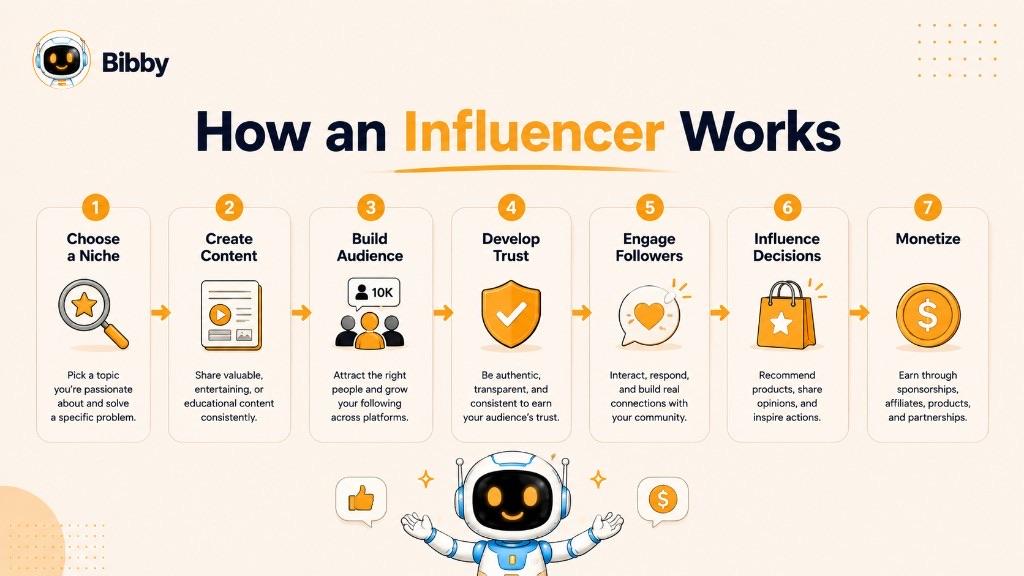
The process is not simply “gain followers and promote products.” Successful influence usually develops through audience relevance, valuable content, consistent communication, and a strong relationship between the creator and their community.
1. Influencers Choose a Niche or Area of Focus
Most influencers have a recognizable subject, theme, or identity that helps people understand why they should follow them. Common niches include fashion, beauty, fitness, food, travel, technology, gaming, finance, business, education, parenting, photography, lifestyle, health and wellness, and entrepreneurship.
A clearly defined niche can make it easier to attract a relevant audience. A technology creator, for example, is more likely to attract people interested in gadgets, software, and consumer technology than someone who publishes completely unrelated topics.
2. Influencers Create Content
Content is the primary vehicle through which influencers communicate. Depending on the platform and niche, this can include short-form video, long-form video, photos, carousels, Stories, livestreams, tutorials, reviews, product demonstrations, educational posts, interviews, commentary, personal stories, and behind-the-scenes content.
The most effective content usually gives the audience a reason to pay attention—entertainment, education, inspiration, useful information, problem-solving, or a distinctive personality.
3. Influencers Build an Audience
Audience growth can come from search and discovery, recommendations, shares, trending content, collaborations, communities, existing audiences on other platforms, consistent publishing, and distinctive content.
The quality and relevance of the audience are as important as size. An audience interested in the influencer's subject is generally more valuable than a large audience with little connection to the content.
4. Influencers Develop Relationships With Followers
Influence is strengthened through interaction—comments, questions, discussions, Stories, and livestreams. These interactions can make the relationship feel more direct than traditional mass-media communication, and they reveal what followers care about.
5. Influencers Build Credibility
Credibility can come from professional expertise, personal experience, demonstrated results, specialized knowledge, consistent content quality, or strong community relationships. Influence is usually context-specific: someone can be highly influential in one niche while having little authority in another.
6. Influencers Affect Audience Decisions
Once an audience recognizes and trusts an influencer's perspective, their content can introduce products, increase brand awareness, explain how something works, compare options, provide a personal recommendation, or direct followers to a website. Not every interaction results in a purchase.
7. Influencers Collaborate With Brands
Common collaborations include sponsored posts, product reviews and demonstrations, affiliate promotions, brand ambassador programs, product launches, giveaways, event coverage, content licensing, and long-term partnerships. Collab Posts can also put brand and creator content on both profiles at once.
8. Influencers Monetize Their Audience
Common methods include brand sponsorships, affiliate commissions, advertising revenue, paid subscriptions, digital products, courses, consulting, merchandise, membership communities, and licensing.
How Social Media Automation Fits Into the Influencer Workflow
Managing an influencer business can involve planning campaigns, generating captions, preparing different content formats, maintaining a consistent publishing schedule, and distributing content across several social platforms.
With Bibby, an influencer can upload an image or generate one with AI, select a posting style, generate captions, and schedule content across Facebook, Instagram, LinkedIn, YouTube, and TikTok. The workflow can also include image posts, carousels, videos, Stories, campaigns, brand kits, and chat-based social media management.
The result is a workflow that lets influencers spend less time manually coordinating individual posts and more time on the creative and strategic parts of building their audience.
The Influencer Flywheel
Create valuable content → Attract the right audience → Build engagement → Develop credibility → Influence decisions → Generate opportunities → Create more valuable content
This cycle is why successful influencing is generally a long-term process rather than a direct result of reaching a particular follower milestone.
Types of Influencers
Influencers can be classified by audience size and niche or area of influence. There is no single universal system. Different agencies, platforms, and marketing organizations may use different follower thresholds. The categories below are practical industry conventions rather than strict definitions.
Types of Influencers by Follower Count
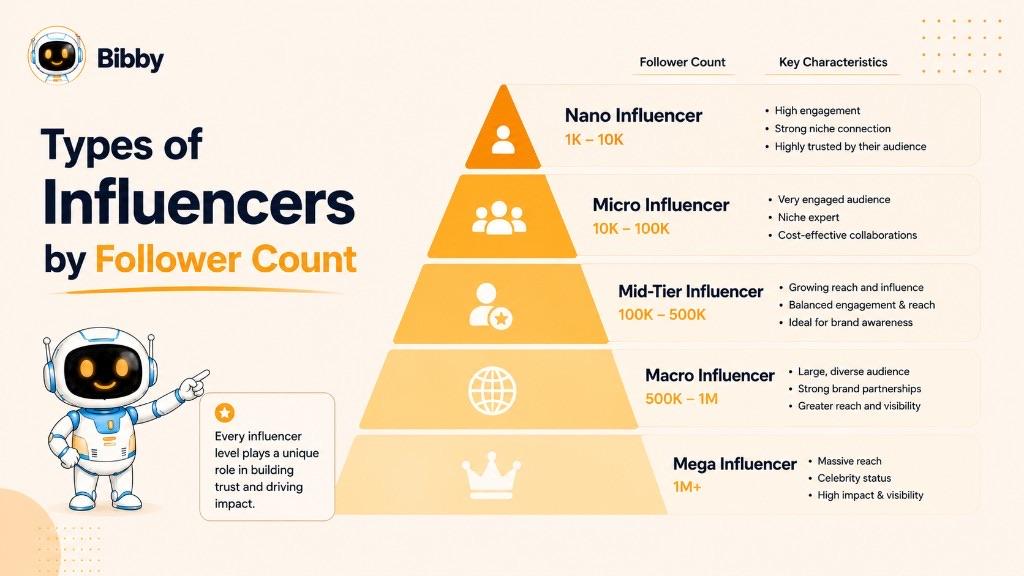
| Influencer Type | Typical Follower Range | Common Characteristics |
|---|---|---|
| Nano-influencer | 1,000–10,000 | Small, highly focused audience and often strong community relationships |
| Micro-influencer | 10,000–100,000 | Niche expertise, targeted reach, and potentially strong engagement |
| Mid-tier influencer | 100,000–500,000 | Larger audience while often retaining a recognizable niche |
| Macro-influencer | 500,000–1 million | Broad reach and established online presence |
| Mega-influencer | 1 million+ | Very large audience and substantial visibility |
Follower count does not measure influence by itself. A creator with 7,000 highly relevant followers can be extremely influential within a specialized community, while a creator with millions of followers may have a much broader but less targeted audience.
Nano-influencers frequently focus on very specific interests or local communities. Micro-influencers often occupy a specific niche and have a recognizable reputation within that community. Mid-tier creators can reach substantially larger audiences while still maintaining a topic or personal brand. Macro- and mega-influencers offer significant reach; a smaller influencer with a highly relevant audience may still be a better fit when a brand needs specialized reach or community engagement.
Types of Influencers by Niche
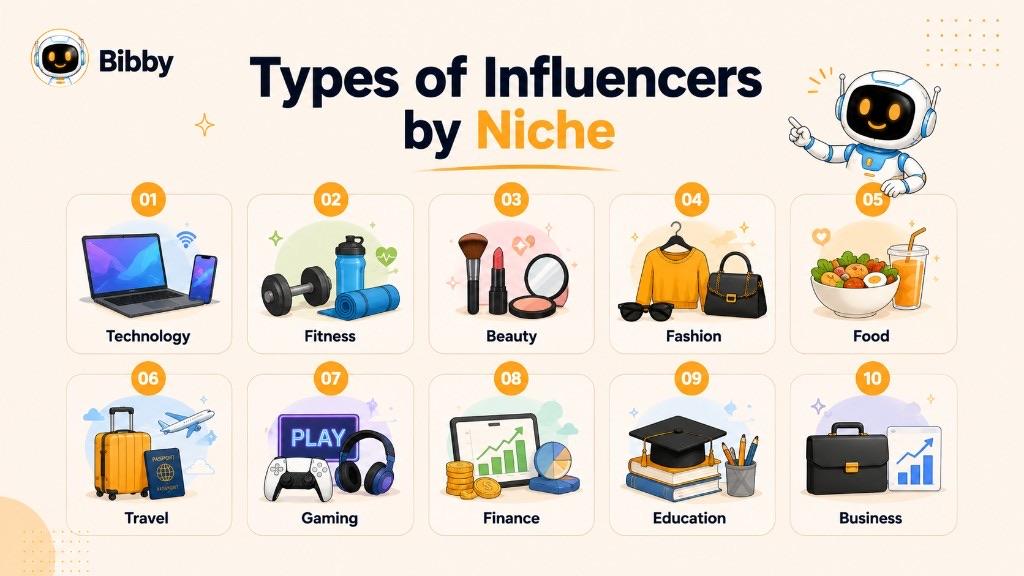
Follower count describes how large an audience is; niche describes what that influencer is known for.
Beauty influencers cover makeup, skincare, haircare, tutorials, and reviews. Fashion influencers cover clothing, styling, trends, and outfit inspiration. Fitness influencers publish workouts, training advice, and equipment reviews. Food influencers cover restaurants, recipes, cooking tutorials, and local recommendations. Travel influencers cover destinations, hotels, itineraries, and travel products. Technology influencers cover smartphones, software, AI, gadgets, apps, and comparisons. Gaming influencers create gameplay, reviews, livestreams, and hardware recommendations. Business and LinkedIn influencers share entrepreneurship, leadership, careers, and industry analysis. Finance influencers publish personal finance, investing, and economic education—audiences should distinguish general education from advice from qualified professionals. Education influencers teach academic topics, languages, professional skills, or science. Lifestyle influencers often combine fashion, food, travel, home, wellness, and personal experiences.
Types of Influencers by Platform
Instagram influencers commonly use photos, carousels, short-form videos, and Stories. TikTok influencers typically focus on short-form video, trends, entertainment, and discovery. YouTube influencers often create longer-form videos, tutorials, reviews, entertainment, livestreams, and Shorts. LinkedIn influencers generally focus on professional topics. Facebook influencers may build audiences through videos, posts, groups, live content, and communities.
One Influencer Can Fit Multiple Categories
Classifications are not mutually exclusive. One creator could be a micro-influencer + technology influencer + YouTube creator + Instagram influencer.
The most useful question is not simply “How many followers does this influencer have?” but “Who follows this influencer, why do they follow them, and how strongly do they respond to their content?”
Examples of Influencers
What makes people influencers is not simply that they publish content. It is their ability to build an audience that pays attention to their perspective and may be influenced by their recommendations, expertise, experiences, or opinions.
Technology: A creator who publishes smartphone reviews and gadget demonstrations. Influence comes from relevant expertise, consistent content, and audience trust.
Fitness: Workout routines, equipment reviews, and training advice. Monetization may include sponsorships, affiliate partnerships, training programs, or memberships.
Food: A local food creator with 15,000 highly engaged followers can have substantial influence over restaurant discovery in a city—audience relevance can be more meaningful than raw follower count.
Travel: Destination guides, hotels, and itineraries. Tourism organizations and hotels may collaborate to reach people interested in specific experiences.
Beauty and fashion: Tutorials, product demonstrations, styling, and reviews. Partnerships may include sponsored content, launches, affiliates, or ambassador relationships.
Gaming: Gameplay, livestreams, and hardware recommendations that can extend to consoles, accessories, and services.
Finance: Educational content about budgeting or investing. Popularity is not proof of expertise—evaluate qualifications and reliability.
Business: Industry insights on LinkedIn or YouTube that shape how professionals think about tools, careers, or strategy.
Education: Teaching languages, technology, or career skills. An educator does not need celebrity status if learners consistently find the explanations useful.
Examples of Influencers by Audience Size
Nano: A local photographer with 5,000 followers who recommends camera equipment. Micro: A fitness creator with 40,000 followers focused on home workouts. Mid-tier: A technology creator with 250,000 followers who publishes gadget reviews. Macro: A lifestyle creator with 800,000 followers. Mega: A globally recognized creator with several million followers.
These are audience-size conventions rather than guarantees of influence or performance.
Examples of Influencer Content
Product reviews, tutorials, demonstrations, comparisons, recommendations, educational posts, personal stories, short-form video, carousels, Stories, and livestreams.
Across all of these examples, an influencer generally has an identifiable audience, a recognizable niche, consistent content, a relationship with followers, credibility or perceived expertise, engagement, and the ability to affect awareness, opinions, behavior, or decisions.
Influencer vs Content Creator: What's the Difference?
Influencer and content creator are often used interchangeably, but they describe different concepts.
A content creator is primarily someone who creates and publishes content for an audience. An influencer is someone whose audience relationship gives them the ability to affect opinions, behaviors, preferences, or decisions.
Many modern creators are both, but not every content creator is necessarily an influencer.
| Content Creator | Influencer |
|---|---|
| Primarily defined by creating and publishing content | Primarily defined by the ability to influence an audience |
| Can create content without having significant influence | Usually has an established audience relationship |
| May focus on production, storytelling, education, or entertainment | Often focuses on a niche, community, expertise, personality, or personal brand |
| Success may be measured through content quality, views, reach, or audience growth | Success may also be measured through engagement, audience response, actions, and conversions |
| May work behind the scenes or create content for brands | Often communicates directly with their own audience |
| Does not necessarily promote products | May participate in brand partnerships or recommendations |
Content creation describes the activity. Influence describes the relationship and effect on an audience.
A photographer who creates free lighting tutorials is a content creator. If that photographer also develops an audience that regularly relies on their camera recommendations, they may also be considered an influencer.
Use content creator when the focus is production, storytelling, or publishing. Use influencer when the focus is audience trust, recommendations, behavior, brand partnerships, or community authority.
Influencer vs Content Creator vs Celebrity
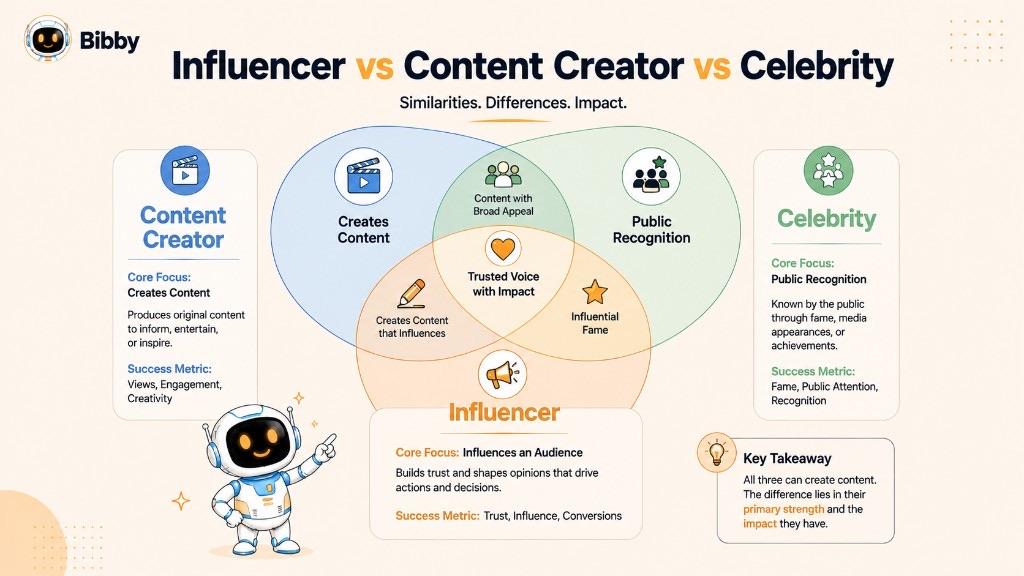
Content creator: Defined primarily by creating content.
Influencer: Defined primarily by having influence over an audience.
Celebrity: Defined primarily by public recognition or fame, often originating outside social media.
A celebrity can become an influencer. An influencer can become a celebrity. A content creator can become both. These categories are overlapping circles rather than rigid boxes.
Creator = creates the content. Influencer = influences the audience. Celebrity = has broad public recognition. One person can occupy all three roles.
What Is Influencer Marketing?
Influencer marketing is a digital marketing strategy in which a brand collaborates with an influencer to promote, demonstrate, recommend, or create content around a product, service, or brand for the influencer's audience.
At its simplest:
Brand → Influencer → Content → Audience → Action
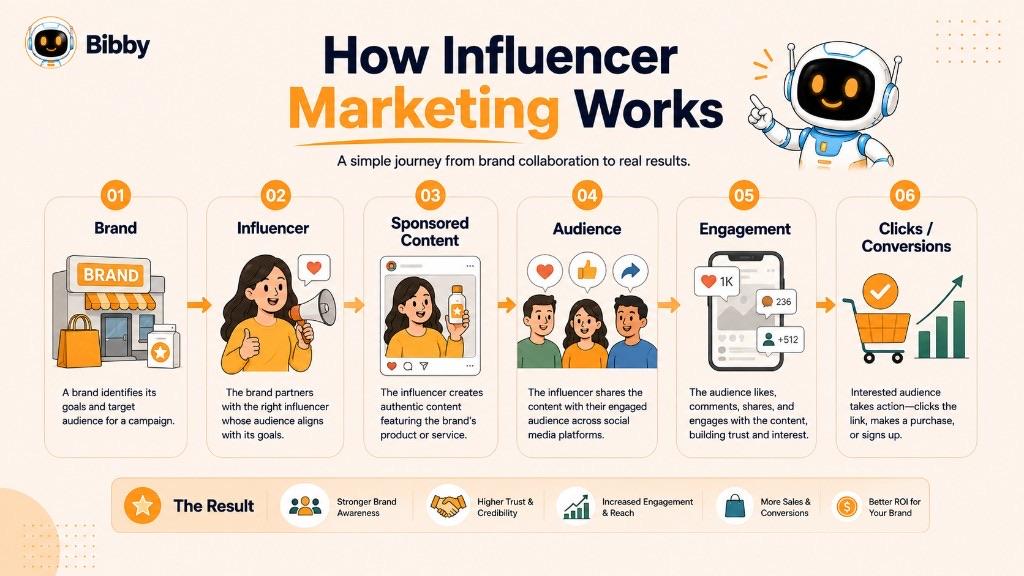
The action might be product discovery, a website visit, engagement, a lead, an app installation, a purchase, or increased awareness.
Influencer marketing is not limited to famous personalities. Brands increasingly work with niche creators and smaller influencers when audience relevance and community engagement are more important than maximum reach.
How Does Influencer Marketing Work?
- Brand identifies a marketing objective
- Relevant influencers are researched
- Influencers are evaluated
- The brand and influencer agree on campaign terms
- The influencer creates or publishes content
- The audience interacts with the content
- Results are measured against campaign goals
For example, a skincare company might collaborate with beauty influencers to demonstrate a new product. A software company might work with technology creators to explain how its application solves a specific problem.
Why Do Brands Work With Influencers?
Potential benefits include targeted reach, content creation, product discovery, community engagement, niche credibility, and social proof. These benefits are not guaranteed. Campaign performance depends on audience relevance, content quality, strategy, disclosure, offer, platform, timing, and influencer-brand fit.
Types of Influencer Marketing
Sponsored posts pay an influencer to publish content featuring a product. Product reviews and demonstrations share experience and show how something works. Affiliate marketing uses a trackable link or code and a commission on qualifying actions. Brand ambassador partnerships are longer-term than a single post. Product launches may involve many creators. Giveaways and community campaigns encourage participation—rules and disclosure vary by jurisdiction and platform. Influencer-generated content can also be licensed for the brand's own channels.
What Is an Influencer Marketing Campaign?
A coordinated set of influencer activities designed to achieve a specific objective—awareness, launches, traffic, leads, downloads, sales, community growth, content production, or event promotion. The most effective campaigns usually begin with the business objective, rather than simply choosing the influencer with the largest audience.
How Do Brands Choose Influencers?
Evaluate audience demographics and interests, niche relevance, engagement, content quality, brand alignment, previous partnerships, audience authenticity, platform, geographic relevance, and campaign objectives. A local restaurant may gain more from a smaller food creator whose followers live nearby than from a global lifestyle influencer.
Relevance often matters more than raw reach.
Influencer Marketing vs Traditional Advertising
Traditional advertising purchases media placement for the brand's own message. Influencer marketing collaborates with a person who already communicates with an established audience. Brands can use both. Traditional ads can provide controlled messaging and scalable distribution; influencer marketing can provide creator-led storytelling, niche access, social content, and personalized demonstrations.
How Is Influencer Marketing Measured?
Match metrics to the objective. Awareness: reach, impressions, views. Engagement: comments, shares, saves, engagement rate. Traffic: clicks and visits. Conversion: leads, purchases, revenue, ROI. Review those numbers in the platform's native analytics (and any tracking links or codes you set up)—not as a single vanity score.
How Bibby Can Help With Influencer Marketing Content
Campaigns can generate a large amount of content that needs to be organized, captioned, adapted, and scheduled. Bibby helps the publishing side: upload media or generate images with AI, select a posting style, generate captions, organize campaigns, and schedule across Facebook, Instagram, LinkedIn, YouTube, and TikTok.
The goal is not to automate the relationship between an influencer and their audience. It is to automate repetitive content planning and publishing tasks.
How Do Influencers Make Money?
Influencers can turn their audience, expertise, content, and personal brand into revenue. Brand sponsorships are one recognizable method, but they are only one part of the influencer economy.
Income is not determined by follower count alone. Audience relevance, engagement, niche, platform, content quality, location, business model, and the type of commercial relationship all matter.
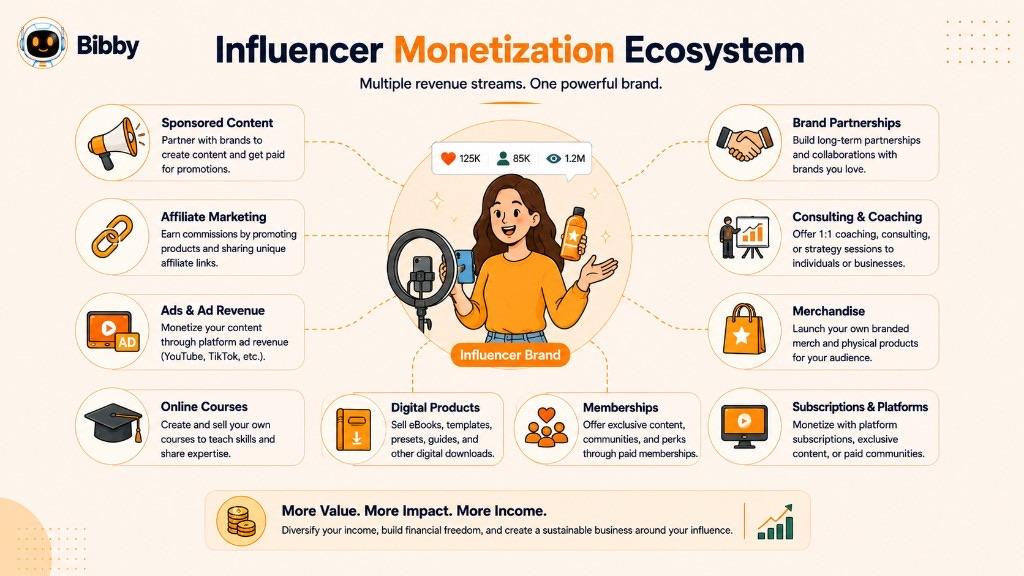
1. Sponsored Content
A brand pays an influencer to create content that features, discusses, demonstrates, or promotes its product. Formats include Instagram posts, short-form videos, YouTube videos, Stories, carousels, livestreams, reviews, and educational content.
There is no universal “price per follower” formula. Compensation may be a fixed fee, a package, a campaign fee, performance incentives, a mix with affiliate revenue, or a long-term partnership. Brands may also pay separately for reuse rights.
2. Affiliate Marketing
Affiliate marketing pays a commission when the audience completes a qualifying action through a unique tracking link or code.
3. Advertising Revenue
Some platforms allow eligible creators to earn from ads displayed alongside or within content. YouTube is a prominent example. Requirements and models vary by platform and can change.
4. Paid Subscriptions and Memberships
Exclusive videos, subscriber-only posts, private communities, bonus content, livestreams, or members-only resources can provide recurring revenue.
5. Digital Products
Ebooks, templates, presets, guides, design resources, and downloadable tools. A photography influencer might sell presets; a business creator might sell templates.
6. Online Courses
Turn specialized expertise into a structured product—photography, marketing, fitness programs, and similar subjects.
7. Consulting and Services
Coaching, strategy, training, speaking, workshops, and professional services—especially relevant for B2B, technology, finance, marketing, and education influencers.
8. Merchandise
Clothing, accessories, books, and niche-specific products when a community or brand identity is strong enough.
9. Brand Ambassador Partnerships
Longer-term than a single post: regular posts, launches, events, exclusive promotions, and ongoing campaigns.
10. Licensing and Content Usage
A brand may pay to reuse an influencer's video or photograph in ads, websites, product pages, or email. Creation fees and reuse rights may be separate.
Does Having More Followers Mean More Money?
Not necessarily. A creator with 40,000 highly specialized software professionals may be more commercially relevant to a software company than a 500,000-follower general-interest account.
There is no single standard influencer salary. Diversified models (sponsorships, products, services, subscriptions) can reduce dependence on one income source.
A useful monetization funnel is:
Audience → Attention → Trust → Influence → Commercial Opportunity → Revenue
What Is Influencer Engagement?
Influencer engagement refers to the ways an audience interacts with content—likes, comments, shares, saves, replies, clicks, video views, profile visits, Story interactions, and other measurable actions, depending on the platform.
Engagement helps show whether an audience is actively responding rather than simply being counted as followers. Brands and influencers often evaluate engagement alongside audience size.
What Is an Influencer Engagement Rate?
Engagement rate expresses interactions relative to a chosen audience or exposure measure:
Engagement Rate = Engagements ÷ Relevant Audience or Exposure × 100
There is no single universal formula. Calculations may use followers, reach, impressions, views, or another denominator. Always interpret the rate alongside the formula used.
Influencer Engagement vs Follower Count, Reach, and Impressions
Follower count measures audience size. Engagement measures interaction. Reach asks how many unique accounts were exposed. Impressions count displays (including repeats). Examine reach, impressions, and engagement together.
How Influencers Can Increase Meaningful Engagement
Create content for a specific audience, encourage conversation, experiment with formats, study performance in native analytics, maintain consistency, and respond to the community. Avoid engagement bait.
How Bibby Can Help Influencers Manage Engagement-Focused Content
Bibby streamlines repetitive publishing: upload or generate images with AI, choose a posting style, generate captions, and schedule images, carousels, videos, and Stories across supported platforms. Chat can help with campaigns, a brand kit, creating posts, and regenerating captions.
Automation is not meant to replace genuine audience interaction. It can reduce publishing busywork so influencers can spend more time creating valuable content and responding to their communities.
There is no universal “good” engagement rate. Compare with relevant benchmarks and historical performance using the same methodology.
Influencer vs Celebrity: What's the Difference?
A celebrity typically becomes well known through entertainment, sports, music, television, film, or other mainstream media. An influencer generally builds an audience through digital content and develops influence within a particular niche, community, or social platform.
A celebrity can become an influencer by building a strong social presence. An influencer can eventually become a widely recognized celebrity.
| Influencer | Celebrity |
|---|---|
| Often builds an audience primarily through digital platforms | Often becomes famous through entertainment, sports, media, or another public profession |
| May focus on a specific niche | Often has broader mainstream recognition |
| Frequently creates content directly for their audience | May communicate through traditional and digital media |
| Audience relationships can be highly niche or community-driven | Audience may be much broader and less specialized |
| Can build influence without mainstream fame | Usually has significant public recognition |
Celebrity is primarily about public recognition. Influence is primarily about the ability to affect an audience.
In marketing, celebrity partnerships can provide large-scale awareness and media visibility. Influencer partnerships can provide niche audiences, creator-led content, community interaction, and specialized expertise. Neither is automatically better. Trust depends on the individual, subject matter, transparency, and relationship with followers—popularity is not proof of expertise.
A brand should ask: Does the audience match the customer? Does the person have credibility in the subject? Does the content fit the brand? Does the audience engage? Can they communicate the product naturally? Is their influence relevant to the objective? The strongest partner is not always the largest account.
How to Become an Influencer
Becoming an influencer is less about reaching a particular follower count and more about building a recognizable identity, attracting the right audience, consistently creating valuable content, and developing a relationship with that audience. There is no guaranteed formula.
Choose a niche → Define your audience → Build your personal brand → Create valuable content → Publish consistently → Engage with your community → Review performance → Build partnerships → Monetize your influence
1. Choose a Specific Niche
Start with a recognizable subject. A strong niche usually sits at what you know + what you enjoy + what people care about.
2. Define Your Target Audience
“Fitness” is broad. “Busy professionals looking for short home workouts” gives a clearer foundation for content.
3. Build a Personal Brand
Expertise, personality, visual identity, communication style, topics, values, and formats. Consistency and recognizability often matter more than appearing perfect.
4. Choose the Right Social Media Platforms
You do not need every platform on day one. Match audience, format, and strengths—for example, video educator → YouTube plus short-form; fashion → Instagram and TikTok; business professional → LinkedIn and YouTube.
5. Create Valuable Content
Ask: “Why would someone want to see this?” Information, education, entertainment, inspiration, practical advice, stories, or problem-solving. Consistently useful content is usually more sustainable than chasing viral moments.
6. Develop Repeatable Content Formats
Recurring formats (news, tips, comparisons, tutorials, recommendations) create a recognizable system without inventing every post from scratch.
7. Publish Consistently
A sustainable schedule beats an aggressive one you cannot maintain. Quality, theme, and regular interaction matter as much as frequency.
8. Engage With Your Audience
Respond to comments, answer questions, and turn recurring questions into videos, carousels, tutorials, or reviews.
9. Analyze Your Content Performance
Use each platform's analytics for reach, impressions, views, watch time, likes, comments, shares, saves, clicks, and follower growth. A post with fewer views may generate more meaningful engagement or traffic than a viral post that attracts an irrelevant audience.
10. Collaborate With Other Creators
Joint videos, interviews, livestreams, cross-promotions, and guest content work best when audiences overlap—not only when someone has a larger following.
11. Build Relationships With Brands
Consider niche fit, audience care, personal brand alignment, deliverables, compensation, usage rights, exclusivity, and disclosure.
12. Diversify Your Revenue
Sponsorships, affiliates, courses, digital products, memberships, consulting, merchandise, advertising, and ambassador partnerships.
13. Automate Repetitive Social Media Work
With Bibby, creators can upload media or generate images with AI, select a posting style, generate captions, and schedule content across Facebook, Instagram, LinkedIn, YouTube, and TikTok at AI-optimized times. They can also create campaigns and brand kits and use chat to manage tasks conversationally.
14. Keep Improving
Platforms, formats, and audience interests change. Learn what consistently provides value to your audience rather than chasing every trend.
There is no fixed timeline to become an influencer. A better measure of progress is steadily building relevant audience + valuable content + engagement + credibility + consistency.
How Influencers Manage Social Media Content
A typical workflow looks like:
Idea → Content Creation → Caption → Review → Scheduling → Publishing → Engagement → Analysis → Repurposing
Influencers may manage images, carousels, short-form and long-form video, Stories, livestreams, reviews, tutorials, sponsored and affiliate content, campaign assets, and community posts—each with different captions, dimensions, and times.
Without a plan, publishing becomes idea → create quickly → caption → post → repeat. A content calendar organizes topics, formats, dates, campaigns, launches, series, and repurposed content.
Creating Content for Multiple Platforms
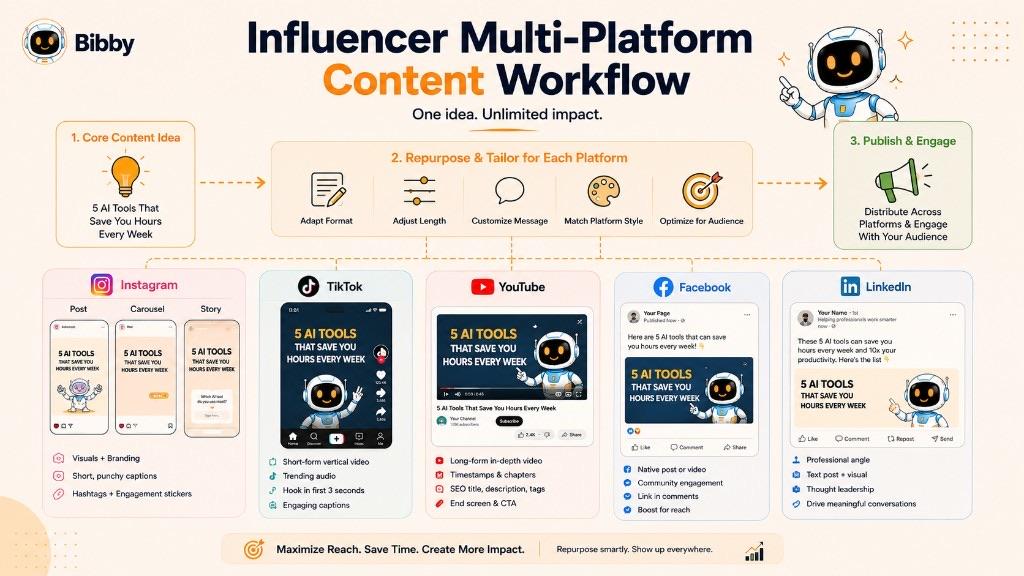
One product review can become a full YouTube video, an Instagram carousel of key findings, a TikTok demonstration, a Facebook community post, and a LinkedIn professional take. Adapt the idea to each platform rather than copying one post everywhere.
Writing Captions and Scheduling
Captions introduce ideas, explain products, tell stories, and include a call to action. AI-assisted drafts can speed that work if you review them in your own voice. Scheduling prepares dates, times, platforms, and campaigns in advance. There is no universal best time—use your own history, and AI-optimized scheduling can help pick windows.
Managing Campaigns and Brand Consistency
A campaign might include an announcement, demonstration, short video, carousel, Story, and follow-up. A brand kit helps keep colors, typography, tone, and themes recognizable.
How Bibby Helps Influencers Automate Social Media
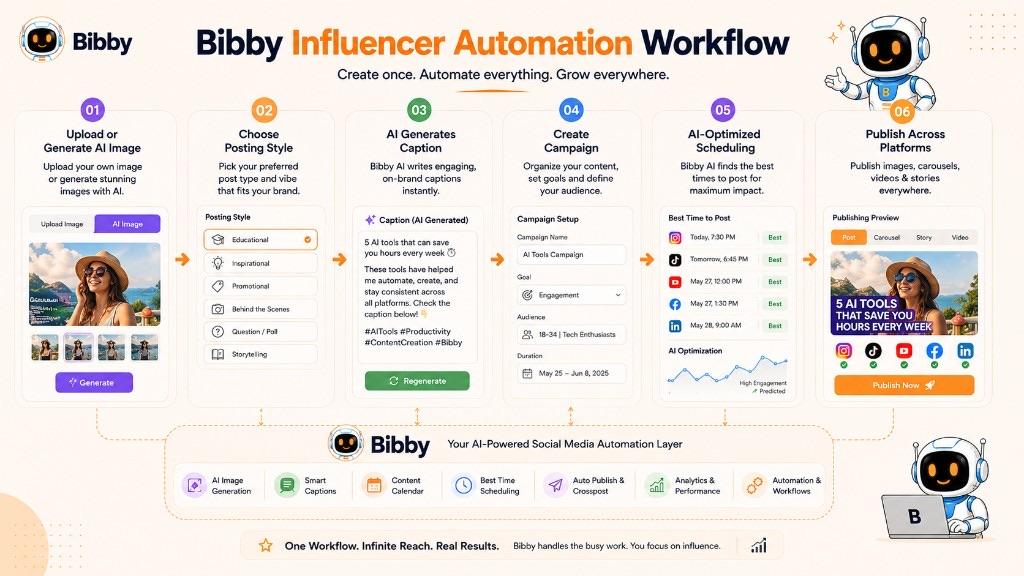
An influencer can upload existing media or generate an image with AI, choose a posting style, and have captions generated automatically, then schedule across supported platforms. Formats include images, carousels, videos, and Stories. Chat can help create a brand kit, build campaigns, create posts, and regenerate captions.
A practical automated workflow:
- Create or upload media
- Select the posting style
- Generate and refine the caption
- Select platforms
- Schedule the content
- Repurpose the idea for other formats
- Review performance in native analytics
Creator provides the ideas, personality, expertise, and judgment. Automation handles repetitive planning, captioning, scheduling, and publishing.
How Is an Influencer's Performance Measured?
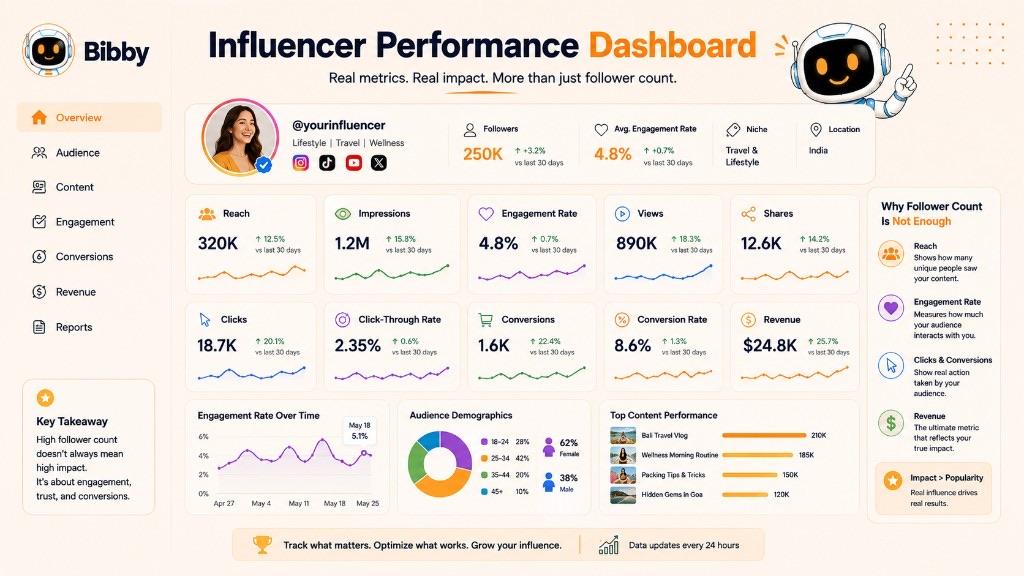
There is no single metric that fully measures influence. A useful framework is:
Audience → Reach → Engagement → Action → Conversion
| Campaign Goal | Useful Metrics |
|---|---|
| Awareness | Reach, impressions, views |
| Audience growth | Followers, profile visits |
| Engagement | Comments, shares, saves, engagement rate |
| Video performance | Views, watch time, retention |
| Traffic | Clicks, CTR, website visits |
| Lead generation | Leads, form submissions |
| Sales | Purchases, revenue, conversions |
| Performance marketing | CPA, revenue, ROI |
Followers show potential audience size, not engagement, relevance, or conversion ability. Reach is unique exposure. Impressions are displays, including repeats. Engagement is interaction. Engagement rate needs a stated denominator. Views, watch time, and retention matter for video. Shares and saves signal value. CTR is clicks relative to impressions. Traffic, leads, conversions, revenue, and ROI connect social activity to business outcomes when tracking is set up.
Compare two influencers: 500,000 followers with low interaction on sponsored content versus 50,000 in a highly relevant niche with strong engagement. If the objective is specialized product discovery, the smaller account could be the better partner.
Evaluate reach + relevance + engagement + content quality + audience fit + campaign objective.
Influencers can use native performance data as a feedback loop—which topics get saves, which formats attract new viewers, which posts drive clicks—without turning creativity into a spreadsheet.
Bibby automates the operational side (visuals, captions, campaigns, scheduling) so creators can spend more time reviewing results, refining strategy, and engaging with their audience.
What Is Sponsored Influencer Content?
Sponsored influencer content is content created or published as part of a paid or otherwise compensated relationship with a brand (money, products, services, commissions, experiences, or another commercial arrangement).
The defining characteristic is the commercial relationship, not the format.
Organic content is created independently. Sponsored content involves a commercial arrangement. Audiences should be able to understand when content has a commercial connection. Disclosure requirements vary by country, jurisdiction, platform, and relationship type—follow applicable advertising rules and platform policies. Disclosures should be clear enough that an ordinary audience member understands the commercial nature of the relationship.
An influencer brand partnership can be a single post, a multi-post campaign, a launch, reviews, affiliates, or an ambassador arrangement. Agreements typically define deliverables, compensation, dates, platforms, approvals, usage rights, exclusivity, and disclosure.
Usage rights describe how a brand may reuse creator content (ads, website, email). Exclusivity may restrict competing promotions for a period or category.
Sponsored content works best when relevant brand + relevant influencer + relevant audience align. Unrelated sponsorships can weaken trust.
Bibby can help organize campaigns, prepare visual content, generate captions, and schedule deliverables across platforms. The influencer remains responsible for reviewing the content, representing the partnership accurately, and maintaining the audience relationship.
Influencer Meaning at a Glance
| Term | Meaning |
|---|---|
| Influencer | A person who can influence an audience's opinions, behavior, preferences, or decisions |
| Social media influencer | An influencer who primarily builds an audience through social media |
| Content creator | Someone who creates and publishes digital content |
| Influencer marketing | Collaborations between brands and influencers |
| Nano-influencer | Commonly ~1,000–10,000 followers |
| Micro-influencer | Commonly ~10,000–100,000 followers |
| Mid-tier / macro / mega | Larger audience-size conventions (~100k–500k / ~500k–1M / 1M+) |
| Brand ambassador | Someone who represents a brand, often ongoing |
| Sponsored content | Content published as part of a commercial relationship |
| Affiliate marketing | Commissions from qualifying referrals |
| Engagement | Audience actions such as likes, comments, shares, saves, or clicks |
| Engagement rate | Engagement relative to a chosen audience or exposure measure |
| Reach | Unique accounts exposed, per the platform's methodology |
| Impressions | Times content is displayed |
| UGC | Content created by customers, users, or community members |
| Social media scheduling | Preparing content in advance with dates and times |
An influencer is not simply someone with many followers; an influencer is someone whose audience pays attention to their perspective and can be meaningfully affected by what they say, create, recommend, or demonstrate.
For multi-platform creators, the workflow is:
Create → Caption → Plan → Schedule → Publish → Engage → Analyze → Improve
Key Takeaways
An influencer is a person who has developed an audience and can affect that audience's opinions, preferences, behaviors, or decisions through content, expertise, credibility, personality, or community relationships.
- Influence is not the same as follower count. A smaller, highly relevant audience can be more valuable than a much larger but less targeted audience.
- Influencers exist in almost any niche—technology, fitness, beauty, fashion, food, travel, gaming, finance, education, business, lifestyle, and more.
- Audience-size labels (nano, micro, mid-tier, macro, mega) are conventions; thresholds vary.
- Influencer and content creator are not identical. A creator makes content; an influencer is characterized by the ability to affect an audience. Many people are both.
- Influencers and celebrities can overlap without being the same thing.
- Influencer marketing connects brands with established audiences through sponsored posts, reviews, demonstrations, affiliates, and longer partnerships.
- Monetization is broader than sponsorships—affiliates, ads, subscriptions, courses, products, consulting, merchandise, and licensing.
- Engagement provides context beyond follower count.
- Measure against the objective—awareness, engagement, traffic, leads, and sales need different metrics.
- Automation can reduce repetitive work. Bibby can help generate visuals, create captions, organize campaigns, build brand kits, and schedule images, carousels, videos, and Stories across Facebook, Instagram, LinkedIn, YouTube, and TikTok.
- The human relationship remains central. Credibility, creativity, expertise, personality, and genuine interaction create lasting influence.
Being an influencer is about having meaningful influence over an audience, not simply accumulating followers.
With Bibby, you can upload or generate media, choose a posting style, generate captions, and schedule posts across Facebook, Instagram, LinkedIn, YouTube, and TikTok.
Continue learning with related dictionary entries on content creators, micro-influencers, nano-influencers, brand ambassadors, affiliate marketing, UGC, engagement, and Collab Posts—or browse the social media dictionary. Then start a free Bibby trial to create, caption, and schedule content across your channels.