
A micro-influencer is a social media creator with a relatively small but highly targeted audience, commonly classified as having around 10,000 to 100,000 followers. Unlike celebrity or mega-influencers who focus on reaching millions of people, micro-influencers often build their influence within specific niches such as fitness, beauty, travel, food, technology, fashion, finance, or local communities.
Their value is not simply the number of followers they have. A micro-influencer can be valuable because of their niche expertise, audience relevance, engagement, credibility, and relationship with their community. For brands, this can make micro-influencers an effective way to reach a specific audience without relying entirely on large-scale influencer partnerships.
Micro-influencer marketing involves collaborating with these creators to produce content such as Instagram posts, TikTok videos, YouTube videos, Stories, carousels, product reviews, tutorials, and user-generated content. Depending on the campaign, a brand may pay a creator, provide free products, use affiliate arrangements, or establish a longer-term creator partnership.
In this guide, you'll learn what a micro-influencer is, how many followers they typically have, how micro-influencers differ from nano and macro-influencers, how much they can cost, how to find the right creators, how to run a micro-influencer campaign, and how to measure its results.
What Is a Micro-Influencer?
A micro-influencer is a social media creator who has built a relatively small, focused audience around a particular topic, interest, profession, lifestyle, or community. They are commonly defined as creators with 10,000 to 100,000 followers, although the exact follower range can vary depending on the platform, agency, or influencer-marketing framework being used.
What makes a micro-influencer different from a larger influencer is not simply their follower count. Their strength often comes from audience relevance and community connection. A creator with 25,000 followers who consistently talks about sustainable fashion, for example, may have considerably more value for an eco-friendly clothing brand than a celebrity with millions of followers whose audience has little interest in that category.
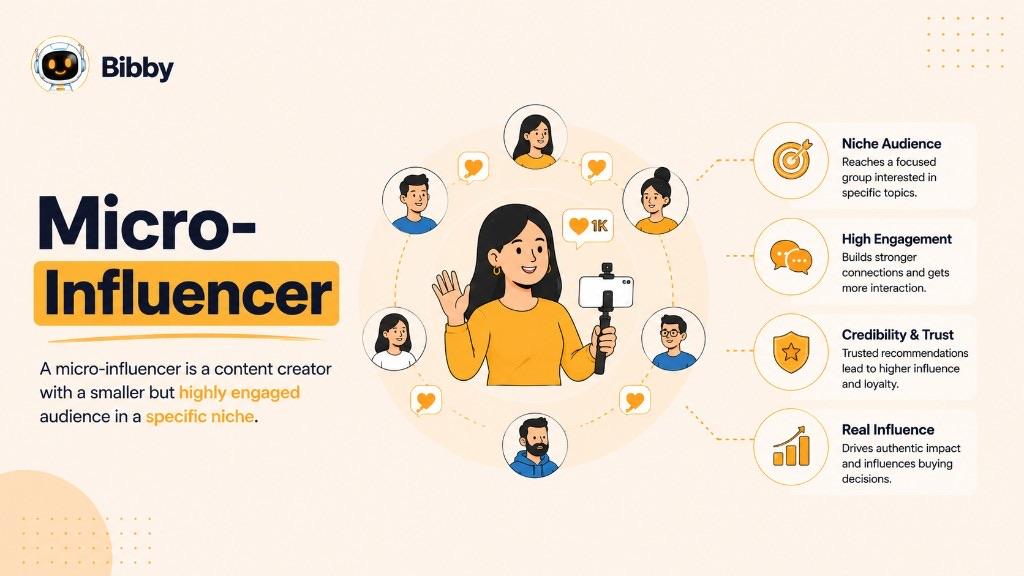
Micro-influencers typically develop their presence on platforms such as Instagram, TikTok, YouTube, Facebook, and LinkedIn. Their content can range from product reviews and tutorials to educational posts, short-form videos, Stories, carousels, livestreams, and everyday lifestyle content.
For brands, working with a micro-influencer can provide access to a clearly defined audience while also generating content that feels native to the platform. A successful collaboration therefore depends on more than selecting a creator with the right number of followers. Audience fit, content quality, engagement, credibility, and alignment with the brand's goals all matter.
It is also important to remember that there is no universal official definition of a micro-influencer. Follower categories are industry conventions rather than a standardized social media classification. Some organizations may use different follower thresholds, so follower count should be treated as a useful guideline rather than the sole measure of influence.
How Many Followers Does a Micro-Influencer Have?
A micro-influencer typically has between 10,000 and 100,000 followers on a social media platform. This is one of the most commonly used ranges in influencer marketing, but it is not a universal standard. Different agencies, platforms, and marketing frameworks may define influencer tiers using slightly different follower thresholds.
Follower count is useful for categorizing influencers, but it does not tell the entire story. A creator with 15,000 highly relevant followers can be more valuable to a niche brand than a creator with 80,000 followers whose audience has little connection to the product or industry.
Common Micro-Influencer Follower Range
| Influencer type | Common follower range | Primary strength |
|---|---|---|
| Nano-influencer | 1,000–10,000 | Personal relationships and highly focused communities |
| Micro-influencer | 10,000–100,000 | Niche reach and audience engagement |
| Macro-influencer | 100,000–1 million | Broad reach and visibility |
| Mega-influencer | 1 million+ | Massive audience exposure |
These ranges are general industry classifications, not fixed rules. A creator's category may differ depending on the platform and the source defining the influencer tiers.
Micro-Influencer Follower Range by Platform
The same follower count can represent a very different level of influence depending on where the creator publishes content.
| Platform | Common micro-influencer range | What matters beyond followers |
|---|---|---|
| 10K–100K | Engagement, niche, saves, shares, Stories and Reels performance | |
| TikTok | 10K–100K | Video views, watch time, shares, and audience relevance |
| YouTube | 10K–100K | Views, watch time, subscribers, and topic authority |
| Varies | Community participation, reach, and engagement | |
| Varies | Professional authority, post engagement, and industry relevance |
These platform-specific considerations matter because followers are not directly comparable across social networks. A YouTube creator with 30,000 subscribers operates in a different content environment from an Instagram creator with 30,000 followers.
Does 10,000 Followers Make Someone a Micro-Influencer?
Generally, yes. Under the commonly used 10,000-to-100,000 framework, a creator with 10,000 followers would fall into the micro-influencer category.
However, follower count alone does not establish whether someone is an effective influencer for a particular campaign. Brands should also consider whether the creator's audience is genuine, relevant, active, and aligned with the campaign objective.
Does 100,000 Followers Make Someone a Micro-Influencer?
It can, depending on the classification system being used. Under the common framework, 100,000 followers is generally the upper boundary of the micro-influencer category. Some marketing frameworks may place creators at or above this level into the macro-influencer category.
The important point is that influencer tiers are ranges, not official platform labels.
Why Follower Count Is Not Enough
A creator's follower count tells you how large their potential audience is, but it does not necessarily tell you how much influence they have.
When evaluating a micro-influencer, brands should also look at:
- Engagement: Are followers actively interacting with the creator's content?
- Audience relevance: Does the audience match the brand's target customers?
- Content quality: Can the creator produce useful, engaging content?
- Audience authenticity: Are the followers and interactions genuine?
- Niche authority: Does the creator have credibility in the subject?
- Consistency: Does the creator publish regularly?
- Conversion potential: Can the creator motivate clicks, sign-ups, or purchases?
A better question than “How many followers does this micro-influencer have?” is often “How relevant and engaged is this audience?”
A micro-influencer's real value comes from the combination of audience size, audience quality, content, credibility, and relevance, not from a follower number displayed beneath their profile name.
Micro-Influencer vs Nano, Macro and Mega Influencer
Micro-influencers are one part of a broader influencer hierarchy. The main categories are usually based on audience size, although there is no single industry-wide standard for where one category ends and another begins.
| Influencer type | Typical follower range | Common strength |
|---|---|---|
| Nano-influencer | 1,000–10,000 | Highly personal audience relationships |
| Micro-influencer | 10,000–100,000 | Niche reach and strong community engagement |
| Macro-influencer | 100,000–1 million | Broad reach and visibility |
| Mega-influencer | 1 million+ | Mass audience exposure |
These ranges are useful guidelines rather than strict rules. A creator's actual marketing value depends on audience relevance, engagement, content quality, credibility, and campaign objectives.
Micro-Influencer vs Nano-Influencer
A nano-influencer generally has a smaller audience than a micro-influencer, often between 1,000 and 10,000 followers.
Nano-influencers tend to operate within very small communities. Their audiences may be geographically concentrated or centered around an extremely specific interest.
A micro-influencer generally provides a larger potential reach while still maintaining a relatively focused niche.
Nano-influencer: Smaller audience, highly personal community.
Micro-influencer: Larger niche audience with greater potential reach.
For local businesses or highly specialized products, a nano-influencer can sometimes be a better choice than a micro-influencer because the audience may be exceptionally relevant.
Micro-Influencer vs Macro-Influencer
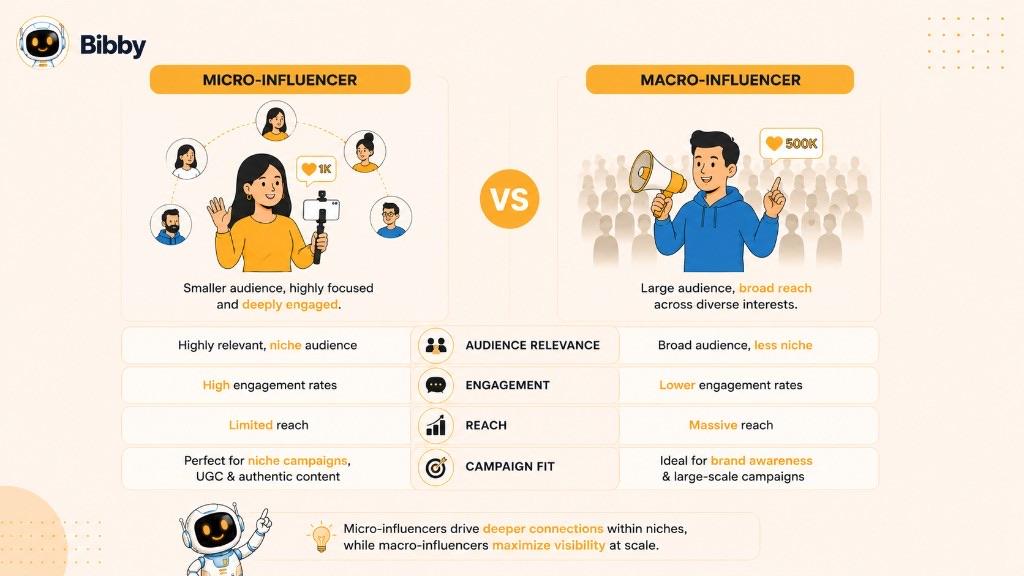
A macro-influencer typically has between 100,000 and 1 million followers.
Macro-influencers can provide substantially greater reach than micro-influencers and may be useful when a campaign is primarily focused on broad awareness.
Micro-influencers, on the other hand, can offer a more concentrated audience and may be easier for brands to work with on niche campaigns.
Micro-influencer: Targeted reach and niche relevance.
Macro-influencer: Larger reach and broader awareness.
A new consumer brand trying to reach a very broad market may prioritize macro-influencers, while a specialized software company, fitness brand, or local business may benefit more from micro-influencers.
Micro-Influencer vs Mega-Influencer
A mega-influencer generally has more than 1 million followers. This category often includes major celebrities, highly established creators, athletes, entertainers, and other public figures.
Mega-influencers can expose a campaign to enormous audiences, but that reach may be less targeted than the audience of a specialized micro-influencer.
Micro-influencer: Smaller, focused audience.
Mega-influencer: Extremely large, broad audience.
A campaign does not automatically become more effective simply because the influencer has more followers. If the objective is reaching a specific customer segment, a smaller but highly relevant creator can be strategically stronger.
Micro-Influencer vs Celebrity
Celebrities generally provide scale, recognition, and mass awareness. Micro-influencers typically provide niche relevance, community access, and creator-led content.
For example, a sports celebrity could introduce a shoe brand to millions of people, while several running-focused micro-influencers could introduce the same product to smaller communities specifically interested in running.
The choice comes down to the campaign objective:
- Mass awareness: Larger influencers or celebrities may be appropriate.
- Niche targeting: Micro-influencers can be a strong option.
- Local promotion: Nano- or micro-influencers may provide better audience relevance.
- Content generation: Micro-influencers can also be valuable as creators of authentic campaign assets.
- Large product launches: A combination of influencer tiers can provide both reach and targeted engagement.
Which Influencer Type Is Best for a Brand?
There is no universally best influencer category.
The right creator depends on who you need to reach, what you want them to do, how much you can spend, and what type of content you need.
Nano = community. Micro = niche influence. Macro = broad reach. Mega = mass visibility.
For many targeted campaigns, the strongest strategy is not choosing one category exclusively. Brands can combine different influencer tiers to create a broader campaign while maintaining relevance at the community level.
Why Are Micro-Influencers Important?
Micro-influencers have become an important part of influencer marketing because they can connect brands with specific, clearly defined audiences rather than relying only on mass reach.
A creator with 30,000 followers may not have the visibility of a celebrity with several million followers, but those 30,000 people may share a strong interest in a particular topic, product category, profession, lifestyle, or location. For brands with a clearly defined target audience, that relevance can be more useful than sheer audience size.
Micro-influencers also operate closer to the communities they serve. Their content often revolves around a particular niche, and their followers may regularly comment, ask questions, share recommendations, and seek their opinions. This can create a more direct communication channel between a brand and potential customers.
Micro-Influencers Can Reach Niche Audiences
One of the biggest advantages of micro-influencers is specificity.
A brand selling specialized hiking equipment could work with outdoor creators whose audiences are interested in hiking, camping, trekking, and trail gear. A skincare company could collaborate with creators focused specifically on sensitive-skin routines rather than choosing a general lifestyle personality.
The closer the creator's audience is to the brand's ideal customer, the more relevant the partnership can become.
Micro-Influencers Can Build Strong Community Relationships
Influence is not only about how many people see a post. It is also about the relationship between the creator and their audience.
Micro-influencers often have the opportunity to interact directly with followers through comments, messages, Stories, livestreams, and other community-oriented content. That interaction can help creators establish familiarity and credibility over time.
When a creator recommends a product that genuinely fits their niche, the recommendation can feel more relevant than a generic advertisement.
That does not mean every micro-influencer is automatically trusted or authentic. Brands still need to evaluate the creator's history, content, audience quality, and previous partnerships.
Micro-Influencers Can Support Authentic Content
A collaboration may produce much more than a single sponsored post. Depending on the agreement, creators can produce short-form videos, product demonstrations, tutorials, reviews, Instagram Stories, TikTok content, YouTube videos, carousel posts, unboxing content, lifestyle photography, and user-generated content.
This makes micro-influencer campaigns useful not only for distribution, but also for content production.
A brand can potentially use successful creator content across its own social channels, website, advertising campaigns, or email marketing, provided the appropriate usage rights have been agreed upon.
Micro-Influencers Can Help Brands Target Specific Markets
A restaurant, fitness studio, local retailer, tourism business, or regional service provider might benefit from creators who have strong audiences in a particular city or community.
The same principle applies to professional and B2B marketing. A creator with a smaller audience of people working in a specific industry may be more relevant to a specialized business than a general-interest influencer with a much larger following.
Micro-Influencers Can Make Creator Campaigns More Flexible
Brands do not necessarily have to build an entire campaign around one creator.
One campaign → 10 micro-influencers → 10 niche audiences → multiple pieces of content
This approach can diversify the campaign's reach, provide more creative variations to test, and reduce dependence on the performance of a single creator.
Micro-Influencers Can Be Valuable Beyond Follower Count
Influence and audience size are not exactly the same thing. Ask who follows the creator, why they follow, how relevant they are to the product, whether they interact, whether the creator has genuine expertise, whether they can produce compelling content, how previous collaborations performed, and whether the partnership supports the campaign's actual objective.
Ultimately, micro-influencers sit at an intersection of reach, relevance, community, and content creation. For brands that care about reaching the right people rather than simply reaching the most people, that combination can make micro-influencer marketing an important part of a broader social media strategy.
Benefits of Micro-Influencer Marketing
The biggest advantage is not necessarily lower cost or higher engagement in every situation. The real opportunity comes from finding the right creator-audience fit.
1. Reach Highly Targeted Audiences
A specialty coffee company could collaborate with coffee-focused creators, while a running-shoe company could work with creators who regularly publish content for runners. Instead of paying primarily for broad exposure, the brand can place its message in front of an audience that already has an interest in the relevant subject.
2. Build Trust and Credibility
A micro-influencer who has consistently produced content within a particular niche may have established credibility with that audience. A relevant product recommendation can become part of an existing conversation rather than appearing as an unrelated advertisement.
Trust should never be assumed. Review previous sponsorships, content quality, transparency, and the relationship with the audience.
3. Generate Authentic Social Content
A single collaboration might generate product photography, Reels, TikTok videos, tutorials, reviews, Stories, carousels, unboxing videos, demonstrations, or lifestyle content.
4. Support User-Generated Content
Creator content can show how a product works in a real-world setting. If a brand obtains the appropriate permissions, high-performing creator content may also be repurposed across other marketing channels.
5. Reach Niche Communities
Micro-influencers can help brands reach communities around running, gaming, photography, vegan cooking, personal finance, travel, parenting, home improvement, software development, entrepreneurship, sustainable living, or local tourism. The narrower the market, the more important audience relevance can become.
6. Potentially Reduce Campaign Costs
Micro-influencers can sometimes be more accessible than larger creators, particularly for brands with limited budgets. Micro-influencer marketing is not automatically inexpensive. Pricing depends on audience, engagement, expertise, format, production, usage rights, exclusivity, and scope. Working with several micro-influencers creates a different budget structure rather than guaranteeing a lower total cost.
7. Work With Multiple Creators
Instead of depending on one influencer, a brand could collaborate with multiple creators who represent different segments of the same target market.
Fitness brand → running creator + strength-training creator + yoga creator + outdoor fitness creator
8. Test Products With Relevant Audiences
A brand might experiment with different product positioning, creative formats, hooks, offers, calls to action, audience segments, and content styles. Treat a small campaign as additional evidence, not a guaranteed predictor of a large campaign.
9. Support Local Marketing
A local restaurant, hotel, gym, retailer, event organizer, tourism company, or service provider may benefit from creators whose audiences are concentrated in the same city or region. Local relevance can matter more than total follower count.
10. Create Content for Multiple Social Channels
With the appropriate permissions, a creator's video could inspire or become a Reel, TikTok post, YouTube Short, Facebook video, carousel, Story, or website asset.
Organize, adapt, caption, and schedule approved content so assets do not disappear into a campaign folder after publication.
The Biggest Benefit: Relevance
A micro-influencer does not need to reach millions of people to be useful. They need to reach the right people with the right message in a credible and engaging way.
What Does a Micro-Influencer Do?
A micro-influencer creates and publishes content for a specific audience while using their knowledge, personality, experience, or community presence to shape opinions and behavior within that niche.
For brands, a micro-influencer can serve two roles at once: audience distributor and content creator.
Create Sponsored Social Media Posts
A brand may pay a micro-influencer to create sponsored content: an Instagram post, TikTok video, Instagram Reel, Facebook post, LinkedIn post, YouTube video, or YouTube Short. The creator typically incorporates the product into content that fits their established format and audience.
Create Product Reviews and Demonstrations
Reviews and tutorials are useful for software, beauty, fitness, electronics, travel, food, clothing, and home products. A useful review gives context about how the product works rather than simply repeating promotional claims. Demonstration-based content helps potential customers understand the product more clearly.
Create Short-Form Videos, Stories, and Temporary Content
Short-form video might include demonstrations, tutorials, reviews, comparisons, tips, reactions, behind-the-scenes footage, or educational clips. Stories can support limited-time offers, launches, events, discount codes, giveaways, and direct calls to action.
Create User-Generated Content
Some micro-influencers work primarily as content creators, producing UGC that the company can use on its own channels. A creator does not necessarily need to distribute the content to their audience for the content itself to have marketing value.
Share Affiliate Links or Discount Codes
The creator may receive a commission when their audience completes a qualifying action through a tracked link. Discount codes can help brands attribute conversions to individual creators.
Educate Their Audience
Not every collaboration needs to be a direct product promotion. A financial creator could explain budgeting; a fitness creator could discuss workout techniques; a software creator could teach productivity workflows. The product can appear naturally within the broader educational context.
Participate in Brand Campaigns and Ambassador Programs
A campaign may provide a central message, required hashtags, product information, creative guidelines, publishing dates, tracking links, discount codes, and disclosure instructions. Some brands develop ongoing ambassador relationships with recurring content, launches, exclusive offers, events, or product feedback.
Engage With Their Community
Work does not necessarily end when a post goes live. Creators may respond to comments, answer questions, or continue the conversation through Stories. Evaluate audience quality and engagement, not follower count alone.
A single travel-app campaign might include YouTube video → Instagram Reel → Story → carousel → TikTok video. Agree deliverables and reuse rights before the campaign begins.
In practice, a micro-influencer can act as a niche publisher, community voice, product educator, content creator, reviewer, and campaign partner.
Micro-Influencer Examples
Micro-influencers exist across almost every social media niche. They are not limited to fashion, beauty, or lifestyle. A micro-influencer can be a professional, hobbyist, educator, reviewer, local personality, or specialist.
Fitness, Beauty, Food, Travel, and Fashion
A running-focused creator could demonstrate sportswear or training content. A beauty creator might show routines, tutorials, or comparisons. A food creator who reviews restaurants in one city may be especially useful to local businesses. A travel creator could produce property tours, itineraries, or destination guides. A fashion creator might share outfit posts, try-ons, or seasonal looks.
The strongest partnerships are those where the product naturally fits the creator's existing content.
Technology, Finance, Gaming, and B2B
A technology creator could produce a demonstration, tutorial, review, or comparison. Finance creators may cover personal finance, investing education, or fintech—pay particular attention to expertise, accuracy, transparency, and applicable advertising or regulatory requirements. Gaming creators may specialize in a particular game or community. On LinkedIn, specialists can develop influence around software, marketing, sales, HR, cybersecurity, entrepreneurship, or operations. In B2B, expertise and professional credibility may matter more than raw follower numbers.
Local Business Micro-Influencer
A creator does not need a global audience to influence purchasing decisions. A strong following in a particular city can be valuable to restaurants, hotels, gyms, salons, retail stores, events, tourism businesses, and local service providers. Geographic relevance becomes a critical part of creator selection.
What These Examples Have in Common
Effective micro-influencers generally serve a recognizable niche, have an audience with identifiable interests, publish content consistent with that niche, have an established community relationship, can naturally incorporate relevant products, and align with a particular marketing objective.
There is no single type of micro-influencer. The category describes an influencer tier, not a particular profession or content style. The best micro-influencer is usually the creator whose audience, expertise, content, and brand fit intersect most effectively.
What Makes Someone a Good Micro-Influencer?
A creator can have 50,000 followers and still be a poor fit for a campaign, while another creator with 15,000 followers may be highly valuable to the right brand.
A good micro-influencer combines a relevant audience, credible content, genuine engagement, consistent activity, and a strong connection to a particular niche.
1. Audience Relevance
Does this creator reach the people who could realistically become customers? A video-editing software company would likely benefit more from filmmakers and editors than from a general lifestyle influencer with a larger following.
2. Genuine Engagement
Look beyond likes: comments, shares, saves, replies, video views, discussion quality, and audience questions. Engagement rate can be useful for comparison, but it should not be treated as a standalone measure of influence.
3. Audience Authenticity
Look for unusual patterns such as sudden unexplained follower growth, very low engagement relative to audience size, large numbers of irrelevant comments, suspicious-looking follower profiles, or engagement that appears inconsistent with normal behavior. No single signal proves an audience is fake.
4. Strong Niche Expertise and Consistent Content
A technology creator who consistently explains software may have greater authority than a general creator who occasionally mentions technology products. Review publishing frequency, topic consistency, visual identity, and audience interaction. A creator who has not posted for several months may not provide the same campaign value.
5. High-Quality Content and Brand Alignment
Depending on the campaign, quality may mean clear photography, well-produced videos, strong storytelling, useful tutorials, effective demonstrations, engaging captions, or good audio and lighting. A highly polished video is not always necessary when authenticity is part of the strategy.
Would this recommendation make sense if the sponsorship label were removed? If the answer is no, reconsider the partnership.
6. Audience Demographics and Previous Partnerships
Depending on the campaign, brands may need age, location, language, professional background, or purchasing interests. A local service provider may care more about where followers live than total audience size.
Review types of brands, quality of previous sponsored posts, frequency of sponsorships, and audience response. If almost every recent post is sponsored, audiences may respond differently.
7. Conversion Potential, Professionalism, and Transparency
If the objective is conversion, consider whether the creator has generated measurable actions through links, affiliates, or codes. Some campaigns focus on awareness, reach, engagement, content, or traffic instead.
Agree deliverables, deadlines, pricing, revisions, formats, usage rights, and disclosure requirements. Creators should disclose commercial relationships according to applicable laws, regulations, and platform rules.
The Micro-Influencer Evaluation Checklist
| Evaluation factor | Question to ask |
|---|---|
| Audience | Does the creator reach our target customers? |
| Engagement | Do followers meaningfully interact with the content? |
| Authenticity | Does the audience appear genuine and relevant? |
| Niche | Does the creator have authority in the relevant subject? |
| Content | Can they produce the required formats and quality? |
| Brand fit | Does the partnership feel natural? |
| Demographics | Does the audience match our target market? |
| Consistency | Do they publish and engage regularly? |
| Experience | Have previous brand collaborations been handled well? |
| Conversion | Can campaign outcomes be tracked? |
| Professionalism | Can they meet agreed deliverables and deadlines? |
The strongest micro-influencer is not necessarily the creator with 10,000, 50,000, or 100,000 followers. It is the creator whose audience, expertise, content, credibility, and objectives align with the campaign. The right 20,000 people can be more valuable than the wrong 200,000.
How to Find Micro-Influencers
Finding the right micro-influencers starts with defining who you want to reach, not simply searching for creators with 10,000 to 100,000 followers.
Bibby does not discover, rank, or match influencers. Use social platforms, communities, and dedicated discovery tools for that work.
1. Search Directly on Social Media
Search niche-related keywords, industry terms, product-related keywords, location names, relevant hashtags, and topic-specific phrases. A sustainable clothing brand could search sustainable fashion, ethical clothing, capsule wardrobes, or slow fashion. Explore related creators, suggested accounts, tagged posts, and conversations.
2. Search Relevant Hashtags
Combine large and highly specific terms. Broad: `#fitness`. More specific: `#runningcommunity`, `#homeworkout`, `#trailrunning`. Location combinations: `#nycfitness`, `#austinrunning`.
3. Explore Niche Communities
Some valuable micro-influencers may not describe themselves as influencers. Look at professional interests, hobbies, local activities, industry discussions, online groups, specialized forums, creator communities, events, and conferences.
4. Use Influencer Discovery Platforms
Dedicated platforms can filter by audience size, location, industry, niche, engagement, demographics, platform, or content category. They should support human evaluation rather than replace it. Always review the creator's actual profile and recent content.
5. Look at Competitor Collaborations
Review sponsored posts, creator partnerships, product reviews, brand mentions, hashtag campaigns, UGC, and ambassador programs. Don't automatically copy competitor partnerships.
6. Search for Local Creators
Local micro-influencers can be especially useful for restaurants, hotels, retail stores, gyms, events, tourism, local services, and regional products. A creator with 25,000 followers concentrated in your target city may be more valuable than a creator with 100,000 followers in markets you do not serve.
7. Examine Who Already Talks About Your Brand
Search for people mentioning your brand, using or reviewing your products, tagging your business, sharing your content, or discussing your category. Existing customers and enthusiasts can become strong partners because their relationship with the product already exists.
8. Search Through Your Existing Audience
Look for followers who regularly engage, create relevant content, have an audience in your target market, demonstrate category expertise, or already understand your brand.
9. Build a Micro-Influencer Shortlist
| Information | Why it matters |
|---|---|
| Creator name | Identification |
| Platform | Campaign compatibility |
| Followers | Audience-size context |
| Niche | Audience relevance |
| Location | Geographic targeting |
| Engagement | Audience activity |
| Content formats | Creative capabilities |
| Audience demographics | Customer fit |
| Previous partnerships | Brand experience |
| Estimated cost | Budget planning |
| Contact information | Outreach |
10. Vet Creators Before Contacting Them
Review at least the most recent several weeks of activity: content consistency, engagement quality, comments, sponsored-content frequency, brand alignment, content quality, audience relevance, authenticity issues, and previous partnerships.
How Many Micro-Influencers Should You Find?
There is no universal number. It depends on budget, target audience, geographic coverage, duration, product category, content requirements, objective, and creator availability. The goal should be quality and strategic coverage, not maximizing the number of influencers.
A useful discovery formula is:
Niche → Audience → Platform → Creator → Content → Performance
Start with the customer, find the relevant community, and then identify the creators who have earned attention within that community. Do not start with follower count and invent a reason to work with the creator afterward.
How to Choose the Right Micro-Influencer for Your Brand
Audience-product fit matters more than follower count.
1–6. Audience, Engagement, Content, Niche, Brand Fit, Demographics
A creator can have 40,000 followers and still be a poor choice if only a small portion of those followers are relevant. Don't focus exclusively on the engagement percentage. The quality of interactions matters too. A post with hundreds of generic comments may tell you less than a post where followers ask genuine questions.
If your campaign requires short-form video, a creator's ability to produce good video should matter more than their photography. A travel creator might specialize in luxury hotels, budget backpacking, family travel, adventure tourism, or business travel—those audiences behave differently.
Review tone of voice, visual style, values, topics, previous partnerships, and audience expectations. For a campaign targeting customers in the United States, a creator whose audience is primarily located elsewhere may not be a good choice regardless of follower count.
7–12. Partnerships, Authenticity, Consistency, Conversion, Professionalism, Value
A long list of brand partnerships isn't automatically positive. Too many unrelated sponsorships can weaken audience trust. Warning signs include sudden unexplained follower growth, very low engagement relative to follower count, repetitive or suspicious comments, or followers unrelated to the niche. These are reasons to investigate further, not automatic proof of fraud.
A creator's influence is a living thing. An impressive profile from two years ago does not guarantee strong performance today.
If the objective is sales, leads, app installs, or website traffic, examine link clicks, affiliate sales, promo-code usage, website traffic, leads, purchases, or previous campaign results.
Establish deliverables, deadlines, formats, number of posts, revision process, compensation, usage rights, exclusivity, disclosure, and approval process.
The cheapest creator is not necessarily the best. Compare audience relevance + content quality + engagement + credibility + campaign fit + expected outcomes.
A Simple Micro-Influencer Selection Framework
| Factor | What to evaluate |
|---|---|
| Audience fit | Does the creator reach your target customers? |
| Niche relevance | Do they specialize in your category or an adjacent one? |
| Engagement | Does their audience actively interact with content? |
| Content quality | Can they create the required assets? |
| Authenticity | Does the audience and engagement appear genuine? |
| Brand fit | Does the partnership feel natural? |
| Location | Does the creator reach the required geography? |
| Experience | Have they handled relevant collaborations? |
| Conversion | Can their performance be measured? |
| Professionalism | Can they meet agreed requirements? |
A conversion-focused campaign might give audience fit and conversion history more weight than visual quality. An awareness campaign might prioritize reach, content quality, and audience relevance.
Right creator → right audience → right message → right content → measurable outcome
How Much Does a Micro-Influencer Cost?
There is no fixed price for working with a micro-influencer. Fees can range from free-product arrangements to substantially higher payments for specialized expertise, high-performing content, or demanding production.
Follower count is only one part of the pricing equation. Cost can depend on platform, format, audience quality, engagement, expertise, campaign scope, usage rights, exclusivity, location, and workload.
What Determines Micro-Influencer Pricing?
Audience size may raise rates, but a smaller highly relevant audience can have greater value for a niche campaign.
Engagement should be evaluated using meaningful interactions and recent performance, not a single headline percentage.
Content format matters: a single image, a carousel, a Reel, a TikTok, a YouTube integration, multiple Stories, or a professionally produced campaign video require different amounts of work.
Creator expertise can raise rates for technical, professional, or industry specialists.
Production requirements such as filming, editing, scripting, travel, props, locations, or multiple revisions increase cost.
Usage rights matter. There is a major difference between “the creator publishes on their own account” and “the brand can use the content on its website, social channels, email, and paid ads for a specified period.”
Exclusivity and campaign duration also affect price. A one-off post and a three-month partnership are different commercial arrangements.
Common Micro-Influencer Compensation Models
- Paid sponsored content: A fixed fee for agreed deliverables.
- Free products or product seeding: Provide products without a traditional fee. Receiving a free product does not automatically require publication. Set expectations in advance.
- Affiliate compensation: Commission on tracked sales or another qualifying action.
- Hybrid: Fixed payment plus affiliate commission.
- Long-term ambassador agreements: Ongoing compensation for recurring deliverables, launches, or affiliate activity.
What Should Be Included in a Micro-Influencer Rate?
A campaign agreement may specify number of posts and videos, Stories, formats, platforms, dates, caption requirements, hashtags or mentions, links, discount codes, revisions, approval, usage rights, paid-ad rights, exclusivity, payment terms, and disclosure requirements.
Without this clarity, a seemingly inexpensive collaboration can become expensive once additional requirements are added.
Is Micro-Influencer Marketing Cheap?
Not necessarily. A highly specialized creator may charge significant fees. Working with ten micro-influencers can cost more in total than hiring one larger creator.
Ask: What marketing value can the campaign generate for the investment?
Creator A: Lower fee + weak audience fit + limited content.
Creator B: Higher fee + highly relevant audience + strong content + measurable conversions.
Creator B may produce better campaign economics despite the higher upfront cost.
Micro-influencer pricing is a negotiation around audience, influence, creative work, rights, and campaign scope, not a simple price-per-follower calculation.
How to Calculate Micro-Influencer Engagement Rate
Engagement rate helps brands understand how actively an influencer's audience interacts with their content. There is no single formula that works for every platform. Different tools may use followers, reach, impressions, views, or another denominator.
A simple follower-based formula is:
Engagement rate = Total engagements ÷ Total followers × 100
Example of Engagement Rate Calculation
Suppose a micro-influencer has 25,000 followers and a post receives 1,200 likes, 80 comments, 150 shares, and 220 saves.
Total engagements: 1,200 + 80 + 150 + 220 = 1,650
1,650 ÷ 25,000 × 100 = 6.6%
This example illustrates the formula, not a benchmark for what every micro-influencer should achieve.
What Counts as Engagement?
Common signals include likes, comments, shares, saves, reactions, replies, clicks, video interactions, and other meaningful actions. Decide which interactions matter before comparing creators. Educational content may prioritize saves and shares; traffic campaigns may prioritize clicks.
Engagement Rate by Followers, Reach, and Impressions
By followers: Total engagements on a post ÷ follower count × 100. Average several recent posts rather than relying on one publication.
By reach: Total engagements ÷ reach × 100. Useful when reach data is available, because follower counts do not tell you how many people viewed a particular post.
By impressions: Total engagements ÷ impressions × 100. Useful when a campaign generates repeated exposure.
These percentages should not be compared as though they were identical metrics.
Why Engagement Rate Matters—and What It Does Not Mean
| Metric | Creator A | Creator B |
|---|---|---|
| Followers | 80,000 | 25,000 |
| Relevant audience | Moderate | Very high |
| Average engagement | Moderate | High |
| Niche relevance | Moderate | Very high |
If the campaign targets a specialized segment, Creator B could be stronger despite fewer followers.
Don't judge a creator by one post. A post may perform unusually well because of a trend, giveaway, controversy, platform recommendations, or external promotion. Review multiple recent pieces of content.
A high engagement rate is not automatically high-quality influence. Compare “Love this!” with “I've been looking for a tool that does this. Does it support X?” Examine whether comments are relevant, whether followers ask genuine questions, whether the creator responds, and whether discussions relate to the niche.
Engagement rate is not the same as ROI. Campaign A might have high likes and few conversions. Campaign B might have moderate engagement and strong traffic and sales. If the goal is revenue, Campaign B may be more successful.
Evaluate engagement alongside audience relevance, demographics, content quality, reach, impressions, video views, clicks, leads, sales, affiliate conversions, and previous campaign performance.
Engagement rate answers: “How actively does this audience interact with this creator's content?” It does not answer every marketing question.
How to Run a Micro-Influencer Marketing Campaign
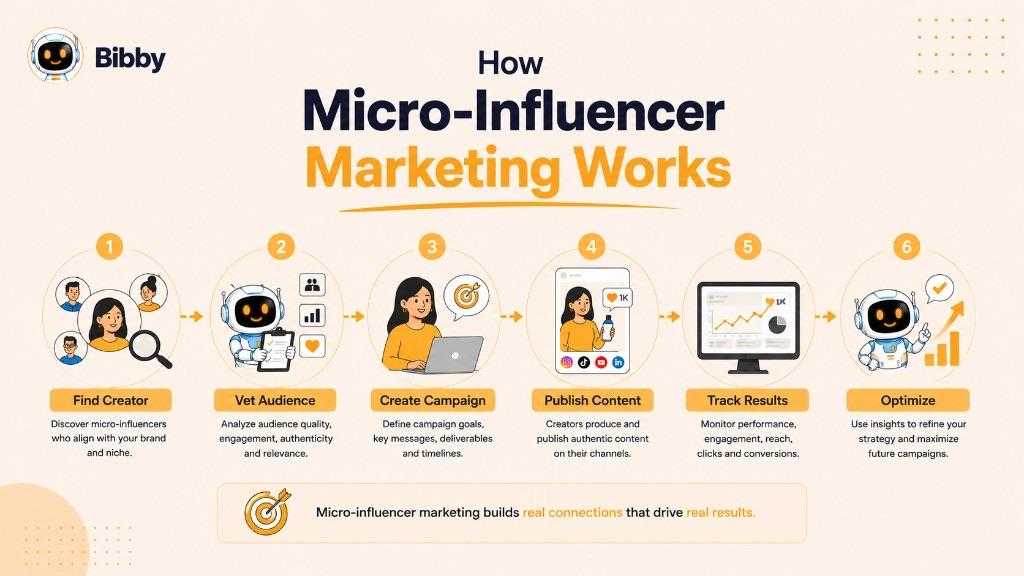
Set the goal → Define the audience → Find creators → Vet creators → Set the budget → Create the brief → Agree on deliverables → Launch content → Measure results → Optimize
1. Define the Campaign Goal
Common objectives include brand awareness, product discovery, website traffic, lead generation, app installs, product sales, engagement, user-generated content, product education, and community growth.
An awareness campaign may prioritize reach and impressions. A sales campaign may focus on clicks, conversions, revenue, and customer acquisition cost.
2–5. Audience, Discovery, Vetting, and Budget
Define location, age, interests, industry, purchasing behavior, problems, and preferred platforms. Search social media, hashtags, discovery platforms, competitor campaigns, existing customers, brand mentions, industry communities, and local networks.
Vet audience relevance, engagement, content quality, authenticity, niche expertise, previous partnerships, posting consistency, location, demographics, and professionalism.
The budget may need to cover creator fees, samples, shipping, production, usage rights, paid amplification, agency or platform fees, and tracking.
6–8. Brief, Deliverables, and Creative Freedom
A useful brief includes the objective, product information, target audience, key messages, deliverables, platforms, dates, required mentions or links, discount codes, disclosures, creative restrictions, approval process, and usage rights.
Example partnership: 1 TikTok video, 1 Instagram Reel, 3 Stories, 1 campaign link, published between specified dates.
Clarify whether the brand can reuse the content on its own marketing or paid advertising.
Give the campaign objective, product facts, important claims, brand guidelines, required information, and things to avoid—then allow the creator to fit the message to their normal style. Creative freedom does not mean abandoning brand requirements.
9–13. Publish, Repurpose, Measure, Compare, Optimize
Confirm links, tracking, codes, tags, disclosures, and dates. A content calendar helps when multiple creators publish.
Depending on rights, adapt approved assets into Instagram posts, TikTok videos, Facebook content, YouTube Shorts, Stories, website content, email, or paid ads.
Measure against the original objective. Do not judge the entire campaign using likes alone.
| Creator | Reach | Engagement | Clicks | Conversions |
|---|---|---|---|---|
| Creator A | High | Medium | Low | Low |
| Creator B | Medium | High | Medium | High |
| Creator C | Medium | Medium | High | Medium |
The “best” creator depends on the campaign objective.
Use findings about creators, formats, hooks, platforms, and offers to improve the next campaign.
Example Micro-Influencer Campaign Workflow
Imagine a software company launching a productivity application.
Goal: Awareness and trial sign-ups.
Audience: Freelancers, creators, and small-business professionals.
Creators: 10 productivity and business micro-influencers.
Content: Short-form videos, tutorials, Stories, and educational posts.
Tracking: Individual links and creator-specific codes.
Measurement: Views, engagement, clicks, trial registrations, and conversions.
Optimization: Increase investment in creators and formats that generate the strongest results.
Managing a Campaign at Scale
Managing 20 creators across several platforms can produce dozens of images, videos, captions, links, dates, variations, and approvals.
Bibby can help organize campaign content, generate captions, create variations, and schedule approved content across Facebook, Instagram, LinkedIn, YouTube, and TikTok. Chat can create campaigns, prepare posts, regenerate captions, and organize a brand kit.
Creators provide the audience, perspective, and original content. Automation helps the brand manage the operational machinery around that content. Bibby does not replace creator relationships, contracts, or attribution dashboards.
Micro-Influencer Content Formats
Choose formats based on the action you want the audience to take, rather than asking every creator to publish the same type of post.
| Content format | Common use | Example |
|---|---|---|
| Image post | Product awareness | Creator showcases a product in their normal content |
| Carousel | Education and storytelling | Step-by-step guide or product features |
| Short-form video | Discovery and engagement | Product demonstration or tutorial |
| Story | Direct promotion | Product mention with link or offer |
| Long-form video | Education and reviews | Detailed product review |
| Live video | Community interaction | Q&A, demonstration, or launch |
| Product review | Trust and consideration | Creator shares their experience |
| Tutorial | Product education | Creator demonstrates how to use the product |
| Unboxing | Product discovery | First-look experience |
| UGC | Content production | Creator produces assets for brand channels |
| Giveaway | Awareness and engagement | Creator and brand offer a promotional prize |
| Comparison | Purchase consideration | Product compared with alternatives |
Image posts can work well for fashion, beauty, food, travel, lifestyle, home, and consumer goods. Carousels can hold benefits, steps, tips, before-and-after examples, or educational information. Short-form video can include demonstrations, tutorials, reviews, tips, unboxings, comparisons, and problem-and-solution clips.
Stories support introductions, codes, links, questions, launches, events, and demonstrations. Long-form video helps when products require detailed explanation. Live streams support Q&A, launches, tutorials, and events.
A useful review covers what the product does, how the creator used it, features, advantages, limitations, and who it may suit. Brands should avoid requiring unsupported claims or an entirely positive opinion if the collaboration is intended as an authentic review.
Tutorials work well for software workflows, beauty looks, fitness equipment, recipes, and device setup. Unboxing works when the product experience is visually interesting. UGC-focused work may treat the creator's audience as secondary. Giveaways should follow platform rules and promotional regulations. Comparison content helps at the consideration stage.
Repurposing Micro-Influencer Content
Original video → Reel → TikTok → YouTube Short → Facebook video → Story
Original image → Social post → Carousel → Story → Website asset
Whether a brand can reuse or modify creator content depends on the usage rights agreed upon in the partnership.
| Campaign goal | Potentially useful formats |
|---|---|
| Awareness | Short-form video, image, Story |
| Education | Carousel, tutorial, long-form video |
| Product consideration | Review, comparison, tutorial |
| Website traffic | Story, video with CTA |
| Sales | Review, demonstration, Story, affiliate content |
| UGC generation | Short-form video, image, testimonial |
| Community engagement | Live video, Q&A, Story |
| Product launch | Short-form video, Story, live stream |
A campaign can combine several formats to move audiences from discovery to consideration to action.
Micro-Influencer Campaign Ideas
1. Product Launch Campaign
Product launch → 10 creators → 10 content styles → multiple niche audiences
Potential content includes first impressions, demonstrations, unboxings, short-form videos, Stories, reviews, and educational posts.
2. Product Review Campaign
Give selected creators time and information to test the product. Reviews can be short videos, long-form videos, carousels, Stories, or tutorials. Establish required claims before publication.
3. User-Generated Content Campaign
15 creators × 2 videos = 30 potential content assets
With appropriate usage rights, selected content may appear on the brand's social channels, website, email, or advertising.
4. Giveaway Campaign
Mechanics might involve following the brand, commenting, sharing, answering a question, visiting a landing page, or signing up. Follow platform rules. Large participation numbers do not necessarily translate into valuable customers.
5. Educational Campaign
Software: Productivity tutorials. Fitness: Training techniques. Travel: Destination planning. Beauty: Skincare education. Financial service: General financial education. The product can become part of the solution without making every post a direct advertisement.
6. Seasonal Campaign
Holiday shopping, summer travel, back-to-school, New Year, Valentine's Day, Black Friday, industry events, or seasonal launches. Plan creators, production, approvals, and dates in advance.
7. Local Creator Campaign
A restaurant could invite several local food creators to experience a new menu. Geographic relevance can be more important than total follower count.
8. Product Education Campaign
Tutorials, walkthroughs, feature demonstrations, use cases, FAQs, and before-and-after examples help when seeing the product in action matters—software, technology, beauty, and fitness equipment especially.
9. Affiliate Campaign
Creator A → unique link → 75 purchases. Creator B → 32. Creator C → 110. Compare performance. Affiliate campaigns can also combine with fixed compensation.
10. Creator Ambassador Program
Recurring content, early access, exclusive offers, affiliate commissions, product feedback, launch participation, events, and community activities. Long-term partnerships can give creators a deeper understanding of the product.
11–15. Challenges, Behind-the-Scenes, Customer Stories, Series, and Takeovers
Challenges should be easy to understand and relevant to the brand. Behind-the-scenes content can show product development, kitchens, operations, packaging, or founder stories. Customer stories can follow problem → experience → solution → result. A multi-creator series might ask ten creators “How I use [product] in my daily workflow.” A takeover, where platform functionality allows, can give the brand's existing audience a different voice.
How to Choose the Right Campaign Idea
| Objective | Campaign ideas |
|---|---|
| Brand awareness | Product launch, giveaway, seasonal campaign |
| Product education | Tutorials, educational campaign, demonstrations |
| UGC generation | UGC campaign, customer stories |
| Sales | Affiliate campaign, product reviews |
| Local awareness | Local creator campaign |
| Community engagement | Challenge, takeover, giveaway |
| Long-term growth | Creator ambassador program |
| Product consideration | Reviews, comparisons, demonstrations |
A campaign can combine approaches: product launch + UGC + affiliate tracking + long-term ambassador program.
As campaigns grow, each asset may need its own caption, date, format, approval status, and tracking link. Bibby can help create campaign content, generate captions, prepare formats, and schedule approved media. The creative idea still comes first.
How to Measure Micro-Influencer Marketing ROI
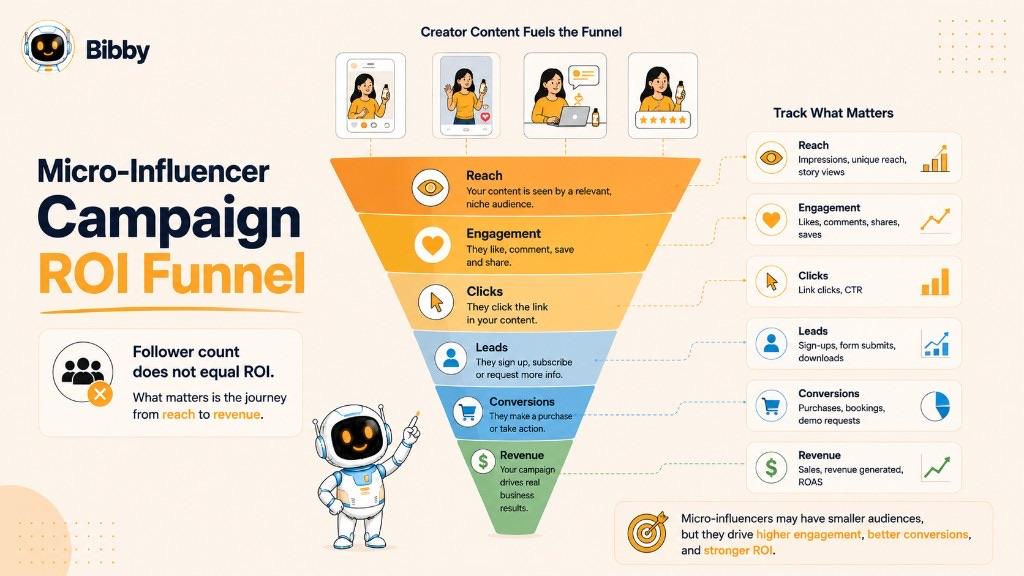
Measuring micro-influencer marketing ROI means determining whether the resources invested produced enough business or marketing value to justify the investment.
ROI = (Return − Investment) ÷ Investment × 100
If a campaign generates $8,000 in attributable revenue from a $5,000 investment:
($8,000 − $5,000) ÷ $5,000 × 100 = 60% ROI
Some campaigns are designed for awareness or content production rather than immediate revenue.
| Campaign objective | Important metrics |
|---|---|
| Brand awareness | Reach, impressions, video views, mentions |
| Engagement | Comments, shares, saves, engagement rate |
| Website traffic | Clicks, sessions, CTR |
| Lead generation | Leads, sign-ups, cost per lead |
| Sales | Purchases, revenue, conversion rate |
| App promotion | Installs, registrations, purchases |
| UGC generation | Number and quality of usable assets |
| Community growth | Relevant followers, subscribers, participation |
Reach measures unique accounts exposed to content. Impressions generally represent how many times content was displayed. Neither necessarily indicates how many people remembered the message or became customers.
Engagement can help evaluate audience response, but it should not be confused with business ROI.
For video, 100,000 views + very low retention tells a different story from 50,000 views + strong retention.
Track website traffic with creator-specific links: clicks, sessions, landing-page visits, CTR, time on page, sign-ups, and conversions. A creator who generates fewer clicks but more qualified leads may be more valuable.
For sales, track purchases, revenue, conversion rate, average order value, customer acquisition cost, and revenue per creator. Use unique affiliate links, creator-specific discount codes, or landing pages.
Cost per engagement = Total campaign cost ÷ Total engagements. If a campaign costs $2,000 and generates 10,000 measurable engagements: $0.20 per engagement. Not every engagement has equal value.
CPA = Total campaign cost ÷ Number of acquisitions. If a campaign costs $4,000 and generates 100 customers: $40 CPA.
If influencer-created content is later used in paid advertising, track original creator cost and subsequent ad spend separately.
Measure Each Creator Separately
| Creator | Reach | Engagement | Clicks | Leads | Sales |
|---|---|---|---|---|---|
| Creator A | 35K | 2.8K | 420 | 28 | 12 |
| Creator B | 22K | 3.1K | 310 | 41 | 19 |
| Creator C | 48K | 1.9K | 180 | 15 | 7 |
These numbers are illustrative, not industry benchmarks. The creator with the largest audience isn't necessarily the one generating the best business results.
Compare video vs image, tutorial vs review, short vs long, educational vs promotional, different hooks, CTAs, and product angles.
A creator who produces several strong reusable assets may provide more overall value than a creator whose content generates similar reach but cannot be reused.
Creator A: 100,000 views, 8,000 likes, 20 purchases.
Creator B: 50,000 views, 3,000 likes, 60 purchases.
If the goal is sales, Creator B generated the more valuable outcome.
Awareness → Engagement → Consideration → Conversion → Retention
Awareness: reach and impressions. Engagement: comments, shares, saves, views. Consideration: clicks, visits, product-page views. Conversion: sign-ups, purchases, leads. Retention: repeat purchases or ongoing customer activity.
How Bibby Can Support Campaign Measurement
Measurement starts with good campaign organization. Bibby can help organize campaigns, create and regenerate captions, prepare social content, and schedule approved media.
Creator content → Campaign organization → Caption creation → Platform-specific content → Scheduling → Performance review in native analytics
Analytics and attribution should still come from the appropriate platform and tracking systems. Bibby does not replace ads-manager reporting, affiliate dashboards, or CRM attribution.
If you need a simple framework: 1. Reach. 2. Engagement. 3. Clicks. 4. Leads. 5. Conversions. 6. Revenue. 7. CPA. 8. Content assets produced.
Micro-Influencers on Different Social Media Platforms
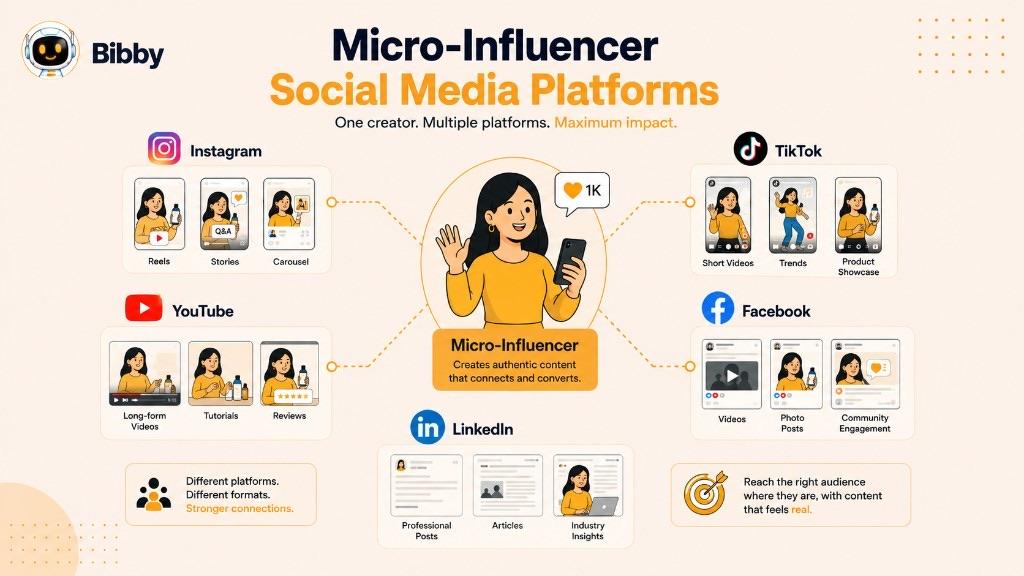
The platform should be selected based on where the target audience is active, what content the creator produces best, and what the campaign is trying to achieve.
Instagram Micro-Influencers
Instagram is useful for visually driven creator marketing: Reels, posts, carousels, Stories, and live video. Common industries include fashion, beauty, travel, food, fitness, lifestyle, and consumer products. Stories can support direct-response campaigns with links, announcements, and limited-time promotions where features allow.
TikTok Micro-Influencers
TikTok creators often focus on short-form video, personality, storytelling, education, entertainment, and trends: demonstrations, tutorials, reviews, “how I use it” videos, educational clips, problem-and-solution videos, and unboxings. Fitting TikTok viewing behavior can matter more than repurposing a traditional advertisement.
YouTube Micro-Influencers
YouTube is useful when products require more explanation: reviews, tutorials, comparisons, how-to videos, demonstrations, educational content, and Shorts. A smaller channel can have a highly specialized audience—valuable for technology, software, education, hobbies, or professional expertise.
Facebook Micro-Influencers
Facebook can support videos, images, Reels, Stories, live broadcasts, and community-oriented posts. It can be relevant for local businesses, community-focused brands, family-oriented products, and established interest groups.
LinkedIn Micro-Influencers
A LinkedIn micro-influencer might be a software engineer, founder, recruiter, marketer, sales professional, consultant, industry specialist, or business educator. Influence may be reflected less by follower count and more by the quality of professional conversations.
Platform Selection Matters
A brand does not need to use every platform.
Target audience → Platform → Creator → Content format → Campaign objective
A B2B software company might prioritize LinkedIn and YouTube. A fashion brand may focus on Instagram and TikTok. The strongest platform is the one where the right audience and the right creator already exist.
Micro-Influencer vs UGC Creator
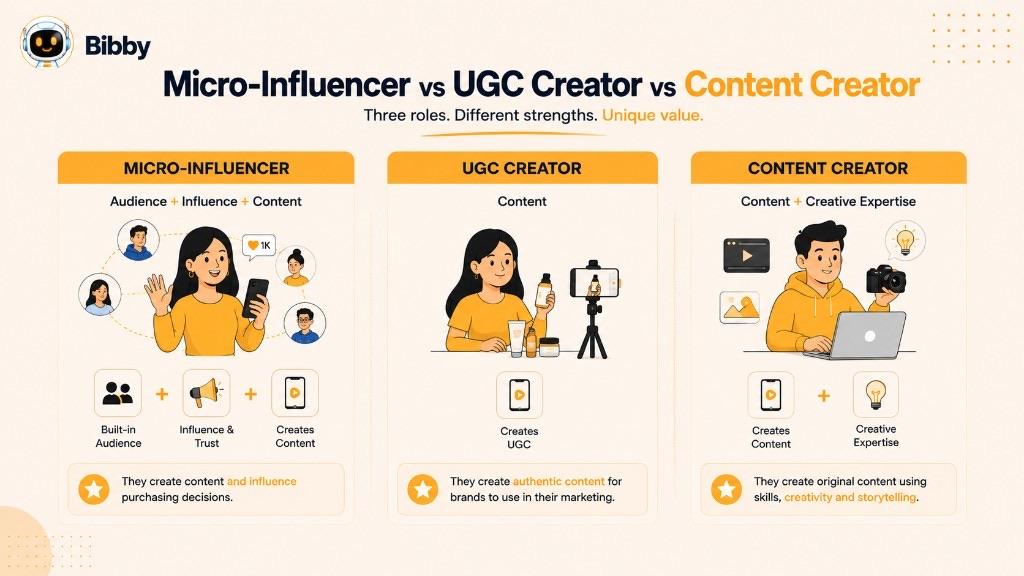
A micro-influencer brings an existing audience. A UGC creator primarily brings content production ability.
| Factor | Micro-influencer | UGC creator |
|---|---|---|
| Existing audience | Important | Not necessarily important |
| Audience distribution | Yes | Usually no |
| Content creation | Yes | Yes |
| Main value | Influence + content | Content |
| Publishes on own account | Usually | Not necessarily |
| Audience fit | Critical | Less important |
| Paid advertising use | Depends on rights | Often negotiated |
| Best for | Reach and influence | Creative asset production |
The two roles can overlap. A micro-influencer can also create UGC. A UGC creator can eventually develop a significant audience. The distinction is based primarily on how the brand is using the creator's value.
Micro-Influencer vs Content Creator
A content creator is a broad term for someone who produces digital content. A micro-influencer is a more specific category involving an established audience and influence within a particular niche.
Content creator = creates content.
Micro-influencer = creates content + has an established niche audience they can influence.
| Factor | Micro-influencer | Content creator |
|---|---|---|
| Audience | Typically established | May be small or large |
| Influence | Central to the role | Not required |
| Niche | Often clearly defined | May or may not be defined |
| Content production | Usually | Central role |
| Distribution | Own audience is important | May use various channels |
| Brand objective | Reach, trust, engagement, conversions | Content production and storytelling |
A successful content creator can become a micro-influencer, and a micro-influencer is usually a content creator as well. The distinction matters when defining what the brand is actually paying for.
How AI Can Help With Micro-Influencer Marketing
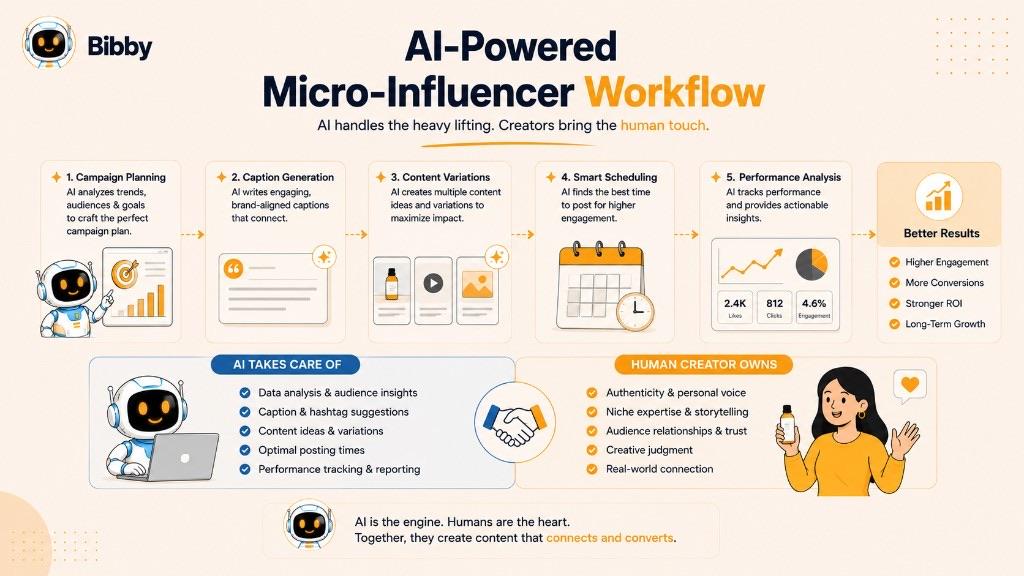
AI can reduce repetitive tasks. It does not replace the human relationship between a creator and their audience.
AI for Influencer Discovery and Campaign Planning
General AI tools and dedicated discovery platforms can help organize large creator lists by niche, audience characteristics, platform, topics, engagement, location, or requirements. Human review remains essential. Bibby does not search, score, or recommend influencers.
AI can turn a campaign objective into draft themes, post ideas, platform variations, a publishing sequence, creator-specific angles, and calls to action. The marketer reviews and refines the plan.
AI for Caption Generation and Content Repurposing
AI can draft captions from product information, brand voice, format, platform, audience, and objective. Review for accuracy, tone, brand compliance, and authenticity.
One campaign concept can become a short caption, social post, carousel concept, or video hook without rewriting every asset from scratch.
AI for Scheduling and Campaign Analysis
Once content is approved, AI-assisted scheduling can publish at suggested times. Bibby can schedule images, carousels, videos, and Stories at AI-optimized times on Instagram, Facebook, LinkedIn, YouTube, and TikTok.
AI can also help marketers summarize patterns in results they already collected—highest-performing creators, formats, platforms, or conversion trends. That analysis belongs in your analytics and tracking tools. Bibby does not provide an influencer ROI dashboard.
Using Bibby for AI-Assisted Social Media Workflows
Upload campaign media or generate visuals, select a posting style, generate captions, and schedule content across selected social platforms. Chat can create a brand kit, campaigns, and posts, or regenerate captions.
For campaigns that produce a large number of assets, this reduces operational workload. AI works best as an operations layer. The creator's personality, audience relationship, expertise, and original perspective should remain human.
How to Manage Micro-Influencer Content at Scale
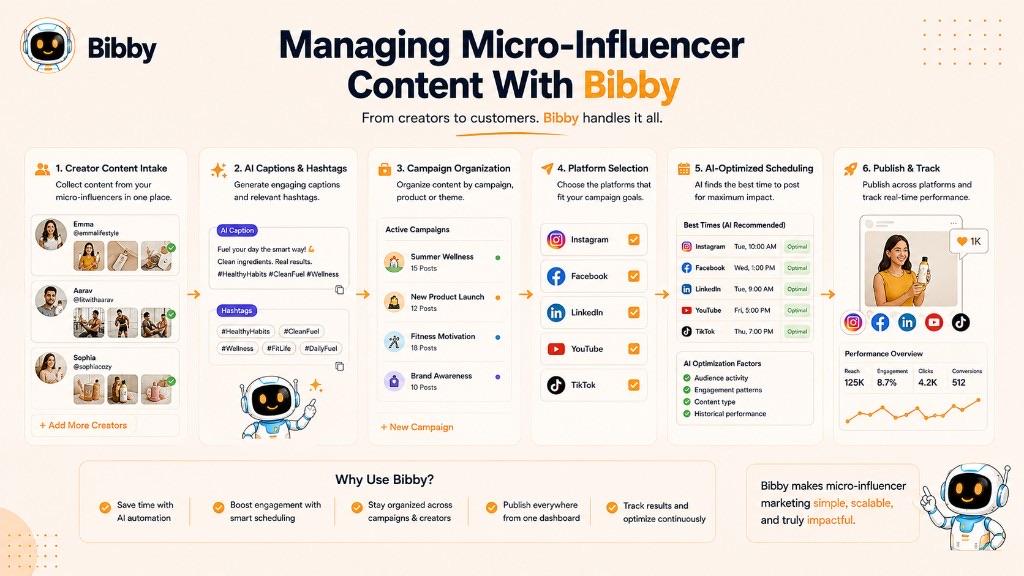
Imagine working with 20 creators across four platforms: multiple deliverables, dates, captions, approvals, links, and revisions.
Create a Central Content Library and Calendar
Organize assets by creator, campaign, platform, content type, publication date, approval status, and usage rights.
A content calendar should show creator, content, platform, date, status, campaign, CTA, and tracking link.
Standardize What Can Be Standardized
Standardize file naming, approval status, tracking links, campaign labels, publishing dates, and reporting structure. Allow creators flexibility around storytelling, hooks, personal opinions, presentation, visual style, and audience interaction.
Automate Repetitive Tasks
Caption generation, content variations, scheduling, publishing, campaign organization, and calendars can be automated so marketers spend more time on strategy and creator relationships.
Use Bibby to Centralize Social Publishing
Creator assets → Upload/generate media → Campaign organization → AI captions → Content variations → Platform selection → AI-optimized scheduling → Publishing
Get started with Bibby when you need that publishing layer. The objective is to reduce operational workload without flattening every creator into the same piece of content.
Key Takeaways
- A micro-influencer is commonly a creator with about 10,000–100,000 followers, but ranges are conventions, not official labels.
- Audience relevance, engagement, credibility, and content usually matter more than the follower number.
- Nano, micro, macro, and mega tiers trade community vs niche vs reach vs mass visibility.
- Price is not a simple rate per follower. Scope, rights, format, and expertise drive cost.
- Find creators by starting with the customer and community, then vet the live profile.
- Measure campaigns against the objective—reach, clicks, leads, sales, CPA, or reusable assets—not likes alone.
- Bibby organizes, captions, and schedules approved campaign content. It does not discover influencers or replace native analytics.
Explore more terms in the social media dictionary, including influencer, nano-influencer, UGC, and content creator.