
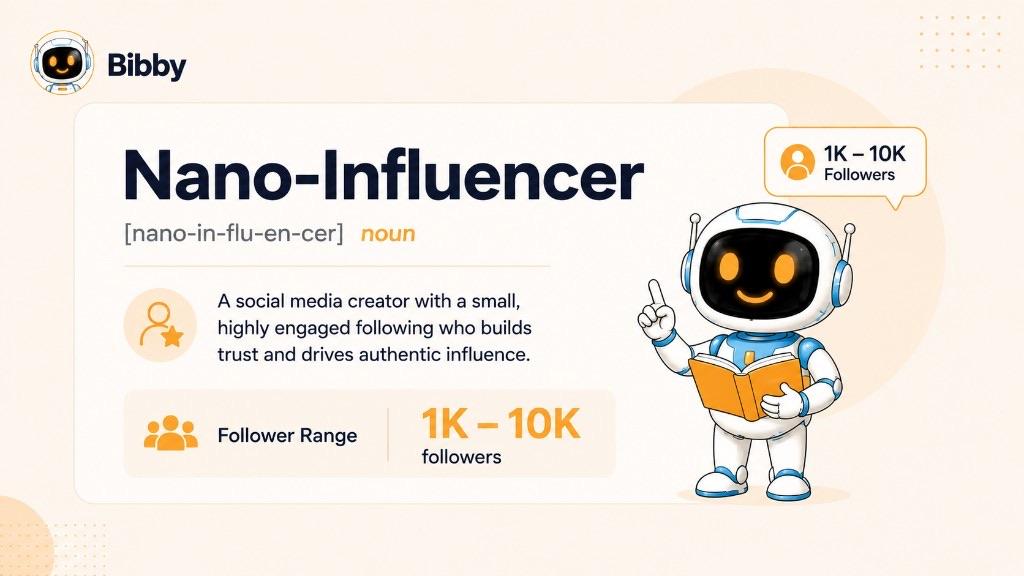
A nano-influencer is a social media creator with a relatively small but highly engaged audience, typically between 1,000 and 10,000 followers.
Follower count is only part of the story. Nano-influencers often build strong relationships with niche audiences, making them valuable for brands that want authentic recommendations, targeted reach, and meaningful engagement. In this article, you'll learn what nano-influencers are, how nano-influencer marketing works, and how brands can use them effectively.
In this page, you will learn:
- What a nano-influencer is and how many followers they have
- Why brands use nano-influencers for targeted marketing
- How to find, work with, and measure nano-influencers
Let's start with exactly what the term nano-influencer means.
What Is a Nano-Influencer?
A nano-influencer is a social media creator who typically has between 1,000 and 10,000 followers and maintains a close, engaged relationship with their audience. Unlike influencers with large audiences, nano-influencers often focus on a specific niche, such as fitness, beauty, food, gaming, fashion, travel, or business.
The defining characteristic of a nano-influencer isn't simply the number of followers they have. Their value comes from the combination of a relatively small audience, strong audience relationships, niche relevance, and the ability to influence what their followers think, discover, or buy.
For example, a creator with 3,000 followers who regularly shares honest skincare recommendations may have more influence within a skincare community than a much larger creator whose audience is less focused on that topic.
What Makes Someone a Nano-Influencer?
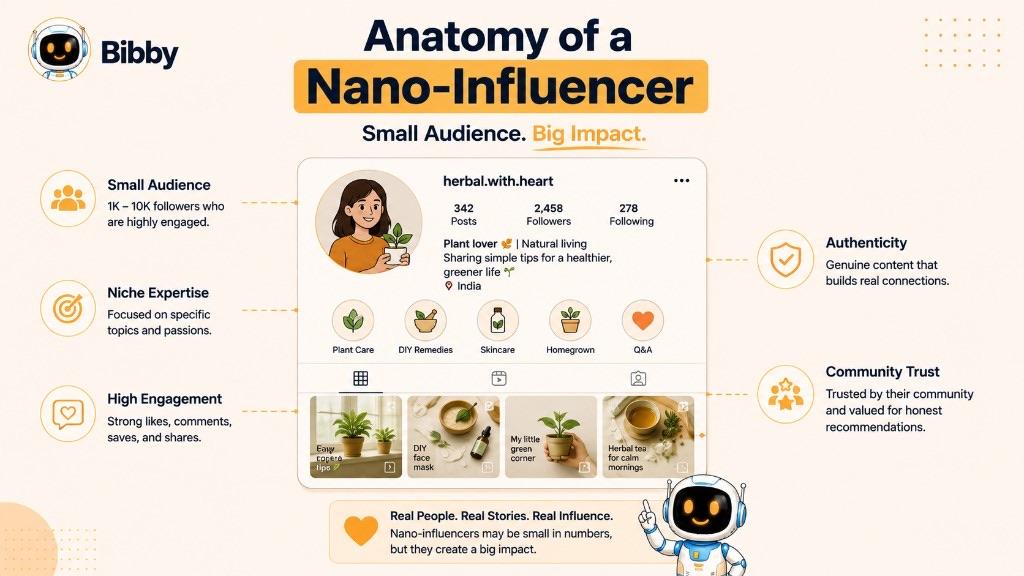
Several characteristics typically distinguish nano-influencers from other types of social media creators:
- Small audience: They generally have between 1,000 and 10,000 followers.
- High audience engagement: Their followers may actively comment, share, save, and respond to their content.
- Niche expertise: Many nano-influencers create content around a specific subject or interest.
- Personal relationships: A smaller audience can make it easier to develop genuine connections with followers.
- Authentic recommendations: Their content can feel more personal and relatable than traditional advertising.
- Consistent influence: They can shape opinions and purchasing decisions within their particular community.
Nano-influencers can exist on virtually any social platform, including Instagram, TikTok, YouTube, Facebook, and LinkedIn. What matters most is not the platform or follower count alone, but whether the creator has a relevant audience that trusts and engages with their content.
How Many Followers Does a Nano-Influencer Have?
A nano-influencer typically has 1,000 to 10,000 followers on a social media platform. This is a commonly used range in influencer marketing, although there is no single universal standard for how influencer tiers are defined.
A creator's follower count provides a useful starting point, but it doesn't tell the whole story. Two creators with the same number of followers can have very different levels of engagement, audience trust, niche relevance, and influence.
For example, a nano-influencer with 2,500 highly relevant followers may be more valuable to a specialized brand than a creator with 8,000 followers whose audience has little connection to the product.
Nano-Influencer Follower Range
| Influencer type | Typical follower range |
|---|---|
| Nano-influencer | 1,000–10,000 |
| Micro-influencer | 10,000–100,000 |
| Mid-tier influencer | 100,000–500,000 |
| Macro-influencer | 500,000–1 million |
| Mega-influencer | 1 million+ |
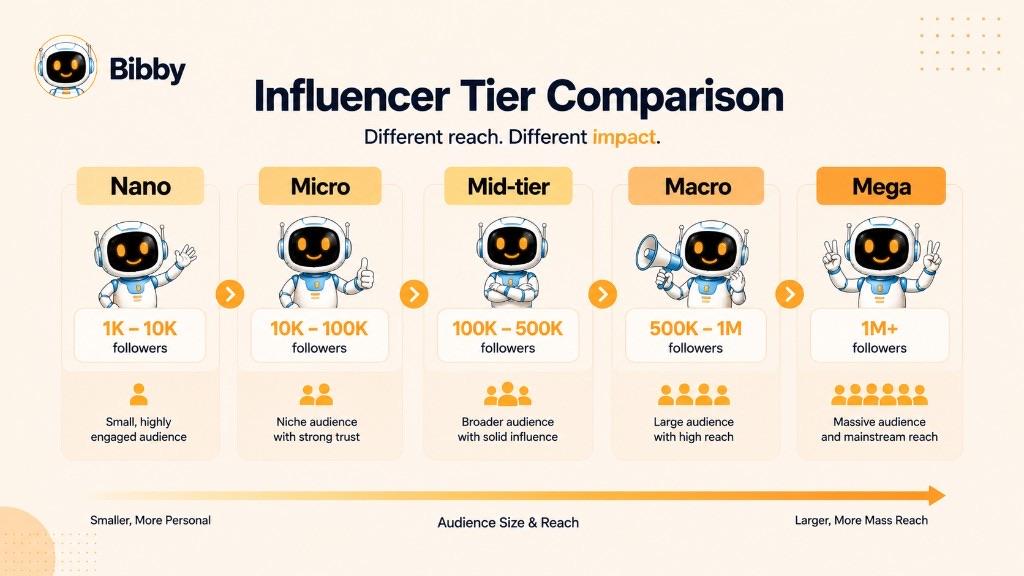
These ranges should be treated as general industry classifications rather than strict rules. Different influencer marketing platforms, agencies, and brands may use slightly different thresholds. Some frameworks, for example, treat macro as beginning closer to 100,000 followers rather than 500,000.
More importantly, having 1,000 followers doesn't automatically make someone influential. Audience quality, engagement, content consistency, credibility, and relevance to a particular niche all play an important role.
For brands, this is why choosing a nano-influencer should involve more than filtering creators by follower count.
Nano vs. Micro vs. Macro Influencers
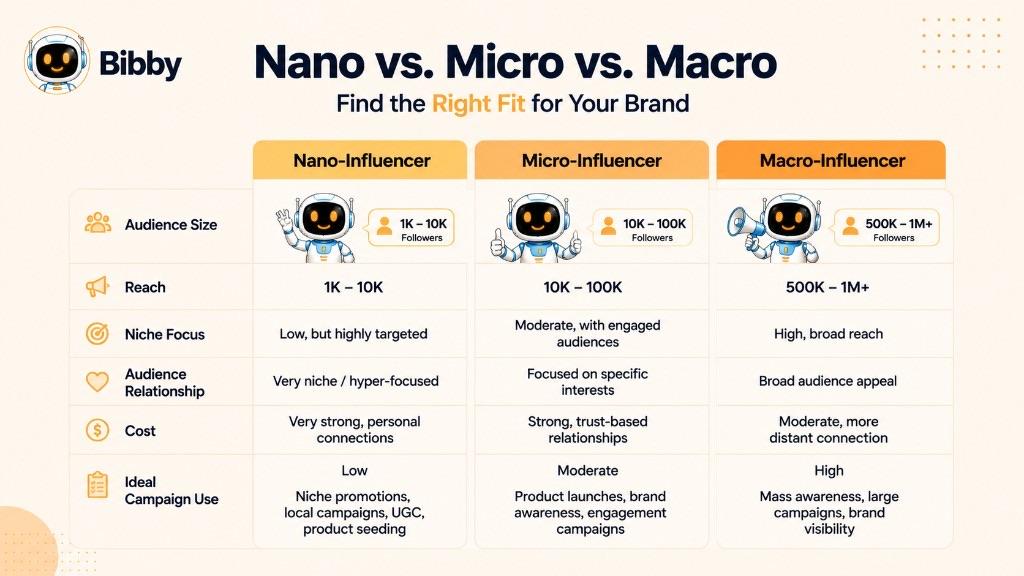
Nano-, micro-, and macro-influencers differ primarily in audience size, reach, and the type of relationship they tend to have with their followers. While larger influencers can provide greater reach, smaller creators often offer more focused communities and closer audience relationships.
Nano-Influencers
Nano-influencers typically have 1,000–10,000 followers. They often serve highly specific niches and maintain close relationships with their audiences.
They can be particularly useful for brands looking for authentic recommendations, niche targeting, community engagement, or localized promotion rather than maximum reach.
Micro-Influencers
Micro-influencers typically have 10,000–100,000 followers. They generally provide a larger reach than nano-influencers while still maintaining a relatively focused audience.
Micro-influencers are often a good fit for brands that want to balance targeted engagement with greater campaign reach.
Macro-Influencers
Macro-influencers typically have 500,000–1 million followers in the classification used in the table below. Other marketing frameworks place the macro tier lower. Their larger audiences allow brands to reach substantially more people through a single creator, although the relationship between the creator and individual followers may be less personal.
Macro-influencers are often used for large-scale awareness campaigns where broad visibility is a primary objective.
Nano vs. Micro vs. Macro Influencers at a Glance
| Factor | Nano | Micro | Macro |
|---|---|---|---|
| Typical followers | 1K–10K | 10K–100K | 500K–1M |
| Potential reach | Lower | Moderate | High |
| Niche specialization | Often very strong | Often strong | Varies |
| Audience relationship | Very personal | Personal | Broader |
| Campaign cost | Generally lower | Moderate | Generally higher |
| Best suited for | Niche engagement and trust | Targeted reach at scale | Broad awareness |
These categories are useful guidelines, not universal rules. Influencer tiers can vary between platforms and marketing organizations, and follower count alone does not determine an influencer's effectiveness.
In practice, the right creator depends on the campaign objective. A brand seeking deep engagement within a specialized community may benefit more from several relevant nano-influencers than from one much larger creator.
What Is Nano-Influencer Marketing?
Nano-influencer marketing is a form of influencer marketing in which brands collaborate with nano-influencers to promote products, services, campaigns, or brand messages to their relatively small but highly targeted audiences.
Instead of relying on one creator with a massive following, a brand can work with nano-influencers who have established credibility within specific communities. The goal is often to reach the right people through content that feels relevant and personal rather than simply maximizing impressions.
How Does Nano-Influencer Marketing Work?
A typical nano-influencer campaign follows a simple process:
- Define the campaign goal: The brand determines whether it wants awareness, engagement, website traffic, sales, user-generated content, or another outcome.
- Find relevant creators: The brand identifies nano-influencers whose niche and audience align with its target customers. Bibby does not discover or match influencers.
- Evaluate the creators: The brand reviews their content quality, engagement, audience relevance, and previous partnerships.
- Agree on the collaboration: Both sides establish compensation, content requirements, deadlines, usage rights, and other campaign terms.
- Create and publish content: The influencer produces content in a style that fits their audience and the campaign.
- Measure the results: The brand evaluates reach, engagement, clicks, conversions, and other relevant metrics in native analytics and tracking tools.
Common Nano-Influencer Marketing Formats
Brands can work with nano-influencers in several ways, including:
- Sponsored posts: The creator publishes paid content featuring the brand or product.
- Product gifting: A brand provides products for creators to try and potentially feature in their content.
- Product reviews: The creator shares their experience with a product or service.
- Affiliate campaigns: The creator earns a commission from sales generated through their unique link or code.
- Discount-code campaigns: Followers receive a special offer associated with the creator.
- User-generated content: Creators produce photos or videos that a brand can potentially use in its own marketing.
- Giveaways: Creators and brands collaborate to generate engagement and introduce products to new audiences.
- Brand ambassador programs: A creator develops an ongoing relationship with a brand rather than participating in a single campaign.
The strength of nano-influencer marketing is that it combines targeted audiences with creator-led content. For brands, the objective isn't necessarily to find the creator with the most followers—it is to find creators whose audience, content, and credibility align with the campaign.
Why Do Brands Work With Nano-Influencers?
Brands work with nano-influencers because a smaller audience can sometimes provide something that large influencer accounts cannot: a focused community with strong relevance and personal connections.
For the right campaign, reaching fewer highly relevant people can be more valuable than reaching a much larger general audience.
1. Stronger Audience Relationships
Nano-influencers often interact directly with their followers through comments, messages, and regular conversations. Because their communities are relatively small, their recommendations can feel more personal and relatable.
This can make a nano-influencer's content feel more like a recommendation from someone the audience follows and trusts than a traditional advertisement.
2. Highly Targeted Audiences
Many nano-influencers create content around a specific interest or niche.
For example, a creator might focus specifically on vegan cooking, budget travel, home workouts, skincare for sensitive skin, local restaurants, photography, small-business marketing, or software and technology.
For brands serving specialized markets, this audience concentration can be extremely valuable.
3. Potentially High Engagement
A smaller community can make meaningful interaction easier to maintain. Followers may be more likely to comment, ask questions, share posts, save content, or respond to recommendations when they have a stronger connection with the creator.
However, nano-influencer does not automatically mean high engagement. Brands should evaluate each creator's actual engagement and audience quality rather than assuming smaller accounts always perform better.
4. Lower Barriers to Collaboration
Working with nano-influencers can give brands access to creator partnerships without requiring the budget associated with some larger influencers.
Depending on the creator and campaign, compensation might involve a paid fee, free products, affiliate commissions, or a combination of these.
This can make nano-influencers particularly attractive to smaller brands and businesses testing influencer marketing for the first time.
5. Authentic, Platform-Native Content
Nano-influencers are often deeply familiar with the platforms where they build their communities. Their content may naturally fit the format, language, and expectations of their audience.
Instead of creating an advertisement that looks like an advertisement, brands can collaborate with creators to produce content that feels native to the platform.
6. Access to Niche Communities
A nano-influencer can act as a bridge between a brand and a specific community.
A fitness supplement brand, for example, might benefit from partnering with several creators who each speak to different fitness niches rather than relying on one general fitness account.
This approach can help a brand test different audiences, messages, and content styles.
7. Easier Campaign Testing
Brands don't necessarily have to put their entire influencer budget behind one creator.
They can test campaigns with multiple nano-influencers, compare performance, and identify which combinations of audience + creator + content format + message produce the strongest results.
The best-performing creators or content concepts can then receive more attention and budget.
Ultimately, the biggest advantage of nano-influencers is not simply that they have fewer followers. It is that they can give brands access to specific communities where relevance, credibility, and engagement matter more than raw audience size.
What Are the Disadvantages of Nano-Influencers?
Nano-influencers can be valuable for targeted marketing, but they aren't the right choice for every campaign. Their smaller audiences and limited resources can create challenges, particularly when a brand needs large-scale reach or wants to manage a campaign with many creators.
1. Limited Reach
The most obvious limitation is audience size. A nano-influencer with a few thousand followers cannot provide the same potential reach as a creator with hundreds of thousands or millions of followers.
Brands focused primarily on mass awareness may therefore need to work with many nano-influencers to achieve the reach that a larger influencer could provide.
2. More Creators Can Mean More Management
Instead of coordinating with one large influencer, a brand may need to communicate with dozens of smaller creators.
That can increase the workload involved in finding creators, sending briefs, negotiating compensation, managing deadlines, reviewing content, collecting performance data, and processing payments.
The potential benefit of working with multiple nano-influencers needs to be weighed against this additional management.
3. Content Quality Can Vary
Not every nano-influencer has professional equipment, editing skills, or extensive experience working with brands.
Some creators may produce excellent content with minimal resources, while others may require more guidance to meet a campaign's quality standards.
Brands should review a creator's existing work before agreeing to a collaboration.
4. Results Can Be Inconsistent
A small following does not guarantee high engagement, conversions, or sales.
One nano-influencer may generate significant interest in a product, while another with a similar follower count may produce very little response.
Performance can depend on the creator's niche, audience, content format, campaign message, timing, and relationship with their followers.
5. Audience Quality Still Needs to Be Verified
Follower count can be misleading. An account may have inactive followers, an audience that doesn't match the brand's target market, or unusually low-quality engagement.
Brands should therefore examine the audience and engagement patterns instead of selecting creators based solely on their follower count.
6. Measuring Direct ROI Can Be Difficult
Not every influencer campaign produces an immediately measurable sale.
A nano-influencer might increase awareness, generate useful user-generated content, or introduce a brand to a new community without producing a directly attributable purchase.
Using trackable links, discount codes, campaign-specific landing pages, and platform analytics can make performance easier to evaluate. Bibby does not replace those attribution systems.
When Are Nano-Influencers a Poor Fit?
Nano-influencers may be less suitable when a campaign requires:
- Massive immediate reach
- Broad public awareness
- A single high-profile spokesperson
- Highly specialized production capabilities
- Minimal campaign-management overhead
The right influencer tier depends on the campaign objective. Nano-influencers are most compelling when audience relevance and community connection are more important than sheer reach.
How to Identify a Good Nano-Influencer
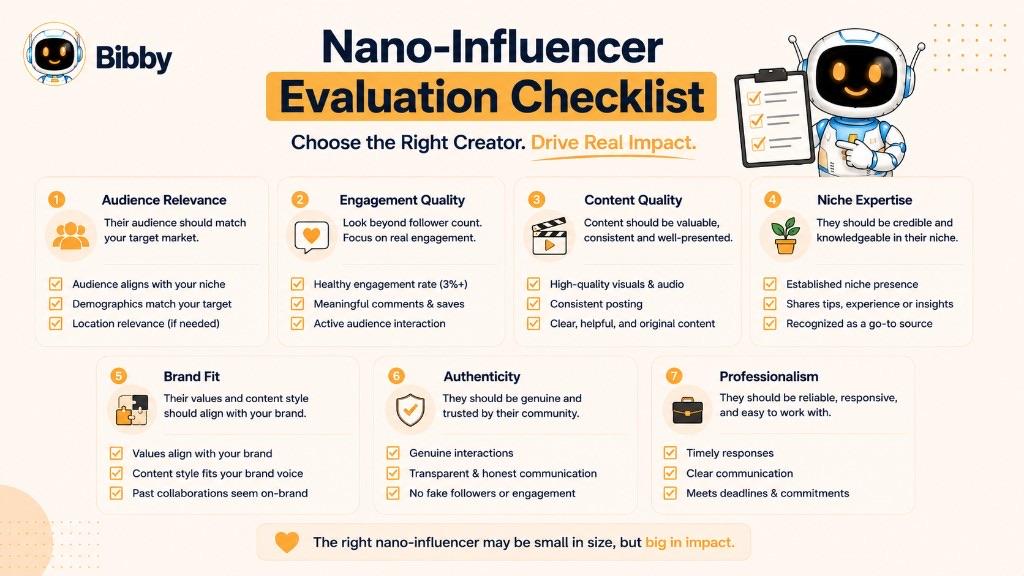
Finding a nano-influencer isn't simply a matter of searching for an account with 1,000–10,000 followers. The most useful creator for a campaign is one whose audience, content, engagement, and values align with the brand.
Before starting a collaboration, evaluate the creator across several areas.
1. Check Audience Relevance
Start by asking whether the creator actually reaches the people your brand wants to reach.
Look at audience demographics, location, interests, niche, language, and content preferences.
For example, a local restaurant may get more value from a food creator whose followers live nearby than from a creator with a larger audience spread across the country.
2. Evaluate Engagement
Don't judge a creator by likes alone. Look at the broader pattern of interaction across their recent content.
Useful signals include comments, shares, saves, views, replies, meaningful conversations, and audience sentiment.
Pay particular attention to whether comments appear genuine and relevant rather than consisting mostly of generic reactions.
3. Review Content Quality
Look through the creator's recent posts rather than judging their profile from a single piece of content.
Consider visual quality, writing and communication, video quality, storytelling, consistency, creativity, and the ability to explain or demonstrate products.
The goal isn't necessarily to find the most professionally produced account. It is to find a creator whose content quality fits the campaign and resonates with their audience.
4. Look for Genuine Niche Expertise
A strong nano-influencer usually has a recognizable area of interest.
A creator who consistently talks about budget travel, for example, may have more credibility with a travel audience than someone who occasionally posts about travel simply because a brand approached them.
Look for consistent topical relevance, not just keywords in a profile bio.
5. Assess Brand Fit
The creator's personality and values should make sense alongside the brand.
Consider tone of voice, values, visual style, previous partnerships, topics they discuss, and products they already recommend.
A technically relevant audience isn't enough if the partnership feels unnatural.
6. Review Previous Brand Collaborations
If the creator has worked with other brands, examine those campaigns.
Ask whether the sponsored content felt authentic, whether the creator clearly disclosed the partnership, whether the content matched their normal style, whether followers responded positively, and whether the creator repeatedly promotes unrelated products.
A long history of poorly matched sponsorships can be a warning sign.
7. Consider Professionalism
A creator can have an excellent audience but still be difficult to work with.
Before launching a campaign, consider whether they respond promptly, follow instructions, meet deadlines, understand campaign requirements, communicate clearly, and provide agreed deliverables.
Professionalism becomes particularly important when a campaign involves multiple nano-influencers.
8. Verify Authenticity
Finally, make sure the audience and engagement appear legitimate.
Watch for warning signs such as sudden unexplained follower growth, large numbers of irrelevant followers, repetitive or suspicious comments, engagement that doesn't match audience size, and extremely inconsistent views or interactions.
No single metric can prove whether an account is authentic, so evaluate the creator's overall activity and audience patterns.
A Simple Nano-Influencer Evaluation Framework
Before choosing a creator, ask five questions:
Is the audience relevant?
Is the engagement genuine?
Is the content consistently good?
Does the creator fit the brand?
Can the creator deliver professionally?
If the answer is yes across all five, follower count becomes much less important. The best nano-influencer is not necessarily the one with the most followers, but the one with the strongest combination of relevance, trust, content quality, and audience engagement.
How Much Does a Nano-Influencer Cost?
There is no fixed price for working with a nano-influencer. Compensation can range from free products or affiliate commissions to paid collaborations, depending on the creator, platform, audience, content format, campaign requirements, and usage rights.
A nano-influencer may charge differently for an Instagram Reel, TikTok video, Story, carousel, YouTube integration, or a package containing multiple pieces of content.
What Determines a Nano-Influencer's Cost?
Audience size and engagement. Follower count can influence pricing, but it isn't the only consideration. A smaller creator with a highly engaged and relevant audience may command a higher rate than another creator with the same number of followers but weaker engagement.
Content format. A simple Story may require less work than a professionally filmed and edited video.
Number of deliverables. A campaign requesting five posts and several Stories will generally require more compensation than a campaign requesting a single post.
Content production requirements. Specific locations, equipment, editing, scripting, models, or other production work can increase the creator's fee.
Usage rights. Brands may want to reuse influencer-created content on their own website, social media accounts, advertisements, or other marketing channels. Extended or paid usage rights can affect the total cost.
Exclusivity. Asking a creator not to promote competing products for a particular period can also affect compensation.
Creator niche and expertise. Creators with specialized knowledge or access to particularly valuable audiences may charge more.
How Are Nano-Influencers Usually Compensated?
- Flat fee: The brand pays an agreed amount for specific deliverables.
- Free products: The creator receives products instead of, or sometimes in addition to, monetary payment.
- Affiliate commission: The creator earns a percentage of sales generated through their link or discount code.
- Product plus fee: The creator receives the product and a monetary payment.
- Performance-based compensation: Payment is tied partly to measurable campaign results.
- Long-term partnerships: The creator receives ongoing compensation for representing the brand over a longer period.
Do Nano-Influencers Get Paid?
Yes, nano-influencers can get paid. However, not every collaboration involves a monetary fee.
Some creators may accept products, affiliate commissions, or other benefits, particularly when they are starting out or genuinely interested in the brand. Experienced creators may expect monetary compensation for their time, creative work, audience access, and content usage.
Brands should therefore avoid assuming that a small audience means a creator should work for free.
How to Set a Nano-Influencer Budget
Instead of starting with a generic price-per-post figure, define the campaign requirements first.
Consider how many creators you need, what content each creator must produce, where the content will be published, whether the brand will reuse the content, whether exclusivity is required, and what result the campaign is designed to achieve.
Then compare creator proposals based on the total value and expected outcome, rather than follower count alone.
For brands, the most useful question isn't simply *“How much does a nano-influencer cost?”* but “What am I paying for, and how well does this creator's audience match my campaign?”
Nano-Influencer Examples
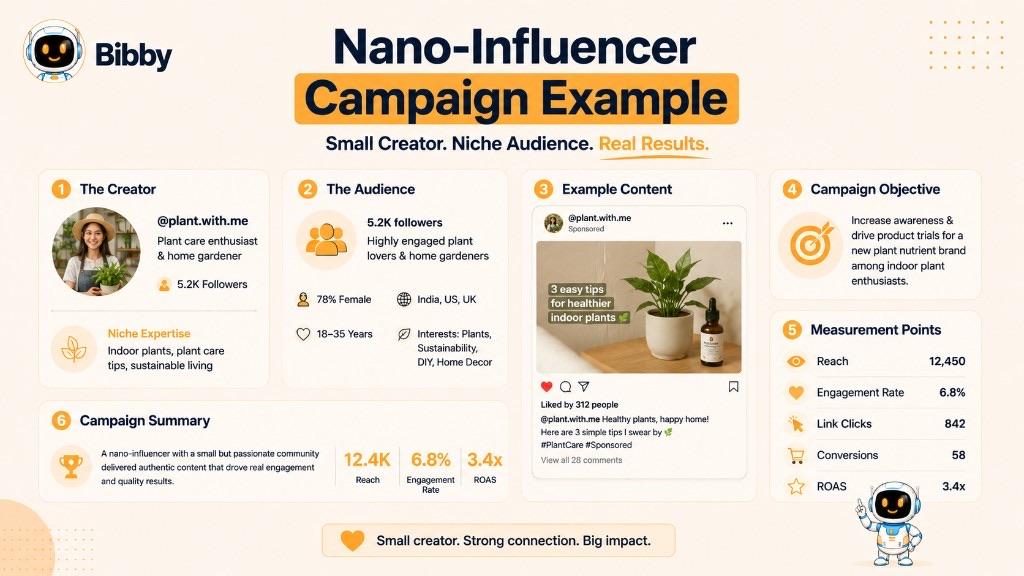
Nano-influencers can exist in almost any niche. What makes them useful isn't simply having a small follower count, but having a specific audience that pays attention to their content and trusts their perspective.
Here are three hypothetical examples of how a brand might work with a nano-influencer.
Example 1: A Local Food Creator
Imagine a food creator with 3,500 followers, most of whom live in the same city. The creator regularly posts restaurant recommendations, food photos, and short videos reviewing local places.
A new restaurant could partner with this creator to introduce itself to the local community.
Campaign: The creator visits the restaurant and publishes a short video and Story featuring the experience.
Target audience: Local food enthusiasts.
Campaign goal: Generate local awareness and restaurant visits.
Why a nano-influencer works: The creator's audience is small but geographically relevant. For a local business, reaching a few thousand nearby people can be more valuable than reaching a much larger audience in unrelated locations.
Example 2: A Skincare Creator
Consider a skincare creator with 7,000 followers who focuses specifically on skincare routines and product education.
A skincare brand launching a new product could collaborate with the creator to demonstrate how the product fits into a daily routine.
Campaign: The creator publishes a product demonstration and explains how they use it.
Target audience: People interested in skincare.
Campaign goal: Product awareness and consideration.
Why a nano-influencer works: The creator has established a clear niche, so the brand isn't simply paying for exposure. It is reaching an audience already interested in the subject.
Example 3: A SaaS or Business Creator
Imagine a business creator with 4,000 followers who regularly shares productivity tips, software recommendations, and workflow tutorials.
A software company could collaborate with the creator to demonstrate a practical use case for its product.
Campaign: The creator publishes a tutorial showing how the software fits into an existing workflow.
Target audience: Professionals and small-business owners interested in productivity tools.
Campaign goal: Generate qualified traffic and product consideration.
Why a nano-influencer works: The creator's audience is relatively small but closely aligned with the product's potential customers. Educational content can also demonstrate the product rather than simply mentioning it.
What These Nano-Influencer Examples Have in Common
Each example follows the same basic principle:
Relevant creator + relevant audience + useful content + clear campaign objective
The creators don't need millions of followers to provide value. Their advantage comes from having a defined community and creating content that naturally fits that community.
This is why brands evaluating nano-influencers should look beyond follower count and consider who the creator reaches, what the creator talks about, how the audience responds, and whether the partnership makes sense for the campaign.
How to Become a Nano-Influencer
You don't need a massive following to start building influence on social media. A nano-influencer typically starts by choosing a focused niche, consistently creating useful content, and developing genuine relationships with a relatively small audience.
1. Choose a Specific Niche
Start with a subject you understand, enjoy, or can consistently create content about.
Instead of choosing something extremely broad like “lifestyle,” consider a more specific topic such as budget travel, home workouts, skincare, photography, local food, or small-business marketing.
A focused niche makes it easier for people to understand why they should follow you.
2. Define Your Target Audience
Think about the specific people you want your content to help or entertain.
Consider their interests, problems, goals, location, experience level, and content preferences.
The clearer your audience is, the easier it becomes to create content that feels relevant.
3. Optimize Your Social Media Profile
Your profile should quickly communicate who you are and what followers can expect from you.
Use a recognizable profile photo, a clear bio, relevant keywords, and a consistent visual identity. Make it easy for a new visitor to understand your niche within a few seconds.
4. Create Useful Content Consistently
Consistency matters more than publishing occasionally and disappearing for weeks.
Create content that provides a reason for people to follow you, such as tutorials, reviews, tips, educational posts, opinions, demonstrations, personal experiences, or behind-the-scenes content.
Focus on being useful or interesting rather than simply trying to increase your follower count.
5. Develop a Recognizable Content Style
Your content should gradually develop its own identity.
That might come from your visual style, storytelling, humor, editing, expertise, or the way you explain a particular subject.
A recognizable style helps followers remember you and can make your content easier to distinguish in crowded social feeds.
6. Engage With Your Community
Influence isn't just about publishing posts.
Respond to comments, answer questions, participate in relevant conversations, and pay attention to what your audience tells you.
A smaller audience gives you an opportunity to build relationships that become increasingly difficult to maintain as an account grows.
7. Study Your Content Performance
Use your platform's analytics to understand what resonates with your audience.
Look beyond follower growth and examine metrics such as views, reach, comments, shares, saves, profile visits, and link clicks.
Use those insights to create more of the content your audience finds valuable.
8. Build a Simple Portfolio
If you want to work with brands, create a collection of your strongest content.
A portfolio can show your niche, audience size, audience demographics, engagement, best-performing content, previous collaborations, and available content formats.
You don't necessarily need previous brand partnerships. High-quality examples of your own content can demonstrate what you are capable of producing.
9. Approach Relevant Brands
Once you've established a consistent presence, identify brands that genuinely fit your niche and audience.
A personalized pitch is usually more useful than sending the same generic message to every company.
Explain who your audience is, why the brand is relevant, what type of content you could create, and what value the collaboration could provide.
10. Treat Your Audience as Your Biggest Asset
The goal shouldn't be to reach 10,000 followers as quickly as possible just to qualify as a nano-influencer.
A smaller audience that trusts your recommendations can be more valuable than a larger audience that rarely engages with your content.
Build influence first; follower count follows.
Bibby can help you upload or generate visuals, choose a posting style, generate AI captions, and schedule images, carousels, videos, and Stories at AI-optimized times on Facebook, Instagram, LinkedIn, YouTube, and TikTok so you spend more time creating and talking with your community.
How Brands Can Run a Nano-Influencer Campaign
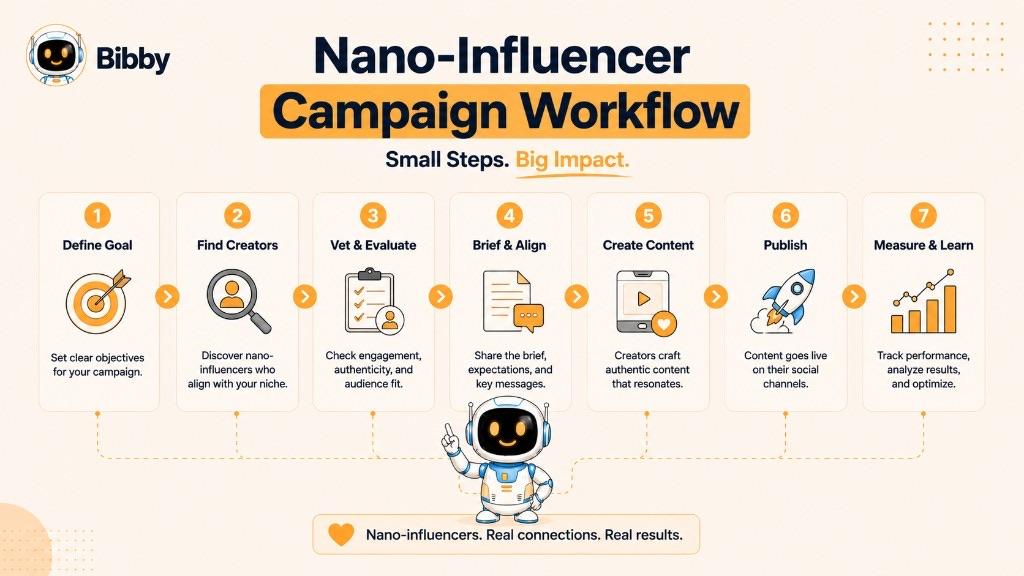
A successful nano-influencer campaign starts with a clear objective and ends with measurable results. Because brands may work with several smaller creators instead of one large influencer, having a structured workflow is especially important.
1. Define the Campaign Objective
Start by deciding what the campaign needs to achieve.
Common objectives include increasing brand awareness, generating engagement, driving website traffic, increasing product sales, collecting user-generated content, launching a new product, or reaching a specific niche audience.
Your objective determines which creators, content formats, and metrics make sense.
2. Define Your Target Audience
Identify exactly who you want the campaign to reach.
Consider age, location, interests, profession, buying behavior, pain points, and platform preferences.
The more specific the audience, the easier it becomes to identify relevant nano-influencers.
3. Find Relevant Nano-Influencers
Search for creators who already communicate with your target audience.
You can discover potential creators through social platforms, niche communities, creator databases, influencer agencies, and direct research.
Prioritize audience fit over follower count. A creator with 2,000 highly relevant followers can be more useful than one with 9,000 followers who rarely reaches your target customers.
4. Vet the Creators
Before reaching out, review each creator's content quality, engagement, audience relevance, posting consistency, previous partnerships, brand alignment, and audience authenticity.
Look at several recent posts rather than making a decision based on one successful piece of content.
5. Create a Clear Campaign Brief
Once you've selected your creators, give them enough information to understand the campaign.
A brief might include campaign objective, key product information, core message, required deliverables, content formats, publishing dates, brand guidelines, disclosure requirements, usage rights, approval process, and compensation.
The brief should provide direction without making the content feel scripted.
6. Give Creators Creative Freedom
Nano-influencers understand their communities better than the brand does.
Instead of dictating every word, give creators the key information and allow them to communicate it in their own voice.
This can make sponsored content feel more natural and better suited to the creator's audience.
7. Coordinate Content and Publishing
When working with multiple nano-influencers, organization becomes important.
Track creator, platform, content format, deliverable, deadline, approval status, publishing date, campaign link or code, and performance results.
A centralized content calendar can make it easier to manage multiple creators and ensure that campaign content is published consistently.
Bibby can help organize campaign content, generate captions, create variations, and schedule approved media across Facebook, Instagram, LinkedIn, YouTube, and TikTok. Chat can create campaigns, prepare posts, regenerate captions, and organize a brand kit.
8. Measure Campaign Performance
After the content is published, compare results against the original objective.
Depending on the campaign, useful metrics can include reach, impressions, engagement, video views, saves, shares, link clicks, leads, conversions, revenue, and cost per result.
Don't evaluate every creator using the same metric. A creator producing awareness content may be judged primarily on reach and engagement, while a creator promoting a product through an affiliate link may be evaluated more heavily on conversions.
9. Identify What Worked
Once the campaign ends, look for patterns.
Which creators performed best? Which content formats generated the most engagement? Which audiences converted? Which messages resonated?
These insights can inform your next campaign and help you decide which creator relationships are worth developing further.
10. Build Long-Term Creator Relationships
A nano-influencer doesn't have to be a one-time advertising channel.
If a creator consistently produces strong results and genuinely fits your brand, consider developing an ongoing partnership.
Long-term collaborations can create greater familiarity between the creator, brand, and audience while making future campaigns easier to coordinate.
The goal of a nano-influencer campaign isn't to work with as many creators as possible. It's to build a repeatable system for finding relevant creators, producing authentic content, and measuring what actually drives results.
Nano-Influencer Content Ideas
The best nano-influencer content doesn't feel like a generic advertisement. It fits the creator's usual style while giving their audience a useful, entertaining, or informative reason to engage with the brand.
The right format depends on the platform, niche, audience, and campaign objective.
1. Product Demonstrations
A creator can show how a product works in a real situation.
For example, a productivity creator might demonstrate how they use a software tool to organize their daily workflow.
Best for: Product education and consideration.
2. Reviews and Recommendations
Creators can share their experience with a product or service and explain what they liked, how they used it, and who it might be suitable for.
Best for: Trust, consideration, and product discovery.
3. Tutorials and How-To Content
Educational content gives the audience value while naturally introducing the product.
Examples include how to use a product, step-by-step tutorials, tips and techniques, workflows, and beginner guides.
Best for: Education and consideration.
4. Short-Form Videos
Short-form video can be used for demonstrations, tips, reviews, storytelling, or entertaining product integrations.
Platforms such as Instagram and TikTok make short-form video particularly useful for creators who want to reach audiences through discovery-oriented feeds.
Best for: Reach, engagement, and awareness.
5. Stories
Stories can provide a more informal way to introduce products, answer questions, share behind-the-scenes content, or direct followers toward a website.
Creators can also use multiple Stories to build a narrative rather than relying on a single promotional message.
Best for: Engagement, product discovery, and traffic.
6. Carousels
Carousels can break information into several slides, making them useful for educational or visually structured content.
A creator might publish a carousel explaining common mistakes, comparing options, or sharing tips related to a brand's product.
Best for: Education, saves, and shares.
7. Before-and-After Content
Where appropriate and truthful, creators can show how a product changes a process or outcome.
For example, a fitness creator might document a workout routine, while a design creator could show the progression of a project.
Best for: Demonstrating practical outcomes.
8. Behind-the-Scenes Content
Creators can show how they use a product as part of their normal routine.
This can make a partnership feel less like a standalone advertisement and more like an authentic part of the creator's existing content.
Best for: Authenticity and brand familiarity.
9. User-Generated Content
A brand can commission nano-influencers to create photos or videos that the brand can potentially reuse in its own marketing, subject to agreed usage rights.
This gives the brand creator-produced content while allowing the creator to reach their own audience.
Best for: Social proof, paid advertising, and content libraries.
10. Q&A or Educational Content
A creator can answer common audience questions related to a product, service, or broader topic.
For example, a skincare creator could answer common questions about building a routine while naturally explaining where a sponsored product fits.
Best for: Education, engagement, and trust.
Choosing the Right Content Format
There is no universally best nano-influencer content format.
| Campaign goal | Potential content formats |
|---|---|
| Awareness | Short-form video, Stories, posts |
| Engagement | Q&A, Stories, interactive content |
| Product education | Tutorials, demonstrations, carousels |
| Trust | Reviews, recommendations, personal experiences |
| Traffic | Stories, posts, videos with links |
| UGC | Product photos, demonstrations, short-form videos |
| Sales | Reviews, demonstrations, affiliate content |
The strongest campaigns usually don't force every creator to produce identical content. Instead, brands provide a clear objective and key message while allowing each nano-influencer to use the format and communication style that already works with their audience.
Nano-Influencers on Different Social Platforms
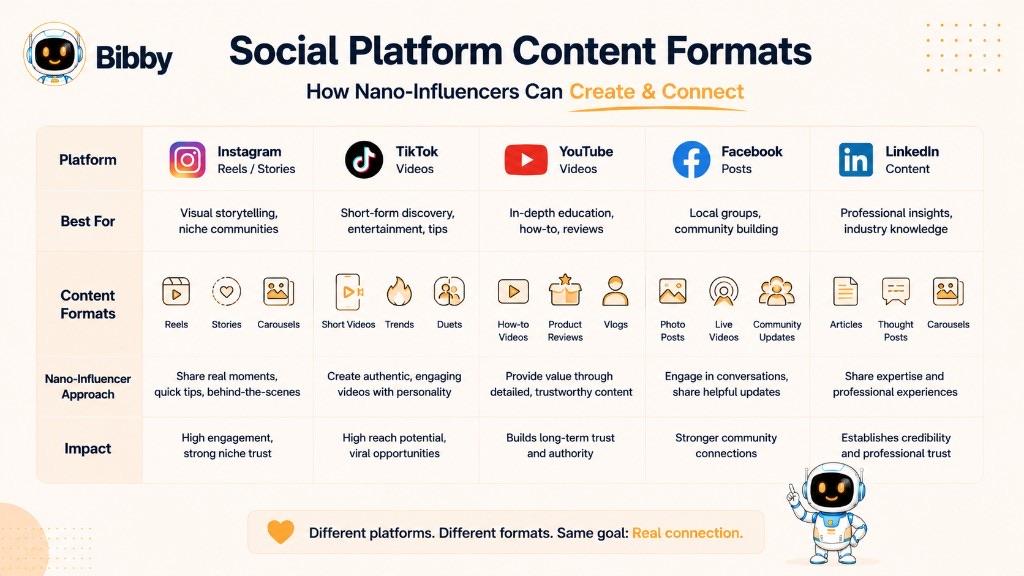
Nano-influencers can build influential communities on almost any social media platform. However, the way they create content and interact with their audiences can vary significantly from one platform to another.
The best platform depends on the creator's niche, audience, content style, and campaign objective.
Instagram is well suited to nano-influencers who rely on visual storytelling and community engagement.
Common formats include Reels, Stories, carousels, photos, and live content.
A skincare creator might demonstrate a product through a Reel, explain their experience in a carousel, and use Stories to answer audience questions.
Best suited for: Product discovery, lifestyle content, visual storytelling, engagement, and community building.
TikTok
TikTok can help nano-influencers reach people beyond their existing followers through short-form, discovery-oriented content.
Creators can use tutorials, product demonstrations, reviews, educational videos, trends, storytelling, and “how I use it” content.
Because content can reach users who don't already follow the creator, follower count isn't necessarily an accurate representation of a TikTok creator's potential reach.
Best suited for: Discovery, short-form video, entertainment, education, and product demonstrations.
YouTube
YouTube can be particularly valuable for nano-influencers who create educational or in-depth content.
Common formats include product reviews, tutorials, comparisons, walkthroughs, explainer videos, long-form demonstrations, and Shorts.
A smaller YouTube creator with a highly specific audience can be useful for products that require explanation before someone is ready to buy.
Best suited for: Education, reviews, tutorials, demonstrations, and deeper product consideration.
Facebook can be useful for nano-influencers who have established communities around local interests, hobbies, groups, or specific demographics.
Creators may use videos, posts, photos, Stories, groups, and live broadcasts.
For local businesses or community-focused campaigns, audience geography and community relevance can be particularly important.
Best suited for: Community marketing, local audiences, discussion, and established interest groups.
LinkedIn nano-influencers can be particularly valuable in B2B and professional niches.
A creator might build an audience around marketing, sales, entrepreneurship, software, finance, careers, leadership, or industry-specific expertise.
Instead of promoting a product through lifestyle content, a LinkedIn creator might demonstrate how a business tool solves a specific professional problem.
Best suited for: B2B marketing, professional expertise, thought leadership, software, and business audiences.
Choosing the Right Platform
Brands shouldn't choose a platform simply because it has the largest number of users.
The better question is:
Where does the target audience already spend time, and which platform best supports the campaign's content format?
A campaign targeting local food enthusiasts might perform well with Instagram creators, while a B2B software campaign could benefit more from professional creators on LinkedIn or YouTube.
The same nano-influencer may also have an audience across multiple platforms. In those cases, brands can evaluate each platform separately rather than assuming that performance on one network will automatically translate to another.
How to Measure Nano-Influencer Campaign Performance
Measuring a nano-influencer campaign requires looking beyond follower count and likes. The right metrics depend on what the campaign is designed to accomplish, whether that means increasing awareness, generating engagement, driving traffic, or producing sales.
1. Reach
Reach measures the number of unique people who saw the campaign content.
It's particularly useful for awareness campaigns, although a large reach doesn't necessarily mean the audience was relevant or engaged.
2. Impressions
Impressions represent the total number of times content was displayed.
One person can generate multiple impressions, so impressions and reach should not be treated as the same metric.
3. Engagement
Engagement measures how audiences interact with the content.
Depending on the platform, this can include likes, comments, shares, saves, replies, and reactions.
For nano-influencer campaigns, meaningful engagement can be particularly useful because it provides insight into how audiences respond to the creator's content.
4. Engagement Rate
Engagement rate puts interactions into context by comparing them with an audience or exposure metric.
However, there are different ways to calculate engagement rate, so brands should use a consistent formula when comparing creators.
A creator with fewer followers can sometimes generate stronger engagement relative to their audience size than a much larger creator.
5. Video Views and Watch Time
For video campaigns, views alone may not tell the full story.
Depending on the platform, brands can also consider average watch time, completion rate, retention, replays, and other available video engagement signals.
These metrics can help determine whether viewers actually consumed the content rather than simply encountering it.
6. Click-Through Rate
If the campaign's goal is to drive traffic, track how many people click the creator's link or call to action.
A unique URL, campaign landing page, or platform-supported tracking method can help attribute traffic to individual creators.
7. Conversions
For performance-focused campaigns, track actions such as purchases, sign-ups, downloads, registrations, leads, and app installs.
Unique discount codes or trackable links can make it easier to connect conversions with specific creators.
8. Revenue
If sales are the primary objective, measure the revenue generated by each creator or campaign.
This helps answer a more important question than *“How many people saw the post?”*:
Did the campaign contribute to business results?
9. Cost Per Result
Brands can calculate the cost of achieving a particular outcome, such as cost per engagement, cost per click, cost per lead, or cost per acquisition.
This makes it easier to compare different creators and campaign approaches.
10. Return on Investment
When reliable revenue and cost data are available, brands can evaluate the campaign's return on investment.
However, not every benefit from influencer marketing is immediately measurable. Increased awareness, audience growth, brand familiarity, and reusable content can also have value.
Analytics and attribution should still come from the appropriate platform and tracking systems. Bibby can help organize, caption, and schedule approved campaign content. It does not provide an influencer ROI dashboard.
What Makes a Nano-Influencer Campaign Successful?
There isn't one universal performance benchmark that determines whether a nano-influencer campaign succeeded.
Instead, compare the results with the original campaign objective.
- An awareness campaign may prioritize reach and impressions.
- An engagement campaign may prioritize meaningful interactions and engagement rate.
- A traffic campaign may focus on clicks and click-through rate.
- A sales campaign may focus on conversions, revenue, and cost per acquisition.
- A UGC campaign may prioritize the quality and quantity of usable content.
The most important principle is simple: measure nano-influencers against the outcome you actually want, not against their follower count alone.
Key Takeaways
A nano-influencer typically has 1,000–10,000 followers, but their real value comes from more than audience size. They can build close relationships with niche communities, making them useful for brands that prioritize relevance, authenticity, and engagement over maximum reach.
- Follower ranges are guidelines, not official labels. Audience quality still has to be verified.
- Nano, micro, and macro tiers trade community vs targeted reach vs broad awareness.
- Nano-influencer marketing works by matching the right creator with the right community, then agreeing deliverables, rights, and measurement.
- Smaller audiences can mean more management if you work with many creators, and results can be inconsistent.
- Price is not a simple rate per follower. Scope, format, rights, and expertise drive cost.
- For brands, successful nano-influencer marketing starts with creators whose audiences genuinely match the target market, then uses clear objectives, authentic content, and measurement against that objective.
If you're exploring nano-influencer marketing, the natural next step is learning how to create and manage a consistent social media content strategy. Once you know which audiences and creators you want to reach, having the right content workflow can make it much easier to plan, create, publish, and measure your campaigns.
Get started with Bibby to organize approved assets, generate captions, and schedule posts across selected social platforms. Creator discovery and attribution stay in your influencer process and native analytics.
Explore more terms in the social media dictionary, including influencer, micro-influencer, UGC, and content creator.