
If you’ve ever wondered why one post reaches thousands of people while another barely gets noticed, the algorithm is a major part of the answer. Understanding how social media algorithms rank, recommend, and personalize content can help you create posts that are more relevant to your audience and more likely to earn meaningful engagement.
Here we will look into:
- How social media algorithms rank and recommend content
- Which signals influence content distribution and reach
- How to create content that works with algorithms
Let’s look at what a social media algorithm actually is and how it works.
What Is a Social Media Algorithm?
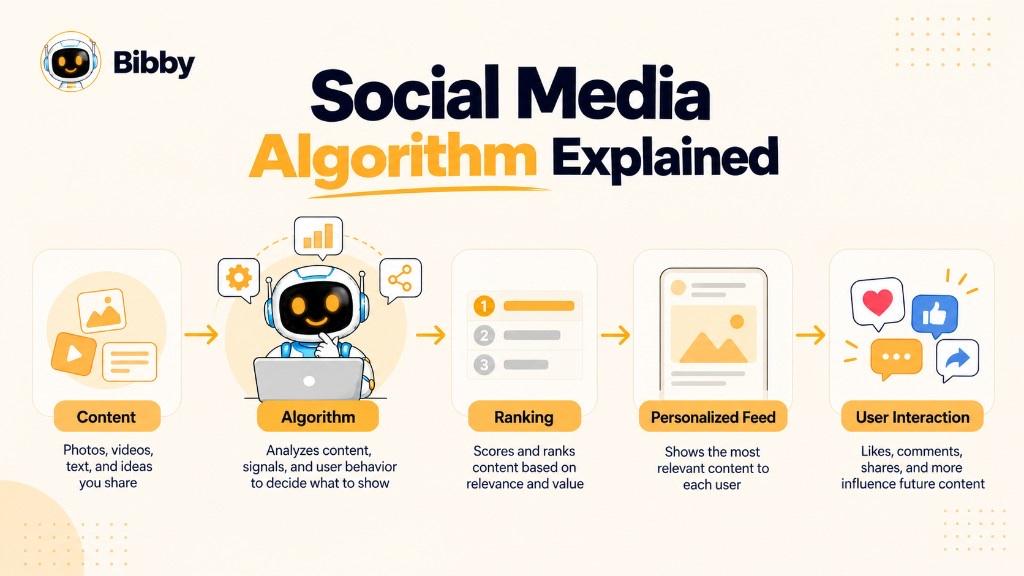
A social media algorithm is a set of rules, signals, and machine-learning systems that platforms use to rank, recommend, and personalize content for individual users. Instead of showing every post in the order it was published, social networks analyze content and user behavior to predict which posts are most relevant or interesting to each person.
In simple terms, the algorithm helps answer one question: “What content is this user most likely to find valuable right now?”
To make that decision, platforms can consider signals such as:
- User interests: Topics and types of content a person regularly interacts with
- Engagement: Likes, comments, shares, saves, clicks, and other interactions
- Watch behavior: How long someone watches a video and whether they continue watching
- Relationships: Interactions with friends, creators, brands, or accounts
- Content information: The topic, format, text, audio, and other characteristics of a post
- Feedback: Actions such as hiding, skipping, unfollowing, or marking content as uninteresting
- Recency: How recently content was published, depending on the platform and surface
There isn't one universal social media algorithm. Facebook, Instagram, TikTok, YouTube, LinkedIn, and other platforms use their own ranking and recommendation systems, and those systems can also work differently across features such as feeds, Stories, search, and video recommendations. X (formerly Twitter) also uses ranking systems; Bibby does not publish to X.
The result is a personalized social media experience where two people can open the same platform at the same time and see very different content.
Next, let's break down how these algorithms make those ranking and recommendation decisions.
How Does the Social Media Algorithm Work?
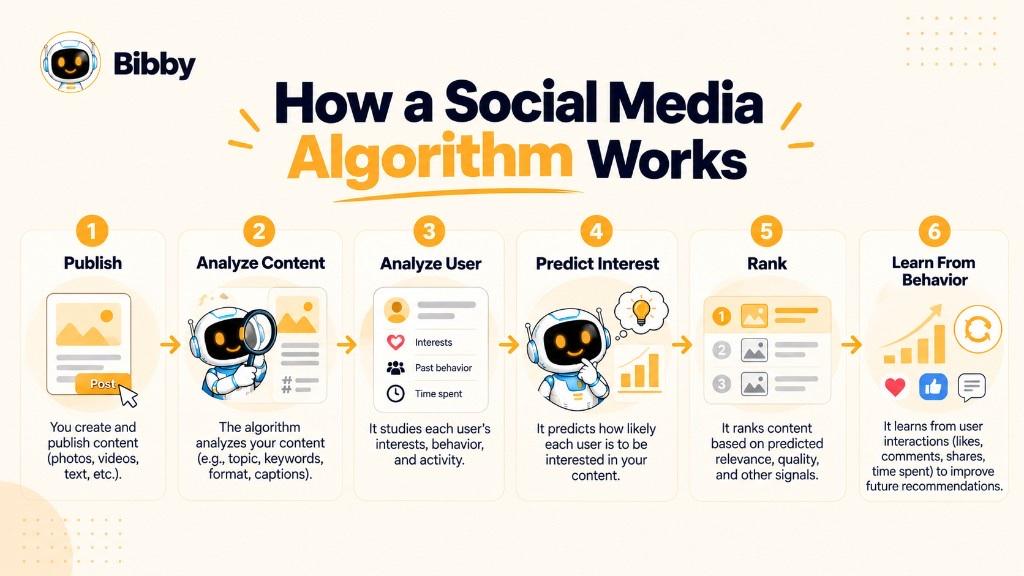
A social media algorithm works by analyzing content, understanding user behavior, and predicting which posts are most relevant to each person. The exact process differs between platforms, but most algorithmic systems follow a similar cycle: collect signals, make predictions, rank content, observe user behavior, and continuously adjust recommendations.
1. Content Is Published
When you publish a post, the platform can analyze information about it, including its format, topic, caption, images, video, audio, and other available content signals.
This helps the platform understand what your content is about and which users might find it relevant.
2. The Platform Analyzes the User
The algorithm also considers information about the person who could see the content. Their previous interactions, viewing behavior, followed accounts, searches, interests, and other activity can help establish what they are likely to engage with.
This is why social media feeds are personalized rather than identical for everyone.
3. The Algorithm Predicts User Interest
The platform uses available signals to predict how a user might respond to a piece of content.
For example, if someone regularly watches cooking videos to completion, saves recipes, and follows food creators, the platform may predict that another relevant cooking video will interest that person.
4. Content Is Ranked
The system then ranks eligible content based on its predictions and other platform-specific factors.
A post isn't necessarily shown simply because it was published recently or because an account has a large following. Its potential relevance to a particular user can also influence where and whether it appears.
5. The User Provides New Signals
Every interaction can provide additional information.
Watching a video, sharing a post, saving an image, clicking a link, commenting, scrolling past something, or selecting “not interested” can all help the platform understand what the user wants—or doesn't want—to see.
6. The System Continuously Learns
The process doesn't stop after content is ranked. New user behavior creates new signals, which can influence future recommendations.
The basic feedback loop looks like this:
Content → Signals → Prediction → Ranking → User behavior → New signals → Updated recommendations
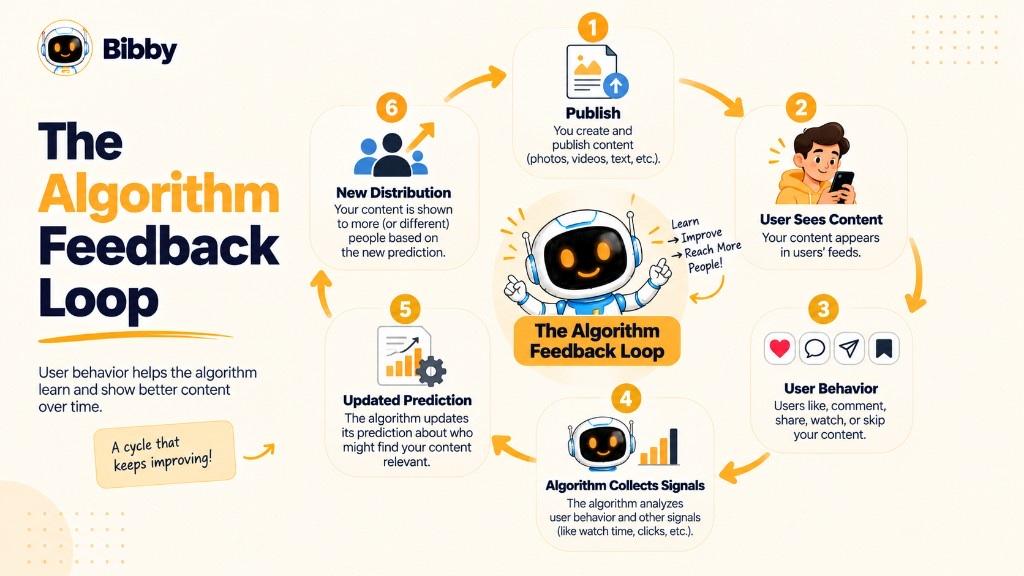
This continuous process is what allows social media platforms to personalize content at scale. It also explains why there is no single formula that guarantees reach on every platform.
Now that we understand the basic process, let's look more closely at the signals social media algorithms use to make these decisions.
Social Media Algorithm Signals
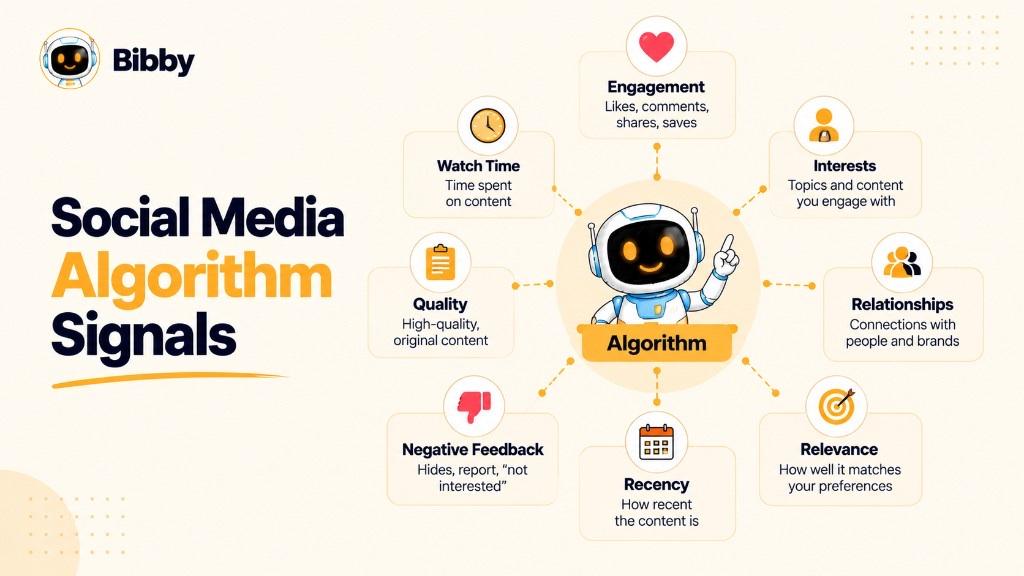
Social media algorithms use signals to estimate which content is relevant, interesting, or valuable to a particular user. A signal is essentially a piece of information the platform can use when deciding how content should be ranked or recommended.
The signals vary by platform, content type, and recommendation surface, but several categories appear repeatedly across social networks.
User Engagement
Interactions can help platforms understand how users respond to content. Common engagement signals include:
- Likes and reactions
- Comments and replies
- Shares
- Saves
- Clicks
- Profile visits
- Follows
However, engagement isn't simply a popularity score. Different interactions can communicate different levels of interest, and their importance can vary between platforms.
For example, sharing a post with someone may indicate a different type of interest than simply tapping a like button.
Watch Time and Retention
For video content, what happens after someone starts watching can be particularly informative.
Platforms may consider signals such as:
- How long someone watches
- Whether they watch a video to completion
- Whether they replay it
- Whether they quickly move to another piece of content
- Whether they continue watching related videos
This is why getting someone to start a video isn't necessarily enough. Keeping their attention can provide valuable information about whether the content actually satisfied their interest.
User Interests and Past Behavior
Algorithms learn from what individual users do over time.
Someone who frequently interacts with content about fitness, for example, may receive more fitness-related recommendations. Their interests can be inferred from actions such as watching videos, following accounts, searching for topics, and interacting with particular types of posts.
This personalization is one of the main reasons social media feeds differ from user to user.
Relationships and Connections
Social platforms can also consider the relationship between users and accounts.
Frequent interactions with a particular friend, creator, company, or community can provide signals about the type of content a user may want to see from that account.
This helps explain why content from accounts a person regularly interacts with may receive prominent placement in certain social media experiences.
Content Relevance
The platform needs to understand what the content is about before it can determine who might be interested in it.
Depending on the platform, content-related signals can include:
These signals help recommendation systems connect content with users who may be interested in it.
Recency
Freshness can also matter, particularly for content where being current is important.
A recent post may have an advantage when users are looking for timely information or updates. However, recency isn't a universal rule that overrides every other ranking signal.
Different platforms and surfaces can place different importance on how recently something was published. A best time to post can still help your audience be online, but it does not replace relevance.
Content Quality and User Satisfaction
Modern recommendation systems can incorporate signals intended to identify content that provides a positive experience.
These can relate to factors such as originality, relevance, quality, or whether users appear satisfied with the content.
The exact signals and formulas used by platforms are generally proprietary and can change over time.
Negative Signals
Algorithms don't only learn from what users engage with. They can also learn from what users ignore or reject.
Potential negative signals include:
- Quickly scrolling past content
- Hiding a post
- Selecting “Not interested”
- Unfollowing an account
- Abandoning a video quickly
- Repeatedly ignoring similar content
These signals help platforms understand what users are less likely to want in their feeds or recommendations. A drop in distribution is not automatically a shadowban.
The Important Takeaway
There is no single “algorithm score” that determines whether a social media post will succeed. Platforms combine multiple signals to make predictions about which content is most relevant to which user at a particular moment.
That distinction matters for marketers: instead of trying to discover one secret algorithm trick, the better strategy is to create content that is genuinely relevant and gives people a reason to watch, read, save, share, or interact.
Next, let's clarify an important distinction: a social media algorithm isn't the same thing as a social media feed.
Is a Social Media Algorithm the Same as a Social Media Feed?
No. A social media algorithm and a social media feed are related, but they are not the same thing.
A social media feed is the stream of posts, videos, images, and other content that a user sees on a platform. A social media algorithm is one of the systems the platform uses to determine which content appears in that feed, how it is ranked, and what may be recommended to the user.
Think of it this way:
Algorithm = the decision-making system
Feed = the content experience produced by those decisions
For example, imagine that 500 accounts have published new content since you last opened a social media app. The platform doesn't necessarily show all 500 posts in chronological order. Its ranking systems can evaluate the available content and determine which posts are most relevant to you.
Your feed might therefore contain:
- A post from someone you frequently interact with
- A recommended video related to a topic you regularly watch
- A recent post from an account you follow
- A carousel similar to content you've previously saved
- Another recommended piece of content from an account you don't follow
The algorithm is helping determine what you see and in what order, while the feed is the interface through which you experience that content.
It's also important to remember that platforms can have multiple recommendation and ranking systems. Instagram, for example, can rank content differently across its Feed, Stories, Reels, and Explore experiences.
Why the distinction matters
Understanding this difference prevents a common misconception: there isn't necessarily one mysterious algorithm controlling everything a user sees.
Instead, social platforms use different ranking and recommendation systems for different experiences, each designed to predict what will be most useful, interesting, or relevant to the user.
This leads to another important distinction: algorithmic feeds aren't the same as chronological feeds.
Algorithmic Feed vs. Chronological Feed
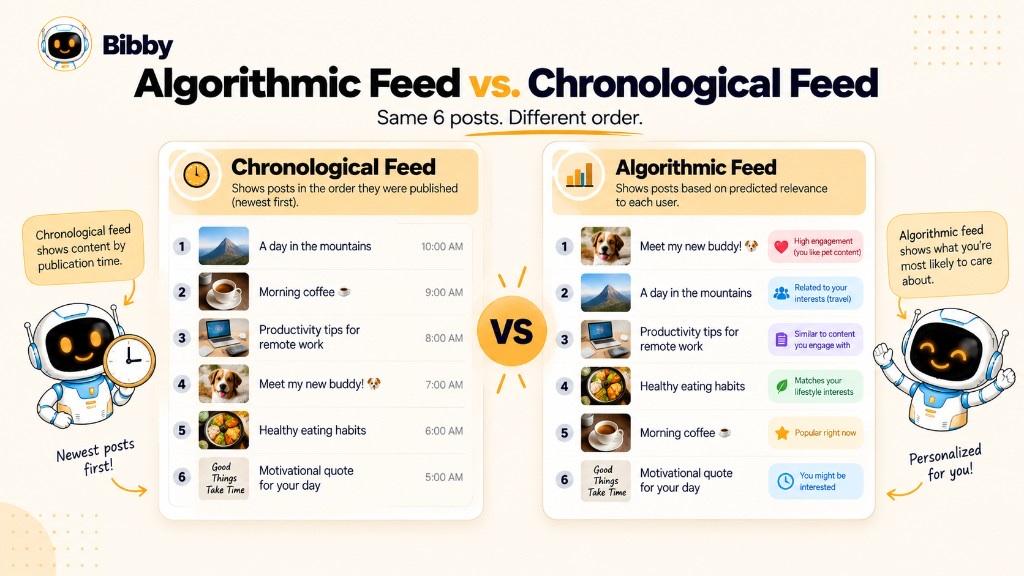
A chronological feed primarily organizes content according to when it was published, while an algorithmic feed uses ranking signals to determine which content should appear first.
The difference is simple:
| Algorithmic feed | Chronological feed |
|---|---|
| Ranks content based on relevance and other signals | Primarily orders content by publishing time |
| Personalized to the individual user | More consistent across users |
| May show older content if it is considered relevant | Newer content generally appears first |
| Uses user behavior to influence what appears | Relies mainly on time of publication |
How a Chronological Feed Works
In a chronological feed, newer posts generally appear above older posts.
For example, if three accounts publish at 9:00 AM, 9:15 AM, and 9:30 AM, a chronological feed would generally display them in that same order.
This approach is straightforward because time is the primary organizing factor.
How an Algorithmic Feed Works
An algorithmic feed can reorder available content based on predicted relevance.
Imagine you follow 500 accounts but only have a few minutes to browse. Showing every post in publishing order may not give you the content you're most interested in.
Instead, the platform can use signals from your previous behavior to determine which posts are more likely to interest you and prioritize those posts.
This means a post published earlier can potentially appear before a newer post if the platform predicts that it will be more relevant to you.
Why Do Social Platforms Use Algorithmic Feeds?
The primary purpose is personalization.
People follow more accounts and creators than they can realistically keep up with. Ranking systems help platforms select a smaller set of content that they predict each user will find valuable.
Algorithmic feeds can therefore help users:
- Discover content beyond the accounts they follow
- Find topics they're interested in
- See content that matches their behavior
- Discover new creators and communities
- Spend less time searching for relevant posts
For businesses and creators, this also creates an opportunity: your content can potentially reach people who aren't already following you when a platform recommends it to them.
However, algorithmic feeds also mean that publishing a post doesn't guarantee that every follower will see it.
The exact balance between recency, relevance, engagement, relationships, and other signals varies by platform and can change over time.
Next, let's look at how these ranking and recommendation systems differ across the major social media platforms.
How Social Media Algorithms Work on Different Platforms
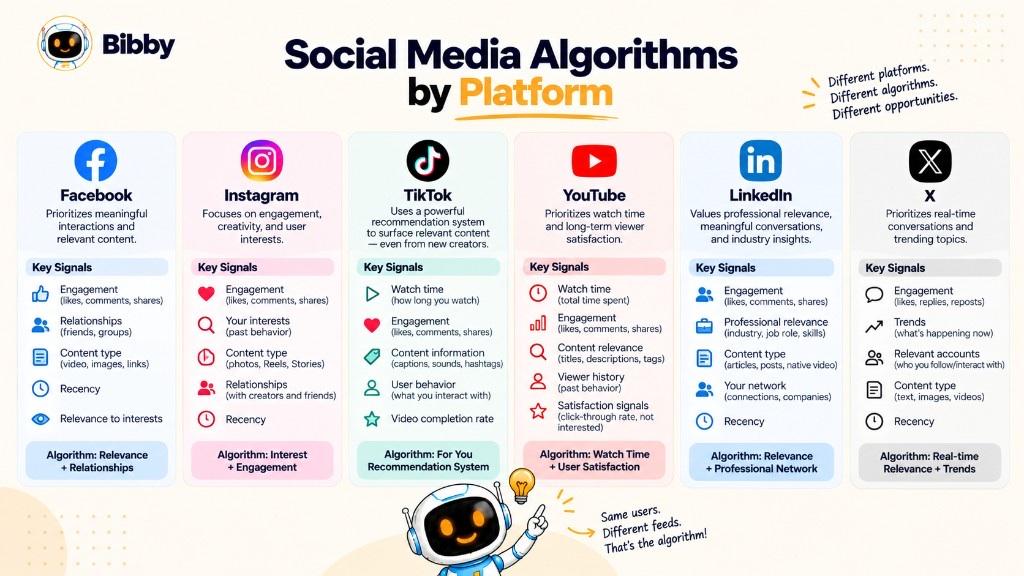
There is no single social media algorithm used across every platform. Facebook, Instagram, TikTok, YouTube, LinkedIn, and X each use their own ranking and recommendation systems, and the signals can also vary depending on whether you're looking at a feed, search result, Story, Reel, Short, or recommendation page.
The underlying goal is similar: show each user content that the platform predicts will be relevant or valuable. The way each platform gets there is different.
Facebook Algorithm
Facebook uses ranking systems to determine which content appears in a user's Feed and how that content is ordered.
Signals can include a user's interactions with people and Pages, characteristics of the content, and predicted interest in the post. Meaningful interactions and relevance can therefore influence whether content receives greater visibility.
For businesses, this means publishing content that encourages genuine interest and interaction is generally more valuable than trying to generate superficial engagement.
Instagram Algorithm
Instagram doesn't have one algorithm controlling every part of the platform. Different experiences, including Feed, Stories, Reels, and Explore, use ranking systems designed for their particular purpose.
For example, the system deciding which Reels a user might enjoy can consider viewing behavior and interactions differently from the system ranking Stories from accounts the user already follows.
For creators and brands, this means content should be optimized for the specific Instagram experience in which it will appear rather than treating Instagram as one universal feed. See also Reel vs Story.
TikTok Algorithm
TikTok is heavily focused on personalized content discovery. Its recommendation systems can use signals such as user interactions, video information, and viewing behavior to determine which videos a person may want to watch next—often on the For You Page.
Watch behavior is particularly important for short-form video because the platform can learn from whether users continue watching, skip content, or interact with similar videos.
This personalized recommendation model is one reason TikTok can introduce users to content from accounts they don't already follow.
YouTube Algorithm
YouTube uses different systems across experiences such as YouTube Search, Home, and recommended videos.
These systems can consider factors related to the viewer, the content, and how viewers respond to it. Watch behavior, relevance, engagement, and viewer satisfaction can all play a role depending on the surface.
This is why optimizing a YouTube video isn't simply about getting the most clicks. The content also needs to deliver an experience that matches what the viewer expected when they chose to watch it—whether that is Shorts or long-form video.
LinkedIn Algorithm
LinkedIn's ranking systems focus on delivering professionally relevant content to users.
Signals can include the relationship between users, the topic of a post, engagement, and other characteristics of the content.
For businesses and professionals, this makes relevance and useful expertise particularly important. A post designed specifically for a professional audience is more likely to provide meaningful value than content created solely to generate generic engagement.
X Algorithm
X uses recommendation and ranking systems to personalize content across different parts of its platform.
User interactions, the accounts someone follows, content characteristics, and other behavioral signals can influence what appears in recommended experiences.
As with other platforms, the exact systems and weighting of individual signals can change over time. Bibby scheduling covers Facebook, Instagram, LinkedIn, YouTube, and TikTok—not X.
The Key Difference Between Platforms
The most important thing to understand is that a strategy that works on one platform isn't automatically optimal on another.
A short video that performs well on TikTok may need a different hook or structure for YouTube Shorts. A professional insight that works on LinkedIn may not make sense as an Instagram Reel. A visual carousel designed for Instagram may need to be adapted before being published elsewhere.
So rather than asking, “How do I beat the social media algorithm?”, a better question is:
“How do I create content that is relevant to my audience and fits the way this platform distributes content?”
That shift in perspective is important because algorithmic distribution ultimately affects one of the metrics businesses care about most: how many people actually see their content.
Why Are Social Media Algorithms Important?
Social media algorithms are important because they influence which content gets discovered, how widely it is distributed, and what users see when they open a platform.
For businesses, creators, and marketers, this can have a direct impact on visibility. You may have thousands of followers, but that doesn't necessarily mean every follower will see every post you publish. Algorithmic ranking helps platforms decide which content to prioritize for each individual user.
Reach and Visibility
Algorithms can determine whether your content is shown to a relatively small audience or recommended to a much larger one.
When a platform predicts that a piece of content will be relevant to a particular group of users, it may distribute that content beyond the people who already follow the account. That is organic reach—not a paid placement.
This creates an important opportunity for smaller accounts: content can sometimes reach people who have never encountered the creator before.
Audience Growth
Algorithmic recommendations can introduce new people to your content.
For example, someone who doesn't follow a fitness creator might still discover one of their videos because their previous behavior indicates an interest in fitness.
When people repeatedly discover and enjoy an account's content, they may eventually follow it, creating a path from:
Recommendation → Content consumption → Engagement → Profile visit → Follow
Engagement
Algorithms can influence how much opportunity a post has to generate engagement.
More relevant distribution can put content in front of people who are more likely to:
- Like or react
- Comment
- Share
- Save
- Watch
- Click
- Follow
However, it's important not to confuse algorithmic distribution with guaranteed engagement. The algorithm can help a post reach the right audience, but the content itself still needs to provide a reason for people to respond.
Brand Awareness
For businesses, consistent algorithmic visibility can help build familiarity with a target audience.
A person might encounter a brand several times through different posts before ever visiting its website or making a purchase. Social media algorithms can therefore play a role in the awareness stage of the customer journey. See brand awareness.
Traffic and Conversions
Social media distribution can also contribute to business outcomes beyond likes and followers.
Depending on the platform and campaign, content can drive:
Reach → Engagement → Website visits → Leads → Customers
This is why businesses shouldn't optimize social media content exclusively around vanity metrics. The most useful measurement depends on the objective behind the content.
Follower Count Isn't the Whole Story
One of the biggest misconceptions about social media is that having more followers automatically guarantees greater reach.
It doesn't.
A follower may not be shown every post from an account they follow. Similarly, someone who doesn't follow an account can sometimes discover its content through recommendations.
This makes content relevance and audience response important alongside audience size.
The Bigger Picture
Social media algorithms matter because they sit between publishing content and getting that content seen.
But this doesn't mean marketers should obsess over finding secret algorithm hacks. The more sustainable approach is to understand the audience, choose the right content format, create something genuinely useful or entertaining, and use performance data to improve future posts.
The next question is therefore the most practical one: how can you work with social media algorithms instead of trying to fight them?
How to Work With Social Media Algorithms
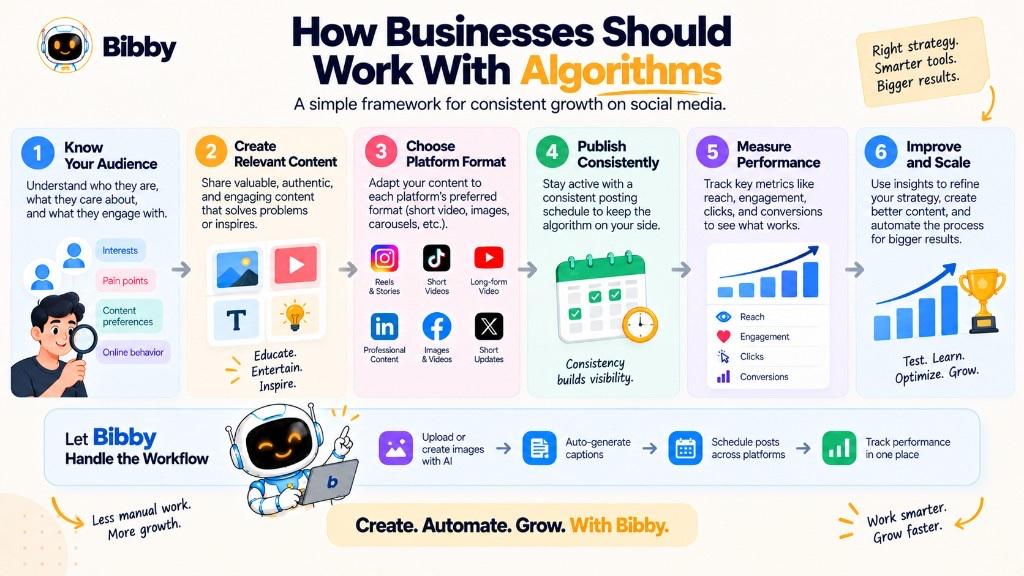
The best way to work with social media algorithms is to focus on the people the algorithms are designed to serve: the audience.
Instead of trying to find a secret trick that guarantees reach, create content that is relevant to a specific audience, delivers on its promise, and generates useful signals such as watch time, shares, saves, comments, or clicks.
Create Content for a Specific Audience
Relevance starts with knowing who you're creating for.
A post about advanced accounting strategies may be valuable to accountants but irrelevant to someone interested in travel. The more clearly your content addresses a particular audience, problem, interest, or need, the easier it is to create something people actually want to consume.
Before publishing, ask:
“Who is this content for, and why would they care?”
Post idea prompts can help you sketch topics; the audience still has to want them.
Make the Opening Strong
For content that users can quickly scroll past, the beginning matters.
A strong opening should immediately communicate why someone should keep watching, reading, or swiping.
For video, this could mean a compelling first few seconds. For a carousel, it could mean a clear first slide. For a text post, it could mean opening with a useful insight, question, or problem.
The objective isn't to trick users into stopping. It's to make the value of the content clear quickly—without clickbait that the post cannot deliver.
Encourage Meaningful Engagement
Don't create content solely by asking people to “like this post.”
Instead, give them a genuine reason to interact.
Useful content may naturally encourage people to:
- Save it for later
- Share it with someone
- Comment with an experience
- Ask a question
- Visit a profile
- Click through for more information
These actions can provide stronger evidence of audience interest than simply chasing high numbers of likes. A clear call to action should match the goal.
Improve Retention
For video, getting someone to start watching is only part of the challenge.
A useful video should maintain attention by:
- Removing unnecessary filler
- Getting to the point quickly
- Maintaining a clear structure
- Delivering the promised information
- Using visual changes where appropriate
- Ending when the value has been delivered
If viewers consistently leave early, that behavior can tell you something important about the content.
Use the Right Format for the Platform
Different platforms and surfaces favor different content experiences.
Your content strategy can include:
- Images
- Carousels
- Short-form videos
- Long-form videos
- Stories
- Text posts
The goal isn't to publish everything everywhere without modification. Adapt the content to the platform and the way its audience consumes information. You can draft carousel layouts with the carousel generator and captions with the caption generator.
Publish Consistently
Consistency can help you maintain an active relationship with your audience and create more opportunities to learn which topics and formats perform well.
But consistency doesn't mean publishing as frequently as possible.
A sustainable content calendar that allows you to maintain quality is generally more useful than flooding your audience with low-value content. Scheduling can support that workflow.
Analyze Performance and Adapt
Your previous posts provide useful information for improving future content.
Look for patterns across metrics such as:
- Reach
- Watch time
- Retention
- Shares
- Saves
- Comments
- Clicks
- Follows
- Conversions
Then ask what those results tell you about your audience. Review them in each platform’s Insights or a social media analytics tool—not as a Bibby dashboard.
The process becomes:
Publish → Measure → Learn → Improve → Publish again
This is a much more sustainable approach than trying to predict exactly what an algorithm will do. Growth insights and the Bibby blog can help with strategy; they do not replace native ranking systems.
Don't Optimize for the Algorithm Alone
Algorithms change. Audience interests change. Platforms change.
If your entire strategy depends on one ranking signal or a particular platform behavior, it can become fragile.
Instead, build around a more durable principle:
Create content people genuinely want to consume and give platforms useful signals that help them find the right audience.
For businesses managing multiple social networks, maintaining that consistency can become difficult as the number of posts and platforms increases. That's where a structured social media automation and scheduling workflow can help.
Does Posting Frequency Affect Social Media Algorithms?
Posting more often does not automatically mean more algorithmic reach. Social media platforms generally don't operate on a simple rule where publishing a certain number of posts per day guarantees better distribution.
What matters is the combination of content quality, audience relevance, user response, and platform-specific signals.
Does Posting Every Day Help the Algorithm?
Not necessarily.
Publishing every day can give you more opportunities to reach your audience and learn which topics and formats perform well. But if increasing your posting frequency causes your content quality to decline, the additional posts may not produce better results.
For example, publishing three highly relevant posts each week may be more valuable than publishing three low-value posts every day.
Is There a Perfect Posting Frequency?
There isn't a universal number of posts that works for every account.
The appropriate frequency can depend on:
- Your audience
- Your industry
- Your content format
- The platform
- Your available resources
- How frequently your audience wants to hear from you
- Your marketing objectives
A news organization may have a very different publishing cadence from a B2B software company or an individual creator. Use a best-time-to-post estimate as a starting point, then validate in Insights.
What Does Consistency Actually Mean?
Consistency is better understood as maintaining a predictable, sustainable publishing process rather than posting as frequently as possible.
A consistent schedule can help you:
- Stay visible to your audience
- Maintain content momentum
- Test different topics and formats
- Collect performance data
- Build audience expectations
- Reduce last-minute publishing
The important distinction is that consistency is a content strategy, not an algorithm hack.
Can Posting Too Much Hurt Performance?
Posting excessively can create practical problems even when there is no direct “overposting penalty.”
If you publish too much low-quality or repetitive content, your audience may become less interested, interact less, or start ignoring your posts. Those audience behaviors can ultimately affect the signals your content generates.
More content also doesn't necessarily mean more attention. Your posts still compete for the limited amount of time your audience has available.
A Better Approach to Posting Frequency
Instead of asking:
“How often do I need to post to please the algorithm?”
Ask:
“How often can I consistently publish valuable content that my audience wants to see?”
Then use your performance data to refine that schedule.
For businesses managing multiple platforms, this can mean planning content in advance, adapting posts for different formats, and scheduling them consistently rather than manually publishing everything at the last minute. Compare Bibby plans if you need that workflow on supported channels.
The same principle applies to another commonly misunderstood tactic: hashtags.
Do Hashtags Affect Social Media Algorithms?
Yes, hashtags can provide context about the topic of a post, but using more hashtags does not automatically produce more reach. Their usefulness and importance vary by platform, and social networks have changed how much weight they place on hashtags over time.
The most useful way to think about hashtags is as contextual and discovery signals, not as a guaranteed algorithm-growth tactic.
How Do Hashtags Work?
A hashtag groups content around a particular topic or phrase.
For example, a post about social media marketing might use hashtags related to:
- Social media marketing
- Content marketing
- Social media strategy
- Marketing automation
These labels can help users and platforms understand what a piece of content is about.
Do More Hashtags Mean More Reach?
No.
Adding a large number of unrelated or repetitive hashtags doesn't guarantee that a post will be distributed more widely.
In fact, excessive hashtag use can make content look spammy or reduce its relevance to the audience you're trying to reach.
The better approach is to use relevant hashtags when they genuinely help describe or categorize the content. The hashtag generator can suggest ideas; you still need to pick ones that match the post.
Should You Use Popular Hashtags?
Not simply because they're popular.
A highly popular or trending hashtag can contain an enormous amount of content, making it difficult for a post to stand out. More importantly, a popular hashtag may have little relevance to your actual audience.
For example, using a broadly popular marketing hashtag on a highly specific post doesn't automatically make that post more useful to people interested in the topic.
Relevance is more important than popularity.
Do Hashtags Work the Same on Every Platform?
No.
Instagram, TikTok, LinkedIn, YouTube, and other platforms have different discovery and recommendation systems. Hashtags may therefore play different roles depending on where you publish.
You should avoid assuming that a hashtag strategy that worked on one platform will produce the same result elsewhere.
What Is a Good Hashtag Strategy?
Use hashtags selectively when they add context or help people discover your content.
A practical approach is to:
- Choose hashtags relevant to the actual topic.
- Avoid irrelevant trending hashtags.
- Don't rely on hashtags as your primary growth strategy.
- Follow the platform's current best practices.
- Test whether hashtags actually improve your results.
Ultimately, hashtags are only one potential signal among many. Content relevance, audience response, viewing behavior, and other platform-specific signals can be much more important to distribution.
That brings us to another common question: does engagement actually affect how social media algorithms distribute content?
Does Engagement Affect Social Media Algorithms?
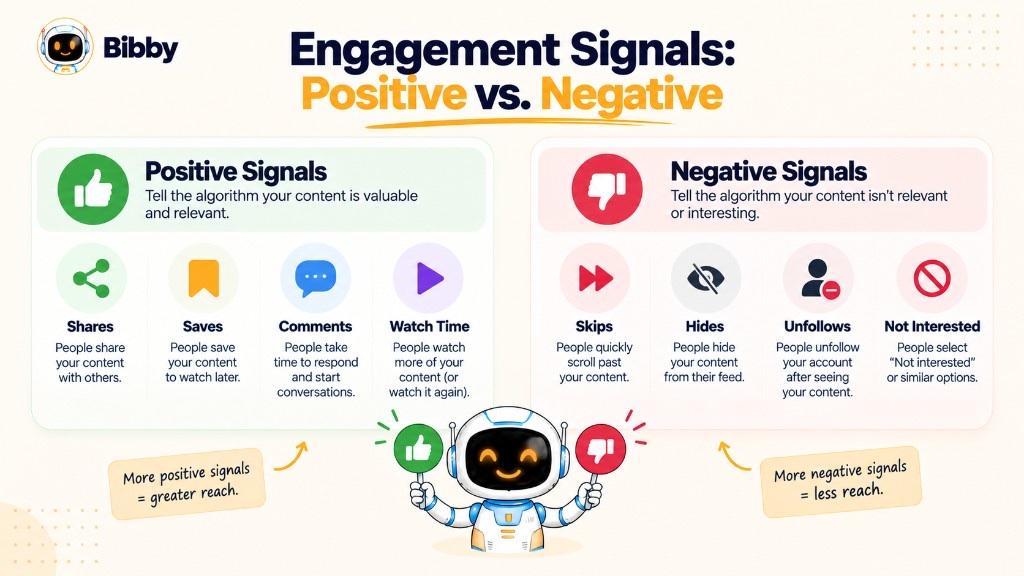
Yes, engagement can influence social media ranking and recommendation systems, but it is not as simple as “more likes = more reach.”
Platforms can use interactions to understand how users respond to content and predict whether similar users might also find that content interesting. The importance of each engagement signal can vary by platform, content format, recommendation surface, and user.
Likes and Reactions
Likes and reactions are basic indicators that someone responded positively to a post.
They can provide useful information about audience interest, but they are only one signal among many. A post with fewer likes can still be valuable if it generates strong shares, saves, watch time, clicks, or other meaningful actions.
Comments and Replies
Comments can indicate that content has generated enough interest for someone to respond.
However, the quality and context of an interaction matter more than simply maximizing the number of comments. Encouraging genuine discussion is generally more useful than creating artificial engagement bait.
Shares
A share can be a particularly meaningful signal because it indicates that someone found the content useful, entertaining, or relevant enough to pass along to another person.
For marketers, this makes shareable content an important goal—but again, there is no universal rule that says a certain number of shares will automatically trigger a specific amount of reach.
Saves
Saves can indicate that someone considers a piece of content useful enough to return to later.
This can be particularly relevant for educational, instructional, inspirational, or reference-style content.
For example, a checklist or step-by-step guide may generate fewer immediate comments than an opinion post but receive significantly more saves.
Clicks and Profile Visits
Clicks and profile visits can provide additional information about user interest.
If someone sees a post and chooses to learn more about the creator, brand, product, or topic, that action can reveal a deeper level of intent than simply scrolling through the feed.
Watch Time and Retention
For video content, engagement shouldn't be viewed only through likes and comments.
Watch time and retention can provide important information about whether people actually consumed the content.
A video that receives many initial views but loses viewers immediately tells a different story from one that keeps people watching until the end.
Negative Engagement Matters Too
Algorithms can also learn from signals that indicate users don't want particular content.
These can include:
- Quickly scrolling past a post
- Leaving a video early
- Hiding content
- Selecting “Not interested”
- Unfollowing an account
- Repeatedly ignoring similar recommendations
This is important because recommendation systems are not simply asking, “Did this person like the post?”
They're also trying to understand:
“Did this person find this content relevant enough to continue consuming?”
Engagement Isn't a Guaranteed Ranking Formula
It's tempting to think of social media algorithms as a points system:
**Like = +1
Comment = +2
Share = +5**
Real recommendation systems are much more complex than that.
Different platforms use different signals, models, and ranking systems. They can also change those systems over time.
Therefore, the goal shouldn't be to manufacture a specific engagement number. Instead, create content that gives people a genuine reason to watch, read, save, share, discuss, or act.
This leads to one of the biggest misconceptions surrounding social media algorithms: the belief that there's a secret formula that marketers can exploit.
Social Media Algorithm Myths
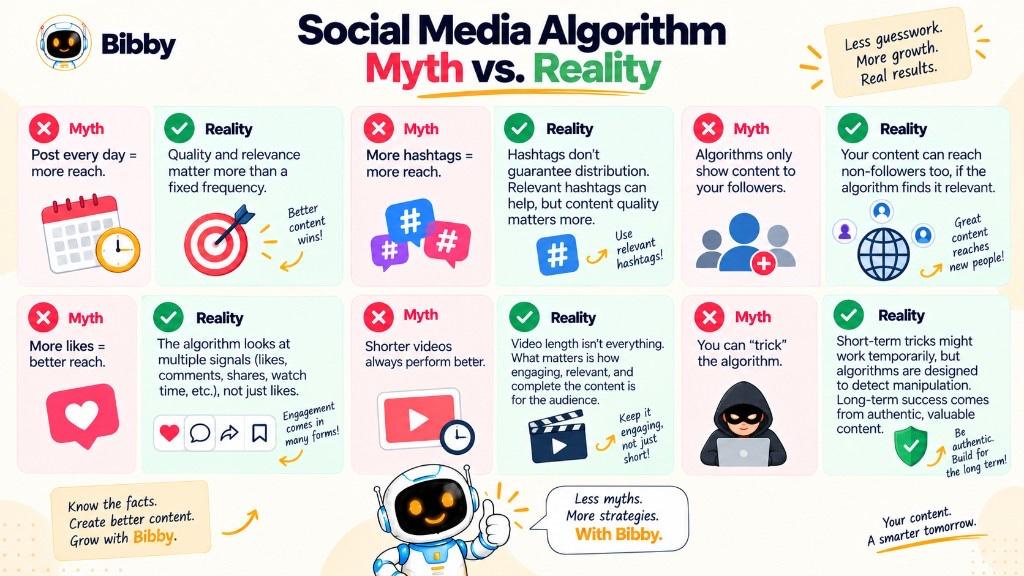
Social media algorithms are surrounded by myths, rumors, and outdated advice. Many of these claims come from observing changes in reach without knowing what actually caused them.
The reality is more nuanced: platforms use complex ranking and recommendation systems that change over time, and there is no universal formula for guaranteed reach.
“There Is One Social Media Algorithm”
False.
There isn't one algorithm that controls Facebook, Instagram, TikTok, YouTube, LinkedIn, and every other social network.
Each platform has its own systems, and a single platform may use different ranking systems for different experiences.
For example, a platform can treat Feed, Stories, Search, and video recommendations differently.
“The Algorithm Hates Small Accounts”
Not necessarily.
Having a small audience doesn't automatically mean your content cannot be recommended to new people.
Recommendation systems can distribute content beyond an account's existing followers when the platform predicts that other users may find it relevant.
This is one reason high-quality content from relatively small accounts can sometimes receive substantial reach.
“You Have to Post Every Day”
False.
There is no universal posting frequency that guarantees better algorithmic performance.
Publishing consistently can give you more opportunities to reach your audience and learn from your performance, but quality and relevance still matter.
A sustainable publishing schedule is generally more useful than posting simply to satisfy a supposed algorithm requirement.
“Likes Are the Most Important Signal”
Oversimplified.
Likes are one possible engagement signal, but they're not necessarily the most important signal in every situation.
Depending on the platform and content type, systems may also consider:
- Watch time
- Retention
- Shares
- Saves
- Comments
- Clicks
- User interests
- Negative feedback
- Other behavioral signals
There is no universal hierarchy that applies to every platform.
“Using More Hashtags Guarantees More Reach”
False.
Hashtags can provide context and support discovery, but adding more hashtags doesn't guarantee greater distribution.
Relevant content and audience response remain more important than simply increasing hashtag volume.
“The Algorithm Punishes You for Taking a Break”
Usually an oversimplification.
Taking a break doesn't necessarily mean the platform has applied a hidden penalty to your account.
A reduction in reach after a break can have many explanations, including changes in audience activity, content recency, topic relevance, or normal fluctuations in distribution.
It's better to evaluate actual performance data than assume an algorithmic punishment.
“There Is a Secret Algorithm Hack”
There isn't a reliable universal hack.
Platforms continuously update their systems, and tactics that appear to work temporarily can become ineffective.
Trying to exploit one perceived ranking signal is also risky because it can distract from the fundamentals:
Relevant audience + valuable content + strong user experience + consistent learning
The most sustainable strategy isn't to beat the algorithm. It's to create content that gives the algorithm useful evidence that the right people will value it.
“Going Viral Means the Algorithm Will Always Favor You”
False.
One viral post doesn't guarantee that every future post will receive the same distribution.
Each piece of content can be evaluated in its own context, and audience interest can vary significantly between topics and formats.
A better goal than chasing one viral post is building a repeatable content system that consistently produces useful results.
With the biggest myths out of the way, there's another question worth answering: how much of today's social media algorithm is actually powered by artificial intelligence?
Are Social Media Algorithms Powered by AI?
Yes, modern social media platforms commonly use artificial intelligence and machine learning as part of their ranking and recommendation systems. However, a social media algorithm and artificial intelligence aren't the same thing.
An algorithm is a set of instructions or a computational process used to solve a problem or make a decision. AI and machine learning are technologies that can be used to build systems capable of making predictions, recognizing patterns, and adapting to data.
What Role Does AI Play in Social Media Algorithms?
Social platforms process enormous amounts of information about content and user behavior. Machine-learning models can use that information to make predictions about what an individual user might want to see.
For example, an AI-powered recommendation system might analyze patterns such as:
- Which videos a user watches
- How long they watch them
- Which accounts they follow
- What topics they interact with
- Which posts they save or share
- What content they repeatedly skip
- Which recommendations they respond to
The system can then use those patterns to predict which new content may be relevant to that person.
Algorithm vs. AI: What's the Difference?
The terms are often used interchangeably, but they describe different concepts.
Algorithm:
A defined process for performing a task or making a decision.
Machine learning:
A method where systems learn patterns from data and use those patterns to make predictions.
Artificial intelligence:
A broader field that includes technologies designed to perform tasks that traditionally require aspects of human intelligence.
A social media platform can therefore use algorithms containing machine-learning models as part of its broader AI and recommendation infrastructure.
Why Does This Matter for Social Media Marketers?
Understanding that recommendation systems are prediction-driven changes how you should approach content.
Instead of assuming:
“The algorithm likes this type of post.”
Think:
“What evidence can my content generate that tells the platform the right audience will find it valuable?”
That means focusing on factors such as relevance, attention, satisfaction, engagement, and audience behavior rather than chasing a supposed secret algorithm formula.
AI also increasingly affects the other side of social media marketing. Businesses can now use AI to help generate ideas, create images, write captions, adapt content, and manage publishing workflows. See AI content generation on Bibby.
But AI-generated content still needs to provide genuine value. Using AI doesn't automatically make content more likely to be recommended.
For businesses, the bigger question is therefore how to turn an understanding of algorithms into a practical social media strategy.
What Does the Social Media Algorithm Mean for Businesses?
For businesses, understanding the social media algorithm means understanding how content moves from being published to being discovered by the right audience.
You can't control how a platform ranks every post, but you can control the quality, relevance, consistency, and strategy behind the content you publish.
Focus on the Audience, Not the Algorithm
The strongest social media strategy starts with the target audience.
Instead of asking:
“What does the algorithm want?”
Ask:
“What does my audience want to see, learn, or share?”
When content genuinely satisfies an audience, it can naturally generate the behavioral signals that recommendation systems use to understand its relevance.
Create Platform-Relevant Content
Publishing the exact same post everywhere isn't always the best approach.
A business might turn one idea into:
- An Instagram carousel
- A short TikTok video
- A LinkedIn text post
- A YouTube video
- A Facebook post
- An Instagram Story
The underlying idea can remain consistent while the format, presentation, and messaging are adapted to each platform.
Build a Consistent Publishing System
Businesses often struggle with social media not because they lack ideas, but because publishing consistently across multiple platforms takes time.
A repeatable workflow can make it easier to:
Create → Adapt → Schedule → Publish → Measure → Improve
Social media scheduling and automation tools can help reduce the operational work involved in maintaining that workflow.
For example, Bibby lets businesses upload or generate visual content, select a posting style, automatically generate captions, and schedule content across Facebook, Instagram, LinkedIn, YouTube, and TikTok. Its chat interface can also be used to manage tasks such as creating campaigns, generating posts, building a brand kit, and regenerating captions. Start a trial or browse free tools if you want to try captions and ideas first.
The purpose of automation isn't to “trick” an algorithm. It's to make it easier to consistently publish high-quality content while spending more time on strategy and creative decisions.
Use Performance Data to Improve Content
Businesses should look beyond follower counts and likes when evaluating algorithmic performance.
Depending on the objective, useful metrics can include:
- Reach
- Impressions
- Watch time
- Retention
- Shares
- Saves
- Comments
- Click-through rate
- Website traffic
- Leads
- Conversions
The goal is to identify patterns.
If educational carousels consistently generate saves, for example, that may be evidence that your audience values that type of content. You can then create more content around similar topics while testing different angles and formats.
Don't Build Your Strategy Around Algorithm Hacks
Algorithms change. Platforms introduce new features. User behavior evolves.
A business that relies on one particular tactic can quickly find its strategy becoming outdated.
A more durable approach is to build around fundamentals:
Relevant content + strong audience value + consistent publishing + meaningful engagement + continuous testing
When you understand the social media algorithm this way, it becomes less mysterious. You don't need to predict every ranking decision—you need to create content that consistently gives the right audience a reason to pay attention.
Next, let's make that idea concrete with a few social media algorithm examples.
Social Media Algorithm Examples
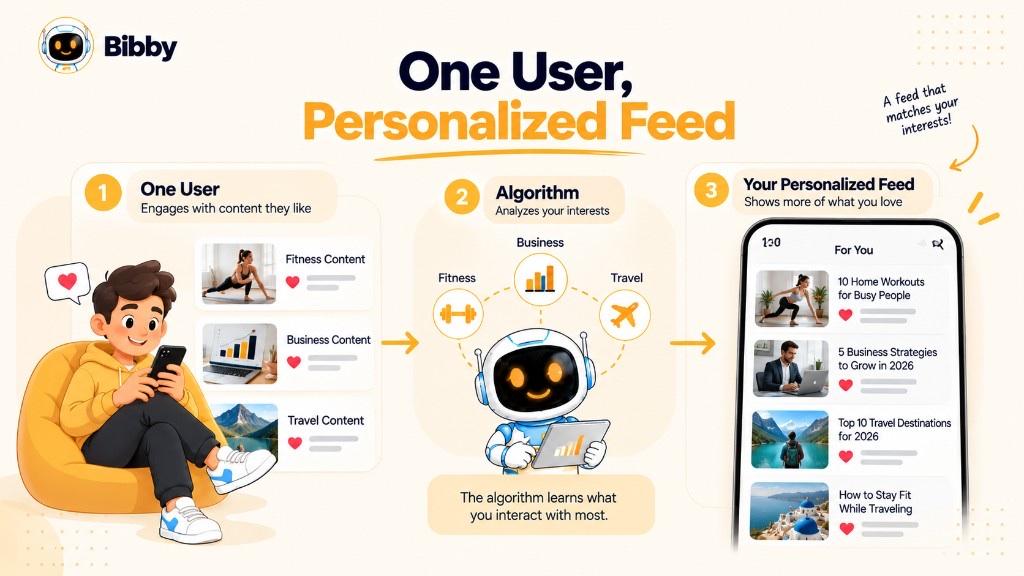
The easiest way to understand a social media algorithm is to see how it can use user behavior and content signals to personalize recommendations. The following examples are simplified illustrations—the actual ranking systems used by social platforms are much more complex.
Example 1: Instagram Reels
Imagine that Sarah frequently watches fitness Reels.
She regularly watches workout videos to the end, saves meal-preparation posts, follows fitness creators, and occasionally shares workout videos with friends.
When Sarah opens Instagram again, the platform has evidence that fitness-related content is relevant to her. A new Reel from a fitness creator she doesn't follow may therefore be recommended to her.
The basic concept is:
Past behavior → Predicted interest → Relevant recommendation
The creator doesn't necessarily need Sarah to follow them for their content to be discovered.
Example 2: TikTok Video
Imagine that David watches several videos about photography.
He watches camera tutorials for a long time, skips unrelated videos quickly, and interacts with other photography content.
A new photography video is then published.
TikTok's recommendation system can use David's previous behavior and information about the new video to predict whether he might enjoy it on his For You Page.
If his behavior continues to indicate interest, the platform can use that information to personalize future recommendations.
This illustrates an important principle:
Algorithms learn from what users repeatedly do, not just what they explicitly say they like.
Example 3: LinkedIn Post
Suppose Priya regularly engages with posts about B2B marketing and entrepreneurship.
She follows several marketing professionals, comments on relevant discussions, and spends time reading posts about growing SaaS businesses.
A new post about B2B customer acquisition is published.
Because the topic is potentially relevant to Priya's interests and professional network, LinkedIn's ranking system may determine that the post is worth showing to her.
If she finds it useful and interacts with it, that behavior provides another signal about her interests.
What These Examples Have in Common
Although the platforms and content are different, the underlying concept is similar:
User behavior + content information + other ranking signals → prediction → personalized distribution
This is why social media algorithms are fundamentally about matching content with users, rather than simply rewarding accounts with the most followers or posts with the most likes.
It's also why businesses should pay attention to the actual behavior their content generates. If people consistently watch, save, share, or interact with a particular type of content, those results can provide useful information for deciding what to create next.
To determine whether your content is working, however, you need to measure more than engagement alone. The next section covers the social media algorithm metrics businesses and creators should track.
Social Media Algorithm Metrics to Track
You can't directly see or control a platform's algorithm, but you can measure how your content performs and use those results to improve your strategy.
The most useful metrics depend on your objective. A brand focused on awareness should evaluate different signals from a business focused on generating website traffic or sales.
Reach
Reach is the number of unique users who were shown your content.
It helps you understand how widely a post was distributed, including whether it reached people beyond your existing audience.
Increasing reach can be valuable for awareness, but reach alone doesn't tell you whether people found the content useful.
Impressions
Impressions represent the number of times content was displayed.
One person can generate multiple impressions, so impressions are different from reach.
Comparing the two can help you understand how frequently your content is being shown relative to the size of its audience.
Engagement Rate
Engagement rate measures interactions relative to an audience or exposure metric.
Depending on the platform and calculation method, engagement can include actions such as:
- Likes or reactions
- Comments
- Shares
- Saves
- Clicks
It's more useful to look at engagement in context than to treat a single engagement-rate benchmark as universally good or bad.
Shares
Shares indicate that someone chose to pass your content to another person or audience.
For many businesses, shares can be particularly valuable because they can extend content beyond its initial audience and indicate that people found it useful, entertaining, or relevant enough to distribute themselves.
Saves
Saves can be a useful indicator for educational and reference-based content.
If people repeatedly save your tutorials, checklists, guides, or other useful posts, it can suggest that the content provides value beyond the initial viewing.
Watch Time
For video content, watch time measures how long viewers spend watching.
A video with a high number of views but very low viewing duration may tell a different story from a video that keeps viewers engaged for substantially longer.
Watch time should therefore be considered alongside other video metrics rather than in isolation.
Retention
Audience retention shows how well a video holds viewers' attention throughout its duration.
If viewers consistently leave during the opening seconds, you may need to improve the hook or get to the promised value faster.
If viewers remain engaged through most of the video, the structure and topic may be resonating well with that audience.
Click-Through Rate
Click-through rate (CTR) measures how frequently people click after seeing an impression or link, depending on the platform's calculation.
CTR can be particularly useful when your goal is to move people from social media to a website, landing page, product page, or other destination.
Profile Visits and Follows
Profile visits can indicate that your content generated enough interest for someone to learn more about your brand or account.
Follows can then show whether that interest translated into a longer-term connection with your audience.
These metrics can be especially useful when your goal is audience growth.
Conversions
For businesses, conversions are often more important than social engagement.
Depending on your business, a conversion could mean:
- A purchase
- A lead
- A sign-up
- A booking
- A demo request
- An email subscription
A post that receives fewer likes but generates significantly more qualified leads may be far more valuable than a post that goes viral without producing a business outcome.
Which Metrics Should You Prioritize?
Match the metric to the goal:
| Goal | Useful metrics |
|---|---|
| Brand awareness | Reach, impressions |
| Audience engagement | Comments, shares, saves, engagement rate |
| Video performance | Watch time, retention |
| Audience growth | Profile visits, follows |
| Website traffic | Clicks, CTR |
| Lead generation | Leads, conversion rate |
| Sales | Conversions, revenue |
The key is to look for patterns rather than isolated results. One unusually successful post doesn't necessarily reveal how an algorithm works.
When you consistently measure performance across topics, formats, platforms, and audiences, you can make better decisions about what to publish next.
And before treating any sudden change in performance as an “algorithm update,” it's worth understanding the common myths and misconceptions surrounding social media algorithms.
Conclusion
A social media algorithm is a system that uses signals about content and user behavior to rank, recommend, and personalize what people see. While every platform has its own ranking systems, they generally aim to connect users with content they are most likely to find relevant, valuable, or interesting.
For marketers, the three biggest takeaways are simple: there is no universal social media algorithm, meaningful audience behavior matters, and creating relevant content is more sustainable than chasing algorithm hacks.
The next step is turning that understanding into a consistent publishing strategy. Learning about social media automation and scheduling can help you plan, create, and publish high-quality content across multiple platforms while giving you more time to focus on your audience and content strategy.
Browse the marketing dictionary, create a Bibby account, or complete onboarding when you are ready to schedule the next post—without treating the calendar as a ranking guarantee.