
Instagram gives creators and businesses several ways to publish content, but Reels and Stories serve very different purposes. Understanding the difference between a Reel and a Story can help you choose the right format for your content, audience, and marketing goal.
An Instagram Reel is a short-form video designed primarily for entertainment, education, discovery, and reaching a wider audience. Reels can remain available on your Instagram profile and have strong potential to reach people who do not already follow you.
An Instagram Story, on the other hand, is a temporary photo or video update that is normally available for 24 hours. Stories are particularly useful for sharing timely updates, starting conversations, using interactive features such as polls and questions, and engaging people who already follow your account.
So, Reel vs Story comes down largely to reach versus timely engagement. Reels are generally better suited to discoverable, longer-lasting content, while Stories are better suited to frequent, temporary, and interactive communication.
Neither format is universally better. A business, creator, or social media marketer can use Reels and Stories together, giving each format a specific job within the overall Instagram content strategy. This guide explains the differences between Instagram Reels and Stories, including lifespan, reach, engagement, content formats, use cases, and when you should choose one over the other.
What Is an Instagram Reel?
An Instagram Reel is a short-form video published on Instagram for sharing entertaining, educational, informative, or promotional content. Reels are designed to make video content more discoverable, allowing creators, influencers, and businesses to reach both existing followers and people who may not already follow their accounts.
Unlike Instagram Stories, which are normally temporary, Reels can remain available on an Instagram profile after they are published. This makes them useful for content that can continue attracting views, engagement, and discovery over time.
Instagram Reels can include video clips, music or audio, text, effects, transitions, and other creative elements. A Reel can be created around almost any topic, from a quick tutorial or product demonstration to a behind-the-scenes video, educational tip, trend, or entertaining clip.
What Are Instagram Reels Used For?
The main purpose of a Reel depends on the creator's social media strategy, but common uses include:
- Reaching new audiences: Reels can help content reach people beyond an account's existing followers.
- Increasing brand awareness: Businesses can use short-form videos to introduce their products, services, or expertise.
- Educating an audience: Tutorials, tips, explainers, and how-to videos can be presented in a concise format.
- Entertaining viewers: Humor, trends, storytelling, and creative video concepts are common Reel formats.
- Showcasing products: Brands can demonstrate products, explain features, or show products in use.
- Building an audience: Discoverable video content can help creators attract new followers.
- Creating evergreen content: Useful Reels can remain on a profile and continue serving as part of its content library.
Are Instagram Reels Permanent?
Instagram Reels are not automatically removed after 24 hours like Stories. Once published, a Reel can generally remain available on the creator's profile until it is deleted, archived, or otherwise removed.
This difference in lifespan is one of the most important distinctions when comparing Reel vs Story. A Story is built around temporary, time-sensitive communication, while a Reel can have a much longer content lifespan.
For this reason, Reels are often a better choice when the goal is to create content that people can discover and watch beyond the day it was published.
What Is an Instagram Story?
An Instagram Story is a temporary photo or video update that lets users share content with their audience in a more immediate and informal format. Unlike Reels, Instagram Stories are designed around short-lived content and are normally available for 24 hours after publication.
Stories can contain photos, videos, text, music, stickers, polls, questions, quizzes, and other interactive elements. This makes them particularly useful for creators and businesses that want to communicate with existing followers, encourage direct interaction, or share something happening right now.
Instagram Stories are often less polished than Reels by design. A Story can be as simple as a quick update, behind-the-scenes clip, announcement, question, or photo from an event. The format makes frequent publishing easier without requiring every post to become a carefully edited piece of permanent content.
What Are Instagram Stories Used For?
Instagram Stories can serve many purposes within a social media strategy, including:
- Sharing daily updates: Stories are useful for communicating what is happening today.
- Engaging existing followers: Questions, polls, reactions, and replies can encourage direct participation.
- Showing behind-the-scenes content: Businesses and creators can provide a more informal look at their work.
- Making announcements: New products, events, launches, updates, and important news can be shared quickly.
- Running interactive content: Polls, quizzes, questions, and other Story features can turn passive viewers into participants.
- Promoting other content: Stories can be used to direct attention toward a Reel, post, product, campaign, or other destination.
- Sharing time-sensitive promotions: Limited-time offers and announcements can fit naturally into the temporary nature of Stories.
- Building community: Frequent, conversational updates can help maintain a closer connection with an existing audience.
Do Instagram Stories Disappear After 24 Hours?
Yes. Instagram Stories normally disappear from Story visibility after 24 hours. This temporary lifespan is one of the defining characteristics of the format.
However, disappearing does not necessarily mean the content is permanently lost. Stories can be saved to an account's archive, and selected Stories can be displayed through Instagram Story Highlights, allowing certain content to remain accessible on a profile beyond the usual 24-hour period.
This creates a fundamental difference in the Reel vs Story comparison. Reels are generally intended to remain as discoverable content on a profile, while Stories are built around immediacy, frequency, and temporary audience interaction.
Why Do Businesses Use Instagram Stories?
For businesses, Stories provide a convenient way to maintain regular communication without filling the main profile with every small update. A brand can use Stories to answer questions, collect feedback, announce changes, showcase behind-the-scenes activity, and keep followers informed between larger pieces of content.
In simple terms, Instagram Reels are often used to attract attention, while Instagram Stories are often used to maintain attention and interaction with an existing audience. The strongest Instagram strategies can use both formats for different purposes.
Reel vs Story: What's the Difference?
The main difference between an Instagram Reel and an Instagram Story is how each format is designed to be consumed and what role it typically plays in a social media strategy.
Reels are short-form videos built primarily for discovery, entertainment, education, and broader reach. Stories are temporary updates designed primarily for timely communication and interaction with an existing audience.
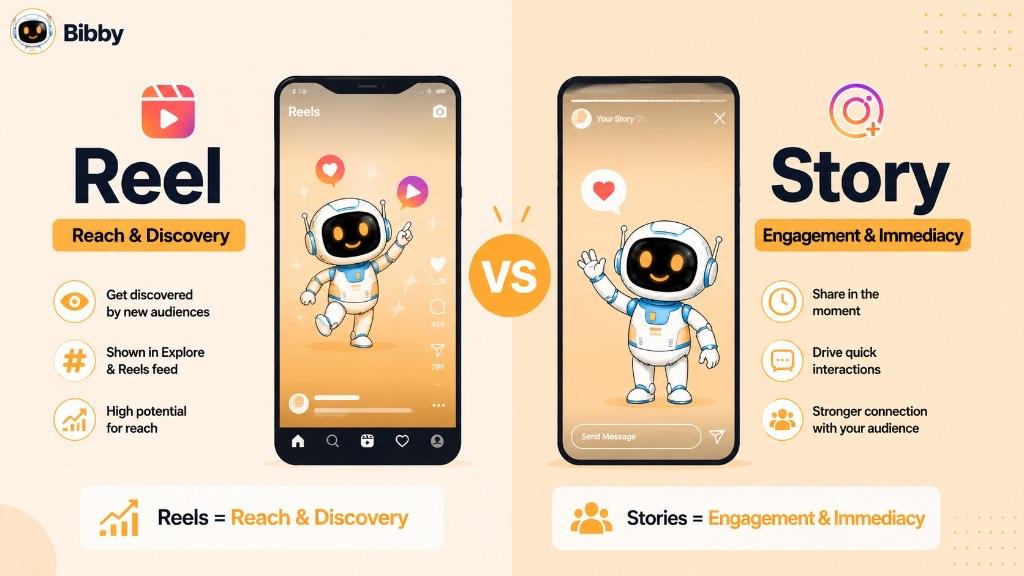
The two formats can both contain video, but they are not interchangeable. A Reel can function as a longer-lasting piece of content that introduces an account to new audiences, while a Story is better suited to quick updates, conversations, and content that is relevant in the moment.
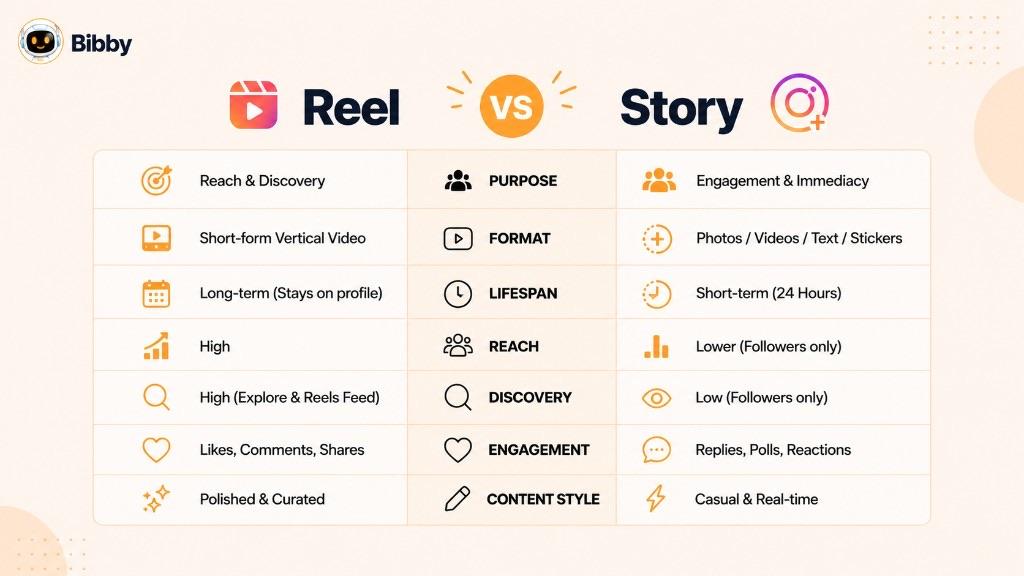
Reel vs Story Comparison
| Feature | Instagram Reels | Instagram Stories |
|---|---|---|
| Primary purpose | Discovery, reach, entertainment, and education | Timely communication and audience engagement |
| Main format | Short-form video | Photos, videos, and other temporary updates |
| Lifespan | Generally remains available on the profile | Normally available for 24 hours |
| Discovery potential | Strong potential to reach people beyond existing followers | Primarily useful for engaging an existing audience |
| Content style | Often edited, creative, educational, or entertaining | Often casual, immediate, conversational, or interactive |
| Best for | Audience growth and discoverable content | Community engagement and daily communication |
| Shelf life | Longer-lasting | Short-lived |
| Common interactions | Likes, comments, shares, saves, and follows | Replies, reactions, polls, questions, and other interactions |
| Content strategy | Evergreen or campaign-focused content | Real-time and recurring updates |
| Profile presence | Can remain part of the profile's content library | Can disappear from Story visibility after 24 hours unless preserved through features such as Highlights |
1. Reels Are Designed for Discovery, Stories Are Designed for Connection
One of the clearest differences between Reels vs Stories is their typical role in audience development.
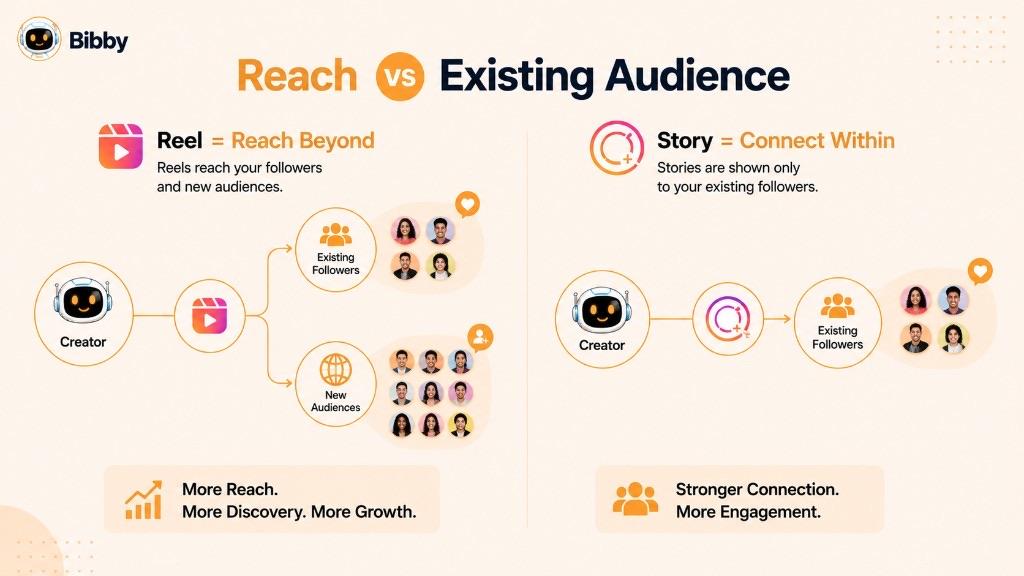
Reels can help expose content to people who have never interacted with an account before. This makes them particularly useful for reach, discovery, brand awareness, and audience growth.
Stories are generally more focused on people who already follow or regularly interact with an account. Their temporary and interactive nature makes them useful for community building, conversations, feedback, and daily updates.
This does not mean that Stories cannot reach people outside an account's existing audience or that every Reel will reach new users. Rather, the formats are designed around different content behaviors and objectives.
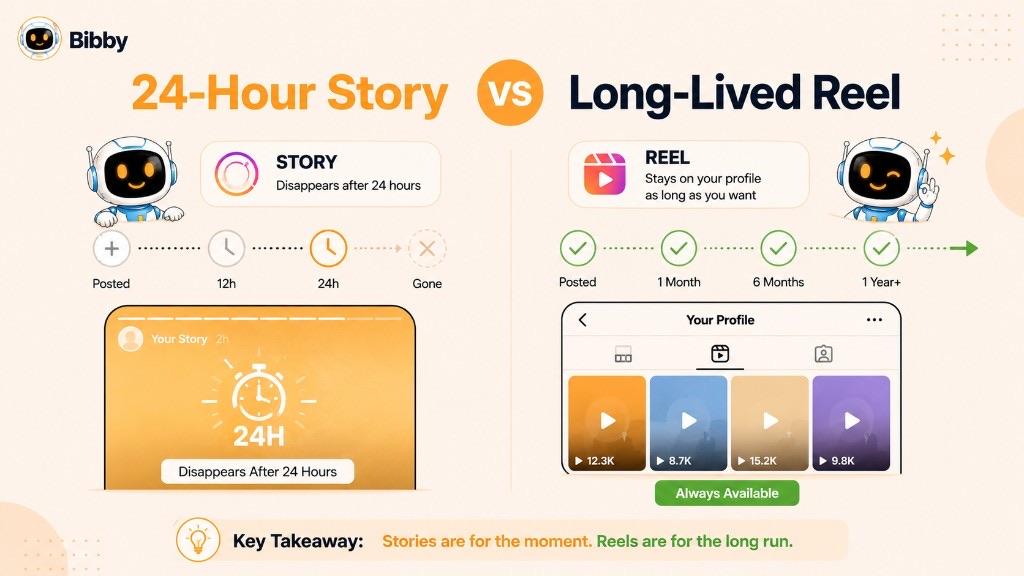
2. Reels Last Longer Than Stories
Another major difference is content lifespan.
A Reel can generally remain available on an Instagram profile after publication. It can therefore continue to generate views and engagement after the original publishing date.
A Story normally disappears from Story visibility after 24 hours. This makes Stories particularly effective for content that is relevant today but may not need to remain permanently visible.
For example, a tutorial about how to use a product could make a strong Reel because people may want to discover and watch it later. A reminder that a live event starts tonight could be better suited to a Story because the information is time-sensitive.
3. Reels Are Video-First, While Stories Are More Flexible
Reels are fundamentally a short-form video format. Their strength comes from visual storytelling, motion, audio, editing, and concise presentation.
Stories are more flexible. A Story can be a photo, video, text-based update, or a combination of these elements. Interactive features can also make Stories feel more like a conversation than a traditional video post.
This difference affects how content should be created. A Reel often benefits from a strong opening, clear visual storytelling, and an obvious reason to keep watching. A Story can succeed with a much simpler approach, particularly when the goal is to communicate something quickly.
4. Reels Generally Have Greater Discovery Potential
If the primary goal is reaching a wider audience, Reels are generally the stronger format.
Their design supports content discovery and gives creators an opportunity to introduce their content to people who do not already follow them. For businesses and creators trying to grow an audience, this makes Reels an important part of an Instagram content strategy.
Stories are generally more valuable after someone has already become part of your audience. They can keep followers informed, encourage interaction, and create repeated touchpoints with the brand or creator.
5. Stories Are Often More Effective for Immediate Interaction
Stories have features specifically suited to quick audience participation. Depending on the available Instagram features, creators can use tools such as:
- Polls
- Questions
- Quizzes
- Reactions
- Replies
- Mentions
- Links and other interactive elements
This makes Stories useful when the goal is not simply to generate views, but to start a conversation or obtain an immediate response.
Reels also generate valuable interactions through likes, comments, shares, saves, and follows. However, the interaction style is often different because the Reel is primarily functioning as discoverable video content.
6. Reels and Stories Have Different Content Shelf Lives
Think about content shelf life when deciding between a Reel and a Story.
A Reel can become part of a long-term content library. A useful tutorial, product demonstration, educational explanation, or entertaining video may continue to attract attention after publication.
A Story is deliberately temporary. Its short lifespan creates urgency and makes the format useful for daily updates, event coverage, limited-time announcements, and conversations that do not need permanent placement on the profile.
7. Reels and Stories Work Best Together
The choice does not always have to be Reel vs Story. In many cases, the better strategy is Reel + Story.
For example, a business could publish a Reel explaining a new product feature and then use Stories to:
- Announce the new Reel.
- Ask followers what they think about the feature.
- Run a poll.
- Answer common questions.
- Share additional product information.
- Direct interested users toward the next step.
The Reel helps create a discoverable piece of content, while the Stories create additional opportunities for interaction.
Quick Answer: Reel vs Story
Choose a Reel when your priority is reach, discovery, audience growth, education, entertainment, or longer-lasting video content.
Choose a Story when your priority is daily communication, immediate interaction, behind-the-scenes updates, temporary announcements, or engaging existing followers.
For many creators and businesses, using both formats is more effective than treating them as competing choices.
Instagram Reels vs Stories at a Glance
When deciding between an Instagram Reel and a Story, the right choice depends on what you want the content to accomplish. Reels generally have stronger potential for discovery and audience growth, while Stories are particularly useful for engaging people who already follow or interact with your account.
Which Is Better for Reach: Reels or Stories?
Reels are generally better for reach and discovery.
Reels can be shown to people beyond an account's existing followers, giving creators and businesses more opportunities to introduce their content to new audiences. This makes Reels particularly useful for brand awareness, audience growth, and discoverable content.
Stories can also generate substantial reach, especially among an account's existing audience, but they are typically used more for maintaining engagement with people who already know the account.
Which Is Better for Engagement With Existing Followers?
Stories are often better suited to direct engagement with existing followers.
Their interactive features make it easy to ask questions, run polls, collect opinions, encourage replies, and share quick updates. Stories can therefore create frequent opportunities for two-way communication.
Reels can generate significant engagement through likes, comments, shares, saves, and follows, but their primary strength is often discoverability rather than direct conversation.
Which Lasts Longer: Reels or Stories?
Reels generally last longer.
A Reel can remain available on an Instagram profile after it is published. A Story normally disappears from Story visibility after 24 hours, although Stories can be preserved through features such as Highlights.
This makes Reels a stronger choice for content with long-term value, while Stories are better suited to temporary or time-sensitive information.
Which Is Better for Going Viral?
Reels generally have greater potential for broad discovery and viral reach.
Their short-form video format can expose content to audiences beyond existing followers. However, no Instagram format guarantees that a piece of content will go viral. Performance depends on factors such as the content itself, audience response, relevance, distribution, and account-specific circumstances.
A better way to think about Reels is that they provide a strong format for increasing discovery potential, rather than guaranteeing viral performance.
Which Is Better for Daily Updates?
Stories are usually the better choice for daily updates.
Because Stories are temporary, creators and businesses can publish frequent updates without making every update a permanent part of their profile.
Examples include behind-the-scenes moments, daily announcements, event updates, quick tips, customer questions, product reminders, limited-time promotions, and casual updates.
Which Is Better for Evergreen Content?
Reels are generally better for evergreen content.
Evergreen content remains useful beyond the day it is published. Tutorials, educational videos, product demonstrations, explanations, and useful tips can continue attracting attention over time.
Stories, by comparison, are intentionally temporary and are therefore better suited to information that has a short useful life.
Which Is Better for a Business: Reels or Stories?
Businesses can benefit from using both, but for different purposes.
A business might use Reels to reach new audiences, build brand awareness, demonstrate products, educate potential customers, showcase expertise, and create discoverable content.
The same business might use Stories to communicate with existing followers, share behind-the-scenes content, collect feedback, run polls and questions, promote time-sensitive announcements, and build a stronger customer community.
The most effective choice is therefore not always Reel vs Story. It can be a matter of assigning each format a different job within the same social media strategy.
Reel vs Story: Key Differences Explained
The difference between an Instagram Reel and a Story goes beyond the fact that one is a video format and the other is temporary content. Their lifespan, discovery potential, content style, engagement patterns, and strategic purpose are all different.
Understanding these differences makes it easier to decide whether a particular piece of content should be published as a Reel, a Story, or adapted for both.
Difference in Lifespan
The most obvious difference between Reels and Stories is how long the content remains available.
Instagram Reels are generally persistent content. Once published, a Reel can remain accessible on the creator's profile until it is deleted, archived, or otherwise removed. This gives useful Reels a longer opportunity to attract views and engagement.
Instagram Stories are designed to be temporary. A Story normally remains visible for 24 hours before disappearing from Story visibility. Selected Stories can, however, be preserved through features such as Highlights.
A product tutorial, educational explanation, or useful tip may work well as a Reel because someone could discover and watch it days or weeks after publication. A flash announcement, event reminder, or behind-the-scenes update may be more appropriate for a Story because its value is tied to a specific moment.
Difference in Reach and Discovery
Another important difference is typical discovery behavior.
Reels are designed to support content discovery and can provide opportunities to reach people who do not already follow an account. This makes them particularly valuable for creators and businesses focused on increasing reach, attracting new audiences, and growing followers.
Stories are generally more focused on an account's existing audience. They are useful for maintaining regular contact with followers and creating repeated opportunities for interaction.
Instagram distribution can vary by account, content, audience, and algorithm behavior. The strategic distinction is that Reels are generally the stronger format when discovery is a primary objective, while Stories are particularly useful for nurturing an existing audience.
Difference in Content Format
Reels are primarily a short-form video format. They work especially well when movement, editing, audio, visual storytelling, or a sequence of ideas is important.
Common Reel formats include tutorials, how-to videos, product demonstrations, educational explainers, entertainment, trend-based videos, interviews or short clips, storytelling, and before-and-after content.
Stories are more flexible. They can combine photos, videos, text, graphics, music, interactive stickers, questions, polls, and other available Instagram Story features.
Because Stories are flexible and temporary, they are particularly suitable for quick communication. They do not always need the same level of editing or production that a polished Reel might require.
Difference in Engagement
Both formats can generate engagement, but the type of interaction can be different.
Reels commonly encourage likes, comments, shares, saves, follows, and profile visits. These interactions can be valuable when the goal is to increase visibility, demonstrate content value, or attract new audiences.
Stories can encourage more direct and immediate interactions, including replies, reactions, poll responses, question responses, quiz interactions, sticker interactions, and link interactions where available.
This makes Stories particularly useful for gathering feedback and encouraging conversations with an existing audience.
There is no universal rule that one format will always generate more engagement than the other. The right metric depends on the objective. A Reel that attracts new viewers and generates shares may be successful for an awareness campaign, while a Story that generates direct replies may be more valuable for community engagement.
Difference in Content Shelf Life
Content shelf life describes how long a piece of content can continue providing value after it is published.
Reels generally have a longer shelf life. A useful Reel can remain on a profile and continue serving as a discoverable piece of content—for example, a Reel titled “How to Create a Social Media Content Calendar.”
Stories have a much shorter shelf life. Their temporary nature makes them ideal for content such as “We're going live tonight,” “New product available today,” “Which design do you prefer?,” “Behind the scenes from today's event,” or “Sale ends tonight.”
The temporary nature of Stories can actually be an advantage because it creates a natural sense of immediacy.
Difference in Content Strategy
Reels and Stories should therefore be given different roles within an Instagram content strategy.
Reels can function as discovery assets. They can introduce your brand, educate an audience, demonstrate expertise, and provide content that remains available after publication.
Stories can function as relationship assets. They can keep followers informed, encourage conversations, collect feedback, and provide frequent touchpoints throughout the day or week.
For example, a software company could publish a Reel demonstrating a new feature. It could then use Stories to ask followers whether they would use the feature, answer questions, share additional screenshots, and direct interested users toward more information.
This approach turns Reel vs Story from a choice between two formats into a strategy for using both formats together.
The Simple Rule to Remember
A useful way to remember the difference is:
Reels are generally built for discovery. Stories are generally built for interaction.
If your content needs to reach new people and remain useful beyond the day it is published, consider a Reel.
If your content is timely, conversational, interactive, or intended primarily for your existing audience, consider a Story.
And when the content has both goals, use the Reel as the long-lasting content asset and the Story as the engagement layer around it.
Instagram Reel vs Story: Which Should You Use?
Choosing between an Instagram Reel and a Story becomes much easier when you start with the goal of the content rather than the format itself.
If you want to reach new people, create longer-lasting content, or showcase something through short-form video, a Reel is usually the better choice. If you want to share a quick update, encourage interaction, or communicate with existing followers, a Story is often more appropriate.
In many cases, you do not have to choose just one. The same idea can be adapted into both formats, with the Reel and Story performing different jobs.
Use a Reel When You Want to Reach New Audiences
Choose a Reel when your primary objective is discovery and broader reach.
Reels are well suited to content that you want people to discover even if they do not already follow your account. Good Reel topics include educational tips, tutorials, product demonstrations, industry insights, entertainment, short-form storytelling, problem-and-solution videos, before-and-after content, and explainers.
If the content could still be useful or interesting several weeks after you publish it, a Reel is often worth considering.
Use a Reel When You Want Evergreen Content
A Reel is also a strong option for content with long-term value.
For example, a digital marketing company might create a Reel explaining “5 Ways to Improve Your Social Media Strategy.” Because the information is not tied to a particular day, the content can remain useful after its original publication.
Other examples include how-to guides, educational explanations, product tutorials, frequently asked questions, expert tips, industry knowledge, and demonstrations.
Use a Reel When You Want to Showcase a Product or Service
Reels can communicate a product or service visually and quickly. A business could create a Reel showing how a product works, how to use a feature, a before-and-after result, a customer use case, a short walkthrough, or a common problem and its solution.
Video can make complicated ideas easier to understand, particularly when the product benefits from visual demonstration.
Use a Story When You Want to Share a Daily Update
Stories are particularly useful for short-lived and time-sensitive information: daily updates, event announcements, behind-the-scenes moments, new product notifications, schedule changes, quick reminders, limited-time promotions, and casual updates.
If the information is relevant primarily because it is happening now, a Story is often the natural format.
Use a Story When You Want Direct Interaction
Choose a Story when you want your audience to respond rather than simply watch.
For example, you could ask “Which design should we launch?,” “What topic should we cover next?,” “Have you tried this feature?,” or “Which product do you prefer?”
Instagram's available interactive Story features can turn these questions into polls, questions, quizzes, and other forms of participation.
Use a Story for Behind-the-Scenes Content
Stories are a natural home for content that does not need to be polished or permanent: the team preparing for an event, a product being packaged, a new office setup, a glimpse of the creative process, a day in the business, or an informal team update.
This type of content can make a brand feel more approachable while giving followers a reason to check Stories regularly.
Use a Story for Time-Sensitive Promotions
Stories are particularly useful when an offer, announcement, or event has a limited window—for example, “Our early-bird offer ends tonight.”
A temporary Story fits naturally with this type of message because the information itself has a short lifespan.
For promotions that deserve longer-term discovery, a business can also create a Reel and use Stories to provide reminders or additional information.
Use Both When You Want Reach and Engagement
Sometimes the best answer to “Reel vs Story?” is “both.”
Consider a business launching a new product.
- Create a Reel: Publish a short video demonstrating the product and explaining its primary benefit. The Reel becomes the main discoverable content asset.
- Share it through Stories: Tell existing followers about the Reel and invite them to watch it.
- Add interaction: Use available Story features to ask followers what they think, collect questions, or gather feedback.
- Continue the conversation: Share additional information, answers, or supporting content through Stories.
This gives the two formats distinct roles: Reel → discovery and longer-term content. Story → interaction and timely communication.
A Simple Reel vs Story Decision Guide
| Your Goal | Recommended Format |
|---|---|
| Reach new audiences | Reel |
| Increase discoverability | Reel |
| Grow your audience | Reel |
| Share educational content | Reel |
| Demonstrate a product | Reel |
| Create evergreen content | Reel |
| Share a daily update | Story |
| Ask your audience a question | Story |
| Run a poll | Story |
| Share behind-the-scenes content | Story |
| Announce something happening today | Story |
| Share a time-sensitive promotion | Story |
| Build ongoing community interaction | Story |
| Reach new people and engage existing followers | Reel + Story |
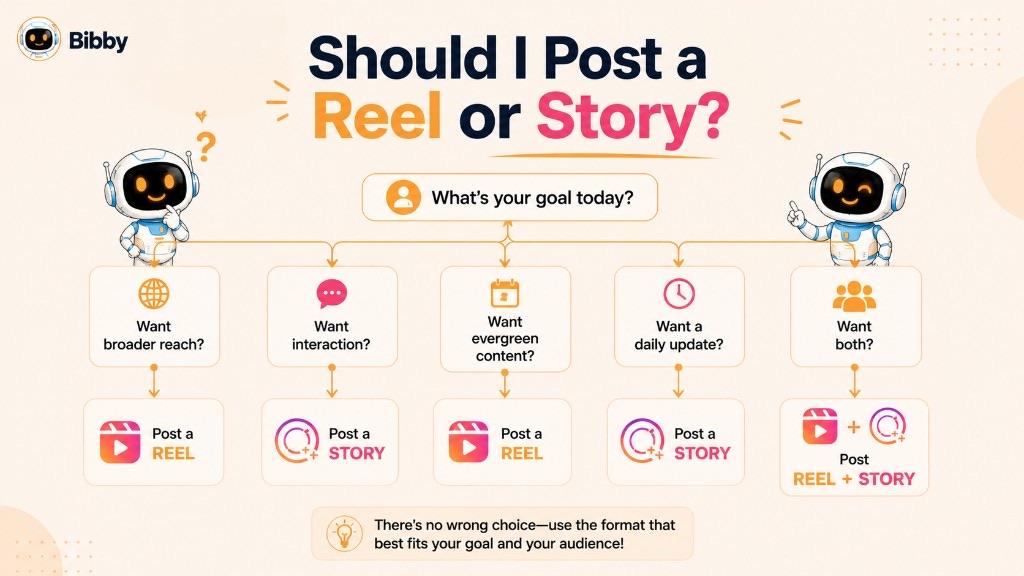
The simplest rule is to start with the question: “What do I want this content to achieve?”
If the answer is reach, discovery, education, or long-term value, start with a Reel.
If the answer is interaction, immediacy, conversation, or a temporary update, start with a Story.
If the answer includes both, adapt the content for Reels and Stories together.
Can You Post the Same Content as a Reel and a Story?
Yes, you can use the same core idea in both an Instagram Reel and a Story, but simply copying and pasting the exact same content is not always the best approach.
Reels and Stories are consumed differently and usually have different objectives. A Reel can be created as a more discoverable, longer-lasting piece of content, while a Story can adapt the same idea into a temporary and interactive update.
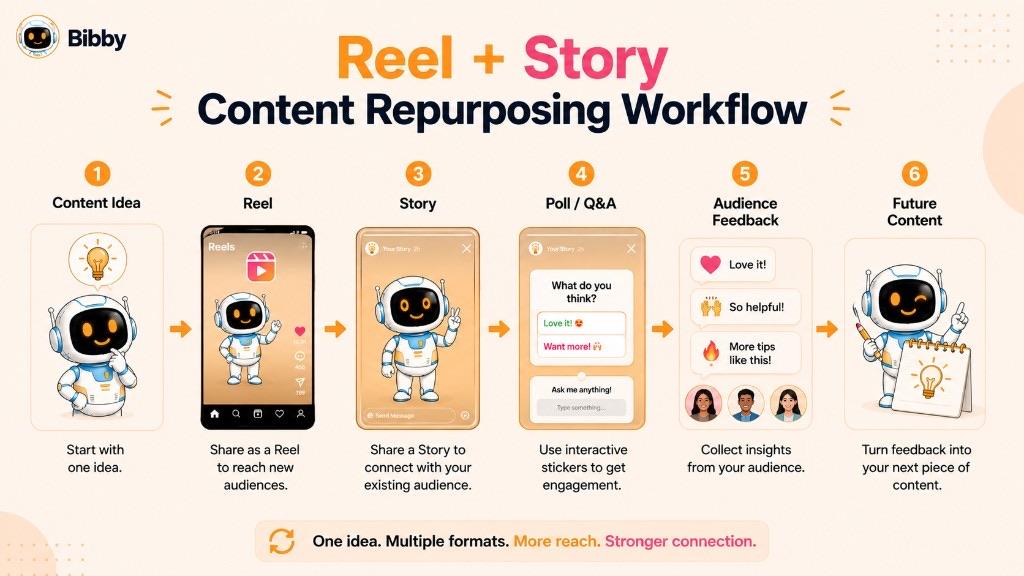
This approach is often called content repurposing. Instead of creating completely different content for every Instagram format, you can take one idea and reshape it for the way people use each format.
How to Repurpose a Reel Into a Story
Suppose a software company publishes a Reel demonstrating a new feature.
The Reel could show the feature in action, explain the problem it solves, demonstrate how to use it, highlight its main benefit, and end with a clear call to action.
The company could then create several Stories around the same topic:
- Story 1: Announce the new feature.
- Story 2: Share a short screen recording or image.
- Story 3: Ask followers whether they have experienced the problem the feature solves.
- Story 4: Share the Reel and encourage followers to watch it.
- Story 5: Answer common questions about the feature.
The central idea stays the same, but the content is adapted to the strengths of each format.
Why Should You Adapt Content Instead of Duplicating It?
The biggest advantage of adapting content is that each format can perform the job it was designed for.
A Reel can focus on capturing attention, delivering information quickly, reaching new viewers, providing long-term content value, and encouraging shares and saves.
A Story can focus on starting conversations, asking questions, collecting feedback, sharing additional context, creating urgency, and engaging existing followers.
This also allows one content idea to generate multiple audience touchpoints without requiring an entirely new concept every time.
Example: Turning One Idea Into a Reel and Story
Imagine a fitness creator has a topic called “Three Common Squat Mistakes.”
The creator could turn the topic into a Reel showing all three mistakes with demonstrations and explanations.
The accompanying Stories could then ask “Which squat mistake do you make most often?,” “Want a full squat tutorial?,” or “Should I make a beginner workout guide?”
The Reel provides the main educational content, while the Stories create opportunities for interaction.
Should Every Reel Also Be Shared to Stories?
Not necessarily.
Sharing a Reel to Stories can be useful when you want to bring additional attention to it, particularly when the content is relevant to your existing followers. However, not every Reel needs to be promoted through Stories, and Stories should not become a stream of identical reposts.
A better approach is to ask whether the Story adds context, interaction, urgency, or another reason to engage with the original content.
For example, instead of simply sharing a Reel with no additional information, you could add a question such as “Which of these three tips are you going to try first?”
The Reel provides the information. The Story provides the conversation.
Can One Content Idea Become Multiple Posts?
Yes. A single idea can often become several pieces of social media content.
For example, one topic—“How to create a social media content calendar”—could become a Reel walkthrough, a Story poll about how often followers plan their content, a carousel checklist, a Story reminder, and a follow-up Reel about common mistakes.
This approach can make content creation more efficient while maintaining variety across formats.
Can a Reel Be Shared to Stories?
Yes, an Instagram Reel can be shared to an Instagram Story. This allows creators and businesses to use Stories as an additional way to bring attention to a Reel after it has been published.
Sharing a Reel to Stories can be useful because Reels and Stories serve different purposes. The Reel can act as the main piece of discoverable video content, while the Story can provide an additional touchpoint with people who already follow the account.
Why Share a Reel to Your Story?
There are several reasons to share a Reel to Stories:
- Give existing followers another way to discover the Reel
- Extend attention around newly published content
- Add context or commentary to the Reel
- Encourage followers to watch the full Reel
- Ask a question related to the Reel
- Create an interactive follow-up
- Connect a temporary Story update with longer-lasting content
For example, a marketing agency could publish a Reel explaining three social media mistakes, then share that Reel to Stories with a message asking followers which mistake they have made.
How to Share a Reel to an Instagram Story
The exact Instagram interface can change over time, but the general process is straightforward:
- Open the Reel you want to share.
- Select Instagram's sharing option.
- Choose the option to add the Reel to your Story.
- Customize the Story with available text, stickers, GIFs, or other elements.
- Publish the Story.
The available options may vary depending on the account, Instagram version, privacy settings, and other platform conditions.
Should You Share Every Reel to Stories?
No. Sharing every Reel to Stories can become repetitive, particularly if the Story simply reproduces the Reel without adding anything useful.
Instead, consider whether the Story can give followers an additional reason to interact with the content.
Basic approach: “New Reel!”
More engaging approach: “I covered three common mistakes in today's Reel. Which one do you think people make most often?”
The second approach gives the Story its own purpose rather than using it as a simple duplicate distribution channel.
Use Stories to Build a Conversation Around a Reel
One of the strongest ways to combine Reels and Stories is to use the Story as a conversation layer.
For example:
- Reel: “5 ways to improve your Instagram content.”
- Story 1: “Which one are you struggling with most?”
- Story 2: Use a poll or question feature to collect responses.
- Story 3: Share the Reel.
- Story 4: Answer a common question from the audience.
This approach allows a single content idea to support multiple forms of engagement.
Reel vs Story: Think Beyond the Format
The important point is that Reels and Stories do not have to compete for attention.
A Reel can provide the main content asset, particularly when the goal is discovery or long-term visibility. A Story can then help bring existing followers into the conversation around that content.
For creators and businesses, this creates a simple content flow:
Create a Reel → Share it to Stories → Add context or interaction → Continue the conversation
Using the two formats together can make an Instagram content strategy more efficient while giving each format a clearly defined role.
Reel vs Story for Businesses
For businesses, the choice between an Instagram Reel and a Story should be based on the marketing objective, audience stage, and type of content.
A business does not need to choose one format exclusively. Reels and Stories can work together, with Reels supporting discovery and brand awareness while Stories help maintain relationships and encourage interaction with existing followers.
Reels for Business Growth
Instagram Reels can be valuable for businesses that want to reach new audiences and increase brand awareness.
Because Reels have strong discovery potential, businesses can use them to introduce their products, services, expertise, and brand personality to people who may not already follow the account.
Common business uses for Reels include product demonstrations, service explanations, educational content, tutorials, industry tips, customer use cases, product launches, behind-the-scenes videos, brand storytelling, frequently asked questions, and problem-and-solution content.
For example, a social media software company could create a Reel showing how a business can plan a week of social media content. The video provides useful information while introducing the company and its expertise to potential customers.
Reels can therefore play an important role near the awareness and discovery stage of a social media marketing strategy.
Stories for Customer Engagement
Instagram Stories are particularly useful for maintaining regular communication with an existing audience.
Because Stories are temporary and support interactive features, businesses can use them to create frequent opportunities for followers to respond, ask questions, provide feedback, or learn about current activities.
Businesses can use Stories for customer questions, polls and surveys, product updates, behind-the-scenes content, event coverage, limited-time promotions, announcements, customer feedback, frequently asked questions, and community updates.
Reels for Product Discovery
A product can often be easier to understand when demonstrated visually. A Reel can show the customer's problem, the product or service solving the problem, how the product works, the primary benefit, and a clear next step.
The objective is not simply to advertise the product. The Reel should provide enough useful or interesting information to earn attention while naturally introducing the product.
Stories for Promotions and Updates
Stories are well suited to information that is temporary or time-sensitive.
A business running a limited promotion could use Stories to communicate when the promotion starts, what the offer includes, how long it lasts, frequently asked questions, customer responses, and a final reminder before the promotion ends.
The temporary nature of Stories can complement the urgency of a limited-time campaign.
For longer-lasting promotional content, a business may also create a Reel that explains the offer and then use Stories to provide reminders and additional context.
Stories for Feedback and Customer Research
Stories can also become a lightweight feedback channel.
A business launching a new product, feature, design, or service could ask followers for opinions before making a decision—for example, “Which feature would you use most?” with options such as automated scheduling or AI captions.
The responses can provide useful audience feedback while also creating engagement around the brand.
Using Reels and Stories Together
The strongest approach is often to give each format a different role.
Consider a company launching a new service.
- Reel: Explain what the service does and why it matters.
- Story: Tell existing followers that the service has launched.
- Story: Ask followers whether they have the problem the service solves.
- Story: Answer common questions.
- Story: Share additional information or a relevant call to action.
The Reel creates a longer-lasting, discoverable content asset. The Stories create a series of interactions around it.
Reel vs Story for the Marketing Funnel
A practical way to think about the two formats is:
Reel → Discovery → Interest → Story → Interaction → Action
This is not a fixed Instagram funnel, and users do not necessarily move through these stages in a specific order. Instead, it is a useful framework for assigning different content jobs.
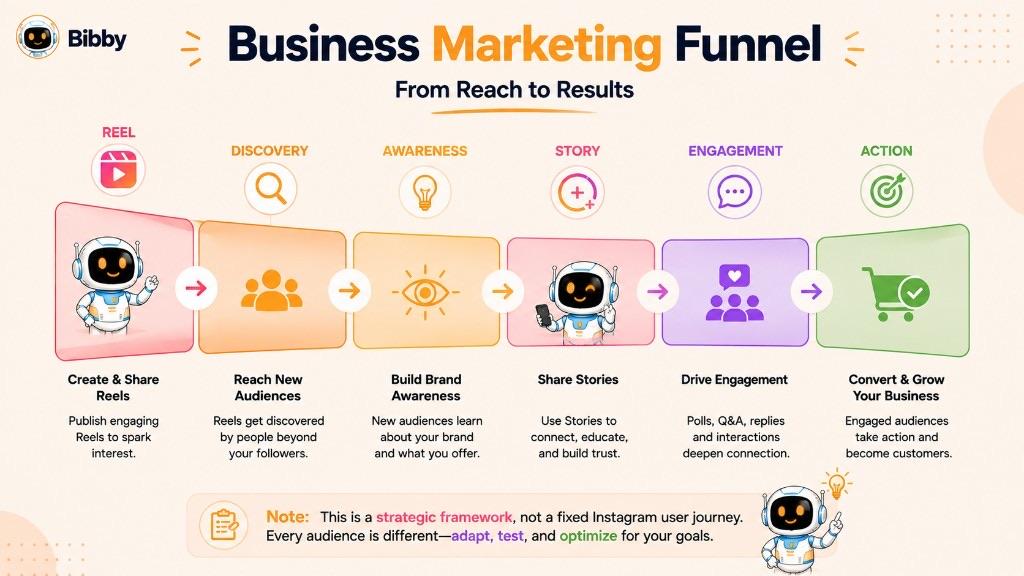
Reels can help introduce the brand to new audiences. Stories can help strengthen the relationship with people who already engage with the brand. Both can support conversions, but their roles within the content strategy may be different.
Which Should a Business Prioritize?
If a business has limited resources, the answer depends on its immediate objective.
Prioritize Reels when you need broader reach, want to attract new audiences, are building brand awareness, have educational or demonstrative video content, or want to build a library of longer-lasting content.
Prioritize Stories when you already have an active follower base, want more direct interaction, frequently have timely updates, want to collect feedback, rely on community engagement, or have promotions or announcements that are time-sensitive.
For many businesses, the most effective strategy is not Reel vs Story, but a coordinated approach in which Reels attract attention and Stories deepen engagement.
Reel vs Story for Influencers and Creators
For influencers and content creators, Instagram Reels and Stories serve different roles in audience growth and community building.
Reels are generally more useful for getting content discovered by new audiences, while Stories are particularly valuable for maintaining a regular connection with existing followers. Creators who use both formats can separate their discovery content from their community content.
Reels for Audience Growth
Reels can help creators introduce their content to people who have never encountered their account before.
A creator can use Reels to showcase their personality, expertise, creativity, or niche through short-form video. Popular Reel concepts include tutorials, educational tips, how-to videos, product reviews, commentary, entertainment, trends, storytelling, before-and-after content, day-in-the-life videos, quick demonstrations, and niche-specific advice.
The common thread is discoverability. The content can introduce the creator to people who are interested in the topic but do not yet follow the account.
Reels for Building a Personal Brand
Creators can also use Reels to establish what they are known for. If a creator consistently publishes videos around a particular subject, viewers can begin associating that subject with the creator's account.
Consistency in topic and presentation can make Reels an important part of a creator's personal-brand strategy.
Stories for Community Building
While Reels can introduce a creator to new audiences, Stories can help turn followers into an active community.
Stories allow creators to share more frequent and personal updates without requiring every piece of content to be a polished, permanent video.
Creators can use Stories to answer follower questions, share daily updates, ask for opinions, run polls, show behind-the-scenes moments, share works in progress, announce upcoming content, discuss personal experiences, respond to audience feedback, and highlight other relevant content.
Stories for Audience Feedback
Stories can also help creators understand what their audience wants to see next—for example, “Which tutorial should I make next?”
This creates a useful cycle:
Story interaction → Audience insight → New content → Reel → New audience → Story interaction
The two formats can therefore support each other rather than functioning as separate publishing channels.
Stories for More Personal Content
Not every moment needs to become a permanent post. A creator might use Stories to share what they are working on today, a quick personal update, a behind-the-scenes clip, a spontaneous thought, a preview of upcoming content, a reaction to a current event, or a casual conversation with followers.
The temporary nature of Stories makes them suitable for this kind of content.
Reels for Collaborations and Discovery
Reels can also be useful for creator collaborations. Two creators can produce a video around a shared topic, challenge, tutorial, discussion, or creative concept. Collaborative content can expose each creator's work to audiences interested in the other creator.
The specific distribution and visibility of collaborative content can vary, but the format itself is well suited to short-form visual collaboration.
Reel vs Story for Influencer Marketing
For influencers working with brands, the two formats can also serve different campaign objectives.
A Reel may be useful when the campaign requires product discovery, demonstration, education, storytelling, broader content reach, or longer-lasting branded content.
A Story may be useful when the campaign requires product announcements, limited-time promotions, direct audience interaction, questions and answers, polls, quick product reminders, or additional campaign context.
For example, an influencer promoting a skincare product could create a Reel demonstrating how they use the product, then use Stories to answer follower questions about it.
Using Reels and Stories Together as a Creator
Creators do not need to treat Reel vs Story as an either-or decision.
A practical content strategy might look like this:
- Reel: Publish the main educational or entertaining content.
- Story: Tell followers about the new Reel.
- Story: Ask a question related to the topic.
- Story: Share audience responses or additional information.
- Story: Preview the next piece of content.
This creates a content ecosystem in which Reels support discovery and audience growth, while Stories support community and ongoing interaction.
The Simple Rule for Creators
Use Reels to help people discover you.
Use Stories to help your existing audience connect with you.
If a piece of content needs broad discovery and can remain useful after publication, a Reel is usually the stronger option. If it is personal, timely, conversational, or interactive, a Story may be the better fit.
Reel vs Story for Social Media Marketing
For social media marketers, the Reel vs Story decision should be based on the objective of the campaign rather than simply the type of content being created.
Reels and Stories can both support a marketing campaign, but they often perform different jobs. Reels are particularly useful for discovery, awareness, education, and audience growth, while Stories can support engagement, communication, feedback, and time-sensitive campaigns.
Reels for Brand Awareness
Reels can be an effective format for introducing a brand to potential customers through brand stories, educational topics, industry insights, product demonstrations, customer problems, solutions, tips and tutorials, product features, and trends relevant to the brand.
The objective is to create content that is useful, entertaining, or interesting enough to attract attention while communicating the brand's value.
Because Reels can have discovery potential beyond an account's existing followers, they are particularly useful for the awareness stage of a social media marketing strategy.
Reels for Audience Acquisition
A marketer focused on audience growth can use Reels to create content that appeals to people who are interested in the brand's subject area but have not yet followed the account.
For example, a social media automation company could publish a Reel explaining “Five ways to save time managing social media.” Someone interested in social media productivity may discover the content without previously knowing the company.
Reels for Education and Product Marketing
Short-form video is particularly useful when a product or service needs visual explanation. A marketer could use a Reel to show the problem customers experience, why the problem matters, how the product addresses it, the result or benefit, and what the viewer can do next.
This approach is often more informative than simply publishing a promotional message.
Stories for Engagement Marketing
Stories can play a different role by creating repeated opportunities for direct audience interaction: asking questions, running polls, collecting feedback, sharing customer responses, announcing updates, providing additional product information, starting conversations, promoting new content, and sharing behind-the-scenes material.
Instead of asking the audience only to watch, Stories can encourage them to participate.
Stories for Time-Sensitive Campaigns
The temporary nature of Stories makes them useful for campaigns built around a specific date, event, launch, or deadline: product launches, event reminders, limited-time promotions, webinar announcements, flash campaigns, new feature announcements, registration deadlines, and seasonal campaigns.
A marketer can publish a Reel with the main campaign message and use Stories to provide reminders and additional information as the campaign progresses.
Stories for Social Proof
Stories can also be used to showcase social proof in a more immediate format: customer feedback, testimonials, user-generated content, product experiences, customer questions and answers, and community responses.
This type of content can complement more polished Reels by showing how real customers interact with the brand.
Reel vs Story by Marketing Goal
| Marketing Goal | Recommended Format |
|---|---|
| Brand awareness | Reel |
| Reach new audiences | Reel |
| Audience discovery | Reel |
| Audience growth | Reel |
| Product education | Reel |
| Product demonstration | Reel |
| Thought leadership | Reel |
| Evergreen educational content | Reel |
| Daily communication | Story |
| Community engagement | Story |
| Polls and questions | Story |
| Audience feedback | Story |
| Behind-the-scenes content | Story |
| Time-sensitive announcements | Story |
| Limited-time promotions | Story |
| Campaign amplification | Reel + Story |
| Launch campaign | Reel + Story |
Using Reels and Stories Together in a Campaign
A social media campaign does not have to assign the entire campaign to one format.
Consider a company launching a new product:
- Reel 1: Problem — Show the problem the product solves.
- Reel 2: Solution — Demonstrate how the product works.
- Story 1: Announcement — Tell existing followers that the product has launched.
- Story 2: Poll — Ask followers what they think about the new product.
- Story 3: Questions — Invite followers to submit questions.
- Story 4: Social Proof — Share relevant customer feedback or user-generated content.
- Reel 3: Education — Explain a common question or misconception about the product.
This creates a coordinated campaign in which each format has a specific role.
Measure Each Format Against Its Objective
One of the most common mistakes in social media marketing is measuring Reels and Stories using exactly the same expectations.
For Reels, marketers may care about reach, views, watch time, shares, saves, comments, follows, and profile activity.
For Stories, marketers may focus more on reach, views, replies, reactions, poll responses, question responses, link interactions where available, and other Story interactions.
The most important metric is ultimately connected to the campaign objective. A Reel that reaches a new audience can be successful even if it generates fewer direct replies than a Story. A Story that produces meaningful customer conversations can be successful even if it reaches fewer people than a Reel.
Reel vs Story: Content Strategy Example
The easiest way to understand the difference between Instagram Reels and Stories is to see how they can work together in a real content strategy.
Consider a fitness brand that wants to increase its visibility on Instagram while keeping its existing followers engaged. Instead of publishing every piece of content in the same format, the brand can give Reels and Stories different jobs throughout the week.
Monday: Educational Reel
The fitness brand publishes a Reel titled “3 Common Squat Mistakes Beginners Make.” The Reel demonstrates each mistake and briefly explains how to correct it.
The primary goals are to reach people interested in fitness, provide useful educational content, establish expertise, encourage saves and shares, and attract potential new followers.
Because the topic is educational and can remain useful over time, a Reel is a natural fit.
Monday: Story Follow-Up
After publishing the Reel, the brand uses Stories to continue the conversation: “Which squat mistake do you make most often?,” a poll or question to collect responses, and a share of the Reel.
The Reel acts as the main content asset, while the Stories create additional interaction.
Wednesday: Product Demonstration Reel
The brand publishes another Reel showing how to use one of its resistance bands for a beginner workout: the exercise, correct technique, a common mistake, and a modification for beginners.
The goal is to educate viewers while naturally demonstrating the product. This is another example of content that can benefit from the video-first nature and longer shelf life of a Reel.
Wednesday: Behind-the-Scenes Stories
The brand then uses Stories to show what happened behind the Reel: a short clip from filming, the team preparing the workout, a question about the next video, or a preview of upcoming content.
This content does not need to become another permanent Reel. Stories provide a place for the brand to share these smaller moments without turning every update into a major production.
Friday: Community-Focused Stories
On Friday, the brand focuses primarily on existing followers: “What is your biggest fitness challenge right now?,” collect responses, share a useful tip based on the responses, and tell followers that a new Reel addressing the most common question is coming next week.
Here, Stories are being used as a feedback and community-building tool.
Friday: Story Feedback Becomes Future Reel Content
Suppose followers repeatedly mention that they struggle with staying consistent with workouts. The brand can turn that audience insight into its next Reel: “5 Simple Ways to Stay Consistent With Your Workouts.”
This creates a useful content cycle:
Story → Audience feedback → Content idea → Reel → New audience → Story → More feedback
Instead of guessing what the audience wants, the brand can use interactions to inform future content.
A Week of Reels and Stories
| Day | Reel | Story |
|---|---|---|
| Monday | 3 Squat Mistakes | Poll + Reel promotion |
| Tuesday | — | Behind-the-scenes update |
| Wednesday | Resistance Band Tutorial | Filming clips + Q&A |
| Thursday | — | Fitness tip + audience question |
| Friday | Workout Consistency Tips | Community discussion |
| Saturday | — | Customer/user-generated content |
| Sunday | Weekly recap Reel | Next-week content preview |
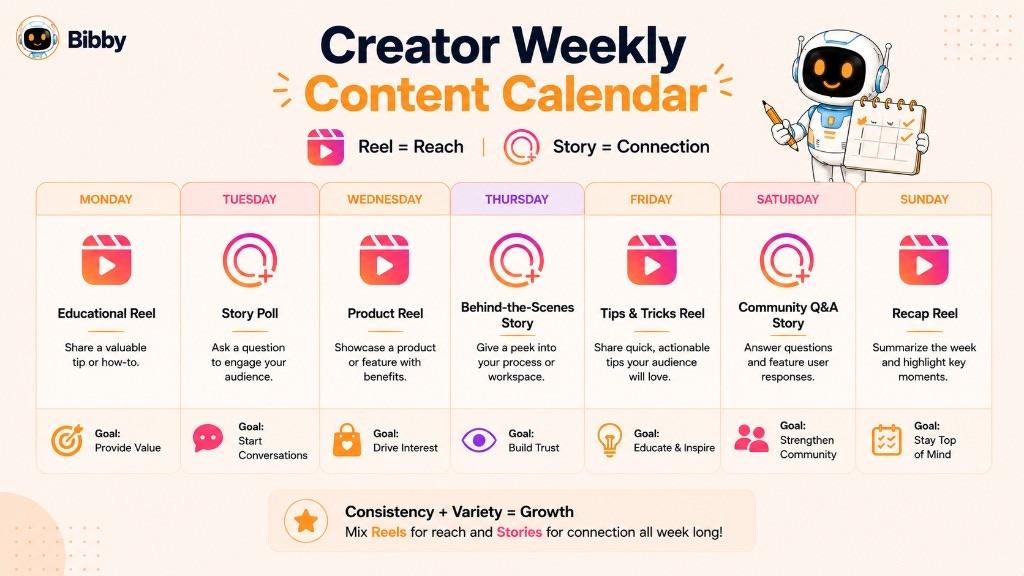
The exact posting frequency will vary by business, audience, resources, and content strategy. The important principle is not to follow a universal number of posts, but to give each format a clear purpose.
What This Example Shows
The fitness brand is not choosing Reels instead of Stories. It is using Reels for discovery and valuable long-lasting content and Stories for interaction, feedback, and timely communication.
The two formats also feed into each other. Stories generate audience insights that can inspire future Reels, while Reels provide content that can be discussed and promoted through Stories.
The Same Strategy Works Across Industries
The concept is not limited to fitness brands.
- A software company could use a Reel for a product tutorial and a Story to ask which feature followers want explained next.
- A restaurant could use a Reel showing how a signature dish is prepared and a Story poll on a favorite menu item.
- A fashion brand could use a Reel of styling ideas and a Story asking which look followers prefer.
- A marketing agency could use a Reel with three social media marketing tips and a Story asking which marketing problem followers want solved next.
In each case, the fundamental strategy remains the same: use Reels to create discoverable content and Stories to create ongoing interaction.
Common Mistakes When Using Reels and Stories
Understanding the difference between Instagram Reels and Stories is only useful if you apply that difference to your content strategy. Many creators and businesses make the mistake of treating both formats as interchangeable, which can lead to repetitive content, weak engagement, or the wrong format for a particular goal.
Treating Reels and Stories as the Same Format
A Reel and a Story may both contain video, but they are built for different content experiences.
Ask: Is this content meant to be discovered later, or is it mainly relevant right now? That simple question can often point you toward the right format.
Posting Every Update as a Reel
Not every social media update needs to become a polished Reel. A quick office update, event reminder, informal announcement, audience question, or behind-the-scenes moment may be better suited to Stories.
Turning every small update into permanent short-form video can also make the content creation process unnecessarily demanding.
Using Stories Only for Promotion
Another common mistake is treating Stories as a continuous advertising channel.
If every Story says “Buy now,” “Shop now,” or “Check out our product,” followers may have fewer reasons to interact with the content.
Stories can be much more useful when they combine promotional messages with questions, polls, educational tips, behind-the-scenes content, customer feedback, community updates, product demonstrations, and informal conversations.
Expecting Every Reel to Go Viral
Reels have strong potential for discovery, but no Reel is guaranteed to go viral.
A common mistake is to judge a Reel solely by whether it reaches a massive audience. An educational Reel that reaches the right potential customers, generates saves, or drives meaningful profile activity may be more valuable to a business than a highly viewed video that attracts an irrelevant audience.
The goal should be useful performance, not simply large numbers.
Ignoring Story Interactions
Stories offer opportunities for direct audience participation, but those opportunities are easy to waste.
Instead of “Here is our new product,” try “Which feature would you use most?” The second approach gives followers an opportunity to participate.
Reposting Content Without Adapting It
Content repurposing can save time, but simply duplicating the exact same content across Reels and Stories is not always effective.
A Reel might explain a topic in detail, while a Story could ask a question about the topic, highlight one important point, share a behind-the-scenes moment, gather audience feedback, direct followers toward the Reel, or provide additional context.
The idea can be reused without making the audience experience identical.
Measuring Reels and Stories With the Same KPI
Another mistake is evaluating Reels and Stories using exactly the same performance expectations.
A Reel may be successful because it reached new people, generated shares, attracted saves, increased profile visits, or helped gain relevant followers.
A Story may be successful because it generated replies, produced poll responses, started conversations, collected customer feedback, or increased interaction with existing followers.
Measure the format against the job you gave it.
Focusing on Quantity Instead of Purpose
Posting more content is not automatically the same as having a better Instagram strategy.
Before publishing, ask: Who is this content for? What do I want them to do? Is this content timely or evergreen? Does it need to remain visible? Is discovery or interaction the priority? Would a Reel, Story, or both formats communicate it better?
Choosing a Format Before Defining the Goal
One of the biggest Reel vs Story mistakes is starting with the format instead of the objective.
Instead of “We need to publish a Reel today,” think “We need to reach people interested in this topic.” That objective can then guide the format, creative approach, caption, timing, and measurement.
Instead of “We need five Stories today,” think “We want to collect feedback about our upcoming product.” Now the Stories have a clear purpose.
How to Measure Reels vs Stories
Comparing Instagram Reels vs Stories only by views or likes can give you an incomplete picture. The two formats serve different purposes, so their performance should be measured against the objective behind the content.
A Reel created to reach new audiences should be evaluated differently from a Story created to generate customer replies. Use the current metrics available in Instagram Insights—those reporting options can change as Instagram updates its analytics features.
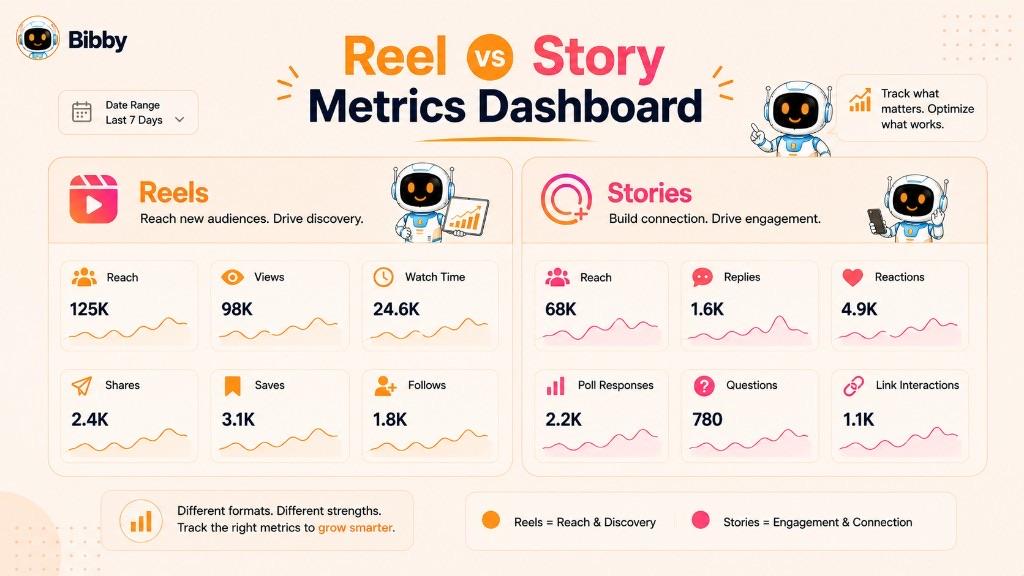
Reel Metrics to Track
For Reels, marketers and creators may pay attention to:
- Views or plays: How many times the Reel was viewed or played.
- Reach: How many accounts were exposed to the content.
- Watch time: How much attention the video received.
- Shares: Whether viewers found the content useful or interesting enough to pass along.
- Saves: Particularly useful for educational, inspirational, or reference-style content.
- Comments: How much conversation the Reel generated.
- Follows: Whether the content attracted people who wanted to see more from the account.
- Profile activity: Whether viewers took additional interest in the account.
Story Metrics to Track
Useful Story metrics may include reach, views, replies, reactions, poll responses, question responses, sticker interactions, link interactions where available, and navigation behavior through a sequence of Stories.
These metrics are particularly valuable when Stories are being used for community engagement, feedback, communication, or conversion-oriented activities.
Which Has Better Engagement: Reels or Stories?
There is no universal answer.
A Reel and a Story may have completely different audiences, objectives, distribution patterns, and content formats. Comparing their raw engagement numbers without considering those differences can lead to the wrong conclusion.
For example, a product tutorial Reel that reaches 50,000 accounts and generates hundreds of saves may be more successful for discovery and awareness, while a product-question Story that reaches 5,000 followers and generates 300 direct responses may be more successful for direct audience interaction.
Neither result is inherently better. The right result depends on the business objective.
Avoid Comparing Raw Numbers Without Context
A common mistake is saying “Our Reel received more views than our Story, so Reels are better.” That conclusion does not necessarily follow.
Instead, compare objective → format → audience → metric → outcome.
A Simple Measurement Framework
Reels: Measure how effectively the content attracts attention and discovery.
Stories: Measure how effectively the content creates interaction and communication.
Both: Measure whether the content contributed to the larger marketing objective.
The goal is not to find a permanent winner between Reels and Stories. The goal is to understand which format is producing the desired result and then improve the content strategy accordingly.
How Bibby Helps Manage Reels and Social Content
Understanding the difference between Reels and Stories is one part of building an effective Instagram strategy. The next challenge is managing all the content consistently.
Bibby is a social media scheduling and automation tool that brings content creation, AI-assisted captions, scheduling, and social media management into one workflow.
You can upload an image, video, carousel, or other supported content, or use AI to generate an image when you need new creative material. Choose a posting style, generate captions with AI, regenerate a caption that does not feel right, and schedule media across dates using AI-optimized publishing times.
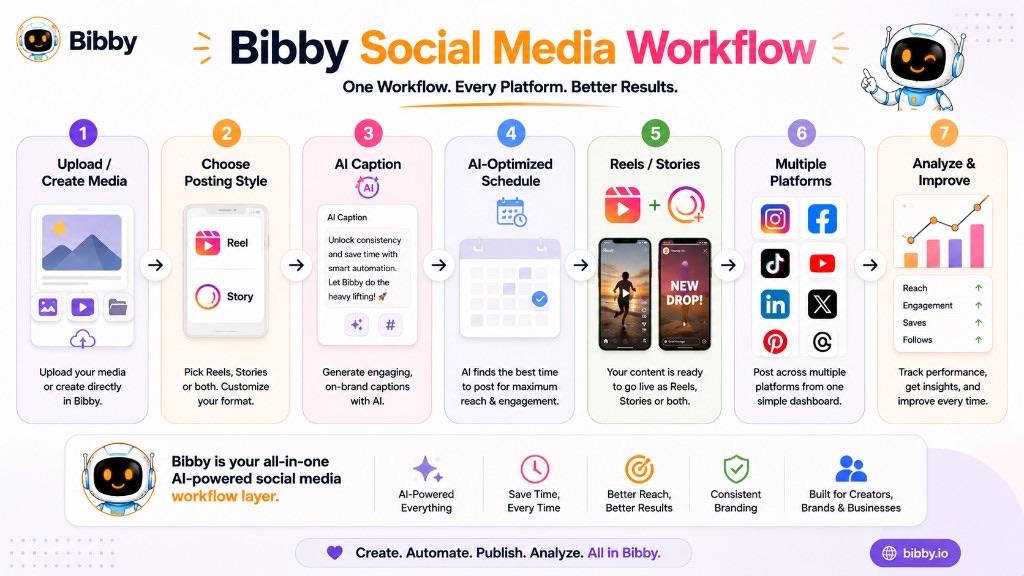
Bibby can help manage content for selected platforms such as Facebook, Instagram, LinkedIn, YouTube, and TikTok. Exact publishing capabilities can vary by platform and content type—confirm that the Instagram format you need is currently supported.
A modern social media strategy rarely consists of only one content format. Depending on the platform and publishing workflow, you may need to manage images, carousels, videos, Stories, short-form video, promotional content, educational content, and campaign content.
Bibby also includes a chat interface for conversational workflow tasks such as creating a brand kit, creating a campaign, creating posts, regenerating captions, and managing content workflows.
Automation should not replace strategy. You still decide what you want to communicate, who you want to reach, whether the idea works better as a Reel or Story, and what the campaign objective is. Bibby can then help turn those decisions into an organized publishing workflow.
In simple terms:
Reels can help you create discoverable, longer-lasting content.
Stories can help you maintain timely communication and audience interaction.
Bibby can help you manage the content workflow behind both.
Measure reach, views, replies, and other Instagram metrics in Instagram Insights. Bibby does not replace those dashboards or guarantee distribution. Get started with Bibby or browse the social media dictionary.
Reel vs Story: Quick Definition
Instagram Reel: A short-form video format designed primarily for discovery, entertainment, education, storytelling, and reaching audiences beyond an account's existing followers. Reels can generally remain available on an Instagram profile after publication.
Instagram Story: A temporary Instagram photo or video update that normally disappears from Story visibility after 24 hours. Stories are commonly used for timely communication, audience interaction, behind-the-scenes content, announcements, and engaging existing followers.
Reel vs Story in One Sentence
Reels are generally better for reach, discovery, and longer-lasting content, while Stories are generally better for timely updates, direct interaction, and engaging an existing audience.
The Simplest Way to Remember
Reel = Reach + Discovery + Longer Shelf Life
Story = Interaction + Immediacy + Temporary Content
Neither format is automatically better than the other. Reels and Stories are designed to perform different jobs, and using them together can create a more complete Instagram content strategy.
If you want to reach new audiences, consider a Reel.
If you want to communicate with and engage existing followers, consider a Story.
If you want both, use Reels and Stories together, adapting the content so each format contributes something useful to the overall strategy.