
Evergreen content is content that stays useful, relevant, and valuable to an audience long after it is first published. Unlike news, trends, seasonal campaigns, or time-sensitive posts, evergreen content focuses on topics people are likely to care about and search for repeatedly over time.
For example, a post explaining how to create a social media content calendar can remain useful for months or even years. The same applies to tutorials, how-to guides, FAQs, checklists, best practices, and educational social media posts. While some details may need occasional updates, the core topic continues to solve a real problem for the audience.
For social media marketers, evergreen content is especially valuable because one strong idea can be reused in different formats and distributed across multiple platforms. An evergreen topic can become an image post, carousel, video, Story, or a series of posts with different captions and angles. This gives businesses a larger library of valuable content without requiring them to start from scratch every time they need something to publish.
With social media automation, evergreen content can become even more useful. Instead of manually remembering when and where to republish useful content, marketers can build a content library and use automation to create captions, repurpose ideas, and schedule posts across platforms at appropriate times.
In simple terms, evergreen content is content that keeps working after the publishing date has passed. It gives your audience lasting value while helping your brand maintain a consistent stream of useful content.
Evergreen Content Meaning in Simple Terms
Evergreen content is content that does not quickly lose its usefulness. It answers a question, solves a problem, teaches a skill, or provides information that remains relevant to your audience over an extended period.
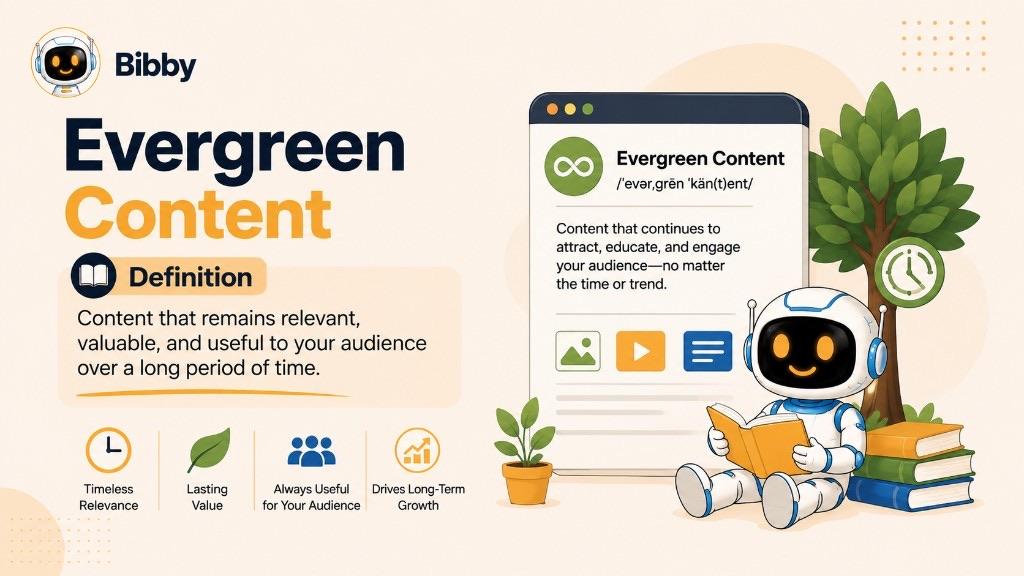
The term "evergreen" comes from evergreen plants, which stay green throughout the year. In content marketing, the idea is similar: the content continues to provide value instead of becoming irrelevant shortly after publication.
For example, consider these two social media topics:
- Time-sensitive: "Instagram's New Features Released in August 2026"
- Evergreen: "How to Write Better Instagram Captions"
The first topic is connected to a specific moment and may become outdated as Instagram changes. The second addresses a recurring need that Instagram users are likely to have regardless of the year.
Evergreen content does not mean the content can never be updated. Platforms, strategies, statistics, and best practices can change. A good evergreen article or social media resource should be reviewed periodically and refreshed when necessary while keeping its core topic intact.
For businesses, this makes evergreen content a valuable part of a long-term content strategy. Instead of creating content that delivers value for only a few days, you can build a library of useful resources that can continue attracting attention, generating engagement, educating customers, and supporting your marketing goals.
A Simple Way to Think About Evergreen Content
Evergreen content = lasting topic + useful information + recurring audience need
If people are likely to have the same question or problem months from now, the topic has strong evergreen potential.
For social media, examples include:
- How to create engaging social media posts
- How to write better captions
- Social media content ideas
- Tips for increasing engagement
- How to create a content calendar
- Common social media marketing mistakes
- Social media terminology and definitions
- How to choose the right social media platform
These topics can remain useful long after their original publication date, making them ideal candidates for repurposing and strategic scheduling.
How Evergreen Content Works
Evergreen content works by addressing a long-term audience need instead of a temporary event or trend. When the topic remains relevant, people can continue discovering and engaging with the content long after its original publication.
The process is relatively simple:
Create → Publish → Discover → Engage → Repurpose → Refresh → Redistribute
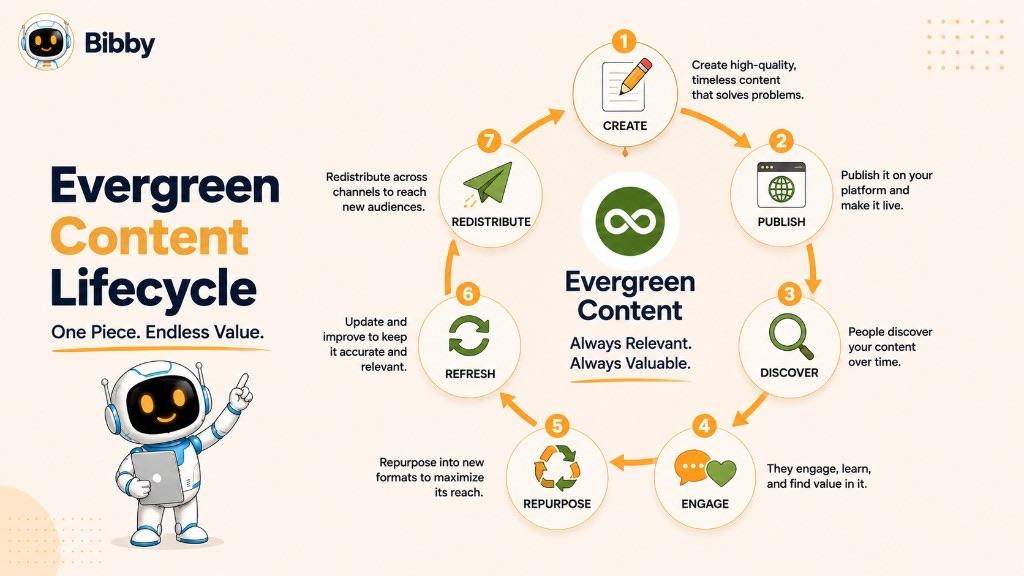
1. Create Content Around a Lasting Topic
Start with a question, problem, or topic your audience is likely to care about repeatedly. The best evergreen topics usually solve common problems rather than reacting to short-lived trends.
For example, "How to Create a Social Media Content Calendar" has stronger evergreen potential than "The Biggest Instagram Trend of August 2026."
2. Publish Useful, High-Quality Information
Evergreen content needs to provide genuine value. A timeless topic alone is not enough. The content should answer the reader's question clearly, provide actionable advice, and make the information easy to understand.
3. Let People Discover It Over Time
Once published, evergreen content can continue reaching people through search engines, social media, email newsletters, recommendations, and other distribution channels.
Unlike a trend-based post that may receive most of its attention within a short period, evergreen content can continue attracting visitors and engagement over a much longer period.
4. Repurpose the Original Idea
One evergreen topic does not have to remain in one format.
A single guide about social media engagement could become:
- An Instagram carousel
- A LinkedIn post
- A short-form video
- A Story
- A YouTube video
- Several individual social media posts
- A checklist or infographic
Repurposing allows businesses to get more value from content they have already created.
5. Refresh It When Necessary
Evergreen does not mean "write it once and forget it." Some information may eventually become outdated, particularly when it involves social media platforms, tools, statistics, or recommended practices.
Refreshing examples, facts, screenshots, and recommendations can keep the content useful while preserving the original topic.
6. Redistribute It Strategically
Once refreshed, evergreen content can be shared again through appropriate channels. Social media scheduling and automation tools can make this process easier by helping businesses organize content, generate variations, and schedule posts instead of manually managing every publication.
This creates a content flywheel where one useful idea can continue producing value through discovery, engagement, repurposing, updating, and redistribution.
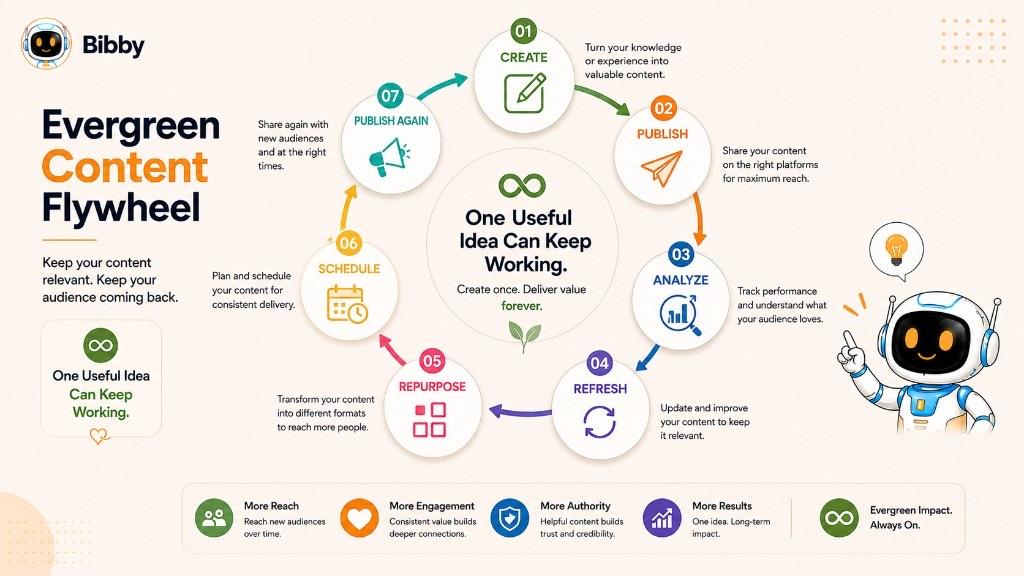
The key principle is simple: evergreen content keeps working because the problem it solves keeps existing.
Evergreen Content vs. Trending Content
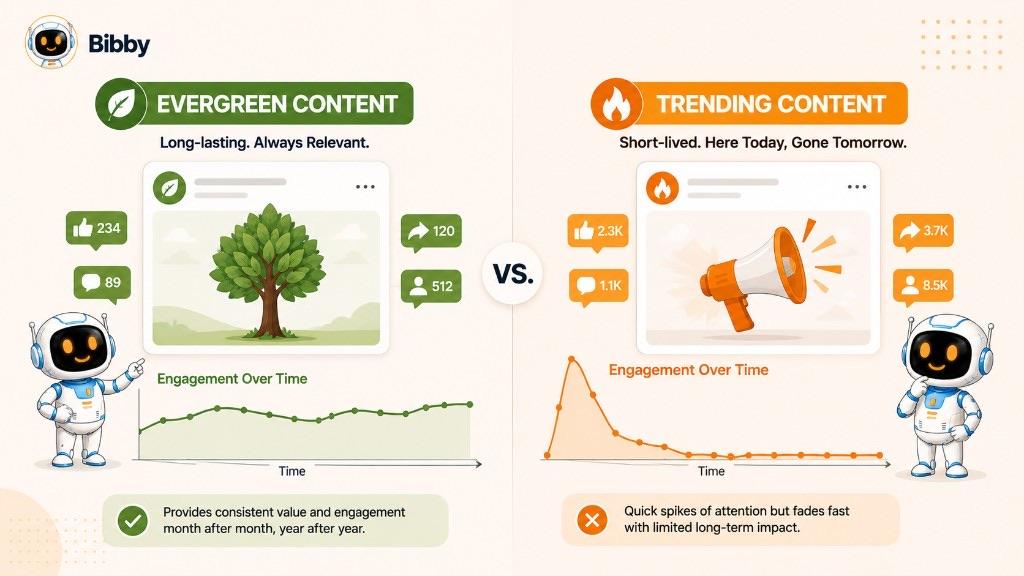
Evergreen content and trending content serve different purposes in a content strategy. Evergreen content is designed for long-term relevance, while trending content is created to capture attention around something happening right now.
Neither approach is automatically better. A strong social media strategy often uses both, balancing content that delivers immediate attention with content that continues providing value over time.
| Factor | Evergreen Content | Trending Content |
|---|---|---|
| Relevance | Remains useful over a long period | Usually tied to a current event or trend |
| Lifespan | Months or years | Often hours, days, or weeks |
| Main goal | Provide lasting value | Generate timely attention and engagement |
| Search potential | Can attract recurring searches | Often depends on current interest |
| Updates | May need occasional refreshing | Can become outdated quickly |
| Examples | Social media tips, tutorials, FAQs | Viral trends, breaking news, platform updates |
| Content strategy | Long-term asset | Short-term opportunity |
Example of the Difference
Consider two social media posts:
Evergreen:
"7 Ways to Improve Your Instagram Engagement"
People can find this useful regardless of the month or year.
Trending:
"Instagram Just Released a New Feature: Here's How It Works"
This can attract significant attention when the feature is new, but its value may decrease as the news becomes old or the feature changes.
Why Use Both?
Trending content can help a brand participate in current conversations and capture short-term attention. Evergreen content provides a more stable foundation of useful information that can be reused, repurposed, and distributed over time.
For example, a social media brand might publish a post about a current Instagram update today while also maintaining evergreen posts about writing captions, improving engagement, creating content calendars, and planning social media campaigns.
This combination creates a healthier content mix:
Trending content → Immediate attention
Evergreen content → Long-term value
The most effective strategy is not choosing between the two. It is knowing when to create each type and how to use them together.
Examples of Evergreen Content
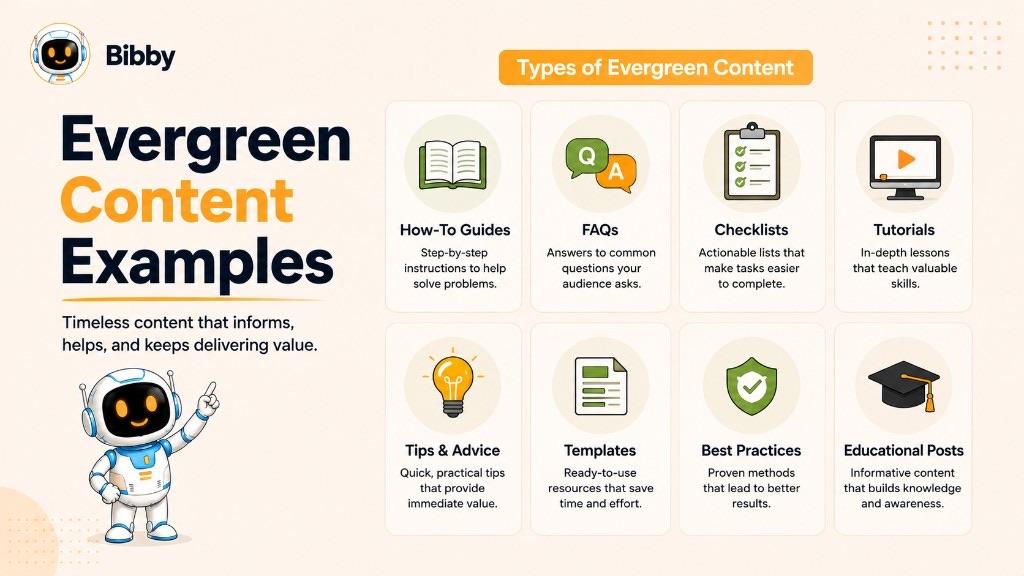
Evergreen content can take many forms, from educational guides and tutorials to social media posts, FAQs, checklists, and practical tips. The common factor is that the content continues to solve a problem or answer a question that does not disappear quickly.
Here are some common examples of evergreen content.
1. How-To Guides
How-to content explains how to complete a task or solve a specific problem.
Examples include:
- How to Create a Social Media Content Calendar
- How to Write Better Instagram Captions
- How to Create a LinkedIn Content Strategy
- How to Schedule Social Media Posts
- How to Create a Content Plan for Your Business
These topics can remain useful because audiences will continue to need guidance on these tasks.
2. Tutorials
Tutorials provide step-by-step instructions for using a tool, completing a process, or developing a skill.
For example, a tutorial explaining how to create a social media carousel can remain relevant even when the original post is months old. The tutorial may need minor updates when platform features change, but the underlying skill remains useful.
3. Frequently Asked Questions
FAQs are naturally suited to evergreen content because they answer recurring questions.
A social media marketing brand might create content around questions such as:
- How often should I post on social media?
- What should I post on Instagram?
- How do I increase social media engagement?
- What is a social media content calendar?
- What is social media automation?
As long as people continue asking these questions, the content can continue providing value.
4. Checklists
Checklists turn complicated processes into simple, actionable steps.
Examples include:
- Social Media Post Checklist
- Instagram Profile Optimization Checklist
- Content Planning Checklist
- Social Media Campaign Checklist
- Before-You-Publish Checklist
Because the underlying process is often consistent, these resources can remain useful for a long time.
5. Best Practices
Best-practice content shares practical recommendations for doing something effectively.
Examples include:
- Social Media Content Best Practices
- Instagram Caption Best Practices
- LinkedIn Marketing Best Practices
- Content Repurposing Best Practices
- Social Media Scheduling Best Practices
These topics can be refreshed as platforms and audience behavior evolve while remaining valuable as long-term resources.
6. Educational Content
Educational content teaches concepts, terminology, strategies, or skills.
For example, a dictionary entry explaining "evergreen content" itself can be evergreen because marketers will continue encountering and searching for the term.
Other examples include:
- Social Media Marketing Definitions
- Content Marketing Fundamentals
- Social Media Engagement Explained
- What Is Content Repurposing?
- What Is Social Media Automation?
7. Templates and Frameworks
Templates give audiences something practical they can use immediately.
Examples include:
- Social Media Content Calendar Template
- Social Media Strategy Template
- Content Brief Template
- Social Media Campaign Framework
- Caption Writing Framework
Templates can become long-term content assets when they solve a recurring need.
8. Evergreen Social Media Posts
Social media itself can contain evergreen content. Posts that provide timeless advice, educational information, tips, FAQs, or useful frameworks can remain valuable well beyond their original publishing date.
Examples include:
"5 Ways to Improve Your Social Media Content"
"3 Common Social Media Marketing Mistakes"
"How to Write a Strong Social Media Caption"
"10 Content Ideas for Small Businesses"
These posts can also be adapted into different formats, allowing one idea to support multiple pieces of content.
9. Problem-Solving Content
Content that addresses a persistent customer problem has strong evergreen potential.
For example, businesses consistently struggle with:
- Coming up with content ideas
- Maintaining a consistent posting schedule
- Writing engaging captions
- Managing multiple social platforms
- Understanding their audience
- Measuring content performance
A useful resource that solves one of these recurring problems can continue attracting attention long after publication.
10. Resource Guides
Comprehensive resource pages can bring several related pieces of information together in one place.
For example:
"The Complete Guide to Social Media Content Planning"
could cover content ideas, content pillars, scheduling, formats, publishing frequency, repurposing, and measurement.
Because the underlying need for effective content planning is ongoing, the guide can become a long-term resource.
Evergreen Content Examples for Social Media
For a social media-focused business, a useful evergreen content library might include:
- Social media tips
- Caption-writing tips
- Content ideas
- Engagement strategies
- Platform-specific best practices
- Social media FAQs
- Content planning guides
- Content calendar resources
- Social media checklists
- Marketing frameworks
- Educational carousels
- How-to videos
- Industry tips
- Common mistakes and solutions
The best evergreen topics are not necessarily the most exciting topics. They are the ones that continue solving problems your audience has repeatedly.
For businesses using social media automation, this library can become even more valuable. A single evergreen idea can be transformed into an image, carousel, video, Story, or multiple social posts, giving the original idea a much longer useful life.
Evergreen Content for Social Media
Evergreen content is particularly valuable for social media because businesses constantly need useful posts, but creating something completely new every day can quickly become exhausting. A well-planned library of evergreen content gives brands a collection of ideas that can be reused, repurposed, refreshed, and distributed over time.
Unlike posts built around a specific news event or viral trend, evergreen social media content focuses on topics that continue to matter to your audience.
What Makes Social Media Content Evergreen?
An evergreen social media post usually has one or more of these characteristics:
- It answers a frequently asked question.
- It solves a recurring customer problem.
- It teaches a useful skill.
- It provides practical tips.
- It explains a concept or process.
- It shares a repeatable strategy.
- It provides a checklist, framework, or template.
- It remains useful regardless of a specific date or trend.
For example, "5 Ways to Improve Your Social Media Engagement" has evergreen potential because businesses will continue looking for ways to increase engagement.
On the other hand, "The Best Social Media Trends for August 2026" is time-sensitive. Its relevance will naturally decline as the month and trends change.
Evergreen Social Media Content Examples
Businesses can build evergreen content around many recurring audience needs.
Educational posts
Explain concepts, strategies, tools, or processes your audience wants to understand.
Tips and tricks
Share practical advice that people can apply to improve their results.
FAQs
Turn frequently asked customer questions into individual posts, carousels, videos, or Stories.
How-to content
Break down a task into simple steps that your audience can follow.
Mistakes to avoid
Highlight common problems and explain how to prevent them.
Checklists
Turn a complex process into an easy-to-follow list.
Industry insights
Share useful knowledge that remains relevant beyond a particular news cycle.
One Evergreen Idea Can Become Multiple Posts
One of the biggest advantages of evergreen content is that the original idea does not have to remain locked into one format.
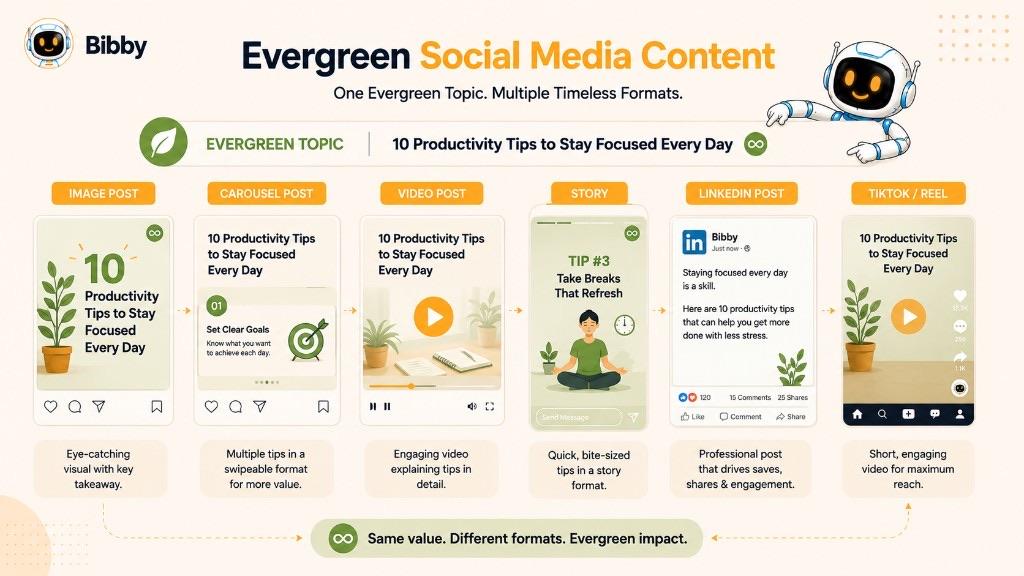
For example, consider the evergreen topic:
"How to Create Better Social Media Captions."
That single idea could become:
- An Instagram carousel explaining five caption-writing techniques
- A short video demonstrating a caption formula
- A LinkedIn post sharing three common caption mistakes
- A Story featuring a quick caption-writing tip
- A Facebook post with a practical checklist
- A longer educational article
- Several future posts focusing on individual techniques
The information stays rooted in the same evergreen topic, but the presentation can change.
Evergreen Content and Different Social Platforms
The same evergreen idea can also be adapted to different platforms.
An educational concept might become a carousel on Instagram, a professional insight on LinkedIn, a short-form video on TikTok, a video for YouTube, and a Facebook post.
The key is not simply copying the exact same post everywhere. Each platform can use the same underlying idea while adapting the format, caption, presentation, and audience context.
Why Evergreen Content Matters for Social Media Strategy
A strong social media strategy needs both timely and long-lasting content.
Trending content can help brands participate in current conversations, while evergreen content creates a dependable foundation of useful material.
A balanced content library might therefore include:
Trending content → Current conversations and timely opportunities
Evergreen content → Long-term educational and useful content
Promotional content → Products, services, offers, and campaigns
Community content → Questions, conversations, and audience interaction
This mix helps prevent a social media feed from becoming entirely dependent on trends.
Evergreen Content Can Be Automated
Managing evergreen content manually can become difficult when a business publishes across several platforms. Content needs to be organized, adapted, captioned, scheduled, and published without overwhelming the person managing the accounts.
Social media automation can simplify this workflow.
With a tool such as Bibby, businesses can upload an existing image or generate an image with AI, choose a posting style, let AI create the caption, and schedule content across selected social platforms. Evergreen ideas can also be turned into different content formats, including images, carousels, videos, and Stories.
Bibby's chat interface adds another layer to this workflow. Instead of navigating through separate tools, users can use conversation to create campaigns, create posts, build a brand kit, regenerate captions, and manage other parts of their social media workflow.
The result is a more systematic approach to evergreen content: create valuable ideas once, adapt them thoughtfully, and keep them working across your social media strategy over time.
Benefits of Evergreen Content
Evergreen content can become one of the most valuable assets in a long-term content strategy. Instead of producing content that delivers value for only a short period, businesses can create resources and social media posts that continue attracting attention, educating audiences, and supporting marketing goals over time.
Here are some of the main benefits of evergreen content.
1. Extends the Lifespan of Your Content
Most content has a limited initial publishing window. Evergreen content can continue providing value long after that first wave of attention has passed.
A useful guide, tutorial, or social media post can be discovered again through search, shared by users, included in newsletters, or repurposed into another format.
This gives businesses more value from the effort invested in creating the original content.
2. Supports Consistent Traffic
Evergreen topics often address questions and problems that people repeatedly search for.
For example, people will continue looking for information about:
- How to create a content calendar
- How to improve social media engagement
- How to write better captions
- How to create social media content
- How to schedule social media posts
When content answers these recurring questions well, it can continue attracting organic traffic over time.
3. Provides a Reliable Source of Social Media Ideas
One of the biggest challenges for social media teams is deciding what to publish next.
An evergreen content library helps solve this problem.
Instead of starting from a blank page every time, marketers can revisit topics such as:
- Common customer questions
- Frequently made mistakes
- Tutorials
- Industry tips
- Educational concepts
- Checklists
- Best practices
These topics provide a foundation for creating new posts and variations.
4. Makes Content Repurposing Easier
A strong evergreen idea can be transformed into multiple formats.
For example, a guide about social media engagement could become a carousel, short video, Story, LinkedIn post, infographic, or a series of individual tips.
This allows businesses to extend the usefulness of an existing idea without recreating the entire concept from scratch.
5. Helps Build Brand Authority
Consistently publishing genuinely useful information can help a brand demonstrate expertise.
When a business repeatedly answers important questions and provides practical solutions, audiences have more opportunities to recognize it as a useful source of information.
Over time, this can support trust, brand awareness, and authority within a particular niche.
6. Supports SEO Over the Long Term
Evergreen content can be particularly useful for search engine optimization because it targets topics that remain relevant.
A well-optimized evergreen resource can potentially:
- Attract organic search traffic
- Earn backlinks
- Generate internal linking opportunities
- Rank for related search queries
- Bring new visitors to a website over time
The key is to keep the content genuinely useful and update it when important information changes.
7. Saves Content Creation Time
Evergreen content does not eliminate the need to create new content, but it can reduce the pressure to constantly invent completely new topics.
Once you have a library of proven evergreen ideas, you can refresh, expand, repurpose, or repackage them.
This creates a more sustainable content workflow, particularly for small businesses and lean marketing teams.
8. Works Well With Social Media Automation
Evergreen content and automation naturally complement each other.
Automation can help businesses organize their content library, generate variations, create captions, schedule posts, and distribute content across multiple social platforms.
Instead of manually deciding what to publish every day, a business can build a strategic collection of evergreen content and use automation to manage much of the repetitive work.
9. Creates More Opportunities for Engagement
Useful content gives audiences a reason to save, share, comment on, or return to a post.
For example, a practical checklist might be saved for later, while a useful tip could be shared with someone facing the same problem.
Because evergreen content remains relevant, those engagement opportunities can continue beyond the original publishing date.
10. Creates a Long-Term Content Asset
Perhaps the biggest benefit is that evergreen content can become a reusable business asset.
A strong piece of content can support multiple activities:
SEO → Social media → Email → Lead generation → Education → Repurposing → Brand authority
Instead of treating every piece of content as a one-time publication, businesses can build a library of resources that continues contributing to their marketing strategy.
The Bottom Line
Evergreen content is valuable because it shifts the focus from "What can we publish today?" to "What can we create that will continue helping our audience tomorrow?"
When combined with thoughtful repurposing and social media automation, evergreen content can help businesses maintain a consistent publishing presence while getting more value from every idea they create.
How to Create Evergreen Content
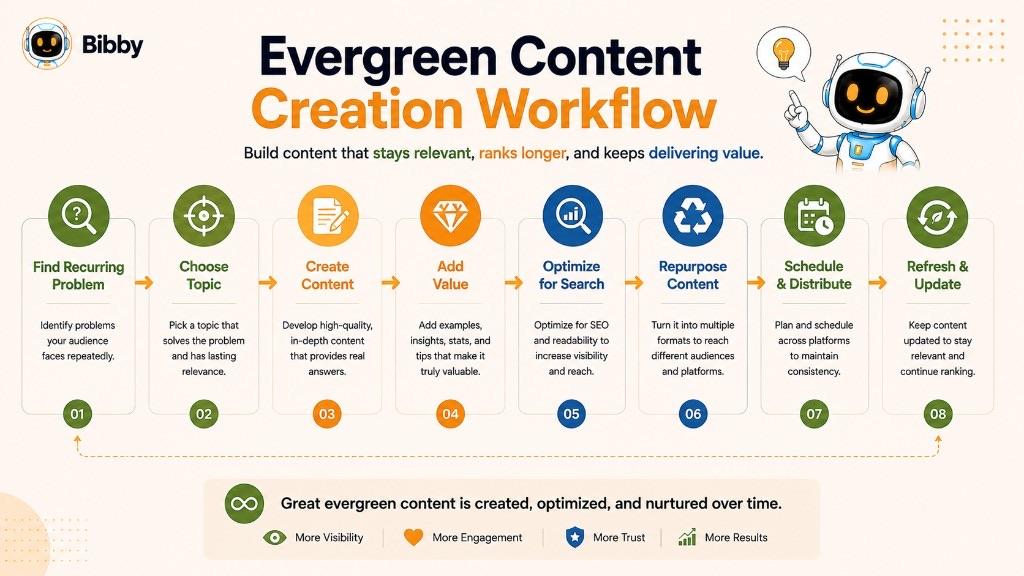
Creating evergreen content starts with understanding what your audience will continue to need, not simply what is popular today. The goal is to create content around recurring questions, problems, and interests that can remain useful for months or years.
Here is a practical process for creating evergreen content.
1. Identify Recurring Audience Problems
Start by finding problems your audience faces repeatedly.
Look at:
- Frequently asked questions
- Customer support conversations
- Comments on social media
- Search queries
- Community discussions
- Common mistakes
- Topics competitors explain repeatedly
- Questions your sales team receives
If people are likely to ask the same question six months from now, it may be a strong evergreen topic.
2. Choose Topics With Long-Term Relevance
Not every popular topic is evergreen.
Choose subjects that are relatively independent of:
- Specific dates
- Temporary events
- Short-lived trends
- Breaking news
- Limited-time offers
- Temporary platform features
For example, "How to Build a Social Media Content Strategy" has stronger evergreen potential than "The Biggest Social Media Trends of 2026."
The first addresses an ongoing need, while the second is tied to a particular period.
3. Focus on a Specific Problem
Evergreen content should have a clear purpose.
Instead of creating a broad article called "Social Media Tips," consider a more focused topic such as:
"How to Create Social Media Posts When You Have No Content Ideas."
A specific problem makes it easier to create useful, actionable content and gives the audience a clear reason to read or save it.
4. Create Content That Actually Solves the Problem
Timelessness alone does not make content evergreen.
The content must provide real value.
Include:
- Clear explanations
- Practical steps
- Examples
- Frameworks
- Checklists
- Relevant data
- Useful resources
- Actionable recommendations
Avoid filling the page with generic advice simply because the topic has search volume.
5. Make the Content Easy to Update
Even evergreen topics can change.
This is especially important for social media because platforms regularly introduce new features, modify interfaces, and change recommended practices.
Structure your content so individual sections can be updated without rewriting everything.
For example, instead of building an entire guide around a temporary Instagram interface, focus primarily on the underlying strategy and update platform-specific instructions when necessary.
6. Optimize for Search Intent
If you want evergreen content to generate organic traffic, create it around what people are actually searching for.
Understand:
- The primary search query
- Related questions
- Search intent
- Relevant subtopics
- Common terminology
- Questions users want answered
Then organize the content so readers can quickly find the information they need.
7. Add Examples
Examples make evergreen content more practical and easier to understand.
For instance, if you are explaining evergreen social media content, do not simply define it. Show the difference between an evergreen post and a time-sensitive post.
Evergreen:
"5 Ways to Improve Your Social Media Engagement"
Time-sensitive:
"Top Social Media Trends This Week"
The examples help readers understand how to apply the concept themselves.
8. Build Multiple Content Formats From One Idea
Think beyond a single article or post.
One evergreen topic can become:
Article → Carousel → Image → Short Video → Story → LinkedIn Post → Email → FAQ
This approach increases the number of ways your audience can discover and consume the information.
9. Create Variations Instead of Repeating the Same Post
When redistributing evergreen ideas, avoid publishing the exact same content repeatedly.
Instead, change elements such as:
The underlying idea can remain the same while the actual post feels fresh.
10. Schedule and Distribute Strategically
Creating evergreen content is only half the job. Your audience needs opportunities to discover it.
A social media scheduling and automation platform can help organize evergreen posts and distribute them across multiple channels.
For example, Bibby can help turn an idea or uploaded visual into social media content, generate captions with AI, select posting styles, and schedule content across platforms such as Facebook, Instagram, LinkedIn, YouTube, and TikTok.
Its chat-based workflow can also make the process conversational. Users can create campaigns, create posts, regenerate captions, build a brand kit, and manage other social media tasks through chat.
11. Monitor Performance
Once evergreen content is published, look at how people respond to it.
Depending on the platform and content type, useful signals can include:
- Engagement
- Shares
- Saves
- Comments
- Clicks
- Organic traffic
- Conversions
- Watch time
Performance data can help you identify which evergreen topics deserve more attention.
12. Refresh Successful Content
Finally, revisit your strongest evergreen content periodically.
Update:
- Outdated statistics
- Examples
- Screenshots
- Platform information
- Links
- Recommendations
- Product information
Refreshing successful content helps preserve its relevance while allowing you to build on what has already worked.
A Simple Evergreen Content Formula
A useful way to approach evergreen content is:
Recurring Problem + Useful Solution + Long-Term Relevance + Periodic Refresh = Evergreen Content
The goal is not to create content that never changes. The goal is to create content whose core value remains useful even as the surrounding landscape evolves.
How to Create Evergreen Social Media Posts
Evergreen social media posts are designed to remain useful beyond the day they are published. They answer recurring questions, solve common problems, teach practical skills, or provide advice that your audience can continue using over time.
The key is to create posts around lasting audience needs rather than temporary attention.
1. Start With a Recurring Problem
The best evergreen social media posts usually begin with something your audience repeatedly struggles with.
For example:
- "What should I post on Instagram?"
- "How can I get more engagement?"
- "How often should I post?"
- "How do I write better captions?"
- "How can I stay consistent on social media?"
These questions are not limited to a particular date, which gives them strong evergreen potential.
2. Use a Simple Content Formula
A practical evergreen social media post can follow this structure:
Problem → Insight → Actionable Tip → CTA
For example:
Problem:
"Struggling to come up with social media content every day?"
Insight:
"You don't need a new idea every morning. Build a library of content around the questions your customers ask repeatedly."
Actionable tip:
"Turn your top five customer questions into five educational posts."
CTA:
"Save this idea for your next content planning session."
This structure is simple, useful, and easy to adapt to different platforms.
3. Focus on Save-Worthy Information
Evergreen social media content often performs well when it gives people something worth returning to.
Consider creating:
- Checklists
- Step-by-step guides
- Frameworks
- Formulas
- Tips
- Mistake lists
- Tutorials
- Resource collections
- Frequently asked questions
For example, "10 Things to Check Before Publishing a Social Media Post" can become a useful resource people save and revisit.
4. Create Strong but Timeless Hooks
Your opening line needs to capture attention without relying entirely on a temporary trend.
Instead of:
"This week's Instagram hack is..."
Try:
"Your social media content may not need more ideas. It may need a better system."
The second hook can remain relevant much longer because it addresses an ongoing problem.
5. Make the Visual Easy to Understand
Evergreen posts should communicate their main idea quickly.
Depending on the topic, you can use:
- Minimal graphics
- Carousels
- Infographics
- Screenshots
- Short videos
- Checklists
- Diagrams
- Educational illustrations
The visual should support the message rather than overwhelm it.
6. Adapt the Idea to Each Platform
An evergreen idea does not need to look identical everywhere.
For example, the topic "How to Improve Social Media Engagement" could become:
Instagram: A five-slide carousel
LinkedIn: A professional post with practical recommendations
TikTok: A short video explaining three engagement mistakes
YouTube: A longer educational video
Facebook: A concise educational post
The central idea stays consistent while the format and presentation adapt to each audience.
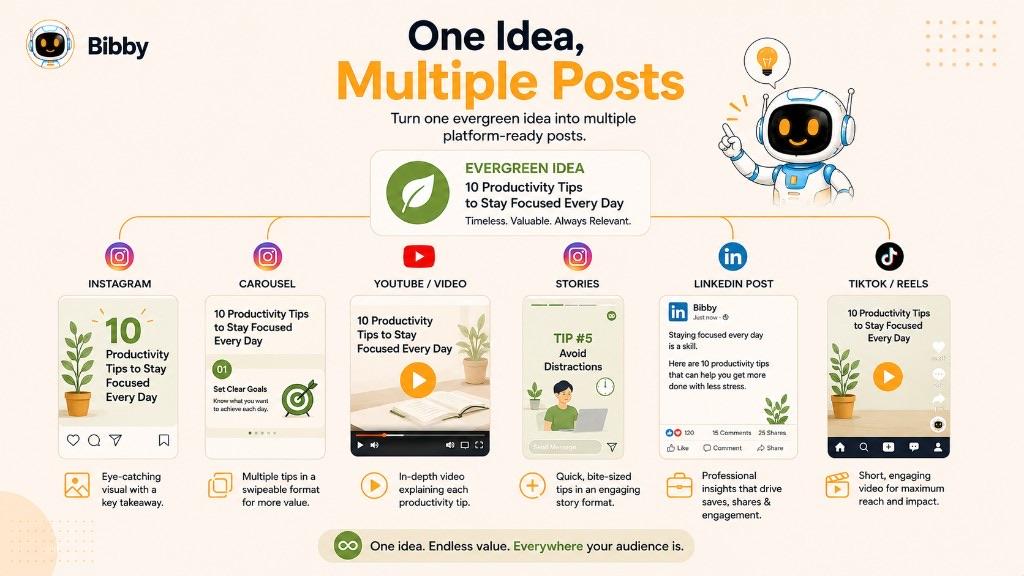
7. Repurpose Instead of Recreating
One evergreen topic can generate multiple pieces of content.
Imagine you create a detailed guide about social media content planning.
You could extract:
- Five individual tips
- A checklist
- A carousel
- A short video
- A Story
- A quote-style graphic
- A FAQ post
- A LinkedIn discussion
This turns one strong idea into an entire content cluster.
8. Refresh the Content When Needed
Evergreen does not mean posting something forever without checking it.
If your post references:
- Platform features
- Statistics
- Tools
- Algorithms
- Best practices
- Screenshots
- Pricing
- Specific interfaces
review it periodically and update anything that has changed.
The goal is to preserve the evergreen idea while keeping the information accurate.
9. Schedule Evergreen Posts Strategically
Once you have a library of evergreen posts, scheduling can help distribute them consistently.
Instead of manually deciding every day which post should go live, you can organize content into campaigns or posting workflows and schedule different pieces across your selected platforms.
Bibby can support this workflow by allowing users to upload an image or generate one with AI, choose a posting style, generate captions automatically, and schedule content across platforms such as Facebook, Instagram, LinkedIn, YouTube, and TikTok.
Users can also manage social media tasks through Bibby's chat interface, including creating campaigns, creating posts, regenerating captions, and managing a brand kit.
10. Avoid Posting the Exact Same Content Too Often
Reusing an evergreen idea is different from repeatedly publishing an identical post.
If an evergreen post performed well, consider creating a new version with:
- A different hook
- A new visual
- A different caption
- Another example
- A different format
- A new CTA
- A platform-specific adaptation
This keeps the content useful while reducing repetition for your audience.
A Simple Evergreen Social Media Framework
Use this framework when creating your next post:
Identify a recurring problem
↓
Share a useful solution
↓
Turn it into a clear visual
↓
Adapt it for each platform
↓
Generate a strong caption
↓
Schedule strategically
↓
Review performance
↓
Refresh and repurpose
The goal is not to make one post last forever. It is to create ideas that remain valuable long enough to be reused intelligently.
Evergreen Content and Social Media Automation
Evergreen content becomes even more useful when combined with social media automation. Instead of manually deciding what to publish, writing every caption, creating every variation, and scheduling every post, businesses can build a library of valuable content and use automation to manage much of the repetitive publishing work.
The important distinction is that automation does not make content evergreen. The content becomes evergreen because its underlying topic remains useful. Automation simply makes it easier to distribute, repurpose, and manage that content consistently.
How Evergreen Content Fits Into an Automated Workflow
A typical evergreen social media workflow can look like this:
Evergreen Idea → Content Creation → Caption Generation → Repurposing → Scheduling → Publishing → Performance Review → Refresh
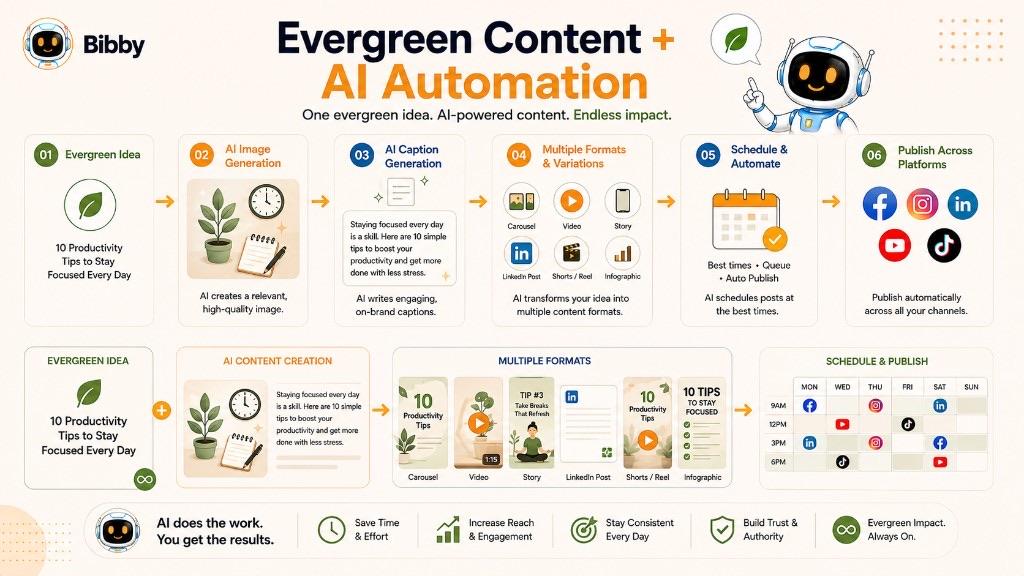
Each stage serves a different purpose.
1. Build an Evergreen Content Library
Start by collecting topics your audience is likely to need repeatedly.
For a social media marketing business, this could include:
- Caption-writing tips
- Content ideas
- Engagement strategies
- Social media checklists
- Content planning tips
- Common marketing mistakes
- Platform best practices
- Social media definitions
- How-to guides
- Frequently asked questions
This library becomes a reusable source of content ideas instead of relying on inspiration every time you need to publish.
2. Create or Generate the Content
An evergreen idea can be turned into different content formats depending on the platform and audience.
You might create:
- Images
- Carousels
- Videos
- Stories
- Educational graphics
- Short-form videos
- Text-based posts
AI can also assist with generating visuals or developing variations of an existing idea, while the marketer remains responsible for making sure the final content is accurate and useful.
3. Generate Captions Automatically
Writing captions for every post can become repetitive, particularly when the same underlying idea is being adapted for multiple platforms.
AI-powered tools can generate caption variations based on the topic, posting style, platform, brand voice, and content format.
This makes it easier to turn one evergreen idea into multiple posts without manually writing every caption from scratch.
4. Repurpose the Content
Automation can help turn a single evergreen concept into a broader content series.
For example:
Evergreen topic:
"How to Improve Instagram Engagement"
Could become:
- Instagram carousel
- Short video
- Facebook post
- LinkedIn post
- Story
- Educational graphic
- Several individual tips
The core idea remains consistent, while the format and presentation change.
5. Schedule Content Across Platforms
Once content is ready, scheduling tools can distribute it across multiple social networks.
For example, a business might schedule evergreen content for:
Instead of manually publishing each post at different times, an automated workflow can organize the publishing schedule in advance.
6. Use AI-Optimized Publishing Times
Timing can matter when distributing social media content.
An automation platform can use audience and publishing data to help determine suitable posting times rather than forcing marketers to manually guess when every post should go live.
For evergreen content, this is particularly useful because the objective is often consistent distribution over time rather than maximizing attention around one specific moment.
7. Manage the Workflow Through Chat
Modern social media automation can also move beyond traditional dashboards.
For example, Bibby's chat interface allows users to manage parts of their social media workflow conversationally.
A user could ask the system to:
- Create a brand kit
- Create a campaign
- Create posts
- Generate captions
- Regenerate captions
- Develop content variations
- Manage publishing workflows
This makes evergreen content management more conversational and reduces the need to manually move between multiple tools.
Evergreen Content + Automation: A Practical Example
Imagine a fitness business creates an evergreen topic:
"5 Simple Ways to Stay Consistent With Your Workouts."
Instead of publishing one post and moving on, the business can turn that idea into several pieces of content:
Original idea
→ Carousel
→ Short video
→ Story
→ LinkedIn/Facebook post
→ Caption variations
→ Scheduled posts
The business gets multiple opportunities to deliver the same underlying value without constantly searching for completely new topics.
Automation Does Not Mean "Post Everything Forever"
This is an important distinction.
Evergreen content should still be managed thoughtfully.
Avoid:
- Publishing identical posts too frequently
- Ignoring outdated information
- Automating low-quality content
- Posting without considering platform differences
- Treating automation as a replacement for strategy
The best approach is strategic automation: create useful content, adapt it appropriately, distribute it intelligently, monitor its performance, and refresh it when necessary.
Why Bibby Fits the Evergreen Content Workflow
Bibby brings several of these activities into one social media automation workflow. Users can upload an image or generate one with AI, choose a posting style, have AI generate captions, and schedule content across multiple social platforms.
Because Bibby also supports images, carousels, videos, and Stories, one evergreen idea can be developed into different content formats instead of remaining a single static post.
Its chat-based workflow adds another layer of convenience, allowing users to manage tasks such as creating campaigns, creating posts, building a brand kit, and regenerating captions through conversation.
In practical terms, the combination looks like this:
Create valuable evergreen content → Let AI help adapt it → Schedule strategically → Publish across platforms → Analyze → Refresh → Repurpose again
That turns evergreen content from a collection of old posts into a living content library that can continue supporting your social media strategy.
Evergreen Content vs. Repurposed Content vs. Recycled Content
Evergreen content, repurposed content, and recycled content are related concepts, but they are not the same thing. Understanding the difference helps businesses build a better content strategy and avoid treating every form of content reuse as "evergreen."
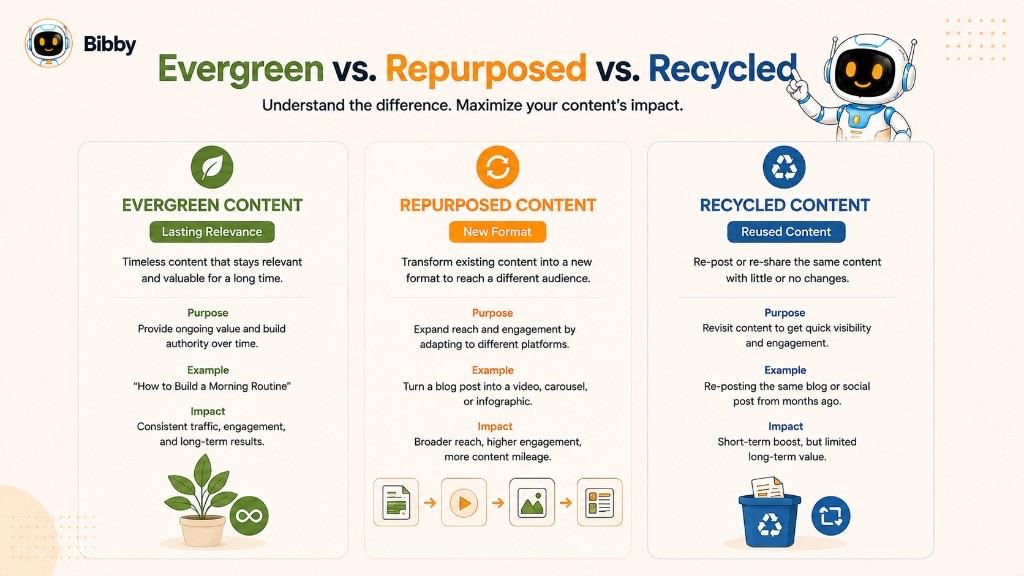
Evergreen Content
Evergreen content is defined by its relevance.
It remains useful because the topic addresses a recurring need, question, or problem.
Examples include:
- How to Write Better Social Media Captions
- How to Create a Content Calendar
- Social Media Marketing Best Practices
- Common Social Media Mistakes
- How to Improve Audience Engagement
The content may be updated over time, but its core subject remains valuable.
Repurposed Content
Repurposed content is defined by its format or presentation.
It takes an existing piece of content and transforms it into another format or adapts it for another channel.
For example:
Blog article
→ Instagram carousel
→ LinkedIn post
→ YouTube video
→ TikTok video
→ Email newsletter
Repurposing does not automatically make content evergreen. A time-sensitive article about a specific event can also be repurposed, even though it will eventually become outdated.
Recycled Content
Recycled content generally refers to reusing existing content again.
For example, a business might bring back a successful social media post after some time, particularly when the topic remains relevant.
However, recycling does not necessarily mean creating a new format. It can involve publishing an existing piece of content again, sometimes with minor changes.
The Difference at a Glance
| Concept | What Defines It? | Example |
|---|---|---|
| Evergreen content | Long-term relevance | "How to Improve Social Media Engagement" |
| Repurposed content | New format or presentation | Turning an article into a carousel |
| Recycled content | Reusing existing content | Republishing a successful post |
| Trending content | Current relevance | "Today's Viral TikTok Trend" |
Can Content Be All Three?
Yes.
Imagine a business creates an evergreen article called:
"10 Ways to Improve Your Social Media Content."
The article remains useful over time, so it is evergreen content.
The business then turns the article into an Instagram carousel and short video. It is now repurposed content.
Later, the business publishes an updated version of the successful carousel. That is recycled content.
So one piece of content can move through several stages:
Evergreen → Repurposed → Recycled → Refreshed → Repurposed Again
Why the Distinction Matters
Understanding these concepts helps marketers use content more strategically.
If something is evergreen, you can consider how it can continue delivering value.
If something is repurposable, you can explore new formats and platforms.
If something is worth recycling, you can consider bringing it back to your audience at an appropriate time.
Together, these approaches can help businesses get more value from the content they already create without relying entirely on producing something completely new every day.
How Often Should You Repost Evergreen Content?
There is no universal schedule for reposting evergreen content. The right frequency depends on the platform, audience, content type, posting volume, and how quickly the information can become outdated.
The goal is not to publish the same post repeatedly. The goal is to reuse valuable ideas strategically without creating audience fatigue.
Start With the Content's Lifespan
Consider how long the information remains useful.
A basic social media tip may remain relevant for months or years, while advice connected to a platform feature may need to be reviewed much sooner.
The more time-sensitive the information, the more carefully you should monitor it before reposting.
Consider the Platform
Different social platforms have different content consumption patterns.
A post that can reasonably be revisited after a longer interval on one platform may need a different approach on another.
For example, a business may adapt an evergreen idea into a new Instagram carousel, create a fresh TikTok video around it, or turn the same concept into a LinkedIn discussion rather than simply publishing the original post everywhere again.
Look at Previous Performance
Your analytics can help determine which evergreen content deserves another opportunity.
Pay attention to signals such as:
- Saves
- Shares
- Comments
- Clicks
- Reach
- Engagement
- Website traffic
- Conversions
If an evergreen post consistently generates useful engagement, consider creating a new version rather than abandoning the underlying topic.
Change the Presentation
One of the simplest ways to reuse evergreen content is to change how you present it.
For example, an original post titled:
"5 Ways to Improve Social Media Engagement"
could later become:
- "Are You Making These 5 Engagement Mistakes?"
- "5 Social Media Engagement Tips You Can Use Today"
- A carousel explaining each tip
- A short video covering the three most important tips
- A checklist for improving engagement
The underlying idea remains evergreen, but the audience receives a different experience.
Avoid Excessive Repetition
Posting the exact same content too frequently can make a social feed feel repetitive.
Avoid:
- Reposting identical content back-to-back
- Using the same caption repeatedly
- Reusing the same visual too often
- Ignoring audience feedback
- Recycling outdated information
Instead, create enough variation between uses of the same evergreen idea.
Refresh Before Reposting
Before bringing an older post back, check whether anything has changed.
Look for:
- Outdated statistics
- Changed platform features
- Old screenshots
- Broken links
- Outdated recommendations
- References to discontinued tools
- Changes in audience behavior
A quick review can prevent an evergreen post from becoming accidentally outdated.
Build a Content Rotation
Businesses with a large evergreen library can organize content into categories and rotate them over time.
For example:
Week 1: Educational tip
Week 2: How-to post
Week 3: FAQ
Week 4: Checklist
Week 5: Industry insight
Week 6: Refreshed version of a high-performing post
The exact schedule can vary. What matters is maintaining a healthy balance between new, repurposed, evergreen, promotional, and timely content.
Use Automation to Manage Reposting
Managing a large evergreen library manually can become time-consuming.
A social media automation platform such as Bibby can help organize content, generate captions, create different posts, and schedule content across multiple platforms. This makes it easier to build a consistent publishing workflow without manually managing every post.
However, automation should support your strategy rather than replace it. Always review content that may have become outdated and adjust the message for the platform and audience.
The Best Rule for Reposting Evergreen Content
Instead of asking:
"How many times can I repost this?"
Ask:
"Is this still useful to my audience, and can I present it in a better way?"
If the answer is yes, the underlying idea may still have plenty of life left.
Evergreen content is not about repeating the past indefinitely. It is about reusing valuable ideas intelligently while keeping them relevant, useful, and fresh for your audience.
Evergreen Content Ideas for Social Media
Coming up with social media ideas consistently can be one of the biggest challenges for businesses. Evergreen content makes this easier by focusing on topics that remain useful instead of relying entirely on trends, news, or seasonal events.
The best evergreen ideas usually come from questions your audience asks repeatedly, problems they regularly face, and information they can use regardless of when they discover it.
Here are some evergreen content ideas that work across different types of businesses.
1. How-To Posts
Teach your audience how to accomplish something useful.
Examples:
- How to Create a Social Media Content Calendar
- How to Write an Effective Social Media Caption
- How to Create a Productive Content Workflow
- How to Plan a Social Media Campaign
- How to Improve Your Online Presence
How-to content works well as carousels, short videos, articles, and step-by-step graphics.
2. Tips and Best Practices
Short, practical advice can make excellent evergreen social media content.
Examples:
- 5 Ways to Improve Your Social Media Engagement
- 7 Tips for Creating Better Visual Content
- 10 Social Media Scheduling Best Practices
- 5 Ways to Make Your Content More Shareable
- 7 Tips for Writing Better Captions
Individual tips can also be turned into separate posts, giving you multiple pieces of content from one topic.
3. Common Mistakes
People are often interested in knowing what they are doing wrong and how to fix it.
Examples:
- 7 Social Media Mistakes Small Businesses Make
- 5 Instagram Caption Mistakes to Avoid
- Common Content Planning Mistakes
- Social Media Scheduling Mistakes That Waste Time
- Mistakes That Can Hurt Audience Engagement
These topics remain relevant because businesses continuously encounter similar challenges.
4. Frequently Asked Questions
Your audience's questions are a ready-made source of evergreen content.
Turn common questions into individual posts, carousels, videos, or Stories.
For example:
Question: "How often should I post on social media?"
Content: Explain the factors that influence posting frequency and how businesses can develop a sustainable publishing schedule.
The same approach can be applied to questions about pricing, products, services, processes, tools, and industry concepts.
5. Checklists
Checklists are useful because they make complicated tasks easier to follow.
Examples:
- Social Media Post Checklist
- Content Planning Checklist
- Instagram Profile Checklist
- Social Media Campaign Checklist
- Before-Publishing Checklist
- Social Media Audit Checklist
They are also highly adaptable to carousel and infographic formats.
6. Educational Content
Explain concepts your audience needs to understand.
For a social media business, topics could include:
- What Is Social Media Automation?
- What Is Content Repurposing?
- What Is a Content Pillar?
- What Is a Social Media Campaign?
- What Is Engagement Rate?
- What Is Evergreen Content?
Educational posts can help audiences understand your industry while creating useful resources they can return to later.
7. Templates and Frameworks
Give your audience something they can use.
Examples include:
- Social Media Content Calendar Template
- Caption Writing Framework
- Social Media Strategy Framework
- Content Planning Template
- Campaign Planning Framework
- Social Media Audit Template
Templates can also become lead magnets, downloadable resources, or recurring social media content.
8. Industry Tips
Share knowledge that applies to your audience's ongoing work.
For example, a digital marketing company might publish:
- Social Media Tips for Small Businesses
- Content Marketing Tips for Startups
- Social Media Tips for E-commerce Brands
- Marketing Tips for Local Businesses
The more closely these tips address recurring problems, the stronger their evergreen potential.
9. Before-and-After Educational Posts
Show how a process, strategy, or piece of content can be improved.
For example:
Before: A vague social media caption
After: A clearer caption with a strong hook, useful information, and a relevant CTA
This format works particularly well for visual social media platforms.
10. Myth vs. Fact Posts
Correct common misconceptions within your industry.
Examples:
- Social Media Marketing Myths vs. Facts
- Instagram Engagement Myths
- Content Marketing Myths
- Social Media Automation Myths
- SEO Myths Businesses Should Know
These posts can generate curiosity while providing lasting educational value.
11. Resource Lists
Create collections of useful resources your audience can refer back to.
Examples:
- Social Media Content Resources
- Useful Tools for Content Creators
- Social Media Planning Resources
- Free Content Creation Resources
- Marketing Resources for Small Businesses
Make sure resources remain available and update the list when necessary.
12. Customer Problem-Solution Posts
Take a common customer problem and explain a practical solution.
For example:
Problem: "You spend hours managing multiple social media accounts."
Solution: Explain how centralized scheduling, content planning, automation, and reusable content can reduce repetitive work.
This type of content is especially valuable for businesses because it connects educational information with real customer needs.
13. Content Ideas From Your Own Expertise
Your existing knowledge can become an evergreen content library.
Consider turning:
- Customer questions
- Sales objections
- Support requests
- Internal processes
- Industry lessons
- Tutorials
- Frequently explained concepts
- Successful strategies
into educational content.
This approach often produces more useful content than simply chasing popular topics.
Build an Evergreen Content Bank
Rather than creating evergreen posts one at a time, maintain a bank of ideas organized by category.
For example:
Educational → 20 ideas
How-to → 20 ideas
FAQs → 20 ideas
Tips → 20 ideas
Mistakes → 20 ideas
Checklists → 20 ideas
This gives your team a substantial pool of content that can be developed, repurposed, refreshed, and scheduled over time.
With a social media automation workflow such as Bibby, these ideas can move from a simple content bank into actual campaigns and scheduled posts. You can create posts, generate captions, develop content with AI, and schedule different formats across your selected platforms.
The objective is simple: build an evergreen library large enough that your social media strategy never has to depend entirely on finding a new idea every day.
How to Know If Content Is Evergreen
Not every useful piece of content is evergreen. Some topics may perform well initially but quickly lose relevance because they depend on a specific event, trend, date, or temporary situation.
Before adding content to your evergreen library, ask whether it can continue providing value after the initial publishing period.
Here are some practical questions to help determine whether content is evergreen.
1. Does It Solve a Recurring Problem?
Strong evergreen content usually addresses a problem that people experience repeatedly.
For example:
"How to Create a Social Media Content Calendar"
solves an ongoing problem for marketers and businesses.
By comparison:
"How We Used Instagram's August 2026 Update"
is tied to a particular moment and is less likely to remain relevant indefinitely.
2. Will People Still Need This Information Months From Now?
Think beyond the publication date.
Ask:
"Would someone still find this useful six months or one year from now?"
If the answer is likely yes, the topic has evergreen potential.
This does not mean every detail will remain unchanged. The underlying problem or subject should simply continue to matter.
3. Is the Topic Independent of a Short-Lived Trend?
Evergreen content generally does not depend on a viral moment or temporary event.
Topics such as:
- How to Write Better Captions
- How to Plan Social Media Content
- How to Improve Engagement
- How to Create a Content Strategy
have stronger evergreen potential than content focused entirely on a short-lived trend.
4. Can the Content Be Updated Without Starting Over?
A strong evergreen resource can usually be refreshed without completely rebuilding it.
For example, a social media scheduling guide might need updated screenshots or platform information, but the basic principles of planning and scheduling content may remain the same.
This makes the content easier to maintain over time.
5. Does It Provide Practical Value?
Evergreen content should do more than describe a topic.
Ask whether readers can actually use the information.
Useful evergreen content often includes:
- Examples
- Steps
- Tips
- Frameworks
- Checklists
- Templates
- Solutions
- Practical recommendations
The more actionable the content, the more likely people are to save, share, revisit, or reference it later.
6. Can the Idea Be Repurposed?
Repurposability is not a requirement for evergreen content, but it is a useful signal.
A strong evergreen idea can often be transformed into different formats.
For example:
"How to Improve Social Media Engagement"
could become:
- A carousel
- A short video
- A Story
- A checklist
- A LinkedIn post
- An educational graphic
- Several individual tips
If the topic can support multiple useful variations, it may have strong long-term potential.
7. Does It Continue to Match Your Audience?
Even timeless topics can become less useful if your audience changes.
Review whether the content still matches:
- Your target audience
- Their problems
- Their goals
- Their level of knowledge
- Their expectations
- Your products or services
Evergreen content should remain relevant to both the topic and the people you are trying to reach.
A Simple Evergreen Content Test
Use these questions before adding a topic to your evergreen library:
- Recurring need: Will people continue to need this?
- Long-term relevance: Will the topic remain useful?
- Practical value: Does it solve a real problem?
- Low dependence on trends: Is it mostly independent of current events?
- Update potential: Can outdated details be refreshed?
- Repurposing potential: Can the idea become multiple useful formats?
If most answers are yes, the content is likely a strong evergreen candidate.
Remember: Evergreen Does Not Mean Permanent
A common misconception is that evergreen content never needs to change.
In reality, even evergreen content can become outdated.
Social media platforms evolve. Tools change. Algorithms are updated. Statistics become old. Best practices improve.
The topic can remain evergreen while the information inside it needs to be refreshed.
That distinction is important.
For example, "How to Create Better Social Media Content" can remain an evergreen topic for years. However, specific platform recommendations, examples, screenshots, and statistics within the content may need periodic updates.
The best evergreen content therefore has two qualities:
Long-lasting subject matter + accurate, maintained information
That combination allows content to keep providing value without becoming a forgotten page or outdated social media post.
Common Evergreen Content Mistakes
Evergreen content can deliver value for a long time, but simply choosing a timeless topic does not guarantee success. Poorly researched information, weak execution, excessive repetition, and outdated details can reduce the value of even a strong evergreen idea.
Here are some common mistakes to avoid.
1. Assuming Evergreen Means "Never Update It"
One of the biggest misconceptions is that evergreen content can be published once and forgotten.
A topic can remain relevant while the information surrounding it changes.
For example, social media marketing tips may remain evergreen, but platform features, algorithms, statistics, and recommended practices can change.
Review important evergreen content periodically and update anything that is no longer accurate.
2. Choosing a Timeless Topic but Providing Generic Information
A topic can be evergreen without being useful.
For example:
"Post Consistently on Social Media."
This is technically relevant, but it does not give the reader much to work with.
A stronger approach would explain:
- How to build a realistic posting schedule
- How to choose content categories
- How to maintain consistency
- How to plan content in advance
- How automation can reduce repetitive work
Evergreen content should be specific, practical, and actionable.
3. Writing Only for Search Engines
SEO can help evergreen content get discovered, but keyword placement should not become the main purpose of the content.
Avoid:
- Keyword stuffing
- Repetitive headings
- Awkward keyword usage
- Thin explanations
- Writing purely to reach a word count
Instead, create content that genuinely answers the user's question and naturally covers related topics.
4. Confusing Evergreen Content With Trending Content
A viral topic can generate significant engagement without being evergreen.
For example:
"How to Use This New Instagram Feature"
may perform well when the feature launches, but its usefulness can decline if Instagram changes or removes the feature.
Before adding content to an evergreen library, consider whether its value depends on something happening right now.
5. Reposting the Exact Same Content Too Often
Evergreen content can be reused, but that does not mean the same post should appear repeatedly without modification.
Excessive repetition can make a social media feed feel stale.
Instead, change:
- The hook
- Visual
- Caption
- Format
- Example
- CTA
- Angle
The idea can remain evergreen while the execution evolves.
6. Ignoring Platform Differences
An evergreen idea may work across multiple social platforms, but that does not mean the exact same post should be copied everywhere.
Instagram may favor a visual carousel, LinkedIn may work better with a professional insight, and TikTok may benefit from a short video.
Adapt the presentation while keeping the underlying idea consistent.
7. Creating Content That Is Too Broad
Broad topics can be difficult to make genuinely useful.
For example:
"Social Media Marketing Tips"
covers an enormous subject.
A more focused topic such as:
"How to Create a Weekly Social Media Content Plan for a Small Business"
gives you a clearer audience, problem, and outcome.
Specific evergreen content often provides more practical value than vague general advice.
8. Forgetting to Monitor Performance
Evergreen content should not disappear into an archive after publication.
Review how it performs.
Depending on the content type, useful metrics may include:
- Organic traffic
- Engagement
- Saves
- Shares
- Clicks
- Comments
- Watch time
- Leads
- Conversions
Performance data can reveal which evergreen topics deserve additional versions or repurposing.
9. Automating Without Reviewing
Automation can make evergreen content distribution easier, but fully hands-off publishing can create problems if information changes.
Before automatically distributing older content, check whether:
- The information is still accurate
- Links still work
- Platform recommendations remain valid
- Images are still appropriate
- The CTA still makes sense
- The content still matches your brand
Automation should remove repetitive work, not remove quality control.
10. Focusing Only on Evergreen Content
Evergreen content is powerful, but it should not be the entire content strategy.
A healthy social media mix can include:
Evergreen content → Long-term value
Trending content → Timely attention
Promotional content → Products and offers
Community content → Conversations and relationships
Campaign content → Specific marketing goals
Using different content types gives your brand both stability and flexibility.
11. Forgetting the Audience
An evergreen topic is only valuable if it is relevant to the people you want to reach.
Before creating content, ask:
Who is this for?
What problem does it solve?
Why would they care?
What can they do with this information?
These questions help turn an ordinary timeless topic into genuinely useful evergreen content.
The Biggest Lesson
The goal of evergreen content is not simply to make content last longer.
The goal is to create lasting usefulness.
A successful evergreen piece should remain relevant, provide genuine value, be easy to refresh when necessary, and offer opportunities for thoughtful repurposing and distribution.
When those elements come together, evergreen content becomes more than an old post. It becomes a reusable asset that can continue supporting your content and social media strategy over time.
Key Takeaway
Evergreen content is content that stays useful and relevant long after its original publication. It focuses on recurring audience needs rather than short-lived trends, making it a valuable part of a long-term content strategy.
For social media, evergreen content can include tutorials, FAQs, tips, checklists, educational posts, how-to guides, and practical advice. A single evergreen idea can also be transformed into images, carousels, videos, Stories, and platform-specific posts, giving businesses more ways to deliver the same underlying value.
The most effective evergreen content is:
- Useful: It solves a real audience problem.
- Relevant: People can benefit from it over an extended period.
- Actionable: Readers or viewers can do something with the information.
- Adaptable: The idea can be repurposed into different formats.
- Maintainable: Outdated details can be refreshed when necessary.
When combined with social media automation, evergreen content becomes easier to organize, repurpose, caption, schedule, and distribute across multiple platforms.
With Bibby, businesses can upload an image or generate one with AI, choose a posting style, generate captions, create different types of social content, and schedule posts across platforms such as Facebook, Instagram, LinkedIn, YouTube, and TikTok. Bibby's chat interface also lets users manage tasks such as creating campaigns, creating posts, building a brand kit, and regenerating captions through conversation.
The bigger idea is simple:
Create content that remains valuable, then build a system that keeps distributing that value.
Evergreen content does not mean publishing the same post forever. It means creating ideas that continue to matter, then refreshing, repurposing, and distributing them intelligently as your audience and platforms evolve.
Continue learning with related dictionary entries on content calendars, content pillars, social media strategy, captions, carousel posts, engagement, and social media scheduling—or browse the social media dictionary. Then start a free Bibby trial to create, caption, and schedule evergreen posts across your channels.