

A content pillar is a broad topic or theme that a brand consistently creates content around as part of its social media strategy.
If you want to build a consistent social media presence without running out of ideas, content pillars give your strategy structure and direction. They help you organize your content, create more relevant posts, and maintain a balanced mix of topics across multiple platforms.
In this guide, we will discuss:
- What content pillars are and why they matter
- Practical content pillar examples for different businesses
- How to create content pillars for your social media strategy
Next, let's look at exactly what a content pillar means and how it works.
What Is a Content Pillar?

A content pillar is a broad, recurring topic or theme that a brand uses to organize and guide its content strategy. Instead of creating random posts whenever you need something to publish, content pillars give you a defined set of topics to consistently create content around.
For example, a social media management company might use social media tips, content marketing, productivity, customer success, and product education as its content pillars. Each pillar can then generate dozens or even hundreds of individual post ideas.
Think of content pillars as the main categories that support your entire content strategy. They help you decide what to talk about, while individual posts determine what you say about each topic.
Content Pillar Meaning in Simple Terms
In simple terms, a content pillar is a main subject your brand regularly talks about.
For example, imagine you run a fitness brand. Your content pillars could be:
- Workout tips
- Nutrition
- Fitness motivation
- Recovery
- Healthy lifestyle
You can then create different posts within each pillar. A "Workout Tips" pillar might include posts about home workouts, strength-training techniques, warm-up routines, or common exercise mistakes.
This approach makes content creation more predictable while still giving you plenty of room to create different types of content.
Content Pillar vs. Individual Post
A content pillar is not the same thing as a post.
A content pillar is a broad category, while a content post is a specific piece of content created within that category.
For example:
Content pillar: Social Media Marketing
Topic: Instagram content ideas
Post: "10 Instagram post ideas for small businesses"
One content pillar can therefore produce many different topics, formats, and posts. This is what makes content pillars particularly useful for maintaining a consistent social media publishing strategy.
Why Are Content Pillars Important for Social Media?
Content pillars give your social media strategy a clear structure. Instead of deciding what to post from scratch every day, you have a set of topics that guide your content creation.
This makes it easier to stay consistent, create useful content, and maintain variety across your social media channels.
Make Content Planning Easier
Without content pillars, your content calendar can quickly become a collection of disconnected ideas. With a defined set of pillars, you can quickly identify which topics to create content about and plan posts weeks or months in advance.
For example, a marketing agency with five content pillars can rotate between those topics when building its weekly content calendar.
Keep Your Content Consistent
Consistency is easier when you know what your brand should regularly talk about. Content pillars help reinforce the topics your audience should associate with your brand over time.
This doesn't mean repeating the same post. Instead, you explore different angles within the same core topics.
Avoid Repetitive Content
Posting about the same subject in the same format can make your social media feed feel repetitive. Content pillars allow you to build variety into your strategy by giving you multiple categories to rotate between.
You can also explore each pillar through different formats, including images, carousels, videos, stories, and text-based posts.
Build Authority Around Important Topics
Consistently publishing useful content around a particular subject can help establish your brand as a knowledgeable source in that area.
For example, a personal finance creator might consistently publish content about budgeting, investing, saving money, and financial planning. Over time, these recurring topics help establish a recognizable area of expertise.
Generate More Content Ideas
A content pillar can act as a starting point whenever you need a new post idea.
Instead of asking, "What should I post today?", you can ask:
"What can I teach, show, discuss, or share about this content pillar?"
One broad pillar can generate dozens of specific ideas, making it much easier to maintain an active publishing schedule.
Improve Social Media Automation
Content pillars are also useful when you want to automate your social media workflow. They provide structure for generating different posts while keeping the overall content strategy focused.
For example, an AI-powered social media tool can use your chosen pillars to help generate post ideas, captions, visuals, and variations across different platforms. This allows automation to support your strategy rather than simply producing content at random.
Ultimately, content pillars turn social media from a daily guessing game into a repeatable content system.
Content Pillar Examples
The best content pillars depend on your business, audience, expertise, and goals. There is no universal set of pillars that every brand should use, but the examples below show how different businesses can organize their social media content.
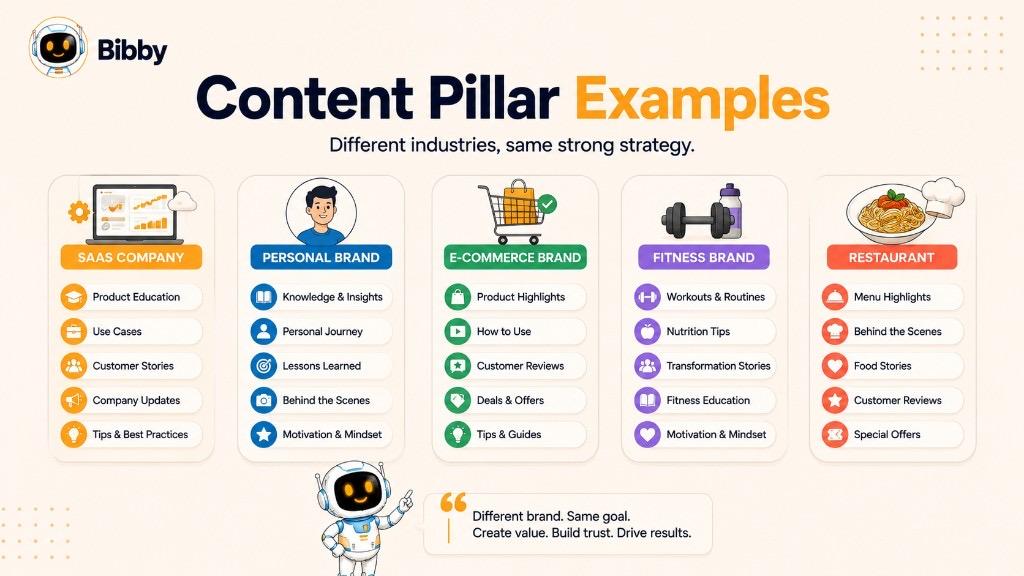
Example: SaaS Company
A software company could use these content pillars:
- Product education — Features, tutorials, and use cases
- Industry insights — Trends, statistics, and industry news
- Customer success — Testimonials, case studies, and customer stories
- Productivity — Tips and strategies related to the problem the product solves
- Company culture — Team updates, behind-the-scenes content, and company news
For example, a project management software company could create a post explaining how to organize a project, a carousel showing a useful workflow, or a customer story demonstrating how a team improved its productivity.
Example: Personal Brand
A creator, consultant, or professional might build their content strategy around:
- Expertise — Advice and educational content
- Personal experiences — Lessons learned and stories
- Opinions — Perspectives on industry topics
- Behind the scenes — Work routines and processes
- Resources — Tools, books, frameworks, or other recommendations
This combination allows a personal brand to demonstrate expertise while also creating more personal and relatable content.
Example: E-commerce Brand
An online store could use pillars such as:
- Product showcases — Features, benefits, and demonstrations
- Customer stories — Reviews, testimonials, and user-generated content
- Education — Tips related to the products or category
- Lifestyle content — Ways the products fit into customers' lives
- Promotions — Offers, launches, and seasonal campaigns
For example, a skincare brand could combine product demonstrations with skincare education, customer results, ingredient explanations, and seasonal routines.
Example: Fitness Brand
A fitness business might choose:
- Workouts — Exercises, routines, and training plans
- Nutrition — Food, meal planning, and healthy eating
- Motivation — Mindset and motivational content
- Recovery — Rest, mobility, and recovery techniques
- Transformations — Progress stories and customer results
Each pillar can support multiple content formats, from short videos and carousels to educational posts and customer stories.
Example: Restaurant
A restaurant could organize its social media around:
- Food and menu — Dishes, ingredients, and specials
- Behind the scenes — Kitchen and staff content
- Customer experiences — Reviews and customer photos
- Promotions — Deals, events, and seasonal offers
- Community — Local events, partnerships, and stories
The important takeaway is that content pillars should reflect what your audience cares about and what your brand wants to be known for. They are a framework for generating content, not a rigid list of categories you have to follow.
What Are Social Media Content Pillars?
Social media content pillars are the core topics or themes a brand consistently covers across its social media channels. They help create a balanced content strategy by giving you a clear framework for deciding what to publish.

A simple social media content pillar framework might look like this:
| Content Pillar | Example Content |
|---|---|
| Education | Tips, tutorials, guides, and how-to posts |
| Entertainment | Memes, trends, stories, and relatable content |
| Product | Features, demonstrations, and use cases |
| Social Proof | Reviews, testimonials, and case studies |
| Brand | Behind-the-scenes content, team stories, and company updates |
These categories are only examples. Your own pillars should be based on your audience, industry, brand, and social media goals.
Content Pillars Can Work Across Multiple Platforms
A content pillar doesn't have to belong to a single social network. The same core topic can be adapted into different formats for different platforms.
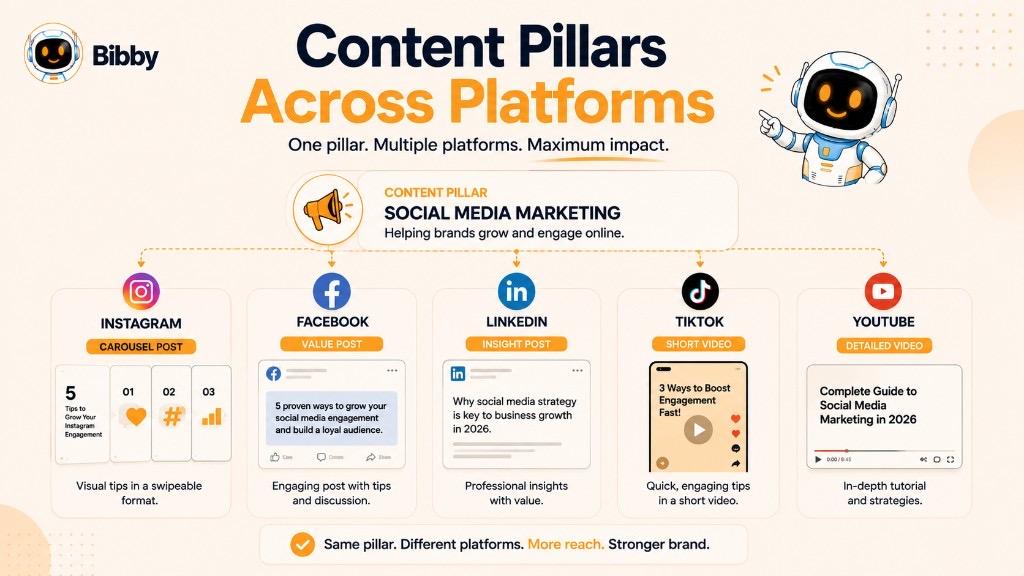
For example, imagine Product Education is one of your content pillars:
- Instagram: A carousel explaining a product feature
- Facebook: An image with an educational caption
- LinkedIn: A detailed post explaining the business use case
- TikTok: A short product demonstration
- YouTube: A longer tutorial
The underlying topic stays consistent, while the format and presentation change to suit each platform.
Content Pillars Create Variety Without Losing Focus
A good social media strategy needs both consistency and variety. Content pillars provide consistency by keeping your brand focused on a defined set of topics, while different formats, angles, and ideas prevent your feed from becoming repetitive.
For example, a brand with five content pillars could rotate between educational, promotional, entertaining, and community-focused content throughout the week.
This makes content pillars particularly useful when managing multiple social media platforms or publishing frequently. Instead of creating completely different strategies for every post, you have a structured foundation that can be adapted and reused.
How Many Content Pillars Should You Have?
Most brands can start with 3–5 content pillars. This gives you enough variety to keep your social media content interesting without making your strategy so broad that your brand loses focus.
There is no fixed number that works for every business. The right number depends on your audience, goals, industry, resources, and how frequently you publish.
Start With 3–5 Core Pillars
For a small business or personal brand, three to five pillars are usually enough to create a diverse content strategy.
For example, a social media marketing brand might choose:
- Social media education
- Content creation
- Social media automation
- Customer success
- Behind the scenes
Each pillar can then generate many individual content ideas.
Avoid Using Too Few Pillars
If you only have one or two pillars, your content can become repetitive. Your audience may start seeing the same topics and messages over and over again.
Adding another few relevant pillars gives you more opportunities to explore different subjects while staying aligned with your overall strategy.
Avoid Using Too Many Pillars
More isn't always better. If you have ten or fifteen unrelated pillars, it can become difficult to maintain consistency or establish what your brand is actually known for.
Every additional pillar also requires enough ideas, expertise, and resources to create quality content around it.
Consider These Factors When Choosing Your Number
Ask yourself:
- How often do you publish? More frequent publishing may support more pillars.
- Who is your audience? Different audience interests may require different topics.
- What are your goals? Awareness, engagement, leads, and sales may require different content categories.
- How much content can you create? Choose a number you can realistically maintain.
- Which platforms do you use? Multiple platforms may create more opportunities to repurpose each pillar.
The goal isn't to find the perfect number of content pillars. The goal is to create a focused set of topics that gives you enough variety to consistently produce useful content.
How to Create Content Pillars
Creating content pillars starts with understanding what your audience needs and what your brand wants to be known for. The goal is to find a small number of broad topics that can consistently generate useful and relevant content.
Follow these steps to create your own content pillars.
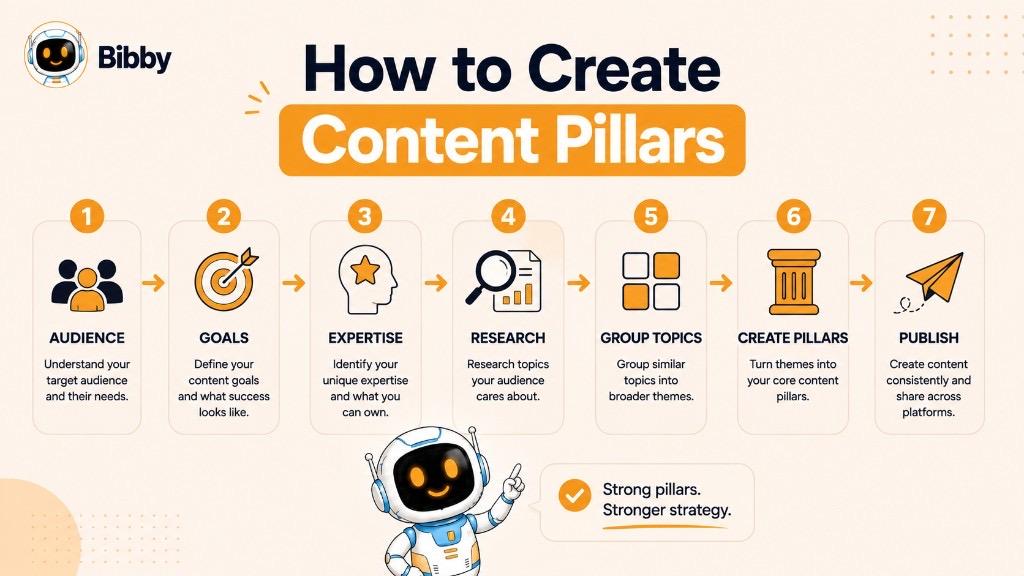
Step 1: Define Your Target Audience
Start by identifying who you want to reach.
Consider their:
- Problems and challenges
- Goals and interests
- Questions and concerns
- Buying motivations
- Preferred types of content
Your content pillars should be built around topics that are genuinely useful to this audience.
Step 2: Define Your Business Goals
Your content should support a purpose beyond simply filling your social media calendar.
Decide what you want your content to accomplish. For example, you might want to:
- Increase brand awareness
- Build trust
- Generate leads
- Drive sales
- Establish industry authority
- Educate existing customers
- Increase engagement
Your goals can help determine which topics deserve to become recurring pillars.
Step 3: Identify Your Areas of Expertise
Think about the subjects your brand can credibly talk about.
Ask:
What does my business know well?
What problems can we help our audience solve?
What topics naturally connect to our products or services?
The strongest content pillars usually sit at the intersection of what your audience cares about and what your brand can provide expertise on.
Step 4: Research What Your Audience Cares About
Look for topics your audience is already interested in.
You can use:
- Frequently asked questions
- Customer conversations
- Search queries
- Social media discussions
- Comments and reviews
- Competitor content
- Industry trends
- Common problems and objections
This research helps ensure your pillars are based on real audience interests rather than assumptions.
Step 5: Group Related Topics Together
You will probably discover many individual content ideas during your research. Don't turn every idea into its own content pillar.
Instead, group related ideas into broader categories.
For example:
Individual ideas:
- How to write Instagram captions
- How to find hashtags
- How often to post on Instagram
- How to improve Instagram engagement
These could all fit under one broader pillar:
Content Pillar: Instagram Marketing
This makes your strategy easier to manage while giving you plenty of room for individual posts.
Step 6: Turn Those Groups Into Content Pillars
Give each group a clear, broad name that describes the topic.
Good content pillars should be:
- Relevant to your audience
- Connected to your business
- Broad enough to generate multiple ideas
- Specific enough to keep your content focused
- Sustainable enough to use repeatedly
Avoid making pillars so broad that they could mean almost anything.
For example, "Marketing" may be too broad for a small business, while "Instagram Content Strategy" could provide a more useful direction.
Step 7: Assign Content Formats to Each Pillar
Once you've established your pillars, think about how each one can be turned into different types of content.
A single pillar could produce:
- Images
- Carousels
- Videos
- Stories
- Tutorials
- Text posts
- Case studies
- Lists
- Interviews
For example, a Product Education pillar could become a feature carousel, a product demonstration video, a tutorial, or a frequently asked questions post.
Step 8: Build a Repeatable Publishing System
Finally, turn your pillars into a repeatable content workflow.
Instead of asking what to post every morning, you can plan content around your pillars and rotate between them throughout your publishing schedule.
For example:
Monday: Educational content
Tuesday: Product content
Wednesday: Customer story
Thursday: Educational content
Friday: Behind-the-scenes content
The exact schedule isn't important. What matters is having a system that makes your content strategy consistent, organized, and easier to scale.
How to Build a Content Pillar Strategy
Creating content pillars is only the first step. A content pillar strategy defines how you will use those pillars to consistently create, organize, and publish content.
A strong strategy connects each pillar to a specific purpose and gives you a repeatable way to turn broad topics into individual posts.
Assign a Purpose to Each Pillar
Each content pillar should have a reason for being part of your strategy.
For example:
- Education → Build authority and provide value
- Product → Demonstrate features and drive conversions
- Social proof → Build trust and credibility
- Entertainment → Increase reach and engagement
- Brand content → Build familiarity and connection
This prevents your content from becoming a collection of unrelated posts. Each pillar contributes to a larger business or marketing objective.
Decide How Frequently Each Pillar Appears
You don't necessarily need to publish every pillar equally.
A brand focused on building authority might publish educational content frequently, while a product-focused brand may give more space to product education and customer success.
The right balance depends on your goals and audience. Avoid treating content ratios as universal rules; instead, monitor what works and adjust your mix over time.
Generate Multiple Ideas From Each Pillar
A good content pillar should give you many opportunities to create individual posts.
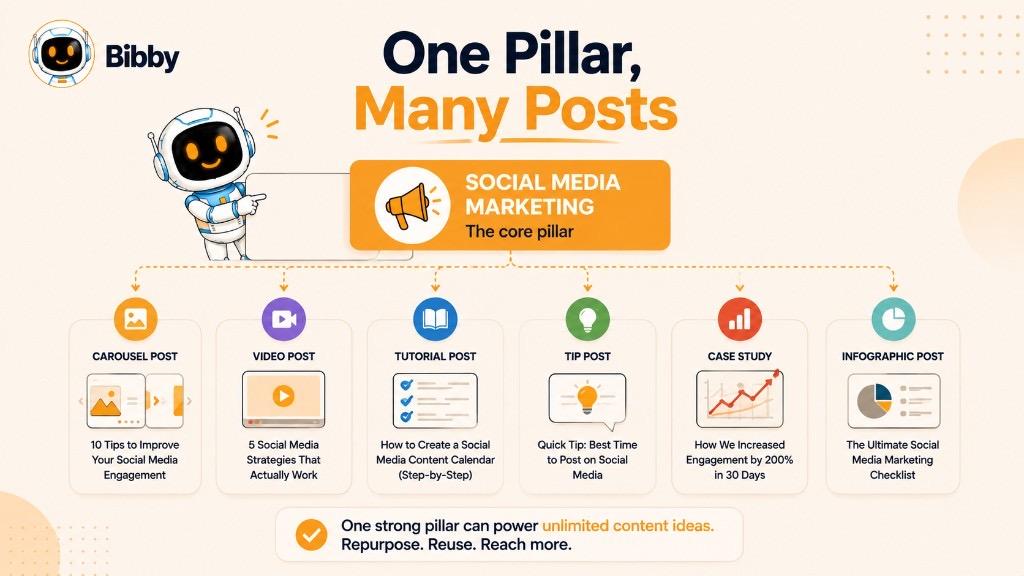
For example, consider the pillar Social Media Tips. It could produce content about:
- Creating better captions
- Increasing engagement
- Planning a content calendar
- Choosing content formats
- Repurposing existing content
- Improving posting consistency
- Measuring social media performance
You can also approach the same subject from different angles, such as how-to guides, mistakes to avoid, tips, examples, statistics, opinions, and case studies.
This is how a small number of content pillars can support a large content library.
Adapt Your Pillars Across Platforms
Your content pillars can remain consistent even when your publishing format changes.
For example, a Social Media Education pillar could become:
- An Instagram carousel
- A Facebook post
- A LinkedIn thought-leadership post
- A TikTok video
- A YouTube tutorial
You don't need to create an entirely separate content strategy for every platform. Instead, start with your core topic and adapt the idea to the audience, format, and strengths of each platform.
Review and Improve Your Content Pillars
Content pillars shouldn't be permanent. Review your content performance periodically to understand which topics generate meaningful results.
Look at metrics such as:
- Engagement
- Reach
- Saves and shares
- Website traffic
- Leads
- Conversions
- Audience feedback
If one pillar consistently performs well, you may want to explore more topics within it. If another produces little value, consider changing, combining, or replacing it.
A good content pillar strategy is therefore structured but flexible: it gives you enough direction to stay consistent while leaving room to respond to your audience and improve over time.
Content Pillars vs. Content Buckets vs. Content Themes
The terms content pillars, content buckets, and content themes are often used interchangeably in social media marketing. However, they can describe slightly different levels of organization depending on the strategy.
Understanding the distinction can make your content strategy easier to structure.
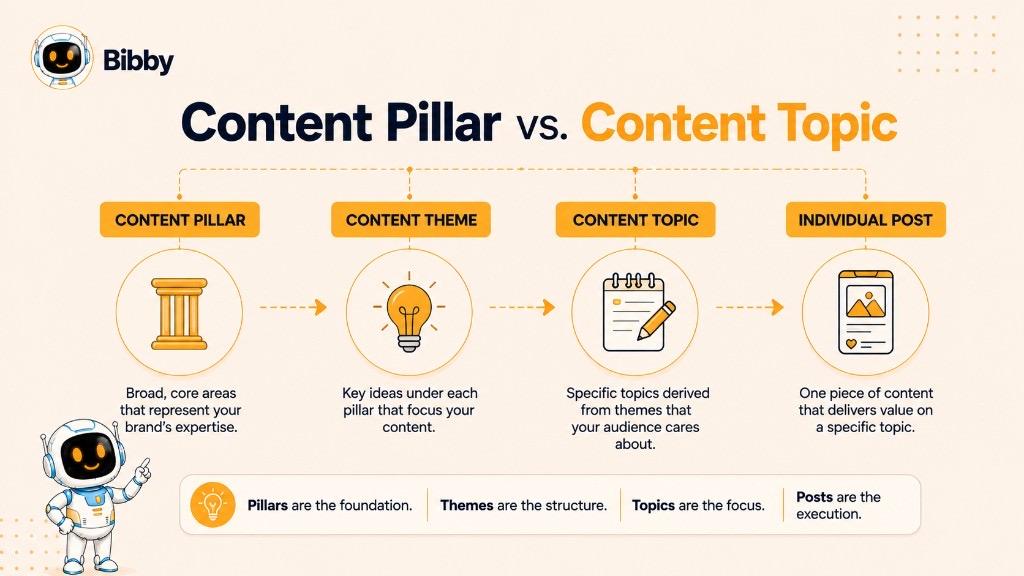
Content Pillars
Content pillars are the main topics or categories your brand consistently creates content around.
For example, a social media automation company might have:
- Social media education
- Content creation
- Automation
- Customer success
- Product education
These pillars form the foundation of the overall content strategy.
Content Buckets
Content buckets are often used as another name for content pillars. Many marketers use the two terms to describe the same concept: broad categories used to organize recurring content.
For example, a brand might say it has five "content buckets" instead of five "content pillars," while using exactly the same framework.
There is no universal industry definition that requires the terms to be different.
Content Themes
A content theme is a recurring angle, idea, or subject that can be explored within a broader pillar.
For example:
Content Pillar: Social Media Marketing
Content Theme: Instagram growth
Content Topic: How to increase Instagram engagement
Content Post: "7 Instagram Engagement Strategies to Try This Week"
Themes can therefore help you develop more specific ideas within a larger content category.
Content Topics
A content topic is the specific subject covered by an individual piece of content.
Using the same example:
Pillar: Social Media Marketing
↓
Theme: Instagram growth
↓
Topic: Improving Instagram engagement
↓
Post: A carousel explaining seven engagement strategies
This hierarchy isn't a strict industry standard, but it provides a useful way to understand how broad content pillars can become specific, publishable content ideas.
The important thing is not which terminology you use. What matters is having a clear system for moving from broad strategic topics to specific content ideas.
Content Pillars and AI Social Media Automation
Content pillars become even more useful when you combine them with AI-powered social media automation. They give AI a clear strategic direction, so it can help create content that stays aligned with your brand instead of generating unrelated posts.
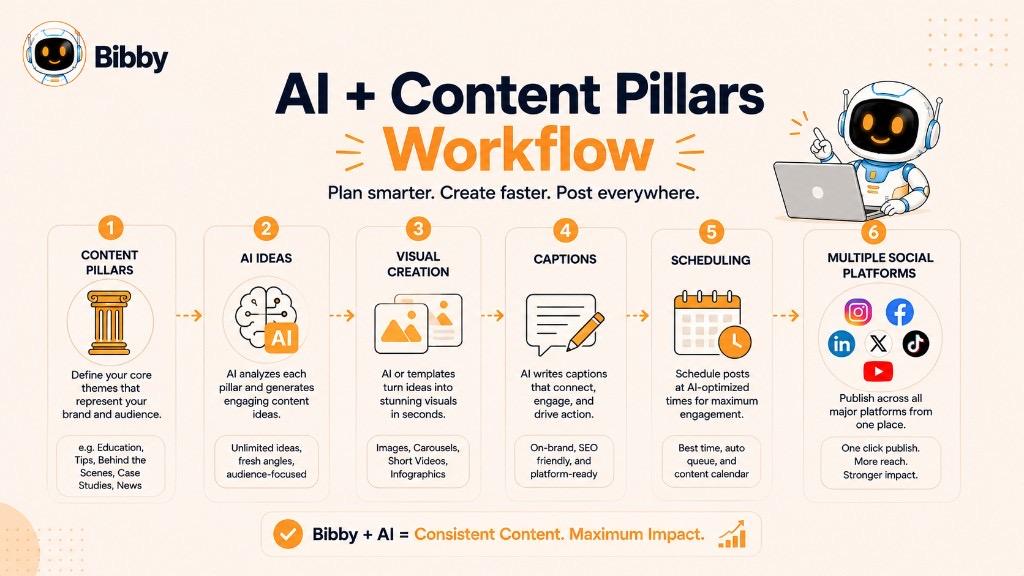
Instead of asking an AI tool to simply "create a social media post," you can give it a content pillar and use that topic as the foundation for the content.
How AI Can Help With Content Pillars
AI can help turn your content pillars into a repeatable content creation workflow.
For example, AI can help you:
- Generate new ideas within each content pillar
- Turn one idea into multiple post concepts
- Write and regenerate captions
- Adapt content for different social media platforms
- Create variations of existing content
- Suggest different content formats
- Organize content around campaigns
- Maintain variety across your publishing schedule
This makes it easier to consistently publish without manually brainstorming every post from scratch.
How Bibby Can Turn Content Pillars Into Published Content
With Bibby, content pillars can become part of a larger automated social media workflow.
You can upload an image or generate one with AI, choose your preferred posting style, and let Bibby generate captions for your content. You can then schedule your media across supported platforms at AI-optimized times.
Content pillars can provide the strategic foundation behind that workflow. For example, if Social Media Education, Product Education, and Customer Success are your three pillars, you can use them to guide the ideas and campaigns you create rather than publishing disconnected content.
Bibby's chat interface can also make this workflow conversational. You can use the chat to manage tasks such as creating a brand kit, creating campaigns and posts, regenerating captions, and managing other parts of your social media workflow.
The key distinction is that automation handles the execution, while content pillars provide the strategy. When the two work together, you can create and publish content more efficiently without losing sight of what your brand wants to communicate.
Content Pillar Example: A Complete Social Media Strategy
Seeing content pillars in action makes the concept easier to understand. Let's look at how a fictional SaaS company could use content pillars to build a complete social media strategy.
Imagine a company that sells project management software to small and growing teams.
Its social media strategy could be built around five content pillars:
1. Productivity Education
This pillar helps the audience work more efficiently.
Possible posts include:
- "5 ways to reduce unnecessary meetings"
- "How to prioritize your tasks each morning"
- "A simple weekly planning framework"
- "7 productivity mistakes slowing your team down"
2. Project Management Tips
This pillar focuses specifically on helping teams manage projects more effectively.
Possible posts include:
- How to create a project timeline
- Common project management mistakes
- How to manage project deadlines
- Tips for improving team collaboration
- How to handle changing project requirements
3. Product Education
This pillar connects the company's expertise with its product.
Possible posts include:
- Feature tutorials
- Product walkthroughs
- New feature announcements
- Tips for using specific features
- Examples of different workflows
The goal isn't to make every post a sales pitch. Instead, the content should demonstrate how the product can solve real problems.
4. Customer Success
This pillar provides social proof and shows how real customers use the product.
Possible posts include:
- Customer testimonials
- Case studies
- Before-and-after stories
- Customer workflows
- Results achieved using the product
For example, a post could explain how a growing team changed its project management process and reduced missed deadlines.
5. Company Culture
This pillar makes the brand more personal and relatable.
Possible posts include:
- Behind-the-scenes content
- Team introductions
- Company milestones
- Employee stories
- Events and celebrations
Turning the Pillars Into a Publishing Schedule
The company could then rotate these pillars throughout its content calendar:
| Day | Content Pillar | Example |
|---|---|---|
| Monday | Productivity Education | Weekly planning tips |
| Tuesday | Product Education | Feature tutorial |
| Wednesday | Project Management | Project planning advice |
| Thursday | Customer Success | Customer story |
| Friday | Company Culture | Behind-the-scenes post |
The company doesn't have to follow this exact schedule. The important part is that every post has a clear strategic purpose.
This example also shows why content pillars are useful: five broad pillars can generate hundreds of individual content ideas. Once the pillars are established, the brand can continuously create new posts while keeping its social media strategy focused and recognizable.
Common Content Pillar Mistakes
Content pillars can make social media planning much easier, but they only work when they're chosen and used strategically. Avoiding a few common mistakes can help you build a more focused and sustainable content strategy.
Mistake 1: Choosing Too Many Pillars
Trying to cover every possible topic can make your content strategy unfocused.
Start with a small number of relevant pillars and expand only when you have a clear reason to do so.
Mistake 2: Making Your Pillars Too Narrow
A pillar should be broad enough to generate multiple content ideas.
For example, "Instagram carousel design tips" may be too narrow to serve as a long-term pillar for many businesses. A broader pillar such as "Social Media Content" gives you more room to explore related topics.
Mistake 3: Choosing Topics Your Audience Doesn't Care About
A topic might be relevant to your business but still fail to interest your audience.
Your content pillars should sit at the intersection of your expertise, your audience's interests, and your business goals.
Mistake 4: Making Every Post Promotional
If every pillar ultimately leads to "buy our product," your social media feed can quickly become repetitive and overly promotional.
Balance promotional content with educational, entertaining, useful, and community-focused content.
Mistake 5: Never Reviewing Performance
Your original content pillars don't have to remain unchanged forever.
Review how different pillars perform and look for patterns in engagement, reach, traffic, leads, conversions, and audience feedback. Use those insights to refine your strategy.
Mistake 6: Using the Same Format for Every Pillar
Even strong topics can become repetitive when presented in exactly the same way.
Experiment with different formats such as images, carousels, videos, stories, tutorials, text posts, and customer stories.
Mistake 7: Confusing Pillars With Individual Topics
A content pillar is a broad category, not a single post idea.
For example:
Pillar: Social Media Marketing
Topic: Instagram engagement
Post: "7 Ways to Increase Instagram Engagement"
Keeping these levels separate makes it much easier to generate a large variety of content from a relatively small number of pillars.
Ultimately, the best content pillars aren't the ones that simply give you more things to post about. They're the ones that help you consistently create useful content for the right audience while supporting your broader business goals.
Key Takeaways
- A content pillar is a broad, recurring topic that organizes your social media strategy into a small number of consistent categories.
- Most brands can start with 3–5 content pillars—enough variety without losing focus.
- Content pillars make content planning easier, improve consistency, generate more ideas, and support automation.
- The same pillar can be adapted across multiple platforms using different formats such as images, carousels, videos, and Stories.
- A strong content pillar strategy assigns a purpose to each pillar, balances publishing frequency, and adapts topics across Instagram, Facebook, LinkedIn, TikTok, and YouTube.
- Content pillars, content buckets, and content themes describe different levels of organization—from broad categories to specific post ideas.
- AI and tools like Bibby can turn pillars into published content—generating visuals, writing captions, and scheduling at AI-optimized times—while pillars provide the strategic foundation.
- Review engagement, reach, and business results regularly to refine pillars over time.