
Unlike content that only reaches people through paid promotion or an existing audience, viral posts can travel far beyond the original creator. One person shares; some of their network shares again. In a short time the piece can reach thousands or millions of people.
There is no guaranteed formula. Viral posts often make people stop, react, and pass them along: funny, surprising, emotional, useful, relatable, timely, or already part of a conversation people care about.
For marketers, the job is not only chasing views. It is understanding why people share and how strong ideas get created, published, and distributed. Bibby can generate visuals and captions, organize campaigns in chat, and schedule images, carousels, videos, and Stories on Facebook, Instagram, LinkedIn, YouTube, and TikTok—not X. Audience response still decides how far a post travels. Scheduling is a workflow, not a FYP or reach guarantee. See the dictionary, blog, and free tools.
What Does Viral Content Mean?
The meaning is simple: the content spreads quickly and reaches a large audience because people share it.
*Viral* describes how it moves. It does not stay only with the original creator’s followers. Someone sees it, finds it interesting or valuable, and passes it on. That chain can grow rapidly.
Example: a funny short video on TikTok gets reshared, appears on other apps, and shows up in group chats. People who never followed the creator still see it. If growth is fast and much larger than usual organic reach, people call it viral.
Viral Content Is About Distribution
Lots of views are not the whole story. The defining trait is rapid, widespread distribution—especially through sharing.
A creator with 2,000 followers whose post reaches 500,000 people through shares is a different pattern from a large brand reaching 500,000 through its existing audience or ads.
What Can Become Viral Content?
Almost any digital format:
- Videos — short clips, tutorials, reactions, entertainment
- Images — photos, graphics, visual jokes
- Memes — humorous or relatable formats people remix
- Posts — text, opinions, questions, stories
- Carousels — multi-slide education or entertainment
- Stories — temporary posts that spark sharing or talk
- Articles — news, guides, opinion
- Challenges — formats people join
- Campaigns — brand ideas built for conversation
- User-generated content — customer, fan, or community posts
It does not need a studio. A phone clip, a sentence, or a simple image can travel if people want to pass it along.
Viral Content and Social Media
Facebook, Instagram, TikTok, YouTube, and LinkedIn make sharing almost instant. A clip can move into Stories, Reels, group chats, or other communities. That network effect means each sharer can expose a new audience. Content can also spread on X, Threads, Pinterest, and messaging apps—Bibby does not publish there.
Why Do People Share Viral Content?
They may share because it makes them laugh, surprises them, teaches something useful, reflects their beliefs, helps someone they know, feels strong, starts a conversation, matches an experience, gives them something to talk about, or ties to a current moment.
Shareability is the center: people become part of distribution.
Viral Content vs. Popular Content
Popular can mean a large audience from followers, search, or promotion. Viral means unusually rapid, broad spread—often beyond the existing audience. A post can be popular without being viral. An unknown creator can still have one post take off.
Viral Content vs. Viral Marketing
Viral content is the media and how far it spreads. Viral marketing is a strategy that encourages people to share a brand, product, campaign, or message.
A meme from an individual can go viral with no marketing plan. A company can design a campaign for sharing. Spreading is one thing; turning attention into awareness, engagement, traffic, leads, or customers is another.
How Does Viral Content Work?
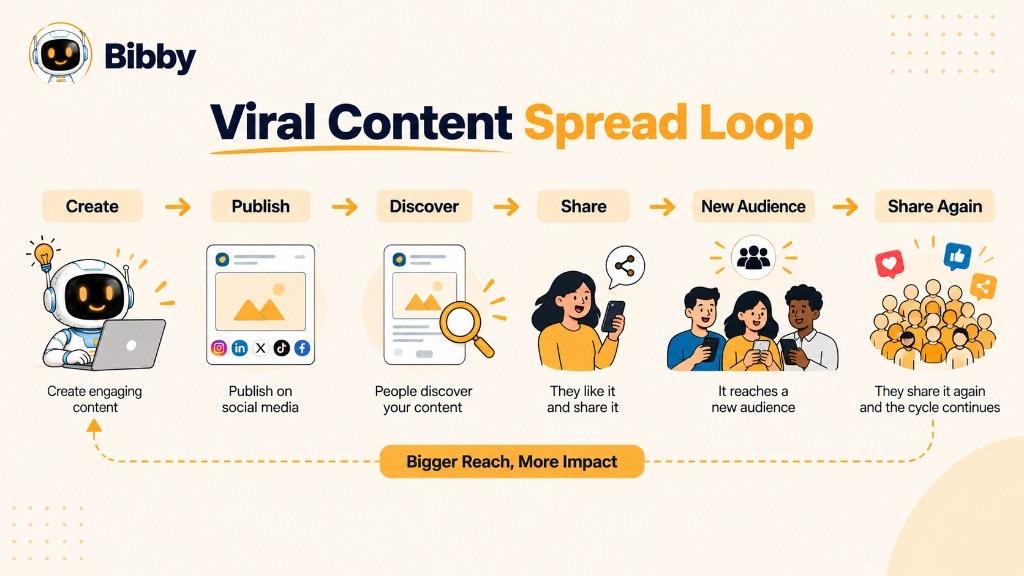
People discover something, react, and share. New networks see it. The loop can take minutes or days. Platforms can recommend beyond followers; shares, messages, embeds, and talk move it across communities.
Create → Publish → Discover → React → Share → Reach new people → Share again
1. Someone Creates and Publishes
A short video, meme, Instagram carousel, LinkedIn post, TikTok, YouTube video, photo, infographic, surprising fact, or brand campaign. Size of the account does not decide whether it can travel.
2. An Initial Audience Discovers It
Followers, recommendations, search, communities, or other channels. If people scroll past, distribution stays small. If they watch, react, comment, save, or share, more chances open.
3. The Content Creates a Reaction
Reasons sound like: this is hilarious; my friend needs this; I didn’t know that; this is exactly me; I agree; this is unbelievable; I want to try this; this explains it.
4. People Share
Reposts, DMs, Stories, links, groups, tags, embeds, public discussion. The creator no longer owns every distribution point.
5. New Audiences Discover It
1 creator → 100 viewers → 20 shares → hundreds of new viewers → more shares. Not every share starts another round. Each new audience is another chance.
6. Platforms Can Amplify
Ranking and recommendation can show the post to more people when response is strong. Engagement is not an automatic viral switch. Relevance, quality, timing, competition, and platform behavior still matter.
7. The Cycle Can Repeat
Exposure → reaction → sharing → new exposure. When that happens fast and far beyond original distribution, people call it viral.
The Role of the Network Effect
One share to 200 followers, then a few of those people share, opens many more potential viewers. Growth is rarely a perfect chain. Audience sizes differ, most people do not share, repeat exposure can dull interest, and private shares are hard to count. Treat virality as a dynamic distribution process, not a formula.
Why Some Content Stops Spreading
Interest drops, the topic ages, people have seen it, the relevant audience is saturated, competing posts win, context disappears, or nothing invites another share. Spikes can fade quickly.
The Key Idea Behind Viral Content
People distribute it, not only the creator. You can publish and present well; widespread sharing depends on response. Platforms can amplify; they do not guarantee. Posting often creates more chances to find a strong idea. Each post still has to earn attention.
Why Does Content Go Viral?
Outcomes mix audience response, emotion, relevance, timing, shareability, format, and distribution. Two similar posts can diverge completely.
1. Strong emotional response
Humor, surprise, joy, inspiration, curiosity, nostalgia, awe, anger, empathy. Ask what people feel, not only how the asset looks.
2. Highly relatable
Daily life, work, parenting, frustrations, interests, community, industry problems. *This is exactly me.*
3. Useful
Tips, tutorials, checklists, facts, educational carousels, time-savers, insights. Sharing becomes helping someone else.
4. Surprise
Challenge an assumption. “Your best-performing post may not be your most important post” beats a generic tip list.
5. A strong hook
Opening line, unexpected visual, question, opinion, curiosity gap. Critical for short video and first carousel slides. Not the same as clickbait.
6. Easy to understand
Clear central idea so people can explain and share it—especially memes, short videos, infographics, and carousels.
7. A reason to share
Entertain, help, opine, show personality, start talk, celebrate, recommend, join a community. Ask: why would someone send this to another person?
8. A current moment
Events, holidays, launches, seasons, trends. Relevance beats being early on every trend.
9. The right format
Tutorial as carousel; reaction as short video; insight as a LinkedIn text post. Use the format that makes the idea easy to share—not every format at once.
10. The right audience
Spread inside a niche still counts. Relevant viewers can beat raw view counts. Use a persona so you are not aiming at “everyone.”
11. Participation
Challenges, questions, prompts, remixes, UGC, before-and-after. Native Stitch and Duet live in TikTok—not in Bibby. Instagram polls stay in the app.
12. Originality
A familiar topic plus a fresh angle.
13. Distribution beyond the original post
Larger creators, communities, news, cross-platform reposts, search, recommendations.
There Is No Guaranteed Viral Formula
Strong hook + trend + emotion ≠ viral post. Platforms change; audiences are unpredictable. The practical goal is content people want to watch, read, react to, save, discuss, and share—plus a calendar and experiments—not a secret recipe.
Types of Viral Content
Format does not make a post viral. Connection and speed of spread do.
- Videos — funny clips, tutorials, stories, demos; budget is not the predictor.
- Memes — simple, remixable humor (they also travel on X and Reddit; Bibby does not publish there).
- Social posts — text and conversation can spread without video.
- Images — one visual that is instantly clear.
- Carousels — useful, save-worthy slides.
- Stories — curiosity and interaction; Highlights and polls stay native.
- Challenges — participants become distributors.
- UGC — reviews, unboxings, real use; get permission; Bibby does not scrape mentions.
- Educational — utility-driven shares.
- News — speed is not the same as accuracy.
- Brand campaigns — attention ≠ sales.
- Quotes — compact and easy to repost.
- Infographics — data made scannable.
- Personal stories — specific experience, broader recognition.
Viral Content Can Combine Multiple Formats
A video can become memes, challenges, and UGC. A carousel can be educational *and* an infographic. Categories overlap.
The Format Is Not the Formula
A viral video does not make the next video viral. Ask: does this give the intended audience a reason to pay attention and share?
Examples of Viral Content
1. Relatable short-form video
Workplace joke, tags, remixes. Lesson: people share what reminds them of someone they know.
2. Before-and-after
Makeover, design, product change. Visual contrast tells the story.
3. Surprising fact
Curiosity plus usefulness. Keep claims accurate.
4. Funny meme
Specific enough to feel personal, broad enough to understand.
5. Educational carousel
“7 mistakes that can reduce engagement.” Saves and colleague shares.
6. Personal story
Job loss, mistake, lesson. Authenticity.
7. Product demonstration
Show the outcome of a real problem—not only a feature list.
8. Challenge
Each participant introduces a new audience.
9. User-generated product content
Real use, permission, then you may republish.
10. Timely reaction
Join a conversation people already care about—with an original take.
Examples of Viral Content by Format
| Example | Format | Primary trigger | Typical response |
|---|---|---|---|
| Workplace joke | Short video | Humor, relatability | Tags, shares |
| Unexpected statistic | Image or carousel | Surprise | Shares, discussion |
| Tutorial | Carousel or video | Utility | Saves, shares |
| Success story | Text or video | Emotion | Comments, shares |
| Transformation | Video or image | Visual contrast | Reactions |
| Challenge | Video | Participation | UGC |
| Customer experience | UGC video | Authenticity | Recommendations |
| Industry insight | Text or carousel | Social currency | Saves, comments |
| Timely reaction | Video or post | Relevance | Reposts |
| Meme | Image or video | Recognition | Direct shares |
What These Examples Have in Common
A reason to care. Easy to understand. A reason to share. Travel beyond the original audience.
A Viral Example Is Not a Guaranteed Template
Copying yesterday’s meme rarely works. Study the principle: what made people stop, feel, share, and who shared it?
What Makes Content Shareable?
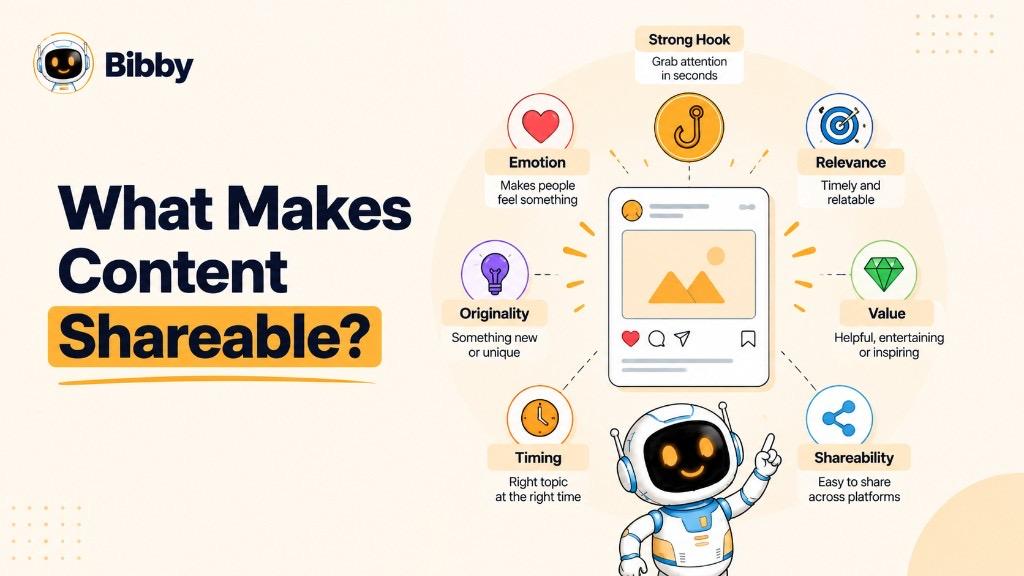
People can like a post without sharing it. Shareable posts feel worth passing along.
- Feeling something
- Relatability and tagging
- Useful information
- Identity and social expression
- Social currency
- Helping someone else
- Starting a real conversation—not fake controversy
- Easy to consume
- Easy to pass along (share, Story, DM, screenshot)
- Timely without forcing a trend
- A new perspective
- A role for the audience (not engagement bait)
The Shareability Test
Why would someone share this with another person? If the answer is unclear, strengthen the angle. Entertainment, teaching, curiosity, feeling understood, identity, discussion, problem-solving, clarity, audience fit, and “I would send this to a colleague” are useful checks.
Shareability Does Not Guarantee Virality
A useful post can stay small. A well-shared post can stop at one community. Audience size, timing, platform behavior, competition, and culture all matter. Create content that deserves shares rather than manufacturing tricks.
Viral Content vs. Trending Content
| Viral | Trending |
|---|---|
| How widely and rapidly this piece spreads | What is getting increased attention now |
| Often sharing and redistribution | Often many people on the same topic |
| Can be unexpected | Usually a current conversation |
| Can outlive the moment | Often tied to a moment |
A topic can trend without any one post going viral. An old clip can go viral without being the current trend. They overlap when a trending event plus a clever video both take off. Viral posts can also create trends through remixes and challenges.
Chasing every trend is optional. Fit, brand, originality, and whether the post still makes sense later matter. Listening and native trend tabs stay outside Bibby.
Trending = what people are paying attention to right now. Viral = how rapidly and widely a particular piece spreads.
A viral entertainment clip with no customer overlap can lose to a smaller educational post that attracts the right people.
Viral Content vs. Evergreen Content
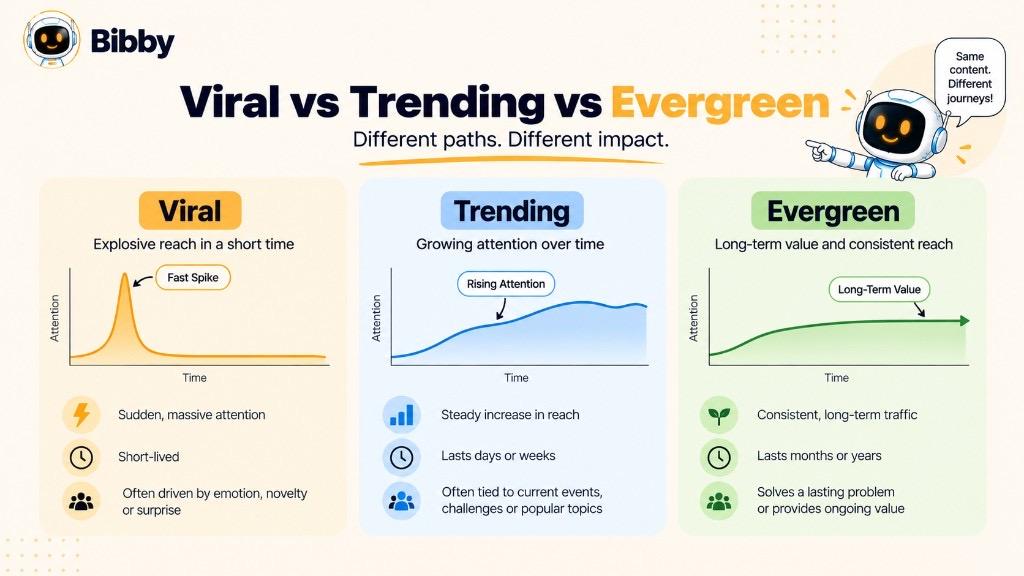
| Viral | Evergreen |
|---|---|
| Speed and spike | Lasting usefulness |
| Timing, emotion, moment | Recurring questions |
| Immediate sharing | Search, saves, return visits |
A content calendar can use both: viral for bursts of attention, evergreen for durable value. Example: a trend reaction with a million views in three days vs. a calendar carousel that keeps getting saves for a year. Neither automatically equals business value.
Viral is about speed and reach. Evergreen is about longevity.
Viral Content vs. Viral Marketing
| Viral content | Viral marketing |
|---|---|
| The media | The strategy |
| Anyone can create it | Usually a business goal |
| Can spread with no brand | Promotes a message |
| Can be accidental | Often designed for sharing |
Viral marketing can use referrals, UGC, challenges, and community—not only one hit post. Views ≠ successful marketing. Measure leads, trials, and sales where you can attribute them. ROI lives in your analytics stack—not as a Bibby dashboard.
Viral content = a piece that spreads. Viral marketing = a strategy that uses sharing and word of mouth.
How to Create Viral Content
You cannot force shares. You can raise the chance that people notice, understand, and pass the idea along.
- Audience — interests, problems, what they already share.
- Idea — entertainment, utility, curiosity, emotion, participation.
- Angle — not “10 tips” if “habits that waste time” is sharper.
- Hook — first seconds or first slide; honest, not clickbait.
- Format — serve the idea.
- Clarity — readable type, tight video, short paragraphs.
- Share reason — “Share this!” is weaker than a natural send.
- Platform fit — length, ratio, caption, hook, thumbnail.
- Visuals — clear beats expensive.
- Timing — when your audience is active; no universal viral hour.
- Real interaction — questions tied to the topic.
- Early signals in Insights — shares, saves, watch time.
- Learn — idea, hook, format, who shared, why.
- Repurpose — video → carousel → Story → LinkedIn post.
- Keep testing — topics, hooks, lengths. A/B tests where the platform allows.
Can You Guarantee That Content Will Go Viral?
No. You control idea quality, clarity, execution, publishing, and learning. You do not control whether thousands of people share it. A realistic goal: more content people want to watch, save, discuss, and share.
Creating Viral Content Is an Iterative Process
Research → Create → Publish → Measure → Learn → Improve → Repurpose → Publish again.
How to Increase the Viral Potential of Social Media Content
Start with the audience, not a supposed algorithm cheat code. One hero idea. Design for who they would send it to. Make visuals instantly readable. Use video when motion adds something. Build honest curiosity. Stay relatable and useful. Use trends without depending on them. Invite participation without bait. Adapt per platform. Test hooks and variations. Publish consistently so you can learn—automation reduces busywork; it does not create hits. Study Insights (shares, saves, retention, traffic)—Bibby does not replace them. Repurpose winners. Use AI for speed, not as a viral button. Remove share friction. Learn from weak posts too.
Attention, value, shareability, relevance, measurement. Optimization improves conditions. It cannot guarantee virality.
Can AI Create Viral Content?
AI can help with ideas, angles, images, captions, hooks, repurposing, and platform variants. It cannot guarantee spread or reliably predict a hit. Output can look generic if everyone uses the same patterns. Keep human context: emotion, culture, brand voice, accuracy.
Human insight → AI assistance → human review → publish → measure → learn.
Bibby can upload or generate visuals, generate captions, create posts and carousels, schedule on five channels, and run campaigns and a brand kit in chat. Neither Bibby nor any tool can guarantee a post will go viral. Ask AI to explore ideas and variations—not to “make this viral.”
Viral Content and Social Media Algorithms
There is no viral button. Simplified flow: publish → first audience → response → platform evaluates signals → more people may see it.
Signals can include views, watch time, retention, reactions, comments, shares, saves, clicks, follows, profile visits, search, and similar-content behavior. They are not a universal checklist.
Shares extend distribution. Watch time matters for video. Lots of likes in a small group is not virality; private shares can hide spread. Good content can stay small (small seed audience, weak hook, crowded moment). Simple content can explode if the reaction is strong. Hashtags and posting time help context; they do not buy the For You feed.
Good content → response → possible extra distribution → new response. People still decide.
How to Measure Viral Content
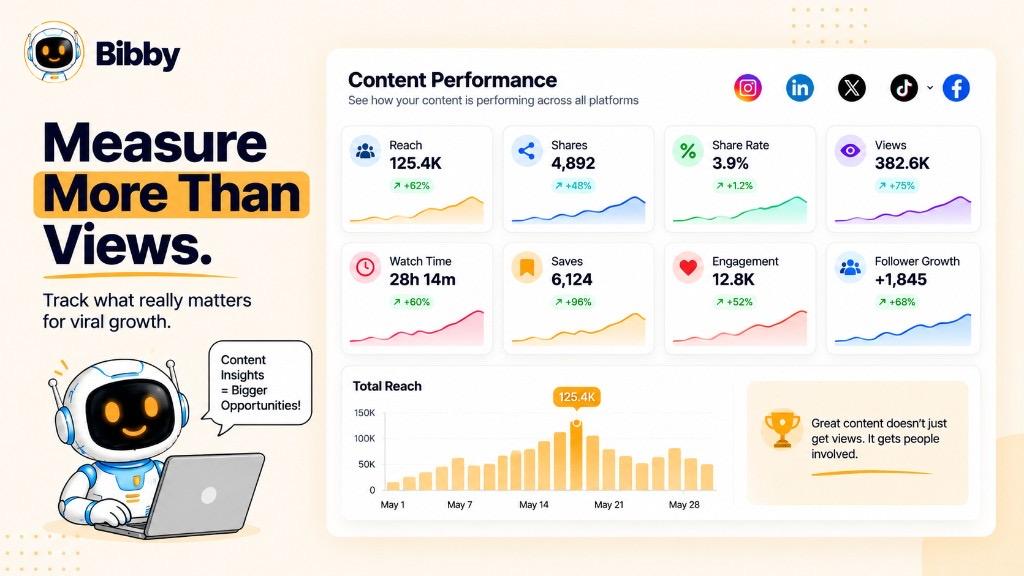
Use native Insights or your analytics tools. Combine reach, sharing, engagement, consumption, growth, and business outcomes.
- Reach — unique people exposed; compare to your baseline; paid and large audiences also inflate it.
- Impressions — displays, not unique people.
- Shares / share rate — Shares ÷ Reach × 100 when the platform reports both.
- Engagement rate — not a synonym for viral.
- Views, watch time, retention, completion — especially video.
- Saves — useful for tutorials and checklists.
- Comments — quantity and quality.
- Follower growth, profile visits, site traffic, conversions — what happened after the view.
Some teams use a virality rate (shares ÷ reach, or new vs original audience). Define it consistently. Compare to your averages, not a celebrity account. Speed of growth and source (followers vs recommendations vs shares) matter. Do not stop at vanity metrics.
Attention → consumption → sharing → engagement → business impact. Ask how people responded, how far they shared, who they reached, and what happened next.
Viral Content Metrics: What Should You Focus On?
Depends on the goal.
- Distribution → shares and share rate
- Video → watch time and retention
- Useful content → saves
- Community → comments and follows
- Awareness → reach and relevant new audience
- Site → clicks and sessions
- Revenue → leads and sales you can attribute
Virality measures distribution. Business value measures what that distribution accomplishes. A niche 10,000 with the right buyers can beat several million irrelevant views.
How Long Does Viral Content Stay Viral?
No fixed clock. Typical path: discovery → rapid growth → peak → decline → possible resurgence.
Short-lived: news, live events, current memes. Longer-lived: evergreen humor, tutorials, unusual facts. Cross-platform copies can start a second wave (TikTok → Instagram → Facebook → YouTube → chats).
When something spikes: follow-up posts, comment-inspired content, new formats, participation, link to evergreen resources, study the hook. Do not assume you can repeat the same post. Watch slowing view growth, share rate, and new-audience reach.
Some posts last hours. Some last months. The question is whether people keep giving it new chances to spread.
Can You Predict Viral Content?
You can study patterns. You cannot reliably predict a specific post. History, AI scores, early engagement, and trends are clues—not certificates. You *can* predict more usefully: likely audience, format, relevant platform, objective, and which KPIs to watch.
Research → hypothesis → create → publish → measure → learn → test again. Uncertainty remains. Aim for viral potential, not viral certainty.
Common Viral Content Mistakes
- Chasing every trend
- Copying a hit instead of the principle
- Misleading clickbait
- Celebrating views only
- Ignoring the target audience
- Making the idea too complicated
- Weak openings
- Treating every platform the same
- Hashtag stuffing
- Engagement bait
- Sacrificing accuracy
- Zero brand connection
- Making every post an ad
- Ignoring comments after a spike
- Repeating one format forever
- Never measuring
- Confusing virality with business success
- Manufacturing controversy
- No follow-up
- Expecting every post to go viral
Ask: relevant, clear, valuable, shareable, platform-fit, accurate, measurable? Better content beats bigger numbers for their own sake.
Viral Content for Different Social Platforms
- Instagram — Reels, carousels, images, Stories; first seconds and first slide matter.
- TikTok — short video and discovery; a trend format is not a guarantee.
- Facebook — shareable posts, video, groups.
- LinkedIn — insights, career stories, educational carousels; professional ≠ stiff.
- YouTube — Shorts and long-form; titles, thumbnails, retention; search can extend life.
- X, Pinterest, Threads — real-time talk, saves, and text conversation happen there; Bibby does not publish to those networks.
Reuse the idea, not always the identical file. Native length, hook, and caption usually win.
One Idea Can Become Multiple Pieces of Content
Core idea: five social mistakes → Instagram carousel, TikTok clip, YouTube tutorial, LinkedIn story, Facebook discussion prompt.
The best platform is where your audience already is.
Use Bibby to Adapt and Schedule Viral Content
Create idea → visual → caption → adapt → schedule → publish → measure in Insights → improve.
Plans and sign up. Help in resources and help. Bibby automates the create-and-publish loop. It does not guarantee virality, replace Insights, collect UGC, run ads, or post to X.
Viral Content for Brands
Use spikes for awareness, new audiences, personality, launches, or UGC—then connect attention to relevance. People share entertainment, usefulness, relatability, identity, emotion, surprise, and conversation—not because the brand asked.
Balance discovery posts with education, evergreen, community, product, and promo. Soft path: entertain → recognition → interest → value → action. Map viral post → profile → next post → site → conversion. Brand safety: no false claims, bait, or careless sensitive topics.
Viral Content Workflow With Bibby
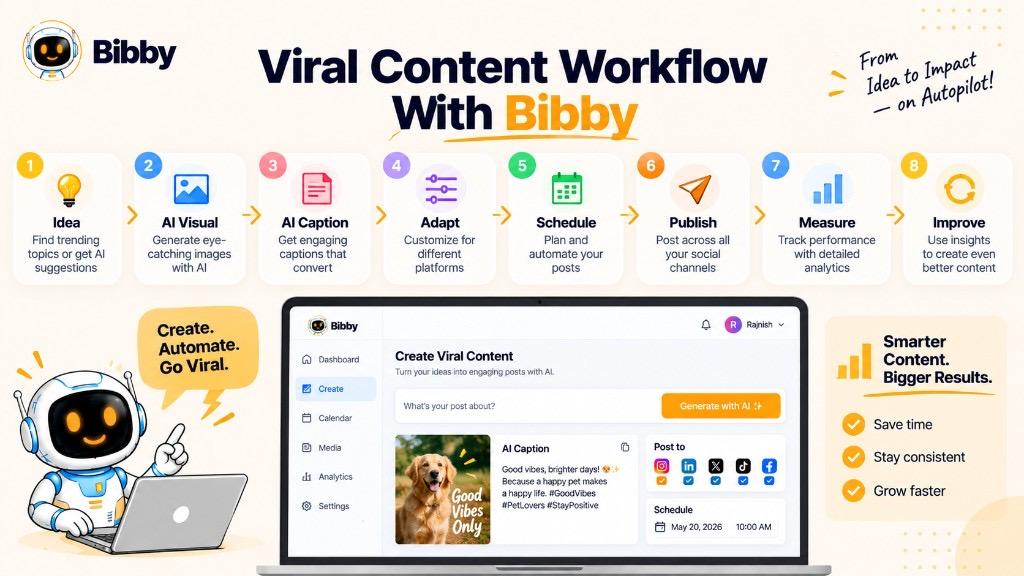
Research → idea → create → caption → adapt → schedule → publish → measure → improve.
Chat can help set a campaign, brand kit, posts, and regenerated captions. Human review stays on accuracy and voice. Analytics stay in native Insights.
How to Use Bibby to Plan Content With Viral Potential
Build an idea bank. Turn one topic into several formats. Generate visual and caption variants. Keep a mixed week (educational, relatable, product, timely, evergreen)—not a calendar that assumes every post will explode. Test a small set of formats. Schedule consistently without filling the grid with weak posts. Turn winners into series. Keep editorial judgment.
Viral Content Checklist
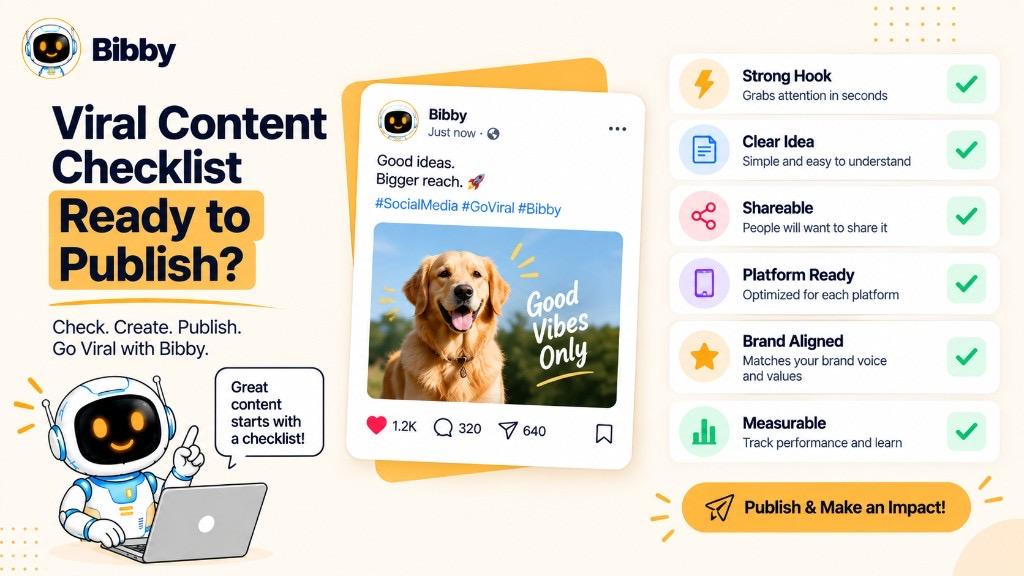
Idea — relevant, one clear idea, original angle, natural share reason.
Hook — honest, fast, no filler.
Quality — accurate, delivers the promise.
Share — help, humor, feeling, identity, surprise, conversation.
Visual / video — readable on mobile; opening earns the next second.
Platform — right format and caption.
Brand — tone and claims fit.
Trend — relevant, still current, original take.
CTA — matches the post; not empty “comment YES.”
Measure — pick metrics before you publish.
Quick 10-point check
- Relevant idea? 2. Strong hook? 3. Clear message? 4. Value or reaction? 5. Reason to share? 6. Format fit? 7. Brand fit? 8. No bait or deception? 9. Known metrics? 10. Plan to learn?
You cannot control virality. You can control the quality of the process.
Viral Content Meaning in Simple Terms
Viral content is a post, video, image, or idea that people rapidly pass to other people, so reach grows far beyond the original audience. Platforms can help. They cannot promise it. Trending is what is loud *now*. Evergreen is what stays useful. Marketing success is what happens after the view.
Key Takeaways
- Viral means speed and spread through people, not “lots of views” alone.
- Shareability, emotion, utility, timing, and format raise potential—never certainty.
- Measure shares, new audience, and outcomes—not vanity metrics in isolation.
- Bibby helps create, caption, and schedule on five channels. The audience still decides.