
When people search “trending,” they usually want the meaning, how something becomes a trend, and what that means for users and marketers. Understanding momentum—not just size—helps you use trends instead of copying whatever is loudest.
Bibby does not detect trends, scrape mentions, or guarantee the FYP. After you choose a relevant conversation, you can generate captions and schedule images, carousels, videos, and Stories on Facebook, Instagram, LinkedIn, YouTube, and TikTok—not X. See the dictionary, blog, and free tools.
What Does “Trending” Mean?
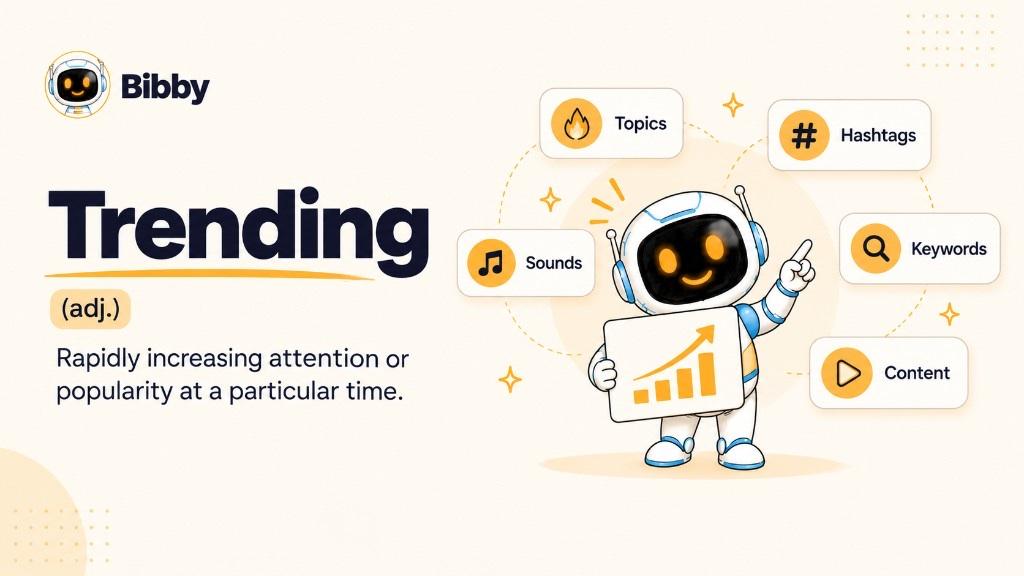
Trending is a time-sensitive rise in attention. A subject can start trending because of breaking news, a major event, a viral post, a product launch, entertainment, a cultural moment, or a conversation that suddenly spreads.
What counts as trending differs by platform, location, audience, and industry. A movie release might trend as people discuss it; a related hashtag, Reel format, or sound can then trend as more people join in. Tomorrow, interest may already have moved on.
Trending vs. Popular
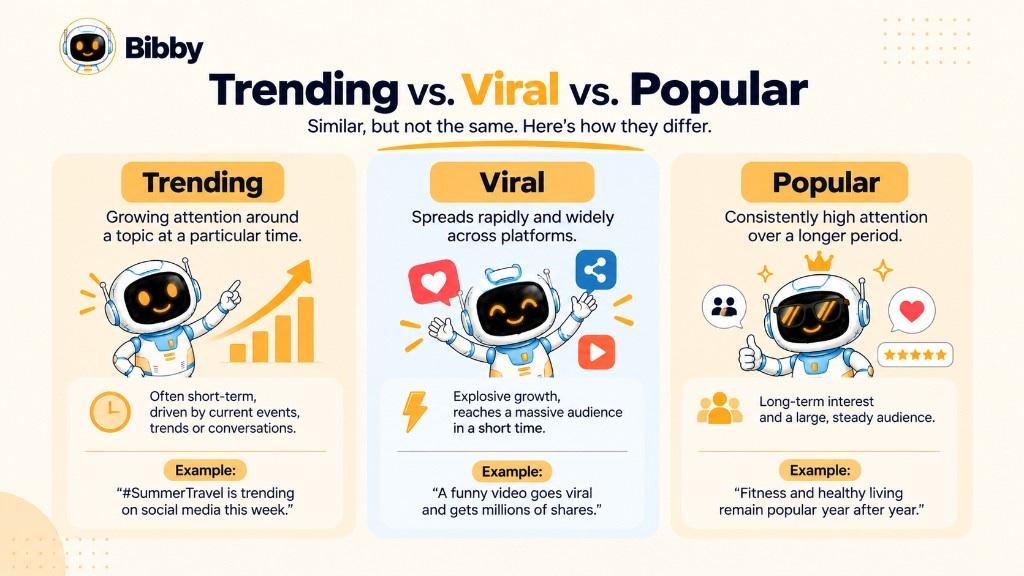
Popular usually means a high, sustained level of attention. Trending emphasizes a noticeable increase over a period.
A topic can be popular without currently trending. A newer, smaller topic can trend because interest is climbing fast.
Dictionary Definition of Trending
Trending: A topic, hashtag, keyword, phrase, idea, or piece of content that is rapidly gaining attention or popularity at a particular time, especially on social media.
What Does Trending Mean on Social Media?
On social media, trending means a topic, hashtag, keyword, sound, video, meme, or conversation is getting unusually high or rapidly increasing attention.
Platforms surface content using engagement, activity, interests, and emerging conversations. When interest spikes, it may appear in recommendations, search, feeds, or dedicated trend features. The algorithm is not one public formula, and Bibby does not report those rankings.
Forms include:
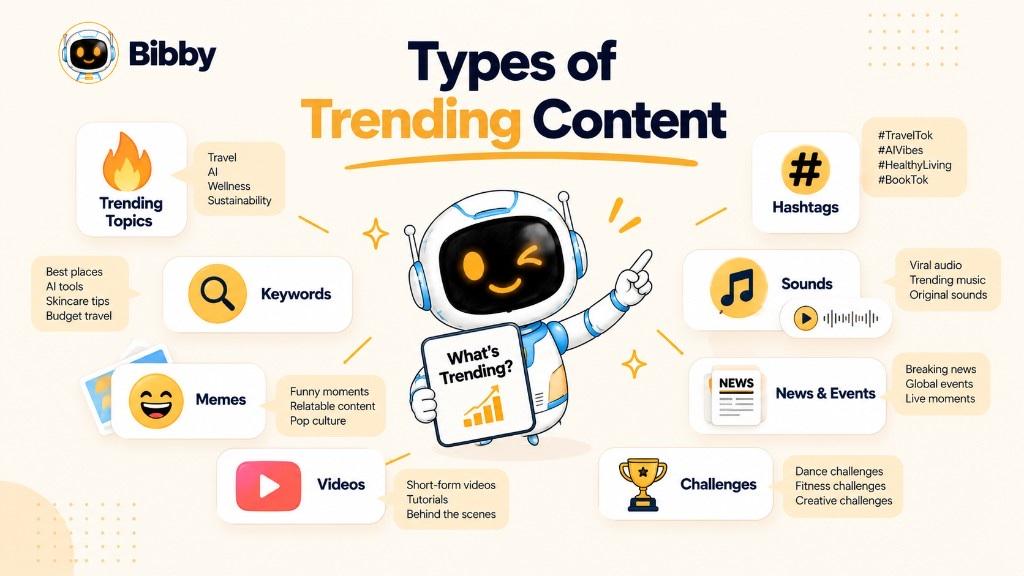
- Trending topics — subjects people are discussing now
- Trending hashtags — tags in rising use
- Trending keywords — phrases with growing search or social activity
- Trending sounds — audio clips creators reuse in short-form video
- Trending videos — clips or formats with growing attention
- Trending memes — jokes or templates spreading through communities
- Trending challenges — formats that invite participation
- Trending news — current events driving discussion
Why Do Things Trend on Social Media?
Many people engage within a short window. News, entertainment, sports, culture, influencers, and surprises can all trigger that spike.
Trending is not “the thing with the most views.” A consistently popular subject can have huge volume without being *today’s* trend. A smaller subject with a sudden surge can be trending because momentum is up.
Trends are platform- and audience-specific. A TikTok sound may never trend on LinkedIn. For marketers, value comes from relevance, timing, audience interest, and brand fit—not from size alone.
What Is a Trending Topic?
A trending topic is a subject, idea, event, or conversation attracting rapidly increasing attention. People post, comment, share, search, and create around the same thing at once.
Sources include news, sports, movie releases, product launches, celebrity announcements, cultural events, public debate, memes, or unexpected moments. A product announcement that draws thousands of reactions in hours can become a trending topic.
What Makes a Topic Trending?
Interest grows compared with its normal baseline. Signals can include:
- A rapid rise in mentions or searches
- More likes, comments, shares, or other interactions
- More people joining the conversation
- Wide sharing of posts and videos
- Prominent accounts joining in
- A tie to a major current event
- Activity in a particular location or community
There is no universal formula. Each network scores trends differently.
How Long Does a Trending Topic Last?
Usually temporarily. Hours for some; days or longer for major events if new developments keep the conversation alive.
Timing matters. Joining while interest is still rising beats posting after the room has emptied. That is not a promise of reach.
What Is the Difference Between Trending and Viral?
Trending is a current rise in interest or conversation. Viral is content that spreads rapidly to a large audience.
| Trending | Viral |
|---|---|
| Increasing or current interest | Rapid, widespread distribution |
| Often tied to events or conversations | Often a specific post, video, image, or meme |
| Strongly time-sensitive | Can keep circulating after the first surge |
| Topics, hashtags, keywords, conversations | Usually a specific asset |
| May stay on one platform, place, or community | Can cross platforms |
A product launch can trend as people discuss it. One explainer video can go viral if millions share it. They overlap: viral clips can fuel a trending topic; trend content can go viral. You do not need to go viral to be trending, and widely shared posts are not always the current trend.
Trending is what is gaining attention now; viral is how widely and rapidly content spreads.
What Is the Difference Between Trending and Popular?
Popular = large or established audience. Trending = interest increasing or unusually high now.
| Trending | Popular |
|---|---|
| Growing or unusually high current interest | High overall interest |
| Changes quickly | Can stay consistent |
| Timing-heavy | Less tied to one moment |
| Emerging topics and conversations | Already widely known |
| Timely content opportunities | Often evergreen demand |
Popularity is how much attention something has. Trending is how that attention is changing right now. Evergreen demand can fill a content calendar; a relevant trend can add a timely slot.
What Can Be Trending on Social Media?
Almost any format can trend when audience interest changes. The format is not the definition—the surge is.
Trending Topics
News, entertainment, sports, technology, politics, culture, and launches.
Trending Hashtags
Increased usage around events, campaigns, or conversations. Draft tags in the hashtag generator only when they match the post.
Trending Keywords
Words or phrases with rising search or social interest.
Trending Sounds and Music
On short-form video apps, songs and clips can become part of a format trend. Use sounds in the native app. Bibby does not license trending audio.
Trending Memes
Images, jokes, phrases, or templates that communities remix. See meme.
Trending Videos
A single video, or a format many creators copy.
Trending Challenges
Many users make their own version of the same activity.
Trending News and Events
Breaking news, sports, awards, and announcements.
How Does Something Become Trending?
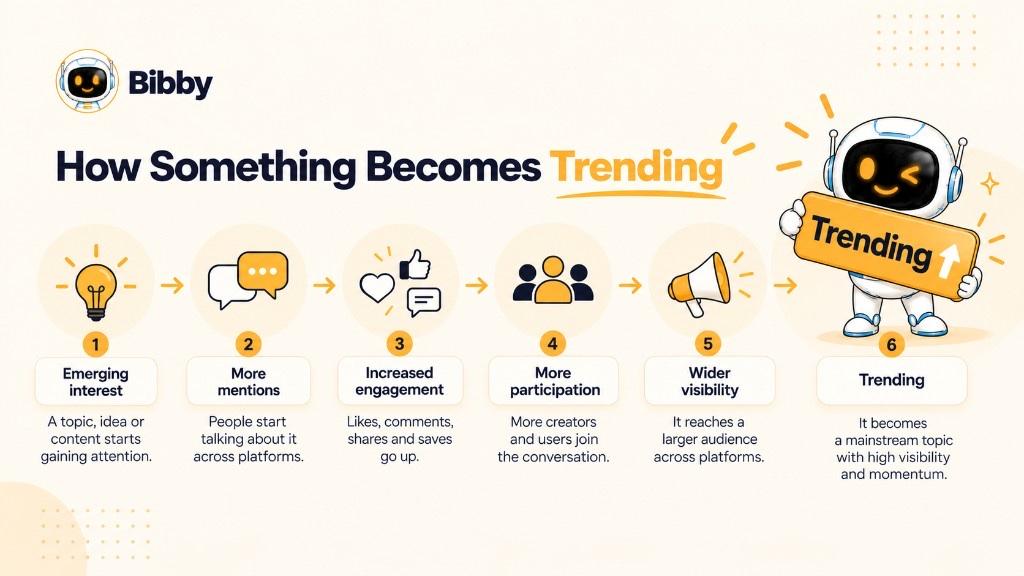
Interest increases significantly for an audience, platform, place, or period. Exact ranking signals differ; a sudden increase in activity is usually part of it.
What Can Cause Something to Trend?
- Rapid growth in discussion, search, or engagement
- Higher engagement on related posts
- Widespread participation (people making their own versions)
- Creator or influencer amplification
- Breaking events
- Cultural moments
- Cross-platform spillover
- A spike in search curiosity
A small audience can still host a trend if attention is rising quickly. Follower count is not the score.
Why Trends Can Be Different for Different People
Feeds are often personalized by interests, location, language, and activity. A community trend may be invisible elsewhere. Digital marketers should chase relevant momentum, not the global leaderboard. Financial services and gyms will rarely share the same “must join” list.
How Can You Find Trending Topics?
Look for rising, relevant interest—not only what is already huge.
- Platform trend and discovery surfaces — search, recommendations, sounds, Explore, the FYP (TikTok, in-app).
- Hashtags and keywords in your niche — frequency and discussion, not stuffing.
- Creators and experts — they often amplify early.
- News and events — from sources you trust.
- Sudden engagement changes — comments, shares, mentions, searches vs. your baseline. Measure in native Insights, not Bibby.
- Social listening tools — conversations, keywords, sentiment. Bibby is not a listening or trend-radar product.
- Competitors and your own audience — comments and questions can reveal niche trends first.
The post idea generator can help you angle a topic you already chose. It does not tell you what is trending this hour. For Instagram-only curiosity, the Instagram calculator estimates earnings math—not trend rank. Tactics in follower guides are not a trend dashboard.
How to Find Trends Relevant to Your Brand
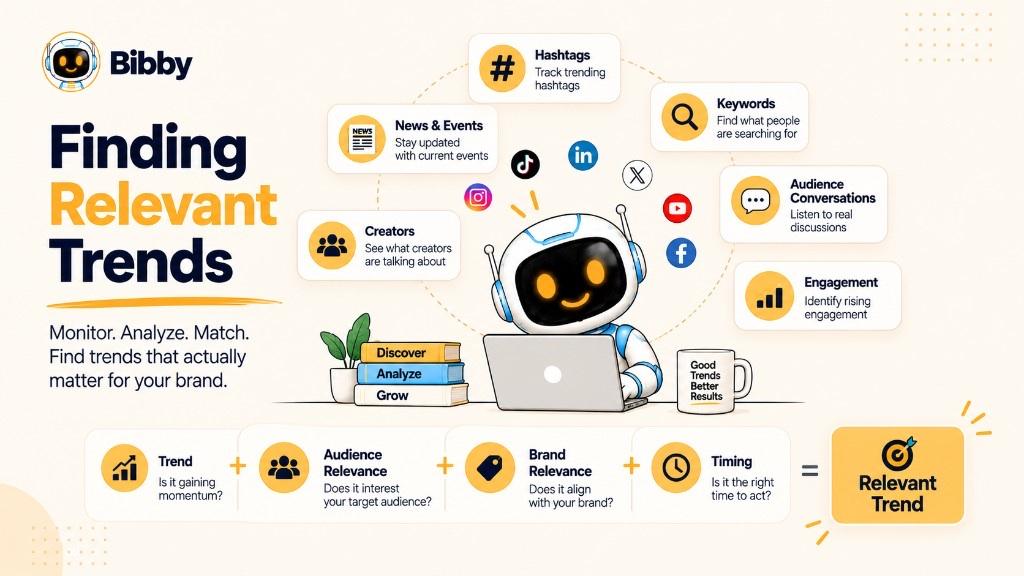
Before you post, check:
Growing interest + audience relevance + brand relevance + good timing
A tech company does not need every viral meme. A rising conversation that affects its customers is usually the better bet. Add something useful; do not chase everything.
How Can Businesses Use Trending Topics on Social Media?
Use trends to make timely posts, join conversations people already care about, and find angles for products you already offer. Relevance first.
Possible uses:
- Timely posts and short-form ideas
- Relevant conversations and format adaptations
- Education or commentary
- Connecting products to natural discussions
- Campaign sparks and new topics
- Audience interaction
Ecommerce and freelancers often adapt a look or format they can actually deliver. See industry pages and case studies.
When Should a Brand Join a Trend?
Ask:
- Is it relevant to our audience?
- Does it relate naturally to the brand or industry?
- Do we understand the context?
- Can we add something meaningful instead of copying?
- Will it still be relevant when we publish?
Speed without understanding can hurt credibility. Avoid clickbait that misrepresents the trend.
When Should a Brand Avoid a Trend?
Skip tragedies, sensitive events, controversy you do not understand, and topics with no audience fit. Judgment beats participating in every trend. Pair timely posts with evergreen work in your strategy.
Why Are Trending Topics Important for Social Media Marketing?
They let you create around growing interest instead of inventing every topic from zero—when the fit is real.
Possible benefits: timely ideas, a reason to interact, new questions to answer, tighter relevance, campaign clues, a chance to add expertise. None of these are guaranteed ROI.
Trending Does Not Always Mean Effective
Views and impressions are not automatically followers, leads, or sales. A mega-trend with no B2B overlap can waste time; a small industry trend can attract the right people. Professional services teams often win on the smaller conversation. Do not treat vanity metrics as success. Paid social can boost a post; it is a separate decision from joining a trend. Organic reach still depends on the platform.
How Trending Content Fits Into a Content Strategy
Use trends as one slice of a social media strategy: timely posts plus evergreen education, promotion, community, and original point of view. Do not make “chase the next sound” the whole plan. Put both types on a content calendar. Templates help structure, not trend picking.
How Do You Create Social Media Content Based on a Trend?
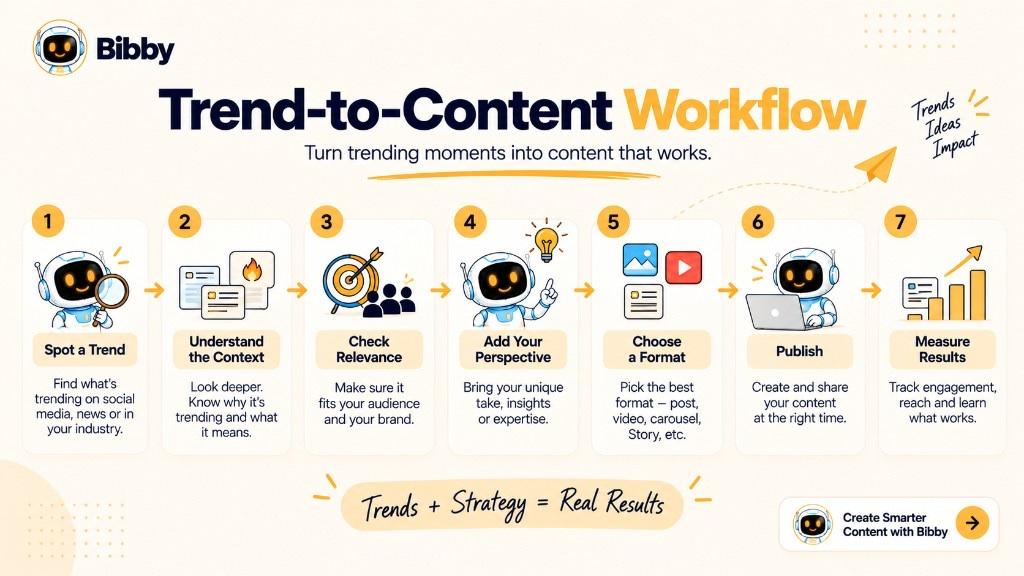
Copying the loudest post is not a strategy. Connect the conversation to something useful, entertaining, or distinctive.
- Identify the actual trend.
- Understand why it is rising.
- Check audience overlap.
- Pick a format that fits: image, carousel, Reel, Story, educational post, commentary, or long-form video.
- Add your perspective — a cybersecurity firm explaining what a tech story means for users, not a news dump.
- Publish while relevant — fast *and* accurate.
- Measure reach, views, engagement, shares, comments, profile visits, traffic, conversions against the goal. Use native Insights. Growth Insights and the report card are not live trend scores.
Draft copy with the caption generator or a Reel script. Best time to post is a hypothesis; read how AI suggests posting times. Timing still will not save an off-brand meme.
Examples of Trending Content
Hypothetical—not real campaigns or results.
Fashion ecommerce — a look is rising; the brand publishes a carousel of ways to style it with existing inventory.
SaaS — an AI news spike; a LinkedIn post explains implications and FAQs for businesses.
Restaurant — a recipe format trends; a TikTok or Reel shows their menu version.
Creator — a sound or format rises; a personal-finance creator uses it to teach one concept.
Trend + relevance + original perspective. Slapping a trending hashtag on unrelated content is not relevance.
What Does Trending Mean on Different Social Media Platforms?
Do not paste one trend onto every network.
Facebook — news, events, groups, videos, search. Timely posts or discussions for *that* audience.
Instagram — Reels, audio, memes, visual formats, hashtags. Adapt; do not clone another Reel.
TikTok — sounds, challenges, formats, effects. Early participation can help if it fits. The FYP is not a Bibby feature.
YouTube — videos, Shorts, search, events. Reactions, explainers, reviews, tutorials. Mix Shorts and long-form when the topic deserves it.
LinkedIn — business, careers, industry news. B2B brands can explain what a development means.
Tone, format, and CTA should match the network. Bibby can schedule the asset you built; it cannot make a LinkedIn post behave like a TikTok sound.
What Are Trending Hashtags?
A trending hashtag is a tag with a significant increase in use or discussion in a period—news, culture, campaigns, challenges, launches.
Why Do Hashtags Trend?
Rapid adoption around a conversation. Creators, organizations, news, and campaigns can all add volume. An industry-event tag may rise as attendees and journalists use it.
Should Businesses Use Trending Hashtags?
When they describe the post. They can signal context. Unrelated tags look forced and can dump you into conversations you did not intend. The hashtag generator is for relevant mixes, not hitchhiking.
Are Trending Hashtags a Guarantee of More Reach?
No. Hashtags are one discovery signal among many. Quality, relevance, timing, and distribution still decide what people see. A trending tag cannot rescue irrelevant content.
Trending Content vs. Evergreen Content
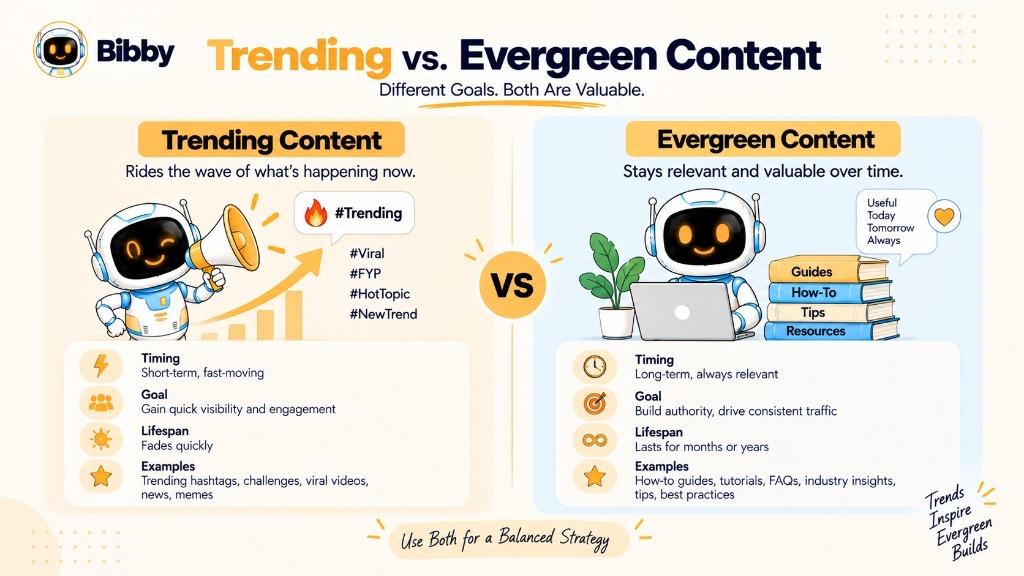
| Trending content | Evergreen content |
|---|---|
| Current or growing interest | Lasting needs |
| Often short lifespan | Useful for months or years |
| Needs timely publishing | Can be planned and scheduled |
| Responds to conversations now | Recurring questions and problems |
| Short-term attention possible | Consistent long-term value possible |
Trending content lives on timing—an industry announcement while people still care. Evergreen is how to build a content calendar, FAQs, definitions, tutorials.
You do not have to choose. Trends are an opportunity inside the strategy, not the entire strategy.
How Social Media Automation Can Help You Act on Trends
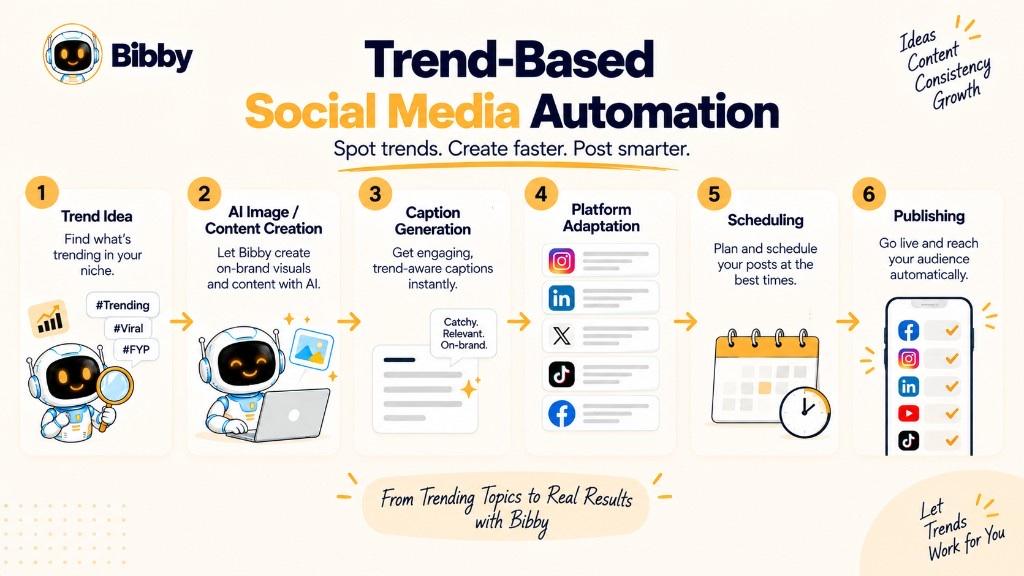
Trends move fast. Automation can reduce the busywork after you decide the trend is fit: idea → visual → captions per network → campaign → schedule → review. It does not replace judgment on relevance, accuracy, or taste. It does not replace listening products.
Using Bibby to Turn Trends Into Social Content
Bibby is a scheduling and automation workflow: upload or generate visuals, choose a posting style, AI captions, then schedule images, carousels, videos, and Stories to Facebook, Instagram, LinkedIn, YouTube, and TikTok. Chat can build a brand kit, campaign, and posts. Supported channels do not include X.
Identify the trend yourself, write the angle, create the asset, then schedule it. Plans and sign up if you want that workflow. More in resources, help, and the blog.
Conclusion
Trending is rising attention now, not “already famous” and not automatically viral.
Remember:
- Momentum, not just volume
- Relevance before speed
- Hashtags and sounds do not guarantee reach
- Balance trends with evergreen posts on a calendar
- Execute in Bibby; discover trends outside it
Next: pair this with a social media strategy and hashtag basics.