A meme is a piece of content—such as an image, video, GIF, phrase, or idea—that spreads across the internet and is often copied, remixed, or adapted by different people.
Today, memes are a major part of internet culture and social media, helping people communicate humor, emotions, opinions, and shared experiences in seconds. But a meme is more than simply a funny post: its ability to spread, evolve, and become a shared cultural reference is what makes it a meme.
Let's explore where memes came from, how they work, and why they have become such an important part of online communication.
What Is a Meme?
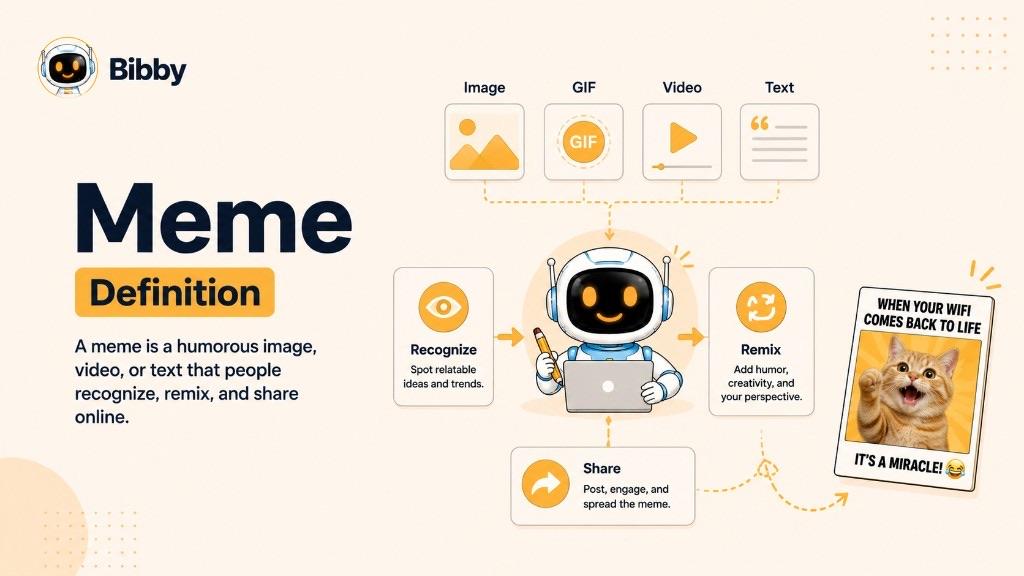
A meme is an idea, image, video, GIF, phrase, or other piece of content that spreads from person to person, usually through the internet. As people share memes, they often change the original content by adding new captions, situations, references, or jokes, creating different versions of the same basic idea.
Internet memes are usually humorous, relatable, ironic, satirical, or designed to provoke a recognizable reaction. However, humor isn't a requirement. A meme can also communicate an emotion, express an opinion, comment on current events, or represent an idea that an online community understands.
What makes a meme different from an ordinary piece of content is its ability to be recognized, repeated, adapted, and shared. One image or phrase can become a reusable template that thousands or even millions of people reinterpret in their own way.
Meme Meaning
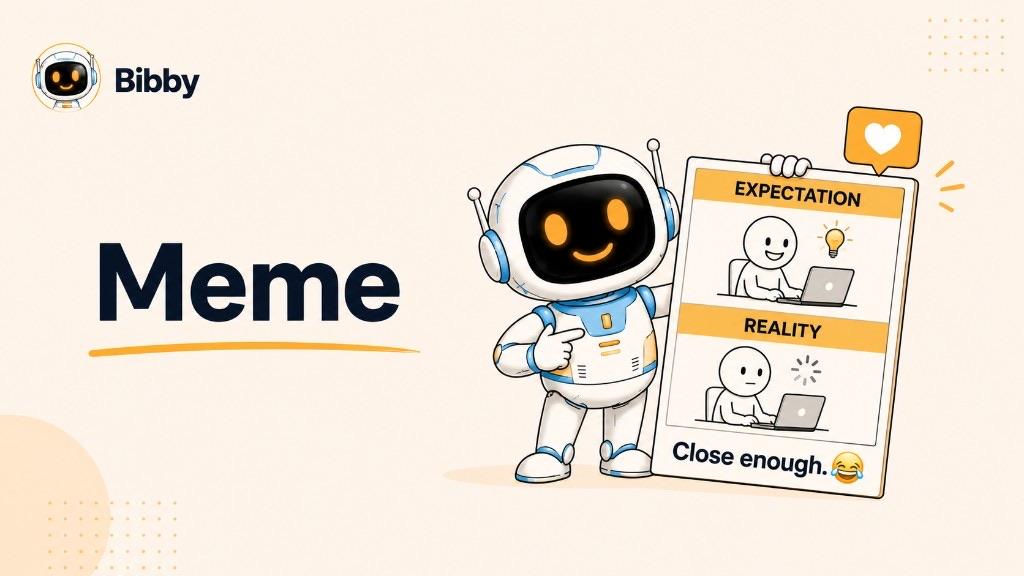
The meaning of a meme depends partly on the context in which it is used. A meme can communicate something that would take several sentences to explain, using a familiar image or format that the audience already understands.
For example, someone might use a familiar reaction image to express frustration without writing “I'm frustrated.” The image itself becomes a shorthand for that feeling because people recognize the cultural reference behind it.
What Does “Meme” Mean on the Internet?
On the internet, “meme” most commonly refers to shareable content that people reproduce and modify, particularly humorous or culturally relevant content.
Memes can appear on social networks, messaging platforms, forums, websites, and video platforms. They may begin within a small online community and eventually reach a much larger audience, or they may remain specific to a particular group.
The defining feature is not the format. A meme can be a picture, video, phrase, GIF, or idea—the important part is how people adopt, repeat, and transform it.
What Makes Something a Meme?
Not every funny post or viral piece of content is a meme. A meme usually becomes a meme when people recognize its underlying format or idea and begin repeating, adapting, or remixing it.
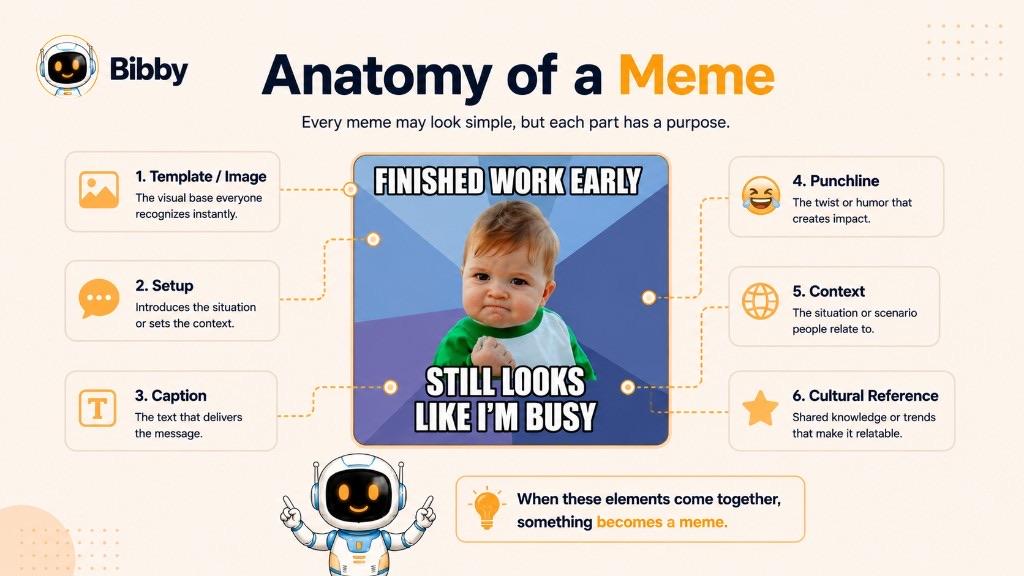
Several characteristics tend to appear in successful memes.
Shareability
Memes are easy to share, making them well suited to social media feeds, group chats, forums, and other online communities. A meme that quickly communicates an emotion or idea can often be understood and shared without additional explanation.
Recognizability
Many memes use familiar images, phrases, characters, video clips, or formats. Once an audience recognizes the underlying reference, a new variation can communicate its meaning almost instantly.
Relatability
Memes often reflect experiences that many people recognize, such as workplace frustrations, relationships, social situations, everyday problems, or reactions to current events. This relatability gives people a reason to share the content with others.
Adaptability
A strong meme format can be reused in countless situations. People can change the caption, context, characters, or message while keeping the recognizable structure of the original.
This adaptability is one of the most important differences between a meme and a one-off viral post.
Replication and Variation
Memes spread through repetition, but they rarely remain exactly the same. Each person who recreates a meme can introduce a small change, creating a new version while preserving the original idea.
Over time, this process can produce hundreds or thousands of variations from one recognizable format.
Cultural Context
Memes depend heavily on shared knowledge. A meme may make perfect sense to one community while being completely confusing to someone unfamiliar with the reference.
This is why memes can develop within specific fandoms, professions, communities, platforms, or cultural groups.
Memes Are Usually Remixed
Remixing is at the heart of internet meme culture. Instead of simply consuming content, people participate by transforming it.
Someone might take an existing image template and add a new caption, edit a video clip into a different situation, or reuse a popular phrase in an unexpected context. Each variation adds a new layer to the original meme.
Memes Depend on Shared Context
The meaning of many memes comes from what the audience already knows. A recognizable reaction image, for example, can communicate an entire emotional response because the audience understands the image's established use.
As a result, memes often work like a form of visual or cultural shorthand.
Memes Change Over Time
Memes have lifecycles. A new format may begin with a small group of users, become increasingly popular as people create variations, reach mainstream attention, and eventually become less popular as audiences move on to something newer.
Some formats disappear completely, while others return months or years later in a new context.
Ultimately, a meme is not defined simply by being funny, popular, or viral. Its defining quality is participation: people recognize the idea, reproduce it, and often transform it into something new.
History of the Word “Meme”
The word meme existed long before social media, viral posts, and reaction images. Its original meaning described how ideas and cultural behaviors spread between people. The internet later transformed that concept into the modern idea of shareable and remixable online content.
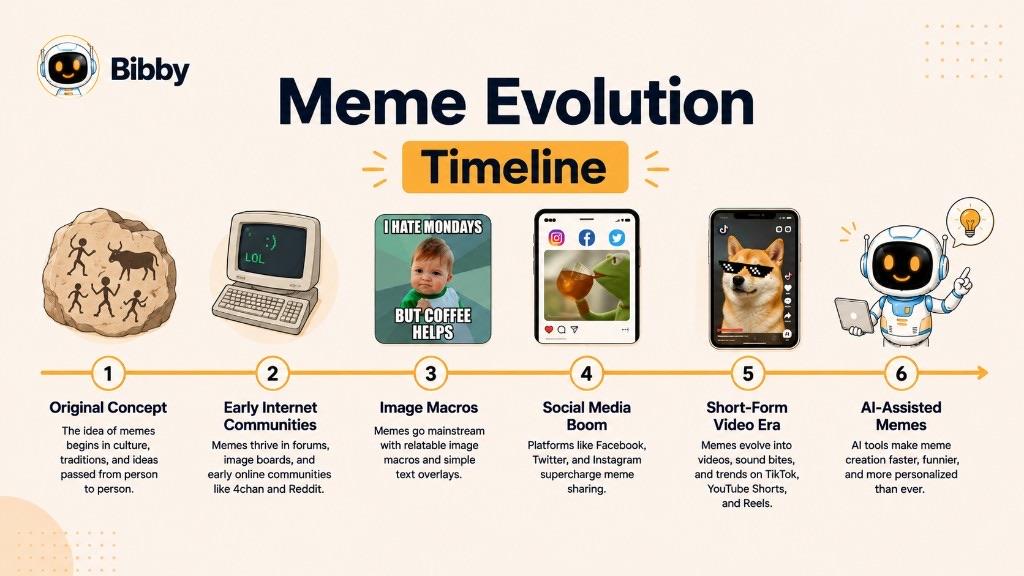
The timeline is a simplified picture of internet meme formats. Cave paintings stand in for cultural imitation, not a claim that prehistoric art was an internet meme. AI can help generate images and captions; whether a result is funny, on-trend, or appropriate still depends on human judgment.
Where Did the Word “Meme” Come From?
The word *meme* was introduced by British evolutionary biologist Richard Dawkins in his 1976 book *The Selfish Gene*. Dawkins used the term to describe a unit of cultural transmission—an idea, behavior, or cultural practice that could spread from one person to another through imitation.
He created the word as a shortened form inspired by the Greek word *mimēma*, meaning something imitated, while also making it resemble the word *gene*.
The original concept wasn't specifically about humor or the internet. It was about how cultural information can reproduce and evolve as it moves through society.
Richard Dawkins and the Original Concept of a Meme
Dawkins proposed that ideas can behave in ways that are, in some respects, similar to biological evolution. Cultural ideas can be copied, modified, become more or less popular, and spread through populations.
For example, a phrase, fashion trend, tradition, or behavior can be passed from one person to another and change along the way.
The modern internet meme follows a similar pattern. A recognizable idea or format is copied, modified, and redistributed by different people, often at an enormous speed.
From Cultural Idea to Internet Meme
The internet gave the concept of cultural imitation a new environment in which to spread.
Early online communities, forums, email chains, blogs, and image boards allowed people to rapidly copy and modify jokes, images, phrases, and other pieces of content. As social media platforms became widespread, the process became even faster.
Image macros, reaction images, GIFs, viral videos, hashtags, and recognizable caption formats helped establish the modern internet meme.
Today, memes can spread across multiple platforms within hours. A format that begins in a small online community can be adapted by thousands of users and eventually become recognizable far beyond its original audience.
The evolution from a broad theory of cultural transmission to the modern internet meme reflects a fundamental characteristic that both concepts share: ideas spread by being copied, adapted, and passed from one person to another.
How Do Memes Spread?
Memes spread through a combination of sharing, imitation, remixing, and social interaction. Someone creates or discovers a piece of content, other people recognize its appeal, and they reproduce or adapt it for their own audience.
Unlike traditional media, where distribution is controlled by publishers, internet memes can be created and redistributed by almost anyone. A meme can move from a private group chat to a public social network, then across multiple platforms as people continue creating new versions.
A typical meme lifecycle looks something like this:
Discovery → Adoption → Remixing → Wider sharing → Saturation → Decline or revival
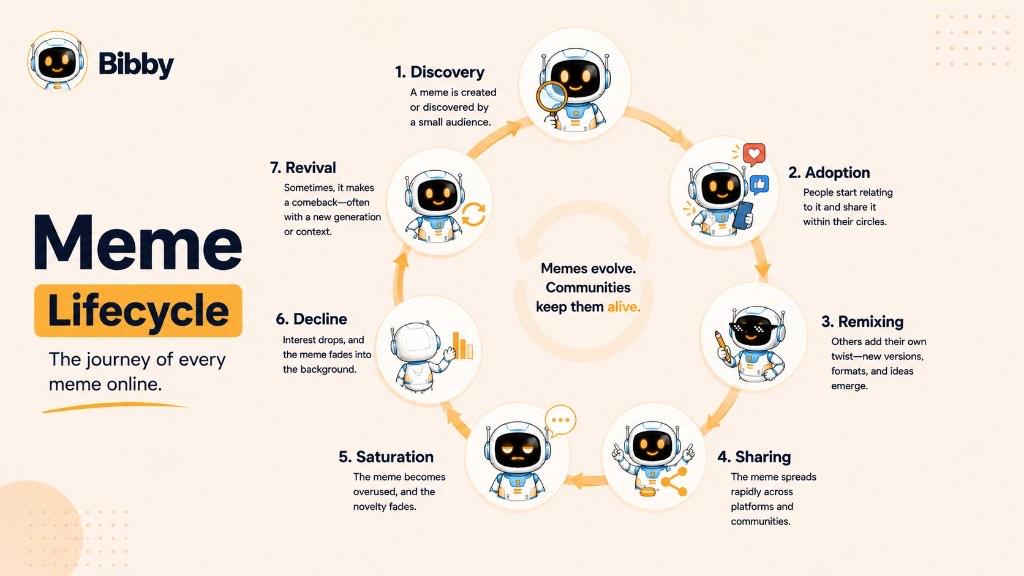
Not every meme follows this exact path, but the pattern explains why some formats become recognizable so quickly.
Why Do Some Memes Go Viral?
There is no single formula that guarantees a meme will go viral. However, memes that spread widely often combine several characteristics:
- Humor: They make people laugh or provide an entertaining reaction.
- Relatability: They reflect experiences that many people recognize.
- Simplicity: Their message can be understood quickly.
- Emotional impact: They trigger amusement, surprise, nostalgia, frustration, or another strong reaction.
- Timeliness: They connect with a current event, trend, conversation, or cultural moment.
- Recognizability: People understand the format or reference without much explanation.
- Adaptability: Other users can easily create their own versions.
- Shareability: The content gives people a reason to send it to someone else.
- Community relevance: It speaks directly to the interests or experiences of a particular group.
The most successful memes often don't just entertain an audience—they invite participation. Once people can easily put their own spin on a format, every new variation can help the meme travel further.
The Role of Social Media Algorithms
Social media algorithms can accelerate the spread of memes by recommending engaging content to people beyond the creator's existing audience.
When users repeatedly watch, share, comment on, save, or otherwise interact with a piece of content, platform recommendation systems may expose it to additional users. Those users can then create their own versions, producing another wave of distribution.
This creates a feedback loop:
Engagement → More exposure → More participation → More variations → More engagement
However, algorithms don't automatically make every meme successful. Audience interest, cultural relevance, timing, and the meme's ability to be understood and adapted still play important roles.
Memes can also spread without becoming globally viral. A meme shared extensively within a particular fandom, workplace, profession, or online community can still function as a successful meme even if most internet users never encounter it.
Ultimately, meme culture is powered by people. Platforms can accelerate distribution, but users create the repetition and variation that turn individual pieces of content into memes.
Types of Memes
Memes come in many forms, and there is no single classification system for them. Some are defined by the type of media they use, while others are defined by how people use or remix them.
Understanding the different types of memes makes it easier to recognize how meme culture works across different platforms and communities.
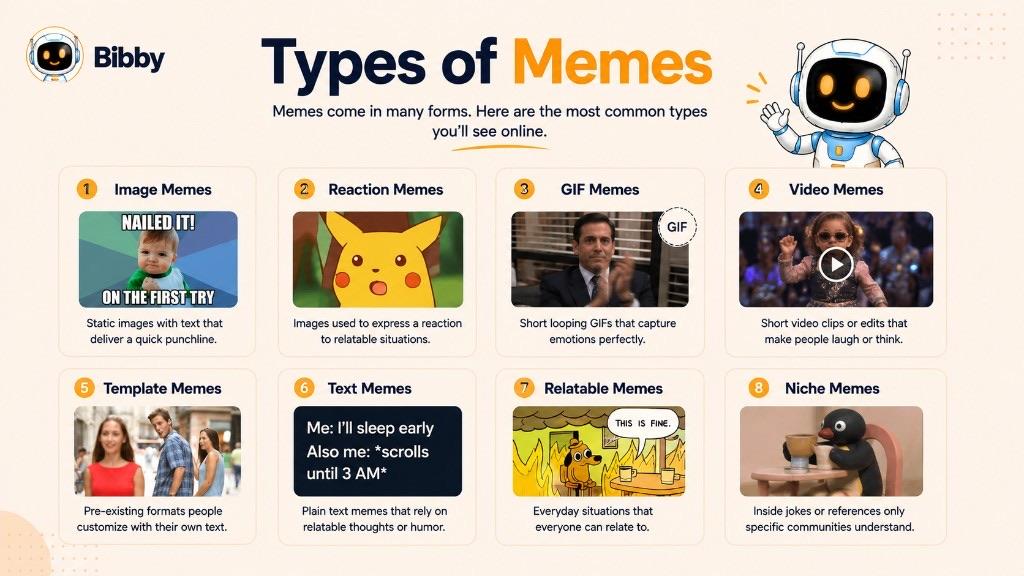
The thumbnails are familiar examples of formats, not a complete catalog. Categories can overlap, and a meme does not have to be a famous template to function as a meme.
Image Memes
Image memes use a still image as the primary piece of content, usually combined with text, a caption, or another visual element.
The image might be an original photograph, screenshot, illustration, artwork, or recognizable internet image. Image memes are popular because they can communicate an idea quickly and are easy to adapt and share.
Reaction Memes
Reaction memes are used to express an emotion or response to a particular situation.
They commonly feature a recognizable facial expression, character, photograph, GIF, or short video. Instead of explaining a reaction with words, users can share a familiar reaction meme that communicates the feeling immediately.
Common reactions include laughter, confusion, excitement, disappointment, disbelief, frustration, and surprise.
GIF Memes
GIF memes use short, looping animated clips to communicate a joke, reaction, emotion, or situation.
Because GIFs contain motion, they can express reactions that would be difficult to capture in a static image. They are especially common in conversations, comments, messaging apps, and social media.
Video Memes
Video memes use short-form or edited video as their main format.
They may involve a memorable clip, unusual moment, audio track, visual effect, or recurring video structure that people begin reusing. Short-form video platforms have made video memes particularly easy to reproduce and adapt.
Caption Memes
Caption memes combine an image or video with text that changes its meaning or adds the joke.
The same visual can be reused repeatedly with different captions, allowing people to apply a familiar format to completely different situations.
Image Macro Memes
An image macro is a common meme format consisting of an image combined with prominent text, often placed above, below, or directly over the image.
Image macros were particularly influential in the development of early internet meme culture and helped establish many conventions associated with online memes.
Template Memes
A meme template is a reusable piece of content that provides the basic structure for creating multiple variations.
A template might be an image, video, screenshot, phrase, or visual arrangement. Users keep the recognizable structure while replacing the message or situation.
The more adaptable a template is, the more potential variations it can generate.
Phrase and Text Memes
Not all memes require images or videos. Some memes are words, phrases, sentences, slogans, or recurring expressions that spread through repeated use.
A phrase can become a meme when an online community repeatedly recognizes, copies, and adapts it to communicate a particular idea or joke.
Political and Satirical Memes
Political and satirical memes use humor, irony, exaggeration, or parody to comment on politicians, governments, policies, public events, or social issues.
These memes can spread rapidly during major news events or elections because they combine recognizable formats with topics that people are already discussing. Brands should treat this category with extra care around accuracy, sensitivity, and brand safety.
Relatable Memes
Relatable memes focus on everyday experiences that a particular audience recognizes.
Common subjects include work, school, relationships, family, money, social situations, technology, and ordinary frustrations. Their appeal comes from the feeling that the meme accurately describes an experience shared by the audience.
Niche and Community Memes
Niche memes are created for specific communities rather than a general audience.
They may reference a particular game, television show, profession, hobby, fandom, online community, or cultural group. Understanding the meme often requires knowledge of the community behind it.
Niche memes demonstrate that a meme does not need millions of views to be meaningful. A format can spread successfully within a relatively small community.
Trending Memes
Trending memes are formats or references that experience a rapid increase in popularity because of a current event, viral moment, popular creator, entertainment release, news story, or emerging online conversation.
Their popularity can be short-lived. A meme may dominate social media for days or weeks before audiences move to a new format.
Short-Form Video Memes
Short-form video memes combine the characteristics of memes with the fast-moving nature of short-form video.
They may revolve around recurring sounds, dialogue, editing patterns, challenges, visual jokes, or recognizable scenarios. Users can reproduce the underlying format while changing the characters, context, or message.
Platforms built around short-form video have made this type of meme increasingly important to modern internet culture.
Ultimately, these categories can overlap. A single piece of content might be an image meme, reaction meme, relatable meme, and template meme at the same time. What matters most is not the category itself, but how people recognize, share, adapt, and participate in the format.
Meme Examples
Meme examples can range from a simple image with a caption to a widely reused video format. Some become recognizable across the internet, while others remain popular only within a specific community.
The important thing about an example is not simply how popular it becomes. A true meme demonstrates how people can recognize a format, reproduce it, and adapt it to communicate something new.
Classic Image-Based Meme Formats
Classic image-based memes often use a recognizable photograph, illustration, or screenshot as a reusable template.
Users keep the original visual but change the text or context to create a new joke. The image provides the familiar structure, while the new caption gives it a different meaning.
This format became one of the defining forms of early internet meme culture because it was simple to understand and easy to reproduce.
Reaction Meme Examples
Reaction memes use recognizable expressions, characters, or moments to communicate a response.
For example, an image showing someone looking shocked might be reused whenever someone wants to express disbelief. A GIF of someone celebrating might become a shorthand for excitement or success.
The visual does much of the communication, allowing users to express an entire reaction without writing a detailed explanation.
Relatable Meme Examples
Relatable memes turn ordinary experiences into shareable jokes.
A meme about struggling to get out of bed on a Monday, procrastinating on an important task, or checking a notification repeatedly can resonate because the audience recognizes the underlying experience.
These memes often work because sharing them allows people to communicate both “this is funny” and “this is exactly me.”
Viral Video Meme Examples
Video memes can emerge from a memorable moment in a video, a piece of dialogue, an unusual reaction, or a recurring editing format.
Once people recognize the original clip, they can reuse it in different situations. A video that originally had one meaning can therefore take on completely different meanings as users add new captions, sounds, edits, or contexts.
Short-form video has made this process particularly fast because users can reproduce popular formats directly within many social platforms.
Text-Based Meme Examples
Some memes spread primarily through words rather than images.
A distinctive phrase, deliberately misspelled expression, recurring joke, or piece of text can become recognizable through repeated use. People may then insert the phrase into unrelated conversations or adapt it to new situations.
Text-based memes demonstrate that a meme is fundamentally about cultural repetition and adaptation, not a particular type of media.
Community-Specific Meme Examples
Some of the most effective memes are meaningful only to a particular group.
A gaming community might create memes around a specific game mechanic. A professional community might joke about an industry-specific problem. A fandom might repeatedly reference a character or scene that outsiders don't understand.
These memes can spread extensively within their intended community without ever becoming mainstream.
That is an important characteristic of meme culture: a meme does not need to be universally understood or globally viral to function as a meme.
Why Meme Examples Matter
Looking at different meme formats reveals a common pattern. The surface content changes, but the underlying mechanism remains similar:
A recognizable idea is copied → people add their own interpretation → new versions are shared → the format becomes culturally recognizable.
That process of recognition, imitation, and variation is what turns ordinary content into a meme.
Meme vs. Other Types of Internet Content
Memes overlap with many forms of online content, but the terms are not interchangeable. A viral video can be popular without becoming a meme, while a relatively niche image can function as a meme within a small community.
The key difference is usually how people use the content. Memes are commonly recognized, repeated, adapted, and transformed by different people.
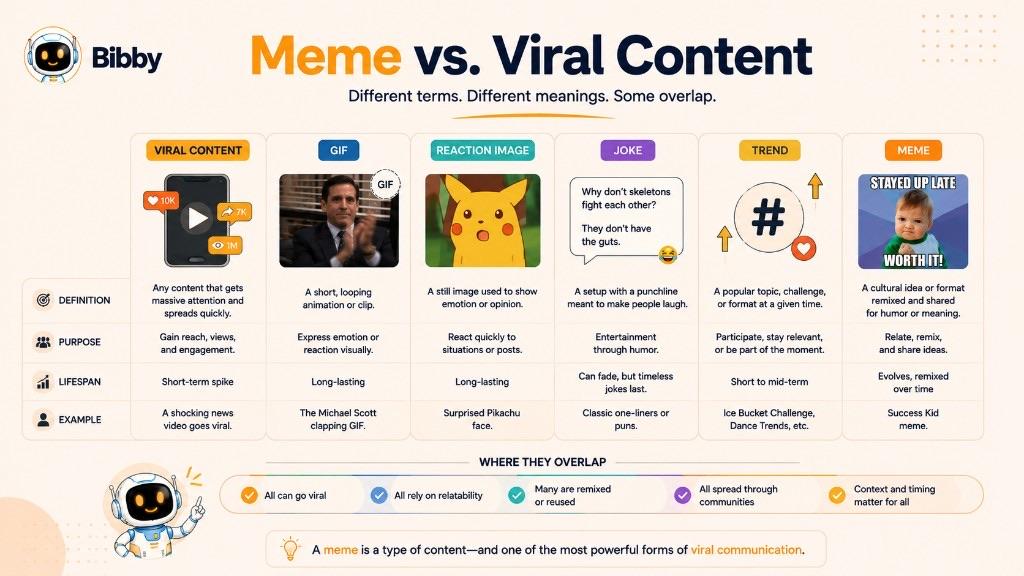
| Term | What it describes | Relationship to memes |
|---|---|---|
| Viral content | Spreads rapidly to a large audience | A meme can be viral; viral content is not automatically a meme |
| GIF | A looping animation file format | A GIF can be a meme; not every GIF is a meme |
| Reaction image | An image used to communicate a response | Often becomes a meme through repeated reuse |
| Joke | Humor intended to amuse | Can be the content of a meme; a meme is the reusable format |
| Viral video | A widely viewed video | Can become a meme when clips, sounds, or formats are reused |
| Trend | Something becoming popular | Memes and trends overlap; they are not identical |
Meme vs. Viral Content
Viral content is content that spreads rapidly and reaches a large audience. It can be a news story, photograph, video, social media post, or any other type of content.
A meme can be viral, but it doesn't have to be. Likewise, viral content isn't necessarily a meme. A video might receive millions of views while remaining a single, unchanged piece of content.
A meme typically involves some degree of reproduction or adaptation.
Meme vs. GIF
A GIF is a file format used to display animated images. A meme is a cultural concept involving content that is recognized, shared, and often adapted.
A GIF can therefore be a meme, but not every GIF is a meme. For example, a short animation used simply as decoration is a GIF but does not necessarily function as a meme.
Meme vs. Reaction Image
A reaction image is an image used to communicate a response or emotion, such as surprise, laughter, confusion, or frustration.
Reaction images often become memes when people repeatedly recognize and reuse them in different contexts. However, the terms describe slightly different things: *reaction image* describes the function of an image, while *meme* describes a broader pattern of cultural sharing and adaptation.
Meme vs. Joke
A joke is a humorous idea or story intended to produce laughter. It can be told once and never repeated.
A meme can contain a joke, but memes are often more participatory. A recognizable meme format can be reused by many people, with each person creating a new version.
In this sense, a joke can be the content of a meme, while the meme is the reusable cultural format surrounding it.
Meme vs. Viral Video
A viral video is a video that receives unusually widespread attention and sharing.
A viral video can become a meme when people begin extracting moments, sounds, phrases, characters, or formats from it and using them to create new content.
For example, one memorable moment from a viral video might become a reusable reaction or audio format that appears in thousands of unrelated posts.
Meme vs. Trend
A trend is a behavior, topic, format, style, or activity that becomes increasingly popular.
Memes and trends frequently overlap, but they aren't identical. A trend might involve people performing the same activity without copying a specific cultural reference, while a meme usually involves a recognizable idea or format that people reproduce and adapt.
A meme can also become a trend when enough people begin participating in it.
The Simple Difference
The easiest way to distinguish these concepts is to focus on participation and adaptation.
- Viral content: spreads widely.
- GIF: describes a media format.
- Reaction image: communicates a reaction.
- Joke: is designed to entertain or amuse.
- Viral video: is a widely viewed video.
- Trend: describes something becoming popular.
- Meme: is content, an idea, or a format that people recognize, reproduce, and often adapt.
These categories can overlap. The same piece of content can be a viral video, a meme, and part of a broader trend at the same time.
Why Are Memes So Popular?
Memes are popular because they make communication fast, recognizable, emotional, and participatory. A single image, phrase, or short video can communicate an idea that might otherwise require several sentences to explain.
Their appeal also comes from the fact that people don't just consume memes—they can participate in them. Anyone can take a familiar format and adapt it to their own experience, audience, or sense of humor.
Memes as a Form of Communication
Memes have become a kind of shorthand for communicating online.
A familiar image can express frustration. A reaction GIF can communicate excitement. A recognizable phrase can signal irony. A familiar format can turn an everyday situation into a joke without requiring a long explanation.
This works because the audience brings existing cultural knowledge to the content. Once people understand what a particular format represents, they can interpret new variations almost instantly.
Memes can therefore communicate emotion, humor, opinions, identity, and social commentary in a compact format.
Memes and Online Communities
Memes help online communities develop their own shared language.
A gaming community, fandom, professional group, or social media community may develop references that are immediately understood by its members. Creating or sharing those memes can reinforce a sense of belonging because participants demonstrate that they understand the group's culture.
This is one reason niche memes can be highly effective even when they have little relevance outside their original community.
Memes aren't only entertainment—they can also function as social signals that communicate, “I understand this community, and I'm part of it.”
Memes and Internet Culture
Memes have become closely connected to modern internet culture because they reflect what people are talking about, watching, experiencing, and reacting to.
Current events, entertainment, technology, politics, celebrities, social trends, and everyday experiences can all become raw material for memes.
Internet culture also moves quickly, and memes match that pace. A new format can emerge, spread across communities, evolve through thousands of variations, and disappear within a short period.
At the same time, some memes survive much longer than their original moment. Formats can be revived, repurposed, or rediscovered by new audiences.
Why People Share Memes
People share memes for different reasons. They might find something funny, see themselves in it, want to make a friend laugh, react to a situation, or communicate an opinion indirectly.
Sharing can also strengthen relationships. Sending someone a meme that perfectly describes a shared experience can communicate familiarity and understanding without saying much at all.
Ultimately, memes succeed because they combine communication with participation. They give people a simple way to recognize an idea, add their own interpretation, and pass it on to someone else.
How Memes Are Used on Social Media
Social media has become one of the main environments where memes are created, shared, remixed, and discovered. Different platforms encourage different types of meme content, so the same idea may look very different depending on where it is published.
Memes can be used simply for entertainment, but they can also help people express emotions, participate in conversations, build communities, and communicate a brand's personality.
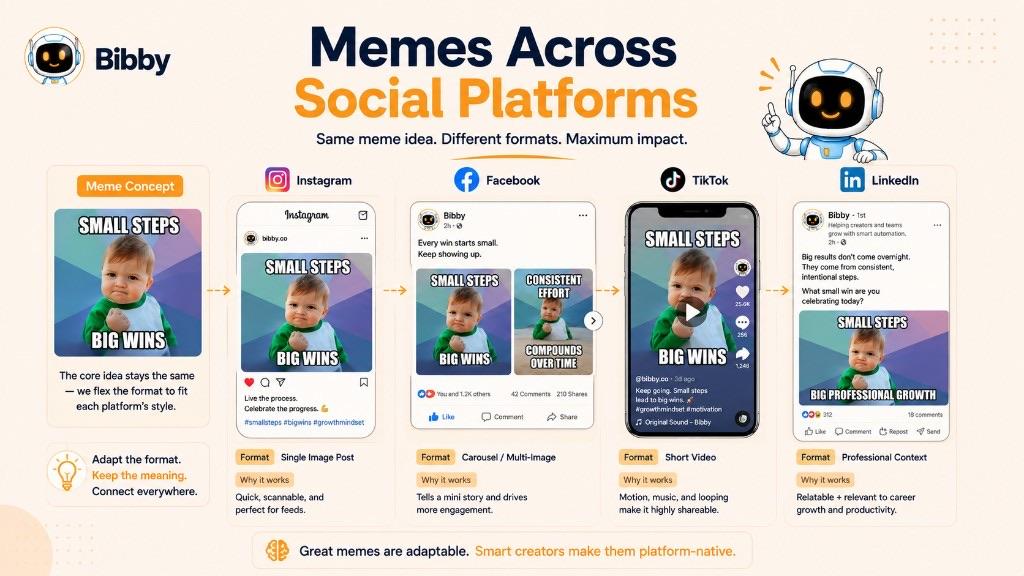
Memes on Instagram
Instagram is well suited to visual memes, including images, carousels, Reels, Stories, and short-form video.
Image-based memes can work well in feeds, while video memes can take advantage of short-form viewing and audio trends. Stories can also be used for more temporary reactions, jokes, polls, and community interactions.
Because Instagram is highly visual, successful memes generally need to communicate their idea quickly without relying on lengthy explanations.
Memes on Facebook
Facebook has a long history of meme sharing through Pages, Groups, feeds, and private conversations.
Memes can spread particularly well within communities built around shared interests, hobbies, entertainment, local topics, or specific demographics. A meme shared within a relevant group may generate discussion and further sharing even if it never becomes broadly viral.
Facebook also makes memes easy to redistribute between public posts, Groups, and personal networks.
Memes on TikTok
TikTok has expanded the concept of the meme beyond static images by making sounds, video structures, editing patterns, dialogue, and recurring formats highly reusable.
A meme on TikTok might therefore be a specific sound, a recurring scenario, an editing technique, a visual joke, or a particular style of video.
The platform's short-form format also makes it easy for users to reinterpret popular ideas while adding their own personality and context.
Memes on LinkedIn
Memes are also used on LinkedIn, although the tone and subject matter tend to differ from entertainment-focused platforms.
Professional memes often revolve around workplace experiences, meetings, hiring, management, careers, productivity, business culture, and industry-specific frustrations.
The most effective professional memes generally feel relevant to the audience rather than simply copying a popular internet format. A meme that works on one platform may feel inappropriate or out of place on another.
Why Platform Context Matters
A meme does not exist independently of its audience. The same joke can receive very different reactions depending on the platform, community, format, and expectations of the people seeing it.
For example, an image that works as an Instagram post may need to become a short video for TikTok, while a workplace-related joke may be more appropriate for LinkedIn.
When using memes on social media, creators and brands should therefore consider the platform, the audience, the format, the timing, and the cultural context rather than simply reposting identical content everywhere.
Memes work best when they feel native to the community where they appear.
Memes in Social Media Marketing
Memes can be a powerful social media marketing tool when they fit a brand's personality and audience. Unlike traditional promotional content, a good meme can feel conversational, entertaining, and native to the platform rather than like an advertisement.
For brands, the goal isn't simply to make something funny. The goal is to use a familiar cultural format to communicate something relevant to the audience while remaining consistent with the brand.
Why Brands Use Memes
Brands use memes for several reasons:
- Engagement: Memes can encourage likes, comments, shares, and reactions.
- Shareability: Relatable content can give followers a reason to share a post with others.
- Brand personality: Humor can make a brand feel more human and approachable.
- Cultural relevance: Memes allow brands to participate in conversations already happening online.
- Community building: Relevant memes can create a sense of shared experience between a brand and its audience.
- Attention: Familiar formats can make social content easier to notice while people scroll.
However, popularity should not be the only objective. A meme that generates engagement but has no meaningful connection to the brand may create attention without building a useful relationship with the audience.
When Should a Brand Use a Meme?
A brand should consider using a meme when the format naturally fits its audience, voice, and subject matter.
Memes can work particularly well when:
- The audience already understands the reference.
- The joke relates naturally to the brand or industry.
- The format matches the platform.
- The brand has a tone that allows for humor or informality.
- The meme adds entertainment rather than simply promoting a product.
- The trend is still relevant when the content is published.
A useful test is simple: Would this still make sense if the brand name were removed?
If the content is entertaining or relatable on its own and the brand connection feels natural, the meme is more likely to work.
Risks of Using Memes for Marketing
Meme marketing also has risks. Internet culture changes quickly, and a format that is popular today can become outdated tomorrow.
Brands should watch out for:
Forced humor: A meme that doesn't match the brand's personality can feel artificial.
Outdated trends: Using a format after audiences have moved on can make a brand appear out of touch.
Misunderstood context: A meme may have meanings or associations that aren't obvious to someone unfamiliar with its original community.
Copyright and usage issues: Not every image, video, character, or piece of popular content can automatically be used commercially. Brands should understand the rights associated with the material they publish.
Cultural sensitivity: Memes can involve sarcasm, controversial subjects, stereotypes, or references that may be inappropriate for a particular audience.
Brand-safety concerns: A trending meme may be associated with topics that conflict with a company's values or reputation.
The Best Meme Marketing Feels Native
The strongest brand memes generally don't feel like advertisements disguised as jokes. They feel like content that belongs naturally in the conversation.
That means understanding the reference, knowing the audience, adapting the format appropriately, and giving people a reason to engage with the content beyond the fact that a company published it.
For brands, the most valuable meme isn't necessarily the one that gets the most views. It's the one that gets the right audience to recognize, enjoy, and share the brand's message.
How to Make a Meme
Making a meme usually starts with a simple idea: take a recognizable image, video, phrase, or situation and add a new interpretation that your audience can understand and relate to.
A good meme doesn't need complicated design or expensive tools. What matters most is the idea, timing, context, and ease with which people can understand and share it.
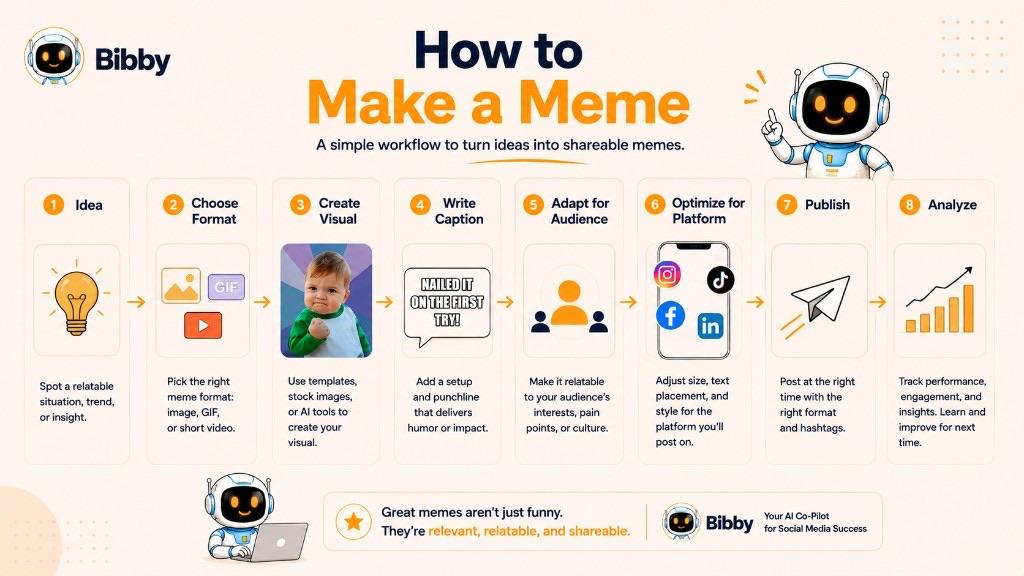
Publishing “at the right time with hashtags” is optional and platform-specific. Bibby can generate visuals and captions and schedule posts at AI-optimized times; it does not auto-generate hashtags or replace each platform’s analytics.
Choose a Meme Idea
Start with an observation, situation, reaction, or joke that your audience will recognize.
Good meme ideas often come from everyday experiences, common frustrations, current events, popular entertainment, workplace situations, community inside jokes, trending conversations, and relatable emotions.
The strongest ideas are usually simple enough to understand quickly but specific enough to feel relevant.
Choose an Image, Video, GIF, or Template
Next, choose the format that best communicates the idea: a photograph, an illustration, a screenshot, a GIF, a short video, an existing meme template, or an original image or video.
If you're using an existing piece of media, make sure you have the appropriate rights or permission to use it, particularly for commercial content.
Add the Caption or Message
The caption gives the media its meme context.
Keep the message concise and make sure the audience can understand the joke without unnecessary explanation. If the humor depends on a specific reference, assume the audience needs enough context to recognize it—but avoid explaining the joke so thoroughly that it stops being funny.
A useful meme often creates a quick connection between the visual and the situation being described.
Make the Meme Easy to Understand
People often encounter memes while scrolling quickly, so clarity matters.
Use readable text, a clear visual hierarchy, and a message that can be understood without excessive effort. Avoid adding unnecessary elements that distract from the central idea.
The audience should generally understand what the meme is communicating within a few seconds.
Adapt It for Your Audience
The same meme format can work differently for different communities.
A gaming audience may understand references that make no sense to a general audience. A workplace audience may respond better to professional situations than internet slang.
Before publishing, consider: Who is this for? What does this audience already understand? Why would they want to share it?
The more closely the meme matches the audience's interests and cultural context, the more naturally it is likely to perform.
Optimize It for the Social Platform
A meme should also fit the platform where it will be published.
Consider the platform's preferred formats, aspect ratios, content style, audience behavior, and typical viewing experience. A static image might work well as a feed post, while the same idea could be transformed into a short video for a short-form video platform.
Avoid treating every social network as if it has the same audience and content culture.
Publish and Learn From the Response
After publishing, pay attention to how people respond in native platform analytics.
Look beyond views and consider shares, comments, saves, reactions, watch time for video memes, profile visits, follower growth, and conversations generated by the post.
If a particular format resonates with your audience, you can experiment with new variations rather than simply repeating the same meme.
The goal isn't to reproduce someone else's joke indefinitely. A good meme gives you a recognizable starting point that you can adapt into something relevant to your own audience.
How to Create Memes with AI
AI can make meme creation faster by helping with everything from generating ideas and images to writing captions and producing multiple variations. Instead of starting with a blank canvas, creators can use AI to explore different concepts and adapt them for specific audiences.
However, AI doesn't automatically understand humor, cultural context, or internet trends perfectly. The best results usually come when AI handles repetitive creative work while a person provides the idea, context, and final judgment.
Generate Meme Ideas
AI can help brainstorm meme concepts based on a topic, audience, industry, or situation.
For example, a creator could ask AI for meme ideas about remote work, marketing, gaming, entrepreneurship, or everyday workplace experiences. The creator can then select the ideas that feel most relevant and develop them further.
Create or Adapt Meme Images
AI image-generation tools can create original visuals for memes or help transform an existing concept into a new visual direction.
Original imagery can be particularly useful for brands that want to create meme-style content without relying entirely on commonly reused templates.
Bibby can generate visuals as part of a post, or you can upload your own. That is not the same as a dedicated meme-template library or a guarantee that a generated image is funny, on-trend, or cleared for every commercial use.
Generate Meme Captions
AI can also generate different caption variations for the same visual idea.
A creator might ask for versions that are more relatable, more sarcastic, more professional, more playful, shorter, or more appropriate for a particular audience.
Generating several options makes it easier to compare different approaches before publishing. In Bibby, you can generate and regenerate captions in chat while you build the post.
Create Multiple Meme Variations
One advantage of AI is the ability to turn a single concept into several variations.
Instead of publishing one version, a creator can experiment with different visuals, captions, tones, or audience angles. This can help identify which interpretation resonates most strongly with a particular audience.
Adapt Memes for Different Platforms
A meme created for one social network may need to be changed for another.
AI can assist with adapting the same underlying concept into different formats—for example, turning an image-based idea into a short video concept or rewriting the caption to better match a professional audience.
The goal should be platform adaptation, not simply copying the same post everywhere.
Use Human Judgment
AI-generated memes still need human review.
Before publishing, check whether the joke makes sense, whether the cultural reference is accurate, whether the content fits the brand, whether you have the rights to any media involved, and whether the material could be misunderstood or offensive.
AI can generate possibilities quickly, but people provide the context and judgment that make those possibilities useful.
AI Meme Creation in a Social Media Workflow
AI becomes particularly useful when meme creation is connected to the rest of the social media workflow.
With Bibby, that path can look like: idea → visual (upload or generate) → posting style → AI caption → schedule at AI-optimized times → publish on Facebook, Instagram, LinkedIn, YouTube, and TikTok.
Measure how the post performs in each platform's native analytics. Bibby does not replace those dashboards.
Used well, AI can reduce the time spent on repetitive tasks while leaving the most important decisions—what to say, who to say it to, and whether it is actually worth publishing—in human hands. Get started with Bibby when you want that creation and scheduling workflow in one place.
Meme Best Practices for Social Media
Creating a meme is easy; creating one that people actually understand, enjoy, and want to share takes more thought. The best social media memes combine a clear idea with the right audience, platform, timing, and cultural context.
Whether you're an individual creator or a brand, these practices can help make meme content more effective.
1. Understand the Reference Before Using It
Don't use a meme format simply because it is popular.
Understand what the original image, phrase, sound, or format means and how people typically use it. A reference can have cultural associations that aren't obvious from the surface.
Using a format incorrectly can make the content feel forced or disconnected from the community that created it.
2. Keep the Message Easy to Understand
Memes are usually consumed quickly, particularly on social media.
Keep the central idea clear and avoid unnecessary text or visual elements. If someone needs several paragraphs of explanation to understand the joke, the meme probably needs to be simplified.
3. Don't Force a Meme Onto Unrelated Content
Not every trend is relevant to every creator or brand.
A meme should have a natural connection to the topic, audience, personality, or situation you're addressing. Trying to attach a popular format to an unrelated product or message can make the content feel like an advertisement rather than a genuine meme.
4. Match the Platform's Culture
A meme that performs well on one platform may not work the same way somewhere else.
Consider how people on the platform consume content, what formats they prefer, and what tone is normal within that community.
Adapting the concept to the platform is usually more effective than publishing an identical version everywhere.
5. Avoid Overusing the Same Format
A meme format can become less effective when audiences see it repeatedly.
If every post uses the same template, the content can quickly become predictable. Experiment with different formats, subjects, visual styles, and types of humor.
6. Publish While the Trend Is Relevant
Trending memes can have short lifespans.
If you're responding to a current meme or cultural moment, publishing too late can make the content feel outdated. At the same time, speed shouldn't come at the expense of understanding the reference or checking whether the content is appropriate.
7. Make Sure the Meme Fits the Brand
Brands should use memes that are consistent with their personality and audience.
A playful brand may have more freedom with internet humor, while a highly formal organization may need a more restrained approach.
The objective isn't to make a brand behave like an individual internet user. It's to find forms of humor that feel authentic to the brand.
8. Avoid Potentially Harmful Context
Before publishing, consider whether a meme contains sensitive references, stereotypes, misinformation, controversial imagery, or material that could damage the brand's reputation.
Context matters. A format that seems harmless in isolation may have a very different meaning within the community where it originated.
9. Test Different Variations
There isn't always one perfect version of a meme.
Creators can experiment with different captions, visuals, formats, or angles while keeping the underlying idea consistent. Testing can reveal which types of humor and topics resonate with a particular audience.
10. Retire Outdated Formats
Not every meme needs to be used forever.
Some formats have short lifecycles and eventually become repetitive or associated with an earlier internet trend. Continuing to use an outdated meme can make content feel less relevant.
Watch how audiences respond and move on when a format has reached the end of its useful life.
The Goal of Meme Content
The best meme content doesn't feel like content created solely to chase engagement. It feels relevant to the people seeing it.
A successful meme should give the audience something worth recognizing, enjoying, reacting to, or sharing. When those elements come together, memes can become one of the simplest ways to participate in an online conversation while expressing a distinct point of view.
Meme Terminology
Meme culture has developed its own vocabulary to describe different formats, behaviors, communities, and types of internet content. Understanding these terms makes it easier to recognize how memes are created, shared, and adapted online.
| Term | Meaning |
|---|---|
| Meme template | A reusable image, video, phrase, or other format that provides structure for variations |
| Meme format | The recognizable structure or pattern behind a meme |
| Meme culture | Shared practices, references, humor, and communities around memes |
| Viral meme | A meme that spreads rapidly to a large audience |
| Reaction meme | A meme used to communicate a response or emotion |
| Dank meme | Subjective term for highly online, often absurd, ironic, or niche humor |
| Image macro | An image combined with prominent captions |
| Reaction image | An image used to express an emotion or response |
| Meme page / account | An account or site dedicated to publishing or collecting memes |
| Meme trend | A format or style that sees a period of increased participation |
| Meme community | A group that shares particular formats, references, or humor |
| Meme generator | A tool for selecting a template and adding text or other elements |
| Shitpost | Deliberately low-quality, absurd, or chaotic content, often for comedy |
| Remix | A modified version of existing content that keeps a connection to the original |
| Copypasta | Text repeatedly copied and pasted as a joke or recognizable reference |
Meme Template
A meme template is a reusable image, video, phrase, or other format that provides the basic structure for creating multiple meme variations.
Meme Format
A meme format is the recognizable structure or pattern behind a meme. It can include a particular image, caption style, video structure, phrase, sound, or recurring joke.
Meme Culture
Meme culture refers to the shared practices, references, humor, behaviors, and communities that develop around memes and internet-based communication.
Viral Meme
A viral meme is a meme that spreads rapidly and reaches a large audience across one or more platforms.
Not every meme becomes viral, and a meme can be successful within a small community without reaching a mainstream audience.
Reaction Meme
A reaction meme is a meme used primarily to communicate a response or emotion, such as excitement, disbelief, frustration, amusement, or surprise.
Dank Meme
A dank meme is a term commonly associated with highly online, often intentionally absurd, ironic, surreal, or niche meme humor.
The term is subjective and can change meaning depending on the online community using it.
Image Macro
An image macro is an image combined with text, traditionally using prominent captions placed over or around the image.
Image macros were an important format in the development of early internet meme culture.
Reaction Image
A reaction image is an image used to express a particular emotion or response in an online conversation.
Reaction images can become memes when they are repeatedly reused and adapted across different contexts.
Meme Page and Meme Account
A meme page is a social media account or website primarily dedicated to publishing, collecting, or sharing memes. A meme account is built primarily around meme content and may publish original memes, curate existing formats, or create variations around current trends.
Some meme pages focus on general humor, while others specialize in particular communities, interests, or subjects.
Meme Trend
A meme trend is a meme format, reference, or style that experiences a period of increased popularity and participation.
Meme trends can spread rapidly and may disappear just as quickly.
Meme Community
A meme community is a group of people who share particular meme formats, references, interests, or styles of humor.
Communities can form around platforms, fandoms, hobbies, professions, games, or other shared interests.
Meme Generator
A meme generator is a tool that allows users to create memes, commonly by selecting an image or template and adding text or other elements.
Modern meme-generation tools may also include video editing, AI-generated imagery, automatic captioning, and other creative features. Bibby is a social content and scheduling workflow, not a dedicated meme-generator product.
Shitpost
A shitpost is deliberately low-quality, absurd, nonsensical, provocative, or intentionally chaotic online content, often created for comedic effect.
The term is strongly associated with internet culture and can overlap with meme culture.
Remix
A remix is a modified version of existing content that changes or combines elements while retaining some connection to the original.
Remixing is fundamental to meme culture because users frequently take existing formats and reinterpret them.
Copypasta
A copypasta is a piece of text that is repeatedly copied and pasted across online communities, often as a joke or recognizable reference.
Although copypasta is primarily text-based, it shares the broader meme characteristic of cultural replication.
Together, these terms describe the ecosystem surrounding memes—from the templates people reuse to the communities that give those formats meaning.
Key Takeaways
- A meme spreads through imitation and variation, not only through being funny or popular.
- Humor helps, but memes can also communicate emotion, opinion, identity, and commentary.
- Viral content, GIFs, jokes, and trends overlap with memes; they are not the same thing.
- The word *meme* predates social media; internet culture gave it a new, faster environment.
- Brands can use memes when the reference, rights, platform, and voice all fit—forced humor usually fails.
- Bibby can help generate visuals and captions and schedule the finished post. You still decide whether the joke is worth publishing.
Explore more terms in the social media dictionary, including GIFs, viral content, UGC, and short-form video.