
In marketing, social proof helps people feel more confident about a brand, product, or decision by showing that others have already chosen, trusted, or benefited from it. A campaign can generate likes and still produce little business value. Conversely, a smaller set of specific customer results can carry more weight than a vague “everyone loves us” claim.
Social proof is both a psychological concept and a practical tool. It is not the same as quality, and it is not a conversion guarantee. Popularity can be a useful signal; it does not prove something is the best choice.
Tools such as Bibby can help you turn *approved* customer quotes and stories into images, carousels, videos, and Stories, then schedule them on Facebook, Instagram, LinkedIn, YouTube, and TikTok. Bibby does not collect reviews, scrape mentions, run ads, publish to X, or report whether proof increased conversions.
What Is Social Proof?
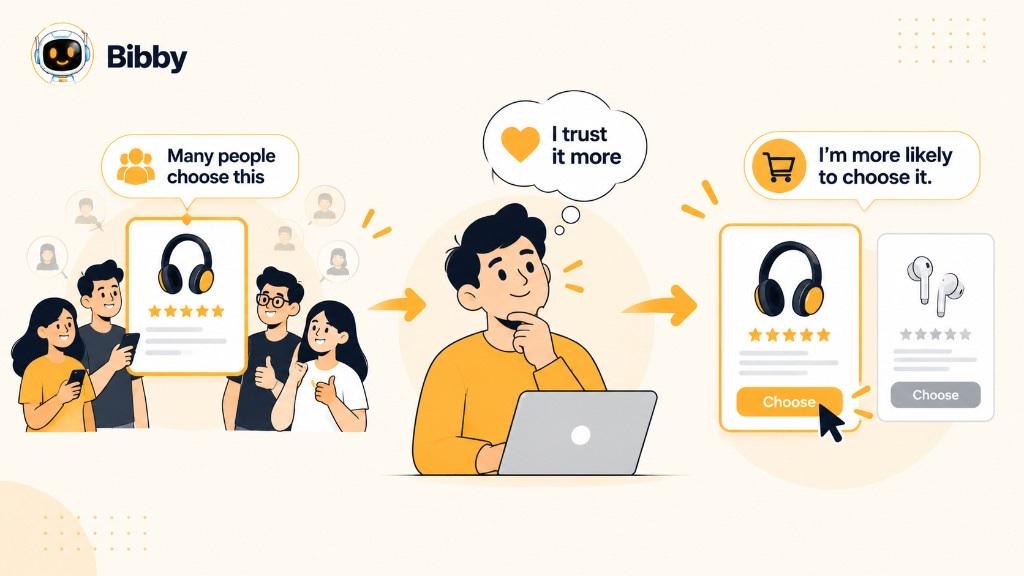
Social proof is the psychological tendency to look at the behavior, opinions, or experiences of other people when deciding what to do, particularly when you are uncertain about the right choice.
When people are unsure how to act, they often look to others for guidance. If many people appear to trust, use, recommend, or approve of something, that choice can feel more credible.
Everyday examples:
- Checking Google reviews before picking a restaurant.
- Choosing a product with thousands of positive ratings over one with almost none.
- Paying more attention to a post with many genuine likes, comments, and shares.
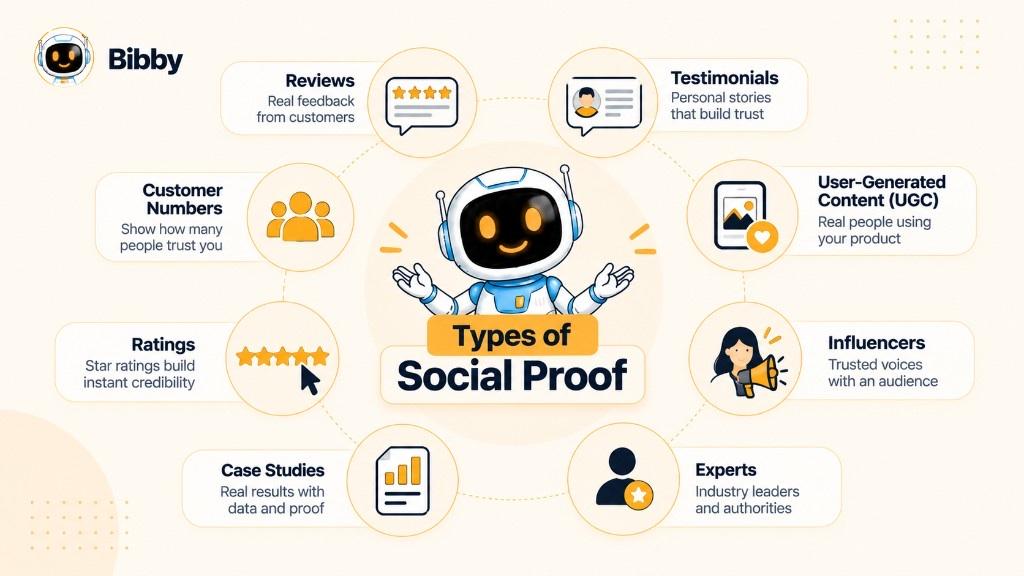
In marketing, social proof uses those signals to reduce uncertainty. Common forms include customer reviews, testimonials, ratings, case studies, UGC, influencer recommendations, expert endorsements, and customer numbers.
Social Proof Meaning
The term describes the influence other people’s actions or opinions can have on our decisions. It is especially strong when:
- We lack enough information.
- The situation is unfamiliar.
- We believe the people we are watching are knowledgeable or similar to us.
- Many people appear to be making the same choice.
- The cost of a wrong choice feels high.
Social proof does not mean a popular choice is the best choice. It explains why evidence of what others are doing or saying can change perception and behavior.
Social Proof in Marketing
Marketers show that real people have already interacted with a brand, product, service, or piece of content:
- Customer reviews — feedback from people who bought or used it.
- Testimonials — statements a business selects and presents (ideally specific).
- Ratings — aggregate scores such as 4.8/5.
- User-generated content — photos, videos, and posts customers create.
- Case studies — detailed before/after stories with outcomes.
- Influencer recommendations — relevant creators, not only large audiences.
- Expert endorsements — specialists with recognized knowledge.
- Customer numbers — “Trusted by 50,000+ businesses,” if the figure is accurate.
- Social media engagement — likes, comments, shares, views, saves.
The principle is the same: showing that other people trust or value something can make new audiences more willing to consider it.
How Does Social Proof Work?
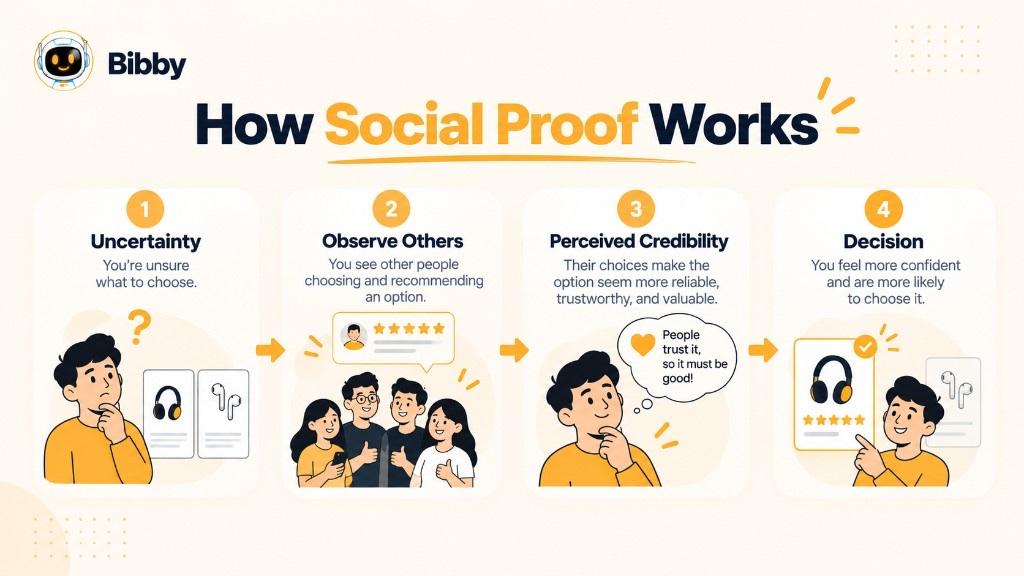
People often use others as information when they cannot evaluate every option from scratch. In unfamiliar situations, seeing others choose something can make that option feel safer.
Uncertainty Makes Social Proof More Influential
The less certain someone feels, the more they look for signals. Hundreds of reviews on an unknown brand do not guarantee quality, but they add information that can reduce perceived risk.
People Use Others as Decision-Making Shortcuts
Rather than researching every option, people may ask: “What are other people choosing?” Phrases such as “most popular,” “best seller,” or “trusted by thousands” work because they communicate that others already decided—if those claims are true.
Popularity Can Signal Credibility
A post with thousands of genuine interactions may attract more attention than an identical post with almost none. A product with many positive reviews may look more established than one with none. Popularity is still not the same as quality. Inflated likes or bought followers are weak or harmful signals.
Social Proof Can Reduce Perceived Risk
Compare:
No social proof: “Try our social media automation platform.”
With social proof: “Join thousands of businesses already using our social media automation platform.”
The second line adds context *if the number is accurate*. It does not prove the product is right for every reader. Do not invent customer counts for Bibby or any brand.
Similar People Create Stronger Proof
A small-business owner often finds another small-business owner more persuasive than a large corporation with a different use case. Effective proof identifies who is speaking, not only how many.
Influence Is Not a Guarantee
Someone can see hundreds of reviews and still not buy. A post with thousands of likes does not persuade everyone. Effectiveness depends on authenticity, relevance, credibility, recency, and context.
Types of Social Proof
1. Customer Reviews
First-hand opinions from people who purchased or used the product. Volume plus detail helps; verified reviews are stronger than anonymous praise.
2. Testimonials
Statements the business presents. Strong ones explain a problem, experience, or result—not only “great product.”
“We reduced the time spent managing social content from several hours a week to less than an hour.”
3. Ratings and Star Scores
Quick sentiment: 4.8/5, 95% positive. Useful as a scan signal; still read the underlying reviews when stakes are high.
4. User-Generated Content
UGC is created by customers, not the brand: photos, unboxings, Instagram posts, TikTok videos, mentions. It shows real-world use. Get permission before you reshare. Bibby does not discover or rights-clear UGC.
5. Influencer Recommendations
Influencer proof works when the creator is relevant. An unrelated celebrity may add attention without adding trust. Disclose paid partnerships.
6. Expert Endorsements
Authority from credentials or recognized knowledge—a marketer discussing a marketing tool, a chef recommending a kitchen tool.
7. Celebrity Endorsements
Familiarity and status more than technical expertise. Most useful when the person has a real connection to the audience or product.
8. Social Media Engagement
Likes, comments, shares, views, saves, reposts, and follower counts are visible signals. They should not be treated as proof of quality. Manufactured engagement is a mistake, not a tactic.
9. Customer Numbers
“Used by 50,000+ businesses” communicates scale when accurate and current. Say what the number means (customers vs. free sign-ups vs. email subscribers).
10. Case Studies
Problem → solution → how they used the product → measurable results → experience. Especially useful for higher-consideration B2B purchases.
11. Awards, Certifications, and Recognition
Third-party awards, accreditations, and “best of” lists—strongest when the issuer is credible and relevant.
12. Community and Peer Recommendations
Referrals, community threads, and peer advice. Often influential because the source already feels trusted.
13. Popularity and Behavioral Signals
“Best seller,” “most popular plan,” “1,500 purchased this week.” Use real data. Do not invent scarcity.
Which Type Is Best?
There is no single winner. A detailed case study may fit an expensive B2B buy; volume of product reviews may fit ecommerce. Strong proof is authentic, relevant, specific, credible, and easy to verify.
Social Proof Examples
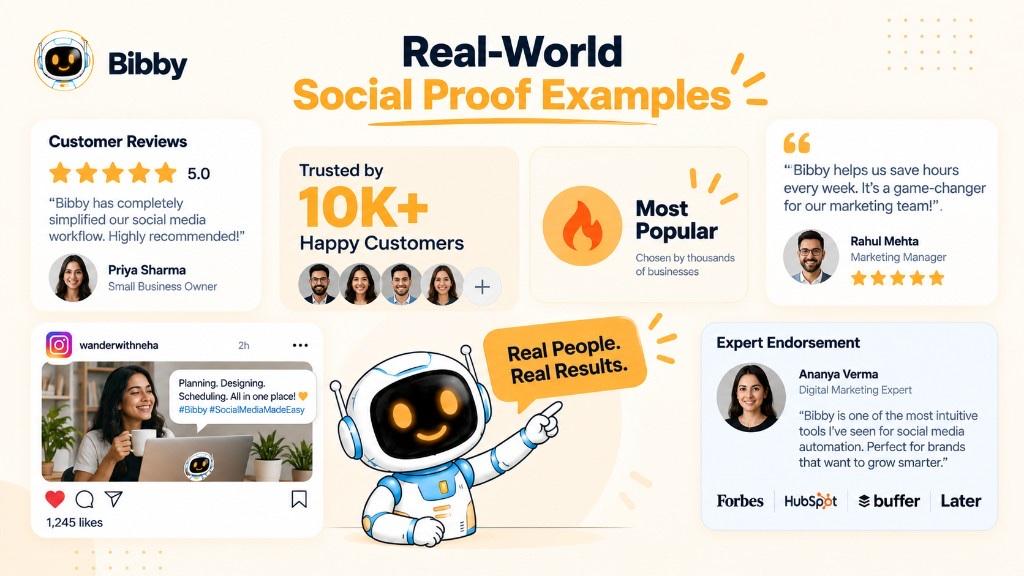
- Thousands of reviews — 4.8/5 from 3,000+ customers on a product page.
- A specific testimonial — “Our team reduced weekly social management time by 60%,” not “We love this software.”
- “Trusted by” logos — recognizable companies, used with permission.
- A customer Instagram post — the brand reposts with credit after asking.
- A TikTok demo — a creator shows the product in use.
- “Most popular” pricing — only if that plan is actually chosen most often.
- A case study — a customer increased leads by 35%, with method and context.
- Adoption numbers — “More than 50,000 businesses,” if true.
- An expert recommendation — a marketer explains why they use a tool.
- A review in an ad — paid creative that includes a real customer quote (ads run in ads managers, not in Bibby).
- Restaurant ratings — hundreds of 4.7-star reviews vs. a handful of 3.2-star reviews.
- A milestone post — “100,000 customers served,” if accurate.
- Results stories — fitness progress or software outcomes from real customers.
- Community consensus — several peers independently recommend the same tool.
- High engagement on a useful post — a signal that others found it interesting, not proof it is accurate.
What they share: evidence of what other people have done, experienced, trusted, recommended, or valued. The most useful proof shows the right people, making a relevant choice, with credible evidence.
Social Proof in Social Media Marketing
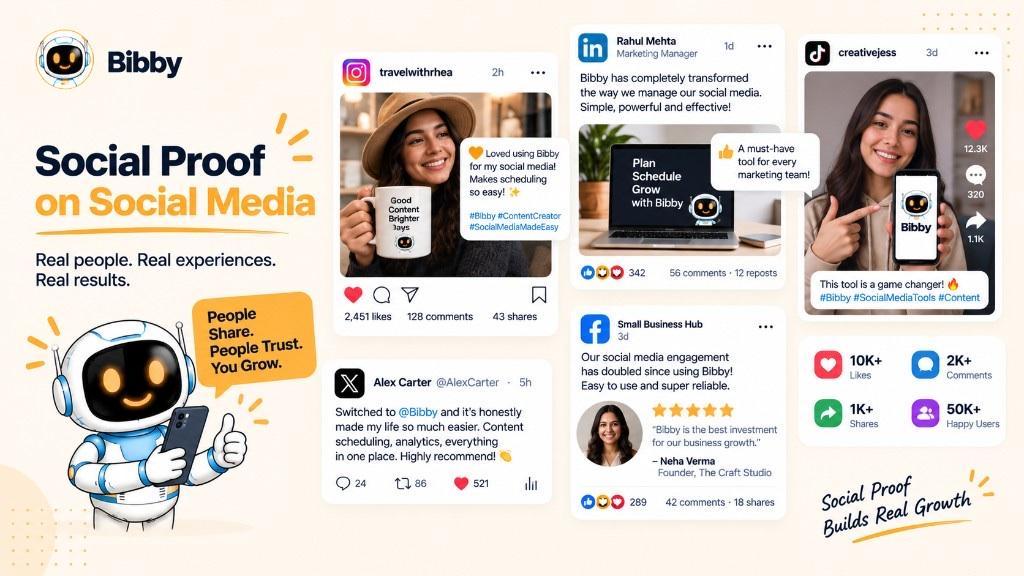
Platforms make other people’s behavior visible. That can support brand awareness and trust—if the signals are real.
Why It Matters on Social
A potential customer may lean in after seeing a customer demo, several recommendations, a testimonial post, meaningful comments, an expert discussion, or other businesses describing how they use the product.
Common Signals
Likes and reactions show interaction. Comments show discussion or questions. Shares show people thought it worth passing on. Views show exposure, not approval. Followers show audience size, not expertise. Mentions and UGC show independent talk. Testimonials let you showcase experiences you already have permission to use.
How Brands Use It
- Turn a testimonial into a graphic, carousel, video, or text post.
- Reshare UGC after permission and credit.
- Show specific results: time saved, outcomes, milestones—not vague quality claims.
- Pull a detailed review into an image or Reel; keep the wording honest.
- Tell a longer customer story (who, problem, what they used, what changed).
- Work with relevant creators; do not treat follower count as the only filter.
In Bibby you can create those assets and schedule them. You still collect quotes, rights, and results outside Bibby. Community management—replies and sensitive conversations—stays human.
Engagement Is a Signal, Not Success
A post with 50,000 likes may attract attention. A smaller post may generate better leads or conversations. Do not manufacture engagement to look popular. Review meaningful outcomes in native Insights, ads, or analytics tools.
A Practical Content Workflow
- Collect evidence (reviews, posts, case studies).
- Choose the strongest, most relevant story.
- Pick a format (image, carousel, video, Story).
- Create the post without exaggerating.
- Add who the customer is and why the result matters.
- Publish on a content calendar.
- Measure outcomes that match the goal—not likes alone.
Why Is Social Proof Important?
People do not decide from brand copy alone. They look for third-party evidence.
- Builds trust — “Our team saves several hours every week” beats “Our software saves time.”
- Reduces uncertainty — Does it work? Is it for someone like me?
- Reduces perceived risk — Others have already taken the step.
- Strengthens credibility — Reviews, awards, case studies, UGC, media coverage.
- Helps unfamiliar brands — Early, specific customer results can matter more than a thin follower count.
- Supports decisions — “Most popular” or verified review volume can help comparison—when accurate.
- Can support conversions — Proof near pricing, product pages, or sign-up can help. It does not automatically lift conversion rate. Track that in your site, ads, or analytics—not in Bibby.
Social proof is a component of marketing, not a substitute for a good product, clear messaging, or a decent customer experience.
How to Use Social Proof in Marketing
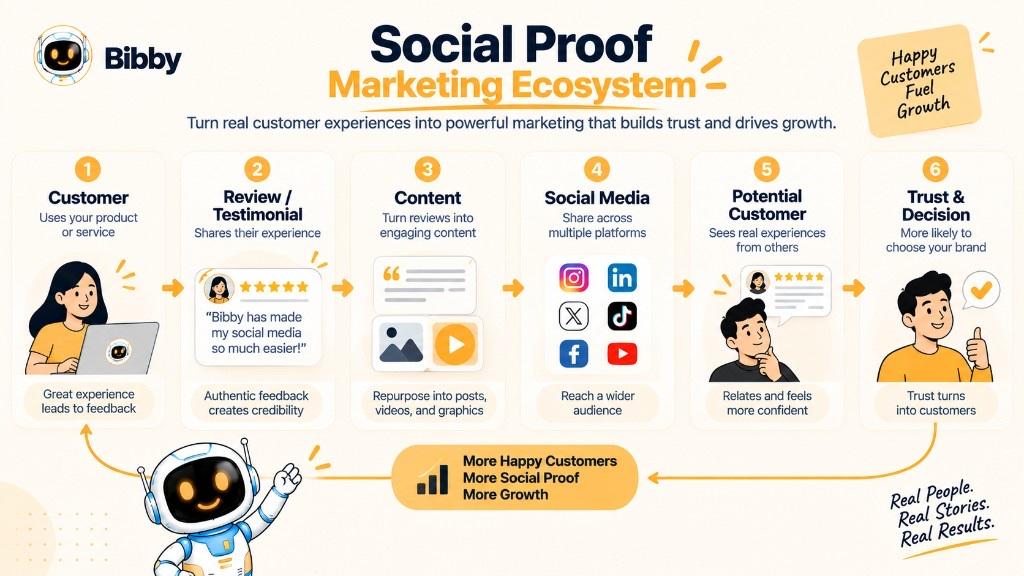
Do not sprinkle proof everywhere because a checklist said so. Find where people hesitate, then answer that hesitation with relevant evidence.
- Collect authentic feedback — reviews, surveys, support themes, interviews, mentions.
- Repurpose reviews (with permission) — social posts, quote graphics, email, landing-page quotes. Bibby can produce the creative and queue it; it is not a review inbox.
- Show specific outcomes — time saved, leads, costs reduced—only when you can support the claim.
- Feature people like the buyer — small businesses, freelancers, agencies, in-house teams, as relevant.
- Use more than one form — reviews + results + a case study + UGC.
- Place proof near the decision — pricing, product copy, demo forms, checkout on *your* site or shop—not inside Bibby.
- Keep it current — refresh stats, logos, screenshots, and user counts.
- Make it verifiable — name, role, and company when the customer agrees; avoid “our customers love us.”
- Turn proof into a content habit — one story can become a graphic, carousel, Reel, and email.
- Ask at the right time — after a result or successful implementation: “What problem were you solving, and what changed?”
- Never manufacture proof — no fake reviews, bought comments, invented case studies, or edited quotes that change meaning. Paid endorsements should be disclosed.
Social Proof on Different Marketing Channels
The format changes; the rule does not: show relevant evidence of what real people experienced, chose, recommended, or achieved.
| Channel | Useful proof |
|---|---|
| Website | Testimonials, reviews, logos, case studies |
| Quotes, case-study links, stories matched to the segment | |
| Social media | UGC, stories, reviews, creator content |
| Paid social | Reviews, ratings, quotes, results (built in ads tools) |
| Ecommerce | Ratings, reviews, customer photos, verified purchase |
| Landing pages | Testimonials, case studies, usage stats |
| B2B | Case studies, industry logos, expert endorsements |
| Content marketing | Interviews, expert quotes, research, examples |
On social, a testimonial can become an Instagram carousel, a customer video can run on TikTok, and a longer story can live on LinkedIn. Chase evidence and context—not vanity like counts.
Social Proof vs. Related Marketing Concepts
Social proof is the influence of other people’s behavior, opinions, or experiences. Reviews, testimonials, UGC, and influencer posts are *forms of evidence*, not synonyms.
vs. Testimonials
A testimonial is one statement. Customer counts are social proof without being testimonials.
vs. Customer Reviews
Reviews are one form of social proof. Social proof is the broader concept.
vs. Word-of-Mouth
Word-of-mouth is how recommendations spread. A friend suggesting a restaurant is WOM; hundreds of high ratings are also social proof.
vs. Influencer Marketing
Influencer marketing is a method. The recommendation becomes social proof when the audience treats the creator’s opinion as evidence. Disclose paid work.
vs. Authority
Expertise, credentials, and status. An expert endorsement can be both authority and social proof.
vs. Popularity
How widely something is known or chosen. Interpreting millions of views as “this is worth watching” is social proof. Views alone do not prove value.
vs. User-Generated Content
UGC is content customers make. It becomes social proof when someone else uses it as evidence. Not all UGC is marketing you have the right to reuse.
What Makes Social Proof Effective?
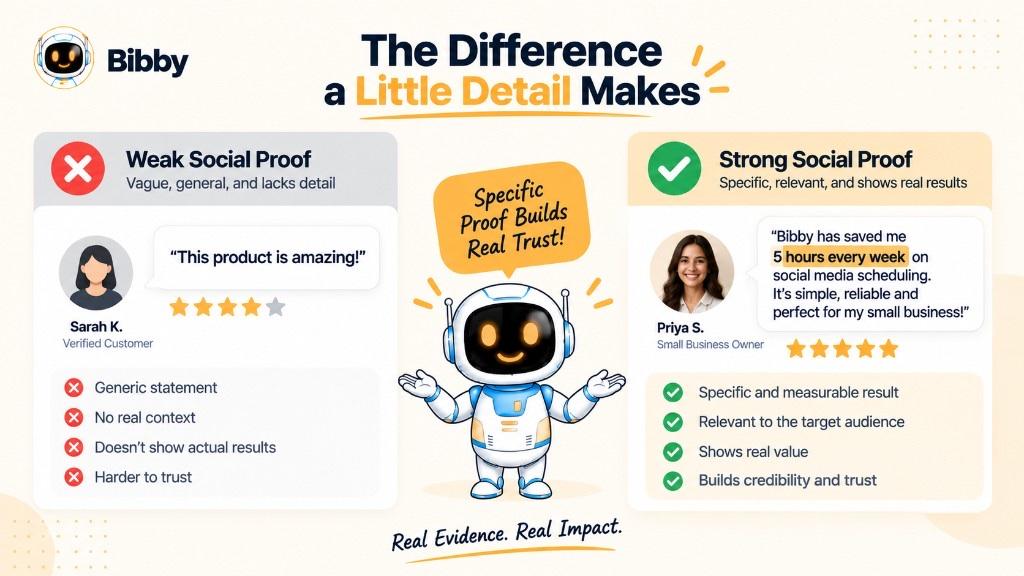
- Authenticity — real experiences, including limits when they matter.
- Relevance — a freelancer trusts another freelancer more than an enterprise logo.
- Specificity — “We cut weekly scheduling from four hours to one” beats “best platform ever.”
- Credibility — verified customers, named sources, honest methods.
- Recency — old stats and retired features confuse people.
- Quantity with quality — “4.9/5 from 2,400 reviews” beats a lone 5/5.
- Similarity — industry, role, company size, use case.
- Verifiability — extraordinary anonymous claims are weak.
- Context — “100,000 views” without audience or outcome is thin.
- Placement — the right evidence at the moment of doubt.
A detailed testimonial from one relevant customer can beat a generic claim about thousands of people.
Common Social Proof Mistakes
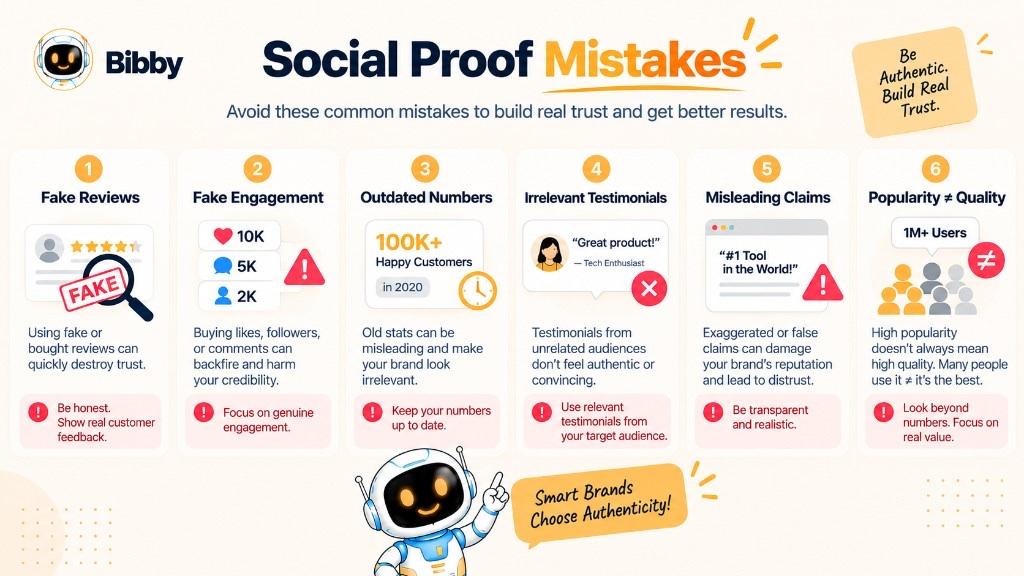
- Fake reviews — they destroy trust and can violate platform or legal rules.
- Bought engagement or followers — inflated counts are not evidence.
- Irrelevant testimonials — the wrong use case does not reassure your buyer.
- Vague claims — “thousands of happy customers” without support.
- Outdated stats — neglected numbers look careless.
- Treating follower count as quality — vanity metrics are not a full credibility story.
- Too much proof — endless widgets dilute the best evidence.
- Hidden context — “95% satisfaction” needs a real measurement.
- Editing quotes until they lie — grammar is fine; changing meaning is not.
- Using customer content without permission.
- Confusing popular with correct — viral is not the same as accurate.
- Using proof instead of fixing the product — testimonials cannot paper over a bad experience.
Don’t manufacture proof. Make genuine customer experiences easy to see.
Conclusion
Social proof is the influence of other people’s behavior, opinions, and experiences on our decisions. In marketing it gives potential customers evidence that others have already trusted, used, recommended, or benefited from something.
Remember three things:
- It reduces uncertainty — people look to others when they are unsure.
- Different types serve different jobs — reviews, testimonials, UGC, case studies, experts, and numbers are not interchangeable.
- Authenticity matters most — specific, relevant, credible experiences beat inflated popularity.
For social teams, approved customer stories can become a repeatable content source. Create and schedule those posts in a tool such as Bibby after you have the rights and the facts. Pair proof with a social media strategy so you are not posting testimonials without a goal.