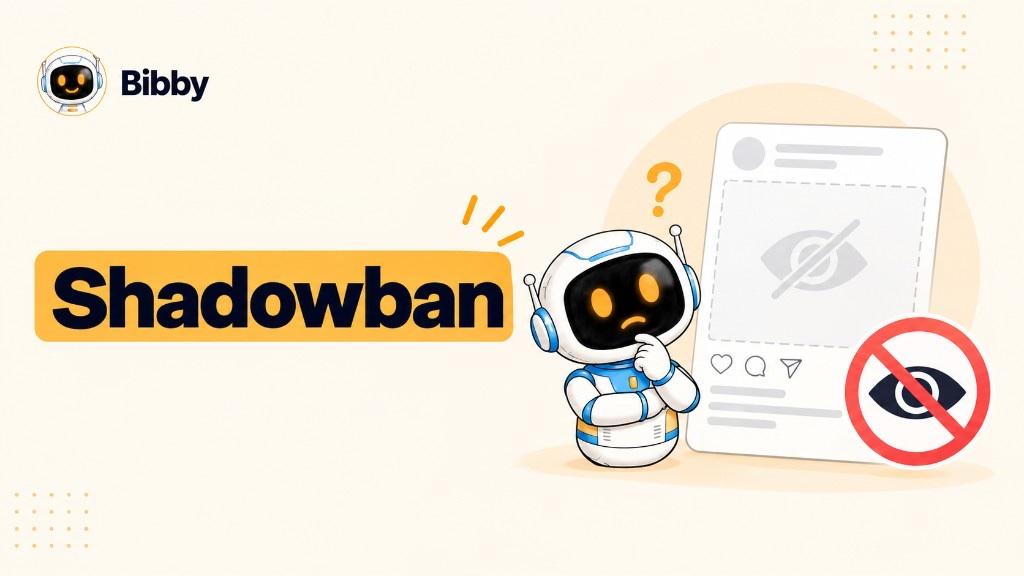
If your reach suddenly drops, your posts stop reaching non-followers, or your content becomes harder to discover, you may wonder whether you’ve been shadowbanned. In this guide, you’ll learn what a shadowban actually means, how to identify possible signs, and what you can do to restore your content’s visibility.
Understanding the difference between a genuine restriction and normal fluctuations in reach is the first step.
Bibby does not detect shadowbans or restore distribution. Use each platform’s status tools and analytics first; use Bibby to create, caption, and schedule the next compliant posts.
What Is a Shadowban?
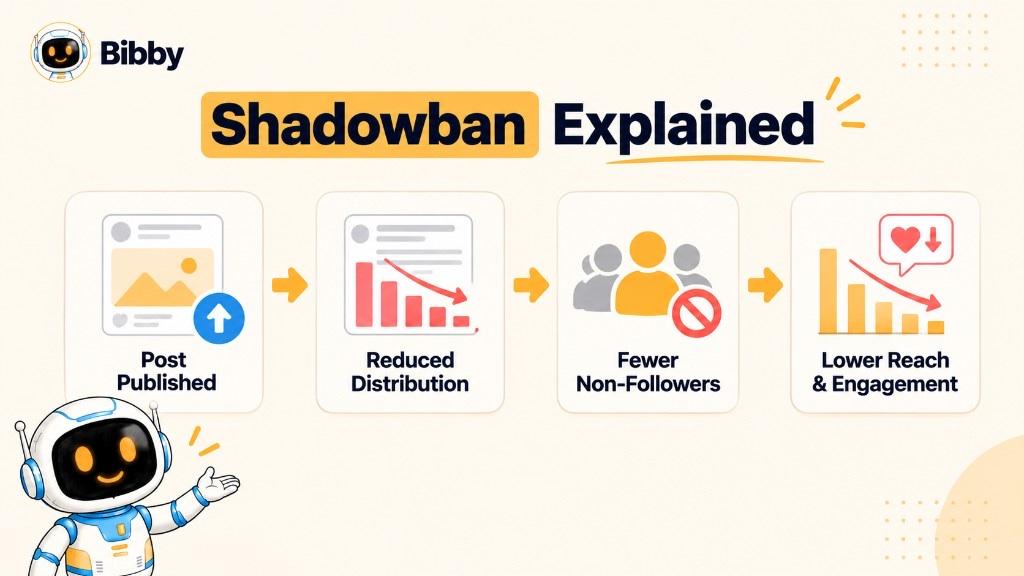
A shadowban is when a social media platform reduces the visibility or discoverability of your content without clearly notifying you that your account has been restricted. Your posts may still appear on your profile and remain visible to existing followers, but they may reach fewer people through recommendations, search, hashtags, feeds, or other discovery surfaces.
The term shadowban is widely used by social media users and marketers, but it is not a universal official term used by every platform. Different platforms use different systems and terminology for limiting content distribution, recommendations, or account activity.
In practice, people often use “shadowban” to describe a noticeable and unexplained decline in content visibility. However, a sudden drop in reach does not automatically mean you have been shadowbanned. Changes in audience behavior, content performance, recommendation algorithms, posting patterns, or platform policies can also cause your reach and engagement to fall.
In simple terms
A shadowban means your content is still published, but fewer people may be able to discover or see it.
For creators, businesses, and social media marketers, the important question is therefore not simply whether reach has declined, but why it has declined. Checking your analytics, reviewing your account or content status where available, and looking at performance across multiple posts can help distinguish a potential restriction from normal changes in content distribution.
What Does Shadowbanned Mean?
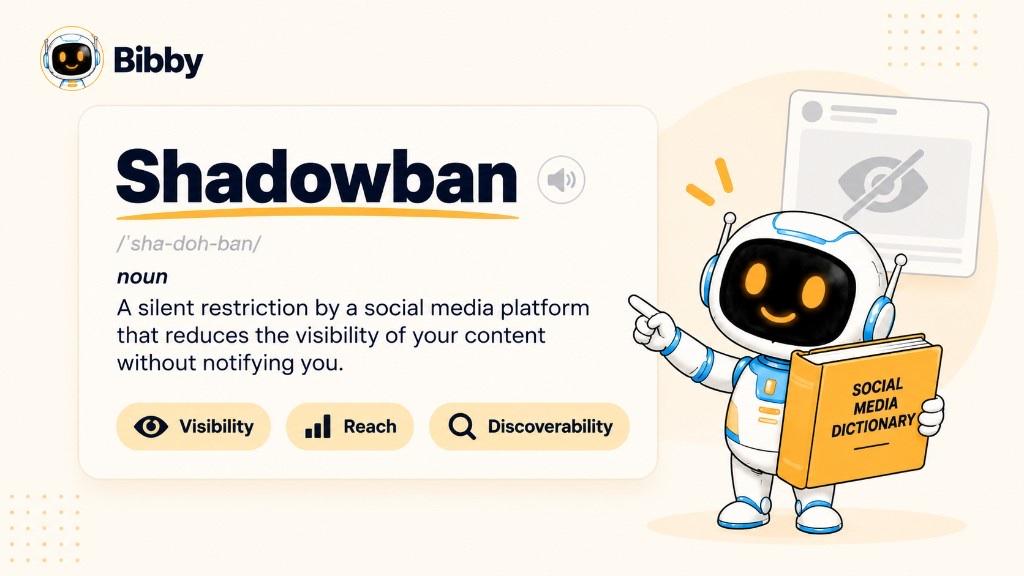
Shadowbanned means that a person believes their social media content or account has had its visibility reduced without receiving a clear notification about the limitation.
For example, a creator might notice that their posts are still visible to their followers, but their content suddenly receives much less reach from people who do not follow them. Their posts may also appear less frequently in recommendations, search results, hashtag feeds, or other discovery areas.
The term can describe several different situations, which is why it is important not to treat every decline in reach as proof of a shadowban.
Shadowban vs. content restriction
A content restriction generally means that a specific post, video, image, or other piece of content has limited visibility or access because of a platform's rules or systems.
A shadowban, by contrast, is commonly used to describe a broader or less obvious reduction in visibility where the user may not receive a clear explanation.
Shadowban vs. account restriction
An account restriction limits specific activities or features available to an account. Depending on the platform and situation, this could affect actions such as posting, commenting, messaging, or other account functions.
A shadowban is generally associated with reduced content distribution, rather than an obvious loss of account functionality.
Shadowban vs. ban
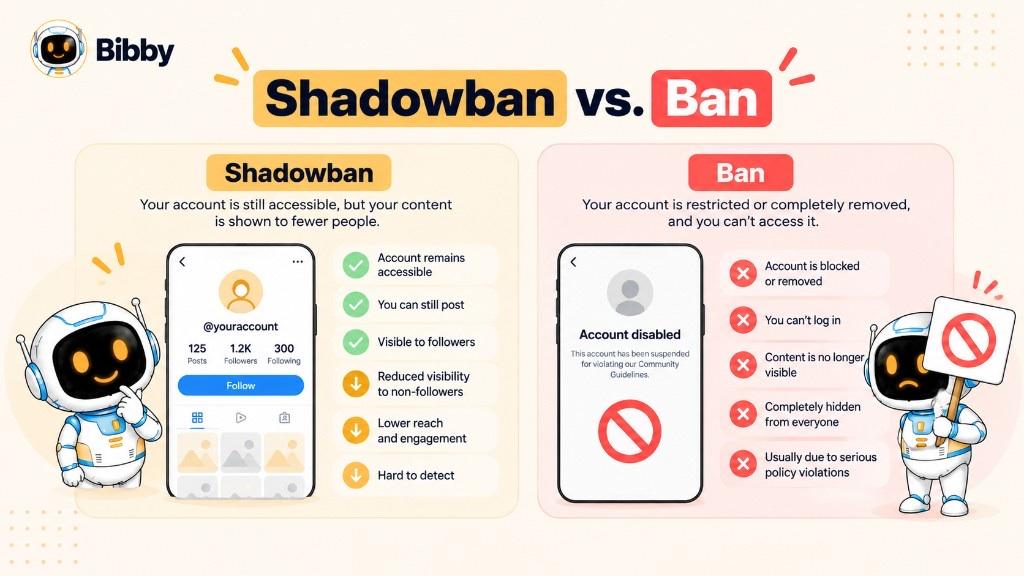
A ban is much more direct. A banned or suspended account may lose access to the platform or have its ability to publish or interact substantially disabled.
With a suspected shadowban, the account and content may remain accessible while visibility and discoverability are reduced.
| Term | General meaning |
|---|---|
| Shadowban | Content visibility or discoverability appears reduced without an obvious notification |
| Content restriction | Specific content has limited distribution or access |
| Account restriction | Certain account features or activities are limited |
| Suspension | Account access is temporarily or permanently disabled |
| Ban | Account or content is prohibited from the platform |
Because platforms use different recommendation and enforcement systems, these terms should not be treated as interchangeable. If your reach falls, look for concrete evidence in your analytics and any account-status or content-status information provided by the platform rather than assuming you have been shadowbanned.
How Does a Shadowban Work?
A shadowban is generally used to describe a situation where your content remains published but receives less distribution than expected. Instead of removing your post or blocking your account, a platform may show the content to fewer people through the surfaces that help users discover new content.
The exact mechanics vary between social media platforms. There is no single “shadowban switch” that works the same way everywhere. Recommendation systems, search systems, content eligibility rules, account restrictions, and ranking algorithms can all influence how widely a post is distributed.
A suspected shadowban may therefore affect several areas of content visibility.
Reduced recommendation reach
Social platforms use recommendation systems to introduce users to content from accounts they do not follow. If your content becomes less eligible for recommendation, you may notice a significant decline in non-follower reach.
Your followers may still see your posts, while fewer new people encounter them through recommendation feeds, Explore-style surfaces, For You feeds, or similar features.
Reduced search visibility
Search is another important source of discovery. If your content becomes less visible in search, people may have a harder time finding your posts, profile, videos, or other content through relevant queries.
A change in search visibility can be particularly important for businesses and creators that rely on social platforms for discovery.
Reduced hashtag or topic visibility
On platforms that use hashtags or topic-based discovery, reduced eligibility can limit how often your content appears to users browsing those categories.
However, poor hashtag performance by itself does not prove a shadowban. Hashtag reach can change because of competition, content relevance, user behavior, or changes to the platform's discovery system.
Reduced exposure to non-followers
One of the most noticeable signs users associate with shadowbanning is a sharp decline in non-follower distribution.
For example, your existing audience may continue interacting with your content while impressions from new audiences fall substantially. Looking at this distinction in your analytics can provide more useful information than judging your account solely by likes or comments.
Lower engagement as a downstream effect
When fewer people see a post, it naturally has fewer opportunities to generate likes, comments, shares, saves, views, or clicks.
This creates an important distinction: low engagement can be a result of low distribution, but low engagement does not prove that distribution was deliberately restricted.
Content quality, audience interest, timing, competition, seasonality, and normal algorithmic fluctuations can produce similar results.
Why shadowbans can be difficult to identify
The biggest challenge is that the symptoms associated with a shadowban overlap with many ordinary changes in social media performance.
A post can suddenly receive less reach because the topic is less relevant to your audience, the content performs poorly in its initial distribution, your audience is less active, or the platform has changed how it ranks content.
For that reason, a single underperforming post is weak evidence of a shadowban. A consistent and unusual change across multiple posts, combined with relevant account or content-status signals, provides a much stronger basis for investigating a potential restriction.
How to Tell If You Are Shadowbanned
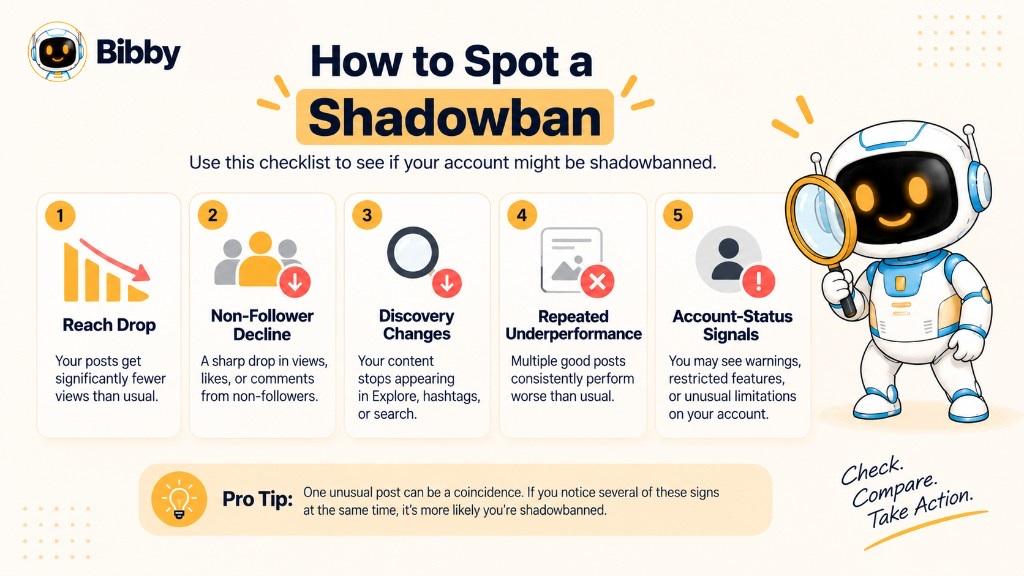
There is no universal test that can definitively prove you have been shadowbanned. A sudden drop in reach or engagement can happen for many reasons, so the best approach is to look for consistent changes in content distribution and check any account or content-status information your platform provides.
Instead of relying on one unusual post, look for a pattern across several recent posts.
1. Your reach suddenly drops
A significant and unexpected decline in reach can be a reason to investigate.
Compare your recent posts with your normal performance rather than with your best-performing content. If several posts consistently receive far less reach than usual despite similar topics, formats, and audience interest, there may be a distribution issue worth examining.
2. Non-follower reach falls sharply
Pay particular attention to reach from people who do not already follow you.
If your content normally reaches a substantial number of non-followers but that source of discovery suddenly falls across multiple posts, it can indicate that your content is appearing less often in recommendation or discovery surfaces.
This is still not definitive proof of a shadowban, but it is a more useful signal than simply looking at likes.
3. Your content becomes harder to discover
Look for changes in where people find your content.
Depending on the platform, this could include:
- Recommendations
- Search results
- Hashtag pages
- For You-style feeds
- Explore or discovery sections
- Suggested content
- Topic-based feeds
A noticeable reduction across several discovery sources can be more significant than a decline in one metric.
4. Multiple posts underperform in a similar way
One poorly performing post is normal. A repeated pattern is more worth investigating.
Compare several recent posts against your historical averages while accounting for differences in content format, topic, timing, and audience.
If videos, images, carousels, or other formats are all experiencing an unusually large distribution decline, investigate further rather than immediately assuming you are shadowbanned.
5. Engagement drops despite similar content
If your content strategy has remained relatively consistent but impressions and engagement suddenly decline, check whether the change began at a specific point.
For example, compare:
- Reach per post
- Impressions
- Non-follower reach
- Video views
- Profile visits
- Shares
- Saves
- Comments
- Follower growth
Looking at several metrics together can reveal whether the problem is distribution, audience response, or both.
6. Your account or content status shows a problem
If your platform provides an account-status, recommendation-eligibility, or content-status feature, check it.
These tools can provide more concrete information than third-party “shadowban” tests. If the platform identifies content that is ineligible for recommendation or has violated a policy, that is stronger evidence of a distribution issue than a simple drop in engagement.
7. Rule out normal reasons for lower reach
Before concluding that you are shadowbanned, consider other explanations.
Your reach can fall because:
- Your audience is less active
- Your recent content is less relevant
- A post received weak early engagement
- You changed your posting frequency
- Competition increased
- A trend or topic lost popularity
- The platform changed its recommendation system
- Your content format is performing differently
- Your audience composition changed
The key takeaway
A drop in reach is a signal to investigate, not proof of a shadowban.
The strongest approach is to compare multiple posts, examine where your traffic and impressions come from, check platform-provided account or content-status information, and rule out normal performance fluctuations before assuming your account has been shadowbanned.
Shadowban Test: How Can You Check?
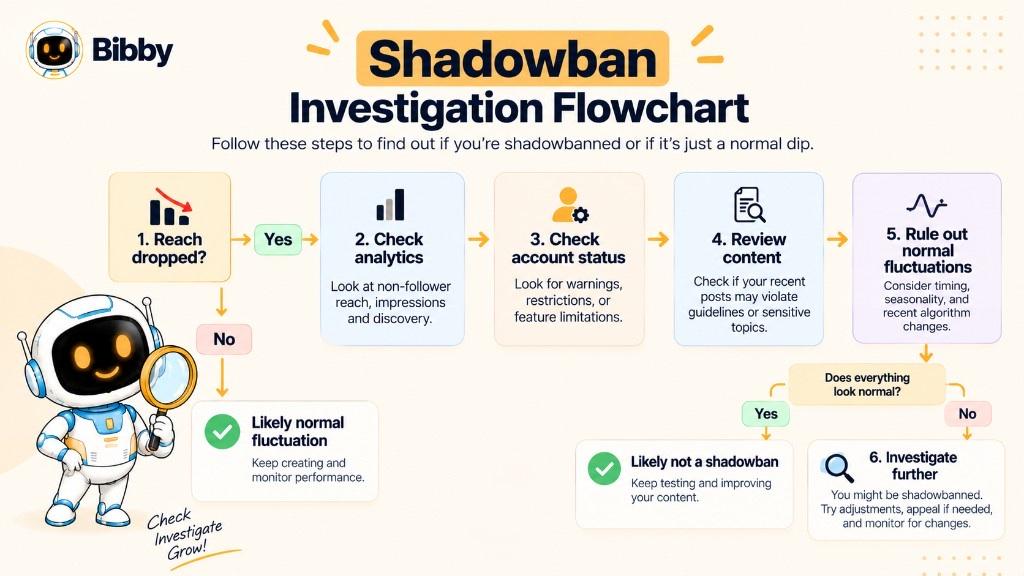
There is no single shadowban test that can reliably confirm whether every social media platform has limited your content's visibility. Third-party websites and apps may claim to detect shadowbans, but they cannot see or verify every part of a platform's recommendation, ranking, or enforcement systems.
A better approach is to perform your own visibility check using platform analytics, account-status information, and patterns across multiple posts.
1. Check your account and content status
Start with the platform's own tools.
Depending on the social network, you may be able to see whether your account or specific content has:
- Violated a policy
- Been removed or restricted
- Become ineligible for recommendations
- Received a content or account warning
- Lost access to certain features
This information is generally more useful than a third-party shadowban checker because it comes directly from the platform.
2. Compare follower and non-follower reach
Check where your recent impressions and reach are coming from.
If your content historically receives significant exposure from non-followers but that source suddenly falls across several posts, investigate further.
For example, compare your recent performance with your typical results for:
- Follower reach
- Non-follower reach
- Impressions
- Video views
- Profile visits
- Engagement
A change in non-follower distribution can help identify whether your problem is primarily discoverability rather than audience engagement.
3. Check your content's discovery sources
Review the traffic or reach sources available in your analytics.
Look for significant changes in:
- Search
- Recommendations
- Hashtags
- Suggested content
- Explore or discovery surfaces
- Feed distribution
If one discovery source disappears while the others remain stable, the issue may be specific to that distribution channel rather than an account-wide shadowban.
4. Compare several recent posts
Don't base your conclusion on one post.
Choose several recent posts with similar formats and audiences, then compare them against your historical performance.
A useful comparison might look like this:
| Metric | Typical performance | Recent performance |
|---|---|---|
| Reach | 10,000 | 3,000 |
| Non-follower reach | 6,000 | 900 |
| Impressions | 14,000 | 4,200 |
| Engagement rate | 5% | 4.8% |
In this hypothetical example, the major change is distribution rather than engagement rate. That would justify further investigation, but it still would not independently prove a shadowban.
5. Check whether the problem affects all content
Ask whether the decline is limited to one format, topic, or content type.
For example:
- Are your videos affected but images are normal?
- Are only certain topics underperforming?
- Did reach decline after a particular post?
- Are followers still seeing your content normally?
- Has non-follower discovery declined across everything?
The answers can help distinguish a content-performance problem from a broader distribution issue.
6. Look for policy or behavior changes
Think about what changed shortly before your reach declined.
Consider whether you:
- Published content that may violate platform guidelines
- Repeatedly posted very similar content
- Used aggressive engagement tactics
- Increased posting dramatically
- Used automation in a spam-like way
- Received an account warning
- Changed your content strategy substantially
A correlation does not automatically establish causation, but identifying changes can help you investigate the problem.
What Not to Trust as a Shadowban Test
Be cautious with tools that promise to guarantee whether you are shadowbanned.
A third-party checker generally cannot provide complete access to a platform's internal recommendation and enforcement systems. A result saying “shadowbanned” should therefore be treated as a clue at most, not definitive evidence.
Be especially skeptical of claims such as:
- “We can detect any shadowban instantly.”
- “Your account is guaranteed to recover in seven days.”
- “Using this tool will remove your shadowban.”
- “One hidden hashtag proves your account is restricted.”
The best shadowban test is evidence, not a score
Instead of looking for a single yes-or-no result, combine analytics + discovery patterns + platform status information + recent account activity.
That approach gives you a much more reliable picture of whether your reduced reach is likely to be a genuine visibility restriction or simply a normal change in content performance.
What Causes a Shadowban?
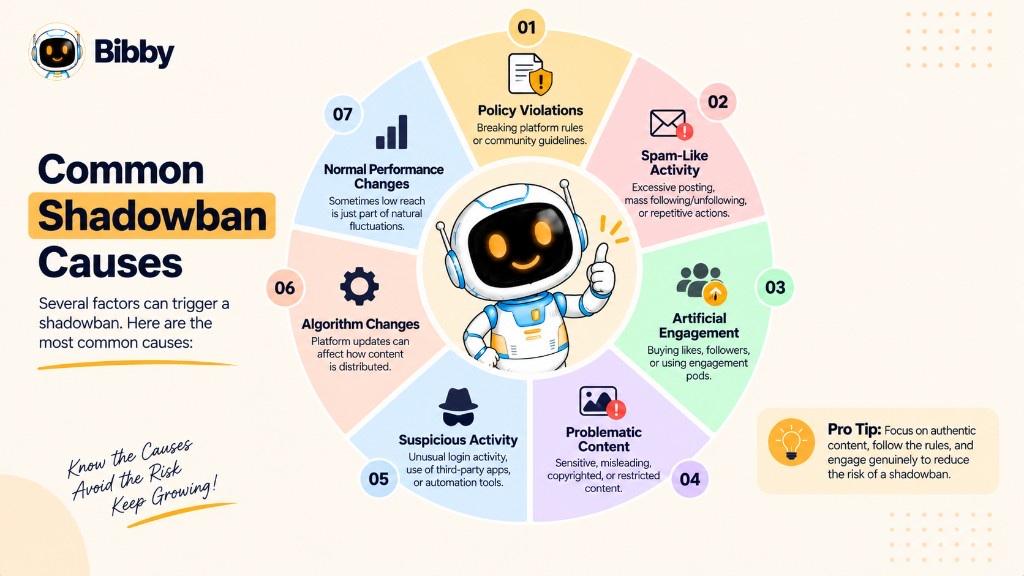
Because shadowban is not a universal official classification used by every social media platform, there is no single list of actions that automatically causes one. What users call a shadowban may instead be the result of content restrictions, reduced recommendation eligibility, spam detection, policy enforcement, or normal changes in content distribution.
That said, certain behaviors can increase the likelihood of your content being limited, removed from recommendations, or otherwise receiving less visibility.
Violating community or content guidelines
Publishing content that violates a platform's rules can result in reduced distribution or other enforcement actions.
Depending on the platform and violation, consequences may include content removal, recommendation ineligibility, account restrictions, or suspension.
Always check the specific platform's current policies rather than assuming every network applies the same rules.
Posting spam-like content
Platforms generally try to prevent users from flooding feeds with repetitive or unwanted activity.
Behaviors that may be treated as spam-like can include:
- Repeatedly publishing nearly identical content
- Posting excessively in a short period
- Repeating the same comments
- Sending unsolicited promotional messages
- Performing large numbers of repetitive account actions
Normal, consistent publishing is different from deliberately generating large amounts of low-value activity.
Using artificial engagement tactics
Trying to manipulate engagement can create problems for an account.
Examples include artificially generating:
- Likes
- Comments
- Shares
- Views
- Followers
- Other engagement signals
Even when these tactics temporarily increase visible numbers, they can damage the quality of your audience and may conflict with platform policies.
Publishing misleading or manipulative content
Content designed primarily to deceive users, manipulate engagement, or exploit platform systems may face reduced distribution or enforcement.
This can include misleading claims, deceptive practices, engagement bait, or other tactics that conflict with a platform's rules.
Repeatedly publishing problematic content
A single mistake does not necessarily explain a long-term reach decline.
However, repeatedly publishing content that receives warnings, removals, or other policy-related signals may create a broader account-quality or eligibility problem.
If your platform provides information about content violations or recommendation eligibility, use those tools to identify the specific issue.
Suspicious account activity
Unusual account behavior can sometimes trigger security or anti-abuse systems.
For example, a sudden change in activity patterns, unusual login behavior, or large amounts of repetitive interaction may lead a platform to review or limit certain activity.
This is different from proving that an account has been “shadowbanned,” but it can contribute to unexpected changes in what an account is able to do or how its activity is distributed.
Algorithm or recommendation changes
Not every reach decline is caused by something you did.
Social platforms regularly change how content is ranked and recommended. A change in the recommendation system can cause certain formats, topics, or account types to receive less distribution even when there is no account restriction.
This is one of the most important explanations to consider before assuming a shadowban.
Normal changes in content performance
Sometimes the simplest explanation is that recent content is performing differently.
Reach can naturally change because of:
- Audience interest
- Content quality
- Competition
- Posting time
- Content format
- Topic popularity
- Seasonality
- Early engagement
- Changes in follower behavior
For this reason, a sudden drop in reach should be investigated rather than automatically labeled a shadowban.
The key takeaway
A shadowban is not something you should diagnose from one metric or one poorly performing post. Look for a consistent change in distribution, check for platform-provided restrictions or eligibility issues, and review your recent content and account activity before deciding that your visibility has been limited.
Shadowban on Different Social Media Platforms
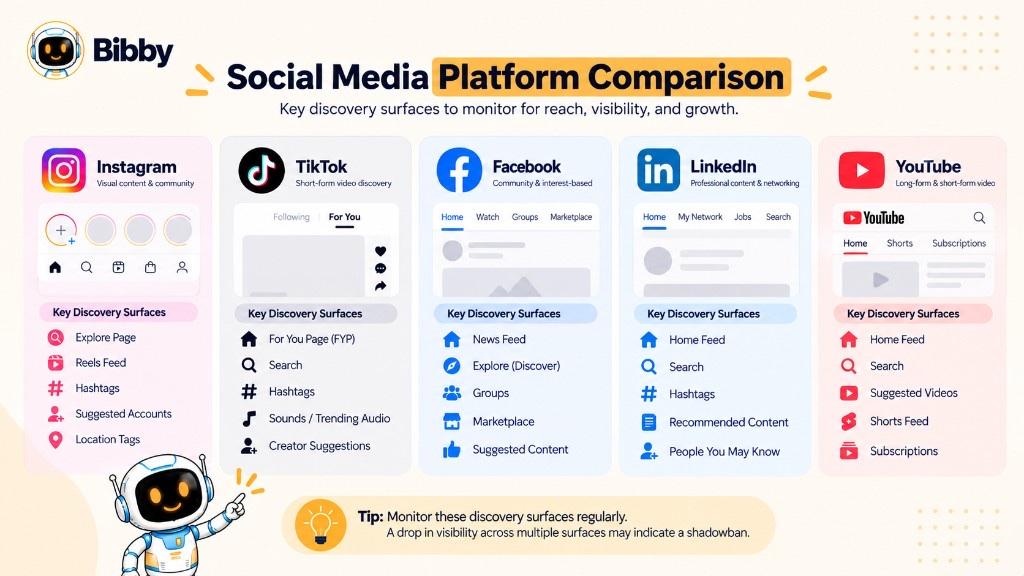
People use the term shadowban across Instagram, TikTok, Facebook, LinkedIn, YouTube, and other social networks. However, each platform has its own recommendation systems, content policies, analytics, and account-status tools.
That means a visibility problem on one platform does not necessarily mean the same thing on another. The most useful approach is to look at the specific discovery surfaces and account information available on the platform you're using.
Instagram Shadowban
An Instagram shadowban generally refers to a situation where an account's content appears to receive less visibility from people who do not already follow the account.
Creators commonly associate it with reduced visibility through recommendations, search, hashtags, or other discovery surfaces.
If you suspect an Instagram shadowban, look at:
- Non-follower reach
- Recommendation reach
- Search and discovery performance
- Recent content performance
- Account Status and any recommendation-eligibility information available to you
A decline in Instagram reach alone does not prove that your account has been shadowbanned.
TikTok Shadowban
A TikTok shadowban is commonly used to describe an unexplained reduction in video distribution, particularly when videos appear to receive fewer views from new audiences.
Creators may look at changes in:
- For You distribution
- Search discovery
- Video views
- Non-follower exposure
- Engagement
- Content or account-status information
TikTok performance can fluctuate significantly based on content, audience response, trends, and recommendation systems. A video receiving fewer views than usual is therefore not enough to establish a shadowban.
Facebook Shadowban
A Facebook shadowban generally refers to an unexplained reduction in the visibility or distribution of posts, pages, or other content.
When investigating a suspected restriction, consider:
- Post reach
- Feed distribution
- Recommendation eligibility
- Page or account status
- Content-policy notifications
- Changes in audience engagement
Facebook's distribution systems can change independently of your account, so compare multiple posts before concluding that a restriction is responsible.
LinkedIn Shadowban
A LinkedIn shadowban is a term some users use when their posts appear to receive substantially less distribution than usual.
Potential signals to examine include:
- Post impressions
- Follower versus non-follower exposure
- Engagement
- Feed distribution
- Changes in posting behavior
- Any relevant policy or account notifications
As with other platforms, lower LinkedIn engagement does not automatically mean that LinkedIn has secretly restricted your account.
YouTube Shadowban
A YouTube shadowban generally refers to a perceived reduction in the visibility or discoverability of videos without an obvious account-level notification.
Creators may notice changes in:
- YouTube Search traffic
- Recommended video traffic
- Suggested video exposure
- Browse features
- Shorts distribution
- Views and impressions
YouTube recommendations and search rankings depend on many factors, including viewer behavior and content performance. A decline in views should therefore be evaluated alongside impressions, traffic sources, click-through rate, audience retention, and any available policy information.
Why platform-specific checks matter
There is no universal shadowban mechanism that works identically across every social network.
For example, a creator experiencing lower TikTok For You distribution is dealing with a different recommendation environment from someone whose Instagram recommendation reach has declined.
The platform's own analytics, account-status information, content policies, and recommendation-eligibility signals should take priority over generic shadowban advice.
If you manage several social accounts, monitor each platform separately rather than assuming that a reach decline on one network means all of your accounts are affected.
How to Fix a Shadowban
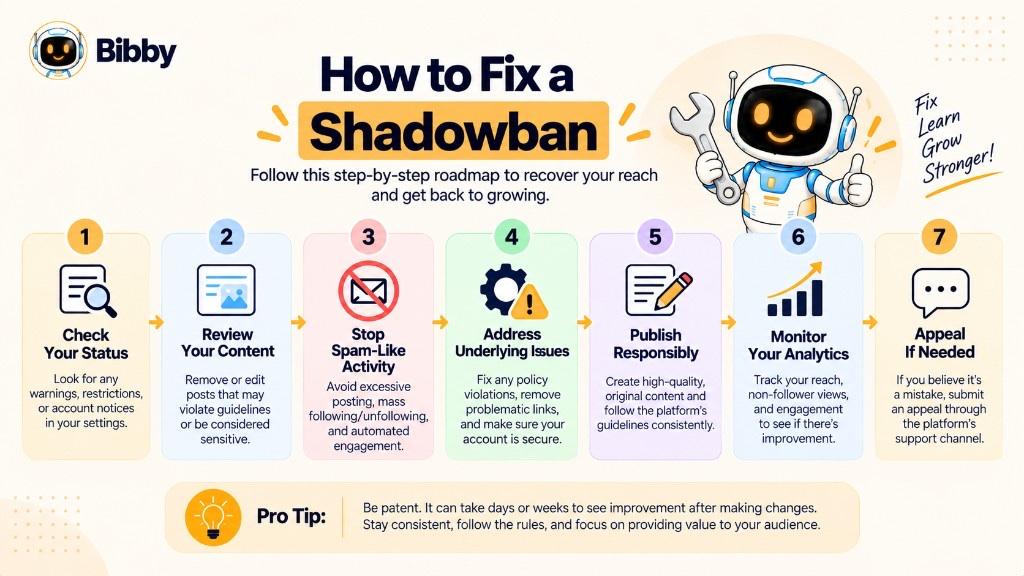
If you think you have been shadowbanned, don't immediately delete your account, stop posting indefinitely, or rely on a third-party “shadowban removal” service. First, identify whether there is an actual restriction and what may have caused the change in visibility.
There is no universal fix for a shadowban because the term covers different situations across different platforms. However, these steps can help you address potential visibility or distribution problems.
1. Check your account and content status
Start with the platform's official account-status, content-status, or policy tools, if available.
Look for notifications about:
- Removed content
- Policy violations
- Recommendation ineligibility
- Account restrictions
- Feature limitations
- Other enforcement actions
If the platform tells you exactly what is affecting your content, follow its recommended resolution process.
2. Review your recent content
Look at the posts, videos, images, or other content you published shortly before your reach declined.
Check whether anything may have:
- Violated community guidelines
- Used misleading claims
- Repeatedly triggered moderation
- Been excessively promotional
- Resembled spam
- Used artificial engagement tactics
Identifying a specific issue is much more useful than trying random “shadowban fixes.”
3. Stop spam-like activity
If your account has been performing repetitive or aggressive actions, return to normal activity.
Avoid behaviors such as:
- Repeatedly posting nearly identical content
- Excessive repetitive comments
- Aggressive follow/unfollow activity
- Mass unsolicited messaging
- Artificial engagement
- Other attempts to manipulate distribution
The goal is not simply to “trick the algorithm,” but to maintain normal, authentic account behavior.
4. Address problematic content
If you identify content that clearly violates a platform's rules, use the platform's available options to correct the issue.
Depending on the situation, this could involve editing, removing, appealing, or otherwise addressing the content.
Don't mass-delete your entire content library simply because your reach dropped. There is no universal evidence that deleting everything is a reliable shadowban cure.
5. Stop artificial engagement tactics
Avoid buying followers, views, likes, or comments and don't use engagement schemes designed to manufacture activity.
Artificial numbers can make your analytics harder to interpret and may conflict with platform rules.
Focus instead on attracting genuine engagement from people who actually want to see your content.
6. Return to consistent, useful publishing
Once you've addressed obvious problems, return to a normal publishing routine.
Prioritize:
- Original content
- Useful information
- Relevant topics
- Strong audience value
- Appropriate posting frequency
- Genuine conversations
Consistency also makes your analytics easier to interpret because you have a stable baseline for comparison.
7. Monitor your analytics over multiple posts
Don't judge recovery from one post.
Track your performance across several posts and compare:
- Reach
- Impressions
- Non-follower reach
- Video views
- Engagement
- Profile visits
- Traffic sources
- Follower growth
Look for a sustained improvement rather than a single spike.
8. Appeal when the platform provides an option
If you believe your content or account was incorrectly restricted, use the platform's official appeal or review process when available.
Explain the issue clearly and provide any relevant information requested by the platform.
Avoid paying third-party services that promise guaranteed reinstatement.
9. Give the platform time to reflect changes
Some changes in distribution or account eligibility may not be reflected immediately.
After correcting a genuine issue, continue following the platform's rules and monitor your performance rather than repeatedly changing your strategy every few hours.
What if your reach doesn't recover?
If your account continues to underperform, don't automatically assume the shadowban is still active.
Revisit your content strategy and compare your recent performance with your historical baseline. Your audience, competitors, platform recommendations, content format, or broader algorithm changes may be responsible for the decline.
The goal isn't simply to “remove a shadowban.” The goal is to restore healthy, legitimate content distribution—and determine whether a shadowban was actually the problem in the first place.
How Long Does a Shadowban Last?
There is no universal length of time that a shadowban lasts. The term describes different types of visibility problems across different platforms, and the duration can depend on the underlying cause, the platform's policies, the account's history, and whether an identified issue is corrected.
You may see claims that every shadowban lasts exactly 7, 14, or 30 days, but there is no universal timeline that applies to all social media accounts.
What can affect how long reduced visibility lasts?
Several factors can influence how quickly your content distribution returns to normal.
#### The reason for the restriction
A temporary distribution issue caused by a specific content or policy problem may behave differently from an ongoing account-level restriction.
#### The platform involved
Instagram, TikTok, Facebook, LinkedIn, YouTube, and other platforms use different recommendation, ranking, and enforcement systems.
A solution or timeframe that applies to one platform should not automatically be applied to another.
#### Your account history
Repeated policy violations or suspicious activity may be treated differently from an isolated issue.
#### Whether you correct the problem
If the platform identifies a specific issue, resolving it or successfully appealing an incorrect restriction may help restore normal account or content eligibility.
#### Normal algorithmic fluctuations
Sometimes what appears to be a shadowban is simply a temporary change in content distribution.
If your content begins performing normally again without any intervention, the original decline may have been caused by audience behavior, content performance, or recommendation-system changes rather than a formal restriction.
How do you know when a shadowban is over?
There is no universal “shadowban removed” notification.
Instead, look for sustained changes such as:
- Non-follower reach returning toward your normal levels
- Increased visibility through recommendations
- Search or discovery traffic recovering
- Impressions returning to historical ranges
- Normal engagement from new audiences
- Account or content status showing no active issues
Don't use a single successful post as proof that your account has recovered. Compare several posts over time.
Should you stop posting during a suspected shadowban?
Not necessarily.
If you have identified a genuine policy or account issue, follow the platform's instructions first. Otherwise, continuing to publish useful, compliant content at a normal pace can provide more useful data than completely abandoning your account.
Avoid dramatically increasing or decreasing your activity simply because you suspect a shadowban.
The key takeaway
There is no fixed shadowban duration. If your visibility has declined, focus less on counting days and more on identifying the underlying cause, correcting genuine issues, following platform rules, and monitoring whether your distribution gradually returns to normal.
Shadowban vs. Low Reach: What's the Difference?
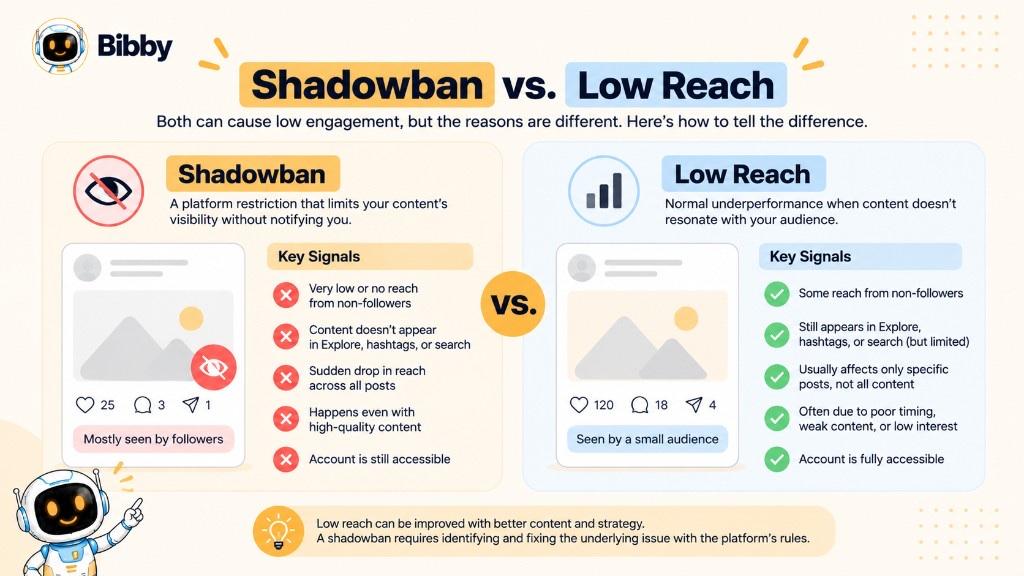
A drop in social media reach does not automatically mean you have been shadowbanned.
Content distribution naturally changes from post to post. Audience interest, competition, content quality, posting time, engagement, platform algorithms, and recommendation systems can all affect how many people see your content.
The key difference is that a suspected shadowban involves an unusual change in content visibility or eligibility, while low reach can simply mean that recent content is performing below its normal level.
| Shadowban-like symptoms | Normal low reach |
|---|---|
| Sudden and persistent distribution decline | Temporary or gradual performance decline |
| Non-follower reach drops sharply | Audience response varies normally |
| Discovery traffic changes noticeably | Discovery remains available |
| Multiple content types may be affected | One topic or format may underperform |
| Possible account or content-status signals | No restriction signals |
| May follow a policy or account issue | Can happen without any account problem |
Signs it may simply be low reach
Your account may not be shadowbanned if:
- Only one or two posts performed poorly
- Your content topic changed significantly
- Your audience is less active than usual
- Your content received weaker early engagement
- A trend your content relied on has ended
- Similar content across your industry is also receiving less reach
- Your follower count or audience composition changed
- Your content format has become less effective
For example, if your average post reaches 10,000 people but one post reaches only 3,000, that alone isn't strong evidence of a shadowban.
Signs that deserve further investigation
A more unusual pattern might look like this:
- Several consecutive posts underperform
- Non-follower reach falls dramatically
- Multiple discovery sources decline
- Your content appears less frequently in recommendations
- The change happens across otherwise comparable posts
- Your platform reports a content or account eligibility issue
Even then, these signals don't automatically prove a shadowban. They indicate that your content distribution deserves investigation.
Look at distribution, not just engagement
One of the easiest mistakes is to focus only on likes and comments.
Suppose your post receives fewer likes because only half as many people saw it. The lower engagement may be a consequence of lower distribution rather than evidence that the audience suddenly dislikes your content.
Instead, examine metrics such as:
- Reach
- Impressions
- Non-follower reach
- Traffic sources
- Recommendation traffic
- Search traffic
- Video views
- Profile visits
- Engagement rate
Looking at these metrics together can help you determine whether the problem is primarily visibility, audience response, or both.
Check your historical baseline
Your own historical data is usually more useful than an arbitrary benchmark.
Compare recent posts with posts that have:
- Similar formats
- Similar topics
- Similar audience sizes
- Similar posting frequency
- Similar publishing times
This creates a more meaningful comparison than asking whether your latest post “should” have received a certain number of views.
Don't confuse an algorithm change with a shadowban
Social media platforms continually adjust how content is ranked and recommended.
If your reach falls after a recommendation-system change, your account may simply be responding to a new distribution model. Other creators in your niche may experience the same change.
A broad performance shift affecting many accounts is very different from an isolated account-specific restriction.
The simplest rule
Low reach means fewer people saw your content. A shadowban is a suspected explanation for why your visibility declined.
Always establish the performance change first, then investigate its cause. Don't start with the assumption that you've been shadowbanned.
Common Shadowban Myths
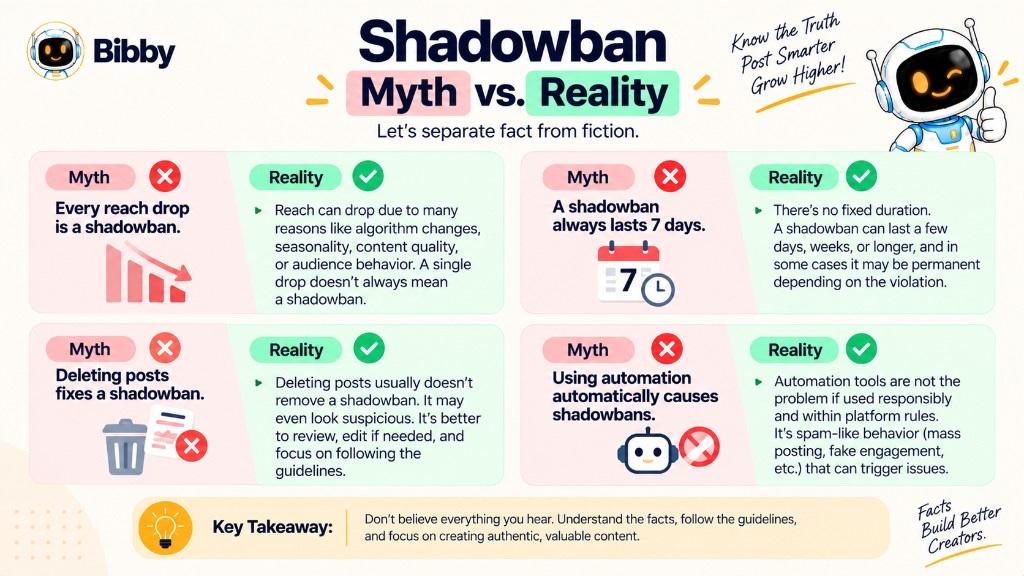
The word shadowban is widely used in social media discussions, but many popular claims about it are oversimplified or unsupported. Understanding what is actually known can help you avoid making unnecessary changes to your content strategy.
Myth 1: Every sudden drop in reach means you're shadowbanned
False. Reach can fall for many reasons, including weaker content performance, changes in audience behavior, increased competition, seasonality, or changes to a platform's recommendation system.
A sudden decline is a reason to investigate—not automatic proof of a shadowban.
Myth 2: A shadowban always lasts seven days
False. There is no universal seven-day shadowban period that applies across social media platforms.
The duration of any genuine content or account restriction depends on the platform, the underlying issue, account history, and how the platform handles the situation.
Myth 3: Using hashtags can automatically shadowban your account
Misleading. Hashtags can affect discoverability, but using a particular hashtag does not automatically prove that your account has been shadowbanned.
If hashtag performance changes, consider whether the hashtag is relevant, competitive, restricted, or simply receiving less traffic than before.
Myth 4: Deleting all your posts removes a shadowban
Unsupported. There is no universal rule that mass-deleting your content will restore reach.
If a specific post violates a platform's rules, follow the platform's recommended process for addressing that content. Don't delete your entire content library based solely on a suspected shadowban.
Myth 5: You can prove a shadowban with one third-party checker
Unreliable. Third-party tools generally cannot see all of a platform's internal recommendation, ranking, or enforcement systems.
A “shadowban detected” result should therefore not be treated as definitive evidence.
Platform-provided account-status information and your own analytics are more useful sources of evidence.
Myth 6: A shadowban means your account has been secretly banned
Not necessarily. A shadowban is commonly used to describe reduced visibility while the account itself remains accessible.
A suspension or ban is much more direct: the platform may restrict or remove access to the account or its functionality.
Myth 7: Social media automation automatically causes shadowbans
False as a blanket claim. Using scheduling or automation software does not, by itself, prove that an account will be shadowbanned.
The important distinction is between legitimate workflow automation and behavior that violates platform rules or resembles spam, manipulation, or artificial engagement.
Always use automation in a way that complies with the rules of the platforms you publish to.
Myth 8: Taking a long break from posting will always fix a shadowban
Unsupported. There is no universal rule that stopping all activity for a specific number of days removes a shadowban.
If you have an actual account or content issue, identify and address that issue instead of relying on a fixed “rest period.”
Myth 9: A shadowban is the only reason non-follower reach can disappear
False. Non-follower distribution can change because of recommendation eligibility, content performance, audience behavior, ranking changes, or platform-wide algorithm updates.
A decline in non-follower reach is useful information, but it still needs context.
The bottom line
Most “shadowban fixes” focus on tricks and arbitrary timelines. A better approach is to check platform-provided status information, review your content and account activity, analyze your distribution data, and rule out normal performance changes before deciding that you have been shadowbanned.
Does Social Media Automation Cause Shadowbans?
Social media automation does not automatically mean an account will be shadowbanned. The important distinction is between legitimate automation—such as scheduling posts in advance—and automated behavior that violates platform rules or resembles spam, manipulation, or abuse.
For businesses and creators managing multiple social media accounts, scheduling can simply make publishing more consistent. The potential problem is not automation itself, but what the automation does and how the account uses it.
Legitimate social media automation
Common examples of legitimate automation include:
- Scheduling posts for future publication
- Planning content across multiple platforms
- Organizing a social media content calendar
- Automatically publishing approved content
- Generating draft captions or content ideas
- Reviewing performance analytics
- Managing a planned publishing workflow
These activities are fundamentally different from using automation to manipulate engagement or overwhelm a platform.
Automated behavior that can create problems
Automation becomes riskier when it is used for behavior that may violate platform policies or resemble spam.
Examples can include:
- Automatically generating large amounts of repetitive content
- Sending unsolicited messages at scale
- Posting identical low-value content repeatedly
- Automatically generating repetitive comments
- Artificially increasing likes, views, followers, or other engagement
- Performing large numbers of repetitive account actions
- Attempting to manipulate recommendation or ranking systems
The exact rules vary by platform, so automation users should always follow the current policies of each network they publish to.
Does scheduling posts cause a shadowban?
Scheduling posts is not, by itself, evidence of a shadowban.
A business can plan and schedule content while still maintaining a normal publishing strategy. What matters is whether the resulting activity follows platform rules and provides genuine value to the audience.
However, scheduling a large volume of repetitive or low-quality content can create problems even if the scheduling itself is legitimate.
How to use automation safely
A responsible automated workflow should focus on consistency, quality, and compliance.
Good practices include:
- Create content that is relevant to the intended audience.
- Review AI-generated captions and content before publishing when necessary.
- Avoid publishing repetitive content simply to increase volume.
- Maintain a sensible posting frequency.
- Don't automate artificial engagement.
- Avoid unsolicited mass messaging.
- Monitor analytics for unusual changes in distribution.
- Check each platform's current rules and content requirements.
Automation should make your workflow better—not noisier
The purpose of social media automation is to reduce repetitive work while maintaining a high-quality publishing process.
A tool such as Bibby can help organize content creation, captions, scheduling, and publishing across Facebook, Instagram, LinkedIn, YouTube, and TikTok. The goal should be to help marketers publish consistently and efficiently—not to flood platforms with automated activity.
If your reach drops after introducing automation, don't automatically conclude that automation caused a shadowban. Compare your publishing volume, content quality, account activity, platform status, and analytics before drawing a conclusion.
The key takeaway: automation is a workflow method, not a shadowban trigger. Use it responsibly, follow platform-specific rules, and prioritize useful content over publishing more content simply because you can.
How to Avoid Getting Shadowbanned
There is no guaranteed way to prevent a shadowban because the term can describe different types of visibility or distribution problems across social media platforms. However, you can reduce the risk of content restrictions and avoid many behaviors that may negatively affect your account's distribution.
The safest approach is simple: follow platform rules, publish useful content, avoid manipulative behavior, and monitor your account's performance.
Follow each platform's guidelines
Every social network has its own rules for content, spam, engagement, automation, and account behavior.
Before publishing at scale, understand the policies for the platforms you use. Don't assume that an action permitted on one network is automatically permitted everywhere else.
Avoid spam-like publishing
Consistency is useful, but more content isn't always better.
Avoid flooding your audience with:
- Repetitive posts
- Nearly identical captions
- Duplicate content published excessively
- Irrelevant promotional posts
- Repetitive comments
- Unwanted messages
A sustainable publishing schedule is generally more useful than maximizing the number of posts you publish.
Don't manipulate engagement
Avoid tactics designed to artificially inflate performance.
This includes buying or exchanging engagement, using fake accounts, generating artificial interactions, or participating in schemes intended to manipulate platform metrics.
Focus on earning engagement from a genuine audience instead.
Don't repeatedly publish problematic content
If a platform flags or removes content, understand why before publishing similar material again.
Repeatedly triggering the same policy or moderation issue can create more problems than an isolated mistake.
Use automation responsibly
Scheduling tools can help you maintain a consistent publishing workflow, but automation should not be used to generate spam or artificial engagement.
When using a social media automation tool:
- Review generated content
- Avoid excessive posting
- Keep content relevant
- Don't automate fake engagement
- Follow each platform's rules
- Monitor your account and content status
Automation should reduce repetitive work while preserving the quality of your social media strategy.
Monitor your analytics
Regularly review your account's performance so you can identify unusual changes early.
Useful metrics include:
- Reach
- Impressions
- Non-follower reach
- Engagement
- Video views
- Profile visits
- Traffic sources
- Follower growth
Monitoring these metrics gives you a baseline, making it easier to distinguish normal fluctuations from significant changes in distribution. Review those numbers in native or dedicated analytics tools—Bibby does not replace platform analytics.
Pay attention to account-status notifications
If your platform provides account-status, content-status, or recommendation-eligibility information, check it regularly.
These tools can provide concrete information about content or account limitations that is much more useful than guessing based on reach alone.
Prioritize original and useful content
Ultimately, the best protection against many social media problems is to create content people genuinely want to see.
Focus on:
- Audience relevance
- Original ideas
- Useful information
- Authentic engagement
- Strong creative quality
- Consistent publishing
Don't build your strategy around trying to “beat” the algorithm. Build it around consistently providing value to your audience.
Keep a healthy publishing baseline
A consistent content workflow also makes unusual performance easier to spot.
If your publishing frequency, topics, and formats change constantly, it becomes difficult to know whether a reach decline comes from the platform or from your own strategy.
A stable publishing process gives you a better benchmark for identifying genuine changes.
The key takeaway
You cannot guarantee that your account will never experience reduced distribution. But you can avoid many unnecessary risks by following platform policies, publishing valuable content, avoiding spam and artificial engagement, using automation responsibly, and monitoring your analytics and account status.
That approach is more reliable than chasing supposed shadowban “hacks” or fixed recovery formulas.
Shadowban: Key Takeaway
A shadowban is a commonly used term for a situation where social media content appears to receive reduced visibility or discoverability without a clear notification. However, a sudden drop in reach does not automatically mean you've been shadowbanned.
The three most important things to remember are:
- Understand the symptoms: Look for persistent changes in distribution, especially non-follower reach and discovery traffic.
- Check the evidence: Review analytics, account-status information, content eligibility, and recent activity before assuming a restriction.
- Focus on healthy publishing: Follow platform rules, avoid spam and artificial engagement, and consistently publish useful content.
If your reach has declined, don't focus solely on finding a “shadowban fix.” First determine whether you're dealing with an actual restriction, a recommendation change, or simply content that isn't performing as strongly as it used to.
From here, the natural next step is learning how to improve social media reach—including how to create better content, optimize your publishing strategy, and consistently reach more of the right audience.
Continue with related dictionary entries on reach, organic reach, impressions, engagement, engagement rate, hashtags, the social media algorithm, and social media automation—or browse the social media dictionary. Then start a free Bibby trial to create, caption, and schedule content across your channels.