
Paid reach is a social media metric that measures how many unique people see your content through paid promotion or advertising.
If you’re trying to understand what paid reach means, how it differs from organic reach, or whether a high reach number means your campaign is performing well, the distinction matters. This guide breaks down paid reach in simple terms so you can understand what the metric actually measures and how to interpret it.
First, let’s look at exactly what paid reach means.
What Is Paid Reach?
Paid reach is the number of unique people who see your social media content as a result of paid promotion or advertising.
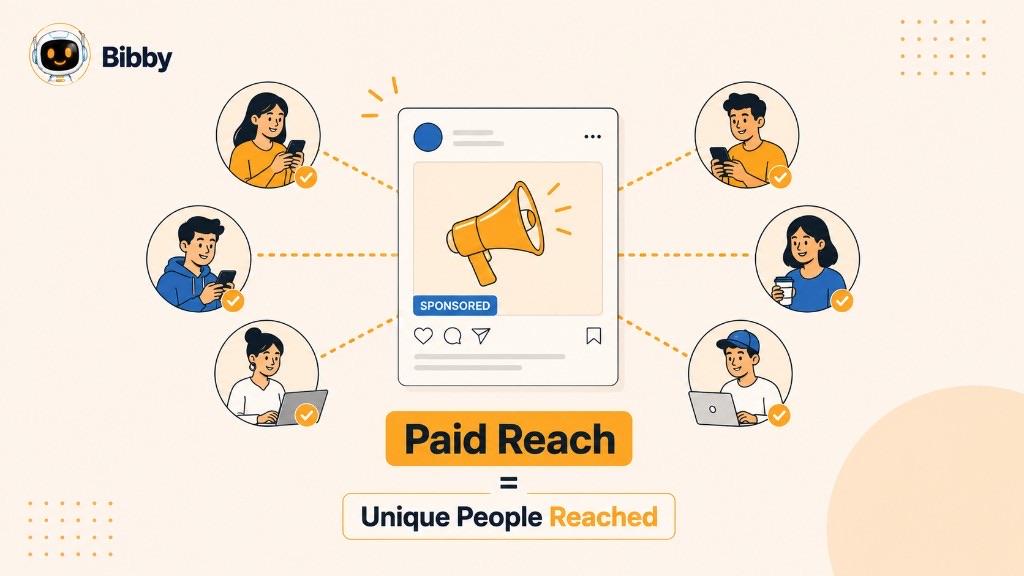
The word “paid” means that money is being spent to distribute the content, while “reach” refers to the number of unique people exposed to it. For example, if you pay to promote a post and 10,000 different people see it, your paid reach is 10,000.
Paid reach can come from different forms of paid social media distribution, including advertisements, boosted posts, sponsored content, and promoted campaigns. The exact way reach is calculated and reported can vary between social media platforms, but the underlying idea is the same: paid reach measures unique audience exposure generated through paid distribution.
It is important not to confuse paid reach with impressions. If the same person sees your advertisement five times, those five exposures can contribute to your impressions, but that person generally counts only once toward your reach.
In simple terms:
Paid reach = the number of unique people reached through paid promotion.
How Does Paid Reach Work?
Paid reach starts when you spend money to distribute social media content beyond its unpaid audience. Instead of relying entirely on a platform’s organic distribution, you use advertising or promotion to put your content in front of a selected audience.
The process typically looks like this:
- Create your content: You publish or prepare a post, image, video, carousel, Story, or other social media format.
- Choose paid distribution: You promote the content through an advertising campaign, boosted post, or another paid placement.
- Define your audience: Depending on the platform and campaign, you can select characteristics such as location, interests, demographics, professional attributes, or previous interactions.
- Set your campaign parameters: You choose factors such as your budget, duration, placements, and campaign objective.
- The platform distributes the content: The social network uses its advertising system to decide which eligible users are shown your content.
- The platform reports the results: After distribution begins, you can see metrics such as paid reach, impressions, frequency, clicks, and engagement.
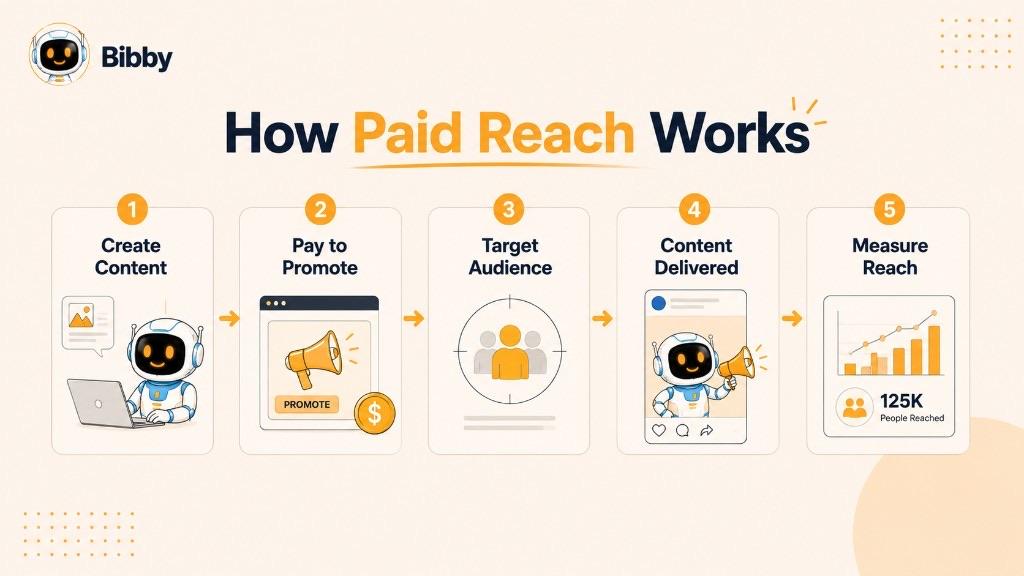
For example, imagine a company publishes an Instagram product post and then promotes it to a targeted audience. If 30,000 unique Instagram users are exposed to that promoted content, the campaign has generated 30,000 in paid reach.
Paid reach therefore describes the audience exposure produced by paid distribution, not the amount of money spent or the number of people who took action.
What Can Create Paid Reach?
Paid reach can come from several types of social media promotion, including:
- Social media advertisements
- Boosted posts
- Sponsored posts
- Promoted content
- Feed advertisements
- Story advertisements
- Video advertisements
- Carousel advertisements
- Retargeting campaigns
- Paid creator or influencer campaigns
The important distinction is that the content reaches those users because of a paid distribution mechanism. The content itself can be similar to something you would publish organically; what changes is how it is distributed.
Paid Reach vs. Organic Reach
The main difference between paid reach and organic reach is how people discover the content.
Paid reach comes from advertising or paid promotion. Organic reach comes from unpaid distribution, such as people seeing your post naturally in their feed, visiting your profile, or discovering your content through normal platform activity.
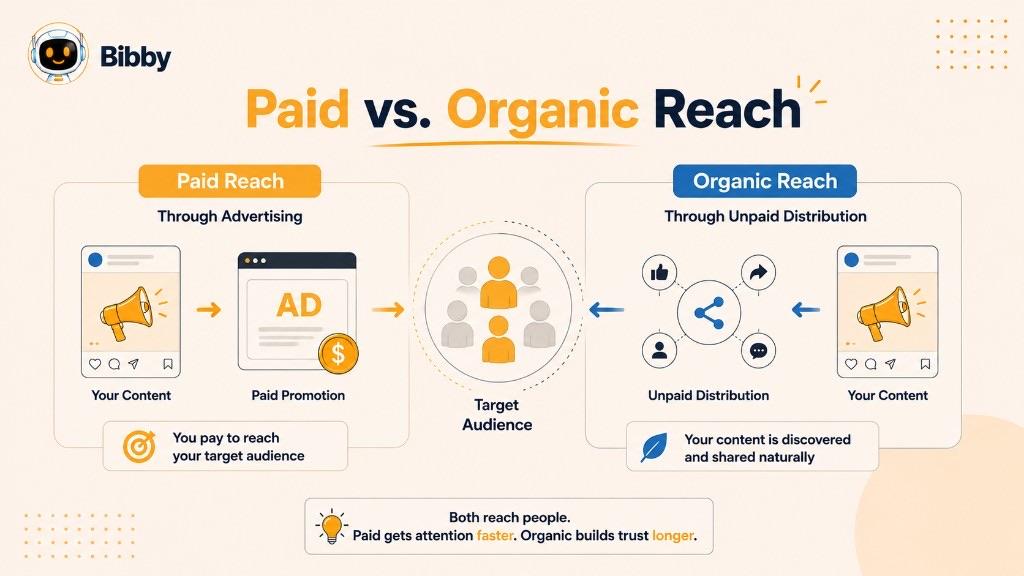
| Paid Reach | Organic Reach |
|---|---|
| Comes from paid promotion | Comes from unpaid distribution |
| Requires advertising spend | Does not require advertising spend |
| Can target specific audiences | Distribution is influenced by the platform and audience behavior |
| Can increase distribution quickly | Growth can be slower and less predictable |
| Gives you more control over audience targeting | Gives you less direct control over who sees the content |
| Commonly used for campaigns and amplification | Commonly used for ongoing content and audience building |
For example, if you publish an Instagram post and 2,000 followers see it without any advertising, those users contribute to your organic reach. If you then promote that same post and another 15,000 unique users see it because of the paid promotion, that additional distribution contributes to your paid reach.
Paid and organic reach can therefore work together rather than being competing strategies. A business might use organic content to build its existing audience and then use paid promotion to put its strongest content in front of a larger or more targeted audience.
Is Paid Reach Better Than Organic Reach?
Neither is automatically better. They serve different purposes.
Paid reach can be useful when you need faster, more targeted, or more predictable distribution, while organic reach can help you build an audience and maintain an ongoing presence without paying for every impression.
The right approach depends on your objective, audience, content, budget, and the results you are trying to achieve. Most importantly, a larger reach number alone does not guarantee better performance. You should evaluate reach alongside metrics such as engagement, clicks, conversions, and other relevant campaign outcomes.
Paid Reach vs. Paid Impressions
Paid reach and paid impressions both measure the distribution of paid social media content, but they answer different questions.
Paid reach measures how many unique people saw your paid content. Paid impressions measure the total number of times that content was displayed or served.
The same person can therefore contribute multiple impressions but generally counts only once toward reach.
For example, suppose you run a paid social media campaign and your advertisement is shown:
- Person A: 3 times
- Person B: 2 times
- Person C: 1 time
Your results would be:
Paid reach: 3 people
Paid impressions: 6 impressions
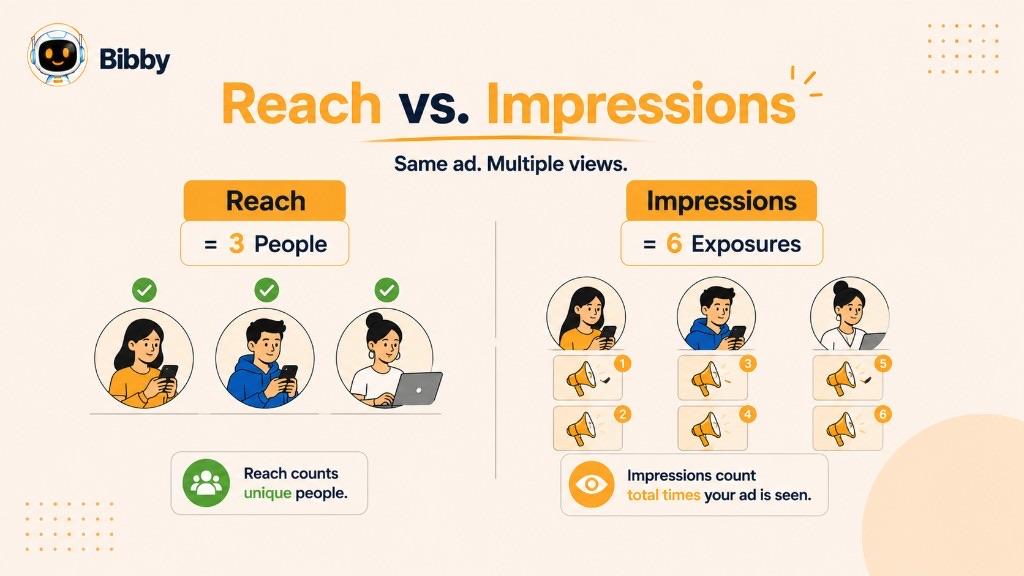
This distinction becomes especially important when evaluating campaign performance. A campaign can have a high number of impressions without reaching a large number of unique people because the same audience members may be seeing the content repeatedly.
Paid Reach vs. Paid Impressions: Quick Comparison
| Metric | What it measures | Example |
|---|---|---|
| Paid reach | Unique people exposed to paid content | 3,000 people |
| Paid impressions | Total paid content exposures | 7,500 impressions |
Neither metric is inherently more important than the other. Reach tells you the size of the audience you exposed your content to, while impressions show how often the content was delivered to that audience.
Looking at both metrics together also helps you understand frequency—the average number of times people in your reached audience were exposed to the content.
Paid Reach Examples
Paid reach becomes easier to understand when you see how the metric works in real social media campaigns. In each example below, the key number is the unique audience reached through paid distribution, not the total number of times the content was displayed.
Example 1: Instagram Product Promotion
A clothing brand publishes a product carousel on Instagram and promotes it to people interested in fashion.
After the campaign runs, the promoted carousel reaches 25,000 unique Instagram users.
The brand's:
Paid reach = 25,000
If those users generate 60,000 total impressions, the paid reach is still 25,000 because reach counts unique users rather than every exposure.
Example 2: Facebook Event Campaign
A local business wants to increase awareness of an upcoming event. It runs a paid Facebook campaign targeting people in the surrounding area.
The campaign is shown to 8,500 unique people.
The business therefore has:
Paid reach = 8,500
Some of those people may see the event advertisement several times, so the campaign could have considerably more than 8,500 impressions.
Example 3: LinkedIn B2B Campaign
A software company promotes an educational post on LinkedIn to professionals who match its target audience.
The campaign reaches 12,000 unique LinkedIn users.
The company's:
Paid reach = 12,000
The company can then look at additional metrics—such as clicks, engagement, leads, or conversions—to determine what those users did after being exposed to the content.
What These Examples Show
In all three examples, paid reach answers the same basic question:
How many unique people were reached because the content was distributed through paid promotion?
It does not tell you how many people clicked, liked, commented, purchased, or fully consumed the content. Those are separate metrics that should be evaluated alongside paid reach when measuring campaign performance.
Why Is Paid Reach Important?
Paid reach tells you how far your paid social media content was distributed to a unique audience. This makes it particularly useful when your goal is to increase awareness, introduce content to new audiences, or amplify an important message beyond your existing organic audience.
For example, a business may have a strong social media presence but only reach a fraction of its potential audience organically. Paid promotion can help put selected content in front of people who may not otherwise encounter it.
Paid reach can be useful for:
- Increasing awareness: Introduce your brand, product, service, or message to more people.
- Reaching specific audiences: Use available targeting options to distribute content to audiences that matter to your business.
- Supporting launches: Give a new product, service, event, or announcement additional distribution.
- Amplifying content: Put additional budget behind content that deserves a larger audience.
- Testing audiences: Compare how different audience segments respond to the same content.
- Expanding beyond existing followers: Reach people who do not already follow your social media accounts.
Is More Paid Reach Always Better?
No. A larger paid reach does not automatically mean a more successful campaign.
Reaching 100,000 people who have little interest in your product may be less valuable than reaching 10,000 highly relevant potential customers. The objective of the campaign should determine what constitutes a useful reach.
That is why paid reach should be considered alongside other metrics, such as:
- Engagement
- Clicks
- Click-through rate
- Conversions
- Leads
- Sales
- Return on advertising spend
- Frequency
Paid reach primarily tells you about audience exposure. To understand whether that exposure produced meaningful results, you need to look at what happened after people encountered the content.
How Is Paid Reach Measured?
Paid reach is measured by counting the unique users who were exposed to content through paid distribution during a specified reporting period.
In most cases, the social media platform's advertising or analytics system reports paid reach for you. You generally do not need to calculate it manually.
For example, if a paid campaign is delivered to 40,000 unique users, the reported paid reach is 40,000, regardless of how many total times those users saw the content.
A useful way to think about the metric is:
Paid reach = unique audience exposed to paid content
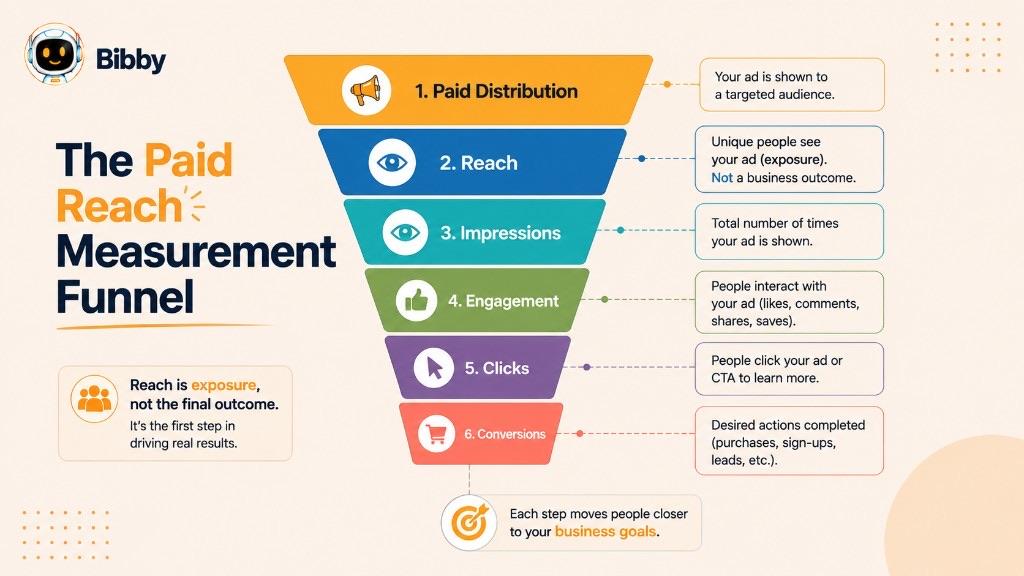
Paid Reach Is Not the Same as Impressions
If 40,000 people see an advertisement and some of them see it multiple times, the campaign could generate significantly more than 40,000 impressions.
For example:
- Paid reach: 40,000 unique users
- Paid impressions: 100,000 total exposures
The difference between these numbers reflects repeated exposure to some users.
Why Can Paid Reach Differ Between Platforms?
Paid reach is not necessarily measured and reported in exactly the same way on every social network. Each platform has its own advertising infrastructure, reporting methodology, attribution rules, and available metrics.
That means you should be careful when comparing a paid reach number from one platform directly with a number from another.
For example, a campaign reaching 50,000 users on Instagram and another reaching 50,000 users on LinkedIn have the same reported reach number, but that does not necessarily mean the campaigns had the same audience characteristics, costs, frequency, or business value.
For meaningful analysis, consider paid reach alongside spend, impressions, frequency, audience characteristics, engagement, clicks, and conversions.
Can You Calculate Paid Reach From Impressions?
Not exactly.
You can use impressions and reach to calculate an approximate average frequency:
Average frequency = impressions ÷ reach
But you cannot reliably derive the exact number of unique people reached from impressions alone. You need a reach metric reported by the platform or measurement system.
For this reason, paid reach is best treated as a reported unique-audience metric, rather than something that can be reconstructed from total impressions.
How to Increase Paid Reach
Increasing paid reach means getting your paid content in front of more unique people. The main levers are your budget, audience, creative, campaign settings, and delivery strategy.
However, simply maximizing reach is not always the right objective. The best approach depends on whether you are trying to build awareness, generate traffic, collect leads, or drive sales.
Increase Your Advertising Budget
A larger budget can give a campaign more opportunity to reach additional people. However, increasing spend does not guarantee a proportional increase in reach because advertising costs and competition can change.
If your campaign is already performing well, gradually increasing the budget may provide more room for distribution.
Expand Your Target Audience
Highly restrictive targeting can limit how many people your campaign can reach.
If your objective is broad awareness, consider whether your audience settings are unnecessarily narrow. A larger relevant audience gives the platform more potential users to reach.
Review Your Audience Targeting
More reach is only valuable when the people being reached are relevant.
Instead of targeting everyone possible, focus on finding the appropriate balance between audience size and audience relevance. Your targeting should reflect the people most likely to care about your content, product, or offer.
Test Different Creative Formats
Different audiences may respond differently to different types of content. Depending on the platform, you can test formats such as:
- Images
- Carousels
- Short-form videos
- Stories
- Feed posts
- Other platform-specific ad formats
Testing creative can help you identify which content earns stronger distribution and audience response.
Improve Your Creative
Your creative needs to compete for attention in crowded social feeds. Clear messaging, strong visual content, and a relevant offer can make your advertising more effective.
If one creative consistently performs better than another, testing variations of the stronger concept can help you improve campaign results.
Monitor Frequency
Increasing impressions without increasing reach may simply mean that the same people are seeing your content repeatedly.
Monitor frequency alongside reach to understand whether additional delivery is expanding your audience or primarily creating more exposure among people you have already reached.
Choose the Right Campaign Objective
If your goal is awareness, optimizing toward reach or related awareness objectives may make sense. If your goal is sales or leads, maximizing reach alone may not produce the best business outcome.
The right question is therefore not simply:
“How can I get more paid reach?”
It is:
“How can I reach more of the right people while achieving my campaign objective?”
Paid Reach vs. Frequency
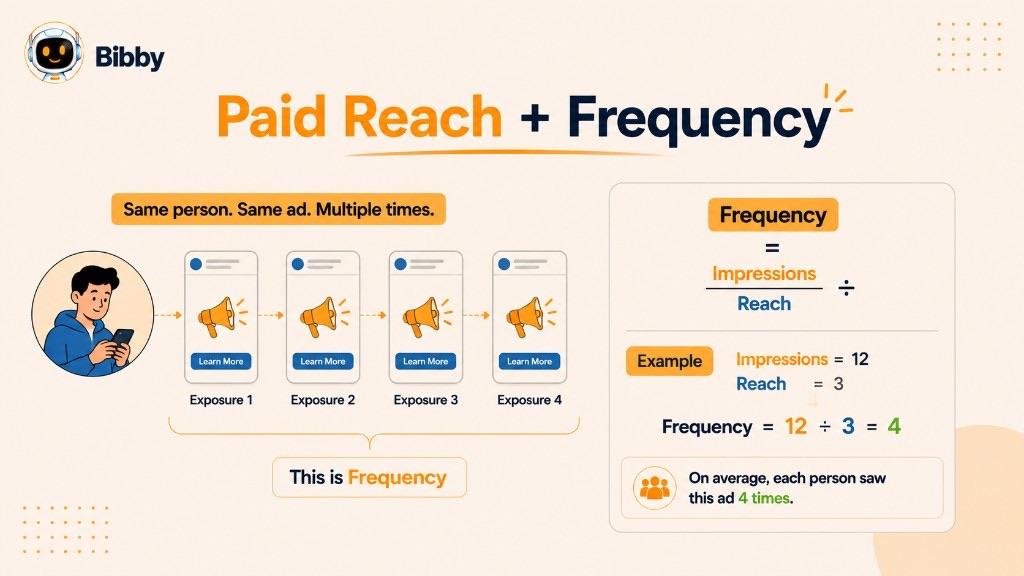
Paid reach tells you how many unique people your campaign reached. Frequency tells you how often those people were exposed to your content on average.
These metrics are closely related because a campaign can increase its impressions without significantly increasing its reach if the same people continue seeing the content.
A common way to express average frequency is:
Average frequency = impressions ÷ reach
For example, if your campaign generates:
- 100,000 paid impressions
- 25,000 people reached
Then:
Average frequency = 100,000 ÷ 25,000 = 4
This means the campaign generated an average of approximately 4 impressions per person reached.
Why Does Frequency Matter?
A high frequency can be useful when repeated exposure is part of your campaign strategy. For example, someone may need to encounter a brand or message several times before taking action.
However, repeatedly showing the same content to the same audience can also become inefficient if additional impressions are no longer producing meaningful results.
On the other hand, very low frequency may mean that people are being exposed to your message only once, which may not provide enough repetition for certain campaigns.
Paid Reach, Impressions, and Frequency Together
These three metrics provide a more complete picture:
- Paid reach: How many unique people did you reach?
- Paid impressions: How many total times was your content displayed?
- Frequency: How many times did people see it on average?
For example:
50,000 reach + 150,000 impressions = approximately 3 average frequency
Looking at these metrics together helps you determine whether your campaign is expanding its audience, repeatedly reaching the same audience, or doing a combination of both.
Paid Reach Across Social Media Platforms
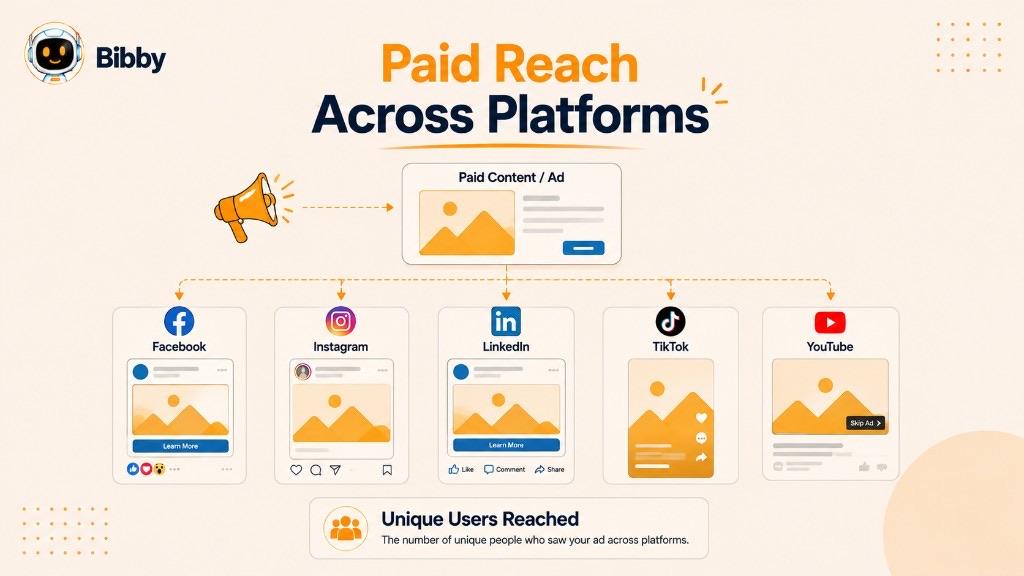
Paid reach exists across major social media platforms, but the way campaigns are created, delivered, and reported can differ from one platform to another.
The underlying concept remains the same: paid reach represents the unique audience exposed to content through paid distribution. However, you should use each platform’s own reporting when evaluating campaign performance rather than assuming that reach is perfectly comparable across networks.
Paid Reach on Facebook
On Facebook, paid reach can come from advertising campaigns and other forms of paid content promotion. Businesses can use paid distribution to put posts, images, videos, carousels, and other content in front of audiences beyond their normal organic distribution.
Facebook paid reach can be particularly useful for expanding awareness, promoting products or services, and reaching selected audience segments.
Paid Reach on Instagram
Instagram paid reach measures the unique audience exposed to content through paid promotion on the platform.
Depending on the campaign and available placements, paid content can appear in areas such as feeds and Stories. Advertisers can use paid reach to introduce content to new audiences or amplify content beyond their existing followers.
Paid Reach on LinkedIn
LinkedIn is particularly relevant when the target audience is defined by professional or business characteristics.
A company can use paid distribution to expose sponsored content to a selected professional audience. Paid reach can then help indicate how broadly that campaign was distributed among the targeted audience.
Paid Reach on TikTok
TikTok supports paid distribution of short-form video content through its advertising ecosystem.
For campaigns focused on awareness, paid reach can help show how many unique users were exposed to the promoted content. Reach should still be evaluated alongside metrics such as video views, engagement, clicks, and conversions when judging campaign effectiveness.
Paid Reach on YouTube
On YouTube, paid campaigns can distribute video content to audiences beyond a channel's organic viewers.
Paid reach is particularly useful for understanding the size of the unique audience exposed to a video advertising campaign. It should not be confused with video views, which represent a different measurement of audience behavior.
Why Platform Differences Matter
A paid reach number should always be interpreted in its platform and campaign context.
For example, 100,000 paid reach on Instagram and 100,000 paid reach on LinkedIn represent the same numerical count of unique users, but the audiences, costs, placements, campaign objectives, and reporting environments can be very different.
For accurate analysis, use each platform's reporting definitions and compare paid reach alongside the other metrics relevant to your campaign objective.
Is Paid Reach the Same as Paid Advertising?
No. Paid advertising is the activity, while paid reach is a metric that measures the unique audience exposed through that activity.
When you run a paid social media campaign, you spend money to distribute content to an audience. The campaign can produce many different results, including reach, impressions, clicks, engagement, leads, and conversions.
Paid reach answers one specific question:
How many unique people were reached through the paid distribution?
For example, a business might spend $500 on a social media advertising campaign. After the campaign ends, its results could look like this:
- Ad spend: $500
- Paid reach: 40,000 people
- Paid impressions: 100,000
- Clicks: 2,500
- Conversions: 120
In this example, the $500 is the advertising spend, while 40,000 is the paid reach.
This distinction matters because paying more for advertising does not automatically mean you will achieve proportionally more reach. Campaign performance can be affected by factors such as audience targeting, competition, creative quality, placements, campaign objectives, and advertising costs (CPM, CPC, and similar).
Similarly, high paid reach does not automatically mean an advertising campaign was successful. If the campaign's objective is to generate sales, for example, conversions and revenue may be more important than the number of people exposed to the advertisement.
In short: paid advertising is what you do; paid reach is one of the metrics that tells you how many unique people your paid distribution reached.
Does Paid Reach Mean Someone Actually Saw Your Content?
Not necessarily in the sense of actively reading, watching, or paying attention to it. Paid reach generally indicates that your content was delivered or exposed to a unique user according to the platform's measurement methodology.
Being counted in paid reach does not necessarily mean that the person:
- Read the entire post
- Watched the entire video
- Clicked the content
- Liked or commented
- Remembered the brand
- Took a desired action
This is why reach should not be confused with engagement or conversion.
How Paid Reach Differs From Other Metrics
| Metric | What it tells you |
|---|---|
| Paid reach | How many unique users were reached through paid distribution |
| Impressions | How many total times the content was displayed or served |
| Video views | How many views were recorded under the platform's definition |
| Engagement | How users interacted with the content |
| Clicks | How many times users clicked a link or other clickable element |
| Conversions | How many users completed a desired action |
For example, a campaign might reach 100,000 people but generate only 1,000 clicks. That does not make the reach metric incorrect; it simply means that exposure and action are different stages of the marketing process.
Likewise, 100,000 people reached does not mean that all 100,000 consciously noticed or consumed the content.
Why This Distinction Matters
Paid reach is most useful when you want to understand the size of the audience exposed to your paid content. To understand what happened after that exposure, you need additional metrics.
The most useful metrics depend on your campaign objective. An awareness campaign may focus heavily on reach and frequency, while a traffic, lead-generation, or sales campaign may place greater importance on clicks, conversions, revenue, or return on advertising spend.
Think of paid reach as the size of your paid audience exposure—not a measurement of attention, engagement, or business results.
When Should You Use Paid Reach?
Paid reach is most useful when you need to understand how many unique people your paid social media distribution has exposed your content to.
It is particularly relevant when your campaign is designed to expand awareness, reach a specific audience, or distribute important content beyond the people you can reach organically.
Use Paid Reach When Building Awareness
If your goal is to introduce a brand, product, service, or message to a larger audience, paid reach helps you understand the size of the audience exposed to your campaign.
For awareness campaigns, reach can be especially useful when evaluated alongside impressions and frequency.
Use Paid Reach When Launching Something New
Product launches, new services, events, and major announcements often need distribution beyond an existing social media audience.
Paid promotion can help expose launch content to additional users, while paid reach shows how many unique people received that exposure.
Use Paid Reach When Reaching a Specific Audience
Paid social advertising can provide targeting options that help businesses distribute content to particular audience segments.
In these campaigns, paid reach can help answer whether your content actually reached a meaningful number of people within the audience you were trying to reach.
Use Paid Reach When Amplifying Content
You may have an organic post that performs particularly well with your existing audience. Paid promotion can give that content additional distribution.
In this situation, paid reach helps separate the additional audience exposure generated through paid distribution from the content's existing organic reach.
Use Paid Reach When Comparing Campaign Distribution
When you run multiple paid campaigns, reach can help you understand how broadly each campaign distributed its content.
However, avoid judging campaigns on reach alone. A campaign that reaches fewer people can still produce better business results if those people are more relevant or more likely to take action.
When Paid Reach Should Not Be Your Main Metric
Paid reach is not always the most important metric.
If your primary objective is sales, leads, website traffic, app installs, or another measurable action, you should evaluate those outcomes alongside reach.
The right question is not simply:
“How many people did we reach?”
It is:
“Did we reach the right people, and did that exposure help us achieve our campaign objective?”
How Paid Reach Fits Into a Social Media Strategy
Paid reach is one part of a broader social media measurement and distribution strategy. It tells you how many unique people were exposed to content through paid promotion, but it does not replace the other metrics or activities involved in managing social media.
A practical social media workflow might look like this:
Create content → Publish → Measure performance → Identify opportunities → Promote selected content → Measure paid results
For example, a brand might publish several posts organically, discover that one performs particularly well, and then put paid promotion behind it to expose the content to a larger or more targeted audience.
The brand can then evaluate:
- Organic reach: How many people encountered the content through unpaid distribution?
- Paid reach: How many unique people encountered it through paid distribution?
- Impressions: How many total times was the content displayed?
- Engagement: How did people interact with it?
- Clicks: Did people visit the intended destination?
- Conversions: Did the campaign produce the desired action?
This approach helps prevent a common mistake: treating reach as the final goal rather than as one measurement within the larger marketing process.
How Bibby Fits Into This Workflow
Bibby helps businesses manage the content creation, organization, and publishing side of social media. You can use it to create or generate visual content, generate captions, choose posting styles, schedule posts across supported social platforms, and manage social media workflows through its chat interface.
For example, you can use Bibby to prepare and schedule your organic social content, then use the relevant advertising platform when you decide to put paid distribution behind selected content.
The distinction is important: Bibby’s social media scheduling and automation features do not themselves create paid reach. Paid reach occurs when content is distributed through a paid advertising or promotion system.
Understanding that difference helps you use social media automation and paid advertising together without confusing content publishing with paid media distribution.
Common Paid Reach Mistakes
Paid reach is a straightforward metric, but it is easy to misinterpret when it is viewed without context. Avoiding these mistakes can help you make better decisions about your social media campaigns.
1. Confusing Reach With Impressions
Reach counts unique users, while impressions count total exposures.
If 10,000 people see your content and some of them see it multiple times, your impressions can be much higher than 10,000 without your reach increasing by the same amount.
2. Treating Reach as Engagement
Someone being reached does not necessarily mean they interacted with your content.
A person can be included in your paid reach without liking, commenting, sharing, clicking, or otherwise engaging with the post.
If engagement matters to your campaign, evaluate engagement metrics separately.
3. Assuming More Reach Always Means Better Performance
More reach can be useful, but audience quality matters.
Reaching 100,000 people who are unlikely to care about your product may be less valuable than reaching 10,000 highly relevant potential customers.
Your campaign objective should determine whether increasing reach is actually beneficial.
4. Ignoring Frequency
A campaign can generate more impressions without reaching many additional people if it repeatedly serves content to the same audience.
Always consider paid reach alongside impressions and frequency to understand how broadly—and how often—your content is being delivered.
5. Comparing Platform Reach Numbers Without Context
A reach figure reported by one social platform should not automatically be treated as directly equivalent to the same figure reported by another.
Platforms can have different audiences, placements, reporting methodologies, campaign objectives, and advertising environments.
Use each platform's reporting definitions when making comparisons.
6. Focusing Only on Cheap Reach
A low cost per reached user can look attractive, but inexpensive exposure is not necessarily valuable exposure.
The people you reach, the quality of the content, and the actions generated after exposure can matter more than the raw cost of reaching another user.
7. Using Reach as a Substitute for Business Results
Paid reach measures audience exposure, not revenue.
If your campaign objective is leads, sales, website traffic, or another conversion, measure those outcomes directly rather than assuming that higher reach means better business performance.
8. Assuming Potential Reach Equals Actual Reach
A platform may estimate that a campaign can potentially reach a large audience, but that does not mean every person in that audience will see the content.
Potential reach is an estimate; paid reach reflects actual reported audience exposure.
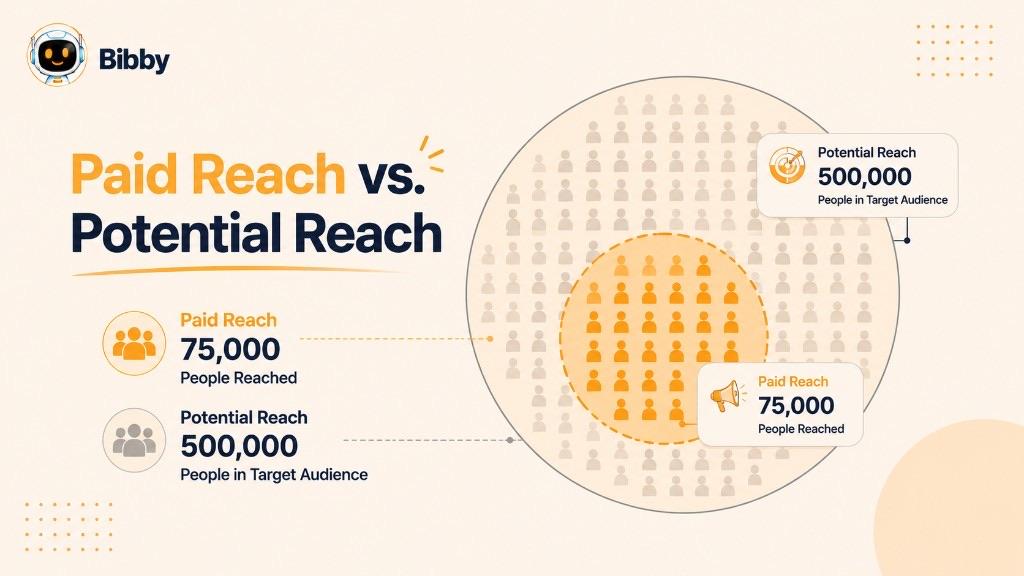
Keeping these distinctions clear makes paid reach much more useful as part of a larger social media measurement strategy.
Key Takeaway
Paid reach is the number of unique people exposed to your social media content through paid advertising or promotion. It tells you how broadly your paid content was distributed, but it does not tell you whether people engaged with it, clicked it, or converted.
Remember these three key points:
- Paid reach measures unique audience exposure, while impressions measure total exposures.
- Paid reach differs from organic reach because it comes from paid distribution rather than unpaid discovery.
- Reach is only one performance metric and should be evaluated alongside frequency, engagement, clicks, conversions, and other campaign objectives.
Once you understand paid reach, the next useful concept to explore is organic reach—how many people discover your content without paid promotion and how organic and paid distribution can work together as part of a broader social media strategy. Browse more terms in the social media dictionary, or start publishing with Bibby.