

Unlike traditional ecommerce, where customers typically leave social media to visit an online store, social commerce brings more of the shopping journey into the social environment. It allows businesses to turn posts, videos, creators, and conversations into opportunities to discover and buy products.
Checkout is not always inside the app. Depending on the platform, product, location, and available features, a customer may complete the transaction on the social network or be sent to the seller’s website.
Bibby helps you create, caption, and schedule product-focused social content. Product catalogs, shoppable tags, shops, and checkout stay in each platform’s native commerce tools.
What Is Social Commerce?

Social commerce is the practice of buying and selling products or services directly through social media platforms. It combines social media with ecommerce, allowing people to discover products, interact with brands or creators, evaluate products, and make purchases as part of their social media experience.
In traditional ecommerce, social media may introduce a customer to a product, but the customer usually has to leave the platform and visit a separate online store to complete the purchase. With social commerce, shopping features can be integrated into the social experience, making the path from product discovery to purchase more direct.
For example, someone watching a video about a new pair of shoes may be able to tap a product, view its details, and purchase it without navigating through a separate search journey.
How Social Commerce Differs From Traditional Ecommerce
The biggest difference is where the shopping experience begins and how closely it is connected to social interaction.
Traditional ecommerce typically follows a journey such as:
Search or advertisement → Online store → Product page → Checkout
Social commerce can look more like:
Social content → Product discovery → Product page → Purchase
Social commerce can also incorporate elements that are central to social platforms, including comments, reviews, creators, recommendations, user-generated content, and community interactions. These elements can influence purchasing decisions while the customer is discovering or evaluating a product.
Social commerce does not necessarily mean that every purchase must be completed inside a social media app.
How Social Commerce Differs From Social Media Marketing
Social media marketing and social commerce are closely related, but they are not the same.
Social media marketing uses social platforms to build awareness, engage audiences, distribute content, and promote products or services. A business might publish a product video and direct interested customers to its website.
Social commerce takes that process further by connecting product discovery and social interaction with the shopping or purchasing experience.
In simple terms:
Social media marketing helps people discover and consider a product. Social commerce helps connect that discovery with buying the product.
A business can use both at the same time. Its social media content can attract an audience, while shoppable content and product features can turn that attention into purchases.
How Does Social Commerce Work?
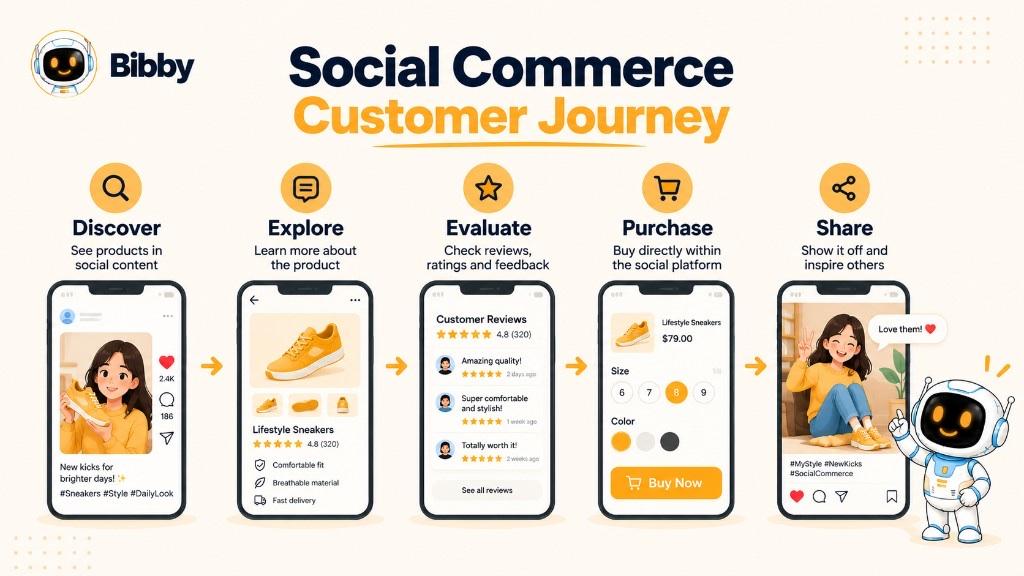
Social commerce works by connecting product discovery, social interaction, and purchasing within the same customer journey. Instead of treating social media only as a way to send visitors to an online store, businesses can use social content and shopping features to help customers move from discovering a product to considering and purchasing it.
A typical social commerce journey looks like this:
1. Product Discovery
The journey often begins when someone encounters a product while using social media. Products can be discovered through regular posts, short-form videos, Stories, livestreams, creator recommendations, paid advertisements, or user-generated content.
For example, someone watching a video about home organization might discover a storage product being demonstrated in the content.
2. Product Interaction
Once a customer becomes interested, social commerce features can make it easier to explore the product.
Depending on the platform, this may include product tags, shopping buttons, product catalogs, links, or other interactive shopping features. The customer can move from the content they are already viewing to additional product information without having to start a completely separate search.
3. Product Evaluation
Social commerce also brings social proof into the shopping journey.
Customers may evaluate a product by looking at reviews, comments, ratings, demonstrations, creator recommendations, or content from other customers. Seeing how real people use a product can help potential buyers understand its value and decide whether it is right for them.
4. Purchase
The customer can then purchase the product through the available shopping experience.
In some cases, the transaction can be completed directly through the social media platform. In other cases, the platform sends the customer to the business’s website or another checkout experience.
The exact process depends on the platform, country, merchant, product, and available commerce features.
5. Post-Purchase Engagement
The relationship does not necessarily end when the purchase is completed.
Customers may follow the brand, leave reviews, share their experience, create user-generated content, or interact with future posts. This creates another source of social proof that can influence future customers.
As a result, social commerce can create a continuous cycle:
Discover → Explore → Evaluate → Purchase → Share → Discover again
This connection between content, community, and commerce is what makes social commerce different from simply advertising a product on social media.
Social Commerce Examples
Social commerce can take many forms, from a customer purchasing a product after seeing it in a social media video to discovering a product through a creator or buying during a livestream. The common element is that social interaction and product purchasing are connected within the same customer journey.
1. Instagram Product Discovery
A clothing brand publishes a Reel featuring a new jacket. A viewer likes the jacket, taps the product featured in the content, reviews its details, and continues to purchase through the available shopping experience.
The social post is not simply advertising the jacket—it becomes part of the path to purchasing it.
2. TikTok Product Demonstrations
A skincare brand creates a short video demonstrating how one of its products works. Someone watching the video becomes interested, explores the featured product, and purchases it through the shopping functionality available to them.
This combines entertainment, product education, discovery, and commerce in one social experience.
3. Facebook Product Shopping
A business showcases its products through its Facebook presence and makes relevant products available for customers to explore. A customer discovers a product while browsing Facebook, views additional information, and proceeds through the available purchase journey.
This allows the business to connect its social audience with its product catalog.
4. Creator Recommendations
A creator recommends a product they genuinely use and creates content showing how it fits into their daily routine. Followers who are interested can interact with the featured product and potentially purchase it.
This is particularly powerful because the product is discovered through a person the audience already follows and trusts.
5. Livestream Commerce
A beauty brand hosts a livestream where someone demonstrates several products and answers questions from viewers in real time.
Viewers can watch the demonstration, ask about the products, see them being used, and access the available shopping experience while the livestream is happening.
Livestream commerce combines the immediacy of live video with interactive shopping.
6. User-Generated Content
A customer purchases a fitness product and posts a video showing how they use it. Another person discovers the video, becomes interested in the product, and follows the available product or shopping path to make a purchase.
In this example, an existing customer effectively becomes part of the brand's product discovery process through UGC.
7. Social Commerce Through Product-Focused Content
A home decor brand creates a carousel showing five ways to style a particular room. Each image features products that can be explored through the platform's available shopping features.
Instead of separating product promotion from content, the brand makes the content itself part of the shopping experience.
These examples show that social commerce is broader than simply adding a “Buy” button to a social media post. It is the integration of social discovery, content, interaction, and commerce into a connected customer journey.
Social Commerce on Major Social Media Platforms
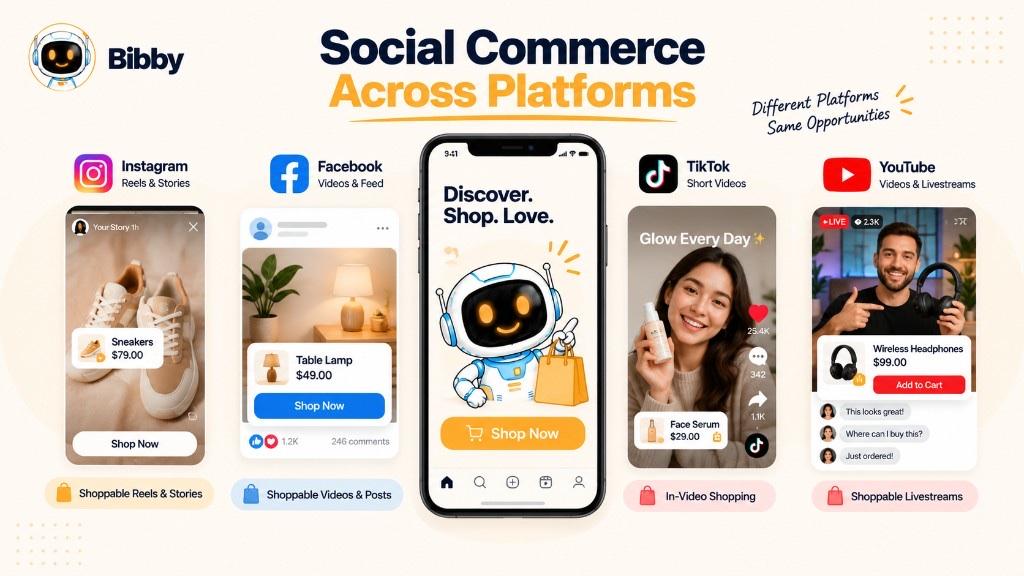
Social commerce looks different from one social media platform to another. Each platform has its own combination of shopping features, content formats, creator tools, and checkout options, and the features available can vary by country and business.
Instagram is well suited to social commerce because product discovery is closely connected to visual content.
Businesses can use formats such as Reels, Stories, photos, and other content to showcase products and connect interested customers with product information. Product-focused content can also benefit from creator recommendations, customer-generated content, and social interactions such as comments and shares.
For visually driven businesses, Instagram can connect content discovery with product exploration in a highly visual environment.
Facebook can support social commerce by allowing businesses to showcase products and connect their social presence with shopping experiences.
Businesses can use their Facebook presence to introduce products, engage with customers, share product-focused content, and direct interested users toward available purchasing options.
Facebook can be particularly useful for businesses that already have an established community or customer base on the platform.
TikTok
TikTok combines entertainment, short-form video, creator influence, and product discovery.
A product can appear naturally within a demonstration, review, tutorial, trend, or creator video. Where shopping functionality is available, users can then move from discovering the product in the content toward exploring or purchasing it.
This makes TikTok especially relevant to discovery-driven commerce, where entertaining or educational content creates interest in a product.
YouTube
YouTube can support social commerce through product-focused videos, creator recommendations, product integrations, and shopping features.
For example, a creator might publish a product review or tutorial that helps viewers understand how a product works. Relevant shopping functionality can then provide a path for interested viewers to explore or purchase the product.
YouTube is particularly valuable for products that benefit from demonstrations, comparisons, tutorials, and longer-form explanations.
LinkedIn is primarily a professional networking and B2B platform rather than a traditional consumer social-commerce marketplace.
However, social interactions on LinkedIn can contribute to commercial activity. Businesses can use educational content, product insights, case studies, and expert-led content to introduce products or services to potential customers.
For B2B companies, this is more closely related to social selling and social-driven product discovery than traditional social commerce.
Why the Platform Matters
The same social-commerce strategy will not work equally well everywhere.
A business should consider:
- Where its target customers spend their time
- Which content formats perform best for its products
- Whether shopping features are available in its market
- Whether customers need demonstrations, reviews, or education before buying
- How much of the purchasing journey can happen within the platform
The key is not simply to sell on every social network. It is to match the product, audience, content format, and available commerce features to the platform where customers are most likely to discover and purchase.
Benefits of Social Commerce
Social commerce can make the path from discovering a product to purchasing it more connected. By bringing content, social interaction, product information, and commerce closer together, businesses can meet customers where they are already spending time online.
1. Shorter Path From Discovery to Purchase
Traditional customer journeys can require several steps between seeing a product and buying it. Social commerce can reduce that friction by connecting product content with product information and purchasing options.
A customer can discover a product in a post or video, explore it, and continue toward purchase without having to independently search for the product afterward.
2. Product Discovery Happens Where People Already Spend Time
People use social media to watch videos, follow creators, interact with friends, discover trends, and explore interests.
Social commerce adds product discovery to that existing behavior. Instead of requiring customers to begin their shopping journey on a search engine or ecommerce website, brands can introduce products directly within social experiences.
3. Social Proof Can Influence Buying Decisions
Social commerce naturally incorporates forms of social proof such as comments, reviews, creator recommendations, customer photos, and user-generated videos.
This information can help potential customers understand how other people experience a product and provide additional confidence before making a purchase.
4. Content and Commerce Work Together
A product demonstration, tutorial, review, or customer story can do more than generate engagement. It can also help someone understand why they might want the product.
Social commerce connects that content with the opportunity to explore or purchase the product, turning useful content into part of the commerce journey.
5. Creator Recommendations Can Drive Product Discovery
Creators can introduce products to audiences that already follow and engage with them.
When a creator demonstrates, reviews, or recommends a product, the recommendation can feel more contextual than a traditional advertisement. When shopping functionality is available, interested viewers can move directly from the recommendation toward the product.
6. Interactive Shopping Experiences
Social platforms allow customers to interact with brands and creators while discovering products.
They can ask questions, read comments, watch demonstrations, respond to content, and see how other people use a product. This makes the shopping experience more interactive than simply viewing a static product page.
7. More Opportunities to Turn Engagement Into Sales
Likes, comments, shares, views, and followers do not automatically generate revenue. Social commerce provides businesses with ways to connect that attention to actual products and purchasing opportunities.
The result is a closer relationship between social engagement and commercial outcomes. Views are not the same as conversions.
8. Continuous Product Discovery
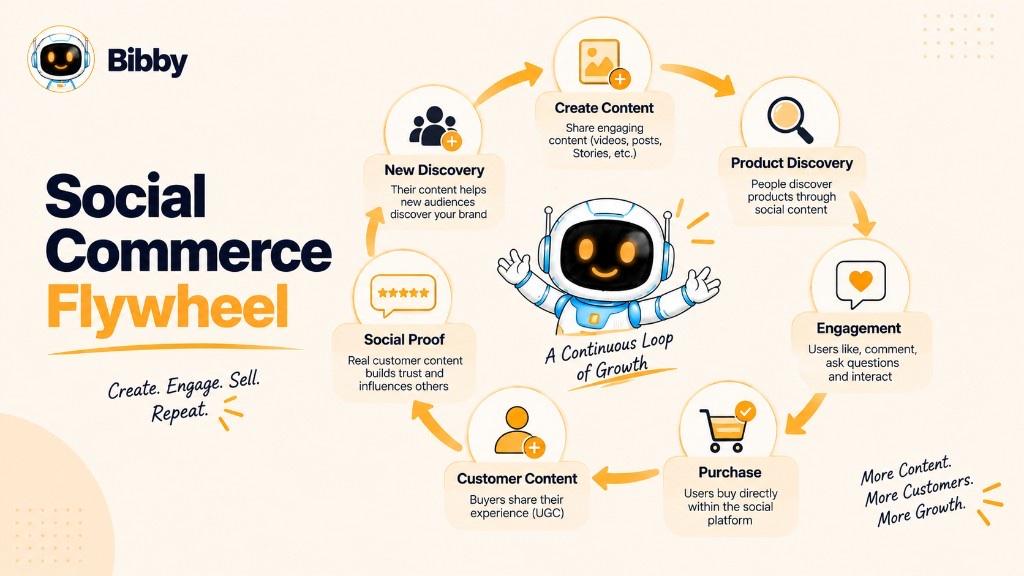
Social commerce is not limited to a single shopping session. New posts, videos, creator recommendations, customer content, and campaigns can continually introduce products to existing and potential customers.
This creates an ongoing discovery loop:
Content → Discovery → Interaction → Purchase → Customer Content → New Discovery
For businesses that can consistently produce useful and engaging content, this loop can become an important part of their broader ecommerce strategy.
Social Commerce vs Ecommerce
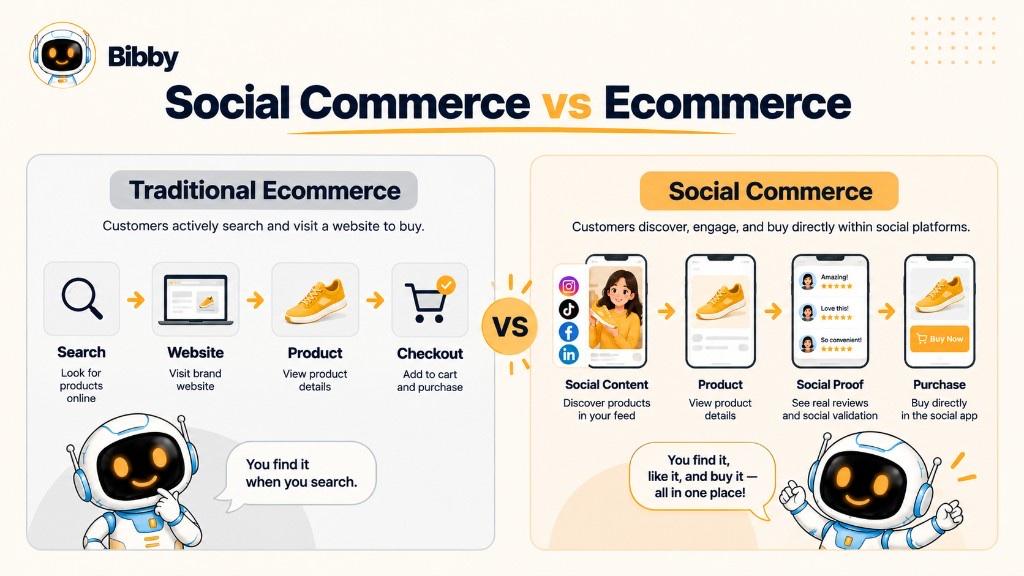
Social commerce and ecommerce both involve selling products online, but they differ mainly in where and how customers discover and purchase those products.
Traditional ecommerce generally takes place through a dedicated online store or marketplace. Social commerce brings shopping into social media environments, where product discovery can happen alongside content, conversations, creators, and communities.
Social Commerce vs Ecommerce: Key Differences
| Social Commerce | Ecommerce | |
|---|---|---|
| Primary environment | Social media platforms | Online stores and ecommerce marketplaces |
| Product discovery | Social content, creators, recommendations, communities | Search, websites, marketplaces, ads, email, and other channels |
| Social interaction | Central to the shopping experience | Usually separate from the core purchase journey |
| Content | Often directly connected to product discovery | Usually exists alongside the store experience |
| Purchase journey | Can happen within or through a social platform | Usually happens on an ecommerce website or marketplace |
| Social proof | Comments, creators, UGC, reviews, and shares can be integrated into discovery | Reviews and ratings are typically found on product pages |
| Customer relationship | Often built through ongoing social interaction | Usually managed through the store, email, loyalty programs, and other channels |
Is Social Commerce the Same as Ecommerce?
No. Social commerce is a form of online commerce that uses social platforms as part of the shopping experience.
An ecommerce business can have its own website while also using Instagram, TikTok, Facebook, YouTube, or other platforms to sell products.
For example, a clothing company might operate an ecommerce website where customers can browse its complete catalog and manage their orders. The same company could use social commerce to showcase individual products through videos, creator collaborations, or shoppable social content.
The two channels can therefore work together rather than replacing one another.
Why Social Commerce Is Different
The defining feature of social commerce is not simply that a product is advertised on social media. The social environment becomes part of the commerce experience.
A customer might discover a product because a creator recommends it, see other customers discussing it, watch a demonstration, interact with the brand, and then purchase it—all as part of a connected social journey.
In traditional ecommerce, the customer typically enters a shopping environment first. In social commerce, the shopping opportunity can emerge naturally from the social experience itself.
Social Commerce vs Social Selling
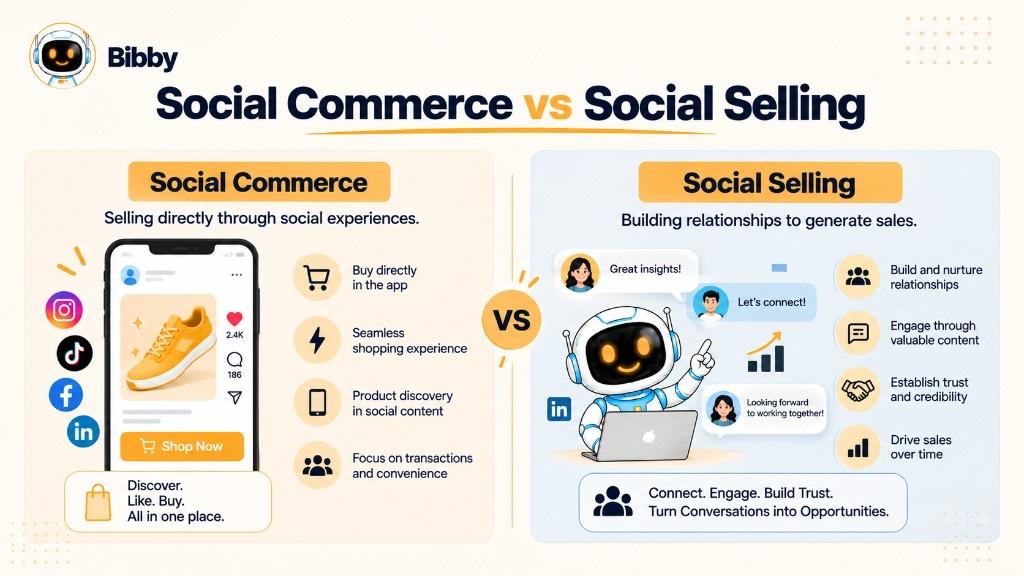
Social commerce and social selling both use social media to support sales, but they describe different approaches.
Social commerce focuses on selling products through social media and integrating shopping into the social experience. Social selling focuses on using social networks to build relationships with potential customers and develop sales opportunities.
What Is Social Commerce?
Social commerce connects product discovery and purchasing with social media.
For example, a customer sees a product in an Instagram video, explores the product through an available shopping feature, and proceeds toward purchasing it.
The emphasis is on the commerce experience.
What Is Social Selling?
Social selling is a relationship-driven approach to sales. Sales professionals use social networks to identify potential customers, establish relationships, share relevant information, engage in conversations, and eventually develop those relationships into sales opportunities.
For example, a B2B salesperson might use LinkedIn to identify a potential customer, interact with their posts, share useful industry information, and eventually begin a sales conversation.
The emphasis is on the relationship and sales process.
Social Commerce vs Social Selling: The Simple Difference
The easiest way to remember the distinction is:
Social commerce = selling through social experiences.
Social selling = building relationships through social networks to generate sales.
The two can also work together. A business might use social selling to build relationships with potential customers while using social commerce to give customers a convenient way to discover and purchase its products.
What Types of Content Drive Social Commerce?

Social commerce depends heavily on content because content is often what introduces customers to a product in the first place. The most effective content does more than promote a product—it shows its value, builds trust, answers questions, or gives customers a reason to explore it further.
Product Demonstrations
Product demonstrations show a product in use and help potential customers understand how it works.
For example, a kitchen brand could create a short video demonstrating how quickly a particular appliance prepares a meal. The content provides useful information while creating an opportunity for viewers to explore the featured product.
Short-Form Videos
Short-form videos can introduce products through demonstrations, tutorials, reviews, comparisons, or entertaining content.
Because the product can be presented within a broader piece of content, short-form video allows businesses to make product discovery feel more natural than a straightforward promotional message.
Tutorials and How-To Content
Tutorials demonstrate how a product can solve a specific problem or help someone accomplish a particular task.
For example, a cosmetics brand might publish a tutorial showing how to create a particular look using its products. Viewers who want to recreate the result can then explore the products featured in the content.
User-Generated Content
User-generated content is content created by customers or other users rather than directly by the brand.
Customers might post unboxing videos, product reviews, demonstrations, or photos showing how they use a product. This type of content can provide social proof and give prospective customers a more authentic view of the product.
Customer Reviews and Testimonials
Reviews and testimonials can help customers evaluate a product before purchasing.
Businesses can incorporate customer experiences into social content through review videos, testimonial posts, screenshots, or other formats, where appropriate and authentic.
Before-and-After Content
Before-and-after content can be useful when a product produces a visible or measurable result.
For example, a home organization company could show a space before and after using its products. The visual comparison helps communicate the product's practical value quickly.
Product Carousels
Carousels can showcase multiple products, product variations, features, or use cases within a single social post.
A fashion brand, for example, could create a carousel showing several ways to style the same item or highlight different products from a collection.
Stories
Stories can provide a more immediate way to showcase products, promotions, launches, behind-the-scenes content, or customer experiences.
Their temporary and highly interactive nature can also make them useful for product announcements and ongoing engagement.
Livestreams
Livestreams combine real-time video with interaction.
A business or creator can demonstrate products, answer questions, compare products, and respond to viewers while the content is happening. Where shopping features are available, viewers can also move from the live experience toward purchasing.
The Role of Content in Social Commerce
The strongest social-commerce content does not treat every post as an advertisement. Instead, it gives people a reason to watch, learn, engage, trust, and ultimately explore a product.
That is why a social-commerce strategy usually works best when businesses combine promotional content with educational, entertaining, demonstrative, and customer-generated content.
How to Use Social Commerce for Your Business
Businesses can use social commerce to connect their social media content with product discovery and purchasing. The right approach depends on the products, target audience, social platforms, and commerce features available in the business’s market.
1. Choose the Right Social Platforms
Start with the platforms where your target customers already spend time.
Consider factors such as:
- Your target audience
- Product category
- Preferred content formats
- Platform-specific shopping features
- Availability of commerce features in your market
- Whether your customers need education or demonstrations before purchasing
You do not necessarily need to sell on every social platform. A focused presence on the platforms most relevant to your audience can be more effective.
2. Set Up Your Product Information
Make sure customers can easily understand what you are selling.
Depending on the platform and commerce setup, this can include product names, descriptions, images, prices, variations, availability, product links, and shipping and return information.
Accurate product information reduces friction when someone discovers an item through social content. Set this up in the platform shop or your store—not in Bibby.
3. Create Content That Helps People Discover Products
Create content that naturally introduces your products to potential customers.
Instead of publishing only promotional posts, experiment with product demonstrations, tutorials, reviews, short-form videos, customer stories, user-generated content, product comparisons, educational content, and behind-the-scenes content.
The goal is to give people a reason to engage with the content before asking them to buy.
4. Make Products Easy to Explore
When shopping features are available, connect relevant products to the content that showcases them in the native shopping tools.
A customer who sees a particular product in a video should not have to search through your entire catalog to find it.
The easier it is to move from content to product information, the less unnecessary friction there is in the customer journey. A link in bio can still help, but it is not the same as a shoppable post.
5. Build Social Proof
Social commerce benefits from the trust signals that naturally exist on social platforms.
Encourage and showcase authentic customer reviews, testimonials, product demonstrations, creator content, customer photos and videos, and questions and answers.
Social proof can help potential customers understand how a product performs in real-world situations.
6. Test Different Content Formats
There is no single format that works for every business.
Test different combinations of videos, carousels, Stories, livestreams, creator content, and other formats to identify what generates meaningful results.
Look beyond likes and views. Where possible, measure actions closer to the commercial outcome, such as product interactions, website visits, add-to-carts, and purchases—in platform commerce analytics or your store.
7. Publish Consistently
Social commerce depends on ongoing product discovery. A customer cannot discover your products through content that never gets published.
Consistent publishing gives businesses more opportunities to introduce products, answer customer questions, test creative ideas, and learn which topics and formats resonate with their audience.
This is where social media scheduling can become useful. Businesses can plan content in advance, maintain a consistent content calendar, and spend more time improving the content itself.
8. Measure and Optimize
Track the metrics that matter to your business.
Depending on your setup, these may include product views, product clicks, engagement, add-to-cart actions, purchases, conversion rate, revenue, and revenue attributed to social content.
Use these results in platform Insights, commerce tools, and your store. Bibby does not replace native shopping analytics or an ROI dashboard.
Social commerce works best as an ongoing process: create, publish, measure, learn, and improve.
How Social Media Automation Supports Social Commerce
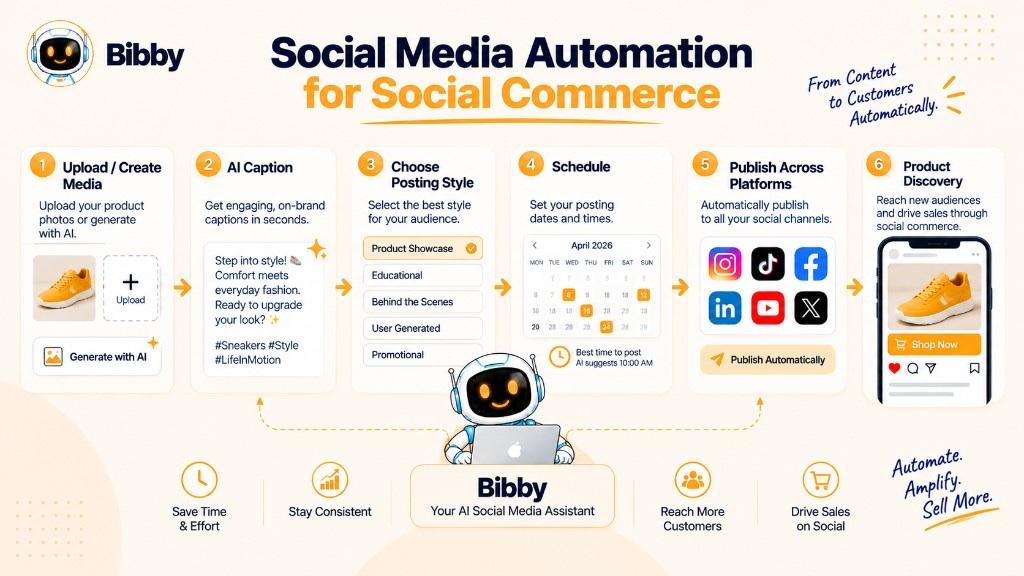
Social commerce depends on consistent product discovery. A business may have excellent products and strong shopping features, but customers cannot discover those products through social media if the business rarely publishes content.
Social media automation can help businesses maintain the content workflow behind social commerce. Instead of manually creating, writing, and scheduling every post for every platform, businesses can automate repetitive parts of the publishing process while keeping control over their content and strategy.
Create More Product-Focused Content
Automation tools can help businesses turn product images, videos, carousels, and other media into social posts.
For example, a business launching a new product could create several pieces of content around the launch, including a product introduction, demonstration, customer-focused post, and educational post.
This creates more opportunities for potential customers to encounter the product.
Schedule Content Across Multiple Platforms
Social commerce often involves reaching customers across multiple social networks.
Rather than publishing every post manually, businesses can schedule content in advance across the platforms they use. This makes it easier to maintain a consistent publishing schedule and coordinate product campaigns.
Adapt Content for Different Platforms
The same product can be presented differently depending on the platform.
A business might use a short video to demonstrate a product on one platform, a carousel to explain its features on another, and a professional product-focused post elsewhere.
A social media automation workflow can make managing these variations more efficient.
Automate Caption Creation
Captions can provide context around a product, explain its benefits, answer common questions, or encourage people to explore it with a clear call to action.
AI-powered tools can help generate caption variations from existing media, reducing the amount of repetitive writing required when businesses publish content regularly.
Human review remains important, particularly for product claims, pricing, promotions, and brand-specific information.
Maintain a Consistent Publishing Schedule
Consistency gives businesses more opportunities to put products in front of potential customers.
Automation allows businesses to prepare content ahead of time and schedule it for different dates and times. This can be especially useful during product launches, seasonal campaigns, promotions, and other periods when multiple posts need to be coordinated.
Manage Social Commerce Content With Bibby
Bibby is a social media scheduling and automation tool designed to simplify the process of creating and managing social content.
Businesses can upload existing media or generate images with AI, choose a preferred posting style, and use AI to generate captions. Content can then be scheduled across selected social platforms at different dates and AI-optimized posting times on Facebook, Instagram, LinkedIn, YouTube, and TikTok.
Bibby also supports different content formats, including images, carousels, videos, and Stories, depending on the platform and available publishing capabilities.
Its chat interface adds another layer to the workflow. Instead of managing every task separately, users can interact with Bibby conversationally to perform tasks such as creating a brand kit, planning a campaign, creating posts, or regenerating captions.
For businesses using social commerce, the value is straightforward: more efficient content creation and publishing can create more consistent opportunities for customers to discover products through social media.
Automation does not replace the fundamentals of social commerce. Businesses still need compelling products, useful content, authentic social proof, accurate product information, and a frictionless purchasing experience. Catalogs, tags, checkout, ads, and sales reporting stay on each platform or your store.
Social Commerce Trends
Social commerce continues to evolve as social platforms bring content, creators, communities, and shopping closer together. While specific features change frequently, several broader trends are shaping how businesses use social media to sell products.
Social Discovery Is Becoming More Important
People increasingly discover products through content rather than starting every purchase journey with a traditional product search.
Short-form videos, creator recommendations, customer content, and social trends can introduce products to people who were not actively looking to buy them.
This makes product discovery an increasingly important part of social commerce.
Short-Form Video Is a Major Commerce Format
Short-form video can combine entertainment, education, demonstration, and product discovery in a single piece of content.
A product can be shown in use, explained, reviewed, or incorporated into a larger story without requiring the content to feel like a traditional advertisement.
Creators Are Becoming Part of the Shopping Journey
Creators can influence what their audiences discover, consider, and purchase.
Rather than treating creators only as advertising partners, brands can use creator content to demonstrate products, answer customer questions, provide recommendations, and generate authentic social proof.
User-Generated Content Supports Product Trust
Customers increasingly encounter products through content created by other customers.
Unboxing videos, reviews, tutorials, product demonstrations, and customer photos can give potential buyers additional context before they make a purchasing decision.
This makes UGC an important bridge between social engagement and purchase confidence.
Livestream Commerce Is Becoming More Interactive
Livestreams allow brands and creators to combine product demonstrations with real-time conversations.
Viewers can ask questions, see products being used, and interact with the presenter while the shopping experience is taking place. This creates a more interactive form of product discovery than traditional static advertising.
AI Is Changing Social Commerce Content Creation
AI tools are making it easier for businesses to create, adapt, and schedule social content at scale.
Businesses can use AI to help generate captions, develop content ideas, create or edit visuals, repurpose existing media, and plan publishing schedules.
The important distinction is that AI can accelerate content production, but strategy, brand judgment, product accuracy, and authenticity still require human oversight.
Social Commerce Is Becoming More Connected to the Overall Customer Journey
Social commerce is no longer limited to a single “buy” interaction.
Customers may discover a product through a video, research it through comments and reviews, visit a brand's profile, see additional content, interact with a creator, and eventually make a purchase.
The broader trend is toward connecting social discovery, consideration, community, and commerce into one continuous customer journey.
Challenges of Social Commerce
Social commerce can make product discovery and purchasing more convenient, but it also introduces challenges that businesses need to consider. Success depends on more than simply making products available through a social platform.
Platform Dependency
Businesses using social commerce rely on third-party platforms to reach customers and provide shopping functionality.
Platform algorithms, policies, fees, features, and eligibility requirements can change. A feature that is available today may work differently in the future or may not be available in every market.
For this reason, businesses should avoid relying entirely on a single social platform for their sales.
Building Customer Trust
Customers may hesitate to purchase products they discover through social media, particularly when they are unfamiliar with the brand.
Clear product information, authentic reviews, transparent policies, secure purchasing experiences, and genuine customer interactions can help establish trust.
Businesses should also avoid exaggerated claims or misleading content simply to generate conversions.
Managing Customer Questions and Feedback
Social commerce makes product discussions highly visible.
Potential customers may ask questions in comments, raise concerns, or share their experiences publicly. Businesses need a process for responding to questions and handling negative feedback professionally.
Good customer interaction can strengthen trust, while poor responses can become visible to a much larger audience.
Keeping Product Information Accurate
Social commerce relies on accurate information about products.
Prices, availability, product descriptions, images, variations, shipping details, and other information should remain consistent wherever customers encounter the product.
Outdated information can create confusion and damage the customer experience.
Measuring the Customer Journey
A customer may interact with several pieces of social content before purchasing.
For example, they might discover a product through a video, view a creator recommendation several days later, visit the brand's profile, and eventually purchase through another channel.
This can make attribution more difficult. Businesses should therefore avoid judging social commerce solely by individual post metrics such as likes or views.
Creating Enough Content
Social commerce relies on ongoing product discovery, which requires a consistent supply of useful content.
Creating high-quality videos, images, carousels, Stories, and other content can become time-consuming when everything is produced and published manually.
Content planning, scheduling, and automation can help businesses manage this workload more efficiently.
Different Platforms Have Different Capabilities
There is no universal social-commerce experience.
Shopping features, checkout options, product tagging, eligibility requirements, and supported content formats can differ by platform, country, business type, and product category.
Businesses should verify the commerce features available to them rather than assuming that a particular social-shopping feature works everywhere.
Social Commerce Still Requires a Strong Product and Customer Experience
Social commerce can make it easier for people to discover and purchase products, but it cannot compensate for fundamental problems with the product, pricing, fulfillment, customer service, or overall value proposition.
Ultimately, social commerce is a distribution and shopping channel—not a substitute for a good product and a reliable customer experience.
Social Commerce: Key Takeaways
Social commerce connects social media, product discovery, and online shopping into a more integrated customer journey. Instead of using social platforms only to promote products and send traffic elsewhere, businesses can use social content, creators, communities, and shopping features to help customers discover, evaluate, and purchase products.
The three key ideas to remember are:
- Social commerce combines social interaction with product discovery and purchasing.
- It differs from traditional ecommerce and social selling, although they can work together.
- Consistent, useful social content is essential for turning social attention into commerce opportunities.
As social platforms continue to bring content and shopping closer together, businesses need an efficient way to consistently create and publish content across the channels where their customers spend time.
Continue learning with related dictionary entries on shoppable posts, UGC, influencers, CTAs, short-form video, Reels, conversion rate, and link in bio—or browse the social media dictionary. Then start a free Bibby trial to create, caption, and schedule product-focused content across your channels.