
Social media has evolved from a simple marketing channel into one of the most powerful growth engines for businesses, creators, and personal brands in 2026.
Whether you're launching a new business, growing an existing brand, or building an online audience, success on social media no longer comes from posting randomly and hoping for engagement. Today's top-performing brands rely on clear strategies, data-driven decisions, AI-powered tools, and consistent execution to reach the right audience and achieve measurable results.
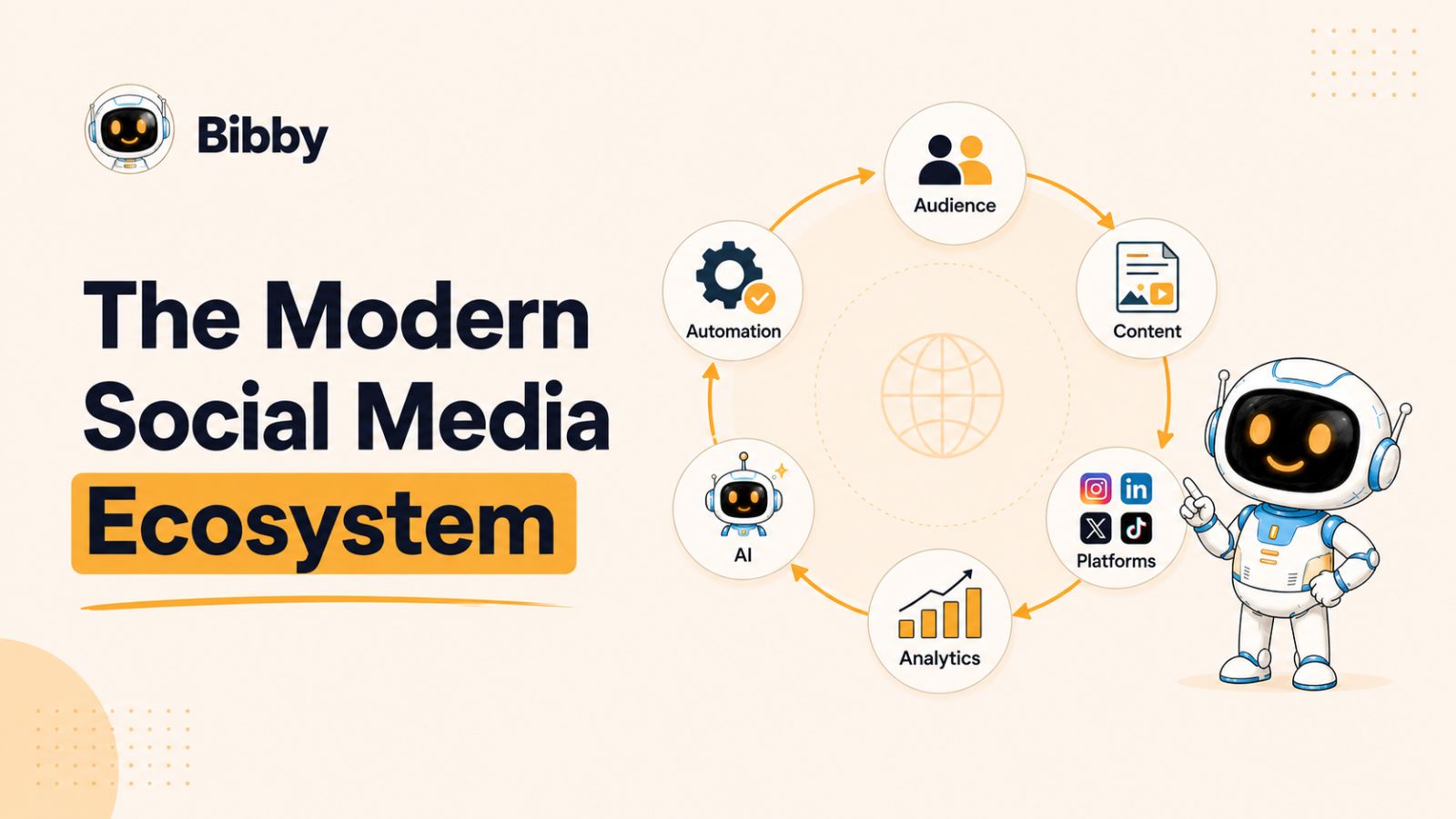
The good news is that building an effective social media strategy doesn't require a massive team or budget. By following a structured framework—and leveraging modern AI tools such as Bibby to automate content creation, scheduling, publishing, and analytics—you can build a scalable social media presence that generates awareness, engagement, leads, and sales across platforms like Facebook, Instagram, LinkedIn, YouTube, and TikTok.
Let's start with the foundation of every successful social media strategy: understanding what a social media strategy actually is and why it matters more than ever in 2026.
What Is a Social Media Strategy?
A social media strategy is a documented plan that outlines how a business, brand, or creator will use social media platforms to achieve specific goals. Rather than posting content randomly, a strategy provides a clear roadmap for what you will publish, who you are targeting, which platforms you will use, and how success will be measured.
At its core, a social media strategy answers five critical questions:
- What are your goals?
- Who is your target audience?
- Which platforms should you focus on?
- What type of content will you create?
- How will you measure results?
Without clear answers to these questions, it's easy to waste time creating content that generates likes but fails to produce meaningful business outcomes.
The Key Components of a Social Media Strategy
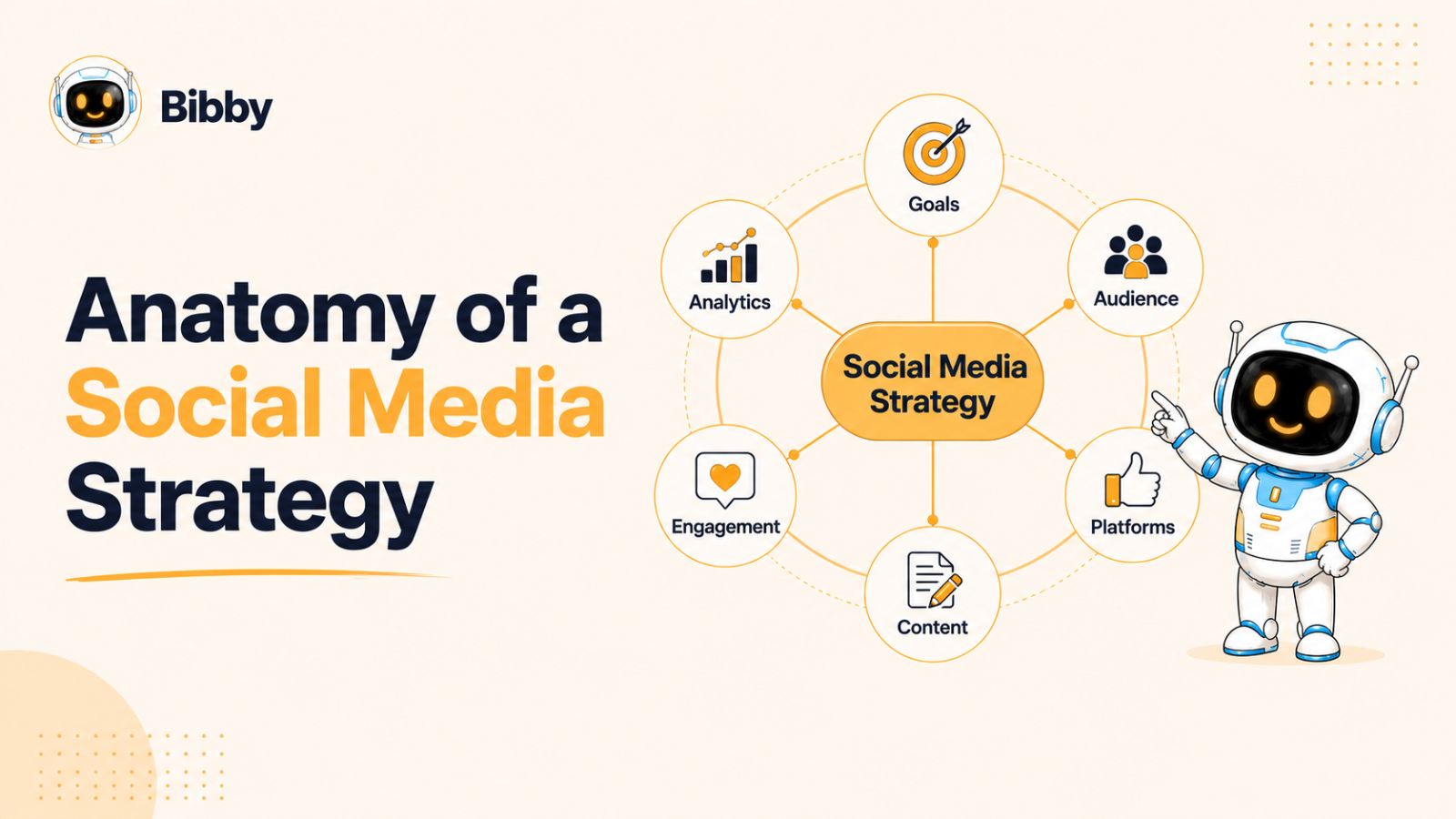
A successful social media strategy typically includes:
Goals and Objectives
Every social media effort should support a larger business objective. These goals may include increasing brand awareness, generating leads, driving website traffic, boosting sales, or building a loyal community.
Audience Research
Understanding your audience is essential. The more you know about their interests, challenges, behaviors, and preferred platforms, the easier it becomes to create content they actually want to engage with.
Platform Selection
Not every social network is right for every business. A strong strategy identifies the platforms where your target audience spends the most time and focuses resources there.
Content Planning
Content planning defines the topics, formats, and publishing frequency that support your goals. This includes educational posts, short-form videos, customer stories, industry insights, and promotional content.
Engagement and Community Building
Social media is a two-way conversation. Responding to comments, answering messages, and interacting with followers helps strengthen relationships and increase brand loyalty.
Analytics and Optimization
The best strategies are continuously refined using performance data. Tracking key metrics helps identify what works, what doesn't, and where improvements can be made.
Why Most Businesses Fail on Social Media
Many businesses struggle with social media because they focus on activity instead of strategy. They post inconsistently, chase trends that don't align with their brand, or prioritize vanity metrics like follower counts over meaningful business results.
Some of the most common mistakes include:
- Posting without clear goals
- Targeting the wrong audience
- Creating content without a plan
- Ignoring analytics and performance data
- Failing to maintain a consistent brand voice
- Managing everything manually and inefficiently
As competition increases across Facebook, Instagram, LinkedIn, TikTok, and YouTube, these mistakes become even more costly.
Why Strategy Matters More Than Ever in 2026
The social media landscape has changed dramatically over the last few years. Algorithms have become more sophisticated, audiences expect higher-quality content, and AI has transformed how marketers create and distribute content.
Brands that succeed in 2026 are not necessarily creating more content—they are creating smarter content and distributing it more effectively. Many are also using AI-powered platforms such as Bibby to streamline content creation, automatically generate captions, schedule posts across multiple platforms, optimize publishing times, and analyze performance from a single dashboard.
A well-designed social media strategy ensures that every piece of content serves a purpose, every platform supports your goals, and every action contributes to measurable growth.
Before choosing platforms or creating content, however, you need a clear destination. That's why the first step in building a successful social media strategy is defining specific business goals.
Step 1: Define Clear Business Goals
One of the biggest reasons social media strategies fail is the absence of clear goals. Many businesses start posting content because they know they should be active on social media, but they never define what success actually looks like.
Without goals, it's impossible to know whether your efforts are generating meaningful results or simply consuming time and resources.
Before creating content, choosing platforms, or investing in tools, establish specific objectives that align with your overall business strategy.
Why Goals Are the Foundation of Every Social Media Strategy
Your goals influence every decision you make on social media, including:
- The platforms you prioritize
- The content you create
- The audience you target
- The metrics you track
- The tools you use
For example, a company focused on brand awareness may prioritize short-form video content on TikTok and Instagram, while a B2B software company focused on lead generation may invest more heavily in LinkedIn content and thought leadership.
When goals are clearly defined, your strategy becomes focused, measurable, and far more effective.
Common Social Media Goals for Businesses in 2026
While every organization is different, most social media goals fall into one of the following categories.
Increase Brand Awareness
Brand awareness focuses on reaching new audiences and increasing visibility.
Key metrics include:
- Reach
- Impressions
- Video views
- Follower growth
- Share rate
This goal is especially important for new businesses, startups, and brands entering competitive markets.
Generate Leads
Many businesses use social media to attract potential customers and move them into their sales funnel.
Key metrics include:
- Lead form submissions
- Email signups
- Demo requests
- Consultation bookings
- Direct messages
Lead generation often requires a combination of valuable content, strong calls-to-action, and optimized landing pages.
Drive Website Traffic
If your website is where conversions happen, social media can become a powerful traffic source.
Key metrics include:
- Link clicks
- Website sessions
- Click-through rate (CTR)
- Time on site
Traffic-focused campaigns are commonly used by publishers, bloggers, SaaS companies, and e-commerce brands.
Increase Sales and Revenue
For many businesses, social media is ultimately a revenue channel.
Key metrics include:
- Purchases
- Conversion rate
- Revenue generated
- Return on ad spend (ROAS)
- Customer acquisition cost (CAC)
Platforms such as Facebook, Instagram, TikTok, and YouTube are increasingly integrating social commerce features that make direct sales easier than ever.
Build Community and Customer Loyalty
Loyal customers often become repeat buyers, advocates, and referral sources.
Key metrics include:
- Engagement rate
- Community growth
- User-generated content
- Customer retention
- Brand mentions
Strong communities create long-term business value beyond immediate sales.
Also read: How Solo Business Owners Can Use AI for Social Media Growth?
How to Set SMART Social Media Goals
A common mistake is setting vague goals such as:
- Get more followers
- Go viral
- Increase engagement
These goals are difficult to measure and provide little direction.
Instead, use the SMART framework:
Specific
Clearly define what you want to achieve.
Example:
Increase Instagram followers by attracting small business owners interested in social media marketing.
Measurable
Attach metrics to the goal.
Example:
Grow Instagram followers from 5,000 to 8,000.
Achievable
Ensure the goal is realistic based on your resources and current performance.
Relevant
The goal should support broader business objectives.
Time-Bound
Set a deadline.
Example:
Increase Instagram followers from 5,000 to 8,000 within six months.
SMART Goal Examples
Here are a few examples of effective social media goals:
- Generate 200 qualified leads through LinkedIn over the next quarter.
- Increase website traffic from social media by 30% within six months.
- Grow YouTube subscribers by 50% before the end of the year.
- Improve Instagram engagement rate from 2% to 5% within 90 days.
- Increase monthly sales from social media by 25% over the next six months.
Aligning Goals With Your Social Media Workflow
Once your goals are established, every piece of content should support those objectives.
This is where automation can significantly improve consistency and execution. Platforms like Bibby help businesses maintain momentum by streamlining content creation, generating captions automatically, scheduling posts at AI-optimized times, and publishing across multiple platforms from a single workflow. Instead of spending hours managing daily posting tasks, marketers can focus on strategy and growth while ensuring their content supports clearly defined business goals.
With your objectives in place, the next step is understanding exactly who you're trying to reach. Even the best goals won't produce results if your content is being shown to the wrong audience.
Step 2: Identify and Understand Your Target Audience
You can create amazing content, post consistently, and use the latest social media tools, but if you're speaking to the wrong audience, your strategy will struggle to produce results.
The most successful social media brands in 2026 don't try to appeal to everyone. Instead, they develop a deep understanding of their ideal audience and create content specifically designed for their needs, interests, and goals.
The better you understand your audience, the easier it becomes to create content that earns attention, builds trust, and drives action.
Why Audience Research Matters
Audience research helps you answer important questions such as:
- Who are your ideal customers?
- What challenges are they facing?
- What type of content do they consume?
- Which social platforms do they use most?
- What motivates them to make purchasing decisions?
- What questions do they frequently ask?
When you understand these factors, your content becomes more relevant and more likely to generate engagement, leads, and sales.
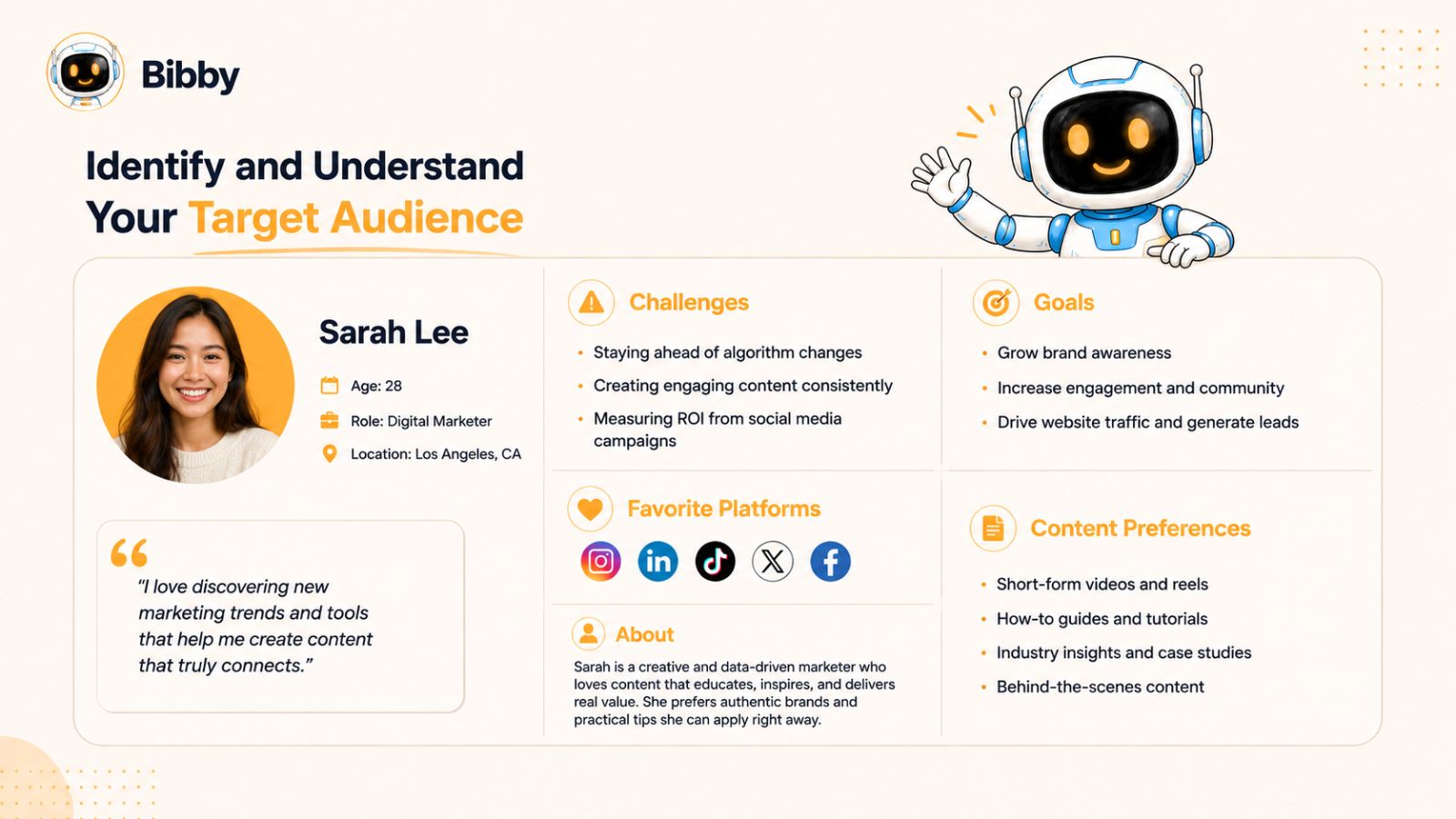
Create Detailed Audience Personas
An audience persona is a semi-fictional representation of your ideal customer based on research and real data.
Rather than targeting a broad audience, create specific profiles that represent the people you want to reach.
Key Information to Include
Demographics
Basic characteristics such as:
- Age
- Gender
- Location
- Education level
- Occupation
- Income level
For example, a software company targeting marketing professionals may focus on business owners, marketing managers, and agency founders between the ages of 25 and 45.
Interests
Identify topics your audience regularly engages with.
Examples include:
- Entrepreneurship
- Fitness
- Personal finance
- Technology
- Travel
- Social media marketing
Understanding interests helps you create content that naturally fits into their feeds.
Pain Points
Pain points are the problems your audience wants solved.
For example:
A small business owner may struggle with:
- Finding time to create content
- Maintaining consistent posting schedules
- Generating engagement
- Managing multiple social platforms
The more clearly you understand these challenges, the more valuable your content becomes.
Goals and Aspirations
People engage with content that helps them achieve desired outcomes.
Ask yourself:
- What are they trying to accomplish?
- What does success look like for them?
- What results are they hoping to achieve?
Your content should bridge the gap between where they are and where they want to be.
How to Research Your Audience
Many businesses already have access to valuable audience insights.
Analyze Existing Customers
Review information from:
- Customer surveys
- Sales calls
- Support conversations
- CRM data
- Website analytics
Your current customers often reveal valuable patterns about your ideal audience.
Study Competitors
Look at competitors in your industry and analyze:
- Their most popular posts
- Audience engagement levels
- Frequently asked questions
- Content themes that generate strong responses
This can reveal opportunities and content gaps you can leverage.
Use Platform Analytics
Every major social platform provides audience insights.
Review data such as:
- Age groups
- Geographic locations
- Active hours
- Interests
- Device usage
These insights help refine your content and posting strategy.
Monitor Community Discussions
Communities often reveal audience needs more honestly than surveys.
Look at:
- Facebook groups
- LinkedIn groups
- Reddit discussions
- Industry forums
- YouTube comments
Pay close attention to recurring questions and frustrations.
Social Listening in 2026
Social listening has become one of the most valuable audience research methods available.
Instead of simply monitoring mentions, AI-powered tools can now identify:
- Emerging trends
- Audience sentiment
- Frequently discussed topics
- Buying signals
- Competitor opportunities
By understanding what your audience is talking about in real time, you can create content that feels timely and relevant.
You may also like reading: How to automate posting Instagram Reels?
Understand Platform Behavior
Your audience may behave differently on each platform.
For example:
LinkedIn Users
Often seek:
- Industry insights
- Career advice
- Professional development
- Thought leadership
Instagram Users
Often engage with:
- Visual storytelling
- Lifestyle content
- Behind-the-scenes content
- Short-form videos
TikTok Users
Typically prefer:
- Fast-paced content
- Entertainment
- Trends
- Authentic experiences
YouTube Users
Frequently search for:
- Tutorials
- Product reviews
- Educational content
- Long-form explanations
Understanding these differences allows you to adapt your messaging while maintaining a consistent brand voice.
Example Audience Persona
Let's say you're marketing Bibby, an AI-powered social media scheduling and automation platform.
Your ideal customer might look like this:
Name: Sarah
Role: Small business owner
Age: 34
Primary Goal: Grow her business through social media
Challenges:
- Limited time for content creation
- Difficulty maintaining consistency
- Managing multiple platforms manually
- Lack of social media expertise
Desired Outcome:
A simple system that helps her create, schedule, publish, and analyze content without spending hours every week.
Understanding personas like Sarah helps shape everything from your content topics to your product messaging.
Focus on Serving, Not Selling
One of the biggest mistakes brands make is creating content entirely about themselves.
Modern audiences are looking for solutions, education, inspiration, and entertainment. When your content consistently helps people solve problems or achieve goals, trust grows naturally.
Trust is often the first step toward engagement, leads, and eventual sales.
Now that you understand who you're trying to reach, it's time to determine where those people spend their time online. In the next step, we'll identify the best social media platforms for your business and learn how to avoid spreading your efforts too thin.
Step 3: Choose the Right Social Media Platforms
One of the most common social media mistakes is trying to be everywhere at once.
Many businesses create accounts on every major platform, only to discover they don't have enough time, resources, or content to maintain them effectively. The result is inconsistent posting, poor engagement, and slow growth.
A successful social media strategy focuses on the platforms where your target audience is most active and where your content is most likely to perform well.
In 2026, strategic focus beats platform quantity every time.
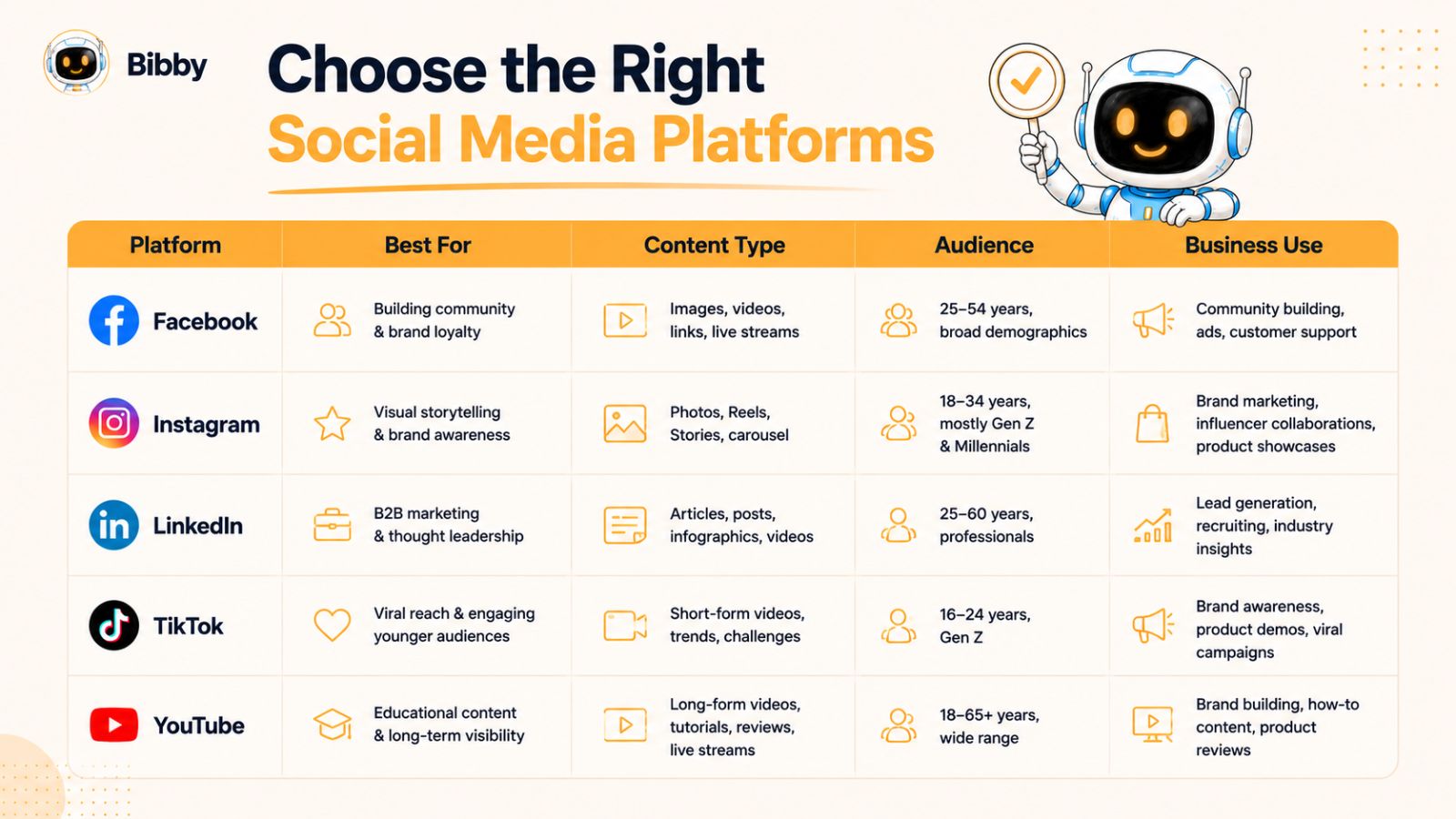
Why Platform Selection Matters
Each social media platform has its own audience demographics, content preferences, algorithms, and engagement patterns.
The best platform for a B2B software company may be completely different from the best platform for a fashion brand, local business, creator, or e-commerce store.
Instead of asking, "Which platform is biggest?" ask:
- Where does my audience spend time?
- Which platform supports my goals?
- What content formats can I consistently create?
- Which channels deliver the highest ROI?
The answers will guide your platform strategy.
Also read: Why Every Small Business Should Use a Social Media Scheduling Tool?
Despite newer platforms attracting attention, Facebook remains one of the largest social networks in the world and continues to be highly effective for businesses.
Best For
- Local businesses
- Community building
- Facebook Groups
- Paid advertising
- Customer engagement
Content That Performs Well
- Videos
- Community posts
- Educational content
- Customer stories
- Live streams
Strengths
- Powerful advertising tools
- Strong targeting capabilities
- Large user base
- Community-driven engagement
Businesses that rely on local audiences often see strong results from Facebook.
Instagram continues to be one of the most important platforms for visual storytelling and brand building.
Best For
- E-commerce brands
- Creators
- Lifestyle businesses
- Personal brands
- Consumer products
Content That Performs Well
- Reels
- Stories
- Carousels
- User-generated content
- Behind-the-scenes content
Strengths
- High engagement potential
- Strong visual appeal
- Effective product discovery
- Influencer-friendly ecosystem
Brands that invest in visual content often thrive on Instagram.
LinkedIn has evolved far beyond an online resume platform and is now a major content and lead-generation channel.
Best For
- B2B companies
- Agencies
- Consultants
- Coaches
- SaaS businesses
- Professional service providers
Content That Performs Well
- Industry insights
- Case studies
- Thought leadership
- Business lessons
- Personal experiences
Strengths
- High-quality professional audience
- Strong organic reach opportunities
- Effective lead generation
- Trust-building environment
If your target audience includes decision-makers, LinkedIn should be a priority.
TikTok
TikTok continues to shape online content trends and remains one of the fastest ways to achieve organic reach.
Best For
- Brand awareness
- Consumer brands
- Creators
- Entertainment-driven content
- Younger demographics
Content That Performs Well
- Short-form videos
- Educational content
- Trend participation
- Product demonstrations
- Storytelling
Strengths
- Exceptional organic reach
- Rapid audience growth potential
- Highly engaging algorithm
TikTok rewards creativity and authenticity more than polished production.
YouTube
YouTube remains one of the most powerful long-term marketing platforms available.
Unlike many social networks where content disappears quickly, YouTube videos can generate traffic, leads, and sales for years.
Best For
- Educational businesses
- Coaches
- SaaS companies
- Creators
- Product-focused brands
Content That Performs Well
- Tutorials
- Product reviews
- How-to videos
- Industry insights
- Case studies
Strengths
- Search-driven discovery
- Long content lifespan
- High trust factor
- Strong conversion potential
Many businesses use YouTube as the foundation of their content strategy.
Should You Be on Every Platform?
Usually, no.
Most businesses achieve better results by mastering two or three platforms before expanding further.
For example:
Local Business
Primary Platforms:
B2B SaaS Company
Primary Platforms:
- YouTube
Creator Brand
Primary Platforms:
- TikTok
- YouTube
E-commerce Brand
Primary Platforms:
- TikTok
Starting with fewer platforms allows you to focus your efforts and maintain content quality.
Repurposing Content Across Platforms
One of the biggest opportunities in 2026 is content repurposing.
Instead of creating entirely new content for every platform, successful marketers adapt a single piece of content into multiple formats.
For example:
One YouTube video can become:
- Multiple Instagram Reels
- TikTok videos
- LinkedIn posts
- Facebook posts
- Story content
This dramatically increases content efficiency.
Platforms like Bibby simplify this process by allowing marketers to manage content across Facebook, Instagram, LinkedIn, TikTok, and YouTube from one dashboard. After uploading an image or video—or generating content with AI—users can choose a posting style, generate captions automatically, schedule content at AI-optimized times, and publish to multiple platforms simultaneously.
This reduces the workload associated with managing multiple channels while maintaining a consistent presence everywhere your audience spends time.
Focus on Quality Over Quantity
Success on social media isn't about having the most accounts.
It's about showing up consistently on the platforms that matter most to your audience.
Choose your primary channels carefully, learn what works on each platform, and commit to creating valuable content consistently.
Once you've selected your platforms, the next step is ensuring that every piece of content feels uniquely recognizable as your brand. That's where a strong brand voice and messaging strategy come into play.
Also read: Proven Strategies to Create Viral Social Media Content
Step 4: Develop Your Brand Voice and Messaging
You can have the best content strategy, the right platforms, and powerful automation tools, but if your brand sounds different every time you post, it becomes difficult for audiences to recognize, trust, and remember you.
Your brand voice is the personality behind your content. It's how your business communicates with its audience across every platform, post, comment, video, and message.
In a crowded social media landscape, a consistent brand voice helps you stand out and build stronger connections with your audience.
What Is a Brand Voice?
A brand voice is the unique way your company communicates with people.
Think of it as the combination of:
- Personality
- Tone
- Values
- Communication style
- Language choices
Just as every person has a distinct way of speaking, every successful brand should have a recognizable voice.
Over time, a strong brand voice makes your content instantly identifiable—even before someone sees your logo.
Why Brand Voice Matters
A consistent brand voice delivers several important benefits:
Builds Trust
People trust brands that communicate consistently.
When your messaging feels familiar and predictable, audiences are more likely to engage with your content and eventually become customers.
Creates Recognition
Many successful brands are recognizable from their writing style alone.
Consistency helps audiences remember who you are in busy social media feeds.
Improves Engagement
Content that feels authentic and relatable often generates higher engagement than generic marketing messages.
Strengthens Brand Identity
Your voice reinforces your company's values, mission, and positioning within the market.
Key Elements of a Strong Brand Voice
Consistency
Your voice should remain recognizable across:
- Facebook posts
- Instagram captions
- LinkedIn articles
- TikTok videos
- YouTube descriptions
- Customer support interactions
While the format may change, the personality should remain consistent.
Authenticity
Audiences are increasingly skeptical of overly polished marketing.
Brands that communicate honestly and transparently often build stronger relationships than those relying on corporate jargon.
Clarity
The best social media content is easy to understand.
Avoid unnecessarily complex language and focus on delivering value clearly.
Personality
Your content should sound human.
Whether your brand is professional, playful, educational, inspirational, or bold, personality helps create emotional connections.
Common Brand Voice Styles
While every brand is unique, most fall into one or more of the following categories.
Professional and Authoritative
Common among:
- B2B companies
- Financial services
- SaaS brands
- Consultants
Characteristics:
- Educational
- Data-driven
- Expert-focused
- Credible
Friendly and Conversational
Common among:
- Small businesses
- Lifestyle brands
- Community-driven companies
Characteristics:
- Warm
- Approachable
- Helpful
- Relatable
Inspirational and Motivational
Common among:
- Coaches
- Fitness brands
- Personal development companies
Characteristics:
- Encouraging
- Positive
- Goal-oriented
Bold and Entertaining
Common among:
- Consumer brands
- Creators
- Startups
Characteristics:
- Humorous
- Confident
- Memorable
- Trend-aware
How to Define Your Brand Voice
A simple exercise is to complete the following statement:
"Our brand is..."
Choose three to five personality traits.
For example:
- Helpful
- Innovative
- Friendly
- Confident
- Practical
Then define how those traits should appear in your content.
Example:
Helpful
We educate rather than sell.
Friendly
We write as if speaking to a colleague.
Practical
We focus on actionable advice rather than theory.
These guidelines create consistency for anyone producing content on behalf of the brand.
Create Messaging Pillars
Messaging pillars are recurring themes that reinforce your brand's positioning.
For example, if you're promoting Bibby, your messaging pillars might include:
Simplicity
Social media management should be easy and accessible.
Automation
Businesses should spend less time posting and more time growing.
AI-Powered Productivity
Technology should eliminate repetitive tasks and improve efficiency.
Growth
Consistent content should lead to measurable business results.
By repeatedly communicating these themes, your audience begins to associate them with your brand.
Adapting Your Voice Across Platforms
Consistency does not mean posting identical content everywhere.
Different platforms require different communication styles.
Professional and educational.
Example:
Share insights, case studies, and industry expertise.
Visual and conversational.
Example:
Tell stories and connect emotionally with your audience.
TikTok
Fast-paced and engaging.
Example:
Focus on entertainment, trends, and quick value.
YouTube
Detailed and educational.
Example:
Provide deeper explanations and tutorials.
The core personality remains the same, but the delivery adapts to platform expectations.
Using AI Without Losing Your Brand Voice
As AI-generated content becomes increasingly common, maintaining a distinct voice becomes even more important.
Many brands struggle because AI-generated posts sound generic and interchangeable.
The most effective approach is to use AI as an assistant rather than a replacement for your brand identity.
For example, Bibby allows users to automatically generate captions and content ideas based on their chosen posting style. This saves significant time while still enabling businesses to maintain consistent messaging across Facebook, Instagram, LinkedIn, TikTok, and YouTube.
When paired with clear brand guidelines, AI can accelerate content production without sacrificing authenticity.
Build a Voice People Remember
Your audience may forget individual posts, but they will remember how your brand made them feel.
A clear and consistent voice helps create familiarity, trust, and recognition over time. It transforms your social media presence from a collection of posts into a recognizable brand experience.
Now that you've defined how your brand will communicate, it's time to decide what you'll actually publish. In the next section, we'll build a content strategy designed to support your goals, attract your ideal audience, and drive consistent growth.
Step 5: Create a Content Strategy That Supports Your Goals
Once you've established your goals, identified your audience, selected your platforms, and defined your brand voice, it's time to build the engine that drives your social media strategy: your content.
Content is what attracts attention, builds trust, generates engagement, and ultimately converts followers into customers.
However, successful brands don't create content randomly. They follow a structured content strategy that aligns every post with specific business objectives.
In 2026, creating more content is no longer the goal. Creating the right content consistently is what drives results.
What Is a Content Strategy?
A content strategy is a plan that determines:
- What content you'll create
- Why you're creating it
- Who it's designed for
- Where it will be published
- How it supports business goals
Without a content strategy, businesses often fall into a cycle of posting whatever comes to mind, leading to inconsistent messaging and unpredictable results.
A strong content strategy ensures that every piece of content serves a purpose.
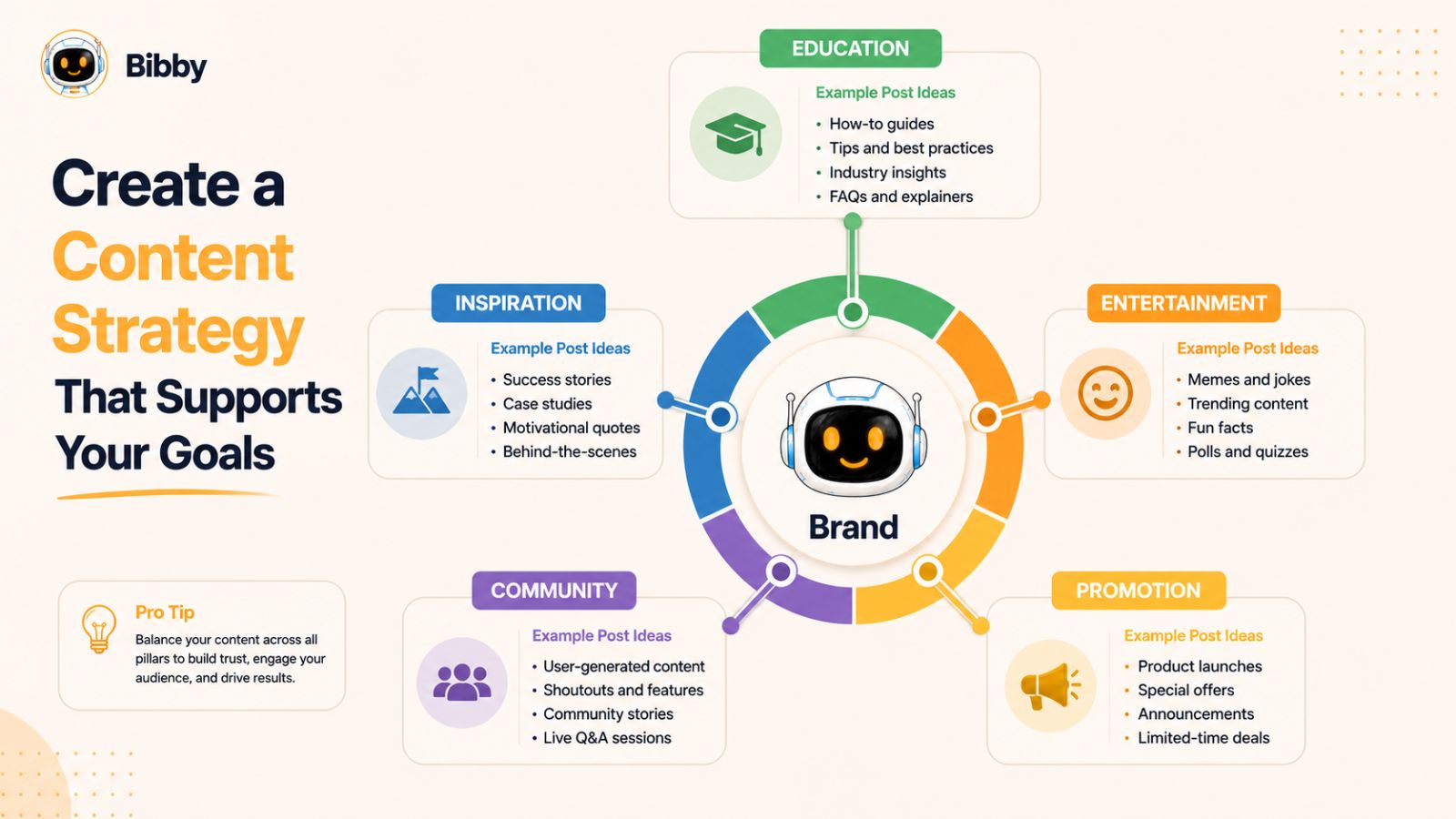
Start With Content Pillars
Content pillars are the primary topics your brand consistently talks about.
Think of them as the foundation of your content strategy.
Most businesses perform best with three to five content pillars.
Educational Content
Educational content helps your audience learn something valuable.
Examples:
- Tutorials
- How-to guides
- Industry tips
- Best practices
- Step-by-step processes
Educational content is often highly shareable and helps establish authority.
Inspirational Content
Inspiration motivates people to take action.
Examples:
- Success stories
- Customer wins
- Transformation journeys
- Personal experiences
- Motivational insights
This content creates emotional connections with your audience.
Entertainment Content
People use social media to be entertained.
Examples:
- Trends
- Memes
- Humorous observations
- Behind-the-scenes content
- Relatable experiences
Entertainment often drives engagement and reach.
Community Content
Community-focused content strengthens relationships.
Examples:
- Polls
- Questions
- Discussions
- User-generated content
- Audience spotlights
This content encourages participation and conversation.
Promotional Content
Promotional content showcases your products or services.
Examples:
- Product demonstrations
- Feature announcements
- Case studies
- Testimonials
- Special offers
Promotion is important, but it should not dominate your content mix.
The 70-20-10 Content Framework
One of the most effective frameworks for balancing content is the 70-20-10 rule.
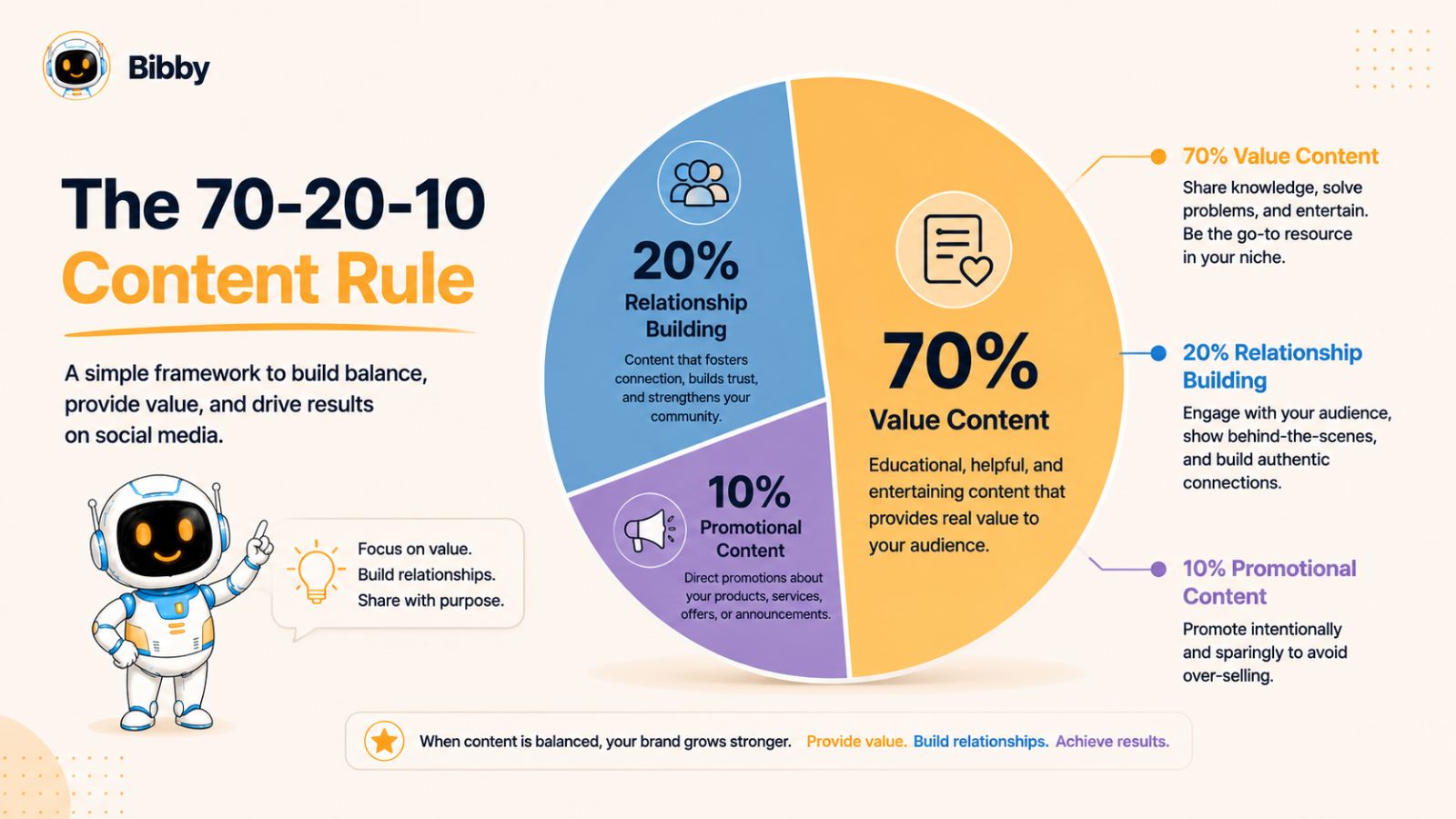
70% Value Content
Focus on educating, entertaining, or helping your audience.
Examples:
- Tips
- Tutorials
- Industry insights
- Problem-solving content
20% Relationship-Building Content
Strengthen connections with your audience.
Examples:
- Stories
- Community discussions
- Behind-the-scenes updates
- Team content
10% Promotional Content
Directly promote your products, services, or offers.
Examples:
- Product launches
- Sales campaigns
- Feature highlights
This balance helps maintain audience trust while still driving business outcomes.
Content Formats That Perform Best in 2026
Different content formats serve different purposes.
The most successful brands diversify their content while focusing on formats that match audience preferences.
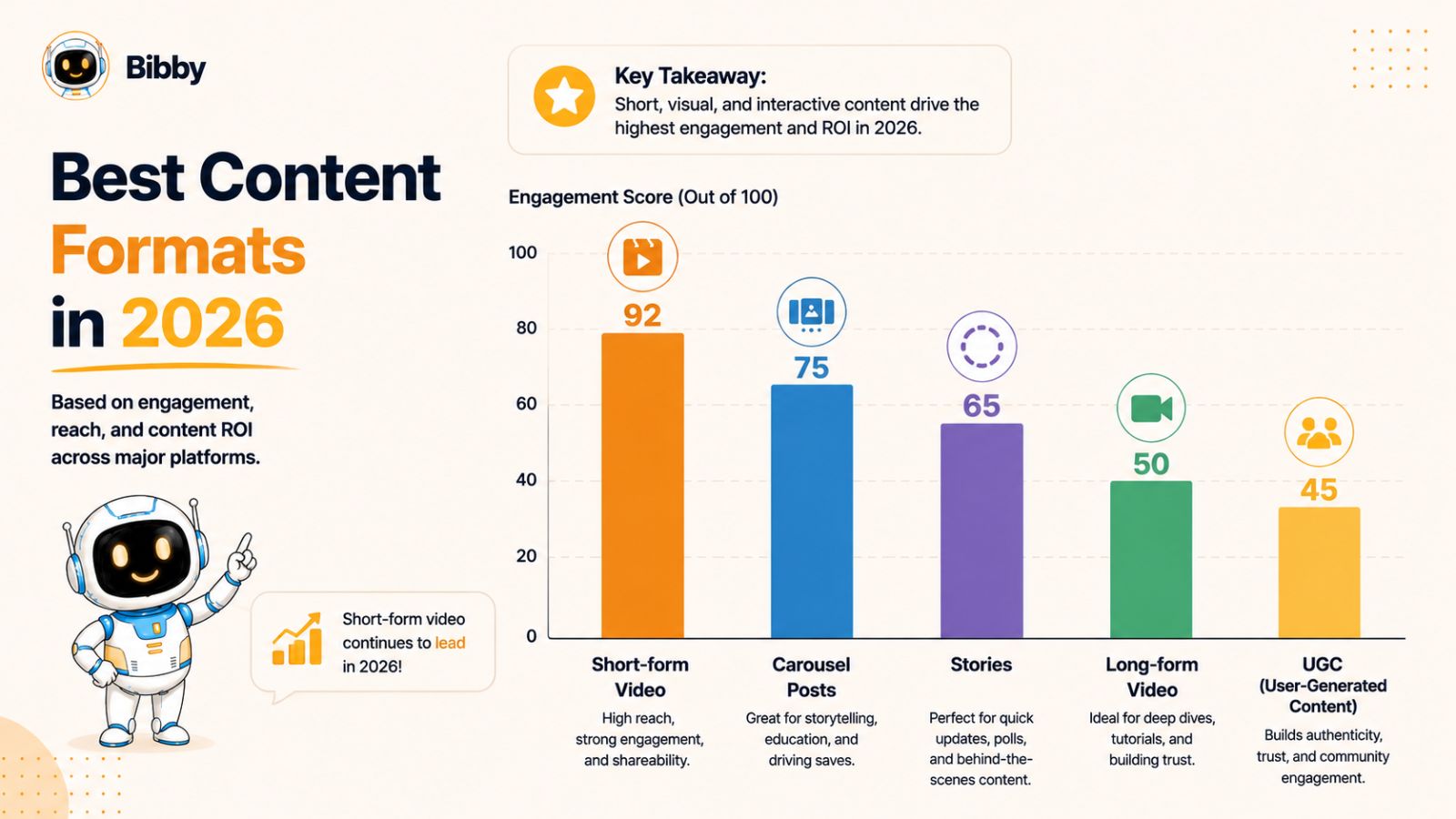
Short-Form Video
Short-form video continues to dominate engagement across platforms.
Examples:
- Instagram Reels
- TikTok videos
- YouTube Shorts
- Facebook Reels
Benefits:
- High reach potential
- Strong engagement
- Easy content repurposing
Carousel Posts
Carousels remain highly effective for education and storytelling.
Examples:
- Step-by-step guides
- Lists
- Frameworks
- Case studies
Benefits:
- Increased engagement
- Longer viewing time
- High shareability
Stories
Stories create opportunities for daily interaction.
Examples:
- Polls
- Questions
- Announcements
- Behind-the-scenes content
Benefits:
- Real-time engagement
- Audience feedback
- Increased visibility
Long-Form Video
Long-form content remains valuable for building authority.
Examples:
- Tutorials
- Interviews
- Product demonstrations
- Webinars
Benefits:
- Deep trust building
- Search visibility
- Long-term content value
User-Generated Content (UGC)
People trust people more than brands.
Examples:
- Customer reviews
- Testimonials
- Product experiences
- Community submissions
Benefits:
- Social proof
- Higher credibility
- Increased conversions
Build Content Around Audience Problems
The highest-performing content typically addresses one of the following:
Problems
Help your audience solve challenges.
Example:
"Why Your Social Media Engagement Is Dropping"
Questions
Answer common audience concerns.
Example:
"How Often Should You Post on Instagram in 2026?"
Goals
Help people achieve desired outcomes.
Example:
"How to Generate More Leads From LinkedIn"
Mistakes
Show audiences what to avoid.
Example:
"7 Social Media Strategy Mistakes Costing You Growth"
When your content consistently solves problems, people begin viewing your brand as a trusted resource.
Create Content Efficiently With AI
One challenge businesses face is maintaining a consistent publishing schedule while producing high-quality content.
AI-powered tools are helping marketers overcome this challenge.
For example, Bibby simplifies content creation by allowing users to upload their own images or generate images with AI. Users can then choose a preferred posting style, and Bibby automatically generates captions, prepares content for multiple platforms, and schedules posts at AI-optimized publishing times.
This workflow significantly reduces the time required to create and distribute content while maintaining consistency across Facebook, Instagram, LinkedIn, TikTok, and YouTube.
Rather than spending hours creating and publishing individual posts, marketers can focus on strategy, creativity, and audience engagement.
Prioritize Consistency Over Perfection
Many brands delay publishing because they are trying to create the perfect piece of content.
The reality is that consistency almost always beats perfection on social media.
A steady stream of valuable content will outperform sporadic bursts of high-quality content followed by long periods of inactivity.
Your goal should be to create a repeatable content system that you can sustain over the long term.
Once you've determined what content you'll create, the next step is organizing it into a structured publishing schedule. In the next section, we'll build a social media content calendar that keeps your strategy running smoothly and consistently.
Step 6: Build a Social Media Content Calendar
Even the best content strategy can fail without a clear publishing plan.
Many businesses start strong with content creation but quickly become inconsistent because they lack a structured system for planning, organizing, and scheduling posts. As a result, they miss posting opportunities, scramble for last-minute content ideas, and struggle to maintain momentum.
A social media content calendar solves these problems by providing a roadmap for what will be published, when it will be published, and where it will appear.
In 2026, consistency is one of the strongest signals for long-term social media growth, and a content calendar is the foundation of that consistency.
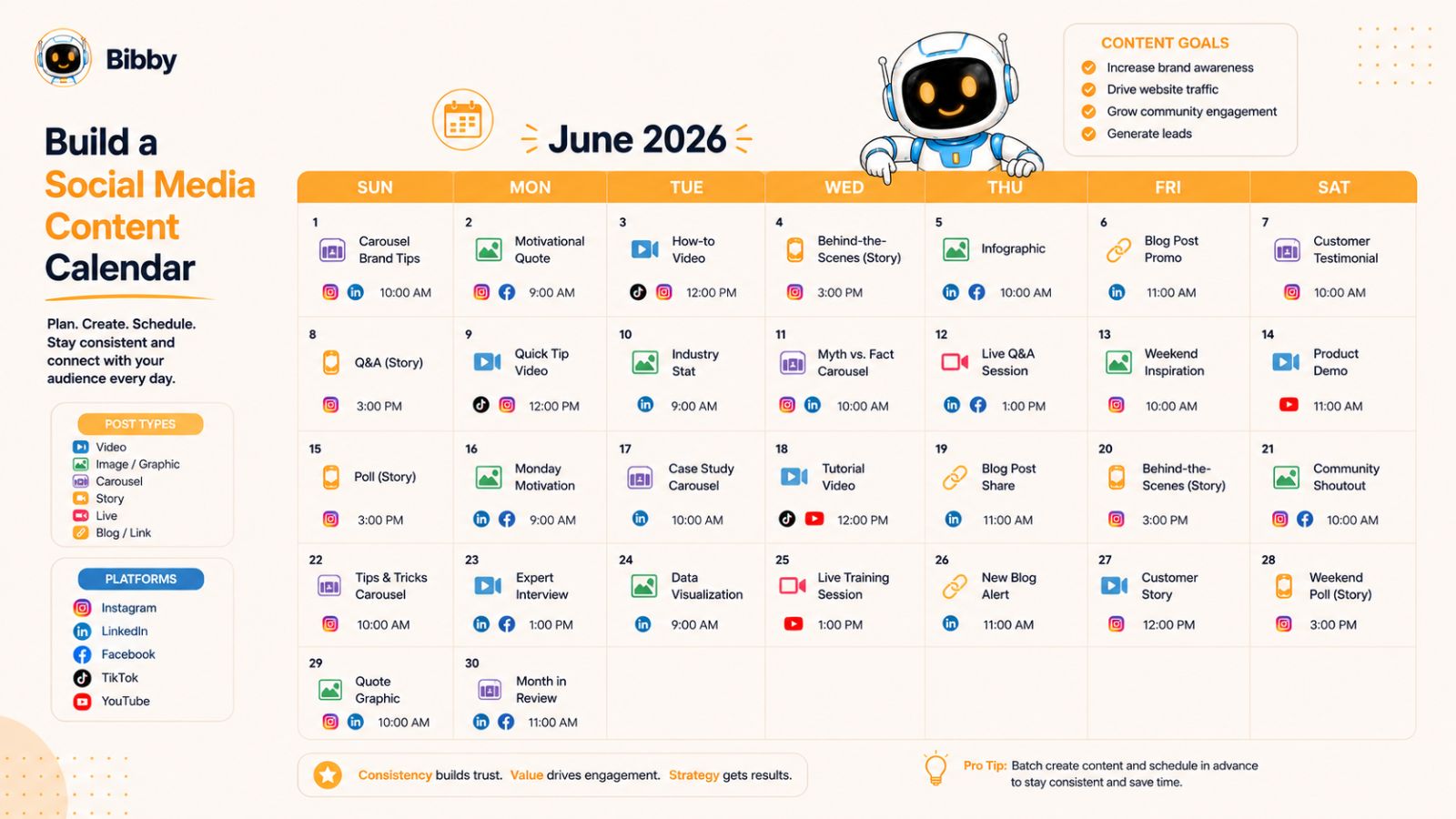
What Is a Social Media Content Calendar?
A social media content calendar is a planning document that organizes your content schedule across all platforms.
It helps you visualize:
- Upcoming content
- Publishing dates
- Content formats
- Campaigns
- Promotions
- Seasonal events
- Platform-specific posts
Rather than deciding what to post each day, your content is planned in advance.
Benefits of Using a Content Calendar
Consistent Publishing
Consistency helps build audience trust and keeps your brand visible in platform algorithms.
A content calendar ensures there are no long gaps between posts.
Improved Content Quality
Planning ahead gives you time to research, create, edit, and optimize content before publishing.
Better Campaign Coordination
Marketing campaigns often involve multiple posts across multiple platforms.
A content calendar helps ensure everything launches on schedule.
Reduced Stress
Instead of worrying about daily content creation, you can focus on engagement, optimization, and growth.
Easier Team Collaboration
If multiple people contribute to content creation, a calendar helps everyone stay aligned.
What to Include in Your Content Calendar
A well-organized content calendar should include:
Publication Date
The exact date content will be published.
Platform
Specify whether content will be posted on:
- TikTok
- YouTube
Content Topic
The primary subject of the post.
Example:
"How to Build a Social Media Strategy"
Content Format
Examples include:
- Reel
- Carousel
- Story
- Video
- Image post
- Text post
Call-to-Action (CTA)
Define the action you want users to take.
Examples:
- Visit website
- Download guide
- Leave a comment
- Watch video
- Book a demo
Status
Track progress such as:
- Planned
- In Production
- Ready
- Scheduled
- Published
Create a Weekly Content Framework
A content framework makes planning easier and ensures a balanced content mix.
Here's an example:
Monday: Educational Content
Share actionable tips or industry insights.
Tuesday: Community Engagement
Ask questions, run polls, or encourage discussion.
Wednesday: Case Study or Success Story
Highlight customer wins or lessons learned.
Thursday: Industry Trends
Discuss emerging developments and opportunities.
Friday: Promotional Content
Showcase products, services, or special offers.
Saturday: Behind-the-Scenes Content
Humanize your brand and build connections.
Sunday: Inspiration or Reflection
Share lessons, motivation, or community highlights.
This framework can be customized based on your audience and goals.
Plan Monthly Content Themes
Many successful brands organize content around monthly themes.
For example:
January
Goal Setting and Planning
February
Productivity and Systems
March
Marketing Growth Strategies
April
AI and Automation
Monthly themes create cohesion and simplify content creation.
Balance Evergreen and Timely Content
Your calendar should include both:
Evergreen Content
Content that remains valuable over time.
Examples:
- Tutorials
- How-to guides
- Educational resources
Benefits:
- Long-term value
- Consistent traffic
- Repurposing opportunities
Timely Content
Content related to current events, trends, or industry developments.
Examples:
- Industry news
- Product launches
- Trend commentary
Benefits:
- Increased relevance
- Higher engagement potential
A balanced approach delivers both immediate and long-term results.
Schedule Content in Advance
Planning content is only half the process.
Publishing consistently requires reliable scheduling.
Many businesses still publish manually, which creates several challenges:
- Missed posting times
- Inconsistent schedules
- Increased workload
- Difficulty managing multiple platforms
Scheduling content in advance eliminates these issues and allows your strategy to operate more efficiently.
Automate Your Content Calendar With Bibby
One of the biggest advantages of modern social media management is automation.
Instead of manually creating and scheduling every post, Bibby streamlines the entire workflow.
A typical process looks like this:
- Upload your image or video, or generate one using AI.
- Select your preferred posting style.
- Let Bibby automatically generate captions.
- Choose the social platforms you want to publish on.
- Bibby schedules content across Facebook, Instagram, LinkedIn, TikTok, and YouTube.
- Posts are automatically published at AI-optimized times designed to maximize engagement.
This approach transforms content planning from a daily task into a streamlined system that can manage weeks or even months of content in advance.
Leave Room for Flexibility
While planning is important, your content calendar should not be completely rigid.
The social media landscape changes quickly.
You should always leave room for:
- Breaking industry news
- Trending topics
- Viral opportunities
- Product announcements
- Community conversations
The most effective content calendars provide structure without eliminating flexibility.
Turn Planning Into a Competitive Advantage
Businesses that consistently publish valuable content often outperform competitors that rely on spontaneous posting.
A well-designed content calendar ensures your strategy remains organized, scalable, and aligned with your goals.
However, creating a content calendar is only the beginning. To truly scale your efforts in 2026, you'll need to leverage AI and automation to reduce manual work and improve efficiency. In the next section, we'll explore how AI-powered tools are transforming social media management and helping businesses grow faster with less effort.
Also read: How to Grow on Social Media With AI?
Step 7: Use AI and Automation to Scale Faster
As social media platforms continue to evolve, one thing has become clear: managing social media manually is no longer the most efficient way to grow.
In 2026, successful brands aren't necessarily working harder than their competitors—they're using smarter systems. Artificial intelligence and automation have transformed social media management, making it possible to create content faster, publish more consistently, and optimize performance with far less effort.
Whether you're a solo creator, small business owner, marketing agency, or enterprise brand, AI-powered automation can dramatically improve both productivity and results.
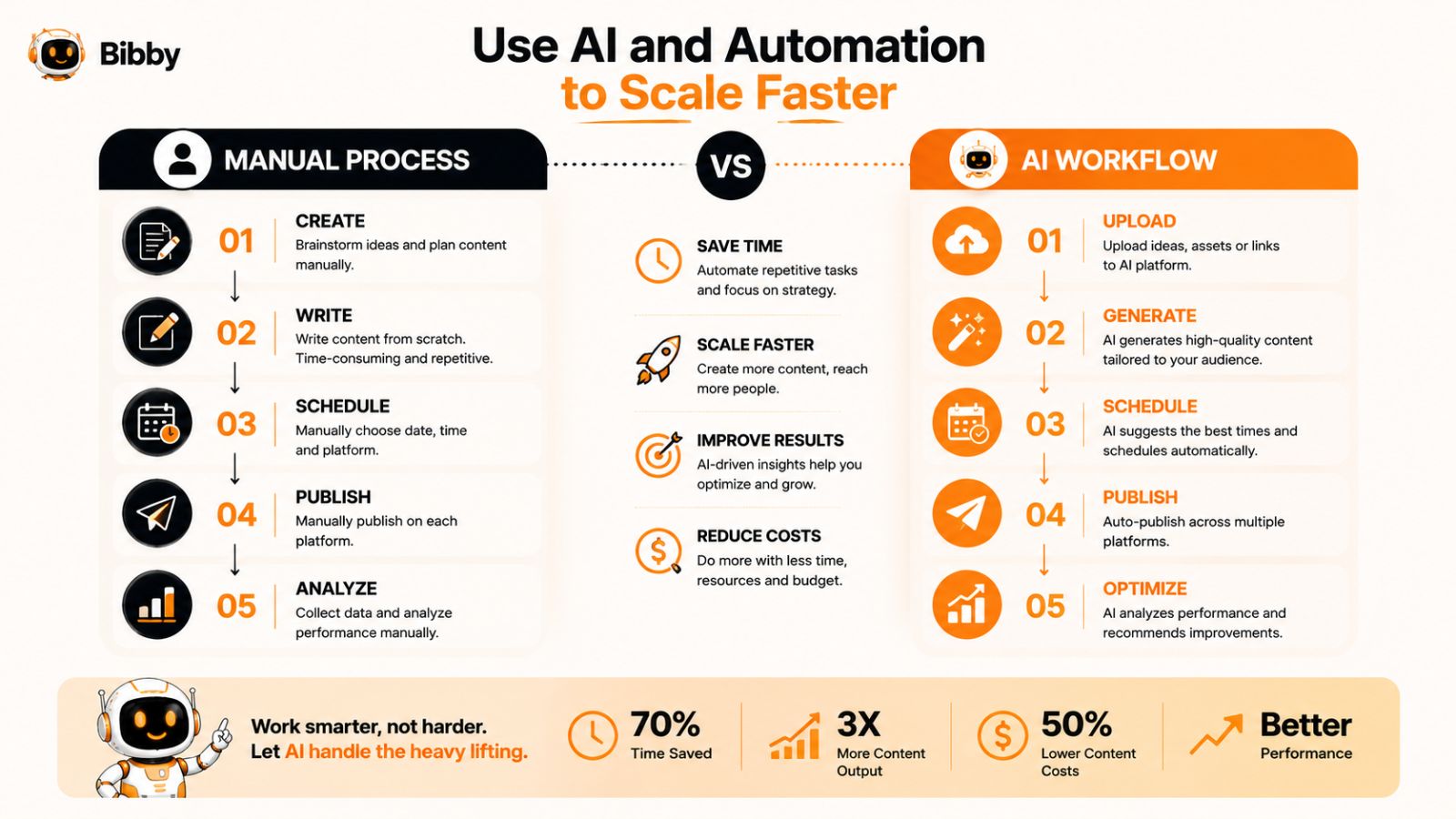
Why Manual Social Media Management No Longer Scales
Many businesses still rely on outdated workflows.
A typical manual process often looks like this:
- Create content
- Write captions
- Resize images
- Log into multiple platforms
- Publish posts individually
- Track performance manually
- Repeat every day
While this approach may work initially, it quickly becomes difficult to maintain as your business grows.
Common challenges include:
- Inconsistent posting schedules
- Time-consuming content creation
- Missed publishing opportunities
- Difficulty managing multiple platforms
- Limited performance insights
- Team coordination issues
As the number of social channels increases, these challenges multiply.
How AI Is Transforming Social Media Marketing
Artificial intelligence is helping marketers automate repetitive tasks while improving content performance.
Today's AI-powered tools can assist with:
Content Creation
Generate:
- Captions
- Content ideas
- Post variations
- Hashtags
- Content briefs
This reduces creative bottlenecks and accelerates production.
Publishing and Scheduling
AI can analyze audience behavior and determine the most effective times to publish content.
Benefits include:
- Higher engagement
- Increased visibility
- Better consistency
Content Repurposing
AI can help transform one piece of content into multiple formats for different platforms.
For example:
A YouTube video can become:
- Instagram Reels
- TikTok clips
- LinkedIn posts
- Facebook content
- Story content
Performance Analysis
AI can identify patterns and provide recommendations based on:
- Engagement rates
- Reach
- Click-through rates
- Audience activity
- Content performance
These insights help marketers make better decisions faster.
The Competitive Advantage of Automation
Automation isn't about removing the human element from marketing.
It's about eliminating repetitive tasks so you can focus on:
- Strategy
- Creativity
- Community building
- Customer relationships
- Business growth
The brands that adopt intelligent automation often gain a significant advantage over competitors still relying on manual processes.
Why Bibby Stands Out as a Social Media Automation Platform
As social media management becomes increasingly complex, businesses need tools that simplify workflows rather than add more complexity.
Bibby is designed to help businesses, creators, agencies, and marketers manage their entire social media process from a single platform.
Instead of juggling multiple tools for content creation, scheduling, publishing, and analytics, Bibby combines everything into one streamlined workflow.
Create Content Faster With AI
One of the biggest challenges in social media marketing is consistently creating high-quality content.
Bibby simplifies this process by allowing users to:
- Upload their own images
- Generate images using AI
- Create content quickly without advanced design skills
This helps reduce content production time while maintaining quality and consistency.
Automatic Caption Generation
Writing captions for every social media post can be surprisingly time-consuming.
With Bibby, users can choose a preferred posting style, and the platform automatically generates captions designed to match that style.
This helps maintain a consistent brand voice while significantly reducing manual work.
AI-Powered Scheduling
Timing plays a major role in social media performance.
Rather than manually selecting publishing times, Bibby uses AI to schedule content at optimized times based on engagement opportunities.
This helps increase visibility without requiring constant monitoring.
Multi-Platform Publishing
Managing multiple social networks often means logging into multiple accounts every day.
Bibby eliminates this complexity by allowing users to publish content across multiple platforms from one dashboard.
Supported platforms include:
- TikTok
- YouTube
This centralized approach saves time and improves workflow efficiency.
Support for Multiple Content Types
Modern social media strategies require more than static images.
Bibby supports:
- Images
- Videos
- Stories
- Reels
- Short-form content
- Campaign content
This flexibility allows businesses to execute a comprehensive content strategy from a single platform.
Built-In Analytics
Creating and publishing content is only part of the process.
Understanding performance is equally important.
Bibby provides analytics that help users monitor:
- Reach
- Engagement
- Growth trends
- Audience behavior
- Top-performing content
These insights help marketers continuously improve their strategies.
The Simple Bibby Workflow
One reason users appreciate Bibby is its simplicity.
The workflow is designed to reduce complexity while maximizing efficiency.
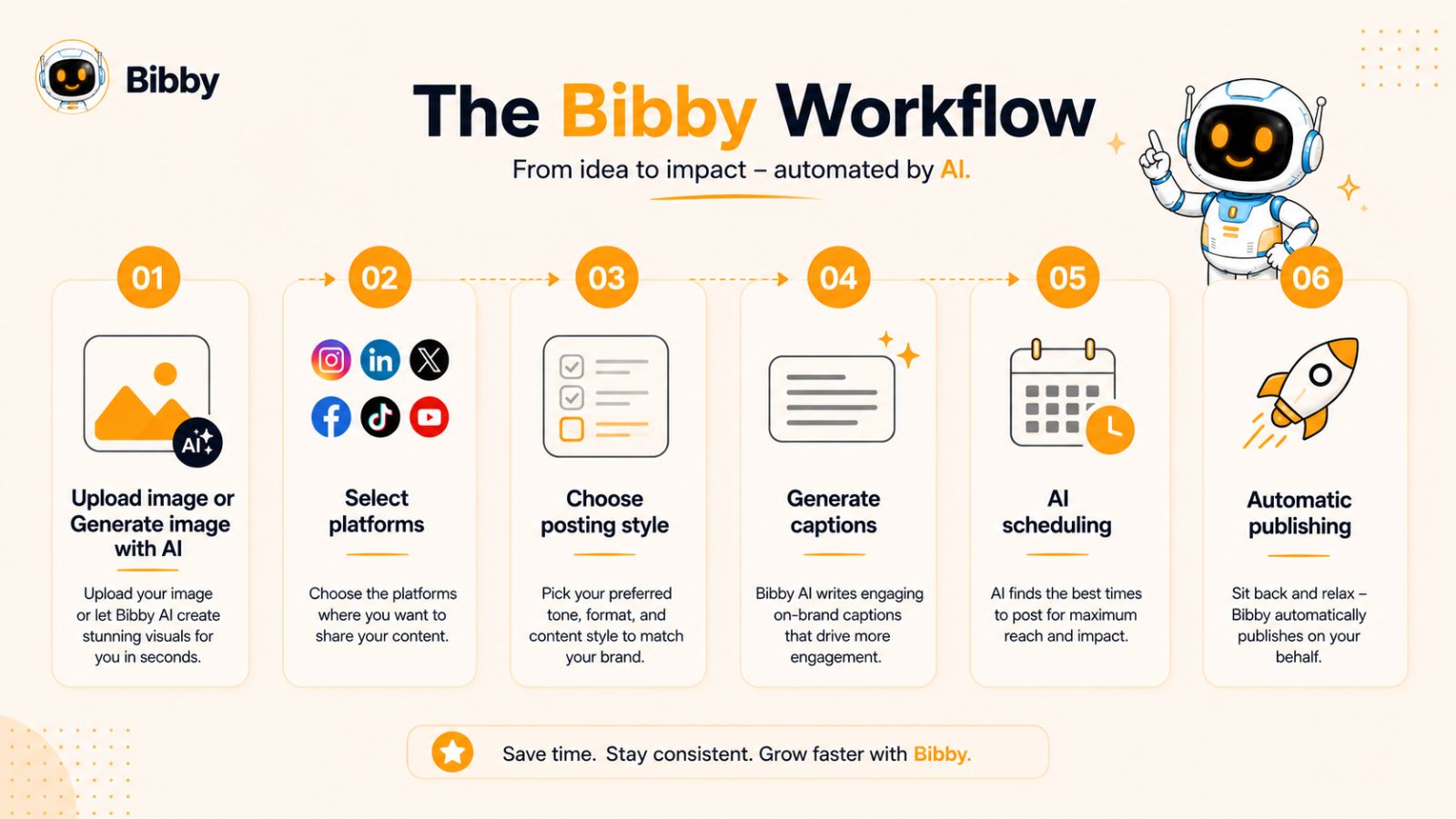
Step 1: Upload or Generate Content
Upload your own image or create one using AI.
Step 2: Choose Your Posting Style
Select the tone and style that best fits your brand.
Step 3: Generate Captions Automatically
Bibby creates captions tailored to your selected style.
Step 4: Select Your Platforms
Choose where you want your content published.
Step 5: Schedule Everything
Bibby automatically schedules content at AI-optimized posting times.
Step 6: Monitor Results
Track analytics and performance from one dashboard.
This process can save hours every week while maintaining a consistent social media presence.
AI Is a Multiplier, Not a Replacement
One misconception about AI is that it replaces marketers.
In reality, AI is most effective when it amplifies human creativity and strategic thinking.
The best social media strategies still require:
- Audience understanding
- Brand positioning
- Creative direction
- Community engagement
- Business expertise
AI simply removes much of the repetitive work that slows marketers down.
The Future Belongs to Automated Workflows
As social media becomes more competitive, efficiency becomes a major advantage.
Businesses that embrace AI-powered workflows can create more content, publish more consistently, and respond more quickly to opportunities—all without significantly increasing workload.
Tools like Bibby make this possible by combining content creation, AI-generated captions, multi-platform scheduling, publishing, and analytics into one streamlined platform.
With your content creation and publishing systems in place, the next step is ensuring your audience actively engages with your brand. In the next section, we'll explore how to build an engagement strategy that transforms followers into loyal community members and customers.
Step 8: Create an Engagement Strategy
Many brands focus heavily on creating content but overlook what happens after a post is published.
The reality is that social media was designed to be social. Publishing content is only one part of a successful strategy. The brands that grow the fastest are often the ones that actively engage with their audience and build genuine relationships over time.
In 2026, engagement is one of the strongest indicators of social media success. Algorithms increasingly prioritize content that sparks conversations, encourages interactions, and keeps users active on the platform.
If you want sustainable growth, engagement must become a core part of your strategy.
Why Engagement Matters More Than Follower Count
Many businesses still obsess over follower numbers.
While followers can be useful, a large audience means very little if those people never interact with your content.
For example:
- 5,000 highly engaged followers can outperform 50,000 inactive followers.
- An active community can generate more leads than a much larger passive audience.
- Engagement often leads to higher reach because platforms reward content that generates interaction.
Strong engagement creates a positive cycle:
- More engagement signals content quality.
- Algorithms increase distribution.
- More people discover your content.
- Additional engagement follows.
- Reach continues to grow.
This is why engagement should often be prioritized over vanity metrics.
The Types of Engagement That Matter Most
Not all engagement carries the same value.
Comments
Comments indicate deeper audience interest and often contribute significantly to algorithm performance.
Examples:
- Questions
- Opinions
- Discussions
- Feedback
Shares
Shares are one of the strongest signals of content value.
When someone shares your content, they are effectively recommending it to their own audience.
Saves
Saves often indicate educational or highly useful content.
Platforms frequently view saves as a strong quality signal.
Direct Messages
DMs often represent high-intent engagement and can create opportunities for conversations, leads, and sales.
Story Interactions
Poll responses, sticker taps, questions, and reactions help strengthen audience relationships and increase visibility.
How to Increase Engagement Consistently
Ask Better Questions
One of the simplest ways to encourage interaction is by asking questions.
Instead of ending posts with:
"Thoughts?"
Try:
- What's your biggest challenge with social media right now?
- Which platform delivers the best results for your business?
- What's one strategy you've tested recently?
Specific questions generate more responses than generic prompts.
Create Conversation Starters
People enjoy sharing experiences and opinions.
Examples:
- Hot takes
- Industry predictions
- Success stories
- Lessons learned
- Common mistakes
The goal is to invite participation rather than simply broadcasting information.
Respond Quickly
Engagement is a two-way process.
When someone comments or sends a message, respond whenever possible.
Benefits include:
- Stronger relationships
- Increased trust
- Additional conversations
- Improved visibility
Fast responses also encourage future engagement.
Use Interactive Features
Most platforms offer built-in engagement tools.
Examples:
- Polls
- Q&A stickers
- Quizzes
- Live streams
- Surveys
These features provide low-friction ways for audiences to participate.
Build a Community, Not Just an Audience
An audience consumes content.
A community participates.
The strongest brands create environments where followers feel connected to the mission, values, and people behind the brand.
Ways to build community include:
Highlight Audience Members
Share:
- Customer stories
- Testimonials
- User-generated content
- Community achievements
People appreciate recognition and are more likely to remain engaged.
Encourage User-Generated Content
User-generated content (UGC) can be incredibly powerful.
Examples:
- Product photos
- Customer reviews
- Success stories
- Challenge participation
UGC provides social proof while increasing engagement.
Create Shared Experiences
Communities grow when members feel part of something larger.
Examples:
- Challenges
- Campaigns
- Live events
- Educational series
- Group discussions
Shared experiences foster loyalty and connection.
Engagement Across Different Platforms
Each platform has unique engagement opportunities.
Focus on:
- Group discussions
- Community interactions
- Comment conversations
Focus on:
- Stories
- Reels
- Polls
- DMs
Focus on:
- Professional discussions
- Thought leadership
- Industry insights
TikTok
Focus on:
- Trends
- Replies
- Community-driven content
YouTube
Focus on:
- Comment sections
- Community posts
- Long-form audience interaction
Understanding platform-specific behaviors can significantly improve engagement rates.
Use Automation to Support Engagement
While engagement should feel human, automation can help streamline supporting tasks.
For example, by using Bibby to automate content creation, caption generation, scheduling, and publishing, marketers can spend less time on repetitive administrative work and more time responding to comments, interacting with followers, and building relationships.
This is one of the biggest advantages of automation: it creates more time for meaningful audience interaction.
Measure Engagement Quality
Instead of focusing solely on total interactions, evaluate engagement quality.
Ask questions such as:
- Are conversations increasing?
- Are followers becoming customers?
- Are people returning to engage repeatedly?
- Are shares and saves growing?
- Is community participation increasing?
These indicators often reveal more about long-term success than likes alone.
Relationships Drive Results
The brands that win on social media are rarely those that publish the most content.
They are often the brands that create the strongest relationships.
When audiences feel heard, valued, and connected, engagement increases naturally. Over time, this engagement translates into trust, loyalty, referrals, and revenue.
Of course, engagement efforts should always be measured to determine what's working and what needs improvement. In the next section, we'll explore the key social media metrics every business should track and how to use analytics to continuously improve performance.
Step 9: Track Key Social Media Metrics
One of the biggest advantages of digital marketing is the ability to measure performance.
Unlike traditional advertising, social media provides access to detailed data that reveals what content is working, which platforms are driving results, and where improvements can be made.
Yet many businesses either ignore analytics entirely or focus on the wrong metrics.
Tracking the right data allows you to make informed decisions, improve performance over time, and maximize the return on your social media investment.
In 2026, successful social media marketing is driven by data—not guesswork.
Why Analytics Matter
Without analytics, it's impossible to answer important questions such as:
- Which content generates the most engagement?
- Which platform delivers the highest ROI?
- What posting times perform best?
- Which campaigns generate leads and sales?
- What topics resonate most with your audience?
Analytics provide the feedback needed to continuously improve your strategy.
Rather than relying on assumptions, you can make decisions based on real audience behavior.
Focus on Metrics That Support Your Goals
Not every metric matters equally.
The metrics you prioritize should align with the goals established earlier in your strategy.
For example:
- A brand awareness campaign should focus on reach and impressions.
- A lead generation campaign should prioritize conversions and inquiries.
- A community-building strategy should focus on engagement metrics.
The key is matching measurement to objectives.
Awareness Metrics
Awareness metrics help determine how many people are seeing your content.
Reach
Reach measures the number of unique users who viewed your content.
A growing reach often indicates:
- Improved visibility
- Stronger content performance
- Increased audience discovery
Impressions
Impressions represent the total number of times content was displayed.
Unlike reach, impressions may include multiple views from the same person.
Video Views
For video content, view counts can indicate audience interest and content effectiveness.
Track:
- Total views
- View duration
- Completion rates
These metrics reveal whether people are actually consuming your content.
Engagement Metrics
Engagement metrics measure how audiences interact with your content.
Likes and Reactions
Likes indicate positive sentiment but should not be viewed in isolation.
Comments
Comments often represent deeper engagement and audience interest.
Shares
Shares are among the strongest indicators of content value because users are actively recommending your content to others.
Saves
Saves suggest that users find your content useful enough to revisit later.
Educational content often performs particularly well in this area.
Engagement Rate
Engagement rate compares interactions against audience size or reach.
This metric often provides a more accurate performance indicator than raw engagement numbers.
Traffic Metrics
If your goal is driving visitors to a website or landing page, traffic metrics become essential.
Link Clicks
Measures how many people clicked on links within your content.
Click-Through Rate (CTR)
CTR calculates the percentage of users who clicked after seeing your content.
A higher CTR often indicates:
- Strong messaging
- Effective calls-to-action
- Relevant content
Website Sessions
Website analytics can reveal how much traffic social media contributes to your business.
Conversion Metrics
For businesses focused on leads and sales, conversion metrics are critical.
Lead Generation
Track:
- Form submissions
- Demo requests
- Consultation bookings
- Email signups
Sales
Measure:
- Purchases
- Revenue
- Conversion rates
- Customer acquisition costs
Return on Investment (ROI)
ROI helps determine whether your social media efforts are producing profitable outcomes.
Ultimately, this is one of the most important metrics for most businesses.
Platform-Specific Metrics
Different social networks provide unique insights.
Monitor:
- Reach
- Reel plays
- Story interactions
- Profile visits
- Saves
Monitor:
- Impressions
- Engagement rate
- Profile views
- Lead generation activity
TikTok
Monitor:
- Video views
- Completion rates
- Shares
- Follower growth
YouTube
Monitor:
- Watch time
- Subscriber growth
- Audience retention
- Traffic sources
Understanding platform-specific metrics helps optimize content more effectively.
Build a Reporting System
Many businesses collect data but never review it systematically.
Create a reporting process that includes:
Weekly Reviews
Evaluate:
- Top-performing content
- Engagement trends
- Publishing consistency
Monthly Reviews
Analyze:
- Growth metrics
- Audience behavior
- Content performance
- Campaign outcomes
Quarterly Reviews
Assess:
- Goal achievement
- Platform performance
- ROI
- Strategic adjustments
Regular reviews transform analytics into actionable insights.
Use Analytics to Improve Future Content
Analytics should influence future content decisions.
For example:
If educational carousel posts consistently outperform image posts, create more educational carousels.
If short-form videos generate the highest reach, increase video production.
If a specific topic drives strong engagement, expand coverage of that topic.
The goal is continuous optimization.
Simplify Reporting With Unified Analytics
One challenge businesses face is collecting analytics from multiple platforms.
Reviewing Facebook, Instagram, LinkedIn, TikTok, and YouTube separately can become time-consuming.
This is where centralized reporting tools become valuable.
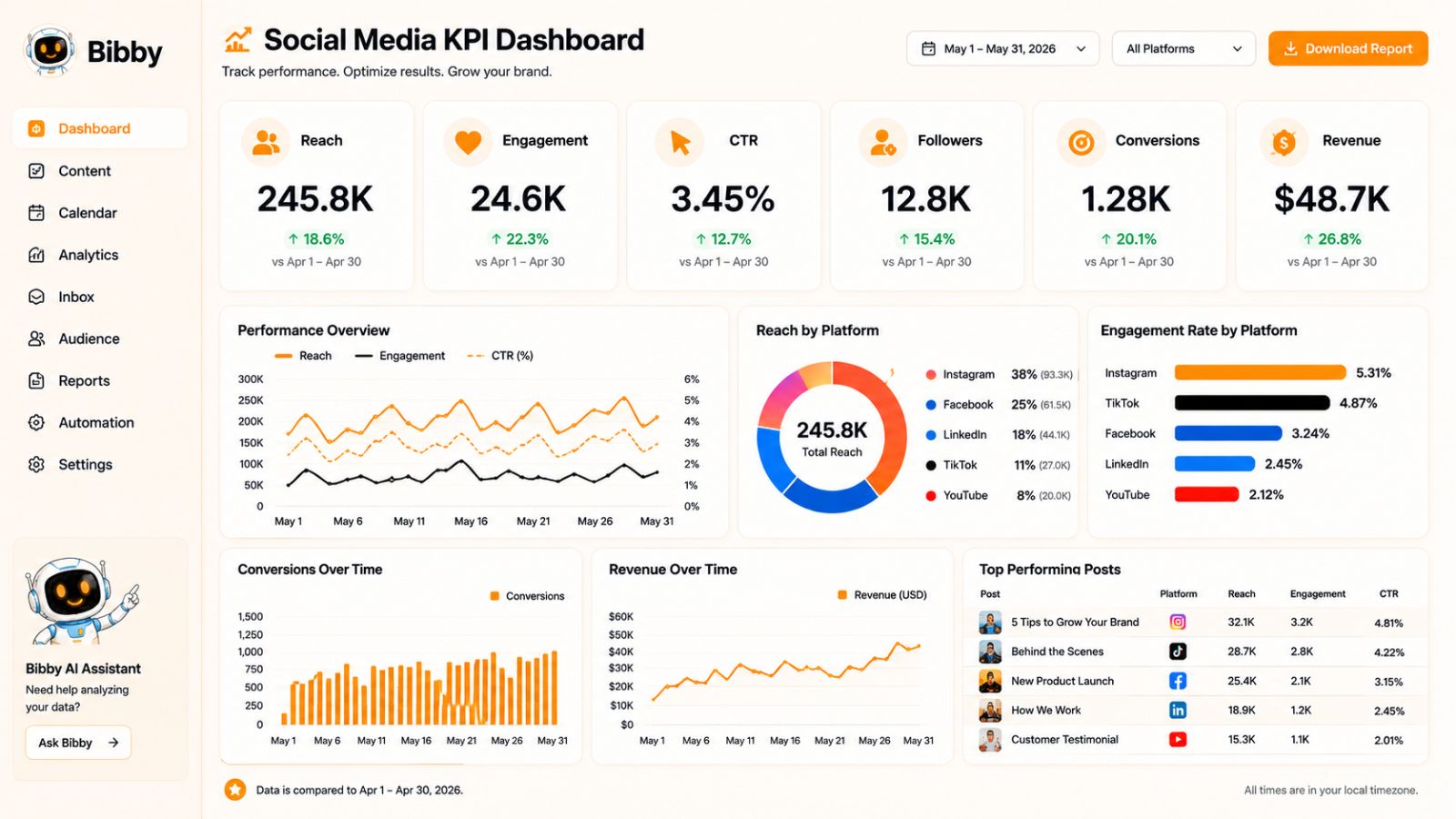
For example, Bibby provides analytics that help users monitor engagement, reach, growth trends, audience behavior, and content performance from a single dashboard. Instead of switching between multiple platforms, marketers can quickly identify what's working and make data-driven decisions more efficiently.
Combined with AI-powered scheduling and content automation, analytics become part of a streamlined workflow that supports continuous growth.
Data Should Drive Decisions
The most successful social media strategies evolve constantly.
Audience preferences change.
Platforms change.
Algorithms change.
Analytics provide the information needed to adapt and stay competitive.
Rather than guessing what works, use data to identify winning content, eliminate underperforming tactics, and improve results over time.
Once you understand what your metrics are telling you, the next step is optimization. In the following section, we'll explore how to continuously refine your strategy, test new ideas, and improve performance month after month.
Step 10: Optimize and Improve Continuously
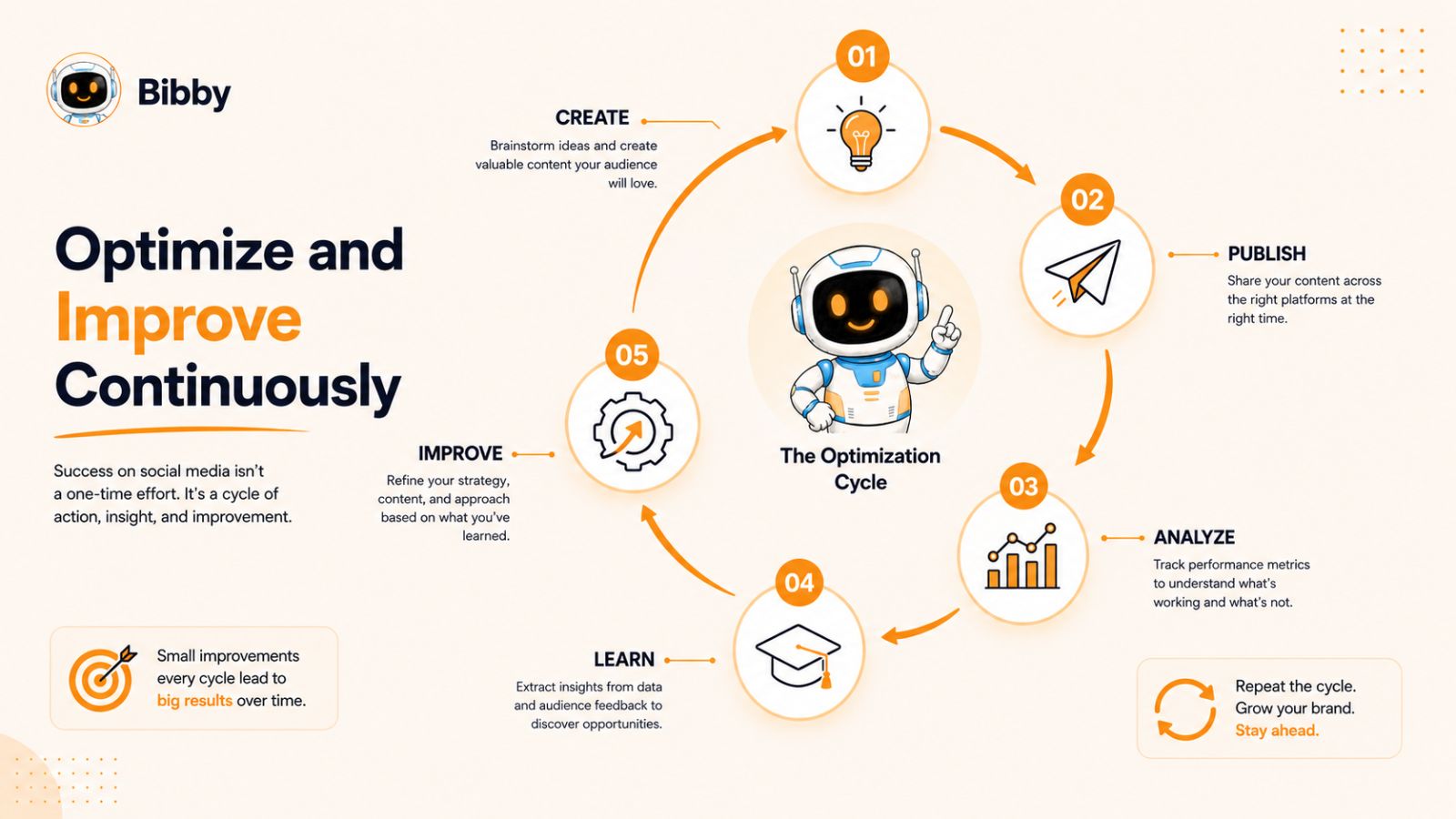
Building a social media strategy is not a one-time project.
The most successful brands treat social media as an ongoing process of learning, testing, and improving. What works today may not work six months from now, and strategies that remain unchanged often lose effectiveness as platforms, algorithms, and audience behaviors evolve.
Optimization is what separates average social media performance from exceptional results.
In 2026, the brands that grow fastest are those that adapt fastest.
Why Continuous Optimization Matters
Social media platforms constantly update their algorithms and features.
Audience preferences shift.
New content formats emerge.
Competitors introduce new strategies.
Without regular optimization, even a strong strategy can gradually become less effective.
Continuous improvement helps you:
- Increase engagement
- Improve reach
- Generate more leads
- Maximize content ROI
- Identify new growth opportunities
Optimization ensures your strategy remains aligned with current audience behavior and platform trends.
Conduct Monthly Performance Reviews
One of the simplest ways to improve results is through consistent performance reviews.
Set aside time each month to evaluate:
Content Performance
Review:
- Top-performing posts
- Lowest-performing posts
- Engagement trends
- Reach trends
Look for patterns rather than isolated successes.
Platform Performance
Identify:
- Which platforms drive the most engagement
- Which platforms generate leads
- Which channels deliver the highest ROI
This information helps prioritize resources effectively.
Audience Growth
Monitor:
- Follower growth
- Community engagement
- Audience retention
- Audience demographics
Changes in audience behavior often reveal new opportunities.
Goal Progress
Compare current performance against the goals established earlier in your strategy.
Ask:
- Are we on track?
- What's working?
- What needs adjustment?
These reviews create a clear path for improvement.
Use A/B Testing to Improve Results
A/B testing involves comparing two variations to determine which performs better.
Rather than making assumptions, testing provides data-backed answers.
Test Content Formats
Compare:
- Videos vs. images
- Carousels vs. single posts
- Long captions vs. short captions
You may discover significant differences in performance.
Test Headlines and Hooks
The first few seconds or first few lines often determine whether people engage with content.
Experiment with different:
- Opening statements
- Headlines
- Questions
- Calls-to-action
Small changes can have a large impact.
Test Posting Times
Audience behavior varies by platform and industry.
Experiment with different publishing schedules to identify optimal engagement windows.
Test Calls-to-Action
Examples:
- Leave a comment
- Visit our website
- Download the guide
- Book a demo
Different CTAs can produce dramatically different results.
Learn From High-Performing Content
One of the fastest ways to improve is to study your own successes.
When content performs exceptionally well, ask:
- Why did it work?
- What problem did it solve?
- What format was used?
- What audience segment responded most strongly?
Then replicate those successful elements in future content.
Top-performing content often reveals what your audience values most.
Stay Updated on Platform Changes
Social media platforms evolve constantly.
Examples include:
- New content formats
- Algorithm updates
- Advertising features
- Commerce integrations
- AI-powered discovery systems
Businesses that adapt early often gain a competitive advantage.
Make it a habit to monitor industry news and platform updates regularly.
Use AI Insights to Optimize Faster
Artificial intelligence can identify trends and patterns that may not be obvious through manual analysis.
AI-powered tools can help marketers:
- Identify high-performing content themes
- Detect audience behavior trends
- Recommend posting schedules
- Highlight engagement opportunities
- Improve content planning
This allows teams to make smarter decisions in less time.
Create an Optimization Framework
A simple framework for continuous improvement might look like this:
Monthly
- Review analytics
- Identify top content
- Evaluate goals
Quarterly
- Audit platform performance
- Refresh content strategy
- Update audience insights
Annually
- Reassess goals
- Review technology stack
- Evaluate overall ROI
- Adjust long-term strategy
This structured approach prevents stagnation and supports sustainable growth.
How Bibby Supports Ongoing Optimization
Optimization becomes much easier when your content, scheduling, publishing, and analytics are connected within a single workflow.
Bibby helps marketers streamline this process by combining:
- AI-generated content creation
- Automatic caption generation
- AI-optimized scheduling
- Multi-platform publishing
- Performance analytics
Because everything is managed from one platform, users can quickly identify trends, evaluate content performance, and refine their strategies without jumping between multiple tools.
This creates a feedback loop where insights lead directly to better content, smarter scheduling, and stronger results.
Progress Beats Perfection
Many businesses search for the perfect social media strategy.
The truth is that perfect strategies rarely exist.
The brands that succeed are the ones that consistently learn, test, and improve.
Every post provides data.
Every campaign offers insights.
Every interaction reveals something new about your audience.
Over time, these small improvements compound into significant growth.
By combining clear goals, audience understanding, strategic content creation, engagement, analytics, and continuous optimization, you create a social media system capable of delivering long-term results.
Now that we've covered the complete framework for building a successful social media strategy, let's examine some of the most common mistakes businesses make—and how to avoid them.
Common Social Media Strategy Mistakes to Avoid in 2026
Even with the right tools and a well-designed strategy, many businesses struggle to achieve consistent social media growth because they make a handful of avoidable mistakes.
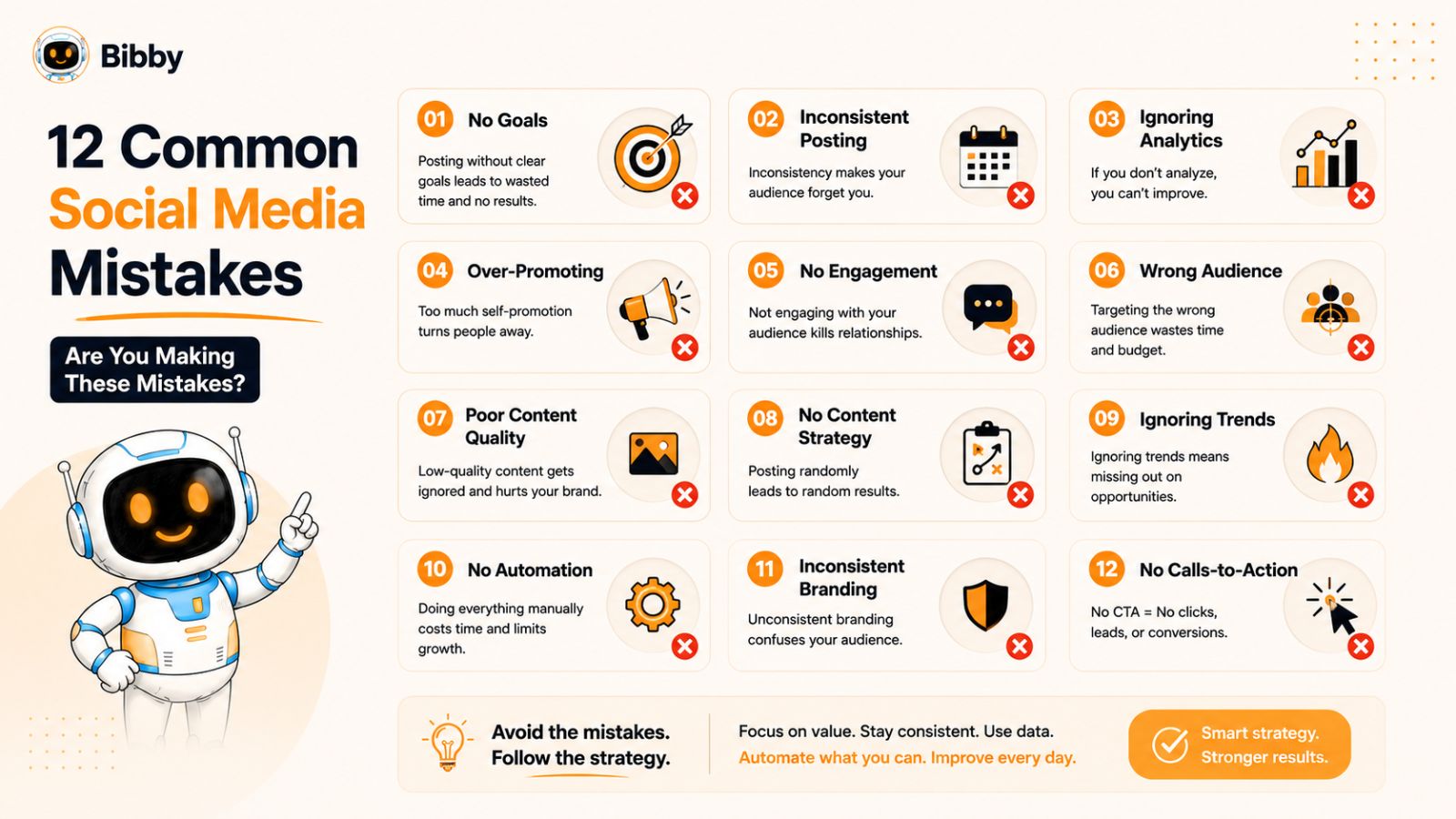
The good news is that most social media failures are not caused by a lack of budget, talent, or resources. More often, they're the result of poor planning, inconsistent execution, or focusing on the wrong priorities.
By recognizing these common mistakes early, you can avoid costly setbacks and accelerate your growth.
Mistake #1: Posting Without Clear Goals
One of the biggest mistakes businesses make is creating content without a specific objective.
They post regularly but never define what success looks like.
As a result:
- Content feels disconnected
- Performance becomes difficult to measure
- Resources are wasted
- Growth remains inconsistent
Every post should support a larger business goal, whether that's increasing brand awareness, generating leads, driving website traffic, or building community engagement.
Without goals, social media becomes activity without direction.
Mistake #2: Trying to Be on Every Platform
Many brands assume they need a presence on every major social network.
In reality, spreading resources too thin often leads to:
- Lower content quality
- Inconsistent posting
- Burnout
- Weak engagement
A focused strategy typically produces better results.
It's usually more effective to dominate two or three platforms than to perform poorly on six or seven.
Choose platforms based on:
- Audience behavior
- Business goals
- Content capabilities
- Available resources
Focus first, then expand later.
Mistake #3: Ignoring Audience Research
Some businesses create content based entirely on what they want to say rather than what their audience wants to hear.
This often leads to:
- Low engagement
- Weak reach
- Poor conversion rates
Successful content starts with audience understanding.
Ask:
- What problems does my audience face?
- What questions are they asking?
- What goals are they trying to achieve?
The more relevant your content, the stronger your results.
Mistake #4: Focusing Only on Followers
Follower count remains one of the most misunderstood metrics in social media marketing.
A large audience does not automatically translate into business success.
Many brands with relatively small audiences generate impressive results because they focus on:
- Engagement
- Trust
- Community
- Conversions
Instead of asking:
"How can I get more followers?"
Ask:
"How can I create more value for the people already following me?"
Quality often matters more than quantity.
Mistake #5: Posting Inconsistently
Consistency is one of the strongest predictors of long-term social media success.
Unfortunately, many businesses follow a pattern like this:
- Post heavily for two weeks
- Get busy
- Stop posting
- Return months later
This inconsistency makes growth much more difficult.
Platforms reward active accounts, and audiences expect regular engagement.
A sustainable publishing schedule is far more effective than occasional bursts of activity.
Mistake #6: Creating Content Without a Strategy
Content should never exist in isolation.
Every post should contribute to:
- Business goals
- Brand positioning
- Audience education
- Community growth
Without a content strategy, businesses often produce random content that lacks direction and consistency.
The result is lower engagement and weaker overall performance.
Mistake #7: Ignoring Analytics
Many businesses spend significant time creating content but very little time reviewing performance data.
This creates a major problem:
They continue repeating ineffective tactics without realizing it.
Analytics reveal:
- What content works
- What content doesn't
- Which platforms perform best
- Where opportunities exist
Data-driven decisions consistently outperform assumptions.
Mistake #8: Over-Promoting Products and Services
Constant promotion is one of the fastest ways to lose audience attention.
People follow brands because they want:
- Education
- Inspiration
- Entertainment
- Community
Not endless sales pitches.
A healthy content mix prioritizes value while using promotional content strategically.
Remember:
Trust is earned before sales are made.
Mistake #9: Neglecting Engagement
Social media is not a broadcasting platform.
It's a relationship-building platform.
Brands that ignore comments, messages, and conversations often struggle to build meaningful connections.
Engagement helps:
- Strengthen trust
- Improve visibility
- Build loyalty
- Increase retention
Publishing content is only half the job.
The other half is participating in conversations.
Mistake #10: Avoiding Automation and AI
Some businesses still rely entirely on manual processes.
This often leads to:
- Lost productivity
- Missed opportunities
- Inconsistent publishing
- Increased workload
As social media becomes more demanding, automation is no longer a luxury—it's a competitive advantage.
AI-powered tools can help businesses:
- Create content faster
- Generate captions
- Schedule posts
- Optimize publishing times
- Analyze performance
This allows marketers to focus more on strategy and less on repetitive tasks.
Mistake #11: Using Too Many Tools
Ironically, another common mistake is using too many disconnected tools.
Many marketers manage:
- Content creation in one tool
- Scheduling in another
- Analytics elsewhere
- Asset management in a separate platform
This fragmented workflow increases complexity and reduces efficiency.
Platforms like Bibby solve this challenge by bringing content creation, AI-generated captions, scheduling, publishing, and analytics together in one streamlined system. Instead of switching between multiple tools throughout the day, marketers can manage their entire social media workflow from a single platform.
Mistake #12: Failing to Adapt
Social media changes rapidly.
Strategies that worked last year may not work today.
Brands that resist change often lose momentum.
Successful marketers continually:
- Test new formats
- Monitor trends
- Review analytics
- Improve workflows
- Adapt to platform changes
Flexibility is one of the most valuable skills in modern social media marketing.
Learn From Mistakes Before They Become Expensive
Most social media mistakes are preventable.
By setting clear goals, understanding your audience, creating valuable content, engaging consistently, reviewing analytics, and leveraging AI-powered automation, you can avoid the traps that prevent many businesses from reaching their full potential.
The social media landscape will continue evolving, which makes it important to stay ahead of emerging trends. In the next section, we'll explore the biggest social media trends shaping 2026 and what businesses should prepare for in the years ahead.
Future Social Media Trends to Watch in 2026 and Beyond
Social media has changed dramatically over the past decade, and the pace of innovation is only accelerating.
New technologies, evolving consumer behavior, and increasingly sophisticated algorithms are transforming how brands create content, reach audiences, and drive business growth.
Businesses that stay ahead of these trends will be better positioned to build stronger communities, generate more engagement, and gain a competitive advantage.
While no one can predict the future with complete certainty, several major trends are already shaping the next generation of social media marketing.
AI-Generated Content Will Become Mainstream
Artificial intelligence is rapidly becoming a core part of content creation workflows.
What began as basic text generation has evolved into AI-powered systems capable of creating:
- Images
- Videos
- Captions
- Content ideas
- Content calendars
- Marketing campaigns
In the coming years, AI will help businesses produce more content in less time while maintaining consistency across multiple platforms.
However, the brands that stand out will not be those using AI alone. They will be the brands that combine AI efficiency with human creativity, expertise, and authenticity.
The winning formula will be:
AI for execution. Human insight for differentiation.
Personalized Content Experiences Will Expand
Modern audiences increasingly expect personalized experiences.
Algorithms are becoming better at understanding:
- User interests
- Behavioral patterns
- Purchase intent
- Engagement history
As a result, content feeds are becoming more individualized than ever before.
Businesses that create highly relevant content for specific audience segments will likely outperform those relying on broad, generic messaging.
The future belongs to brands that deeply understand their audience and tailor content accordingly.
Short-Form Video Will Continue to Dominate
Despite constant platform changes, short-form video remains one of the most effective content formats available.
Platforms continue prioritizing:
- Reels
- TikTok videos
- YouTube Shorts
- Vertical video content
Short-form video combines:
- High engagement
- Strong reach
- Efficient storytelling
- Mobile-first consumption
Brands that develop repeatable video creation systems will have a significant advantage moving forward.
Social Commerce Will Keep Growing
The line between social media and e-commerce continues to blur.
Consumers increasingly discover, evaluate, and purchase products without leaving social platforms.
Key developments include:
- In-app shopping
- Creator-driven commerce
- Livestream shopping
- Product tagging
- AI-powered recommendations
Businesses that integrate commerce into their social media strategies will likely see stronger conversion opportunities.
Community-Led Growth Will Become More Important
Audiences are becoming less responsive to traditional advertising and more influenced by trusted communities.
As a result, community building is becoming a major growth strategy.
Successful brands are investing in:
- Private communities
- Facebook Groups
- Creator communities
- Brand ambassador programs
- User-generated content initiatives
The future will reward brands that foster genuine relationships rather than simply broadcasting marketing messages.
Creator Partnerships Will Continue Expanding
Influencer marketing is evolving into long-term creator partnerships.
Instead of one-off sponsorships, businesses are increasingly building ongoing relationships with creators who align with their values and audience.
Benefits include:
- Greater authenticity
- Higher trust
- Improved audience targeting
- Stronger brand affinity
Creators are becoming one of the most powerful distribution channels available to brands.
Search-Based Social Media Will Grow
More users are turning to social platforms as search engines.
People now search social media for:
- Product recommendations
- Tutorials
- Reviews
- Industry advice
- Local businesses
This shift means social content must increasingly be optimized for discoverability.
Brands should focus on:
- Keyword-rich captions
- Search-friendly video titles
- Educational content
- Clear topic organization
Social SEO is becoming an essential component of social media strategy.
Predictive Analytics Will Improve Decision-Making
Analytics tools are becoming smarter.
Instead of simply reporting past performance, future platforms will increasingly predict future outcomes.
Marketers will gain access to insights such as:
- Which content is likely to perform best
- Optimal publishing schedules
- Audience behavior forecasts
- Growth opportunities
Predictive analytics will help reduce guesswork and improve strategic planning.
Automation Will Become Standard Practice
As social media responsibilities continue expanding, automation will move from a competitive advantage to a business necessity.
Businesses will increasingly automate:
- Content scheduling
- Caption generation
- Publishing workflows
- Performance reporting
- Content repurposing
The goal is not to replace marketers but to free them from repetitive tasks.
This allows teams to focus on:
- Strategy
- Creativity
- Customer relationships
- Community growth
Integrated Platforms Will Replace Complex Tool Stacks
Many businesses currently use separate tools for:
- Design
- Scheduling
- Publishing
- Analytics
- Asset management
Over time, businesses will increasingly favor integrated platforms that simplify workflows.
Solutions like Bibby reflect this trend by combining AI content creation, image generation, caption writing, scheduling, multi-platform publishing, and analytics within a single system. As social media management becomes more complex, streamlined platforms will become increasingly valuable for businesses looking to save time and scale efficiently.
Human Connection Will Remain the Ultimate Advantage
Despite advances in AI, automation, and analytics, one thing remains unchanged:
People connect with people.
Technology will continue making content creation easier, but trust, authenticity, expertise, and relationships will remain the foundations of successful social media marketing.
The brands that thrive in the future will be those that use technology to enhance human connection—not replace it.
By understanding these trends and adapting early, businesses can position themselves for long-term success in an increasingly competitive digital landscape.
Before we wrap up, let's answer some of the most common questions businesses have about building and managing a successful social media strategy in 2026.
Frequently Asked Questions (FAQ)
How often should I post on social media in 2026?
There is no universal posting frequency that works for every business. The ideal schedule depends on your audience, industry, content quality, and available resources.
As a general guideline:
- Facebook: 3–7 times per week
- Instagram: 4–7 times per week
- LinkedIn: 3–5 times per week
- TikTok: 1–3 times per day
- YouTube: 1–3 videos per week
However, consistency is more important than volume. A sustainable posting schedule that delivers value will typically outperform an aggressive schedule that cannot be maintained long term.
Which social media platform is best for businesses?
The best platform depends on your audience and goals.
- Facebook is strong for local businesses and community engagement.
- Instagram is ideal for visual brands and e-commerce.
- LinkedIn is highly effective for B2B marketing and lead generation.
- TikTok excels at brand awareness and organic reach.
- YouTube is one of the best platforms for long-term content visibility and authority building.
Most businesses should focus on two or three primary platforms before expanding further.
What is a social media strategy?
A social media strategy is a documented plan that outlines how a business will use social media to achieve specific objectives.
A strong strategy includes:
- Clear goals
- Audience research
- Platform selection
- Content planning
- Engagement tactics
- Analytics and optimization
Without a strategy, social media efforts often become inconsistent and difficult to measure.
Can AI manage social media accounts?
AI can assist with many aspects of social media management, including:
- Content creation
- Caption generation
- Scheduling
- Analytics
- Content recommendations
However, human oversight remains important for strategy, creativity, relationship building, and brand positioning.
The most successful businesses combine AI efficiency with human expertise.
How do I automate social media posting?
Social media automation typically involves:
- Creating content
- Scheduling posts in advance
- Publishing automatically across multiple platforms
- Monitoring analytics
Modern automation tools can significantly reduce manual workload while improving consistency and efficiency.
What is the best social media scheduling and automation tool?
The ideal tool depends on your needs, but many businesses are looking for solutions that combine content creation, scheduling, publishing, and analytics into a single workflow.
Bibby is designed around this concept. Users can upload images or generate images with AI, choose a posting style, generate captions automatically, schedule content at AI-optimized times, publish across Facebook, Instagram, LinkedIn, TikTok, and YouTube, and monitor performance from one dashboard.
This streamlined workflow helps businesses save time while maintaining a consistent social media presence.
Is Bibby suitable for small businesses, creators, and agencies?
Yes. Bibby is designed to simplify social media management for businesses of all sizes.
Whether you're a solo creator, startup, small business, marketing agency, or growing brand, Bibby helps streamline:
- Content creation
- AI-generated captions
- Scheduling
- Multi-platform publishing
- Analytics
Its simple workflow makes it particularly useful for teams looking to reduce manual work and scale content production efficiently.
How long does it take to see results from a social media strategy?
Results vary depending on:
- Industry
- Competition
- Content quality
- Consistency
- Audience size
Many businesses begin seeing meaningful engagement improvements within a few months, while larger business outcomes such as lead generation, brand authority, and revenue growth often require sustained effort over six to twelve months or longer.
Social media should be viewed as a long-term growth channel rather than a short-term tactic.
Conclusion
Building a successful social media strategy from scratch in 2026 requires much more than simply posting content and hoping for results.
The most effective strategies begin with clear business goals, a deep understanding of the target audience, and a focused platform selection process. From there, businesses can create valuable content, build meaningful engagement, track performance through analytics, and continuously optimize based on real-world data.
At the same time, AI and automation are reshaping how social media is managed. Businesses that leverage tools like Bibby can dramatically reduce the time spent creating, scheduling, publishing, and analyzing content while maintaining a consistent presence across multiple platforms.
The key takeaway is simple: success on social media comes from combining strategy, consistency, data, and efficient execution.
As you begin implementing the framework outlined in this guide, your next step should be developing a repeatable content creation and distribution system that allows you to scale without increasing complexity. Mastering that process will help transform social media from a time-consuming task into a predictable growth engine for your business.