
Growing on social media has never offered more opportunity—or more competition.
Whether you're a creator, marketer, founder, or business owner, you're competing against millions of posts published every day across platforms like Instagram, LinkedIn, TikTok, X, and YouTube. Consistently creating high-quality content, posting at the right time, and staying active across multiple channels can quickly become overwhelming. That's why more brands and creators are turning to artificial intelligence (AI) to streamline their workflows and accelerate growth.
In this article, you'll learn:
- How AI helps create better content in less time
- The most effective AI-powered social media growth workflows
- How automation turns AI content into consistent audience growth
The most successful social media accounts aren't necessarily creating more content—they're building smarter systems. Let's explore how AI can help you create, publish, optimize, and scale your social media presence more efficiently than ever before.
What Does It Mean to Grow on Social Media With AI?
Social media growth used to be relatively straightforward: create content, post consistently, engage with your audience, and watch your following grow over time. Today, the landscape is much more competitive. Algorithms are constantly evolving, audience attention spans are shrinking, and brands are expected to maintain a presence across multiple platforms simultaneously.
As a result, growing on social media now requires more than creativity alone. It requires systems that help you consistently produce high-quality content, distribute it efficiently, and learn from performance data. This is where AI becomes valuable.
Why Social Media Growth Has Become More Competitive
Every major platform has experienced explosive growth in content creation. Millions of creators, businesses, and influencers are competing for the same audience attention. While this creates opportunities, it also means that publishing occasionally is rarely enough to achieve meaningful growth.
Successful accounts typically excel in three areas:
- Consistent content production
- Strong audience understanding
- Fast adaptation to trends and platform changes
Managing all three manually can be difficult, especially for small teams and solo creators.
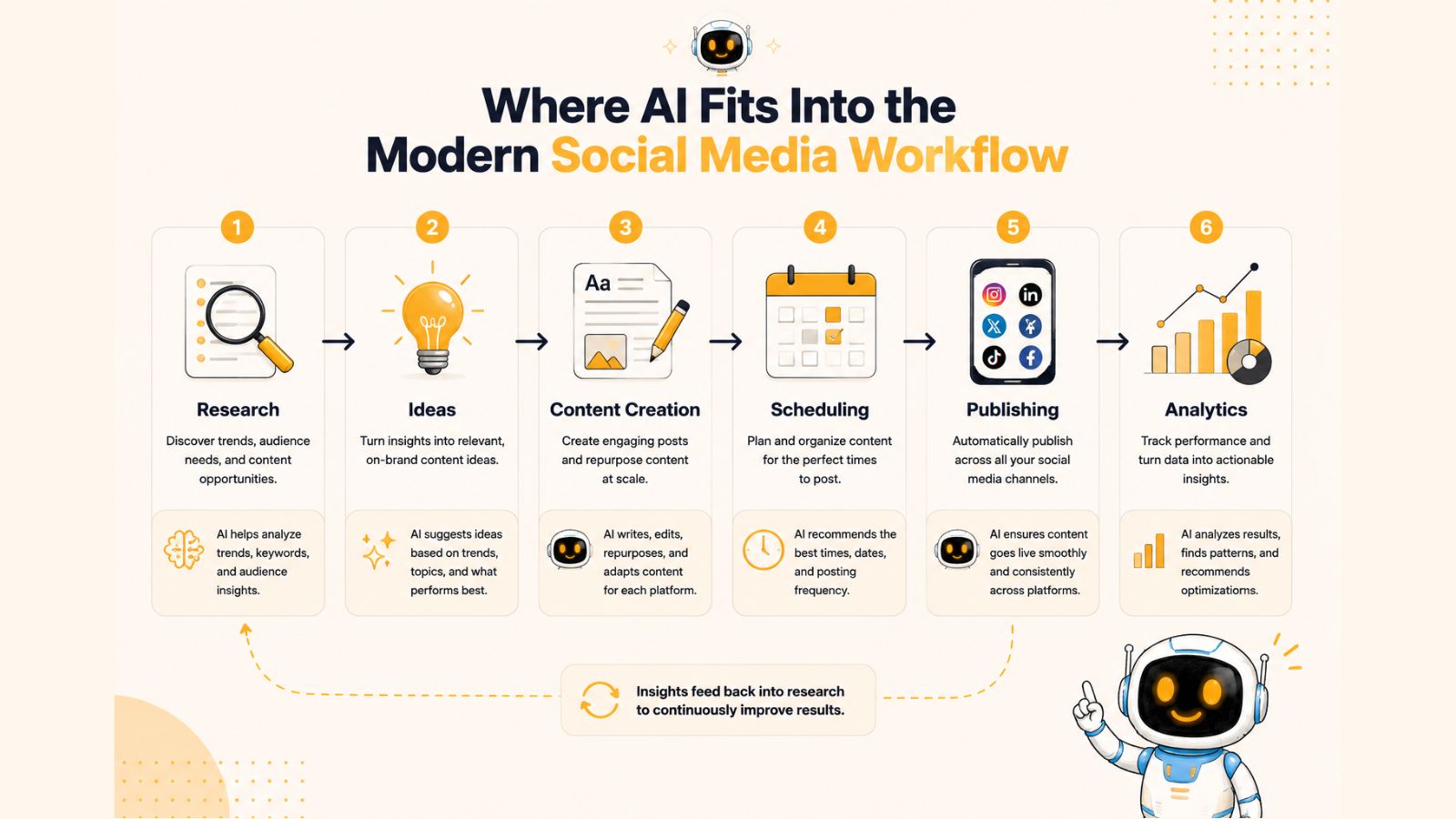
Where AI Fits Into the Modern Social Media Workflow
AI can assist at nearly every stage of the content lifecycle.
For example, AI can help:
- Generate content ideas based on audience interests
- Create post drafts and captions
- Repurpose existing content into multiple formats
- Suggest platform-specific optimizations
- Analyze performance trends
- Automate repetitive publishing tasks
Rather than replacing marketers and creators, AI acts as a force multiplier. It helps teams accomplish more work in less time while maintaining consistency across channels.
Common Misconceptions About AI and Social Media Growth
Despite its popularity, there are still misconceptions about what AI can and cannot do.
Myth #1: AI can automatically make content go viral.
No tool can guarantee virality. Successful content still depends on audience relevance, timing, positioning, and execution.
Myth #2: AI eliminates the need for human creativity.
The best-performing content combines AI efficiency with human insights, experiences, and expertise. AI can accelerate production, but people still provide authenticity and strategic direction.
Myth #3: AI is only useful for large brands.
In reality, AI often provides the greatest advantage to solo creators, startups, and small businesses because it allows them to compete with larger organizations without hiring additional staff.
The real value of AI isn't that it creates perfect content automatically. It's that it removes bottlenecks from the social media process, allowing creators and businesses to focus more energy on strategy, storytelling, and audience relationships.
Grow Faster With AI-Powered Social Media Automation
Create less, publish more, and stay consistent across every social platform with Bibby.
Start FreeWhy Traditional Social Media Growth Methods Are No Longer Enough
For years, social media growth relied on a relatively simple formula: create content, post regularly, engage with your audience, and gradually build a following. While those fundamentals still matter, the amount of work required to execute them successfully has increased dramatically.
Today, creators and businesses are expected to produce more content, publish across more platforms, and respond faster to changing trends than ever before. As a result, traditional manual workflows often struggle to keep pace.
The Growing Demand for Consistent Content
Consistency remains one of the strongest predictors of social media growth. Most platforms reward accounts that publish regularly because frequent activity creates more opportunities for engagement and audience discovery.
However, maintaining consistency is easier said than done.
A single content strategy may require:
- Long-form articles
- LinkedIn posts
- X threads
- Instagram captions
- Short-form videos
- Community engagement
Creating each asset manually can quickly consume hours every week. For many teams, content production becomes the primary bottleneck preventing faster growth.
The Hidden Cost of Manual Social Media Management
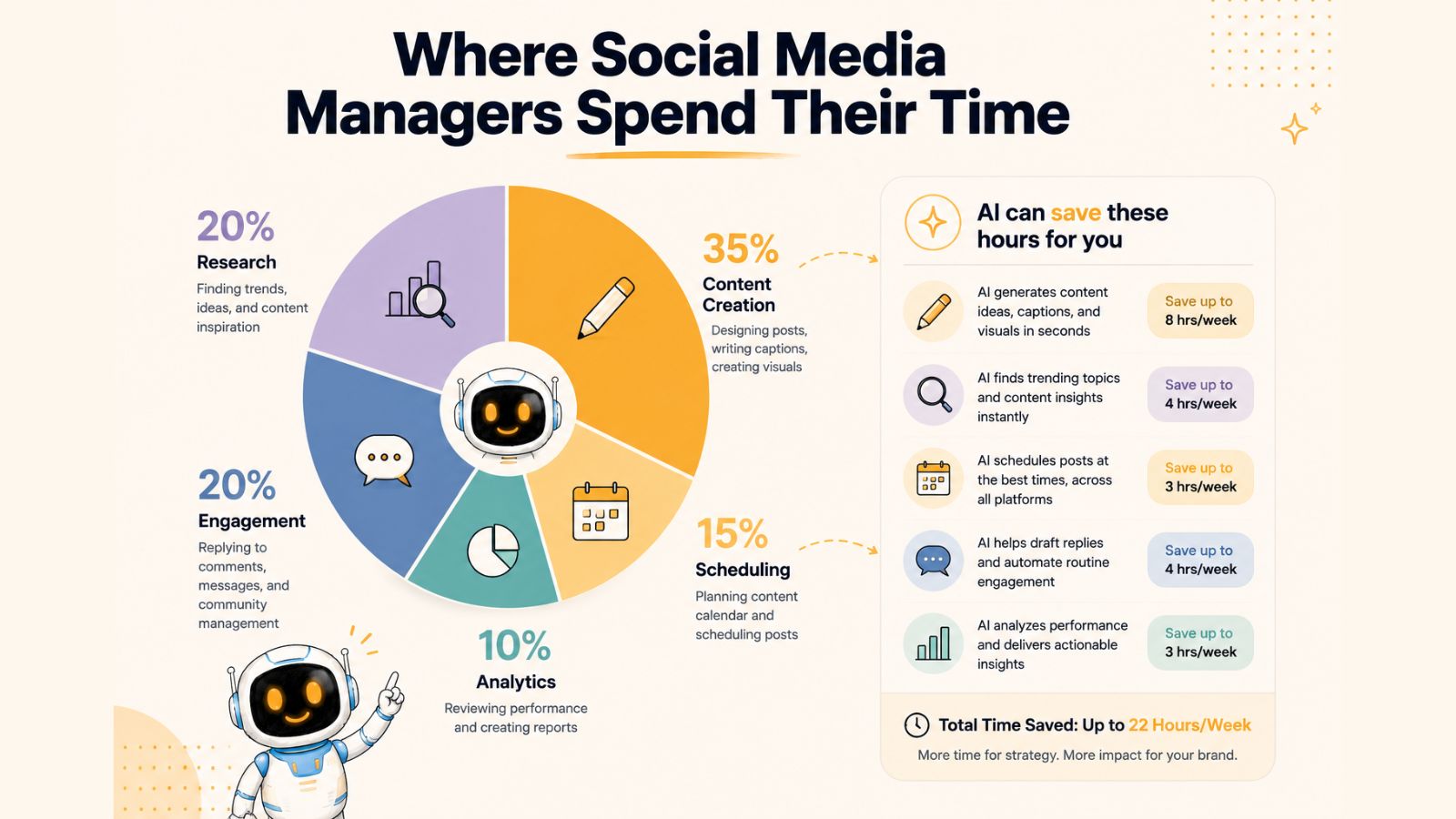
When people think about social media management, they often focus on the time spent publishing posts. In reality, posting is only a small portion of the workload.
A typical workflow includes:
- Researching content ideas
- Planning a content calendar
- Writing posts
- Creating visuals
- Scheduling content
- Monitoring performance
- Responding to audience interactions
Each task may seem manageable individually, but together they create a significant operational burden.
As audiences grow and more platforms are added to the mix, manual processes become increasingly difficult to scale.
Why More Content Isn't Always the Answer
Many brands attempt to solve growth challenges by simply producing more content. Unfortunately, increasing volume without improving systems often leads to burnout rather than better results.
When content teams are overwhelmed, common problems emerge:
- Inconsistent publishing schedules
- Lower content quality
- Missed opportunities for engagement
- Difficulty analyzing results
- Reduced experimentation and creativity
The issue isn't usually a lack of effort. It's a lack of leverage.
How AI Helps Creators and Brands Scale Efficiently
AI introduces leverage by reducing the time required for repetitive tasks while improving consistency across the entire workflow.
Instead of starting every post from scratch, creators can use AI to generate ideas, draft content, repurpose existing assets, and identify opportunities for optimization. Automation tools can then handle scheduling and distribution, ensuring content reaches audiences consistently.
This allows creators and businesses to shift their focus from manual execution to higher-value activities such as:
- Developing content strategy
- Understanding audience needs
- Building relationships
- Testing new growth opportunities
- Refining brand positioning
The accounts that grow fastest in today's environment are often not the ones working the hardest. They're the ones building efficient systems that allow them to produce, distribute, and optimize content at scale.
AI has become one of the most effective tools for building those systems.
Also read: Best LinkedIn Scheduling Tool for Agencies
7 Ways AI Can Accelerate Social Media Growth
AI is most effective when it's used to eliminate bottlenecks throughout the content creation and distribution process. Rather than replacing your marketing strategy, it helps you execute that strategy faster, more consistently, and at a larger scale.
Here are seven practical ways AI can accelerate social media growth.
1. Generate Better Content Ideas Faster
One of the biggest challenges creators face is deciding what to post.
Many content calendars stall before content creation even begins because teams spend too much time brainstorming topics. AI can dramatically speed up this process by generating ideas based on audience interests, industry trends, customer questions, and existing content.
For example, a social media manager can use AI to generate:
- Content pillar ideas
- Post hooks
- Educational topics
- Thought leadership angles
- Frequently asked questions
- Trend-based content opportunities
Instead of starting with a blank page, you start with dozens of potential ideas that can be refined and prioritized.
2. Create More Content From Existing Assets
Most businesses already have valuable content—they just aren't maximizing it.
AI makes it easier to repurpose existing assets into multiple social media formats.
A single blog post can become:
- LinkedIn posts
- X threads
- Instagram captions
- Carousel outlines
- Email newsletters
- Video scripts
Likewise, a webinar, podcast, or YouTube video can generate weeks of social content.
Repurposing allows brands to increase content output without continuously creating new material from scratch.
3. Optimize Content for Each Platform
Every social platform has different content formats, audience expectations, and engagement patterns.
Content that performs well on LinkedIn may not work on Instagram. A successful X thread may need significant adaptation before being published elsewhere.
AI can help transform one core message into platform-specific versions by adjusting:
- Length
- Formatting
- Tone
- Hooks
- Calls to action
This enables creators to maintain a consistent message while increasing relevance for each platform's audience.
4. Automate Posting and Scheduling
Creating content is only half the challenge. Consistent publishing is equally important.
Unfortunately, many businesses create content that never gets posted because scheduling becomes an afterthought.
Automation tools solve this problem by allowing content to be queued and published automatically.
Benefits include:
- Consistent posting schedules
- Reduced manual work
- Better content organization
- Improved multi-platform distribution
- More opportunities for audience engagement
This is where social media automation platforms become especially valuable. By combining AI-powered content creation with automated publishing, brands can maintain a steady presence without spending hours managing daily posts.
5. Analyze Performance More Efficiently
Growth depends on learning what works and doing more of it.
However, manually reviewing analytics across multiple platforms can be time-consuming and difficult to scale.
AI can help identify patterns by analyzing:
- Top-performing content
- Engagement trends
- Audience behavior
- Posting performance
- Content themes that drive results
Instead of sorting through large amounts of data manually, teams can focus on implementing insights that improve future content.
6. Improve Audience Engagement
Engagement plays an important role in social media growth because it strengthens audience relationships and increases platform visibility.
AI can assist with:
- Drafting comment responses
- Creating personalized reply templates
- Summarizing conversations
- Prioritizing engagement opportunities
While authentic human interaction should remain part of the process, AI can reduce the administrative burden associated with managing growing communities.
7. Build Repeatable Growth Systems
The most successful creators and brands rarely rely on inspiration alone.
Instead, they develop repeatable systems that consistently generate content, publish it, and improve results over time.
A typical AI-powered growth system might look like this:
- Generate content ideas
- Create content drafts
- Repurpose content into multiple formats
- Schedule posts automatically
- Measure performance
- Refine future content based on results
As these workflows mature, content production becomes more predictable, scalable, and sustainable.
The biggest advantage of AI isn't simply creating content faster. It's helping organizations build growth systems that continue producing results even as audience size, platform complexity, and content demands increase.
The Best AI Workflow for Social Media Growth
Knowing how to use AI is valuable. Building a repeatable workflow around it is what drives long-term growth.
Many creators experiment with AI tools but never see meaningful results because they use them inconsistently. The most successful social media teams treat AI as part of a structured process that helps them research, create, distribute, and optimize content every week.
Here's a practical workflow that can be adapted for individuals, startups, and larger marketing teams.
Step 1: Research Audience Interests
Every successful content strategy starts with understanding the audience.
Before creating content, identify:
- Common customer questions
- Industry trends
- Frequently discussed topics
- Pain points and challenges
- Popular content formats
AI can help organize research, summarize discussions, and uncover patterns that might otherwise be missed.
The goal is to ensure your content aligns with topics your audience already cares about.
Step 2: Generate Content Ideas
Once audience research is complete, use AI to generate content opportunities.
A single topic can often produce dozens of content angles.
For example, if your audience is interested in social media growth, AI might generate content such as:
- Beginner growth strategies
- Platform-specific tactics
- Case studies
- Common mistakes
- Industry predictions
- Step-by-step tutorials
This creates a steady pipeline of content ideas and eliminates the need to constantly brainstorm from scratch.
Step 3: Create Content Variations
Rather than creating unique content for every platform, start with one core idea and adapt it.
For example:
- A blog post becomes a LinkedIn article
- A LinkedIn post becomes an X thread
- A webinar becomes multiple short-form clips
- A podcast becomes quote graphics and captions
AI can accelerate this process by generating platform-specific versions while maintaining a consistent message and brand voice.
This approach increases content output without significantly increasing workload.
Step 4: Schedule Content Automatically
Publishing manually often creates inconsistency.
Even when content is ready, teams frequently delay posting because they become busy with other priorities.
This is where automation becomes essential.
Once content has been created and approved, it should be scheduled in advance to maintain a reliable publishing cadence.
A typical workflow might include:
- Weekly content planning
- Batch content creation
- Automated scheduling
- Cross-platform distribution
Tools like Bibby help streamline this process by allowing teams to move content from creation to publishing without managing each post manually. This creates a more consistent presence across platforms while reducing the operational overhead associated with daily posting.
Step 5: Measure Results and Refine
Publishing content is not the end of the workflow.
The final step is analyzing performance and using those insights to improve future content.
Review metrics such as:
- Reach
- Engagement
- Shares
- Click-through rates
- Follower growth
- Conversion metrics
Over time, patterns emerge that reveal which topics, formats, and messages resonate most with your audience.
These insights can then be fed back into the content creation process, creating a continuous improvement loop.
Example Weekly AI-Powered Social Media Workflow
A simple weekly workflow might look like this:
Monday
- Research trends and audience interests
- Generate content ideas
Tuesday
- Create content drafts
- Produce visual assets
Wednesday
- Repurpose content into multiple formats
Thursday
- Schedule content across platforms
Friday
- Review analytics and identify top-performing content
By following a repeatable workflow like this, creators and businesses can dramatically increase content output while maintaining quality and consistency.
The combination of AI-powered creation and automated distribution allows social media growth to become a scalable system rather than a constant manual effort.
Common Mistakes When Using AI for Social Media Growth
AI can dramatically improve efficiency, but simply adding AI to your workflow does not guarantee better results.
Many creators and businesses adopt AI tools expecting immediate growth, only to discover that their content performs no better—or sometimes worse—than before. In most cases, the issue isn't the technology itself. It's how the technology is being used.
Avoid these common mistakes to get the most value from AI-powered social media growth.
Publishing Generic AI Content
One of the fastest ways to blend into the crowd is publishing content that sounds exactly like everyone else's.
AI-generated content often becomes repetitive when users rely on default outputs without adding their own perspective, expertise, or experiences.
Readers and social media algorithms increasingly reward content that feels original and valuable.
Instead of publishing AI-generated drafts unchanged:
- Add personal insights
- Include real-world examples
- Share lessons learned
- Reference actual results
- Inject your brand voice
AI should create the first draft, not the final product.
Ignoring Brand Voice
Consistency builds trust.
If every post sounds different, audiences may struggle to understand what your brand stands for.
Many organizations use AI successfully because they train it to follow specific communication guidelines, including:
- Tone of voice
- Writing style
- Target audience
- Messaging priorities
- Brand values
The more context AI receives, the more consistent and recognizable your content becomes.
Over-Automating Engagement
Automation can save time, but audience relationships still require genuine human interaction.
People can usually tell when responses are overly scripted or automated.
While AI can help draft replies, summarize conversations, and prioritize engagement opportunities, important interactions should still receive human attention.
The goal is to enhance engagement efficiency, not replace authentic communication.
Chasing Every Trend
AI makes it easy to generate content around trending topics.
However, not every trend aligns with your audience, business goals, or brand positioning.
Publishing trend-driven content solely because it's popular can dilute your messaging and confuse your audience.
Before pursuing a trend, ask:
- Is it relevant to our audience?
- Does it support our expertise?
- Does it align with our content strategy?
- Can we provide a unique perspective?
Growth is often driven more by consistency and relevance than by constantly chasing viral opportunities.
Measuring the Wrong Metrics
Many creators focus exclusively on vanity metrics such as likes, impressions, or follower counts.
While these metrics can provide useful signals, they don't always indicate business impact.
Depending on your goals, more meaningful metrics may include:
- Website traffic
- Lead generation
- Email subscribers
- Product signups
- Conversion rates
- Customer acquisition
AI can help identify performance trends, but it's important to evaluate success using metrics that align with actual business outcomes.
Treating AI as a Shortcut Instead of a System
Perhaps the biggest mistake is viewing AI as a shortcut to growth.
The accounts seeing the strongest results aren't using AI to avoid work. They're using AI to improve their systems.
Successful social media growth still requires:
- Understanding your audience
- Delivering valuable content
- Publishing consistently
- Measuring performance
- Iterating over time
AI simply helps execute these activities more efficiently.
The creators and businesses that win with AI are those that combine technology with strategy, creativity, and a deep understanding of their audience. When those elements work together, AI becomes a powerful growth accelerator rather than just another tool.
Also read: The Ultimate Guide to Social Media Management Tools for Small Businesses
How Social Media Automation Amplifies AI Results
AI can help you generate ideas, draft content, and analyze performance. But there's a missing piece that often prevents businesses from realizing the full value of AI: execution.
Content only drives growth when it gets published consistently.
Many teams successfully use AI to create content, but they still struggle to maintain a reliable posting schedule. Drafts accumulate, content calendars fall behind, and opportunities for audience engagement are missed.
This is where social media automation becomes a critical part of the growth equation.
Why Content Creation Alone Isn't Enough
Imagine a creator who uses AI to generate 50 high-quality social media posts every month.
If only half of those posts are published because scheduling becomes a bottleneck, the value of the content is significantly reduced.
The same challenge affects marketing teams, agencies, and business owners.
Common problems include:
- Forgetting to publish content
- Inconsistent posting schedules
- Managing multiple platforms manually
- Switching between tools
- Spending excessive time on repetitive tasks
AI helps create content. Automation ensures that content consistently reaches your audience.
The Importance of Consistency
Most social media platforms reward accounts that publish regularly.
Consistent posting helps:
- Increase audience reach
- Strengthen brand recognition
- Generate more engagement opportunities
- Improve content testing
- Accelerate learning and optimization
Unfortunately, consistency is difficult to maintain when publishing relies entirely on manual effort.
Automation removes this friction by ensuring content is delivered according to a predefined schedule.
This allows teams to focus more energy on creating valuable content and less energy on operational tasks.
Connecting AI Generation With Automated Publishing
The most effective social media workflows combine AI-powered creation with automated distribution.
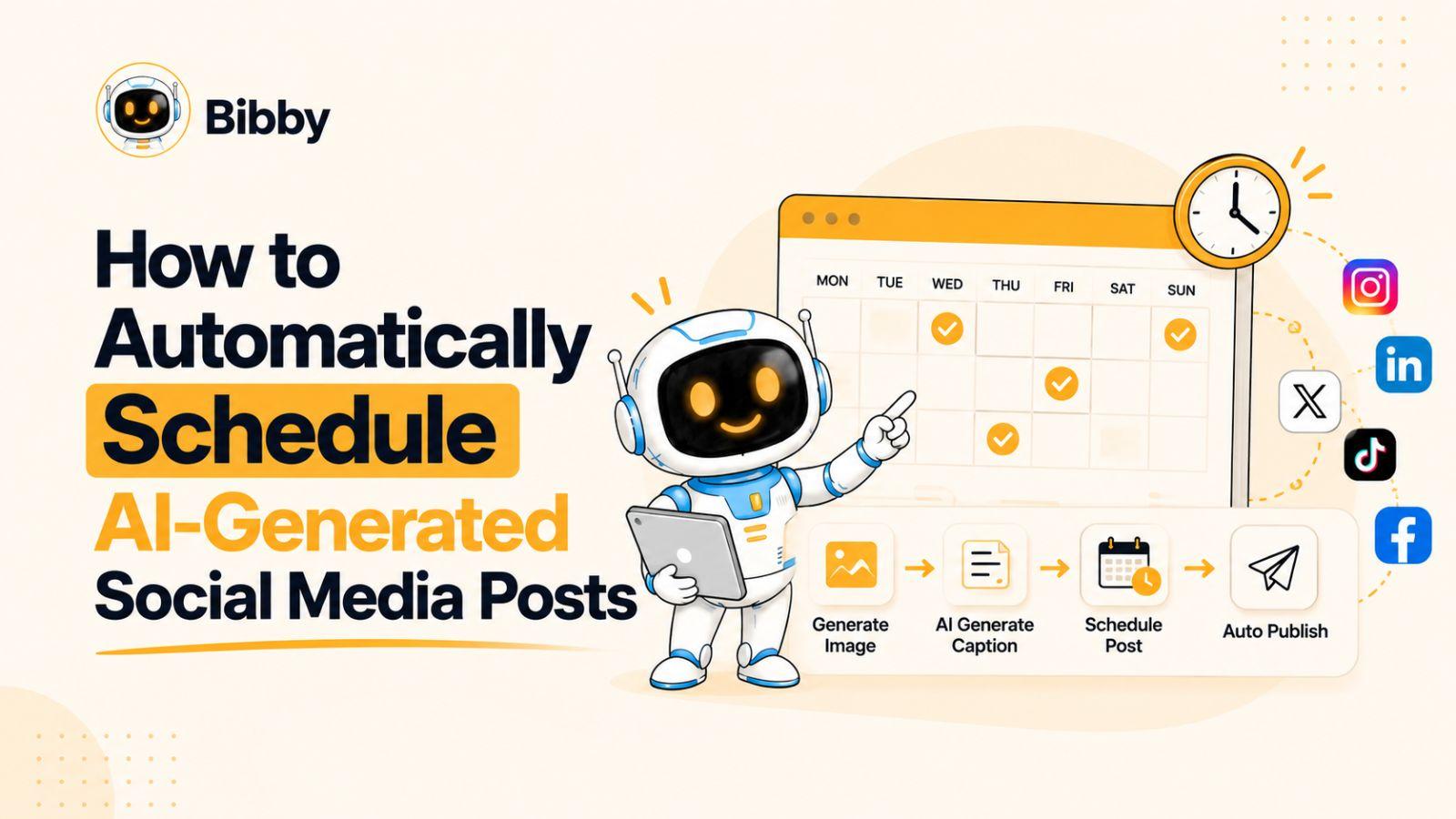
A typical process looks like this:
- Research audience interests
- Generate content ideas with AI
- Create and refine content
- Repurpose content for multiple platforms
- Schedule content automatically
- Review performance data
- Improve future content
When these steps work together, social media growth becomes a repeatable system rather than a collection of disconnected tasks.
Example: An AI-Powered Creator Growth System
Consider a creator publishing educational marketing content.
Without automation:
- Content is created manually
- Publishing happens inconsistently
- Performance tracking is fragmented
- Growth depends on daily effort
With AI and automation:
- Ideas are generated continuously
- Content is created in batches
- Posts are scheduled in advance
- Distribution happens automatically
- Analytics inform future content decisions
The result is a more predictable and scalable growth process.
Where Bibby Fits Into the Process
Many AI tools focus on helping users create content. However, content creation is only one stage of the workflow.
Bibby helps bridge the gap between content production and content distribution by making it easier to organize, schedule, and automate publishing across social channels.
Instead of juggling multiple tools and manual processes, creators and businesses can build a streamlined workflow that supports consistent publishing at scale.
This becomes especially valuable as content volume grows. The more content AI helps you create, the more important it becomes to have a reliable system for getting that content in front of your audience.
The Future of Social Media Growth
The future of social media growth is unlikely to be driven by AI alone.
Instead, successful brands will combine:
- Human creativity
- AI-powered content creation
- Automated distribution
- Data-driven optimization
Organizations that build integrated systems around these capabilities will be able to create more content, maintain greater consistency, and adapt more quickly to changing audience preferences.
AI helps you create.
Automation helps you execute.
Together, they create a scalable framework for long-term social media growth.
Also read: 7 Reasons Your Small Business Should Switch to AI Social Media Scheduling
Frequently Asked Questions
Can AI Really Help Grow Social Media Accounts?
Yes, AI can significantly improve social media growth when used strategically.
AI helps reduce the time required for content ideation, writing, repurposing, scheduling, and analysis. This allows creators and businesses to publish more consistently and focus on higher-value activities such as audience engagement and content strategy.
However, AI works best as an accelerator rather than a replacement for human creativity and expertise.
Which Social Media Platforms Benefit Most From AI?
Nearly every major platform can benefit from AI-assisted workflows, including:
- X (formerly Twitter)
- TikTok
- YouTube
The biggest advantage comes from adapting content to each platform while maintaining a consistent publishing schedule.
Is AI-Generated Content Penalized by Social Media Algorithms?
There is currently no evidence that major social media platforms automatically penalize content simply because AI was used to create it.
Platforms generally prioritize content that generates engagement and delivers value to users.
Low-quality, repetitive, or spam-like content may perform poorly, whether it was created by AI or by humans. The focus should be on creating useful, original content that resonates with your audience.
How Often Should I Post When Using AI?
The ideal posting frequency depends on your audience, platform, and available resources.
For most businesses and creators, consistency matters more than volume.
A sustainable schedule might look like:
- LinkedIn: 3–7 posts per week
- X: Daily posting
- Instagram: 3–7 posts per week
- TikTok: Several posts per week
- YouTube: 1–3 videos per week
AI can help increase output, but it's important to maintain quality and avoid publishing content solely to meet a quota.
What Is the Best AI Social Media Growth Strategy?
The most effective strategy combines four key components:
- Audience research
- AI-assisted content creation
- Automated publishing
- Performance optimization
Rather than relying on AI to generate random content, focus on building a repeatable workflow that consistently delivers value to your target audience.
Should Small Businesses Use AI for Social Media Marketing?
Absolutely.
In fact, small businesses often benefit the most from AI because they typically have limited time and resources.
AI can help small teams:
- Generate content ideas faster
- Create more content with fewer resources
- Maintain a consistent posting schedule
- Analyze performance more efficiently
- Compete with larger organizations
When paired with automation tools, AI allows small businesses to scale their social media efforts without dramatically increasing workload or headcount.
What's the Difference Between AI Content Creation and Social Media Automation?
AI content creation focuses on generating ideas, captions, posts, scripts, and other content assets.
Social media automation focuses on publishing, scheduling, organizing, and distributing that content.
The strongest growth systems use both. AI helps create content efficiently, while automation ensures that content reaches audiences consistently and at scale.
Also try: AI caption generator
Conclusion
Growing on social media is no longer just about posting more content. It's about building systems that help you create, publish, and optimize content consistently over time.
The most effective AI-powered growth strategies focus on three key principles: generating better content ideas faster, repurposing content efficiently across platforms, and combining AI creation with automated publishing workflows. Together, these capabilities allow creators and businesses to scale their social media efforts without proportionally increasing their workload.
As AI continues to evolve, the biggest advantage won't come from using more tools. It will come from building smarter processes that connect content creation, distribution, and performance optimization into a repeatable growth engine.
If you're ready to take the next step, explore how to build a complete AI-powered content system—from content planning and creation to automated publishing and analytics. That's where sustainable, long-term social media growth truly begins.