
Social media growth is no longer just about posting more often—it’s about using AI to discover opportunities hidden inside your audience, content, competitors, and performance data.
The right AI approach can reveal what your audience wants next, which content gaps your competitors have overlooked, and when and where your content has the best chance of being seen. More importantly, these insights become valuable when you can turn them into high-quality posts and consistently distribute them across the platforms where your audience spends time.
Let’s look at how AI goes beyond generating captions and starts becoming a system for finding and acting on social media opportunities.
What Are “Hidden” Social Media Growth Opportunities?
A social media growth opportunity is any overlooked signal that can help you attract more attention, engagement, followers, leads, or customers. The problem is that many of the most valuable opportunities aren't obvious when you look at surface-level metrics such as follower count, likes, or total views.
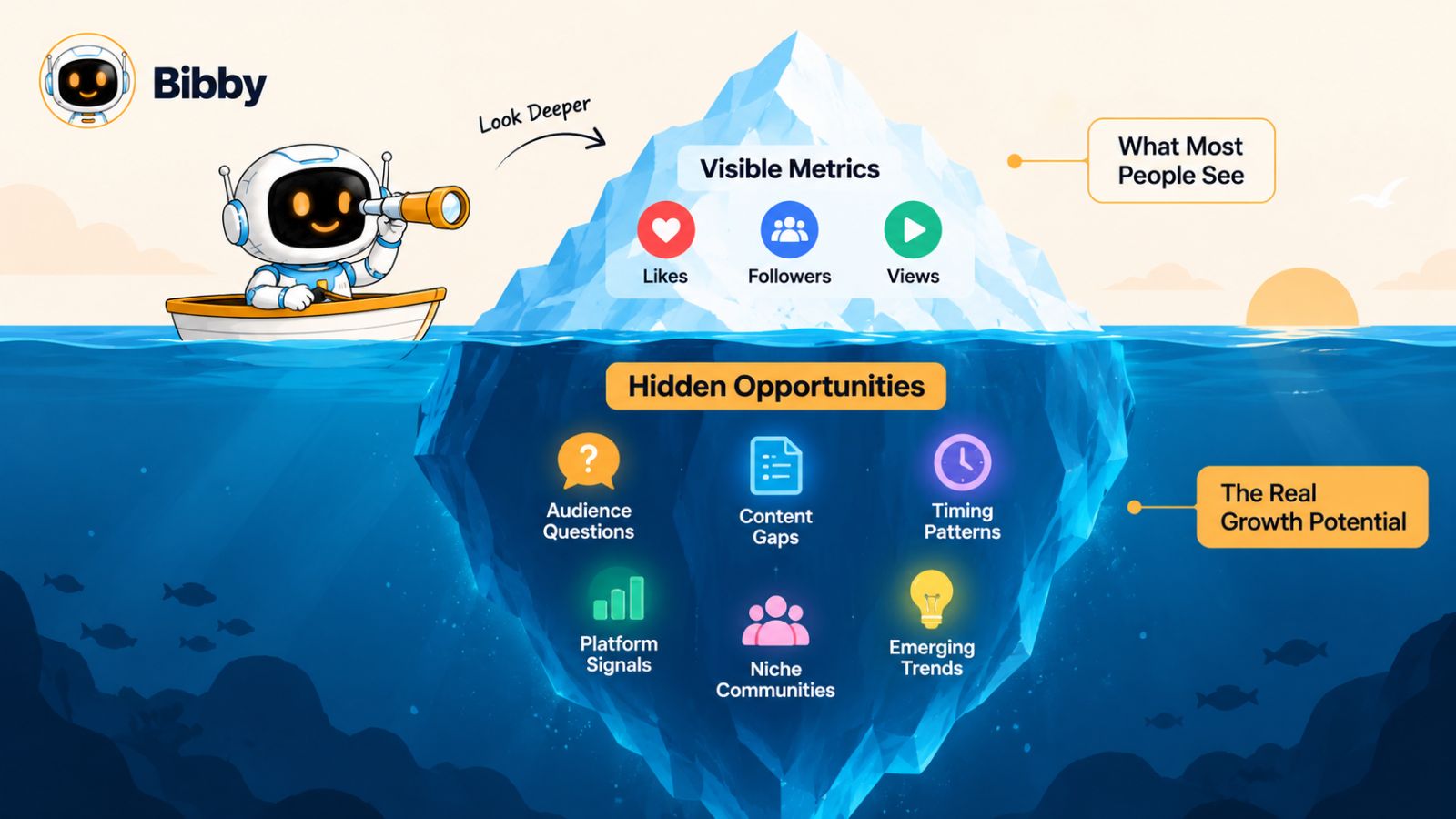
For example, imagine one of your LinkedIn posts receives fewer likes than your usual content but generates several meaningful comments from people describing the same problem. A traditional social media report might classify the post as an average performer. A more sophisticated analysis could recognize something much more valuable: your audience is telling you exactly what they want to learn about next.
That is a hidden opportunity.
AI can help uncover these patterns by looking across much more information than a person can reasonably analyze manually. Instead of asking only, “Which post got the most engagement?” you can ask deeper questions:
- Which topics repeatedly generate meaningful interactions?
- What questions does my audience keep asking?
- Which posts perform well despite having relatively little reach?
- What subjects are competitors discussing that we haven't covered?
- Which content could be repurposed into another format?
- Are certain platforms producing better results for particular types of content?
- When does our audience appear most responsive?
- Which ideas could become an ongoing content series?
This changes the way you think about social media strategy.
The Difference Between Performance Data and Opportunity Data
Performance data tells you what happened.
Opportunity data helps you understand what you should do next.
Suppose a video gets 100,000 views. That's useful information, but the number itself doesn't explain why it worked or what you should create next.
AI can look for the underlying patterns. Perhaps the video addressed a frequently searched problem, used a format your audience prefers, attracted comments from a particular customer segment, or performed unusually well on one platform compared with another.
Those details can turn a single successful post into a repeatable content strategy.
The same principle applies when a post performs poorly. Instead of simply abandoning the topic, AI can help determine whether the problem was the subject, hook, format, platform, timing, or execution.
That distinction matters because a weak-performing post doesn't necessarily mean a weak opportunity.
Five Types of Hidden Opportunities
Most overlooked social media opportunities fall into five broad categories.
1. Content opportunities
These are topics your audience cares about but that you haven't covered—or haven't covered from the right angle. Audience questions, recurring comments, competitor gaps, and emerging conversations can all reveal potential content ideas.
2. Audience opportunities
AI can identify patterns in who engages with your content and what different audience groups respond to. This can reveal underserved customer segments or topics that resonate with a specific type of follower.
3. Format opportunities
The same idea can perform differently as an image, carousel, short-form video, story, text post, or long-form piece. AI can help identify opportunities to match subjects with formats rather than treating every idea the same way.
4. Timing opportunities
Posting time isn't a universal formula. The optimal publishing window can vary by audience, platform, geography, and content type. Historical performance data can help identify patterns that aren't obvious from a generic “best time to post” chart.
5. Distribution opportunities
A valuable piece of content doesn't have to live on one platform. An idea that works on Instagram may be adapted for LinkedIn, Facebook, TikTok, or YouTube. AI can help identify where an idea has additional potential and adapt the content for each environment.
The important point is that AI isn't valuable simply because it can produce content faster. Its bigger advantage is helping you notice opportunities that would otherwise remain buried in your social media activity.
Once you know what signals to look for, the next question becomes more interesting: how does AI actually find these opportunities in the first place?
How AI Finds Social Media Opportunities Humans Often Miss
Most social media managers don't have a lack of data. They have too much of it.
Every post generates signals: impressions, watch time, likes, comments, shares, saves, clicks, follows, profile visits, and more. Then there are competitor posts, audience conversations, trending subjects, platform differences, publishing schedules, and months or years of historical content.
Finding useful patterns across all of that information manually is difficult.
This is where AI can change the social media research process. Instead of looking at individual metrics in isolation, AI can analyze large collections of signals simultaneously and identify relationships that might otherwise be easy to overlook.
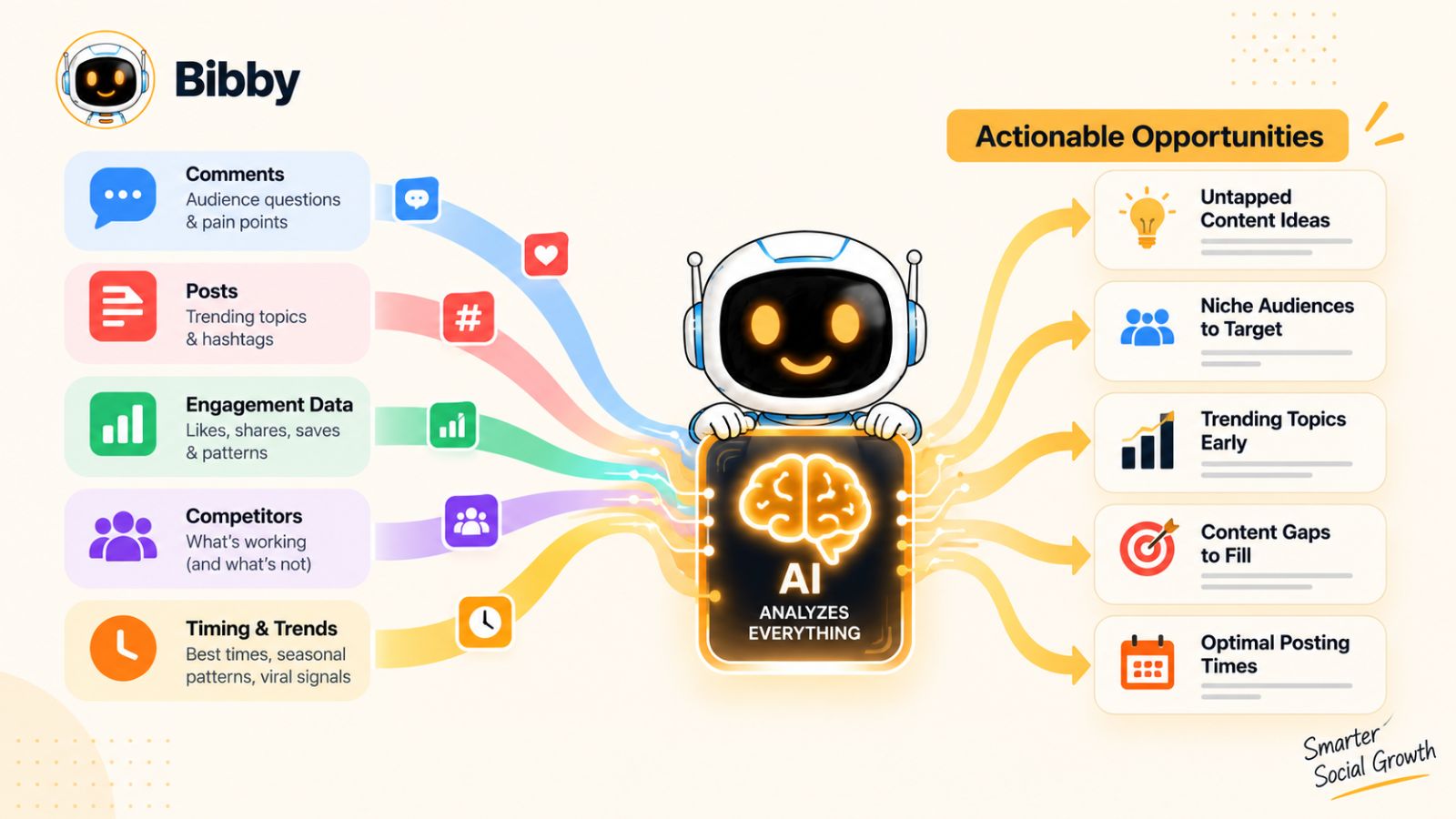
1. AI Detects Patterns Across Your Content
One successful post doesn't necessarily reveal a strategy.
Ten or twenty posts can.
AI can compare your content over time and look for recurring characteristics among posts that generate stronger responses. Perhaps educational posts consistently outperform promotional posts. Maybe posts answering specific customer questions receive more saves. Perhaps short videos generate reach while carousels generate more meaningful engagement.
These patterns can help answer a more useful question than “What was my best post?”
What characteristics appear repeatedly in the content that works?
Once those characteristics are identified, you can deliberately create more content around them.
2. AI Finds Repeated Audience Signals
Your audience is constantly giving you content ideas, often without explicitly saying, “Please create a post about this.”
Someone asks a question in a comment.
Another person asks the same thing in a direct message.
A third person discusses the problem in a community.
Several people save a post explaining a related concept.
Individually, these interactions might seem insignificant. Collectively, they can reveal strong demand for a particular topic.
AI is particularly useful for identifying these recurring themes because it can group similar questions, comments, and conversations together. Instead of seeing dozens of separate interactions, you can start seeing the underlying topic.
That can turn audience feedback into a continuous source of content opportunities.
3. AI Identifies Content Gaps
Your competitors can also reveal opportunities—not simply by showing you what to copy, but by showing you what the market is currently talking about.
Imagine that several competitors consistently publish content about a broad topic, but none of them answer a specific question people repeatedly ask about that topic.
That missing explanation could be an opportunity.
AI can help compare topics, formats, messaging, and audience reactions to identify areas where existing content may not fully satisfy the audience's needs.
The goal isn't to produce another version of the same post.
The goal is to find the unanswered part of the conversation.
4. AI Connects Topics With Content Formats
An idea isn't automatically a good post.
The format can determine how effectively the idea communicates.
A step-by-step tutorial might work well as a carousel. A quick demonstration could become a short video. A strong opinion or industry observation might work better as a text-led LinkedIn post. A collection of related tips could become a series.
AI can help map ideas to formats based on your previous content and the characteristics of each platform.
This is especially useful when you have plenty of ideas but struggle to decide what to do with them.
5. AI Finds Repurposing Opportunities
One of the most overlooked sources of social media growth is content you have already created.
A successful video could become several short clips.
A detailed article could become a carousel.
A customer question could become a short educational video.
A webinar could produce multiple social posts.
A strong LinkedIn post could inspire an Instagram carousel or a YouTube Short.
AI can analyze existing content and suggest ways to transform one useful idea into multiple pieces of platform-specific content.
This isn't simply about producing more posts. It's about extracting more value from ideas you've already invested time and expertise into developing.
6. AI Can Identify Timing Patterns
The idea that everyone should post at one universal “best time” is misleading.
Your audience has its own behavior.
AI can analyze historical performance and identify patterns between publishing times, days, platforms, content types, and audience responses.
For example, one type of content might perform particularly well during weekday mornings while another gets stronger engagement during evening hours.
The important insight isn't that AI knows a magical posting time.
It's that AI can use your own performance signals to make scheduling decisions more intelligently.
7. AI Turns Individual Signals Into Strategic Opportunities
This is where AI-powered social media analysis becomes particularly interesting.
A human might notice:
“Our carousel about pricing got a lot of saves.”
AI can potentially connect that observation with other signals:
- pricing-related posts receive above-average saves
- comments frequently contain pricing questions
- competitor content about pricing attracts discussion
- your audience engages strongly with educational carousels
- LinkedIn produces stronger engagement for this subject
- related topics have not yet been covered extensively
Now you have more than a successful post.
You have the beginnings of a content opportunity.
That opportunity could become a series, campaign, lead-generation asset, or recurring content pillar.
And this is ultimately where AI becomes more useful than a simple content generator.
The real advantage isn't asking AI to create another post. It's using AI to figure out which post is worth creating in the first place.
Once those opportunities have been identified, the next challenge is turning them into a consistent stream of content. That's where the seven most valuable types of AI-discovered social media opportunities become especially useful.
The 7 Hidden Opportunities AI Can Find for Your Social Media
AI becomes most useful for social media growth when it moves from analysis to action. Instead of simply telling you that a post performed well, it can help uncover the underlying opportunities you can turn into your next content ideas, campaigns, and publishing decisions.
Here are seven opportunities worth looking for.
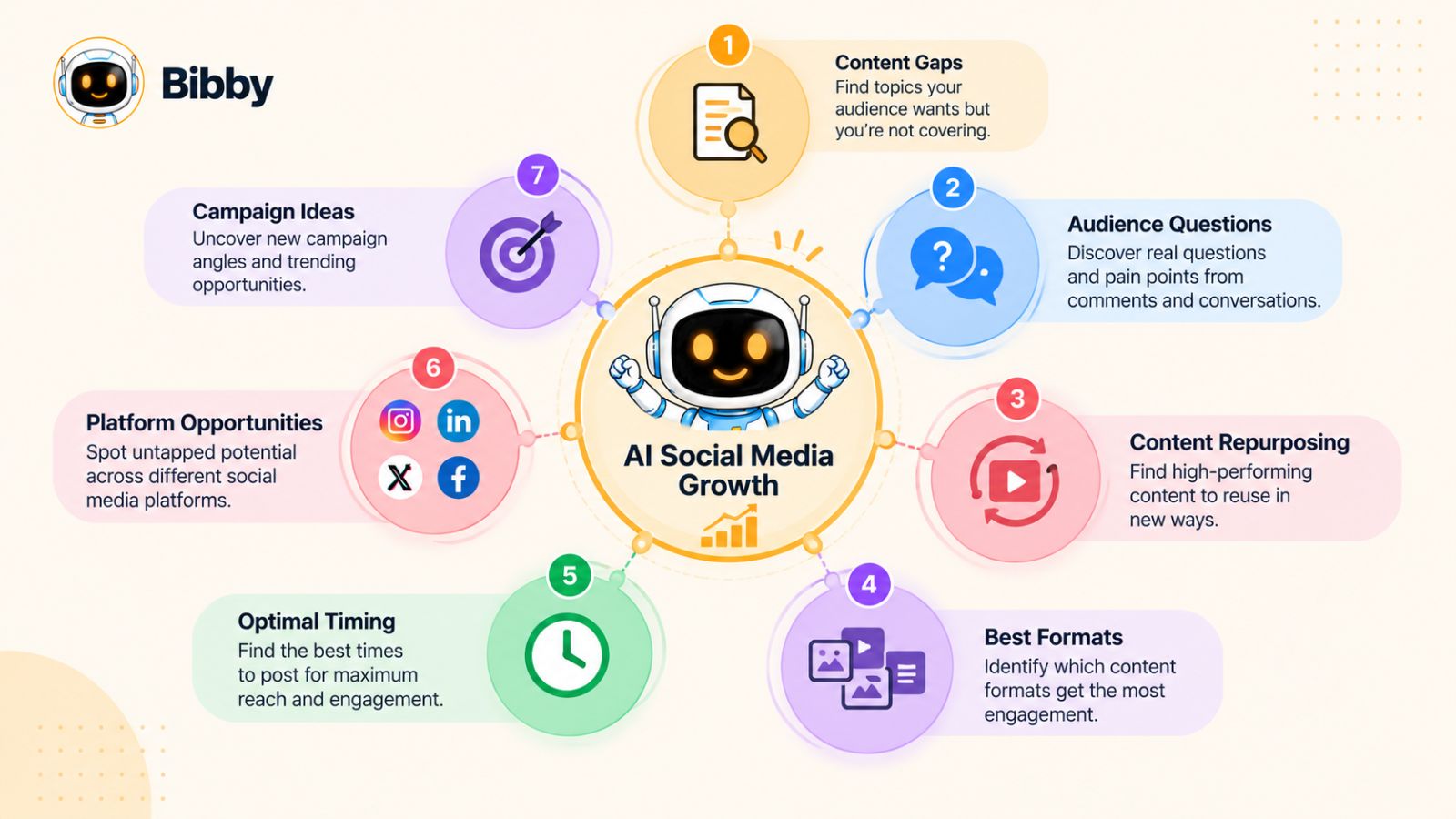
1. Content Gaps Your Competitors Aren't Covering
Your competitors can tell you what topics already have demand. The more interesting question is what they're not explaining.
AI can analyze competitor content and help identify recurring subjects, unanswered questions, missing perspectives, and areas where existing content is shallow or repetitive.
For example, suppose competitors frequently publish beginner-level posts about social media advertising. If audiences are repeatedly asking more advanced questions about attribution, creative testing, or campaign measurement, that gap could represent an opportunity.
The objective isn't to copy competitors.
It's to find where the existing conversation stops—and provide something useful beyond it.
2. Questions Your Audience Keeps Asking
Questions are some of the strongest raw materials for social media content.
A question appearing once might be an isolated interaction. The same question appearing repeatedly across comments, messages, communities, reviews, and customer conversations is a much stronger signal.
AI can group similar questions and identify recurring themes.
Those themes can become:
- Educational posts
- FAQs
- Short-form videos
- Carousels
- Tutorials
- Webinars
- Content series
- Lead magnets
Instead of guessing what your audience wants, you're building content around problems they've already demonstrated they care about.
3. Successful Posts That Could Become More Content
A high-performing post shouldn't necessarily be treated as a one-time event.
It can be a clue.
AI can help identify what made the post interesting and then suggest related angles.
For example, imagine a post titled “5 Mistakes New Freelancers Make.”
That one idea could lead to:
- “5 Pricing Mistakes New Freelancers Make”
- “5 Client Communication Mistakes”
- “How to Fix the Most Common Freelancing Mistakes”
- “A Beginner's Freelancing Checklist”
- “What I Wish I Knew Before Freelancing”
- A carousel summarizing the lessons
- A short video explaining the biggest mistake
One successful idea can become an entire content cluster.
This approach is particularly valuable because you aren't starting from a blank page. You're expanding from evidence that an existing topic has already attracted attention.
4. The Right Format for Each Idea
The same subject can produce dramatically different results depending on how you present it.
A complex process may be easier to understand in a carousel. A visual demonstration may work better as video. A strong professional opinion may generate discussion as a text post. A quick tip might be perfect for a short-form video or story.
AI can help match ideas with formats based on your historical performance and platform characteristics.
This matters because content strategy isn't just about what you say; it's also about how you package it.
Instead of asking, “What should I post today?” you can ask:
“What is the best way to communicate this idea to this audience on this platform?”
That's a much more useful question.
5. Publishing-Time Opportunities
Timing is another area where social media accounts often rely on generic advice.
You may have heard recommendations such as “post at 9 AM” or “post on Tuesday.” But audience behavior isn't identical across industries, platforms, or locations.
AI can examine your historical publishing and engagement patterns to identify potentially useful timing signals.
More importantly, timing can be connected with content type.
Perhaps educational posts perform well in the morning, while entertaining content gets stronger engagement later in the day. Perhaps your LinkedIn audience behaves differently from your Instagram audience.
Instead of applying one schedule everywhere, AI can help create a more individualized publishing strategy.
6. Platform-Specific Opportunities
A common social media mistake is treating every platform as if it were the same channel.
The same underlying idea can have different opportunities on Facebook, Instagram, LinkedIn, YouTube, and TikTok.
For example, a business lesson could become a text-driven LinkedIn post, a visual Instagram carousel, a short TikTok explanation, and a longer YouTube video.
AI can help identify these differences and adapt the idea accordingly.
This creates an important distinction:
Repurposing isn't copying and pasting.
Effective repurposing preserves the core idea while changing the presentation, hook, length, and context for the platform.
7. Opportunities to Build Campaigns Instead of Individual Posts
Perhaps the biggest opportunity is recognizing when several content ideas belong together.
If AI identifies multiple related topics that your audience consistently responds to, those topics may form the foundation of a campaign.
For example, a fitness brand might discover recurring interest around:
- Beginner workout plans
- Nutrition mistakes
- Recovery
- Consistency
- Home workouts
Instead of publishing these topics randomly, the brand could organize them into a month-long beginner fitness campaign.
That campaign could include educational posts, videos, carousels, stories, audience questions, and promotional content.
The result is a social media strategy with a narrative rather than a collection of disconnected posts.
The Bigger Opportunity: Connecting the Signals
The seven opportunities above become considerably more valuable when they're connected.
A recurring audience question can reveal a content gap.
That content gap can become a post.
The post can reveal a successful format.
That format can be adapted for another platform.
The resulting content can become part of a campaign.
AI can help connect these steps much faster than a manual workflow.
And once you've identified an opportunity, the next challenge is turning that insight into content without adding another hour of work to your week. That's where AI-powered content creation and automation start to become important.
From Social Media Data to Actual Content Ideas
Finding a promising social media opportunity is only half the job.
Knowing that your audience is interested in a particular topic doesn't automatically give you a great post. You still need to decide what to say, how to say it, which format to use, where to publish it, and how to make the idea relevant to your brand.
This is where AI can move from being an analytics tool to becoming a content strategy assistant.
Instead of treating every social media post as a completely new creative project, you can use the signals you've already discovered to build a repeatable process.
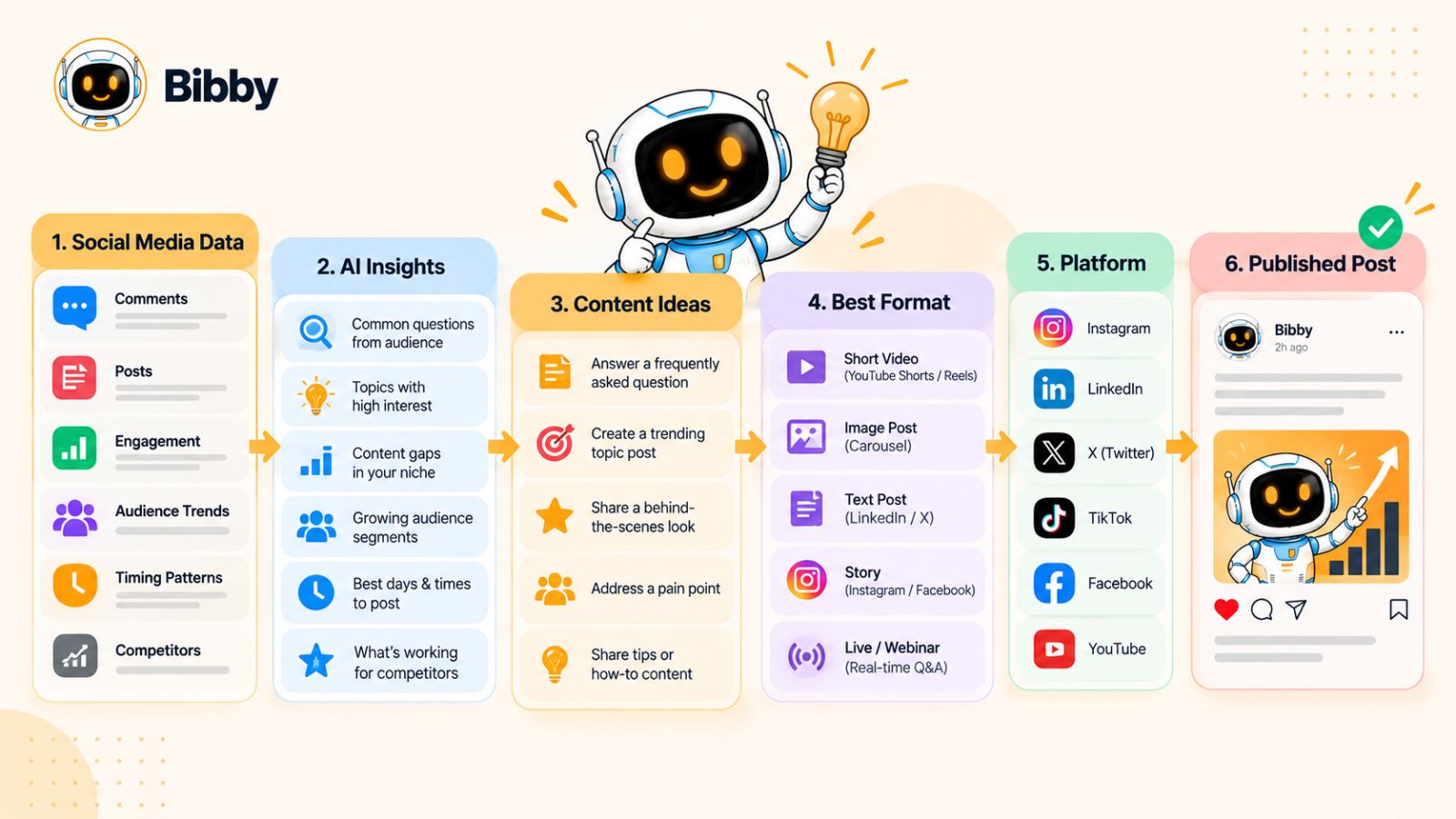
Start With the Problem, Not the Post
One of the easiest ways to create generic AI content is to start with a request like:
“Give me 10 social media post ideas.”
You'll probably get 10 ideas.
But there's no guarantee that any of them matter to your audience.
A better approach starts with a real signal.
Maybe customers repeatedly ask how to choose between two products. Maybe your audience saves posts about a particular topic. Maybe competitor content generates significant discussion around a problem you've barely addressed.
That signal becomes the starting point.
The question changes from:
“What should I post?”
to:
“What useful content can I create around this demonstrated audience need?”
That small change can dramatically improve the relevance of AI-generated content.
Turn One Signal Into Multiple Angles
A single topic rarely has only one useful angle.
Suppose an AI analysis reveals that your audience wants to understand social media automation.
You could approach that subject from several directions:
- What social media automation actually means
- Which tasks should be automated
- Which tasks should remain human
- Common automation mistakes
- How automation affects consistency
- How to build an automated content workflow
- How to measure whether automation is working
Instead of creating one generic post about automation, you now have the beginnings of a content cluster.
This gives your audience multiple ways to engage with the same underlying subject while allowing your brand to build deeper topical authority.
Match the Idea to the Content Format
Once you know the angle, choose the format intentionally.
A simple concept might work as an image post.
A list of steps could become a carousel.
A demonstration could become a video.
A behind-the-scenes update might work particularly well as a story.
A detailed professional insight could become a LinkedIn post or longer video.
AI can help generate variations for these formats while preserving the central idea.
This is especially useful for teams that have plenty of expertise but limited time. Instead of manually transforming every idea into every format, AI can accelerate the adaptation process.
Create Platform-Specific Versions
Your audience doesn't consume content identically across platforms.
A LinkedIn user may respond to a detailed professional insight. A TikTok viewer may need a much faster hook and visual explanation. An Instagram audience may engage with a concise carousel. YouTube may provide more room for a detailed demonstration.
The underlying idea can remain consistent while the execution changes.
For example:
Core idea: AI can identify hidden social media content opportunities.
LinkedIn: Explain the strategic shift from creating more content to finding better opportunities.
Instagram: Turn the seven opportunity types into a swipeable carousel.
TikTok: Create a short video showing three overlooked signals that can generate content ideas.
YouTube: Explain the complete AI-powered social media opportunity workflow.
This is more efficient than inventing completely unrelated content for every platform.
Turn Content Ideas Into a Publishing System
There's another problem with generating ideas: ideas don't create results sitting in a document.
They have to become finished content and actually get published.
This is where the workflow needs to move from:
Insight → Idea
to:
Insight → Idea → Content → Schedule → Publish → Measure
Tools such as Bibby are designed around this practical part of the workflow.
Instead of stopping after generating an idea or caption, you can upload an image or generate an image with AI, choose your preferred posting style, and let Bibby generate captions and schedule the content across your selected platforms.
That can include platforms such as Facebook, Instagram, LinkedIn, YouTube, and TikTok, while supporting formats including images, carousels, videos, and stories.
The significance isn't simply that another AI tool can write captions.
It's that the distance between discovering an opportunity and distributing content around it becomes much shorter.
The Goal Isn't More AI Content
This distinction is important.
AI makes it incredibly easy to produce more content.
That doesn't mean producing more content automatically produces more growth.
If you use AI to publish hundreds of irrelevant posts, you've simply automated irrelevance.
The better approach is:
Find a real signal → identify an opportunity → develop a useful idea → create the right format → distribute it consistently → learn from the results.
AI can assist with every stage, but the quality of the initial signal still matters.
That is why the strongest AI social media workflows don't begin with content generation.
They begin with opportunity discovery.
And once you've found those opportunities, the next challenge is making sure your publishing process is fast enough and consistent enough to act on them. That's where social media automation becomes more than a convenience—it becomes part of the growth strategy.
AI Can Reveal What to Post—But Execution Is Where Growth Happens
Knowing what your audience wants is valuable. Acting on that knowledge consistently is where the real challenge begins.
A business can discover ten promising content opportunities and still fail to benefit from them if those ideas remain trapped in spreadsheets, notes, content calendars, or AI chat conversations.
Social media growth requires execution.
That means creating the content, adapting it for the right platforms, writing the accompanying copy, choosing when it should go live, and maintaining enough consistency for your strategy to produce useful performance data.
This is why the future of AI-powered social media isn't just about AI-generated content.
It's about connecting insight, creation, scheduling, publishing, and learning into one workflow.
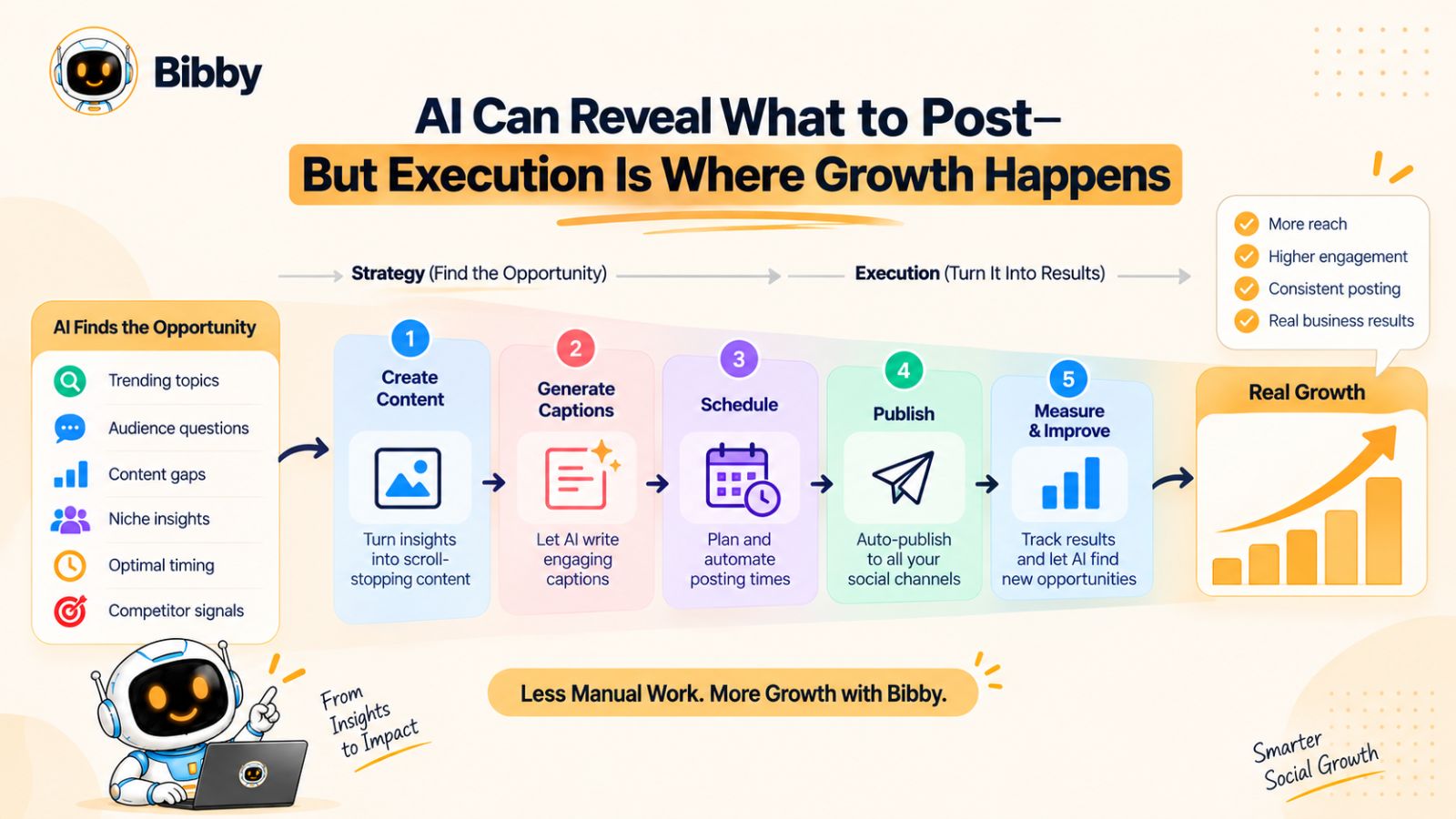
The Gap Between Strategy and Publishing
Consider what typically happens after a marketer discovers a promising content idea.
First, they write the idea down.
Then they create the visual.
Next, they write a caption.
Then they adapt the post for different platforms.
After that, they open a scheduling tool.
They choose a date and time.
They repeat the process for several more posts.
Eventually, the original strategic insight gets buried under the administrative work required to publish it.
None of these tasks is particularly complicated.
The problem is the cumulative friction.
Every extra step creates another opportunity to delay, forget, or abandon the idea.
Automation Removes the Repetitive Work
Automation can reduce this friction by turning individual publishing tasks into a connected workflow.
Instead of treating every post as a separate project, you can create a system where content moves from creation toward distribution with fewer manual decisions.
That's particularly useful when you are managing multiple platforms.
A single campaign might require:
- Instagram posts
- Facebook posts
- LinkedIn content
- TikTok videos
- YouTube content
- Stories
- Carousels
- Different captions and variations
Manually coordinating all of that can quickly become a full-time operational task.
AI automation can handle much of the repetitive work while leaving humans responsible for the things that require judgment: the brand's positioning, expertise, creativity, and final approval.
Where Bibby Fits Into the Workflow
This is where Bibby can turn an AI-powered social media strategy into a practical publishing workflow.
The basic process is designed to be simple.
You can upload an image or generate an image with AI. Then you choose a posting style, and Bibby can automatically generate captions and schedule your content at AI-optimized times across the platforms you've selected.
That means the workflow can move from:
Create → Write → Schedule → Repeat
to a much more streamlined process:
Create → Choose your style → Let AI handle the publishing workflow.
Bibby supports different types of social content, including images, carousels, videos, and stories, so the system isn't limited to one type of post.
It can also help distribute content across major platforms such as Facebook, Instagram, LinkedIn, YouTube, and TikTok.
For someone managing multiple channels, that consolidation can make a significant difference.
From Content Calendar to AI-Assisted Social Media Manager
Bibby's newer chat interface takes this idea further.
Instead of navigating through multiple menus and manually configuring every task, you can interact with the tool conversationally.
For example, you can use the chat interface to:
- Create a brand kit
- Create a campaign
- Create posts
- Regenerate captions
- Manage content ideas
- Refine existing content
- Work through social media tasks conversationally
This changes the interaction model.
Instead of learning where every feature lives, you can describe what you want to accomplish and use the conversation as the starting point for the workflow.
Imagine saying:
“Create a campaign around our new product launch, make the content suitable for Instagram, LinkedIn, and Facebook, and give each platform a different caption style.”
That's closer to how you'd brief a social media manager than how you'd traditionally operate a scheduling dashboard.
Automation Should Follow Strategy
There is one important caveat.
Automation doesn't replace strategy.
It amplifies whatever strategy you give it.
If your content is useful, automation can help you distribute that content more consistently.
If your strategy is based on strong audience signals, automation can help you act on those signals faster.
But if you're publishing generic content simply because an AI tool makes it easy, automation can make the problem worse by helping you publish more of the wrong thing.
The most effective approach is therefore not:
AI → Generate everything → Publish everything.
It's:
AI → Discover opportunities → Develop useful content → Automate execution → Measure results → Discover the next opportunity.
That creates a feedback loop.
And the more effectively that loop operates, the less social media management feels like repeatedly starting from zero.
The next step is to look at that workflow in practice—and how a tool like Bibby can connect AI content creation, captions, scheduling, and multi-platform publishing into one system.
Using Bibby to Turn AI Opportunities Into Scheduled Social Content
Finding a hidden social media opportunity is useful. Turning that opportunity into a finished, scheduled content plan is where the advantage becomes practical.
This is where an AI-powered social media scheduling and automation platform like Bibby can fit into the workflow.
Instead of using separate Tools for image creation, captions, scheduling, and publishing, Bibby brings these parts of the social media process into a simpler workflow.
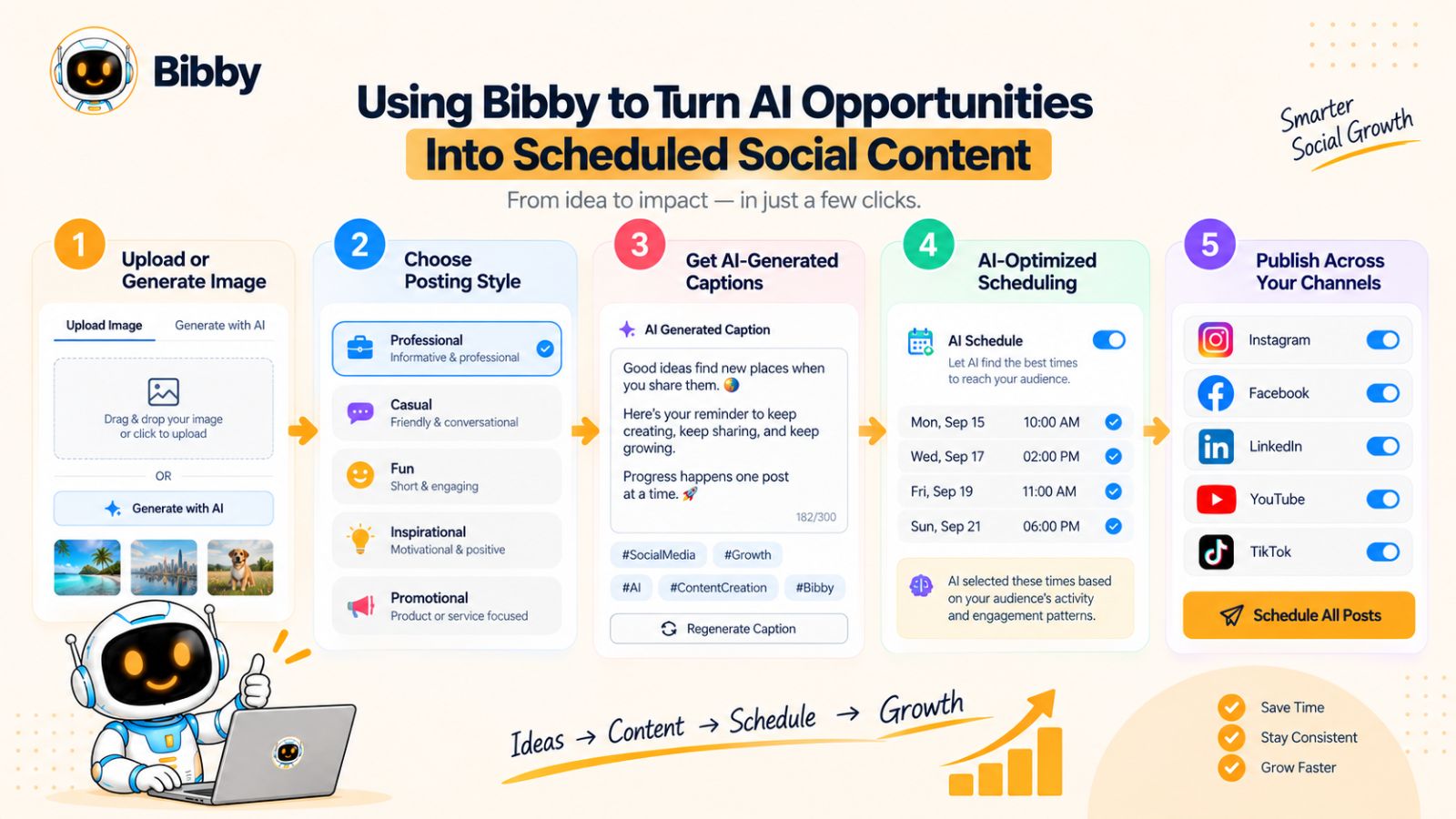
Start With an Image—or Create One With AI
Every piece of social content needs a starting point.
With Bibby, you can upload your own image or use AI to generate one. This gives you flexibility depending on where your content is in the creative process.
If your design team has already created the visual, upload it.
If you're working from an idea and don't have an asset yet, generate one with AI.
The important part is that you don't have to build your entire social media workflow around having finished creative assets before you can start planning your content.
Choose Your Posting Style
Once you have your visual, you can choose the style you want for the post.
This helps turn a basic content asset into something that fits the communication style you're trying to achieve.
The goal isn't simply to produce a caption.
It's to create content that feels intentional and consistent with the broader strategy.
For brands managing multiple campaigns or audiences, this can reduce the amount of repetitive setup required for every individual post.
Let AI Generate the Caption
Writing captions manually for every social platform can become one of the most repetitive parts of social media management.
Bibby can automatically generate captions based on your content and selected posting style.
That means you can spend less time staring at a blank caption box and more time deciding whether the underlying idea is actually worth publishing.
This is an important distinction.
AI should reduce the mechanical work of social media creation without removing the strategic thinking behind it.
Schedule Content at AI-Optimized Times
Creating good content doesn't guarantee that it will be published consistently.
Scheduling solves part of that problem, while AI can help determine appropriate publishing times based on available performance signals.
Bibby can schedule your content at AI-optimized times rather than requiring you to manually choose a date and time for every post.
That becomes especially useful when you're managing a larger content pipeline.
Instead of thinking:
“What should I publish today?”
you can build content ahead of time and let the system handle the scheduling.
This changes social media from a daily task into a more structured publishing system.
Publish Across Multiple Platforms
Managing each platform separately creates another layer of friction.
You might have an idea that belongs on Instagram, Facebook, LinkedIn, YouTube, and TikTok—but manually preparing and scheduling that content everywhere can take significantly longer than creating the original idea.
Bibby allows you to select the platforms you want to publish to and manage different types of content from the same workflow.
That includes formats such as:
- Images
- Carousels
- Videos
- Stories
And it can support publishing across platforms including Facebook, Instagram, LinkedIn, YouTube, and TikTok.
The advantage isn't simply “post everywhere.”
It's being able to take one strategic content opportunity and turn it into a coordinated multi-platform publishing plan.
One Idea Can Become a Content Distribution System
Imagine your AI analysis identifies a recurring audience question:
“How can small businesses use AI to save time on social media?”
Instead of answering it with one post, you could build a small content campaign around the opportunity.
One piece could explain the problem.
Another could provide practical tips.
A carousel could break down the workflow.
A video could demonstrate the process.
A story could ask your audience about their biggest social media challenge.
A LinkedIn post could explore the strategic implications.
Bibby can then help move those assets through the creation, captioning, and scheduling workflow.
The important concept is that AI identifies the opportunity, while automation helps you capitalize on it repeatedly.
Why This Matters for Social Media Growth
The biggest constraint for many businesses isn't a lack of content ideas.
It's the distance between having an idea and getting that idea published consistently.
Every additional tool, login, manual caption, scheduling decision, and platform-specific workflow adds friction.
Reducing that friction makes it easier to maintain consistency.
And consistency gives you something else that matters: more data.
The more relevant content you publish, the more signals you collect about what your audience responds to. Those signals can then feed your next round of analysis.
That creates a continuous cycle:
Discover → Create → Schedule → Publish → Measure → Discover again.
Bibby can help simplify the middle of that cycle, so your team spends less time managing the mechanics of publishing and more time identifying the opportunities worth pursuing.
But there's an even more interesting way to interact with that workflow.
Instead of clicking through every individual feature, you can increasingly use conversation itself as the interface for managing your social media.
Managing Social Media Through AI Chat
Traditional social media management tools are built around dashboards, menus, calendars, buttons, and individual settings.
That works—but it can become cumbersome when you're managing multiple campaigns, platforms, content formats, and brand requirements.
A chat-based interface offers a different approach.
Instead of figuring out which feature to open, you can describe the outcome you want and work through the task conversationally.
This is the direction Bibby is taking with its AI chat interface.
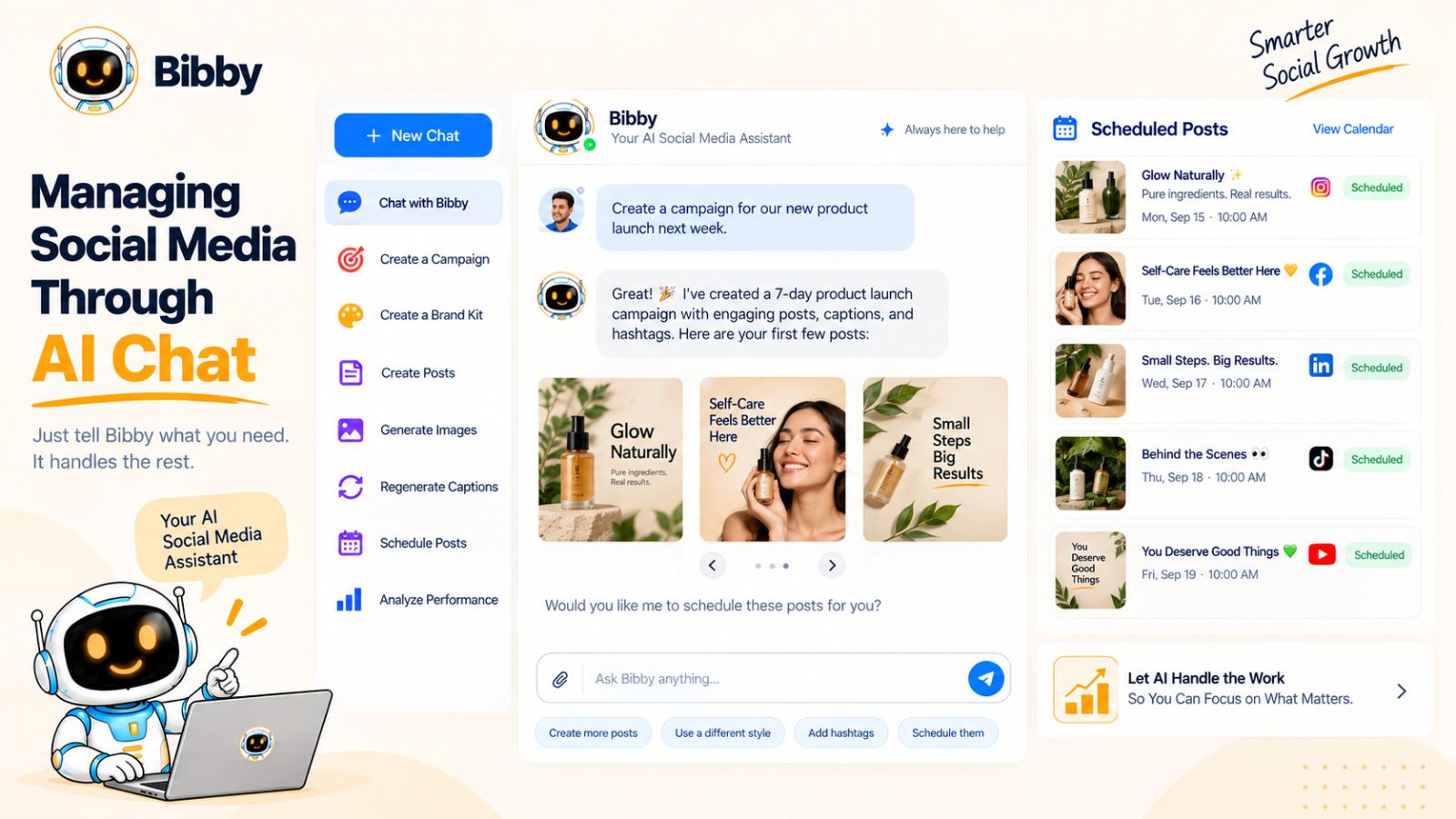
From Clicking Through Menus to Giving Instructions
Imagine you need to prepare a campaign for a new product.
In a traditional workflow, you might need to create a campaign, configure the details, create individual posts, prepare captions, upload creative assets, and then schedule everything.
With a conversational interface, you can start with a simple instruction:
“Create a social media campaign for our new product launch.”
From there, you can refine the campaign through conversation.
You could ask for different content ideas, change the tone, regenerate captions, adjust the campaign, or create additional posts without having to restart the process.
The interface becomes less about operating software and more about communicating your intent.
Create a Brand Kit Through Chat
Consistency matters when AI is producing social media content.
Your audience should be able to recognize your brand across different platforms and formats.
Bibby's chat experience can help you create a brand kit, giving the AI important context about how your brand should be represented.
That can help establish a foundation for future content rather than requiring you to explain your brand from scratch every time you create a post.
The broader idea is important:
The more context an AI system has about your brand, the more useful its assistance can become.
Create Campaigns Without Starting From Scratch
Campaigns are another area where conversational AI can reduce complexity.
Instead of thinking about individual posts, you can describe the campaign objective and let the system help structure the content around it.
For example:
“Create a two-week campaign introducing our new AI-powered product. Focus the first week on education and the second week on product use cases.”
That instruction provides a strategic direction rather than a single content request.
From there, the campaign can be developed into individual content pieces and publishing activities.
This is a meaningful shift from post creation toward campaign management.
Create and Regenerate Posts
Not every first draft will be right.
Maybe the caption is too formal.
Maybe the hook isn't strong enough.
Maybe you want a more educational tone.
Maybe you want the same idea expressed in a shorter format.
With a chat-based interface, you can simply ask for a revision.
For example:
- “Make this more conversational.”
- “Give me three stronger hooks.”
- “Make the caption shorter.”
- “Rewrite this for LinkedIn.”
- “Make this more educational.”
- “Regenerate the caption.”
- “Turn this idea into a carousel.”
This makes iteration much more natural.
Instead of abandoning an idea because the first output isn't perfect, you can continue the conversation until the content better matches your needs.
Chat Can Become the Control Center for Social Media
The larger opportunity isn't any single feature.
It's the possibility of managing more of your social media workflow through one conversational interface.
You could move from:
Idea → Brand context → Campaign → Posts → Captions → Scheduling
without constantly switching between disconnected tools.
That is particularly useful for small teams and solo creators who may not have a dedicated social media manager.
Instead of learning a complicated stack of specialized tools, they can increasingly interact with one system in natural language.
AI Still Needs Human Direction
A conversational interface doesn't mean you should hand over your entire social media strategy without oversight.
AI can accelerate execution, but your expertise still determines what your brand should say, which opportunities matter to your business, and which claims or ideas are appropriate for your audience.
Think of AI chat as a highly capable operating layer—not a replacement for judgment.
You provide the context and direction.
The AI helps turn that direction into action.
That distinction becomes especially important as social media workflows become increasingly automated.
The Bigger Shift: From Tool to Teammate
The most interesting development in AI-powered social media isn't that AI can write a caption.
We've already seen that.
The bigger shift is AI becoming capable of participating in the workflow around the caption.
It can help create the brand foundation, develop campaigns, generate posts, revise content, and support the publishing process.
That starts to resemble the role of a social media assistant or manager rather than a simple content generator.
And once AI can help manage the workflow, the next question becomes practical: how do you build your own repeatable system for finding opportunities, creating content, and distributing it consistently?
How to Use AI to Find Your Own Social Media Growth Opportunities
AI becomes much more valuable when you stop using it only as a content generator and start using it as part of a repeatable Social media growth process.
The goal isn't to ask AI for random post ideas every morning.
Instead, build a system that continuously turns audience signals, content performance, competitor activity, and platform data into new opportunities.
Here's a practical eight-step workflow.
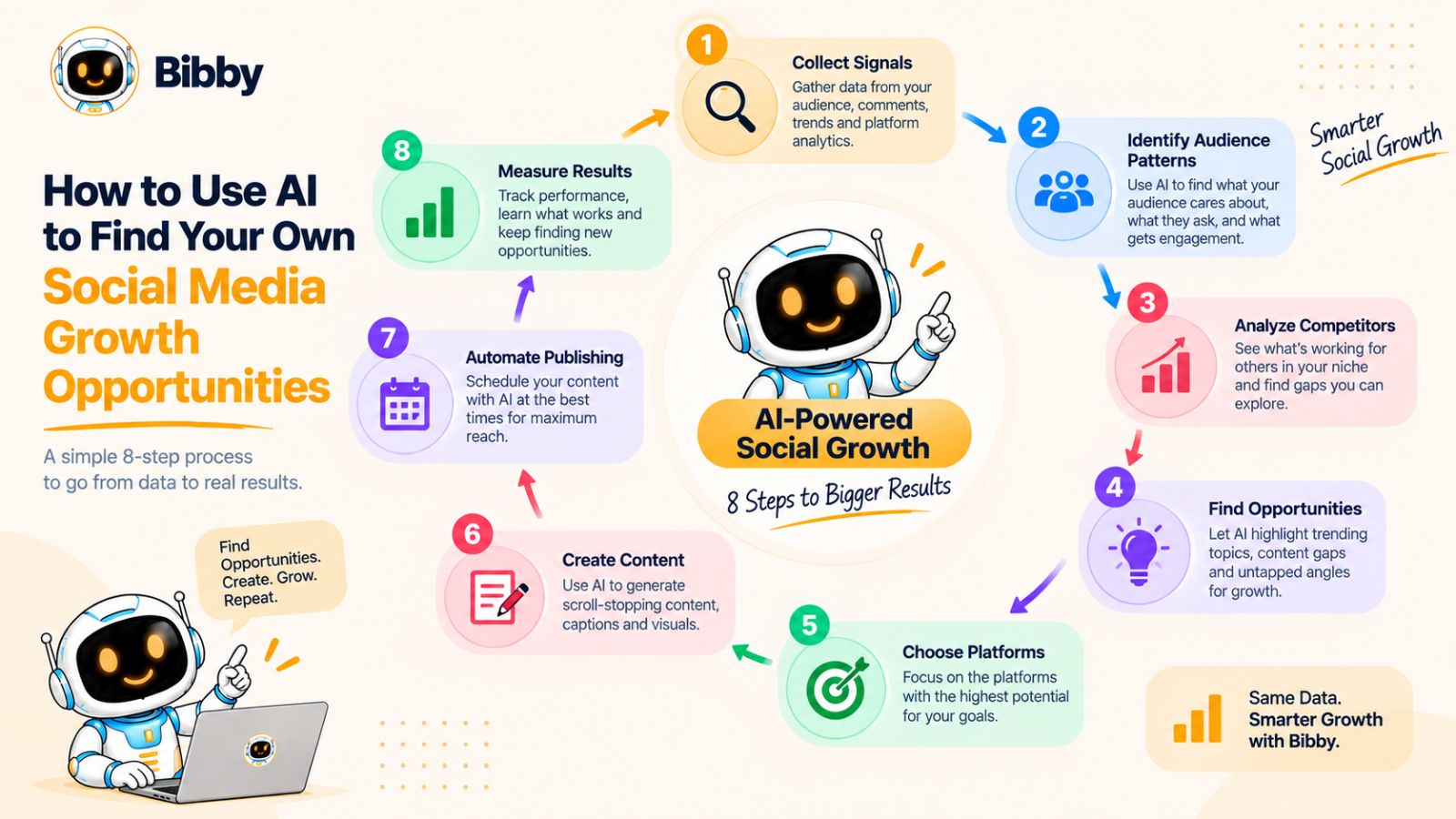
Step 1: Collect Your Existing Social Media Signals
Start with what you already have.
Look at your recent posts, engagement, comments, shares, saves, clicks, profile visits, follower growth, and other meaningful metrics available on your platforms.
Don't focus exclusively on your highest-viewed posts.
Look for unusual patterns.
A post with modest reach but exceptionally high saves could reveal an educational opportunity. A post with relatively few likes but many comments might indicate strong audience interest. A video with high watch time could reveal a format worth exploring further.
The objective is to gather enough information for AI to identify patterns rather than judging posts individually.
Step 2: Identify What Your Audience Keeps Talking About
Your audience is one of your best sources of content research.
Collect recurring questions from comments, direct messages, customer conversations, reviews, community discussions, and other relevant sources.
Then look for repetition.
If people keep asking similar questions, they're giving you evidence of a problem they want solved.
AI can help organize these conversations into themes.
For example, 50 different questions might ultimately reveal three recurring topics:
Topic A: Getting started
Topic B: Choosing the right tools
Topic C: Measuring results
Those themes can become content pillars.
Step 3: Analyze Competitor Content for Gaps
Next, examine what competitors are publishing.
Don't just ask AI:
“What are my competitors posting?”
Ask more useful questions:
- Which topics appear repeatedly?
- Which posts receive meaningful engagement?
- What questions do audiences ask in response?
- Which subjects receive little coverage?
- Which perspectives are missing?
- Where does competitor content remain superficial?
- Which topics could be explained more clearly or practically?
The goal isn't to imitate competitors.
It's to understand the existing information landscape and find areas where you can contribute something genuinely useful.
Step 4: Turn Signals Into Opportunities
Now combine the information.
Suppose you discover:
- Your audience frequently asks about AI automation.
- Posts about saving time receive high engagement.
- Competitors focus mostly on AI content generation.
- Few competitors explain complete AI-powered workflows.
That's more interesting than any single data point.
It suggests a potential opportunity around using AI to automate the complete social media workflow, rather than simply generating individual posts.
This is where AI can help connect seemingly separate signals into a strategic content direction.
Step 5: Match Each Opportunity to a Platform
Don't automatically publish every opportunity everywhere in exactly the same format.
Ask where the idea makes the most sense.
A professional strategy breakdown might be particularly suitable for LinkedIn.
A visual tutorial could work well as an Instagram carousel.
A quick demonstration might become a TikTok or YouTube Short.
A deeper educational explanation could become a YouTube video.
The core idea can remain consistent while the execution changes.
Step 6: Turn Opportunities Into Content
Once you've selected an opportunity, develop actual content around it.
Start with the audience problem.
Then define the specific insight you want to communicate.
From there, create the appropriate hook, structure, visual, caption, and call to action.
AI can accelerate much of this process.
But don't ask AI to simply “make something engaging.”
Give it the context that made the opportunity valuable in the first place.
For example:
“Our audience repeatedly asks how small businesses can automate social media without losing their brand voice. Create a practical carousel explaining a five-step workflow, aimed at small business owners who manage their own social media.”
The result is more likely to be useful because the AI has an actual audience problem to solve.
Step 7: Automate the Publishing Process
Once the content is ready, reduce the manual work required to distribute it.
This is where an AI-powered platform such as Bibby can become part of the workflow.
You can upload your creative or generate an image with AI, select a posting style, have AI generate captions, and schedule content across your selected social platforms.
Instead of manually coordinating every post across Facebook, Instagram, LinkedIn, YouTube, and TikTok, you can manage the publishing process through a more centralized workflow.
You can also work with different formats, including images, carousels, videos, and stories.
The objective isn't to automate social media for the sake of automation.
It's to make sure good opportunities don't disappear simply because publishing them manually takes too much time.
Step 8: Feed the Results Back Into the System
This final step is what turns a collection of AI tools into an actual growth loop.
After publishing, measure what happened.
Which topics generated meaningful engagement?
Which formats worked?
Which platforms responded?
Which hooks attracted attention?
Which posts generated saves, shares, comments, clicks, or other meaningful actions?
Then feed those observations back into your next round of analysis.
Your workflow becomes:
Collect → Analyze → Identify → Create → Publish → Measure → Learn → Repeat.
Over time, this can become more intelligent because every publishing cycle creates new information.
Don't Optimize for Volume
There's a temptation to interpret AI automation as a reason to publish as much content as possible.
That's usually the wrong goal.
The better objective is to increase the number of relevant experiments and useful interactions you can run without dramatically increasing your workload.
Ten strategically chosen posts can teach you more than fifty generic posts.
One strong audience insight can be more valuable than dozens of randomly generated ideas.
And one successful content theme can become the foundation for an entire campaign.
AI gives you leverage.
Your strategy determines where that leverage is applied.
The next step is to turn this workflow into a simple framework you can use repeatedly—one that connects the original audience signal all the way through publishing and learning.
A Practical AI Social Media Opportunity Framework
AI can help with almost every part of social media marketing, but that doesn't mean you should use it randomly.
A better approach is to give your AI workflow a structure.
One simple framework is:
Signal → Opportunity → Content → Distribution → Measurement → Learning
Each stage answers a different question, and together they create a repeatable system for finding and acting on social media growth opportunities.
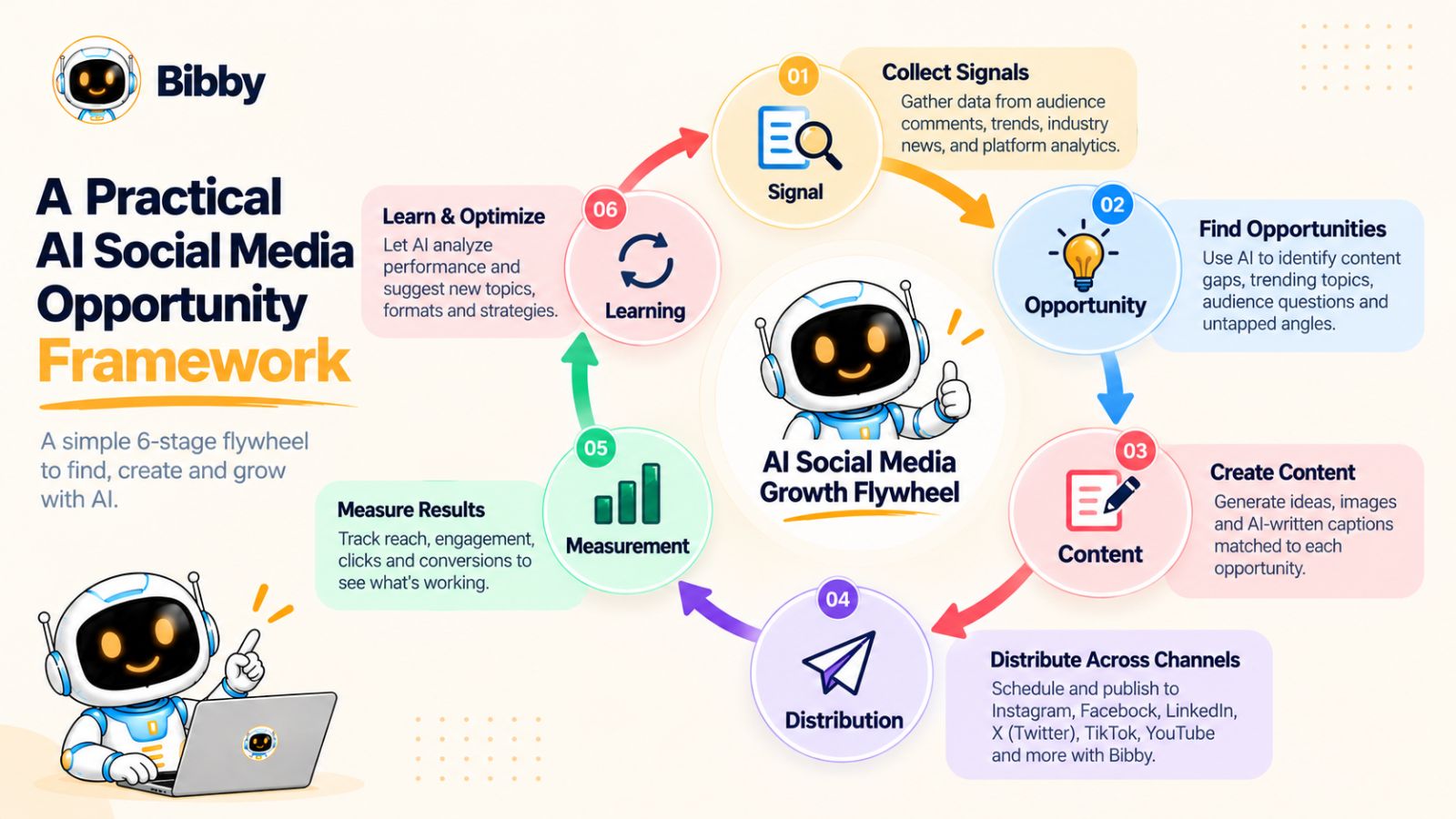
1. Signal: What Is Your Audience Telling You?
Every growth opportunity starts with a signal.
Signals can come from:
- Comments
- Saves
- Shares
- Clicks
- Direct messages
- Search behavior
- Customer questions
- Content performance
- Competitor activity
- Emerging conversations
The important thing is to avoid treating every signal equally.
A single like may not tell you much.
A recurring question appearing across multiple audience interactions is potentially much more meaningful.
AI can help organize large numbers of signals and identify recurring themes.
Question to ask:
What is happening repeatedly that deserves my attention?
2. Opportunity: What Could This Signal Become?
A signal isn't automatically an opportunity.
You need to interpret it.
Suppose your audience repeatedly asks how to create better short-form videos.
The opportunity might not simply be “make a video about short-form video.”
It could be:
- Create a beginner tutorial series
- Build a checklist
- Demonstrate common mistakes
- Compare different video formats
- Create a recurring weekly series
- Develop a lead-generation campaign
AI can help generate and compare possible directions.
Question to ask:
What useful problem can I solve based on this signal?
3. Content: What Should We Create?
Now turn the opportunity into something your audience can consume.
Decide:
- What is the main idea?
- Who is it for?
- What format makes sense?
- What is the strongest angle?
- What action should the audience take?
This is where AI content creation becomes useful.
It can help with hooks, outlines, captions, scripts, visual concepts, variations, and platform adaptations.
But the opportunity should come first.
Question to ask:
What is the most useful piece of content we can create around this opportunity?
4. Distribution: Where and When Should It Be Published?
A great piece of content can underperform if it reaches the wrong audience or is distributed poorly.
Think about:
- Which platform?
- Which format?
- Which audience segment?
- Which publishing window?
- Should the idea be adapted for multiple platforms?
- Should it become part of a larger campaign?
This is where social media scheduling and automation can remove operational friction.
For example, Bibby can help take your content through the publishing workflow by generating captions, scheduling content at AI-optimized times, and distributing different content formats across selected platforms.
That makes distribution part of the system rather than an afterthought.
Question to ask:
Where and when is this content most likely to reach the right audience?
5. Measurement: What Actually Happened?
Don't measure success using only follower growth.
Depending on your objective, useful signals might include:
- Engagement
- Saves
- Shares
- Comments
- Watch time
- Clicks
- Profile visits
- Leads
- Conversions
- Audience growth
The important thing is to measure against the original opportunity.
If the goal was to discover whether your audience cares about a particular topic, comments and saves might be more informative than raw impressions.
Question to ask:
Did the content validate the opportunity we identified?
6. Learning: What Should We Do Next?
This is the stage that turns individual posts into a learning system.
Suppose your original opportunity produced strong saves but weak clicks.
That doesn't necessarily mean the content failed.
It might mean the educational subject is valuable while the call to action needs improvement.
Or perhaps the topic works but the format doesn't.
Or the content resonates on Instagram but not LinkedIn.
AI can help identify these patterns and suggest what to test next.
Question to ask:
What did this result teach us about our audience, content, or distribution?
The Framework Creates a Continuous Loop
The most important part of this framework is that it doesn't end with publishing.
The output from one cycle becomes the input for the next.
Signal
↓
Opportunity
↓
Content
↓
Distribution
↓
Measurement
↓
Learning
↓
New Signal
That final step is what makes the system increasingly useful over time.
You're no longer asking AI to invent something from nothing every morning.
You're giving it a growing body of evidence about your audience, your content, and your distribution.
Where Bibby Fits
Bibby can sit primarily in the Content → Distribution portion of this framework.
Once you've identified an opportunity, you can use the platform to create or upload visuals, select a posting style, generate captions, and schedule content across your selected platforms.
Its chat interface also adds another layer: you can interact with the workflow conversationally, including tasks such as creating a brand kit, creating campaigns, creating posts, and regenerating captions.
That means the strategy remains human-directed while many of the repetitive execution steps can be handled through AI and automation.
The result is a more complete system:
Humans identify what matters. AI helps uncover patterns. Automation helps turn those insights into consistent action.
And that leads to an important question: if AI and automation can make publishing easier, what mistakes should you avoid so that your social media doesn't simply become a machine for producing more generic content?
Common Mistakes When Using AI for Social Media Growth
AI can make social media faster, but faster doesn't automatically mean better.
The same technology that helps you discover opportunities, create content, and automate publishing can also help you produce large amounts of content that nobody particularly wants to see.
The difference usually comes down to how AI is used.
Here are some of the most common mistakes to avoid.
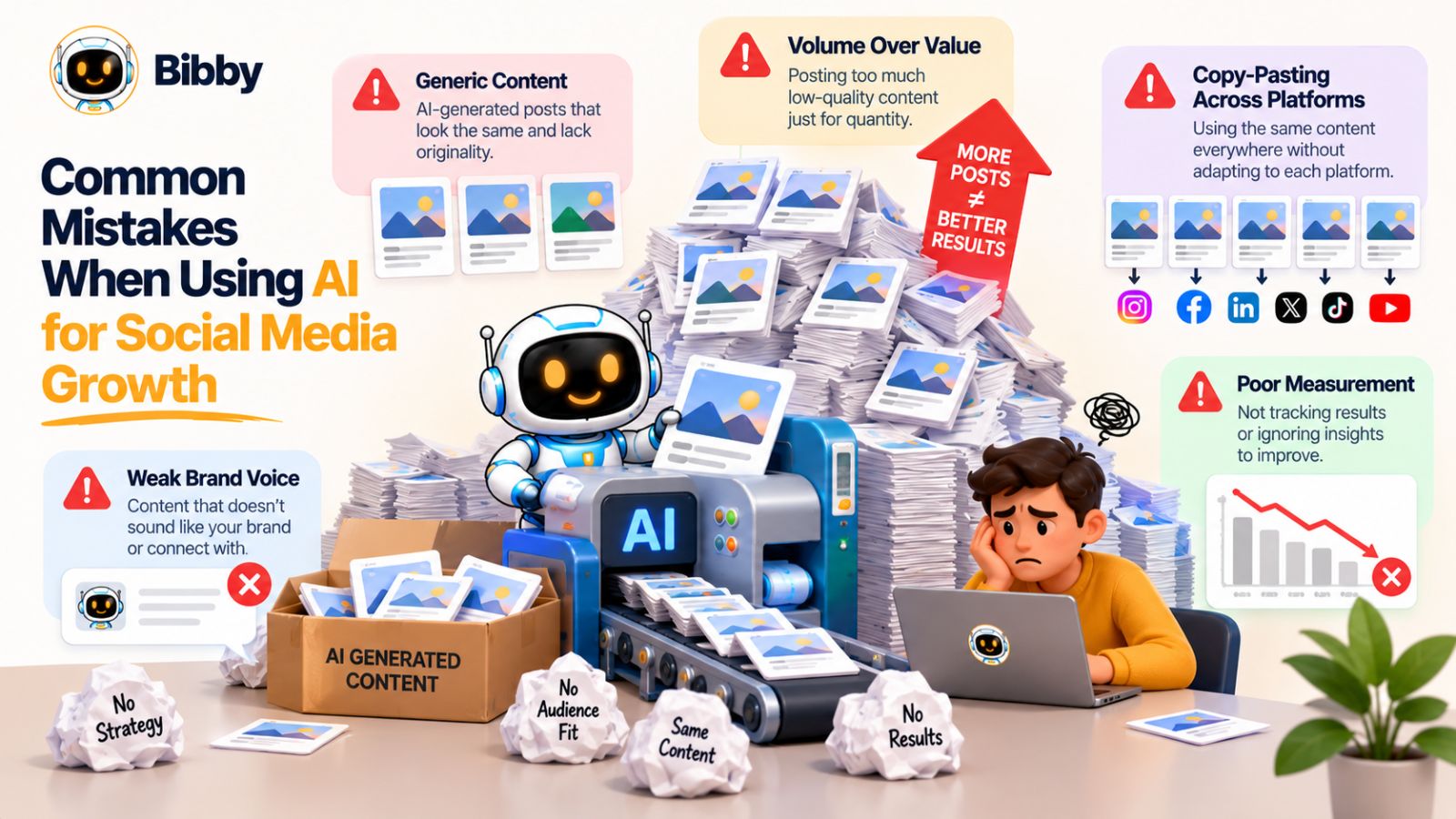
1. Generating Content Without a Real Audience Signal
The easiest way to use AI is to ask it for a list of social media ideas.
The problem is that generic ideas aren't necessarily valuable ideas.
“Five tips for better marketing” might be perfectly acceptable content, but why should your audience care about your version of it?
A stronger workflow starts with evidence.
Look at audience questions, previous content performance, customer problems, competitor gaps, and conversations happening in your market.
Then use AI to help turn those signals into content.
Don't start with “What can AI create?” Start with “What does my audience need?”
2. Confusing More Content With More Growth
AI removes much of the friction involved in creating posts.
That can create a dangerous temptation: publish more simply because you can.
But increasing publishing volume doesn't automatically increase relevance, engagement, or conversions.
A better objective is to create a sustainable publishing system where each piece has a reason for existing.
If AI allows you to produce twice as much content, use that capacity to test more meaningful ideas—not simply to fill your calendar.
3. Publishing the Same Content Everywhere
Cross-platform publishing can save time, but blindly copying and pasting the exact same post everywhere can make your content feel disconnected from the platform.
The audience expectations are different.
The format is different.
The content consumption behavior is different.
A better approach is to preserve the core idea while adapting the execution.
A single insight might become a carousel on Instagram, a professional perspective on LinkedIn, a short video on TikTok, and a deeper explanation on YouTube.
Automation should make adaptation easier—not eliminate it.
4. Ignoring Brand Voice
AI can generate grammatically correct and polished content that still doesn't sound like your company.
If every brand uses the same generic AI language, social feeds become increasingly difficult to distinguish.
Your expertise, personality, terminology, opinions, examples, and customer understanding are what make your content recognizable.
That's why establishing clear brand context matters.
A tool such as Bibby can help you establish a brand kit and use that context as part of the social media workflow.
The objective isn't to make AI sound like AI.
It's to make AI-generated content feel more consistent with the brand behind it.
5. Automating Before You Have a Strategy
Automation is powerful when you know what you're trying to accomplish.
Without a strategy, it can simply accelerate the wrong activities.
Before automating your social media, establish:
- Who you're trying to reach
- What problems you want to solve
- Which content pillars matter
- Which platforms are relevant
- What outcomes you're measuring
- How you'll evaluate new opportunities
Then automate the repetitive parts.
6. Treating AI Recommendations as Guaranteed Answers
AI can identify patterns and make recommendations, but social media is not a perfectly predictable system.
A pattern that worked last month may not work forever.
An audience can change.
A platform can change its distribution behavior.
A trend can disappear.
A successful post can sometimes remain a one-off.
Use AI recommendations as hypotheses to test—not guarantees.
That mindset encourages experimentation rather than blind automation.
7. Forgetting the Human Expertise Behind the Content
AI can identify patterns in information, but your experience provides context.
You know why customers choose your product.
You understand the objections they have.
You know which industry assumptions are wrong.
You have stories, experiences, and insights that generic AI systems don't automatically possess.
The strongest AI-assisted content combines those human inputs with AI's ability to analyze, structure, generate, and automate.
AI provides leverage. Human expertise provides substance.
8. Measuring Activity Instead of Outcomes
Publishing 30 posts is an activity.
It isn't necessarily an achievement.
Ask what those posts actually produced.
Did they increase meaningful engagement?
Did they generate conversations?
Did they bring qualified traffic?
Did they help people understand your product?
Did they create leads or sales?
Did they reveal a new audience interest?
A strong AI social media system should become more intelligent with every publishing cycle.
If you're collecting data but never changing your strategy based on it, you're missing one of AI's biggest potential advantages.
The Right Role for Automation
The best way to think about AI automation isn't:
“Let AI run my social media.”
It's:
“Let AI remove repetitive work so I can spend more time on the decisions that matter.”
That means using AI to surface patterns, accelerate content creation, simplify scheduling, adapt content across platforms, and reduce repetitive administrative work.
Tools such as Bibby can help with that execution layer, but the strategy still starts with understanding your audience and identifying opportunities worth pursuing.
Once you've found an opportunity, the next question is how to determine whether it deserves your time and resources in the first place.
How to Know Whether an AI-Found Opportunity Is Worth Pursuing
AI can uncover dozens—or even hundreds—of potential social media opportunities.
That creates a new problem.
Which opportunities are actually worth pursuing?
Not every recurring topic deserves a campaign. Not every competitor gap represents demand. And not every high-performing post contains a repeatable strategy.
Before turning an AI-generated insight into a significant content investment, evaluate it against a few practical criteria.
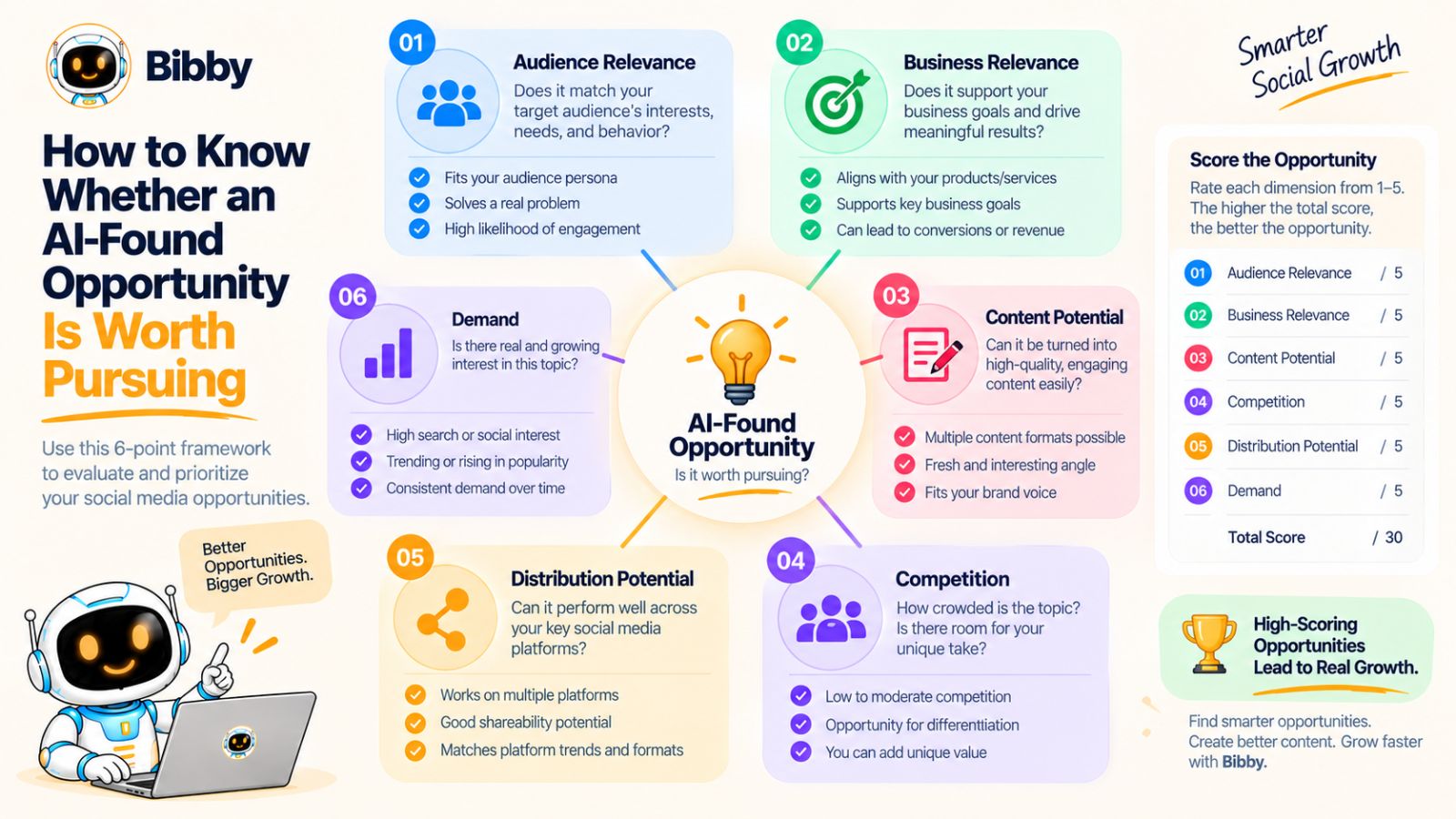
1. Audience Relevance
The first question is simple:
Does your audience actually care about this?
An opportunity should connect to a problem, interest, goal, question, or desire that matters to the people you're trying to reach.
Look for evidence such as recurring questions, meaningful comments, saves, shares, search interest, customer conversations, or repeated engagement around related subjects.
The stronger the evidence, the more confidence you can have that the topic deserves testing.
2. Business Relevance
A topic can be popular without being useful to your business.
For example, a viral subject might attract enormous attention but have almost no connection to your product, expertise, or customers.
A stronger opportunity sits at the intersection of:
What people care about + what your brand knows + what your business offers.
This allows your content to attract relevant attention rather than simply maximizing reach.
3. Content Potential
Some ideas are interesting once but difficult to develop into meaningful content.
Others can support an entire series.
Ask:
- Can we explain this from multiple angles?
- Can it become several posts?
- Could it support different formats?
- Can we provide original examples?
- Can we add genuine expertise?
- Could this become a campaign?
An opportunity with multiple possible content angles has greater potential than one that can produce only a single generic post.
4. Competitive Saturation
Competition isn't automatically a reason to avoid a topic.
A crowded subject can still contain opportunities if existing content doesn't answer the audience's questions particularly well.
Look beyond how many competitors cover a topic.
Examine how they cover it.
Are they all repeating the same basic advice?
Are important questions missing?
Are examples outdated?
Are explanations too technical?
Are they targeting beginners while your audience needs advanced guidance?
AI can help surface these differences, but the final assessment should be grounded in the actual content and audience response.
5. Distribution Potential
An idea becomes more valuable when it can travel across formats and platforms.
Ask whether the opportunity could become:
- A carousel
- A short video
- A long-form video
- A text post
- A story
- An infographic
- A tutorial
- A campaign
If one insight can produce several useful pieces of content, you have more opportunities to test the idea without constantly searching for a completely new topic.
6. Evidence of Demand
Before investing heavily in an idea, look for signals that demand exists.
These can include:
- Existing high-performing content
- Recurring audience questions
- Search behavior
- Comments and discussions
- Shares and saves
- Customer requests
- Competitor engagement
- Historical performance on your own account
The goal isn't to predict performance with certainty.
It's to reduce unnecessary guesswork.
7. Ability to Test Quickly
Some opportunities don't require a major campaign.
You can test them with a single post.
If the response is promising, expand the idea.
For example:
Test → Measure → Expand
A single educational carousel could become a five-part series if the initial response validates the topic.
This is one of the advantages of AI-assisted workflows. When content creation and publishing require less manual effort, you can run more thoughtful experiments without turning every experiment into a major production project.
A Simple Opportunity Filter
Before pursuing an AI-discovered opportunity, ask six questions:
| Question | What You're Looking For |
|---|---|
| Does the audience care? | Evidence of genuine interest |
| Does it fit the business? | Relevance to your expertise or offer |
| Can we add value? | Original knowledge or useful perspective |
| Is there a content gap? | Something existing content doesn't address well |
| Can we test it quickly? | A low-friction first experiment |
| Can it expand? | Potential for multiple posts or formats |
The more of these questions you can answer positively, the more interesting the opportunity becomes as a candidate for testing.
AI Helps You Find Opportunities. You Still Decide What Matters.
This is an important principle to keep throughout an AI-powered social media strategy.
AI can process information quickly.
It can surface patterns.
It can suggest connections.
It can generate content variations.
It can help automate distribution.
But deciding which opportunities are strategically meaningful still benefits from human judgment.
The goal isn't to remove people from the process.
It's to give people better information and more leverage.
And that leads to the broader change happening in social media: AI is gradually moving from being a tool that creates individual pieces of content toward becoming a system that helps manage the entire cycle of discovering, creating, distributing, and learning from content.
The Future of AI-Powered Social Media Growth
AI has already changed how social media content is created.
But content generation may be only the beginning.
The bigger shift is happening as AI starts connecting the different parts of social media management: understanding audiences, identifying opportunities, creating content, adapting it for different platforms, scheduling it, and learning from the results.
That changes the role of AI from a content generator into something closer to an operating layer for social media.
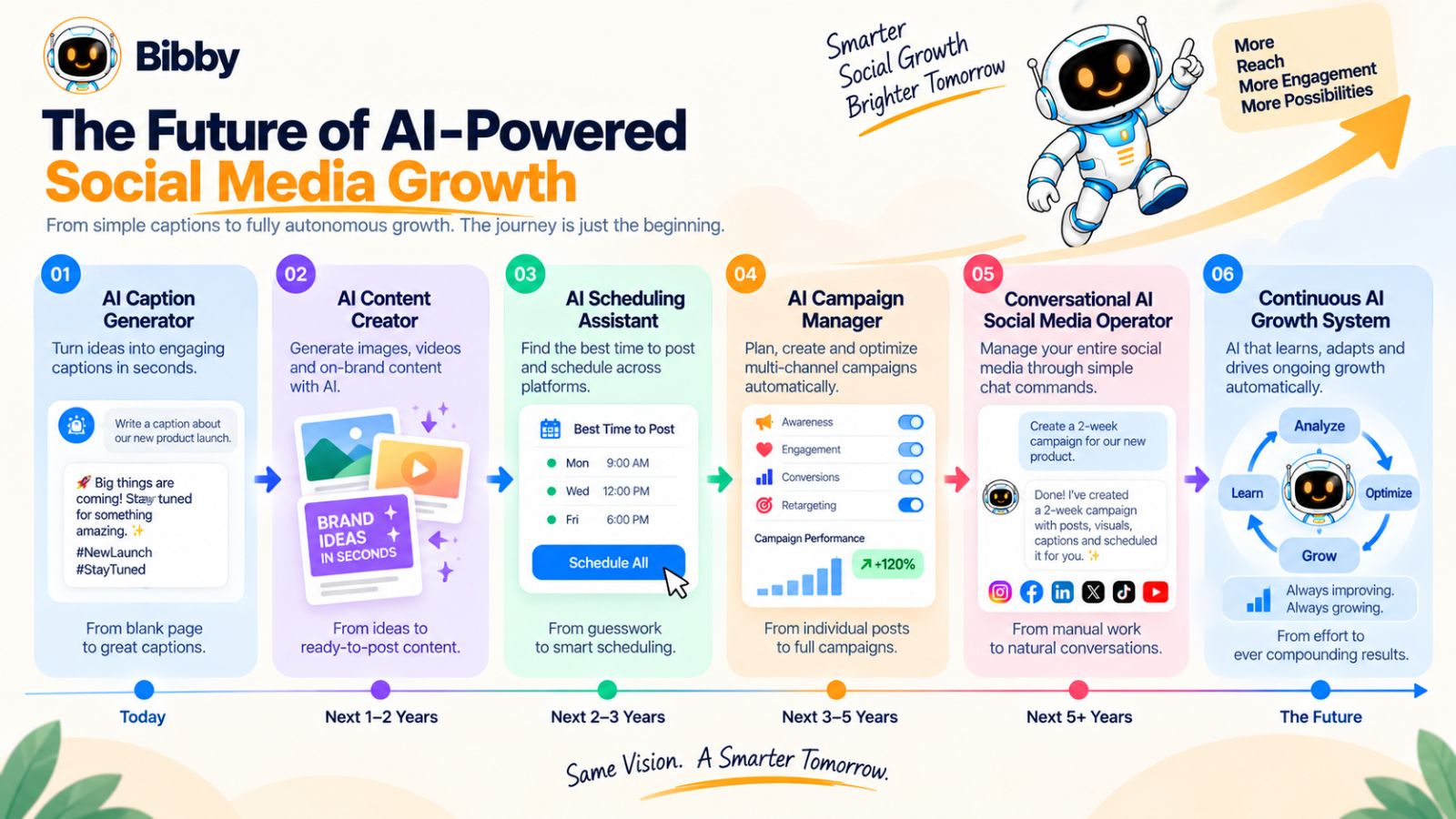
From AI Content Generators to AI Social Media Operators
Early AI social media tools largely focused on individual tasks.
Generate a caption.
Write a post.
Create an image.
Suggest hashtags.
Those capabilities are useful, but they're isolated.
The next generation of AI tools is moving toward workflows.
Instead of asking AI to perform one task, you can give it a broader objective and let it help coordinate multiple steps.
For example:
“Create a campaign around our new product.”
That could eventually involve understanding the brand, developing content ideas, creating assets, generating platform-specific copy, scheduling posts, and analyzing the resulting performance.
The value isn't just that each individual task becomes faster.
It's that the tasks become connected.
From Individual Posts to Continuous Content Systems
Traditional social media management often revolves around the content calendar.
You have a blank space for Monday.
You need something for Tuesday.
Then Wednesday.
And so on.
AI introduces the possibility of a different model.
Instead of constantly asking what to publish next, you can build a continuous system that learns from previous content.
A successful post produces a signal.
That signal generates another opportunity.
The opportunity becomes new content.
The content produces new performance data.
That data creates another signal.
The system continues.
Signal → Opportunity → Content → Distribution → Measurement → Learning.
This is a fundamentally different way to think about social media growth.
Conversational Social Media Management Will Become More Important
Another major shift is how people interact with social media software.
Dashboards require users to understand the software.
Conversational interfaces allow users to describe what they want.
This distinction matters.
A business owner may not know exactly which settings to configure to launch a campaign. But they can explain what the campaign should accomplish.
A marketer may not want to manually navigate through five different screens to regenerate captions. They can simply ask for new versions.
A creator may not want to build a campaign structure from scratch. They can describe the concept and refine the output through conversation.
Bibby's chat interface reflects this broader direction by allowing users to work conversationally on tasks such as creating brand kits, campaigns, posts, and caption variations.
The interface increasingly becomes the conversation itself.
AI Will Make Cross-Platform Content More Connected
Publishing the same content everywhere isn't the future of social media automation.
Adapting one strategic idea across multiple platforms is more useful.
A single campaign can contain different executions for Instagram, Facebook, LinkedIn, YouTube, and TikTok.
AI can help preserve the central message while adapting the format, length, hook, tone, and structure for each platform.
That creates a more coherent brand presence without requiring every piece of content to be manually recreated.
Automation Will Shift From Scheduling to Decision Support
Scheduling is already one of the most common forms of social media automation.
But future systems can go further.
Instead of simply asking:
“When should I publish this?”
AI can increasingly help answer:
- Should I publish this at all?
- Which audience should see it?
- Which platform makes the most sense?
- Which format should I use?
- Should this become a campaign?
- What related content should follow it?
- What did the results teach us?
- What should we test next?
That's a much more strategic role.
The objective isn't maximum automation.
It's better decisions with less repetitive work.
The Competitive Advantage Will Come From Learning Faster
When everyone has access to AI content generation, simply being able to generate content won't be much of a differentiator.
The more valuable advantage may come from how quickly a brand can:
- Detect a meaningful audience signal.
- Turn it into a useful hypothesis.
- Create content around that hypothesis.
- Distribute it efficiently.
- Measure the response.
- Learn from the result.
- Run the next experiment.
That creates a compounding learning process.
The brands that build this kind of system won't necessarily be the ones publishing the most.
They'll be the ones learning the most from what they publish.
The Human Role Isn't Disappearing
As AI becomes more capable, human expertise becomes more important in certain areas.
People still provide:
- Original experience
- Brand judgment
- Industry expertise
- Creativity
- Strategic priorities
- Customer understanding
- Ethical judgment
- Final approval
AI can make these inputs more powerful by helping turn them into repeatable workflows.
That is why the most useful vision of AI-powered social media isn't human versus AI.
It's human expertise multiplied by AI capabilities.
The future of social media growth is therefore less about finding a machine that can magically create viral content and more about building a system that continuously finds opportunities, acts on them, and learns from the results.
And with tools such as Bibby bringing content creation, AI-generated captions, scheduling, multi-platform publishing, and conversational management into a single workflow, that future is increasingly becoming something marketers can use today—not merely something to wait for.
Conclusion
AI is changing social media growth by making it possible to find opportunities that are difficult to spot manually. Instead of relying only on follower counts or individual post performance, you can use AI to identify content gaps, recurring audience questions, promising formats, timing patterns, platform opportunities, and ideas that can grow into larger campaigns.
The biggest advantage comes when discovery connects with execution. Signal → Opportunity → Content → Distribution → Measurement → Learning creates a continuous system where every piece of content can teach you something about what your audience wants next.
Tools like Bibby can help close the execution gap by bringing AI-assisted content creation, caption generation, scheduling, multi-platform publishing, and conversational social media management into a simpler workflow.
The natural next step is to turn these ideas into a system you can actually run every week. Start by building an AI-powered social media workflow that defines your audience signals, content pillars, publishing process, and measurement loop—and then use those insights to continuously find your next growth opportunity.