
Social media has never been more important—or more competitive—for businesses and creators trying to grow online.
If you're posting consistently but seeing little engagement, slow follower growth, or few conversions, your social media strategy may be working against you instead of for you. The good news is that most social media problems leave clear warning signs, and once you know what to look for, they're often easier to fix than you think.
In this article, you will learn:
- The 20 biggest signs your social media strategy is underperforming.
- Practical fixes to improve engagement, reach, and long-term growth.
- How AI and automation can simplify content creation and posting.
Whether you're a business owner, marketer, content creator, or agency, this guide will help you identify what's holding your strategy back and show you actionable ways to build a more effective, scalable social media presence.
Why Even Good Businesses Struggle on Social Media
If your social media results have stalled, you're not alone. Many businesses invest significant time creating content, posting regularly, and following trends, only to see minimal engagement or little impact on their bottom line. The problem usually isn't a lack of effort—it's a strategy that no longer aligns with how social media platforms and audiences behave today.
Algorithms are constantly evolving, user expectations change quickly, and every platform rewards different types of content. Simply posting more often isn't enough if your content doesn't resonate with your audience or support clear business goals. Without a well-defined strategy, it's easy to spend hours creating posts that generate likes but fail to build meaningful relationships, drive traffic, or increase sales.
Another common challenge is inconsistency. Many brands post whenever inspiration strikes, recycle the same content across every platform, or rely on manual workflows that make it difficult to stay active. Over time, this leads to missed opportunities, reduced visibility, and an audience that gradually loses interest.
The good news is that ineffective social media strategies are usually easy to diagnose. From declining engagement and stagnant follower growth to inconsistent branding and inefficient workflows, there are clear warning signs that reveal where your strategy is falling short.
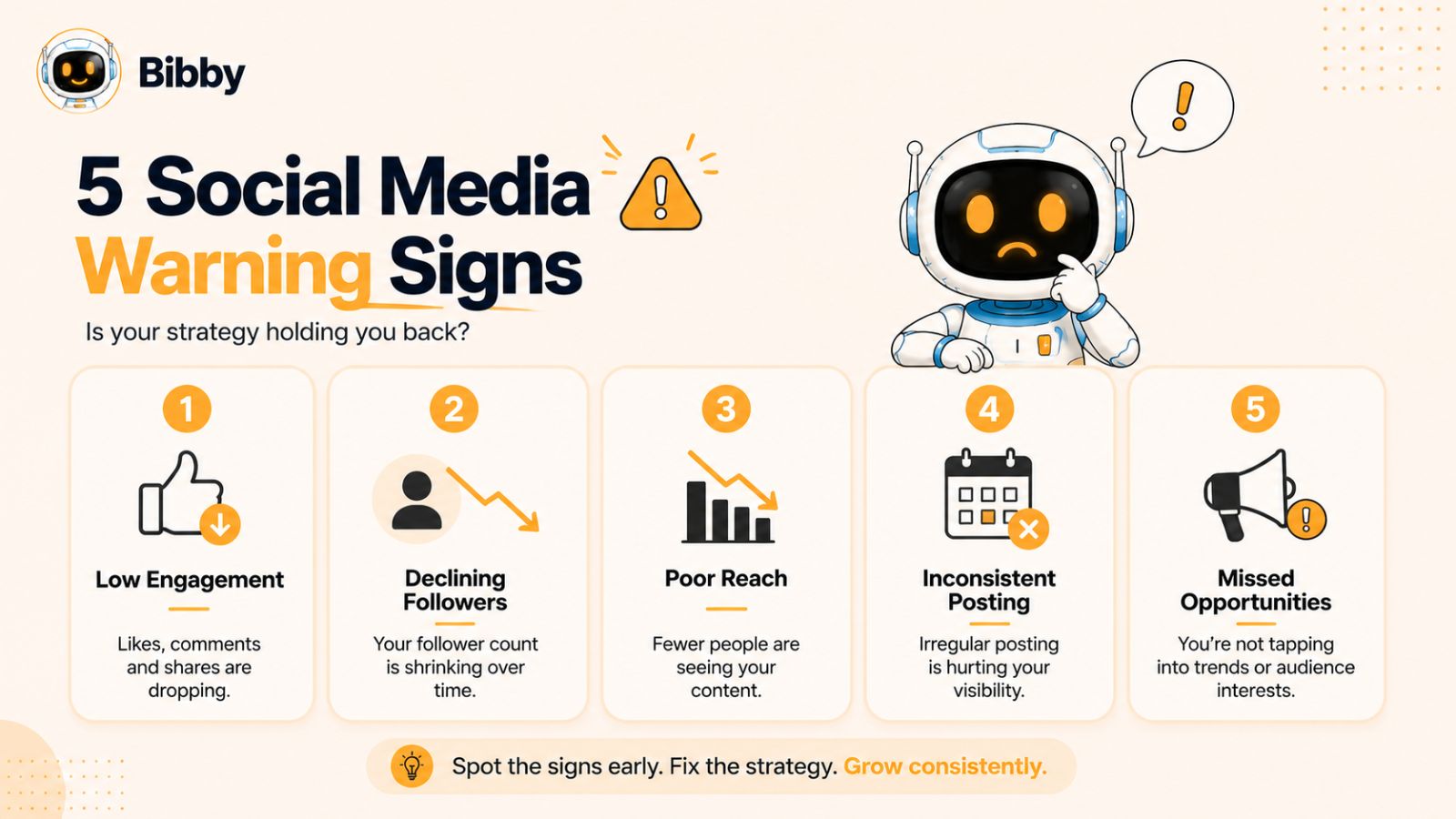
Let's walk through 20 signs your social media strategy isn't working—along with practical solutions you can implement to improve performance, save time, and achieve better results.
1. Your Engagement Keeps Declining
One of the clearest signs your social media strategy isn't working is a steady decline in engagement. If your posts are receiving fewer likes, comments, shares, saves, or clicks than they did a few months ago, it's a signal that your content is no longer connecting with your audience.
Low engagement doesn't always mean your content is poor—it often means your strategy needs to evolve. Social media algorithms prioritize content that sparks conversations and encourages meaningful interactions. When engagement drops, your posts are less likely to be shown to a wider audience, creating a cycle of declining reach and visibility.
Why It Happens
Several factors can contribute to falling engagement:
- You're posting content that no longer matches your audience's interests.
- Your posts are too promotional and offer little value.
- You're relying on the same content formats repeatedly.
- Your competitors are creating more engaging, interactive content.
- Your posting schedule is inconsistent or poorly timed.
How to Fix It
Start by reviewing your analytics to identify which posts consistently perform well. Look for patterns in topics, formats, captions, and posting times, then use those insights to shape future content.
Next, focus on creating content that encourages interaction. Ask thoughtful questions, share behind-the-scenes moments, publish educational tips, and use polls, quizzes, or stories to invite participation. Rather than treating social media as a broadcasting channel, use it as a place to build conversations and relationships.
Finally, experiment with different content formats. If you've been posting mostly static images, try incorporating short-form videos, carousels, or user-generated content. Small changes can often lead to significant improvements in engagement over time.
Pro Tip: Instead of chasing vanity metrics, prioritize meaningful engagement. A post that generates genuine conversations, saves, and shares often delivers more long-term value than one that simply attracts a large number of likes.
2. Your Follower Count Has Stalled
While follower count isn't the only metric that matters, consistent audience growth is usually a sign that your content is reaching new people and delivering value. If you've been stuck at the same number of followers for weeks—or even months—it may be time to reassess your social media strategy.
A plateau in growth often happens when your content isn't attracting new audiences or giving existing followers enough reason to share it. Algorithms tend to favor content that generates engagement and watch time, so if your posts aren't creating momentum, your visibility can gradually decline.
Why It Happens
There are several reasons your follower growth may have stalled:
- Your content looks too similar from post to post.
- You're not posting consistently enough to stay visible.
- You're not optimizing content for each platform's algorithm.
- Your profile doesn't clearly communicate who you help or why someone should follow you.
- You're not creating shareable or discoverable content.
How to Fix It
Start by reviewing your profile from a new visitor's perspective. Your profile photo, bio, and recent posts should immediately communicate your expertise and the value people can expect by following you.
Next, diversify your content. Mix educational posts with entertaining content, behind-the-scenes updates, customer success stories, trending topics, and short-form videos. Creating a variety of content helps you reach different audience segments while keeping your existing followers engaged.
Don't overlook discoverability, either. Use relevant keywords in captions, write compelling hooks, and include strategic hashtags where appropriate. Collaborating with creators, encouraging user-generated content, and actively engaging with your community can also introduce your brand to new audiences.
Finally, make consistency easier by planning content in advance. Instead of scrambling to create posts every day, build a content calendar and schedule your posts ahead of time. AI-powered tools like Bibby can simplify this process by helping you generate captions, organize your content, and schedule posts across platforms such as Facebook, Instagram, LinkedIn, YouTube, and TikTok from one place. That means less time managing posts manually and more time focusing on creating content your audience wants to see.
Pro Tip: Don't chase followers for the sake of bigger numbers. Focus on attracting the right audience—people who engage with your content, trust your brand, and are more likely to become customers or loyal advocates.
3. You're Posting Consistently but Seeing No Results
One of the biggest misconceptions in social media marketing is that posting more often automatically leads to better results. While consistency is important, it only works when your content is relevant, valuable, and aligned with your audience's needs. If you've been posting regularly but your engagement, reach, website traffic, or conversions haven't improved, your strategy likely needs a reset.
Many businesses fall into the habit of posting simply to stay active. Over time, this creates a stream of content that fills feeds without giving people a compelling reason to stop, engage, or take action. Social media success isn't measured by how many posts you publish—it's measured by the impact those posts have.
Why It Happens
Here are some common reasons consistent posting isn't producing results:
- Your content isn't solving your audience's problems.
- You're prioritizing quantity over quality.
- Every post feels promotional instead of informative or entertaining.
- Your content lacks a clear goal or call to action.
- You're creating content based on assumptions instead of analytics.
How to Fix It
Start by defining the purpose of every post before you create it. Ask yourself: Do I want to educate, inspire, entertain, start a conversation, or drive a specific action? Every piece of content should support a broader marketing objective rather than simply filling your content calendar.
Next, build your content around a few core content pillars that matter most to your audience. For example, if you're a digital marketing agency, your pillars might include educational tips, client success stories, industry insights, behind-the-scenes content, and product updates. This keeps your messaging focused while providing enough variety to maintain audience interest.
It's also important to review your performance regularly. Identify your top-performing posts over the last three to six months and look for recurring patterns. Which topics generate the most comments? Which formats earn the most shares or saves? Use these insights to create more of what already resonates instead of constantly starting from scratch.
Finally, streamline your workflow so you can spend more time improving content quality instead of managing repetitive tasks. With Bibby, you can upload your own images or generate new ones with AI, choose your preferred posting style, and let the platform automatically generate captions. You can then schedule images, carousels, videos, and stories across Facebook, Instagram, LinkedIn, YouTube, and TikTok at AI-optimized posting times—all from one simple workflow.
Pro Tip: Posting less often with high-quality, audience-focused content will almost always outperform publishing frequent, low-value posts. Consistency matters, but relevance is what drives lasting engagement and growth.
4. Your Reach Continues to Drop
Have you noticed that fewer people are seeing your posts—even though you're posting just as often? Declining reach is one of the most frustrating signs your social media strategy isn't working. It limits your ability to attract new followers, engage your audience, and generate leads, making it harder for every piece of content to perform.
While social media algorithms do change, they aren't usually the sole reason for a drop in reach. More often than not, declining visibility is a symptom of content that no longer captures attention or encourages meaningful interactions. Platforms prioritize content that keeps users engaged, so if people scroll past your posts without interacting, your content is less likely to appear in more feeds.
Why It Happens
A decline in reach can be caused by several factors, including:
- Your content isn't grabbing attention in the first few seconds.
- You're relying on outdated content formats.
- Your audience has lost interest in repetitive topics.
- You're posting at times when your audience is inactive.
- Your posts generate very little engagement shortly after publishing.
How to Fix It
Start by improving your content hooks. Whether it's a carousel, video, or image post, the first few seconds—or first slide—should immediately give people a reason to stop scrolling. Lead with an interesting question, a surprising statistic, a bold statement, or a common problem your audience faces.
Next, diversify your content formats. Most platforms reward creators who use a mix of videos, carousels, images, stories, and interactive content. Experiment with different formats to discover what resonates most with your audience instead of relying on a single content style.
Timing also plays an important role. Publishing when your audience is most active gives your content a better chance of earning early engagement, which can significantly increase its reach. Rather than guessing the best time to post, use scheduling tools that optimize publishing times based on audience behavior.
This is where Bibby can make a noticeable difference. Instead of manually posting throughout the day, you can upload or generate your content with AI, choose your posting style, and schedule it across Facebook, Instagram, LinkedIn, YouTube, and TikTok. Bibby automatically schedules your content at AI-optimized times, helping your posts reach your audience when they're most likely to engage.
Finally, don't be afraid to refresh your content strategy. Analyze which topics, formats, and captions consistently perform well, and create more content around those themes. Small adjustments, repeated consistently, often produce much better results than constantly chasing the latest trend.
Pro Tip: Reach is often the first metric to decline when your audience loses interest. Focus on creating content that earns comments, shares, and saves—those engagement signals tell algorithms your content deserves greater visibility.
5. You Don't Know Which Posts Perform Best
If someone asked you which of your last 20 posts generated the most engagement, website clicks, or conversions, could you answer with confidence? If not, you're making decisions based on guesswork instead of data—and that's a clear sign your social media strategy isn't working as effectively as it could.
Many businesses spend hours creating content but rarely take the time to analyze the results. Without tracking performance, it's impossible to know what's resonating with your audience, which content formats deserve more attention, or where your strategy needs improvement. The result is often a cycle of producing similar content without understanding why it succeeds—or fails.
Why It Happens
There are several reasons marketers overlook analytics:
- You're focused on publishing rather than measuring performance.
- You're tracking vanity metrics like follower count instead of meaningful KPIs.
- You don't have a regular reporting process.
- You're managing multiple platforms without a centralized workflow.
- You don't know which metrics actually matter for your goals.
How to Fix It
Start by identifying the key performance indicators (KPIs) that align with your business objectives. If your goal is brand awareness, monitor reach, impressions, and follower growth. If you're focused on engagement, pay close attention to comments, shares, saves, and engagement rate. For lead generation or sales, track link clicks, conversions, and website traffic.
Next, review your analytics consistently—weekly or monthly works well for most businesses. Look for patterns rather than isolated wins. Ask questions like:
- Which topics generate the most engagement?
- Are videos outperforming images?
- Which captions encourage the most comments?
- What posting times consistently produce better results?
- Which content drives the most website traffic?
The answers to these questions should shape your future content strategy. Instead of guessing what your audience wants, you'll be making informed decisions backed by real performance data.
You can also simplify the process by planning and organizing your content in advance. With Bibby, your content creation and publishing workflow is managed from one place. Upload your own visuals or generate them with AI, let Bibby create captions based on your preferred posting style, and schedule content across Facebook, Instagram, LinkedIn, YouTube, and TikTok. By removing repetitive publishing tasks, you'll have more time to review analytics and focus on improving what actually works.
Pro Tip: Don't try to optimize every metric. Focus on the handful that directly support your business goals. A smaller audience that actively engages with your content and converts into customers is far more valuable than a large audience that simply scrolls past your posts.
6. Your Audience Rarely Comments
Likes are easy. Comments require effort.
If your posts receive a handful of likes but almost no comments, it's a sign that your content isn't inspiring conversation. While every engagement metric has value, comments are one of the strongest indicators that your audience finds your content interesting, relatable, or worth discussing. They're also a positive signal to social media algorithms, which often reward posts that generate meaningful interactions with greater visibility.
A quiet comment section doesn't necessarily mean people dislike your content—it may simply mean you're not giving them a reason to join the conversation.
Why It Happens
Low comment activity is often caused by one or more of the following:
- Your posts don't ask questions or invite discussion.
- Your captions end without a clear call to action.
- Your content feels one-sided or overly promotional.
- You're covering topics your audience doesn't feel strongly about.
- You rarely engage with your audience yourself.
How to Fix It
Shift your mindset from publishing content to starting conversations. Instead of ending a post with a generic statement, invite your audience to share their opinions, experiences, or challenges. Open-ended questions almost always generate more discussion than simple yes-or-no prompts.
For example, instead of writing:
"Here's our latest social media tip."
Try something like:
"What's the biggest challenge you're facing with your social media strategy right now?"
You can also increase engagement by responding to every comment you receive. When people see that your brand actively participates in conversations, they're more likely to comment again in the future. Social media is meant to be social, and building genuine relationships often leads to stronger loyalty than constantly publishing promotional content.
Another effective strategy is to share content that naturally sparks discussion. Industry opinions, behind-the-scenes moments, lessons learned, common misconceptions, and personal stories often encourage more meaningful conversations than polished promotional graphics.
Finally, don't rush your publishing process. Planning content in advance gives you more time to write thoughtful captions that encourage engagement. With Bibby, you can upload your own image or generate one with AI, choose your preferred posting style, and let AI generate captions for you automatically. Instead of spending hours writing every caption manually, you can focus on refining questions and conversation starters that inspire your audience to interact.
Pro Tip: Every comment is an opportunity to build a relationship. Respond promptly, ask follow-up questions, and keep the conversation going. The more meaningful interactions your content generates, the more likely social media platforms are to show it to a wider audience.
7. You're Only Promoting Products
If every post is about your product, service, or latest offer, don't be surprised if your audience starts scrolling past your content. People don't come to social media to be sold to constantly—they come to be entertained, educated, inspired, or connected with brands they trust.
One of the biggest mistakes businesses make is treating social media like a digital billboard. While promotional content certainly has its place, it should only be one part of a balanced content strategy. If every post is asking people to buy something, you'll likely see declining engagement, reduced reach, and slower audience growth over time.
Why It Happens
Many brands become overly promotional because:
- They're focused solely on driving sales.
- They don't have a long-term content strategy.
- They're running out of content ideas.
- They underestimate the importance of building relationships before making offers.
- They prioritize short-term conversions over long-term audience trust.
How to Fix It
Instead of constantly promoting your products, aim to provide value first. A useful framework is the 80/20 rule: spend about 80% of your content educating, entertaining, or inspiring your audience, and reserve the remaining 20% for direct promotional posts.
Think beyond product features. Share practical tips, answer frequently asked questions, highlight customer success stories, offer behind-the-scenes insights, discuss industry trends, and showcase the people behind your brand. This type of content positions your business as a trusted resource rather than just another company trying to make a sale.
For example, if you sell social media software, don't just post about new features. Create content that helps people improve their social media strategy, avoid common mistakes, understand platform updates, or learn proven growth techniques. When your audience consistently benefits from your content, they'll be much more receptive when you do promote your products or services.
Maintaining this balance is much easier when you plan content in advance. With Bibby, you can organize a mix of educational, inspirational, and promotional posts from one simple dashboard. Upload your own visuals or generate images with AI, choose your preferred posting style, let Bibby automatically generate engaging captions, and schedule images, carousels, videos, and stories across Facebook, Instagram, LinkedIn, YouTube, and TikTok. This makes it easy to build a well-rounded content calendar instead of scrambling to publish another sales-focused post.
Pro Tip: Before publishing any post, ask yourself, "Would someone still find this valuable if they never became my customer?" If the answer is yes, you're creating content that builds trust—and trust is what ultimately drives long-term sales.
8. Your Branding Looks Inconsistent
Your audience should be able to recognize your content before they even see your logo or username. If every post looks different, uses a different tone of voice, or feels like it came from a different brand, you're missing an opportunity to build familiarity and trust.
Consistent branding isn't just about using the same colors or fonts. It's about creating a recognizable experience across every platform. When your visuals, messaging, and personality are consistent, people are more likely to remember your brand, engage with your content, and eventually become loyal customers.
Why It Happens
Inconsistent branding often stems from a lack of planning or clear brand guidelines. Common causes include:
- Different team members creating content without a unified style.
- Frequently changing colors, fonts, or graphic designs.
- Writing captions in different tones of voice.
- Posting content that doesn't align with your brand values.
- Adapting trends without considering whether they fit your brand identity.
Over time, these inconsistencies make your content feel disconnected and less memorable.
How to Fix It
Start by creating a simple brand style guide. Define your brand colors, typography, logo usage, image style, and tone of voice. You don't need a lengthy document—even a one-page guide can help ensure every piece of content looks and feels consistent.
Next, establish a few recurring content formats. Whether it's educational carousels, behind-the-scenes videos, customer success stories, or quick tips, using familiar layouts and themes helps build recognition over time. Your audience should know it's your content the moment it appears in their feed.
It's also important to tailor your content for each platform without losing your brand identity. A LinkedIn post may sound more professional than an Instagram caption, but both should reflect the same personality, values, and messaging.
Using a centralized workflow can make this much easier. With Bibby, you can upload your own visuals or generate new images with AI, choose a posting style that matches your brand voice, and let AI create captions that stay consistent across your campaigns. From there, you can schedule images, carousels, videos, and stories across Facebook, Instagram, LinkedIn, YouTube, and TikTok—all from one place. This helps maintain a cohesive brand presence without juggling multiple tools or workflows.
Pro Tip: Consistency builds recognition, and recognition builds trust. The more familiar your brand feels across every platform, the more likely people are to remember you when they're ready to make a purchasing decision.
9. You Rarely Post Videos
If your content strategy relies almost entirely on static images or text-based posts, you're likely missing one of the biggest opportunities for growth. Across nearly every major social media platform, video content consistently generates higher engagement, longer viewing times, and greater reach than many other content formats.
That doesn't mean every post needs to be a professionally produced video. In fact, authentic, informative, and relatable videos often outperform polished productions because they feel more genuine and easier to connect with.
Why It Happens
Many businesses avoid video because:
- They think creating videos is too time-consuming.
- They don't have professional recording equipment.
- They're uncomfortable appearing on camera.
- They don't know what type of videos to create.
- They assume videos require a large production budget.
The result is a content strategy that misses out on one of the most effective ways to capture attention and increase visibility.
How to Fix It
Start simple. You don't need a studio setup or expensive equipment to create engaging videos. A smartphone, good lighting, and valuable content are often enough to produce videos your audience will appreciate.
Focus on creating videos that educate, solve problems, or entertain. Some easy ideas include:
- Quick how-to tutorials
- Frequently asked questions
- Behind-the-scenes clips
- Customer success stories
- Industry news and insights
- Product demonstrations
- Tips and best practices
Short-form videos are especially effective because they deliver value quickly and are favored by many social media algorithms. You can also maximize your efforts by repurposing one video into multiple pieces of content, such as shorter clips, carousel posts, quote graphics, or blog content.
Managing all those formats manually can quickly become overwhelming. With Bibby, you can upload your video content, generate AI-powered captions based on your preferred posting style, and schedule videos alongside images, carousels, and stories from a single dashboard. Bibby also publishes your content across Facebook, Instagram, LinkedIn, YouTube, and TikTok at AI-optimized posting times, making it easier to maintain a consistent video strategy without adding extra work to your day.
Pro Tip: Don't aim for perfection—aim for consistency. A helpful 30-second video published regularly will almost always outperform a professionally produced video that's posted once every few months. The more valuable content you consistently share, the more opportunities you create to reach new audiences.
10. You're Ignoring Stories
If you're only publishing posts to your main feed and overlooking Stories, you're missing one of the easiest ways to stay visible and connected with your audience. Stories are designed for quick, authentic interactions, making them ideal for building relationships, increasing engagement, and keeping your brand top of mind between regular posts.
Unlike traditional feed posts, Stories don't have to be polished or heavily edited. In fact, audiences often prefer casual, behind-the-scenes content because it feels more personal and genuine.
Why It Happens
Many businesses underuse Stories because:
- They think Stories disappear too quickly to be worthwhile.
- They don't know what to post outside of promotions.
- They believe creating Stories requires extra work.
- They focus only on feed posts or short-form videos.
- They don't have a consistent content plan.
The result is fewer touchpoints with your audience and missed opportunities to build trust through everyday interactions.
How to Fix It
Start treating Stories as a daily conversation rather than another marketing campaign. Share content that gives your audience a glimpse behind the scenes, highlights your team, celebrates customer wins, or documents your day-to-day activities.
Some effective Story ideas include:
- Polls and quizzes
- Question-and-answer sessions
- Product sneak peeks
- Behind-the-scenes content
- Customer testimonials
- Quick tips and tutorials
- Event updates
- User-generated content
Interactive features like polls, sliders, quizzes, and question stickers encourage people to participate rather than simply watch. These small interactions can strengthen your relationship with your audience while providing valuable insights into their interests and preferences.
Planning Stories in advance can also help you stay consistent. Instead of deciding what to post every day, use Bibby to organize your content calendar in one place. Upload your own visuals or generate new images with AI, let Bibby create captions that match your preferred posting style, and schedule not only feed posts but also Stories, images, carousels, and videos across Facebook, Instagram, LinkedIn, YouTube, and TikTok. With repetitive publishing handled automatically, you can focus on engaging with your audience instead of worrying about what to post next.
Pro Tip: Think of your feed as your portfolio and your Stories as your personality. While feed posts showcase your expertise, Stories help your audience get to know the people behind your brand—and that human connection often leads to stronger engagement and customer loyalty.
11. Your Posting Schedule Is Inconsistent
Consistency is one of the foundations of a successful social media strategy. If you post three times one week, disappear for the next two weeks, and then suddenly publish multiple posts in a single day, you're making it difficult for both your audience and social media algorithms to know what to expect.
An inconsistent posting schedule doesn't just reduce visibility—it can also affect trust. Followers who enjoy your content may forget about your brand if you disappear for long periods, while irregular posting makes it harder for algorithms to recognize your account as an active, reliable creator.
Why It Happens
There are many reasons businesses struggle to stay consistent:
- You're creating content at the last minute.
- Social media isn't your primary responsibility.
- You run out of content ideas.
- Manual posting takes too much time.
- You're managing multiple social media platforms separately.
As your workload grows, social media often becomes the first task to be delayed or skipped.
How to Fix It
The key to consistency isn't working harder—it's creating a better workflow.
Start by building a content calendar. Planning your content weekly or monthly helps you maintain a balanced mix of educational, entertaining, and promotional posts while eliminating the stress of deciding what to publish each day.
Content batching is another effective strategy. Instead of creating one post every day, dedicate a few hours to producing several weeks' worth of content at once. This allows you to focus on creativity without constantly switching between planning, designing, writing, and publishing.
Automation can make an even bigger difference. Rather than logging into every platform daily, use Bibby to streamline your entire publishing process. Simply upload your own images or generate visuals with AI, choose your preferred posting style, and let Bibby automatically generate captions for each post. From there, you can schedule images, carousels, videos, and Stories across Facebook, Instagram, LinkedIn, YouTube, and TikTok at AI-optimized posting times. Once your content calendar is set, your social media continues working for you—even while you're focused on running your business.
Remember, consistency doesn't mean posting constantly. It means publishing on a reliable schedule your audience can expect and your team can realistically maintain.
Pro Tip: A sustainable schedule beats an ambitious one every time. It's better to publish three high-quality posts every week for a year than to post multiple times a day for a month and then disappear. Consistency builds momentum, and momentum drives long-term growth.
12. Every Platform Gets the Exact Same Post
Sharing the exact same content across every social media platform might seem like an efficient way to save time, but it can limit your results. Each platform has a unique audience, different content formats, and its own algorithm. A post that performs exceptionally well on LinkedIn may receive little attention on Instagram or TikTok.
While it's perfectly fine to repurpose content, simply copying and pasting the same caption, image, or video everywhere rarely delivers the best outcome. Optimizing your content for each platform helps you maximize engagement without constantly creating new content from scratch.
Why It Happens
Many businesses publish identical posts because:
- They don't have enough time to customize content.
- Managing multiple platforms feels overwhelming.
- They're trying to maintain consistency with minimal effort.
- They lack a structured content workflow.
- They don't understand how audiences differ across platforms.
Although this approach saves time initially, it often leads to lower engagement because the content doesn't feel native to each platform.
How to Fix It
Instead of creating separate content for every social network, focus on adapting one core idea into multiple platform-specific formats.
For example:
- Instagram: Turn your idea into a carousel with concise, visually engaging captions.
- LinkedIn: Expand the same topic into a professional story or thought leadership post.
- Facebook: Encourage discussion with a question-driven caption.
- TikTok: Create a short, engaging video highlighting the key takeaway.
- YouTube: Develop a longer educational video that explores the topic in greater depth.
The message stays consistent, but the presentation matches what users expect on each platform.
This doesn't have to create extra work. Bibby makes multi-platform publishing simple by letting you upload your own content—or generate images with AI—and choose your preferred posting style. Bibby then generates captions automatically and helps you schedule images, carousels, videos, and Stories across Facebook, Instagram, LinkedIn, YouTube, and TikTok from one dashboard. Instead of copying and pasting the same content everywhere, you can maintain a consistent brand while optimizing your publishing workflow.
The goal isn't to work harder—it's to work smarter. Small adjustments to your captions, visuals, and content format can significantly improve performance without doubling your workload.
Pro Tip: Think of each platform as a different audience attending the same presentation. The core message can stay the same, but the way you deliver it should match the expectations and behaviors of the people you're speaking to.
13. You Spend Hours Writing Captions
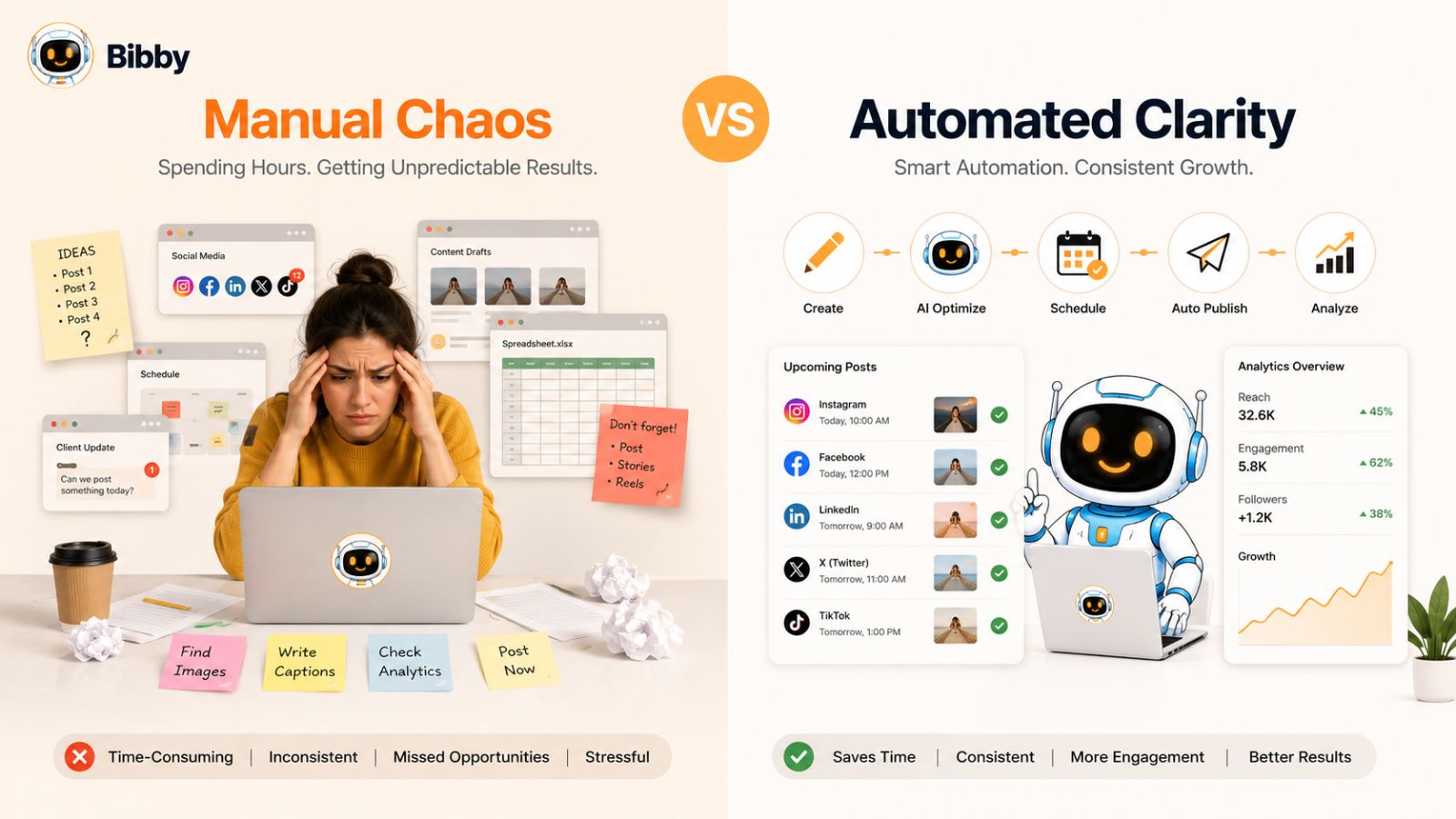
Creating engaging captions for every post can quickly become one of the most time-consuming parts of social media management. If you're staring at a blank screen trying to come up with the perfect hook, call to action, and hashtags every time you publish, you're spending valuable time on a task that can be streamlined.
A great caption should complement your content—not delay your entire marketing workflow. While thoughtful copy is important, manually writing every caption from scratch isn't the most efficient use of your time, especially if you're managing multiple social media accounts.
Why It Happens
Many marketers struggle with caption writing because:
- They overthink every word before publishing.
- They try to create a completely unique caption for every platform.
- They don't have a consistent brand voice.
- They wait until the last minute to write captions.
- They're managing several social media channels at once.
This often leads to creative fatigue, inconsistent messaging, and delayed publishing schedules.
How to Fix It
Start by developing a consistent brand voice. Whether your tone is professional, educational, conversational, or humorous, having clear guidelines makes writing captions much faster and more consistent.
Next, create reusable caption frameworks instead of reinventing the wheel every time. A simple structure works well for most posts:
- Hook: Grab attention in the first sentence.
- Value: Share your tip, story, or insight.
- Call to Action: Encourage readers to comment, save, share, or visit your website.
You can also batch-write captions for multiple posts during one content planning session. This helps you stay focused and maintain a consistent tone across your content calendar.
For even greater efficiency, let AI handle the first draft. Bibby simplifies caption creation by allowing you to upload your own image—or generate one with AI—and then select your preferred posting style. Based on your content and brand voice, Bibby automatically generates engaging captions, saving hours of manual writing. Once your captions are ready, you can schedule images, carousels, videos, and Stories across Facebook, Instagram, LinkedIn, YouTube, and TikTok at AI-optimized posting times—all without switching between multiple tools.
The result is a faster, more consistent workflow that lets you focus on strategy, creativity, and audience engagement instead of repeatedly writing captions from scratch.
Pro Tip: Your caption doesn't have to be perfect—it has to be relevant. Publishing a valuable post with a strong, authentic caption today is far more effective than delaying it for days while trying to write the "perfect" copy.
14. You Miss Important Posting Times
Even the best content can underperform if it's published when your audience isn't online. Timing plays a bigger role in social media success than many businesses realize. While there's no universal "best time to post," consistently publishing when your audience is most active can significantly improve your reach, engagement, and overall performance.
If you're manually posting whenever you have a free moment, there's a good chance you're missing the windows when your followers are most likely to see and interact with your content.
Why It Happens
Businesses often miss optimal posting times because:
- They're posting based on their own schedule instead of their audience's.
- They're managing social media alongside other responsibilities.
- They don't have time to publish throughout the day.
- They're guessing when their audience is online.
- They rely entirely on manual posting.
As a result, valuable content gets buried before it has a chance to gain traction.
How to Fix It
Start by reviewing your platform analytics. Most social media platforms provide insights into when your audience is most active. Use this data to identify patterns and schedule your content during those high-engagement periods.
It's also important to remember that every platform is different. Your LinkedIn audience may be most active during weekday business hours, while your Instagram or TikTok followers may engage more during evenings or weekends. Instead of using one posting schedule for every platform, tailor your publishing times based on audience behavior.
Of course, manually tracking different schedules across multiple platforms can quickly become overwhelming. That's where automation becomes invaluable.
With Bibby, you don't have to guess the best time to post. Simply upload your own images or generate visuals with AI, choose your preferred posting style, and let Bibby generate captions automatically. From there, Bibby schedules your images, carousels, videos, and Stories across Facebook, Instagram, LinkedIn, YouTube, and TikTok at AI-optimized posting times, helping your content reach your audience when they're most likely to engage.
By removing the guesswork from scheduling, you can maintain a consistent presence without interrupting your day or setting reminders to post manually.
Pro Tip: The best posting time is the one that's backed by your own audience data. Combine those insights with AI-powered scheduling, and you'll give every piece of content the strongest possible chance to succeed.
15. Creating Content Feels Overwhelming
If creating content constantly feels like an uphill battle, you're not alone. Many businesses start with enthusiasm but eventually find themselves running out of ideas, rushing to meet deadlines, or spending far more time on social media than they expected. When content creation becomes overwhelming, consistency suffers—and so do your results.
The truth is, successful brands don't rely on daily bursts of inspiration. They rely on repeatable systems that make content creation faster, easier, and more sustainable.
Why It Happens
Content creation often becomes overwhelming because:
- You're creating every post from scratch.
- You don't have a content calendar or long-term plan.
- You're trying to keep up with every trend.
- You wear multiple hats within your business.
- Your workflow includes too many manual steps.
Without a structured process, even experienced marketers can experience creative fatigue and burnout.
How to Fix It
The first step is to stop thinking about content one post at a time. Instead, develop a content strategy built around a handful of content pillars. For example, you might rotate between educational tips, customer success stories, industry news, behind-the-scenes updates, and promotional content. This gives you a reliable framework and makes brainstorming much easier.
Next, batch your work. Set aside dedicated time to create multiple posts in one session instead of starting from scratch every day. This improves efficiency and helps you maintain a consistent brand voice across all your content.
You should also repurpose your best-performing content. A single blog post can become multiple social media posts, a carousel, a short-form video, an infographic, and several Stories. Repurposing not only saves time but also helps you maximize the value of every piece of content you create.
AI can simplify the process even further. With Bibby, you can upload your own images or generate new visuals with AI, choose your preferred posting style, and let the platform automatically create engaging captions. Once your content is ready, Bibby schedules images, carousels, videos, and Stories across Facebook, Instagram, LinkedIn, YouTube, and TikTok at AI-optimized posting times. Instead of juggling multiple tools and repetitive tasks, you can manage your entire workflow from one intuitive platform.
The less time you spend worrying about what to post next, the more time you can invest in creating valuable content that strengthens your brand and grows your audience.
Pro Tip: Content creation should feel like a repeatable process—not a daily emergency. Build systems, plan ahead, and use AI to automate repetitive tasks so you can focus on creativity instead of constantly racing against the clock.
16. Your Team Has No Publishing Workflow
As your business grows, managing social media becomes more than just creating great content—it requires coordination. If your team is constantly asking, "Has this been posted yet?" or "Who's writing the caption?" it's a sign your publishing workflow needs improvement.
Without a clear process, content gets delayed, mistakes become more common, and opportunities are missed. Even small teams can struggle when there isn't a defined system for creating, reviewing, approving, and publishing content.
Why It Happens
Publishing workflows often break down because:
- Roles and responsibilities aren't clearly defined.
- Content is created at the last minute.
- Feedback and approvals happen through scattered emails or chat messages.
- Assets are stored in multiple locations.
- Team members manually publish content across different platforms.
These inefficiencies may seem minor at first, but they quickly add up, reducing productivity and making it difficult to maintain a consistent social media presence.
How to Fix It
Start by documenting your content workflow. Every piece of content should follow a simple, repeatable process, such as:
- Content idea
- Content creation
- Design or media preparation
- Caption writing
- Review and approval
- Scheduling
- Publishing
- Performance analysis
Having a standardized workflow eliminates confusion and ensures everyone knows what needs to happen before content goes live.
Next, centralize your assets. Store images, videos, captions, and creative files in one location so your team isn't wasting time searching through emails, cloud folders, or messaging apps.
Finally, automate as much of the publishing process as possible. Bibby simplifies team workflows by bringing content creation, caption generation, scheduling, and publishing into a single platform. Team members can upload images or generate visuals with AI, select a preferred posting style, automatically generate captions, and schedule images, carousels, videos, and Stories across Facebook, Instagram, LinkedIn, YouTube, and TikTok—all from one streamlined dashboard.
With repetitive publishing tasks handled in one place, your team can spend less time managing logistics and more time creating high-quality content and engaging with your audience.
Pro Tip: Great social media teams don't rely on memory—they rely on systems. A documented workflow reduces errors, improves collaboration, and helps your team publish consistently, even as your content volume grows.
17. You Aren't Repurposing Your Best Content
If you're constantly creating new content while your highest-performing posts are collecting dust, you're doing far more work than necessary. One of the smartest social media strategies isn't creating more content—it's getting more value from the content you've already created.
Many businesses assume every social media post needs to be completely original. In reality, your audience won't see every piece of content you publish, and even those who do often benefit from seeing your best ideas presented in different formats.
Why It Happens
Businesses often fail to repurpose content because:
- They believe every post has to be brand new.
- They don't know which content performed best.
- They don't have a process for adapting content into different formats.
- They're too focused on creating today's post to think about long-term content value.
- Their workflow makes repurposing feel like extra work.
The result is a constant cycle of creating from scratch, leading to unnecessary stress and missed opportunities.
How to Fix It
Start by identifying your top-performing content from the past six to twelve months. Look for posts that generated the most engagement, shares, saves, website traffic, or conversions. These are your proven winners and deserve a second life.
Then, think about how one idea can become multiple pieces of content. For example:
- Turn a blog post into a carousel.
- Break a long video into several short-form clips.
- Transform customer testimonials into quote graphics.
- Convert frequently asked questions into educational posts.
- Compile several related tips into a downloadable guide.
Repurposing isn't about copying the same content repeatedly—it's about presenting the same valuable ideas in formats that suit different audiences and platforms.
Managing all these variations is much easier with a streamlined workflow. Bibby helps you organize, create, and schedule content from one place. Upload your own images or videos—or generate visuals with AI—choose your preferred posting style, and let Bibby automatically generate captions. You can then schedule images, carousels, videos, and Stories across Facebook, Instagram, LinkedIn, YouTube, and TikTok at AI-optimized posting times, ensuring your best content continues reaching new audiences without requiring hours of additional work.
Repurposing allows you to maximize every piece of content you create while maintaining a consistent publishing schedule and reducing creative fatigue.
Pro Tip: Before creating something new, ask yourself, "Can I present an existing high-performing idea in a new way?" Often, your next successful post is already hiding in your content library.
18. You're Managing Every Platform Separately
If you're logging into Facebook, Instagram, LinkedIn, YouTube, and TikTok individually every day to upload content, write captions, and publish posts, you're spending far more time on social media than necessary. As your presence grows across multiple platforms, managing each one separately quickly becomes inefficient and increases the risk of mistakes.
The more manual your workflow is, the harder it becomes to stay consistent. You might forget to publish on one platform, use an outdated caption on another, or spend hours repeating the same tasks instead of focusing on creating valuable content.
Why It Happens
Managing each platform separately often becomes the default because:
- You started with just one social media account.
- You use different tools for different platforms.
- You manually upload every image, video, and carousel.
- You don't have a centralized content management system.
- Your publishing process has grown organically without a clear workflow.
While this approach may work in the beginning, it doesn't scale as your business or content library expands.
How to Fix It
The best solution is to centralize your social media workflow. Instead of treating every platform as a separate task, manage your entire content strategy from a single dashboard.
Begin by planning your content calendar for the week or month ahead. Organize your campaigns, prepare your media assets, and write your messaging before your publishing dates arrive. This proactive approach eliminates the daily stress of deciding what to post.
Next, use automation to remove repetitive tasks. Rather than uploading the same content multiple times, choose a platform that lets you create, organize, and publish everything from one place.
This is exactly what Bibby is designed to do. With one simple workflow, you can upload your own images or generate new visuals with AI, choose your preferred posting style, and let Bibby automatically generate captions that match your brand voice. From there, schedule images, carousels, videos, and Stories across Facebook, Instagram, LinkedIn, YouTube, and TikTok at AI-optimized posting times—all without switching between multiple apps or dashboards.
By centralizing your workflow, you'll reduce manual work, minimize publishing errors, and free up hours every week that can be spent analyzing performance, engaging with your audience, or creating even better content.
Pro Tip: Every extra click in your publishing process costs time. The simpler your workflow becomes, the easier it is to stay consistent—and consistency is one of the biggest drivers of long-term social media success.
19. You're Spending Too Much Time on Routine Tasks
If social media is consuming several hours of your day, it's worth asking whether you're spending that time on high-impact work—or just repeating the same routine tasks over and over.
Many marketers and business owners spend more time uploading files, writing captions, resizing images, switching between platforms, and scheduling posts than they do developing strategy or engaging with their audience. While these tasks are necessary, they shouldn't dominate your workday.
Why It Happens
Routine tasks often take longer than expected because:
- You're uploading content separately to every platform.
- You write every caption from scratch.
- You don't schedule content in advance.
- You switch between multiple tools throughout the day.
- You repeat the same publishing process for every post.
Individually, these tasks may only take a few minutes. Together, they can consume several hours every week—time that could be invested in growing your business.
How to Fix It
The first step is identifying which parts of your workflow can be automated without sacrificing quality. Ask yourself:
- Which tasks do I repeat every day?
- Which steps require little or no creative thinking?
- Which activities could be completed in advance?
Tasks like scheduling posts, generating first-draft captions, organizing media, and publishing across multiple platforms are ideal candidates for automation.
This is where Bibby can dramatically simplify your workflow. Instead of managing multiple apps, Bibby brings your entire content process together in one place. Simply upload your own image or generate one with AI, choose your preferred posting style, and Bibby will automatically create captions tailored to your content. You can then schedule images, carousels, videos, and Stories across Facebook, Instagram, LinkedIn, YouTube, and TikTok at AI-optimized posting times—all from a single dashboard.
By automating repetitive tasks, you gain something far more valuable than efficiency: time. Time to respond to comments, build relationships, analyze performance, experiment with new ideas, and focus on the strategic decisions that actually grow your brand.
Pro Tip: Don't automate your authenticity—automate your administration. Let technology handle repetitive tasks so you can spend more time creating meaningful content and connecting with your audience.
20. Social Media Feels Like a Full-Time Job
If social media has become one of the most stressful parts of running your business, it's a strong indication that your strategy—or more specifically, your workflow—isn't sustainable.
Creating content, designing graphics, writing captions, scheduling posts, monitoring engagement, responding to comments, analyzing performance, and keeping up with platform updates can easily consume hours every day. While these tasks are all important, they shouldn't leave you feeling overwhelmed or prevent you from focusing on other parts of your business.
The goal of social media isn't to spend all your time managing it. The goal is to build your brand, grow your audience, and generate business results as efficiently as possible.
Why It Happens
Social media starts feeling like a full-time job when:
- You're doing everything manually.
- You don't have a repeatable content workflow.
- You're creating content at the last minute.
- You're managing multiple platforms individually.
- You aren't using AI or automation to eliminate repetitive work.
- You're constantly reacting instead of planning ahead.
When these inefficiencies pile up, social media becomes exhausting rather than productive.
How to Fix It
Instead of trying to work harder, focus on building a smarter workflow.
Begin by planning your content in batches, creating a monthly content calendar, and identifying which tasks can be automated. Reserve your time for activities that genuinely require human creativity—developing ideas, engaging with your community, and refining your strategy.
Everything else should be simplified wherever possible.
This is exactly where Bibby shines. Instead of juggling multiple tools and logging into every platform separately, Bibby provides a simple, AI-powered workflow from start to finish.
With Bibby, you can:
- Upload your own images or generate new visuals with AI.
- Choose your preferred posting style and brand voice.
- Automatically generate engaging captions.
- Schedule images, carousels, videos, and Stories.
- Publish across Facebook, Instagram, LinkedIn, YouTube, and TikTok from one dashboard.
- Let AI optimize your posting times for maximum reach and engagement.
Rather than spending hours every week on repetitive publishing tasks, Bibby allows you to automate the process so you can focus on growing your business, creating better content, and building stronger relationships with your audience.
At the end of the day, social media should be working for you—not the other way around.
Pro Tip: If your social media strategy depends on constant manual effort, it won't scale. The most successful businesses combine great content with efficient systems, allowing AI and automation to handle repetitive tasks while their teams focus on creativity, strategy, and meaningful customer interactions.
How AI Can Fix Most of These Problems
If you recognized several of the warning signs in this article, there's good news: you don't have to solve them by working longer hours. Many of the biggest challenges in social media marketing—from inconsistent posting and creative burnout to manual scheduling and caption writing—can now be simplified with AI.
Artificial intelligence isn't here to replace creativity. It's here to eliminate repetitive tasks, speed up your workflow, and give you more time to focus on strategy, storytelling, and building relationships with your audience.
AI Helps You Create Content Faster
One of the biggest obstacles to consistency is simply finding enough time to create content.
AI can help you:
- Generate fresh content ideas.
- Create images from text prompts.
- Write engaging first-draft captions.
- Repurpose existing content into multiple formats.
- Overcome creative blocks in minutes.
Instead of staring at a blank screen, you can start with an AI-generated draft and customize it to match your brand voice.
AI Makes Scheduling Effortless
Publishing content manually across multiple platforms is one of the biggest productivity killers.
AI-powered scheduling tools allow you to:
- Plan weeks or months of content in advance.
- Automatically publish across multiple social networks.
- Optimize posting times based on audience behavior.
- Maintain a consistent posting schedule without daily effort.
This means your content continues working for you—even when you're focused on other priorities.
AI Improves Content Consistency
Maintaining a consistent brand voice across dozens of posts can be difficult, especially if multiple people create content.
AI helps by:
- Following your preferred writing style.
- Generating consistent captions.
- Supporting your content planning process.
- Reducing repetitive writing tasks.
Instead of starting every caption from scratch, you can refine AI-generated content and publish with confidence.
AI Frees You to Focus on Strategy
The most valuable part of social media isn't scheduling posts—it's understanding your audience, responding to comments, building trust, and creating content that solves real problems.
By automating routine tasks, AI gives you more time to:
- Analyze performance.
- Experiment with new content ideas.
- Engage with your community.
- Build partnerships.
- Grow your business.
That's where the real value lies.
Why Bibby Is Built for Modern Social Media Management
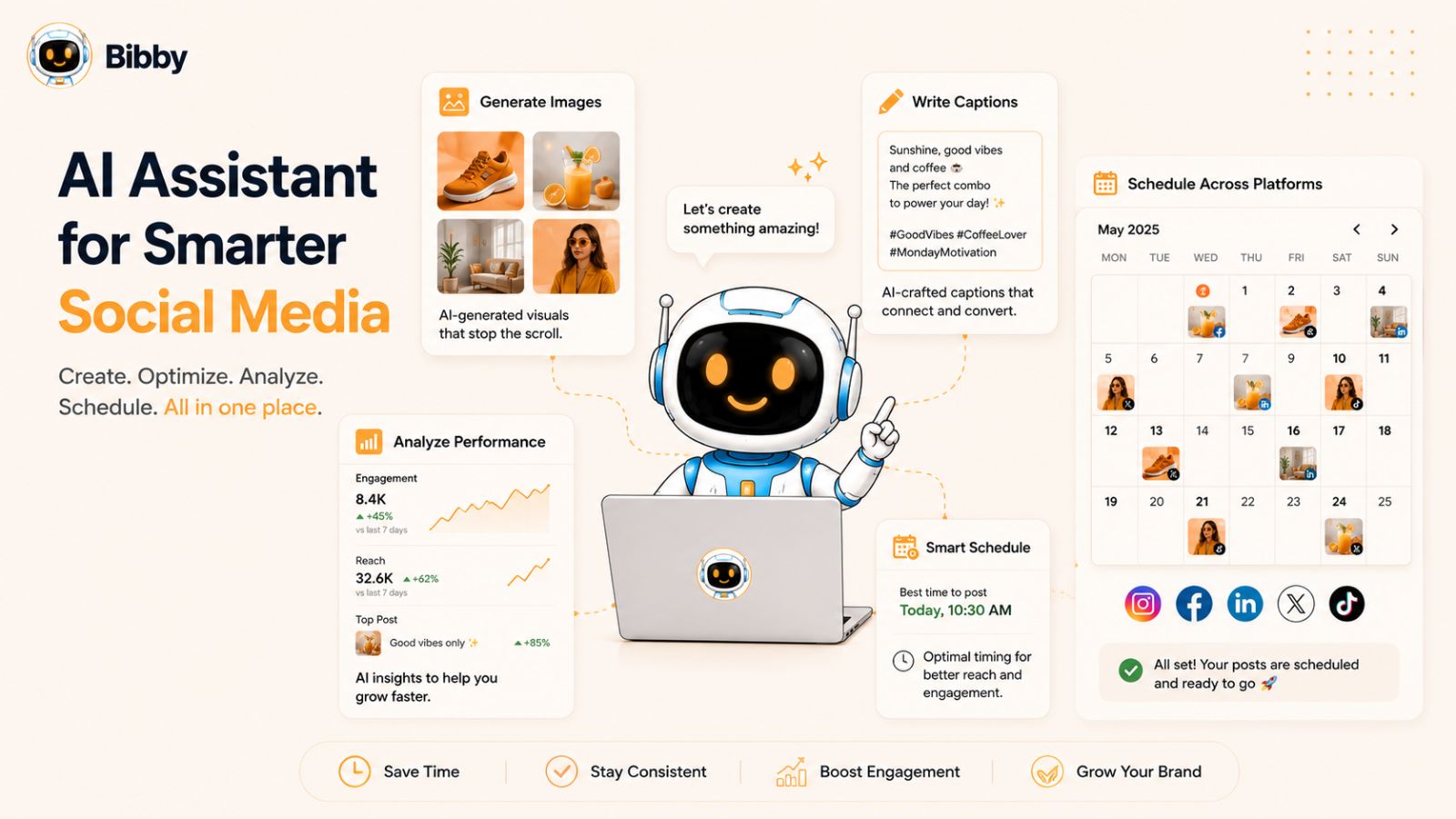
While many tools automate one part of the process, Bibby brings your entire workflow together into one simple platform.
With Bibby, you can:
- Upload your own images or generate stunning visuals with AI.
- Choose your preferred posting style, allowing Bibby to generate captions that match your brand voice.
- Schedule content across Facebook, Instagram, LinkedIn, YouTube, and TikTok from one dashboard.
- Publish images, carousels, videos, and Stories without switching between multiple tools.
- Let AI determine the best posting times for maximum reach and engagement.
- Manage your entire content calendar in one organized workspace.
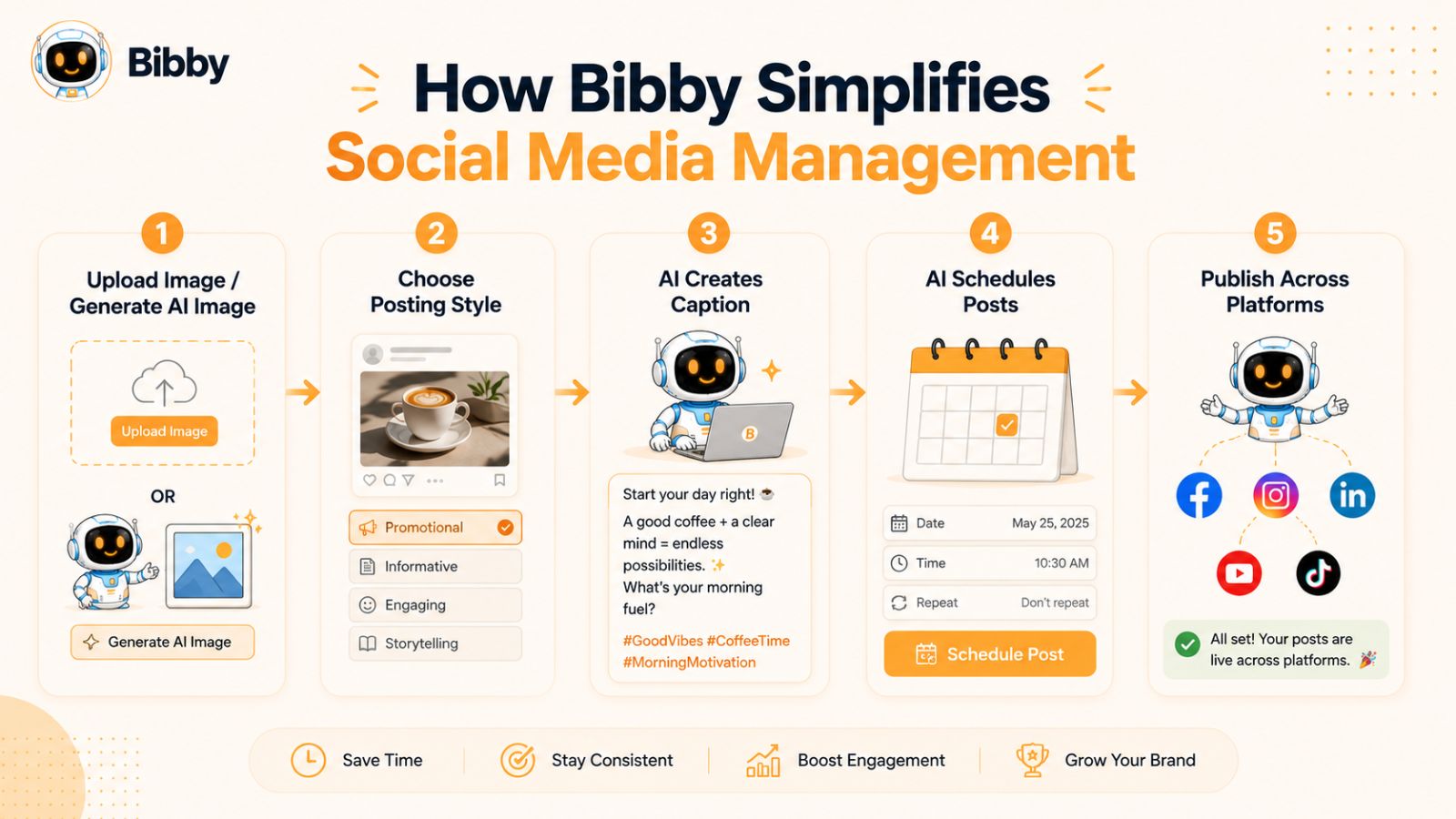
Instead of spending hours creating content, writing captions, and publishing manually across multiple platforms, Bibby simplifies the entire process into a streamlined workflow:
- Upload or generate your content.
- Select your posting style.
- Let AI generate your captions.
- Schedule everything across your social channels.
- Get back to growing your business while Bibby handles the publishing.
The result is a faster, more consistent, and more scalable social media strategy—one that allows you to spend less time managing content and more time creating meaningful connections with your audience.
The businesses that succeed on social media over the next few years won't necessarily be the ones posting the most content. They'll be the ones combining human creativity with AI-powered efficiency to consistently deliver valuable content at scale.
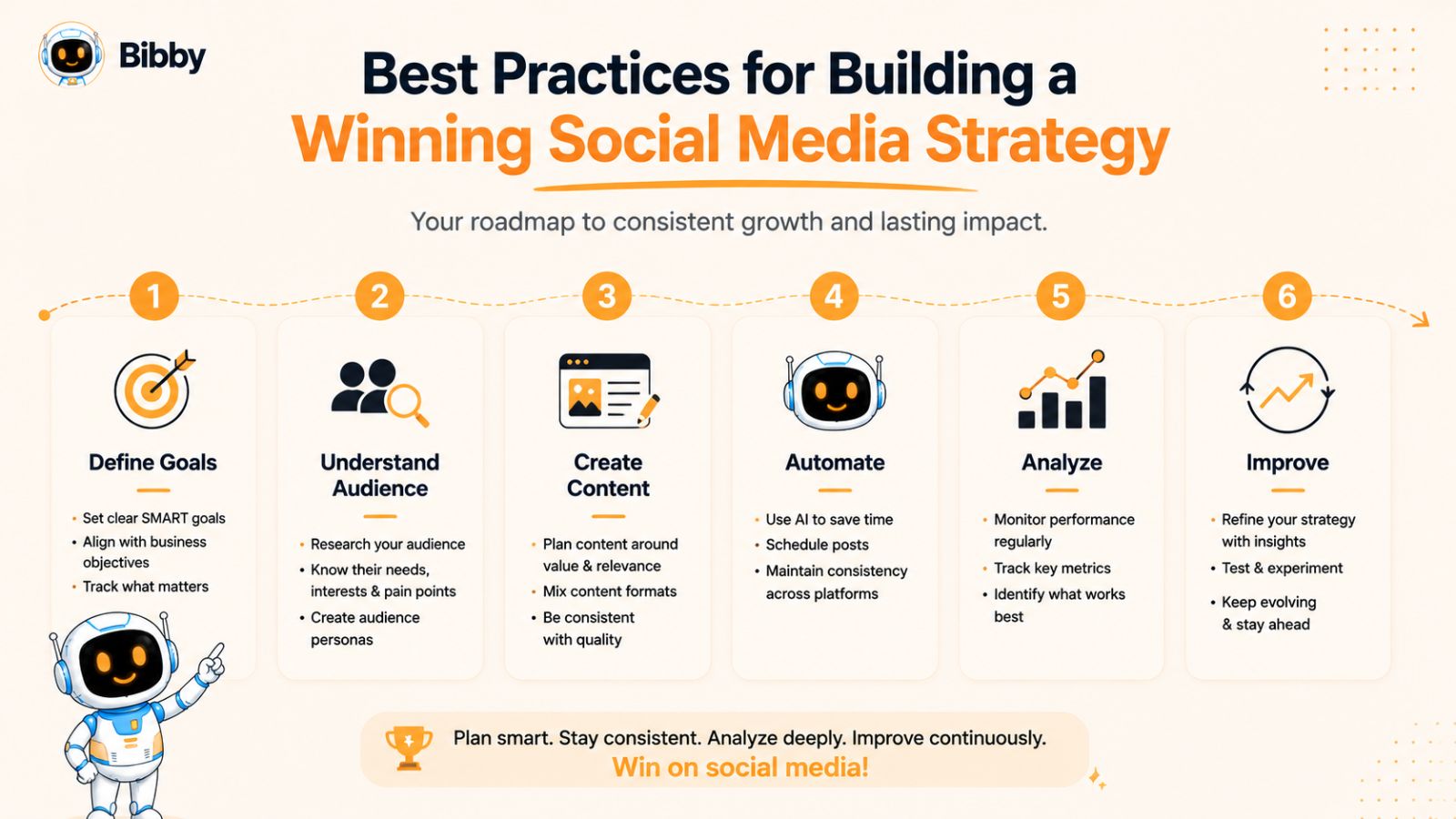
Best Practices for Building a Winning Social Media Strategy
Recognizing what's wrong with your current social media strategy is only half the battle. The next step is creating a system that helps you consistently publish valuable content, engage your audience, and achieve measurable business results.
Use these best practices as your roadmap for long-term success.
Set Clear, Measurable Goals
Before creating any content, define what success looks like.
Ask yourself:
- Do you want to increase brand awareness?
- Generate more leads?
- Drive website traffic?
- Grow your community?
- Increase sales?
Your goals should guide every content decision you make. Without clear objectives, it's impossible to know whether your strategy is actually working.
Know Your Audience
The best-performing content isn't created for everyone—it's created for a specific audience.
Take time to understand:
- Their biggest challenges
- Their interests
- Their preferred content formats
- The platforms they use most
- The questions they're already asking
The better you understand your audience, the easier it becomes to create content they'll genuinely want to engage with.
Focus on Quality Over Quantity
Publishing more content doesn't automatically produce better results.
One insightful video or educational carousel that solves a real problem will usually outperform several rushed posts created simply to fill your content calendar.
Aim to create content that's:
- Helpful
- Relevant
- Authentic
- Easy to consume
- Worth sharing
Every post should provide value in some way.
Build Content Pillars
Instead of wondering what to post every day, organize your content around a handful of recurring themes.
For example:
- Educational tips
- Industry news
- Customer success stories
- Behind-the-scenes content
- Product updates
- Frequently asked questions
Content pillars make planning easier while ensuring your audience receives a healthy mix of valuable information.
Review Your Analytics Regularly
Successful social media strategies evolve based on data—not assumptions.
Review your analytics every month and look for patterns such as:
- Highest-performing posts
- Best content formats
- Peak engagement times
- Most effective calls to action
- Audience growth trends
Double down on what works and continuously improve what doesn't.
Keep Experimenting
Social media changes constantly.
New features, algorithms, and audience preferences emerge every year, which means even successful strategies require ongoing refinement.
Don't be afraid to test:
- New content formats
- Different posting schedules
- Alternative caption styles
- Fresh creative ideas
- Emerging platform features
Small experiments often lead to your biggest breakthroughs.
Automate Repetitive Tasks
Your creativity should never be limited by repetitive administrative work.
Instead of manually uploading posts, writing every caption from scratch, or publishing separately across multiple platforms, use AI to streamline your workflow.
With Bibby, you can upload your own images or generate new visuals with AI, choose your preferred posting style, automatically generate captions, and schedule images, carousels, videos, and Stories across Facebook, Instagram, LinkedIn, YouTube, and TikTok—all from one intuitive dashboard. By automating repetitive tasks, you'll have more time to create better content, engage your audience, and grow your business.
Stay Consistent
Consistency is what turns occasional success into long-term growth.
You don't need to post every hour or chase every viral trend. Instead, focus on delivering valuable content on a reliable schedule your audience can depend on.
The brands that achieve sustainable growth aren't necessarily the ones posting the most—they're the ones consistently showing up, providing value, learning from their data, and improving over time.
By combining a clear strategy with AI-powered tools and efficient workflows, you'll spend less time managing social media and more time building a brand that people trust, remember, and recommend.
Frequently Asked Questions
How do I know if my social media strategy isn't working?
Some of the most common warning signs include declining engagement, stagnant follower growth, inconsistent posting, falling reach, low website traffic from social media, and poor conversion rates. If you're spending significant time creating content without seeing measurable business results, it's time to evaluate your strategy and make improvements.
Why is my social media engagement dropping?
Engagement often declines when your content no longer resonates with your audience. Other common reasons include inconsistent posting, overly promotional content, poor timing, repetitive formats, or failing to encourage conversations. Regularly reviewing your analytics and experimenting with new content types can help reverse the trend.
How often should I post on social media?
There's no universal posting frequency that works for every business. The most effective schedule is one you can maintain consistently while delivering high-quality content. For many brands, posting three to five times per week is more effective than posting multiple times a day with lower-quality content.
What is the biggest mistake businesses make on social media?
One of the biggest mistakes is focusing too much on selling instead of providing value. Audiences are more likely to engage with educational, entertaining, or inspiring content than constant promotions. Building trust first often leads to better long-term business results.
Should I automate my social media posting?
Yes—automation can save time and improve consistency when used correctly. Scheduling posts in advance allows you to maintain an active presence while focusing on strategy, customer engagement, and content creation. Automation works best when it supports authentic communication rather than replacing it.
Can AI help manage social media?
Absolutely. AI can assist with content ideation, image generation, caption writing, content planning, and scheduling. By automating repetitive tasks, businesses can spend more time creating valuable content and building relationships with their audience.
What types of social media content perform best?
While performance varies by platform and audience, educational content, short-form videos, carousels, customer stories, behind-the-scenes content, and practical tips consistently perform well because they provide value and encourage engagement.
What's the easiest way to manage multiple social media platforms?
Using an all-in-one social media management platform is the simplest solution. Instead of manually posting across different networks, tools like Bibby let you upload your own images or generate visuals with AI, automatically create captions based on your preferred posting style, and schedule images, carousels, videos, and Stories across Facebook, Instagram, LinkedIn, YouTube, and TikTok—all from one streamlined dashboard.
Conclusion
Building a successful social media strategy isn't about posting more—it's about posting with purpose.
If you recognized several of the 20 warning signs in this guide, don't be discouraged. Every challenge, whether it's declining engagement, inconsistent posting, stalled growth, or spending too much time on manual tasks, is an opportunity to improve your strategy and create a more efficient workflow.
Remember the three biggest takeaways:
- Focus on value over volume. High-quality, audience-first content consistently outperforms frequent, low-value posts.
- Use data to guide your decisions. Review your analytics regularly, identify what's working, and refine your strategy based on real insights—not guesswork.
- Work smarter with AI and automation. Eliminate repetitive tasks so you can spend more time creating meaningful content and engaging with your audience.
If you're ready to simplify your social media workflow, Bibby brings everything together in one intuitive platform. Upload your own images or generate visuals with AI, choose your preferred posting style, let AI generate captions, and schedule images, carousels, videos, and Stories across Facebook, Instagram, LinkedIn, YouTube, and TikTok at AI-optimized posting times. Instead of managing multiple tools and daily publishing tasks, you can focus on what matters most—growing your business and connecting with your audience.
The next step isn't just fixing what's broken—it's building a social media system that saves time, scales with your business, and delivers consistent results. Start applying these strategies today, and you'll be well on your way to turning your social media channels into reliable engines for growth.