
Artificial intelligence is rapidly reshaping how brands, creators, and businesses approach social media, making content creation and audience engagement faster, smarter, and more effective.
If you're wondering about the future of AI in social media, you're likely looking to understand how AI will transform content creation, marketing, automation, and customer engagement in the years ahead. The reality is that AI is no longer just a productivity tool—it is becoming the driving force behind the next generation of social media marketing, helping businesses save time while delivering more personalized experiences at scale.
In this article, you will learn:
- How AI is changing content creation and social media marketing.
- The biggest AI trends shaping the future of social platforms.
- How AI-powered tools streamline publishing, scheduling, and analytics.
Whether you're a marketer, business owner, or content creator, understanding these trends today will help you stay competitive as AI continues to redefine the future of social media.
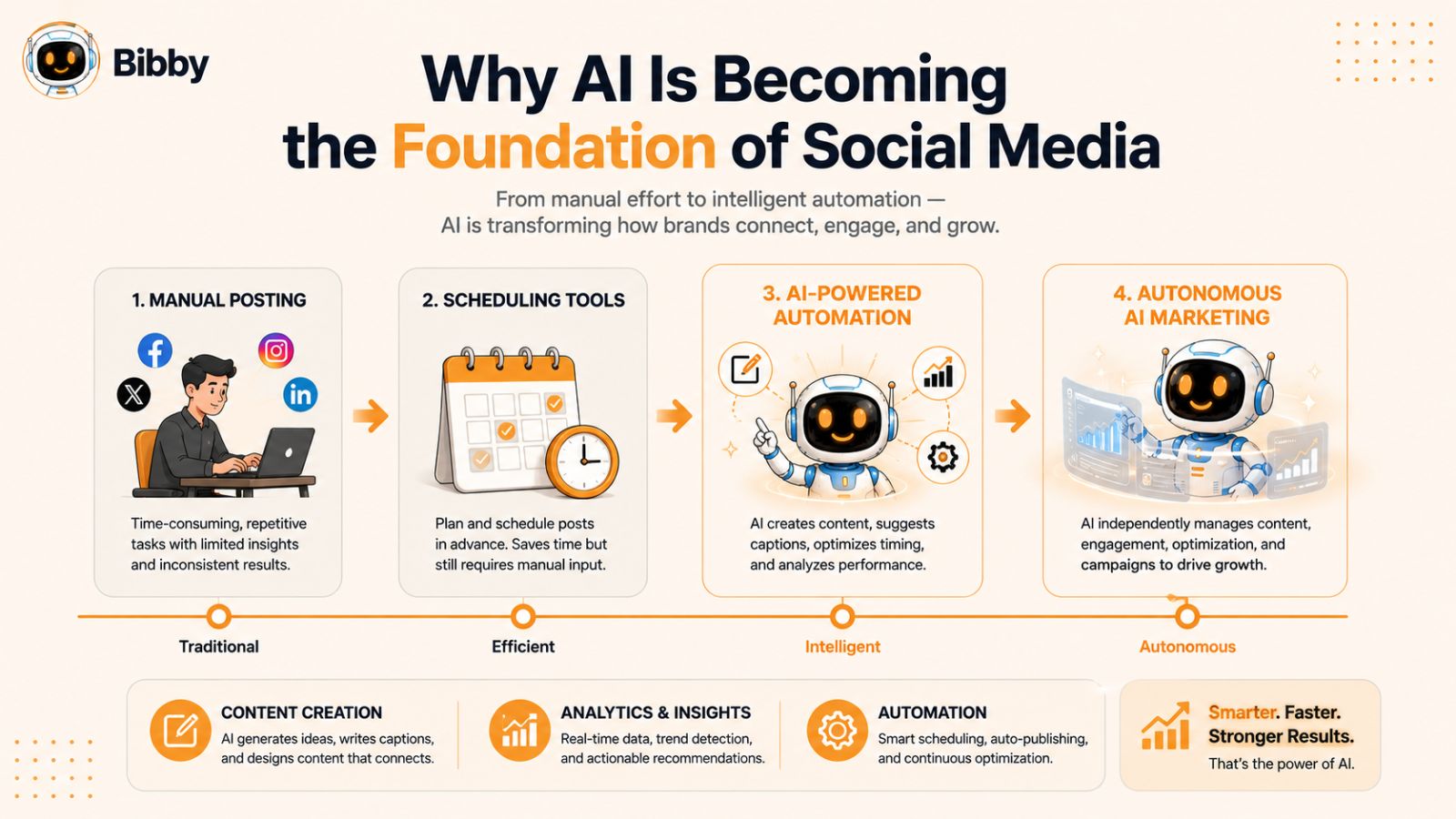
Why AI Is Becoming the Foundation of Social Media
Social media has evolved dramatically over the past decade. What once revolved around manually creating posts, choosing hashtags, and publishing content one platform at a time has become a fast-paced ecosystem driven by personalization, automation, and data. Today, businesses are expected to maintain an active presence across multiple platforms while consistently producing engaging, high-quality content—a challenge that is difficult to meet without the help of artificial intelligence.
One of the biggest reasons AI is becoming the foundation of social media is the growing demand for content. Brands need to create posts, videos, stories, short-form clips, and campaigns at a much higher frequency than ever before. AI-powered tools help reduce this workload by generating ideas, writing captions, suggesting hashtags, editing images, and even creating videos, allowing marketers to focus more on strategy and creativity instead of repetitive tasks.
At the same time, social media platforms have become increasingly dependent on AI to deliver personalized experiences. Every time you open Facebook, Instagram, LinkedIn, TikTok, or YouTube, AI algorithms analyze your interests, interactions, watch time, and engagement patterns to determine which content appears in your feed. This level of personalization benefits users by surfacing more relevant content and helps businesses reach audiences who are most likely to engage with their brand.
Another major shift is the rise of automation. Managing multiple social media accounts manually can be time-consuming, especially for growing businesses and agencies. AI-powered automation simplifies tasks such as scheduling posts, generating captions, recommending optimal publishing times, responding to common customer inquiries, and tracking campaign performance. Instead of spending hours managing daily operations, marketers can automate repetitive work while maintaining a consistent online presence.
AI also enables businesses to make smarter decisions through data-driven insights. Rather than relying on guesswork, marketers can analyze engagement trends, audience behavior, and campaign performance in real time. Predictive analytics help identify what type of content is most likely to perform well, when audiences are most active, and how future campaigns can be optimized for better results.
Perhaps the most significant reason AI is becoming essential is its ability to scale marketing efforts. Small businesses can compete more effectively with larger brands by producing professional-quality content faster and at a lower cost. Meanwhile, enterprise organizations can coordinate global campaigns across multiple teams and platforms with greater efficiency and consistency.
As AI continues to advance, its role will extend beyond automating routine tasks. It will increasingly act as a creative collaborator, strategic advisor, and intelligent assistant, helping marketers plan campaigns, personalize customer experiences, and make better decisions based on real-time data. Businesses that embrace these capabilities today will be better positioned to adapt to the rapidly evolving landscape of social media marketing.
The Biggest AI Trends Transforming Social Media
Artificial intelligence is no longer limited to automating repetitive tasks—it is fundamentally changing how content is created, distributed, and optimized. From generating compelling captions to producing videos and personalized campaigns, AI is helping brands and creators work faster while maintaining quality and consistency. Below are some of the biggest AI trends shaping the future of social media.
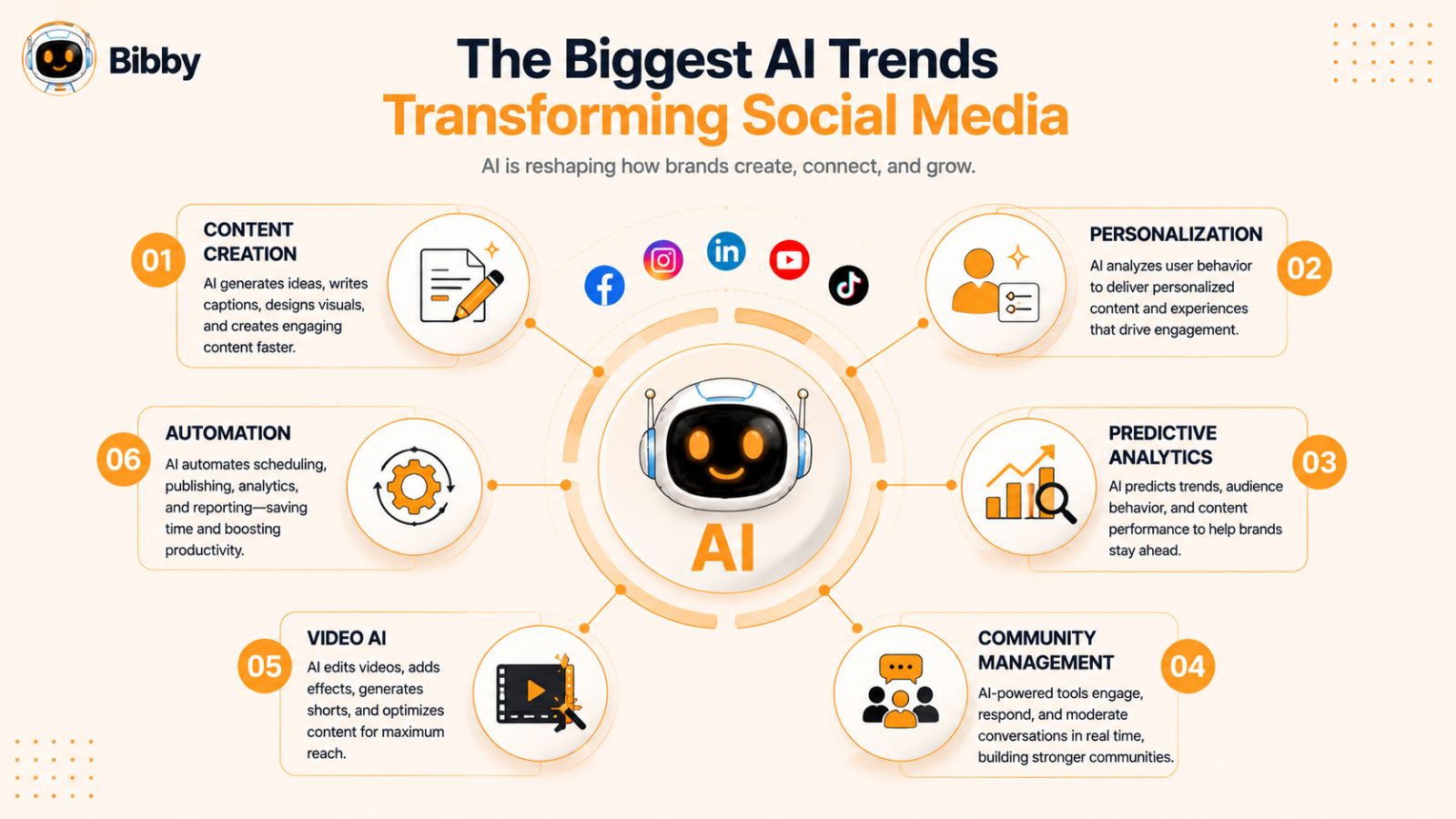
AI Content Creation
Creating fresh, engaging content every day is one of the biggest challenges for marketers and creators. Whether you're managing a personal brand or a global company, consistently producing posts that capture attention across multiple platforms can quickly become overwhelming. This is where AI-powered content creation is making a significant impact.
Modern AI tools can assist with nearly every stage of the creative process. Instead of starting with a blank page, marketers can generate content ideas, write engaging captions, suggest relevant hashtags, create high-quality images, edit videos, and even repurpose existing content for different social media platforms. These capabilities dramatically reduce the time required to plan and publish campaigns while helping maintain a consistent brand voice.
One of the most valuable applications of AI is caption generation. Rather than spending time crafting unique captions for every post, AI can generate multiple caption variations based on your audience, tone, and campaign goals. Whether you're aiming for a professional LinkedIn update, a conversational Facebook post, or an attention-grabbing Instagram caption, AI can adapt the messaging to fit the platform and your preferred style.
Visual content has also entered a new era. AI image generation enables businesses to create original graphics, illustrations, product mockups, and promotional visuals without relying solely on traditional design tools. Combined with AI-powered image editing, brands can quickly produce eye-catching visuals that align with their marketing campaigns and brand identity.
Video content is another area experiencing rapid transformation. AI can help generate scripts, create subtitles, remove background noise, produce voiceovers, and even generate short-form videos optimized for platforms like TikTok, Instagram Reels, YouTube Shorts, and Facebook. As short-form video continues to dominate social media, these tools make high-quality video production accessible to businesses of all sizes.
Beyond creation, AI also helps optimize content before it goes live. It can recommend keywords, hashtags, posting times, and content formats based on audience behavior and historical performance, increasing the likelihood of higher engagement and broader reach.
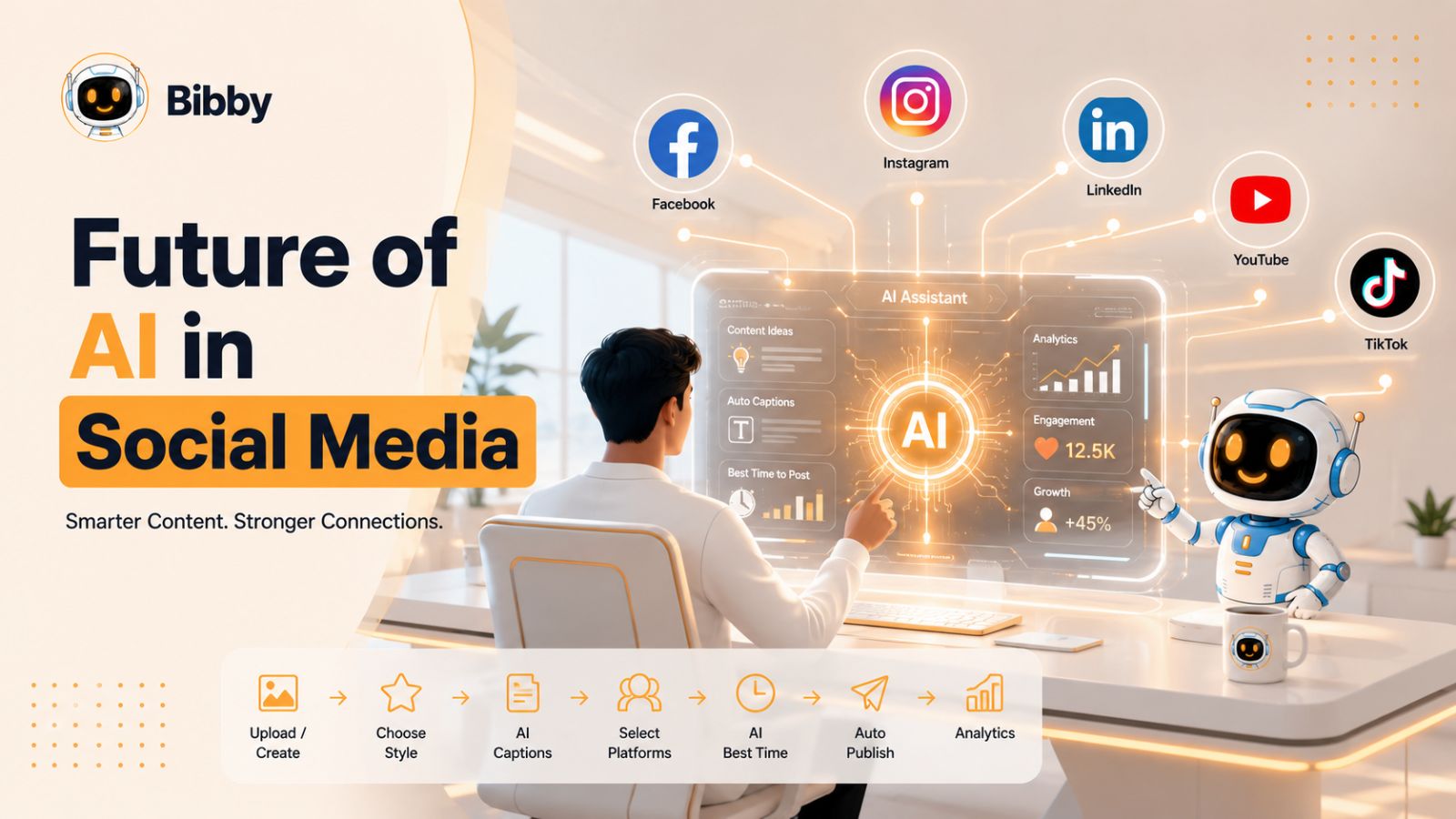
This is where integrated AI platforms are becoming especially valuable. Instead of switching between multiple apps for design, writing, scheduling, and analytics, marketers can manage the entire workflow in one place. For example, with Bibby, users can upload their own image or generate one using AI, select a preferred posting style, and let AI automatically generate captions tailored to that style. From there, content can be scheduled across platforms such as Facebook, Instagram, LinkedIn, YouTube, and TikTok at AI-optimized publishing times. Bibby also supports video and story publishing while providing analytics to measure performance, creating a streamlined workflow from content creation to campaign analysis.
As AI continues to evolve, content creation will become even more collaborative. Rather than replacing human creativity, AI will handle repetitive and time-consuming tasks, allowing marketers, creators, and businesses to focus on storytelling, strategy, and building authentic relationships with their audiences.
Also read: How to Create a Social Media Funnel That Actually Converts (Step-by-Step Guide) →
Hyper-Personalized Content
One-size-fits-all content is quickly becoming a thing of the past. As artificial intelligence becomes more sophisticated, social media platforms and marketing tools can deliver highly personalized experiences tailored to each user's interests, behaviors, and preferences. This shift toward hyper-personalization is transforming how brands connect with their audiences and is expected to become one of the defining characteristics of the future of AI in social media.
Every interaction on social media—from the posts users like and share to the videos they watch and the accounts they follow—creates valuable data. AI analyzes these patterns to understand what content resonates with different audience segments. Instead of showing the same message to everyone, businesses can deliver content that feels more relevant and timely to each individual.
Audience segmentation has become far more intelligent with AI. Rather than grouping users by basic demographics such as age or location, AI can identify audiences based on interests, purchasing behavior, engagement history, and even content consumption habits. This allows marketers to create highly targeted campaigns that speak directly to the needs of different customer groups, resulting in stronger engagement and higher conversion rates.
AI also enables dynamic content personalization. For example, the same marketing campaign can present different headlines, captions, visuals, or calls to action depending on who is viewing it. A first-time visitor may see educational content introducing a brand, while a loyal customer may receive exclusive offers or product recommendations. This level of personalization helps businesses build stronger relationships and improve the overall customer experience.
Recommendation engines are another powerful application of AI. Platforms like Facebook, Instagram, YouTube, TikTok, and LinkedIn use advanced algorithms to suggest posts, videos, creators, and advertisements that users are most likely to engage with. For businesses, this means creating valuable, relevant content is more important than ever, as AI increasingly rewards quality and audience relevance over simple posting frequency.
Hyper-personalization also extends to communication. AI-powered chatbots and virtual assistants can provide instant responses to customer inquiries, recommend products based on previous interactions, and guide users through the buying journey. By combining automation with personalized messaging, businesses can deliver faster support while maintaining a more engaging customer experience.
For marketers, this evolution represents a major opportunity. Instead of relying on guesswork, AI provides actionable insights into what audiences want, when they are most active, and how they prefer to interact with content. These insights make it easier to create campaigns that feel personal, meaningful, and relevant at every stage of the customer journey.
As AI continues to improve, hyper-personalization will become even more precise. Future social media experiences are likely to feature real-time content adaptation, predictive recommendations, and individualized user journeys that make every interaction feel uniquely tailored. Brands that embrace this shift will be better positioned to build trust, increase engagement, and foster long-term customer loyalty.
Predictive Analytics
One of the most powerful advantages of artificial intelligence is its ability to turn massive amounts of data into actionable insights. Instead of simply reporting what happened in the past, AI-powered predictive analytics helps marketers understand what is likely to happen next. This enables businesses to make smarter decisions, optimize campaigns before they launch, and consistently improve their social media performance.
Every social media campaign generates valuable data, including impressions, reach, engagement, clicks, watch time, shares, comments, and conversions. While this information is useful on its own, AI can analyze these metrics alongside historical performance, audience behavior, and industry trends to identify patterns that humans might overlook. The result is more accurate forecasting and better-informed marketing strategies.
One of the most practical uses of predictive analytics is identifying the best time to publish content. While many marketers rely on general recommendations, AI analyzes the activity patterns of your specific audience to determine when they are most likely to engage. By publishing content at these AI-optimized times, businesses can improve visibility, increase engagement, and maximize the impact of every post.
Predictive analytics also helps marketers understand which types of content are most likely to succeed. By examining past campaigns, AI can identify trends such as the topics, formats, captions, visuals, and posting styles that consistently generate the highest engagement. Instead of relying on trial and error, businesses can create future content based on data-driven insights, improving efficiency and reducing wasted effort.
Another valuable capability is campaign forecasting. Before launching a campaign, AI can estimate potential performance based on similar campaigns, audience characteristics, and historical data. This allows marketers to adjust their messaging, creative assets, or targeting strategies before investing significant time and budget, leading to more effective campaigns and better returns on investment.
Predictive analytics also supports smarter resource allocation. Businesses can identify which platforms deliver the highest engagement, which campaigns produce the strongest results, and where marketing budgets should be focused. Whether the goal is increasing brand awareness, generating leads, or driving sales, AI helps ensure resources are invested where they will have the greatest impact.
Integrated AI platforms are beginning to make these insights accessible to businesses of every size. For example, Bibby not only helps users create and schedule content but also provides analytics that track performance across multiple social media platforms. By combining publishing data with AI-driven insights, marketers can better understand what resonates with their audience and continuously refine their content strategy.
As predictive analytics becomes more advanced, AI will move beyond recommending improvements to proactively suggesting complete campaign strategies. Future AI systems will be able to identify emerging trends, anticipate audience interests, and recommend content ideas before they become popular. Businesses that leverage predictive analytics today will gain a significant competitive advantage by making faster, smarter, and more informed marketing decisions.
AI Community Management
Building an engaged online community is one of the most important aspects of social media marketing, but it can also be one of the most time-consuming. Responding to comments, answering messages, moderating discussions, and interacting with followers across multiple platforms requires constant attention. As communities grow, maintaining meaningful engagement becomes increasingly challenging. Artificial intelligence is helping businesses manage these interactions more efficiently while improving the overall customer experience.
AI-powered chatbots have become one of the most common tools for community management. They can answer frequently asked questions, provide product recommendations, share business information, and respond to customer inquiries instantly. This allows businesses to offer 24/7 support without requiring someone to be online around the clock. When more complex issues arise, conversations can be seamlessly handed over to a human team member.
Another valuable application of AI is automated comment moderation. Popular social media accounts often receive thousands of comments every day, making it difficult to manually review every interaction. AI can automatically detect spam, offensive language, fake accounts, and inappropriate content, helping brands maintain a safe and welcoming environment for their communities.
Sentiment analysis is also transforming how businesses understand their audiences. Instead of simply counting likes and comments, AI can evaluate whether conversations around a brand are positive, negative, or neutral. By identifying shifts in customer sentiment, businesses can respond more quickly to concerns, address potential issues before they escalate, and better understand how audiences perceive their products or services.
AI can also help prioritize customer interactions. Rather than treating every message equally, intelligent systems can identify urgent inquiries, highlight high-value leads, and surface conversations that require immediate attention. This enables support teams to respond faster to the people who need assistance most, improving customer satisfaction while making better use of available resources.
For marketers, AI community management offers more than automation—it provides valuable insights into audience behavior. By analyzing recurring questions, engagement patterns, and discussion topics, AI can uncover content opportunities, identify customer pain points, and reveal emerging trends. These insights help businesses create more relevant content while strengthening relationships with their audiences.
Although AI significantly improves efficiency, human interaction remains essential. People still value authentic conversations, empathy, and genuine relationships with the brands they follow. The most successful businesses use AI to handle repetitive tasks while allowing human teams to focus on meaningful engagement, creative storytelling, and personalized customer experiences.
Looking ahead, AI community management will become even more proactive. Future systems may identify dissatisfied customers before they leave negative feedback, recommend personalized responses based on conversation history, and even predict which community members are most likely to become loyal customers or brand advocates. Businesses that combine AI-driven efficiency with authentic human communication will be well-positioned to build stronger, more engaged communities in the evolving social media landscape.
How AI Will Change the Daily Workflow of Social Media Managers
The role of a social media manager has evolved far beyond simply posting content online. Today's professionals are responsible for content strategy, graphic design, copywriting, video editing, audience engagement, analytics, advertising, and community management—often across multiple platforms at once. As these responsibilities continue to grow, artificial intelligence is becoming an essential partner that simplifies workflows and boosts productivity.
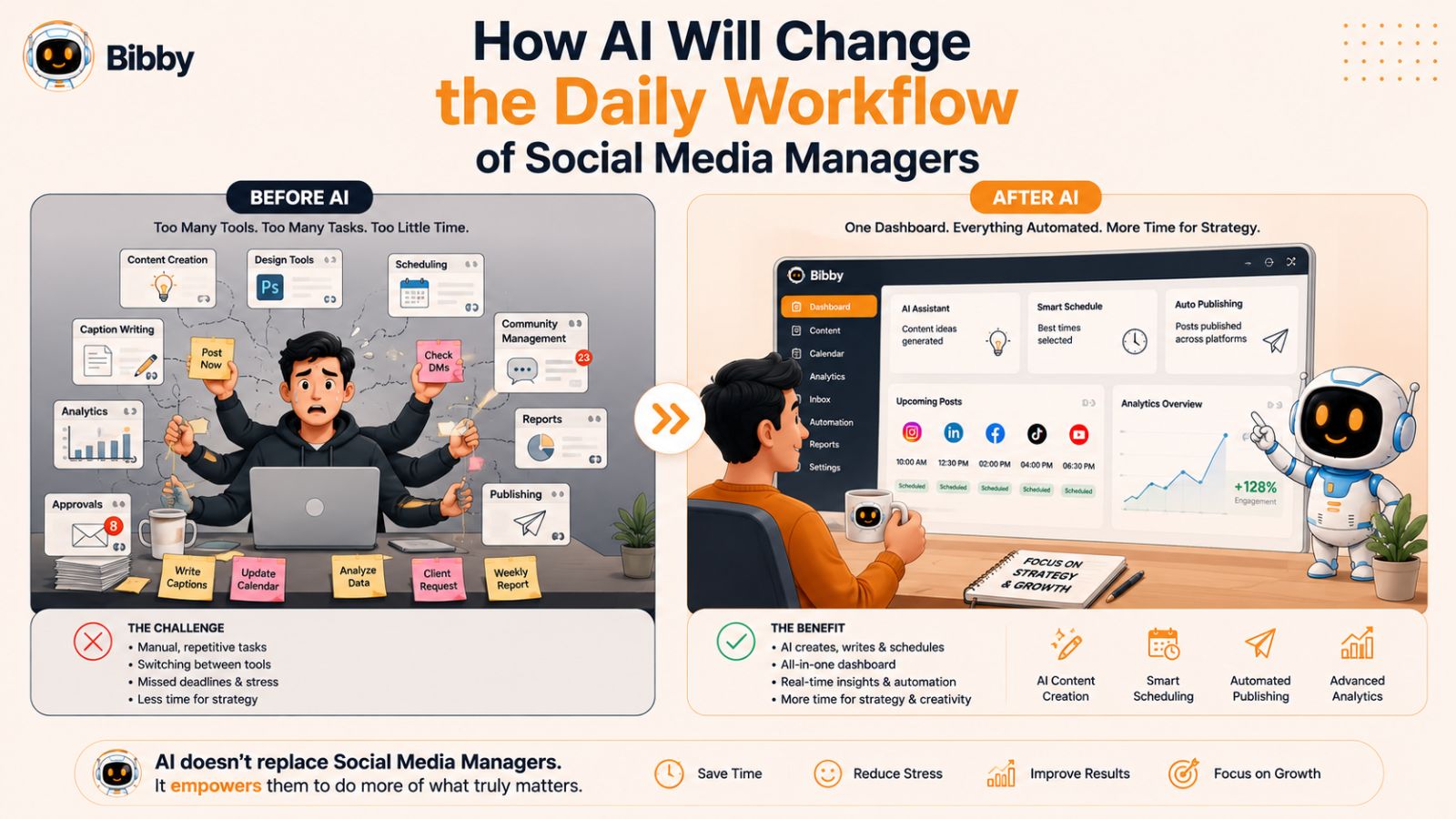
Instead of spending hours brainstorming ideas, AI can generate content suggestions based on industry trends, audience interests, and previous campaign performance. Whether you're planning a week's worth of Instagram posts or a month-long LinkedIn campaign, AI helps eliminate creative blocks by providing fresh ideas in seconds.
Content creation is also becoming significantly faster. AI can write engaging captions, suggest relevant hashtags, generate compelling calls to action, and even recommend different versions of the same post for different social media platforms. Rather than rewriting content multiple times, marketers can create platform-specific posts with minimal effort while maintaining a consistent brand voice.
Visual content production has become equally efficient. Instead of relying on multiple design tools, marketers can use AI to generate images, enhance existing visuals, remove backgrounds, resize graphics for different platforms, and even assist with video creation. This reduces production time and allows teams to publish high-quality content more consistently.
Scheduling is another area undergoing major transformation. Traditionally, marketers needed to manually choose publishing dates and times for every post. AI now analyzes audience activity and engagement patterns to recommend the best times for maximum visibility. This helps businesses reach more people without constantly monitoring analytics or experimenting with different posting schedules.
Modern AI platforms take this even further by combining multiple tasks into a single workflow. For example, Bibby simplifies social media management by allowing users to upload an existing image or generate one using AI, choose a preferred posting style, and automatically generate captions that match their brand voice. From there, content can be scheduled across Facebook, Instagram, LinkedIn, YouTube, and TikTok at AI-optimized publishing times. Businesses can also publish videos and stories, monitor performance through built-in analytics, and manage multiple social media channels from one intuitive dashboard.
Analytics and reporting are becoming more actionable with AI as well. Instead of manually compiling performance reports, AI can automatically identify top-performing posts, explain engagement trends, highlight audience growth, and recommend improvements for future campaigns. This enables marketers to spend less time analyzing spreadsheets and more time refining their strategy.
Perhaps the biggest change is the shift from repetitive execution to strategic thinking. As AI takes over routine tasks such as caption writing, scheduling, reporting, and content optimization, social media managers gain more time to focus on creativity, storytelling, relationship building, brand positioning, and long-term marketing goals. AI doesn't replace the expertise of marketers—it amplifies it by removing repetitive work and enabling teams to accomplish far more in less time.
In the future, the most successful social media professionals won't be those who do everything manually. They'll be the ones who know how to combine human creativity with AI-powered automation to create smarter campaigns, build stronger communities, and deliver better results across every platform.
Also read: AI Content Planner: Plan an Entire Month of Content in Minutes →
Benefits of AI in Social Media Marketing
Artificial intelligence is transforming social media marketing by making it faster, smarter, and more efficient. Whether you're a solo creator, a growing business, a marketing agency, or a global brand, AI helps simplify complex workflows while improving the quality and performance of your campaigns. As AI technology continues to evolve, its benefits extend far beyond automation, empowering marketers to achieve better results with less effort.
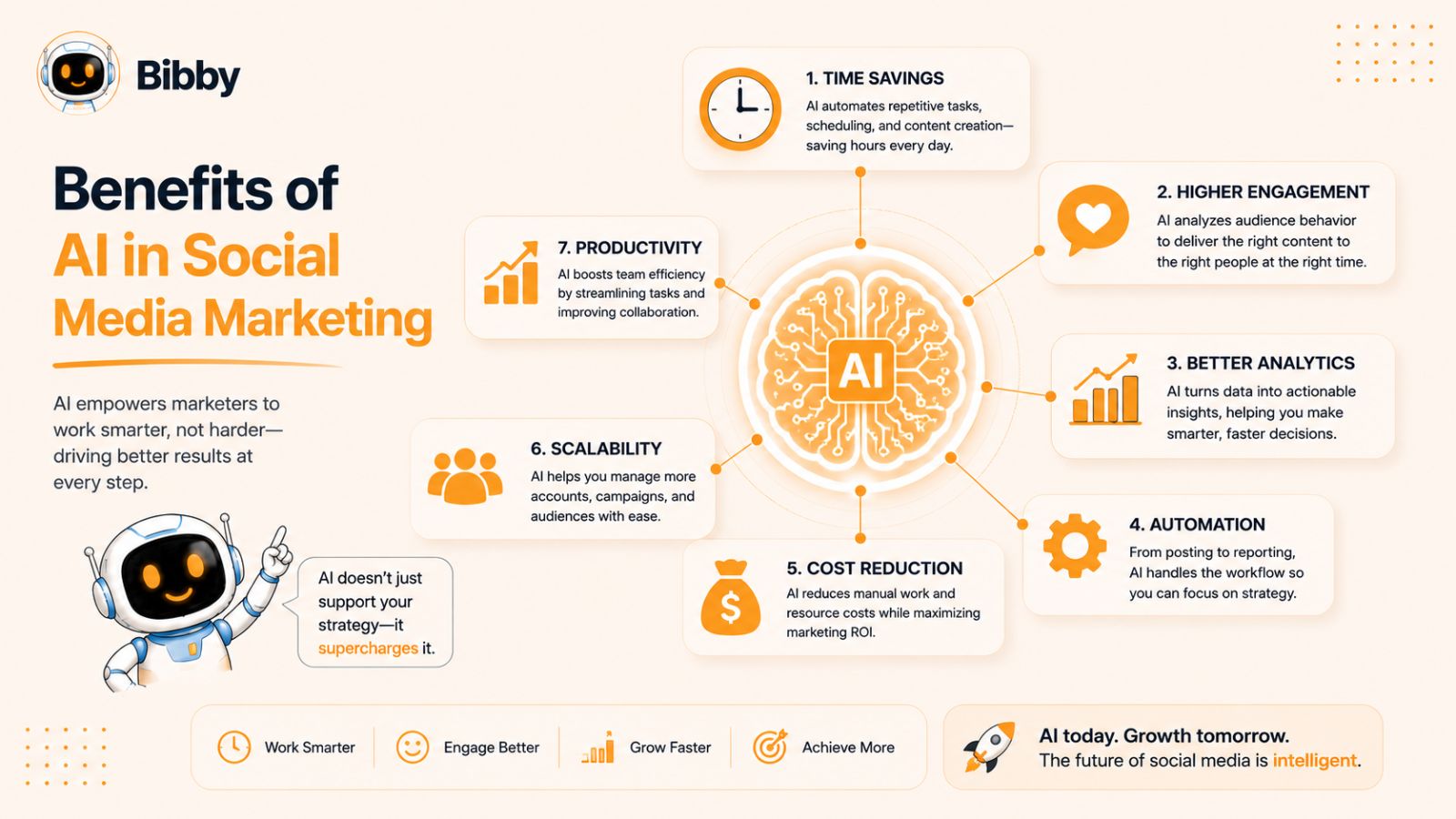
Save Time Through Automation
One of the most immediate benefits of AI is the amount of time it saves. Tasks that once took hours—such as brainstorming content ideas, writing captions, designing visuals, scheduling posts, and generating reports—can now be completed in minutes. By automating repetitive work, marketers can dedicate more time to strategic planning, creative storytelling, and audience engagement.
Create More Content Without Sacrificing Quality
Maintaining a consistent posting schedule across multiple social media platforms is challenging. AI helps businesses generate high-quality captions, images, videos, and campaign ideas at scale, making it easier to keep audiences engaged without overwhelming marketing teams. This allows brands to publish more frequently while maintaining a consistent tone and professional appearance.
Increase Engagement with Smarter Content
AI analyzes audience behavior to identify the types of content that resonate most with followers. It can recommend optimal posting times, suggest effective hashtags, personalize messaging, and identify trending topics relevant to your industry. These data-driven recommendations help improve reach, engagement, and overall campaign performance.
Improve Decision-Making with Real-Time Analytics
Successful marketing relies on understanding what works and what doesn't. AI-powered analytics provide valuable insights into audience demographics, engagement patterns, content performance, and campaign effectiveness. Instead of relying on assumptions, businesses can make informed decisions backed by real-time data, leading to continuous improvement and stronger results.
Reduce Marketing Costs
Hiring specialists for copywriting, graphic design, scheduling, reporting, and analytics can be expensive, especially for small businesses. AI helps reduce these costs by automating many routine tasks while maintaining high-quality output. Although human creativity remains essential, AI enables smaller teams to accomplish work that previously required significantly larger resources.
Maintain Consistency Across Platforms
Building a recognizable brand requires consistency. AI helps ensure that messaging, tone of voice, visual style, and publishing schedules remain aligned across platforms such as Facebook, Instagram, LinkedIn, YouTube, and TikTok. This consistency strengthens brand identity and creates a more cohesive experience for audiences.
Simplify Multi-Platform Management
Managing multiple social media channels often means switching between different applications for content creation, scheduling, publishing, and analytics. AI-powered platforms streamline this process by bringing everything together in one place. For example, Bibby enables marketers to upload or generate AI images, create captions automatically, schedule posts at AI-optimized times, publish videos and stories, and monitor performance across multiple platforms—all from a single, easy-to-use dashboard. This integrated workflow reduces complexity and helps teams stay organized while saving valuable time.
Scale Marketing as Your Business Grows
As businesses expand, their social media needs become more demanding. AI makes it easier to scale content production, manage additional accounts, support larger audiences, and analyze increasing amounts of data without dramatically increasing workload. This flexibility allows businesses to grow their marketing efforts while maintaining efficiency and quality.
Gain a Competitive Advantage
Early adopters of AI are already benefiting from faster workflows, better audience insights, and more personalized marketing strategies. Businesses that embrace AI today will be better equipped to adapt to changing algorithms, emerging platforms, and evolving customer expectations. Rather than replacing marketers, AI provides them with the tools they need to work more effectively and stay ahead in an increasingly competitive digital landscape.
Ultimately, the greatest benefit of AI in social media marketing is its ability to combine automation with intelligence. By reducing manual effort, improving decision-making, and enabling more personalized customer experiences, AI empowers businesses to focus on what truly matters: building meaningful relationships, creating valuable content, and driving sustainable growth.
Also read: TikTok Growth Hacks Backed by Data: 21 Proven Strategies That Actually Work →
Challenges and Ethical Concerns
While the future of AI in social media offers exciting opportunities, it also introduces important challenges that businesses, creators, and platforms must address. Artificial intelligence can improve efficiency and creativity, but it should be used responsibly to maintain trust, protect users, and ensure authentic communication. Understanding these challenges is essential for organizations that want to build sustainable, long-term social media strategies.
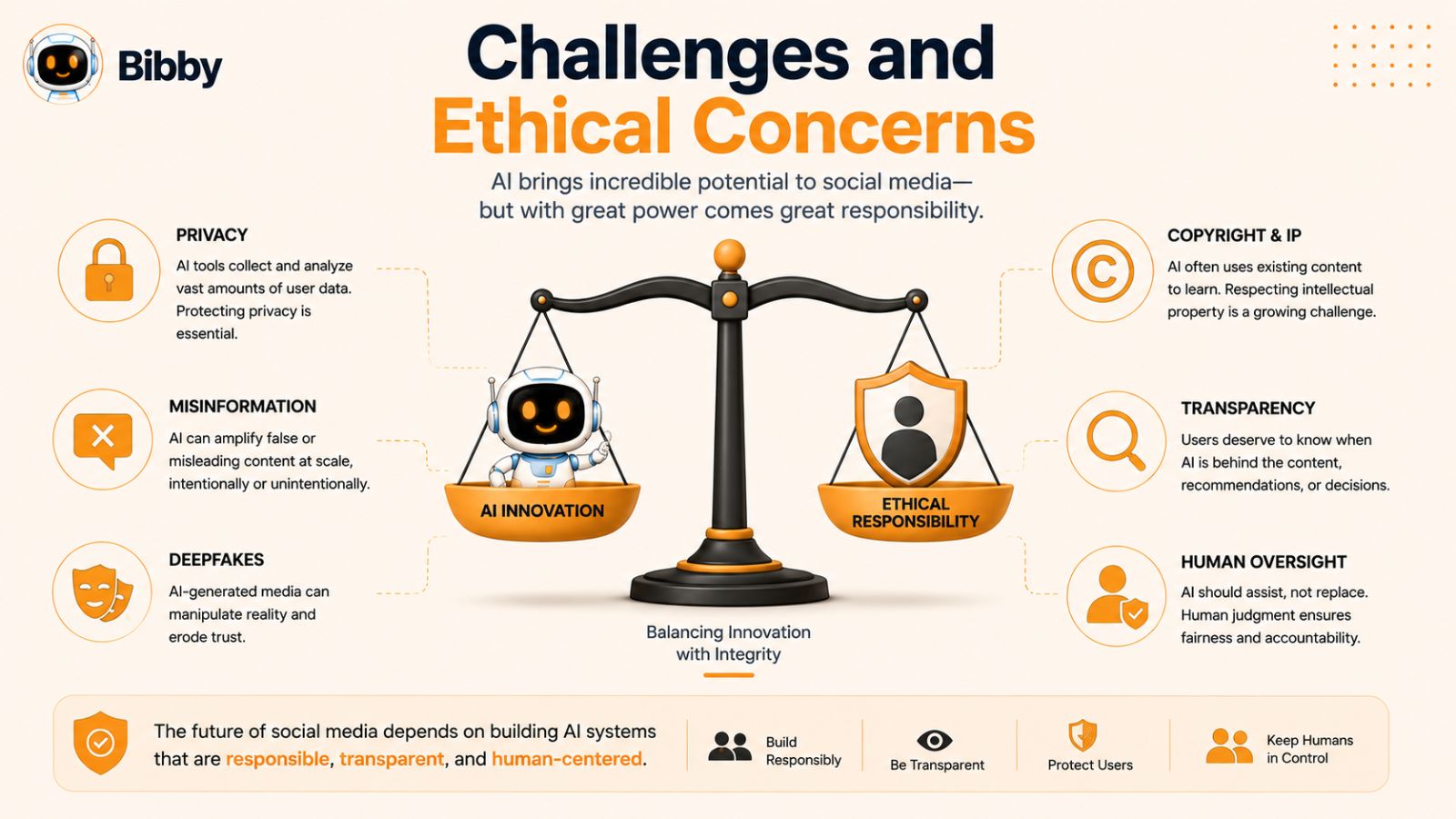
Misinformation and Deepfakes
One of the biggest concerns surrounding AI is its ability to generate highly realistic images, videos, and audio. While these technologies have many legitimate applications, they can also be misused to spread misinformation or create convincing deepfakes. False content can damage reputations, influence public opinion, and erode trust in online platforms. As AI-generated media becomes more advanced, businesses and users must verify information before sharing it and prioritize credible sources.
Copyright and Intellectual Property
Generative AI often learns from large datasets, raising questions about ownership and intellectual property. Businesses should ensure they have the appropriate rights to use AI-generated content and understand the licensing terms of the tools they rely on. Using original ideas, respecting copyrights, and maintaining transparent creative processes can help reduce legal and ethical risks.
Privacy and Data Protection
AI relies on data to deliver personalized experiences and meaningful insights. However, collecting and analyzing user data also creates privacy concerns. Businesses should be transparent about how they collect, store, and use customer information while complying with applicable data protection regulations. Respecting user privacy is not only a legal responsibility but also a key factor in building long-term customer trust.
AI Bias and Fairness
AI systems are only as reliable as the data they are trained on. If training data contains biases, AI-generated recommendations or decisions may unintentionally favor certain groups or perspectives while overlooking others. This can affect content recommendations, advertising, and audience targeting. Regular monitoring, diverse datasets, and human oversight are essential for minimizing bias and promoting fair outcomes.
Maintaining Authenticity
Audiences increasingly value genuine connections with the brands and creators they follow. Overusing AI-generated content without adding a human perspective can make social media feel impersonal or repetitive. While AI is an excellent assistant for generating ideas and automating routine tasks, authentic storytelling, personal experiences, and meaningful conversations remain irreplaceable.
Balancing Automation with Human Creativity
Automation can significantly improve productivity, but it should not replace strategic thinking or creative direction. The most successful marketing teams use AI to handle repetitive work while relying on human expertise to shape brand messaging, develop campaigns, and build relationships with customers. This balance ensures that content remains both efficient and emotionally engaging.
Transparency Builds Trust
As AI-generated content becomes more common, transparency will play an increasingly important role. Businesses should be honest about how they use AI, especially when creating synthetic media or automating customer interactions. Open communication helps establish credibility and reassures audiences that technology is being used responsibly.
The Future Requires Responsible AI
The future of AI in social media is not simply about adopting the latest technology—it is about using it ethically. Organizations that prioritize accuracy, fairness, privacy, and authenticity will be better positioned to earn customer trust and build lasting relationships. AI should enhance human creativity and decision-making, not replace the values that make communication meaningful. By combining innovation with responsibility, businesses can unlock the full potential of AI while creating a safer and more trustworthy social media ecosystem.
Also read: 12 LinkedIn Scheduling Tips for Consistent Visibility →
Industries That Will Benefit Most
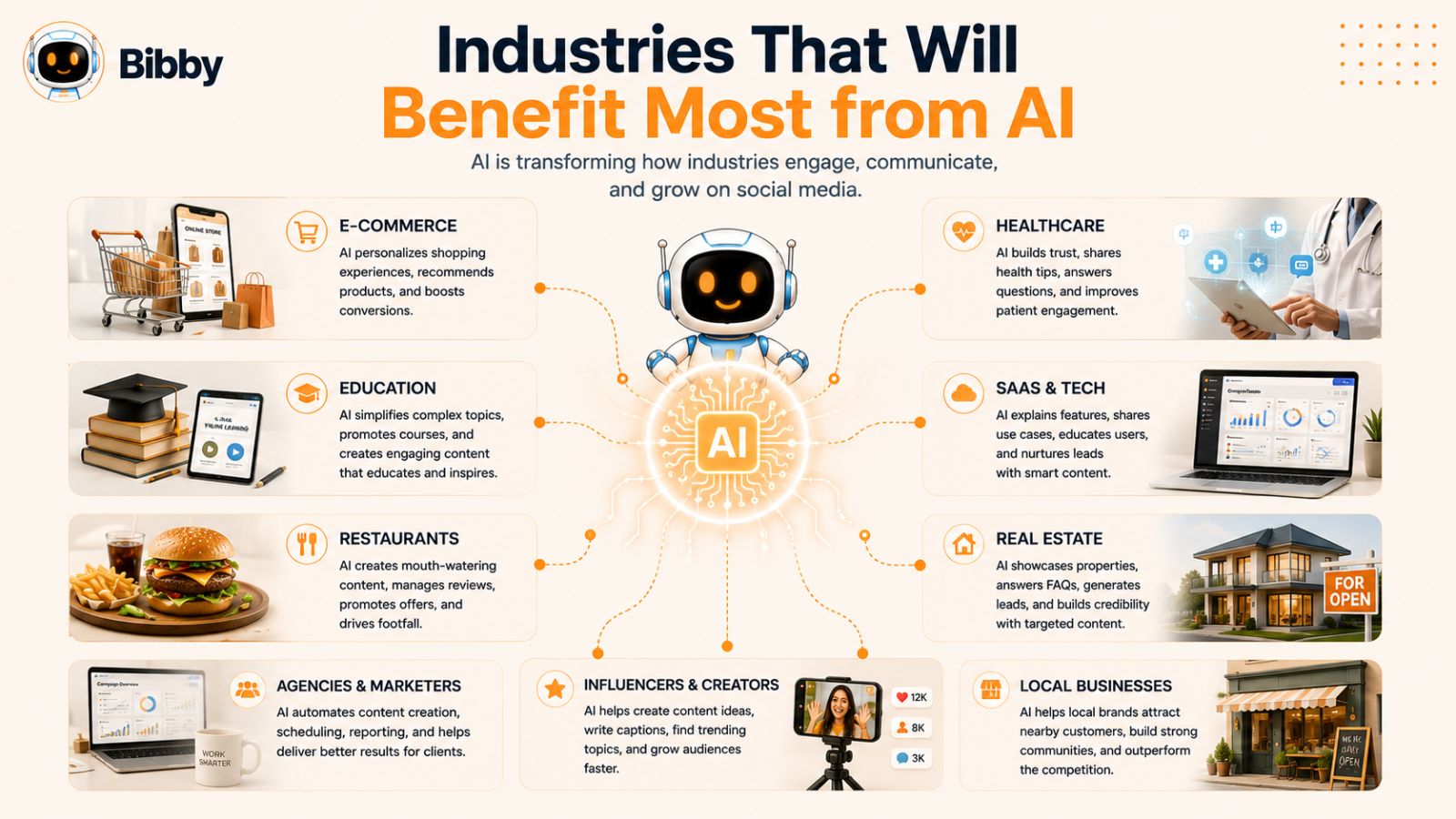
Artificial intelligence is changing the way organizations of every size approach social media marketing. While nearly every industry can benefit from AI-powered tools, some sectors stand to gain the most due to their need for frequent content creation, audience engagement, and multi-platform management. By automating repetitive tasks and providing data-driven insights, AI enables businesses to market more effectively while reducing the time and resources required to maintain a strong online presence.
E-commerce
E-commerce brands rely heavily on social media to showcase products, launch promotions, and drive online sales. AI helps create product descriptions, promotional captions, lifestyle images, and short-form videos while recommending the best times to publish content. It can also analyze customer behavior to deliver personalized product recommendations and improve conversion rates.
Marketing Agencies
Agencies often manage multiple clients across several social media platforms, making efficiency essential. AI streamlines content planning, caption generation, scheduling, reporting, and analytics, allowing teams to handle larger client portfolios without sacrificing quality. Automated workflows also free account managers to focus on strategy, campaign optimization, and client relationships.
SaaS Companies
Software companies use social media to educate potential customers, announce product updates, and generate leads. AI can help repurpose blog posts into engaging social content, identify trending industry topics, and analyze campaign performance to improve lead generation and customer engagement.
Healthcare and Wellness
Hospitals, clinics, fitness professionals, and wellness brands can use AI to maintain a consistent online presence while sharing educational content, health tips, and service updates. AI also helps schedule posts, monitor engagement, and answer frequently asked questions, allowing healthcare professionals to spend more time focusing on patient care.
Education and Online Learning
Educational institutions, online course creators, and training providers need to communicate with students across multiple channels. AI can assist with creating educational posts, promoting webinars, sharing success stories, and analyzing audience engagement to attract prospective learners and strengthen existing communities.
Real Estate
Real estate professionals depend on social media to showcase property listings, market local expertise, and build trust with potential buyers and sellers. AI simplifies the creation of listing posts, promotional videos, neighborhood highlights, and market updates while helping agents schedule content consistently and engage with prospective clients more effectively.
Restaurants and Hospitality
Restaurants, cafés, hotels, and travel businesses can use AI to promote seasonal menus, special offers, events, and customer experiences. Automated scheduling ensures promotions reach audiences at optimal times, while analytics reveal which campaigns drive the highest engagement and reservations.
Personal Brands and Influencers
Content creators and influencers face constant pressure to produce engaging content across multiple platforms. AI helps generate captions, edit videos, create visuals, identify trending topics, and schedule posts in advance. This allows creators to spend more time building authentic relationships with their communities while maintaining a consistent publishing schedule.
Local Businesses
Small businesses often have limited marketing budgets and lean teams. AI levels the playing field by automating content creation, scheduling, and performance tracking. Whether it's a local retail store, salon, gym, or professional service provider, AI enables small businesses to maintain a professional social media presence without requiring a dedicated marketing department.
Enterprises Managing Global Brands
Large organizations often oversee multiple brands, regions, and marketing teams. AI helps standardize workflows, maintain brand consistency, coordinate international campaigns, and analyze performance across different markets. This improves collaboration while ensuring marketing efforts remain aligned with business objectives.
A Unified AI Workflow for Every Industry
Regardless of the industry, one challenge remains the same: managing content efficiently across multiple social media platforms. Instead of juggling separate tools for design, caption writing, scheduling, publishing, and analytics, businesses increasingly prefer all-in-one AI solutions.
Bibby is designed around this streamlined approach. Users can upload an image or generate one using AI, choose a preferred posting style, and let AI automatically create captions that match their brand voice. From a single dashboard, they can schedule posts at AI-optimized times, publish content to Facebook, Instagram, LinkedIn, YouTube, and TikTok, share videos and stories, and monitor performance through built-in analytics. This simplified workflow helps businesses of every size save time, maintain consistency, and focus on growth rather than repetitive administrative tasks.
As AI technology continues to mature, organizations across every industry will have new opportunities to improve efficiency, personalize customer experiences, and scale their marketing efforts. Those that adopt AI strategically today will be better prepared to compete in the increasingly digital future of social media.
The Rise of AI Social Media Management Platforms
For years, social media management required marketers to juggle multiple tools. One platform was used to design graphics, another to write captions, another to schedule posts, and yet another to analyze performance. While each tool solved a specific problem, switching between multiple applications often slowed productivity, increased costs, and complicated collaboration.
Artificial intelligence is changing this model. Modern social media management platforms are evolving into comprehensive marketing hubs that combine content creation, automation, publishing, analytics, and optimization within a single workflow. Instead of piecing together several disconnected tools, businesses can now manage their entire social media strategy from one centralized platform.
One of the biggest advantages of these AI-powered platforms is streamlined content creation. Rather than starting every campaign from scratch, marketers can generate images, write captions, suggest hashtags, and create platform-specific content with AI assistance. This not only accelerates production but also helps maintain consistency across every social media channel.
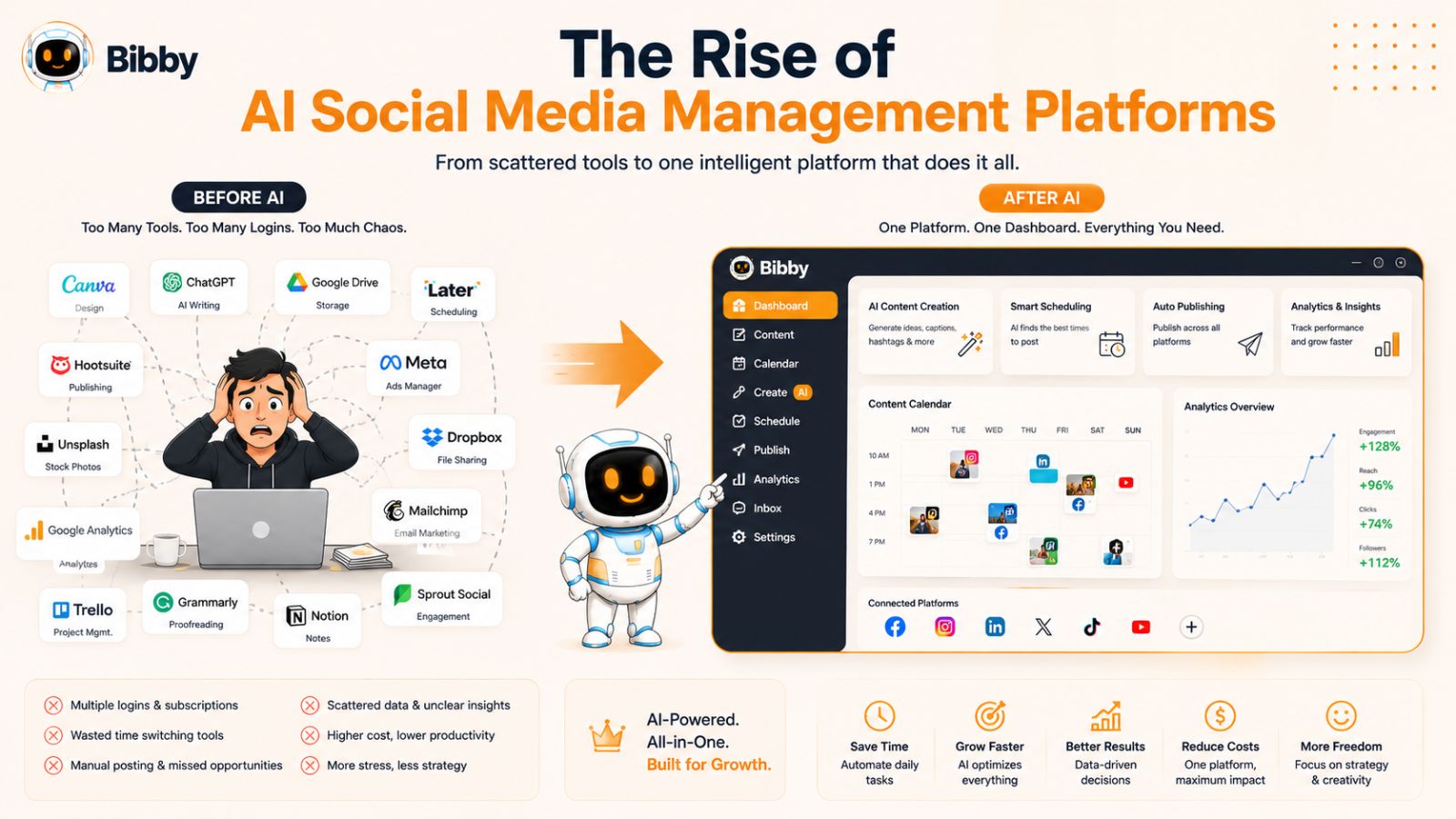
Automation is another defining feature. Businesses no longer need to manually publish every post or remember the best time to share content. AI analyzes audience behavior and recommends—or automatically selects—the optimal publishing times to maximize visibility and engagement. Campaigns can be planned days, weeks, or even months in advance, ensuring a consistent online presence without constant manual effort.
Centralized publishing has become equally important. As brands expand their presence across Facebook, Instagram, LinkedIn, YouTube, TikTok, and emerging platforms, managing each account individually becomes increasingly inefficient. Unified AI platforms enable marketers to publish content across multiple channels from a single dashboard while adapting posts to suit the unique requirements of each platform.
Analytics have also become more intelligent. Instead of presenting raw numbers alone, AI platforms can identify trends, highlight top-performing content, recommend improvements, and predict future performance. These insights help businesses continuously refine their strategies and make data-driven decisions without spending hours interpreting reports.
Collaboration is another area where integrated platforms deliver significant value. Marketing teams can manage content calendars, review drafts, approve campaigns, and monitor results together in one workspace. This reduces communication gaps and creates a more efficient workflow, particularly for agencies and organizations managing multiple brands or clients.
As AI capabilities continue to advance, these platforms are evolving from simple scheduling tools into intelligent marketing assistants. They not only help execute campaigns but also support strategic decision-making by recommending content ideas, identifying audience preferences, forecasting campaign performance, and uncovering new growth opportunities.
This shift reflects the future of social media marketing: fewer disconnected tools, greater automation, and smarter workflows powered by AI. Businesses that adopt integrated platforms can reduce manual work, improve consistency, and focus more on creativity and strategy rather than repetitive operational tasks.
Among the new generation of AI-powered social media platforms, Bibby stands out by combining simplicity with powerful automation. Instead of requiring users to navigate a complex collection of tools, Bibby brings content creation, AI assistance, scheduling, publishing, and analytics into one intuitive workflow. Whether you're a solo creator, a growing business, or a marketing agency, having every essential feature in one place makes it easier to manage campaigns, stay consistent, and scale your social media presence efficiently.
Also read: Social Media Automation for B2B Companies: The Complete Guide (2026) →
How Bibby Is Redefining AI-Powered Social Media Management
As AI becomes an essential part of social media marketing, businesses are looking for solutions that simplify the entire workflow instead of forcing them to switch between multiple applications. From content creation to scheduling and analytics, marketers want a platform that saves time without compromising quality. Bibby was built with exactly that goal in mind.
Unlike traditional scheduling tools that focus only on publishing posts, Bibby combines AI-powered content creation, automation, scheduling, and performance tracking into one seamless experience. Whether you're managing a single personal brand or dozens of client accounts, the platform is designed to make social media management faster, easier, and more efficient.
Step 1: Upload an Image or Generate One with AI
Every great social media post starts with compelling visuals. With Bibby, users can either upload their own images or generate original visuals using AI. This gives marketers the flexibility to work with existing brand assets or quickly create fresh content without relying on separate design software.
By integrating AI image generation directly into the workflow, Bibby helps reduce the time spent creating visual content while ensuring every post has a professional appearance.
Step 2: Choose Your Posting Style
Every brand has its own unique voice. A corporate LinkedIn post should sound different from a fun Instagram caption or an engaging TikTok description.
Bibby allows users to select a preferred posting style before generating content. Whether the goal is to educate, entertain, inspire, promote a product, or increase engagement, the platform adapts its AI-generated content to match the desired tone and communication style.
This helps businesses maintain a consistent brand identity across every social media channel.
Step 3: Let AI Generate Captions Automatically
Writing captions for multiple platforms every day can quickly become repetitive and time-consuming.
Bibby's AI automatically generates engaging captions based on the uploaded image, selected posting style, and campaign goals. Instead of starting from scratch, users receive ready-to-publish copy that can be used immediately or customized further to better match their brand voice.
This dramatically speeds up content production while helping maintain creativity and consistency.
Step 4: Schedule Content at AI-Optimized Times
Publishing content at the right moment can have a significant impact on reach and engagement.
Instead of relying on generic best-time-to-post recommendations, Bibby uses AI to help schedule content at optimized publishing times based on audience behavior. This allows businesses to maximize visibility while reducing the need for manual scheduling and constant monitoring.
Users can plan content days, weeks, or even months in advance, creating a reliable publishing schedule with minimal effort.
Step 5: Publish Everywhere from One Dashboard
Managing multiple social media platforms separately can quickly become overwhelming.
Bibby simplifies this process by allowing users to publish content across multiple networks from a single dashboard, including:
- YouTube
- TikTok
This centralized approach eliminates repetitive work and helps ensure a consistent presence across every platform.
Step 6: Publish More Than Just Posts
Modern social media marketing extends beyond standard image posts.
Bibby also supports publishing videos and stories, making it easier for businesses and creators to execute complete content strategies without switching between different applications. Whether you're promoting a new product, sharing behind-the-scenes content, or publishing short-form videos, everything can be managed within the same streamlined workflow.
Step 7: Measure Performance with Built-In Analytics
Publishing content is only part of a successful strategy. Understanding what works is equally important.
Bibby's analytics dashboard helps users monitor campaign performance, track engagement, evaluate audience growth, and identify which content delivers the best results. These insights make it easier to refine future campaigns and continuously improve social media performance.
A Complete AI Workflow That Saves Time
The true strength of Bibby lies in how seamlessly every feature works together. Instead of piecing together separate tools for image creation, caption writing, scheduling, publishing, and analytics, users can complete the entire process in one place.
The workflow is simple:
- Upload an image or generate one with AI.
- Choose your preferred posting style.
- Let AI create engaging captions automatically.
- Schedule content for AI-optimized publishing times.
- Publish across Facebook, Instagram, LinkedIn, YouTube, and TikTok.
- Share videos and stories from the same platform.
- Track performance with built-in analytics.
By removing repetitive tasks and combining essential marketing tools into one intuitive platform, Bibby allows creators, businesses, and agencies to spend less time managing social media and more time building their brand, engaging with their audience, and growing their business. As AI continues to shape the future of social media, integrated platforms like Bibby are making advanced automation accessible to everyone—regardless of team size or marketing experience.
Also read: How to Build a Winning Social Media User-Generated Content Strategy
What the Future of AI in Social Media Looks Like
Artificial intelligence has already transformed how businesses create, publish, and optimize social media content. However, the innovations we've seen so far are only the beginning. As AI models become more advanced and social platforms continue to evolve, the next generation of AI-powered marketing will be more autonomous, personalized, and intelligent than ever before.
AI Agents Will Manage Entire Campaigns
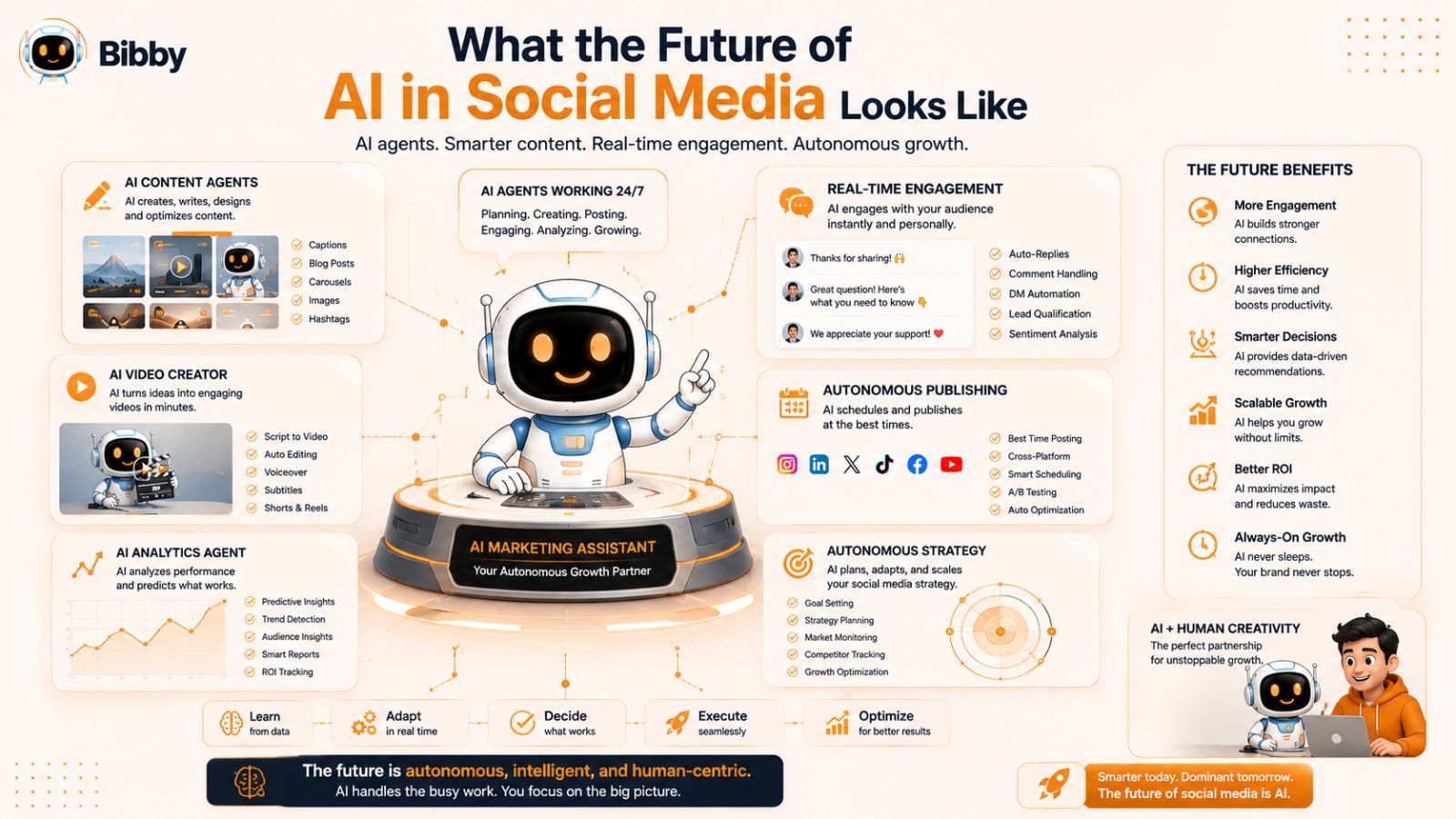
Today's AI tools help marketers with specific tasks such as writing captions or scheduling posts. In the near future, AI agents will be capable of managing entire social media campaigns from start to finish.
Imagine describing your marketing goal—such as promoting a new product launch or increasing brand awareness—and having an AI agent generate a content calendar, create images and videos, write captions, schedule posts, monitor engagement, and continuously optimize the campaign based on real-time performance. Human marketers will still guide the overall strategy, but AI will handle much of the execution.
Real-Time Personalization at Scale
Personalization will become even more sophisticated. Instead of creating a single version of a post for everyone, AI will dynamically adapt content based on individual user preferences, browsing behavior, location, language, and previous interactions.
This means two people could see the same campaign but receive different headlines, visuals, or calls to action that are most relevant to their interests. As a result, businesses can create more meaningful customer experiences while improving engagement and conversion rates.
Smarter Predictive Marketing
Future AI systems won't just analyze historical performance—they'll anticipate future opportunities. By monitoring market trends, competitor activity, seasonal patterns, and audience behavior, AI will recommend campaign ideas before trends become mainstream.
Marketers will spend less time reacting to changes and more time capitalizing on emerging opportunities, giving businesses a valuable competitive advantage.
AI-Generated Video Will Become the Standard
Video already dominates social media, and AI will accelerate its growth even further. Creating professional-quality videos will become faster and more accessible through AI-generated scripts, voiceovers, animations, subtitles, editing, and visual effects.
Businesses will be able to produce engaging content for platforms like TikTok, Instagram Reels, YouTube Shorts, and Facebook with significantly less time and production cost, making high-quality video marketing achievable for organizations of every size.
Voice and Conversational AI Will Continue to Grow
As voice assistants and conversational AI become more capable, brands will find new ways to interact with audiences. AI-powered virtual assistants may answer customer questions, guide purchasing decisions, and provide personalized recommendations directly through social media messaging platforms.
These conversational experiences will help businesses deliver faster support while creating more natural and engaging customer interactions.
Intelligent Automation Will Replace Repetitive Work
Many of today's repetitive marketing tasks will become almost entirely automated. AI will coordinate publishing schedules, generate multiple content variations, monitor campaign performance, identify underperforming posts, and recommend improvements without requiring constant manual input.
Rather than replacing marketing professionals, this automation will allow them to focus on creative direction, brand storytelling, customer relationships, and long-term business strategy.
AI Will Become a Creative Partner
One of the biggest misconceptions about artificial intelligence is that it replaces human creativity. In reality, the future points toward collaboration rather than replacement.
AI will act as a creative assistant by generating ideas, exploring different messaging approaches, and accelerating production. Human marketers will continue to provide originality, emotional intelligence, strategic thinking, and cultural understanding—qualities that technology cannot fully replicate.
Platforms Like Bibby Represent the Next Generation
The future of AI in social media isn't just about smarter algorithms—it's about creating seamless workflows that combine multiple capabilities into one intelligent platform.
Solutions like Bibby are already moving in this direction by integrating AI-assisted content creation, caption generation, image generation, scheduling, multi-platform publishing, and analytics into a single workflow. As AI technology advances, platforms like Bibby are expected to become even more intelligent, helping users not only automate routine tasks but also recommend content ideas, optimize campaigns in real time, and support strategic decision-making.
The Future Belongs to Businesses That Embrace AI
The next decade of social media marketing will be defined by businesses that successfully combine human creativity with artificial intelligence. Organizations that adopt AI responsibly will produce better content, respond faster to changing trends, personalize customer experiences, and scale their marketing efforts more efficiently than ever before.
The future of AI in social media is not about replacing people—it's about empowering marketers, creators, and businesses with smarter tools that eliminate repetitive work and unlock new levels of creativity, productivity, and growth.
Also read: The Complete Guide to Cross-Posting on Social Media
How Businesses Can Prepare for the AI Future
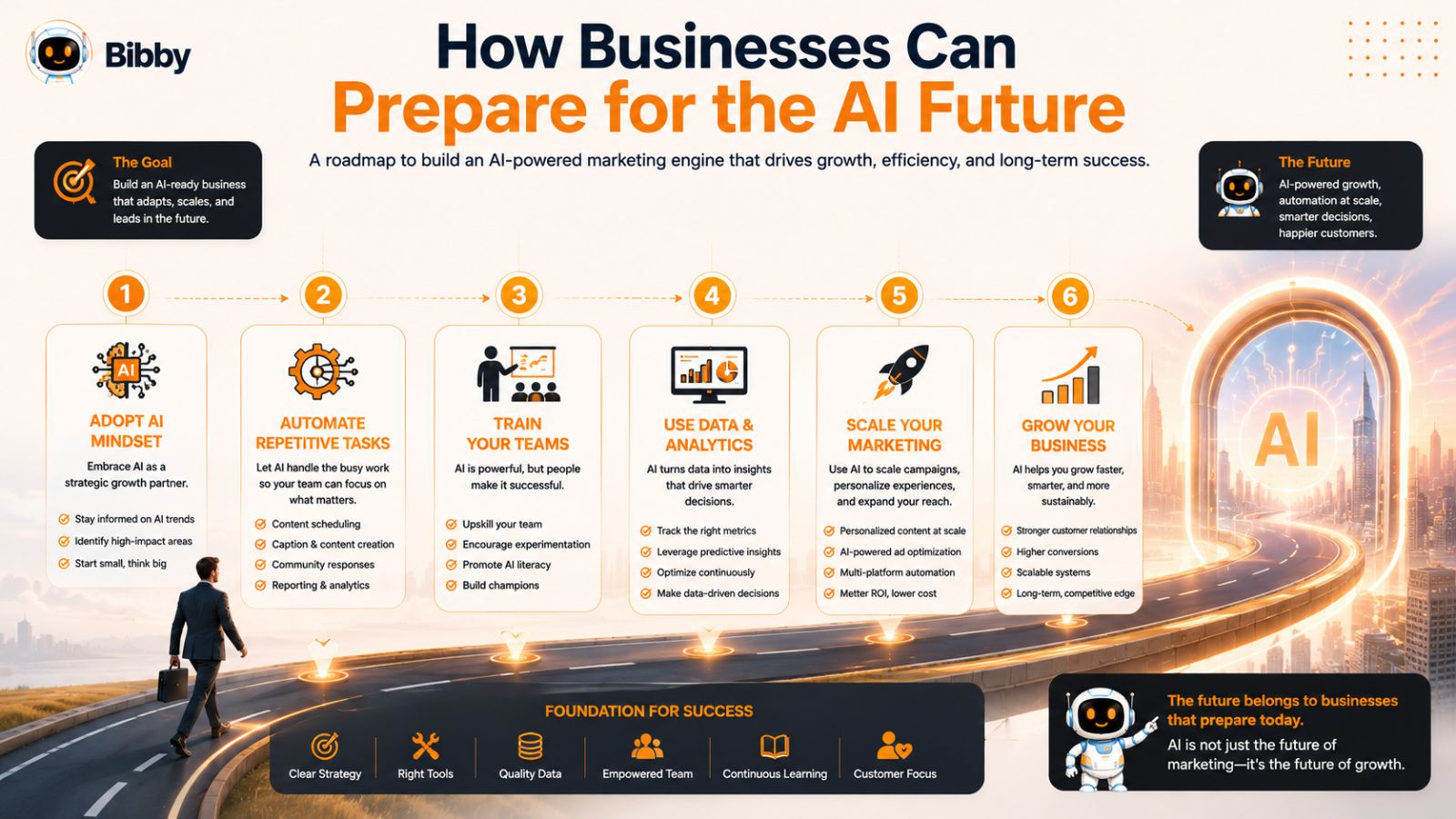
The future of AI in social media isn't something businesses need to wait for—it's already here. Every day, companies are using AI to create content, automate publishing, analyze performance, and build stronger relationships with their audiences. The organizations that start adopting AI today will be better prepared to adapt as the technology becomes even more capable.
The good news is that preparing for the AI future doesn't require replacing your existing marketing team or completely changing your strategy. Instead, it's about using AI to enhance your team's productivity and help them work smarter.
Start with Repetitive Tasks
One of the easiest ways to adopt AI is by automating routine activities that consume valuable time.
These tasks include:
- Writing social media captions
- Generating content ideas
- Scheduling posts
- Publishing across multiple platforms
- Creating performance reports
- Organizing content calendars
By allowing AI to handle these repetitive responsibilities, your team can focus on strategic planning, creativity, and customer engagement.
Invest in an All-in-One AI Platform
Using separate tools for image creation, caption writing, scheduling, publishing, and analytics can quickly become inefficient as your business grows.
Instead, consider adopting an integrated platform that combines these capabilities into one workflow. A unified solution reduces complexity, improves collaboration, and minimizes the time spent switching between applications.
For example, Bibby enables businesses to upload or generate AI images, automatically create captions, schedule content at AI-optimized times, publish across Facebook, Instagram, LinkedIn, YouTube, and TikTok, and analyze campaign performance—all from a single dashboard. This integrated approach allows teams to spend more time creating impactful campaigns instead of managing multiple software tools.
Keep Humans at the Center
Although AI is becoming increasingly powerful, it works best when paired with human expertise.
People still bring creativity, empathy, storytelling, cultural understanding, and strategic thinking that AI cannot fully replicate. Businesses should view AI as a collaborative assistant rather than a replacement for marketers, designers, or content creators.
The strongest marketing campaigns will continue to combine AI-driven efficiency with authentic human creativity.
Train Your Team to Work with AI
Adopting AI isn't only about choosing the right software—it's also about developing the right skills.
Encourage your marketing team to learn how AI tools work, experiment with different prompts, analyze AI-generated recommendations, and understand when human judgment is needed. As AI becomes a standard part of marketing workflows, these skills will become increasingly valuable.
Organizations that invest in AI education today will be better positioned to adapt to future innovations.
Use Data to Improve Every Campaign
AI produces valuable insights, but those insights only create value when they are put into action.
Regularly review analytics to identify:
- Top-performing content
- Audience engagement trends
- Best publishing times
- High-performing platforms
- Content formats that drive results
Using this information to refine future campaigns creates a cycle of continuous improvement that helps businesses grow more efficiently over time.
Stay Flexible as AI Evolves
Artificial intelligence is advancing at an extraordinary pace. New features, models, and automation capabilities are introduced every year, making it important for businesses to remain adaptable.
Rather than chasing every new trend, focus on adopting technologies that solve real business challenges, improve customer experiences, and support long-term marketing goals.
A flexible mindset will make it easier to integrate future AI innovations as they emerge.
Build Trust Through Responsible AI
As businesses increase their use of AI, maintaining customer trust becomes even more important.
Be transparent about how AI is used, protect customer data, review AI-generated content for accuracy, and ensure automated interactions remain helpful and respectful. Responsible AI practices not only reduce risks but also strengthen your brand's credibility and reputation.
The Future Starts Today
The businesses that succeed in the next generation of social media marketing won't necessarily be those with the largest budgets—they'll be the ones that adapt the fastest.
By embracing AI-powered automation, investing in integrated platforms like Bibby, developing human expertise alongside AI capabilities, and continuously learning from data, organizations can create more engaging content, improve efficiency, and build stronger relationships with their audiences.
The future of AI in social media belongs to businesses that see artificial intelligence not as a replacement for people, but as a powerful partner that enables smarter marketing, better decision-making, and sustainable growth.
Also read: Social Media Automation for Franchises and Multi-Location Businesses
Frequently Asked Questions
1. What is the future of AI in social media?
The future of AI in social media is centered on automation, personalization, and intelligent decision-making. AI will help businesses create content, generate images and videos, write captions, schedule posts at optimal times, analyze audience behavior, and deliver personalized experiences across multiple platforms. As AI continues to evolve, it will become an essential partner for marketers rather than simply a productivity tool.
2. Will AI replace social media managers?
No. AI is designed to enhance the work of social media managers, not replace them. While AI can automate repetitive tasks like content generation, scheduling, analytics, and reporting, human creativity, strategic thinking, storytelling, and relationship-building remain essential for successful social media marketing. The most effective teams will combine human expertise with AI-powered tools.
3. How does AI help with social media marketing?
AI helps businesses create content faster, generate captions, produce images and videos, schedule posts, analyze campaign performance, identify audience trends, optimize publishing times, and improve customer engagement. These capabilities save time while enabling marketers to make more informed, data-driven decisions.
4. Can AI create social media content automatically?
Yes. Modern AI tools can generate captions, hashtags, blog summaries, images, videos, and content ideas based on a few simple inputs. Many AI-powered platforms also allow users to customize the tone, style, and purpose of the content before publishing.
5. What are the benefits of AI-powered social media scheduling?
AI-powered scheduling goes beyond selecting a date and time for a post. It analyzes audience activity and engagement patterns to recommend or automate publishing at the times most likely to generate reach and interaction. This helps businesses maintain consistency while improving overall campaign performance.
6. Which social media platforms use AI?
Most major social media platforms rely heavily on artificial intelligence, including Facebook, Instagram, LinkedIn, TikTok, YouTube, X (formerly Twitter), Pinterest, and Snapchat. AI is used to personalize content feeds, recommend videos, moderate content, detect spam, improve advertising, and deliver more relevant user experiences.
7. What is the best AI tool for social media management?
The ideal AI tool depends on your business goals and workflow. Many businesses prefer all-in-one platforms that combine content creation, caption generation, scheduling, publishing, and analytics in one place. Bibby is designed with this approach, allowing users to upload or generate AI images, automatically create captions, schedule posts at AI-optimized times, publish across Facebook, Instagram, LinkedIn, YouTube, and TikTok, and monitor performance through a unified dashboard.
8. Can AI schedule posts across multiple social media platforms?
Yes. Many modern AI-powered social media management platforms allow users to schedule and publish content across multiple platforms from a single dashboard. This saves time, ensures consistent publishing, and simplifies campaign management for businesses, agencies, and creators.
9. Is AI-generated content good for SEO?
AI-generated content can perform well in search engines when it is accurate, original, valuable, and written with the reader in mind. Search engines prioritize helpful, high-quality content rather than how it was created. Human review and editing remain important to ensure factual accuracy, clarity, and a unique perspective.
10. How can small businesses use AI for social media?
Small businesses can use AI to generate content ideas, create captions, design images, schedule posts, monitor analytics, respond to customer inquiries, and manage multiple social media accounts more efficiently. By automating repetitive tasks, AI enables small teams to maintain a professional online presence while focusing on serving customers and growing their business.
Conclusion
Artificial intelligence is redefining the future of social media by making content creation faster, marketing more personalized, and campaign management more efficient. Businesses that embrace AI today can save valuable time through automation, make smarter decisions with data-driven insights, and build stronger connections with their audiences through more relevant and engaging content.
The next generation of social media marketing won't be driven by AI alone—it will be powered by the combination of human creativity and intelligent automation. Platforms like Bibby demonstrate how this future is already becoming a reality by bringing AI image generation, automatic caption writing, AI-optimized scheduling, multi-platform publishing, video and story management, and analytics together in one simple workflow.
As AI continues to evolve, the businesses that learn to use these technologies strategically will be best positioned to grow their online presence and stay ahead of the competition.
If you're ready to take the next step, explore how to build a complete AI-powered social media strategy—from content planning and automation to performance optimization—to maximize the results of every campaign you publish.