
An AI social media manager helps businesses, creators, and marketing teams create, schedule, publish, and analyze social media content faster with the help of artificial intelligence.
For anyone trying to stay active on Facebook, Instagram, LinkedIn, YouTube, tiktok, and other platforms, the hardest part is not just posting—it is creating the right content, resizing it correctly, writing strong captions, choosing the best time to publish, and understanding what works. This guide explains how AI social media management works, why it is becoming essential for modern brands, and how tools like Bibby simplify the entire workflow from image creation to automated scheduling and analytics.
In this article, you will learn:
- What an AI social media manager actually does
- How AI automates captions, scheduling, and analytics
- How Bibby simplifies multi-platform social media management
Let’s start by breaking down what an AI social media manager is and why it matters.
What Is an AI Social Media Manager?
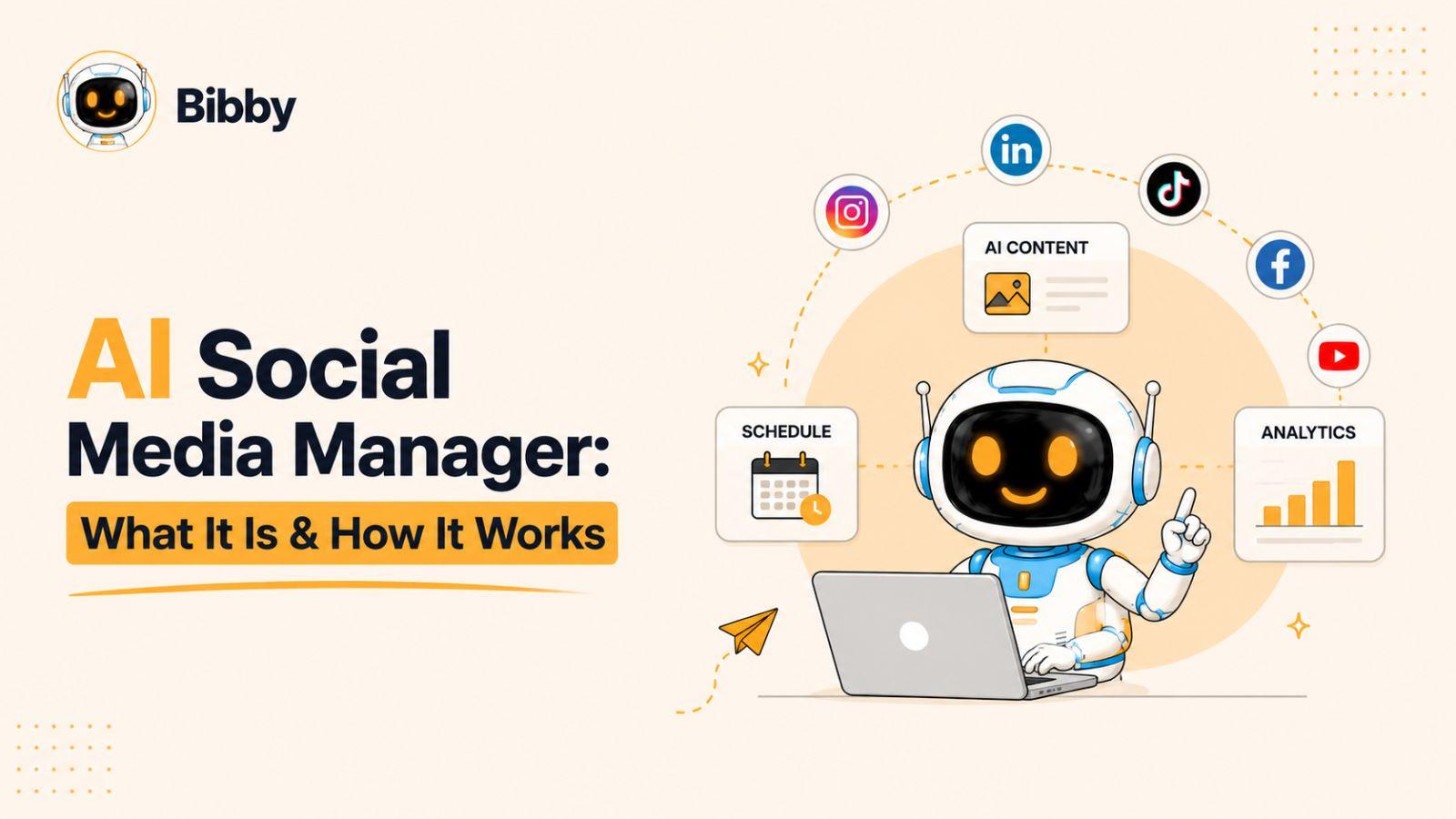
An AI social media manager is a software tool that uses artificial intelligence to help plan, create, schedule, publish, and analyze social media content across multiple platforms.
Instead of manually resizing every image, writing every caption from scratch, choosing posting times by guesswork, and checking performance platform by platform, an AI social media manager brings those tasks into a faster, more automated workflow. It can help with content creation, caption generation, post formatting, publishing schedules, performance tracking, and sometimes even AI image generation.
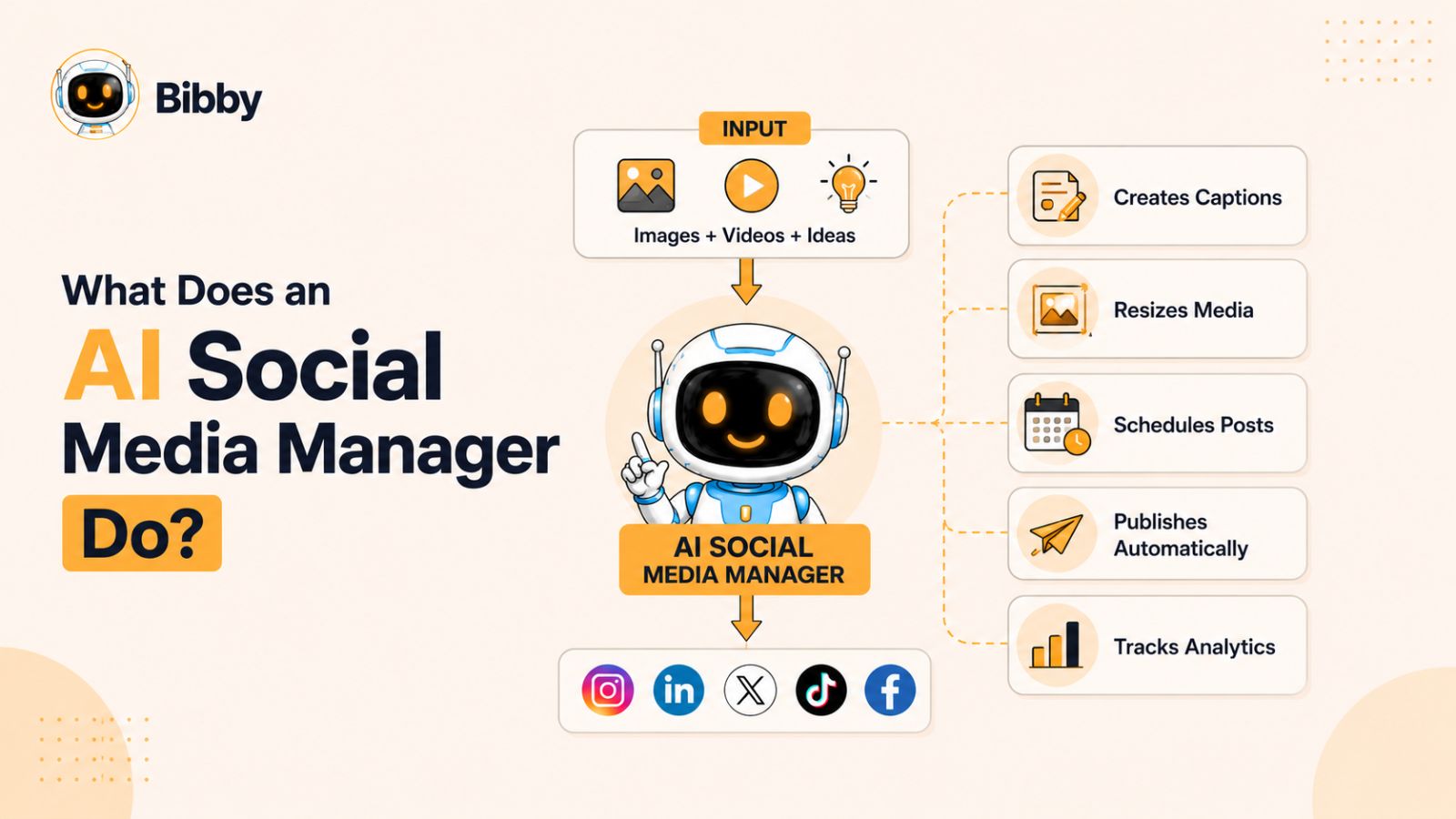
For businesses, creators, agencies, and small marketing teams, this matters because social media management has become much more complex than it used to be. A single campaign may need different versions for Instagram posts, Instagram Stories, Facebook, LinkedIn, TikTok, YouTube Shorts, and more. Each platform has its own content style, audience expectations, media sizes, and ideal posting behavior.
That is where AI becomes useful. An AI social media manager does not simply publish posts. It helps reduce the manual work behind the post.
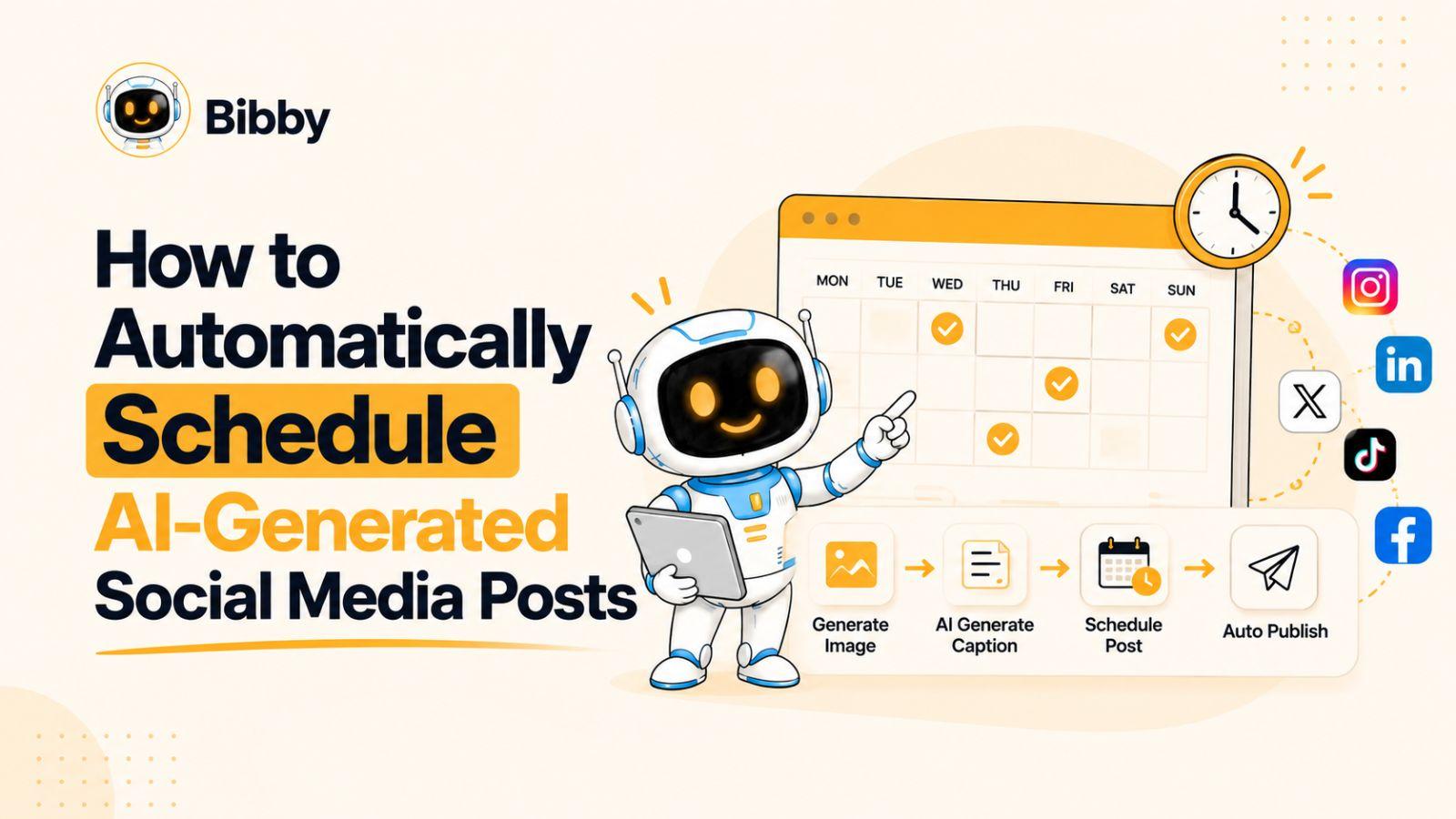
For example, a tool like Bibby is designed to simplify the social media workflow by helping users upload an image or generate one with AI, choose a posting style, automatically generate captions, schedule media on different dates, publish at AI-optimized times, and review analytics afterward. It also takes care of social media platform sizes, which removes one of the most repetitive parts of preparing content for multiple channels.
AI Social Media Manager vs. Traditional Social Media Scheduler
A traditional social media scheduler mainly helps users upload content, select a date and time, and publish posts automatically. This is useful, but it only solves one part of the social media management process.
An AI social media manager goes further by helping with the creative and strategic steps before and after publishing.
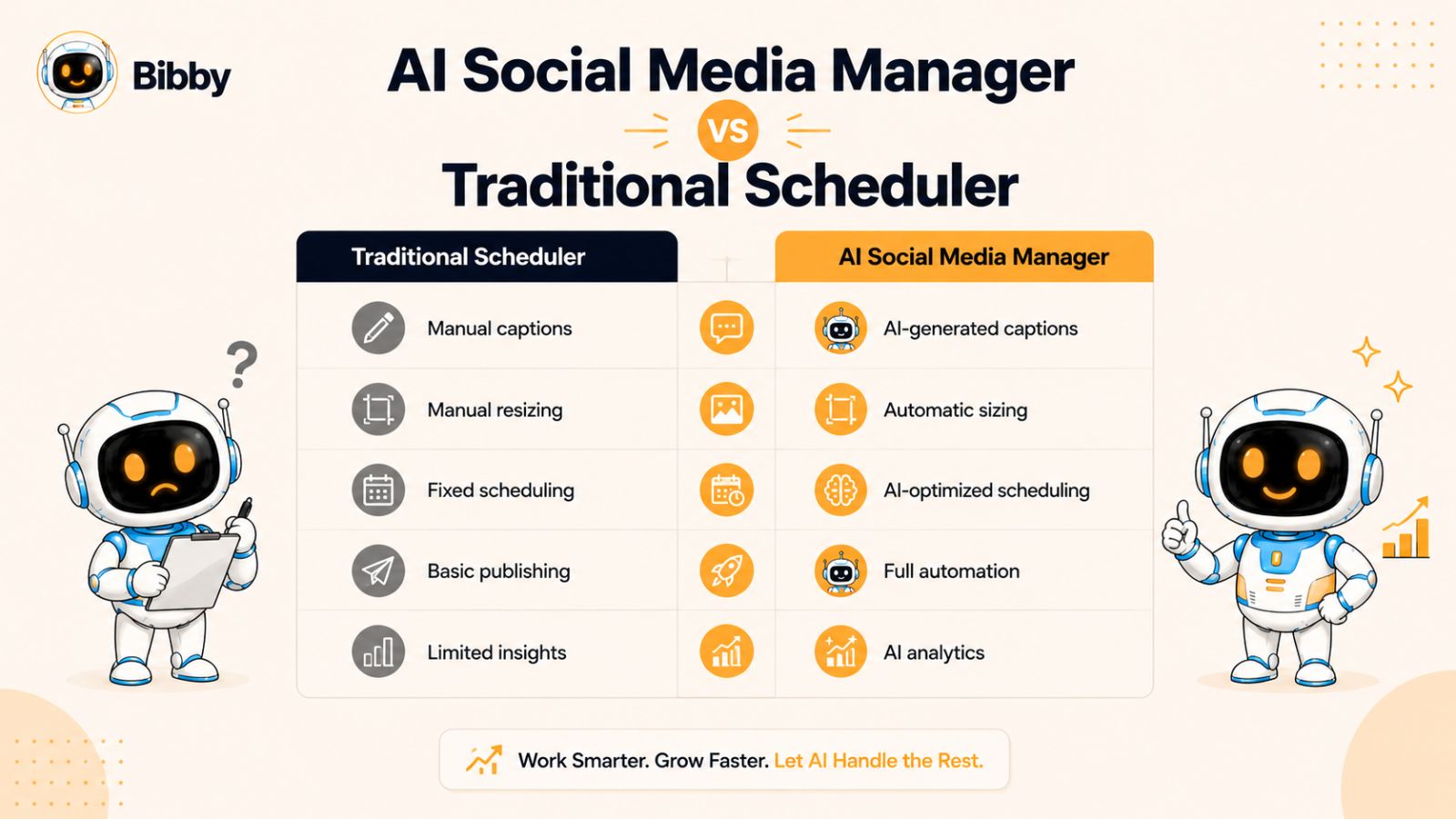
A traditional scheduler may help you post a finished Instagram image next Tuesday at 10 a.m. An AI social media manager may help you create or prepare the image, resize it for multiple platforms, write captions in different tones, suggest or apply optimized posting times, schedule the content across channels, and analyze how it performed.
The difference is important because modern social media management is not just about posting more. It is about producing better content more consistently with less manual effort.
Does an AI Social Media Manager Replace a Human Social Media Manager?
An AI social media manager can automate many repetitive tasks, but it does not fully replace a human social media manager.
AI is helpful for speed, structure, and workflow automation. It can generate caption drafts, resize content, organize schedules, recommend posting times, and surface analytics. However, humans are still needed for brand strategy, creative direction, audience understanding, campaign planning, community management, and final approval.
This is especially important for brands that care about trust and reputation. AI can help create content faster, but a person should still review captions for accuracy, tone, context, and brand fit before anything goes live.
The best approach is not human versus AI. It is human plus AI.
A human social media manager can decide what the brand should say, who it should speak to, and what goals the content should support. An AI social media manager can then help execute that plan faster by handling the repetitive tasks that usually slow the process down.
Why Social Media Management Has Become So Complicated
Social media management used to be simple: write a caption, upload a photo, and publish it.
Today, that workflow is much harder.
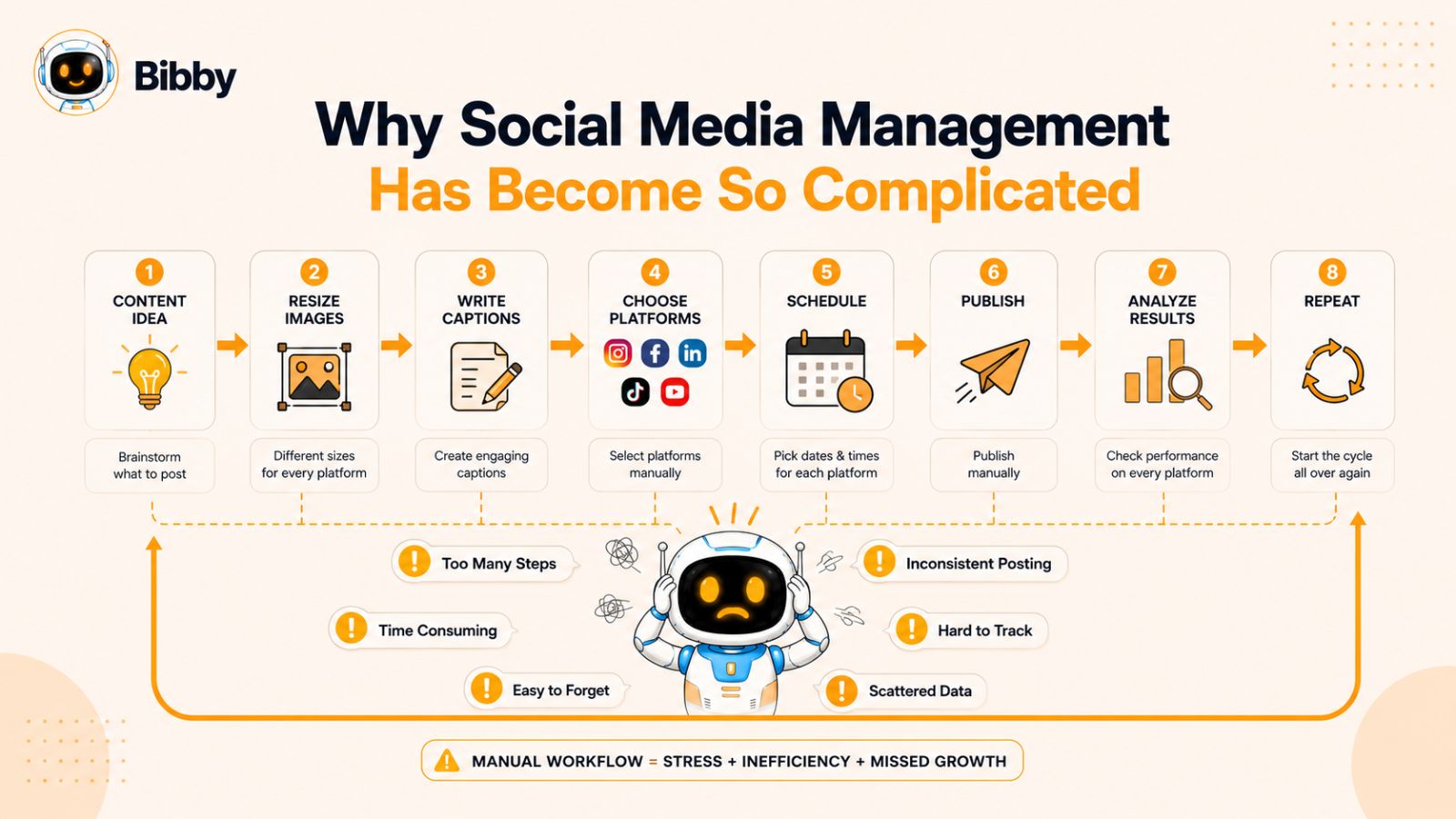
A brand may need to post on Facebook, Instagram, LinkedIn, YouTube, TikTok, and other platforms just to stay visible. But each platform has different content formats, audience expectations, caption styles, image sizes, video requirements, and posting behaviors. What works well on LinkedIn may feel too formal for TikTok. What looks perfect on Instagram may need to be resized or reformatted before it works as a YouTube Short, Facebook post, or story.
This is why social media management has become one of the most time-consuming parts of digital marketing. It is no longer just about posting content. It is about preparing the right version of that content for the right platform, publishing it at the right time, and then reviewing the data to understand what should happen next.
For creators, small businesses, agencies, and marketing teams, that can quickly become overwhelming.
An AI social media manager helps solve this by bringing content creation, formatting, caption writing, scheduling, publishing, and analytics into one streamlined workflow. Instead of jumping between multiple apps and manually adjusting every post, users can use AI to reduce repetitive work and manage their social presence more efficiently.
Different Platforms Require Different Content Formats
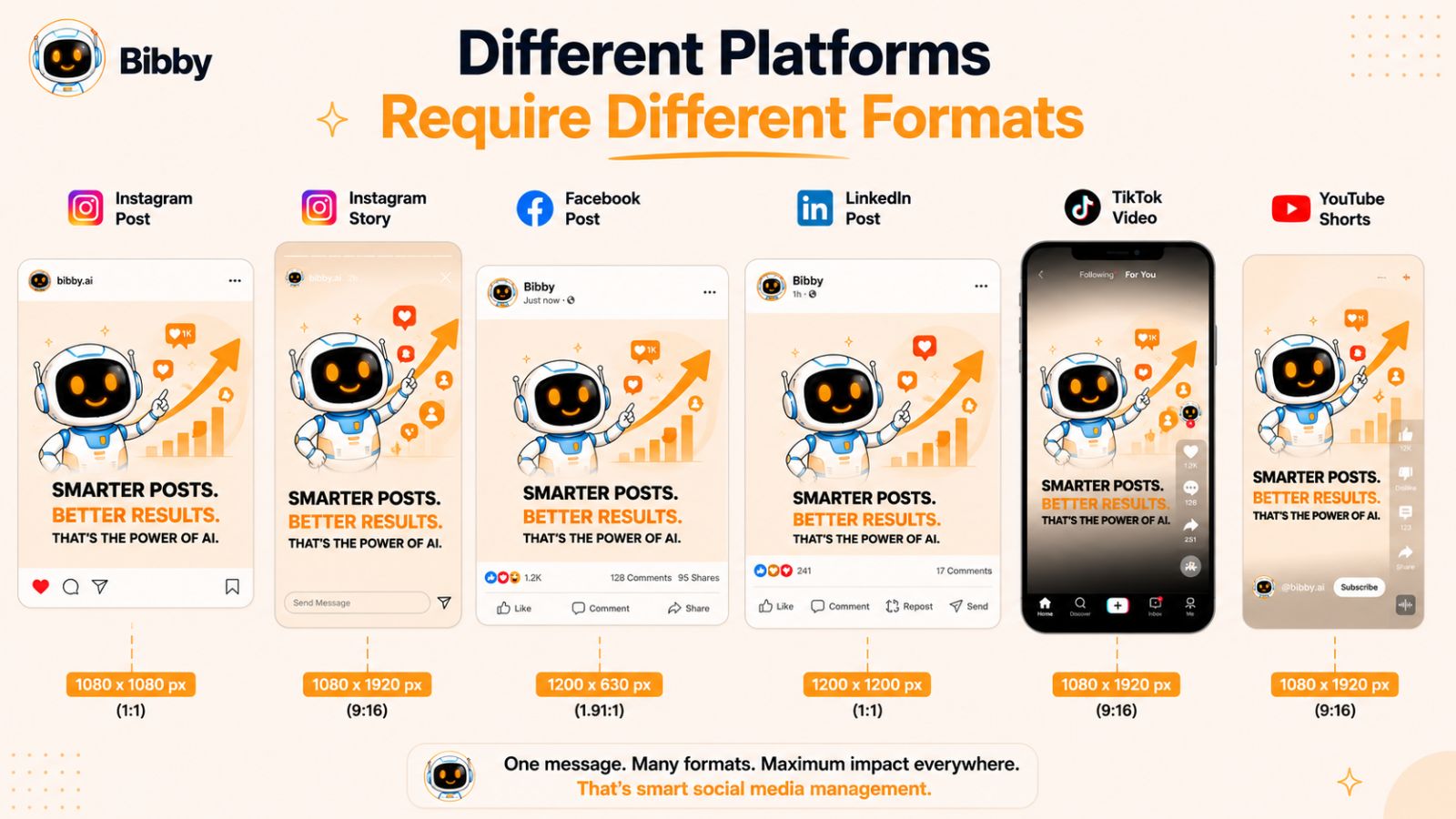
One of the biggest challenges in social media management is that every platform has its own format rules.
Instagram feed posts, Instagram Stories, Reels, TikTok videos, YouTube Shorts, Facebook posts, and LinkedIn updates all require different creative decisions. Some formats work best vertically. Others may need square, landscape, or platform-specific dimensions. Some posts need short captions. Others perform better with a more detailed explanation or professional tone.
This creates a lot of extra work.
A single image or video often needs to be resized, cropped, reformatted, and rewritten before it can be used across multiple platforms. Without the right workflow, a simple post can turn into a long production process.
This is one reason tools like Bibby are valuable. Bibby helps take care of the sizes for different social media platforms, so users do not have to manually resize every piece of content before publishing. That makes it easier to create once and prepare content for Facebook, Instagram, LinkedIn, YouTube, TikTok, and other selected platforms.
For busy teams, this can save hours of repetitive formatting work every month.
Captions Need to Match Platform and Audience
Captions are another reason social media management has become more complicated.
A strong LinkedIn caption usually needs to sound professional, thoughtful, and useful. An Instagram caption may need to be more visual, emotional, or lifestyle-driven. A TikTok caption often works better when it is short, direct, and attention-grabbing. Facebook captions may need to encourage discussion, comments, or shares.
Using the exact same caption everywhere can make a brand feel disconnected from the platform it is posting on.
An AI social media manager can help by generating captions based on the media, selected posting style, target platform, and audience. This does not remove the need for human review, but it does remove the pressure of writing every caption from a blank page.
With Bibby, users can choose their posting style, and the tool generates captions automatically. This makes the workflow faster while still giving users the opportunity to review, edit, and approve the final content before it is scheduled.
Posting at the Right Time Matters
Even strong content can underperform if it is posted when the audience is inactive.
Timing is not the only factor that affects social media performance, but it can influence how quickly a post gets seen, clicked, liked, shared, or commented on. For brands managing several platforms, choosing the right time manually can become difficult because audience behavior may vary from channel to channel.
An AI social media scheduler helps reduce that guesswork.
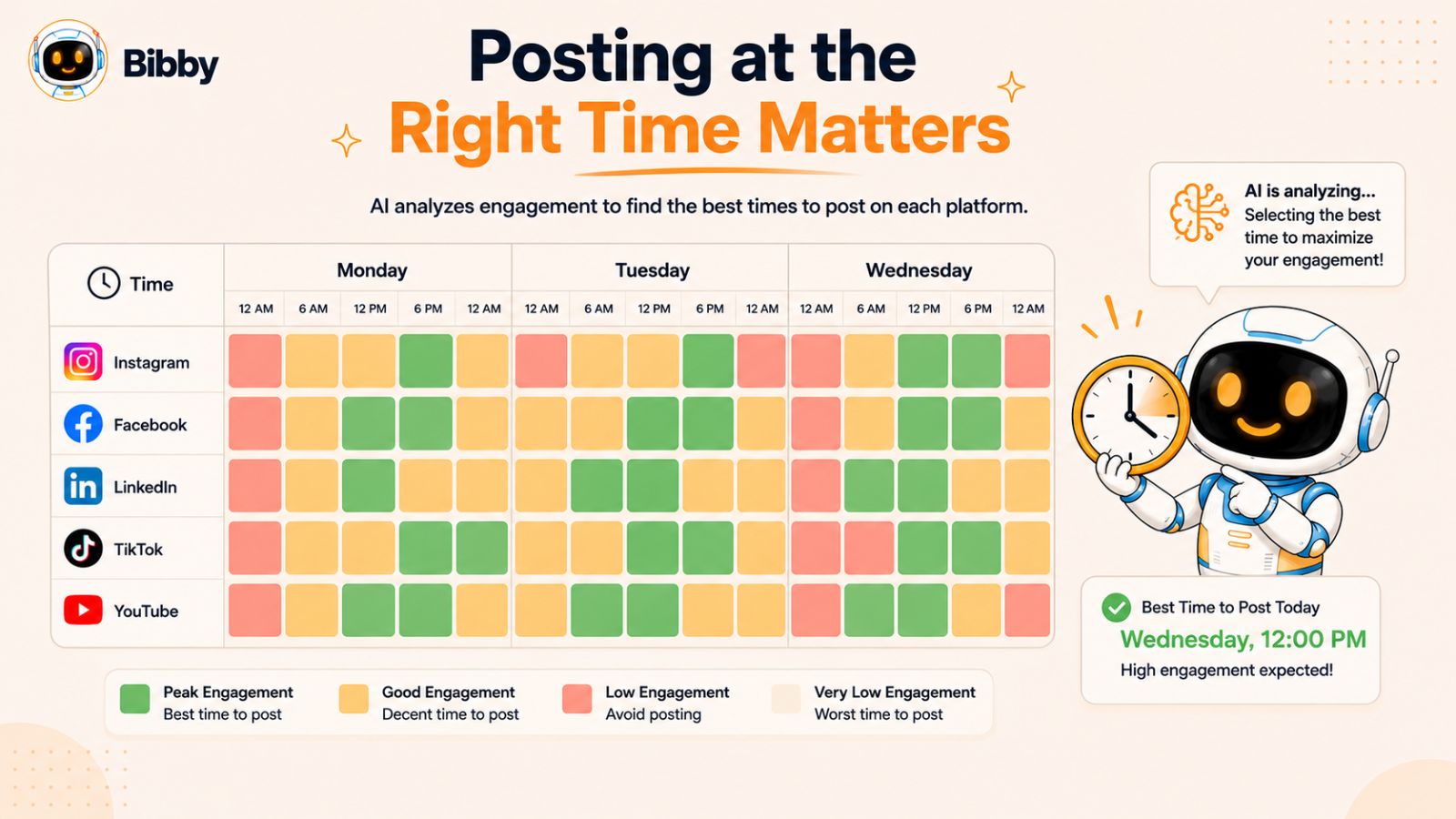
Instead of manually choosing dates and times for every post, AI can help identify better posting windows based on available data and engagement patterns. This allows users to schedule content more strategically without spending extra time analyzing every platform by hand.
Bibby supports this kind of simplified workflow by scheduling media on different dates at AI-optimized times across selected platforms such as Facebook, Instagram, LinkedIn, YouTube, and TikTok. For creators, agencies, and small businesses, this means they can plan ahead, stay consistent, and spend less time worrying about when to post.
Also read: 15 Social Media Scheduling Hacks Every Small Business Owner Should Know →
How an AI Social Media Manager Worksd
At its core, an AI social media manager is designed to automate the most repetitive parts of managing social media while giving users more control over their content strategy.
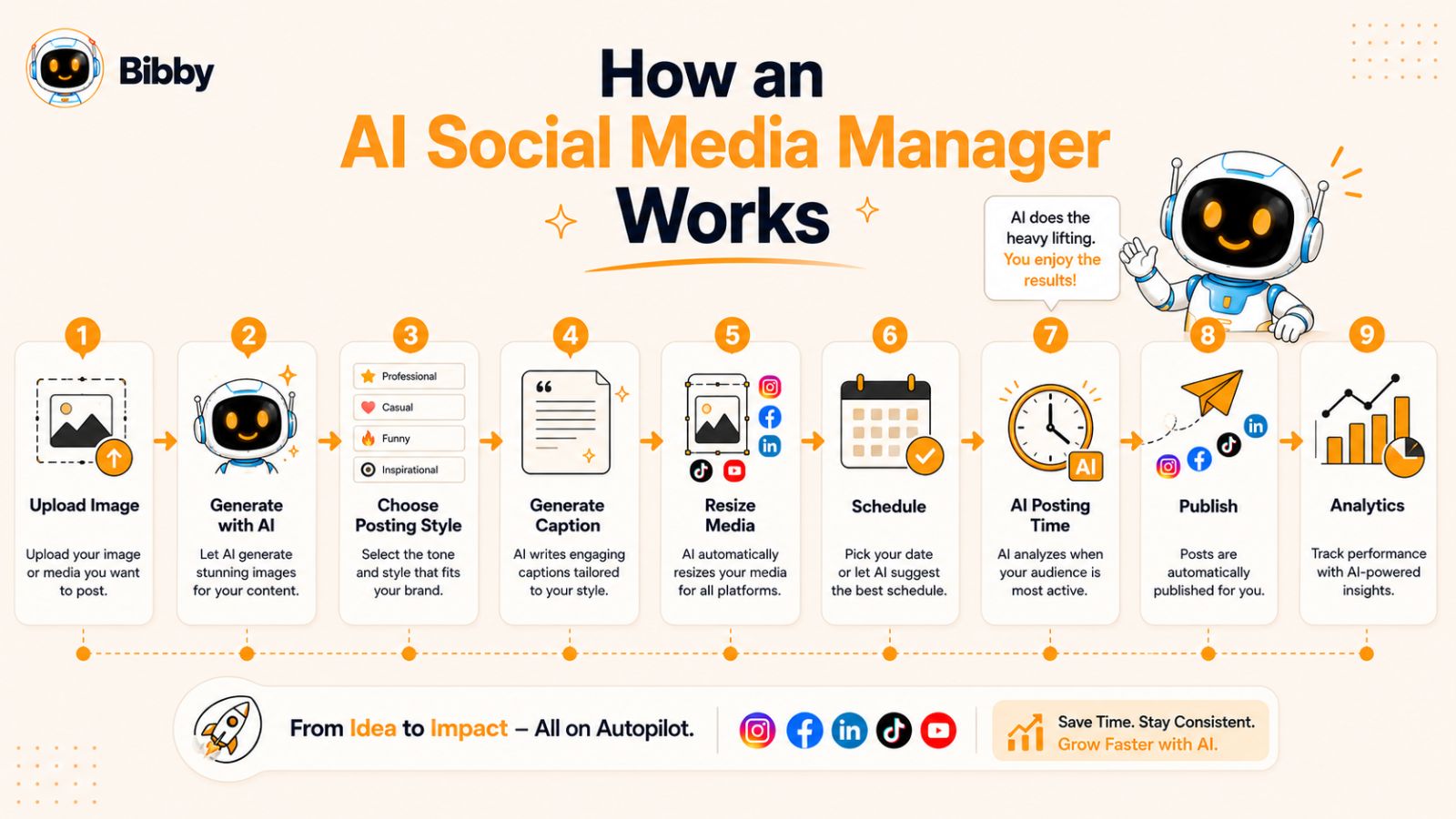
Rather than switching between design software, AI writing tools, scheduling platforms, and analytics dashboards, an AI-powered workflow brings everything together in one place. From creating content to publishing it across multiple platforms, the goal is to reduce manual effort without sacrificing quality.
While different tools offer different features, most AI social media managers follow a similar workflow. Below is a step-by-step look at how the process typically works.
Step 1: Upload or Generate Your Creative
Every social media post starts with content.
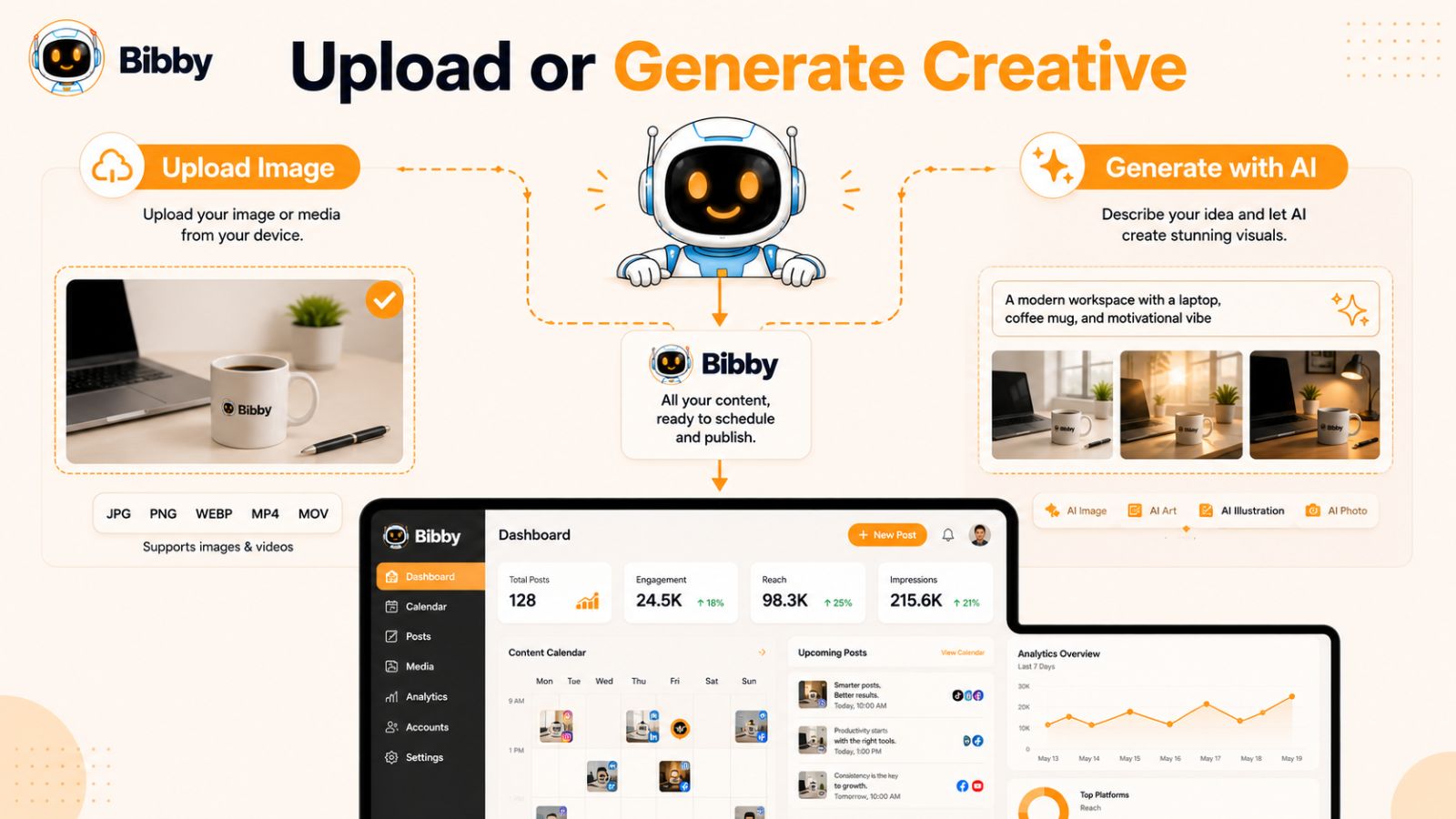
This could be an image, video, product photo, promotional graphic, infographic, or any other creative asset. If you already have media prepared, you can simply upload it. If not, many modern AI tools also allow you to generate images using artificial intelligence, making it easier to create content even without graphic design experience.
Starting with high-quality visuals is important because they are often the first thing people notice while scrolling through their feeds. Strong visuals capture attention, encourage engagement, and improve the overall effectiveness of a post.
With Bibby, users can either upload their own image or generate one with AI, making content creation faster and more accessible for businesses, creators, and marketers.
Step 2: Automatically Resize Content for Each Platform
One of the biggest frustrations in social media management is preparing content for multiple platforms.
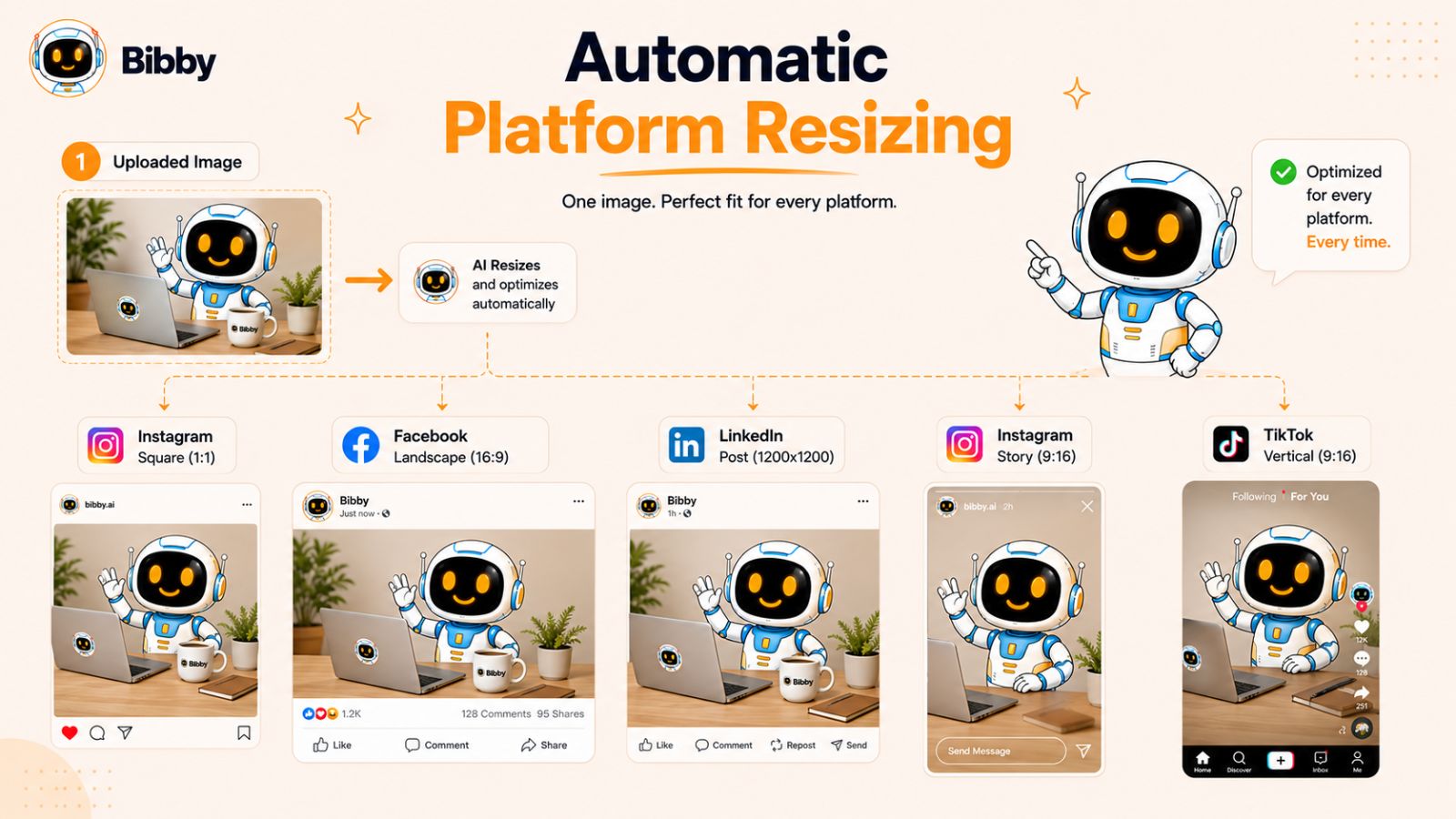
Each network has its own recommended image dimensions, aspect ratios, and video formats. A design that looks perfect on Instagram may require adjustments before it fits Facebook, LinkedIn, YouTube, or TikTok.
Manually resizing every piece of content can quickly become repetitive, especially when publishing regularly across several channels.
An AI social media manager helps simplify this process by adapting content for different platforms automatically.
Bibby takes care of social media platform sizes, allowing users to prepare one image or video for multiple destinations without manually creating separate versions for each platform. This not only saves time but also helps maintain a consistent brand appearance across every channel.
Step 3: Choose a Posting Style
Not every social media post should sound the same.
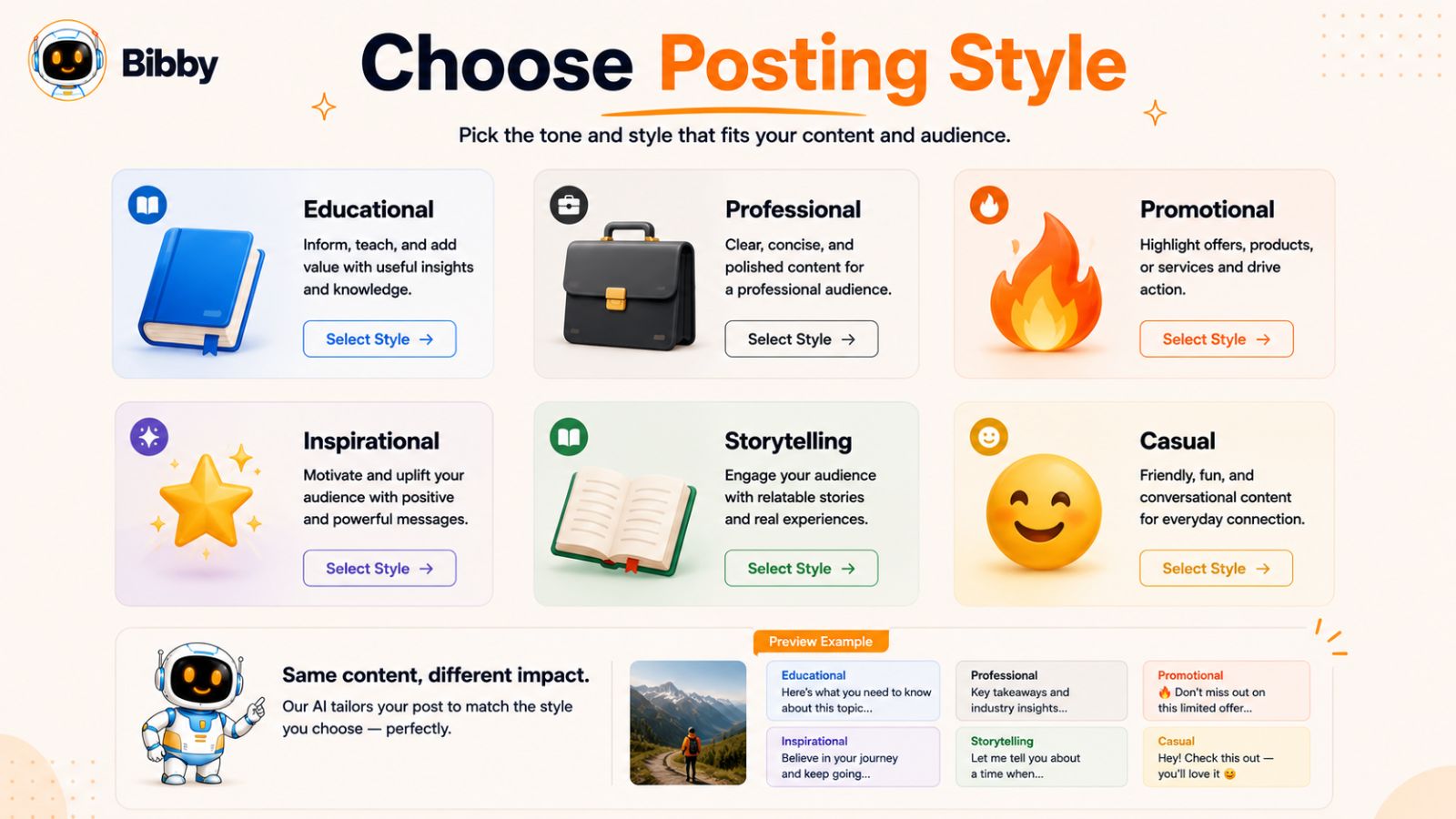
A product announcement requires a different tone than an educational tip or an inspirational story. Likewise, a post written for LinkedIn often differs significantly from one intended for Instagram or TikTok.
Many AI social media managers allow users to select a preferred posting style before generating content. This helps the AI better understand the desired tone and structure.
Depending on your goals, you might choose a style such as:
- Educational
- Professional
- Promotional
- Storytelling
- Inspirational
- Casual and conversational
Bibby includes this step in its workflow, allowing users to select a posting style before captions are generated. This helps ensure the content aligns more closely with the brand's voice and the expectations of each platform.
Step 4: Generate Captions Automatically
Writing captions is one of the most time-consuming parts of social media management.
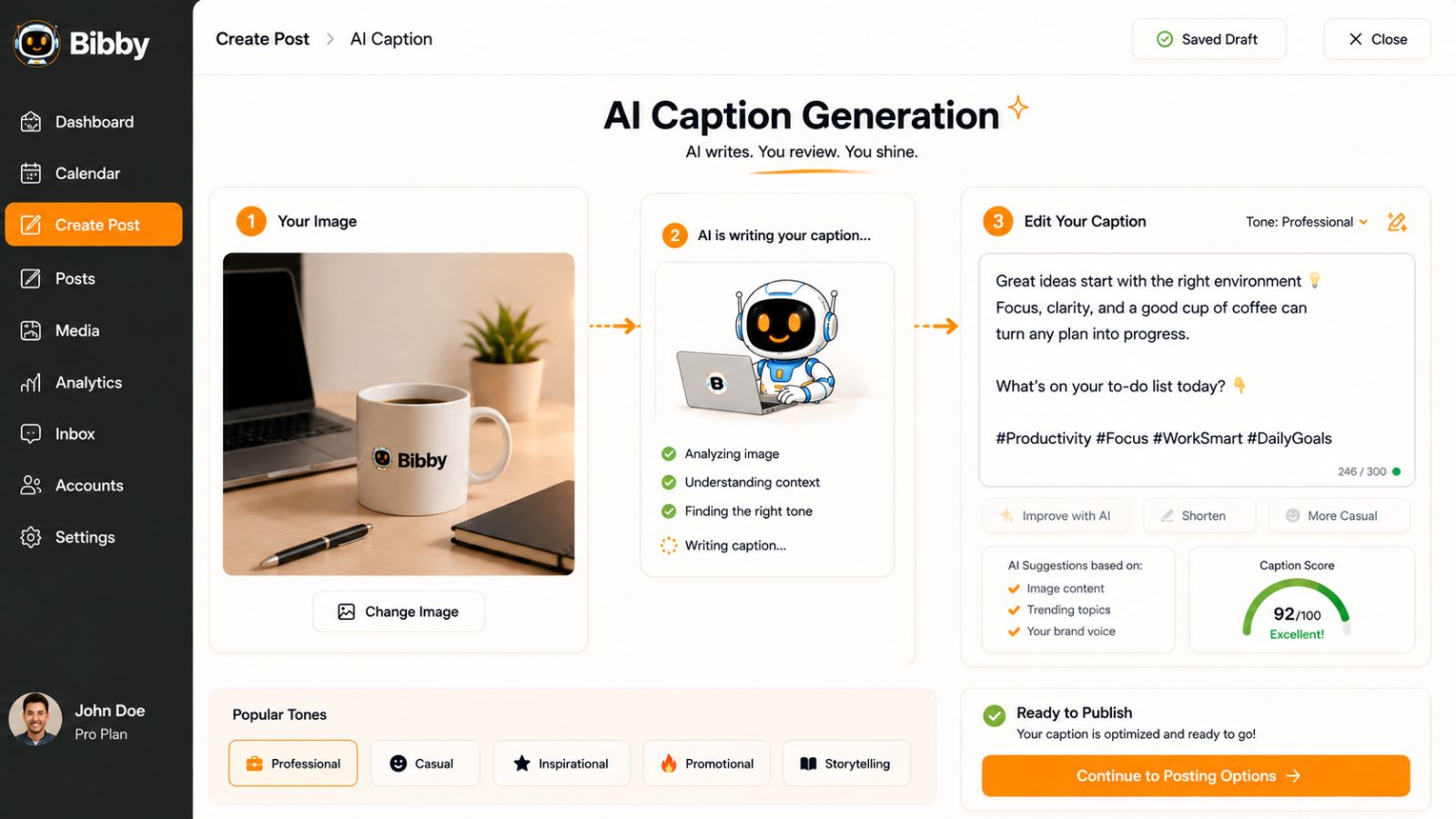
Many businesses struggle to consistently come up with engaging captions that match their visuals, reflect their brand personality, and encourage interaction.
AI helps remove that bottleneck.
After analyzing the uploaded or AI-generated media and the selected posting style, an AI social media manager can generate captions in seconds. These captions provide a strong starting point that users can edit, personalize, or approve before publishing.
With Bibby, caption generation is built directly into the workflow. Instead of staring at a blank text box, users receive AI-generated captions that can be refined to match their messaging, saving valuable time while maintaining consistency.
Step 5: Schedule Posts Across Multiple Platforms
Once the content is ready, the next step is publishing.
Instead of logging into every social network individually, an AI social media manager allows users to schedule posts across multiple platforms from a single dashboard.
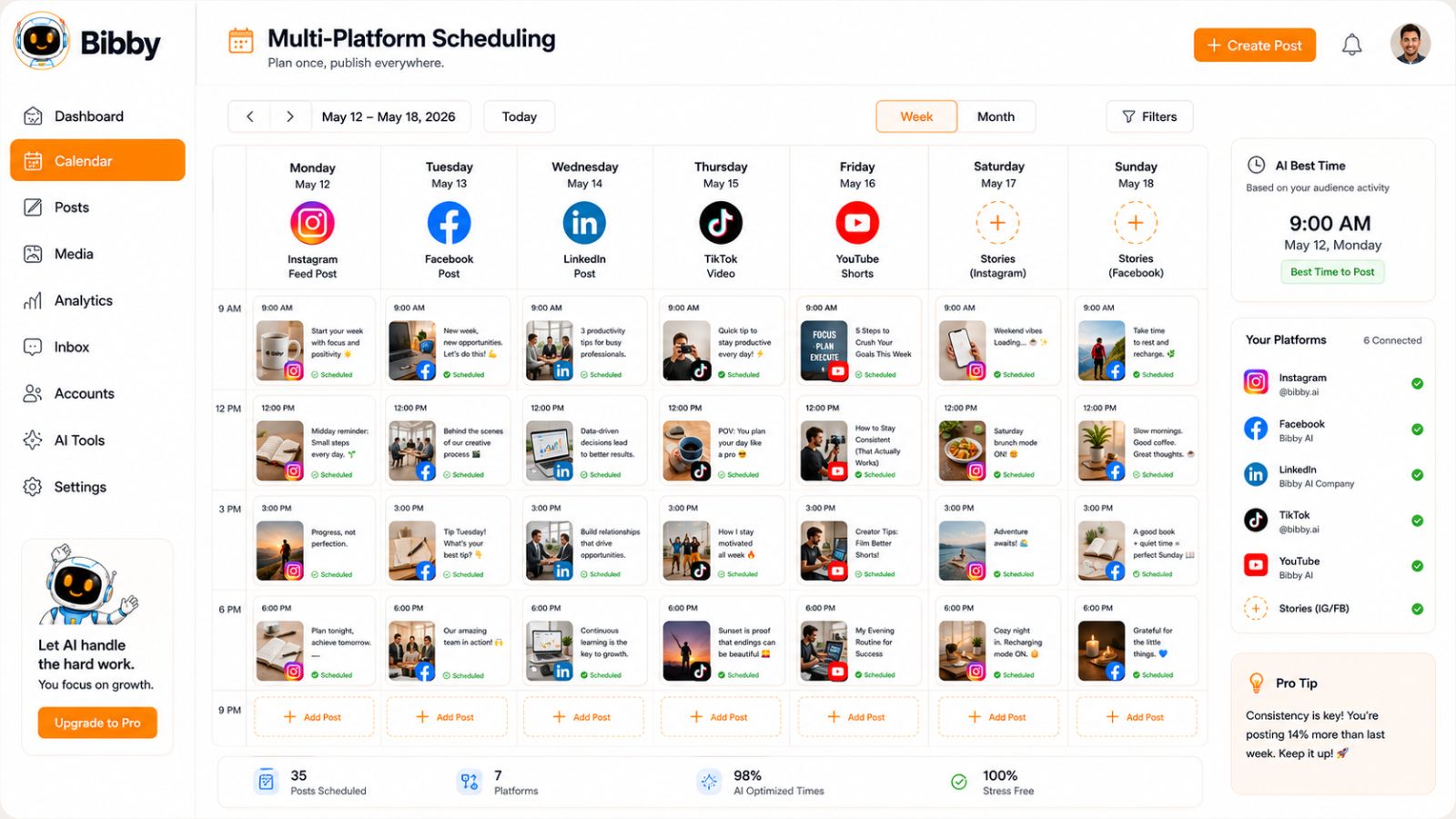
This approach offers several benefits:
- Plan content weeks or months in advance.
- Maintain a consistent posting schedule.
- Avoid last-minute publishing.
- Manage multiple social accounts more efficiently.
- Keep campaigns organized across different channels.
Bibby enables users to schedule media across selected platforms—including Facebook, Instagram, LinkedIn, YouTube, and TikTok—and publish different pieces of content on different dates. This helps maintain a steady content calendar without requiring daily manual uploads.
Step 6: Publish at AI-Optimized Times
Publishing consistently is important, but publishing at the right time can help maximize a post's potential reach and engagement.
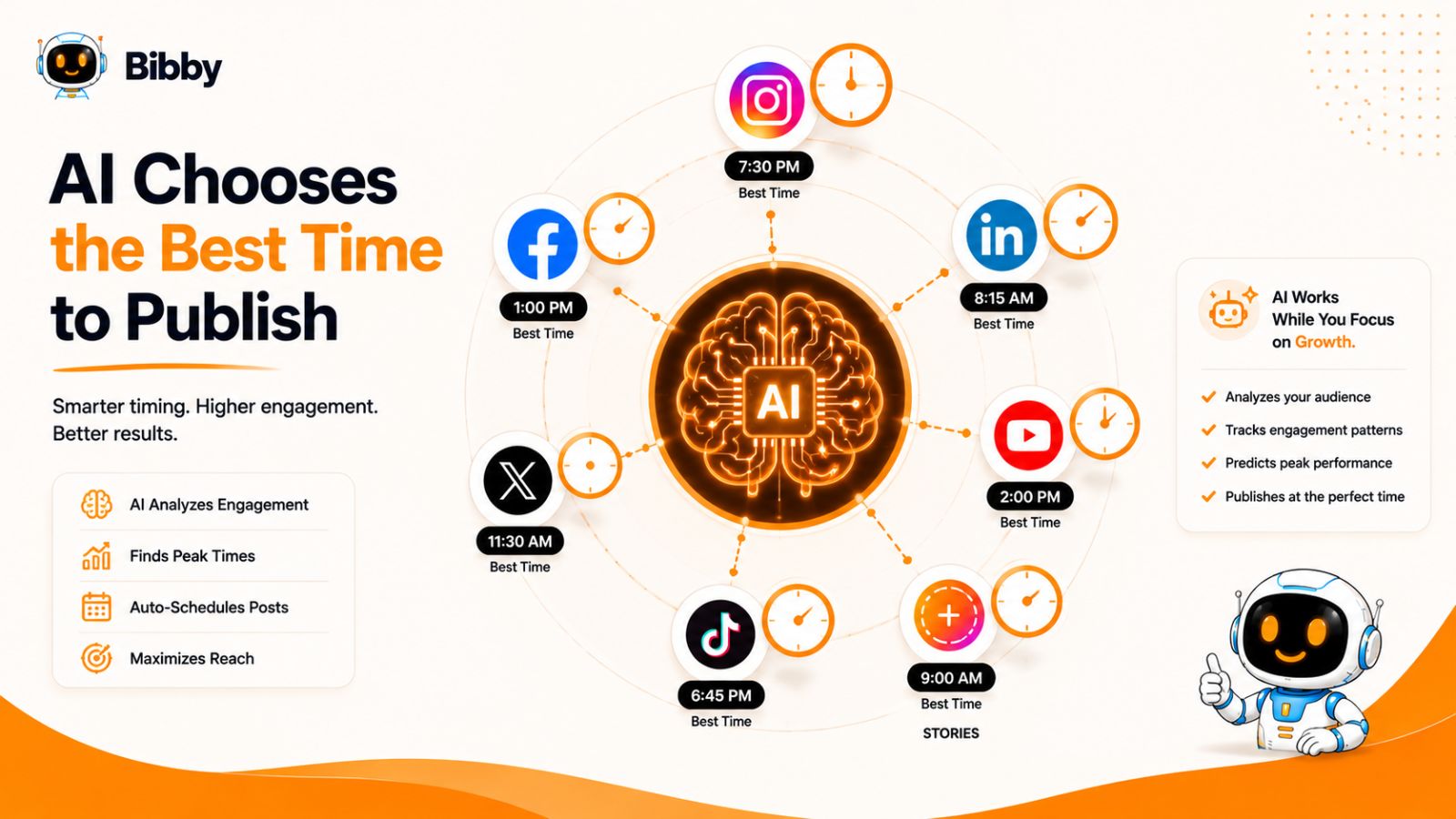
Instead of relying solely on guesswork or generic "best time to post" articles, AI can analyze patterns and recommend smarter publishing windows.
While no tool can guarantee viral results, scheduling content at AI-optimized times helps businesses make more informed decisions about when their audience is likely to be active.
Bibby incorporates AI-optimized scheduling into its workflow, allowing users to publish content automatically at recommended times across their selected social media platforms. This reduces manual planning while helping users maintain a more strategic posting schedule.
Step 7: Track Analytics and Improve Future Posts
Publishing content is only part of the social media management process.
To grow consistently, businesses need to understand what works and what does not.
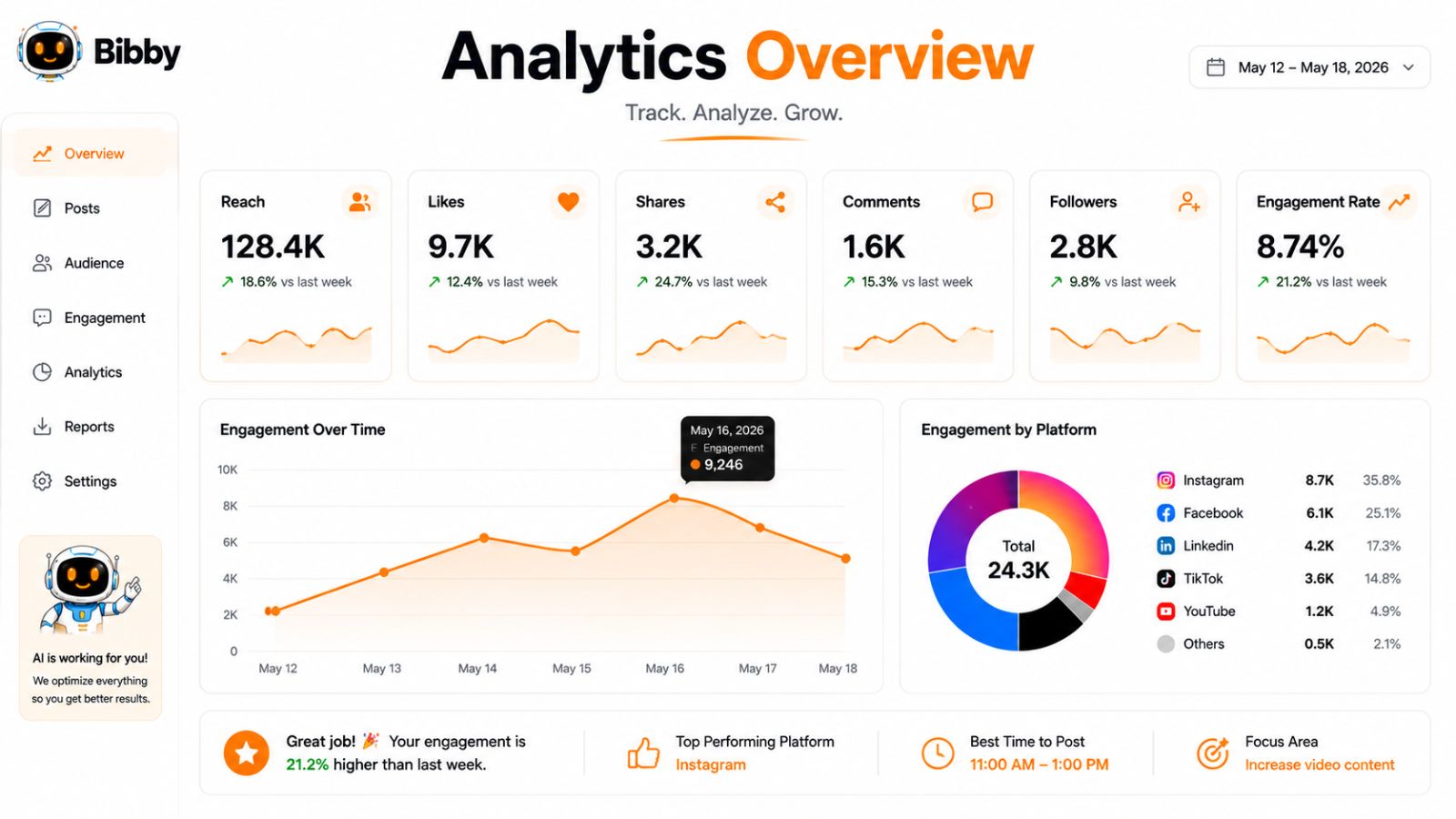
Analytics provide valuable insights into metrics such as:
- Reach
- Impressions
- Engagement
- Likes
- Comments
- Shares
- Clicks
- Video views
- Audience growth
By reviewing this data regularly, users can identify which topics, visuals, captions, and posting times generate the strongest results.
Bibby includes analytics so users can monitor performance after their content is published. Instead of guessing why one post performed better than another, marketers can use real data to improve future campaigns and build a more effective long-term social media strategy.
Ultimately, this continuous cycle of creating, scheduling, publishing, measuring, and improving is what makes an AI social media manager far more powerful than a traditional scheduling tool. It transforms social media management from a collection of manual tasks into an efficient, AI-assisted workflow that helps users save time while staying consistent across every platform.
Key Features to Look for in an AI Social Media Manager
Not all AI social media tools offer the same capabilities. Some focus only on scheduling, while others specialize in content generation or analytics. The best AI social media manager combines all of these features into one seamless workflow, helping you create, publish, and optimize content without constantly switching between different apps.
If you're evaluating AI-powered social media management tools, here are the most important features to prioritize.
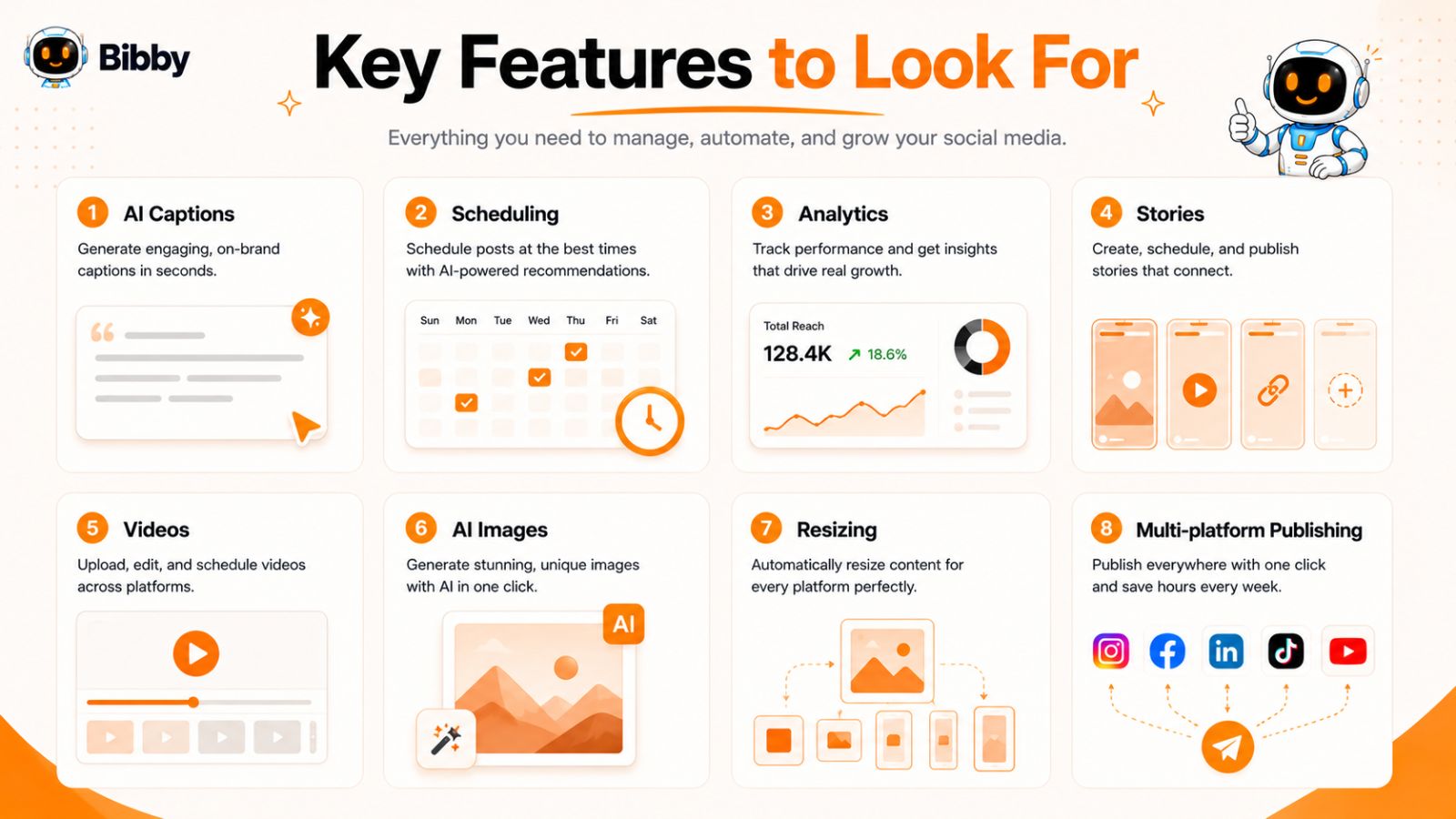
Multi-Platform Publishing
Managing multiple social media accounts separately is both time-consuming and inefficient.
A modern AI social media manager should allow you to create content once and publish it across several platforms from a single dashboard. This centralized workflow helps maintain consistency while reducing the effort required to manage each account individually.
Look for support for major platforms such as:
- TikTok
- YouTube
Instead of logging into every platform every day, you can manage your publishing schedule from one place, making it easier to stay consistent with your content strategy.
Automatic Image and Video Formatting
Every social media platform has different content specifications.
Images may need different dimensions, while videos often require different aspect ratios depending on whether they are published as feed posts, Stories, Reels, Shorts, or other formats.
Manually preparing separate versions of every asset quickly becomes repetitive.
An AI social media manager should automatically optimize content for each destination, helping ensure your visuals display correctly across platforms.
Bibby simplifies this process by taking care of platform-specific media sizes, allowing users to prepare content once instead of repeatedly resizing images or videos for every social network.
AI Caption Generation
Writing engaging captions consistently can be one of the biggest productivity challenges in social media marketing.
An effective AI social media manager should generate captions based on:
- Your image or video
- Your selected posting style
- Your brand voice
- The platform you're publishing to
Rather than replacing your creativity, AI provides a solid first draft that you can personalize before publishing.
Bibby automatically generates captions as part of its workflow, helping users save time while maintaining a consistent voice across multiple social media platforms.
AI-Optimized Scheduling
Choosing when to publish content can be just as important as deciding what to publish.
While every audience behaves differently, AI can analyze engagement patterns and recommend publishing windows that may improve visibility and interaction.
Instead of manually selecting dates and times for every post, AI scheduling helps automate that decision-making process.
Bibby schedules content at AI-optimized times across selected platforms, making it easier for users to maintain a consistent publishing schedule without constantly monitoring audience activity.
Support for Videos, Stories, and Multiple Content Types
Today's audiences expect more than static image posts.
Video continues to dominate engagement across platforms, while Stories, Reels, and Shorts have become essential parts of many successful content strategies.
A complete AI social media manager should support multiple content formats, including:
- Images
- Videos
- Stories
- Reels
- Shorts
- Promotional graphics
- Product content
Bibby supports publishing videos, Stories, and other social media content formats, allowing users to manage diverse content from one workflow instead of relying on multiple publishing tools.
Built-In Analytics
Publishing content without measuring results makes it difficult to improve over time.
Analytics help answer important questions, including:
- Which posts receive the most engagement?
- Which content formats perform best?
- What posting times generate stronger results?
- Which platforms deliver the highest return?
- How is audience engagement changing over time?
A good AI social media manager should present these insights through an easy-to-understand dashboard rather than overwhelming users with raw data.
Bibby includes built-in analytics that help users monitor performance, identify successful content, and make more informed decisions for future campaigns.
A Simple, Time-Saving Workflow
Perhaps the most important feature is simplicity.
Many marketing tools promise automation but introduce complicated interfaces and lengthy setup processes that slow teams down instead of helping them.
A well-designed AI social media manager should reduce complexity, not create it.
Bibby follows a straightforward workflow that allows users to:
- Upload an image or generate one with AI.
- Let Bibby prepare the content for different platform sizes.
- Choose a posting style.
- Generate AI-powered captions automatically.
- Schedule content across multiple social media platforms.
- Publish posts at AI-optimized times.
- Review analytics to improve future performance.
This end-to-end workflow eliminates many of the repetitive tasks that traditionally consume hours each week, making it especially valuable for creators, small businesses, agencies, and marketing teams managing multiple social media accounts.
Ultimately, the best AI social media manager isn't simply the one with the most features—it's the one that makes creating, publishing, and optimizing social media content feel effortless while helping you stay consistent across every platform.
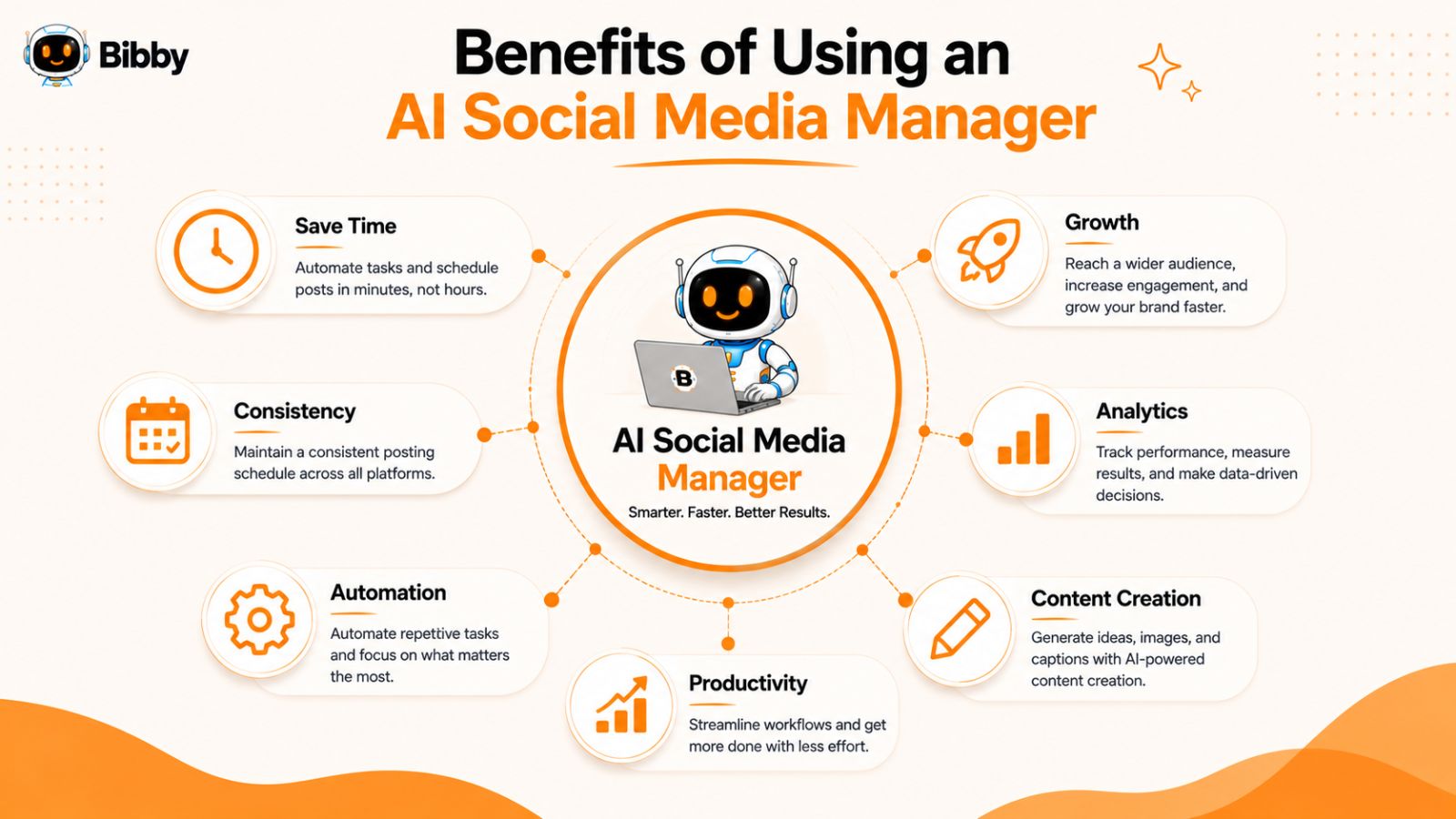
Benefits of Using an AI Social Media Manager
Whether you're a solo creator, a growing business, or a marketing agency, managing multiple social media accounts can quickly become overwhelming. Creating content, writing captions, scheduling posts, tracking analytics, and staying consistent all require significant time and effort.
An AI social media manager helps simplify these responsibilities by automating repetitive tasks while giving you more time to focus on strategy, creativity, and business growth.
Here are some of the biggest benefits of using AI for social media management.
Saves Hours Every Week
One of the greatest advantages of an AI social media manager is the amount of time it can save.
Instead of manually resizing images, writing captions for every platform, selecting publishing times, and uploading content individually, AI streamlines much of the workflow into just a few steps.
Tasks that once took several hours can often be completed in minutes, allowing businesses to maintain an active social media presence without sacrificing valuable time.
For busy entrepreneurs and marketing teams, this means spending less time on repetitive administrative work and more time creating campaigns, engaging with customers, and growing their brand.
Helps You Stay Consistent
Consistency is one of the most important factors in building a successful social media presence.
However, maintaining a regular posting schedule can be difficult when you're balancing client work, meetings, product development, or everyday business operations.
An AI social media manager helps solve this problem by allowing you to schedule content days, weeks, or even months in advance.
Instead of wondering what to post every morning, you can build a content calendar ahead of time and let your posts publish automatically according to your schedule.
Bibby makes this process even simpler by allowing users to schedule posts across multiple platforms at AI-optimized times, helping maintain a consistent online presence with minimal manual effort.
Eliminates Repetitive Manual Tasks
Many social media activities don't require creativity—they simply require time.
Examples include:
- Resizing images for different platforms
- Copying captions into multiple apps
- Uploading the same content repeatedly
- Selecting publishing dates
- Switching between social media accounts
- Monitoring basic performance metrics
While each task may only take a few minutes, together they consume hours every week.
An AI social media manager automates much of this repetitive work, allowing marketers to focus on activities that actually require human expertise, such as campaign planning, storytelling, and audience engagement.
Makes Content Creation Easier
One of the biggest challenges marketers face is deciding what to post.
Creative fatigue is common, especially for businesses that publish content every day across several platforms.
AI helps reduce this pressure by assisting with content creation.
Instead of starting from a blank page, users can generate captions, organize content ideas, and even create images with AI. This speeds up the creative process while still allowing room for human editing and personalization.
With Bibby, users can upload an existing image or generate one with AI, choose a posting style, and automatically receive captions tailored to their content. This removes much of the friction from creating consistent social media posts.
Improves Multi-Platform Efficiency
Publishing separately to every social media platform is rarely the most efficient approach.
Each platform requires slightly different formatting, media dimensions, caption styles, and publishing workflows.
An AI social media manager helps centralize these activities so that users can manage multiple platforms from one location.
Instead of repeating the same process five or six times, content can be prepared once and distributed more efficiently.
Bibby supports publishing across selected platforms such as Facebook, Instagram, LinkedIn, YouTube, and TikTok, helping businesses manage their entire social media presence from a single workflow.
Helps You Make Better Decisions with Analytics
Successful social media marketing is built on continuous improvement.
Without analytics, it's difficult to know which content resonates with your audience and which posts need adjustment.
An AI social media manager makes performance tracking much easier by organizing important metrics into one dashboard.
These insights help answer questions like:
- Which posts generated the most engagement?
- What content formats perform best?
- Which publishing times produce stronger results?
- Which platforms deliver the highest return?
- What topics should you create more of?
Rather than relying on assumptions, businesses can make informed decisions based on actual performance data.
Bibby includes built-in analytics, making it easier to monitor results, identify trends, and refine future content strategies.
Scales with Your Business
As your business grows, your social media workload grows with it.
You may start with one platform and a handful of weekly posts, but eventually you'll likely expand to multiple social networks, publish different content formats, manage several campaigns, and collaborate with additional team members.
Without automation, this growth often leads to more manual work.
An AI social media manager allows your workflow to scale more efficiently by handling many of the repetitive tasks that increase alongside your content volume.
Whether you're managing one brand or dozens of client accounts, automation helps you maintain quality without dramatically increasing your workload.
Gives You More Time to Focus on Strategy
The biggest value of AI isn't simply that it works faster—it's that it gives marketers more time to focus on work that truly matters.
Instead of spending hours formatting images or writing repetitive captions, you can dedicate more energy to:
- Developing stronger content strategies
- Understanding your audience
- Building your brand voice
- Creating better campaigns
- Engaging with your community
- Growing your business
AI handles much of the operational workload, while humans continue to provide the creativity, storytelling, and strategic thinking that drive meaningful results.
Ultimately, an AI social media manager is not about replacing marketers. It's about helping them work smarter, stay consistent, and spend less time on repetitive tasks—making it an increasingly valuable tool for anyone looking to grow their presence across today's competitive social media landscape.
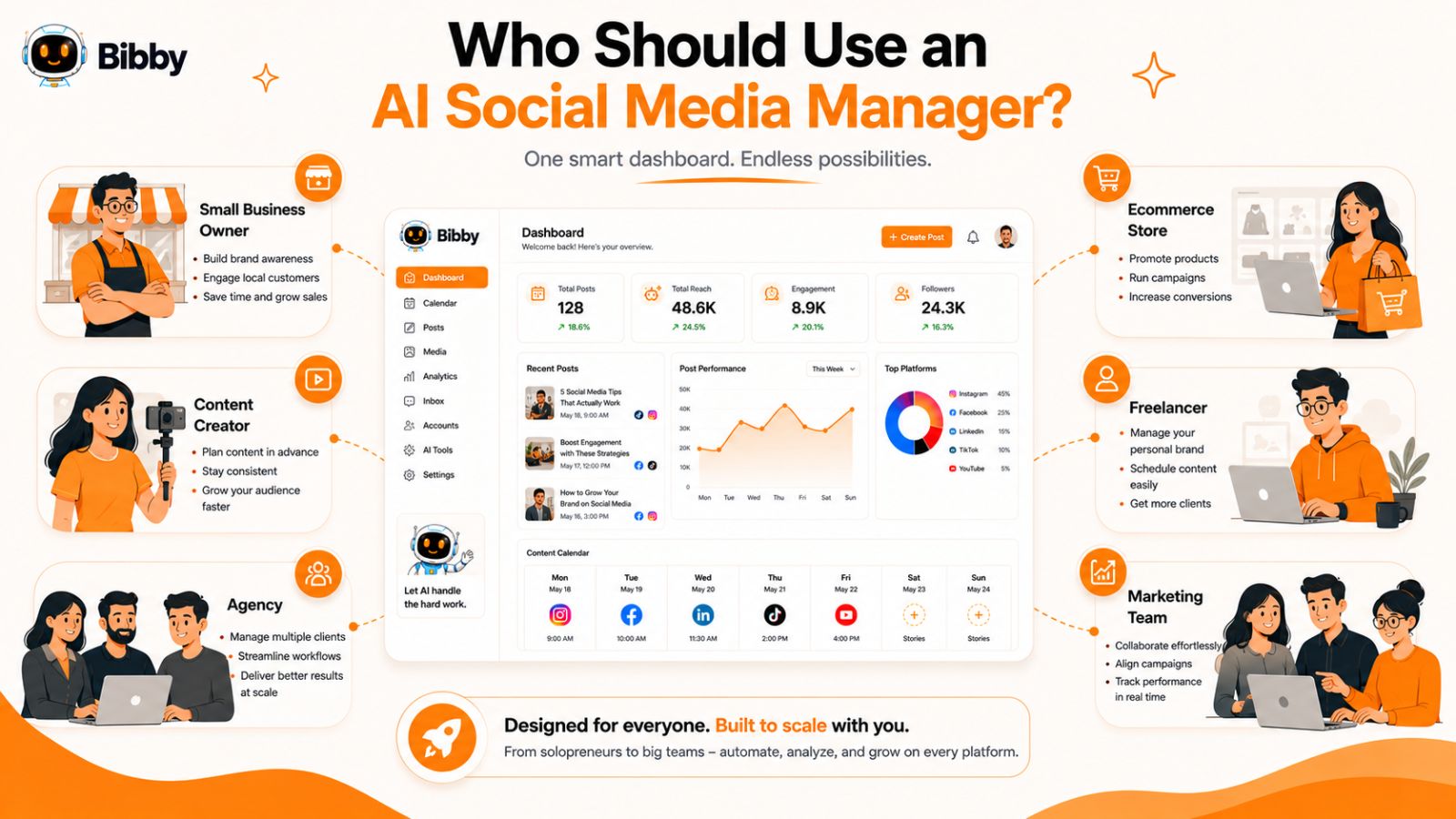
Who Should Use an AI Social Media Manager?
An AI social media manager isn't just for large companies with dedicated marketing departments. Today, businesses of every size—and even individuals—can benefit from using AI to simplify content creation, scheduling, and social media management.
If you spend hours every week creating posts, writing captions, or switching between multiple social platforms, AI can help streamline your workflow and improve consistency.
Here are the groups that benefit the most.
Small Business Owners
For many small business owners, social media is essential for attracting customers, building trust, and promoting products or services. However, managing multiple platforms often becomes another full-time job.
Between running daily operations and serving customers, finding time to consistently create and publish content can be challenging.
An AI social media manager helps small businesses stay active online by automating much of the work involved in social media marketing.
For example, a local restaurant can schedule an entire week's promotions in advance. A real estate agent can prepare property listings for multiple platforms in one session. A fitness coach can create motivational posts, educational content, and client testimonials without logging into several different apps every day.
By reducing manual tasks, AI allows business owners to spend more time growing their business and less time managing their social feeds.
Content Creators and Influencers
Consistency is one of the biggest factors behind social media growth, but maintaining that consistency isn't easy.
Creators often produce content for Instagram, TikTok, YouTube, Facebook, LinkedIn, and other platforms simultaneously. Every platform requires different captions, media formats, and publishing schedules.
An AI social media manager helps creators simplify that process.
Instead of manually preparing every version of a post, creators can use AI to generate captions, optimize content for multiple platforms, and schedule everything in advance.
Bibby's workflow is particularly helpful for creators who want to upload or generate visuals with AI, choose a posting style, generate captions automatically, and schedule content across multiple platforms from one dashboard.
This allows creators to spend more time producing quality content and engaging with their audience instead of managing repetitive publishing tasks.
Marketing Teams
Marketing teams are expected to deliver consistent results across multiple campaigns, brands, and social channels.
That often means juggling content calendars, approval workflows, platform-specific assets, analytics reports, and publishing schedules—all while meeting tight deadlines.
An AI social media manager helps marketing teams increase productivity without sacrificing quality.
Instead of creating every caption manually or preparing separate media files for each platform, AI can automate many repetitive tasks while marketers focus on campaign strategy, messaging, and creative direction.
This combination of automation and human expertise enables teams to produce more content without dramatically increasing workload.
Agencies and Freelancers
Social media agencies and freelance marketers often manage multiple client accounts at the same time.
Each client may have different branding, audiences, posting schedules, and campaign objectives. Managing all of this manually can quickly become overwhelming.
AI simplifies client management by making it easier to:
- Create content faster
- Generate captions consistently
- Schedule posts across multiple platforms
- Organize publishing calendars
- Monitor analytics from one place
Bibby's streamlined workflow can help agencies reduce repetitive administrative work while maintaining consistent service across multiple clients.
Instead of spending hours preparing content for every account, teams can focus on client strategy, reporting, and business growth.
Ecommerce Brands
Ecommerce businesses rely heavily on social media to showcase products, announce promotions, drive website traffic, and build customer relationships.
Unlike many other businesses, ecommerce brands often publish content daily—or even multiple times per day.
An AI social media manager helps ecommerce teams maintain that publishing pace by simplifying content production and scheduling.
For example, AI can help generate captions for:
- New product launches
- Seasonal promotions
- Limited-time discounts
- Customer testimonials
- Product demonstrations
- Educational buying guides
Combined with automated scheduling and analytics, this allows ecommerce brands to maintain an active social presence while reducing the workload involved in daily publishing.
Startups and Growing Businesses
Startups often operate with lean teams where employees wear multiple hats.
The founder might also be the marketer, customer support representative, salesperson, and content creator.
Hiring a dedicated social media manager isn't always practical during the early stages of growth.
An AI social media manager acts as a productivity multiplier by helping startups maintain a professional social media presence without requiring a large marketing team.
By automating content creation, scheduling, and performance tracking, startups can build brand awareness while focusing their limited resources on product development and customer acquisition.
Nonprofits and Educational Organizations
Nonprofits, schools, and educational institutions often have limited marketing budgets but still need to communicate regularly with donors, volunteers, students, parents, or community members.
An AI social media manager can help these organizations stay active online without requiring extensive marketing resources.
Whether it's promoting fundraising campaigns, sharing educational content, announcing events, or highlighting community impact, AI helps reduce the time spent managing day-to-day social media operations.
Is an AI Social Media Manager Right for You?
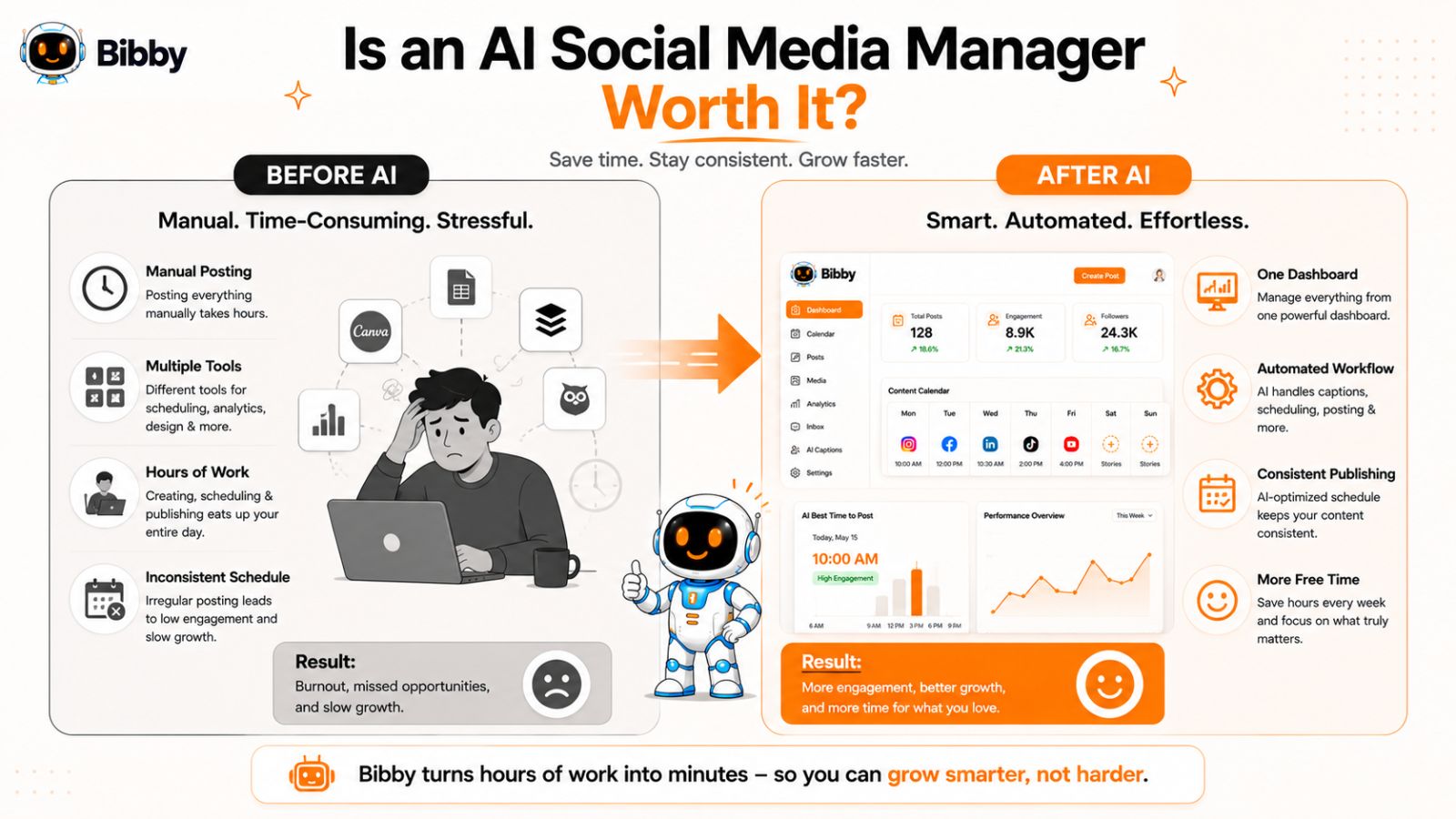
If any of the following sound familiar, an AI social media manager is likely worth considering:
- You manage more than one social media platform.
- You struggle to post consistently.
- Writing captions takes too much time.
- Resizing content for different platforms feels repetitive.
- You want to automate scheduling.
- You need analytics without checking multiple dashboards.
- You want to spend more time growing your business instead of managing social media.
Whether you're an entrepreneur, creator, agency, or enterprise marketing team, the value of an AI social media manager comes down to one simple idea: less time spent on repetitive tasks and more time spent creating meaningful content and growing your audience.
Example Workflow: Managing a Week of Social Media With Bibby
Creating high-quality social media content is only one part of the process. The real challenge is turning that content into a consistent publishing schedule across multiple platforms without spending hours on repetitive tasks.
This is where an AI-powered workflow makes a noticeable difference.
Instead of jumping between design tools, AI writing assistants, scheduling platforms, and analytics dashboards, Bibby brings the entire social media workflow into one place. From creating content to tracking its performance, the platform is designed to reduce manual work while helping you stay consistent across your social channels.
Here's what a typical week of social media management looks like with Bibby.
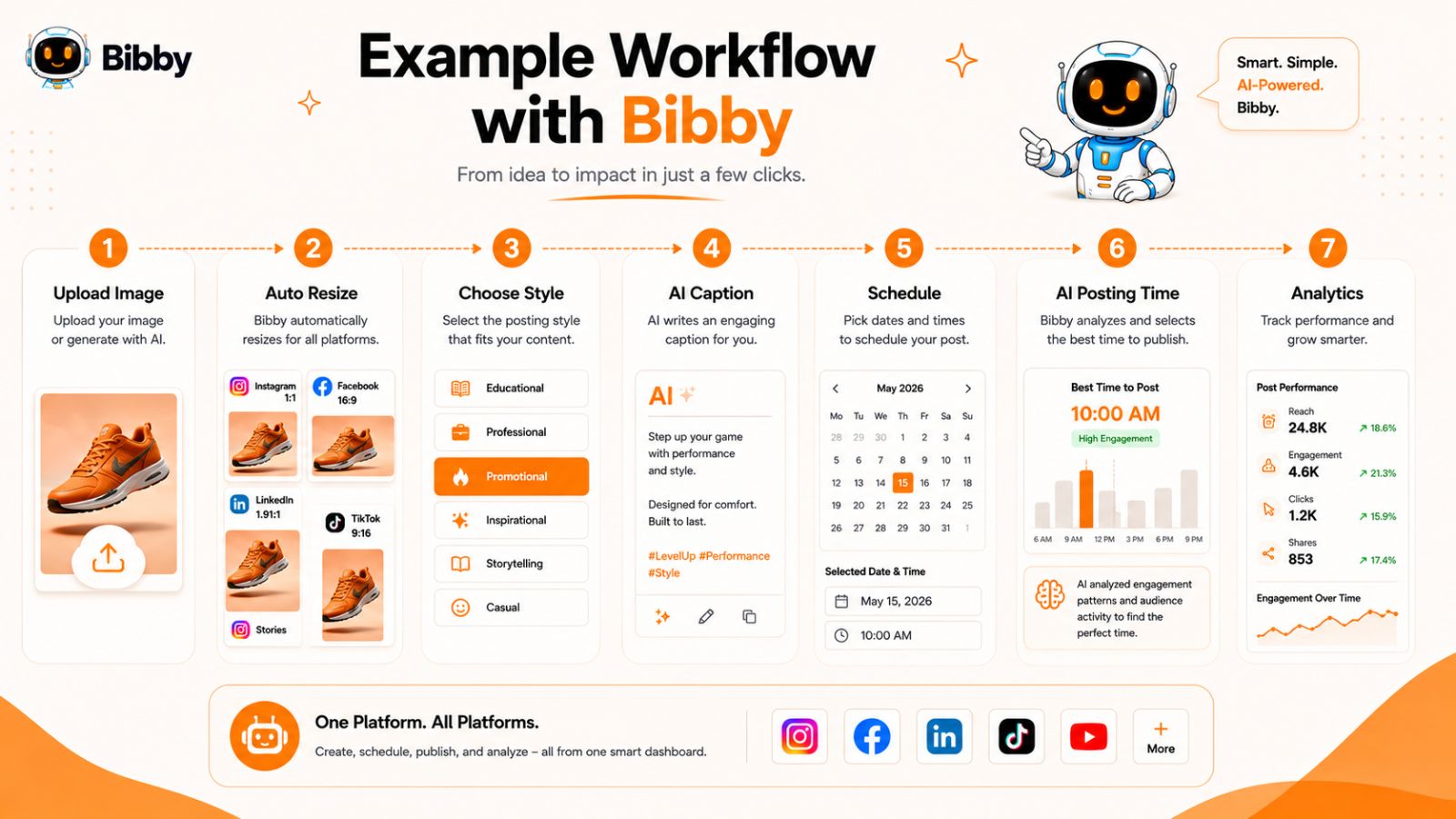
Step 1: Upload an Image or Generate One With AI
Every social media campaign starts with content.
If you already have a product photo, promotional graphic, infographic, or branded visual, simply upload it to Bibby.
Don't have a visual ready? No problem.
Bibby also allows you to generate images with AI, making it easier to create fresh content without switching to a separate design tool. This is especially useful for small businesses, creators, and marketers who need to produce content quickly but don't always have access to a designer.
Whether you're launching a new product, promoting a blog post, or sharing educational content, you can begin your workflow with either existing media or AI-generated visuals.
Step 2: Let Bibby Handle Platform Sizes Automatically
One of the most time-consuming parts of social media management is preparing content for every platform.
Instagram posts, Facebook feeds, LinkedIn updates, YouTube thumbnails, TikTok videos, Stories, Reels, and Shorts all have different recommended dimensions and formats.
Instead of creating multiple versions of the same content manually, Bibby automatically takes care of the platform sizes for you.
This allows you to prepare your content once while ensuring it is optimized for the platforms you've selected. Not only does this save valuable time, but it also helps maintain a consistent and professional brand appearance across every social network.
Step 3: Choose Your Posting Style
Every brand has its own voice.
A software company may prefer an educational and professional tone, while a lifestyle creator might choose something more conversational and entertaining.
Before generating captions, Bibby lets you choose your preferred posting style.
Depending on your goals, you might select a style such as:
- Educational
- Promotional
- Professional
- Storytelling
- Inspirational
- Casual
This simple step helps ensure your content aligns with your brand identity instead of producing generic captions that sound the same for every business.
Step 4: Generate Captions Automatically
Writing captions is often where social media workflows slow down.
Coming up with fresh copy for every platform, every day, can quickly become exhausting.
Once you've selected your posting style, Bibby automatically generates captions based on your media and your chosen tone.
Rather than starting from a blank page, you'll have a ready-to-edit caption that can be customized before publishing.
This significantly reduces the time required to prepare posts while still allowing you to add your own personality, promotions, or calls to action.
Step 5: Schedule Posts Across Multiple Platforms
Once your content is ready, it's time to build your publishing calendar.
Instead of posting manually every day, Bibby lets you schedule content across multiple social media platforms from a single dashboard.
For example, you might prepare:
- Monday: Educational LinkedIn post
- Tuesday: Instagram carousel
- Wednesday: Facebook promotion
- Thursday: TikTok video
- Friday: YouTube Short
- Weekend: Instagram Story and Facebook update
Rather than uploading each post separately, you can organize your entire week's content in one session.
Bibby supports publishing across selected platforms, including Facebook, Instagram, LinkedIn, YouTube, and TikTok, helping you maintain a consistent online presence with far less manual effort.
Step 6: Let AI Choose the Best Time to Publish
Choosing the right publishing time can be difficult, especially when you're managing several platforms with different audiences.
Instead of relying on guesswork, Bibby schedules your content at AI-optimized times.
This helps remove one more repetitive decision from your workflow while increasing the likelihood that your audience sees your content when they're most active.
Although no scheduling tool can guarantee higher engagement, publishing consistently at data-informed times creates a stronger foundation for long-term social media growth.
Step 7: Monitor Analytics and Improve Future Content
Publishing is only the beginning.
Once your content is live, Bibby provides analytics that help you understand how your posts are performing across your selected platforms.
You can monitor metrics such as:
- Reach
- Engagement
- Likes
- Comments
- Shares
- Clicks
- Video performance
- Overall content trends
Instead of guessing what your audience prefers, you can use real performance data to refine your strategy.
Over time, these insights help you create better content, improve your posting schedule, and make more informed marketing decisions.
Why This Workflow Matters
Many social media tools solve only one part of the problem. Some focus on scheduling, while others specialize in AI writing or analytics.
Bibby combines the entire workflow into one streamlined experience:
- Upload your media or generate it with AI.
- Automatically optimize it for different social media platforms.
- Choose your preferred posting style.
- Generate AI-powered captions.
- Schedule content across multiple platforms.
- Publish at AI-optimized times.
- Review analytics to improve future performance.
Instead of managing separate tools for design, caption writing, scheduling, and reporting, you can handle everything from one place.
For creators, agencies, small businesses, and marketing teams, this means less time spent on repetitive tasks—and more time focused on building relationships, creating better content, and growing their brand.
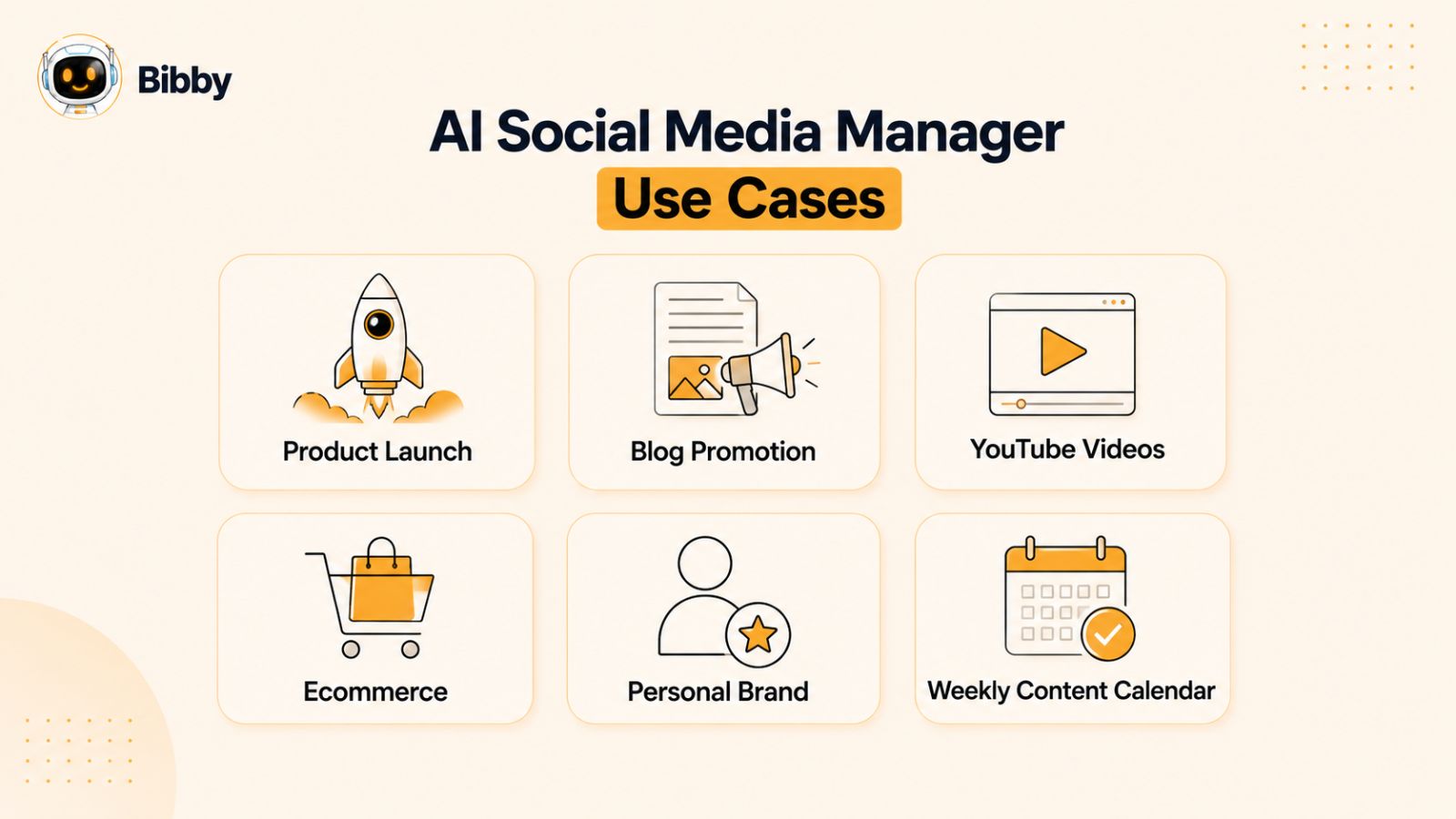
AI Social Media Manager Use Cases
An AI social media manager isn't limited to one type of business or marketing strategy. Whether you're promoting products, growing a personal brand, or managing multiple client accounts, AI can simplify the way you create, schedule, and optimize content.
Below are some of the most common ways businesses and creators use AI-powered social media management tools.
Launching a New Product
Product launches involve much more than publishing a single announcement.
Most successful launches include teaser posts, countdowns, behind-the-scenes content, launch-day announcements, customer testimonials, promotional videos, and follow-up updates. Coordinating all of this across multiple platforms can quickly become overwhelming.
An AI social media manager helps organize the entire campaign by allowing you to:
- Generate promotional images with AI or upload existing product visuals.
- Create platform-specific captions.
- Schedule launch content across multiple dates.
- Publish consistently across Facebook, Instagram, LinkedIn, YouTube, and TikTok.
- Track engagement after the campaign goes live.
With a structured workflow, you can focus on the launch itself instead of worrying about manually publishing every post.
Promoting a Blog Post or YouTube Video
Creating a blog article or YouTube video is only half the work. To maximize its reach, you need to promote it consistently across your social media channels.
Instead of writing new content for every platform from scratch, an AI social media manager helps you repurpose one piece of content into multiple social posts.
For example, a single blog post can become:
- A LinkedIn thought leadership post.
- An Instagram carousel highlighting key takeaways.
- A Facebook discussion post.
- A short promotional video for TikTok.
- A YouTube Community update.
- An Instagram Story directing followers to the article.
With Bibby, you can generate captions, prepare content for different platforms, and schedule the entire promotional campaign in one workflow, helping you extend the lifespan of every piece of content you create.
Running a Weekly Content Calendar
One of the easiest ways to stay consistent is by planning content in advance.
Rather than deciding what to post every morning, many businesses dedicate one day each week to preparing all of their upcoming social media content.
An AI social media manager makes this process significantly faster.
For example, you could plan an entire week's schedule like this:
| Day | Content |
|---|---|
| Monday | Industry tip |
| Tuesday | Customer success story |
| Wednesday | Product feature |
| Thursday | Educational carousel |
| Friday | Behind-the-scenes content |
| Saturday | Community question |
| Sunday | Weekly recap or promotional offer |
After preparing your visuals, Bibby can generate captions, optimize content for different platforms, and schedule each post to publish automatically at AI-optimized times.
This approach helps maintain consistency while reducing daily workload.
Managing Multiple Social Media Platforms
Every platform serves a different audience and has its own best practices.
For example:
- LinkedIn audiences often prefer educational or professional insights.
- Instagram performs well with visual storytelling.
- TikTok favors short-form, engaging videos.
- Facebook encourages conversations and community interaction.
- YouTube supports both long-form videos and Shorts.
Managing each platform separately often means repeating the same tasks over and over again.
An AI social media manager centralizes these activities so you can prepare content once and distribute it efficiently across your selected channels without constantly switching between different apps.
Posting Videos, Stories, and Short-Form Content
Social media has evolved far beyond static image posts.
Today, platforms prioritize video content, Stories, Reels, and Shorts because they tend to drive higher engagement and encourage users to spend more time on the platform.
A complete AI social media manager should support multiple content formats rather than limiting users to image posts alone.
Bibby allows users to publish:
- Images
- Videos
- Stories
- Promotional content
- Educational posts
- Other supported social media formats
This flexibility makes it easier to execute a well-rounded content strategy without relying on multiple publishing tools.
Managing Multiple Client Accounts
For agencies and freelance social media managers, efficiency directly affects profitability.
Managing several clients means balancing different industries, brand voices, content calendars, and approval processes simultaneously.
An AI social media manager helps simplify client management by making it easier to:
- Generate captions faster.
- Schedule content in advance.
- Organize publishing calendars.
- Maintain consistent posting schedules.
- Monitor analytics from a centralized dashboard.
Instead of spending hours on repetitive administrative work, agencies can dedicate more time to strategy, client communication, and campaign optimization.
Building a Personal Brand
Professionals, consultants, coaches, speakers, and entrepreneurs increasingly rely on social media to establish authority within their industries.
However, consistently creating educational content while running a business isn't easy.
An AI social media manager helps personal brands stay visible by simplifying content creation and scheduling.
Whether you're sharing business advice, industry trends, case studies, or personal experiences, AI can help generate captions, organize your posting schedule, and keep your audience engaged without requiring daily manual publishing.
Supporting Seasonal Campaigns
Holiday promotions, product launches, Black Friday sales, webinars, conferences, and special events all require coordinated social media campaigns.
Planning these campaigns manually often leads to missed posting opportunities and inconsistent messaging.
With an AI social media manager, you can prepare an entire campaign in advance by:
- Creating or uploading campaign visuals.
- Generating captions for different platforms.
- Scheduling posts across multiple dates.
- Publishing automatically at AI-optimized times.
- Monitoring campaign performance through analytics.
This structured approach reduces stress during busy promotional periods while ensuring your messaging remains consistent across every platform.
Why These Use Cases Matter
No matter your industry or business size, the underlying challenge is the same: creating enough high-quality content while staying consistent across multiple social media platforms.
An AI social media manager helps solve that challenge by reducing repetitive work and streamlining the entire publishing process.
Whether you're launching a new product, promoting content, managing client accounts, or building a personal brand, tools like Bibby make it easier to create, schedule, publish, and analyze your social media content—all from a single, AI-powered workflow.
Common Mistakes to Avoid When Using an AI Social Media Manager
An AI social media manager can save hours of work every week, but simply using AI doesn't guarantee better results. Like any tool, its effectiveness depends on how you use it.
The most successful brands use AI to speed up repetitive tasks while keeping humans involved in strategy, creativity, and quality control. By avoiding a few common mistakes, you can get far more value from your AI-powered workflow.
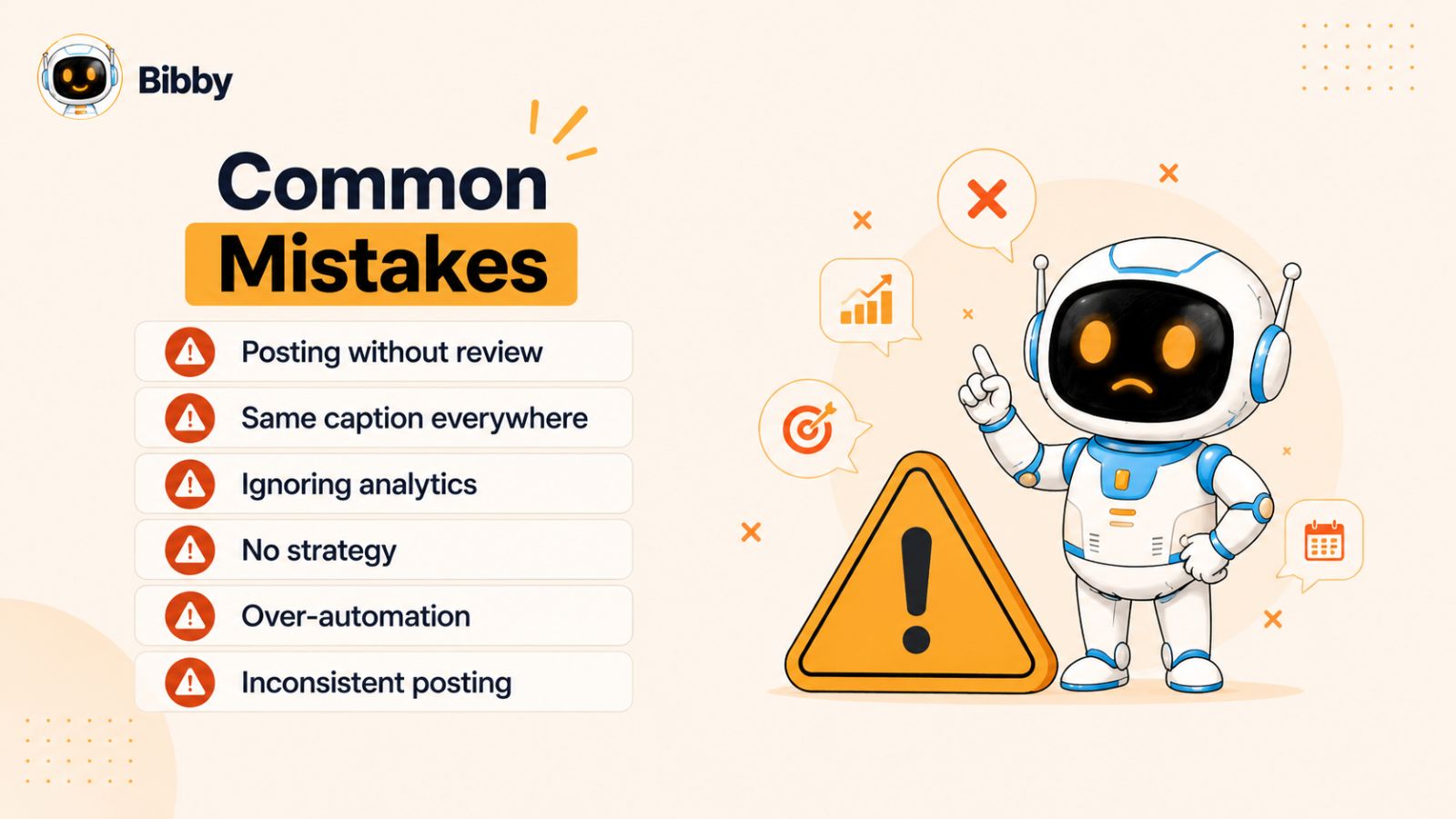
Publishing AI-Generated Content Without Reviewing It
AI can generate captions, suggest hashtags, and even create images in seconds, but it doesn't fully understand your brand, your customers, or the context behind every campaign.
Publishing content without reviewing it can lead to:
- Generic messaging
- Inaccurate information
- Off-brand language
- Awkward phrasing
- Missed opportunities to add personality
Think of AI as your first draft—not your final editor.
Before scheduling any post, review the caption for accuracy, tone, grammar, and alignment with your brand voice. A few minutes of editing can make AI-generated content feel far more authentic and engaging.
Using the Same Caption Across Every Platform
One of the biggest mistakes businesses make is copying and pasting the exact same caption everywhere.
While this may save a little time, it often leads to lower engagement because each platform has different audience expectations.
For example:
- LinkedIn audiences typically respond better to professional insights and thought leadership.
- Instagram users often engage with storytelling and visually driven captions.
- Facebook encourages conversations and community interaction.
- TikTok favors shorter, more conversational copy paired with trending content.
A good AI social media manager helps generate captions that can be adapted for different platforms instead of forcing a one-size-fits-all approach.
Bibby's posting styles and AI-generated captions make it easier to customize your messaging while maintaining a consistent brand voice across every channel.
Ignoring Analytics
Many marketers spend hours creating content but only a few minutes analyzing the results.
That's a missed opportunity.
Analytics reveal which content resonates with your audience and which strategies need improvement. Without reviewing performance, you're essentially guessing what works.
Pay close attention to metrics such as:
- Engagement rate
- Reach
- Click-through rate
- Comments
- Shares
- Saves
- Video watch time
- Audience growth
Bibby's built-in analytics make it easier to monitor these metrics from one place, helping you refine your content strategy over time instead of relying on assumptions.
Over-Automating Your Social Media
Automation is incredibly valuable, but too much automation can make a brand feel robotic.
Social media is designed for conversations, not just broadcasting content.
Even if AI handles your content creation and scheduling, you should still make time to:
- Reply to comments.
- Answer customer questions.
- Join relevant conversations.
- Respond to direct messages.
- Thank followers for their support.
These interactions build trust and strengthen your relationship with your audience—something AI cannot fully replace.
The goal is to automate repetitive tasks, not genuine human engagement.
Posting Without a Clear Strategy
AI can help you create content faster, but it cannot decide what your business should communicate or why.
Without a clear strategy, you'll likely end up publishing content consistently but without achieving meaningful business goals.
Before creating your content calendar, ask yourself:
- Who is your target audience?
- What problems are they trying to solve?
- What action do you want readers to take?
- Which content pillars support your brand?
- How will you measure success?
Once those questions are answered, an AI social media manager becomes much more powerful because it helps execute a well-defined strategy efficiently.
Relying Only on Promotional Content
One of the quickest ways to lose audience engagement is to treat every post like an advertisement.
People follow brands because they want value—not constant sales pitches.
Aim for a healthy mix of content, including:
- Educational tips
- Industry insights
- Behind-the-scenes updates
- Customer success stories
- User-generated content
- Product demonstrations
- Promotional offers
A balanced content strategy builds trust over time and makes promotional posts feel more natural when they appear.
Posting Inconsistently
Many businesses post heavily for a week and then disappear for a month.
Unfortunately, inconsistency makes it difficult to build audience expectations and long-term engagement.
An AI social media manager helps solve this by allowing you to prepare and schedule content well in advance.
With Bibby, you can upload or generate your content, create captions, schedule posts across multiple platforms, and let them publish automatically at AI-optimized times. This makes it much easier to maintain a consistent publishing schedule, even during busy periods.
Expecting AI to Deliver Instant Results
AI can dramatically improve efficiency, but it isn't a shortcut to overnight success.
Growing on social media still requires:
- High-quality content
- Consistent publishing
- Audience engagement
- Continuous testing
- Performance analysis
- Patience
Think of AI as a productivity tool rather than a growth guarantee. It helps you work smarter, but long-term success still depends on delivering valuable content that resonates with your audience.
Final Thoughts
The biggest mistake isn't using AI—it's expecting AI to do everything on its own.
The most successful businesses combine AI's speed with human creativity, strategic thinking, and authentic engagement. By reviewing AI-generated content, adapting posts for each platform, monitoring analytics, and maintaining a clear content strategy, you can maximize the benefits of an AI social media manager while avoiding the pitfalls.
When used thoughtfully, tools like Bibby don't replace great marketers—they help them create better content, stay consistent, and spend more time on the work that truly drives growth.
How to Choose the Best AI Social Media Manager Tool
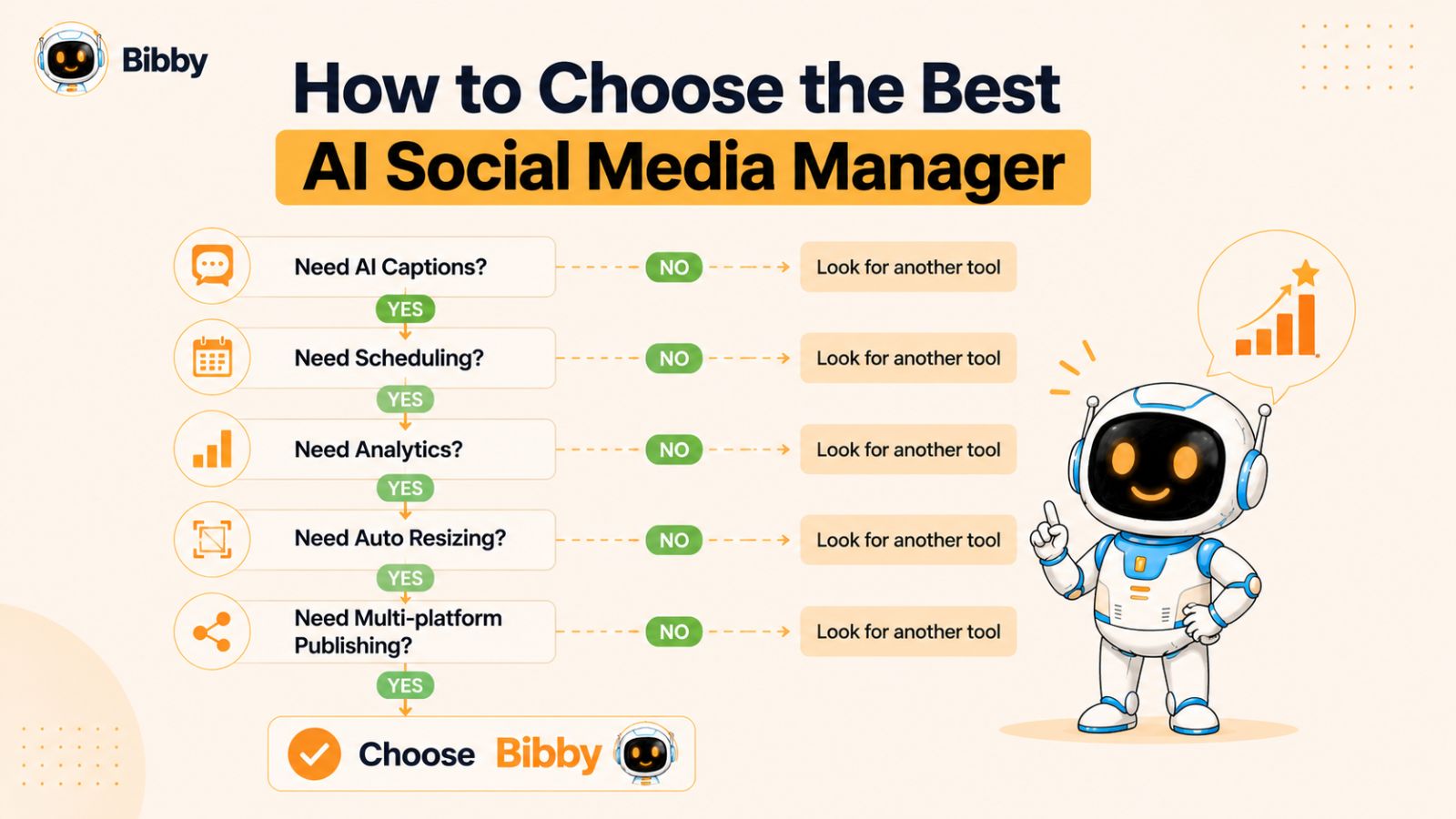
With dozens of AI-powered social media tools available today, choosing the right one can feel overwhelming. While many platforms offer similar features on paper, the real difference lies in how well those features work together to simplify your daily workflow.
The best AI social media manager shouldn't just help you schedule posts—it should help you create content faster, adapt it for multiple platforms, automate repetitive tasks, and provide actionable insights that improve your social media strategy over time.
Here are the key factors to consider before choosing a platform.
Look for an Easy-to-Use Workflow
A powerful tool shouldn't require a complicated setup or hours of training.
The goal of using AI is to save time, not add more steps to your content creation process. A well-designed platform should guide you through the workflow naturally, allowing you to move from content creation to publishing with minimal effort.
An ideal workflow looks something like this:
- Upload an image or generate one with AI.
- Automatically optimize it for different social media platforms.
- Choose your preferred posting style.
- Generate AI-powered captions.
- Schedule content across multiple platforms.
- Publish at AI-optimized times.
- Monitor analytics and improve future posts.
Bibby follows this streamlined workflow, making it easy for creators, businesses, and agencies to manage their entire social media process from one dashboard.
Make Sure It Supports the Platforms You Use
Not every business uses the same social media channels.
Some brands focus primarily on LinkedIn, while others rely heavily on Instagram, TikTok, Facebook, or YouTube. Before choosing an AI social media manager, make sure it supports the platforms that matter most to your business.
Ideally, your tool should allow you to manage multiple social networks from a single interface, reducing the need to switch between different apps throughout the day.
Bibby supports publishing across selected platforms, including Facebook, Instagram, LinkedIn, YouTube, and TikTok, helping businesses maintain a consistent presence wherever their audience spends time.
Prioritize AI-Powered Content Creation
Scheduling content is useful, but creating that content is often the biggest challenge.
Look for a platform that goes beyond basic scheduling by helping you generate:
- Images
- Captions
- Post ideas
- Platform-specific messaging
The more content creation features built into the platform, the fewer external tools you'll need to rely on.
Bibby allows users to upload their own visuals or generate images with AI before automatically creating captions based on their chosen posting style.
This integrated approach saves time and simplifies the entire content creation process.
Choose a Tool That Handles Platform Formatting
Every social network has different image sizes, video dimensions, and content requirements.
If your chosen platform requires you to manually resize every image before publishing, you're still doing a significant amount of repetitive work.
A good AI social media manager should automatically optimize your media for different destinations.
Bibby takes care of platform-specific sizes, helping ensure your content is ready for publishing across multiple social media channels without requiring additional editing.
Look for Smart Scheduling Features
One of the biggest reasons businesses adopt AI is to remove repetitive decision-making.
Instead of selecting publishing times manually for every post, look for a platform that offers intelligent scheduling features.
AI-assisted scheduling can help organize your publishing calendar while recommending times that align with audience engagement patterns.
Bibby includes AI-optimized scheduling, allowing users to publish content automatically across selected platforms without constantly adjusting their calendar.
Ensure It Supports Different Content Formats
Today's audiences consume content in many different ways.
Images remain important, but videos, Stories, Reels, and Shorts now play a major role in driving engagement.
A modern AI social media manager should support multiple content types so you can manage your complete content strategy from one platform.
Bibby supports:
- Images
- Videos
- Stories
- Promotional content
- Educational posts
- Multi-platform publishing
This flexibility makes it easier to execute a well-rounded social media strategy without relying on several separate tools.
Don't Overlook Analytics
Creating and publishing content is only half of successful social media management.
The other half is learning from your results.
A good AI social media manager should provide clear analytics that help answer questions like:
- Which posts performed best?
- Which platforms generate the most engagement?
- What content should you create more often?
- Which posting times produce stronger results?
Instead of simply displaying numbers, the platform should help you understand what those numbers mean so you can make smarter marketing decisions.
Bibby includes built-in analytics that allow users to track performance and continuously improve their content strategy.
Consider Scalability
The right platform should grow with your business.
Even if you're managing only one account today, your needs may change as your audience grows. You may eventually manage multiple brands, collaborate with team members, publish more frequently, or expand to additional platforms.
Choosing a scalable AI social media manager now can help you avoid switching tools later.
Look for software that supports:
- Multiple social media accounts
- Higher publishing volumes
- Additional team members
- More content formats
- Expanded workflows
A platform that scales alongside your business will continue delivering value as your marketing efforts become more sophisticated.
The Best AI Social Media Manager Is the One You'll Actually Use
The platform with the longest feature list isn't always the best choice.
What matters most is whether the tool fits naturally into your workflow and helps you save time every day.
If a platform simplifies content creation, handles platform formatting, generates quality captions, schedules posts intelligently, and provides meaningful analytics, you'll be far more likely to use it consistently.
For many creators, agencies, and businesses, that's where Bibby stands out. By combining AI image generation, automatic caption writing, platform-specific formatting, multi-platform scheduling, AI-optimized publishing times, and analytics into a single workflow, it reduces the complexity of managing social media and helps users stay focused on creating content that drives real results.
Is an AI Social Media Manager Worth It?
For most businesses, creators, and marketing teams, the answer is yes.
Managing social media today involves far more than publishing a post. You need to create engaging visuals, write compelling captions, optimize content for different platforms, publish consistently, monitor analytics, and continuously improve your strategy. Doing all of this manually takes time—time that could be spent growing your business, creating better content, or engaging with your audience.
An AI social media manager helps reduce that workload by automating many of the repetitive tasks involved in social media management. Instead of switching between multiple tools for design, caption writing, scheduling, and reporting, you can streamline your workflow into one centralized platform.
While AI won't replace creativity, strategic thinking, or authentic audience engagement, it can significantly improve efficiency. The best results come from combining human expertise with AI-powered automation.
When an AI Social Media Manager Is Worth It
An AI social media manager is an excellent investment if you:
- Manage multiple social media platforms.
- Struggle to post consistently.
- Spend too much time writing captions.
- Need help resizing content for different platforms.
- Want to schedule content in advance.
- Prefer publishing at AI-optimized times instead of guessing.
- Need analytics to understand what content performs best.
- Want to simplify your overall social media workflow.
For businesses and creators publishing content regularly, even saving a few hours each week can have a significant impact on productivity.
When You May Not Need One
An AI social media manager may not be necessary if you:
- Only post occasionally.
- Use a single social media platform.
- Prefer creating and publishing everything manually.
- Don't need scheduling, analytics, or automation features.
However, as your audience grows and your content strategy expands, automation often becomes increasingly valuable.
The Future of AI Social Media Management
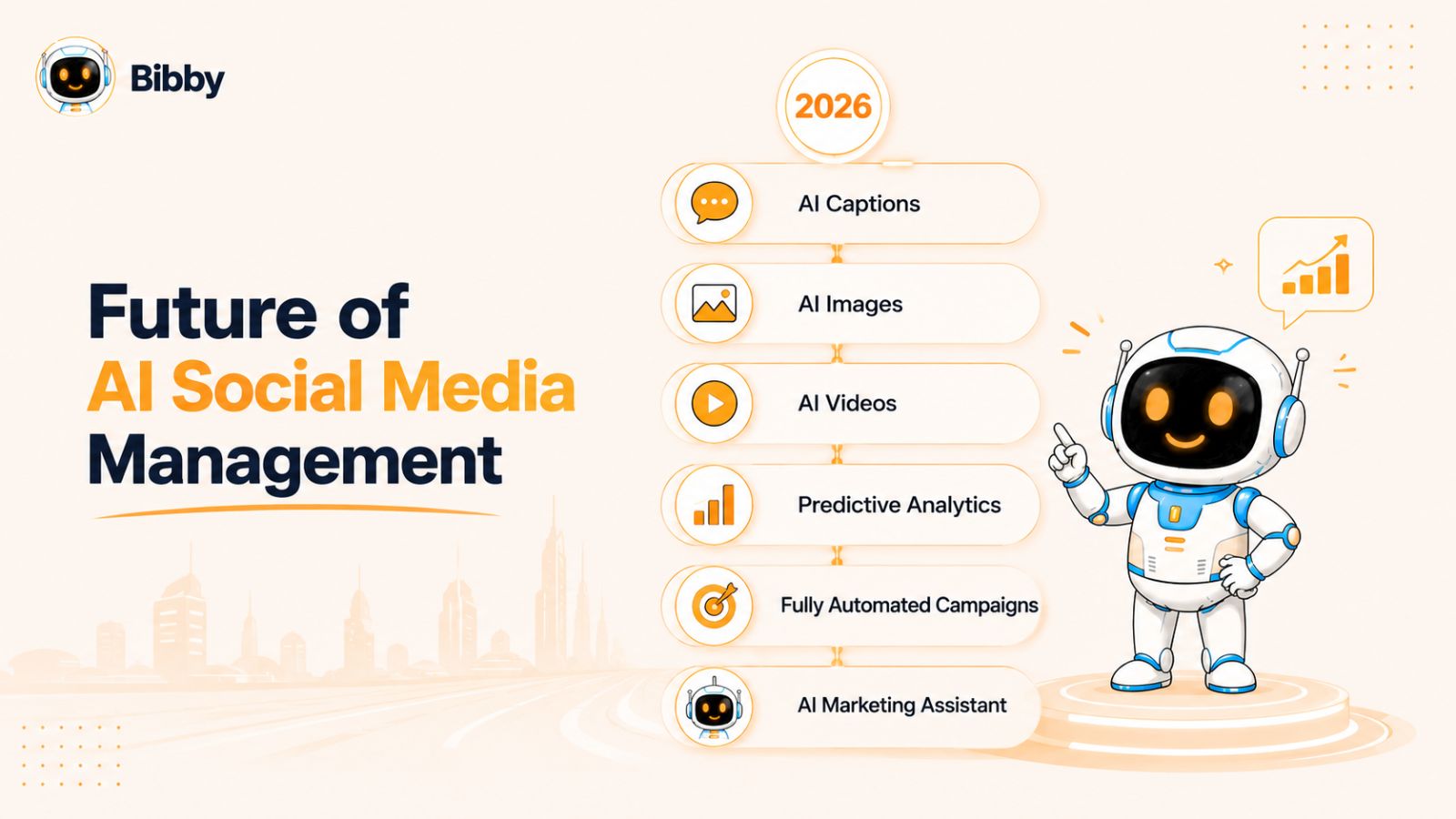
Artificial intelligence is transforming social media from a manual process into an intelligent, automated workflow.
The next generation of AI tools will likely become even better at understanding brand voice, generating personalized content, predicting engagement trends, and helping marketers make data-driven decisions. Instead of simply scheduling posts, AI platforms will continue evolving into complete content management ecosystems.
We're already seeing this shift today. Businesses no longer want separate tools for image creation, caption writing, scheduling, analytics, and publishing—they want one platform that brings everything together.
That's exactly where solutions like Bibby fit in.
By combining AI image generation, automatic platform sizing, customizable posting styles, AI-generated captions, multi-platform scheduling, AI-optimized publishing times, support for videos and Stories, and built-in analytics, Bibby simplifies the entire social media management process from start to finish.
As AI continues to evolve, the businesses that embrace automation while maintaining authentic human creativity will be best positioned to stay competitive, publish consistently, and build stronger relationships with their audiences.
Frequently Asked Questions About AI Social Media Managers
What is an AI social media manager?
An AI social media manager is software that uses artificial intelligence to help create, organize, schedule, publish, and analyze social media content. It can automate repetitive tasks like caption writing, media formatting, scheduling, and performance tracking, making social media management faster and more efficient.
How does an AI social media manager work?
Most AI social media managers follow a simple workflow:
- Upload an image or video, or generate one with AI.
- Optimize the content for different social media platforms.
- Choose a posting style or brand voice.
- Generate AI-powered captions.
- Schedule posts across multiple platforms.
- Publish at AI-optimized times.
- Review analytics to improve future content.
Can AI schedule social media posts automatically?
Yes. Many AI social media management tools allow you to schedule posts in advance across multiple platforms. Some, including Bibby, also use AI to recommend optimized publishing times based on audience engagement patterns.
Can AI write social media captions?
Yes. AI can generate captions based on your image, video, prompt, posting style, or brand voice. Most tools also allow you to edit the generated captions before publishing.
Which social media platforms can AI tools manage?
This varies by platform, but many AI social media managers support popular networks such as:
- TikTok
- YouTube
Always check a platform's supported integrations before choosing a tool.
Can Bibby post videos and Stories?
Yes. Bibby supports publishing multiple content formats, including images, videos, and Stories, helping users manage a complete social media content strategy from one platform.
Does Bibby resize content for different social media platforms?
Yes. Bibby automatically handles platform-specific media sizes, reducing the need to manually resize images or videos for different social networks.
Is an AI social media manager good for small businesses?
Absolutely. Small businesses often have limited time and marketing resources. An AI social media manager helps automate content creation, caption generation, scheduling, and analytics, allowing business owners to maintain a professional social media presence more efficiently.
Will AI replace human social media managers?
No. AI is best viewed as a productivity tool rather than a replacement for human marketers. While it can automate repetitive tasks, people are still needed for strategy, creative direction, community management, customer relationships, and brand storytelling.
Conclusion
Artificial intelligence is changing how businesses approach social media, making it easier than ever to create, schedule, publish, and optimize content across multiple platforms. Instead of spending hours resizing images, writing captions, choosing publishing times, and checking analytics, an AI social media manager helps automate these repetitive tasks so you can focus on strategy, creativity, and audience engagement.
Throughout this guide, we've explored three key takeaways: what an AI social media manager is, how AI simplifies every stage of the social media workflow, and why choosing a platform that combines content creation, scheduling, automation, and analytics can dramatically improve productivity. For businesses, creators, and agencies looking to streamline their workflow, Bibby brings these capabilities together in one intuitive platform—from AI image generation and automatic caption writing to platform-specific sizing, AI-optimized scheduling, support for videos and Stories, and performance analytics.
As your next step, explore how to build a complete AI-powered content strategy by creating a 30-day social media content calendar. When paired with an AI social media manager like Bibby, a well-planned content calendar can help you stay consistent, save even more time, and grow your presence across every major social platform.