
Social media success rarely comes from guessing—it comes from understanding what's already working and improving upon it.
If you're trying to grow your audience, generate more engagement, or increase sales through social media, studying your competitors can give you a significant advantage. The brands that consistently win on platforms like Facebook, Instagram, LinkedIn, YouTube, and TikTok aren't just creating content—they're analyzing performance data, identifying opportunities, and executing faster than everyone else.
In this article, you will learn:
- How to uncover competitors' highest-performing social media strategies
- Which metrics reveal content opportunities your competitors miss
- How AI tools can automate execution and accelerate growth
The good news is that you don't need a massive marketing team to compete. With the right competitor analysis framework and modern AI-powered tools like Bibby, you can discover what's working in your industry, create better content, and automatically publish across multiple platforms at optimal times—all while spending less time managing social media.
Also read: How to Grow on Social Media With AI?
What Is Social Media Competitor Analysis?
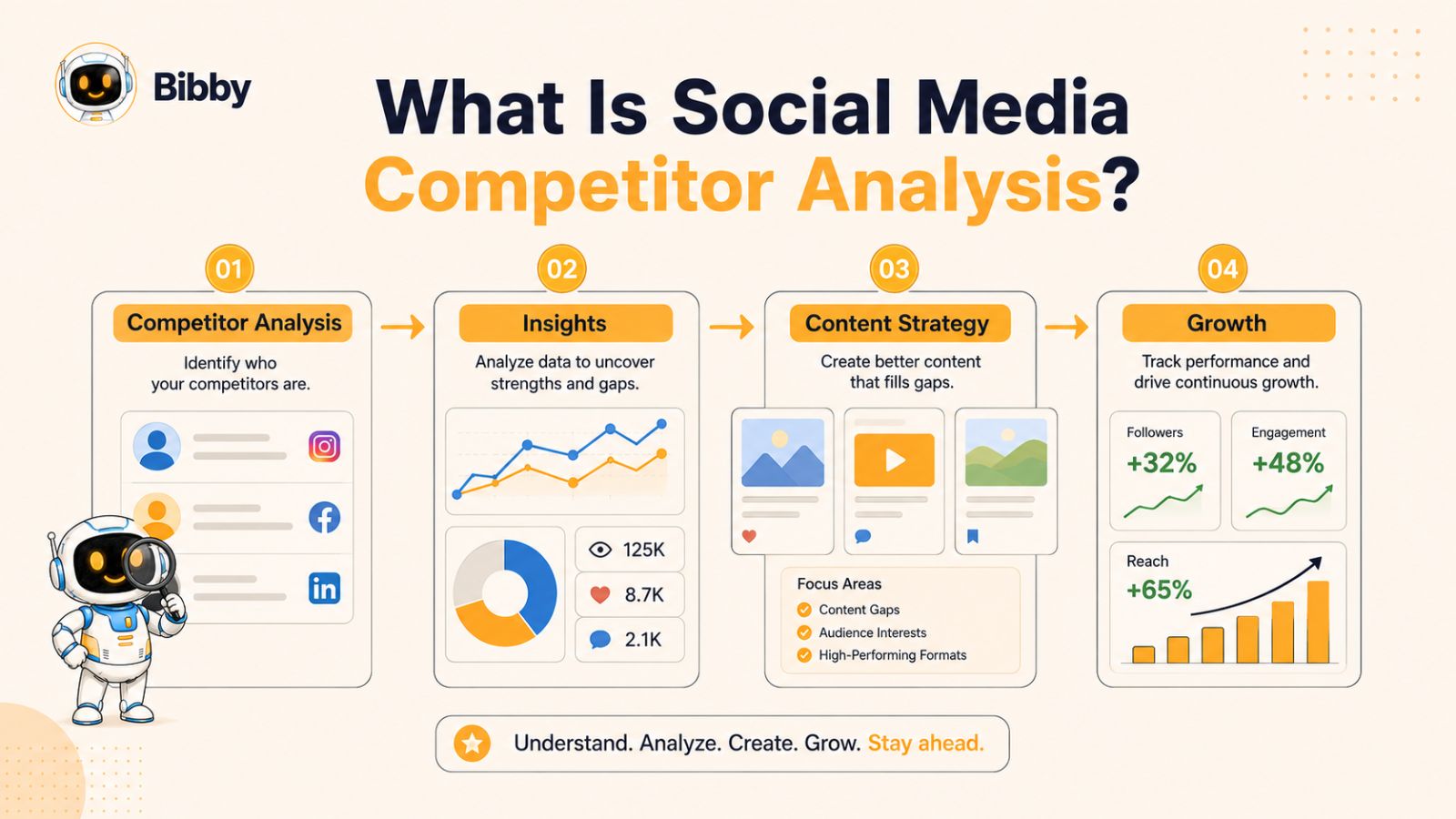
Social media competitor analysis is the process of evaluating your competitors' social media activities to understand what's driving their results and identify opportunities to improve your own strategy.
Rather than creating content based on assumptions, competitor analysis allows you to make data-driven decisions. By studying what your competitors post, how often they publish, which content formats perform best, and how their audience responds, you can uncover valuable insights that help you grow faster and avoid costly mistakes.
At its core, social media competitor analysis answers important questions such as:
- Which platforms should you focus on?
- What content topics generate the most engagement?
- How often should you post?
- Which content formats perform best?
- What audience pain points are competitors addressing?
- Where are competitors falling short?
The goal is not to copy your competitors. In fact, simply duplicating someone else's content strategy rarely produces long-term success. The objective is to understand what resonates with your shared audience and then create something more valuable, more engaging, or more unique.
Why Social Media Competitor Analysis Matters
The social media landscape has become increasingly competitive. Every day, brands, creators, and businesses compete for limited attention across platforms like Facebook, Instagram, LinkedIn, YouTube, and TikTok.
Without competitor analysis, you're essentially operating in the dark. You may spend months testing content ideas that have already failed for others or overlook content opportunities that are generating thousands of engagements in your industry.
A structured competitor analysis process helps you:
- Discover proven content ideas faster
- Identify emerging industry trends
- Understand audience preferences
- Improve engagement rates
- Benchmark your performance against competitors
- Build a more effective content strategy
- Reduce time spent on trial-and-error marketing
For businesses managing multiple social media platforms, competitor analysis becomes even more powerful when combined with automation. Once you've identified the content strategies that work, tools like Bibby can help you execute them consistently by generating captions, scheduling posts across platforms, and publishing content at AI-optimized times without requiring constant manual effort.
Competitor Analysis vs. Audience Research
While they are closely related, competitor analysis and audience research serve different purposes.
Audience research focuses on understanding your customers—their needs, interests, challenges, and behaviors.
Competitor analysis focuses on understanding what other brands are doing to attract and engage those same customers.
The most successful social media strategies combine both approaches. By understanding your audience and analyzing how competitors are serving that audience, you can create content that stands out while delivering exactly what your target market is looking for.
Think of competitor analysis as a shortcut to discovering what already works. Instead of starting from scratch, you can learn from the successes and mistakes of others and use those insights to build a stronger social media presence.
Also read: Best Hootsuite Alternative for Small Business
Why Most Businesses Struggle to Outperform Competitors
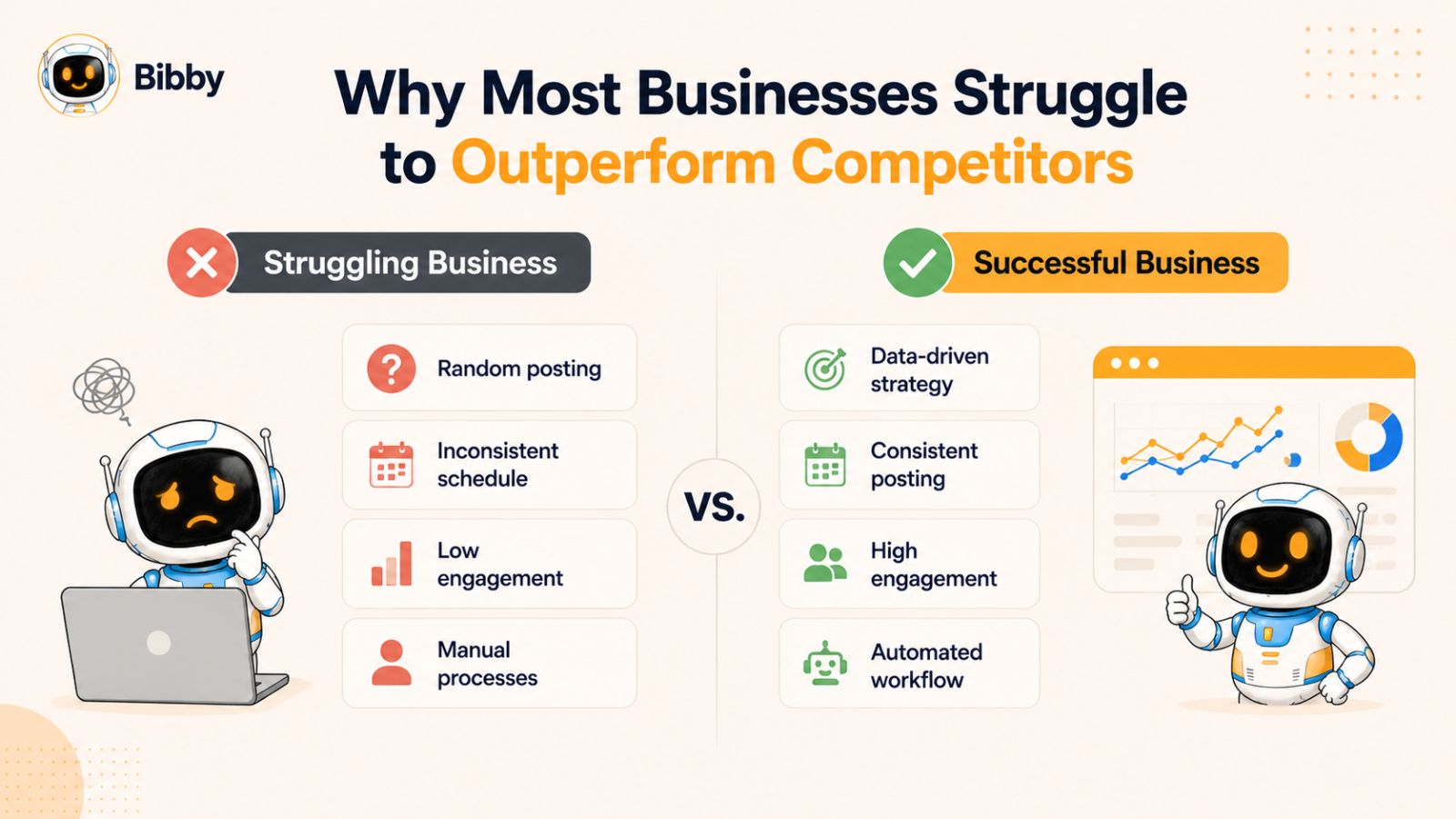
Many businesses understand the importance of social media, yet they still struggle to generate consistent engagement, grow their audience, or turn followers into customers. The problem is rarely a lack of effort. More often, it's a lack of strategy, consistency, and execution.
While successful brands use data to guide their decisions, many businesses rely on guesswork. They publish content sporadically, chase every new trend, and hope something eventually works. Unfortunately, hope is not a social media strategy.
The Content Guessing Problem
One of the biggest reasons businesses fall behind competitors is that they create content without understanding what their audience actually wants to see.
Common mistakes include:
- Posting content based on personal opinions rather than audience data
- Ignoring competitor insights and industry trends
- Creating random content without a clear goal
- Focusing on quantity instead of quality
- Failing to analyze performance metrics
As a result, businesses often spend significant time and resources producing content that generates little engagement or reach.
Meanwhile, competitors who regularly analyze their performance can quickly identify which topics, formats, and messaging styles resonate most with their audience.
Inconsistent Posting Kills Growth
Consistency is one of the strongest predictors of social media success.
Many businesses start strong, posting frequently for a few weeks before becoming overwhelmed by the ongoing demands of content creation. As posting frequency declines, engagement often follows.
Inconsistent publishing creates several challenges:
- Reduced visibility in platform algorithms
- Lower audience engagement
- Slower follower growth
- Missed opportunities to build brand awareness
- Difficulty collecting meaningful performance data
Competitors who maintain a consistent publishing schedule gain a significant advantage because they remain visible and top-of-mind for their audience.
They Focus on Vanity Metrics
Another common mistake is prioritizing vanity metrics such as follower counts while ignoring more meaningful performance indicators.
A competitor with fewer followers may generate significantly more business if their audience is highly engaged.
Instead of focusing solely on follower growth, successful brands pay attention to:
- Engagement rates
- Shares and saves
- Website clicks
- Lead generation
- Audience retention
- Conversion metrics
These indicators provide a clearer picture of content effectiveness and business impact.
The Speed Advantage
In today's social media landscape, execution speed often matters just as much as content quality.
When a trend emerges or a content opportunity appears, the brands that move quickly are usually the ones that capture the most attention. Businesses that rely entirely on manual processes often struggle to keep up.
Tasks such as creating visuals, writing captions, choosing posting times, scheduling content, and managing multiple platforms can consume hours every week.
This is where automation becomes a competitive advantage.
For example, after identifying successful content strategies through competitor analysis, businesses can use Bibby to streamline execution. Instead of manually creating and publishing content across multiple platforms, users can upload an image or generate one with AI, select a posting style, and let Bibby automatically generate captions and schedule content across Facebook, Instagram, LinkedIn, YouTube, and TikTok.
By publishing at AI-optimized times and managing content from a single platform, businesses can maintain consistency without increasing their workload.
The Businesses That Win Do Things Differently
Top-performing brands rarely succeed because they have unlimited resources. More often, they succeed because they have repeatable systems.
They:
- Analyze competitors regularly
- Track meaningful performance metrics
- Identify content opportunities quickly
- Publish consistently
- Automate repetitive tasks
- Continuously optimize their strategy
The good news is that these advantages are available to businesses of all sizes. The first step is identifying who your real competitors are and understanding exactly what they're doing on social media.
In the next section, we'll look at how to identify your true social media competitors so you can begin gathering actionable insights.
Also read: Why Every Small Business Should Use a Social Media Scheduling Tool?
Step 1: Identify Your Real Social Media Competitors
Before you can analyze competitors and outperform them, you need to identify who your competitors actually are.
This sounds straightforward, but many businesses make a critical mistake: they focus only on the biggest brands in their industry. While large companies can provide useful insights, they are not always your most relevant competitors on social media.
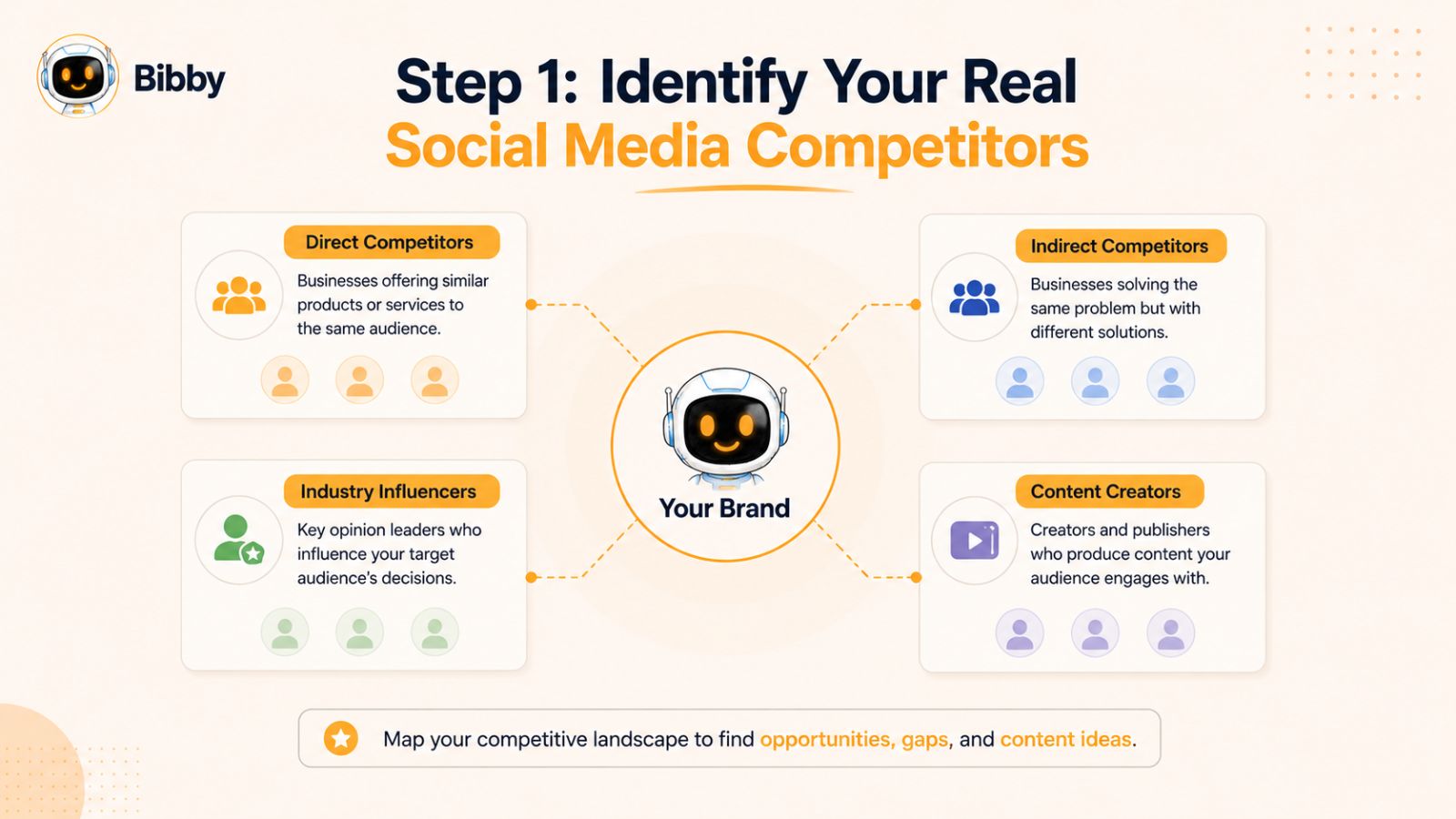
Your true competitors are the accounts competing for the same audience attention, engagement, and customers.
Understand the Three Types of Social Media Competitors
To build an effective competitor analysis framework, start by categorizing competitors into three groups.
Direct Competitors
Direct competitors offer products or services similar to yours and target the same audience.
For example, if you sell social media management software, other social media management platforms would be direct competitors.
These competitors are often your most important source of insights because their audience closely matches your own.
When analyzing direct competitors, pay attention to:
- Content themes
- Posting frequency
- Engagement rates
- Promotional campaigns
- Audience interactions
- Content formats
Indirect Competitors
Indirect competitors solve the same problem but in a different way.
For example, a social media scheduling platform may compete indirectly with marketing agencies, freelancers, or virtual assistants who manage social media for businesses.
Although their products differ, they often attract the same potential customers.
Studying indirect competitors can reveal unique content ideas and alternative positioning strategies that direct competitors may overlook.
Attention Competitors
One of the most overlooked competitor categories is attention competitors.
These are influencers, creators, industry experts, educators, and thought leaders who compete for your audience's time and attention—even if they never sell a competing product.
For example, a marketing consultant on LinkedIn may attract the same audience as a social media software company.
Because creators often experiment more aggressively with content formats and engagement tactics, they can provide valuable inspiration for your own strategy.
How to Find Your Competitors on Social Media
Once you understand the different competitor categories, it's time to build your competitor list.
Search Industry Keywords
Start by searching the primary keywords related to your business on each social media platform.
Look for:
- Frequently appearing accounts
- Highly engaged creators
- Brands with strong visibility
- Accounts consistently ranking in search results
Make a note of the profiles that repeatedly appear across multiple platforms.
Analyze Industry Hashtags
Hashtags can quickly reveal active competitors and influential creators in your niche.
Search relevant hashtags and identify:
- Accounts with high engagement
- Consistent content creators
- Brands publishing regularly
- Emerging competitors gaining traction
This approach often uncovers competitors that traditional search methods miss.
Study Your Audience
A simple way to discover competitors is to look at who your audience already follows.
Review:
- Competitor follower lists
- Comment sections
- Tagged accounts
- Community discussions
If the same names repeatedly appear, they're likely competing for the same audience.
Use Search Engines
Search Google for industry-specific terms combined with platform names.
Examples:
- Best social media management tools
- Top marketing agencies on LinkedIn
- Leading eCommerce brands on Instagram
Search results often reveal both established and emerging competitors worth tracking.
Create a Competitor Tracking Spreadsheet
Once you've identified competitors, organize them in a spreadsheet.
Include:
| Metric | Details |
|---|---|
| Competitor Name | Brand or creator |
| Platform | Facebook, Instagram, LinkedIn, YouTube, TikTok |
| Follower Count | Current audience size |
| Posting Frequency | Daily, weekly, monthly |
| Average Engagement | Likes, comments, shares |
| Content Types | Videos, images, stories, carousels |
| Key Strengths | What they do well |
| Opportunities | Areas where you can improve upon them |
This document becomes your competitor intelligence dashboard and serves as the foundation for future analysis.
Focus on Quality, Not Quantity
You don't need to track dozens of competitors.
In most cases, analyzing:
- 3–5 direct competitors
- 2–3 indirect competitors
- 2–3 attention competitors
will provide more than enough insight to improve your strategy.
The goal isn't to monitor everyone. It's to identify the accounts generating the best results and understand why they're succeeding.
Once you've identified your competitors, the next step is analyzing their social media presence to uncover which platforms, content types, and engagement strategies are driving the strongest performance.
Step 2: Analyze Their Social Media Presence
Now that you've identified your competitors, it's time to examine how they use social media platforms to attract attention, engage audiences, and drive business results.
This stage is where valuable insights start to emerge. Instead of simply looking at follower counts, you'll analyze how competitors present themselves, where they focus their efforts, and which tactics appear to generate the strongest engagement.
The goal is to answer one simple question:
What are successful competitors doing that your business can improve upon?
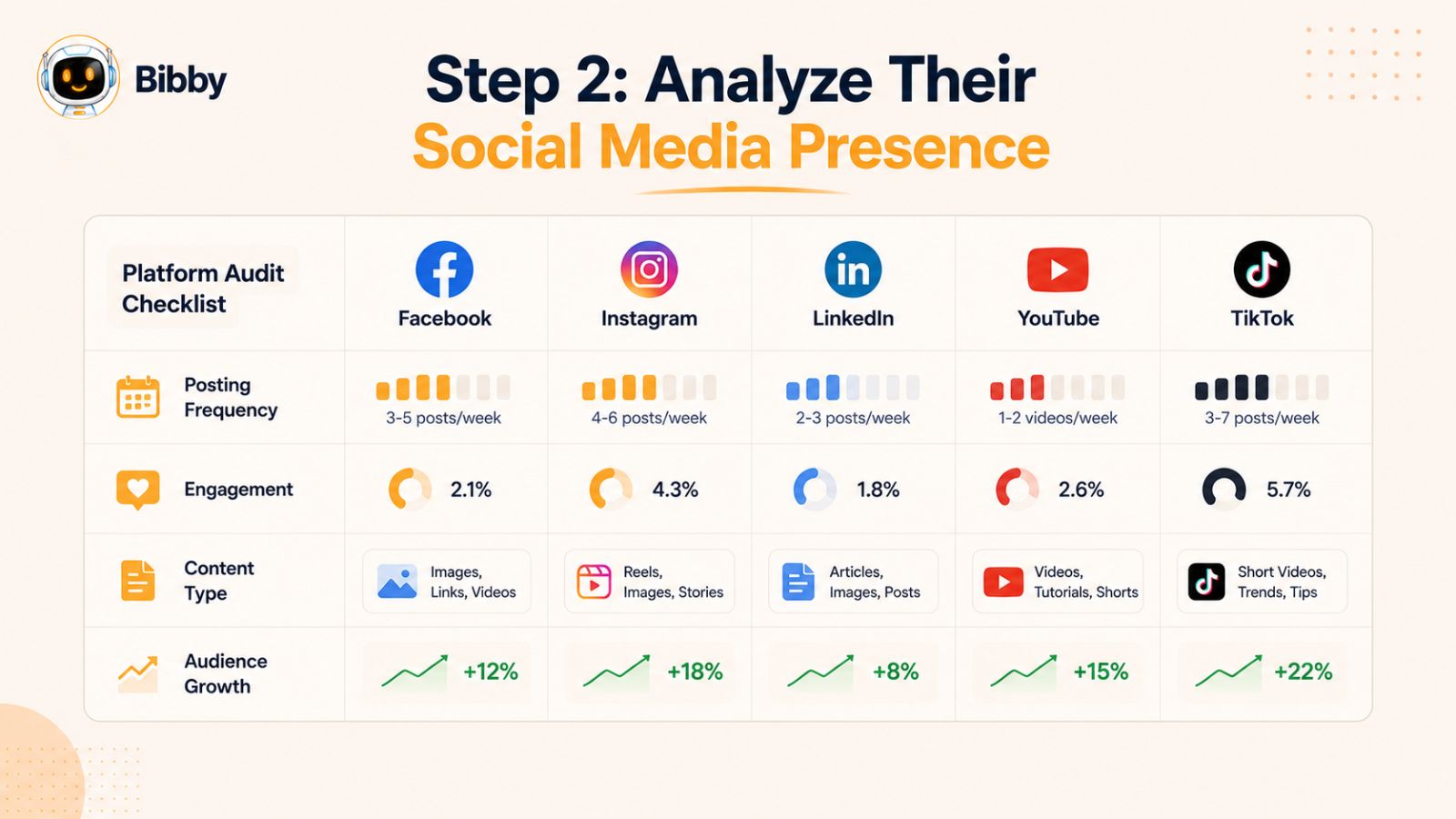
Start by Identifying Their Priority Platforms
Most businesses have profiles on multiple social networks, but not all platforms receive the same level of attention.
A competitor may have accounts on Facebook, Instagram, LinkedIn, YouTube, and TikTok, yet generate most of their engagement from only one or two channels.
Look for patterns such as:
- Where they post most frequently
- Which platforms generate the highest engagement
- Where they invest the most effort
- Which platforms receive the most audience interaction
These patterns often reveal where your target audience is most active.
Analyze Their Facebook Strategy
Facebook remains a powerful platform for community building, advertising, and audience engagement.
Review:
- Posting frequency
- Average engagement per post
- Use of images versus videos
- Community management practices
- Types of posts receiving the most shares
Questions to ask:
- Are they publishing educational content?
- Do they focus on storytelling?
- Are they leveraging Facebook Groups?
- What topics generate discussions?
Analyze Their Instagram Strategy
Instagram offers valuable insights into visual branding and content performance.
Pay close attention to:
- Reels performance
- Carousel posts
- Story usage
- Content design consistency
- Hashtag strategy
Questions to ask:
- Which Reels receive the highest engagement?
- What visual style do they use?
- How frequently do they publish Stories?
- Which content categories appear most often?
Look for recurring themes rather than individual viral posts.
Analyze Their LinkedIn Strategy
LinkedIn is especially important for B2B companies and professional brands.
Review:
- Thought leadership content
- Employee-generated content
- Company page activity
- Engagement quality
- Content topics
Questions to ask:
- Are they sharing educational insights?
- Do employees actively engage with content?
- Which post formats perform best?
- How often do they publish?
LinkedIn often reveals positioning strategies that aren't visible on other platforms.
Analyze Their YouTube Strategy
YouTube provides a wealth of information because long-form video content requires significant planning and investment.
Analyze:
- Upload frequency
- Video topics
- Thumbnail design
- Video length
- Audience engagement
Questions to ask:
- Which videos have the most views?
- What topics appear repeatedly?
- How do they structure video titles?
- Which content formats perform best?
Successful YouTube content often reflects broader audience interests that can inspire content across other platforms.
Analyze Their TikTok Strategy
TikTok can reveal emerging trends before they become mainstream.
Review:
- Posting consistency
- Trend participation
- Video style
- Content hooks
- Engagement patterns
Questions to ask:
- Which videos generate the most views?
- How quickly do they adopt trends?
- What hooks capture attention?
- Which content themes perform repeatedly?
The objective is to identify patterns, not individual successes.
Evaluate Their Brand Positioning
Beyond platform activity, examine how competitors position themselves.
Review:
- Bio descriptions
- Profile images
- Brand messaging
- Value propositions
- Calls-to-action
Ask yourself:
- What audience are they targeting?
- What problems do they solve?
- How do they differentiate themselves?
- What promises do they make?
Understanding positioning helps you identify opportunities to stand out rather than blend in.
Assess Their Consistency
Consistency is often one of the clearest indicators of a successful social media strategy.
Look for:
- Regular posting schedules
- Consistent visual branding
- Unified messaging
- Repeated content themes
- Audience engagement habits
Businesses that publish consistently tend to build stronger audience relationships and generate more predictable growth.
Maintaining this level of consistency manually can be difficult, especially when managing multiple platforms. This is one reason many businesses adopt automation tools like Bibby. Instead of creating and publishing content separately for Facebook, Instagram, LinkedIn, YouTube, and TikTok, teams can manage everything from a single workflow, helping them maintain the consistency that successful competitors often demonstrate.
Document Your Findings
As you review each competitor, record observations such as:
| Category | Notes |
|---|---|
| Top Platforms | Highest-performing channels |
| Best Content Types | Videos, Reels, Stories, Carousels |
| Posting Frequency | Daily, weekly, multiple times per day |
| Engagement Trends | Common audience behaviors |
| Brand Positioning | Core messaging and value proposition |
| Opportunities | Areas where you can outperform them |
Over time, these observations will reveal patterns that individual posts cannot.
What You're Looking For
At this stage, don't focus on creating content yet.
Focus on identifying:
- Which platforms matter most
- Which content formats consistently perform
- Which audience problems competitors address
- Where competitors invest the most effort
- Where opportunities exist for differentiation
Once you've mapped out your competitors' social media presence, the next step is examining their content strategy in detail to uncover exactly what drives engagement and growth.
Also read: How to Automate Your LinkedIn Posting Strategy for B2B Growth
Step 3: Study Their Content Strategy
Once you've analyzed where your competitors are active, the next step is understanding what they publish and why it performs well.
This is often the most valuable part of social media competitor analysis because content is what ultimately drives engagement, shares, followers, and conversions.
Instead of looking at individual posts in isolation, focus on identifying patterns. One viral post may be a lucky break. A content theme that consistently performs well over several months is a strategy.
Your goal is to reverse engineer the content engine behind your competitors' growth.
Identify Their Core Content Pillars
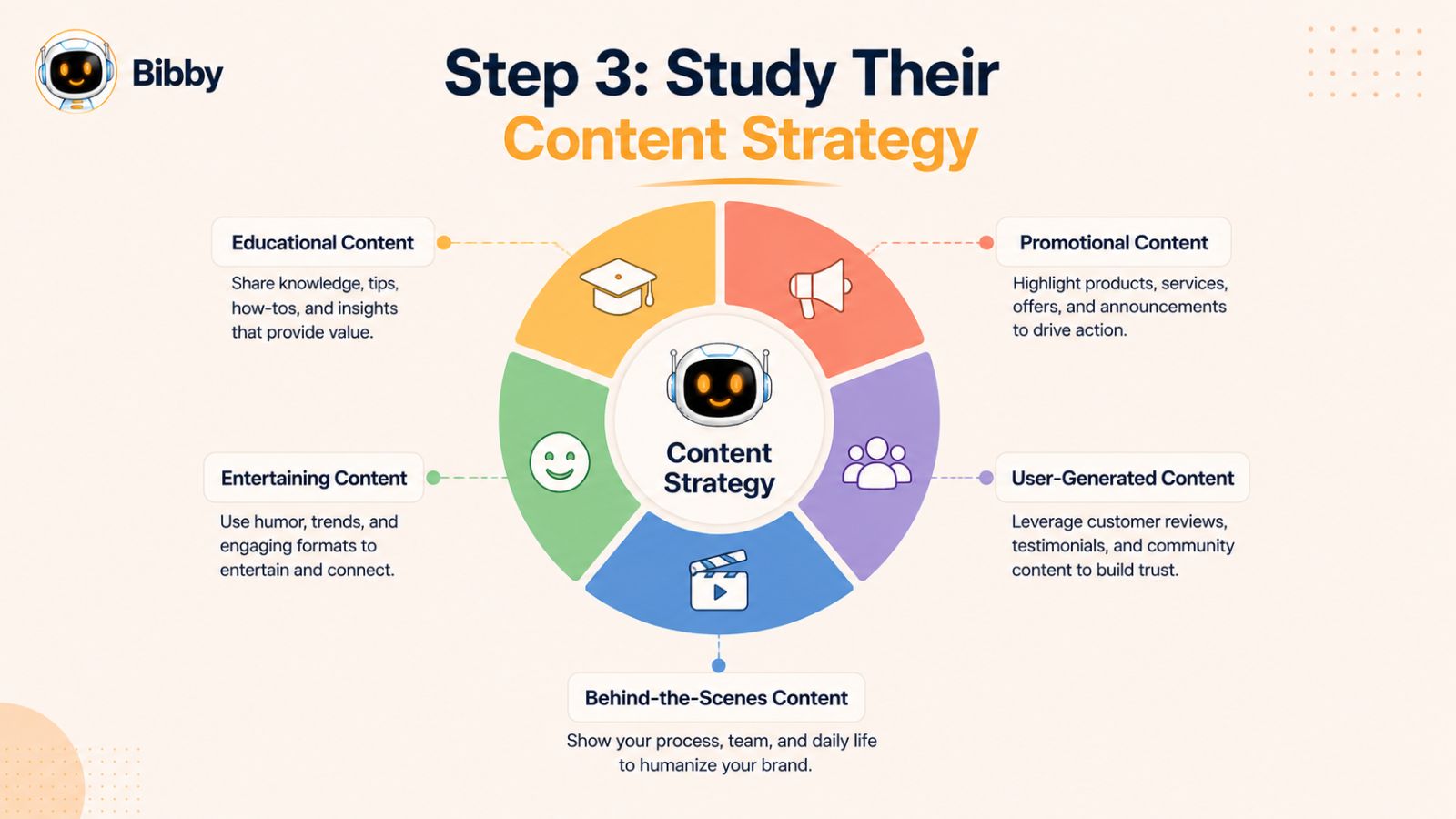
Most successful brands don't post random content. They typically organize their content around a handful of recurring themes known as content pillars.
As you review competitor accounts, categorize their content into major topics.
Common content pillars include:
Educational Content
Educational content helps audiences solve problems, learn new skills, or gain insights.
Examples include:
- How-to guides
- Tutorials
- Industry tips
- Best practices
- Step-by-step walkthroughs
This content often generates strong engagement because it provides immediate value.
Entertaining Content
Entertaining content is designed to capture attention and encourage sharing.
Examples include:
- Memes
- Trends
- Relatable situations
- Humor
- Challenges
These posts can significantly increase visibility and reach.
Promotional Content
Promotional content focuses on products, services, and offers.
Examples include:
- Product announcements
- Feature showcases
- Case studies
- Special promotions
- Customer success stories
While important, high-performing brands rarely make promotional content the majority of their strategy.
Behind-the-Scenes Content
Audiences enjoy seeing the people and processes behind a business.
Examples include:
- Team highlights
- Company culture
- Workflows
- Day-in-the-life content
- Product development updates
This content helps build trust and authenticity.
User-Generated Content
Many successful brands encourage customers to create content on their behalf.
Examples include:
- Testimonials
- Reviews
- Customer photos
- Customer videos
- Success stories
User-generated content often outperforms traditional marketing because it feels more authentic.
Analyze Content Formats
Content topics matter, but formats matter just as much.
Different platforms favor different types of content, and your competitors' strongest formats can reveal important opportunities.
Track how frequently competitors use:
- Single-image posts
- Carousels
- Short-form videos
- Reels
- Stories
- Long-form videos
- Live streams
- Polls
- Infographics
As you analyze content, ask:
- Which format appears most frequently?
- Which format generates the most engagement?
- Are certain topics paired with specific formats?
- Which formats are underutilized?
Often, you'll discover that competitors rely heavily on one format while neglecting another that could become your competitive advantage.
Look for Recurring Topics
One of the easiest ways to uncover a winning content strategy is to identify topics competitors repeatedly revisit.
If a company consistently publishes content around a specific subject, there is usually a reason.
For example, a social media management brand may repeatedly publish content about:
- Instagram growth
- AI marketing tools
- Content scheduling
- Social media trends
- Engagement strategies
Recurring topics often indicate:
- Strong audience interest
- Proven engagement
- Business relevance
- Conversion potential
Create a list of topics that appear frequently across multiple competitors. These are likely areas your audience already cares about.
Examine Their Content Hooks
The first few seconds or first few words of a post often determine whether people engage with it.
Top-performing competitors typically use proven hooks to stop users from scrolling.
Common examples include:
- Asking a question
- Presenting a surprising statistic
- Challenging conventional wisdom
- Highlighting a common mistake
- Promising a specific outcome
Examples:
- "Most businesses are making this social media mistake."
- "Here's why your engagement is dropping."
- "We tested 100 posts and found this surprising result."
- "Stop posting before you read this."
Document the hooks that consistently appear in high-performing content.
Analyze Calls-to-Action (CTAs)
A strong content strategy doesn't just generate engagement—it encourages action.
Review how competitors guide audiences toward the next step.
Common CTAs include:
- Comment below
- Share this post
- Save this for later
- Visit our website
- Download a resource
- Book a consultation
- Start a free trial
Pay attention to:
- Which CTAs appear most frequently
- Which posts generate the most responses
- How competitors encourage participation
Small CTA improvements can significantly increase engagement rates.
Evaluate Visual Style and Branding
Successful brands often have a recognizable visual identity.
Review:
- Color schemes
- Typography
- Graphic styles
- Image quality
- Video editing techniques
- Thumbnail design
Consistency helps competitors become instantly recognizable in crowded feeds.
However, this doesn't mean you should copy their visual style. Instead, identify what makes their content appealing and create a distinctive version that aligns with your own brand.
Find Content Gaps
This is where competitor analysis becomes especially powerful.
As you study competitors' content, look for opportunities they are missing.
Examples include:
- Important questions left unanswered
- Outdated information
- Emerging industry trends
- New platform features
- Beginner-focused content
- Advanced educational content
Content gaps often represent the fastest path to differentiation.
Instead of competing directly on the same topics, you can create more comprehensive, more useful, or more timely content.
Use AI to Scale Winning Content Ideas
Once you've identified successful content themes, the challenge becomes execution.
Many businesses know what content they should create but struggle to produce and publish consistently across multiple platforms.
This is where tools like Bibby can help. After identifying proven content categories from competitor research, you can upload an image or generate one with AI, choose your preferred posting style, and allow Bibby to generate captions automatically.
Rather than manually adapting content for different channels, Bibby helps streamline publishing across Facebook, Instagram, LinkedIn, YouTube, and TikTok while scheduling content at AI-optimized times. This makes it easier to consistently publish the content themes you've already validated through competitor analysis.
Key Takeaway
By the end of this step, you should understand:
- Which content pillars competitors rely on
- Which formats generate the strongest engagement
- Which topics consistently perform well
- Which hooks attract attention
- Which CTAs drive action
- Where content gaps exist
These insights form the foundation of a data-driven content strategy.
Step 4: Analyze Engagement Metrics
Creating content is only half the equation. To truly understand why competitors are succeeding, you need to analyze how audiences respond to their content.
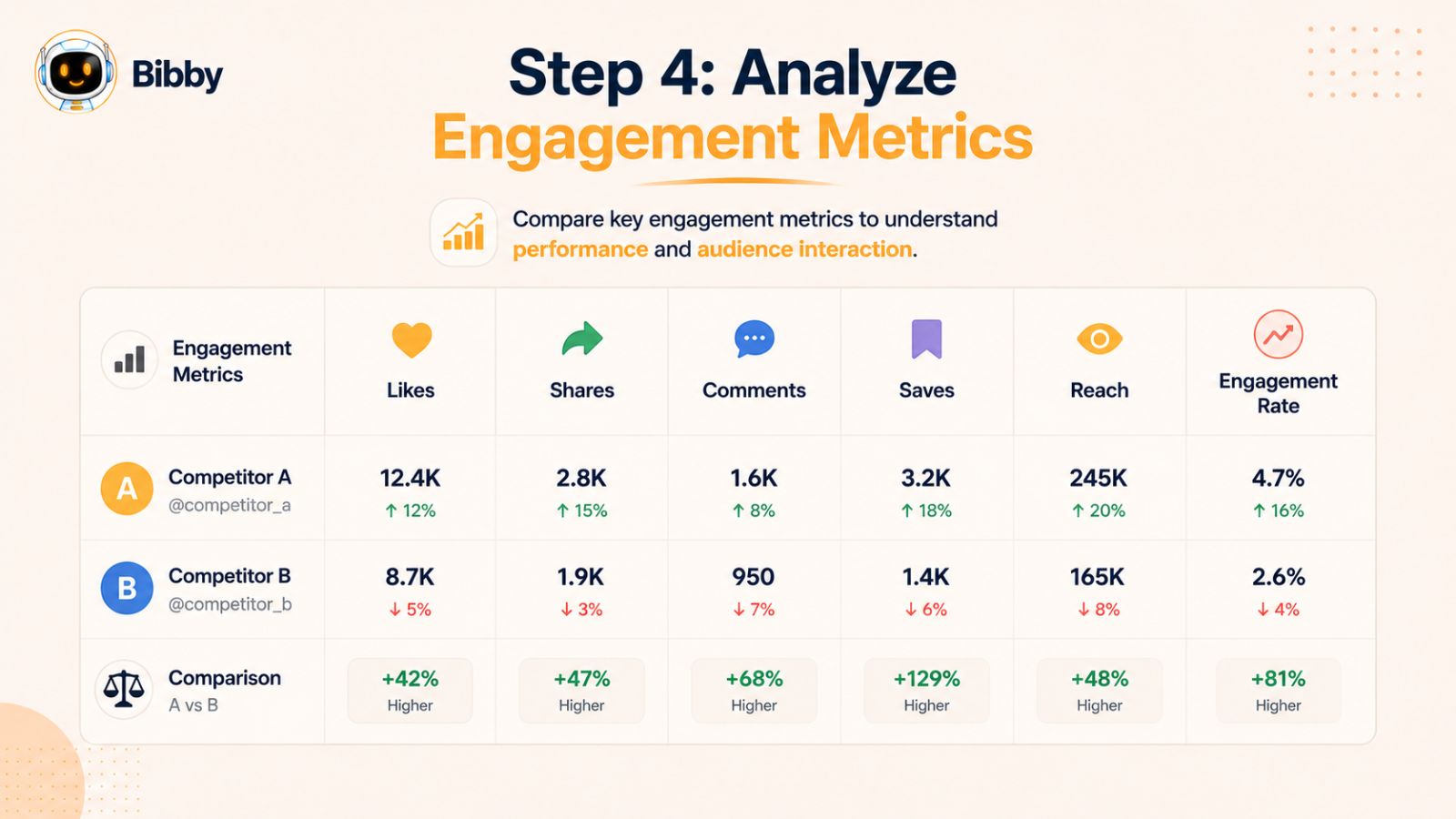
Engagement metrics reveal what people actually find valuable, interesting, or worth sharing. While content topics and formats provide clues, engagement data provides evidence.
This is where competitor analysis moves from observation to actionable intelligence.
Why Engagement Metrics Matter
Many businesses make the mistake of focusing primarily on follower counts.
While audience size can provide context, it doesn't tell the whole story.
Consider these two accounts:
- Account A has 100,000 followers and receives 200 interactions per post.
- Account B has 20,000 followers and receives 1,500 interactions per post.
Despite having a smaller audience, Account B has a much stronger relationship with its followers.
Engagement metrics help you identify which competitors are truly connecting with their audience and which are simply accumulating followers.
Key Engagement Metrics to Track
When reviewing competitor accounts, focus on metrics that indicate genuine audience interest.
Likes and Reactions
Likes are often the easiest metric to track.
While they don't necessarily indicate business success, they can help identify content themes that attract attention.
Look for:
- Posts that consistently generate high likes
- Topics associated with strong reactions
- Content formats that attract engagement
Comments
Comments often provide deeper insights than likes.
A large number of comments usually indicates:
- Strong audience interest
- Emotional engagement
- Community interaction
- Thought-provoking content
Pay attention not only to the number of comments but also to their quality.
Ask yourself:
- Are people asking questions?
- Are they sharing experiences?
- Are discussions developing naturally?
Shares
Shares are among the most valuable engagement signals.
When someone shares content, they're effectively endorsing it to their own audience.
Content with high share counts often contains:
- Educational insights
- Industry statistics
- Actionable advice
- Strong opinions
- Relatable experiences
If competitors are receiving significant shares, investigate what makes that content worthy of distribution.
Saves and Bookmarks
On platforms like Instagram, saves often indicate long-term value.
People save content they intend to revisit later.
Examples include:
- Tutorials
- Checklists
- Guides
- Templates
- Industry insights
Content with a high number of saves is often an excellent source of inspiration for future content creation.
Video Views
For video content, views provide important context.
However, views alone can be misleading.
Instead, compare views against:
- Comments
- Shares
- Engagement rates
- Audience retention indicators
A video with moderate views but strong engagement may be more effective than a viral video that generates little interaction.
Calculate Engagement Rate
One of the most useful ways to compare competitors is through engagement rate.
A simple formula is:
Engagement Rate = (Total Engagement ÷ Total Followers) × 100
This helps normalize performance across accounts of different sizes.
For example:
| Competitor | Followers | Engagement Per Post | Engagement Rate |
|---|---|---|---|
| Competitor A | 50,000 | 500 | 1% |
| Competitor B | 10,000 | 400 | 4% |
Although Competitor A has more followers, Competitor B is generating stronger audience engagement.
This often indicates a more effective content strategy.
Identify Top-Performing Posts
As you review engagement metrics, create a list of each competitor's best-performing content.
For every top-performing post, record:
- Topic
- Format
- Hook
- CTA
- Posting date
- Engagement metrics
After analyzing several competitors, patterns usually emerge.
You may discover that:
- Educational posts consistently outperform promotional content.
- Video content receives more shares than images.
- Industry trends generate stronger engagement than company updates.
- Certain content themes appear across multiple competitors.
These patterns reveal what your audience is most likely to engage with.
Look Beyond the Numbers
Raw engagement data is useful, but context matters.
A post may perform well because:
- It addresses a major industry challenge.
- It aligns with a trending topic.
- It provides exceptional value.
- It sparks debate or discussion.
Ask yourself:
- Why did this content perform well?
- What audience problem is it solving?
- What emotions does it trigger?
- How could you create a better version?
This mindset helps you move beyond imitation and toward innovation.
Spot Warning Signs
Competitor analysis isn't only about finding strengths.
You should also identify weaknesses.
Watch for:
- Large audiences with low engagement
- Repetitive content
- Declining interaction trends
- Excessive promotional content
- Poor audience responses
These weaknesses often reveal opportunities for your brand to differentiate itself.
Build an Engagement Benchmark
After analyzing multiple competitors, create benchmark ranges for your industry.
Examples include:
| Metric | Industry Benchmark |
|---|---|
| Average Engagement Rate | X% |
| Average Comments Per Post | X |
| Average Shares Per Post | X |
| Average Video Views | X |
| Average Posting Frequency | X |
These benchmarks give you realistic performance targets and help measure progress over time.
Use Analytics to Continuously Improve
The best brands don't perform competitor analysis once and forget about it.
They continuously track:
- Competitor performance
- Audience behavior
- Emerging trends
- Content effectiveness
This ongoing analysis enables faster adaptation and smarter decision-making.
Managing this process manually can become difficult as your content volume grows. Platforms like Bibby can simplify execution by combining content creation, publishing, and analytics in one place. Beyond scheduling posts across Facebook, Instagram, LinkedIn, YouTube, and TikTok, businesses can monitor performance trends and identify which content types generate the strongest results.
The faster you can turn engagement insights into action, the easier it becomes to stay ahead of competitors.
Key Takeaway
At this stage, you should understand:
- Which competitors generate the strongest engagement
- Which content topics resonate most with audiences
- Which formats drive shares, comments, and saves
- Which engagement benchmarks define success in your industry
- Which weaknesses create opportunities for differentiation
Now that you've identified what performs best, the next step is learning how to reverse engineer your competitors' most successful content so you can build an even stronger strategy.
Also read: Social Media Marketing Statistics You Need to Know
Step 5: Reverse Engineer Their Best-Performing Content
By now, you've identified your competitors, analyzed their social media presence, studied their content strategy, and examined their engagement metrics.
The next step is where competitor analysis starts producing real competitive advantages.
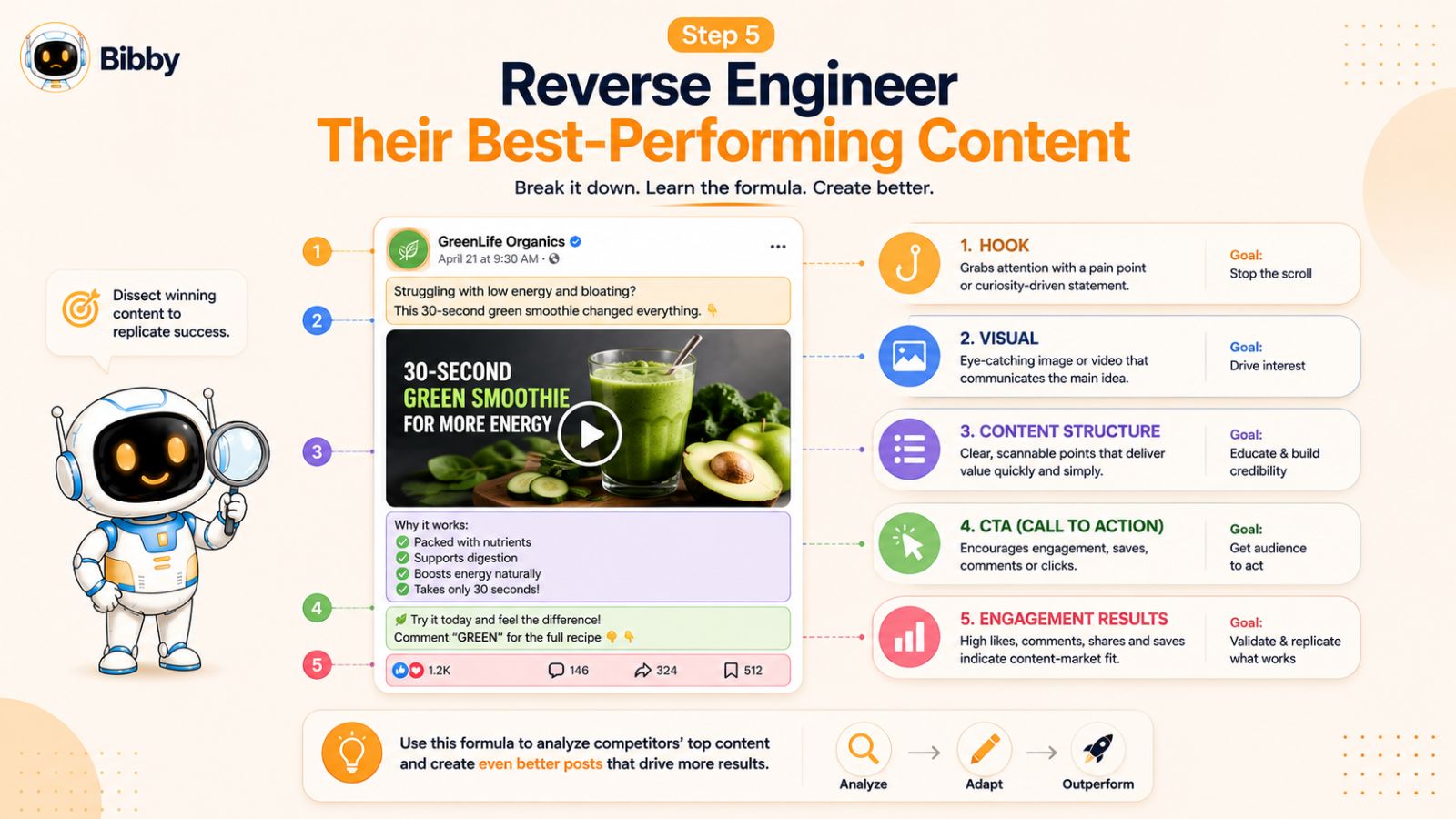
Instead of simply observing what works, you're going to reverse engineer your competitors' best-performing content to understand exactly why it succeeds.
This process allows you to uncover repeatable patterns that can inform your own content strategy without resorting to copying.
Why Reverse Engineering Works
Every high-performing piece of content leaves clues.
When a post consistently generates likes, comments, shares, saves, or views, there is usually a combination of factors contributing to its success.
These factors may include:
- Topic selection
- Content format
- Visual presentation
- Timing
- Audience relevance
- Emotional appeal
- Call-to-action
The goal is to identify the underlying formula behind successful content and then improve upon it.
Think of it as studying a winning playbook—not to duplicate it, but to build a better version.
Find Their Top Posts
Start by identifying the highest-performing content from each competitor.
Ideally, review content published within the last three to six months because it reflects current audience preferences and platform trends.
Create a spreadsheet and record:
| Metric | Details |
|---|---|
| Post URL | Direct link to content |
| Platform | Facebook, Instagram, LinkedIn, YouTube, TikTok |
| Topic | Subject matter |
| Format | Video, Reel, Carousel, Story, Image |
| Engagement | Likes, comments, shares, saves |
| Hook | Opening line or visual |
| CTA | Call-to-action |
| Notes | Observations |
Once you've gathered enough examples, patterns become easier to identify.
Analyze the Hook
One of the most important elements of successful content is the hook.
A hook determines whether users stop scrolling and pay attention.
Examine how competitors open their content.
Common hook styles include:
Curiosity Hooks
Examples:
- "Most marketers don't know this."
- "This simple mistake is costing you customers."
These hooks encourage people to keep reading or watching.
Problem-Based Hooks
Examples:
- "Struggling to grow your Instagram account?"
- "Your engagement rate may be dropping because of this."
These immediately connect with audience pain points.
Data-Driven Hooks
Examples:
- "We analyzed 10,000 social media posts."
- "This strategy increased engagement by 247%."
Statistics often increase credibility and attention.
Contrarian Hooks
Examples:
- "Stop posting every day."
- "Everything you've heard about social media growth is wrong."
These challenge common assumptions and spark curiosity.
If the same hook style repeatedly appears in top-performing content, that's a valuable insight.
Analyze the Content Structure
Successful content often follows a predictable structure.
For example:
Educational Post Structure
- Hook
- Problem
- Solution
- Example
- CTA
Storytelling Structure
- Situation
- Challenge
- Action
- Result
- Lesson
List-Based Structure
- Hook
- Numbered tips
- Summary
- CTA
By identifying common structures, you can create content that is easier for audiences to consume and engage with.
Analyze Visual Elements
Visual presentation has a major impact on performance.
Study:
- Image styles
- Graphic layouts
- Video editing techniques
- Text overlays
- Thumbnail designs
- Branding consistency
Ask yourself:
- What attracts attention immediately?
- What makes the content easy to consume?
- Which visual elements appear repeatedly?
Sometimes the design framework contributes just as much to success as the content itself.
Analyze Audience Reactions
The comment section is one of the most valuable sources of competitor intelligence.
Read through comments and look for:
- Frequently asked questions
- Audience frustrations
- Positive feedback
- Requests for additional information
- Content ideas
Questions left unanswered by competitors often become opportunities for your next piece of content.
For example, if dozens of users are asking follow-up questions, you could create content that provides deeper explanations than the original post.
Identify the Emotional Triggers
People rarely engage with content purely because it is informative.
They engage because it makes them feel something.
Common emotional triggers include:
- Curiosity
- Excitement
- Inspiration
- Fear of missing out
- Validation
- Relief
- Surprise
Review top-performing competitor content and ask:
- What emotion is driving engagement?
- Why are people commenting?
- Why are they sharing this content?
Understanding emotional triggers helps you create content that resonates on a deeper level.
Create a Better Version
This is where many businesses go wrong.
They see successful content and immediately copy it.
Instead, use the "10x Improvement Rule."
Ask:
- Can I make it more detailed?
- Can I provide newer information?
- Can I include better examples?
- Can I make it easier to understand?
- Can I present it in a more engaging format?
The objective is to create content that delivers more value than what already exists.
For example:
If a competitor publishes "5 Social Media Tips," you might create:
- 15 actionable tips
- Real-world examples
- Step-by-step implementation guides
- Visual templates
- Downloadable resources
This approach positions your content as the superior resource.
Build a Repeatable Content Framework
After analyzing dozens of successful posts, you'll begin to recognize recurring patterns.
Document these findings and create your own framework.
For example:
| Element | Winning Pattern |
|---|---|
| Hook | Problem-based questions |
| Format | Short-form videos |
| Topic | Social media growth |
| CTA | Save and share |
| Posting Time | Morning weekdays |
| Visual Style | Bold text overlays |
This framework becomes your blueprint for future content creation.
Scale Winning Ideas Faster
One challenge businesses face after identifying successful content patterns is execution.
Creating visuals, writing captions, adapting content for multiple platforms, and scheduling posts can quickly become overwhelming.
This is where automation creates a significant advantage.
For example, once you've identified a winning content formula, Bibby can help you execute it consistently. You can upload an image or generate one with AI, select a posting style, and allow the platform to automatically generate captions. From there, Bibby can schedule content across Facebook, Instagram, LinkedIn, YouTube, and TikTok at AI-optimized posting times.
Rather than spending hours manually publishing content, you can focus on refining strategy while maintaining a consistent presence across all major platforms.
Key Takeaway
Reverse engineering successful content is one of the fastest ways to accelerate social media growth.
By analyzing your competitors' best-performing posts, you can identify:
- Proven content topics
- High-converting hooks
- Effective content structures
- Strong visual patterns
- Audience pain points
- Opportunities to create superior content
The goal isn't to copy competitors—it's to understand why their content succeeds and then create something even better.
Next, we'll examine another critical factor that influences performance: your competitors' posting schedules and publishing habits.
Also read: how far ahead you can schedule social media posts
Step 6: Analyze Their Posting Schedule
Even the best content can underperform if it's published at the wrong time.
That's why successful social media strategies don't focus solely on what to post—they also focus on when to post.
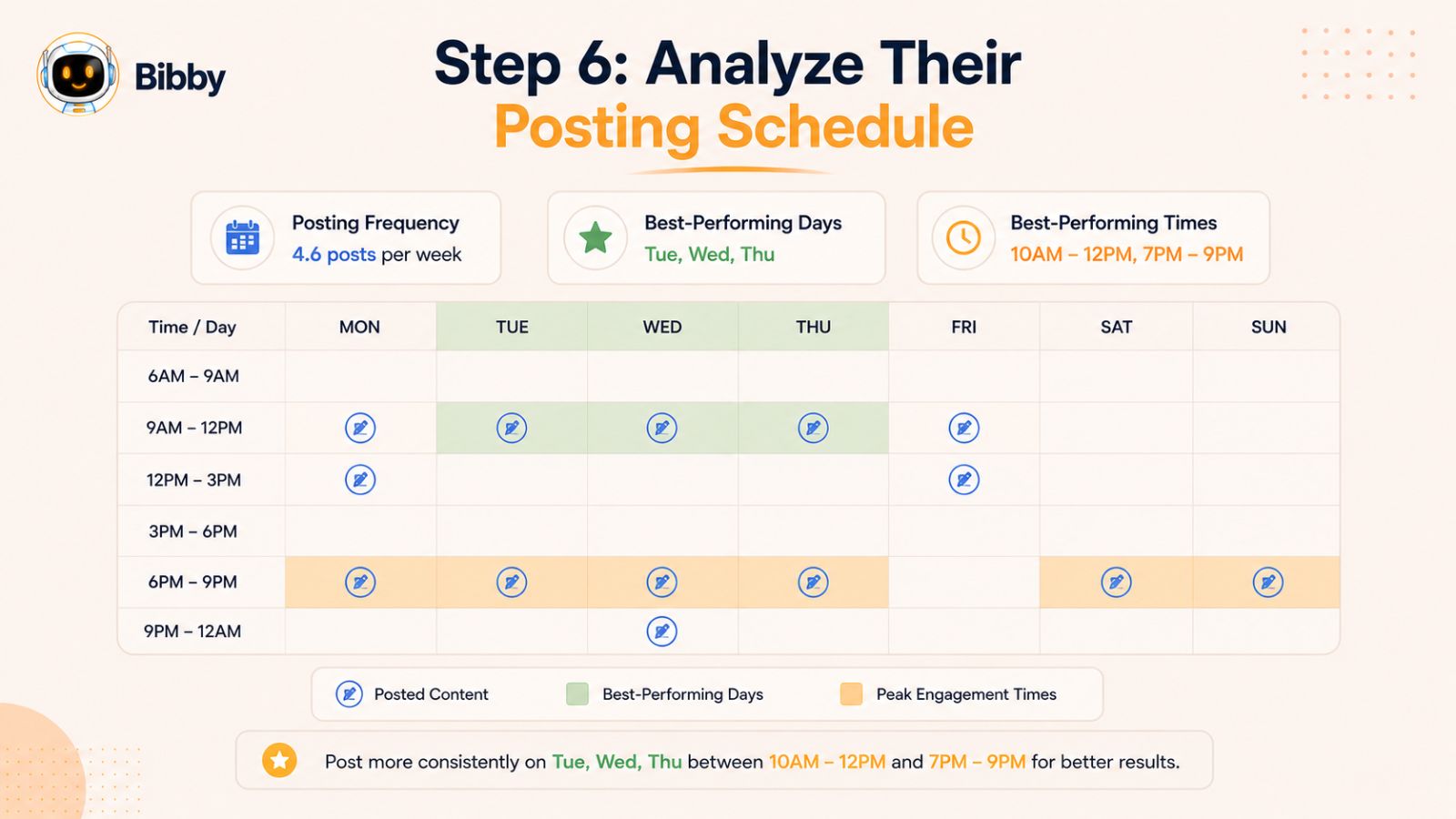
After analyzing your competitors' content and engagement, the next step is understanding their publishing habits. Posting schedules often reveal valuable clues about audience behavior, content priorities, and platform-specific strategies.
While timing alone won't make poor content successful, the right publishing schedule can significantly improve reach, engagement, and visibility.
Why Posting Schedules Matter
Social media platforms reward content that generates engagement quickly after publication.
When a post receives immediate interactions, platform algorithms often interpret it as valuable content and show it to more users.
This creates a snowball effect:
- Content gets published.
- Early engagement occurs.
- The algorithm expands reach.
- More engagement follows.
- Visibility increases.
Understanding when competitors publish can help you identify the time windows most likely to generate engagement within your industry.
Track Competitor Posting Frequency
Start by reviewing how often competitors publish content.
Record:
- Posts per day
- Posts per week
- Platform-specific frequency
- Story frequency
- Video publishing frequency
For example:
| Platform | Frequency |
|---|---|
| 1–2 posts daily | |
| 1 Reel daily + Stories | |
| 3–5 posts weekly | |
| YouTube | 1–2 videos weekly |
| TikTok | 2–4 videos daily |
Patterns often emerge when multiple competitors follow similar publishing schedules.
This may indicate audience expectations or platform-specific best practices.
Identify Publishing Days
Next, examine which days competitors are most active.
Questions to consider:
- Do they publish every day?
- Are they more active on weekdays?
- Do they increase posting around industry events?
- Are weekends part of their strategy?
Many businesses discover that engagement patterns vary significantly depending on the day of the week.
For example:
- LinkedIn often performs strongly during business days.
- TikTok engagement may remain strong throughout the week.
- Certain industries see higher weekend engagement.
The objective isn't to blindly copy competitor schedules but to identify trends worth testing.
Analyze Posting Times
This is one of the most valuable insights competitor analysis can provide.
Review the timestamps on top-performing content and look for recurring posting windows.
You may discover patterns such as:
- Morning engagement spikes
- Lunch-hour activity
- Afternoon browsing behavior
- Evening entertainment consumption
Create a simple tracking table:
| Competitor | Platform | Top Post Time |
|---|---|---|
| Competitor A | 9:00 AM | |
| Competitor B | 8:30 AM | |
| Competitor C | TikTok | 7:00 PM |
After analyzing multiple competitors, you'll often find clusters of successful posting times.
These patterns can serve as starting points for your own testing.
Look for Seasonal Trends
Competitor schedules often change throughout the year.
Pay attention to:
- Product launches
- Holiday campaigns
- Industry events
- Promotional periods
- Seasonal content themes
For example:
- Retail brands often increase activity during holiday seasons.
- B2B companies may focus heavily on industry conferences.
- Fitness brands often ramp up content around New Year's resolutions.
Understanding seasonal behavior helps you plan ahead rather than reacting after competitors have already captured attention.
Analyze Story and Short-Form Content Activity
Many brands focus heavily on feed posts while overlooking Stories and short-form video content.
Review:
- Story frequency
- Story content types
- Reel frequency
- YouTube Shorts activity
- TikTok publishing patterns
You may discover that competitors are using Stories to maintain daily engagement while reserving feed posts for higher-value content.
These insights can help you develop a more balanced content strategy.
Consistency Often Matters More Than Timing
One of the biggest lessons from competitor analysis is that consistency usually outperforms perfection.
Many businesses spend excessive time trying to find the "perfect" posting time while publishing inconsistently.
Successful competitors often achieve better results because they:
- Publish regularly
- Maintain predictable schedules
- Stay active across multiple platforms
- Continuously test and optimize
Consistency creates familiarity and helps audiences know when to expect new content.
The Challenge of Managing Multiple Platforms
As your social media presence grows, maintaining consistent publishing schedules becomes increasingly difficult.
Consider the workload involved:
- Creating content
- Writing captions
- Scheduling posts
- Adapting content for different platforms
- Managing Stories
- Publishing videos
- Monitoring performance
Doing all of this manually can quickly become overwhelming.
This is one reason many businesses adopt automation platforms like Bibby. Instead of manually scheduling content for Facebook, Instagram, LinkedIn, YouTube, and TikTok, users can upload or generate content, choose a posting style, and allow Bibby to automatically generate captions and schedule posts at AI-optimized times.
This not only saves time but also helps ensure consistent publishing across every platform without requiring constant manual intervention.
Build Your Own Publishing Schedule
After analyzing competitor behavior, create a schedule tailored to your audience.
Your schedule should include:
Platform Priorities
Determine which platforms deserve the most attention based on competitor insights and business goals.
Publishing Frequency
Define realistic posting goals that your team can maintain consistently.
Content Mix
Balance:
- Educational content
- Promotional content
- Entertaining content
- Community-focused content
Testing Framework
Regularly test:
- Posting times
- Content formats
- CTAs
- Publishing frequency
The best schedule is not necessarily the one your competitors use—it's the one that produces the strongest results for your audience.
Key Takeaway
By analyzing competitor publishing schedules, you can uncover:
- Optimal posting frequencies
- High-performing publishing days
- Potential audience activity patterns
- Seasonal opportunities
- Content distribution strategies
Most importantly, you'll learn that consistency is often a bigger competitive advantage than timing alone.
Now that you've identified what competitors post and when they post it, the next step is learning how to use AI and automation to execute faster, stay consistent, and scale your social media efforts more efficiently than your competitors.
You may also like reading detailed guide on: how to automate Facebook post?
Step 7: Use AI and Automation to Execute Faster Than Competitors
At this point, you've done the hard work.
You've identified your competitors, analyzed their content strategies, studied their engagement metrics, reverse engineered their best-performing posts, and uncovered their publishing habits.
Now comes the most important question:
How do you consistently execute on everything you've learned?
This is where many businesses struggle.
They gather valuable insights from competitor analysis but fail to implement them consistently because social media management requires significant time and effort.
Creating content, designing graphics, writing captions, scheduling posts, publishing across multiple platforms, and tracking performance can quickly become a full-time job.
Meanwhile, competitors who leverage AI and automation are able to move faster, publish more consistently, and scale their content efforts without dramatically increasing their workload.
Why Execution Is the Real Competitive Advantage
Most businesses don't fail because they lack ideas.
They fail because they lack systems.
A company may know exactly which content topics perform well and which posting schedule works best, but if they only publish sporadically, competitors with stronger execution systems will continue gaining ground.
Successful social media growth often comes down to:
- Consistency
- Speed
- Efficiency
- Scalability
The brands that win are often the brands that can turn insights into action the fastest.
The Problem With Manual Social Media Management
Managing social media manually becomes increasingly difficult as your business grows.
Common challenges include:
Content Creation Bottlenecks
Teams often spend hours:
- Creating graphics
- Editing images
- Designing visuals
- Producing videos
This slows down content production and limits publishing frequency.
Caption Writing Takes Time
Writing compelling captions for multiple platforms is another major time commitment.
Many businesses struggle to:
- Maintain a consistent voice
- Adapt messaging for different platforms
- Create engaging calls-to-action
- Publish frequently enough
Multi-Platform Publishing Is Inefficient
Publishing manually across:
- YouTube
- TikTok
requires repetitive work that consumes valuable time.
Scheduling Becomes Complex
Determining the best posting times for every platform can be challenging, especially when audience behavior changes over time.
Without automation, businesses often rely on guesswork.
How Bibby Helps Businesses Outperform Competitors
Once you've identified the content strategies that work in your industry, the next step is executing them consistently.
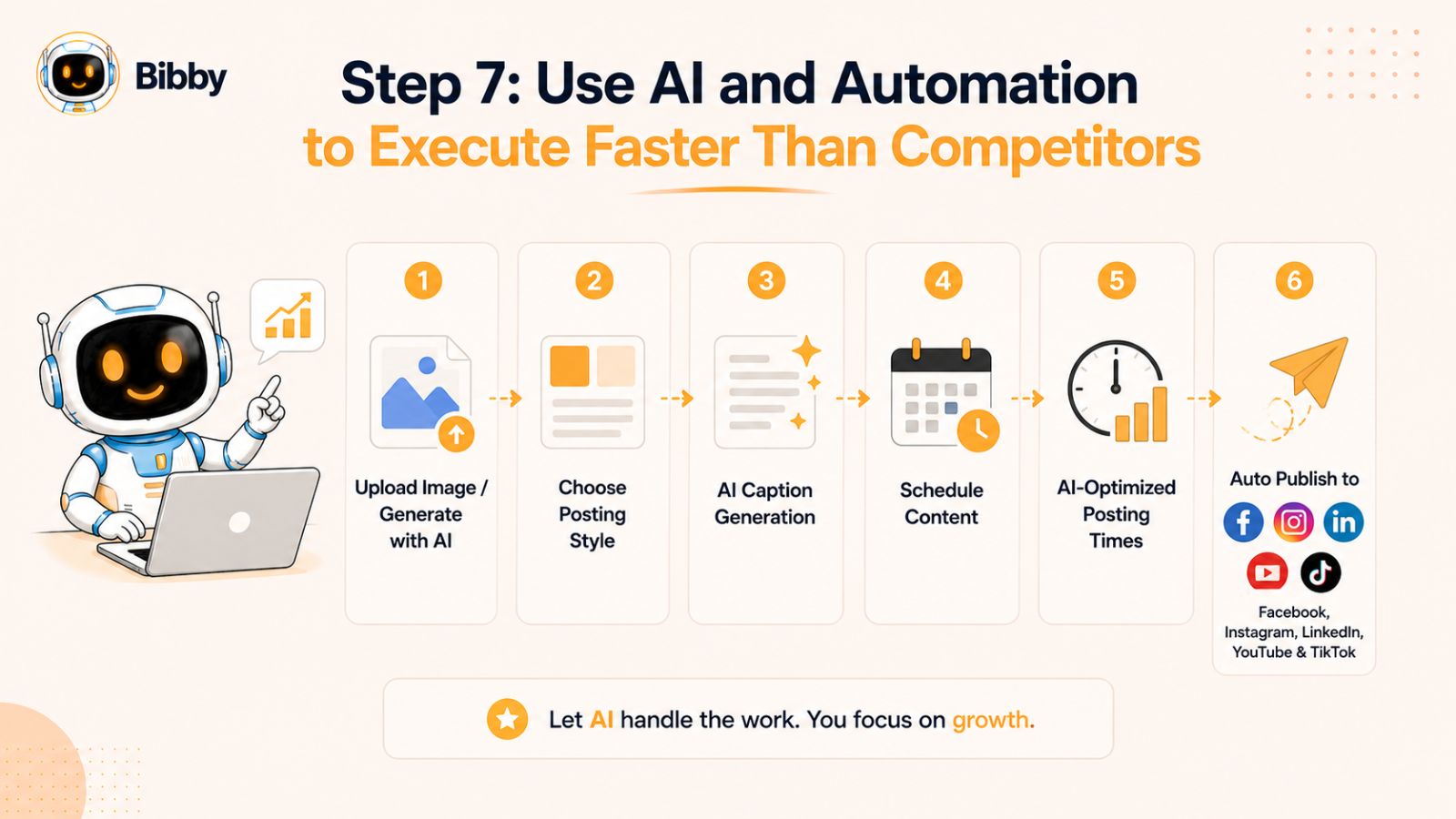
Bibby is designed to simplify this process through an AI-powered workflow that removes much of the manual effort associated with social media management.
Step 1: Upload or Generate Your Content
The process begins with your visual content.
You can:
- Upload your own image
- Create content using AI image generation
This allows businesses to produce content quickly without relying entirely on external design resources.
Step 2: Choose Your Posting Style
Different audiences respond to different types of messaging.
Bibby allows users to select a preferred posting style that aligns with their brand voice and communication goals.
This helps maintain consistency across every platform.
Step 3: Automatically Generate Captions
Writing captions for multiple social networks can be time-consuming.
Bibby automatically generates captions based on your content and selected posting style.
This helps businesses:
- Save time
- Maintain consistency
- Publish more frequently
- Scale content production
Step 4: Schedule Across Multiple Platforms
Rather than manually posting to each platform, Bibby enables users to schedule content across:
- YouTube
- TikTok
This centralized workflow eliminates repetitive publishing tasks and helps maintain a consistent brand presence.
Step 5: Publish at AI-Optimized Times
One of the biggest challenges in social media management is identifying the best time to publish.
Bibby uses AI-powered scheduling to determine optimal publishing times based on performance data and audience activity patterns.
This helps maximize visibility and engagement opportunities.
Step 6: Manage Multiple Content Types
Modern social media strategies require more than static images.
Bibby supports:
- Images
- Videos
- Stories
- Multi-platform campaigns
This allows businesses to manage diverse content strategies from a single platform.
Step 7: Monitor Analytics and Performance
Competitor analysis is only useful if you measure your own results.
Bibby includes analytics capabilities that help users:
- Track engagement
- Measure performance
- Identify successful content
- Refine future campaigns
These insights support continuous improvement and data-driven decision-making.
Why Automation Creates a Competitive Edge
Many businesses assume automation simply saves time.
While time savings are important, the real advantage is consistency.
Automation helps businesses:
- Publish regularly
- Maintain content quality
- Execute proven strategies faster
- Reduce operational bottlenecks
- Scale marketing efforts efficiently
When competitors miss posting opportunities because of workload constraints, automated workflows help ensure your content continues reaching audiences consistently.
A Practical Example
Imagine you've completed your competitor analysis and discovered that:
- Educational content performs best
- Short-form videos generate the highest engagement
- Morning publishing times drive strong results
- Industry tips consistently attract shares
Without automation, implementing these insights may require hours of work each week.
With Bibby, you can:
- Create or upload content.
- Select your preferred posting style.
- Let AI generate captions.
- Schedule posts across all major platforms.
- Publish at AI-optimized times.
- Monitor analytics to refine future content.
The result is a streamlined workflow that allows you to focus more on strategy and less on repetitive tasks.
Competitor Analysis + Automation = Faster Growth
Competitor analysis tells you what works.
Automation helps you execute on those insights consistently.
Together, they create a powerful growth system:
- Analyze competitors.
- Identify winning content patterns.
- Create better content.
- Automate publishing.
- Measure results.
- Optimize continuously.
This cycle allows businesses to improve faster than competitors who rely solely on manual processes.
Key Takeaway
The businesses that outperform competitors on social media aren't necessarily the most creative or the most well-funded.
They're often the ones with the best systems.
By combining competitor intelligence with AI-powered automation, you can consistently execute successful strategies, maintain a strong presence across multiple platforms, and spend less time managing day-to-day publishing tasks.
Now that you've built an efficient execution system, the next step is uncovering the opportunities your competitors are missing so you can create content that stands out even more.
Also read: How to Stay Consistent on Social Media: A Practical System for Sustainable Growth
Step 8: Identify Content Gaps Competitors Are Missing
Analyzing your competitors' strengths is important, but identifying their weaknesses is where the biggest opportunities often exist.
If every business in your industry is publishing the same content, targeting the same topics, and following the same trends, simply matching their strategy won't help you stand out.
To outperform competitors, you need to find the gaps they have overlooked and create content that fills those gaps better than anyone else.
This is where social media competitor analysis shifts from imitation to innovation.
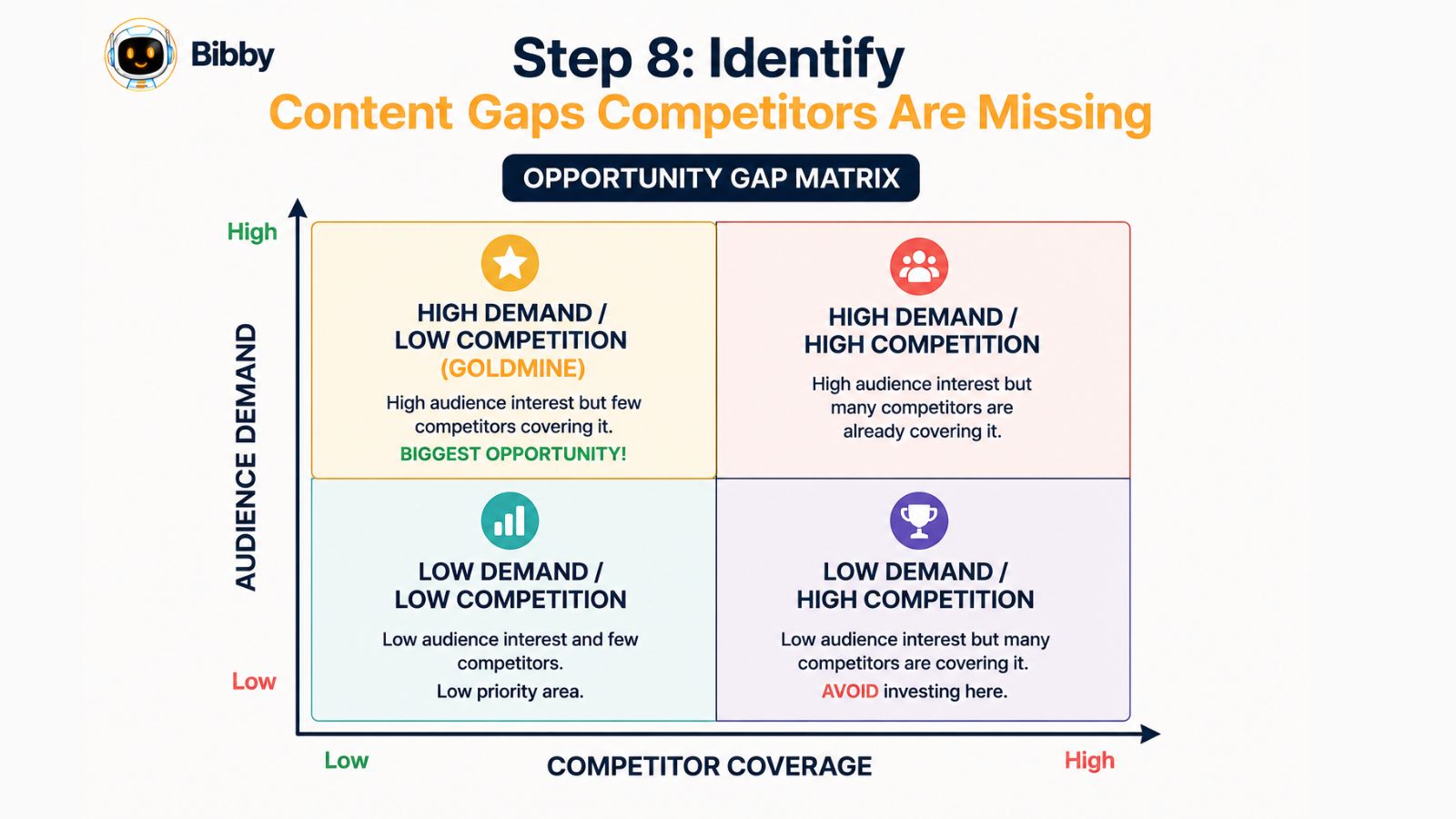
What Is a Content Gap?
A content gap is any topic, question, format, audience segment, or trend that competitors are not addressing effectively.
These gaps create opportunities because they allow you to provide value where others are falling short.
Examples include:
- Frequently asked questions that remain unanswered
- Beginner topics competitors ignore
- Advanced insights competitors avoid
- New platform features competitors haven't adopted
- Industry trends competitors haven't discussed
- Content formats competitors rarely use
The goal is to find areas where audience demand exceeds the available content.
Look for Questions Competitors Aren't Answering
One of the easiest ways to identify content gaps is by studying comments and audience interactions.
Review competitor posts and pay attention to:
- Repeated questions
- Requests for clarification
- Requests for examples
- Requests for tutorials
- Unanswered comments
For example, if a competitor publishes a post about social media growth and dozens of people ask how to implement the strategy, that may be an opportunity to create a detailed step-by-step guide.
These questions often become some of your highest-performing content ideas.
Analyze Negative Feedback
Most businesses focus only on positive engagement.
However, criticism can reveal valuable opportunities.
Look for comments such as:
- "This didn't work for me."
- "Can you explain this further?"
- "What about this situation?"
- "You didn't cover X."
Negative feedback often highlights weaknesses in competitors' content that you can address.
If competitors provide incomplete information, your content can become the more trusted resource.
Find Topics Everyone Covers Poorly
Sometimes competitors are discussing the same topic, but none of them are doing it particularly well.
Ask yourself:
- Are explanations too basic?
- Is important information missing?
- Are examples lacking?
- Is the content outdated?
- Is the advice too generic?
If the answer is yes, you don't need a completely new topic.
You simply need a better version of the existing content.
For example:
Instead of creating another post titled:
"5 Social Media Tips"
You might create:
"25 Data-Backed Social Media Tips With Real Examples and Implementation Steps."
Depth often becomes a competitive advantage.
Identify Underutilized Content Formats
Many businesses become comfortable with a single content format.
Some publish mostly images.
Others rely heavily on short-form videos.
This creates opportunities for brands willing to diversify.
Look for formats competitors rarely use:
Long-Form Educational Videos
Many competitors focus exclusively on short-form content while ignoring deeper educational content.
Carousels
Carousels often generate strong engagement because they encourage users to spend more time interacting with content.
Stories
Stories create opportunities for daily audience engagement and community building.
Live Content
Live sessions often receive less competition while providing higher levels of audience interaction.
Case Studies
Real-world examples frequently outperform generic advice because they provide proof and credibility.
If competitors are neglecting a format, consider testing it as part of your strategy.
Spot Emerging Trends Early
One of the most valuable content gaps is timing.
Many businesses are slow to adopt new trends, features, or technologies.
Watch for:
- Platform updates
- AI developments
- Industry changes
- Consumer behavior shifts
- New content formats
The earlier you create quality content around emerging topics, the easier it becomes to establish authority before competitors catch up.
Analyze Audience Segments Competitors Ignore
Competitors often focus on their largest audience segment while overlooking smaller groups with unique needs.
Examples include:
- Beginners
- Advanced users
- Small businesses
- Enterprise customers
- Specific industries
- Geographic markets
By creating content for underserved audiences, you can build strong engagement with less competition.
Create a Content Gap Matrix
A simple way to organize opportunities is through a content gap matrix.
| Topic | Competitor Coverage | Opportunity Level |
|---|---|---|
| AI Content Creation | Moderate | Medium |
| Social Media Automation | High | Low |
| TikTok Analytics | Low | High |
| LinkedIn Growth | Moderate | Medium |
| Content Repurposing | Low | High |
Focus first on high-opportunity topics where audience interest exists but competitor coverage is limited.
Turn Content Gaps Into a Competitive Advantage
Finding content gaps is only valuable if you consistently act on them.
This is where many businesses struggle.
They identify dozens of opportunities but fail to publish frequently enough to capitalize on them.
A practical workflow might look like this:
- Analyze competitor content.
- Identify overlooked topics.
- Create superior content.
- Schedule distribution across multiple platforms.
- Measure engagement.
- Refine future content.
Tools like Bibby can help streamline this process. Once you've identified content gaps, you can quickly create campaigns by uploading or generating visuals with AI, selecting your preferred posting style, and allowing Bibby to generate captions automatically. Content can then be scheduled across Facebook, Instagram, LinkedIn, YouTube, and TikTok at AI-optimized times, making it easier to capitalize on opportunities before competitors do.
Examples of Content Gap Opportunities
Let's imagine you run a social media marketing business.
After analyzing competitors, you discover:
Competitors Cover:
- Basic Instagram tips
- General social media advice
- Content creation basics
Competitors Ignore:
- AI-powered workflows
- Advanced analytics strategies
- Cross-platform automation
- Content repurposing frameworks
Rather than competing directly on crowded topics, you could become known for the areas competitors neglect.
Over time, this differentiation can lead to stronger engagement, greater authority, and increased audience growth.
Key Takeaway
The biggest social media opportunities often aren't found in what competitors are doing.
They're found in what competitors aren't doing.
By identifying unanswered questions, underserved audiences, neglected content formats, and emerging trends, you can create content that stands out in crowded markets.
The brands that win aren't always the ones producing the most content. They're often the ones producing the most relevant content.
Next, we'll look at how to turn these insights into a sustainable competitive advantage that continues delivering results long after your initial competitor analysis is complete.
Step 9: Build Your Competitive Advantage
By now, you've analyzed your competitors from every angle.
You know:
- Which platforms they prioritize
- Which content formats perform best
- Which topics generate engagement
- When they publish content
- Where content gaps exist
- How audiences respond
Most businesses stop here.
They collect insights, make a few adjustments, and then return to business as usual.
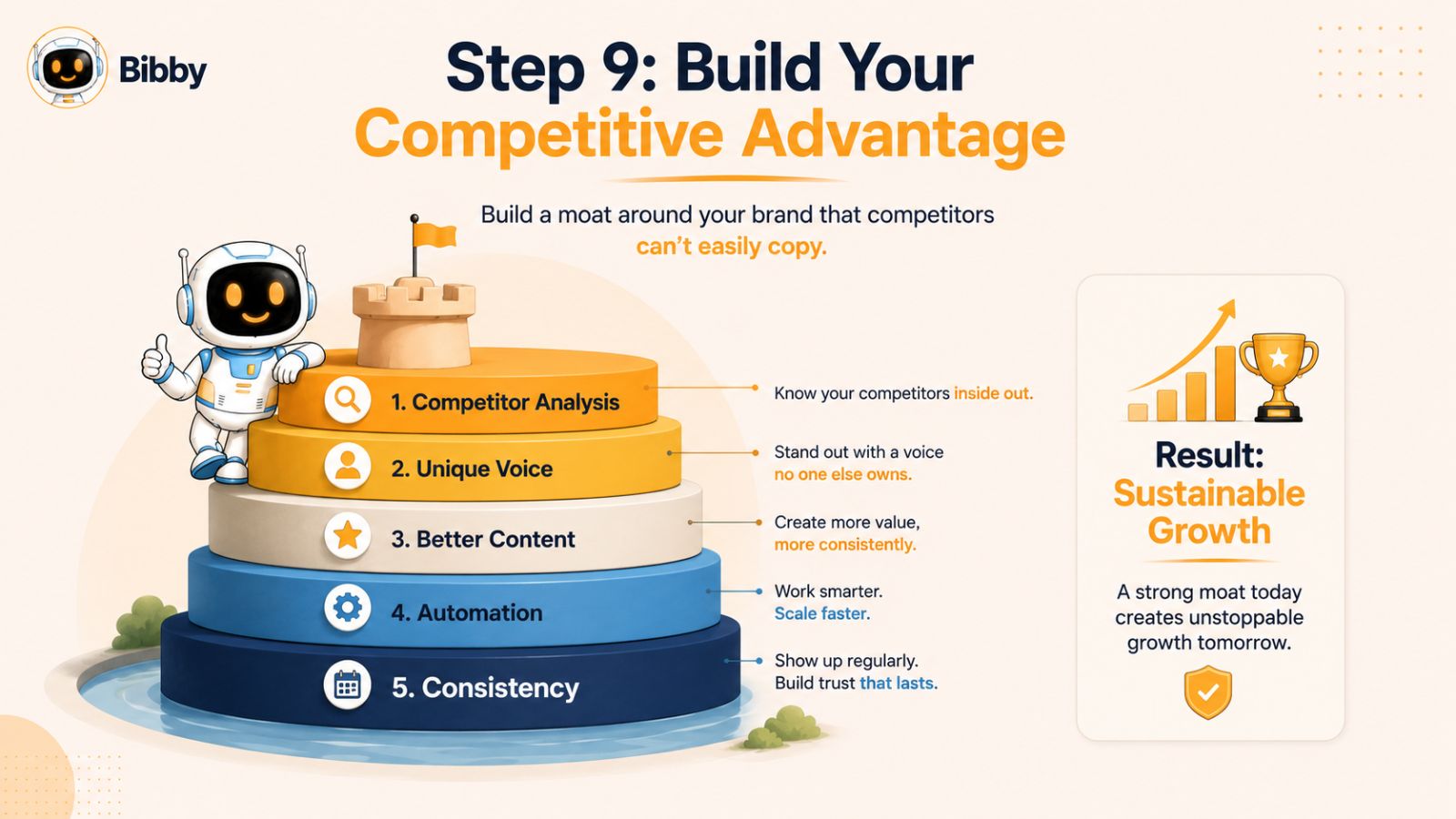
The businesses that consistently outperform competitors take a different approach. They transform competitor insights into a long-term competitive advantage that becomes increasingly difficult for others to replicate.
Why Copying Competitors Is a Losing Strategy
One of the biggest mistakes businesses make after conducting competitor analysis is copying what they see.
The problem is simple:
If you copy a competitor, you'll always be one step behind them.
By the time you've replicated their strategy, they're already testing something new.
Instead of copying competitors, use their success as a starting point for innovation.
Ask yourself:
- How can we make this better?
- How can we make this more useful?
- How can we make this easier to understand?
- How can we provide a unique perspective?
The goal is not to become a better version of your competitor.
The goal is to become the best version of your own brand.
Develop a Unique Brand Voice
One of the most sustainable competitive advantages is a recognizable brand voice.
Audiences should be able to identify your content even without seeing your logo.
Consider:
- Tone of voice
- Writing style
- Messaging approach
- Visual identity
- Core values
For example, some brands focus on:
- Educational authority
- Data-driven insights
- Humor and entertainment
- Personal storytelling
- Industry leadership
The specific approach matters less than consistency.
A strong brand voice helps differentiate your content even when discussing topics similar to competitors.
Create Original Insights
Most content online repeats information that already exists.
One of the fastest ways to stand out is by contributing something new.
Examples include:
Original Research
Conduct surveys, analyze data, and publish findings.
Original data often attracts:
- Shares
- Backlinks
- Media coverage
- Industry attention
Internal Case Studies
Show real results from your own experiences.
Audiences trust practical examples more than generic advice.
Unique Frameworks
Create proprietary processes and methodologies.
Examples:
- Growth frameworks
- Content systems
- Marketing workflows
- Analysis models
Frameworks make your content easier to remember and harder to copy.
Become the Most Helpful Resource
Competitors often focus on producing more content.
A more effective strategy is producing better content.
Ask yourself:
- Can we provide more examples?
- Can we simplify complex concepts?
- Can we offer actionable steps?
- Can we answer follow-up questions?
When audiences consistently find the most useful answers from your brand, engagement and trust naturally increase.
Build a Content Ecosystem
Successful brands rarely rely on isolated posts.
Instead, they create interconnected content systems.
For example:
Pillar Content
Comprehensive resources covering major topics.
Supporting Content
Short-form posts that expand on key ideas.
Video Content
Educational and engaging visual content.
Stories and Community Content
Daily touchpoints that strengthen relationships.
This ecosystem creates multiple opportunities for audiences to discover and engage with your brand.
Create a Competitive Intelligence System
Competitor analysis should not be a one-time activity.
The social media landscape changes constantly.
Platforms evolve.
Audience preferences shift.
New competitors emerge.
Create a monthly process for reviewing:
- Competitor content
- Engagement trends
- Platform updates
- Emerging opportunities
- Industry developments
A simple monthly review can prevent your strategy from becoming outdated.
Leverage Speed as an Advantage
In many industries, speed matters.
The faster you can identify opportunities and act on them, the greater your potential advantage.
This includes:
- Responding to trends
- Creating timely content
- Adopting new features
- Testing new formats
- Publishing consistently
Businesses that move quickly often establish authority before competitors have time to react.
You may also like reading detailed guide on: how to automate Facebook post?
Use Automation to Sustain Your Advantage
A competitive advantage is only valuable if you can maintain it consistently.
Many businesses develop strong strategies but struggle with execution because social media management becomes increasingly complex as they grow.
This is where automation can help transform a temporary advantage into a sustainable one.
For example, after identifying high-performing content opportunities, businesses can use Bibby to streamline content production and distribution. Rather than manually creating captions, scheduling posts, and managing multiple platforms, teams can upload an image or generate one with AI, choose a posting style, and let Bibby automatically generate captions and schedule content.
Because Bibby supports Facebook, Instagram, LinkedIn, YouTube, and TikTok while optimizing publishing times through AI, businesses can maintain a consistent presence across platforms without dramatically increasing their workload.
The result is a repeatable system that supports long-term growth.
Build a Continuous Improvement Loop
The strongest social media strategies never remain static.
They continuously evolve through a cycle of:
- Competitor analysis
- Content creation
- Publishing
- Performance measurement
- Optimization
- Repetition
Each cycle generates new insights.
Each insight improves future performance.
Over time, these small improvements compound into significant competitive advantages.
What the Best Brands Do Differently
The most successful brands don't win because they have secret tactics.
They win because they consistently:
- Analyze competitors
- Identify opportunities
- Create superior content
- Execute efficiently
- Measure results
- Improve continuously
This disciplined approach allows them to adapt faster than competitors and remain relevant in changing markets.
Key Takeaway
A competitive advantage isn't something you discover once.
It's something you build and strengthen over time.
By developing a unique brand voice, creating original insights, becoming the most helpful resource in your niche, and implementing efficient execution systems, you can establish a social media presence that competitors struggle to replicate.
The brands that dominate social media aren't necessarily the biggest or the most well-funded. They're often the ones that learn faster, adapt faster, and execute more consistently than everyone else.
Now that we've covered the complete competitor analysis framework, let's explore the best tools that can help you gather insights, streamline workflows, and accelerate your social media growth.
Best Tools for Social Media Competitor Analysis
A competitor analysis strategy is only as effective as the tools supporting it.
While it's possible to manually track competitors, monitor engagement, and analyze trends, the process quickly becomes overwhelming as your social media presence grows.
The right tools can help you collect insights faster, identify opportunities earlier, and execute your strategy more efficiently.
Below are some of the most useful categories of tools for social media competitor analysis and growth.
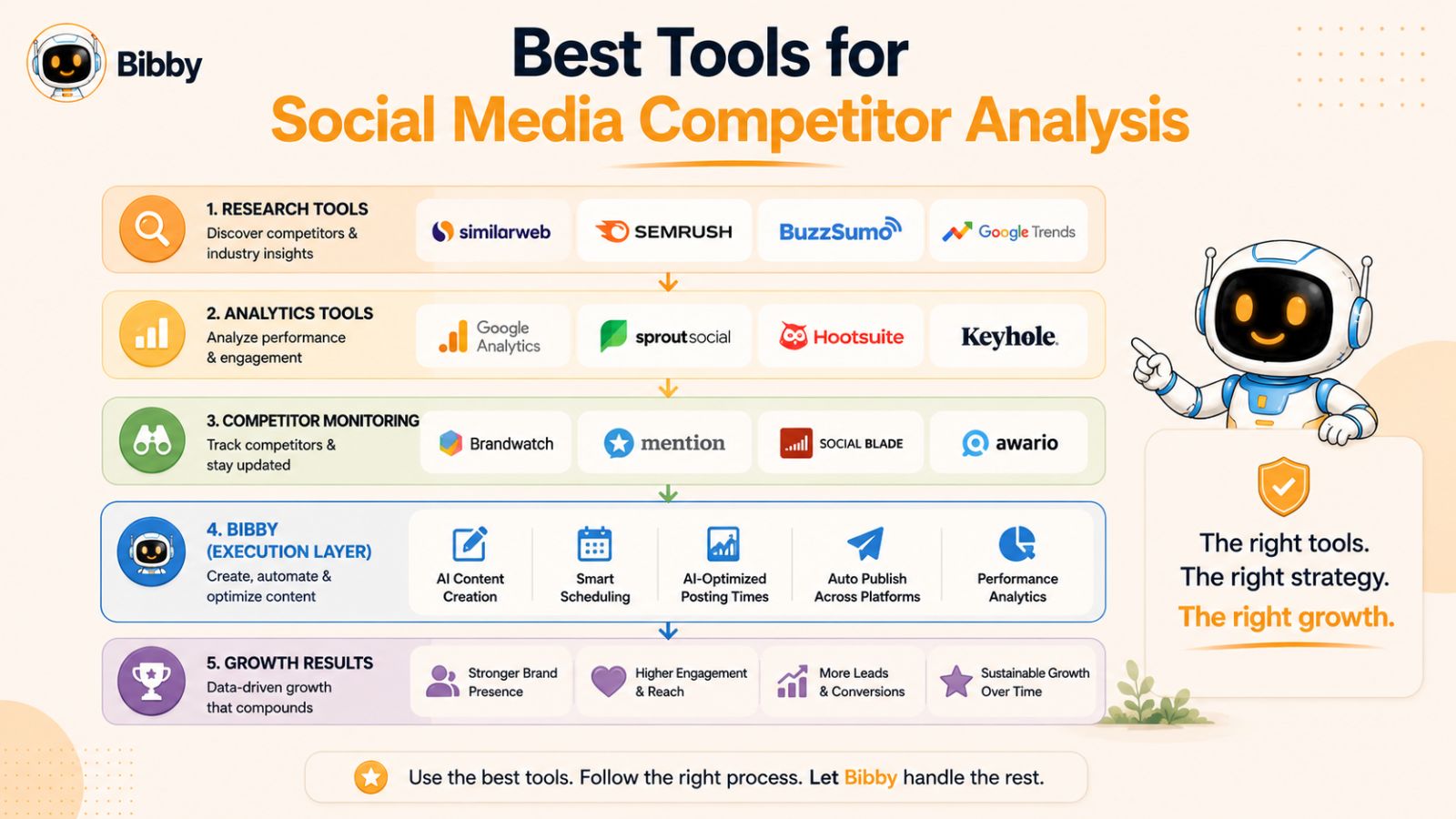
Social Listening Tools
Social listening tools help businesses monitor conversations happening across social media platforms.
These tools allow you to track:
- Brand mentions
- Industry keywords
- Competitor discussions
- Trending topics
- Customer sentiment
Social listening can reveal what audiences are talking about before those conversations become mainstream.
Best Use Cases
- Monitoring competitor brand mentions
- Tracking industry trends
- Identifying emerging content opportunities
- Understanding customer pain points
Native Platform Analytics
Every major social media platform provides built-in analytics.
Examples include:
- Facebook Insights
- Instagram Insights
- LinkedIn Analytics
- YouTube Analytics
- TikTok Analytics
These tools help businesses understand:
- Audience demographics
- Engagement patterns
- Reach and impressions
- Content performance
- Follower growth
While native analytics focus primarily on your own performance, they are essential for benchmarking your results against competitors.
Competitive Research Tools
Dedicated competitor analysis tools help businesses compare performance across multiple accounts and platforms.
Common capabilities include:
- Competitor benchmarking
- Engagement tracking
- Content performance analysis
- Audience growth monitoring
- Industry reporting
These tools help answer questions such as:
- Which competitors are growing fastest?
- Which content formats perform best?
- Which topics generate the most engagement?
- How does your performance compare to industry averages?
Content Research Tools
Content research platforms help identify high-performing topics and content opportunities.
These tools can reveal:
- Trending subjects
- Popular articles
- Frequently shared content
- Audience interests
- Emerging discussions
Combining content research with competitor analysis often leads to stronger content strategies and higher engagement rates.
Analytics and Reporting Platforms
As your content volume increases, reporting becomes more important.
Analytics tools help businesses:
- Track performance over time
- Measure campaign effectiveness
- Identify successful content categories
- Monitor growth trends
- Improve decision-making
Data-driven marketing consistently outperforms guesswork.
The more accurately you can measure performance, the faster you can optimize your strategy.
The Most Important Tool: Your Execution Platform
Competitor analysis provides insights.
Analytics provide data.
Research tools provide opportunities.
But none of those things matter if you cannot consistently execute your strategy.
This is why your social media execution platform is often the most important tool in your entire marketing stack.
After all, identifying a winning content strategy is only useful if you can reliably create, publish, and optimize content across multiple platforms.
Why Bibby Stands Out
For businesses looking to turn competitor insights into results, Bibby simplifies the entire social media workflow.
Instead of juggling multiple tools for content creation, caption writing, scheduling, publishing, and analytics, Bibby brings everything together into a single platform.
AI-Powered Content Creation
Getting started is simple.
You can:
- Upload your own images
- Generate images using AI
This removes one of the biggest bottlenecks in content production and helps teams create content faster.
Automatic Caption Generation
Writing captions for multiple platforms can be one of the most time-consuming parts of social media management.
Bibby automatically generates captions based on your content and selected posting style.
Benefits include:
- Faster publishing
- Consistent messaging
- Reduced manual effort
- Improved scalability
AI-Optimized Scheduling
Timing plays a critical role in social media performance.
Bibby uses AI to determine optimal posting times, helping businesses publish when audiences are most likely to engage.
Rather than manually selecting publishing times, users can rely on data-driven scheduling recommendations.
Multi-Platform Publishing
Managing multiple social media accounts can quickly become overwhelming.
Bibby allows businesses to schedule and publish content across:
- YouTube
- TikTok
From a single workflow, users can manage campaigns that would otherwise require significant manual effort.
Support for Multiple Content Types
Modern social media marketing requires more than static posts.
Bibby supports:
- Images
- Videos
- Stories
- Multi-platform campaigns
This flexibility makes it easier to maintain a consistent presence across every major platform.
Built-In Analytics
Competitor analysis is an ongoing process.
To improve results over time, businesses need access to performance data.
Bibby provides analytics that help users:
- Monitor engagement
- Track growth
- Evaluate content performance
- Identify successful campaigns
- Make informed optimization decisions
A Simple Workflow
One reason many businesses choose Bibby is its simplicity.
The workflow is straightforward:
- Upload an image or generate one with AI.
- Select your preferred posting style.
- Let Bibby generate captions automatically.
- Schedule content across your chosen platforms.
- Publish at AI-optimized times.
- Monitor analytics and improve future campaigns.
This streamlined approach allows businesses to spend less time managing social media and more time focusing on growth.
Building Your Ideal Social Media Toolkit
An effective social media stack often includes:
Research Layer
Used for:
- Competitor analysis
- Industry monitoring
- Content discovery
Analytics Layer
Used for:
- Performance tracking
- Reporting
- Optimization
Execution Layer
Used for:
- Content creation
- Scheduling
- Publishing
- Automation
For many businesses, Bibby serves as the execution layer that transforms insights into action.
Key Takeaway
The best social media strategies combine research, analytics, and execution.
Competitor analysis tools help you discover what's working.
Analytics platforms help you measure results.
Automation platforms help you execute consistently.
The businesses that outperform competitors are usually not the ones with the most tools. They're the ones that use the right tools to create a repeatable system for growth.
With the right toolkit in place, you're ready to avoid the common mistakes that prevent many businesses from getting results from their competitor analysis efforts.
You may like looking into: How to create perfect social media content with AI?
Common Social Media Competitor Analysis Mistakes
Social media competitor analysis can provide powerful insights, but only when it's done correctly.
Many businesses invest time researching competitors, collecting data, and identifying opportunities, yet still fail to improve their results.
The reason is simple: they make mistakes that prevent competitor insights from turning into meaningful action.
Understanding these common pitfalls can help you avoid wasted effort and build a strategy that actually delivers growth.
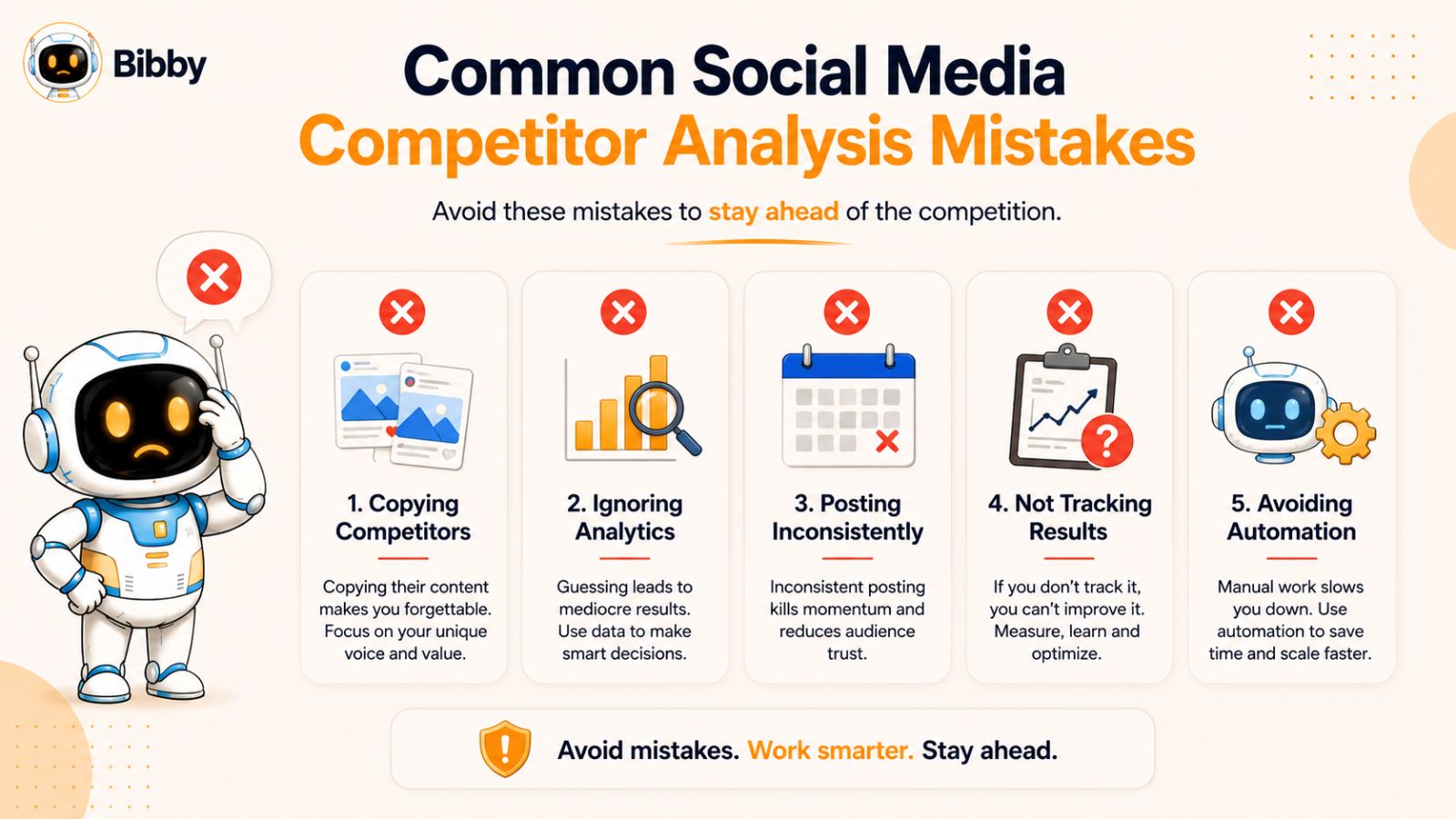
Mistake #1: Copying Competitors Instead of Learning From Them
This is by far the most common mistake.
A business sees a competitor's successful post and immediately tries to recreate it.
The problem is that copying rarely creates a sustainable advantage.
Your competitors already have:
- Their own audience
- Their own brand voice
- Their own positioning
- Their own reputation
Simply replicating their content usually leads to average results.
Instead, focus on understanding:
- Why the content worked
- Which audience problem it solved
- What emotional triggers it used
- How you can improve upon it
The goal is to create something better, not something identical.
Mistake #2: Focusing Only on Follower Counts
Large audiences can be impressive, but follower counts don't tell the full story.
Many businesses assume that the competitor with the most followers is the most successful.
In reality, engagement often matters far more than audience size.
A smaller account with highly engaged followers may generate significantly better business results than a larger account with low engagement.
Focus on metrics such as:
- Engagement rate
- Shares
- Saves
- Comments
- Audience interaction
These metrics provide a much clearer picture of content effectiveness.
Mistake #3: Analyzing Too Many Competitors
Some businesses try to track every competitor in their industry.
This often leads to information overload.
Instead, focus on a smaller group of highly relevant competitors.
A practical approach is:
- 3–5 direct competitors
- 2–3 indirect competitors
- 2–3 attention competitors
This provides enough data to identify meaningful patterns without becoming overwhelmed.
Mistake #4: Ignoring Audience Feedback
Many businesses spend all their time analyzing competitor content and not enough time analyzing competitor audiences.
The comment section often contains some of the most valuable insights available.
Look for:
- Common questions
- Frustrations
- Objections
- Requests for information
- Feature suggestions
Audience feedback often reveals opportunities competitors have not addressed.
Mistake #5: Performing Competitor Analysis Only Once
Social media changes rapidly.
Platforms evolve.
Algorithms change.
Audience interests shift.
Competitors adapt.
A competitor analysis completed six months ago may already be outdated.
Successful brands treat competitor analysis as an ongoing process rather than a one-time project.
A monthly review can help you:
- Identify new trends
- Track competitor growth
- Discover emerging opportunities
- Adapt to market changes
Consistency matters just as much in research as it does in publishing.
Mistake #6: Ignoring Content Gaps
Many businesses become obsessed with what competitors are doing.
The bigger opportunity is often what competitors are not doing.
When every brand is discussing the same topics, differentiation becomes difficult.
Instead, actively look for:
- Unanswered questions
- Underserved audiences
- New trends
- Emerging technologies
- Neglected content formats
Content gaps often provide the fastest route to visibility and authority.
Mistake #7: Not Tracking Your Own Results
Competitor analysis should improve your strategy, not replace it.
Some businesses spend so much time monitoring competitors that they forget to evaluate their own performance.
Track metrics such as:
- Engagement rates
- Reach
- Audience growth
- Website traffic
- Leads and conversions
Your goal is not to outperform competitors on paper.
Your goal is to improve business outcomes.
Mistake #8: Posting Inconsistently
A strong competitor analysis is useless if content isn't published consistently.
Many businesses discover winning content ideas but struggle to maintain execution.
Common reasons include:
- Lack of time
- Limited resources
- Complex workflows
- Managing multiple platforms
Inconsistent publishing often causes businesses to lose momentum and miss growth opportunities.
Mistake #9: Avoiding Automation
Some businesses continue managing every aspect of social media manually, even as content demands increase.
This often creates bottlenecks in:
- Content creation
- Caption writing
- Scheduling
- Publishing
- Performance tracking
As competitors become more efficient, manual processes can become a significant disadvantage.
Automation helps businesses:
- Save time
- Publish consistently
- Scale content production
- Improve workflow efficiency
For example, after identifying content opportunities through competitor analysis, businesses can use Bibby to streamline execution. Instead of manually creating captions and scheduling content across multiple platforms, users can upload or generate visuals with AI, select a posting style, and allow Bibby to automatically generate captions and schedule content across Facebook, Instagram, LinkedIn, YouTube, and TikTok.
This reduces operational friction and makes it easier to maintain the consistency required for long-term growth.
Mistake #10: Failing to Act on Insights
Perhaps the biggest mistake of all is gathering insights without taking action.
Many businesses create spreadsheets, collect data, and build reports that never influence their content strategy.
Competitor analysis only creates value when it leads to action.
Every insight should answer one of these questions:
- What should we create?
- What should we improve?
- What should we test?
- What should we stop doing?
The businesses that win are not necessarily the ones with the most data.
They are the ones that act on data most effectively.
How to Avoid These Mistakes
A simple framework can help:
Analyze
Study competitors, audiences, engagement, and trends.
Identify
Find opportunities, gaps, and successful patterns.
Execute
Create and publish better content consistently.
Measure
Track results and compare performance.
Improve
Use new insights to refine your strategy.
Then repeat the process.
Key Takeaway
Competitor analysis is not about collecting information for the sake of research.
It's about making smarter decisions.
Avoiding these common mistakes can help you extract more value from competitor insights, create stronger content, and build a more effective social media strategy.
The most successful brands don't just analyze competitors. They continuously learn, adapt, execute, and improve.
As social media evolves, new technologies and trends will continue reshaping the competitive landscape. In the next section, we'll explore the future of social media competitor analysis and the innovations that are changing how businesses gain a competitive edge.
Future Trends in Social Media Competitor Analysis
Social media competitor analysis has evolved significantly over the past decade.
What once involved manually tracking competitor posts and recording engagement metrics has become a sophisticated process powered by artificial intelligence, automation, and real-time analytics.
As social media platforms continue to evolve, businesses that adapt to emerging trends will gain a significant advantage over competitors that rely on outdated strategies.
Understanding where competitor analysis is heading can help you prepare for the future and stay ahead of the curve.
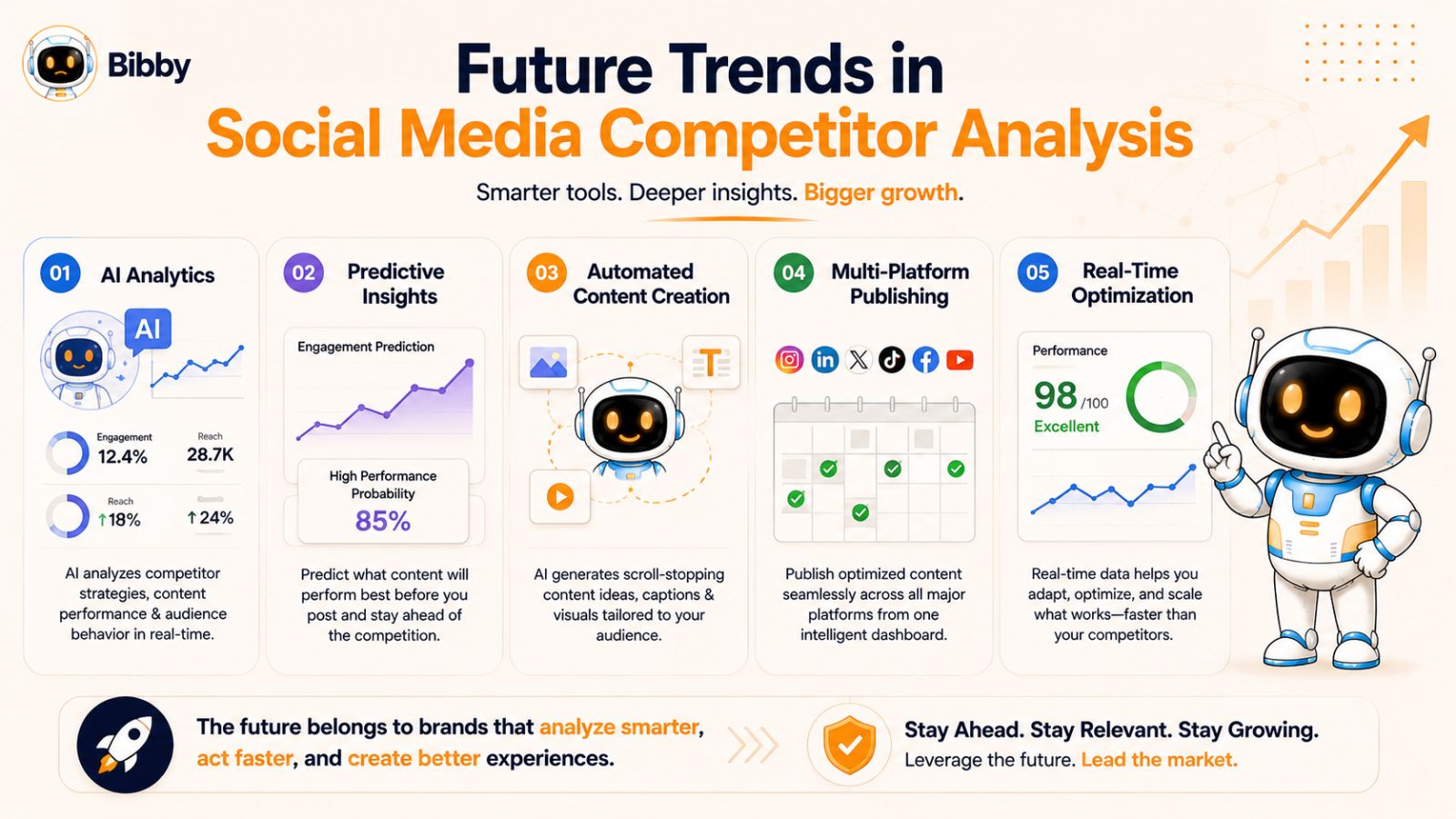
AI-Powered Competitive Intelligence
Artificial intelligence is transforming how businesses collect and analyze competitor data.
Instead of manually reviewing hundreds of posts, AI can identify patterns, trends, and opportunities in seconds.
Future competitor analysis tools will increasingly help businesses:
- Identify high-performing content themes
- Predict engagement trends
- Detect emerging topics
- Monitor competitor growth patterns
- Recommend content opportunities
This will allow marketers to spend less time gathering data and more time executing strategies.
Predictive Analytics Will Become More Important
Traditional analytics focus on what happened in the past.
Predictive analytics focuses on what is likely to happen next.
As AI technology improves, businesses will increasingly use predictive insights to:
- Forecast content performance
- Identify emerging audience interests
- Optimize publishing schedules
- Anticipate industry trends
- Discover growth opportunities earlier
Companies that can identify trends before competitors will have a major advantage in crowded markets.
Hyper-Personalized Content Strategies
Modern audiences expect content that feels relevant to their specific needs and interests.
As platforms become more sophisticated, businesses will move toward greater personalization.
This may include:
- Audience-specific content campaigns
- Personalized messaging
- Dynamic content recommendations
- Segmented publishing strategies
- Customized user experiences
Competitor analysis will increasingly focus on understanding how successful brands tailor content to different audience segments.
Video Will Continue to Dominate
Short-form video has already become one of the most influential content formats on social media.
Platforms continue prioritizing:
- Reels
- TikTok videos
- YouTube Shorts
- Vertical video content
Businesses conducting competitor analysis will place greater emphasis on:
- Video performance metrics
- Audience retention
- Video hooks
- Storytelling techniques
- Engagement patterns
Understanding how competitors use video will become even more critical in the years ahead.
Cross-Platform Strategies Will Become Standard
Many businesses still treat each social platform separately.
The future points toward integrated, cross-platform content ecosystems.
Successful brands will increasingly:
- Repurpose content efficiently
- Maintain consistent messaging
- Coordinate campaigns across platforms
- Use platform-specific optimization strategies
Competitor analysis will need to evaluate not only individual platforms but also how brands connect their efforts across multiple channels.
Social Media Automation Will Accelerate
As content demands increase, automation will become a necessity rather than a luxury.
Businesses will rely more heavily on automation for:
- Content scheduling
- Caption generation
- Content repurposing
- Performance monitoring
- Workflow management
The companies that embrace automation effectively will often outperform competitors that continue relying on manual processes.
AI-Generated Content Will Become More Mainstream
AI-assisted content creation is rapidly becoming part of everyday marketing workflows.
Businesses are increasingly using AI to:
- Generate content ideas
- Create images
- Draft captions
- Develop campaigns
- Optimize messaging
However, successful brands will balance AI efficiency with human creativity and expertise.
The goal will not be replacing human input but enhancing it.
Real-Time Analytics Will Drive Faster Decisions
Traditional reporting often happens weekly or monthly.
Future social media strategies will increasingly rely on real-time insights.
This enables businesses to:
- Adjust campaigns quickly
- Capitalize on trends faster
- Respond to audience behavior immediately
- Optimize content performance continuously
Speed of decision-making will become a major competitive advantage.
The Rise of Unified Social Media Platforms
As social media management becomes more complex, businesses are looking for ways to simplify their workflows.
Instead of managing separate tools for content creation, scheduling, analytics, and publishing, many organizations are moving toward unified platforms.
This trend is expected to accelerate because it reduces complexity and improves efficiency.
For example, platforms like Bibby align closely with this direction by combining multiple stages of the social media workflow into a single system. Businesses can upload their own images or generate visuals with AI, choose a posting style, automatically generate captions, schedule content across Facebook, Instagram, LinkedIn, YouTube, and TikTok, and monitor analytics from one platform.
As social media ecosystems become increasingly fragmented, unified workflows will become more valuable.
Human Creativity Will Remain the Ultimate Differentiator
Despite advances in AI and automation, one thing is unlikely to change:
Authentic human insight remains difficult to replicate.
Competitor analysis can reveal what works.
AI can help execute strategies faster.
Automation can improve efficiency.
But human creativity continues to drive:
- Original ideas
- Unique perspectives
- Brand personality
- Storytelling
- Emotional connection
The most successful businesses will combine technology with human expertise rather than relying entirely on either one.
What the Future Means for Businesses
The future of social media competitor analysis will be defined by three key themes:
Better Data
Businesses will have access to more insights than ever before.
Faster Execution
AI and automation will reduce operational bottlenecks.
Smarter Decision-Making
Predictive analytics will help marketers act proactively instead of reactively.
Organizations that embrace these changes early will be better positioned to outperform competitors.
Key Takeaway
The future of social media competitor analysis is not just about collecting more data.
It's about turning data into action faster and more effectively than your competitors.
Artificial intelligence, predictive analytics, automation, and unified workflows are reshaping how businesses create content, engage audiences, and grow their brands.
The companies that combine these technologies with strong strategic thinking and consistent execution will be the ones that dominate social media in the years ahead.
Now that we've covered the complete framework for analyzing competitors and outperforming them, let's bring everything together with the key lessons and action steps you can implement immediately.
Also read: How to Analyze Your Competitors on Social Media and Outperform Them
Conclusion
Social media success is rarely the result of luck. The brands that consistently grow their audiences, increase engagement, and generate business results are usually the ones that understand their competitors, identify opportunities, and execute with discipline.
Throughout this guide, we've explored three essential strategies for outperforming competitors on social media. First, competitor analysis helps you uncover proven content ideas, audience preferences, and engagement patterns without relying on guesswork. Second, identifying content gaps and underserved opportunities allows you to create more valuable and differentiated content. Third, combining those insights with AI-powered automation enables you to execute consistently across multiple platforms while saving significant time and effort.
The most important thing to remember is that competitor analysis isn't about copying what others are doing. It's about understanding why certain strategies work and then creating something even better for your audience.
As social media platforms become more competitive and content demands continue to grow, businesses that combine data-driven insights with efficient execution will have a clear advantage. Tools like Bibby can help simplify that process by allowing you to create content, generate captions, schedule posts, publish across multiple platforms, and track analytics from a single workflow.
Now that you know how to analyze competitors and build a winning social media strategy, a natural next step is learning how to create a complete AI-powered content marketing system that consistently generates engagement, leads, and growth across every major platform. That approach can help you transform competitor insights into a scalable engine for long-term social media success.