
Cross posting is the practice of publishing the same core content across multiple social media platforms.
If you manage several social channels, cross posting can help you reach more people while reducing the time spent creating and publishing content. The key is knowing how to distribute content efficiently without making every post feel like a copy-and-paste job.
In this section, we will discuss:
- What cross posting means on social media
- How to cross post effectively across platforms
- How automation can simplify cross posting
Let's look at what cross posting actually means and how it works.
What Is Cross Posting?
Cross posting is the practice of publishing the same piece of content, or the same core content idea, across multiple social media platforms or accounts. Instead of creating a completely separate post from scratch for every channel, you distribute one piece of content across several platforms.
For example, a business might create a product announcement and publish it on Instagram, Facebook, LinkedIn, TikTok, and YouTube. The core message stays consistent, while the caption, format, or presentation can be adjusted to suit each platform.
Cross posting can be as simple as publishing the exact same post everywhere, but an effective cross-posting strategy usually involves some platform-specific adaptation. A LinkedIn audience may respond better to a professional explanation, while TikTok users may prefer a short video and Instagram users may engage more with a carousel.
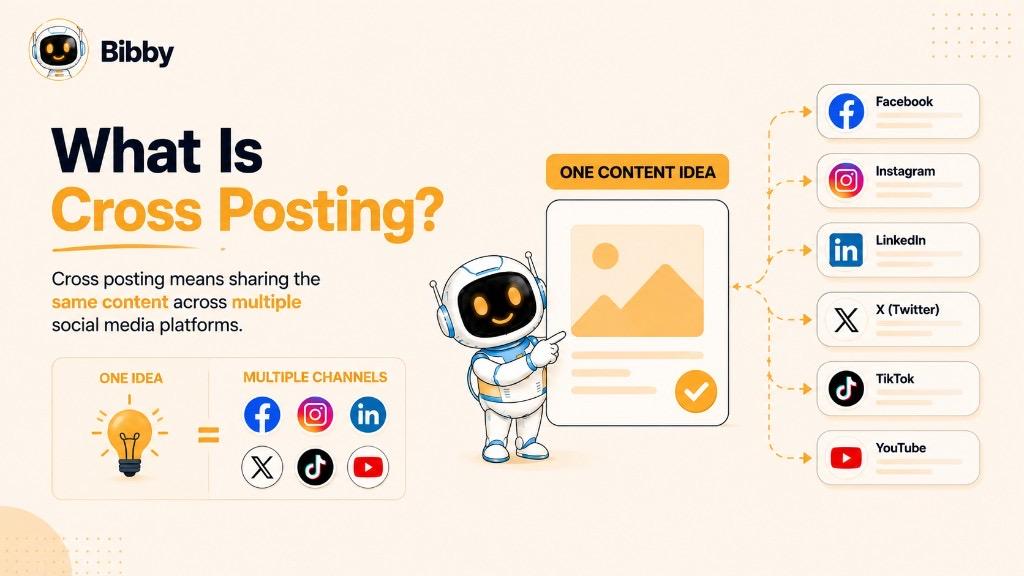
In simple terms, cross posting means taking one piece of content or content idea and distributing it across multiple social media channels.
What Does Cross Posting Mean on Social Media?
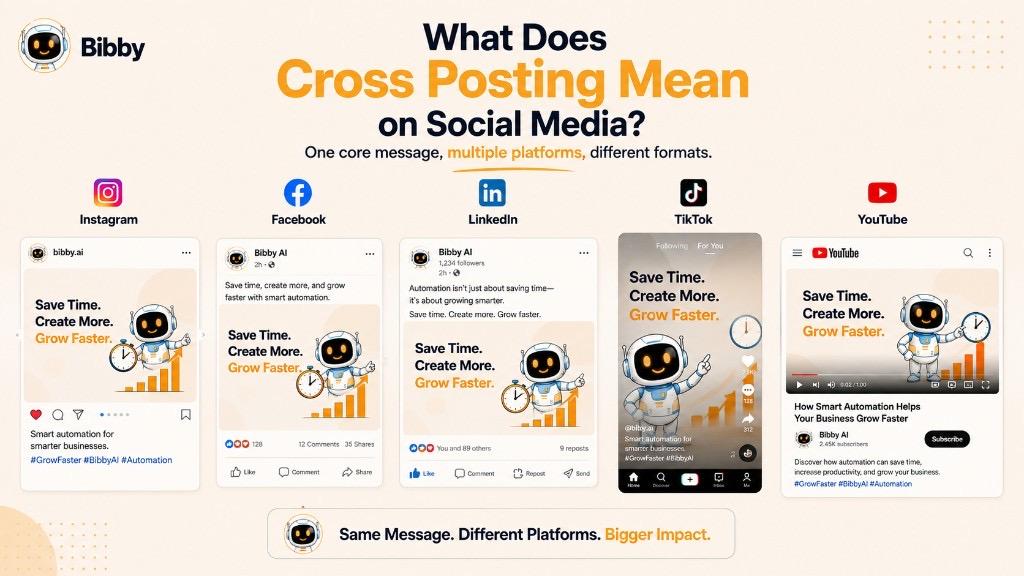
On social media, cross posting means publishing content across multiple social networks instead of creating completely different content for every platform.
For example, a brand might create a post announcing a new product and share it on Facebook, Instagram, LinkedIn, TikTok, and YouTube. The main idea remains the same, but the content can be adjusted to match each platform's format, audience, and style.
Cross posting can involve:
- Publishing the same image or video across multiple platforms
- Adapting one caption for different social networks
- Turning one content idea into different platform-specific posts
- Scheduling the same campaign across several social channels
- Publishing content to multiple accounts managed by the same brand
The important distinction is that cross posting does not have to mean posting an identical piece of content everywhere. In many cases, the most effective approach is to keep the core message consistent while adapting the execution for each platform.
For example, a product launch could become an Instagram carousel, a Facebook post, a LinkedIn announcement, a TikTok video, and a YouTube video. All of these posts support the same campaign, making them part of a cross-posting strategy.
In short, cross posting helps you distribute one content idea across multiple social media channels without rebuilding your entire content strategy for each platform.
How Does Cross Posting Work?
Cross posting works by taking a piece of content or a central content idea and distributing it across multiple social media platforms. The process can be handled manually, through native platform features, or with a social media scheduling and automation tool.
A professional cross-posting workflow usually involves more than uploading the exact same post everywhere. It starts with a central piece of content and then adapts that content to the requirements, audience, and communication style of each platform.
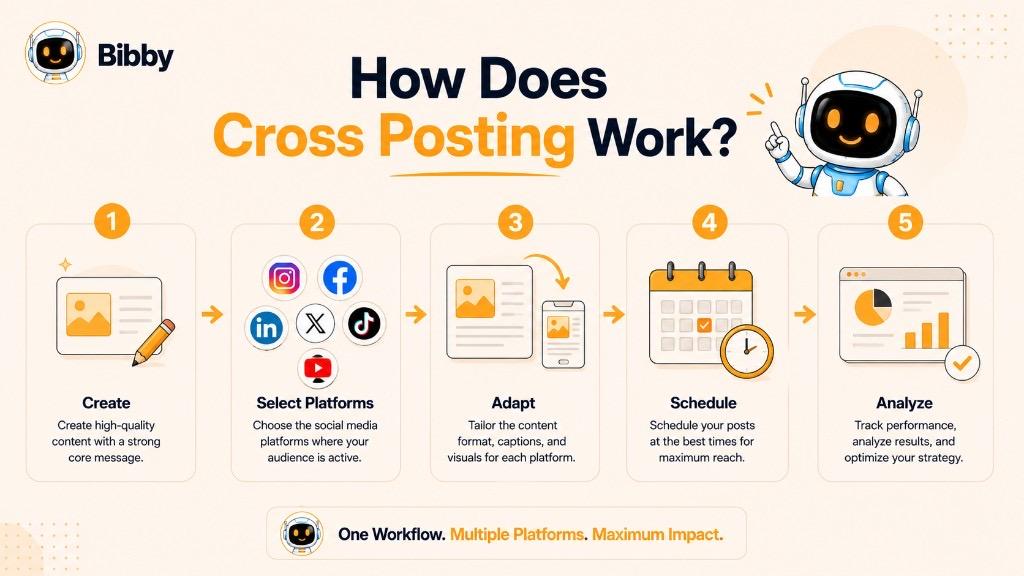
1. Create the Core Content
First, create the original piece of content around a clear topic, message, campaign, product, or offer.
Depending on your social media strategy, this could be:
- An image
- A carousel
- A short-form video
- A long-form video
- A story
- An educational post
- A product announcement
- A promotional post
- A thought-leadership post
The goal is to establish one strong content idea that can be distributed across multiple channels.
2. Choose the Platforms
Next, decide which social media platforms are appropriate for the content and your audience.
For example, a business might distribute a campaign across Facebook, Instagram, LinkedIn, TikTok, and YouTube. However, cross posting does not mean every piece of content must appear on every available platform.
The right selection depends on factors such as your target audience, content format, campaign objective, and the role each platform plays in your social media strategy.
3. Adapt the Content for Each Platform
This is one of the most important parts of effective cross posting.
Instead of blindly copying and pasting the same post, adapt elements such as the caption, tone, hashtags, call to action, media format, and length to fit each platform.
For example:
- Instagram: A visually focused carousel with a concise caption.
- Facebook: An image or video accompanied by more conversational context.
- LinkedIn: A professional post focused on an insight, business problem, or lesson.
- TikTok: A short-form video designed for quick, visual consumption.
- YouTube: A longer video or Short built around the same underlying topic.
The content idea remains consistent, but the presentation becomes more native to each channel.
4. Schedule the Posts
Once the content has been prepared for each platform, the posts can be scheduled for publication.
Scheduling is particularly useful when managing several social networks because you can plan content in advance rather than manually publishing each post at the same time.
A social media scheduling tool can centralize this process, allowing you to select platforms, prepare captions and media, choose publishing dates, and manage multiple posts from one workflow.
5. Publish and Monitor Performance
After the posts are published, review how the content performs on each platform.
Useful performance signals can include:
- Reach and impressions
- Engagement
- Likes and reactions
- Comments
- Shares
- Saves
- Video views and watch time
- Click-throughs
- Conversions
Performance can vary significantly between platforms because each network has different audiences, content formats, and user behaviors.
For that reason, cross posting should be treated as a distribution strategy, not a guarantee that one post will perform identically everywhere.
A Simple Cross-Posting Workflow
The process can be summarized as:
Create → Select platforms → Adapt → Schedule → Publish → Analyze → Improve
This approach allows businesses and creators to get more value from each content idea while still respecting the differences between social media platforms.
The biggest advantage of cross posting is therefore not simply publishing more often. It is creating an efficient system where one strong content idea can be transformed into multiple relevant social media posts without requiring an entirely new content creation process for every channel.
Cross Posting Example
Imagine a SaaS company launching a new feature and wanting to promote it across its social media channels. Instead of creating five unrelated campaigns, the company develops one central campaign around the feature and adapts it for each platform.
The core message might be:
"Our new AI feature helps businesses create social media content faster."
That same idea could become several platform-specific posts:
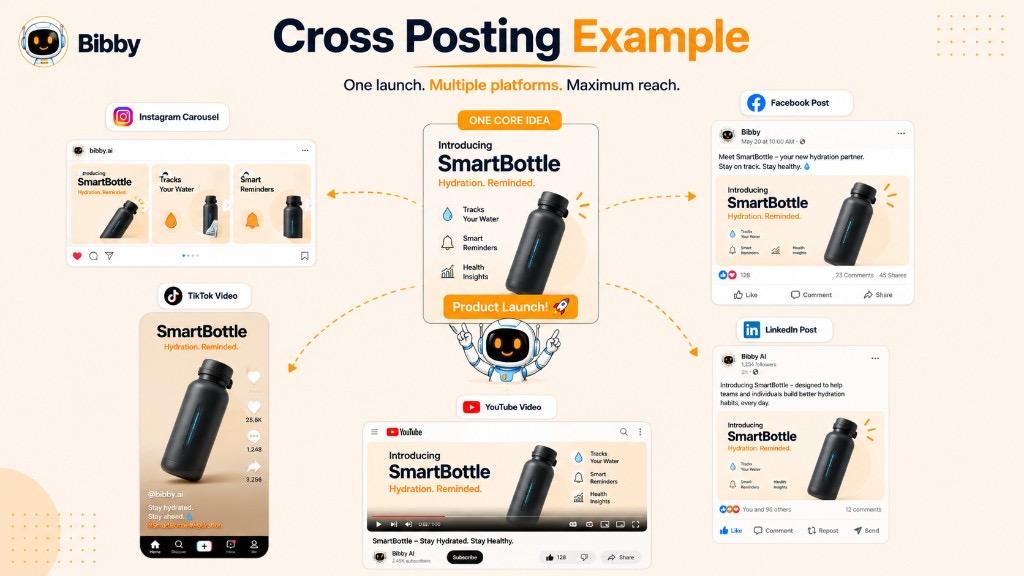
The company publishes a carousel explaining the feature, showing how it works and highlighting its main benefits. The caption provides additional context and encourages followers to try the feature.
The company shares an image or short video announcing the feature, accompanied by a more conversational caption explaining why it was created and who it is designed to help.
The company turns the announcement into a professional post focused on the business problem the feature solves. It might explain how automation can reduce repetitive social media work and improve publishing efficiency.
TikTok
The company creates a short demonstration showing the feature in action. Rather than repeating the LinkedIn caption, the video quickly demonstrates the problem, the solution, and the result.
YouTube
The company publishes a longer product walkthrough explaining how the feature works, demonstrating its workflow, and showing practical use cases.
Although these posts look different, they are all built around the same underlying campaign and content idea. This is a practical example of cross posting.
What Makes This Effective?
The company isn't simply copying and pasting the same post five times. Instead, it is using one piece of core messaging as the foundation for multiple platform-specific executions.
This approach provides several advantages:
- Consistency: The same campaign message reaches audiences across different channels.
- Efficiency: The team does not have to invent a completely new idea for every platform.
- Relevance: Each post can match the format and communication style of its platform.
- Reach: One campaign can reach people who follow the company on different social networks.
- Scalability: A repeatable workflow makes it easier to manage multiple social channels.
This is why effective cross posting is often better understood as "create once, adapt and distribute everywhere" rather than simply "copy and paste everywhere."
For creators and businesses managing several social accounts, a social media automation tool can make this process even more efficient by helping create, adapt, schedule, and publish content across multiple platforms from a single workflow.
Why Do People Cross Post on Social Media?
Cross posting is popular because it helps businesses, creators, and social media teams get more value from the content they already create. Instead of treating every social network as a completely separate publishing operation, cross posting creates a more efficient way to distribute content across multiple channels.
When done strategically, it can save time, expand reach, improve publishing consistency, and make managing several social media accounts more scalable.
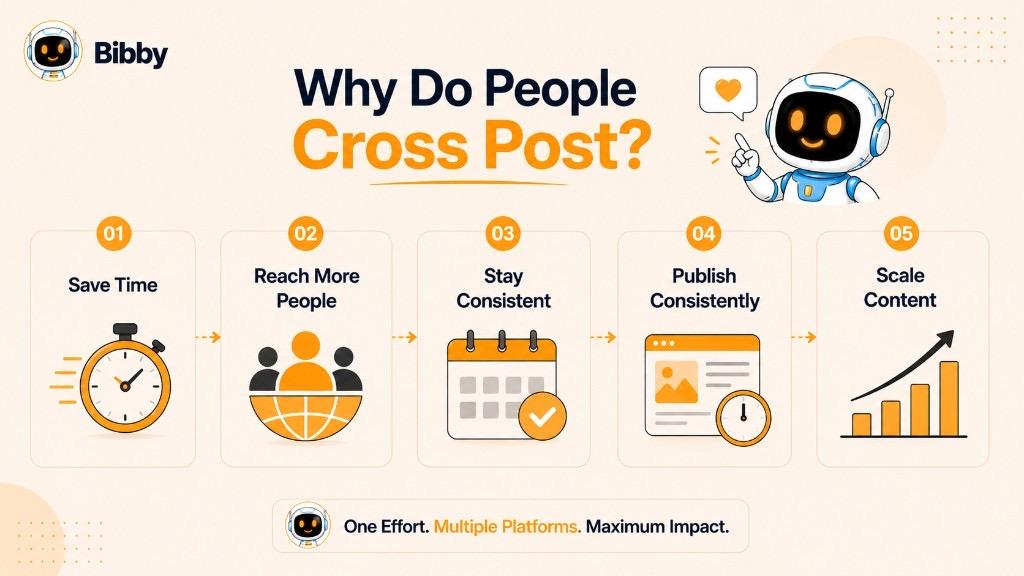
Save Time and Reduce Repetitive Work
Creating unique content for every platform can require significant time and resources. Cross posting allows a team to start with one strong content idea and adapt it for multiple channels.
This does not eliminate the need for platform-specific customization, but it can significantly reduce repetitive work such as recreating the same campaign concept, finding the same media assets, and manually preparing similar posts.
Reach Different Audiences
People do not necessarily use every social network in the same way. A business may have customers on Instagram, prospects on LinkedIn, an active community on Facebook, and a younger audience on TikTok.
Cross posting allows the same campaign or important message to reach these different audiences without requiring a completely separate content strategy for each network.
Maintain a Consistent Brand Presence
Consistent publishing can help a brand remain recognizable across its social channels.
Cross posting makes it easier to distribute important announcements, campaigns, educational content, product updates, and promotional messages across the platforms where the brand has an active presence.
The message can remain consistent while the wording, creative format, and call to action are adapted for each audience.
Publish More Consistently
Consistency is an important part of maintaining an active social media presence. However, manually creating and publishing content across several platforms can make consistency difficult to maintain.
A structured cross-posting workflow gives teams a repeatable way to distribute content. When combined with scheduling, content can be prepared in advance and published according to a planned content calendar.
Get More Value From Existing Content
A strong piece of content does not necessarily need to be used only once.
For example, an original product announcement could become an Instagram carousel, Facebook post, LinkedIn update, TikTok video, and YouTube Short. The central idea remains the same, but each version can be presented in a format that makes sense for its platform.
This helps businesses extend the useful life and reach of their content without constantly starting from a blank page.
Reduce Manual Publishing
Cross posting becomes especially valuable when a brand manages several social accounts.
Without a centralized workflow, a social media manager may need to repeatedly:
- Open each platform.
- Upload the media.
- Write or paste the caption.
- Add platform-specific details.
- Choose a publishing time.
- Repeat the process for every channel.
Social media scheduling and automation tools can consolidate much of this work into a single workflow, making multi-platform publishing easier to manage.
Scale Your Social Media Strategy
As the number of platforms and accounts grows, manual publishing becomes increasingly difficult to scale.
Cross posting provides a foundation for a more systematic content operation: create a strong idea, adapt it for relevant channels, schedule the posts, and analyze the results.
The goal is not simply to publish more content. The goal is to make each content idea work harder across the platforms that matter most to your audience.
What Are the Disadvantages of Cross Posting?
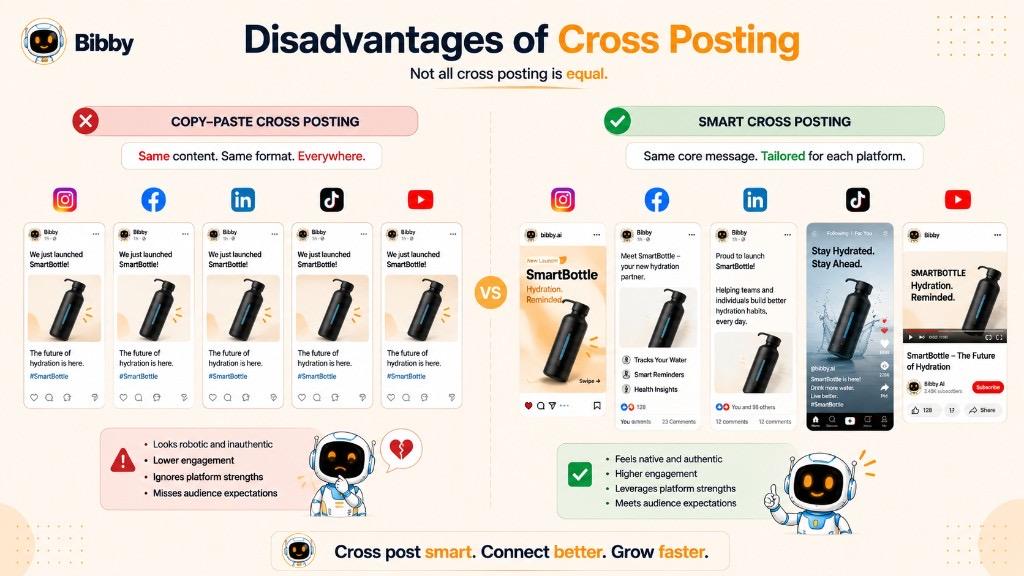
Cross posting can make social media management faster and more efficient, but it is not automatically the right strategy for every post. Publishing identical content across every platform without considering the audience, format, or context can make your social presence feel repetitive and less relevant.
The most effective approach is to use cross posting as a distribution framework, while still adapting content to the platform where it will appear.
Content Can Feel Repetitive
If someone follows your brand on multiple platforms, they may see the exact same post several times.
Repeated exposure can be useful for important campaigns, but excessive duplication may make your content feel predictable. This is particularly noticeable when the same caption, image, video, and call to action are published everywhere without modification.
A better approach is to maintain the central idea while changing the presentation for each platform.
Different Platforms Have Different Audiences
People use social networks for different purposes, and the expectations of those audiences can vary.
For example, a detailed industry insight may work well on LinkedIn but require a more visual or entertaining treatment on TikTok. Similarly, a casual Instagram caption may not be appropriate for a professional LinkedIn audience.
Cross posting works best when the content is adapted to the audience receiving it.
Platform Formats Are Different
Social networks have different content formats, specifications, and publishing features.
An image designed for one platform may not have the ideal dimensions for another. A long caption may work in one environment but be unnecessarily verbose in another. A video that works as a TikTok may also need editing before being used effectively on YouTube or Instagram.
This means cross posting should account for factors such as:
- Image and video dimensions
- Video length
- Caption length
- Hashtags
- Links
- Calls to action
- Interactive features
- Platform-specific publishing requirements
Engagement Can Suffer From Poor Adaptation
A post that performs well on one platform is not guaranteed to perform equally well elsewhere.
If a brand simply duplicates content without considering how people consume content on each network, the post may receive less engagement than a platform-specific version would.
Cross posting should therefore be viewed as a starting point for distribution, not a shortcut around understanding each platform.
Some Content Is Platform-Specific
Not every piece of content belongs on every social network.
A post built around a platform-specific feature, trend, audience behavior, or format may have little value elsewhere. Trying to distribute every piece of content everywhere can result in unnecessary work and weaker content.
Before cross posting, ask:
"Does this content make sense for the audience and purpose of this platform?"
If the answer is no, it may be better to leave that post on its original channel.
Cross Posting Can Encourage a "One-Size-Fits-All" Strategy
One of the biggest risks is allowing automation to replace strategy.
Automation can make publishing easier, but it should not determine where content belongs or how audiences should be addressed. A good cross-posting workflow combines automation with human or strategic oversight.
The ideal balance is:
One core idea + platform-specific adaptation + automated distribution.
When used this way, cross posting can provide the efficiency of centralized publishing without sacrificing the relevance and authenticity that audiences expect from each social media platform.
Should You Cross Post the Same Content on Every Platform?
Yes, you can cross post the same core content across multiple social media platforms, but publishing an identical post everywhere is rarely the best approach.
The most effective cross-posting strategy is usually to reuse the core idea while adapting the content to each platform. This allows you to save time and maintain consistent messaging without making your social media presence feel repetitive or disconnected from each platform's audience.
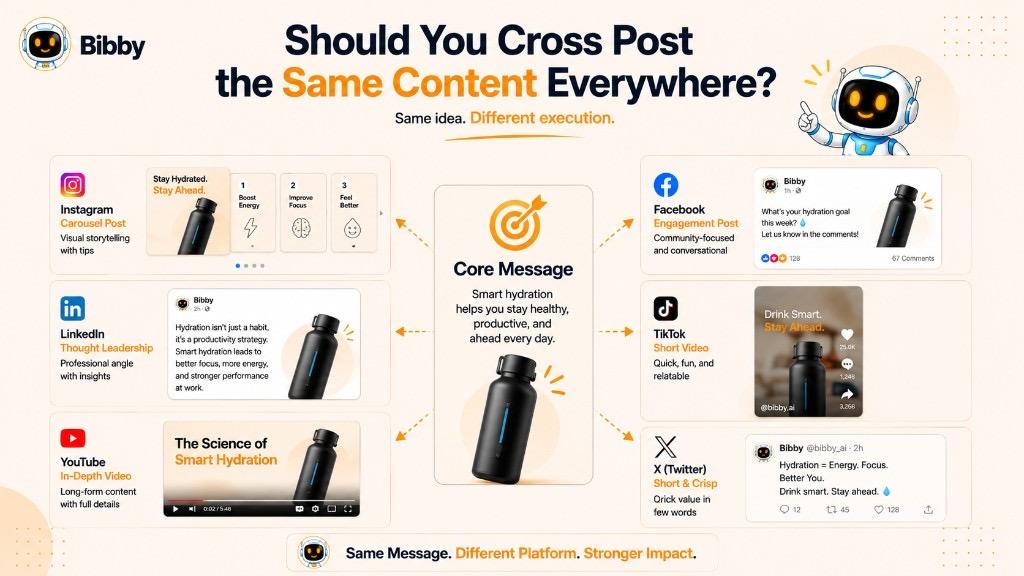
Use the Same Core Idea, Not Necessarily the Same Post
Think of your original content as the source material for multiple platform-specific posts.
For example, suppose a company wants to promote a new feature. The central idea could be:
"Our new feature helps businesses automate repetitive social media tasks."
That idea can then be adapted into different formats:
- Instagram: A visual carousel explaining the feature.
- Facebook: A conversational announcement with supporting details.
- LinkedIn: A professional post focused on productivity and business outcomes.
- TikTok: A short demonstration showing the feature in action.
- YouTube: A detailed walkthrough or product demonstration.
The message remains recognizable across channels, but the execution reflects the platform.
When Posting the Same Content Can Make Sense
There are situations where publishing substantially the same content across platforms is perfectly reasonable.
For example:
- An important company announcement
- A product launch
- A time-sensitive update
- An event announcement
- A major industry news update
- An urgent customer communication
If the message is important and broadly relevant, distributing it across several channels can help ensure your audience sees it.
Even then, small adjustments can improve the experience. You might change the opening sentence, call to action, hashtags, media format, or supporting context rather than publishing a completely identical version.
When You Should Adapt the Content
Adapt your content when the platforms have significantly different audiences, formats, or content expectations.
For example, a long educational LinkedIn post should not necessarily be copied word-for-word into TikTok. Instead, the underlying lesson could become a short video with a strong visual hook.
Likewise, a visual Instagram carousel might be converted into a LinkedIn document post or a short explanatory video for another platform.
The goal is not to create five completely unrelated pieces of content. The goal is to make one strong idea relevant in five different environments.
A Simple Rule for Cross Posting
A useful rule is:
Keep the message consistent. Change the experience.
Your brand voice, campaign objective, and central message should remain recognizable. But the format, caption, tone, hook, length, and call to action can change according to the platform.
This approach gives you the efficiency of cross posting without turning your social media strategy into a simple copy-and-paste routine.
How to Cross Post Effectively
Effective cross posting is about more than publishing the same content on multiple social networks. The goal is to maximize the value of one content idea while making each version feel appropriate for the platform where it appears.
A strong cross-posting strategy combines consistent messaging, platform-specific adaptation, thoughtful scheduling, and performance analysis.
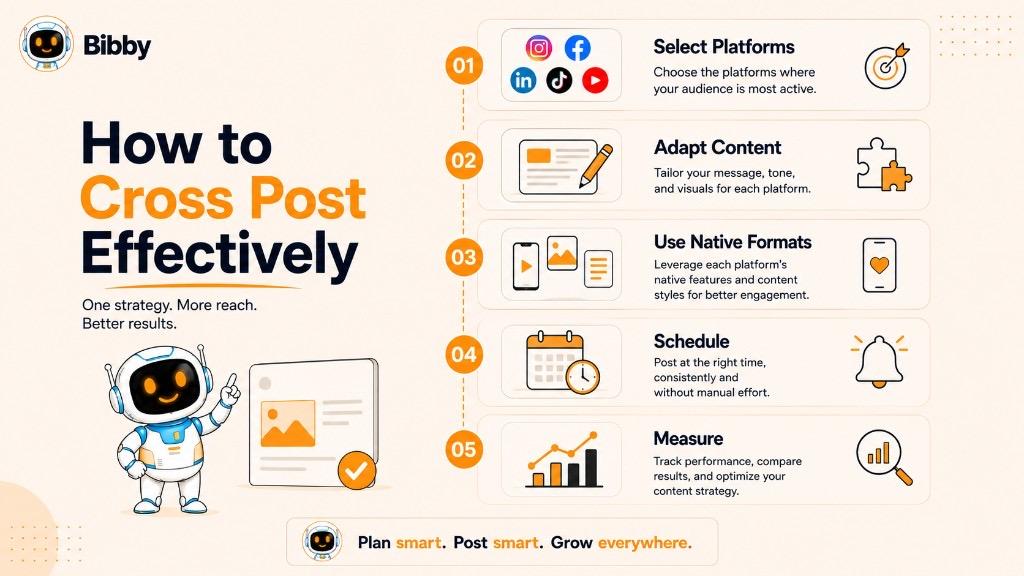
1. Start With One Strong Content Idea
Begin with a clear idea, message, or objective that can support multiple social posts.
This could be:
- A product launch
- An educational topic
- A customer success story
- An industry insight
- A promotional campaign
- A company announcement
- A behind-the-scenes story
Starting with a strong central idea makes it easier to create several related posts without making your content strategy unnecessarily complicated.
2. Choose Platforms That Match Your Audience
Do not assume every post needs to be published everywhere.
Consider where your audience actually spends time and which platforms support your content format and business goals. A B2B company, for example, may prioritize LinkedIn, while a visual consumer brand may place more emphasis on Instagram or TikTok.
Cross posting is most effective when you distribute content to relevant platforms rather than every platform available.
3. Adapt the Content for Each Platform
Keep the central message consistent, but adjust the execution.
Consider adapting:
- The opening hook
- Caption length
- Tone of voice
- Hashtags
- Visual format
- Video length
- Call to action
- Supporting context
- Links or other platform-specific elements
This small amount of customization can make a cross-posted campaign feel native rather than duplicated.
4. Use Platform-Native Formats
Whenever possible, use formats that naturally fit the platform.
An educational idea might become a carousel on Instagram, a text-led post on LinkedIn, a short video on TikTok, and a longer explanation on YouTube.
Using native formats can make the content easier for audiences to consume and gives you more opportunities to communicate the same idea in different ways.
5. Avoid Publishing Everything at the Same Time
Cross posting does not require every platform to receive the content simultaneously.
Different audiences may be active at different times, and publishing schedules can vary by platform. Scheduling posts independently allows you to distribute the same campaign across several days or at different times while maintaining a consistent overall message.
This can also prevent followers who see your brand on multiple platforms from encountering the exact same post everywhere at once.
6. Maintain Consistent Branding
While the content should be adapted, the brand should remain recognizable.
Keep important elements consistent, such as:
- Brand voice
- Visual identity
- Core messaging
- Campaign theme
- Product positioning
- Key offers
This creates continuity across your social presence without requiring every post to look identical.
7. Track Performance by Platform
Measure how each version performs rather than judging the entire cross-posting campaign by a single result.
Look at relevant metrics such as reach, engagement, shares, saves, video views, clicks, and conversions.
If a particular format consistently performs better on one platform, use that insight when planning future cross-posted content.
8. Automate the Repetitive Parts
Once the strategy is established, automation can reduce the manual work involved in publishing across multiple channels.
A social media automation tool can help centralize tasks such as uploading media, generating captions, adapting content, selecting platforms, scheduling posts, and managing publishing workflows.
The objective is not to automate your strategy away. It is to automate repetitive execution so you can spend more time improving the content and understanding your audience.
The Best Cross-Posting Formula
A practical way to think about effective cross posting is:
Create once → Adapt for each platform → Schedule strategically → Publish → Measure → Improve
This approach combines the efficiency of cross posting with the relevance of platform-specific content, making it easier to maintain a consistent and scalable social media presence.
Cross Posting vs Content Repurposing
Cross posting and content repurposing are closely related social media strategies, but they are not exactly the same.
Cross posting focuses on distributing the same core content or message across multiple social media platforms. Content repurposing focuses on transforming existing content into new formats, angles, or assets so it can be used in different ways.
Understanding the difference helps you decide whether you should simply distribute content across channels or turn one piece of content into several new pieces.
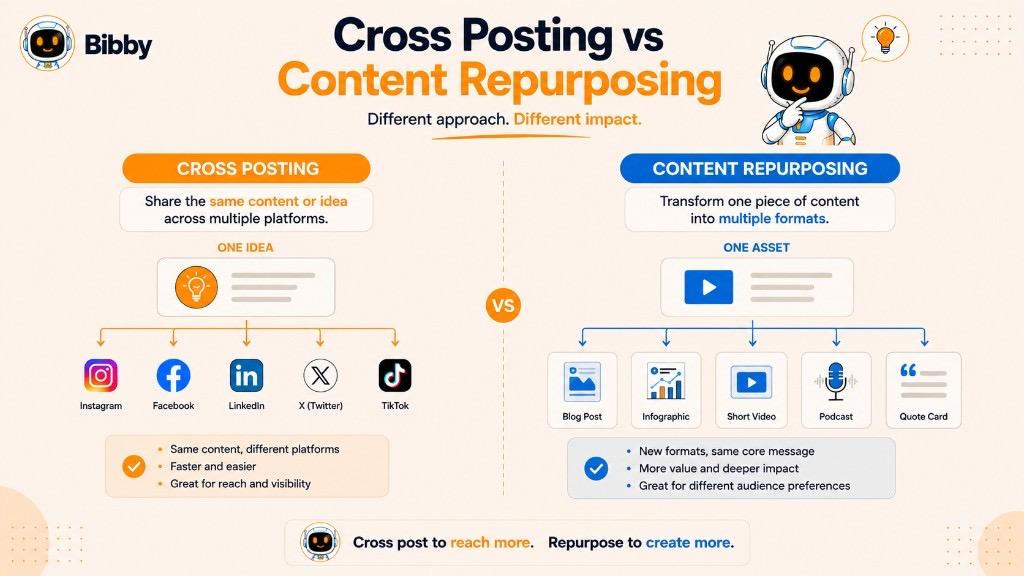
What Is Cross Posting?
Cross posting means taking one piece of content or a central content idea and publishing it across multiple platforms.
For example, a company creates a product announcement and publishes adapted versions on:
The central campaign and message remain the same, even if the format or caption changes.
What Is Content Repurposing?
Content repurposing goes a step further by transforming existing content into substantially different content assets.
For example, a company publishes a 20-minute educational video. That video could be repurposed into:
- Several short-form videos
- An Instagram carousel
- A LinkedIn post
- A blog article
- A collection of social media quotes
- An email newsletter
The original content becomes the source material for new pieces of content.
Cross Posting vs Content Repurposing
| Cross Posting | Content Repurposing |
|---|---|
| Distributes content across multiple platforms | Transforms existing content into new content |
| Usually retains the original core message | Can introduce new formats and angles |
| Primarily focuses on distribution | Primarily focuses on content creation efficiency |
| Often happens across social networks | Can happen across social, blogs, email, video, and other channels |
| May require minor platform-specific changes | Usually involves more substantial transformation |
Can You Use Both Strategies Together?
Yes. In fact, combining them can create a highly efficient content workflow.
Imagine you publish a detailed YouTube video about social media automation.
You could repurpose that video into:
You could then cross post the appropriate versions of those assets across the platforms where they make sense.
In other words:
Repurposing creates more content from an existing asset. Cross posting distributes that content across relevant channels.
Using both strategies can help businesses get more value from every content idea while reducing the amount of work required to maintain an active social media presence.
Cross Posting vs Reposting
Cross posting and reposting are sometimes used interchangeably, but they describe different social media activities.
Cross posting generally means publishing the same or adapted content across multiple platforms or accounts. Reposting usually means sharing or publishing content again, often on the same platform.
The difference is mainly about where and why the content is distributed.
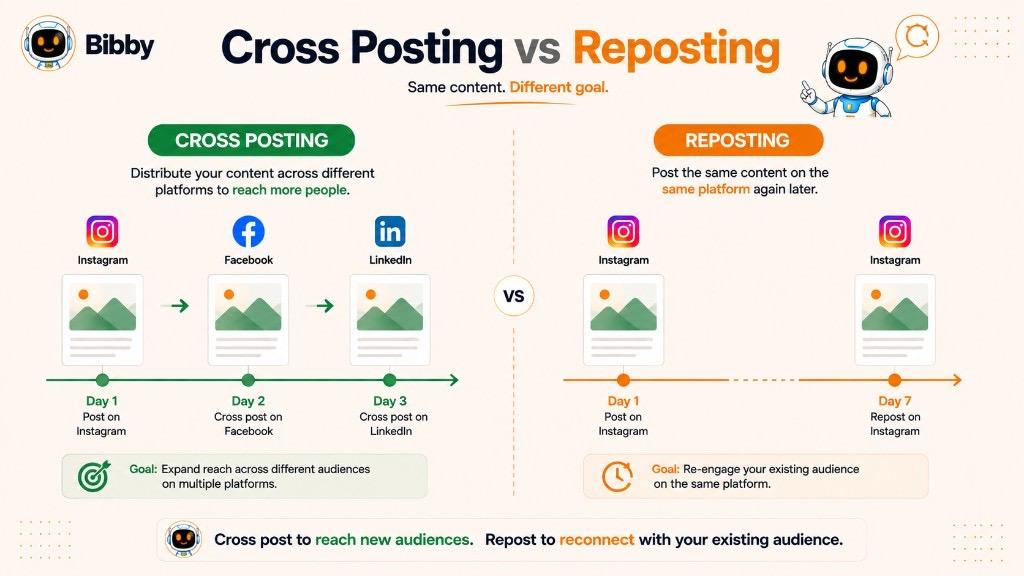
What Is Cross Posting?
Cross posting distributes content across different social media channels.
For example, a business might publish an announcement on Instagram, Facebook, LinkedIn, TikTok, and YouTube. Each version may be adapted to fit the platform, but they all originate from the same campaign or content idea.
Example:
One product launch → Instagram post + Facebook post + LinkedIn post + TikTok video
This is cross posting because the content is being distributed across multiple channels.
What Is Reposting?
Reposting generally involves sharing existing content again, usually on the same social network.
For example, a brand might publish an Instagram post in January and share that post again several weeks later because the content is still relevant.
Reposting can also refer to sharing another person's content, depending on the platform and context.
Example:
That is generally considered reposting rather than cross posting.
Cross Posting vs Reposting
| Cross Posting | Reposting |
|---|---|
| Distributes content across multiple platforms | Publishes or shares content again |
| Usually involves multiple channels | Often happens on the same platform |
| Can involve platform-specific adaptations | Often reuses existing content directly |
| Focuses on reaching audiences across channels | Focuses on extending or repeating content distribution |
Can Cross Posting and Reposting Overlap?
Yes.
A social media manager might cross post a campaign across several platforms and later repost the strongest-performing version on one of those platforms.
For example:
Day 1: Product announcement is cross posted to Instagram, Facebook, and LinkedIn.
Day 30: The Instagram version is reposted because the announcement remains relevant.
The two strategies can therefore work together, but they serve different purposes.
The Simple Difference
A useful way to remember the distinction is:
Cross posting = distributing content across channels.
Reposting = distributing content again.
Both can extend the reach and lifespan of your social media content, but cross posting is primarily about multi-platform distribution, while reposting is primarily about reusing or resharing existing content over time.
Cross Posting vs Social Media Scheduling
Cross posting, social media scheduling, and automation are closely connected, but they describe different parts of the publishing process.
Cross posting is about distributing content across multiple social media platforms. Social media scheduling is about deciding when that content should be published. Automation is about streamlining how you create, customize, schedule, and publish content at scale.
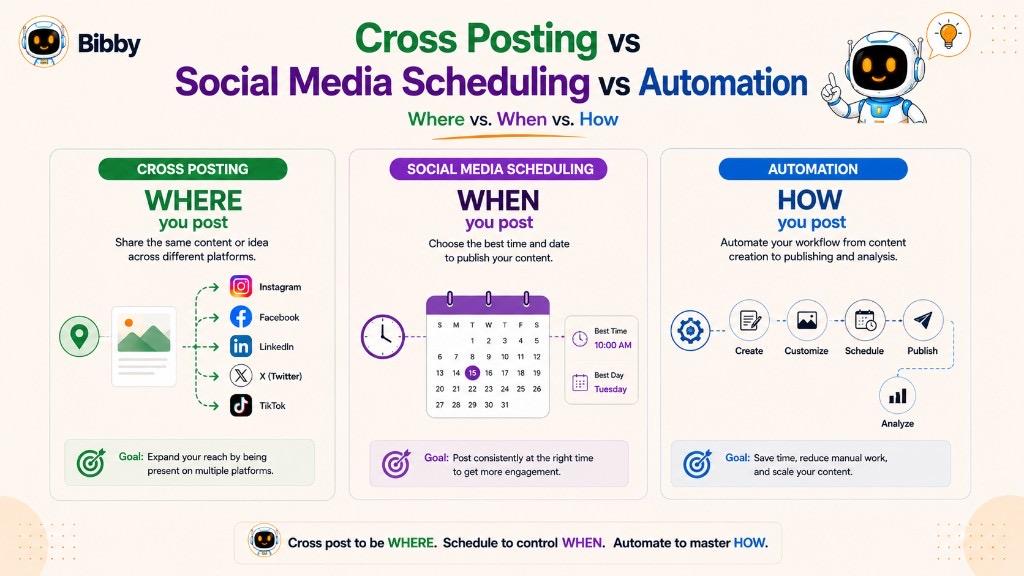
What Is Cross Posting?
Cross posting means publishing the same core content or content idea across multiple social media channels.
For example, a business may create a product announcement and publish adapted versions on Instagram, Facebook, LinkedIn, TikTok, and YouTube.
The primary question behind cross posting is:
"Where should this content be published?"
What Is Social Media Scheduling?
Social media scheduling means preparing content in advance and setting it to publish at a specific date and time.
Instead of manually publishing a post when it is time to go live, you can schedule it ahead of time.
The primary question behind scheduling is:
"When should this content be published?"
Cross Posting vs Scheduling
| Cross Posting | Social Media Scheduling |
|---|---|
| Focuses on distribution | Focuses on timing |
| Determines which platforms receive content | Determines when content is published |
| Can involve multiple social networks | Can involve one or multiple platforms |
| May happen manually or automatically | Usually uses a scheduling system or platform feature |
| Concerned with channel distribution | Concerned with publishing workflow and timing |
How They Work Together
Cross posting and scheduling become particularly powerful when used together.
For example, imagine you create a product announcement on Monday.
You could cross post it to:
Then schedule each version for an appropriate date and time.
Your Instagram post might go live Monday evening, the LinkedIn version Tuesday morning, and the TikTok video later in the week.
The campaign remains connected, but the publishing schedule can be customized for each channel.
Where Automation Fits In
Social media automation can combine both processes into a single workflow.
Instead of manually uploading the same campaign to every platform and then scheduling each post separately, an automation tool can help you:
- Upload or create your content.
- Select the platforms.
- Adapt or generate captions.
- Prepare platform-specific versions.
- Choose publishing dates and times.
- Schedule the content.
- Publish across selected channels.
- Review performance afterward.
This makes cross posting the distribution strategy, scheduling the timing mechanism, and automation the system that reduces repetitive work.
In simple terms:
Cross posting answers "where?"
Scheduling answers "when?"
Automation helps manage "how?"
Which Social Media Platforms Can You Cross Post To?
You can cross post content across many major social media platforms, including Facebook, Instagram, LinkedIn, TikTok, and YouTube. However, cross posting does not mean that every piece of content should automatically be published everywhere.
Each platform has different audiences, content formats, publishing features, and user expectations. The most effective approach is to distribute the same core content idea across relevant channels while adapting the format and messaging for each one.
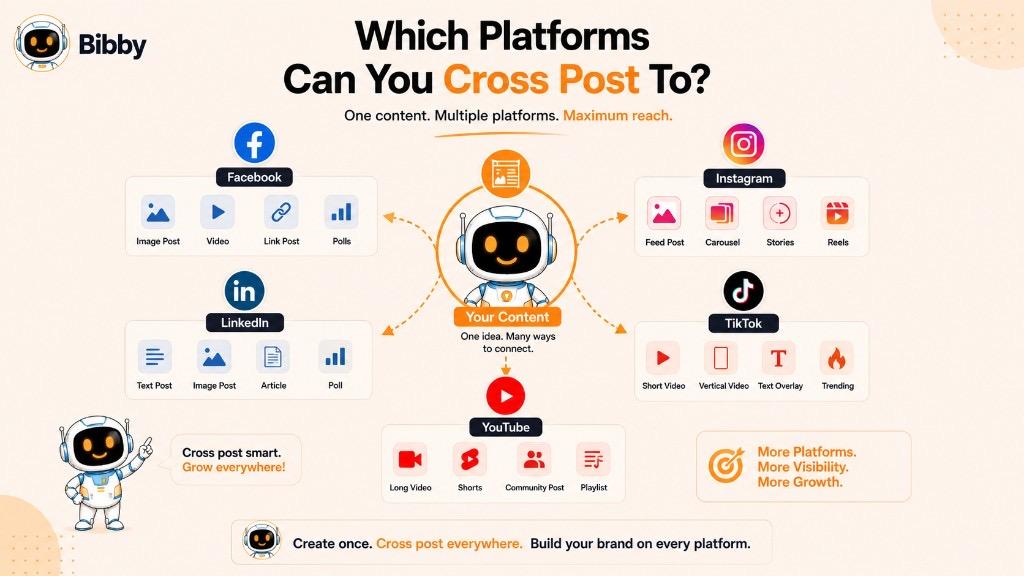
Facebook supports a wide range of content, including images, videos, links, and other post formats.
Cross posting to Facebook can work well for:
- Product announcements
- Educational content
- Community-focused posts
- Promotional campaigns
- Videos and visual content
- Company updates
Because Facebook audiences can include a broad range of demographics, captions can often provide additional context around the content.
Instagram is highly visual and supports formats such as images, carousels, videos, Stories, and Reels.
When cross posting to Instagram, pay particular attention to the visual presentation and the format being used. A campaign that originates as a text-heavy post on another platform may need to become a carousel, Reel, or other visual-first format to work effectively on Instagram.
LinkedIn is primarily oriented toward professional and business-related conversations.
Cross-posted content can be adapted for LinkedIn by emphasizing:
- Industry insights
- Business outcomes
- Professional lessons
- Customer stories
- Company announcements
- Educational information
A promotional post that works on a consumer-focused platform may need a more informative or professional angle on LinkedIn.
TikTok
TikTok is centered heavily around short-form video and fast, engaging content.
When cross posting to TikTok, a static image or long caption may need to be transformed into a short video with a clear opening hook and concise message.
For example, a product announcement could become a quick demonstration showing what the product does and why it matters.
YouTube
YouTube supports both long-form video and shorter video formats.
A cross-posted campaign can be adapted into:
- Product demonstrations
- Tutorials
- Educational videos
- Behind-the-scenes content
- YouTube Shorts
- Video explainers
A short-form social post may therefore become a more detailed video on YouTube, while a longer YouTube video can also serve as source material for shorter social content.
Should You Cross Post to Every Platform?
Not necessarily.
The best platforms depend on your audience, content type, business goals, and resources.
A useful decision process is:
Audience → Platform → Format → Message → Timing
Start by identifying where your target audience is active. Then determine whether the content fits that platform and how it should be adapted.
For example, a B2B software company may prioritize LinkedIn and YouTube for educational content, while a consumer brand may focus more heavily on Instagram, Facebook, and TikTok.
Cross Posting Across Multiple Platforms
When managing several channels, a centralized social media workflow can make cross posting significantly easier.
Instead of manually uploading the same campaign to each network, you can create the core content once, select the relevant platforms, adapt the content where necessary, and schedule the resulting posts.
The important principle is simple:
Cross post where the content is relevant, adapt it where necessary, and avoid publishing everywhere simply because you can.
Can You Automate Cross Posting?
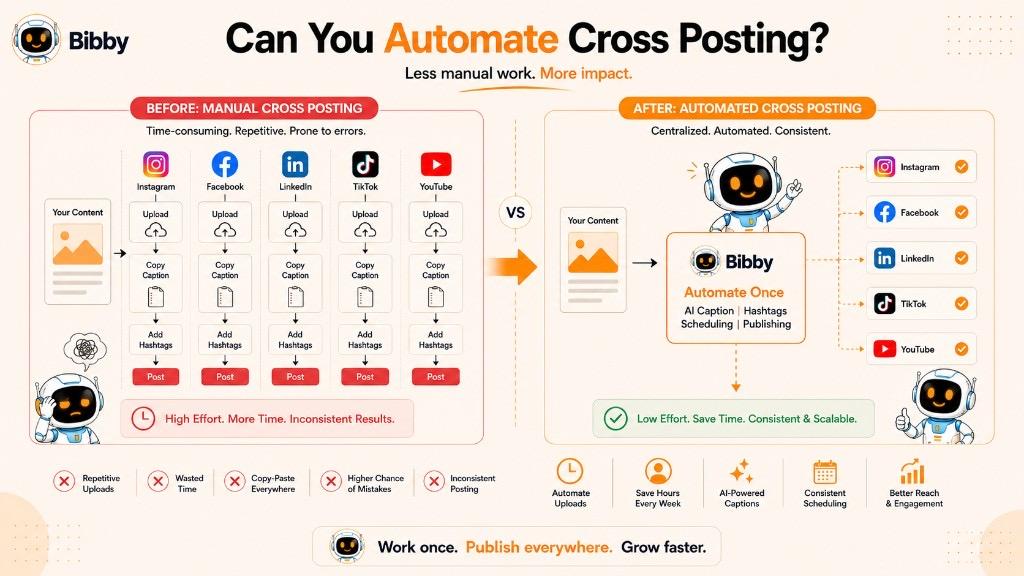
Yes. You can automate many parts of the cross-posting process with social media scheduling and automation tools.
Instead of manually uploading the same campaign to every social network, an automated workflow can help you create or upload content, prepare captions, select platforms, schedule publishing times, and manage multiple posts from one place.
However, effective automation should not mean publishing identical content everywhere without review. The strongest approach combines automation for repetitive tasks with platform-specific customization for relevance.
What Can Be Automated?
Depending on the tool and supported platforms, cross-posting workflows can automate tasks such as:
- Uploading and organizing media
- Generating social media captions
- Preparing multiple versions of a post
- Selecting multiple social media platforms
- Scheduling posts for future dates
- Publishing content automatically
- Managing campaigns and content calendars
- Reusing existing content
- Coordinating posts across multiple accounts
Automation can remove much of the repetitive work involved in managing several social channels.
How Automated Cross Posting Works
A typical automated workflow looks like this:
1. Create or upload content
Start with an image, carousel, video, Story, or another piece of social media content.
2. Choose your platforms
Select the social networks where the content should be distributed.
3. Prepare the post
Generate or customize captions, hashtags, calls to action, and other platform-specific elements.
4. Set the publishing schedule
Choose when each version should be published. Some automation tools can also recommend or select publishing times based on available performance data and audience activity.
5. Publish automatically
The system publishes the scheduled content to the selected platforms according to the configured workflow.
6. Review performance
After publication, compare results across platforms and use those insights to improve future content.
Why Automate Cross Posting?
The biggest advantage is reducing repetitive manual work.
Without automation, a social media manager may need to upload the same media, write captions, select settings, and schedule posts separately for every platform.
With automation, much of this process can be centralized.
This is particularly useful for businesses and creators that publish frequently or manage several social media accounts.
Does Automation Mean You Should Post the Same Thing Everywhere?
No.
Automation and customization are not opposites.
A good cross-posting system can automate the repetitive parts while still allowing you to adapt the content for each platform.
For example, the same campaign could use:
- A carousel and concise caption on Instagram
- A conversational post on Facebook
- A professional explanation on LinkedIn
- A short video on TikTok
- A longer demonstration on YouTube
The campaign can be managed centrally without forcing every platform to receive an identical post.
Automating Cross Posting With Bibby
Bibby brings cross posting into a broader social media automation workflow.
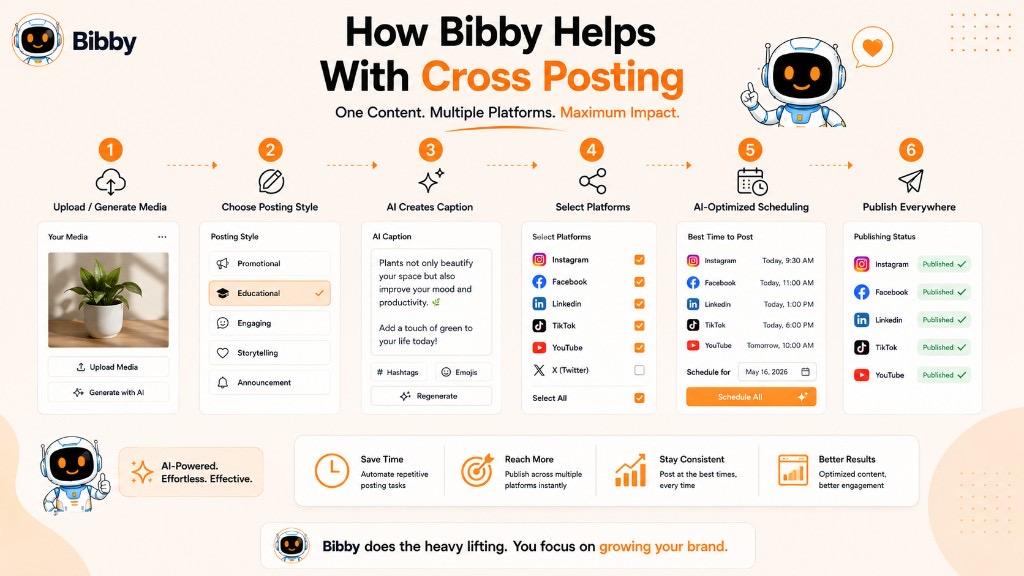
You can upload your media or generate an image with AI, choose your posting style, and let Bibby generate captions for your content. You can then select the platforms you want to publish to and schedule the content across different dates and AI-optimized times.
Bibby supports multiple content formats, including images, carousels, videos, and Stories, allowing you to manage more than simple text-and-image cross posting.
Its chat interface also lets you manage social media through natural-language commands. From the same workflow, you can create a brand kit, build a campaign, create posts, regenerate captions, and manage other parts of your social media operation.
The result is a workflow that turns cross posting from a repetitive manual task into a more streamlined process:
Create → Adapt → Schedule → Publish → Manage
The goal of automation is not to remove strategy from social media. It is to remove repetitive execution so you can spend more time creating useful content and improving your overall social media strategy.
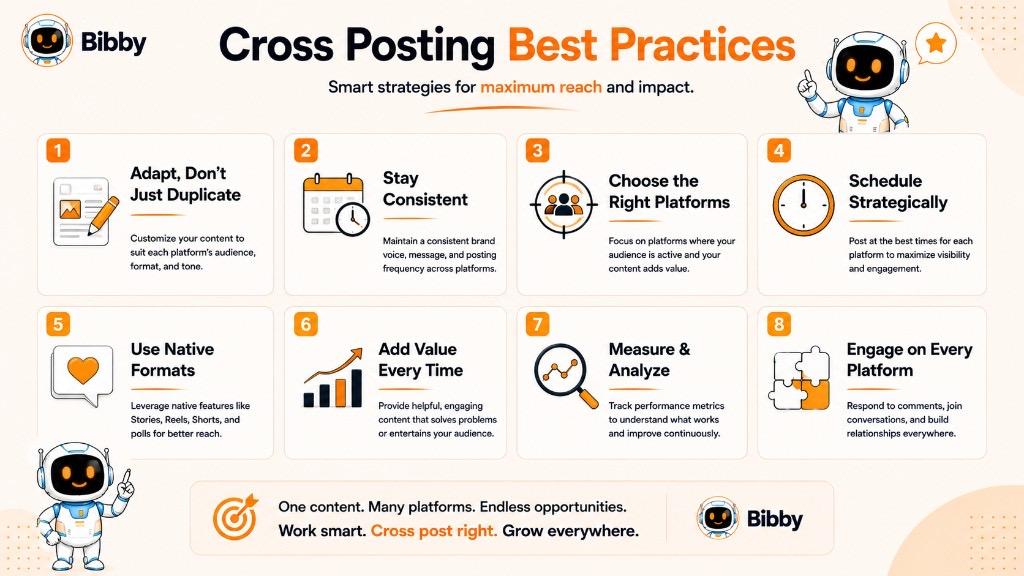
Cross Posting Best Practices at a Glance
Cross posting can make social media management significantly more efficient, but the quality of your strategy still determines the quality of your results. The goal is to distribute content efficiently while making sure every post remains relevant to its platform and audience.
Use these cross-posting best practices to build a more effective workflow.
Start With One Strong Content Idea
Begin with a clear message, topic, campaign, or objective. A strong central idea gives you a foundation for creating multiple platform-specific posts without having to develop an entirely new concept for every channel.
Adapt Content for Each Platform
Avoid automatically publishing an identical caption and format everywhere.
Adjust the content based on:
- Platform audience
- Content format
- Caption style
- Tone of voice
- Video length
- Visual presentation
- Call to action
- Hashtags and other platform-specific elements
Choose Relevant Platforms
You do not need to cross post every piece of content to every social network.
Consider whether the platform has the right audience and whether your content makes sense in that environment. Select channels based on your marketing goals rather than simply trying to maximize the number of platforms receiving each post.
Use Platform-Native Formats
Make the most of the formats each platform provides.
A single campaign might become a carousel on Instagram, an image post on Facebook, a professional insight on LinkedIn, a short-form video on TikTok, and a video demonstration on YouTube.
This creates a more natural experience for audiences while preserving the campaign's central message.
Maintain Consistent Branding
Adapt the content without losing your brand identity.
Keep important elements such as your:
- Brand voice
- Visual identity
- Core message
- Campaign positioning
- Product or service information
Consistent branding helps audiences recognize your business even when the content is presented differently across platforms.
Don't Publish Everything at the Same Time
Cross posting does not require simultaneous publishing.
Consider scheduling each platform's version according to your content calendar, audience behavior, and campaign objectives. Spreading content across different dates or times can also reduce the feeling that followers are seeing the same message everywhere at once.
Avoid Over-Automation
Automation is useful for repetitive publishing tasks, but it should not replace strategic decision-making.
Before scheduling a cross-posted campaign, check that:
- The content is appropriate for each platform.
- The media displays correctly.
- Captions make sense independently.
- Links and calls to action work.
- The tone matches the intended audience.
- The publishing schedule is appropriate.
A quick review can prevent small automation errors from becoming public-facing mistakes.
Measure Performance by Platform
Don't assume that one successful post will perform equally well everywhere.
Track relevant metrics for each platform and compare how different versions of the content perform. Use those insights to determine which formats, topics, hooks, and publishing approaches should be repeated.
Build a Repeatable Workflow
The biggest benefit of cross posting comes from turning it into a repeatable process.
A practical workflow is:
Create → Adapt → Select platforms → Schedule → Review → Publish → Analyze → Improve
Once this workflow is established, social media teams can spend less time on repetitive publishing and more time developing better content and understanding what their audiences respond to.
The Golden Rule of Cross Posting
If you remember only one principle, remember this:
Create once, adapt thoughtfully, and distribute strategically.
Cross posting should make your social media strategy more efficient—not make every social network look identical.
Key Takeaways
- Cross posting means distributing the same core content or content idea across multiple social media platforms—not necessarily publishing an identical post everywhere.
- The most effective approach is create once, adapt for each platform, and distribute strategically rather than copy-and-paste publishing.
- Cross posting saves time, expands reach, and helps maintain a consistent brand presence, but poor adaptation can hurt engagement.
- Cross posting, content repurposing, reposting, and scheduling are related but distinct: cross posting is about *where* content goes; repurposing transforms content; reposting shares content again; scheduling controls *when* content publishes.
- Platform-native formats, audience-specific captions, and staggered publishing times make cross-posted campaigns feel relevant rather than repetitive.
- Bibby can automate the repetitive parts—content creation, caption generation, multi-platform scheduling, and publishing—while you retain control over strategy and platform-specific customization.