
Staying consistent on social media is one of the biggest challenges creators, entrepreneurs, and businesses face when trying to grow an audience online.
Most people know they should post regularly, but knowing what to post, finding the time to create content, and maintaining motivation week after week is often easier said than done. The good news is that consistency isn't about willpower—it's about building systems that make content creation sustainable and predictable.
In this article, you will learn:
- How to create a realistic posting schedule you can maintain
- Simple systems that eliminate content creation overwhelm
- Proven habits that prevent burnout and support long-term growth
Whether you're building a personal brand, growing a business, or becoming a content creator, the strategies in this guide will help you show up consistently without letting social media take over your life.
Also read: How to Grow on Social Media With AI
Why Social Media Consistency Matters More Than Frequency
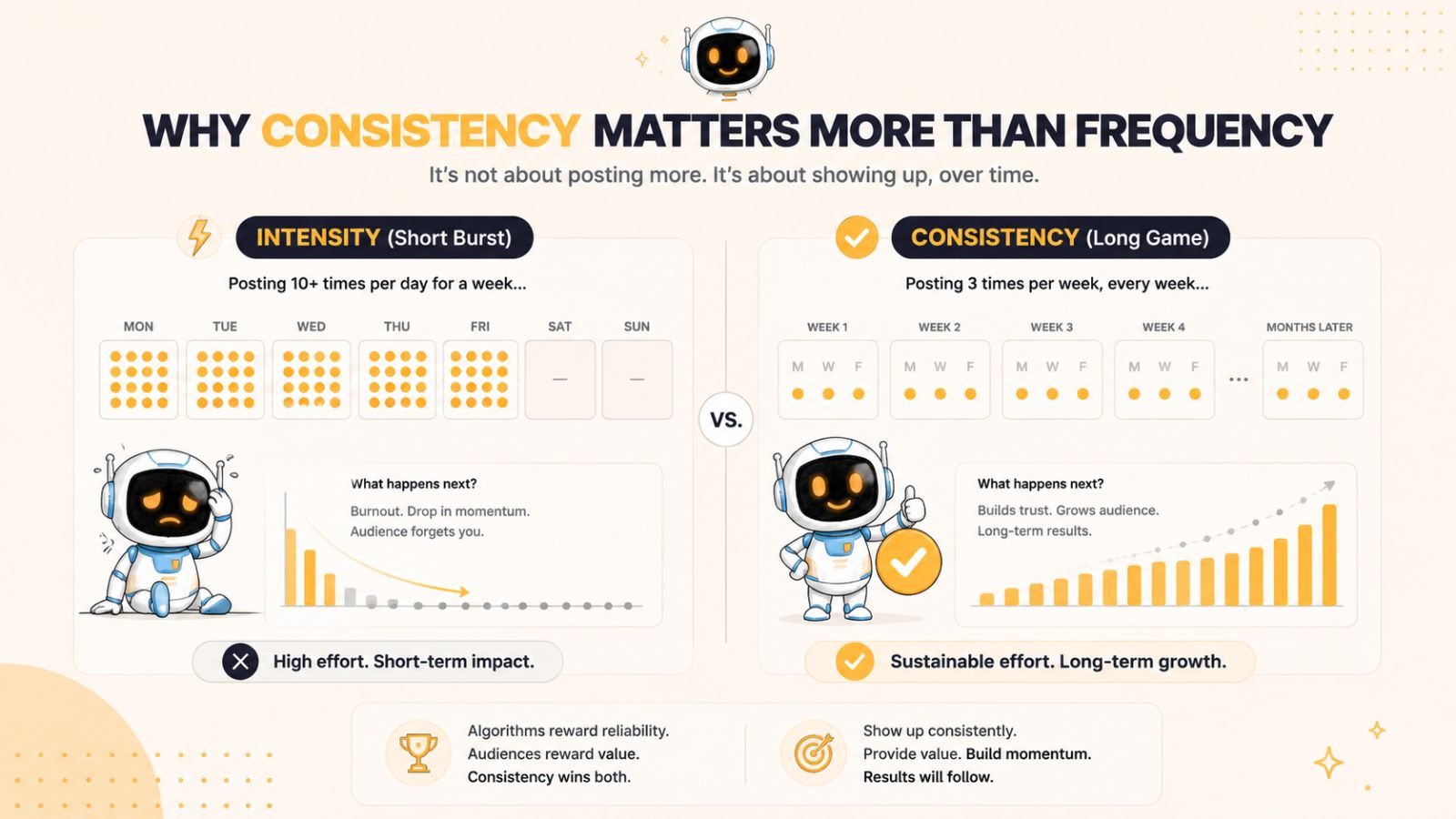
Many people believe social media success comes from posting as often as possible. As a result, they commit to publishing multiple times per day, only to become overwhelmed and quit a few weeks later. In reality, consistency is far more important than frequency.
Consistency builds trust with your audience. When people repeatedly see valuable content from you, they begin to recognize your name, understand your expertise, and develop confidence in what you share. This familiarity is one of the foundations of audience growth. A creator who publishes useful content three times per week for a year will often outperform someone who posts five times daily for a month and then disappears.
Consistency also helps social media platforms understand your content. While every platform uses different algorithms, they all aim to keep users engaged by showing them content they are likely to enjoy. Regular publishing provides more opportunities for your content to be discovered, tested with new audiences, and recommended to people who may find it valuable.
Another reason consistency matters is that content creation is a skill. The more regularly you create, the better you become at generating ideas, writing captions, recording videos, and understanding what resonates with your audience. Sporadic posting interrupts this learning process and makes improvement much slower.
It's also important to understand that consistency does not mean posting every day. The ideal posting frequency is the one you can maintain without sacrificing quality or burning yourself out. For some creators, that might be daily content. For others, it might be three posts per week. Both approaches can be successful if maintained over the long term.
Think of social media growth like compound interest. Each post builds on the credibility, visibility, and audience engagement generated by previous posts. Small, consistent actions repeated over months often produce better results than short bursts of intense activity followed by long periods of silence.
The most successful creators rarely win because they were the most motivated. They win because they developed systems that allowed them to continue showing up long after others stopped.
Also read: How to Automate Social Media for Small Business (Without Hiring Anyone)
The Real Reasons People Struggle to Stay Consistent
Most people don't struggle with social media because they lack ambition. They struggle because they're fighting obstacles that make consistency difficult to maintain over time. Identifying these obstacles is the first step toward overcoming them.
Lack of a Clear Content Strategy
One of the biggest reasons creators become inconsistent is that they don't have a plan. Every time they sit down to create content, they're forced to start from scratch and decide what to post. This constant decision-making quickly becomes exhausting.
Without a clear strategy, content creation feels reactive rather than intentional. Some days you may have a great idea, while other days you stare at a blank screen wondering what to publish. Over time, this uncertainty leads to skipped posting days and a lack of momentum.
Perfectionism and Fear of Judgment
Many creators spend more time worrying about how their content will be received than actually creating it. They rewrite captions repeatedly, record dozens of takes, or delay posting because they feel the content isn't good enough.
Perfectionism creates an impossible standard. The reality is that most successful creators improve by publishing consistently, not by waiting for perfection. Every post is an opportunity to learn what works and what doesn't.
Fear of judgment can be equally damaging. Concerns about criticism, low engagement, or negative feedback often prevent people from posting altogether. However, growth requires visibility, and visibility always comes with some level of risk.
Running Out of Content Ideas
Another common challenge is believing you've run out of things to say. This usually happens when content ideas are not being collected and organized systematically.
The truth is that valuable content ideas are everywhere—in customer questions, industry news, personal experiences, mistakes you've made, lessons you've learned, and conversations happening within your niche. Creators who consistently publish rarely rely on inspiration alone; they maintain a process for capturing ideas whenever they appear.
Time Management Challenges
Creating content takes time. Researching topics, writing posts, designing graphics, editing videos, and responding to comments can quickly consume hours each week.
Many people attempt to fit content creation into random gaps in their schedule. When life becomes busy, social media is often the first task to be postponed. Without dedicated time blocks and clear workflows, consistency becomes difficult to sustain.
Burnout From Unrealistic Expectations
Perhaps the most overlooked cause of inconsistency is burnout. Many creators start with excessive enthusiasm and set unrealistic goals, such as posting multiple times daily across several platforms.
While this approach may work temporarily, it often leads to exhaustion. When content creation begins to feel like an endless obligation, motivation declines and consistency suffers.
Sustainable growth comes from setting expectations that match your available time, energy, and resources. A realistic content schedule that you can maintain for years is far more valuable than an aggressive schedule you can only maintain for a few weeks.
The Good News: These Problems Are Solvable
The encouraging reality is that every obstacle discussed above can be addressed with the right systems. A clear strategy, realistic schedule, organized content framework, and sustainable workflow can dramatically reduce the stress associated with content creation.
Before building those systems, however, you need to know exactly why you're creating content in the first place. That's where setting the right goals becomes essential.
Also read:
Define a Social Media Goal Before Creating Content
One of the most common mistakes people make on social media is creating content without a clear objective. They post because they know they should be posting, not because each piece of content supports a larger goal. While this approach may generate occasional engagement, it rarely produces consistent results.
Before you worry about posting schedules, content ideas, or growth strategies, you need to answer one important question:
Why are you using social media?
The answer will influence every decision you make moving forward.
Choose a Primary Goal
While social media can accomplish many things, trying to pursue too many goals at once often leads to confusion. Instead, identify your primary objective.
Common social media goals include:
- Growing brand awareness
- Building authority in your industry
- Generating leads
- Driving website traffic
- Increasing product or service sales
- Creating a loyal community
- Establishing a personal brand
- Supporting customer relationships
For example, a freelance designer may focus on attracting new clients, while an online coach may prioritize building trust and authority. Although both use social media, the type of content they create will be very different.
Align Your Content With Your Goal
Once you know your objective, creating content becomes much easier.
If your goal is brand awareness, you may focus on educational content, trends, and shareable insights.
If your goal is lead generation, your content might emphasize problem-solving, case studies, and calls to action that encourage people to learn more.
If your goal is community building, you may prioritize conversations, audience participation, and content that encourages engagement.
When content aligns with a specific goal, every post serves a purpose instead of being created simply to fill a publishing calendar.
Focus on Meaningful Metrics
A major obstacle to consistency is becoming emotionally attached to vanity metrics.
Likes, views, and follower counts can feel important, but they don't always reflect real progress. A post with thousands of views may contribute little to your business goals, while a post with modest engagement could generate qualified leads, sales, or valuable relationships.
Instead of focusing exclusively on surface-level numbers, track metrics that connect directly to your objective.
Examples include:
- Website visits
- Email subscribers
- Qualified leads
- Sales inquiries
- Product purchases
- Profile visits
- Audience retention
- Community engagement
Measuring the right metrics helps you stay motivated because you can see meaningful progress even when individual posts perform differently.
Create a Simple Content Filter
A useful exercise is to evaluate every content idea using a simple question:
Does this support my primary goal?
If the answer is yes, create it.
If the answer is no, reconsider whether it's worth your time.
This filter prevents random posting and helps maintain a consistent content strategy. Over time, your audience begins to associate your account with specific topics and expertise, making your content more recognizable and effective.
Goals Create Direction
Consistency becomes much easier when you know where you're going. Without a goal, content creation feels like an endless cycle of posting and hoping for results. With a goal, every piece of content becomes part of a larger strategy.
Once your objective is clear, the next step is creating a posting schedule that supports that goal while remaining realistic enough to maintain long term.
Create a Sustainable Posting Schedule
A posting schedule can either support your consistency or destroy it. Many creators fail not because they lack discipline, but because they commit to a schedule that is impossible to maintain.
The goal isn't to post as often as possible. The goal is to create a publishing rhythm you can sustain for months and years without sacrificing quality or burning out.
Start With Your Available Resources
Before deciding how often to post, consider your current situation:
- How much time can you realistically dedicate to content creation each week?
- Are you creating content alone or with a team?
- What types of content do you produce?
- How much time does each piece of content require?
A business owner managing multiple responsibilities may not have the capacity to publish daily videos. A full-time creator, on the other hand, may have significantly more time available.
Your schedule should reflect your reality, not someone else's.
Choose Consistency Over Ambition
Many creators begin with ambitious goals such as posting three times per day on multiple platforms. While this sounds productive, it often becomes overwhelming.
A better approach is to start with a schedule you know you can maintain.
For example:
- One high-quality post per week
- Three posts per week
- One short-form video per day
- Five posts per week with weekends off
The exact frequency matters less than your ability to sustain it consistently.
Remember that audiences and algorithms value reliability. If followers know they can expect content from you regularly, trust and engagement tend to increase over time.
Match Content Types to Your Schedule
Not all content requires the same amount of effort.
A detailed educational video may take several hours to research, record, and edit. A simple text post or photo update may take only a few minutes.
To maintain consistency, balance high-effort content with lower-effort formats.
For example:
- One long-form educational video each week
- Three short-form videos created from that video
- Several simple engagement posts
- Audience Q&A content
This approach allows you to maintain an active presence without constantly creating everything from scratch.
Create Dedicated Content Time Blocks
One reason schedules fail is that content creation is treated as an afterthought.
Instead of creating content whenever you happen to find free time, schedule it like any other important responsibility.
You might dedicate:
- Monday to planning
- Tuesday to content creation
- Wednesday to editing
- Thursday and Friday to publishing and engagement
Alternatively, you may prefer batching all content creation into a single day each week.
The specific system doesn't matter as much as making content creation a recurring appointment on your calendar.
Leave Room for Flexibility
Life happens. Work deadlines appear, family responsibilities arise, and unexpected events can disrupt even the best plans.
A sustainable schedule accounts for these realities.
Rather than operating at maximum capacity, build some flexibility into your workflow. Creating content ahead of schedule or maintaining a small content backlog can help you stay consistent during busy periods.
Consistency doesn't require perfection. Missing a post occasionally isn't a problem. Abandoning your system entirely is.
Review and Adjust Regularly
Your schedule should evolve as your goals, audience, and resources change.
At the end of each month, ask yourself:
- Was this schedule realistic?
- Did I feel overwhelmed?
- Was I able to maintain quality?
- Which content performed best?
- What should I adjust next month?
Small improvements made consistently often produce better results than dramatic changes.
Build a Schedule You Can Actually Keep
The best posting schedule is not the most aggressive one. It's the one you'll still be following six months from now.
Once you've established a realistic publishing rhythm, the next challenge is ensuring you never run out of things to post. That's where content pillars become invaluable.
Build a Content Pillar Framework
One of the fastest ways to become inconsistent on social media is to create content without a framework. When every post starts with the question, "What should I post today?" content creation quickly becomes stressful and time-consuming.
A content pillar framework solves this problem by giving you a set of core topics that guide everything you publish.
What Are Content Pillars?
Content pillars are the main themes or categories your content revolves around. They represent the subjects you want to be known for and the topics your audience cares about most.
Think of content pillars as buckets that organize your content.
For example, a fitness coach might use the following pillars:
- Workout tips
- Nutrition advice
- Mindset and motivation
- Client success stories
- Common fitness mistakes
A digital marketing consultant might focus on:
- SEO strategies
- Social media marketing
- Content creation
- Business growth
- Industry trends
Instead of creating random content, every post fits into one of these categories.
Why Content Pillars Improve Consistency
The biggest advantage of content pillars is that they eliminate decision fatigue.
Without pillars, you must constantly generate entirely new topics. With pillars, brainstorming becomes much easier because you already know the areas you want to cover.
For example, if one of your pillars is customer success stories, you can create content around:
- Before-and-after results
- Client case studies
- Lessons learned from clients
- Frequently asked client questions
- Success habits of top performers
One pillar can generate dozens of content ideas.
How to Choose Your Content Pillars
A good content pillar framework usually includes three to five core categories.
When selecting your pillars, consider three factors:
1. Audience Interests
What problems does your audience want solved?
The best content directly addresses their goals, challenges, questions, and frustrations.
2. Your Expertise
What knowledge, experience, or perspective can you consistently provide?
Choosing topics you genuinely understand makes content creation easier and more authentic.
3. Business Goals
Your pillars should support your overall objectives.
If your goal is to generate leads for a service, your pillars should showcase your expertise and help potential clients understand how you solve problems.
A Simple Content Pillar Example
Let's imagine you are a social media consultant.
Your pillars might be:
- Social media strategy
- Content creation tips
- Audience growth tactics
- Personal experiences and lessons
- Client success stories
Now, instead of searching for random ideas every day, you can simply rotate through these categories.
Monday: Social media strategy
Wednesday: Content creation tips
Friday: Audience growth tactics
The framework creates structure while still allowing creativity.
Keep Your Pillars Broad but Focused
A common mistake is making content pillars either too broad or too narrow.
For example:
Too broad:
- Business
- Marketing
- Success
Too narrow:
- Instagram carousel headlines for fitness coaches
The ideal pillar is broad enough to generate dozens of content ideas but focused enough that your audience understands what your account is about.
Content Pillars Create Long-Term Clarity
One reason successful creators appear to have endless ideas is that they rarely create content randomly. They work within clearly defined themes that make idea generation predictable and repeatable.
Once your content pillars are established, you'll spend less time wondering what to post and more time creating content that supports your goals.
The next step is making content creation even more efficient by producing multiple pieces of content at once through a process known as content batching.
Use Content Batching to Save Time
One of the biggest mistakes creators make is creating content one post at a time. They wake up, decide what to post, create it, publish it, and then repeat the entire process the next day.
While this approach may work temporarily, it's inefficient and difficult to maintain. Content batching offers a much more sustainable solution.
What Is Content Batching?
Content batching is the process of creating multiple pieces of content during a dedicated work session rather than creating content daily.
Instead of producing one post every day, you might create an entire week's or month's worth of content in a single sitting.
For example:
- Plan 20 content ideas in one session
- Write captions in another session
- Record multiple videos at once
- Edit content in batches
- Schedule everything ahead of time
By grouping similar tasks together, you reduce the time and mental energy required to switch between different activities.
Why Content Batching Works
Every time you switch tasks, your brain needs time to refocus.
Imagine writing a caption, then responding to emails, then editing a video, then attending a meeting. Constant context switching reduces productivity and makes content creation feel more exhausting than it actually is.
Batching minimizes these interruptions.
When you're focused solely on generating ideas, you generate ideas. When you're recording videos, you record several videos. When you're editing, you edit multiple pieces of content at once.
This concentrated workflow often produces better content in less time.
A Simple Weekly Batching Workflow
You don't need a complicated system to benefit from batching.
A simple workflow might look like this:
Monday: Planning
- Review goals and content pillars
- Brainstorm content ideas
- Outline upcoming posts
- Identify trending or timely topics
Tuesday: Creation
- Write captions
- Record videos
- Design graphics
- Create supporting assets
Wednesday: Editing
- Edit videos
- Finalize graphics
- Proofread captions
- Prepare content for publishing
Thursday: Scheduling
- Upload content
- Schedule posts
- Organize publishing calendar
Friday: Engagement and Analysis
- Respond to comments and messages
- Review performance metrics
- Document lessons learned
This structure keeps content creation organized and predictable.
Batch According to Your Content Type
Different creators may need different batching systems.
For example:
Video Creators
Record multiple videos in one session.
Change shirts, backgrounds, or camera angles if needed to create variety while maximizing efficiency.
Writers
Outline multiple posts before writing.
Writing several pieces on related topics often becomes easier once you're already in a creative flow.
Business Owners
Create educational content, promotional content, and customer-focused content in separate batches.
This allows you to stay focused on one objective at a time.
Create a Content Buffer
One of the most powerful benefits of batching is the ability to build a content buffer.
A content buffer is content that has been created but not yet published.
For example:
- One week ahead
- Two weeks ahead
- One month ahead
This buffer protects your consistency when unexpected situations arise. Instead of scrambling to create content during a busy week, you already have content ready to publish.
Progress Over Perfection
When batching, avoid the temptation to perfect every piece of content.
The goal is to create a reliable system that helps you publish consistently. You can always refine your content creation process over time.
Many successful creators prioritize consistency and learning over perfection because they understand that publishing regularly generates more opportunities for improvement.
Batching Turns Content Into a System
The greatest benefit of content batching is that it transforms content creation from a daily challenge into a repeatable process.
Instead of constantly wondering what to post next, you create content in advance and free up mental space for other priorities.
Once you have a batching system in place, the next challenge is ensuring you always have fresh ideas to feed that system. That's where a content idea collection process becomes essential.
Create a Never-Ending Content Idea System
One of the most common excuses for inconsistent posting is, "I don't know what to post."
In reality, most creators don't have an idea problem—they have an idea management problem.
Great content ideas appear throughout the day, but without a system to capture and organize them, they're quickly forgotten. The creators who consistently publish rarely depend on inspiration. Instead, they rely on a process that continuously generates and stores ideas for future use.
Stop Waiting for Inspiration
Inspiration is unpredictable.
Some days you'll feel creative and generate dozens of ideas. Other days your mind will seem completely blank. If your content strategy depends on feeling inspired, consistency will always be difficult.
A better approach is to collect ideas continuously, whether you're actively creating content or not.
Whenever an idea appears, save it immediately.
This can be done using:
- A notes app
- A spreadsheet
- A project management tool
- A voice memo app
- A dedicated content database
The tool doesn't matter. The habit does.
Turn Audience Questions Into Content
Your audience is one of your best sources of content ideas.
Every question you receive represents a topic someone wants help with.
Pay attention to:
- Frequently asked questions
- Comments on your posts
- Direct messages
- Customer support inquiries
- Sales call conversations
- Community discussions
If one person is asking a question, many others are likely wondering the same thing.
Answering these questions often leads to highly relevant and engaging content.
Document, Don't Just Create
Many successful creators follow a simple principle:
Document more than you create.
Instead of constantly inventing new topics, share experiences, observations, lessons learned, challenges, and insights from your daily work.
Examples include:
- Mistakes you've made
- Client experiences
- Behind-the-scenes processes
- Industry observations
- Lessons from recent projects
- Unexpected results and discoveries
Your everyday experiences often contain valuable content opportunities that competitors may overlook.
Repurpose Existing Content for New Ideas
Many creators mistakenly believe every post must be completely original.
In reality, one strong idea can often generate multiple pieces of content.
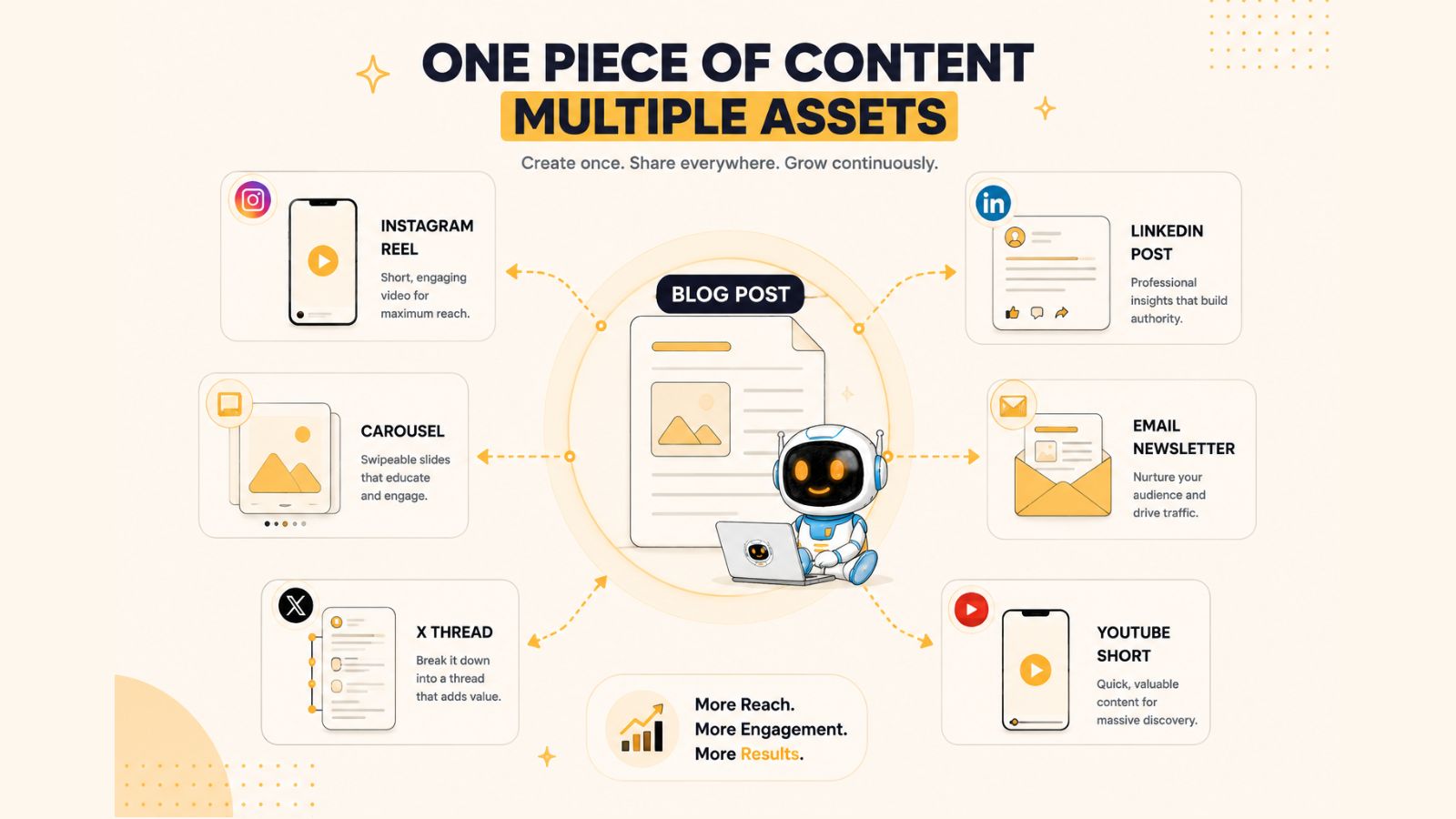
For example, a single blog article could become:
- Several short-form videos
- Multiple social media posts
- A carousel presentation
- A newsletter topic
- A live discussion
- A podcast segment
Instead of constantly searching for new topics, look for ways to extract additional value from content you've already created.
Use a Content Idea Framework
When brainstorming, it helps to use repeatable content formats.
For each content pillar, create ideas around:
- Tips and strategies
- Common mistakes
- Frequently asked questions
- Myths and misconceptions
- Personal experiences
- Case studies
- Industry trends
- Step-by-step tutorials
- Success stories
- Contrarian opinions
This framework can quickly generate dozens of content ideas without relying on creativity alone.
Build an Idea Bank
A content idea bank is a central location where all potential content ideas are stored.
Whenever you encounter an idea, save it.
Do not judge whether it's good or bad in the moment. Simply capture it.
Over time, your idea bank becomes a valuable resource that eliminates the pressure of finding content topics at the last minute.
Many creators discover that once they consistently capture ideas, they accumulate far more topics than they can realistically publish.
Consistency Becomes Easier When Ideas Are Ready
The reason many creators stop posting isn't because they lack knowledge. It's because they repeatedly face the stress of deciding what to create next.
A reliable idea collection system removes this obstacle. Instead of starting from zero each time you sit down to create content, you'll have a library of ideas ready to develop.
Once you have a steady flow of ideas, the next step is maximizing their value by turning one idea into multiple pieces of content through strategic repurposing.
Also read: The Real ROI of Social Media Automation (With Data)
Repurpose One Piece of Content Into Multiple Posts
One of the biggest misconceptions about social media is that every post needs to be completely new. This belief creates unnecessary pressure and significantly increases the amount of work required to stay consistent.
The reality is that successful creators often get the majority of their content from a relatively small number of core ideas. They do this through strategic content repurposing.
What Is Content Repurposing?
Content repurposing is the process of taking existing content and adapting it into different formats, platforms, or angles.
Instead of creating ten completely different posts, you create one valuable piece of content and transform it into multiple assets.
This approach allows you to maximize the return on the time and effort invested in creating content.
Why Repurposing Improves Consistency
Repurposing reduces the constant pressure to generate new ideas.
When one idea can produce several pieces of content, your content calendar fills up faster and requires less effort to maintain.
Additional benefits include:
- Reduced content creation time
- Increased reach across platforms
- More opportunities for audience engagement
- Better content lifespan
- Greater visibility for your best ideas
Remember that many followers won't see every piece of content you publish. Reusing important ideas in different formats helps ensure more people benefit from them.
Turn One Idea Into Multiple Content Formats
Imagine you've created a blog post titled:
"5 Ways to Stay Consistent on Social Media."
That single piece of content could become:
- A short-form video explaining one tip
- A carousel post summarizing all five tips
- A quote graphic featuring a key insight
- A Twitter/X thread
- A LinkedIn post
- An email newsletter
- A podcast discussion
- A live Q&A session
Suddenly, one idea has generated multiple pieces of content without requiring completely new research.
Repurpose Across Different Platforms
Different platforms reward different content formats.
For example:
- Carousels
- Reels
- Stories
- Quote graphics
- Educational text posts
- Industry insights
- Professional experiences
YouTube
- Tutorials
- Long-form explanations
- Case studies
X (Twitter)
- Short insights
- Threads
- Commentary
The same core idea can often be adapted to fit each platform's audience and format requirements.
Repurpose High-Performing Content
Many creators focus too much on creating new content and not enough on maximizing their best content.
If a post performs exceptionally well, consider:
- Updating it with new information
- Expanding it into a longer format
- Breaking it into multiple smaller posts
- Revisiting the topic from a different angle
- Creating a follow-up post
Strong content deserves more than a single opportunity to succeed.
Create a Repurposing Workflow
To make repurposing easier, build it into your content creation process.
For example:
- Create one long-form piece of content.
- Identify the most valuable insights.
- Extract individual points.
- Convert those points into platform-specific content.
- Schedule distribution over several weeks.
This workflow allows you to consistently publish content without constantly starting from scratch.
Work Smarter, Not Harder
The creators who remain consistent for years understand an important principle:
You do not need more ideas—you need more value from the ideas you already have.
Repurposing helps you extend the life of your content, reach more people, and maintain a steady publishing schedule without dramatically increasing your workload.
Once your content is created and repurposed, the next step is using automation and scheduling tools to ensure your content continues reaching your audience consistently, even when you're busy.
Automate and Schedule Content Strategically
Consistency becomes much easier when publishing doesn't depend on being online at the exact moment a post needs to go live. This is where automation and scheduling tools can make a significant difference.
While automation cannot replace creativity, it can eliminate many repetitive tasks that consume time and energy. Used correctly, automation helps you maintain a reliable publishing schedule without feeling tied to social media every day.
Why Scheduling Matters
Many creators create content and publish it immediately. While there's nothing wrong with this approach, it can create unnecessary pressure.
Scheduling content offers several advantages:
- Reduces last-minute stress
- Maintains consistency during busy periods
- Helps organize content campaigns
- Allows strategic planning
- Frees up time for audience engagement
When content is scheduled in advance, you're less likely to miss publishing opportunities due to unexpected responsibilities.
Schedule Content in Batches
Scheduling works best when combined with content batching.
For example, after creating a week's worth of content, you can schedule all posts in a single session.
This approach creates a clear workflow:
- Plan content
- Create content
- Edit content
- Schedule content
- Focus on engagement and analysis
Instead of thinking about posting every day, you think about content management once or twice per week.
Know What to Automate
Automation is most effective when applied to repetitive administrative tasks.
Examples include:
- Scheduling posts
- Organizing content calendars
- Saving content ideas
- Tracking publishing schedules
- Monitoring basic performance metrics
These tasks do not require your personal voice or creativity, making them ideal candidates for automation.
Know What Not to Automate
Some aspects of social media still benefit from human interaction.
These include:
- Responding to meaningful comments
- Building relationships
- Participating in conversations
- Answering audience questions
- Community engagement
Audiences connect with people, not automated systems. While scheduling can help you publish consistently, authentic interaction remains essential for building trust.
Create a Content Calendar
A content calendar provides visibility into your upcoming content.
A simple calendar may include:
- Publishing dates
- Content topics
- Content pillars
- Platforms
- Calls to action
- Content status
When you can see upcoming content at a glance, planning becomes much easier.
Content calendars also reduce the risk of posting repetitive content or forgetting important topics.
Prepare for Busy Seasons
One major benefit of scheduling is protection against life's inevitable disruptions.
Whether you're traveling, launching a project, dealing with personal commitments, or taking a well-earned break, scheduled content helps maintain momentum.
This doesn't mean you should disappear completely. Instead, scheduling gives you flexibility to remain present without constantly worrying about publishing.
Use Scheduling as a Support System
A common mistake is assuming automation will solve all consistency problems.
The truth is that scheduling tools are most effective when they support an already strong content process.
Automation cannot compensate for:
- Lack of strategy
- Poor content quality
- Inconsistent creation habits
- Unclear goals
Think of automation as an amplifier rather than a replacement. It helps your existing system operate more efficiently.
Consistency Should Not Depend on Daily Effort
The most sustainable social media strategies reduce the number of decisions you need to make each day.
Scheduling and automation allow your content to continue working even when your attention is focused elsewhere. This reduces stress and makes long-term consistency far more achievable.
However, even the best scheduling system will eventually fail if it depends entirely on motivation. To stay consistent for months and years, you need something stronger: reliable systems and habits.
Focus on Systems Instead of Motivation
Many people believe consistency comes from motivation.
They assume successful creators wake up every day feeling inspired, energized, and excited to create content. In reality, even the most consistent creators experience days when they don't feel motivated.
The difference is that they don't rely on motivation to take action. They rely on systems.
Motivation Is Unpredictable
Motivation naturally rises and falls.
Some days you'll feel productive and full of ideas. Other days you'll feel distracted, tired, or uninterested in creating content.
If your content strategy depends on feeling motivated, your posting schedule will become inconsistent because your actions are tied to your emotions.
Motivation can help you get started, but systems are what keep you going.
Systems Reduce Decision Fatigue
One reason creators lose momentum is because they make too many decisions every day.
Questions like:
- What should I post?
- When should I post?
- Which platform should I focus on?
- What format should I use?
may seem small individually, but they quickly drain mental energy.
Systems remove much of this uncertainty.
For example:
- Content pillars determine your topics
- Content calendars organize publishing
- Batching reduces daily workload
- Scheduling tools automate publishing
Instead of constantly making decisions, you follow a repeatable process.
Build Content Habits Instead of Content Goals
Goals are useful for creating direction, but habits create results.
A goal might be:
"Grow my audience by 10,000 followers."
A habit might be:
"Spend 30 minutes every morning creating content."
You cannot directly control outcomes such as followers, views, or engagement. You can control the actions that contribute to those outcomes.
Consistent habits create consistent output, and consistent output creates opportunities for growth.
Use Checklists and Workflows
Many successful creators treat content creation like a business process rather than a creative event.
Instead of relying on memory, they use simple workflows.
A basic content workflow might look like:
- Capture content ideas
- Organize ideas by content pillar
- Batch content creation
- Edit content
- Schedule content
- Engage with the audience
- Analyze performance
When every step is clearly defined, content creation becomes easier to repeat.
Technology Can Strengthen Your System
The right tools can significantly reduce the effort required to stay consistent.
For example, platforms like Bibby help automate parts of the content creation and publishing process by generating, scheduling, and posting content automatically. This can be especially valuable for entrepreneurs, small business owners, and creators who struggle to maintain a regular posting schedule while managing other responsibilities.
Tools like this don't replace strategy or creativity, but they can remove repetitive work that often causes inconsistency. When content creation becomes less time-consuming, it's easier to maintain momentum over the long term.
Track Progress Without Obsessing Over Results
Another reason people quit is that they expect immediate outcomes.
They post consistently for a few weeks, don't see dramatic growth, and assume their efforts aren't working.
Instead of focusing only on results, track process-based metrics such as:
- Number of posts published
- Content creation sessions completed
- Days followed according to schedule
- New ideas collected
- Engagement conversations started
These metrics reinforce the behaviors that lead to long-term success.
Make Consistency the Default
The most reliable systems reduce friction.
For example:
- Keep content ideas in one place
- Use templates for recurring content
- Schedule dedicated creation sessions
- Batch work ahead of time
- Automate repetitive tasks
The easier your process becomes, the less likely you are to skip it.
Long-Term Growth Comes From Repeatable Actions
Most successful social media accounts were not built through occasional bursts of motivation. They were built through systems that made content creation sustainable.
When creating content becomes part of a structured routine rather than a daily struggle, consistency stops feeling difficult.
However, even the best systems can fail if they're pushed too hard. To remain consistent for years—not just months—you must also learn how to protect your energy and avoid burnout.
How to Stay Consistent Without Burning Out
Many creators successfully stay consistent for a few weeks or even a few months. The real challenge is maintaining that consistency over the long term.
Burnout is one of the biggest reasons people abandon their social media goals. They start with enthusiasm, push themselves too hard, become exhausted, and eventually stop creating altogether.
The key to long-term success is building a content strategy that supports your energy instead of constantly draining it.
Recognize the Warning Signs of Burnout
Burnout rarely happens overnight.
It often develops gradually through prolonged stress, unrealistic expectations, and excessive workload.
Common warning signs include:
- Feeling overwhelmed by content creation
- Constantly procrastinating on posting
- Losing enthusiasm for your niche
- Feeling anxious whenever you open social media
- Running out of creative energy
- Becoming overly focused on metrics
- Resenting your content schedule
The sooner you recognize these signs, the easier it becomes to make adjustments before burnout becomes severe.
Stop Comparing Your Schedule to Others
One of the fastest paths to burnout is trying to match someone else's output.
You may see creators publishing:
- Multiple videos per day
- Daily newsletters
- Content across every platform
- Frequent live streams
What you don't see are the teams, resources, systems, and years of experience often supporting that output.
Your content strategy should be built around your goals, resources, and capacity—not someone else's.
A schedule you can maintain consistently is always better than an aggressive schedule you cannot sustain.
Prioritize Quality Over Volume
More content is not always better.
Publishing large amounts of content while sacrificing quality can lead to audience fatigue and creator exhaustion.
Instead, focus on creating content that delivers genuine value.
Ask yourself:
- Does this help my audience?
- Does this support my goals?
- Would I find this useful if I were the audience?
One valuable post often produces better results than several rushed posts.
Create Boundaries Around Social Media
Many creators struggle because social media becomes an all-day activity.
They constantly check notifications, monitor analytics, respond to comments, and consume content.
This creates mental fatigue even when they aren't actively creating.
Consider establishing boundaries such as:
- Specific times for engagement
- Limited analytics reviews
- Designated content creation hours
- Screen-free periods during the day
Boundaries help preserve mental energy and prevent social media from dominating your schedule.
Build Recovery Into Your System
Consistency does not mean working continuously without rest.
In fact, recovery is an essential part of sustainable content creation.
Examples include:
- Taking weekends off
- Scheduling lighter content weeks
- Creating content buffers before vacations
- Rotating between high-effort and low-effort content formats
Rest allows you to return with fresh ideas and renewed creativity.
Use Tools to Reduce Workload
Burnout often occurs when content creation requires too much manual effort.
This is where systems and automation can make a meaningful difference.
For example, tools such as Bibby can help reduce the workload associated with planning, generating, scheduling, and publishing content. By automating repetitive tasks, creators can spend more time focusing on strategy, audience engagement, and creative thinking rather than administrative work.
The less energy required to maintain your content workflow, the easier it becomes to stay consistent over the long term.
Accept Imperfection
Many creators burn out because they try to make every post exceptional.
The reality is that not every piece of content will perform well.
Some posts will exceed expectations.
Others will be largely ignored.
Both outcomes are normal.
Progress comes from publishing consistently, learning from feedback, and making gradual improvements over time.
Perfection is not required for growth.
Think in Years, Not Weeks
One of the most powerful mindset shifts is viewing social media as a long-term game.
Instead of asking:
"How can I grow quickly?"
Ask:
"How can I still be creating content two years from now?"
This perspective encourages sustainable habits, realistic expectations, and systems that support long-term success.
Sustainability Is the Ultimate Advantage
Many people can stay motivated for a short period.
Far fewer can remain consistent year after year.
The creators who achieve lasting success are usually not the most talented or the most motivated. They are the ones who build systems that allow them to continue creating without sacrificing their energy, health, or enthusiasm.
Now that you've learned how to create sustainable consistency, it's time to put everything together into a practical 30-day action plan you can start implementing immediately.

A 30-Day Social Media Consistency Plan
Knowing what to do is important. Actually implementing it is what creates results.
The following 30-day plan combines the strategies covered throughout this guide into a practical framework you can follow immediately. The goal isn't perfection—it's building momentum and creating a system that becomes easier to maintain over time.
Week 1: Build Your Foundation
During the first week, focus on strategy and preparation.
Define Your Goal
Choose one primary objective for your social media efforts:
- Grow your audience
- Generate leads
- Build authority
- Increase sales
- Create a community
Having a clear goal will guide every content decision moving forward.
Create Your Content Pillars
Select three to five topics you want to be known for.
For example:
- Educational content
- Industry insights
- Behind-the-scenes content
- Customer success stories
- Personal experiences
These pillars will become the foundation of your content strategy.
Set a Realistic Posting Schedule
Choose a publishing frequency you can confidently maintain.
Examples:
- Three posts per week
- One video per week
- Daily short-form content
Start conservatively. You can always increase frequency later.
Week 2: Build Your Content Library
The goal of week two is to create enough content to avoid last-minute scrambling.
Generate Content Ideas
Use the following sources:
- Audience questions
- Customer conversations
- Industry trends
- Personal experiences
- Common mistakes in your niche
Aim to collect at least 30 content ideas.
Create a Content Bank
Organize ideas into a spreadsheet, document, or content management tool.
At this stage, quantity matters more than perfection.
Batch Content Creation
Create multiple pieces of content in a single session.
For example:
- Record five videos
- Write ten captions
- Design several graphics
By the end of the week, try to have at least one week's worth of content ready.
Week 3: Publish and Engage
Now it's time to execute.
Schedule Your Content
Upload and schedule your content in advance whenever possible.
This is also where tools such as Bibby can be particularly useful. Rather than manually managing every aspect of content creation and publishing, you can use automation to help maintain consistency and reduce administrative work. This allows you to focus more on creating valuable content and building relationships with your audience.
Focus on Engagement
Consistency isn't only about posting.
Spend time:
- Responding to comments
- Answering messages
- Participating in conversations
- Supporting community members
Engagement strengthens relationships and increases audience loyalty.
Track Simple Metrics
Monitor:
- Posts published
- Engagement rate
- Profile visits
- Website clicks
- Leads generated
Avoid checking analytics obsessively. Focus on identifying patterns rather than judging individual posts.
Week 4: Analyze and Improve
The final week focuses on optimization.
Review Content Performance
Ask:
- Which posts received the most engagement?
- Which topics generated conversations?
- Which content formats performed best?
- What was easiest to create consistently?
Look for trends rather than isolated results.
Refine Your System
Based on what you've learned:
- Improve content pillars
- Adjust posting frequency
- Eliminate unnecessary tasks
- Expand successful content formats
Small improvements compound over time.
Build Next Month's Content Plan
Don't wait until the next month begins.
Use your insights to create the following month's content schedule before the current month ends.
This prevents momentum from disappearing.
What Success Looks Like After 30 Days
At the end of the month, success is not necessarily measured by follower growth.
Instead, evaluate whether you have:
- A clear content strategy
- Defined content pillars
- A repeatable workflow
- A content idea bank
- A realistic posting schedule
- Improved consistency
These systems create the foundation for long-term growth.
The Goal Is Momentum, Not Perfection
Many people approach social media with an all-or-nothing mindset. They expect flawless execution and immediate results.
A better approach is to focus on momentum.
If you consistently create, publish, learn, and improve, your content strategy will become stronger each month.
The creators who achieve sustainable growth are rarely the ones with the perfect plan. They are the ones who consistently take action, refine their systems, and continue showing up long after others have stopped.
Conclusion
Staying consistent on social media isn't about finding endless motivation or spending every waking hour creating content. It's about building systems that make content creation predictable, sustainable, and manageable. By focusing on clear goals, developing content pillars and idea banks, and using strategies like batching, repurposing, scheduling, and automation, you can maintain a steady presence without burning out.
The three biggest takeaways are simple: create systems instead of relying on motivation, build a repeatable content workflow that saves time, and prioritize sustainability over short-term bursts of activity. When consistency becomes part of your process rather than a daily struggle, growth becomes much easier to achieve.
As your content system matures, the next logical step is learning how to create content that not only gets published consistently but also drives meaningful engagement, leads, and sales. Understanding how to turn consistent posting into measurable business results is what transforms social media from a marketing task into a long-term growth engine.