
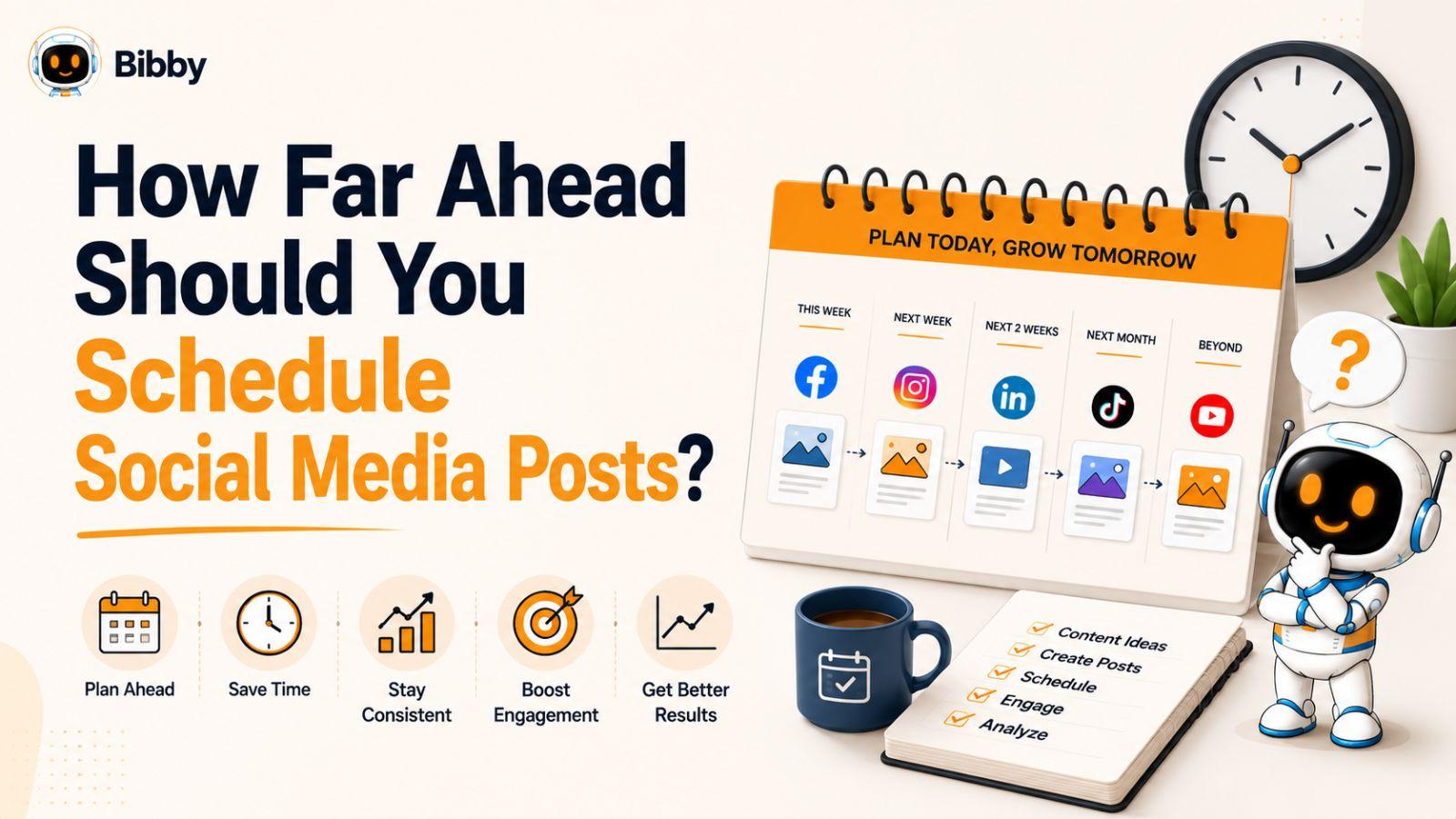
Scheduling social media posts ahead of time is one of the simplest ways to maintain consistency, save time, and grow your audience across multiple platforms.
If you're wondering how far in advance you should schedule social media content, the answer depends on your business goals, content strategy, and the platforms you use. While some brands schedule a few days ahead, others plan months in advance to streamline their marketing efforts and maintain a consistent posting schedule.
Here you will learn:
- The ideal social media scheduling timeline for most businesses
- Common scheduling mistakes that hurt engagement and flexibility
- How AI tools automate content creation and posting schedules
Whether you're a creator, marketer, or business owner, understanding the right scheduling approach can help you stay visible online without spending hours managing social media every day.
Why Social Media Scheduling Matters More Than Ever
Social media has evolved from a simple communication channel into one of the most important marketing tools for businesses, creators, and brands. With audiences spread across platforms like Facebook, Instagram, LinkedIn, TikTok, and YouTube, maintaining a consistent presence is no longer optional—it's essential.
The Challenges of Posting Manually
Many businesses start by posting content manually whenever they have time. While this approach may work initially, it often becomes difficult to sustain as content demands increase.
Manual posting can lead to:
- Inconsistent publishing schedules
- Missed posting opportunities during busy periods
- Increased stress and last-minute content creation
- Difficulty coordinating campaigns across multiple platforms
- Reduced time for engaging with followers and analyzing results
When content creation and publishing happen at the last minute, quality often suffers. Teams spend more time reacting than executing a strategic content plan.
The Benefits of Scheduling Posts in Advance
Scheduling content ahead of time creates a more organized and scalable social media strategy. Instead of worrying about what to post every day, marketers can focus on creating higher-quality content and engaging with their audience.
Key benefits include:
- Consistent posting across all platforms
- Better long-term content planning
- Improved team collaboration
- More efficient campaign management
- Reduced workload and stress
- Increased opportunities to optimize performance
Perhaps most importantly, scheduling allows businesses to maintain visibility even when team members are busy with other priorities.
Modern scheduling tools have made this process even more powerful. Instead of simply choosing a date and time manually, AI-powered platforms can now help create content, generate captions, identify optimal posting times, and automatically publish across multiple social networks.
For businesses looking to scale their social media efforts without increasing workload, scheduling has become a necessity rather than a convenience.
Also read: How to Stay Consistent on Social Media: A Practical System for Sustainable Growth
The Ideal Social Media Scheduling Timeline
One of the most common questions marketers ask is: How far ahead should you schedule social media posts? The truth is that there isn't a universal answer. The ideal timeline depends on your industry, content strategy, team size, and ability to adapt to trends.
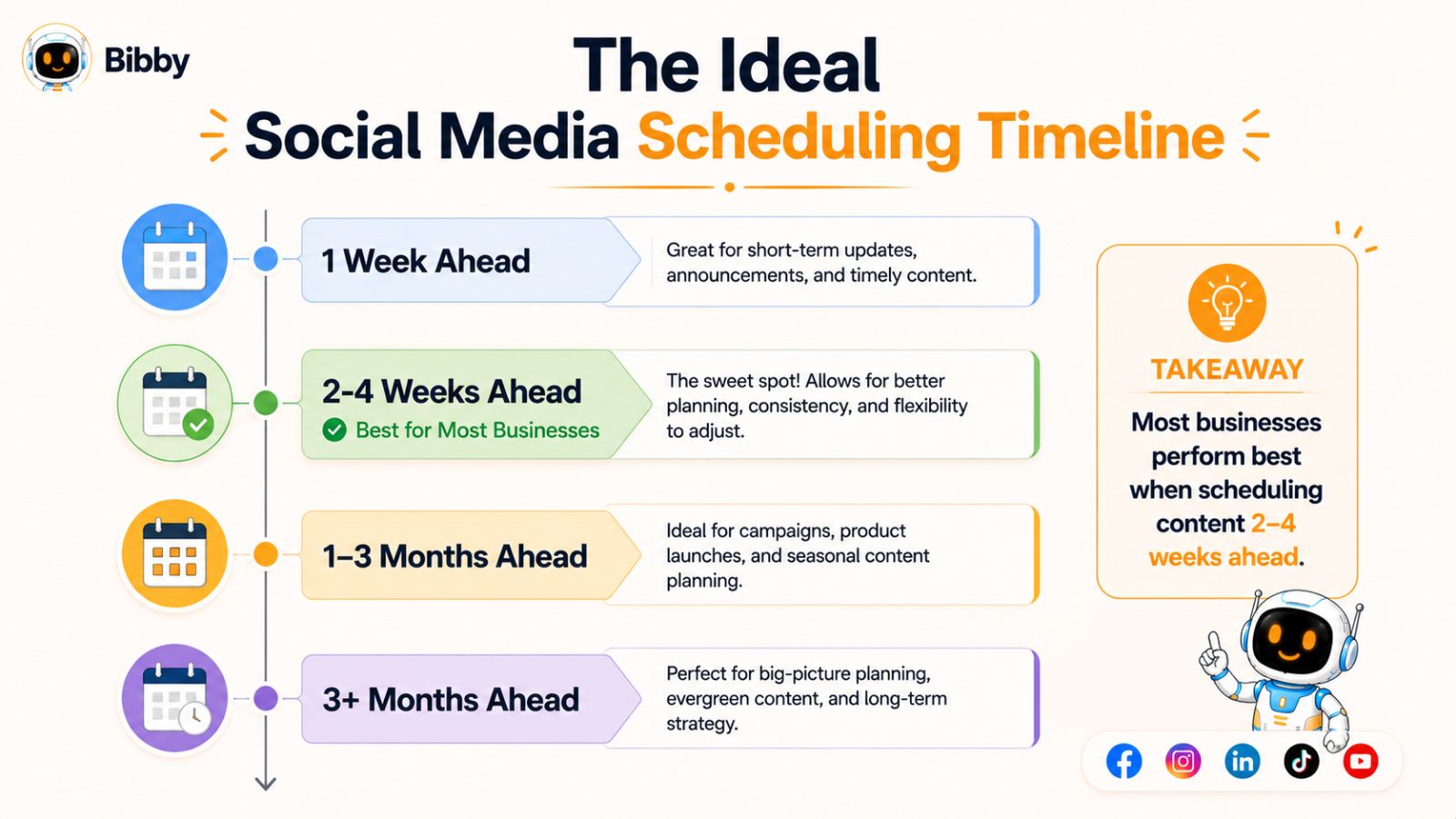
However, for most businesses, scheduling content 2–4 weeks ahead provides the best balance between consistency and flexibility.
Let's break down the advantages and disadvantages of different scheduling timelines.
Scheduling 1 Week Ahead
Scheduling content one week in advance is often the starting point for new creators, small businesses, and companies that publish highly reactive content.
Best for:
- New businesses
- Solo creators
- Trend-driven industries
- Brands still developing their content strategy
Advantages:
- Maximum flexibility
- Easy to respond to industry news and trends
- Minimal risk of content becoming outdated
- Faster content adjustments based on performance
Disadvantages:
- Requires constant content creation
- Less time for strategic planning
- Increased risk of running out of scheduled content
While a one-week schedule provides agility, it can create ongoing pressure to produce content consistently.
Scheduling 2–4 Weeks Ahead
For most brands, this is the sweet spot.
A two-to-four-week content buffer gives teams enough time to plan campaigns, maintain consistency, and avoid last-minute stress while still leaving room for timely content.
Best for:
- Small and medium-sized businesses
- Marketing teams
- Agencies managing multiple clients
- Personal brands
Advantages:
- Strong balance between planning and flexibility
- Consistent publishing schedule
- Better content quality control
- Easier campaign coordination
- Reduced daily workload
Disadvantages:
- Requires a structured content calendar
- Scheduled content still needs periodic review
Most successful brands operate within this range because it provides enough breathing room without making the content feel disconnected from current events.
Scheduling 1–3 Months Ahead
Larger organizations often schedule significant portions of their content calendar months in advance.
This approach works particularly well for evergreen content, product launches, seasonal campaigns, and recurring promotions.
Best for:
- Established businesses
- E-commerce brands
- Large marketing teams
- Companies running seasonal campaigns
Advantages:
- Highly efficient workflow
- Predictable content pipeline
- Better long-term campaign planning
- Less operational pressure
Disadvantages:
- Content may become outdated
- Requires regular content audits
- Less responsive to industry trends
The key is to review scheduled content regularly and make adjustments when necessary.
Scheduling More Than 3 Months Ahead
While it is possible to schedule content several months ahead, this strategy should be reserved primarily for evergreen content.
Examples include:
- Educational content
- Frequently asked questions
- Product tutorials
- Customer success stories
- Industry fundamentals
The further into the future you schedule content, the more likely it is that audience interests, platform algorithms, or industry trends will change.
The Best Approach: The Hybrid Scheduling Model
The most effective social media strategies combine long-term planning with short-term flexibility.
A practical framework looks like this:
- Schedule evergreen content 1–3 months ahead
- Schedule campaign content 2–4 weeks ahead
- Leave room for trending topics and real-time engagement
- Review scheduled posts weekly
This approach provides consistency while allowing your brand to stay relevant and responsive.
Today, AI-powered platforms such as Bibby make this process significantly easier. Instead of manually choosing dates, writing captions, and publishing across multiple channels, businesses can upload or generate images, select a posting style, and let Bibby automatically create captions, determine AI-optimized posting times, and schedule content across Facebook, Instagram, LinkedIn, YouTube, and TikTok from a single dashboard.
The result is a consistent social media presence without the daily workload that traditionally comes with managing multiple platforms.
Recommended Scheduling Timelines by Platform
Not all social media platforms operate the same way. Audience behavior, content lifespan, engagement patterns, and algorithm preferences vary significantly from platform to platform.
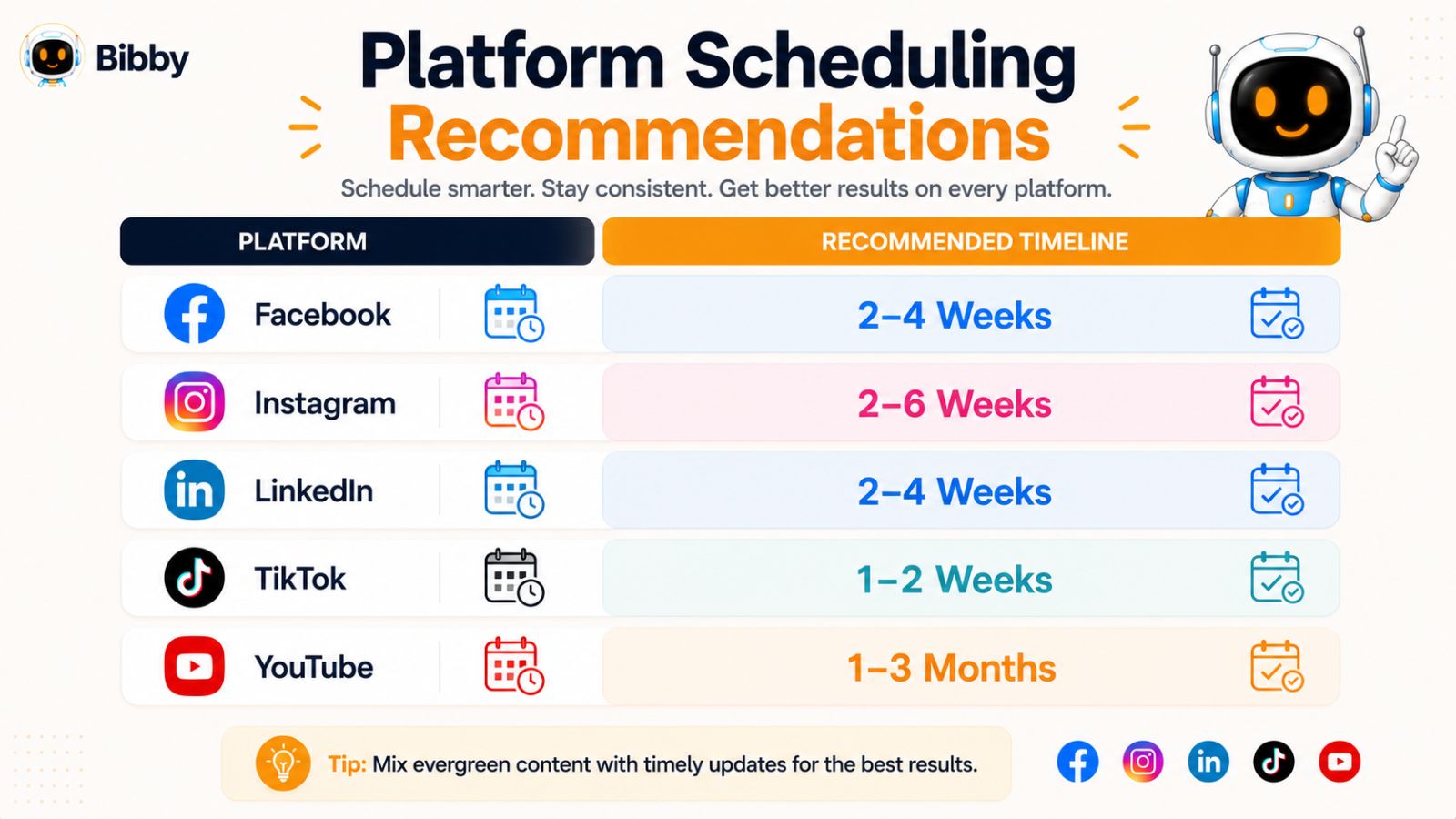
As a result, the ideal scheduling timeline for Facebook may not be the best approach for TikTok or YouTube. Understanding these differences can help you build a more effective content calendar and maximize engagement across every channel.
Facebook: Schedule 2–4 Weeks Ahead
Facebook content tends to have a longer lifespan than fast-moving platforms like TikTok. Most businesses can comfortably schedule content several weeks in advance without losing relevance.
Recommended scheduling window: 2–4 weeks
Content types that work well:
- Educational posts
- Company updates
- Customer testimonials
- Promotional campaigns
- Community-focused content
Because Facebook audiences often engage with evergreen and informational content, scheduling further ahead is generally low risk.
Instagram: Schedule 2–6 Weeks Ahead
Instagram rewards consistency, making it an ideal platform for advance scheduling.
Recommended scheduling window: 2–6 weeks
Content types that work well:
- Feed posts
- Carousel posts
- Reels
- Product showcases
- Brand storytelling
While feed content can be planned well in advance, Stories may require more flexibility to accommodate real-time updates and audience interactions.
LinkedIn: Schedule 2–4 Weeks Ahead
LinkedIn content is typically more strategic and less trend-dependent than content on entertainment-focused platforms.
Recommended scheduling window: 2–4 weeks
Content types that work well:
- Thought leadership posts
- Industry insights
- Company news
- Professional tips
- Case studies
A planned approach allows businesses to maintain a consistent professional presence while supporting broader marketing objectives.
TikTok: Schedule 1–2 Weeks Ahead
TikTok moves quickly, and trends can emerge and disappear within days.
Recommended scheduling window: 1–2 weeks
Content types that work well:
- Trend-based videos
- Behind-the-scenes content
- Educational short-form videos
- Brand personality content
Although some evergreen content can be scheduled further ahead, maintaining flexibility is critical for capturing trending opportunities.
YouTube: Schedule 1–3 Months Ahead
YouTube typically requires more production effort than other platforms, making long-term planning particularly valuable.
Recommended scheduling window: 1–3 months
Content types that work well:
- Long-form educational videos
- Product demonstrations
- Tutorials
- Interviews
- YouTube Shorts
Many successful YouTube creators build content pipelines weeks or even months in advance to ensure consistent publishing.
Managing Multiple Platforms Efficiently
The challenge for many businesses isn't deciding when to post—it's managing multiple platforms simultaneously.
Creating content, writing captions, selecting publishing times, and manually scheduling posts across Facebook, Instagram, LinkedIn, TikTok, and YouTube can quickly become overwhelming.
This is where automation becomes valuable.
With Bibby, businesses can streamline the entire workflow from a single platform. Users can upload their own images or generate images with AI, choose a preferred posting style, and allow Bibby to automatically generate captions tailored to their content. The platform then schedules posts at AI-optimized times and publishes them across selected social networks automatically.
Beyond standard posts, Bibby also supports videos, Stories, and multi-platform campaigns while providing analytics that help users understand what content is performing best.
Instead of managing five separate platforms, businesses can maintain a consistent social media presence from one centralized dashboard.
🚀 Automate Your Social Media in Minutes
Upload images, choose your posting style, and let Bibby generate captions and schedule your posts.
Start for FreeFactors That Determine How Far Ahead You Should Schedule
While general scheduling recommendations can be helpful, the ideal timeline ultimately depends on your specific business, audience, and content strategy.
A schedule that works perfectly for a software company may be completely ineffective for a news publication or trend-driven creator. Before deciding how far ahead to plan your content, consider the following factors.
Industry Volatility
Some industries change rapidly, while others remain relatively stable.
For example, businesses operating in areas such as:
- News and media
- Technology
- Finance
- Entertainment
- Sports
Often need greater flexibility because audience interests can shift quickly.
On the other hand, businesses in industries such as:
- Home services
- Real estate
- Education
- Healthcare
- Professional services
Can typically schedule content much further in advance because much of their content remains relevant for longer periods.
The more frequently your industry changes, the shorter your scheduling window should be.
Team Size and Resources
Your available resources play a major role in determining your scheduling strategy.
Solo Creators
Solo entrepreneurs and creators often benefit from scheduling at least two weeks of content ahead to avoid daily posting pressure.
Small Marketing Teams
Small teams typically perform best with a 2–4 week content buffer that allows for planning while maintaining flexibility.
Large Organizations
Larger companies often build quarterly content calendars and schedule substantial portions of their content months in advance.
The more resources available, the easier it becomes to maintain a longer content pipeline.
Also read: Social Media Marketing Statistics You Need to Know
Content Type
Not all content ages at the same rate.
Evergreen Content
Evergreen content remains valuable regardless of timing and can often be scheduled months ahead.
Examples include:
- Educational posts
- Tutorials
- Frequently asked questions
- Product guides
- Customer success stories
Promotional Content
Promotional content often requires closer monitoring because campaign details, pricing, and priorities can change.
Examples include:
- Product launches
- Sales promotions
- Events
- Seasonal offers
Trend-Based Content
Trend-driven content requires the shortest scheduling timeline.
Examples include:
- Viral challenges
- Breaking industry news
- Current events
- Trending discussions
These posts are often most effective when created and published quickly.
Campaign Complexity
Simple content calendars are easier to schedule far ahead than complex marketing campaigns.
As campaign complexity increases, so does the need for strategic planning.
Complex campaigns often include:
- Multiple content formats
- Several social media platforms
- Product launch sequences
- Paid advertising support
- Email marketing integration
In these situations, scheduling content weeks or months ahead can improve coordination and execution.
Audience Expectations
Your audience also influences your scheduling timeline.
If your followers expect timely commentary on industry developments, scheduling too far ahead may make your content feel disconnected from current conversations.
Conversely, audiences seeking educational or informational content generally respond well to content that is planned and structured in advance.
Also read: How to Automate Your LinkedIn Posting Strategy for B2B Growth
How Automation Changes the Equation
Traditionally, longer scheduling timelines created additional workload because marketers had to manually create content, write captions, determine publishing schedules, and upload everything across multiple platforms.
Modern AI-powered tools have significantly reduced that burden.
For example, Bibby allows users to upload an image or generate one with AI, select a posting style, and automatically generate captions. The platform then schedules content at AI-optimized posting times and publishes it across Facebook, Instagram, LinkedIn, TikTok, and YouTube.
This streamlined workflow makes it practical to maintain weeks—or even months—of scheduled content without spending countless hours managing social media manually.
As a result, businesses can focus more on strategy, creativity, and engagement while automation handles much of the repetitive work behind the scenes.
Signs You're Scheduling Too Far Ahead
Scheduling content in advance is one of the best ways to stay consistent on social media, but there is such a thing as scheduling too far ahead.
When your content calendar becomes too rigid, you risk publishing posts that no longer align with current trends, audience interests, or business priorities. The goal is to create a content pipeline that provides consistency without sacrificing relevance.
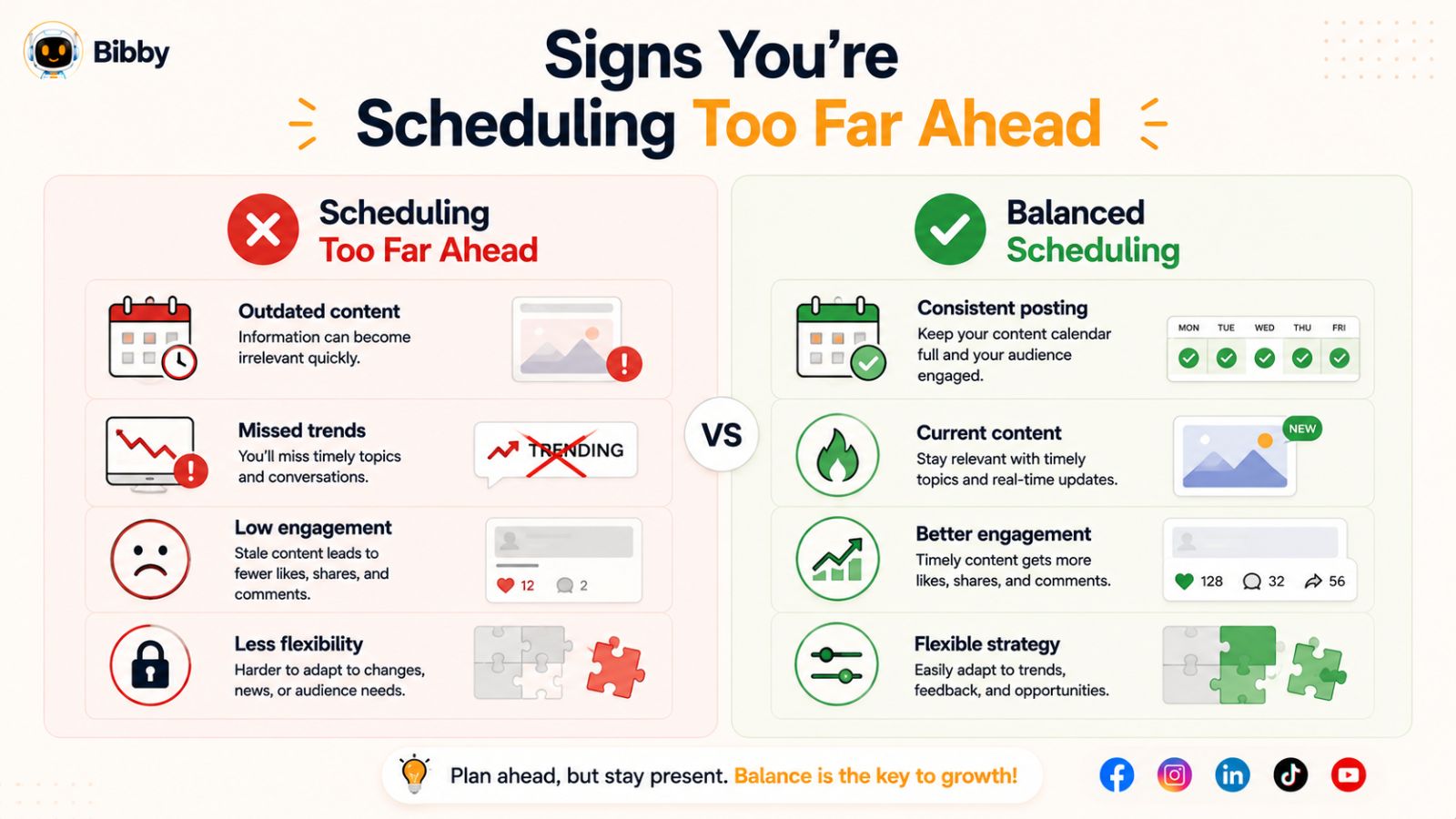
Here are some common signs that you may be scheduling too far into the future.
Your Content Feels Outdated
One of the biggest risks of long-term scheduling is that circumstances change.
Industry developments, platform updates, market conditions, and audience interests can shift significantly over a few weeks or months.
For example:
- A platform releases a major algorithm update
- Industry regulations change
- New competitors enter the market
- Consumer behavior shifts
- Trending topics dominate conversations
If your scheduled content doesn't reflect these changes, it can quickly feel stale or disconnected from what your audience currently cares about.
Engagement Rates Are Declining
A drop in engagement can indicate that your content is losing relevance.
When posts are created months before publication, they may not address the questions, challenges, or interests your audience has at the time they are actually published.
Warning signs include:
- Lower likes and reactions
- Reduced comments
- Fewer shares
- Decreasing click-through rates
- Declining reach and impressions
While many factors affect engagement, outdated content is often an overlooked contributor.
You're Missing Industry Trends
Social media rewards brands that participate in relevant conversations.
If every post is locked into a rigid schedule months in advance, your business may struggle to capitalize on:
- Viral trends
- Breaking news
- Industry discussions
- Seasonal opportunities
- Emerging audience interests
Some of the highest-performing social media content is timely and responsive. Scheduling too far ahead can reduce your ability to participate in those moments.
Business Priorities Keep Changing
Many organizations experience shifting priorities throughout the year.
Examples include:
- New product launches
- Marketing campaign changes
- Updated business goals
- Strategic partnerships
- Unexpected market opportunities
If you're constantly editing or deleting scheduled content because priorities have changed, your scheduling horizon may be too long.
Reviewing Scheduled Content Becomes a Full-Time Job
A large content backlog can create additional maintenance work.
Instead of saving time, you may find yourself repeatedly reviewing hundreds of scheduled posts to ensure they remain accurate and relevant.
When this happens, the efficiency gained from advance scheduling begins to diminish.
The Solution: Build Flexibility Into Your Schedule
The most effective brands avoid over-scheduling by maintaining a balance between planned and reactive content.
A practical framework is:
- Schedule evergreen content months ahead
- Schedule campaign content several weeks ahead
- Leave open publishing slots each week
- Review content calendars regularly
- Monitor trends and audience conversations
This approach provides consistency while preserving the flexibility needed to stay relevant.
How AI Helps Maintain Relevance
Modern scheduling tools can make long-term planning easier without creating a rigid content calendar.
With Bibby, businesses can create and schedule content quickly by uploading images or generating visuals with AI, selecting a posting style, and allowing the platform to generate captions automatically. Bibby then schedules posts across Facebook, Instagram, LinkedIn, TikTok, and YouTube at AI-optimized times.
Because content creation and scheduling become significantly faster, marketers can maintain shorter planning cycles and update content more frequently without increasing their workload.
The result is a social media strategy that remains both organized and adaptable—a combination that often leads to stronger long-term engagement.
Also read: Why Every Small Business Should Use a Social Media Scheduling Tool?
Signs You're Not Scheduling Far Enough Ahead
While scheduling too far ahead can reduce flexibility, not scheduling far enough ahead often creates even bigger problems.
Many businesses operate in a constant cycle of creating content at the last minute, rushing to meet publishing deadlines, and scrambling to find something to post each day. Over time, this reactive approach can hurt content quality, consistency, and overall marketing performance.
If any of the following situations sound familiar, it may be time to build a larger content buffer.
You're Constantly Stressed About What to Post
One of the clearest warning signs is daily content anxiety.
Instead of focusing on strategy, engagement, and growth, you're spending most of your time asking questions like:
- What should we post today?
- Do we have any content ready?
- Can someone quickly create a graphic?
- What should the caption say?
This reactive workflow often leads to unnecessary stress and burnout.
When content is planned ahead, teams can spend less time worrying about publishing and more time improving performance.
Your Posting Schedule Is Inconsistent
Consistency is one of the most important factors in social media success.
If your content calendar frequently looks like this:
- Three posts one week
- No posts the next week
- Several rushed posts before a campaign launch
Your audience may struggle to develop expectations around your content.
Inconsistent posting can lead to:
- Lower engagement
- Reduced reach
- Slower audience growth
- Missed opportunities for brand awareness
Scheduling content in advance helps maintain a predictable publishing rhythm.
Content Quality Is Suffering
When content is created hours—or even minutes—before publication, quality often declines.
Common symptoms include:
- Weak captions
- Generic messaging
- Poor visual design
- Limited creativity
- Missed proofreading errors
Great content typically requires time for planning, review, and optimization.
Building a content buffer gives teams the opportunity to create more thoughtful and effective posts.
Campaigns Feel Disorganized
Marketing campaigns involve more than a single post.
Most successful campaigns require:
- Multiple content pieces
- Cross-platform coordination
- Consistent messaging
- Strategic timing
Without advance planning, campaigns often become fragmented and difficult to manage.
A structured scheduling process helps ensure that every piece of content supports broader business objectives.
You're Spending Too Much Time on Manual Publishing
Manually publishing content every day may seem manageable at first, but it quickly becomes inefficient as your social media presence grows.
Tasks such as:
- Uploading media
- Writing captions
- Choosing posting times
- Publishing across multiple platforms
Can consume hours every week.
This time could be better spent on content creation, audience engagement, and business growth.
You're Missing Opportunities to Analyze Performance
When teams operate in constant content creation mode, analytics often become an afterthought.
As a result, businesses may miss valuable insights about:
- Top-performing content
- Audience behavior
- Engagement trends
- Optimal posting times
- Platform-specific performance
A planned scheduling strategy creates space to review data and make smarter decisions.
The Benefits of Building a Content Buffer
Most businesses benefit from maintaining at least 2–4 weeks of scheduled content.
A content buffer provides:
- Greater consistency
- Reduced stress
- Higher-quality content
- Improved campaign execution
- More time for engagement and analysis
Instead of operating in survival mode, teams can focus on long-term growth.
How Bibby Helps Eliminate Last-Minute Posting
One reason businesses struggle to schedule ahead is the amount of work involved in creating and publishing content.
Bibby simplifies the process with an AI-powered workflow designed to reduce manual effort. Users can upload an image or generate one using AI, choose a posting style, and let Bibby automatically create captions. The platform then schedules content across Facebook, Instagram, LinkedIn, TikTok, and YouTube at AI-optimized times.
Because posts can be created and scheduled much faster, businesses can build a healthy content buffer without adding more work to their marketing team.
Rather than scrambling to publish every day, you can stay consistently visible while Bibby handles much of the scheduling process automatically.
Also read: Best Hootsuite Alternative for Small Business
The 80/20 Social Media Scheduling Framework
If you're looking for a simple rule to determine how far ahead you should schedule social media posts, the 80/20 framework is one of the most effective approaches.
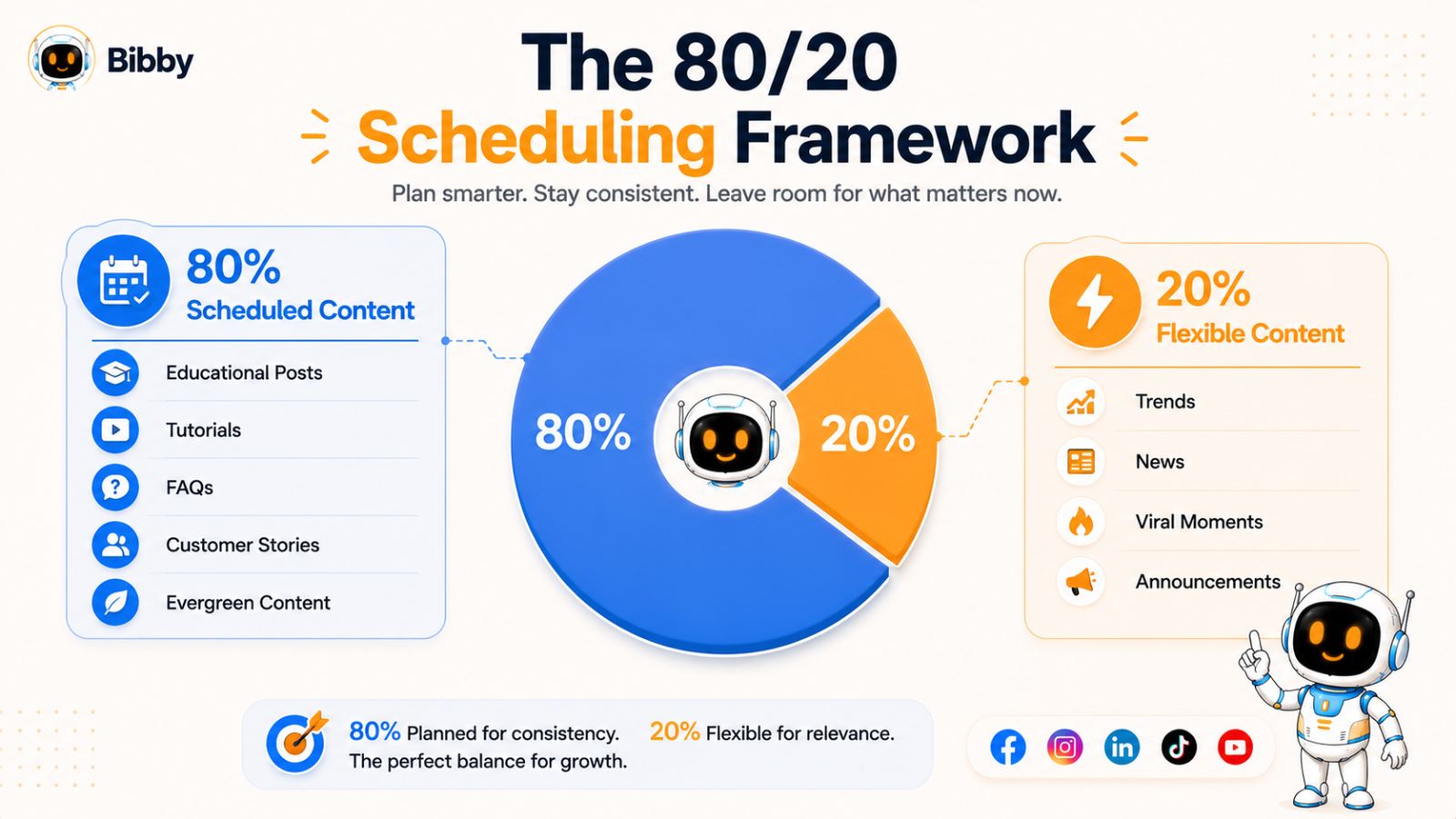
Instead of trying to schedule every post months in advance—or creating everything at the last minute—you divide your content into two categories:
- 80% planned and scheduled content
- 20% flexible, real-time content
This strategy gives you the consistency of advance planning while preserving the flexibility needed to participate in current conversations and trends.
Schedule 80% Evergreen Content in Advance
Evergreen content remains valuable regardless of when it is published. Because it isn't tied to specific events or trends, it can often be created and scheduled weeks or even months ahead.
Examples of evergreen social media content include:
- Educational tips
- How-to guides
- Frequently asked questions
- Product tutorials
- Customer success stories
- Industry best practices
- Case studies
- Behind-the-scenes content
These posts form the foundation of your content calendar and ensure that your audience consistently receives value.
By scheduling most of your evergreen content in advance, you eliminate the daily pressure of finding something to post.
Leave 20% Open for Real-Time Opportunities
The remaining portion of your content calendar should remain flexible.
This reserved space allows your brand to respond to:
- Trending topics
- Industry news
- Viral content opportunities
- Company announcements
- Product updates
- Customer milestones
- Seasonal events
Real-time content often generates strong engagement because it feels timely and relevant.
Brands that leave room for spontaneous content are typically better positioned to capitalize on emerging opportunities.
Why the 80/20 Framework Works
Many businesses struggle because they operate at one of two extremes:
Over-Planned Content Calendars
Every post is scheduled months ahead, leaving little room for adaptation.
This can result in:
- Outdated content
- Missed trends
- Reduced audience engagement
Completely Reactive Posting
Content is created only when needed.
This often leads to:
- Inconsistent posting
- Lower-quality content
- Increased stress
- Missed publishing opportunities
The 80/20 framework avoids both problems by balancing structure with flexibility.
Example of the 80/20 Framework in Action
Imagine a business publishing 20 social media posts each month.
Using the 80/20 model:
16 scheduled posts (80%)
- Educational content
- Customer stories
- Product tips
- Industry insights
- Brand content
4 flexible posts (20%)
- Industry news reactions
- Trending topics
- Company announcements
- Community engagement opportunities
This structure provides a reliable content engine while still allowing the brand to stay relevant and responsive.
How AI Makes the 80/20 Framework Easier
Historically, implementing this strategy required significant manual effort.
Teams had to:
- Create content
- Design graphics
- Write captions
- Determine posting times
- Schedule content across multiple platforms
AI-powered scheduling tools have dramatically simplified this process.
With Bibby, businesses can build the 80% scheduled portion of their content calendar quickly by uploading media or generating images with AI. After selecting a preferred posting style, Bibby automatically creates captions and schedules posts across Facebook, Instagram, LinkedIn, TikTok, and YouTube at AI-optimized posting times.
At the same time, teams can reserve the remaining 20% of their calendar for trend-based and real-time content.
This creates the ideal balance between automation and flexibility, allowing businesses to maintain a consistent social media presence without sacrificing relevance or spending hours managing multiple platforms.
For most brands, the 80/20 framework represents the sweet spot between planning ahead and staying adaptable—making it one of the most effective social media scheduling strategies available today.
Also read: How to Grow on Social Media With AI?
How AI Is Changing Social Media Scheduling
Social media scheduling has come a long way from spreadsheets, calendar reminders, and manual publishing.
In the past, marketers were responsible for nearly every step of the process—from creating content and writing captions to choosing posting times and publishing content individually on each platform. As the number of social networks grew, managing a consistent presence became increasingly time-consuming.
Artificial intelligence is changing that.
Today, AI-powered social media tools can automate many of the repetitive tasks that once consumed hours of a marketer's week, allowing businesses to focus more on strategy, creativity, and audience engagement.
From Manual Calendars to Intelligent Automation
Traditional scheduling tools helped marketers plan content in advance, but they still required significant manual effort.
Users had to:
- Create content manually
- Write every caption
- Research hashtags
- Select posting times
- Schedule content platform by platform
While this was an improvement over manual publishing, it still demanded substantial time and attention.
AI introduces a new level of automation by assisting with content creation, optimization, and scheduling decisions.
Modern AI systems can help:
- Generate content ideas
- Write captions
- Suggest improvements
- Analyze performance trends
- Recommend publishing schedules
- Automate multi-platform distribution
As a result, social media management becomes significantly more efficient.
Why Timing Matters More Than Ever
Publishing great content is important, but publishing it at the right time can make a significant difference in performance.
Every social platform has unique audience behavior patterns. The times when users are most active can vary based on:
- Platform
- Industry
- Audience demographics
- Geographic location
- Historical engagement patterns
Manually determining the best posting times can be difficult, especially when managing multiple social networks.
AI helps solve this challenge by analyzing engagement data and identifying optimal publishing windows based on audience behavior.
Rather than relying on generic recommendations, AI can use actual performance data to improve scheduling decisions over time.
The Rise of AI-Powered Content Workflows
One of the biggest advantages of AI is its ability to streamline the entire content workflow.
Instead of using separate tools for:
- Graphic creation
- Caption writing
- Scheduling
- Publishing
- Analytics
Businesses can increasingly manage everything from a single platform.
This reduces complexity, saves time, and creates a more efficient marketing process.
AI Helps Teams Scale Without Growing Headcount
For many businesses, social media growth traditionally required hiring additional staff or outsourcing content management.
AI changes that equation.
By automating repetitive tasks, businesses can:
- Produce more content
- Maintain consistency
- Expand to additional platforms
- Improve scheduling efficiency
- Reduce administrative workload
This allows smaller teams to achieve results that previously required much larger marketing departments.
The Future of Social Media Scheduling
As AI continues to evolve, social media management is becoming less about manual execution and more about strategic oversight.
Rather than spending hours creating and scheduling posts, marketers can focus on:
- Brand positioning
- Audience engagement
- Campaign strategy
- Creative direction
- Performance optimization
AI handles much of the operational work behind the scenes.
A Practical Example: AI-Powered Scheduling with Bibby
Bibby is an example of how modern AI is transforming social media scheduling into a largely automated process.
Instead of manually managing every step, users simply:
- Upload an image or generate one with AI.
- Choose their preferred posting style.
- Let Bibby generate captions automatically.
- Allow the platform to schedule content at AI-optimized posting times.
- Publish across Facebook, Instagram, LinkedIn, TikTok, and YouTube from one dashboard.
Bibby also supports videos, Stories, and multi-platform campaigns while providing built-in analytics that help users measure performance and refine their strategy.
This type of AI-powered workflow dramatically reduces the time required to manage social media while helping businesses maintain a consistent and effective online presence.
As AI technology continues to improve, tools like Bibby are making it easier than ever for businesses to automate content creation, scheduling, publishing, and performance tracking—all from a single platform.
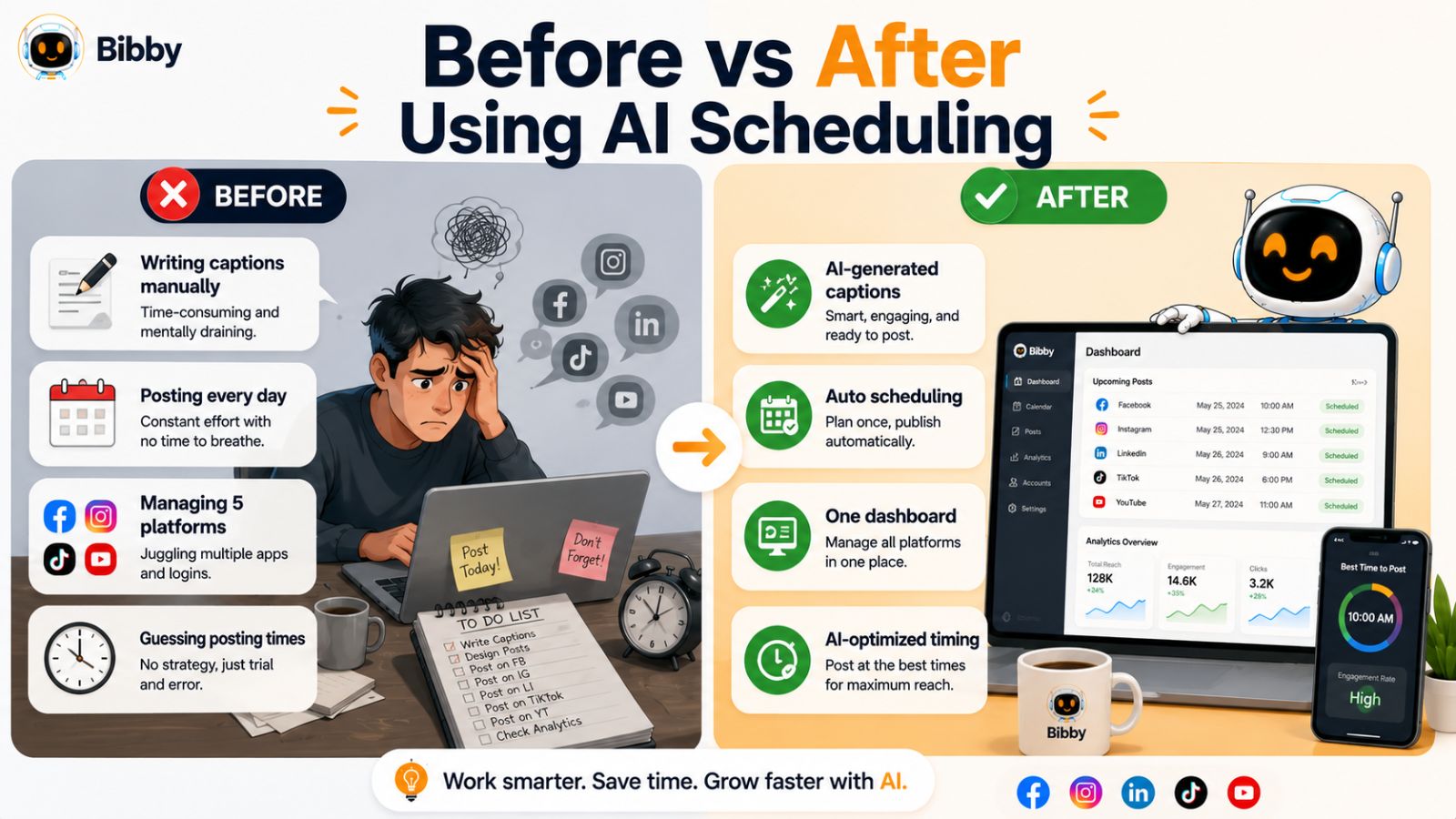
How Bibby Makes Social Media Scheduling Effortless
Knowing how far ahead to schedule social media posts is important. Actually creating, scheduling, publishing, and managing that content consistently is often the bigger challenge.
Many businesses start with a simple content calendar but eventually run into the same problems:
- Creating enough content consistently
- Writing engaging captions
- Managing multiple social platforms
- Finding the best times to post
- Tracking performance across channels
As social media responsibilities grow, the workload can quickly become overwhelming.
Bibby was built to solve this problem by combining content creation, AI automation, scheduling, publishing, and analytics into a single streamlined workflow.
Create Content Faster with AI
Content creation is often the biggest bottleneck in social media marketing.
Instead of spending hours creating graphics for every post, Bibby gives users multiple ways to generate content quickly.
You can:
- Upload your own images
- Generate images using AI
- Create content for multiple campaigns
- Build weeks of content in a single session
This allows businesses to maintain a consistent publishing schedule without constantly worrying about content production.
Generate Captions Automatically
Writing captions for every platform can be surprisingly time-consuming.
A single campaign may require dozens of captions across multiple social networks.
With Bibby, users simply choose a preferred posting style and the platform automatically generates captions designed for social media engagement.
Benefits include:
- Faster content creation
- Consistent brand messaging
- Reduced manual effort
- Improved workflow efficiency
Instead of staring at a blank page, marketers can focus on strategy while Bibby handles much of the writing process.
Schedule Posts at AI-Optimized Times
One of the biggest challenges in social media marketing is determining when to publish content.
Posting too early or too late can reduce visibility and engagement.
Bibby removes the guesswork by automatically scheduling content at AI-optimized posting times.
Rather than relying on generic recommendations, the platform helps ensure content is published when audiences are most likely to engage.
This can lead to:
- Higher reach
- Better engagement
- More efficient content distribution
- Improved overall performance
Publish Across Multiple Platforms from One Dashboard
Managing multiple social networks manually often means switching between different tools and interfaces.
Bibby simplifies this process by allowing users to schedule and publish content across major social media platforms from one centralized dashboard.
Supported platforms include:
- TikTok
- YouTube
Instead of logging into each platform separately, users can manage their entire social media strategy from a single location.
Go Beyond Standard Posts
Modern social media strategies involve much more than static image posts.
Businesses increasingly rely on:
- Videos
- Stories
- Short-form content
- Multi-platform campaigns
Bibby supports a variety of content formats, making it easier to maintain a consistent presence across different channels and content types.
Track Results with Built-In Analytics
Publishing content is only part of the equation.
To improve performance over time, businesses need visibility into what is working and what is not.
Bibby includes analytics tools that help users monitor:
- Engagement trends
- Content performance
- Audience activity
- Campaign effectiveness
- Growth metrics
These insights help marketers make smarter decisions and continuously optimize their content strategy.
Why Bibby Is an Ideal Solution for Advance Scheduling
The biggest reason businesses fail to schedule content ahead of time is complexity.
Traditional workflows require:
- Designing content
- Writing captions
- Choosing posting times
- Scheduling posts manually
- Monitoring multiple platforms
Bibby consolidates all of these tasks into a simple AI-powered workflow.
Upload or generate an image, choose a posting style, and let Bibby handle the rest.
The platform automatically generates captions, schedules posts at AI-optimized times, publishes across your selected social channels, and provides analytics to measure results.
For businesses that want to maintain weeks or even months of scheduled content without spending countless hours managing social media, Bibby offers a faster, simpler, and more scalable approach.
The result is exactly what most marketers want: consistent posting, stronger engagement, less manual work, and more time to focus on growing the business.
Also read: How Social Media Automation Helps Startups Grow Faster
Best Practices for Scheduling Social Media Posts
Scheduling social media content ahead of time can save hours each week, but simply filling a content calendar isn't enough. To maximize engagement, maintain relevance, and achieve long-term growth, it's important to follow a few proven best practices.
Whether you're scheduling one week ahead or planning an entire quarter, these strategies can help you get better results from your social media efforts.
Maintain a Content Calendar
A content calendar provides structure and visibility for your social media strategy.
Instead of deciding what to post each day, you can plan content around business goals, campaigns, promotions, and seasonal opportunities.
A well-organized content calendar helps you:
- Maintain consistency
- Balance content types
- Avoid duplicate posts
- Coordinate marketing campaigns
- Plan ahead for important events
Even a simple calendar can significantly improve your scheduling process.
Review Scheduled Content Weekly
One of the biggest mistakes businesses make is scheduling content and forgetting about it.
Markets change, trends emerge, and business priorities evolve.
A weekly review helps ensure that scheduled content remains:
- Relevant
- Accurate
- Timely
- Aligned with current goals
This simple habit can prevent outdated content from being published and keep your messaging fresh.
Leave Room for Trending Content
While advance planning is important, social media rewards brands that participate in real-time conversations.
Leave a portion of your schedule open for:
- Trending topics
- Industry news
- Viral opportunities
- Customer highlights
- Company announcements
This is one of the reasons the 80/20 scheduling framework works so well. Most content remains planned, while some space is reserved for timely and relevant updates.
Focus on Content Quality Over Quantity
Posting more frequently does not always produce better results.
A consistent schedule of high-quality content generally outperforms a large volume of rushed posts.
Prioritize:
- Valuable information
- Strong visuals
- Clear messaging
- Audience relevance
- Authentic engagement
Creating fewer high-quality posts is often more effective than publishing content simply to fill a calendar.
Repurpose High-Performing Content
Not every post needs to be created from scratch.
Some of your best future content may already exist.
Repurposing can include:
- Turning blog posts into social posts
- Converting videos into short clips
- Reusing successful graphics
- Updating evergreen content
- Repackaging popular tips and insights
This approach helps maintain consistency while reducing content creation workload.
Monitor Analytics Regularly
The best scheduling strategy is one that improves over time.
Reviewing analytics helps you identify:
- Top-performing content
- Audience engagement trends
- Platform-specific behavior
- Optimal posting schedules
- Content opportunities
The more data you analyze, the more effective your content calendar becomes.
Use Automation to Save Time
As your social media presence grows, manual scheduling becomes increasingly inefficient.
Automation allows businesses to:
- Create content faster
- Schedule posts more efficiently
- Maintain consistency
- Reduce repetitive work
- Scale across multiple platforms
This is where AI-powered platforms provide a significant advantage.
Simplify Scheduling with Bibby
Many social media tools focus only on scheduling. Bibby goes much further by helping users create, optimize, schedule, publish, and analyze content from one platform.
With Bibby, you can:
- Upload your own images
- Generate images with AI
- Choose your preferred posting style
- Automatically generate captions
- Schedule content at AI-optimized times
- Publish to Facebook, Instagram, LinkedIn, TikTok, and YouTube
- Manage videos and Stories
- Track performance with built-in analytics
Because much of the workflow is automated, businesses can implement these best practices consistently without spending hours each week managing social media.
The combination of planning, flexibility, analytics, and automation creates a sustainable social media strategy that supports long-term growth while dramatically reducing manual effort.
Also read: Bibby vs Later: Which Social Media Tool Is Best for Small Business?
Frequently Asked Questions
How far ahead should small businesses schedule social media posts?
Most small businesses benefit from scheduling content 2–4 weeks in advance. This timeframe provides enough structure to maintain consistency while still allowing flexibility to respond to trends, customer feedback, and changing business priorities.
Is scheduling social media posts bad for engagement?
No. Scheduling posts does not inherently reduce engagement. In fact, scheduling often improves results because it helps maintain a consistent publishing schedule. The key is to continue engaging with your audience in real time through comments, messages, and community interactions.
Should I schedule posts or publish manually?
A combination of both approaches is often best. Schedule the majority of your evergreen and planned content in advance, then publish trend-based or time-sensitive content manually when opportunities arise. This aligns with the popular 80/20 scheduling framework.
How often should I review scheduled content?
A weekly review is recommended. Regularly checking your content calendar helps ensure that scheduled posts remain relevant, accurate, and aligned with your current marketing goals.
Can I schedule content months in advance?
Yes, especially evergreen content. Educational posts, tutorials, customer success stories, and product guides can often be scheduled several months ahead. However, it's important to review long-term scheduled content periodically to ensure it remains relevant.
What is the best social media scheduling timeline?
For most businesses, the ideal timeline is 2–4 weeks ahead. This provides a strong balance between organization and flexibility. Larger brands may schedule some content months in advance, while trend-focused creators often work with shorter planning windows.
What types of content should be scheduled ahead of time?
Content that performs well when scheduled in advance includes:
- Educational posts
- Product tutorials
- Customer testimonials
- Case studies
- Brand stories
- Promotional campaigns
- Evergreen industry insights
These content types typically remain relevant for extended periods and fit well into a planned content calendar.
Can AI help determine the best time to post on social media?
Yes. Modern AI-powered scheduling tools can analyze audience behavior, engagement patterns, and historical performance data to identify optimal publishing windows. This removes much of the guesswork involved in deciding when to post.
How can I save time managing multiple social media platforms?
Using a centralized social media management platform is often the most effective solution. Instead of logging into multiple platforms individually, businesses can create, schedule, publish, and monitor content from one dashboard.
Why do businesses use Bibby for social media scheduling?
Bibby simplifies the entire social media workflow through AI-powered automation.
Users can:
- Upload images or generate images with AI
- Choose a preferred posting style
- Automatically generate captions
- Schedule content at AI-optimized posting times
- Publish across Facebook, Instagram, LinkedIn, TikTok, and YouTube
- Manage videos and Stories
- Track performance through built-in analytics
By automating content creation and scheduling, Bibby helps businesses maintain a consistent social media presence while reducing the time and effort required to manage multiple platforms.
🚀 Automate Your Social Media in Minutes
Upload an image, choose your posting style, and let Bibby generate captions and schedule your posts.
Start for FreeConclusion
So, how far ahead should you schedule social media posts?
For most businesses, the ideal approach is to schedule content 2–4 weeks in advance. This provides enough time to stay organized, maintain a consistent publishing schedule, and execute campaigns effectively while still leaving room to react to trends and real-time opportunities.
The most important takeaways are:
- Most brands achieve the best results by scheduling content 2–4 weeks ahead.
- The 80/20 framework helps balance planned content with timely, trend-driven posts.
- AI-powered tools can dramatically reduce the time required to create, schedule, and manage social media content.
Ultimately, successful social media scheduling isn't about planning every post months in advance. It's about creating a repeatable system that keeps your brand visible, relevant, and consistent without overwhelming your team.
As social media continues to become more competitive, businesses are increasingly turning to AI-powered solutions to simplify the process. Platforms like Bibby make it possible to upload or generate images, create captions automatically, schedule content at AI-optimized times, publish across Facebook, Instagram, LinkedIn, TikTok, and YouTube, and track performance from a single dashboard.
The next step is learning how to build a complete AI-powered social media content calendar—one that not only keeps your accounts active but also helps you generate more engagement, save time, and scale your marketing efforts with far less manual work.