
Social media automation has become an essential strategy for B2B companies looking to build brand awareness, generate qualified leads, and maintain a consistent online presence without spending countless hours managing multiple platforms.
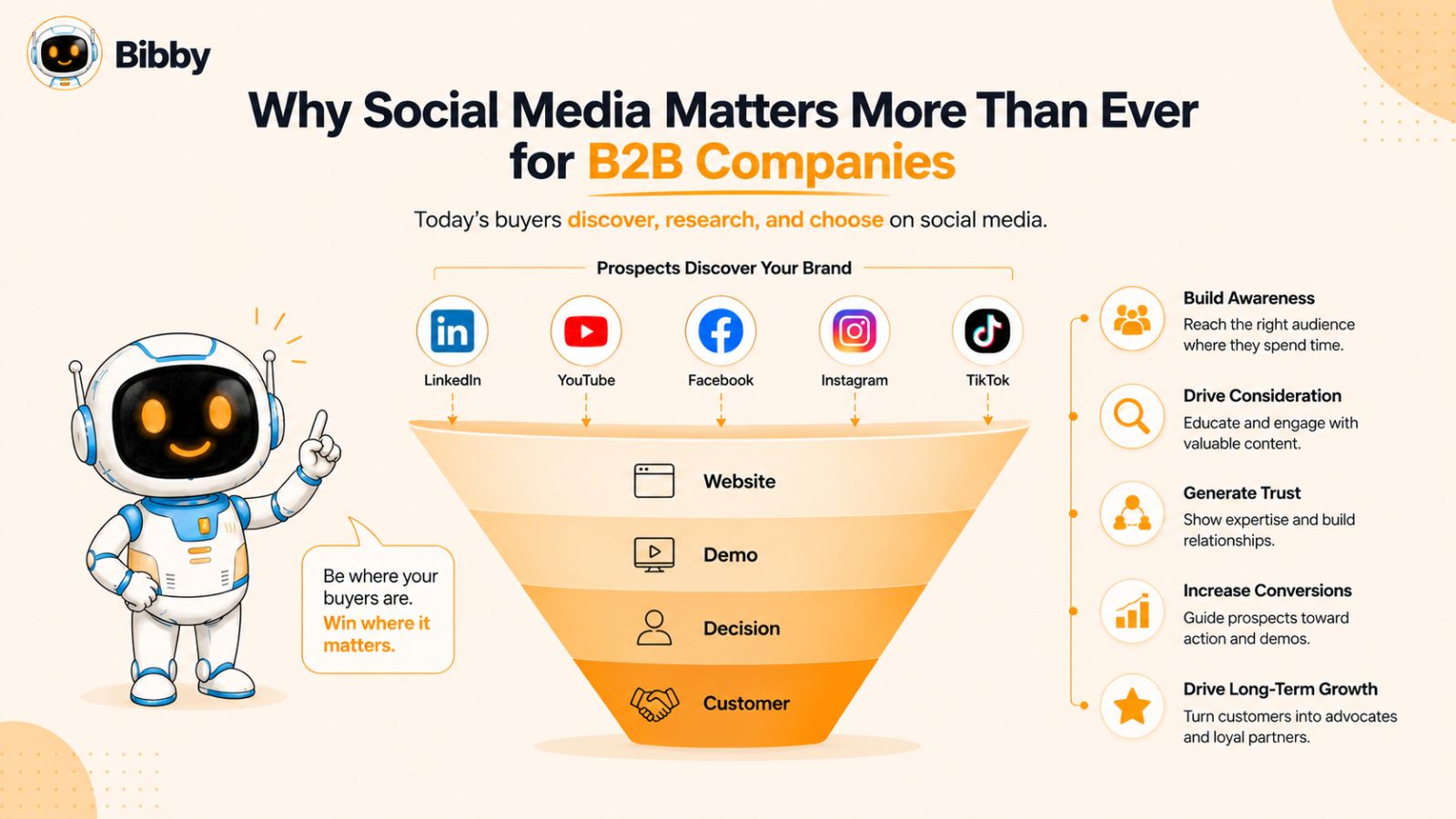
Today's B2B buyers don't just rely on websites or sales calls—they research companies on LinkedIn, YouTube, Facebook, Instagram, and even TikTok before making purchasing decisions. For many marketing teams, keeping up with content creation, scheduling, engagement, and analytics across every platform is overwhelming. That's where social media automation comes in. By combining AI-powered content creation, intelligent scheduling, and multi-platform publishing, businesses can save time, improve consistency, and focus more on building relationships and closing deals.
Whether you're a startup, SaaS company, marketing agency, or enterprise business, this guide will show you how to build an efficient social media automation strategy that helps your team work smarter, reach more prospects, and achieve better results.
Why Social Media Matters More Than Ever for B2B Companies
For years, B2B marketing revolved around trade shows, cold outreach, email campaigns, and referrals. While these channels still play an important role, today's buyers spend a significant amount of time researching businesses online before ever speaking to a sales representative. Social media has become one of the first places potential customers evaluate a company's expertise, credibility, and brand.
A consistent and valuable social media presence helps B2B companies stay visible throughout the buyer's journey. Whether a prospect discovers your business through a LinkedIn post, watches a product demonstration on YouTube, or reads customer success stories on Facebook, every interaction contributes to building trust and moving them closer to a purchasing decision.
Modern B2B Buyers Research on Social Media
B2B purchasing decisions are rarely made overnight. Decision-makers compare solutions, read reviews, consume educational content, and evaluate companies long before requesting a demo or contacting a sales team. Maintaining an active presence across multiple platforms ensures your brand remains part of that research process.
Some of the most important platforms for B2B companies include:
- LinkedIn: The leading professional network for thought leadership, industry insights, lead generation, and relationship building.
- YouTube: Ideal for product demonstrations, tutorials, webinars, case studies, and educational content that answers buyers' questions.
- Facebook: Useful for community building, company updates, customer engagement, and promoting events or webinars.
- Instagram: Helps humanize your brand through behind-the-scenes content, company culture, infographics, and visual storytelling.
- TikTok: Increasingly valuable for sharing quick educational videos, industry tips, company highlights, and reaching younger decision-makers.
Each platform serves a different purpose, but together they create a stronger digital presence that supports every stage of the B2B buying journey.
Why Organic Social Builds Trust
Unlike paid advertising, organic social media allows businesses to demonstrate expertise consistently over time. Sharing valuable insights, industry trends, customer success stories, educational videos, and practical advice positions your company as a trusted authority rather than simply another vendor.
When prospects repeatedly encounter helpful content from your brand, they become more familiar with your expertise. This familiarity builds credibility, making them more likely to engage with your business when they're ready to invest in a solution.
The Biggest Challenge: Staying Consistent
Despite understanding the importance of social media, many B2B companies struggle to maintain a regular posting schedule. Marketing teams often juggle multiple responsibilities, making it difficult to create fresh content, resize images for different platforms, write engaging captions, publish at the right times, and track performance.
As a result, social media often becomes inconsistent—weeks of activity followed by long periods of silence. This inconsistency can reduce visibility, weaken audience engagement, and limit lead-generation opportunities.
This is exactly why social media automation has become a critical part of modern B2B marketing. By automating repetitive tasks such as content scheduling, AI-powered caption creation, image resizing, optimal posting times, and analytics, businesses can maintain a consistent presence while freeing their teams to focus on strategy, creativity, and customer relationships.
What Is Social Media Automation?
Social media automation is the process of using software and AI-powered tools to streamline repetitive social media tasks such as creating content, writing captions, scheduling posts, publishing across multiple platforms, and tracking performance. Instead of manually logging into each platform every day, businesses can manage their entire social media strategy from a single dashboard.
For B2B companies, automation isn't about replacing human creativity or customer engagement. It's about eliminating repetitive work so marketing teams can spend more time creating valuable content, interacting with prospects, and refining their overall strategy.
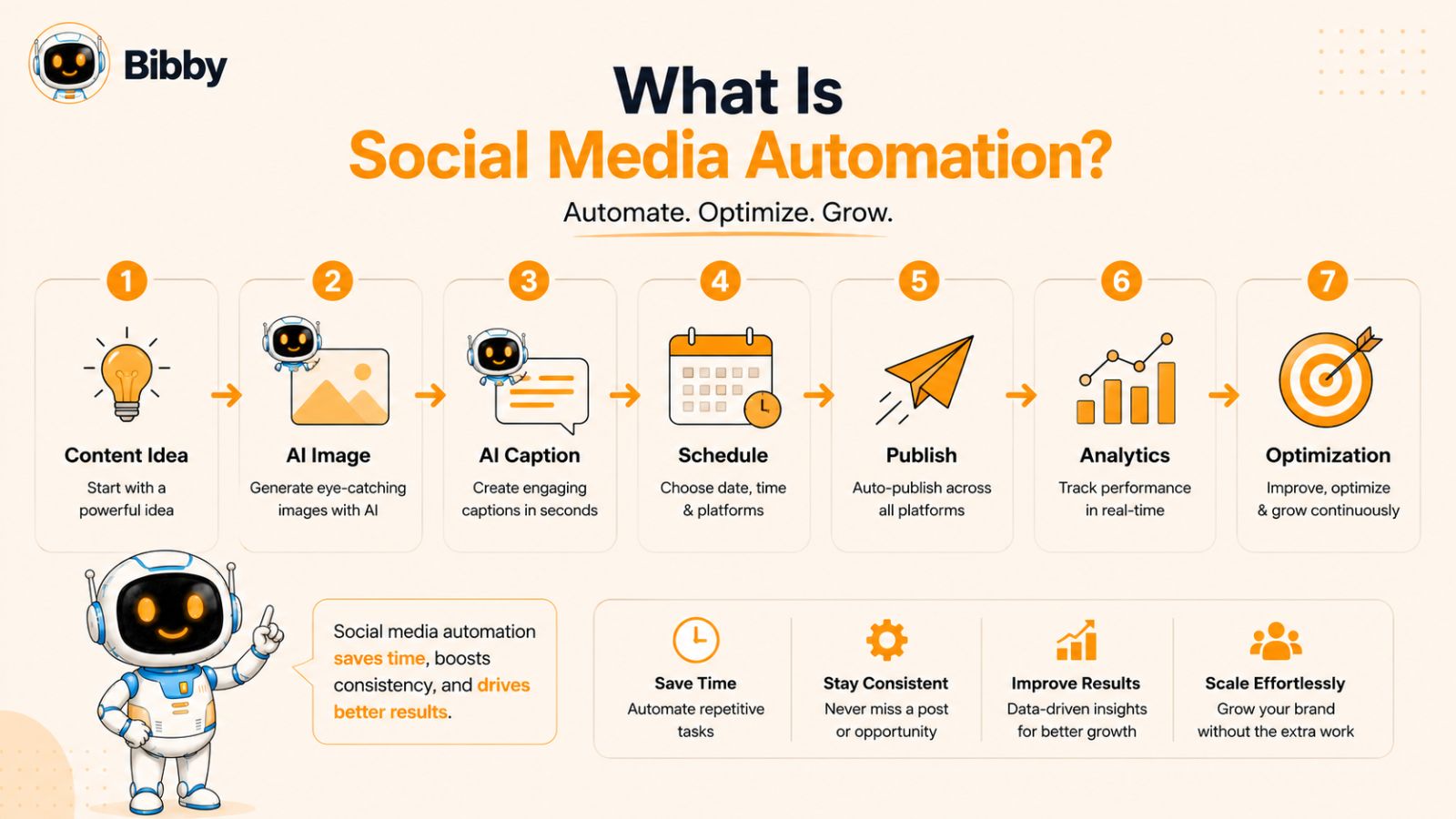
When implemented correctly, social media automation improves consistency, increases efficiency, and helps businesses maintain an active online presence without adding more work to their daily routine.
Automation vs. Scheduling: What's the Difference?
Many people use the terms social media scheduling and social media automation interchangeably, but they aren't the same.
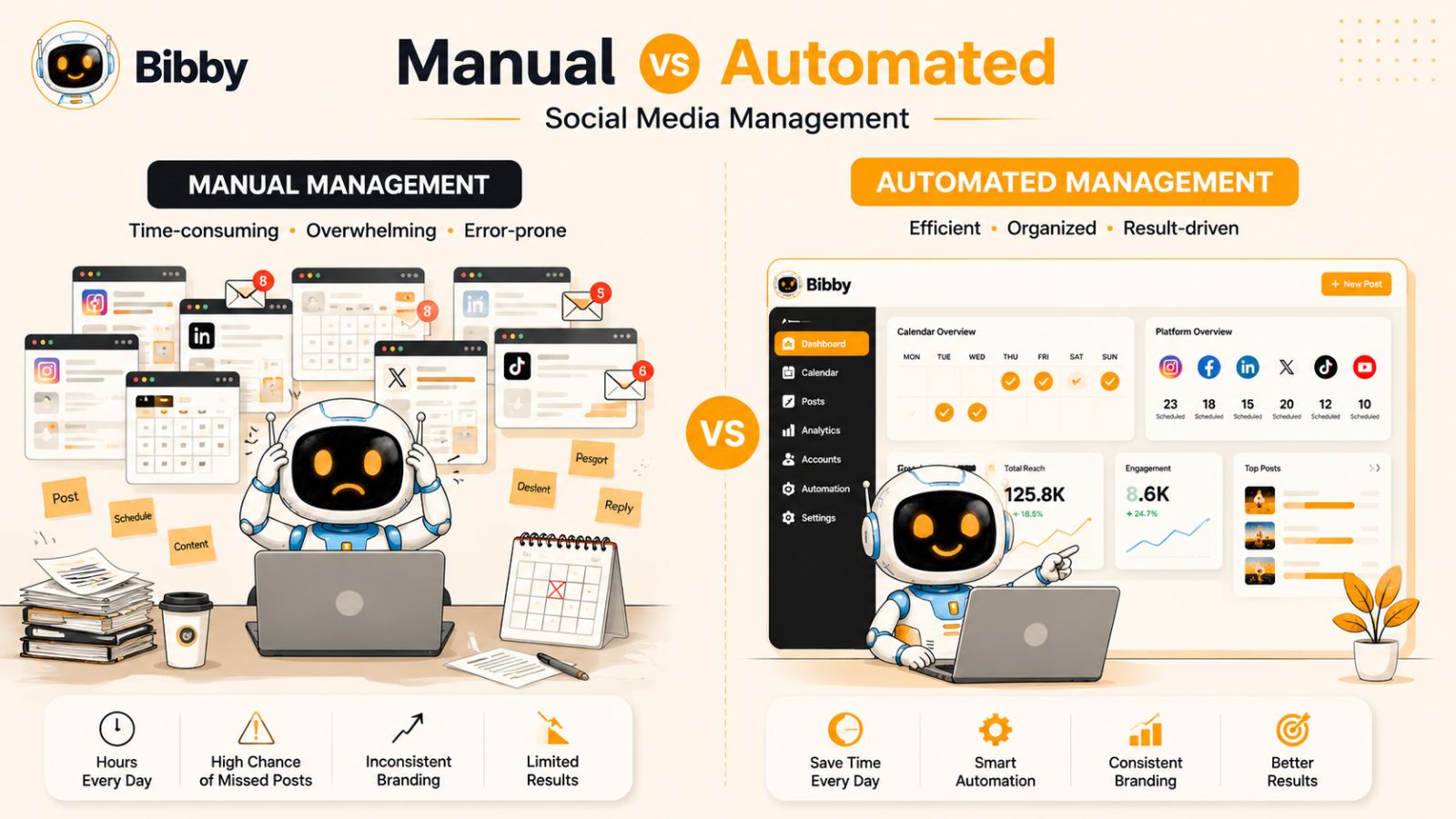
Social media scheduling focuses on publishing content at a specific date and time. You create your post, choose when it should go live, and the scheduling tool publishes it automatically.
Social media automation goes much further. In addition to scheduling, it can help with:
- Generating AI-powered captions
- Creating or enhancing images with AI
- Resizing media for different social platforms
- Publishing to multiple platforms simultaneously
- Recommending the best posting times
- Organizing content with a publishing calendar
- Monitoring engagement and performance through analytics
Think of scheduling as one feature, while automation is the complete workflow that supports your social media marketing from content creation to performance analysis.
The Role of AI in Modern Social Media Automation
Artificial intelligence has transformed social media automation from a simple publishing tool into a powerful marketing assistant.
AI can help marketers brainstorm content ideas, generate engaging captions, suggest relevant hashtags, recommend optimal posting times based on audience behavior, and even create visuals from text prompts. It also analyzes performance data to identify which types of content generate the most engagement, helping businesses continuously improve their strategy.
This means marketing teams spend less time on repetitive tasks and more time focusing on creative campaigns, customer relationships, and business growth.
Why B2B Companies Are Embracing Automation
B2B marketing often involves multiple products, long sales cycles, and several decision-makers. Maintaining a consistent presence across platforms while producing educational, informative content can quickly become time-consuming.
Social media automation helps solve these challenges by enabling teams to:
- Plan and schedule weeks or months of content in advance.
- Publish to multiple platforms from a single workflow.
- Maintain consistent branding across every channel.
- Reduce manual work and repetitive tasks.
- Track performance using centralized analytics.
- Scale social media efforts without significantly increasing marketing resources.
As AI continues to evolve, automation is becoming an essential part of modern B2B marketing. Companies that adopt the right tools can create more content, reach wider audiences, and maintain a consistent presence—all while giving their teams more time to focus on strategy and business growth.
Benefits of Social Media Automation for B2B Companies
Managing social media manually can quickly become overwhelming, especially for B2B companies that publish educational content across multiple platforms. From creating visuals and writing captions to scheduling posts and analyzing performance, every step requires time and attention.
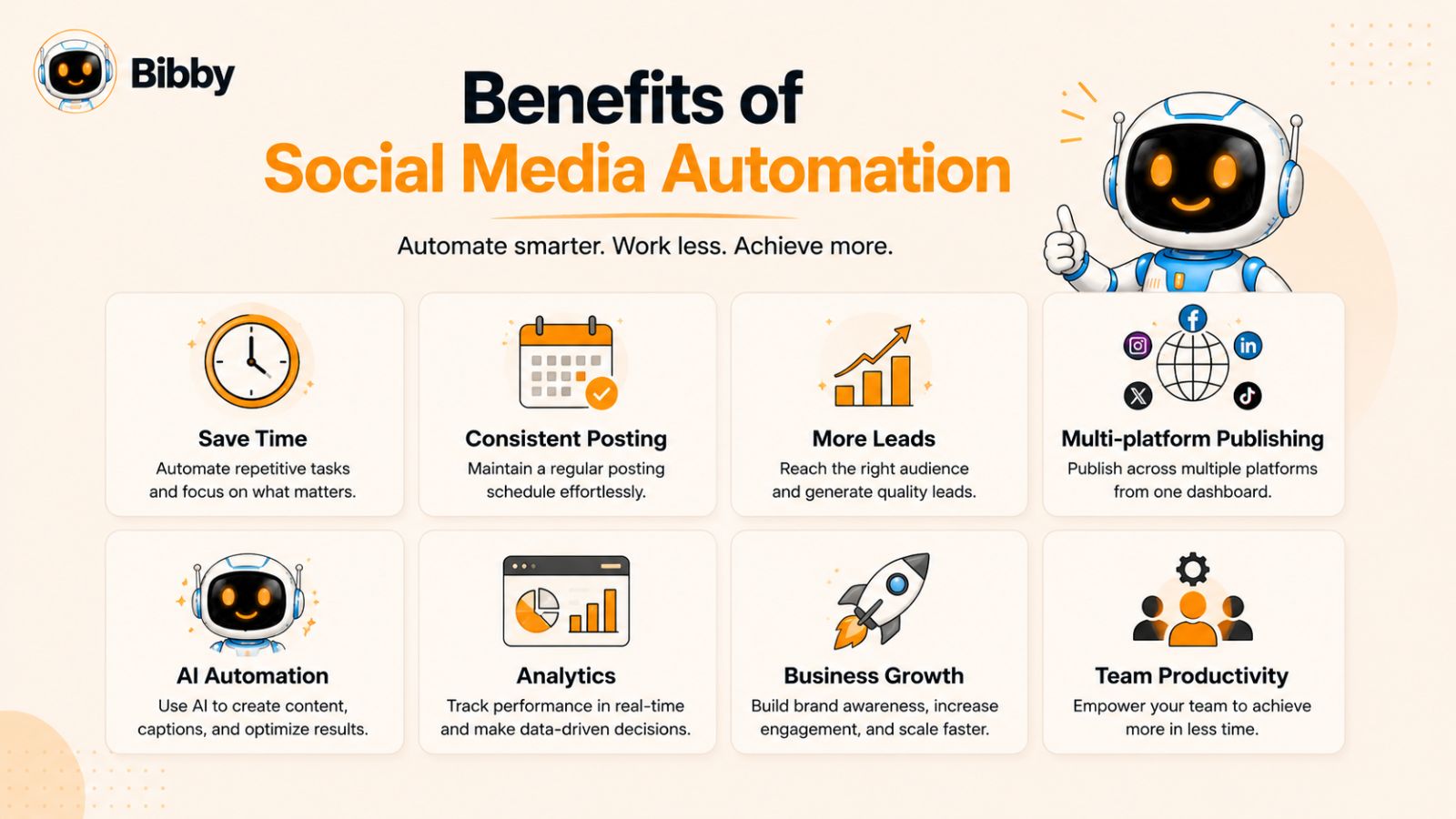
Social media automation simplifies these repetitive tasks, allowing marketing teams to work more efficiently while maintaining a consistent online presence. Here are some of the biggest benefits B2B companies can expect.
Save Hours Every Week
One of the most immediate advantages of social media automation is the time it saves. Instead of logging into multiple platforms every day, marketers can plan, create, and schedule content weeks—or even months—in advance.
This reduces repetitive work and gives teams more time to focus on strategic initiatives like campaign planning, lead nurturing, customer engagement, and content creation.
Maintain Consistent Posting
Consistency is one of the most important factors in building a strong social media presence. Regular posting keeps your brand visible, helps maintain audience engagement, and signals reliability to potential customers.
Automation ensures your content is published according to a planned schedule, even during weekends, holidays, or busy work periods. This helps maintain momentum without requiring daily manual effort.
Publish Across Multiple Platforms Simultaneously
Every social media platform has its own audience, but managing each one separately can be time-consuming.
With automation, you can publish content to platforms like LinkedIn, Facebook, Instagram, YouTube, and TikTok from a single dashboard. This eliminates duplicate work while helping your business maintain a consistent brand presence across every channel.
Increase Brand Awareness
The more consistently your business appears in your audience's social feeds, the more recognizable your brand becomes.
Sharing educational content, industry insights, customer success stories, product updates, and thought leadership on a regular basis helps establish your company as a trusted authority in your industry.
Generate More Qualified Leads
B2B buyers often consume multiple pieces of content before reaching out to a company. Consistent social media activity keeps your business visible throughout this research process.
By regularly sharing valuable content and directing prospects to landing pages, webinars, case studies, or product demonstrations, automation supports a steady flow of qualified leads into your sales pipeline.
Improve Team Productivity
Marketing teams often spend too much time on repetitive administrative tasks.
Automation reduces the need for manual publishing, repetitive copy-and-paste work, and switching between multiple social platforms. This allows team members to dedicate more time to creativity, campaign optimization, customer engagement, and strategic decision-making.
Reduce Human Errors
Manually publishing content increases the risk of mistakes, such as posting on the wrong account, using outdated creative assets, missing scheduled campaigns, or forgetting to publish altogether.
Automation helps standardize workflows and minimize these errors by organizing content in advance and ensuring posts are published according to schedule.
Scale Marketing Without Expanding Your Team
As your business grows, so does the demand for more content across more platforms. Hiring additional staff isn't always the most practical or cost-effective solution.
Social media automation enables existing marketing teams to manage a larger content calendar, publish more frequently, and support multiple campaigns without dramatically increasing their workload. This makes it easier to scale your marketing efforts while keeping operational costs under control.
Gain Actionable Performance Insights
Publishing content is only part of the process—understanding what works is equally important.
Most modern social media automation platforms include built-in analytics that track metrics such as reach, engagement, clicks, follower growth, and top-performing content. These insights help marketers refine their strategy, identify successful content formats, and make data-driven decisions that improve future campaigns.
Stay Competitive in a Fast-Moving Digital Landscape
B2B companies that consistently publish high-quality content are more likely to stay visible, build trust, and remain top of mind with potential customers. Automation makes it possible to keep pace with competitors without sacrificing quality or overwhelming your marketing team.
When combined with AI-powered content creation, intelligent scheduling, and centralized analytics, social media automation becomes more than just a time-saving tool—it becomes a scalable system for long-term business growth.
Common Social Media Automation Mistakes (And How to Avoid Them)
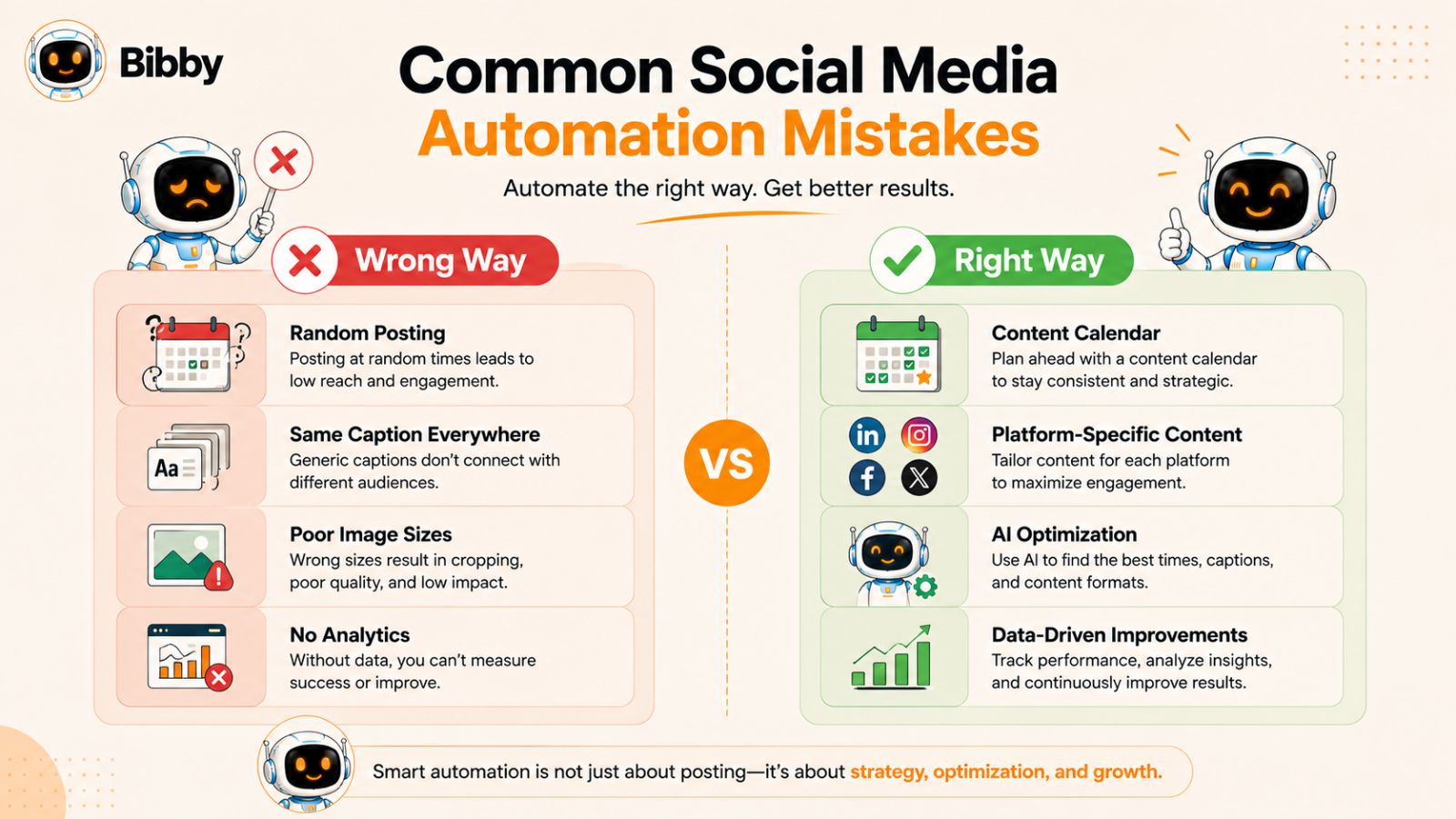
Social media automation can dramatically improve efficiency, but it isn't a "set it and forget it" solution. The most successful B2B companies combine automation with thoughtful content, genuine engagement, and ongoing optimization.
Avoiding these common mistakes will help you get better results while maintaining an authentic brand presence.
Automating Everything
Automation should support your marketing efforts—not replace human interaction.
While scheduling posts and streamlining repetitive tasks is beneficial, responding to comments, answering customer questions, and participating in industry conversations should still be handled personally. These interactions build trust and strengthen relationships with your audience.
Best Practice: Automate publishing, but make time each day to engage with your community.
Posting the Same Content Everywhere
Every social media platform has a different audience, content format, and user behavior. Publishing the exact same post across every channel often leads to lower engagement.
For example, a detailed professional update may perform well on LinkedIn, while a shorter, more visual version of the same message may resonate better on Instagram or Facebook. A concise video clip could be the best fit for TikTok or YouTube Shorts.
Best Practice: Adapt your messaging, visuals, and formatting for each platform while maintaining a consistent brand voice.
Ignoring Analytics
Many businesses schedule their content and rarely review the results. Without measuring performance, it's impossible to know which posts generate engagement, drive website traffic, or produce qualified leads.
Tracking analytics helps you identify what your audience enjoys, which posting times perform best, and which content formats deserve more attention.
Best Practice: Review your analytics regularly and use the insights to improve your content strategy over time.
Focusing on Quantity Instead of Quality
Publishing multiple posts every day doesn't guarantee better results. In fact, low-quality or repetitive content can reduce engagement and make your audience less likely to interact with your brand.
It's far more effective to publish fewer, high-value posts that educate, solve problems, or inspire your target audience.
Best Practice: Prioritize quality, relevance, and consistency over posting frequency alone.
Forgetting to Optimize Images and Videos
Every social media platform has its own recommended image sizes, video dimensions, and aspect ratios. Uploading incorrectly sized media can result in cropped images, distorted videos, or unprofessional-looking posts.
Preparing separate versions for every platform manually is time-consuming and increases the chance of errors.
Best Practice: Use a platform that automatically optimizes your images and videos for each social network, ensuring your content always looks professional.
Overlooking AI as a Productivity Tool
Some businesses still view AI as a replacement for creativity, when it's actually most valuable as a productivity assistant.
AI can help generate caption ideas, recommend hashtags, suggest posting times, organize content calendars, and even create initial visual concepts. Human review ensures the final content matches your brand voice and business goals.
Best Practice: Let AI handle repetitive tasks while your team focuses on strategy, creativity, and relationship building.
Not Having a Content Plan
Automation works best when supported by a clear content strategy. Scheduling random posts without defined goals often leads to inconsistent messaging and missed opportunities.
Develop a content calendar that includes a healthy mix of educational content, industry insights, customer success stories, product updates, company news, videos, and promotional campaigns.
Best Practice: Plan content several weeks in advance and align your publishing schedule with your marketing objectives.
Choosing the Wrong Automation Tool
Not all social media automation platforms offer the same capabilities. Some only schedule posts, while others provide AI-powered content creation, automatic media resizing, analytics, video publishing, story scheduling, and multi-platform management.
Selecting a platform that fits your workflow can significantly reduce manual work and help your marketing team operate more efficiently.
Best Practice: Look for a solution that combines content creation, AI assistance, scheduling, publishing, analytics, and support for multiple content formats in one intuitive workflow.
What Can You Automate?
One of the biggest misconceptions about social media automation is that it only schedules posts. In reality, modern automation platforms can streamline nearly every stage of your social media workflow—from content creation to publishing and performance tracking.
By automating repetitive tasks, B2B companies can spend less time managing social media and more time creating valuable content, engaging with their audience, and driving business growth.
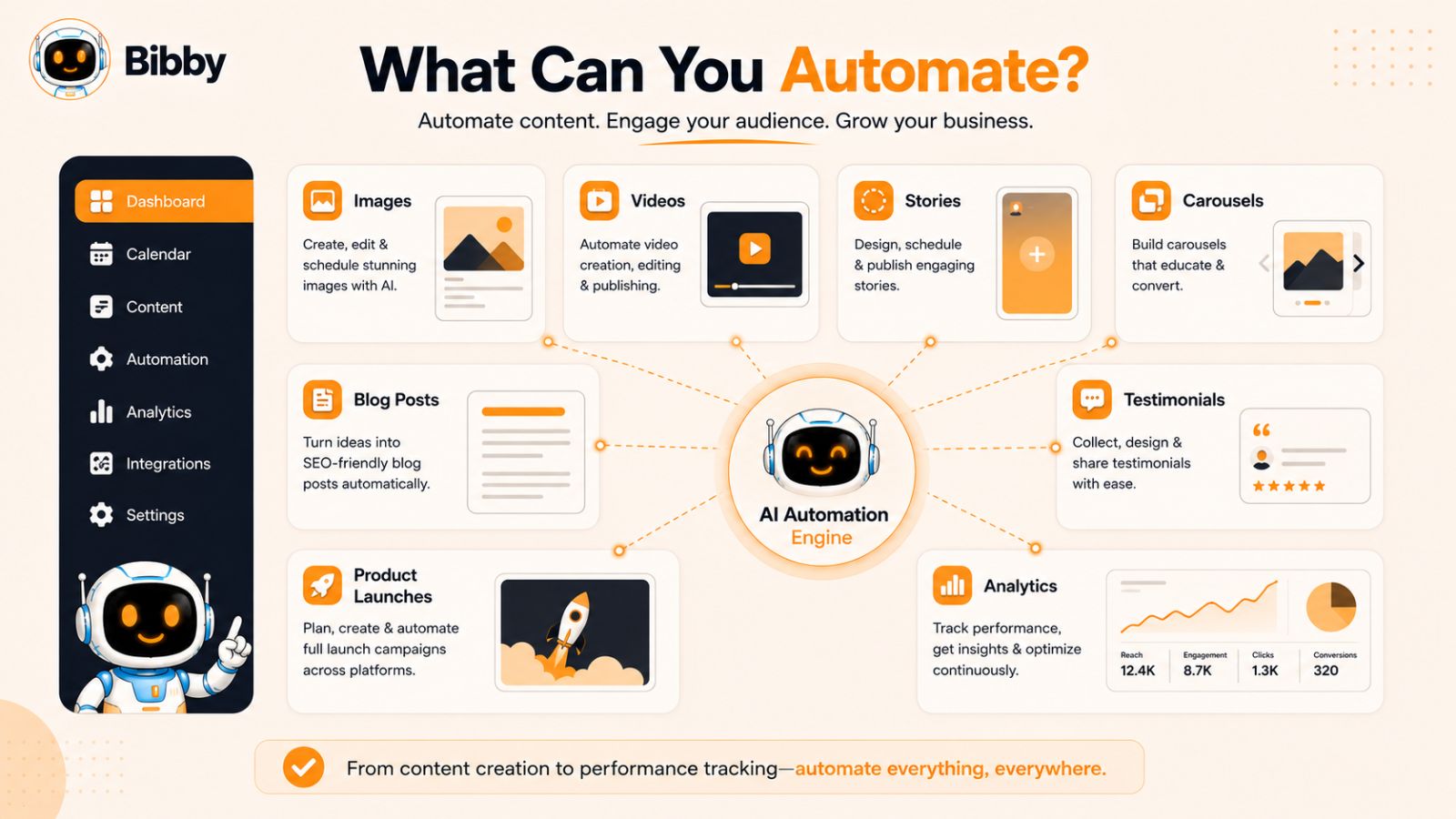
Here are some of the most common tasks you can automate.
Image Posts
Image posts remain one of the most effective ways to share industry insights, company updates, product announcements, and educational content.
Instead of uploading each image manually to multiple platforms, automation tools allow you to prepare your content once and publish it everywhere according to your schedule. Many platforms also optimize image dimensions for each social network, ensuring your posts always look professional.
Video Posts
Video has become one of the fastest-growing content formats across every major social platform.
Whether you're publishing product demonstrations, customer testimonials, webinars, tutorials, or behind-the-scenes content, automation tools can help schedule and publish videos across multiple platforms from a single dashboard.
Stories
Stories on platforms like Instagram and Facebook offer an excellent way to share time-sensitive updates, promotions, event reminders, and behind-the-scenes moments.
Instead of remembering to post manually throughout the day, you can schedule stories in advance to maintain consistent engagement with your audience.
Carousels
Carousel posts are highly effective for educational content, step-by-step guides, product features, and industry insights.
Automation platforms make it easy to prepare carousel posts ahead of time and publish them according to your content calendar, helping you maintain a steady flow of valuable content.
Short-Form Videos
Short-form video content continues to dominate platforms like TikTok, Instagram Reels, Facebook Reels, YouTube Shorts, and LinkedIn's video feed.
These bite-sized videos are ideal for sharing quick tips, answering common customer questions, showcasing product features, or highlighting company expertise. Scheduling them in advance ensures your content reaches your audience consistently without requiring daily uploads.
Blog Promotion
Publishing a blog post is only the first step. Promoting it consistently across social media helps increase visibility, drive website traffic, and extend the lifespan of your content.
Automation allows you to schedule multiple promotional posts for the same article over several weeks or months, reaching different audience segments without creating duplicate work.
Customer Testimonials
Testimonials, reviews, and case studies help establish credibility and build trust with potential customers.
By scheduling these posts as part of your regular content calendar, you can consistently reinforce your company's expertise and showcase real-world success stories.
Product Announcements
Launching a new product, feature, or service often requires coordinated communication across multiple channels.
Automation helps ensure announcements are published simultaneously across your selected platforms, creating a consistent experience for your audience and maximizing reach.
Event Promotion
Whether you're hosting a webinar, attending a trade show, or launching a virtual event, automation makes it easy to schedule reminder posts before, during, and after the event.
This helps maintain awareness while reducing the pressure of publishing updates manually during busy event days.
Evergreen Content
Some content remains valuable for months or even years. Educational articles, how-to guides, industry statistics, FAQs, and best practices can continue generating engagement long after they're published.
Automation tools allow you to recycle and reschedule evergreen content at appropriate intervals, helping you maximize the return on your content investment while keeping your social channels active.
Analytics and Performance Monitoring
Automation doesn't stop after your content is published. Many modern platforms automatically collect performance data, including impressions, reach, engagement, clicks, follower growth, and audience trends.
Having these insights in one place makes it easier to understand what's working, identify opportunities for improvement, and refine your social media strategy over time.
Bringing It All Together
The more tasks you automate, the more efficient your marketing workflow becomes. Instead of juggling multiple design tools, scheduling platforms, spreadsheets, and analytics dashboards, B2B companies can manage their entire social media strategy through a centralized system.
This not only saves time but also improves consistency, reduces manual errors, and makes it easier to scale your social media efforts as your business grows.
Social Media Platforms Every B2B Company Should Automate
Not every social media platform serves the same purpose, and B2B companies don't need to approach them all in the same way. Each platform attracts different audiences, supports different content formats, and plays a unique role in the buyer's journey.
A successful social media automation strategy ensures your content reaches the right audience on the right platform without requiring your team to manage each channel separately.
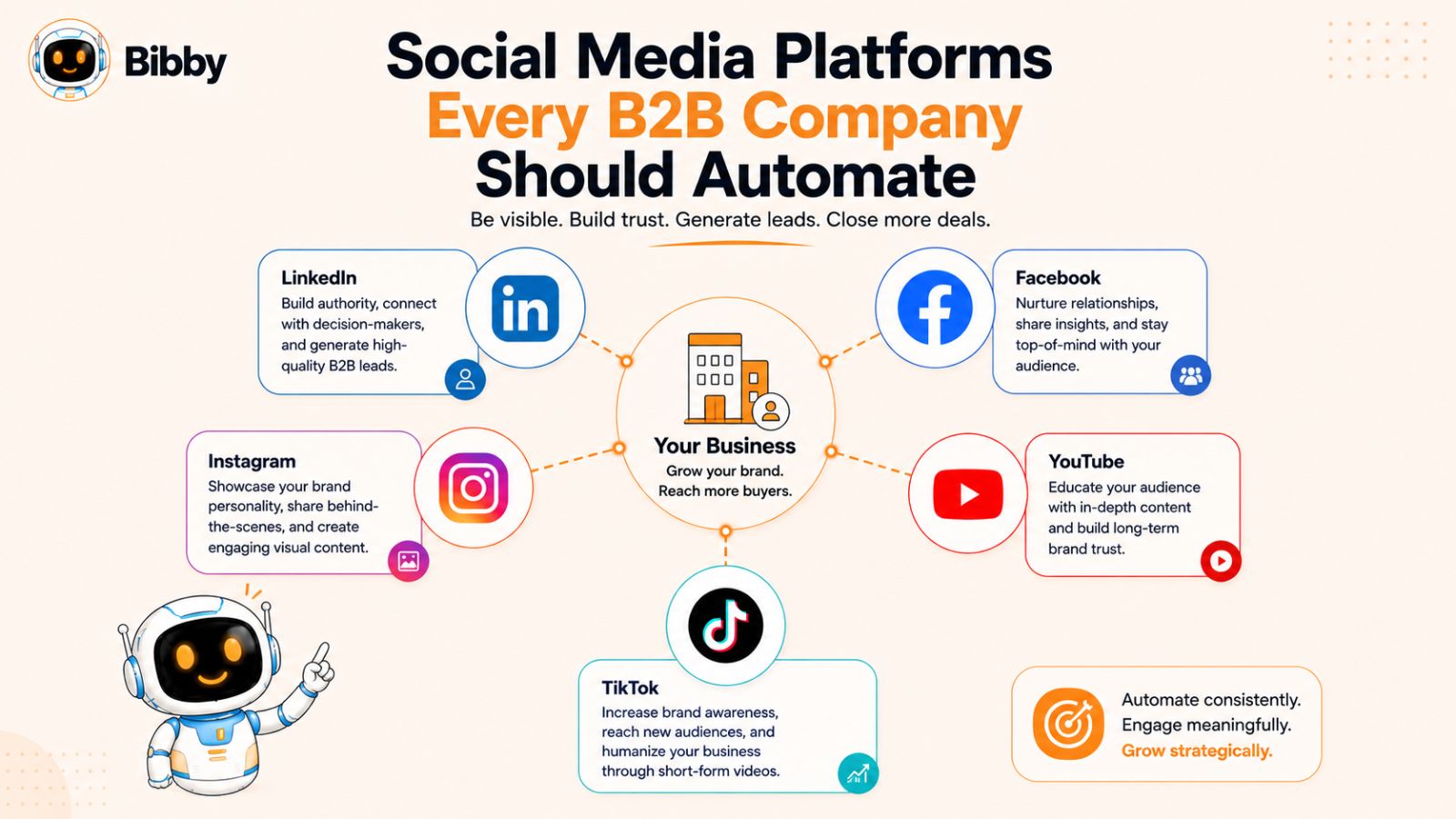
LinkedIn: The B2B Networking Hub
LinkedIn is the most important social platform for B2B companies. Decision-makers, executives, business owners, and industry professionals use it to discover new solutions, learn from experts, and connect with brands.
Content that performs well on LinkedIn includes:
- Industry insights
- Thought leadership articles
- Company updates
- Case studies
- Customer success stories
- Product launches
- Hiring announcements
Maintaining a consistent posting schedule on LinkedIn helps establish authority, build professional relationships, and generate qualified leads.
Facebook: Build Communities and Increase Visibility
Although often associated with B2C marketing, Facebook continues to be valuable for many B2B organizations.
Businesses use Facebook to:
- Share company news
- Promote webinars and events
- Publish blog articles
- Showcase customer testimonials
- Build industry communities
- Run targeted advertising campaigns
Automating Facebook posts ensures your audience continues to receive valuable updates without requiring daily manual publishing.
Instagram: Humanize Your Brand
Instagram allows B2B companies to showcase the people behind the business while creating visually engaging content.
Popular content formats include:
- Behind-the-scenes photos
- Team highlights
- Office culture
- Infographics
- Product visuals
- Educational carousels
- Customer success stories
- Reels and Stories
A consistent Instagram presence helps businesses appear more approachable while strengthening brand recognition.
YouTube: Educate and Build Long-Term Trust
Video content plays a major role in the B2B buying process. Many prospects prefer watching a product demonstration or tutorial before contacting a sales team.
YouTube is ideal for publishing:
- Product demonstrations
- Tutorials
- Webinars
- Industry discussions
- Customer case studies
- Frequently asked questions
- Training videos
Unlike short-lived social posts, YouTube videos can continue attracting viewers and generating leads for months or even years after publication.
TikTok: Reach the Next Generation of Decision-Makers
TikTok has evolved beyond entertainment and is increasingly being used by businesses to share educational and informative content.
B2B companies are finding success with:
- Industry tips
- Quick tutorials
- Product highlights
- Company culture
- Myth-busting videos
- Event highlights
- Thought leadership clips
Short-form educational videos can help businesses reach younger professionals and future decision-makers while increasing brand awareness.
Why a Multi-Platform Strategy Matters
Your audience isn't limited to one social network. A potential customer may discover your brand through a LinkedIn article, watch a product demo on YouTube, follow your company on Instagram, and later engage with your content on Facebook.
Being active across multiple platforms increases your chances of staying visible throughout the buyer's journey. It also allows you to repurpose content into different formats, extending the value of every piece you create.
For example, a single webinar can become:
- A full-length YouTube video
- Several LinkedIn posts highlighting key insights
- An Instagram carousel summarizing the main takeaways
- Multiple short clips for TikTok and Instagram Reels
- A Facebook post linking to the recording
- A blog article shared across all platforms
This approach maximizes your content investment while reaching audiences where they prefer to consume information.
Simplify Multi-Platform Management with Automation
Managing five or more social media platforms manually can quickly become overwhelming. Each platform has different content requirements, recommended image sizes, posting schedules, and audience behaviors.
A modern social media automation platform brings everything together in one place. Instead of switching between multiple apps, marketing teams can create content once, customize it for each platform, schedule posts, and monitor performance from a single dashboard.
This streamlined workflow saves time, reduces manual effort, and helps B2B companies maintain a consistent and professional presence across every major social network.
You may also try our free Post Idea Generator.
Creating an Efficient B2B Social Media Workflow
Creating high-quality social media content consistently doesn't have to be complicated. The most successful B2B companies follow a structured workflow that reduces manual work, improves consistency, and ensures every post supports their marketing goals.
Instead of jumping between design tools, AI writing assistants, scheduling platforms, and analytics dashboards, a streamlined workflow brings everything together in one place.
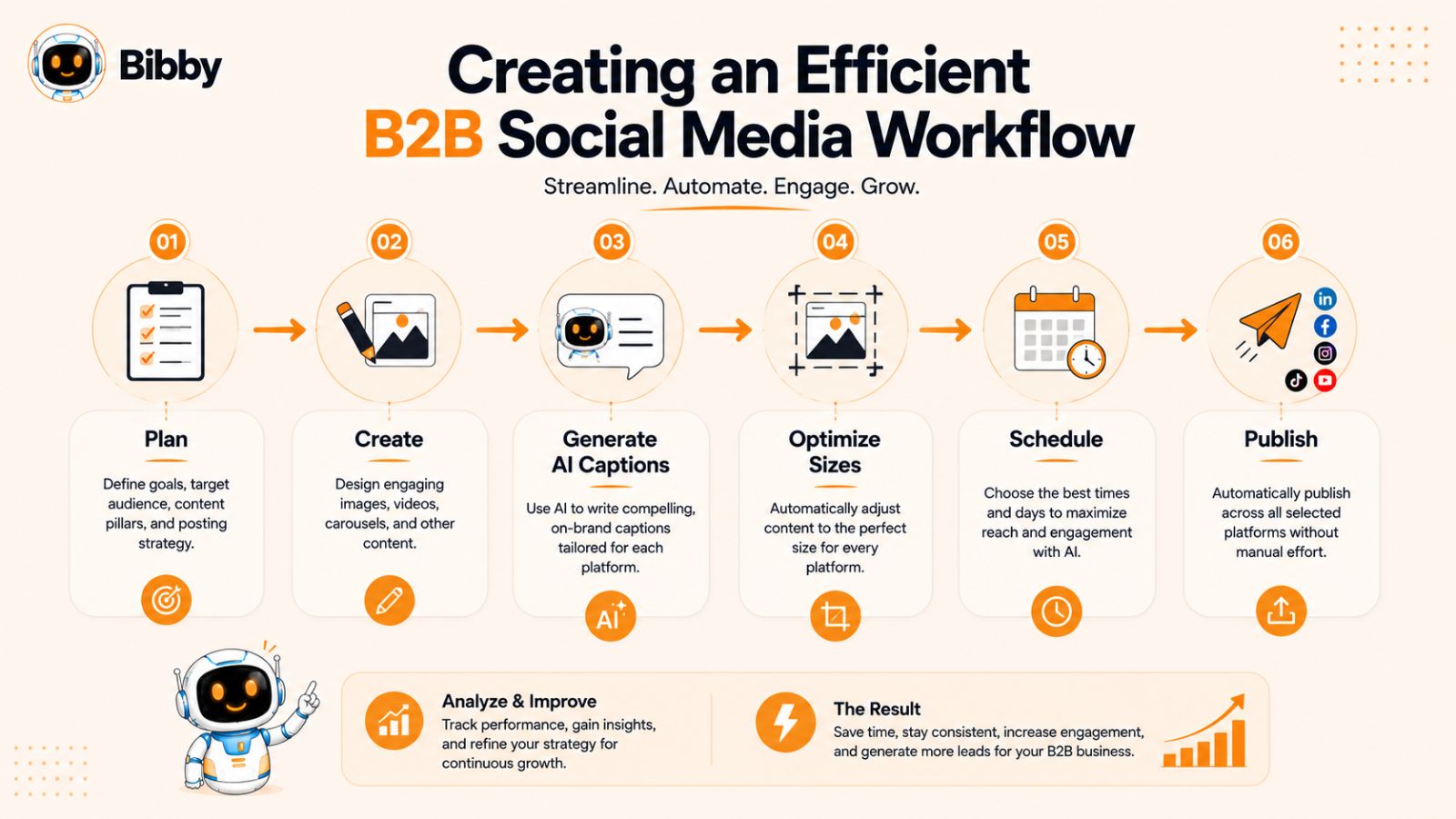
Here's what an efficient B2B social media workflow looks like.
Step 1: Plan Your Content
Every successful social media strategy starts with a content plan.
Before creating posts, identify:
- Your target audience
- Marketing objectives
- Key campaigns
- Content themes
- Publishing frequency
- Social platforms
Planning content in advance helps maintain consistency while ensuring every post aligns with your overall business goals.
Step 2: Create or Generate Your Visuals
Visual content is often the first thing users notice.
Depending on your campaign, you can:
- Upload professionally designed graphics
- Create branded images
- Use product screenshots
- Publish infographics
- Generate visuals with AI
Having the ability to generate images with AI significantly speeds up content creation, especially when producing educational or promotional posts at scale.
Step 3: Generate Engaging Captions
Writing captions for every platform can be surprisingly time-consuming.
Each social network has a different audience, tone, and ideal content style. Instead of writing every caption from scratch, AI can generate engaging copy that you can review and personalize before publishing.
This saves time while helping maintain a consistent brand voice across all platforms.
Step 4: Optimize Content for Every Platform
One of the biggest challenges in social media marketing is preparing content for multiple platforms.
Each network has different recommendations for:
- Image dimensions
- Video formats
- Aspect ratios
- Caption lengths
- Content styles
Rather than manually resizing and adjusting every asset, use a platform that automatically prepares your content for each social network. This ensures your posts look professional wherever they're published.
Step 5: Schedule Posts at the Right Time
Publishing at the right time can significantly improve visibility and engagement.
Instead of manually posting throughout the day, schedule your content in advance and use AI-powered recommendations to publish when your audience is most active.
This keeps your social channels consistently active—even outside business hours or during busy periods.
Step 6: Publish Across Multiple Platforms
Managing LinkedIn, Facebook, Instagram, YouTube, and TikTok individually can quickly become overwhelming.
A centralized publishing workflow allows you to distribute your content across multiple platforms from a single dashboard while still customizing posts where necessary.
This saves valuable time and eliminates repetitive tasks.
Step 7: Measure Performance and Improve
The workflow doesn't end when your content is published.
Regularly reviewing analytics helps answer important questions, such as:
- Which posts generated the most engagement?
- Which platforms drive the most traffic?
- What content produces the most leads?
- When is your audience most active?
- Which content formats perform best?
These insights help you continuously improve your strategy and make better content decisions over time.
How Bibby Simplifies the Entire Workflow
Many businesses rely on multiple tools for design, AI writing, scheduling, publishing, and analytics. While this approach works, it often creates unnecessary complexity, increases costs, and slows down your marketing team.
Bibby brings the entire social media workflow into one intuitive platform, making it easier for B2B companies to create, publish, and manage content at scale.
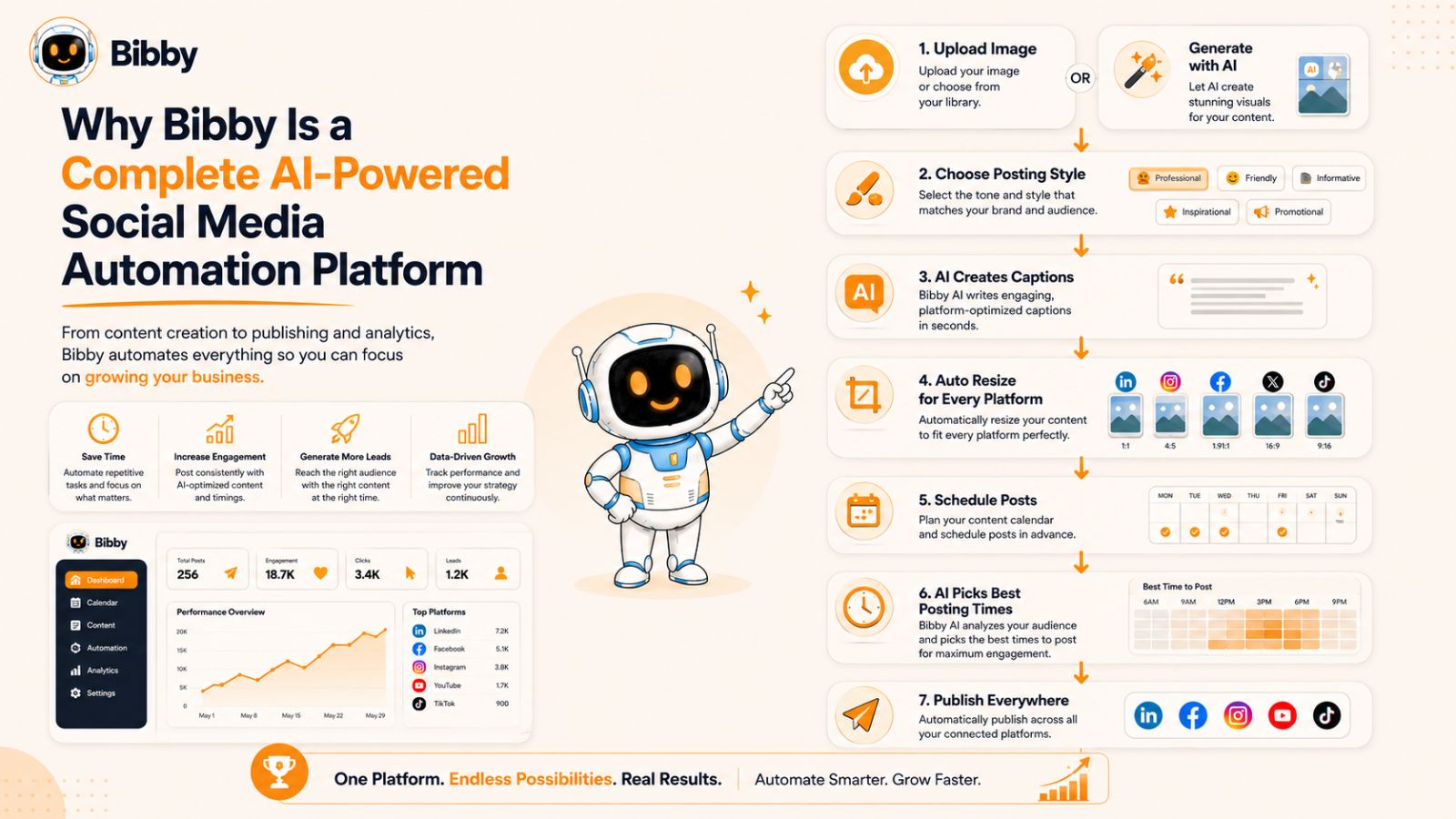
With Bibby, the process is simple:
- Upload your own image or generate one using AI.
- Choose your preferred posting style based on your content goals.
- Let Bibby automatically generate engaging captions using AI.
- Bibby prepares your content in the correct dimensions for every supported social media platform.
- Schedule your posts across Facebook, Instagram, LinkedIn, YouTube, and TikTok from one dashboard.
- AI recommends optimized publishing times to maximize visibility and engagement.
- Monitor performance through built-in analytics to understand what resonates with your audience.
Beyond standard image posts, Bibby also supports videos, Stories, and other social media formats, allowing you to manage nearly every aspect of your publishing strategy from a single workspace.
By replacing multiple disconnected tools with one streamlined workflow, Bibby helps marketing teams spend less time on repetitive tasks and more time creating meaningful content, engaging with prospects, and driving business growth.
Also have a look: Social Media Marketing Goals Every Small Business Should Set
Why Bibby Is a Complete AI-Powered Social Media Automation Platform
Choosing the right Social Media Automation tool can make a significant difference in your marketing team's productivity. While many platforms focus solely on scheduling posts, modern businesses need a solution that simplifies the entire content lifecycle—from creation and optimization to publishing and performance tracking.
Bibby is designed to help B2B companies manage all of these tasks from one intuitive platform, reducing manual work and enabling teams to publish high-quality content consistently.
Create Content Faster with AI
Creating fresh content every day can be challenging, especially for lean marketing teams.
With Bibby, you can either upload your own images or generate new visuals using AI. This allows you to quickly create content for product launches, educational posts, promotions, industry insights, and company updates without relying on multiple design tools.
Whether you're planning content weeks in advance or responding to trending topics, AI-powered image generation helps speed up the creative process.
Generate Captions Automatically
Writing engaging captions for every post is another time-consuming task.
Bibby uses AI to generate captions based on your selected posting style, helping you create professional and engaging copy in seconds. Instead of starting from a blank page, your team can review, edit, and personalize AI-generated captions to match your brand voice.
This not only saves time but also helps maintain consistency across your social media channels.
Automatically Optimize Content for Every Platform
Every social media platform has different image sizes, aspect ratios, and formatting requirements.
Preparing separate versions of the same content manually can be frustrating and time-consuming.
Bibby automatically prepares your media for supported platforms, helping ensure your posts look professional across:
- Instagram Feed
- Instagram Stories
- YouTube
- TikTok
This eliminates the need for manual resizing and reduces the risk of incorrectly formatted posts.
Schedule Everything from One Dashboard
Managing multiple social media accounts shouldn't require multiple tools.
Bibby allows you to schedule content across your selected social media platforms from a single dashboard. Whether you're publishing one post or planning an entire month's content, everything can be organized through a centralized content calendar.
This makes it easier to maintain consistency while reducing repetitive work.
Post at AI-Optimized Times
Timing plays a crucial role in social media performance.
Instead of guessing when your audience is online, Bibby uses AI to recommend optimized publishing times based on engagement patterns. This helps improve the visibility of your content and increases the likelihood of reaching your audience when they're most active.
Publish More Than Just Images
Modern social media marketing requires a variety of content formats.
Bibby supports publishing:
- Images
- Videos
- Stories
- Promotional posts
- Educational content
- Product announcements
- Brand updates
Managing different content types from one platform simplifies your workflow and helps you deliver a more engaging social media experience.
Monitor Performance with Built-In Analytics
Effective social media marketing doesn't end when a post is published.
Bibby's analytics dashboard helps you monitor important performance metrics, including:
- Reach
- Impressions
- Engagement
- Clicks
- Audience growth
- Top-performing content
These insights help you understand what resonates with your audience, identify opportunities for improvement, and make data-driven marketing decisions.
Built for Growing B2B Teams
Whether you're a startup building brand awareness, a SaaS company generating leads, a marketing agency managing multiple clients, or an enterprise organization coordinating large campaigns, Bibby provides a scalable workflow that grows with your business.
By bringing AI-powered content creation, automatic media optimization, multi-platform publishing, intelligent scheduling, and analytics into one platform, Bibby helps B2B marketing teams spend less time managing social media and more time delivering measurable business results.
Also read: Social Media Image Sizes for Every Platform
Example Weekly Social Media Automation Workflow
One of the biggest advantages of social media automation is the ability to batch your work. Instead of creating and publishing content every day, you can dedicate a few hours each week to planning, creating, scheduling, and analyzing your social media campaigns.
Here's an example of how a B2B marketing team can efficiently manage an entire week's social media strategy.
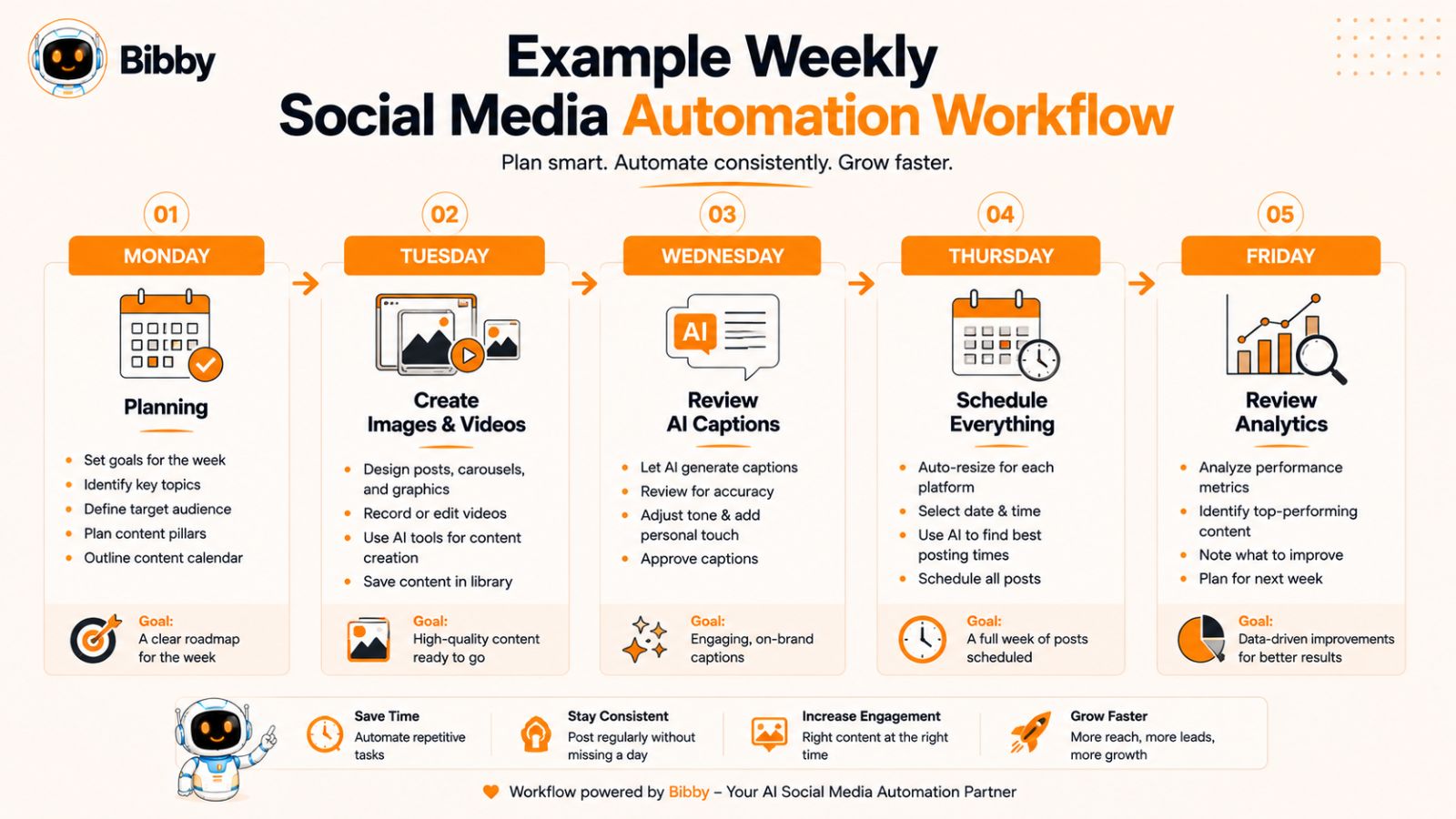
Monday: Plan Your Content
Start the week by defining what you want to communicate.
Review your marketing calendar and identify:
- Product launches
- Blog posts
- Industry news
- Customer success stories
- Upcoming webinars or events
- Seasonal campaigns
Then organize your content into categories such as educational, promotional, thought leadership, company culture, and customer stories. Planning in advance ensures a balanced content mix and keeps your messaging aligned with business goals.
Tuesday: Create Visuals and Content
Once your content plan is ready, create the assets you'll need for the week.
You can:
- Upload branded graphics
- Design infographics
- Record short videos
- Create product demonstrations
- Generate images with AI
Next, prepare your captions. AI-powered tools can generate first drafts, which you can refine to match your brand's tone and messaging.
Wednesday: Review and Optimize
Before scheduling your posts, take time to review everything.
Check for:
- Grammar and spelling
- Brand consistency
- Calls to action
- Correct links
- Image quality
- Platform-specific formatting
If you're publishing across multiple platforms, adjust captions where necessary to better suit each audience.
Thursday: Schedule Your Content
Now it's time to automate your publishing.
Upload your content into your social media automation platform, choose the appropriate platforms, and schedule posts for the coming days or weeks.
If your platform offers AI-powered scheduling, use its recommended posting times to maximize engagement and reach.
At this stage, you can also organize videos, Stories, carousels, and other content formats within your publishing calendar.
Friday: Review Analytics
End the week by measuring your results.
Review key performance metrics such as:
- Reach
- Engagement
- Click-through rate
- Follower growth
- Website traffic
- Top-performing posts
Identify which content generated the strongest response and note any patterns. Over time, these insights will help you refine your content strategy and improve future campaigns.
Repeat and Improve
Social media automation is an ongoing process rather than a one-time task. Every week provides new opportunities to test ideas, experiment with different content formats, and learn more about your audience.
As your library of content grows, you can repurpose evergreen posts, update older content with fresh insights, and continue building a consistent online presence without starting from scratch each time.
By following a structured workflow and using an all-in-one platform like Bibby, B2B companies can transform social media from a daily challenge into a predictable, scalable marketing system. Instead of spending hours switching between design tools, writing software, scheduling platforms, and analytics dashboards, your team can focus on creating valuable content, building relationships, and generating more business opportunities.
Measuring Success: Key Social Media Automation Metrics
Implementing social media automation is only the beginning. To understand whether your strategy is delivering real business value, you need to measure performance consistently and use those insights to improve future campaigns.
While likes and comments are encouraging, B2B companies should focus on metrics that align with broader marketing and business objectives, such as brand awareness, lead generation, website traffic, and customer engagement.
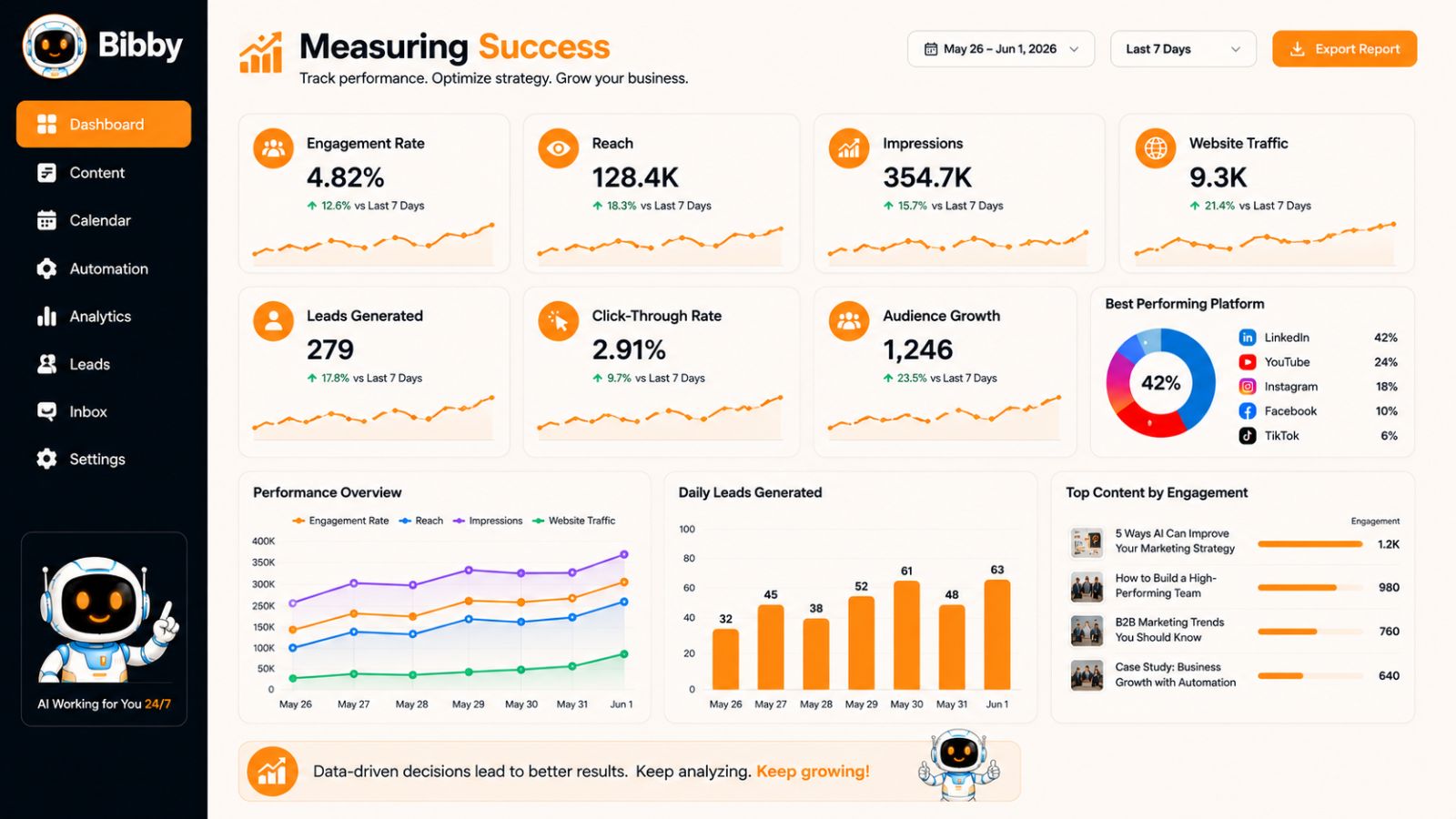
Here are the key metrics to monitor.
Engagement Rate
Engagement measures how your audience interacts with your content. It includes actions such as:
- Likes
- Comments
- Shares
- Saves
- Reactions
A high engagement rate indicates that your content resonates with your audience and encourages meaningful interactions. Educational posts, industry insights, and customer success stories often perform particularly well in B2B marketing.
Reach and Impressions
Although often confused, these metrics measure different aspects of content visibility.
- Reach is the number of unique people who see your content.
- Impressions represent the total number of times your content is displayed, including multiple views by the same person.
Monitoring both metrics helps you understand how effectively your content is being distributed across your chosen platforms.
Website Traffic
One of the primary goals of B2B social media marketing is driving potential customers to your website.
Monitor how much traffic your social media channels generate and identify:
- Which platforms send the most visitors
- Which posts generate the most clicks
- Which campaigns produce the highest-quality traffic
This information helps you allocate more effort to the channels delivering the best results.
Lead Generation
For many B2B companies, generating qualified leads is the ultimate objective.
Track how many prospects complete valuable actions after engaging with your social content, such as:
- Requesting a product demo
- Downloading an eBook or whitepaper
- Registering for a webinar
- Completing a contact form
- Starting a free trial
These conversions provide a much clearer picture of business impact than engagement metrics alone.
Audience Growth
Steady follower growth indicates that your brand is expanding its reach and attracting new potential customers.
Rather than focusing solely on the number of followers, pay attention to the quality of your audience. A smaller, highly relevant audience is often more valuable than a large following with little interest in your products or services.
Click-Through Rate (CTR)
Click-through rate measures how often users click on the links within your social media posts.
A higher CTR usually indicates that your headlines, visuals, and calls to action are compelling enough to encourage users to learn more about your products, services, or content.
Testing different messaging styles and creative formats can help improve this metric over time.
Top-Performing Content
Every audience has different preferences.
Review your highest-performing posts to identify patterns, such as:
- Topics that generate the most engagement
- Content formats that perform best
- Preferred posting times
- Platforms delivering the strongest results
Use these insights to create more of the content your audience values most.
Posting Consistency
Consistency is one of the greatest advantages of social media automation.
Review your publishing calendar regularly to ensure content is being shared according to your planned schedule. Consistent posting helps maintain visibility, strengthen brand recognition, and build trust with your audience over time.
Return on Investment (ROI)
Ultimately, every marketing activity should contribute to business growth.
Evaluate how your social media efforts support goals such as:
- Increasing brand awareness
- Driving website traffic
- Generating qualified leads
- Improving customer engagement
- Supporting sales opportunities
- Growing revenue
Tracking ROI helps justify your marketing investment and identifies opportunities to optimize future campaigns.
Use Analytics to Continuously Improve
The most successful B2B companies don't just collect data—they act on it.
Modern social media automation platforms provide centralized analytics dashboards that make it easy to monitor performance across multiple platforms. Instead of manually gathering reports from different social networks, you can review your most important metrics in one place, identify trends, and make informed decisions about your content strategy.
By regularly analyzing your results and refining your approach, your social media marketing becomes more effective over time. Combined with AI-powered content creation, intelligent scheduling, and automated publishing, data-driven optimization helps transform social media from a routine marketing task into a reliable engine for business growth.
Also try: AI Reel Script Generator
Frequently Asked Questions
What is social media automation for B2B companies?
Social media automation is the use of software and AI to streamline repetitive tasks such as creating content, generating captions, scheduling posts, publishing across multiple platforms, and analyzing performance. It helps B2B companies save time, maintain consistency, and focus on building relationships with prospects and customers.
Why should B2B companies automate social media?
Automation allows B2B companies to publish consistently, reach audiences across multiple platforms, reduce manual work, improve productivity, and generate more qualified leads. It also enables marketing teams to spend more time on strategy and customer engagement instead of repetitive administrative tasks.
Does social media automation reduce engagement?
No. Automation handles repetitive tasks like scheduling and publishing, but authentic engagement still comes from responding to comments, answering questions, and participating in conversations. The best results come from combining automation with genuine human interaction.
Can AI write social media captions?
Yes. Modern AI tools can generate captions based on your topic, audience, and preferred writing style. AI-generated captions can save significant time while giving marketers the flexibility to review and personalize the content before publishing.
Can I automate posts across multiple social media platforms?
Yes. Many social media automation platforms allow you to publish content across multiple channels from a single dashboard. Depending on the platform, you can manage networks such as LinkedIn, Facebook, Instagram, YouTube, and TikTok without logging into each account separately.
Can social media automation publish videos and Stories?
Yes. Many modern automation platforms support a variety of content formats, including images, videos, Stories, carousels, and short-form video content. This allows businesses to maintain a consistent presence across different social media channels using one workflow.
How does AI help choose the best posting time?
AI analyzes historical engagement data and audience activity to recommend publishing times when your followers are most likely to interact with your content. While no system can guarantee maximum engagement, AI-based recommendations can help improve the visibility and reach of your posts.
How does Bibby simplify social media management?
Bibby streamlines the entire social media workflow in one platform. You can upload your own images or generate visuals with AI, choose a posting style, generate AI-powered captions, automatically optimize content for different social media platforms, schedule posts at AI-recommended times, publish across multiple channels, and monitor performance using built-in analytics. It also supports various content formats, including images, videos, and Stories, helping B2B marketing teams save time while maintaining a consistent online presence.
What should I look for in a social media automation platform?
When choosing a platform, look for features such as:
- AI-powered caption generation
- AI image creation
- Multi-platform publishing
- Automatic media optimization
- Content calendar
- AI-recommended scheduling
- Video and Story support
- Built-in analytics
- Team collaboration
- An intuitive user interface
Selecting a platform that combines these features can simplify your workflow and improve your overall marketing efficiency.
Is social media automation suitable for small businesses?
Absolutely. Small businesses and startups often have limited marketing resources, making automation especially valuable. By reducing repetitive work and streamlining content management, automation allows smaller teams to maintain a professional social media presence without significantly increasing their workload.
Also read: Social Media Growth Myths vs Reality: What Actually Works Today
Conclusion
Social media automation has evolved from a convenience into a competitive advantage for B2B companies. By automating repetitive tasks, maintaining a consistent publishing schedule, and using AI to streamline content creation, businesses can spend less time managing social media and more time building relationships, generating leads, and growing their brand.
The three biggest takeaways are simple: develop a structured social media workflow, use automation to improve efficiency without sacrificing authentic engagement, and measure your results so you can continuously optimize your strategy. When these elements work together, social media becomes a scalable growth channel instead of a daily administrative task.
Platforms like Bibby bring this entire process together by combining AI-powered image generation, automatic caption creation, platform-specific media optimization, multi-platform publishing, AI-recommended scheduling, and built-in analytics into one streamlined workflow. Instead of juggling multiple tools, your team can manage every stage of your social media strategy from a single dashboard.
As your social media strategy matures, the next step is learning how to create content that consistently attracts, educates, and converts your ideal customers. Building a repeatable AI-powered content strategy will help you maximize the value of your automation tools and turn every post into an opportunity to grow your business.