
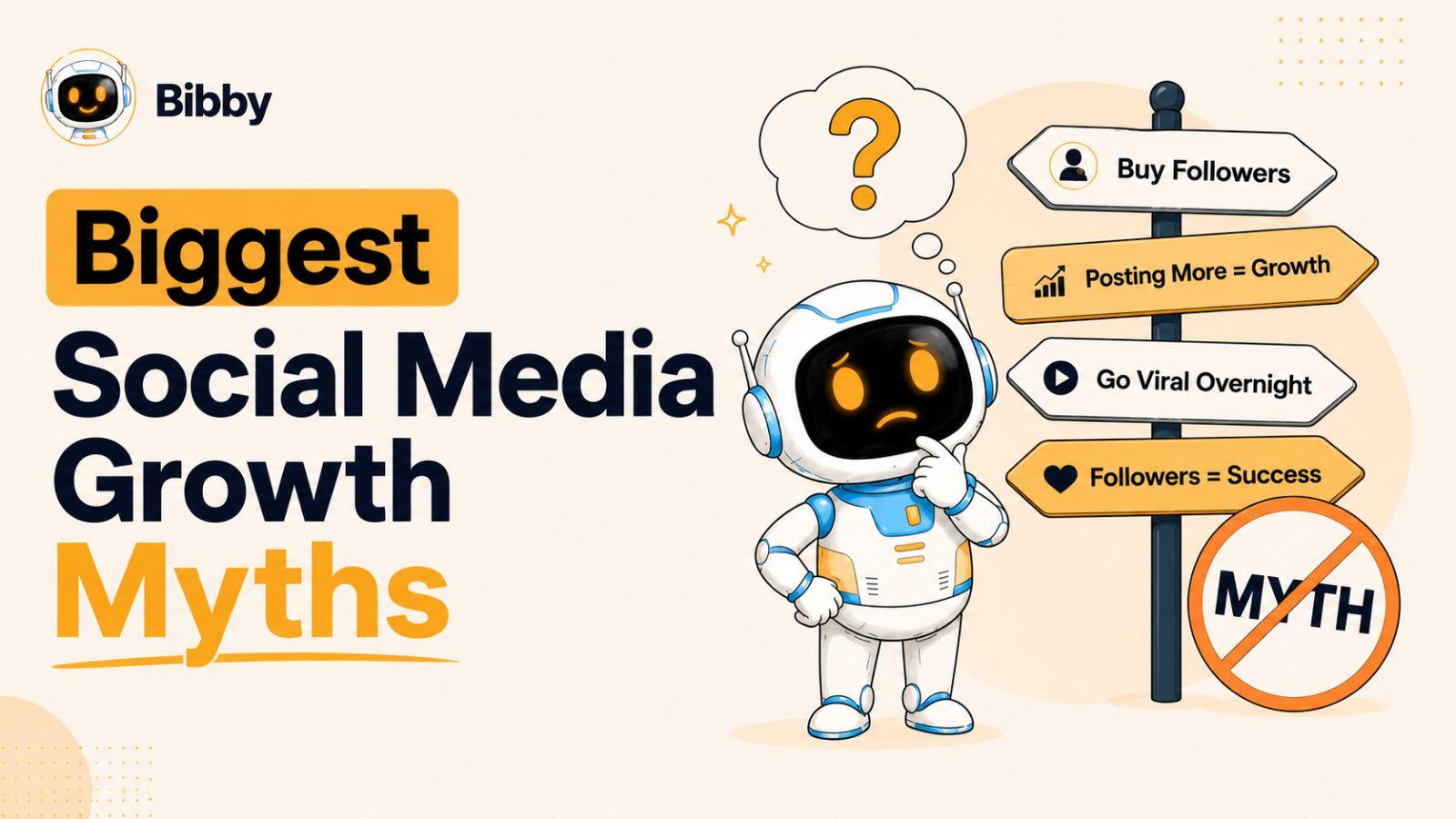
Social media has never offered brands more opportunities to reach customers—yet growing an audience has never felt more confusing.
Every day, marketers are bombarded with advice about beating algorithms, posting more often, chasing viral trends, and growing follower counts. The problem is that much of this advice is outdated, oversimplified, or completely wrong. While brands obsess over tactics that promise quick growth, they often overlook the strategies that actually drive engagement, build communities, and generate revenue.
The result? Countless businesses spend hundreds of hours creating content, only to see disappointing reach, stagnant engagement, and little return on their efforts.
In reality, successful social media growth isn't about posting 10 times a day, going viral, or manually managing every platform. Modern growth comes from understanding how platforms reward valuable content, creating efficient content systems, and using automation intelligently to maximize consistency and performance.
In this article, you will learn:
- The most damaging social media growth myths brands still believe
- What actually drives sustainable engagement and audience growth today
- How automation and AI can help scale social media efficiently
If your social media strategy feels like a constant battle against changing algorithms, these insights may completely change the way you approach growth.
You may like looking into: How to create perfect social media content with AI?
Why Social Media Growth Is Changing Faster Than Most Brands Realize
Social media growth today looks very different from what it did just a few years ago. Strategies that once helped brands gain thousands of followers can now produce little to no results. As platforms evolve, user behavior changes, and competition increases, many businesses find themselves working harder for less reach.
The challenge isn't that social media has become impossible. The challenge is that many brands are still following outdated advice while algorithms and audiences have moved on. Understanding these changes is the first step toward building a growth strategy that actually works.
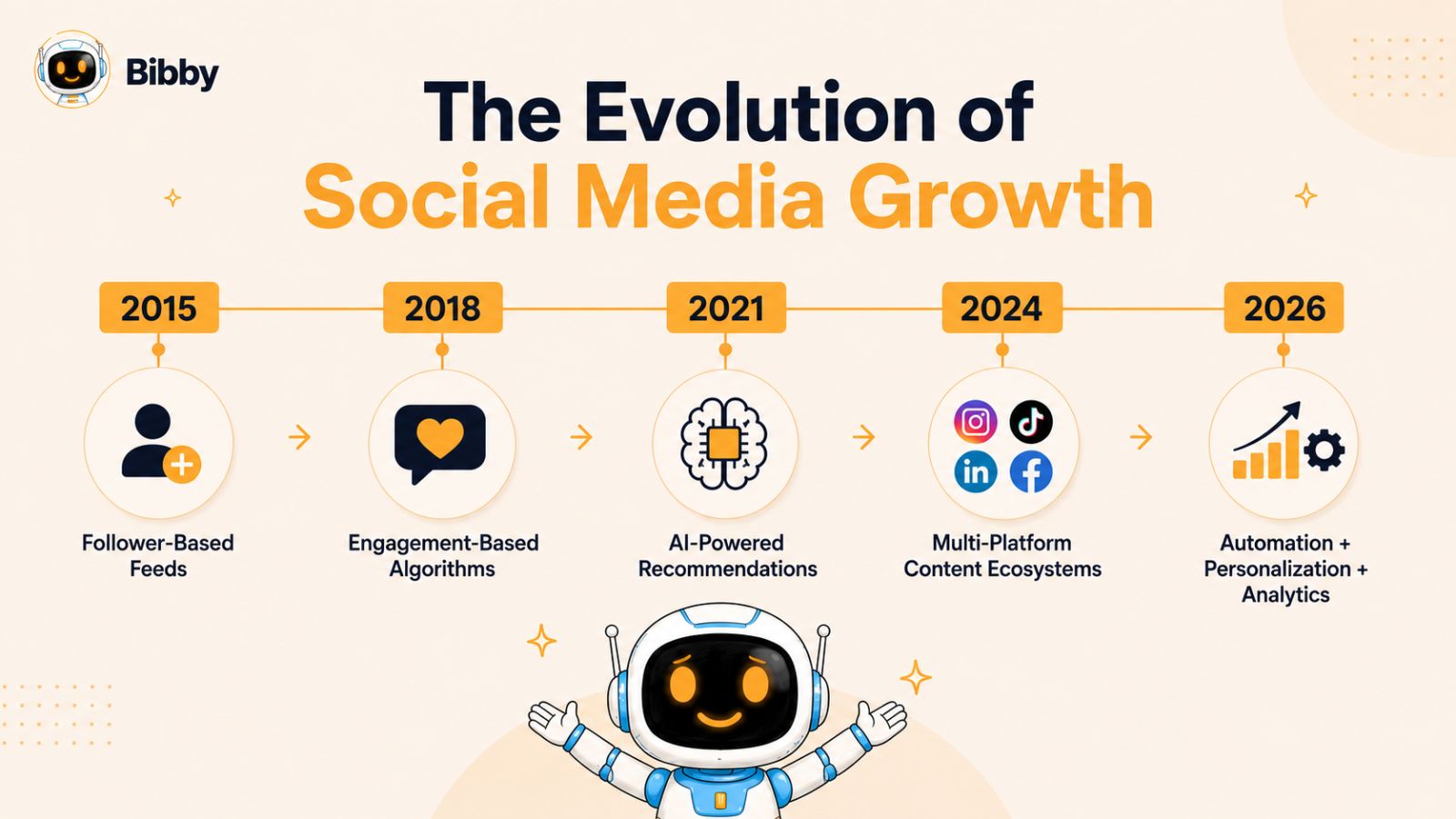
Algorithms Now Prioritize Value Over Volume
One of the biggest shifts in social media marketing is how platforms distribute content. Facebook, Instagram, LinkedIn, TikTok, and YouTube are no longer rewarding brands simply for posting frequently. Instead, they prioritize content that keeps users engaged.
Metrics such as watch time, saves, shares, comments, and meaningful interactions carry far more weight than posting frequency alone. A single high-value post can outperform dozens of average posts because platforms are designed to keep users interested and active.
This means brands must focus less on producing endless content and more on creating content that people genuinely want to consume and share.
Audiences Have Become More Selective
Consumers are exposed to thousands of pieces of content every day. As a result, attention has become one of the most valuable resources in digital marketing.
Modern audiences quickly scroll past generic promotional content. They engage with content that educates, entertains, solves problems, or offers unique insights. Brands that fail to provide value often struggle to gain traction regardless of how frequently they post.
The brands experiencing consistent growth understand that every post must earn attention rather than simply demand it.
Every Platform Rewards Different Behaviors
While many social media principles remain universal, each platform has developed its own ecosystem and engagement patterns.
Instagram rewards visually engaging content and strong engagement signals. LinkedIn favors expertise and professional insights. TikTok prioritizes watch time and content relevance. YouTube rewards audience retention and viewer satisfaction.
This doesn't mean brands need to create completely different content for every platform. It means they need to understand how to adapt content formats while maintaining a consistent message.
Artificial Intelligence Is Reshaping Social Media Marketing
AI is changing how brands create, optimize, schedule, and analyze content. Tasks that once required hours of manual work can now be completed in minutes.
From generating content ideas and writing captions to identifying optimal posting times and analyzing performance data, AI-powered tools are helping businesses become more efficient without sacrificing quality.
The brands that embrace these technologies gain more time to focus on strategy, creativity, and audience relationships rather than repetitive administrative tasks.
Growth Is No Longer About Working Harder
Many marketers still believe social media success comes from doing everything manually. In reality, sustainable growth often comes from building smarter systems.
Successful brands create repeatable workflows that help them produce quality content consistently, distribute it efficiently across multiple platforms, and track performance without wasting valuable time.
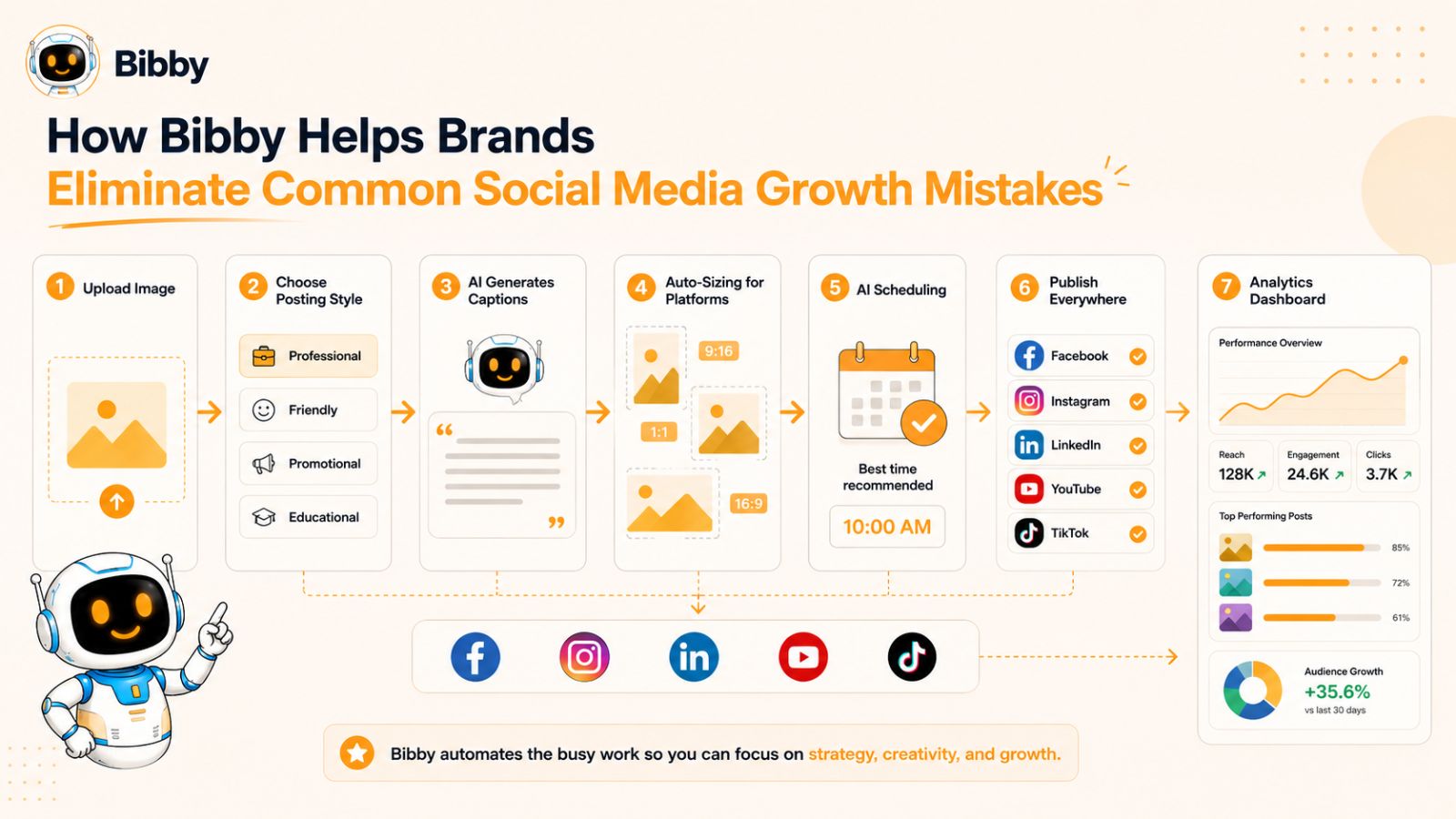
Tools like Bibby exemplify this shift by simplifying content creation, automatically handling platform-specific image sizes, generating AI-powered captions, scheduling posts at AI-optimized times, publishing across multiple social networks, and providing performance analytics from a single dashboard. Instead of spending hours managing social media logistics, brands can focus on creating content that drives meaningful results.
Understanding these industry shifts makes one thing clear: many traditional social media "best practices" are no longer best practices at all. In the next section, we'll examine one of the most common misconceptions that continues to hold brands back from real growth.
Also read: How to Stay Consistent on Social Media: A Practical System for Sustainable Growth
Myth #1: More Followers Automatically Mean More Success
For years, brands treated follower count as the ultimate measure of social media success. The assumption was simple: the more followers you have, the more influence, engagement, and revenue you'll generate.
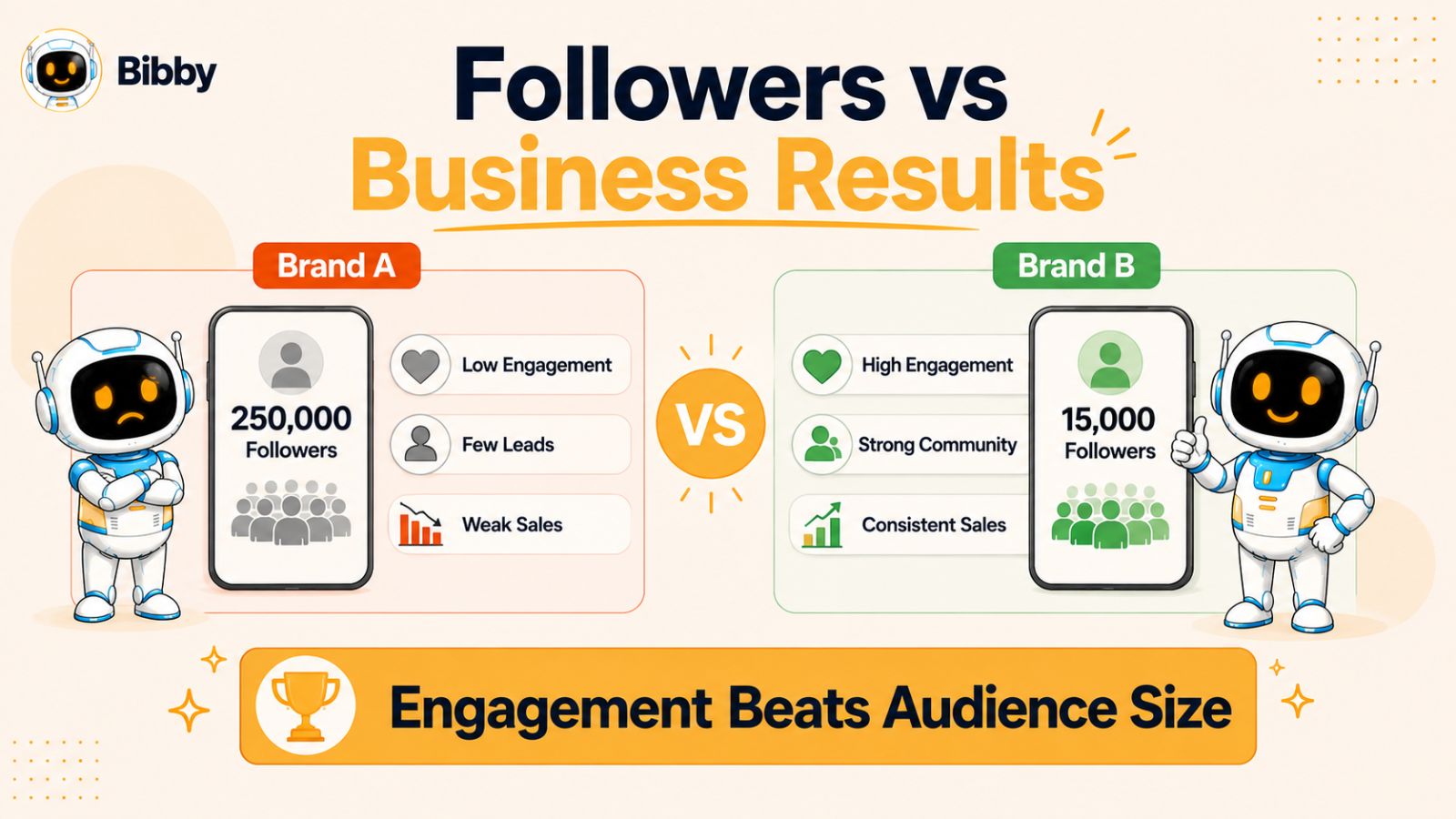
While a large audience can certainly help expand visibility, follower count alone is one of the most misleading social media metrics. In many cases, brands with hundreds of thousands of followers generate less engagement and fewer sales than businesses with significantly smaller audiences.
The reality is that followers don't drive growth—engaged audiences do.
Why Follower Count Became a Vanity Metric
Follower growth is easy to measure, which is why many businesses became obsessed with it. Watching numbers increase creates the impression that a brand is becoming more successful.
However, social media platforms don't distribute content based solely on audience size. Algorithms evaluate how people interact with content after it's is published. If followers ignore a post, platforms reduce its visibility regardless of how large the account is.
As a result, a large audience that rarely engages can become a liability rather than an advantage.
Engagement Matters More Than Audience Size
Modern social media algorithms prioritize signals that indicate genuine interest. These signals include:
- Comments
- Shares
- Saves
- Watch time
- Profile visits
- Direct messages
- Click-through rates
When users actively engage with content, platforms interpret it as valuable and continue showing it to more people. This creates a cycle where quality engagement generates additional reach.
A smaller audience that consistently interacts with content often produces stronger results than a much larger audience that remains passive.
Why Brands Should Focus on Audience Quality
Not every follower represents a potential customer, advocate, or community member. Many accounts accumulate followers who have little interest in their products, services, or expertise.
Audience quality becomes far more important than audience quantity.
Brands that attract the right people typically experience:
- Higher engagement rates
- Better lead generation
- Increased website traffic
- Stronger customer loyalty
- Improved conversion rates
A highly targeted audience of 5,000 engaged followers can often outperform an audience of 100,000 disengaged followers.
The Metrics That Actually Matter
Instead of obsessing over follower count, brands should monitor metrics that directly reflect audience interest and business impact.
These include:
- Engagement rate
- Reach
- Share rate
- Save rate
- Video completion rate
- Website clicks
- Lead generation
- Conversion rates
- Customer acquisition costs
These metrics provide a much clearer picture of whether content is creating meaningful business results.
How Smart Brands Grow Today
Successful brands still care about growing their audience, but they focus on attracting the right followers rather than chasing large numbers.
They prioritize creating content that educates, entertains, solves problems, and encourages interaction. They also use analytics to understand which content resonates most with their audience and refine their strategy accordingly.
Platforms reward engagement, not ego metrics. The brands that understand this shift are often able to grow faster while generating better business outcomes from their social media efforts.
Key Takeaway
A large follower count may look impressive, but engagement, trust, and audience quality are what truly drive social media growth. Brands that focus on building meaningful relationships with the right audience will consistently outperform those chasing vanity metrics.
You may also like reading detailed guide on: how to automate Facebook post?
Myth #2: You Need to Post Constantly to Grow
One of the most common social media growth myths is that brands must publish content nonstop to stay relevant. Many marketers believe that posting multiple times a day is the only way to increase reach, gain followers, and remain visible in crowded feeds.
This belief often leads to content burnout, rushed publishing schedules, and declining content quality. Teams become so focused on producing more content that they lose sight of what actually matters: creating content people want to engage with.
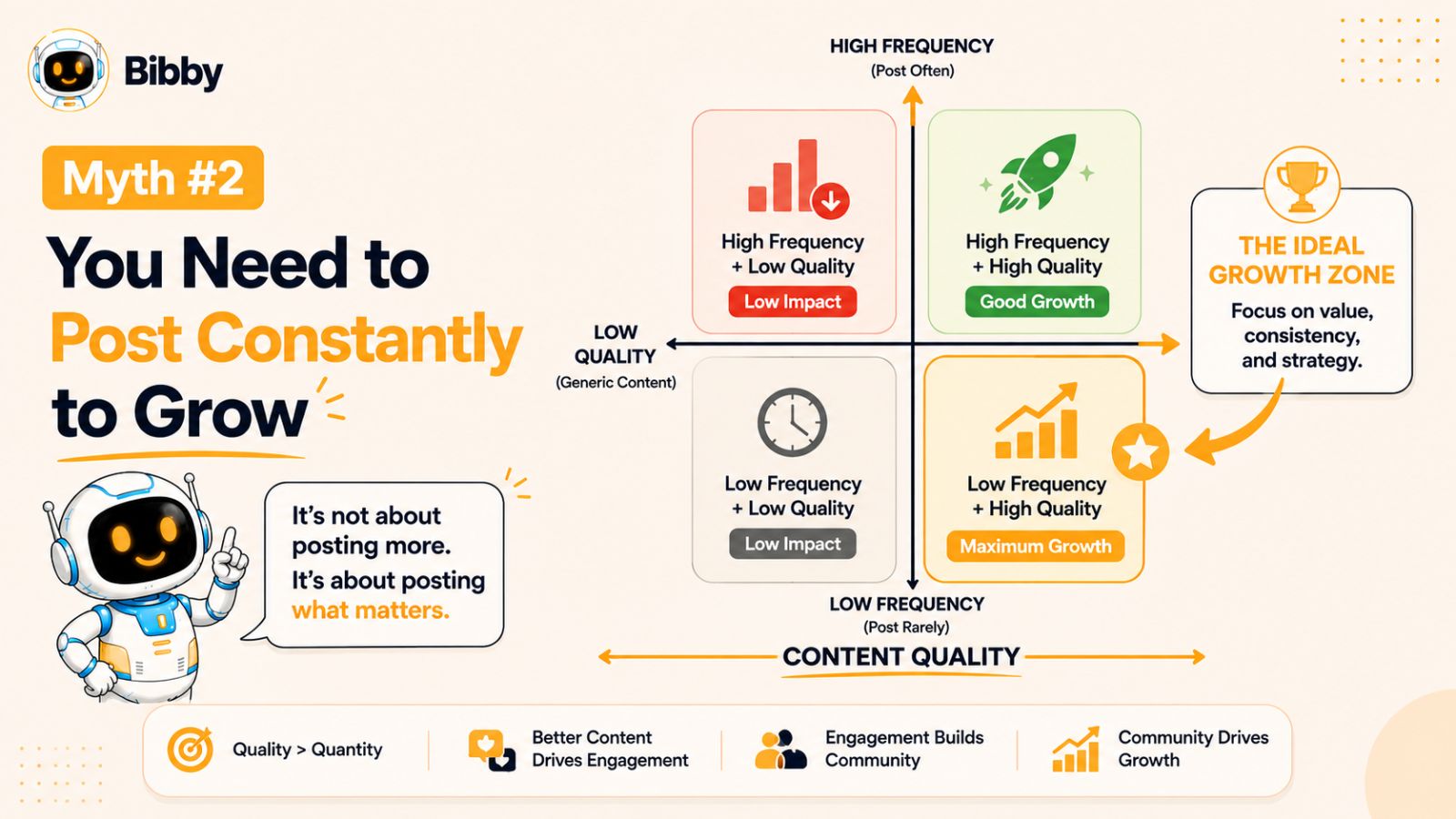
The truth is that posting more doesn't automatically lead to better results.
Why More Content Doesn't Always Mean More Reach
Social media algorithms are designed to prioritize content quality and audience engagement, not simply the volume of posts published.
If a brand publishes low-value content several times per day, users are less likely to interact with it. Over time, weak engagement signals can reduce overall visibility and limit future reach.
On the other hand, a well-researched, highly relevant post that generates comments, shares, and saves can outperform dozens of average posts.
The goal should not be to fill a content calendar. The goal should be to publish content that earns attention.
The Hidden Cost of Chasing Posting Frequency
Many businesses adopt aggressive posting schedules without considering the resources required to maintain them.
This often creates several problems:
- Lower content quality
- Repetitive messaging
- Creative burnout
- Inconsistent branding
- Reduced engagement rates
- Limited time for strategy and analysis
When content creation becomes a race against the clock, brands often sacrifice the value that audiences expect.
Consistency Beats Volume Every Time
Consistency is one of the strongest predictors of long-term social media growth.
A brand that publishes valuable content three times per week for an entire year will often outperform a brand that posts multiple times daily for a few weeks before becoming inconsistent.
Consistency helps build audience trust, creates predictable engagement patterns, and signals reliability to both users and algorithms.
Instead of asking, "How often should we post?" brands should ask, "How often can we consistently publish high-quality content?"
Creating a Sustainable Content System
The most successful brands focus on creating repeatable content systems rather than constantly producing new content from scratch.
This includes:
- Developing content pillars
- Repurposing successful posts
- Building content libraries
- Planning campaigns in advance
- Using analytics to identify winning formats
A structured system allows brands to maintain quality while reducing the pressure of constant content creation.
How Automation Helps Maintain Consistency
One reason many businesses struggle with consistency is the amount of manual work involved in managing multiple social media platforms.
Creating captions, resizing images, choosing posting times, publishing content, and tracking performance can consume hours every week.
This is where automation becomes a competitive advantage.
With Bibby, brands can streamline the entire process. Users can upload or generate images with AI, select a posting style, automatically generate captions, and schedule content across Facebook, Instagram, LinkedIn, YouTube, TikTok, and other platforms. Bibby also handles platform-specific sizing requirements, helping businesses maintain a professional appearance without additional effort.
By automating repetitive tasks and scheduling content at AI-optimized times, brands can focus on creating better content instead of spending their time on manual publishing activities.
Quality Content Wins in the Long Run
The brands achieving sustainable social media growth aren't necessarily publishing the most content. They're publishing the most valuable content.
Every post should have a purpose—whether that's educating an audience, solving a problem, starting a conversation, building trust, or driving action.
When quality becomes the priority, growth becomes more predictable and far more sustainable.
Key Takeaway
Social media success isn't about posting constantly. It's about consistently publishing content that delivers value. A smaller number of high-quality posts will almost always outperform a large volume of content that fails to engage the audience.
Also read: how far ahead you can schedule social media posts
Myth #3: Every Platform Requires Completely Different Content
Many brands avoid expanding their social media presence because they believe every platform requires a completely separate content strategy. The idea of creating unique posts for Facebook, Instagram, LinkedIn, TikTok, YouTube, and other channels can feel overwhelming, especially for small marketing teams.
As a result, businesses often limit themselves to one or two platforms, missing valuable opportunities to reach new audiences.
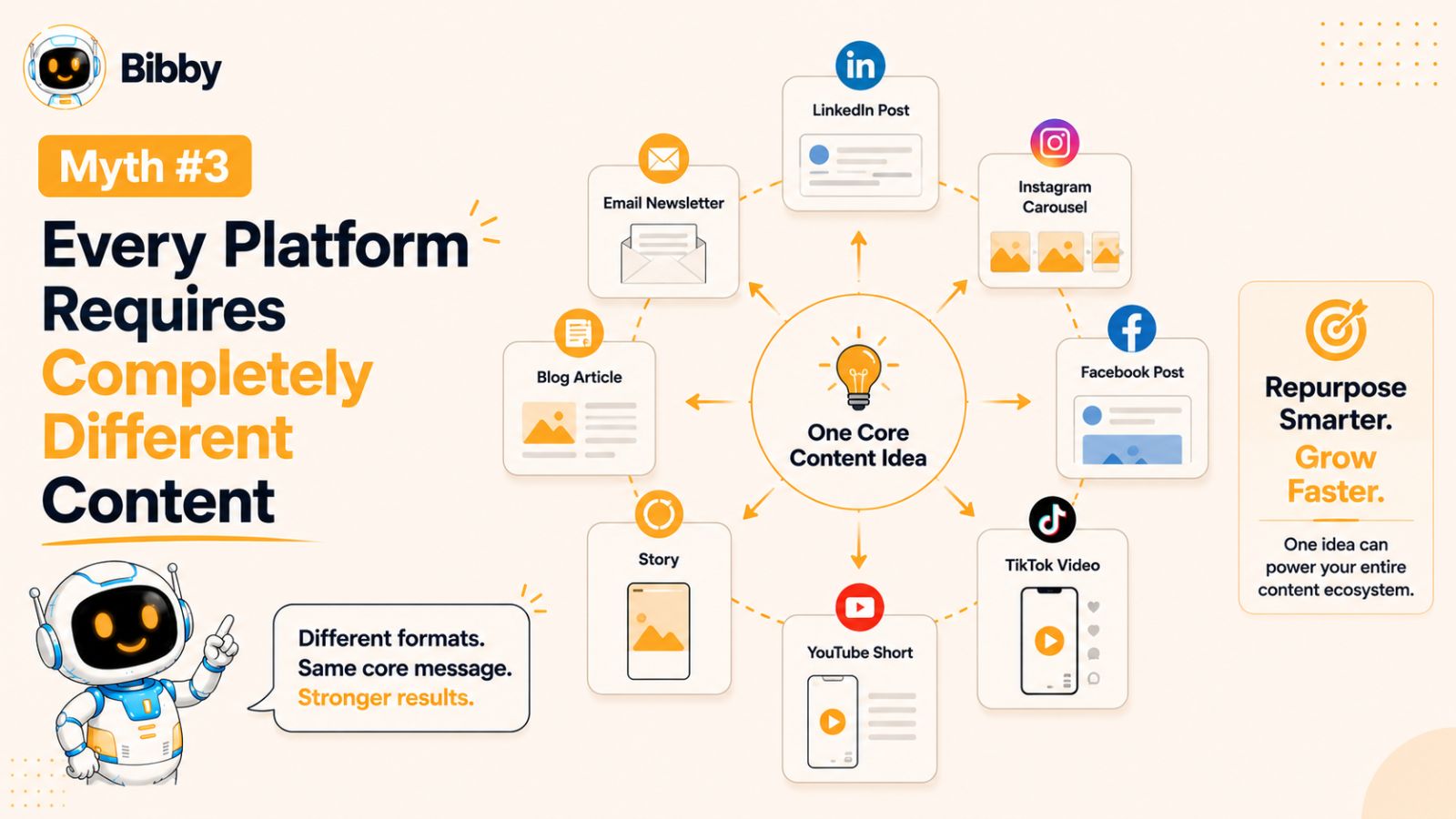
The reality is that creating entirely different content for every platform is usually unnecessary. What successful brands do instead is create content once and adapt it strategically across multiple channels.
Why This Myth Persists
Every social media platform has unique features, audience behaviors, and content formats. Because of these differences, many marketers assume they must reinvent their content for each network.
While platforms do have different expectations, the core message behind successful content rarely changes.
A valuable insight, educational tip, customer success story, industry trend, or product announcement can perform well across multiple platforms when presented in the right format.
The challenge is adaptation—not complete recreation.
The Difference Between Repurposing and Reposting
One mistake brands make is posting identical content everywhere without considering platform context.
Repurposing content is different.
Repurposing means transforming a single idea into multiple formats tailored to each platform's strengths.
For example:
- A long-form blog post can become a LinkedIn thought leadership post.
- Key statistics can become Instagram carousel slides.
- Major takeaways can become TikTok or YouTube Shorts videos.
- A customer success story can become a Facebook post.
- Industry insights can become an email newsletter.
Instead of creating five separate pieces of content, brands create one core asset and distribute it intelligently.
Content Efficiency Is a Growth Advantage
The brands growing fastest on social media are often those with the most efficient content systems.
Rather than spending time creating endless amounts of original content, they focus on maximizing the value of every content asset they produce.
Benefits of content repurposing include:
- Increased content output
- Better return on content investments
- Greater brand consistency
- Faster publishing workflows
- More audience touchpoints
- Reduced creative burnout
This approach allows marketing teams to scale their efforts without dramatically increasing workload.
Why Platform Formatting Matters
Although the message can remain consistent, formatting should align with each platform's user experience.
For example:
- LinkedIn users often prefer professional insights and industry expertise.
- Instagram audiences respond well to visual storytelling.
- TikTok users expect concise, engaging video content.
- YouTube audiences typically value deeper explanations and tutorials.
- Facebook users engage with a mix of educational, community-focused, and entertaining content.
Understanding these preferences helps brands present the same idea in ways that feel native to each platform.
How Automation Makes Multi-Platform Publishing Easier
One of the biggest obstacles to cross-platform content distribution is the amount of manual work involved.
Each platform has different image dimensions, video requirements, posting schedules, and formatting considerations. Managing these details manually can quickly become time-consuming.
This is where tools like Bibby simplify the process.
Instead of manually resizing images, writing unique captions for every channel, and publishing content individually, marketers can upload or generate content, choose a posting style, and let Bibby handle much of the heavy lifting. The platform automatically adjusts content for different social networks, generates captions, schedules posts at AI-optimized times, and distributes content across Facebook, Instagram, LinkedIn, YouTube, TikTok, and other supported platforms.
This streamlined workflow allows brands to maintain a strong presence across multiple channels without multiplying their workload.
Build Once, Distribute Everywhere
The most effective social media strategies are built around leverage. Rather than creating separate content ecosystems for every platform, successful brands focus on creating exceptional core content and extending its reach through smart repurposing.
When done correctly, a single piece of content can generate weeks of social media activity across multiple channels while maintaining consistency and saving valuable time.
Key Takeaway
You don't need completely different content for every social media platform. By repurposing high-quality content and adapting it to each platform's format, brands can increase reach, improve efficiency, and scale their social media growth without creating more work.
Myth #4: Organic Reach Is Dead
Few social media myths have survived as long as the claim that organic reach is dead. Every time a platform updates its algorithm, headlines appear predicting the end of organic growth and insisting that brands must rely entirely on paid advertising to get results.
While it's true that organic reach is more competitive than it was a decade ago, declaring it dead is both inaccurate and misleading. Every day, businesses, creators, and brands continue to grow their audiences organically without spending massive advertising budgets.
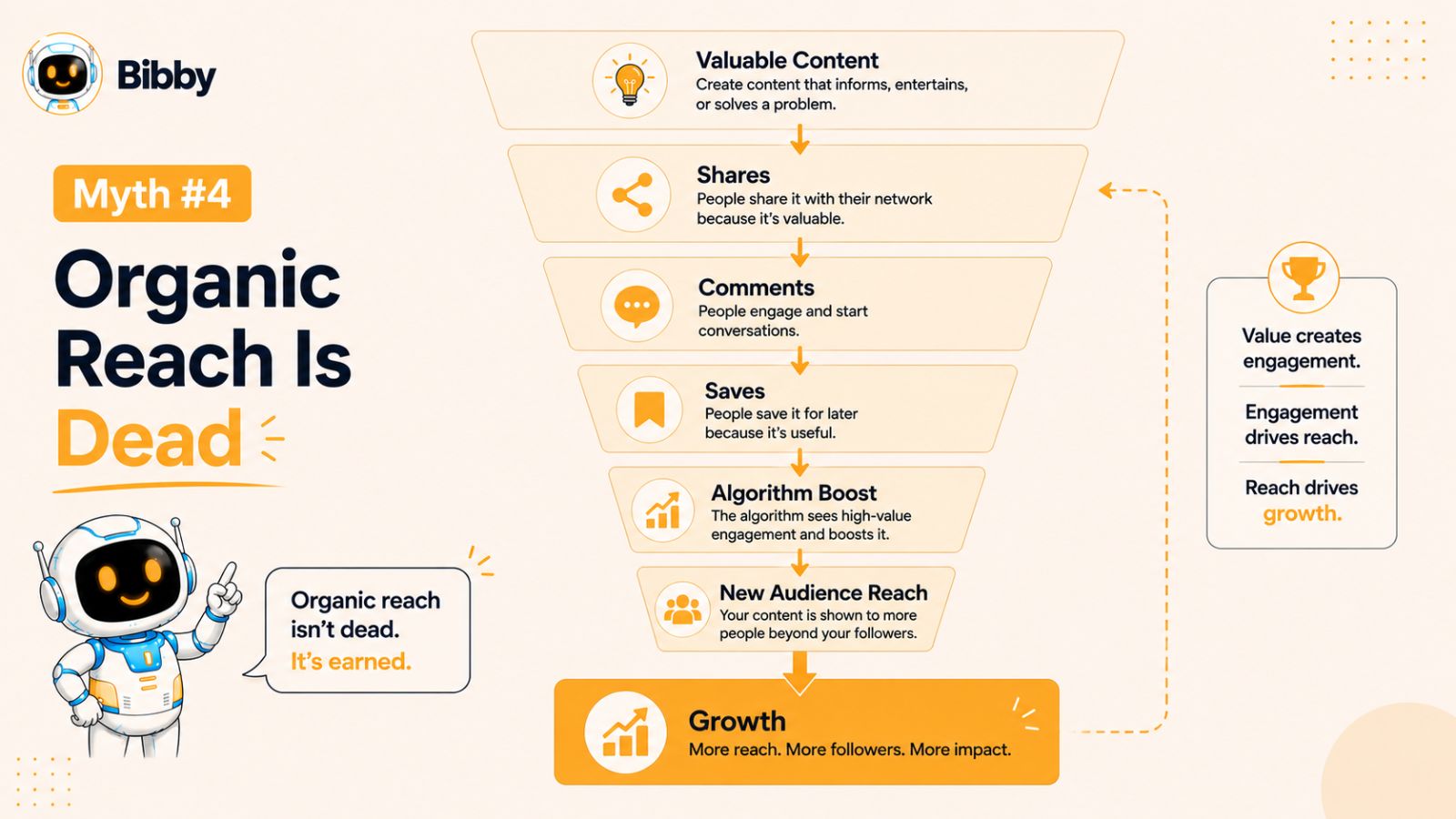
The reality is that organic reach hasn't disappeared—it has evolved.
Why People Believe Organic Reach Is Dead
Years ago, brands could publish almost any content and expect a large percentage of their followers to see it. As platforms expanded and content volume exploded, algorithms became necessary to filter what users see.
Today, social networks prioritize relevance over chronology. Instead of showing every post to every follower, platforms analyze engagement signals to determine which content deserves wider distribution.
For brands accustomed to the old model, reduced visibility can feel like organic reach has vanished altogether.
In reality, platforms are simply becoming more selective about the content they promote.
Algorithms Reward Valuable Content
Modern social media algorithms are designed around a simple goal: keeping users engaged.
To accomplish this, platforms prioritize content that generates positive engagement signals, including:
- Shares
- Saves
- Comments
- Watch time
- Profile visits
- Meaningful interactions
- Content completion rates
When users engage with content, algorithms interpret that behavior as proof of value and continue showing the content to additional audiences.
This means organic reach is still available—it simply must be earned.
Small Brands Can Still Win
One of the biggest advantages of modern algorithms is that they increasingly reward content quality over account size.
A small business with a highly engaging post can often outperform a much larger competitor with a passive audience.
This creates opportunities for brands that focus on:
- Solving audience problems
- Sharing unique insights
- Creating educational content
- Producing engaging videos
- Building genuine communities
Instead of competing on budget alone, brands can compete on relevance and value.
The Real Problem Isn't Reach—It's Content Saturation
Millions of pieces of content are published every day across social media platforms. The challenge for brands isn't that organic reach no longer exists. The challenge is standing out in an environment where audiences have endless content choices.
Content that lacks originality, usefulness, or engagement potential often struggles to gain traction.
Brands that consistently provide value, however, continue to benefit from organic distribution because platforms want users to spend more time engaging with high-quality content.
Consistency Creates Organic Momentum
Organic growth rarely happens through a single post.
Instead, it is often the result of consistently publishing valuable content over time. As engagement accumulates, audiences become more familiar with the brand, and algorithms gain more data about who responds positively to the content.
This creates a compounding effect where successful content generates additional visibility, which leads to more engagement and even greater reach.
Brands that stay consistent often experience stronger long-term growth than those chasing short-term viral moments.
How Automation Supports Organic Growth
One reason businesses struggle with organic reach is inconsistency. Teams become overwhelmed by content creation, scheduling, publishing, and platform management, causing gaps in their posting schedules.
Automation helps solve this problem.
With Bibby, brands can create a streamlined publishing process by uploading or generating content with AI, automatically generating captions, scheduling posts across multiple social networks, and publishing at AI-optimized times. Instead of manually managing Facebook, Instagram, LinkedIn, YouTube, TikTok, and other platforms, marketers can maintain a consistent content presence from a single workflow.
This consistency increases the likelihood of generating the engagement signals that organic growth depends on.
Organic Reach and Paid Reach Work Together
The smartest brands don't view organic and paid strategies as competitors. They use both strategically.
Organic content helps build trust, authority, and community, while paid promotion can amplify high-performing content and accelerate growth.
Strong organic performance often makes paid campaigns more effective because audiences are already familiar with the brand and its messaging.
Key Takeaway
Organic reach is far from dead. Platforms continue to reward content that delivers value, generates engagement, and keeps users interested. Brands that focus on audience needs, consistency, and quality content can still achieve significant organic growth without relying entirely on advertising budgets.
Myth #5: Viral Content Is the Fastest Path to Growth
Ask most marketers what social media success looks like, and many will picture a viral post generating millions of views overnight. Viral content has become the ultimate growth fantasy—a single piece of content that instantly transforms an unknown brand into an industry sensation.
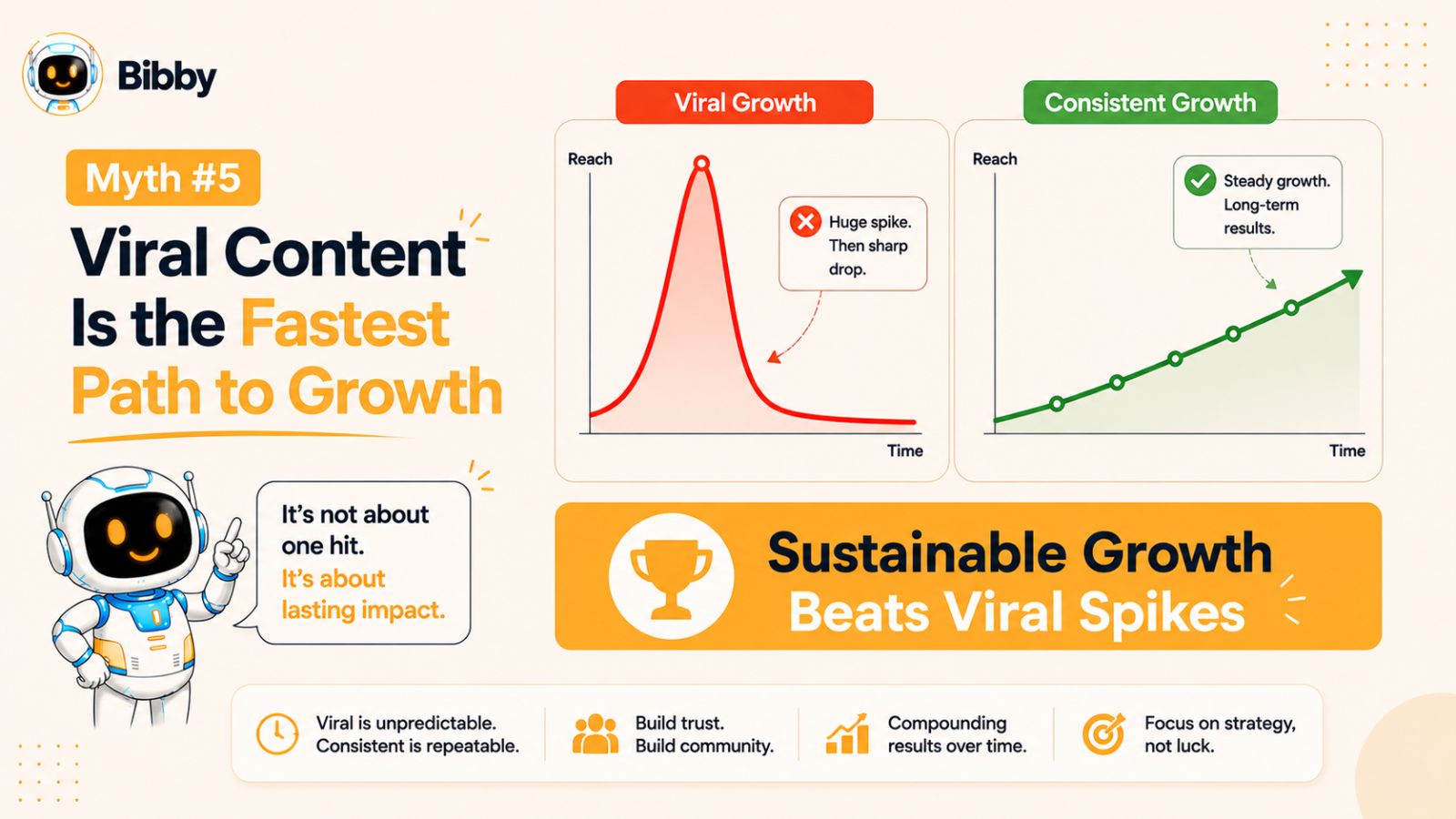
While viral moments can generate impressive visibility, they are often misunderstood as a reliable growth strategy. The truth is that virality and sustainable business growth are not the same thing.
Many brands spend so much time chasing viral success that they neglect the systems and strategies that create long-term results.
Why Brands Become Obsessed With Virality
Viral content creates the illusion of instant success.
When a post receives thousands of shares, millions of views, or widespread media attention, it appears that growth happened effortlessly. These success stories are highly visible, making them seem more common than they actually are.
What most people don't see are the countless brands that chase trends, mimic viral formats, and invest enormous effort into content that never gains traction.
Virality is unpredictable. Sustainable growth is not.
Attention Doesn't Always Equal Business Results
One of the biggest misconceptions in social media marketing is that high visibility automatically leads to revenue.
A viral post may generate:
- Massive reach
- New followers
- Increased website traffic
- Short-term brand awareness
However, none of these outcomes guarantee meaningful business growth.
Many viral posts attract audiences who are interested in the content itself but have little interest in the brand, product, or service behind it. As a result, engagement spikes temporarily before quickly returning to normal levels.
Without a strategy for converting attention into long-term relationships, viral success often produces limited business value.
The Problem With Building a Strategy Around Trends
Brands focused exclusively on virality often become trapped in a cycle of trend chasing.
They continuously look for:
- The latest content format
- Emerging platform features
- Viral audio clips
- Trending hashtags
- Popular challenges
While trends can provide occasional opportunities, relying on them as a primary strategy makes growth unpredictable.
A business cannot build a sustainable marketing engine around content that depends on constantly guessing what will go viral next.
Sustainable Growth Comes From Repeatable Systems
The most successful brands rarely depend on viral content for growth.
Instead, they focus on creating repeatable systems that consistently attract, engage, and convert their target audience.
These systems include:
- Educational content
- Industry insights
- Problem-solving content
- Customer success stories
- Community engagement
- Consistent publishing schedules
Over time, these efforts create trust, authority, and audience loyalty—three factors that contribute far more to long-term success than a temporary viral spike.
Why Consistency Outperforms Virality
Imagine two brands.
The first brand experiences one viral post that generates one million views but struggles to maintain engagement afterward.
The second brand consistently publishes valuable content every week, gradually building an engaged audience that regularly interacts with its content and becomes customers.
While the first brand may receive more short-term attention, the second brand often generates stronger long-term business results because its audience relationship continues to grow over time.
Consistency compounds. Virality often fades.
How Automation Supports Sustainable Growth
One reason brands chase viral content is that creating consistent content can feel overwhelming. Publishing across multiple platforms requires planning, scheduling, formatting, caption writing, and performance tracking.
Automation makes consistency easier.
With Bibby, marketers can create or upload content, generate captions automatically, schedule posts across platforms, and publish at AI-optimized times. By simplifying content distribution across Facebook, Instagram, LinkedIn, YouTube, TikTok, and other channels, Bibby helps brands focus on delivering value rather than constantly searching for their next viral hit.
The result is a more predictable and scalable approach to social media growth.
What Brands Should Aim for Instead
Instead of asking, "How can we go viral?" successful marketers ask:
- How can we provide more value?
- How can we create content people remember?
- How can we build trust with our audience?
- How can we maintain consistency?
- How can we improve engagement over time?
These questions lead to strategies that generate lasting results rather than temporary attention.
Key Takeaway
Viral content can create exciting moments, but it is not a dependable growth strategy. Sustainable social media success comes from consistently creating valuable content, building audience trust, and implementing systems that generate results long after the excitement of a viral post has faded.
Also read: Social Media Marketing Statistics You Need to Know
Myth #6: Automation Hurts Authenticity
As artificial intelligence and automation tools become more common in social media marketing, many brands worry that using them will make their content feel robotic, impersonal, or disconnected from their audience.
This concern is understandable. Nobody wants their brand to sound like a machine or lose the human connection that drives engagement and trust.
However, the belief that automation automatically reduces authenticity is one of the biggest misconceptions in modern social media marketing. In reality, the right automation tools don't replace authenticity—they create more opportunities for it.
Why This Myth Exists
For years, automation was associated with spammy marketing tactics.
Businesses used tools to send generic messages, post repetitive content, and automate interactions without considering the audience experience. These practices created the impression that automation and authentic communication could not coexist.
Today's social media landscape is very different.
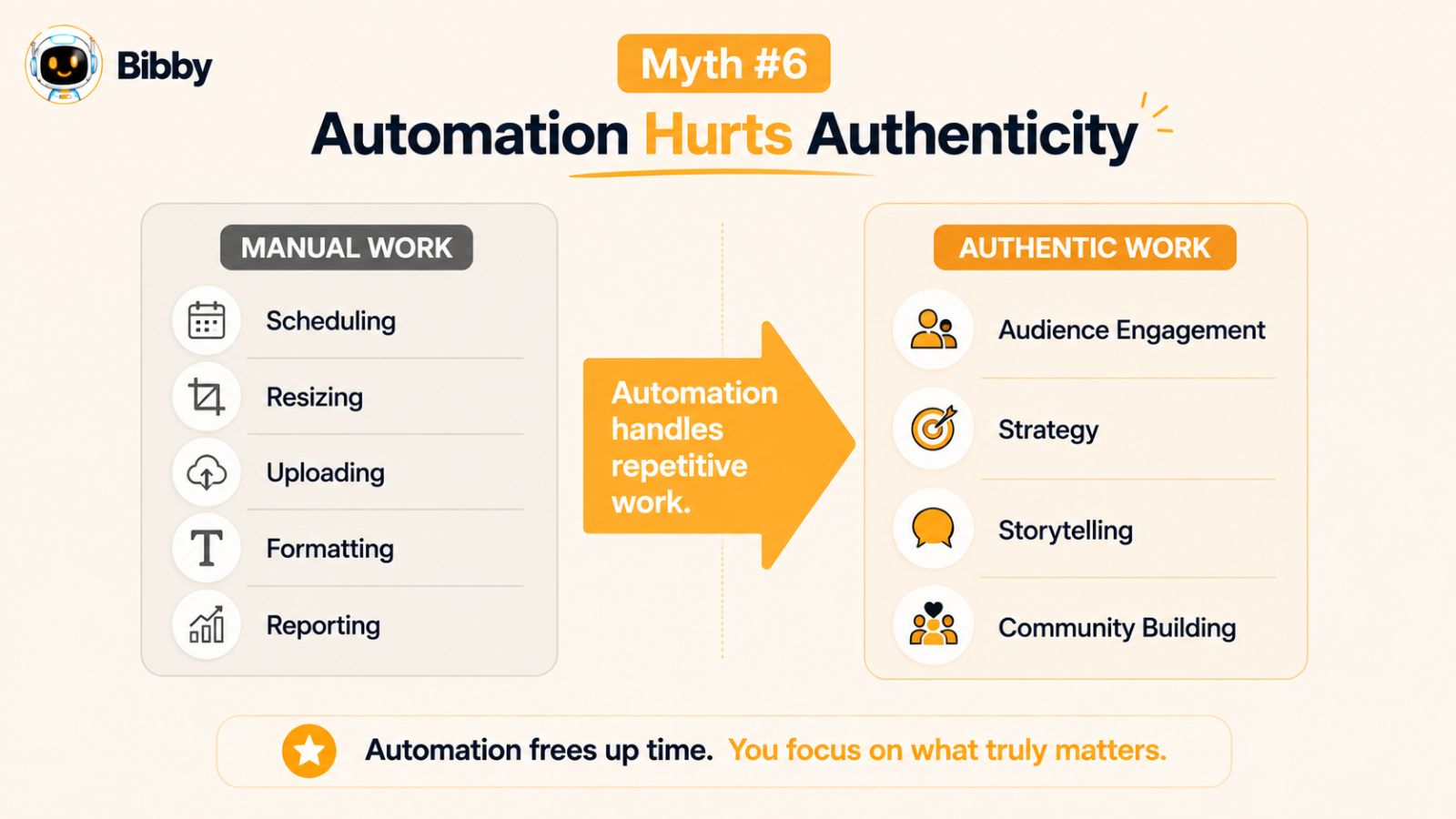
Modern automation focuses less on replacing human creativity and more on eliminating repetitive tasks that consume valuable time.
Authenticity Comes From Content, Not Manual Work
Many of the tasks marketers spend hours performing every week have nothing to do with authenticity.
These tasks include:
- Resizing images for different platforms
- Uploading the same content multiple times
- Scheduling posts individually
- Managing publishing calendars
- Copying content between platforms
- Monitoring posting schedules
Completing these tasks manually does not make content more genuine. It simply makes social media management more time-consuming.
Authenticity comes from understanding your audience, sharing valuable insights, telling compelling stories, and communicating with a clear brand voice.
Automation does not prevent any of these things.
The Best Brands Use Automation Strategically
Many of the fastest-growing brands use automation extensively behind the scenes.
They automate operational tasks so their teams can spend more time on:
- Content strategy
- Creative development
- Audience engagement
- Community building
- Customer relationships
- Performance analysis
Instead of wasting hours on repetitive administrative work, they focus on activities that directly impact growth and brand perception.
This creates a better experience for both marketers and audiences.
Consistency Builds Trust
One often-overlooked benefit of automation is consistency.
When brands rely entirely on manual publishing, content schedules frequently become inconsistent. Posts are delayed, campaigns are forgotten, and opportunities are missed because teams become overwhelmed by competing priorities.
Consistent publishing helps audiences know what to expect and increases visibility across social platforms.
Automation supports this consistency without sacrificing content quality or brand identity.
How AI Can Enhance Content Creation
AI tools are often misunderstood as content replacements.
In reality, many marketers use AI as a starting point rather than a final product.
AI can help with:
- Brainstorming ideas
- Creating content outlines
- Generating caption drafts
- Identifying content opportunities
- Analyzing performance trends
- Optimizing publishing schedules
Human creativity, expertise, and judgment still play a crucial role. AI simply helps teams work faster and more efficiently.
The most effective social media strategies combine human creativity with intelligent automation.
How Bibby Helps Brands Stay Authentic While Scaling
Bibby is a strong example of how automation can support authentic social media growth.
Instead of replacing marketers, Bibby simplifies the workflow that surrounds content creation and publishing.
Brands can:
- Upload images or generate content using AI
- Select a preferred posting style
- Generate captions automatically
- Schedule content across multiple platforms
- Publish at AI-optimized times
- Manage posts, stories, videos, and campaigns from one place
- Track performance through built-in analytics
By removing repetitive tasks, Bibby gives marketers more time to focus on creating meaningful content and building stronger relationships with their audience.
The result is greater efficiency without sacrificing authenticity.
The Real Risk Is Burnout, Not Automation
Ironically, brands that avoid automation often face a bigger problem: burnout.
When teams spend most of their time handling manual tasks, content quality can decline. Creativity suffers, publishing becomes inconsistent, and strategic thinking takes a back seat to day-to-day execution.
Automation helps prevent this by reducing workload and creating more space for the human elements of marketing that audiences value most.
Key Takeaway
Automation does not make brands less authentic. When used correctly, it eliminates repetitive work, improves consistency, and allows marketers to focus on creating valuable content and genuine audience connections. The most successful brands use automation to amplify their human creativity—not replace it.
Myth #7: Scheduling Posts Reduces Reach
Despite the widespread use of social media scheduling tools, many marketers still believe that posts published manually perform better than scheduled content. According to this myth, social media platforms somehow penalize scheduled posts, resulting in lower reach and engagement.
This belief has persisted for years, causing businesses to spend countless hours manually publishing content across multiple platforms.
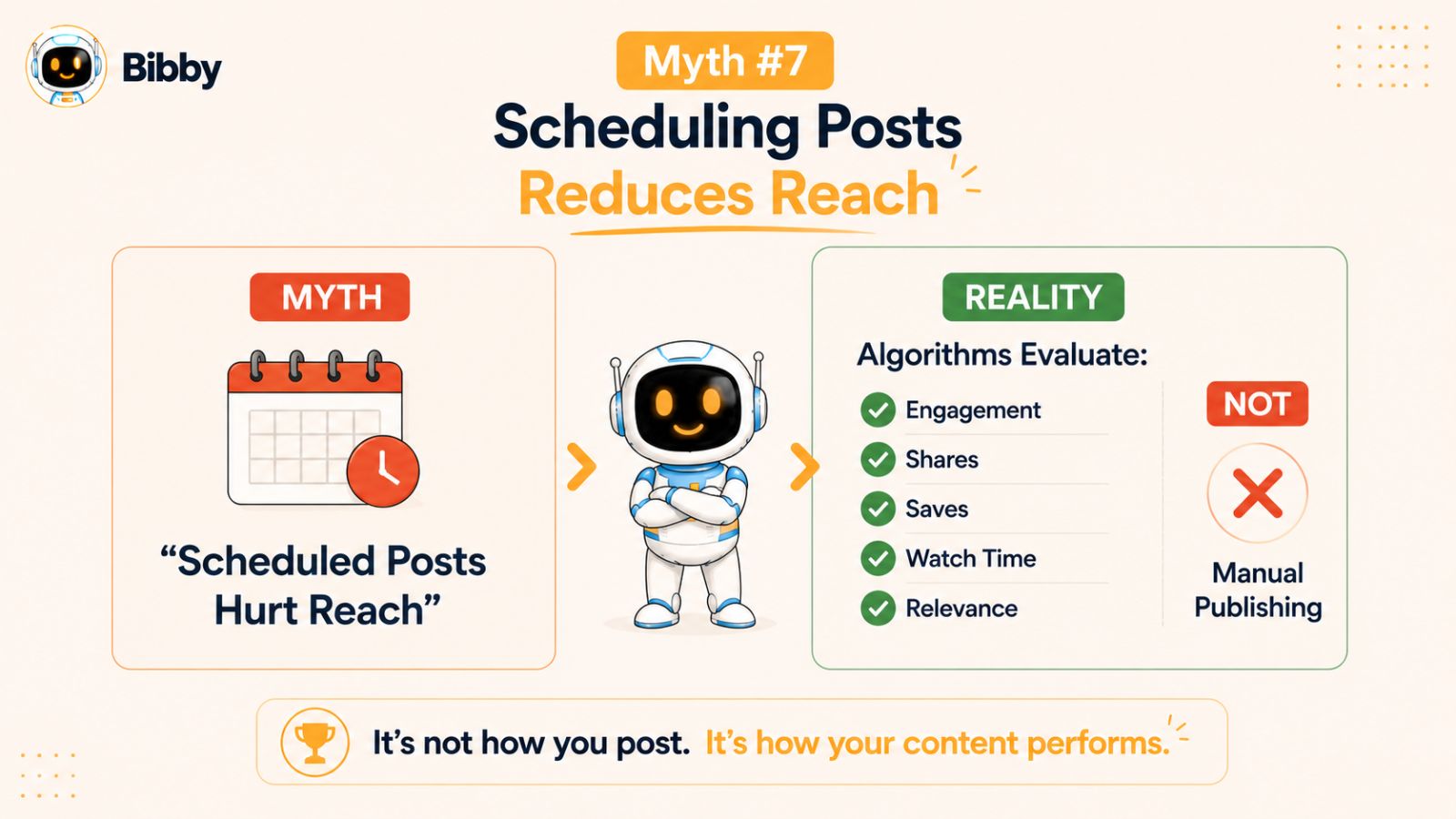
The reality is much simpler: social media platforms care far more about content quality and audience engagement than how a post was published.
Where This Myth Came From
The idea that scheduling hurts reach originated during the early days of social media management when algorithms were less sophisticated and third-party publishing tools occasionally had limitations.
Over time, these concerns evolved into a widely repeated marketing myth.
Today, major platforms actively support content scheduling through both native and third-party tools. Their primary goal is to surface content that users find valuable, regardless of whether it was published manually or automatically.
What matters is how audiences respond after the content goes live.
Algorithms Don't Reward Manual Publishing
Social media algorithms evaluate engagement signals such as:
- Comments
- Shares
- Saves
- Watch time
- Click-through rates
- Profile visits
- Meaningful interactions
Notice what is missing from that list: whether a post was manually published.
Platforms prioritize content that keeps users engaged. If a scheduled post generates strong engagement, it can perform just as well—or even better—than a manually published post.
The publishing method itself is not a ranking factor.
Why Scheduled Content Often Performs Better
In many cases, scheduling content can improve performance because it allows brands to be more strategic.
Benefits include:
- Consistent publishing
- Better campaign planning
- Reduced missed posting opportunities
- Improved content organization
- Better audience targeting
- More accurate performance tracking
Rather than rushing to publish content at the last minute, marketers can focus on quality, messaging, and audience value.
Consistency is one of the most important factors in long-term social media growth, and scheduling helps maintain that consistency.
Timing Matters More Than Publishing Method
One reason scheduled posts often outperform manually published content is timing.
Many brands publish content when their team is available rather than when their audience is most active.
A carefully scheduled post that goes live when followers are most likely to engage will often outperform a manually published post that appears at a less effective time.
The best posting time varies by platform, audience behavior, industry, and content type, making data-driven scheduling increasingly important.
The Challenge of Managing Multiple Platforms
As brands expand their presence across Facebook, Instagram, LinkedIn, TikTok, YouTube, and other networks, manual publishing becomes increasingly difficult.
Marketers must coordinate:
- Different posting schedules
- Platform-specific formatting requirements
- Content calendars
- Campaign launches
- Audience activity patterns
Managing all of these elements manually is not only time-consuming but also increases the risk of mistakes and inconsistencies.
How AI-Powered Scheduling Improves Results
Modern scheduling tools have evolved far beyond simple calendar publishing.
Platforms like Bibby use AI to help brands optimize their publishing strategy. Instead of manually selecting posting times, users can leverage AI-optimized scheduling to publish content when audiences are most likely to engage.
Bibby also streamlines the entire publishing workflow by allowing users to:
- Upload images or generate visuals with AI
- Automatically create captions
- Schedule content across multiple platforms
- Manage videos, stories, and standard posts
- Handle platform-specific image sizing automatically
- Track analytics from a centralized dashboard
This approach reduces manual effort while improving consistency and content distribution.
Strategic Scheduling Creates More Freedom
One of the greatest benefits of scheduling is the freedom it creates for marketing teams.
Instead of spending every day focused on publishing logistics, teams can dedicate more time to:
- Content strategy
- Audience research
- Creative development
- Community engagement
- Performance analysis
This shift allows brands to focus on growth-driving activities rather than repetitive operational tasks.
Key Takeaway
Scheduling posts does not reduce reach. Social media platforms prioritize engagement and content quality—not whether content was published manually or through a scheduling tool. Strategic scheduling often improves consistency, optimizes timing, and helps brands achieve better results with less effort.
Also read: How to Automate Your LinkedIn Posting Strategy for B2B Growth
Myth #8: Managing Social Media Manually Gives Better Results
Many businesses still believe that handling every aspect of social media manually gives them more control and leads to better outcomes. They write captions one by one, resize images for each platform, publish posts individually, and manually track performance across multiple accounts.
At first glance, this approach may seem more hands-on and effective. However, as social media platforms become more complex and content demands continue to increase, manual management often becomes a significant obstacle to growth rather than an advantage.
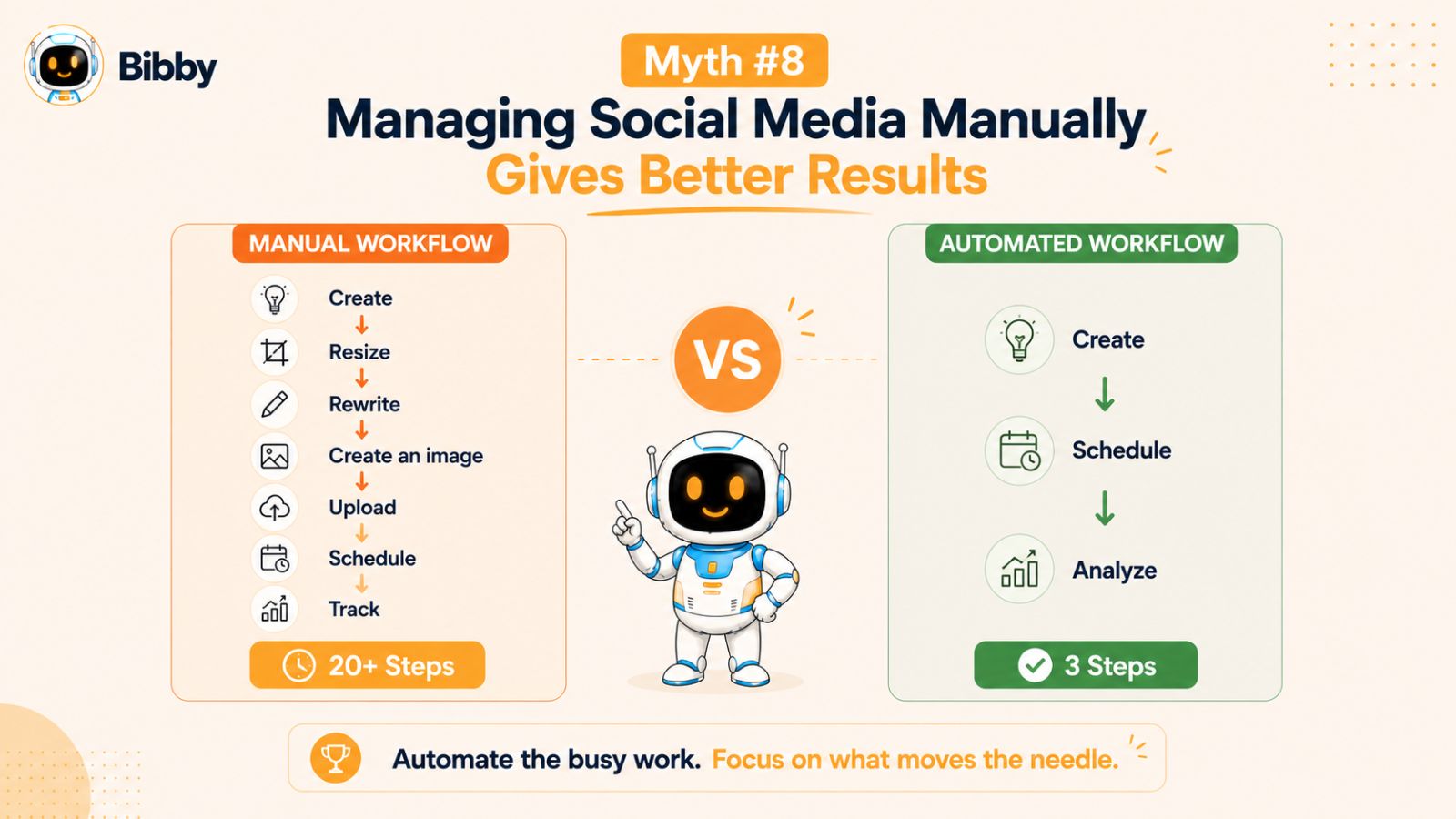
The reality is that manual processes rarely create better results. They simply create more work.
The Hidden Cost of Manual Social Media Management
Most brands underestimate how much time is spent on tasks that contribute little direct value to their social media strategy.
A typical content publishing process may include:
- Creating platform-specific image sizes
- Uploading content multiple times
- Writing variations of captions
- Choosing posting times
- Publishing content manually
- Monitoring multiple social networks
- Collecting analytics from different dashboards
When these tasks are repeated every day, they consume hours that could be spent improving content quality, engaging with audiences, or developing growth strategies.
More Time Spent Doesn't Mean Better Performance
One of the biggest misconceptions in marketing is that effort automatically produces better outcomes.
In reality, spending more time on repetitive administrative tasks often leaves less time for the activities that truly influence growth.
Successful social media performance depends on:
- Content quality
- Audience understanding
- Strategic consistency
- Data-driven decisions
- Creative execution
None of these advantages require marketers to manually publish every post.
Scaling Becomes Nearly Impossible
Manual management may be manageable when a business only uses one social platform. However, growth usually requires a presence across multiple channels.
As brands expand to platforms such as Facebook, Instagram, LinkedIn, TikTok, and YouTube, the workload increases dramatically.
Each platform introduces different requirements:
- Image dimensions
- Video formats
- Content styles
- Posting schedules
- Audience behaviors
- Analytics dashboards
Without an efficient workflow, scaling becomes difficult, expensive, and unsustainable.
Why Modern Brands Focus on Systems
The fastest-growing brands often share one common characteristic: they operate using systems rather than individual tasks.
Instead of approaching every post as a separate project, they build repeatable processes that support:
- Content creation
- Publishing
- Scheduling
- Analytics
- Performance optimization
Systems improve consistency, reduce errors, and make growth more predictable.
Most importantly, they allow teams to focus on strategic work instead of repetitive execution.
How Bibby Eliminates Social Media Bottlenecks
This is where platforms like Bibby can dramatically simplify social media management.
Rather than juggling multiple tools and workflows, Bibby centralizes the entire content publishing process.
The workflow is intentionally simple:
Upload or Generate Content
Users can upload their own images and videos or generate visual content using AI.
Choose a Posting Style
Select the desired content style and messaging approach based on brand goals and audience preferences.
Generate Captions Automatically
Bibby's AI creates platform-ready captions, helping marketers reduce writing time while maintaining consistency.
Schedule Content Across Multiple Platforms
Content can be scheduled across:
- TikTok
- YouTube
- Other supported platforms
Publish at AI-Optimized Times
Instead of guessing when audiences are active, Bibby automatically schedules content for times that maximize engagement potential.
Handle Platform-Specific Sizing Automatically
One of the most time-consuming aspects of social media management is adapting content dimensions for each platform. Bibby takes care of image sizing requirements automatically, ensuring content is optimized wherever it is published.
Manage More Than Standard Posts
Brands can publish:
- Images
- Videos
- Stories
- Short-form content
- Multi-platform campaigns
All from a single dashboard.
Track Analytics in One Place
Rather than switching between multiple reporting tools, users can monitor performance, identify trends, and evaluate content effectiveness through centralized analytics.
Freedom Creates Better Marketing
The ultimate goal of automation is not simply saving time. It is creating freedom.
When marketers spend less time resizing images, scheduling posts, and managing publishing logistics, they gain more time to:
- Understand their audience
- Create stronger content
- Build relationships
- Analyze performance
- Improve campaigns
These activities generate far more value than manual publishing ever could.
The Future of Social Media Growth
As social media becomes increasingly competitive, efficiency will become a major competitive advantage.
Brands that continue relying on manual processes may find themselves struggling to keep pace with competitors that use automation, AI, and streamlined workflows to scale content production and distribution.
The future belongs to businesses that combine creativity, strategy, and intelligent automation.
Key Takeaway
Managing social media manually does not guarantee better results. In many cases, it limits growth by consuming valuable time and resources. By implementing efficient systems and leveraging tools like Bibby, brands can scale their social media efforts, improve consistency, and focus on the activities that truly drive engagement and business growth.
Also read: Why Every Small Business Should Use a Social Media Scheduling Tool?
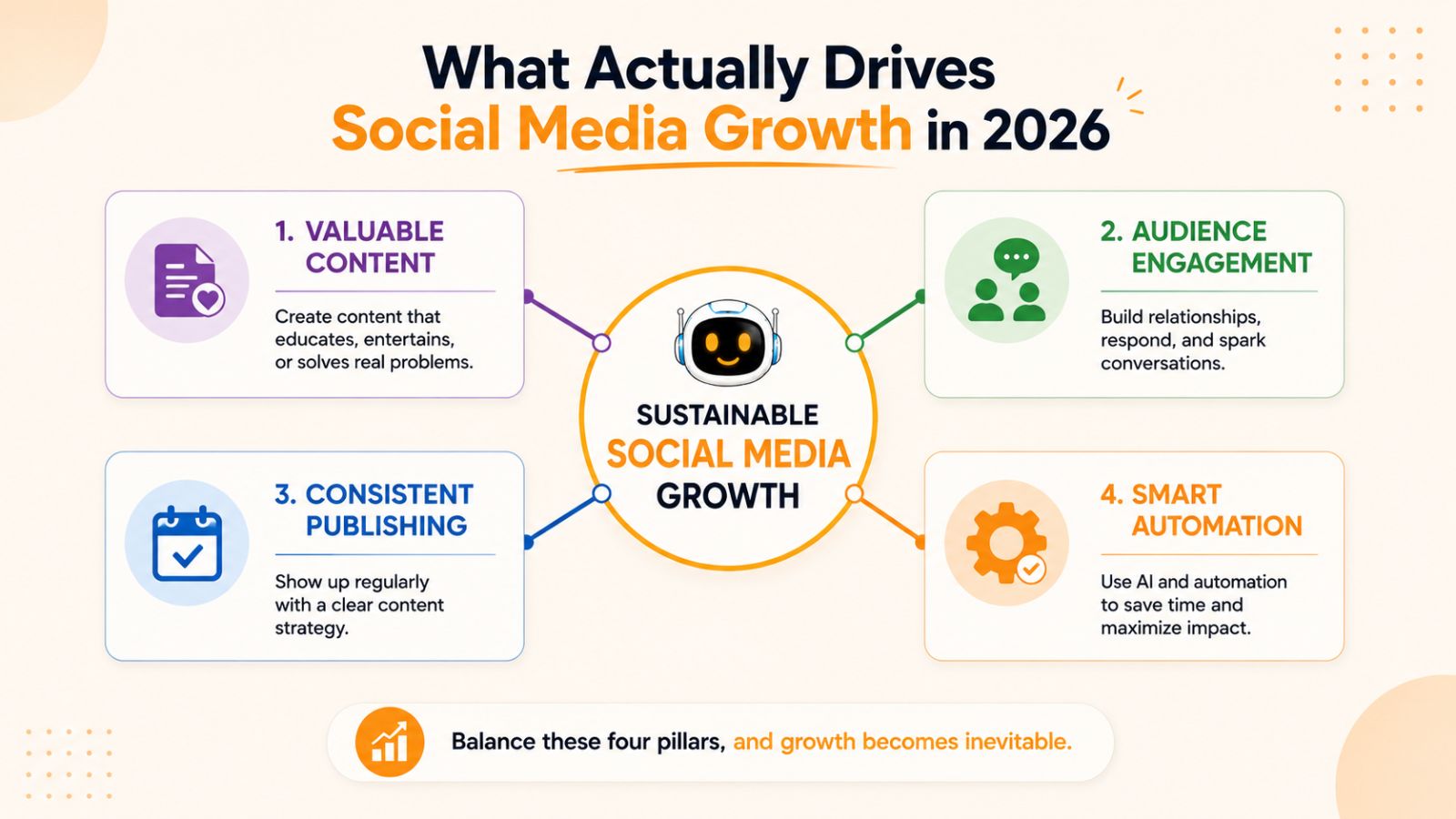
What Actually Drives Social Media Growth in 2026
Now that we've debunked some of the most common social media growth myths, an important question remains: what actually works?
The answer is surprisingly straightforward. While platforms, algorithms, and content formats continue to evolve, the core principles behind successful social media growth remain remarkably consistent.
Brands that achieve sustainable growth focus less on shortcuts and more on creating value, building systems, and understanding their audience.
Build Content Around Audience Problems
One of the biggest mistakes brands make is creating content based on what they want to say rather than what their audience wants to learn.
The most successful content typically addresses:
- Common questions
- Industry challenges
- Customer pain points
- Emerging trends
- Practical solutions
- Frequently misunderstood topics
When content helps people solve problems or make better decisions, engagement becomes a natural outcome.
Instead of constantly promoting products or services, focus on becoming a trusted resource within your industry.
Prioritize Engagement Over Exposure
Many marketers still measure success primarily by impressions and reach. While visibility matters, engagement is often a stronger indicator of long-term growth.
Social media platforms increasingly reward content that encourages interaction.
This means brands should optimize for:
- Comments
- Shares
- Saves
- Watch time
- Clicks
- Conversations
- Community participation
A smaller audience that actively engages with content often delivers greater business value than a much larger audience that rarely interacts.
Create Content Systems, Not Content Chaos
Random posting rarely produces consistent results.
Brands that grow predictably usually operate with a structured content system that includes:
Content Pillars
Content pillars help organize messaging around a few core themes that matter to the audience.
Examples include:
- Educational content
- Industry insights
- Customer success stories
- Product education
- Behind-the-scenes content
These pillars provide direction while maintaining consistency.
Content Repurposing
Creating content from scratch every day is inefficient.
Instead, successful brands maximize the value of each content asset by repurposing it across multiple platforms and formats.
A single blog post can generate:
- LinkedIn posts
- Instagram carousels
- TikTok videos
- YouTube Shorts
- Email content
- Story content
This approach increases reach without dramatically increasing workload.
Content Planning
Growth becomes easier when content is planned in advance.
Content calendars help brands maintain consistency, align campaigns, and avoid last-minute publishing decisions.
Planning also creates opportunities for better storytelling and audience engagement.
Use Data to Guide Decisions
Many businesses rely on assumptions when creating content.
The highest-performing brands rely on data.
Analytics reveal:
- Which content formats perform best
- What topics generate engagement
- When audiences are most active
- Which platforms deliver the strongest results
- What drives conversions
Rather than guessing, successful marketers use performance insights to continuously improve their strategy.
Leverage AI and Automation Strategically
Artificial intelligence is becoming one of the most significant competitive advantages in social media marketing.
However, its value is not in replacing marketers.
Its value lies in helping marketers work more efficiently.
AI can support:
- Content creation
- Caption generation
- Scheduling
- Publishing
- Analytics
- Performance optimization
By reducing manual work, teams gain more time to focus on creativity, audience relationships, and strategic growth initiatives.
Consistency Is Still the Ultimate Growth Multiplier
Despite all the changes in social media marketing, consistency remains one of the most powerful growth drivers.
Brands that consistently publish valuable content build familiarity, trust, and authority over time.
Consistency helps audiences remember a brand. It helps algorithms understand who engages with the content. Most importantly, it creates momentum that compounds month after month.
The challenge is maintaining that consistency without overwhelming marketing teams.
How Bibby Supports Modern Growth Strategies
Many of the growth principles discussed throughout this article become easier to execute with the right workflow.
Bibby helps brands simplify social media management by combining content creation, scheduling, automation, and analytics into a single platform.
Instead of manually managing multiple tools, marketers can:
- Upload or generate content with AI
- Automatically create captions
- Schedule posts across platforms
- Publish at AI-optimized times
- Manage stories, videos, and feed posts
- Track analytics from one dashboard
- Automatically adapt content sizes for different social networks
This allows brands to spend less time on operational tasks and more time on creating content that drives engagement and business results.
Sustainable Growth Beats Quick Wins
The most successful brands in 2026 are not necessarily the ones generating the most viral content or publishing the highest volume of posts.
They are the brands that consistently provide value, understand their audience, leverage technology intelligently, and execute a repeatable growth strategy.
While growth hacks come and go, these principles continue to produce results regardless of platform changes or algorithm updates.
Key Takeaway
Social media growth in 2026 is driven by audience-focused content, meaningful engagement, consistent execution, data-driven optimization, and smart automation. Brands that build systems around these fundamentals are far more likely to achieve sustainable growth than those chasing shortcuts or outdated tactics.
Also read: Best Hootsuite Alternative for Small Business
Social Media Growth Framework for Modern Brands
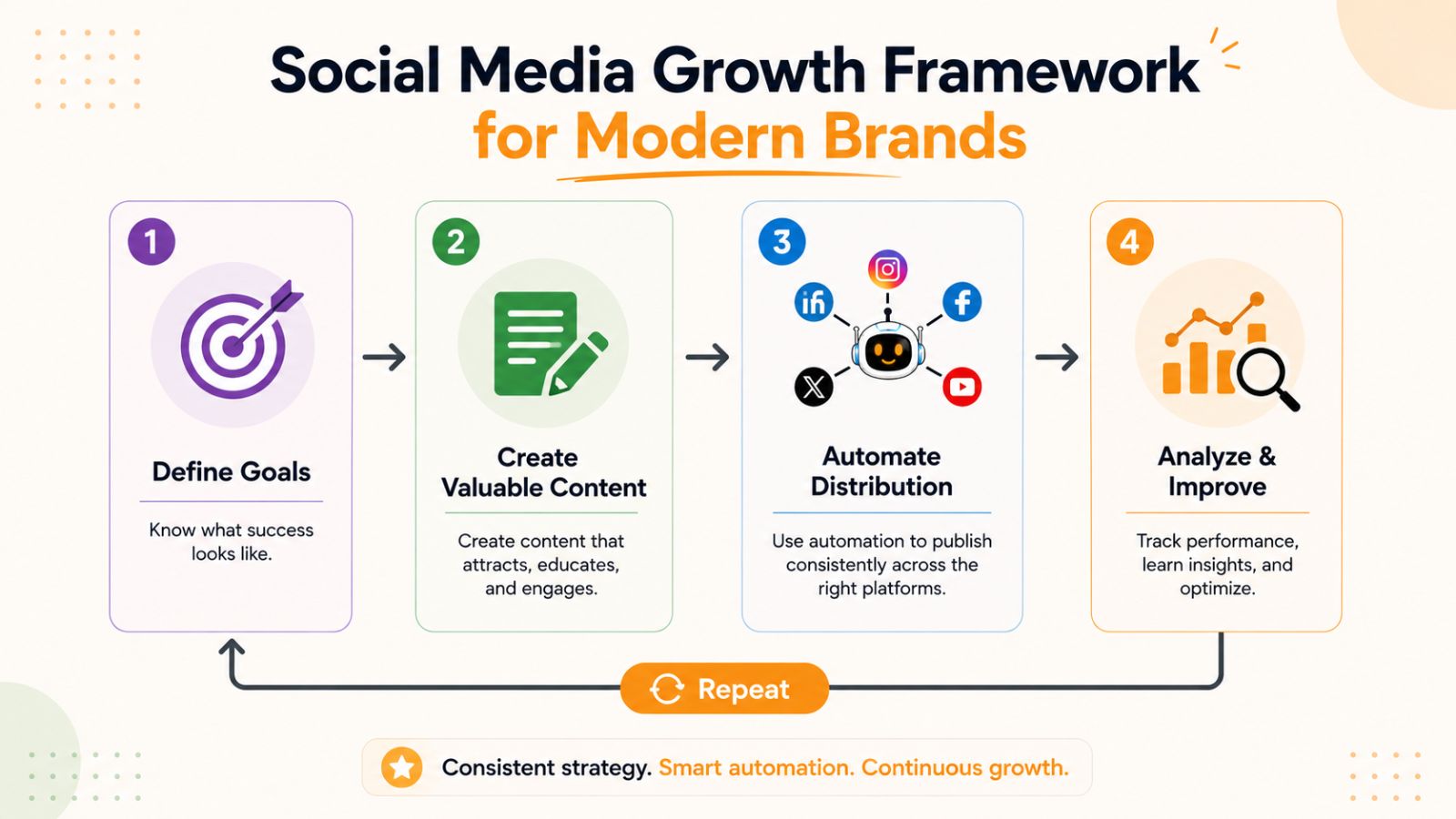
Understanding social media growth myths is valuable, but lasting results come from implementing a clear strategy. The most successful brands don't rely on luck, trends, or viral moments. They follow a repeatable framework that helps them consistently attract attention, engage audiences, and achieve business goals.
The following framework can be applied by businesses of any size, whether you're managing a single social media account or coordinating campaigns across multiple platforms.
Step 1: Define Clear Business Objectives
Before creating content, it's important to understand what success actually looks like.
Many brands focus on metrics such as follower count without connecting them to broader business outcomes. While audience growth can be beneficial, it should support a larger objective.
Common social media goals include:
- Increasing brand awareness
- Generating qualified leads
- Driving website traffic
- Growing an engaged community
- Improving customer retention
- Increasing sales and conversions
Clear goals make it easier to create relevant content and measure performance accurately.
Step 2: Understand Your Audience Deeply
Effective content starts with audience understanding.
Brands that consistently grow on social media spend time learning:
- What challenges their audience faces
- Which topics generate interest
- What content formats perform best
- Which platforms their audience prefers
- What motivates engagement and sharing
The better you understand your audience, the easier it becomes to create content that captures attention and drives meaningful interactions.
Step 3: Build Strong Content Pillars
Content pillars provide structure and consistency.
Rather than publishing random content, organize your strategy around a small number of core themes that align with audience interests and business goals.
Examples include:
Educational Content
Teach your audience something valuable.
This could include:
- How-to guides
- Tutorials
- Industry insights
- Best practices
- Expert advice
Inspirational Content
Help audiences visualize success.
Examples include:
- Customer success stories
- Transformation journeys
- Case studies
- Motivational insights
Entertaining Content
Capture attention and encourage sharing.
This may include:
- Trends
- Humor
- Behind-the-scenes content
- Interactive content
- Creative storytelling
A balanced content strategy often combines all three categories.
Step 4: Create Once, Repurpose Everywhere
One of the most efficient ways to scale content production is through repurposing.
Instead of creating separate content for every platform, develop a core content asset and adapt it into multiple formats.
For example:
- A blog post becomes LinkedIn content
- Key insights become Instagram carousel slides
- Statistics become visual graphics
- Main takeaways become short-form videos
- Expert commentary becomes story content
This approach increases output while maintaining quality and consistency.
Step 5: Automate Repetitive Tasks
As social media efforts grow, manual processes quickly become inefficient.
Tasks such as scheduling, publishing, caption writing, image resizing, and performance tracking consume valuable time that could be spent on strategy and creativity.
Modern brands use automation to streamline these responsibilities.
Platforms like Bibby make this process simple by allowing users to:
- Upload or generate content with AI
- Select a preferred posting style
- Automatically generate captions
- Schedule posts across multiple platforms
- Publish at AI-optimized times
- Manage stories, videos, and standard posts
- Automatically handle platform-specific image dimensions
- Monitor analytics from a single dashboard
By reducing operational workload, brands can focus on producing higher-quality content and building stronger audience relationships.
Step 6: Measure What Matters
Growth becomes difficult when decisions are based on assumptions rather than performance data.
Instead of focusing solely on follower growth, track metrics that indicate meaningful progress.
Key metrics include:
- Engagement rate
- Reach
- Shares
- Saves
- Watch time
- Website traffic
- Lead generation
- Conversion rates
These metrics provide a clearer picture of how social media contributes to business objectives.
Step 7: Continuously Optimize
Social media growth is not a one-time project. It is an ongoing process of testing, learning, and improving.
Successful brands regularly analyze performance to identify:
- Top-performing content formats
- High-engagement topics
- Effective posting times
- Audience behavior patterns
- Areas for improvement
Small optimizations made consistently often produce significant long-term results.
Step 8: Stay Consistent Long Enough to See Results
Many businesses abandon their strategy before it has enough time to work.
Growth rarely happens overnight. It is usually the result of consistent execution over weeks and months.
Brands that continue publishing valuable content, engaging their audience, and refining their approach often outperform competitors who constantly change direction or chase the latest trend.
Consistency creates trust. Trust creates engagement. Engagement creates growth.
Bringing the Framework Together
When combined, these steps create a powerful social media growth system:
- Define clear objectives.
- Understand your audience.
- Build content pillars.
- Repurpose content efficiently.
- Automate repetitive tasks.
- Measure meaningful metrics.
- Optimize continuously.
- Stay consistent.
This framework helps brands move beyond social media myths and focus on proven strategies that generate sustainable growth.
Key Takeaway
The most successful brands approach social media as a system rather than a series of individual tasks. By combining audience-focused content, strategic consistency, data-driven decisions, and smart automation through tools like Bibby, businesses can create a scalable growth engine that delivers results across every major social platform.
Also read: How to Grow on Social Media With AI?
Conclusion
Social media growth is often slowed not by algorithms, competition, or platform changes, but by outdated beliefs that lead brands in the wrong direction. As we've seen throughout this article, many commonly accepted "best practices" are actually growth myths that prevent businesses from reaching their full potential.
The most important takeaway is that audience quality matters more than follower count. Brands that focus on creating valuable content and building genuine engagement consistently outperform those chasing vanity metrics. Equally important, consistency beats volume. Publishing meaningful content on a sustainable schedule delivers far better results than constantly producing content simply to stay active.
Finally, modern social media success is increasingly powered by efficient systems. Automation, AI, analytics, and strategic workflows allow brands to spend less time on repetitive tasks and more time creating content that drives engagement, trust, and conversions.
The brands that thrive in 2026 and beyond will be those that combine creativity with smart technology. Tools like Bibby make this easier by simplifying content creation, automating scheduling, optimizing publishing times, managing multiple platforms, and providing actionable analytics from a single dashboard.
The next step isn't posting more content—it's building a smarter social media system. When you combine valuable content with strategic automation, sustainable growth becomes far more achievable, regardless of platform changes or algorithm updates.