
Short-form video has become one of the most powerful tools brands use to capture attention, grow their audiences, and increase sales in today's highly competitive digital landscape.
Consumers now spend hours each day scrolling through TikTok, Instagram Reels, YouTube Shorts, Facebook Reels, and LinkedIn feeds, making short-form video an essential part of modern marketing strategies. Brands that understand how to create engaging video content can reach millions of potential customers, build stronger relationships with their audiences, and generate measurable business results.
In this article, you will learn:
- Why short-form video consistently outperforms many other content formats
- How successful brands turn video views into customers and revenue
- The tools and strategies that simplify content creation and publishing
Whether you're a small business owner, marketer, or growing brand, understanding how to leverage short-form video effectively can help you increase visibility, strengthen customer engagement, and drive sustainable growth.
Let's begin by exploring exactly what short-form video marketing is and why it has become such a dominant force in digital marketing.
What Is Short-Form Video Marketing?
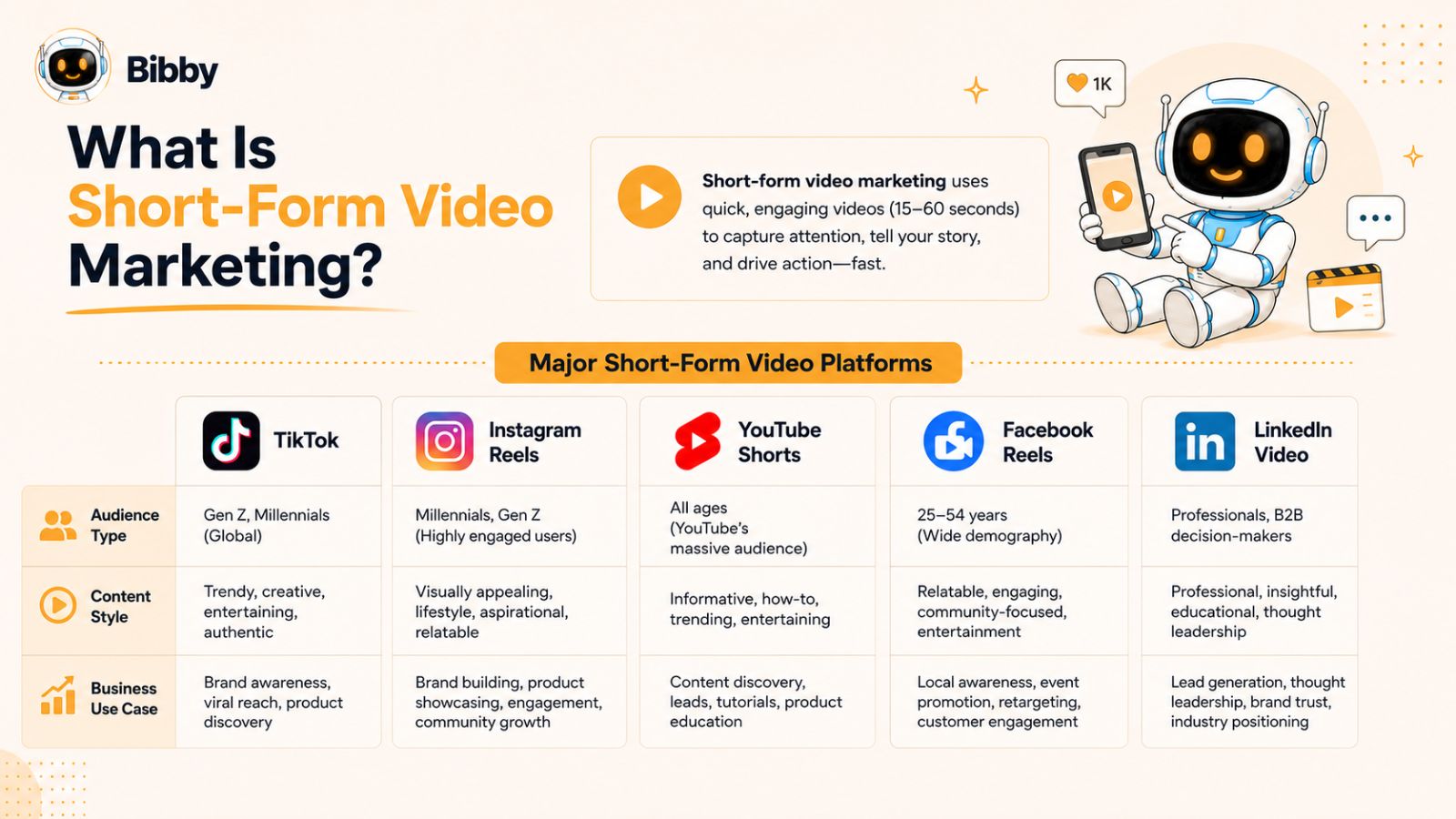
Short-form video marketing is the practice of creating and distributing brief video content to engage audiences, increase brand awareness, and drive business objectives such as lead generation and sales. These videos are typically designed to deliver value quickly, making them ideal for today's fast-paced, mobile-first consumers.
Definition of Short-Form Video
While there is no universal length requirement, short-form videos generally range from a few seconds to around three minutes. The most successful videos are often concise, focused, and built around a single message, idea, or story.
Popular short-form video formats include:
- Product demonstrations
- Educational tips and tutorials
- Behind-the-scenes content
- Customer testimonials
- Industry insights
- Trend-based videos
- User-generated content
Platforms such as TikTok, Instagram Reels, YouTube Shorts, Facebook Reels, and LinkedIn have accelerated the adoption of short-form video by prioritizing video content within their algorithms.
Why Consumers Prefer Short-Form Content
Consumer behavior has changed dramatically over the past decade. With an endless stream of content competing for attention, people increasingly favor information that can be consumed quickly and easily.
Short-form videos appeal to audiences because they:
- Deliver information in seconds rather than minutes
- Require less commitment than long-form content
- Are optimized for mobile viewing
- Combine visual, audio, and text elements for faster understanding
- Provide entertainment and education in a highly engaging format
This format aligns perfectly with how modern consumers discover new brands, products, and ideas online.
The Rise of Video-First Social Platforms
The explosive growth of platforms like TikTok has transformed how social media algorithms distribute content. Instead of relying primarily on follower counts, many platforms now prioritize content quality, engagement signals, and viewer behavior.
As a result, brands no longer need massive audiences to generate significant reach. A single well-crafted video can be shown to thousands—or even millions—of potential customers regardless of how many followers a business has.
This shift has created unprecedented opportunities for brands of all sizes. Whether you're a startup, local business, or global enterprise, short-form video provides a cost-effective way to reach new audiences, build trust, and compete with larger competitors.
For many businesses, short-form video is no longer an optional marketing tactic—it's a core channel for audience growth, engagement, and revenue generation.
Also read: How to Scale a YouTube Channel With Automation
Why Short-Form Video Is So Effective for Brand Growth
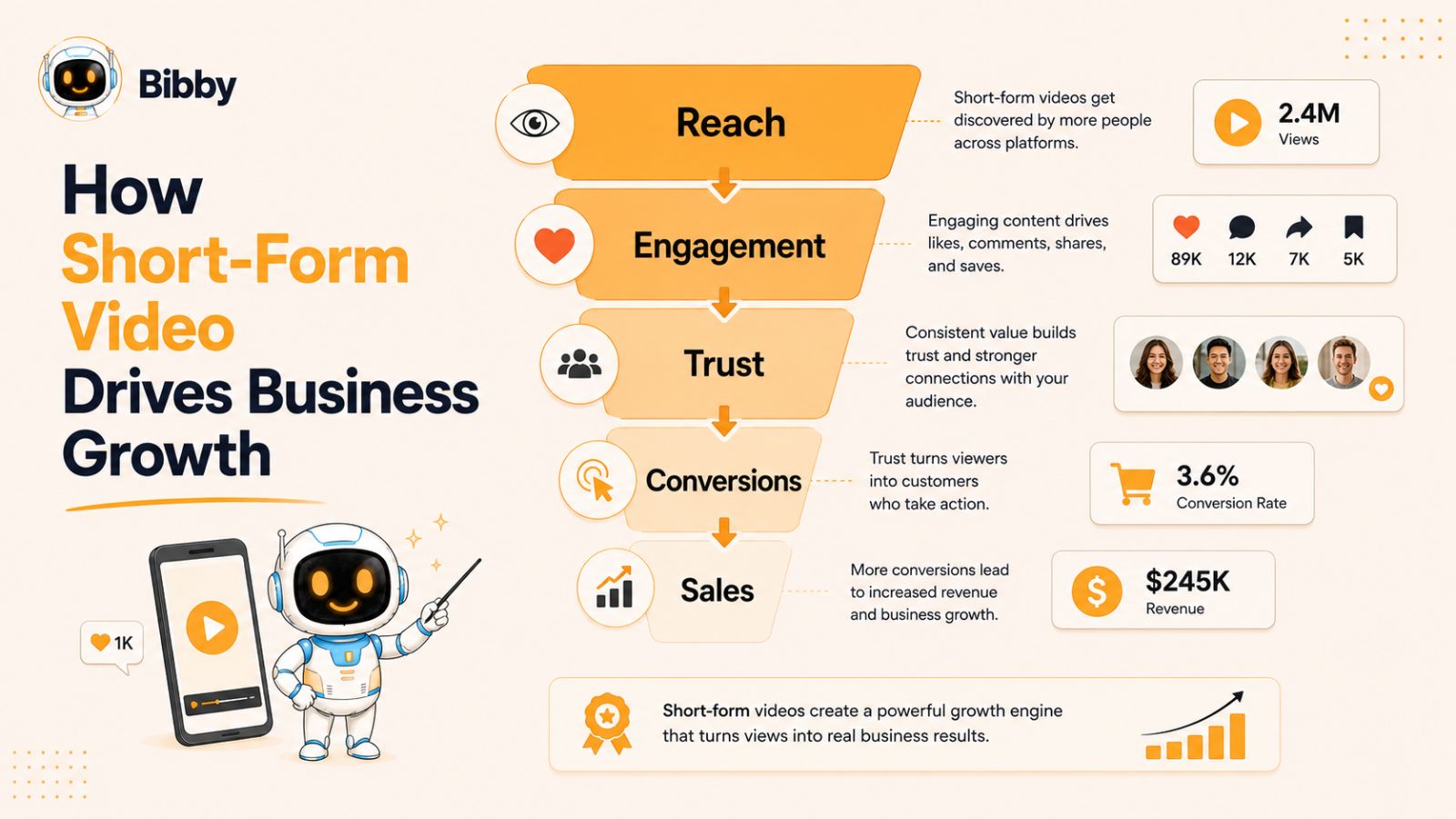
Short-form video has become a cornerstone of modern digital marketing because it aligns perfectly with how people consume content online. Unlike traditional advertising formats that often interrupt the user experience, short-form videos are designed to capture attention quickly, provide immediate value, and encourage engagement.
For brands, this creates a unique opportunity to reach more people, build stronger relationships with their audiences, and drive measurable business growth.
Higher Organic Reach
One of the biggest advantages of short-form video is its ability to generate organic reach. Social media platforms such as TikTok, Instagram Reels, YouTube Shorts, and Facebook Reels actively promote engaging content to users who have never interacted with a brand before.
Unlike traditional social media strategies that depend heavily on follower counts, modern recommendation algorithms prioritize:
- Watch time
- Engagement rates
- Shares and saves
- Viewer retention
- Content relevance
This means even a small business with a limited audience can achieve significant visibility if its content resonates with viewers.
Increased Engagement Rates
Short-form videos are designed to encourage interaction. Because they are quick to consume and easy to understand, viewers are more likely to engage through likes, comments, shares, and saves.
Higher engagement benefits brands in several ways:
- Strengthens relationships with potential customers
- Increases brand awareness through social sharing
- Improves algorithmic visibility
- Creates valuable audience feedback
The more engagement a video receives, the more likely platforms are to distribute it to larger audiences, creating a powerful growth cycle.
Better Brand Recall
Video combines visuals, audio, text, and storytelling into a single format, making it significantly more memorable than many other content types.
Brands can use short-form videos to:
- Showcase their personality
- Demonstrate product value
- Tell compelling stories
- Reinforce brand messaging
When viewers repeatedly encounter consistent branding across videos, they become more likely to remember the company when it's time to make a purchasing decision.
Improved Conversion Opportunities
While reach and engagement are valuable, the ultimate goal for most brands is generating business results. Short-form videos excel at moving prospects through the customer journey because they can educate, entertain, and persuade in a matter of seconds.
Brands commonly use short-form video to:
- Drive traffic to websites and landing pages
- Generate leads and inquiries
- Promote products and services
- Increase online and offline sales
- Encourage app downloads and sign-ups
A well-crafted video can quickly communicate a problem, present a solution, and motivate viewers to take action.
Cost-Effective Marketing at Scale
Compared to traditional video production, short-form content is often faster and less expensive to create. Many high-performing videos are recorded using smartphones and simple editing tools rather than large production teams.
This allows businesses to produce content consistently without requiring substantial budgets.
In addition, AI-powered platforms such as Bibby make the process even more efficient. Instead of spending hours creating captions, scheduling posts, and managing multiple social media accounts, marketers can upload or generate an image, select a posting style, and let Bibby automatically generate captions, schedule content at AI-optimized posting times, and publish across Facebook, Instagram, LinkedIn, YouTube, and TikTok from a single dashboard. This streamlined workflow helps brands stay consistent while focusing on strategy and growth rather than repetitive manual tasks.
A Competitive Advantage for Modern Brands
As consumer attention continues shifting toward video-first platforms, brands that embrace short-form video gain a significant competitive advantage. Businesses that consistently create valuable content can increase visibility, strengthen customer trust, and generate more opportunities for growth than competitors relying solely on traditional marketing channels.
The combination of organic reach, engagement, brand awareness, and conversion potential makes short-form video one of the most effective marketing tools available today.
Also read the complete guide for Multi Platform Social Media Management
The Psychology Behind High-Performing Short-Form Videos
Not all short-form videos achieve the same results. While some generate thousands of views and drive meaningful business outcomes, others struggle to gain traction. The difference often comes down to understanding the psychological factors that influence human attention, engagement, and decision-making.
Brands that understand these principles can create content that not only attracts viewers but also encourages them to take action.
Capturing Attention in the First Three Seconds
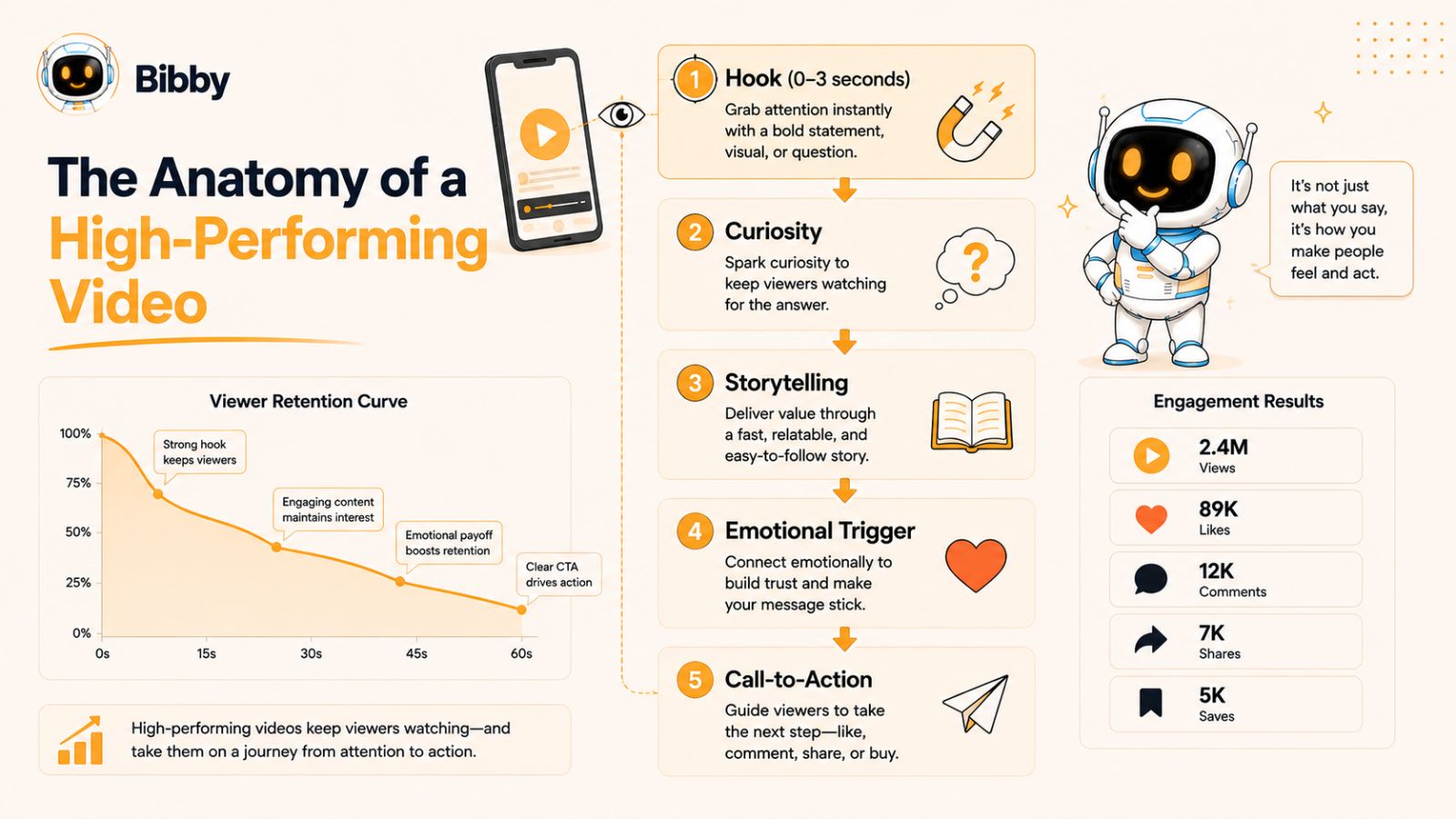
The first few seconds of a video are often the most important. Social media users scroll through content rapidly, making split-second decisions about whether to continue watching or move on.
High-performing videos typically start with a strong hook that immediately captures attention. Effective hooks may include:
- A surprising statistic
- A bold statement
- An unexpected visual
- A common problem the audience faces
- A compelling question
For example, instead of starting with a company introduction, a skincare brand might begin with: “Most people make this mistake when washing their face.”
This creates curiosity and gives viewers a reason to keep watching.
The Power of Storytelling
Humans are naturally drawn to stories. Even in videos that last less than a minute, storytelling can dramatically increase engagement and retention.
A simple short-form video story often follows this structure:
- Present a problem
- Introduce a solution
- Show the result
This framework helps viewers understand information quickly while creating an emotional connection with the content.
For brands, storytelling can transform ordinary product promotions into relatable experiences that resonate with potential customers.
Emotional Triggers Drive Action
People often make decisions based on emotion and then justify those decisions with logic. Effective short-form videos tap into emotions that encourage engagement and action.
Common emotional triggers include:
- Curiosity
- Excitement
- Inspiration
- Trust
- Relief
- Aspiration
- Belonging
For example, a fitness brand may inspire viewers by showcasing a customer's transformation journey, while a software company may create relief by demonstrating how its solution eliminates a frustrating problem.
The stronger the emotional connection, the more likely viewers are to remember and engage with the brand.
Social Proof Builds Trust
Consumers trust recommendations and experiences from other people more than traditional advertising. This is why social proof is one of the most powerful elements in short-form video marketing.
Brands can incorporate social proof through:
- Customer testimonials
- Product reviews
- User-generated content
- Case study highlights
- Influencer partnerships
When potential customers see real people benefiting from a product or service, perceived risk decreases and trust increases.
The Curiosity Gap Keeps People Watching
One of the most effective psychological techniques in video marketing is creating a curiosity gap—the space between what viewers know and what they want to know.
Examples include:
- “Here's the mistake that's costing businesses thousands every month.”
- “Most marketers overlook this simple growth strategy.”
- “Wait until you see the results from this campaign.”
By introducing a knowledge gap, brands encourage viewers to watch longer, which improves retention and increases the likelihood of algorithmic promotion.
Simplicity Improves Retention
Many brands make the mistake of trying to communicate too much information in a single video. However, the human brain processes simple messages more effectively than complex ones.
The best-performing short-form videos typically focus on:
- One problem
- One solution
- One key takeaway
- One call-to-action
This clarity helps viewers understand and remember the message, making the content more effective.
Why Consistency Matters Psychologically
Trust is rarely built through a single interaction. Consumers often need multiple exposures to a brand before they decide to follow, subscribe, or make a purchase.
Consistent short-form video publishing helps brands:
- Increase familiarity
- Build credibility
- Reinforce key messages
- Stay top of mind
This is where automation becomes particularly valuable. Tools like Bibby help brands maintain a consistent posting schedule by automatically generating captions, scheduling content at AI-optimized times, and publishing across multiple social platforms. Consistency becomes much easier when businesses can automate repetitive tasks and focus on creating valuable content.
Turning Attention Into Action
The most successful short-form videos do more than attract views—they guide viewers toward a desired outcome. By combining strong hooks, storytelling, emotional triggers, social proof, and clear messaging, brands can create content that captures attention, builds trust, and motivates action.
Understanding the psychology behind viewer behavior allows marketers to create videos that not only perform better in platform algorithms but also contribute directly to business growth and revenue.
You may also like reading: Best Platforms to Share Video Content and Grow Your Audience
Types of Short-Form Videos Brands Should Create
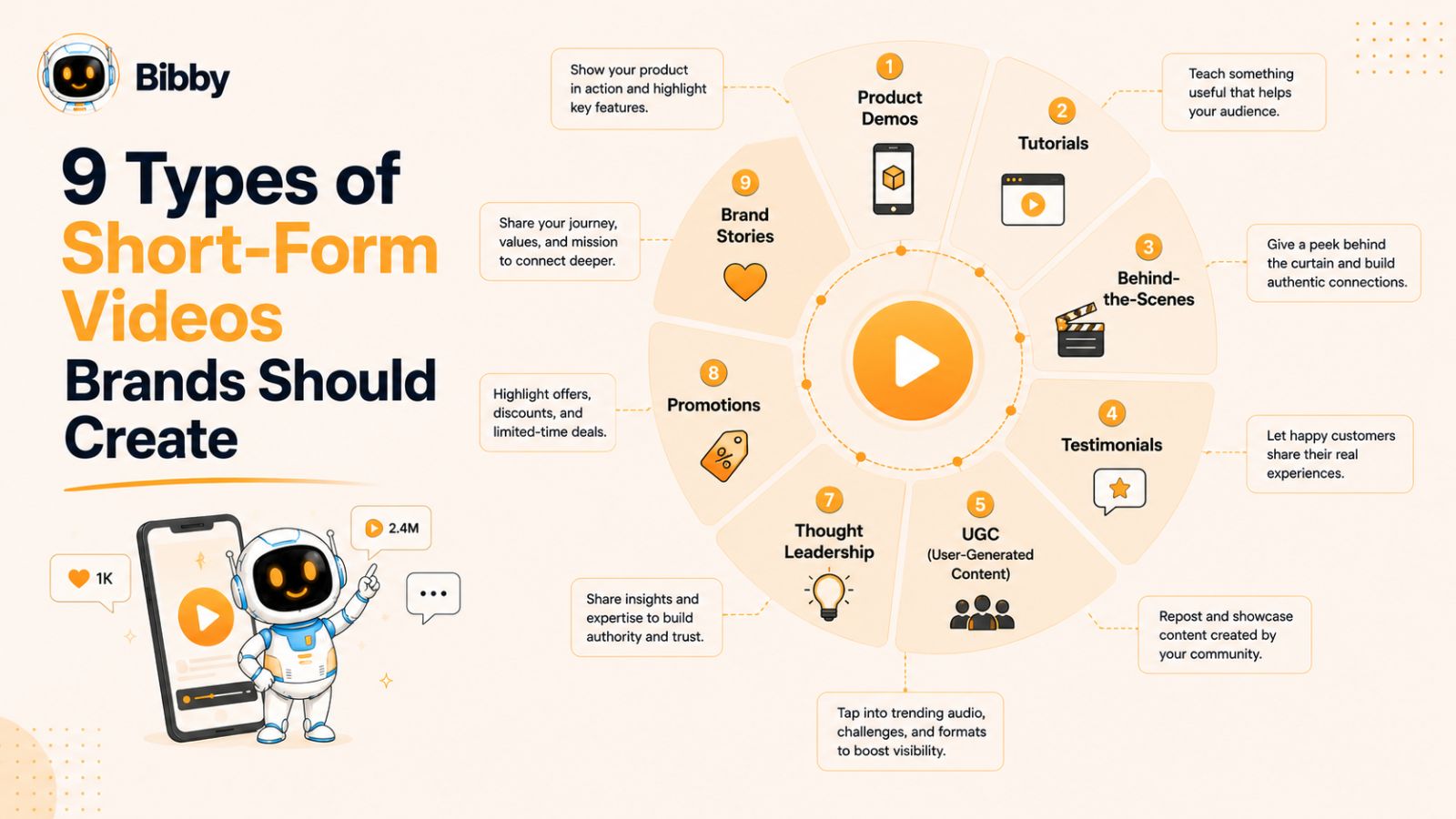
One of the biggest advantages of short-form video marketing is its versatility. Brands are not limited to a single content format or strategy. Instead, they can experiment with different video types to attract new audiences, build trust, educate prospects, and drive sales.
The most successful brands typically use a mix of content formats rather than relying on a single approach. This creates a balanced content strategy that serves customers at every stage of the buying journey.
Product Demonstration Videos
Product demonstrations are among the most effective types of short-form video content because they show potential customers exactly how a product works and the value it provides.
Instead of simply describing features, demonstration videos allow brands to showcase benefits in action.
Effective product demos often include:
- A common customer problem
- The product being used
- Key benefits and outcomes
- A clear call-to-action
For example, a software company might show how its platform saves hours of manual work, while an e-commerce brand could demonstrate how a product solves a specific everyday challenge.
Behind-the-Scenes Content
Modern consumers want to connect with the people behind the brand. Behind-the-scenes videos help businesses appear more authentic, relatable, and trustworthy.
Examples include:
- Team introductions
- Office tours
- Product creation processes
- Packaging and shipping workflows
- Company culture highlights
- Day-in-the-life content
These videos humanize a brand and help audiences feel more connected to the business.
Customer Success Stories
Few marketing assets are more persuasive than real customer results. Customer success stories provide social proof while demonstrating the real-world impact of a product or service.
Brands can create short-form videos featuring:
- Customer testimonials
- Before-and-after transformations
- Quick case study highlights
- User experiences
- Success milestones
These videos help prospects visualize their own potential outcomes, making them more likely to convert.
Educational and How-To Videos
Educational content consistently performs well because it delivers immediate value to viewers.
Rather than focusing solely on selling, brands can establish authority by teaching their audience something useful.
Popular educational video formats include:
- Quick tutorials
- Industry tips
- Common mistakes to avoid
- Step-by-step guides
- Frequently asked questions
- Expert insights
Educational videos build trust over time and position a brand as a credible source of information within its industry.
Trend-Based Content
Social media trends move quickly, but brands that participate strategically can benefit from increased visibility and engagement.
Trend-based content may include:
- Viral audio clips
- Popular challenges
- Trending formats
- Current industry conversations
- Seasonal topics
The key is adapting trends to fit the brand's message rather than following trends solely for exposure.
When executed correctly, trend-based videos can help brands reach audiences that might never have discovered them otherwise.
User-Generated Content (UGC)
User-generated content has become one of the most trusted forms of marketing because it features real customers rather than brand-created advertising.
Examples of UGC include:
- Product reviews
- Customer testimonials
- Unboxing videos
- Customer experiences
- Community-created content
Consumers often view UGC as more authentic and trustworthy than traditional promotional content, making it highly effective for increasing conversions.
Industry Insights and Thought Leadership
For B2B companies and professional brands, thought leadership content can be particularly valuable.
These videos may include:
- Market trends
- Professional advice
- Industry predictions
- Business lessons
- Expert opinions
Platforms like LinkedIn have made short-form video an increasingly effective way for professionals and businesses to build authority and attract qualified audiences.
Story-Based Brand Content
Not every video needs to promote a product directly. Many successful brands use storytelling to communicate their mission, values, and vision.
Story-based content can include:
- Brand origin stories
- Founder journeys
- Customer impact stories
- Company milestones
- Community involvement
These videos create emotional connections that help brands stand out in crowded markets.
Promotional and Offer-Based Videos
While educational and entertaining content should make up the majority of a brand's video strategy, promotional content still plays an important role.
Effective promotional videos can highlight:
- Product launches
- Limited-time offers
- Seasonal promotions
- New features
- Upcoming events
The most successful promotional videos focus on customer benefits rather than simply advertising products.
Repurposed Content at Scale
Creating content consistently can be challenging, which is why many brands repurpose existing assets into short-form videos.
Examples include:
- Turning blog posts into video tips
- Converting webinars into short clips
- Transforming customer reviews into video testimonials
- Breaking podcasts into shareable highlights
This strategy helps businesses maximize the value of content they have already created while maintaining a consistent publishing schedule.
Tools like Bibby can further streamline this process by helping marketers generate captions automatically, schedule content across Facebook, Instagram, LinkedIn, YouTube, and TikTok, and publish at AI-optimized times. This allows brands to distribute a wider variety of content without significantly increasing their workload.
Building a Balanced Content Mix
The most effective short-form video strategies combine multiple content types rather than relying on a single format. A balanced mix of educational content, product demonstrations, customer stories, trends, and promotional videos allows brands to attract attention, build trust, and drive conversions throughout the customer journey.
By experimenting with different formats and analyzing performance data, businesses can discover which video types resonate most with their audience and generate the strongest results.
Also read: How to Increase Instagram Followers: What Actually Works
How Leading Brands Use Short-Form Video to Increase Sales
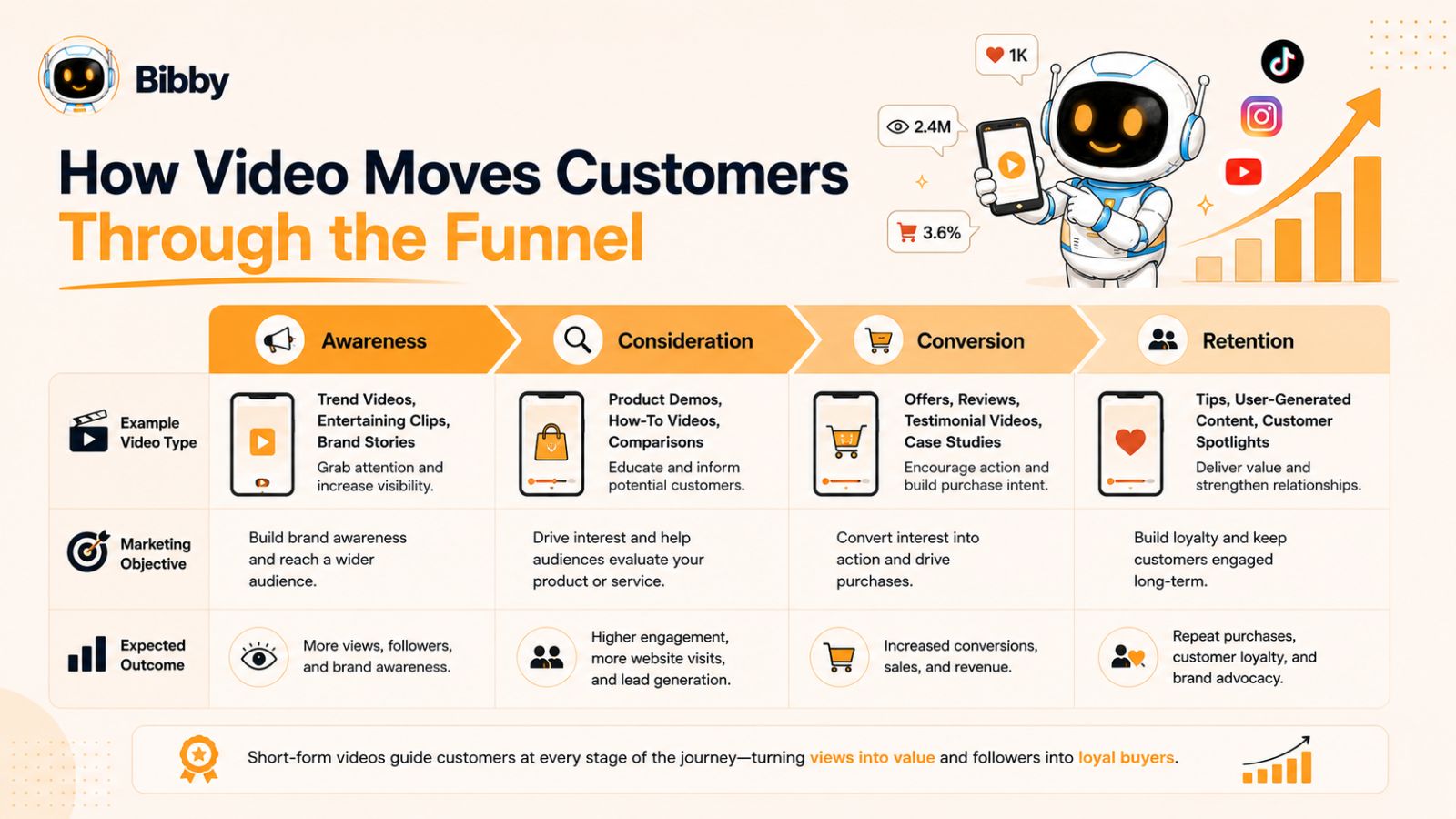
Many businesses assume that short-form video is primarily a tool for generating views and engagement. While those benefits are important, the most successful brands use short-form video strategically throughout the entire customer journey to drive measurable business results.
From attracting new audiences to converting prospects into customers and retaining existing buyers, short-form video can influence every stage of the sales funnel.
Awareness Stage: Reaching New Audiences
Every customer journey begins with awareness. Before someone can buy from a brand, they must first discover it.
Leading brands use short-form videos to maximize visibility by creating content that is highly shareable, educational, entertaining, or trend-driven. Because platforms like TikTok, Instagram Reels, YouTube Shorts, and Facebook Reels prioritize engaging content, brands can reach audiences far beyond their existing followers.
At the awareness stage, popular content formats include:
- Educational tips
- Industry insights
- Entertaining videos
- Viral trends
- Behind-the-scenes content
- Problem-focused content
The goal is not to sell immediately but to capture attention and introduce the brand to potential customers.
Consideration Stage: Building Trust and Credibility
Once people become aware of a brand, they begin evaluating whether its products or services can solve their problems.
At this stage, short-form video helps educate prospects and reduce uncertainty.
Effective consideration-stage videos include:
- Product demonstrations
- Tutorials
- Customer testimonials
- Frequently asked questions
- Comparison videos
- Case study highlights
For example, a software company may create videos showing how its platform automates repetitive tasks, while an e-commerce brand may demonstrate the quality and functionality of its products.
The objective is to provide enough information for prospects to view the brand as a trustworthy solution.
Conversion Stage: Turning Viewers Into Customers
This is where short-form video directly influences revenue.
Conversion-focused videos are designed to encourage immediate action, whether that's making a purchase, booking a consultation, requesting a demo, or signing up for a service.
Common conversion-focused video elements include:
- Customer success stories
- Product benefits
- Limited-time offers
- Promotions and discounts
- Strong calls-to-action
- Social proof
Rather than overwhelming viewers with information, successful brands focus on clearly communicating value and making the next step obvious.
For example, a fitness company might showcase a client's transformation, explain the program's benefits, and invite viewers to start a free trial.
Retention Stage: Increasing Customer Lifetime Value
Many businesses focus heavily on customer acquisition while overlooking customer retention. However, retaining existing customers is often more profitable than constantly acquiring new ones.
Leading brands use short-form video to strengthen customer relationships after the initial sale.
Examples include:
- Product usage tips
- Advanced tutorials
- Customer onboarding videos
- Community highlights
- New feature announcements
- Exclusive customer content
These videos help customers achieve better results, which increases satisfaction and encourages repeat purchases.
Using Social Proof to Accelerate Sales
One of the most effective sales drivers in short-form video marketing is social proof.
When prospects see real customers achieving positive outcomes, trust increases dramatically.
Brands frequently leverage:
- Customer testimonials
- User-generated content
- Product reviews
- Success stories
- Influencer endorsements
This type of content reassures potential buyers that others have already taken the risk and achieved positive results.
Creating Multiple Touchpoints Before the Sale
Very few consumers purchase after seeing a single piece of content.
Successful brands understand that buyers often need multiple interactions before making a decision. As a result, they create consistent streams of short-form content that repeatedly reinforce their value proposition.
A prospect might:
- Discover a brand through an educational video.
- Watch a product demonstration later.
- See a customer testimonial a few days afterward.
- Finally convert after viewing a promotional offer.
Each video contributes to building trust and moving the prospect closer to a purchase.
Scaling Sales Through Consistent Publishing
Consistency is one of the biggest differentiators between brands that generate occasional results and those that achieve sustainable growth.
Publishing multiple videos per week increases the number of opportunities to:
- Reach new audiences
- Build trust
- Educate prospects
- Generate conversions
However, managing content across multiple platforms can become time-consuming as businesses grow.
This is why many brands turn to automation tools like Bibby. Instead of manually writing captions, choosing posting times, and publishing content on every platform, marketers can upload or generate images, choose a posting style, and allow Bibby to automatically create captions, schedule content at AI-optimized times, and publish across Facebook, Instagram, LinkedIn, YouTube, and TikTok. This enables brands to maintain a consistent presence while focusing on strategy, content quality, and customer relationships.
Turning Content Into Revenue
The highest-performing brands don't view short-form video as a standalone marketing tactic. They treat it as a system that supports every stage of the customer journey.
By combining awareness-building content, trust-building educational videos, conversion-focused promotions, and retention-driven customer content, brands can transform short-form video from a source of engagement into a predictable driver of revenue and long-term business growth.
You may also like reading: How to Schedule Instagram Reels Automatically?
Best Practices for Creating High-Performing Short-Form Videos
Creating short-form videos is relatively easy. Creating videos that consistently generate reach, engagement, leads, and sales is much more challenging.
The brands that achieve the best results follow a set of proven principles that maximize viewer retention, increase engagement, and improve conversion rates. While every audience is different, these best practices provide a strong foundation for building a successful short-form video strategy.
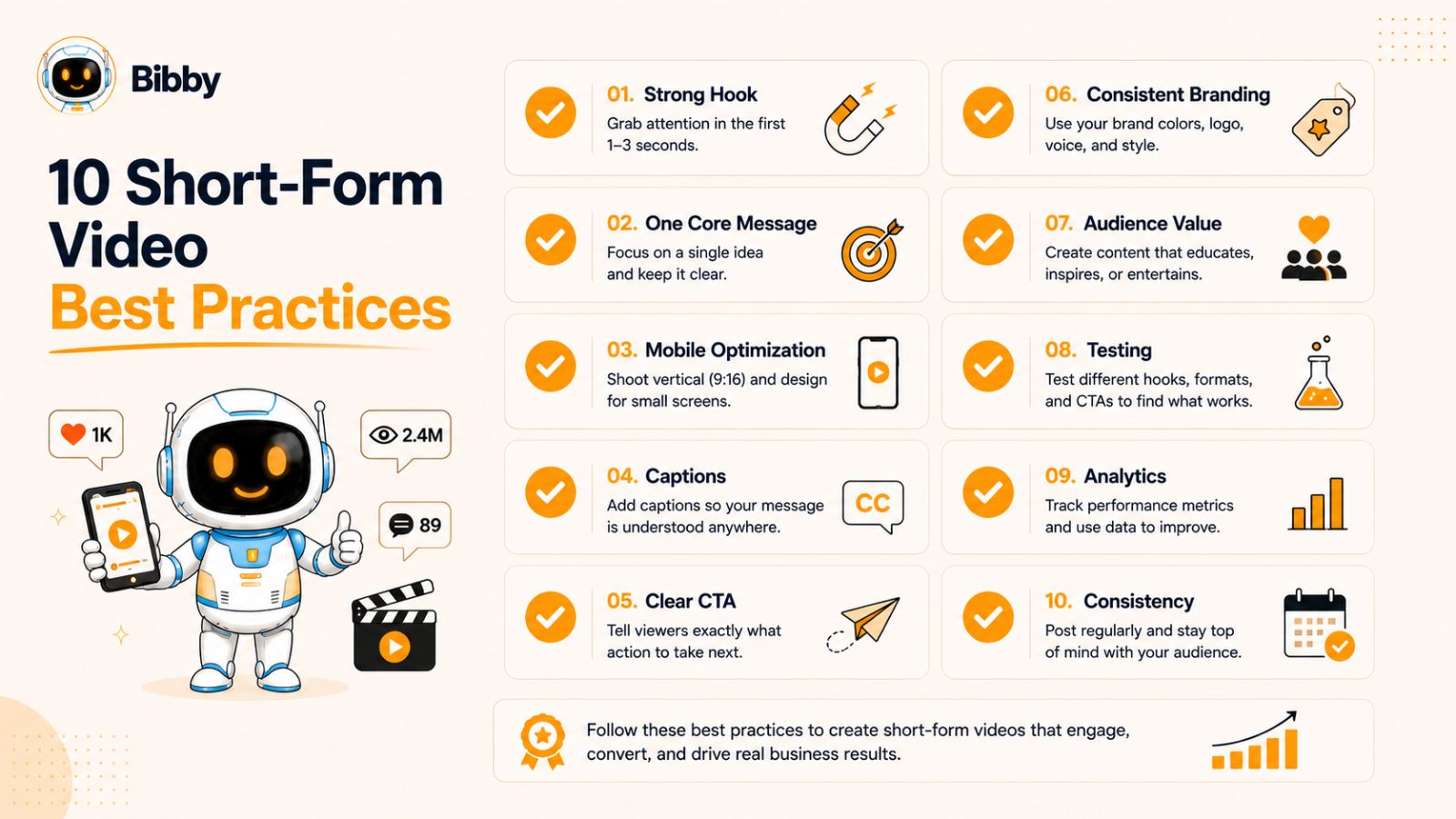
Start With a Strong Hook
The first few seconds determine whether someone continues watching or scrolls past your content.
A strong hook immediately captures attention and gives viewers a reason to stay engaged.
Effective hook strategies include:
- Asking a compelling question
- Highlighting a common problem
- Sharing a surprising fact
- Making a bold statement
- Promising a valuable outcome
For example:
- "Most businesses are making this social media mistake."
- "Here's how one simple change doubled our sales."
- "Stop doing this if you want more engagement."
The goal is to create curiosity and encourage viewers to keep watching.
Focus on One Core Message
Many businesses try to pack too much information into a single video. This often confuses viewers and reduces retention.
Instead, each video should focus on:
- One problem
- One solution
- One lesson
- One offer
- One call-to-action
A clear and focused message is easier for viewers to understand, remember, and act upon.
Prioritize Value Over Promotion
One of the biggest mistakes brands make is treating every video like an advertisement.
While promotional content has its place, audiences are more likely to engage with content that educates, entertains, inspires, or helps them solve a problem.
A useful rule is to create significantly more value-driven content than promotional content.
Examples of value-driven content include:
- Industry tips
- Tutorials
- Best practices
- Common mistakes
- Expert insights
- Customer success lessons
When brands consistently provide value, trust naturally follows.
Optimize for Mobile Viewing
Most short-form video consumption happens on mobile devices.
To maximize performance, videos should be designed specifically for mobile users.
Best practices include:
- Use vertical video formats
- Include large, readable text
- Keep visuals simple and clear
- Ensure important elements remain centered
- Use captions whenever possible
Mobile optimization improves both viewer experience and content accessibility.
Use Captions and On-Screen Text
Many users watch videos with the sound turned off, especially when browsing social media in public places.
Captions and on-screen text help ensure that viewers can understand the message regardless of audio settings.
Additional benefits include:
- Increased accessibility
- Improved retention
- Better message clarity
- Higher engagement rates
Text overlays can also reinforce key points and guide viewers through the content.
Keep Videos Concise
Short-form video succeeds because it respects the audience's time.
While platforms may allow longer videos, many of the highest-performing videos communicate their message as efficiently as possible.
Before publishing, ask:
- Can this be explained faster?
- Is every scene necessary?
- Does each second add value?
Removing unnecessary content often improves performance.
Include a Clear Call-to-Action
Even highly engaging videos can underperform from a business perspective if they lack direction.
Every video should encourage viewers to take a specific next step.
Common calls-to-action include:
- Follow for more content
- Visit our website
- Download a resource
- Leave a comment
- Share with a friend
- Book a consultation
- Start a free trial
The CTA should align with the video's objective and the viewer's stage in the customer journey.
Maintain Consistent Branding
Consistency helps build recognition and trust over time.
Brands should aim to maintain:
- A consistent visual identity
- Similar content themes
- A recognizable tone of voice
- Repeated messaging pillars
When viewers repeatedly encounter familiar branding, they become more likely to remember the business and engage with future content.
Test Different Formats and Ideas
There is no universal formula for viral content.
What works for one audience may not work for another. Successful brands continuously experiment with:
- Video lengths
- Hooks
- Content styles
- Posting times
- Calls-to-action
- Visual formats
Testing allows marketers to identify patterns and refine their content strategy based on real performance data rather than assumptions.
Publish Consistently
Consistency is one of the most important drivers of long-term success.
A single viral video can create temporary visibility, but sustained growth typically comes from publishing content regularly over time.
Consistent publishing helps brands:
- Increase audience familiarity
- Build trust
- Improve algorithmic visibility
- Generate more learning opportunities
- Create predictable growth
The challenge is that managing multiple platforms manually can quickly become overwhelming.
This is where automation becomes valuable. Tools like Bibby allow marketers to upload or generate images with AI, select a posting style, automatically generate captions, and schedule content across Facebook, Instagram, LinkedIn, YouTube, and TikTok at AI-optimized posting times. By reducing the workload associated with content management, brands can focus more on creating high-quality content while maintaining a consistent publishing schedule.
Analyze and Improve Continuously
The most successful brands treat every video as a learning opportunity.
Regularly reviewing performance metrics helps identify:
- Which topics resonate most
- Which hooks generate the highest retention
- Which formats drive engagement
- Which videos produce conversions
Continuous improvement compounds over time and often leads to significantly better results than relying on guesswork.
Build a Repeatable System
Ultimately, high-performing short-form video marketing is not about creating one viral video. It's about building a repeatable process that consistently attracts attention, delivers value, and drives business results.
Brands that combine strong content fundamentals with data-driven optimization and efficient publishing workflows are best positioned to increase their reach, strengthen customer relationships, and generate long-term growth through short-form video marketing.
Also read: The Best Social Media Platforms for Marketing
Common Short-Form Video Marketing Mistakes
Short-form video offers tremendous opportunities for growth, but many brands fail to achieve meaningful results because they make avoidable mistakes. Often, the problem is not the platform or the algorithm—it's the strategy behind the content.
Understanding these common pitfalls can help businesses create more effective videos, improve engagement, and generate better returns from their marketing efforts.
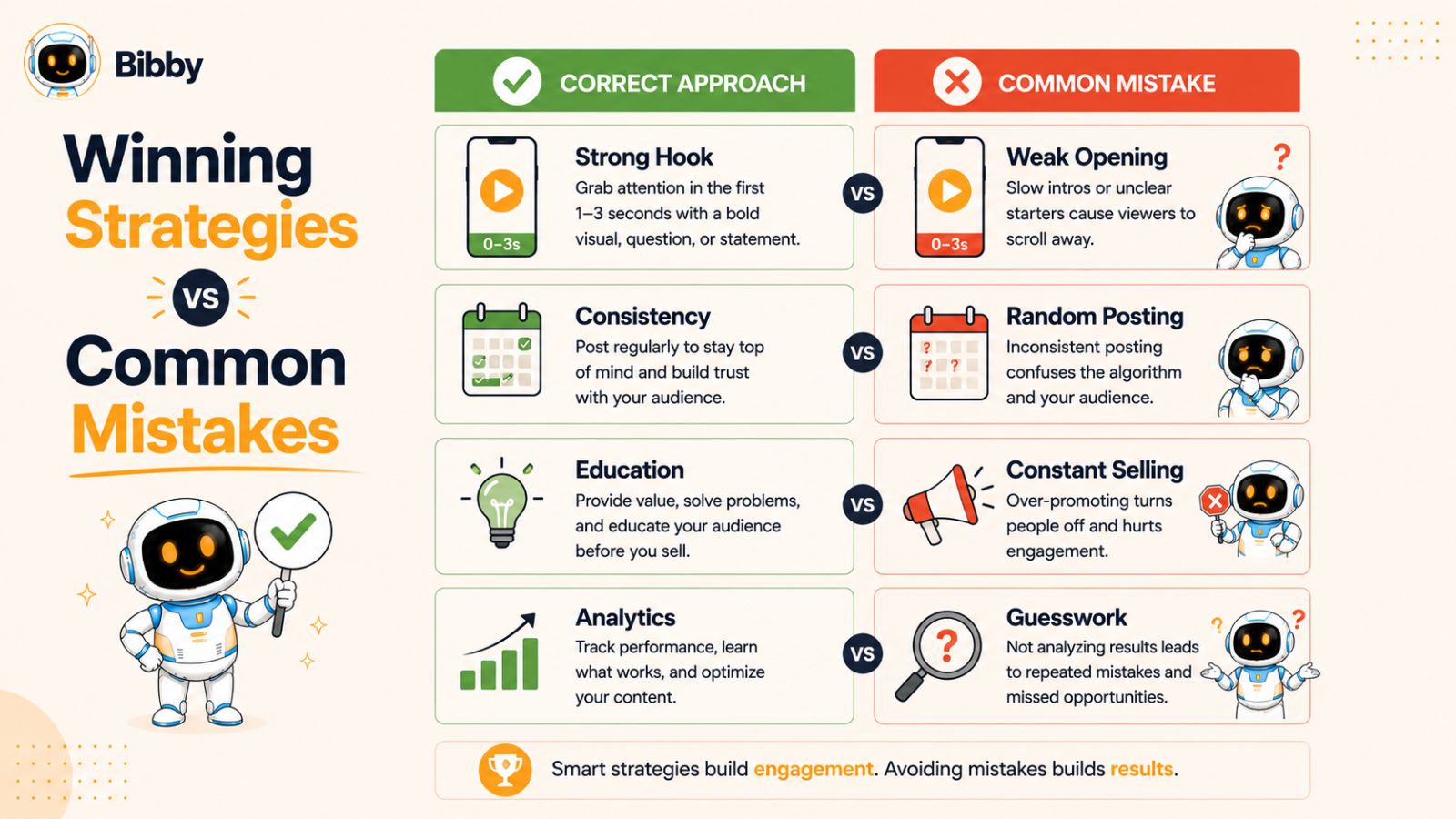
Focusing Only on Going Viral
One of the most common mistakes brands make is obsessing over viral content.
While viral videos can generate significant exposure, they do not always lead to business growth. A video that attracts millions of views from the wrong audience may produce little to no revenue.
Instead of chasing virality, brands should focus on creating content that:
- Attracts the right audience
- Provides genuine value
- Builds trust over time
- Supports business objectives
Consistent performance often delivers better long-term results than occasional viral success.
Selling Too Much, Too Soon
Many businesses treat every video as a sales pitch.
Modern audiences are highly sensitive to overly promotional content and often scroll past videos that feel like advertisements.
Instead of constantly selling, brands should focus on:
- Educating
- Entertaining
- Inspiring
- Solving problems
When businesses consistently provide value, sales opportunities emerge naturally as trust grows.
A useful guideline is to make the majority of content value-focused and reserve a smaller portion for direct promotions.
Ignoring the First Few Seconds
The opening moments of a video have a massive impact on performance.
Many brands waste valuable attention by starting with:
- Long introductions
- Company logos
- Generic greetings
- Unnecessary explanations
Viewers decide quickly whether to continue watching, making strong hooks essential.
If the first few seconds fail to create interest or curiosity, retention rates often drop dramatically.
Creating Content Without a Strategy
Publishing random videos without a clear objective rarely produces sustainable growth.
Every piece of content should serve a purpose, such as:
- Increasing awareness
- Educating prospects
- Building trust
- Driving conversions
- Retaining customers
A strategic approach ensures that content contributes to larger business goals rather than simply generating views.
Overproducing Content
Many marketers assume that professional production quality is required for success.
In reality, authenticity often outperforms highly polished content on social media.
Audiences typically care more about:
- Valuable information
- Relatable experiences
- Authentic communication
- Clear messaging
Brands should prioritize usefulness and relevance over perfection.
Neglecting Audience Research
Even well-produced videos can fail if they do not address audience needs.
Successful brands invest time in understanding:
- Customer pain points
- Common questions
- Desired outcomes
- Industry challenges
- Buying motivations
The better a brand understands its audience, the easier it becomes to create content that resonates and drives engagement.
Inconsistent Publishing
One of the fastest ways to slow growth is publishing inconsistently.
Many businesses start strong, post frequently for a few weeks, and then disappear for extended periods.
Inconsistent posting can:
- Reduce audience engagement
- Limit algorithmic visibility
- Slow audience growth
- Decrease brand recall
Consistency builds momentum, while inconsistency often forces brands to start over repeatedly.
Ignoring Analytics
Creating content without analyzing performance is like driving without looking at the road.
Analytics provide valuable insights into what is working and what needs improvement.
Important metrics include:
- Reach
- Watch time
- Audience retention
- Engagement rate
- Click-through rate
- Conversion rate
Brands that regularly review performance data can make smarter decisions and improve results over time.
Using the Same Content Everywhere Without Optimization
While cross-platform publishing is efficient, simply posting identical content everywhere is not always the best strategy.
Different platforms attract different audiences and encourage different behaviors.
For example:
- TikTok often rewards entertainment and trend participation.
- LinkedIn audiences typically prefer professional insights.
- Instagram users often engage with visually appealing content.
- YouTube Shorts may favor educational and evergreen topics.
Successful brands adapt content when necessary while maintaining consistent messaging.
Trying to Manage Everything Manually
As content volume increases, managing multiple social media platforms manually becomes increasingly difficult.
Common challenges include:
- Writing captions for every platform
- Scheduling content individually
- Tracking posting times
- Monitoring performance metrics
- Maintaining publishing consistency
These repetitive tasks can consume significant amounts of time and often prevent businesses from focusing on content strategy and creativity.
This is one reason many brands adopt automation platforms such as Bibby. By allowing users to upload or generate images with AI, automatically generate captions, schedule posts at AI-optimized times, publish across Facebook, Instagram, LinkedIn, YouTube, and TikTok, and monitor analytics from a centralized dashboard, Bibby helps reduce operational complexity while improving consistency and efficiency.
Failing to Learn and Adapt
Social media platforms evolve constantly. Audience preferences change, algorithms update, and new content formats emerge.
Brands that refuse to adapt often experience declining performance over time.
The most successful marketers continuously:
- Test new ideas
- Analyze results
- Refine strategies
- Experiment with formats
- Learn from audience behavior
Adaptability is often a major competitive advantage in short-form video marketing.
Avoiding Mistakes Creates Faster Growth
Success with short-form video is not solely about doing more things right. It is also about avoiding the mistakes that limit reach, engagement, and conversions.
Brands that focus on providing value, publishing consistently, analyzing performance, and streamlining their workflows are far more likely to build sustainable growth and turn short-form video into a reliable source of awareness, leads, and sales.
Also read: What to Post on Instagram When You Have No Ideas
How AI Is Transforming Short-Form Video Marketing
Artificial intelligence is rapidly changing how brands create, publish, and optimize short-form video content. Tasks that once required hours of manual effort can now be completed in minutes, allowing businesses to produce more content, maintain consistency, and scale their marketing efforts without significantly increasing costs.
As competition for attention continues to grow, AI is becoming an essential tool for brands that want to maximize efficiency while improving content performance.
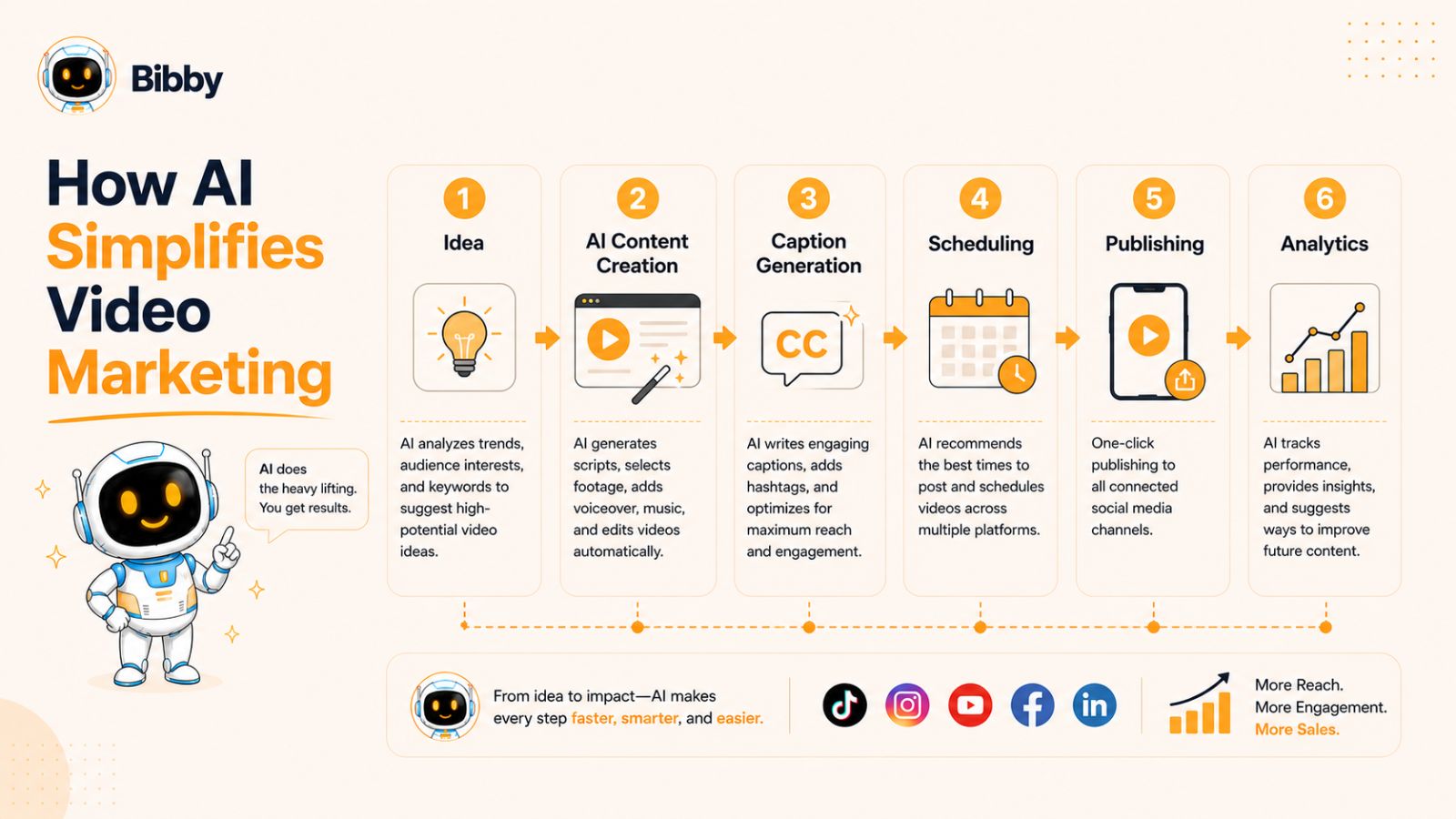
AI-Powered Content Creation
One of the most significant benefits of AI is its ability to accelerate content production.
Creating a single social media post traditionally involves multiple steps:
- Brainstorming ideas
- Writing scripts
- Creating visuals
- Editing content
- Writing captions
- Preparing platform-specific posts
AI tools can assist with many of these tasks, helping marketers generate content ideas, draft scripts, suggest improvements, and create supporting assets much faster than traditional workflows.
This allows businesses to spend less time on repetitive tasks and more time developing effective marketing strategies.
Faster Creative Production
Many brands struggle to publish consistently because content creation requires substantial time and resources.
AI helps reduce these barriers by enabling marketers to:
- Generate visual assets
- Create content variations
- Repurpose existing content
- Develop multiple campaign concepts quickly
- Produce more content with smaller teams
As a result, businesses can maintain a stronger presence across social media platforms without dramatically increasing their workload.
Smarter Caption Generation
Writing captions can be surprisingly time-consuming, especially when managing multiple platforms and publishing frequently.
AI-powered caption generation helps marketers create relevant, engaging copy while maintaining consistency in messaging and tone.
Benefits include:
- Faster content preparation
- Improved consistency
- Reduced creative fatigue
- Easier multi-platform publishing
- Greater scalability
Rather than starting from a blank page each time, marketers can use AI to accelerate the writing process and focus on refining key messages.
AI-Optimized Scheduling
Publishing content consistently is one of the most important factors in short-form video success. However, determining the best times to post can be challenging because audience behavior varies across platforms and industries.
AI scheduling tools help solve this problem by analyzing performance data and identifying optimal posting windows.
Potential benefits include:
- Increased visibility
- Higher engagement rates
- Improved audience reach
- More efficient content distribution
- Reduced manual scheduling effort
By automating scheduling decisions, brands can maintain consistency while maximizing the impact of every post.
Enhanced Analytics and Performance Insights
Creating content is only part of the process. Long-term success depends on understanding what works and continuously improving results.
AI-powered analytics tools can help marketers:
- Identify top-performing content
- Analyze audience behavior
- Track engagement trends
- Discover growth opportunities
- Recommend optimization strategies
Instead of manually reviewing large amounts of data, businesses can use AI-driven insights to make faster and more informed decisions.
Scaling Multi-Platform Marketing
Most brands no longer rely on a single social media channel. Instead, they publish content across multiple platforms to maximize reach and audience growth.
Managing content across Facebook, Instagram, LinkedIn, YouTube, and TikTok can become complex when handled manually.
AI simplifies multi-platform management by helping businesses:
- Create content more efficiently
- Adapt messaging across channels
- Schedule posts from a central location
- Maintain publishing consistency
- Monitor performance from one dashboard
This allows marketing teams to scale their efforts without creating additional operational challenges.
Reducing Time Spent on Repetitive Tasks
Many social media activities are necessary but repetitive:
- Writing captions
- Scheduling posts
- Uploading content
- Managing publishing calendars
- Tracking performance metrics
While these tasks are important, they often consume time that could be spent on strategy, audience research, or content creation.
AI helps automate these operational responsibilities, enabling marketers to focus on higher-value activities that contribute directly to business growth.
Why AI Is Becoming a Competitive Advantage
As more brands invest in short-form video marketing, efficiency becomes increasingly important.
Businesses that leverage AI can often:
- Publish more consistently
- Create content faster
- Analyze performance more effectively
- Reach audiences more efficiently
- Scale marketing efforts with fewer resources
This creates a meaningful competitive advantage, particularly for small and medium-sized businesses that may not have large marketing teams.
The Future of AI in Short-Form Video Marketing
AI is not replacing creativity—it is enhancing it.
The most successful brands use AI to handle repetitive and data-driven tasks while allowing human marketers to focus on storytelling, strategy, brand positioning, and customer relationships.
As AI technology continues to evolve, marketers will gain access to even more sophisticated tools for content creation, scheduling, optimization, and audience analysis.
For businesses looking to grow through short-form video, adopting AI-powered workflows is quickly becoming less of an option and more of a necessity. Brands that embrace these technologies early will be better positioned to create content consistently, scale efficiently, and compete effectively in an increasingly crowded digital landscape.
Also read: How to Automate Social Media for Small Business (Without Hiring Anyone)
How Bibby Helps Brands Scale Short-Form Video Marketing
Creating successful short-form video content is only half the battle. The real challenge for many brands is maintaining a consistent publishing schedule across multiple social media platforms while managing content creation, caption writing, scheduling, analytics, and performance optimization.
As businesses grow, these tasks become increasingly time-consuming. Marketing teams often spend more time managing workflows than creating content and developing strategy.
This is where Bibby helps simplify the entire process.
Bibby is an AI-powered social media scheduling and automation platform designed to help businesses create, publish, manage, and optimize content from a single dashboard. By combining AI content generation, automated scheduling, multi-platform publishing, and analytics, Bibby enables brands to scale their social media marketing efforts while significantly reducing manual work.
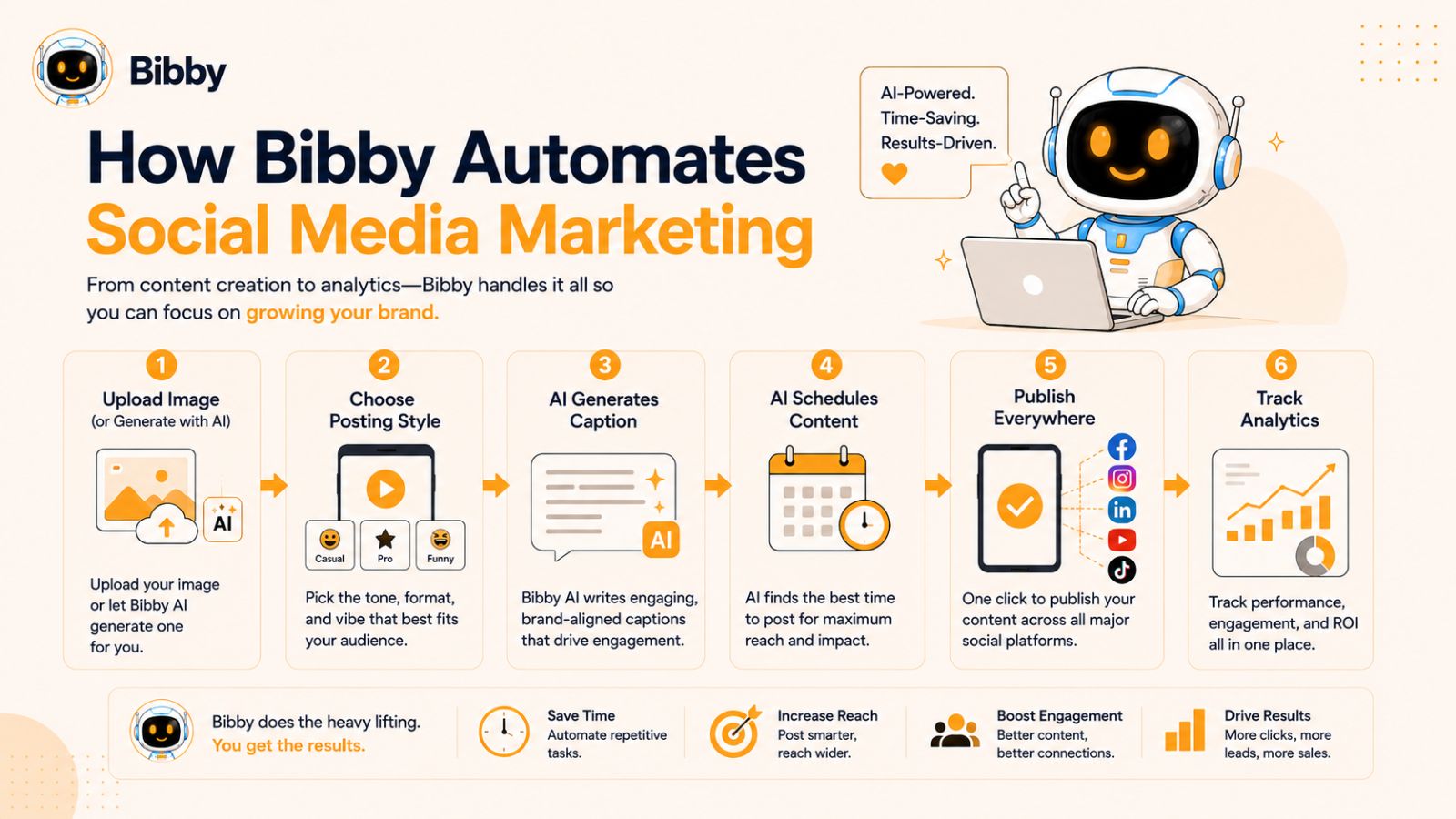
A Simple Workflow Designed for Busy Marketers
One of Bibby's biggest advantages is its simplicity.
Many social media tools require complex workflows involving multiple platforms, manual scheduling, and extensive content preparation. Bibby streamlines the process into a straightforward workflow that anyone can use.
The process typically looks like this:
- Upload an image or generate one using AI.
- Choose your preferred posting style.
- Let Bibby's AI generate captions automatically.
- Select the social media platforms you want to publish to.
- Allow Bibby to schedule content at AI-optimized posting times.
- Track performance through built-in analytics.
Instead of juggling multiple tools and dashboards, businesses can manage their entire social media workflow in one place.
Create Content Faster With AI
One of the biggest bottlenecks in social media marketing is content creation.
Many businesses struggle to publish consistently because creating content requires significant time and creative energy. Coming up with ideas, designing visuals, writing captions, and preparing posts can quickly become overwhelming.
Bibby helps reduce this workload by allowing users to:
- Upload existing images
- Generate images using AI
- Create content more efficiently
- Produce social media assets faster
- Maintain a steady publishing schedule
This allows marketers to spend less time on production and more time focusing on audience engagement and business growth.
AI-Generated Captions That Save Time
Writing captions for every social media post can be one of the most repetitive parts of content marketing.
Different platforms often require slightly different messaging, and producing engaging copy consistently can become challenging over time.
Bibby's AI automatically generates captions based on your content and selected posting style.
Benefits include:
- Faster content creation
- Consistent messaging
- Reduced writer's block
- Improved workflow efficiency
- Easier content scaling
Rather than starting from scratch for every post, marketers can review, customize if desired, and publish much more quickly.
AI-Optimized Scheduling for Better Results
Many brands understand the importance of posting consistently but struggle to determine the best times to publish.
Audience activity varies across:
- Platforms
- Industries
- Geographic regions
- Audience demographics
Posting at the wrong time can limit reach and engagement, regardless of content quality.
Bibby addresses this challenge by scheduling content at AI-optimized times designed to maximize visibility and engagement opportunities.
This helps businesses:
- Improve consistency
- Increase potential reach
- Enhance audience engagement
- Reduce manual scheduling decisions
- Save valuable time
Instead of manually selecting publishing times for every post, marketers can rely on automation to streamline the process.
Publish Across Multiple Platforms From One Dashboard
Modern brands rarely focus on a single social network.
To maximize reach, businesses often maintain a presence across:
- YouTube
- TikTok
Managing each platform separately can be inefficient and time-consuming.
Bibby allows users to publish content across multiple platforms from a centralized dashboard, reducing the need to switch between accounts and tools throughout the day.
This centralized approach helps marketers:
- Save time
- Improve workflow efficiency
- Maintain consistent branding
- Increase content distribution
- Simplify campaign management
Support for Multiple Content Types
Today's social media strategies require more than static posts.
Brands often publish:
- Videos
- Stories
- Images
- Promotional campaigns
- Educational content
- Product announcements
Bibby supports multiple content formats, making it easier for businesses to execute diverse content strategies without relying on multiple software solutions.
This flexibility allows brands to adapt their content mix based on audience preferences and platform requirements.
Maintain Consistency Without Burnout
Consistency is one of the most important factors in social media success.
However, maintaining a regular publishing schedule can become difficult when businesses are managing multiple platforms and competing priorities.
Many brands experience:
- Content gaps
- Missed publishing opportunities
- Inconsistent posting schedules
- Workflow bottlenecks
Bibby's automation capabilities help reduce these challenges by handling much of the repetitive work associated with content publishing.
As a result, businesses can maintain a stronger social media presence without significantly increasing their workload.
Access Performance Analytics in One Place
Creating and publishing content is only part of a successful social media strategy. Brands must also understand how their content performs and identify opportunities for improvement.
Bibby provides analytics that help businesses monitor important performance indicators such as:
- Reach
- Engagement
- Audience growth
- Content performance
- Publishing effectiveness
Having access to these insights allows marketers to make more informed decisions and continuously refine their content strategies.
Improve Team Productivity
For businesses with dedicated marketing teams, efficiency becomes increasingly important as content production scales.
Bibby's streamlined workflow helps reduce time spent on repetitive tasks such as:
- Caption writing
- Scheduling
- Cross-platform publishing
- Content management
This allows teams to focus more energy on:
- Creative development
- Audience research
- Campaign planning
- Strategic growth initiatives
The result is a more productive marketing operation capable of producing greater results with fewer resources.
Why Businesses Are Embracing Social Media Automation
The demand for content continues to increase across virtually every industry.
Consumers expect brands to publish regularly, respond quickly, and maintain active social media presences. Meeting these expectations manually can be difficult, especially for small businesses and growing marketing teams.
Automation helps bridge this gap by allowing brands to:
- Scale content production
- Improve consistency
- Reduce manual work
- Increase efficiency
- Maintain a stronger online presence
Tools like Bibby make it possible to achieve these goals without adding significant complexity to the marketing process.
The Bottom Line
Short-form video marketing offers enormous opportunities for brands to increase reach, engagement, and sales. However, achieving sustainable success requires more than creating great content—it requires a repeatable system for publishing, managing, and optimizing that content at scale.
Bibby provides that system.
By allowing businesses to upload or generate images with AI, automatically create captions, schedule posts at AI-optimized times, publish across Facebook, Instagram, LinkedIn, YouTube, and TikTok, support multiple content formats, and track analytics from a single dashboard, Bibby simplifies the entire social media workflow.
For brands looking to save time, improve consistency, and scale their short-form video marketing efforts, Bibby provides a practical solution that helps transform social media management from a daily challenge into a streamlined, automated process.
Measuring the Success of Your Short-Form Video Strategy
Creating and publishing short-form videos is only the beginning. To achieve sustainable growth, brands must understand how their content performs and whether it contributes to meaningful business outcomes.
Without measurement, it's impossible to know which videos are generating results, which strategies need improvement, and where future opportunities exist.
The most successful brands use data to guide their decisions, continuously refining their content strategy based on audience behavior and performance insights.
Why Measurement Matters
Many marketers focus solely on views when evaluating short-form video performance. While views can indicate reach, they rarely tell the complete story.
A video with thousands of views but no engagement or conversions may contribute less business value than a video with a smaller audience but stronger customer action.
Measuring performance helps brands:
- Understand audience preferences
- Identify successful content formats
- Improve future campaigns
- Allocate resources more effectively
- Increase return on investment (ROI)
Data-driven decisions often outperform assumptions and guesswork.
Key Metrics Every Brand Should Track
Different metrics provide different insights into content performance.
Rather than focusing on a single number, brands should evaluate a combination of indicators that reflect audience engagement, content quality, and business impact.
Reach
Reach measures the number of unique users who see a piece of content.
Tracking reach helps brands understand:
- Content visibility
- Audience expansion
- Brand awareness growth
- Platform distribution effectiveness
Growing reach typically indicates that content is being exposed to new audiences.
Impressions
Impressions represent the total number of times content is displayed, including multiple views by the same person.
This metric can help marketers understand:
- Content exposure frequency
- Distribution patterns
- Overall visibility
Comparing impressions and reach can provide insights into how often audiences encounter your content.
Video Views
Views remain one of the most commonly tracked metrics in short-form video marketing.
While view definitions vary by platform, tracking views helps measure:
- Initial content interest
- Audience attraction
- Topic popularity
However, views should always be analyzed alongside engagement and retention metrics for a more complete picture.
Watch Time
Watch time measures how long viewers spend consuming content.
This metric is particularly important because many social media algorithms use watch time as a signal when deciding how broadly to distribute videos.
Higher watch time often indicates:
- Strong audience interest
- Effective storytelling
- Relevant content
- Successful hooks
Videos that maintain viewer attention tend to perform better over time.
Audience Retention
Retention measures the percentage of a video viewers watch before leaving.
Strong retention often signals that content is delivering value consistently throughout the viewing experience.
Brands should monitor:
- Drop-off points
- Completion rates
- Viewer behavior patterns
Understanding where viewers lose interest can help improve future videos.
Engagement Metrics
Engagement reflects how audiences interact with content beyond simply watching it.
Important engagement metrics include:
Likes
Likes indicate positive audience reactions and can serve as a basic signal of content resonance.
Comments
Comments often provide deeper insights into audience interests, opinions, and questions.
They can also help generate valuable community engagement.
Shares
Shares are one of the strongest indicators of content value because they demonstrate that viewers found the content valuable enough to recommend to others.
Saves
Saves suggest that viewers want to revisit content later, often indicating high educational or practical value.
Together, these engagement metrics help marketers understand how audiences perceive and interact with their content.
Tracking Conversion Metrics
While engagement is important, most brands ultimately care about business outcomes.
Conversion metrics help connect content performance to revenue-generating activities.
Examples include:
- Website visits
- Lead submissions
- Demo requests
- Email sign-ups
- Product purchases
- Free trial registrations
- Consultation bookings
Tracking conversions allows businesses to evaluate whether their content contributes to growth beyond social media engagement.
Understanding Return on Investment (ROI)
ROI helps determine whether content efforts are producing meaningful business value.
A simple ROI evaluation may consider:
- Revenue generated
- Leads acquired
- Customer acquisition costs
- Time invested
- Production costs
- Advertising spend
Understanding ROI allows brands to identify which content strategies produce the strongest returns and deserve greater investment.
Identifying Top-Performing Content
One of the most valuable aspects of analytics is discovering what works.
Brands should regularly review:
- Highest-performing videos
- Most engaging topics
- Strongest hooks
- Best-performing formats
- Top conversion drivers
Patterns often emerge over time, revealing opportunities to replicate successful content.
Using Data to Improve Future Videos
Analytics should not be viewed as a reporting exercise—they should inform future strategy.
For example:
- Low retention may indicate weak hooks.
- Strong engagement may suggest a topic deserves additional coverage.
- High conversions may reveal valuable audience interests.
- Poor reach may indicate a distribution or content issue.
The goal is continuous improvement rather than perfection.
Simplifying Analytics With Automation
As content volume increases, manually tracking performance across multiple platforms becomes more difficult.
Many brands publish simultaneously on Facebook, Instagram, LinkedIn, YouTube, and TikTok, creating large amounts of performance data.
Platforms like Bibby help simplify this process by providing analytics and performance insights within a centralized dashboard. Instead of switching between multiple social networks to evaluate results, marketers can monitor key metrics, identify trends, and make informed decisions more efficiently.
This centralized approach saves time while making performance management more practical and actionable.
Building a Data-Driven Growth Engine
The most successful brands don't rely on luck when creating short-form video content. They use data to understand what resonates with audiences and continuously optimize their approach.
By tracking reach, engagement, retention, conversions, and ROI, businesses can transform short-form video marketing from a content creation activity into a measurable growth engine.
When combined with consistent publishing, audience-focused content, and effective automation tools, performance measurement becomes one of the most powerful drivers of long-term success.
The Future of Short-Form Video Marketing
Short-form video has already transformed the way brands communicate with consumers, but its evolution is far from over. As technology advances and consumer behavior continues to shift, short-form video is expected to become even more influential in how businesses build audiences, generate leads, and drive sales.
Brands that understand emerging trends and adapt early will be better positioned to maintain a competitive advantage in the years ahead.
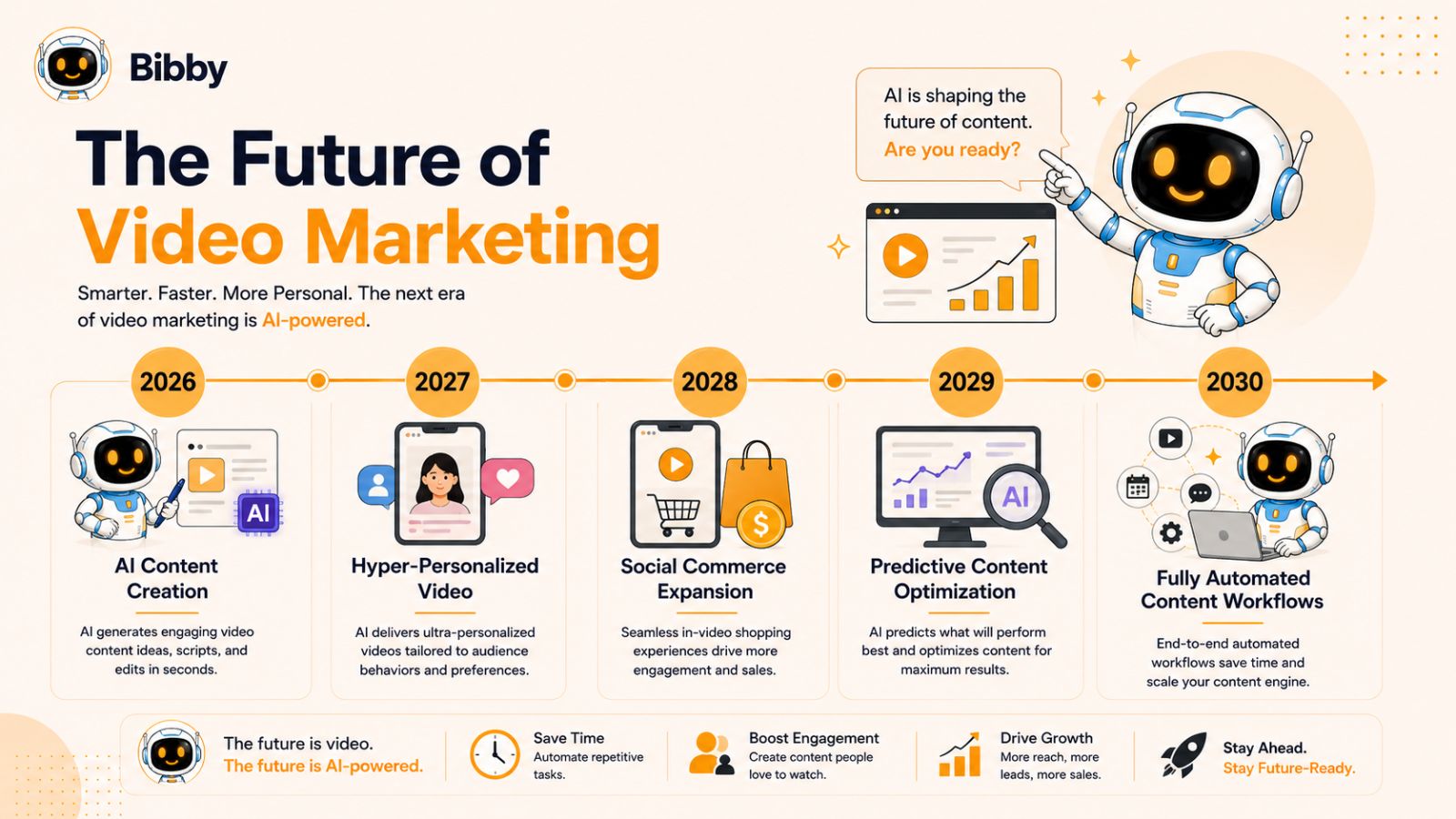
AI Will Become a Core Part of Content Creation
Artificial intelligence is already helping marketers create content more efficiently, but future AI capabilities will likely become even more sophisticated.
Businesses can expect AI tools to assist with:
- Content ideation
- Script creation
- Visual generation
- Caption writing
- Content optimization
- Performance forecasting
Rather than replacing marketers, AI will continue to act as a productivity multiplier, allowing teams to produce more content while maintaining quality and consistency.
The brands that successfully combine human creativity with AI-powered workflows will likely outperform those relying entirely on manual processes.
Personalized Content Will Drive Higher Engagement
Consumers increasingly expect content that feels relevant to their interests, preferences, and behaviors.
As platforms improve their recommendation algorithms, personalization will become an even greater competitive advantage.
Future short-form video strategies may include:
- Audience-specific messaging
- Personalized offers
- Dynamic content variations
- Interest-based recommendations
- Behavior-driven campaigns
Brands that create highly relevant content for specific audience segments will be more likely to attract engagement and conversions.
Social Commerce Will Continue to Grow
The gap between content discovery and purchasing continues to shrink.
Consumers are increasingly discovering products through social media and making purchasing decisions without leaving the platform.
As social commerce expands, short-form video will play an even larger role in:
- Product discovery
- Product education
- Customer trust building
- Purchase decisions
Brands that integrate video content into their sales strategies will be better positioned to capitalize on this trend.
Authenticity Will Remain Essential
While AI and automation will become more advanced, authenticity will remain one of the most valuable assets in digital marketing.
Consumers are becoming increasingly selective about the content they trust. As a result, brands that prioritize transparency, honesty, and genuine communication will continue to stand out.
Future high-performing content will likely emphasize:
- Real customer experiences
- Behind-the-scenes insights
- Founder stories
- Community engagement
- User-generated content
Technology may evolve, but trust will remain a key driver of purchasing behavior.
Multi-Platform Strategies Will Become Standard
Most audiences no longer spend their time on a single platform.
A potential customer may discover a brand on TikTok, follow it on Instagram, watch tutorials on YouTube, and engage professionally on LinkedIn.
This means successful brands will increasingly adopt multi-platform content strategies that maximize visibility across multiple channels.
However, managing content across multiple networks can quickly become operationally complex.
Businesses will need efficient systems that allow them to:
- Create content quickly
- Publish consistently
- Adapt content for different audiences
- Monitor performance across platforms
- Maintain brand consistency
Automation will play a critical role in making these strategies sustainable.
Data-Driven Decision Making Will Become More Important
As competition increases, relying on intuition alone will become less effective.
Brands will need to leverage data to understand:
- Audience preferences
- Content performance
- Conversion patterns
- Engagement trends
- Revenue impact
Organizations that use analytics to guide their content decisions will likely achieve stronger results than those relying solely on creative assumptions.
Consistency Will Become a Bigger Competitive Advantage
As more businesses invest in short-form video, consistency will become increasingly important.
The brands that publish valuable content regularly will have more opportunities to:
- Reach new audiences
- Build trust
- Strengthen brand recognition
- Generate customer demand
Consistency is often easier said than done, particularly when businesses are managing multiple social media channels simultaneously.
This is why automation platforms are becoming essential components of modern marketing operations.
The Rise of End-to-End Content Automation
One of the most significant developments in the future of social media marketing is the movement toward fully integrated content workflows.
Instead of using separate tools for content creation, caption writing, scheduling, publishing, and analytics, businesses increasingly prefer unified solutions that simplify the entire process.
Platforms like Bibby represent this shift by bringing together:
- AI image generation
- Content creation workflows
- Automated caption generation
- AI-optimized scheduling
- Multi-platform publishing
- Centralized analytics
As content demands continue to increase, integrated solutions will become increasingly valuable for businesses seeking efficiency and scalability.
What Brands Should Do Now
While predicting the future with complete certainty is impossible, several actions can help businesses prepare for what's ahead:
- Invest in short-form video content today
- Build a consistent publishing schedule
- Experiment with AI-powered tools
- Focus on audience value rather than platform trends
- Track performance and optimize continuously
- Develop scalable content workflows
Brands that start building these capabilities now will be better prepared for future changes in technology, consumer behavior, and platform algorithms.
The Future Belongs to Agile Brands
The future of short-form video marketing will be shaped by a combination of creativity, technology, automation, and audience understanding.
Businesses that embrace innovation while maintaining authentic connections with their audiences will be best positioned to thrive. By leveraging AI, creating valuable content consistently, and adopting efficient workflows, brands can continue to increase reach, strengthen customer relationships, and drive sustainable revenue growth through short-form video marketing.
The opportunity is no longer simply to participate in short-form video marketing—it's to build a scalable system that allows your brand to grow alongside the evolving digital landscape.
Conclusion
Short-form video has become one of the most effective ways for brands to increase reach, build stronger audience relationships, and drive sales in today's digital landscape. The most successful businesses focus on three key principles: creating valuable content that captures attention, using data and analytics to continuously improve performance, and maintaining a consistent publishing schedule across multiple platforms.
As competition for attention continues to grow, brands that combine compelling content with efficient workflows will have a significant advantage. AI-powered tools and automation platforms make it easier than ever to scale content creation, streamline publishing, and stay visible where audiences spend their time.
Whether you're just getting started with short-form video or looking to improve an existing strategy, the next step is to develop a repeatable content system that supports long-term growth. This includes creating a content calendar, testing different video formats, analyzing performance data, and leveraging tools like Bibby to simplify scheduling, publishing, and optimization.
By consistently delivering value and embracing smarter marketing workflows, brands can turn short-form video from a content trend into a sustainable engine for audience growth, customer acquisition, and revenue generation.