Managing social media across multiple platforms has become essential for businesses that want to maximize visibility, engage audiences, and drive consistent growth online.
If you're struggling to keep up with Facebook, Instagram, LinkedIn, TikTok, and YouTube simultaneously, you're not alone. The good news is that modern AI-powered tools and automation workflows can simplify the entire process while helping you publish better content, more consistently, and with less effort.
In this article, you will learn:
- How to manage multiple social media platforms efficiently
- How AI automation saves hours of manual work weekly
- How to scale content creation, scheduling, and analytics
Whether you're a small business, creator, agency, or marketing team, mastering multi platform social media management can help you reach more customers while spending significantly less time on day-to-day social media tasks.
What Is Multi Platform Social Media Management?
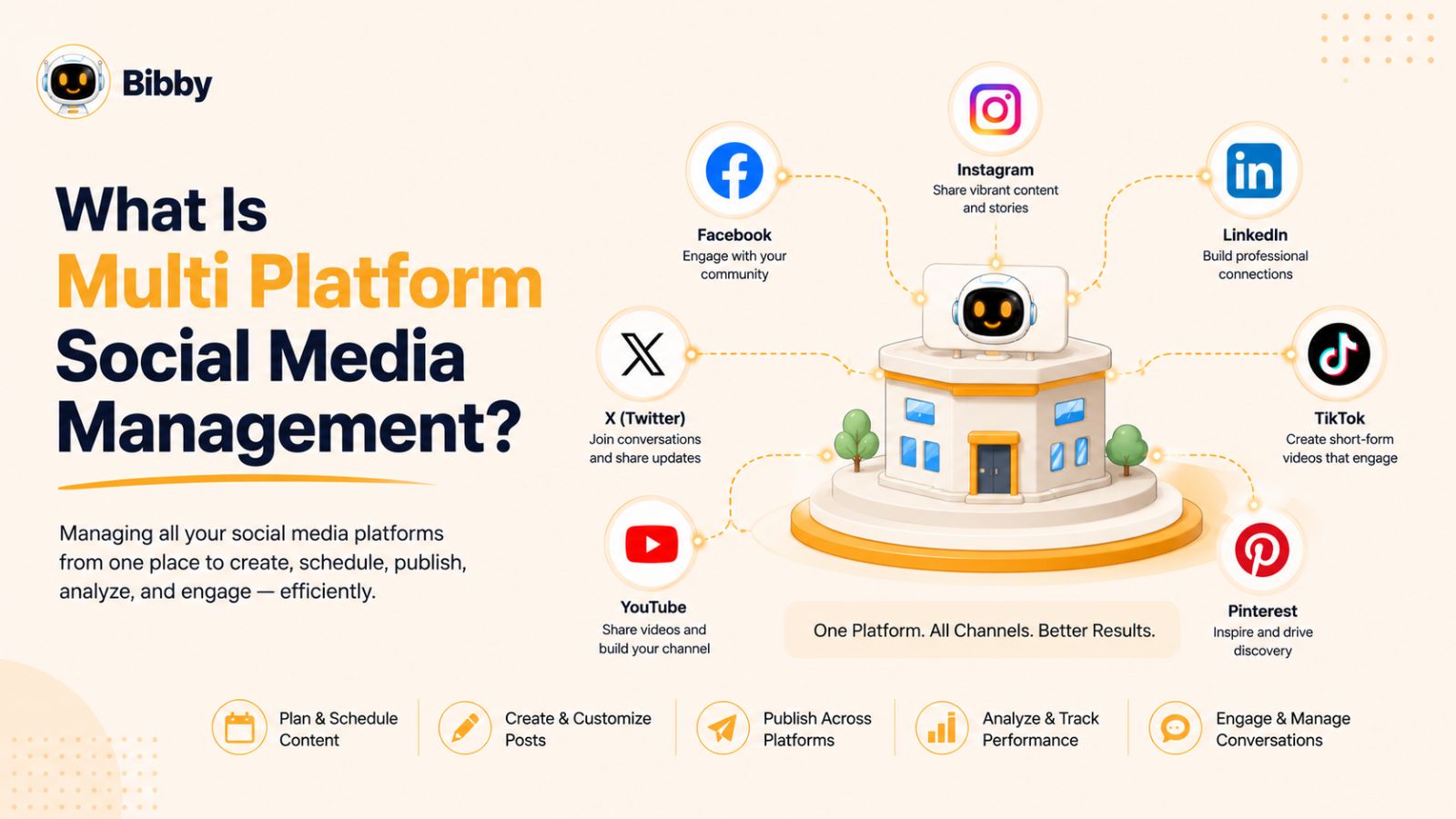
Multi platform social media management is the process of creating, scheduling, publishing, monitoring, and analyzing content across multiple social media platforms from a centralized workflow.
Instead of managing each platform separately, businesses use strategies and tools that allow them to coordinate their social media efforts across channels such as Facebook, Instagram, LinkedIn, TikTok, YouTube, Pinterest, X (formerly Twitter), and Threads. This approach helps maintain brand consistency, improve efficiency, and reach audiences wherever they spend their time online.
Why Businesses Need Multi Platform Social Media Management
Today's customers rarely use just one social network. A potential customer might discover your brand on Instagram, research your company on LinkedIn, watch your videos on YouTube, and eventually make a purchase after seeing a Facebook advertisement.
Without a coordinated strategy, businesses risk delivering inconsistent messaging, missing engagement opportunities, and wasting valuable time managing multiple accounts manually.
Common Social Media Platforms Businesses Manage
Most businesses focus on a combination of the following platforms:
- Facebook for community building and advertising
- Instagram for visual content and brand awareness
- LinkedIn for professional networking and B2B marketing
- TikTok for short-form video content and viral reach
- YouTube for long-form video content and search visibility
- Pinterest for product discovery and inspiration
- X (Twitter) for real-time conversations and updates
- Threads for community engagement and discussions
The Goal of Multi Platform Social Media Management
The primary objective is simple: maximize your reach while minimizing the time and effort required to manage your social media presence.
By using the right processes and automation tools, businesses can publish content consistently, engage with audiences effectively, track performance accurately, and scale their marketing efforts without becoming overwhelmed by daily social media tasks.
The Biggest Challenges of Managing Multiple Social Media Platforms
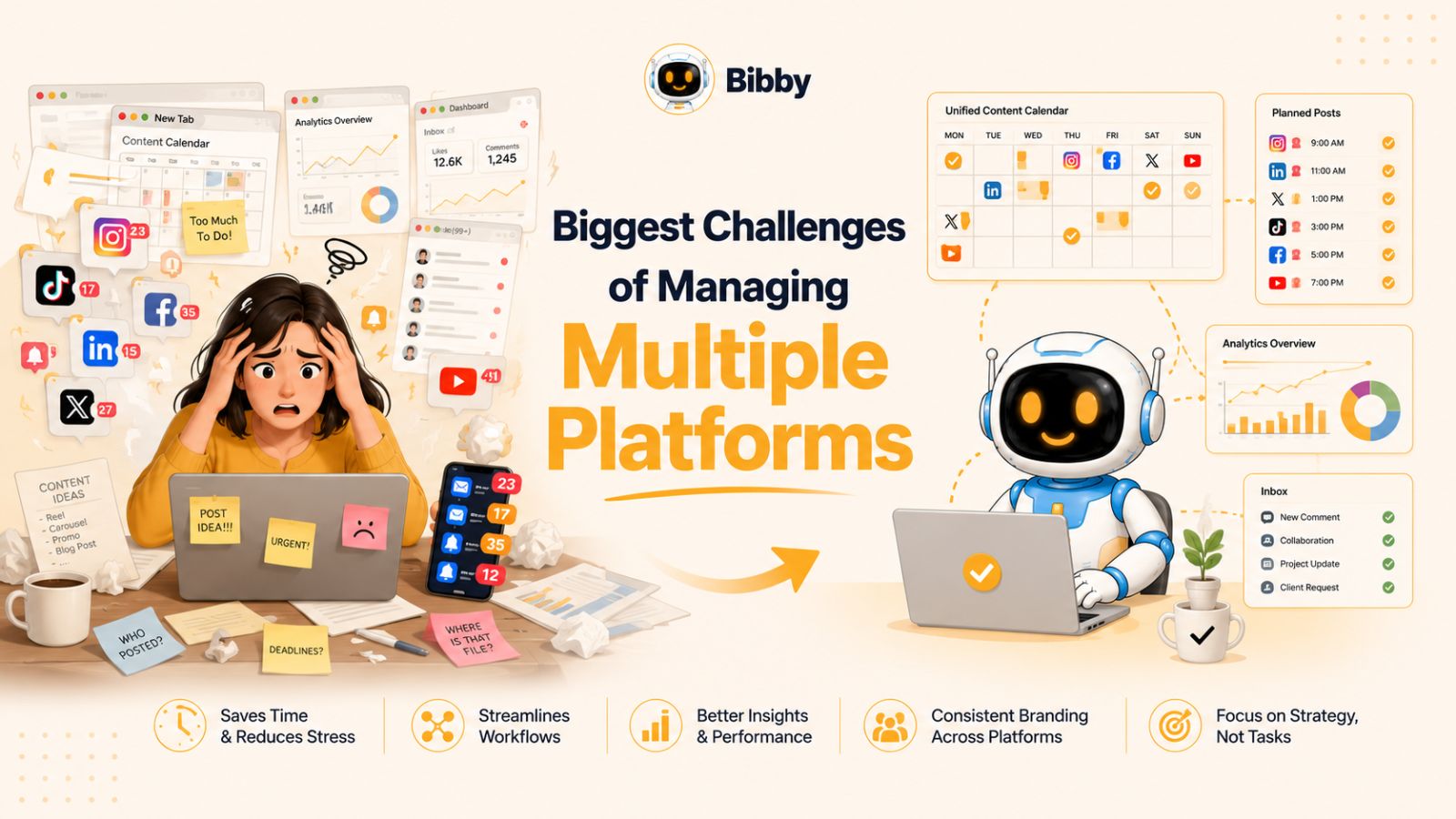
While social media offers tremendous opportunities for growth, managing multiple platforms simultaneously can quickly become overwhelming. As businesses expand their online presence, they often encounter challenges that consume time, reduce productivity, and limit results.
Content Creation Burnout
One of the biggest obstacles is consistently creating fresh, engaging content for multiple audiences.
Each platform has its own content formats, audience expectations, and best practices. A post that performs well on LinkedIn may not resonate with users on TikTok or Instagram. As a result, businesses often spend countless hours brainstorming ideas, writing captions, designing graphics, and producing videos.
Without an efficient workflow, content creation can become a full-time job.
Scheduling Across Multiple Platforms
Publishing content manually across several social networks is both time-consuming and prone to errors.
Marketers often find themselves logging into multiple accounts throughout the day to publish posts, videos, and stories. This repetitive process not only wastes valuable time but also increases the likelihood of missed posts and inconsistent publishing schedules.
Finding the Best Times to Post
Audience behavior varies significantly between platforms.
The optimal posting time for LinkedIn users may differ dramatically from the best time to reach audiences on Instagram, Facebook, or TikTok. Determining these ideal posting windows through trial and error requires ongoing testing and analysis, which many businesses simply do not have time for.
Maintaining Brand Consistency
As content volume increases, maintaining a consistent brand voice and visual identity becomes more difficult.
Different team members may create content using different styles, messaging approaches, or design elements. Over time, this can create a fragmented brand experience that confuses potential customers and weakens brand recognition.
Tracking Performance Across Multiple Dashboards
Every social media platform provides its own analytics dashboard.
This means businesses often need to jump between multiple reporting systems to evaluate performance. Gathering engagement metrics, follower growth data, reach statistics, and conversion information from various platforms can be tedious and inefficient.
Without centralized reporting, it becomes difficult to identify what's working and where improvements are needed.
Managing Videos, Stories, and Different Content Formats
Modern social media marketing extends far beyond simple image posts.
Businesses now need to manage:
- Short-form videos
- Long-form videos
- Stories
- Reels
- Carousels
- Livestreams
- Community posts
Creating, scheduling, and tracking all these content types across multiple platforms adds another layer of complexity to social media management.
Scaling Without Increasing Workload
As businesses grow, their social media demands grow with them.
More platforms, more content, more campaigns, and more audience interactions can quickly overwhelm marketing teams. Without automation and streamlined workflows, scaling social media efforts often requires hiring additional staff or sacrificing quality and consistency.
Why These Challenges Matter
These challenges don't just create frustration—they directly impact business results.
When teams spend too much time on manual tasks, they have less time available for strategy, creativity, audience engagement, and growth initiatives. That's why many businesses are turning to AI-powered social media management solutions that automate content creation, scheduling, publishing, and analytics from a single platform.
Also read: How Solo Business Owners Can Use AI for Social Media Growth?
Benefits of Effective Multi Platform Social Media Management
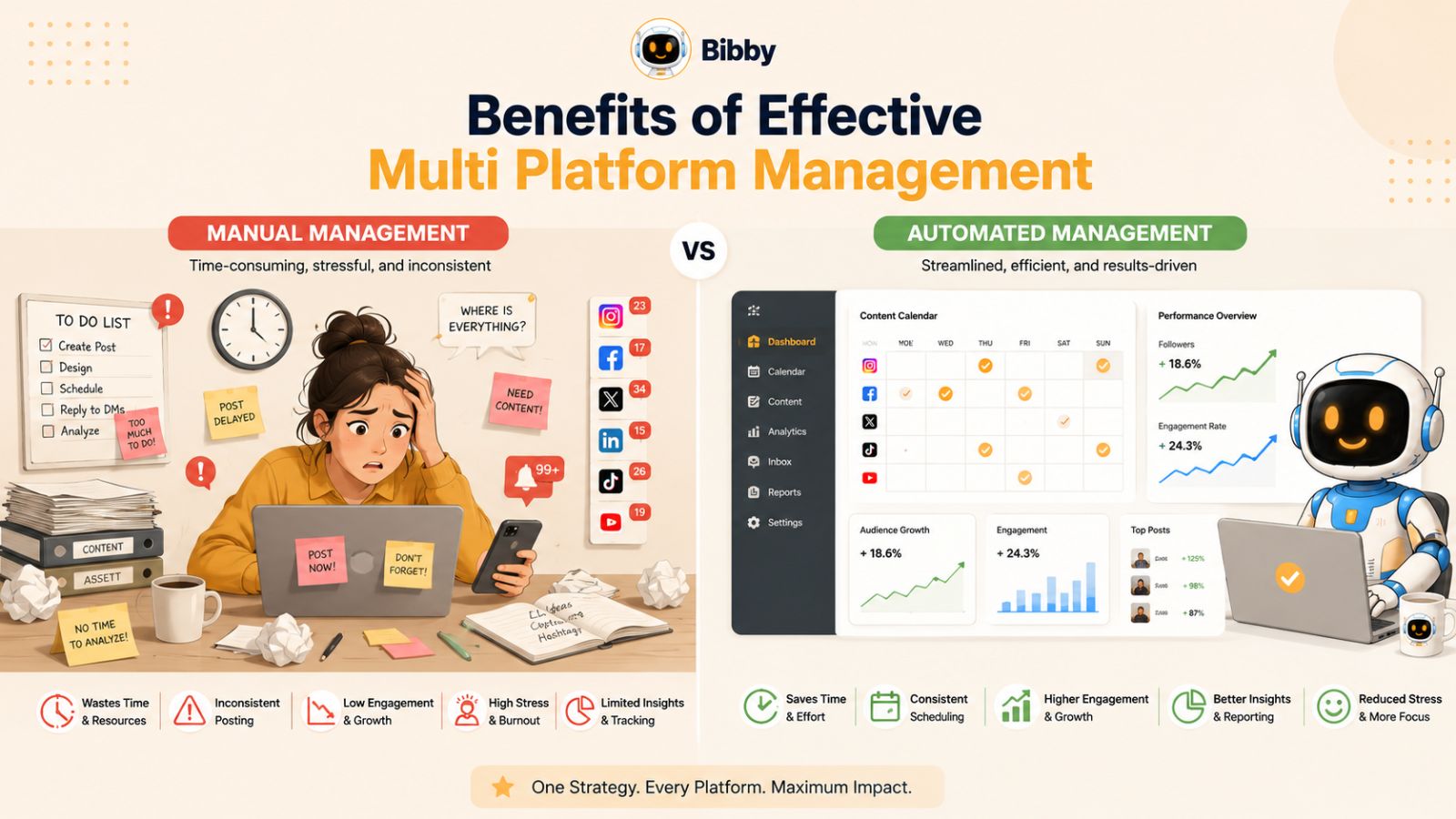
When businesses implement an effective multi platform social media management strategy, they gain far more than just convenience. The right approach can improve productivity, increase brand visibility, strengthen customer relationships, and generate better marketing results across every channel.
Save Significant Time and Resources
One of the most immediate benefits is the ability to reduce the amount of time spent managing social media.
Instead of logging into multiple platforms throughout the day, businesses can plan, schedule, and manage content from a centralized system. This eliminates repetitive tasks and allows marketing teams to focus on higher-value activities such as strategy, creativity, and audience engagement.
By automating routine processes, businesses can accomplish more without increasing their workload.
Maintain Consistent Posting Schedules
Consistency is one of the most important factors in social media success.
Regular posting helps keep your brand visible, strengthens audience trust, and improves platform performance. However, maintaining a consistent schedule manually can be challenging, especially when managing multiple channels.
A structured social media management process ensures that content is published regularly, even during busy periods, holidays, or outside business hours.
Increase Brand Visibility
Every social media platform attracts different audiences and serves different purposes.
By maintaining an active presence across multiple networks, businesses can significantly expand their reach and connect with potential customers at various stages of the buying journey.
A user who misses your content on Facebook may discover it on Instagram, LinkedIn, TikTok, or YouTube. The more touchpoints your brand creates, the more opportunities you have to build awareness and drive engagement.
Improve Audience Engagement
Effective social media management helps businesses deliver the right content to the right audience at the right time.
When content is published consistently and optimized for each platform, audiences are more likely to interact through likes, comments, shares, saves, and direct messages.
Higher engagement not only strengthens customer relationships but can also improve content visibility through platform algorithms.
Publish at Optimal Times
Timing plays a major role in social media performance.
The best time to post varies based on factors such as platform, audience demographics, industry, and geographic location. Identifying these optimal posting windows manually can require extensive testing and analysis.
Modern social media management tools help automate this process by analyzing audience behavior and scheduling content when engagement potential is highest.
Gain Actionable Insights Through Analytics
Data-driven decisions consistently outperform guesswork.
Effective multi platform social media management allows businesses to track key performance indicators such as:
- Reach
- Impressions
- Engagement rates
- Follower growth
- Website traffic
- Lead generation
- Video performance
- Conversion metrics
With access to consolidated analytics, businesses can quickly identify successful content, refine their strategy, and improve overall marketing performance.
Improve Team Collaboration
For larger organizations and agencies, collaboration is essential.
A centralized social media management system helps teams coordinate content creation, approvals, scheduling, and reporting more efficiently. Everyone works from the same content calendar and workflow, reducing confusion and minimizing errors.
This leads to faster execution and a more organized marketing operation.
Scale Social Media Efforts More Efficiently
As businesses grow, social media demands naturally increase.
Without proper systems, growth often leads to additional workload and operational complexity. Effective multi platform social media management allows businesses to scale their content output, audience engagement, and platform presence without proportionally increasing time investment.
Automation becomes a key advantage, enabling teams to accomplish more with fewer manual tasks.
The Bottom Line
Successful social media marketing is no longer about simply posting content. It's about creating an efficient system that consistently delivers high-quality content, reaches the right audiences, and generates measurable business results.
Businesses that invest in effective multi platform social media management gain a competitive advantage by saving time, improving consistency, increasing engagement, and scaling their marketing efforts more efficiently than those relying on manual processes.
Also read: Proven Strategies to Create Viral Social Media Content
Essential Features Every Social Media Management Tool Should Have
Not all social media management platforms are created equal. While many tools offer basic scheduling capabilities, businesses that want to scale efficiently need a solution that goes beyond simple publishing.
The best social media management tools combine content creation, automation, scheduling, analytics, and collaboration into a single streamlined workflow. Here are the essential features to look for when evaluating a platform.
Content Scheduling and Publishing
At its core, a social media management tool should make scheduling content effortless.
Instead of manually publishing posts every day, businesses should be able to plan content weeks or even months in advance. A robust scheduling system helps maintain consistency and ensures that content is delivered according to a predefined strategy.
Key scheduling features include:
- Multi-platform publishing
- Content calendar view
- Bulk scheduling
- Scheduled drafts
- Recurring posts
- Queue management
The ability to manage all social channels from a single dashboard can save countless hours each month.
AI-Powered Content Creation
Creating engaging content consistently is one of the biggest challenges marketers face.
Modern social media tools are increasingly incorporating artificial intelligence to streamline content creation. AI can help generate captions, suggest content ideas, create hashtags, and adapt messaging for different platforms.
Useful AI features include:
- Caption generation
- Content idea generation
- Hashtag recommendations
- Platform-specific copy optimization
- Brand voice consistency tools
These capabilities help businesses create more content in less time without sacrificing quality.
Multi-Platform Management
A powerful tool should support all major social media networks.
Managing Facebook, Instagram, LinkedIn, TikTok, YouTube, and other platforms separately creates unnecessary complexity. Centralized management simplifies workflows and reduces administrative overhead.
Look for support for:
- Facebook posts and stories
- Instagram posts, reels, and stories
- LinkedIn posts and company updates
- TikTok videos
- YouTube videos and shorts
- Additional emerging platforms
The broader the platform support, the easier it becomes to maintain a cohesive social media presence.
Smart Scheduling and Posting Optimization
Publishing content at the right time can significantly impact performance.
Advanced social media management tools analyze audience activity and engagement patterns to determine optimal posting times automatically. This removes much of the guesswork involved in scheduling.
Benefits of smart scheduling include:
- Higher engagement rates
- Greater content visibility
- Improved reach
- Reduced manual testing
AI-powered scheduling helps ensure content is published when audiences are most likely to interact.
Analytics and Performance Reporting
Without analytics, it's impossible to know what's working.
The best social media management tools provide comprehensive reporting that consolidates data from multiple platforms into a single dashboard. This allows businesses to measure performance and make informed decisions based on real results.
Important metrics include:
- Reach and impressions
- Engagement rates
- Audience growth
- Video performance
- Click-through rates
- Website traffic
- Conversion tracking
Centralized reporting eliminates the need to jump between multiple platform dashboards.
Video and Story Management
Video continues to dominate social media engagement across nearly every platform.
Businesses should choose a tool that supports scheduling and publishing not only standard posts but also videos, reels, shorts, and stories. Managing all content formats from one platform creates a much more efficient workflow.
Look for capabilities such as:
- Video uploading
- Reel scheduling
- Story scheduling
- Short-form video management
- YouTube publishing
As video content becomes increasingly important, these features are no longer optional.
Team Collaboration and Approval Workflows
For agencies and larger teams, collaboration tools can dramatically improve efficiency.
Features such as content approvals, role-based permissions, shared calendars, and workflow management help teams stay organized and reduce mistakes.
Collaboration features become especially valuable when multiple people are involved in content creation and publishing.
Automation Capabilities
Automation is where modern social media management platforms deliver the greatest value.
Instead of manually handling repetitive tasks, businesses can automate large portions of their workflow, including:
- Content scheduling
- Publishing
- Caption generation
- Performance reporting
- Content distribution
Automation reduces workload while increasing consistency and scalability.
Choosing the Right Tool
The ideal social media management platform should help businesses simplify their workflow rather than add complexity. The best solutions combine AI-powered content creation, intelligent scheduling, multi-platform publishing, analytics, video management, and automation into a single easy-to-use system.
As artificial intelligence continues to transform digital marketing, businesses are increasingly seeking platforms that not only manage social media but also actively help create, optimize, and automate content from start to finish.
How AI Is Transforming Multi Platform Social Media Management
Artificial intelligence is rapidly changing the way businesses manage social media. Tasks that once required hours of manual work—such as content creation, scheduling, optimization, and performance analysis—can now be completed in minutes with the help of AI-powered tools.
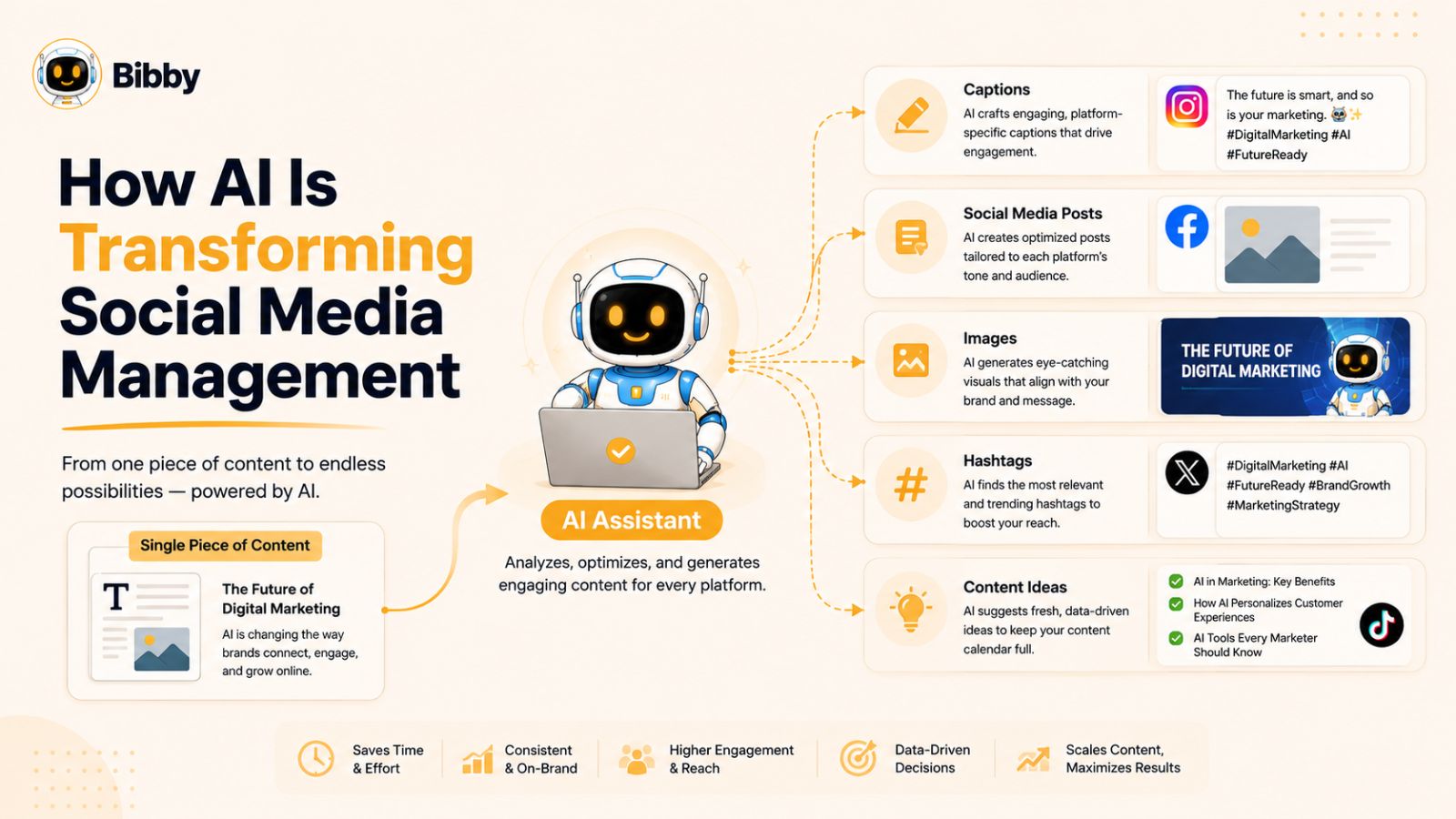
As social media platforms become more competitive, AI is helping businesses produce better content, maintain consistency, and achieve stronger results while spending significantly less time on day-to-day management.
AI-Powered Content Creation
One of the most impactful applications of AI is content creation.
Creating fresh content for multiple social media platforms can be challenging, especially when businesses need to publish consistently. AI helps simplify this process by generating captions, post ideas, content variations, and platform-specific messaging.
Instead of staring at a blank screen, marketers can use AI to:
- Generate engaging captions
- Create multiple content variations
- Adapt content for different platforms
- Maintain a consistent brand voice
- Overcome creative blocks
This allows businesses to create more content in less time without sacrificing quality.
AI Image Generation
Visual content plays a critical role in social media success.
AI image generation tools allow businesses to create custom visuals without relying heavily on designers or stock photography. Marketers can generate unique images based on simple prompts, helping them produce content faster and maintain a consistent posting schedule.
Benefits of AI-generated visuals include:
- Faster content production
- Lower creative costs
- More unique content
- Increased posting consistency
- Greater creative flexibility
For businesses with limited resources, AI-generated images can dramatically improve content output.
AI Caption Generation
Writing captions for every post across multiple platforms can quickly become repetitive.
AI caption generators analyze content and automatically create relevant, engaging copy tailored to specific posting styles and objectives. Whether the goal is education, promotion, thought leadership, or entertainment, AI can generate captions that align with the desired tone and audience.
This reduces the time spent writing while helping maintain a professional and consistent brand presence.
AI-Powered Scheduling
Finding the best time to post has traditionally required extensive testing and analysis.
AI scheduling systems use audience engagement data and behavioral patterns to identify optimal publishing times automatically. Instead of relying on assumptions, businesses can leverage data-driven recommendations to maximize visibility and engagement.
Advantages include:
- Higher reach
- Improved engagement
- Better content performance
- Reduced manual analysis
- Consistent optimization over time
AI continuously learns from performance data, making scheduling decisions smarter and more effective.
AI Analytics and Insights
Data is valuable only when it leads to actionable decisions.
AI-powered analytics tools help businesses identify trends, uncover opportunities, and understand which content performs best. Rather than manually reviewing reports from multiple platforms, marketers can receive automated insights that highlight important patterns and recommendations.
AI can help answer questions such as:
- Which content types generate the most engagement?
- What posting times produce the best results?
- Which platforms deliver the highest return on effort?
- What topics resonate most with audiences?
These insights allow businesses to continuously refine their social media strategy.
Automation at Scale
Perhaps the greatest benefit of AI is its ability to automate entire workflows.
Instead of managing content creation, scheduling, publishing, and reporting separately, businesses can combine these processes into a streamlined system. This allows teams to focus more on strategy and growth while AI handles repetitive operational tasks.
As social media demands continue to increase, automation becomes essential for maintaining efficiency without sacrificing quality.
Why AI Is Becoming a Competitive Advantage
Businesses that embrace AI-powered social media management can often produce more content, publish more consistently, and optimize performance more effectively than competitors relying on manual processes.
The result is greater efficiency, stronger audience engagement, and a more scalable marketing operation.
The next evolution of social media management isn't simply about scheduling posts—it's about creating an intelligent workflow where AI helps generate content, optimize timing, automate publishing, and provide actionable insights from a single platform. This is where modern solutions are redefining what's possible for businesses, creators, and marketing teams.
Bibby: The Simplest Way to Manage Social Media Across Multiple Platforms
While many social media management tools focus on scheduling alone, modern businesses need a solution that simplifies the entire content workflow—from content creation to publishing and performance tracking.
This is where Bibby stands out.
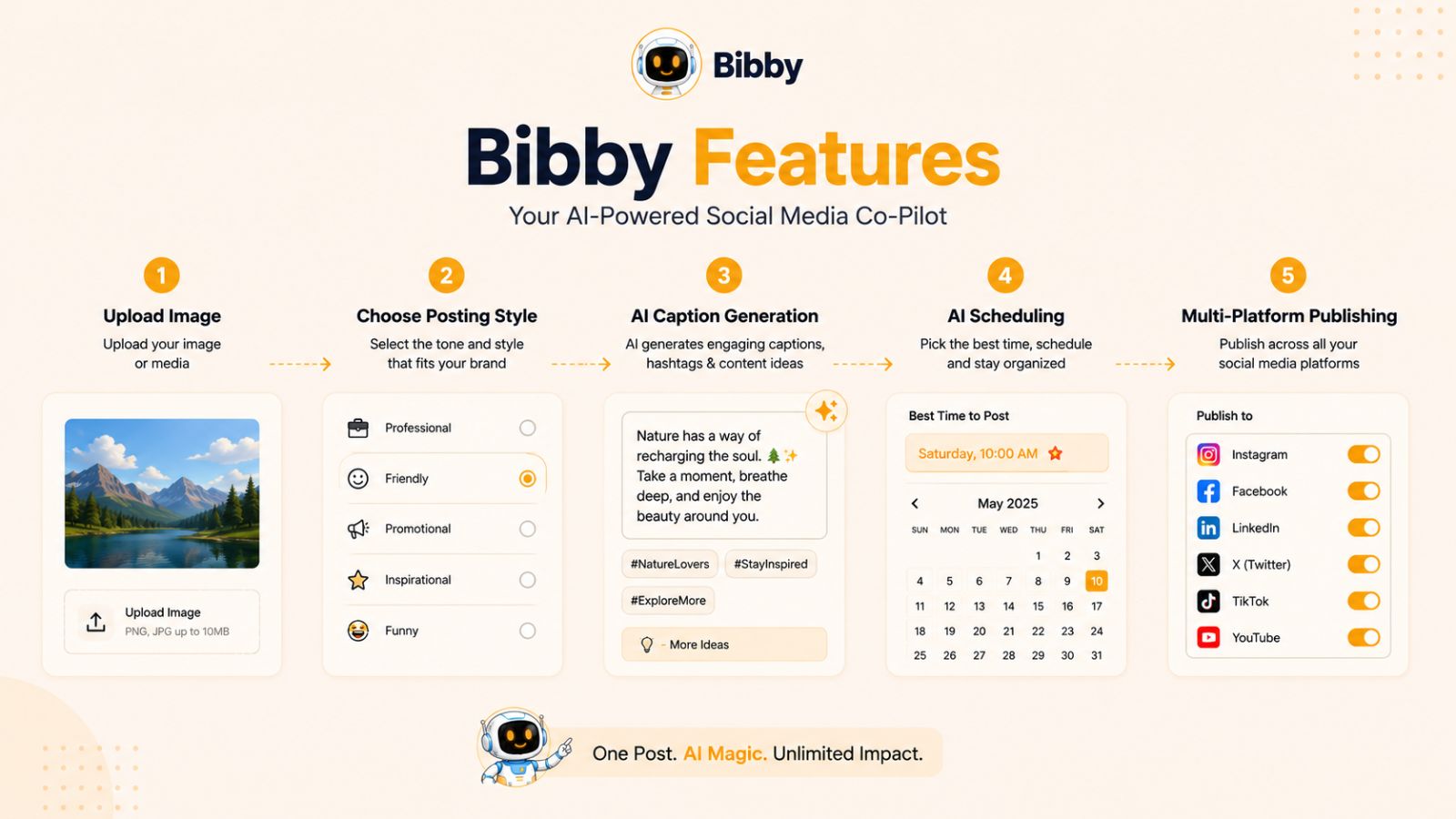
Bibby is an AI-powered social media scheduling and automation platform designed to help businesses, creators, agencies, and marketing teams manage their entire social media strategy from one simple dashboard. Instead of juggling multiple tools for design, copywriting, scheduling, and analytics, Bibby combines everything into a streamlined workflow that saves time and eliminates complexity.
Why Businesses Choose Bibby
Managing social media often involves dozens of repetitive tasks:
- Creating images
- Writing captions
- Choosing posting times
- Scheduling content
- Publishing across platforms
- Tracking performance
Bibby automates much of this process, allowing businesses to focus on growth while the platform handles the heavy lifting.
Step 1: Upload an Image or Generate One with AI
Every social media post starts with content.
With Bibby, users can either upload their own images or generate brand-new visuals using AI. This makes content creation significantly faster and removes the need to switch between multiple design tools.
Whether you're promoting a product, sharing an announcement, or publishing educational content, Bibby helps you create visual assets quickly and efficiently.
Step 2: Choose Your Posting Style
Different audiences respond to different types of content.
Bibby allows users to select a posting style that aligns with their goals and brand voice. Examples include:
- Professional
- Educational
- Promotional
- Inspirational
- Thought Leadership
- Entertaining
This ensures that every post matches the intended tone and audience expectations.
Step 3: Let AI Generate Captions Automatically
Writing captions can be one of the most time-consuming aspects of social media management.
Bibby's AI caption generator creates engaging, platform-ready captions based on your content and selected posting style. Instead of spending time crafting copy for every post, users can generate high-quality captions in seconds.
Benefits include:
- Faster content creation
- Consistent brand messaging
- Reduced workload
- Increased publishing efficiency
The result is a smoother workflow and more consistent content output.
Step 4: Schedule Content at AI-Optimized Times
One of the biggest challenges in social media marketing is determining when to publish content.
Bibby uses AI to identify optimal posting times based on engagement patterns and audience behavior. Rather than guessing when your audience is most active, the platform automatically schedules content for maximum visibility and interaction.
This helps businesses improve performance without spending time analyzing posting schedules manually.
Step 5: Publish Across Multiple Platforms from One Dashboard
Instead of logging into multiple social media accounts every day, Bibby enables users to publish content across several platforms simultaneously.
Supported platforms include:
- TikTok
- YouTube
This centralized approach dramatically reduces the time required to manage a multi-platform social media presence.
Step 6: Schedule More Than Just Posts
Modern social media marketing requires more than static images.
Bibby supports multiple content formats, including:
- Image posts
- Videos
- Stories
- Reels
- Shorts
- Promotional campaigns
This allows businesses to manage their entire content strategy without relying on multiple software solutions.
Step 7: Track Analytics and Performance
Successful social media management requires continuous improvement.
Bibby provides analytics that help users understand how their content is performing across platforms. By monitoring engagement, reach, audience growth, and other key metrics, businesses can make smarter marketing decisions and refine their strategy over time.
Having all analytics in one place eliminates the need to switch between multiple reporting dashboards.
A Complete Social Media Workflow in Minutes
Traditional social media management often requires several separate tools for content creation, copywriting, scheduling, publishing, and analytics.
Bibby simplifies this entire process into a straightforward workflow:
- Upload or generate an image with AI.
- Choose a posting style.
- Generate captions automatically.
- Schedule content at AI-optimized times.
- Publish across multiple platforms.
- Monitor analytics and performance.
The result is a faster, smarter, and more scalable approach to multi platform social media management.
Who Can Benefit Most from Bibby?
Bibby is ideal for:
- Small businesses
- Startups
- Marketing teams
- Agencies
- Content creators
- Personal brands
- E-commerce businesses
Anyone looking to save time, increase consistency, and automate social media workflows can benefit from using a platform that combines AI-powered content creation, scheduling, publishing, and analytics into one seamless experience.
As businesses continue to expand their social media presence, solutions like Bibby make it possible to manage more platforms, publish more content, and achieve better results without increasing workload.
Step-by-Step Process for Building a Multi Platform Social Media Strategy
Managing multiple social media platforms successfully requires more than simply posting content regularly. Businesses that achieve consistent growth typically follow a structured strategy that aligns content, audience targeting, and business objectives.
The following framework can help businesses build a scalable multi platform social media strategy that drives measurable results.
Step 1: Define Clear Business Goals
Before creating content, it's important to understand what success looks like.
Different businesses use social media for different purposes, and your goals should guide every decision you make.
Common social media goals include:
- Increasing brand awareness
- Generating leads
- Driving website traffic
- Building a community
- Growing email subscribers
- Increasing sales
- Establishing industry authority
When goals are clearly defined, it becomes easier to create content that supports meaningful business outcomes.
Step 2: Understand Your Target Audience
The most successful social media strategies are built around audience needs rather than business preferences.
Take time to identify:
- Demographics
- Interests
- Pain points
- Online behaviors
- Preferred social platforms
- Content consumption habits
For example, a B2B audience may spend more time on LinkedIn, while younger consumers might engage more actively on TikTok and Instagram.
Understanding where your audience spends time helps you prioritize the right platforms and content formats.
Step 3: Select the Right Social Media Platforms
Not every platform is necessary for every business.
Instead of trying to dominate every network, focus on the channels where your audience is most active and where your content performs best.
A typical platform strategy may include:
- Facebook for community building and advertising
- Instagram for visual storytelling
- LinkedIn for professional networking and B2B marketing
- TikTok for short-form video content
- YouTube for educational and long-form content
Concentrating resources on the most relevant platforms often delivers better results than spreading efforts too thin.
Step 4: Create Content Pillars
Content pillars provide structure and consistency.
Rather than creating random posts, businesses should organize content around several core themes that align with audience interests and business objectives.
Popular content pillars include:
Educational Content
Teach your audience something valuable.
Examples:
- How-to guides
- Tutorials
- Industry insights
- Tips and best practices
Promotional Content
Highlight products, services, offers, and company updates.
Examples:
- Product launches
- Feature announcements
- Special promotions
- Case studies
Thought Leadership Content
Position your brand as an industry expert.
Examples:
- Expert opinions
- Industry predictions
- Trend analysis
- Professional insights
Community and Engagement Content
Build relationships with your audience.
Examples:
- Polls
- Questions
- User-generated content
- Behind-the-scenes updates
Using content pillars ensures a balanced and sustainable content strategy.
Step 5: Build a Content Calendar
Consistency is critical for long-term social media success.
A content calendar helps businesses plan content in advance and maintain a predictable publishing schedule.
A well-organized calendar should include:
- Post topics
- Content formats
- Publishing dates
- Target platforms
- Campaign objectives
Planning content weeks or months ahead reduces stress and improves execution.
Step 6: Leverage AI to Streamline Content Creation
Modern businesses no longer need to create every piece of content manually.
AI-powered tools can help generate:
- Post ideas
- Captions
- Images
- Content variations
- Platform-specific messaging
This significantly reduces content production time while maintaining quality and consistency.
For example, platforms like Bibby allow businesses to upload or generate images, select a posting style, automatically generate captions, and prepare content for multiple social media channels within minutes.
Step 7: Automate Scheduling and Publishing
Manual posting becomes increasingly difficult as social media activity grows.
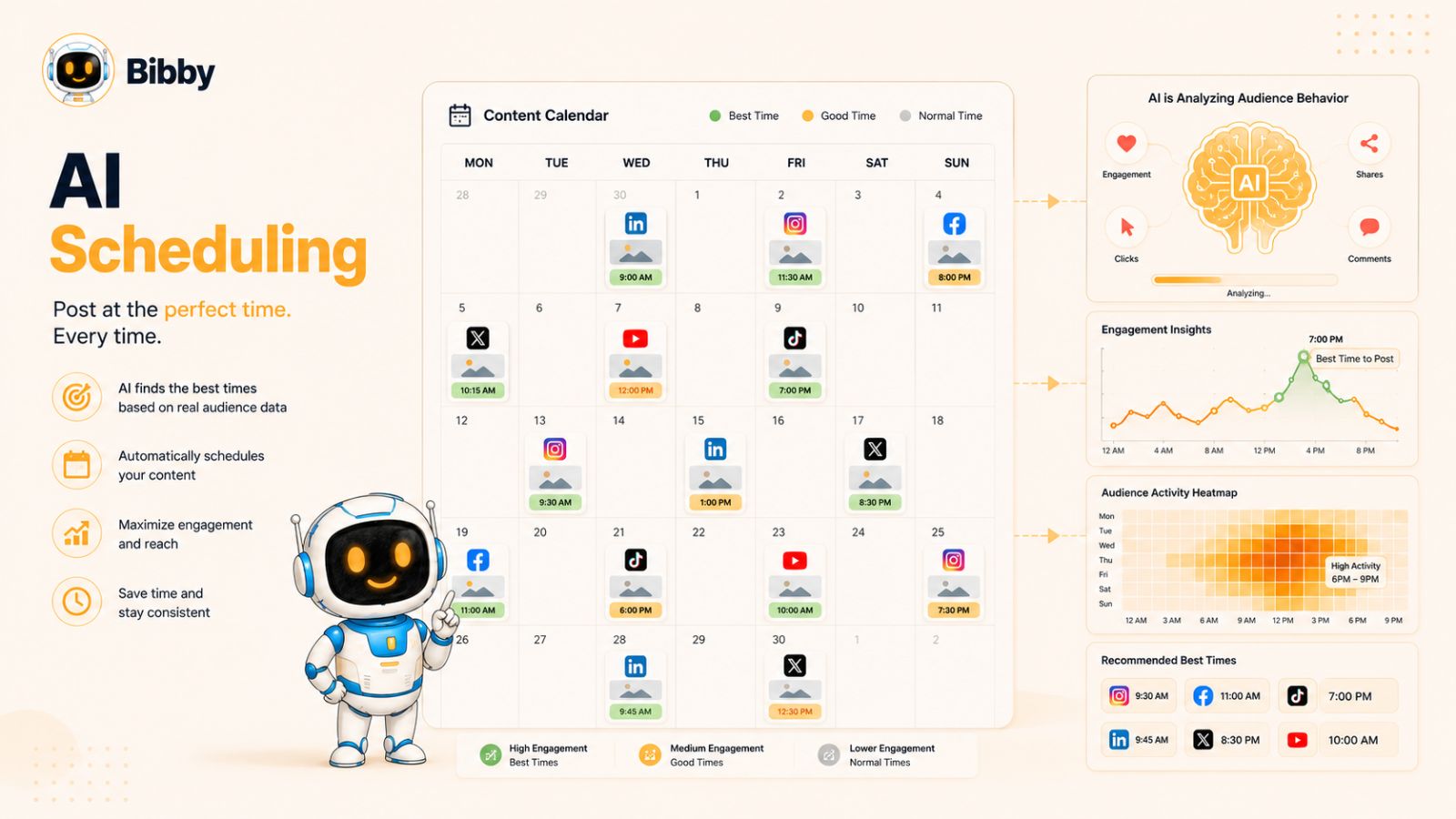
Automation allows businesses to schedule content in advance and maintain consistent publishing without daily intervention.
Benefits include:
- Time savings
- Improved consistency
- Reduced human error
- Better scalability
AI-powered scheduling tools can also optimize posting times based on audience behavior, helping maximize reach and engagement.
Step 8: Monitor Analytics and Optimize Performance
A successful social media strategy is never static.
Businesses should regularly review performance data to understand what is working and what needs improvement.
Key metrics to monitor include:
- Reach
- Impressions
- Engagement rate
- Click-through rate
- Follower growth
- Video views
- Website traffic
- Lead generation
Analyzing these metrics helps identify successful content patterns and informs future content decisions.
Step 9: Continuously Refine Your Strategy
Social media platforms, algorithms, and audience preferences are constantly evolving.
The most successful businesses treat social media as an ongoing optimization process rather than a one-time project.
Regularly evaluate:
- Content performance
- Audience feedback
- Industry trends
- Competitor activity
- Platform updates
Continuous improvement ensures that your strategy remains effective over time.
Bringing Everything Together
A successful multi platform social media strategy combines clear goals, audience understanding, content planning, automation, and performance analysis.
Businesses that follow a structured process can consistently create high-quality content, engage their audiences more effectively, and scale their marketing efforts without becoming overwhelmed.
With AI-powered tools now handling much of the manual work, building and managing a sophisticated social media strategy has become more accessible than ever before.
Best Practices for Multi Platform Social Media Management
Managing multiple social media platforms effectively requires more than the right tools. Success comes from combining smart processes, consistent execution, and continuous optimization. The following best practices can help businesses maximize results while minimizing the time and effort required to manage their social media presence.
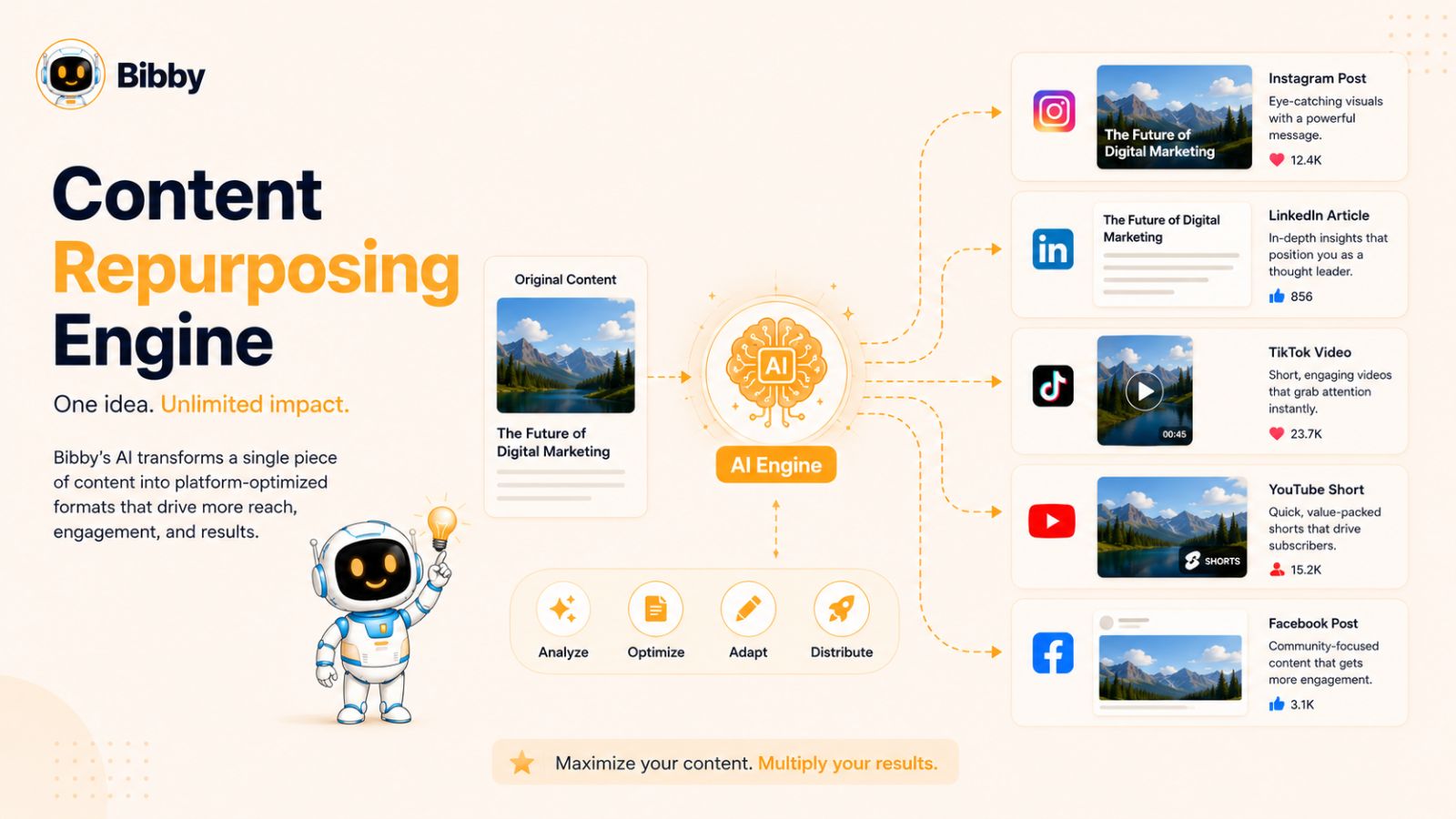
Customize Content for Each Platform
One of the most common mistakes businesses make is publishing the exact same content everywhere.
While it's perfectly acceptable to repurpose content, each platform has unique audience expectations, content formats, and engagement behaviors. Adapting your content to fit each channel can significantly improve performance.
For example:
- LinkedIn users often prefer professional insights and industry expertise.
- Instagram audiences respond well to visual storytelling and behind-the-scenes content.
- TikTok users favor short, engaging, and authentic videos.
- YouTube viewers typically seek educational, entertaining, or in-depth content.
Tailoring your message for each platform helps improve engagement and audience relevance.
Focus on Consistency Over Volume
Many businesses assume they need to publish constantly to stay relevant. In reality, consistency is often more important than posting frequency.
A reliable posting schedule helps build audience expectations and keeps your brand visible over time. It's better to post high-quality content consistently than to post large volumes of content sporadically.
Creating a content calendar and scheduling posts in advance can help maintain consistency even during busy periods.
Use AI to Increase Efficiency
AI can dramatically reduce the time required to create and manage content.
Instead of manually writing every caption, brainstorming every idea, or analyzing every posting schedule, businesses can use AI to streamline these tasks while maintaining quality.
AI can assist with:
- Caption generation
- Content ideation
- Image creation
- Posting time optimization
- Analytics interpretation
The goal is not to replace human creativity but to eliminate repetitive work and improve efficiency.
Automate Repetitive Tasks
As social media operations grow, automation becomes increasingly valuable.
Tasks such as scheduling posts, publishing content, generating reports, and managing content workflows can often be automated. This allows teams to spend more time focusing on strategy, audience engagement, and creative development.
Businesses that embrace automation are often able to scale their social media efforts without significantly increasing workload.
Prioritize Video Content
Video continues to be one of the highest-performing content formats across nearly every major social platform.
Businesses should incorporate a mix of:
- Short-form videos
- Reels
- Stories
- Shorts
- Educational videos
- Product demonstrations
Video content tends to generate higher engagement rates and can help increase reach on platforms that prioritize video distribution.
Maintain a Consistent Brand Voice
Your audience should recognize your brand regardless of which platform they're using.
Consistency in tone, messaging, visual style, and overall communication helps strengthen brand recognition and build trust over time.
Developing brand guidelines can help ensure that all content aligns with your company's identity, even when multiple team members contribute to content creation.
Monitor Analytics Regularly
Social media success is driven by data, not assumptions.
Regularly reviewing analytics allows businesses to understand which content resonates most with their audience and which strategies need adjustment.
Pay close attention to:
- Engagement rates
- Reach and impressions
- Audience growth
- Video performance
- Website traffic
- Conversion metrics
Small improvements based on data can lead to significant long-term gains.
Test and Optimize Continuously
There is no universal formula for social media success.
What works for one audience, industry, or platform may not work for another. Successful businesses continuously test different approaches and refine their strategy based on results.
Areas worth testing include:
- Posting times
- Content formats
- Caption styles
- Call-to-action wording
- Content topics
- Visual styles
Ongoing experimentation helps uncover new opportunities for growth.
Centralize Your Workflow
Managing content creation, scheduling, publishing, and analytics through separate tools can create unnecessary complexity.
A centralized workflow simplifies operations, reduces errors, and improves efficiency. Modern social media management platforms make it possible to manage the entire content lifecycle from a single dashboard, saving time while maintaining consistency across channels.
Balance Automation with Authentic Engagement
While automation can save significant time, social media remains a relationship-driven channel.
Businesses should continue to engage directly with their audience by responding to comments, answering questions, participating in conversations, and building genuine connections.
The most effective strategy combines automation for operational efficiency with human interaction for relationship building.
The Key to Long-Term Success
The businesses that achieve the best social media results are not necessarily the ones posting the most content—they're the ones operating the most effective systems.
By customizing content, maintaining consistency, leveraging AI, automating repetitive tasks, analyzing performance, and continuously optimizing their strategy, businesses can build a scalable social media presence that drives sustainable growth across multiple platforms.
Common Mistakes to Avoid in Multi Platform Social Media Management
Even businesses with strong social media strategies can struggle to achieve consistent results if they fall into common traps. Avoiding these mistakes can save time, improve engagement, and help maximize the return on your social media efforts.
Posting the Exact Same Content Everywhere
While cross-posting can save time, publishing identical content across every platform often leads to lower engagement.
Each social network has unique audience expectations, content formats, and algorithms. A LinkedIn audience may respond well to professional insights, while Instagram users may prefer visual storytelling and TikTok users expect short-form video content.
Repurpose content strategically, but adapt it for each platform whenever possible.
Ignoring Analytics
Many businesses spend significant time creating content but very little time reviewing performance.
Without analytics, it's difficult to understand:
- Which content generates the most engagement
- Which platforms drive the best results
- What posting times work best
- Which campaigns deliver the highest ROI
Regular performance reviews help ensure your strategy evolves based on real data rather than assumptions.
Inconsistent Posting
One of the fastest ways to lose momentum on social media is inconsistency.
Posting frequently for a few weeks and then disappearing for long periods can hurt audience engagement and reduce visibility. Consistent publishing helps build trust and keeps your brand top of mind.
A content calendar and automated scheduling system can help maintain a steady publishing rhythm.
Focusing Only on Follower Count
While follower growth is important, it shouldn't be the only metric that matters.
A smaller, highly engaged audience often delivers better business outcomes than a large audience that rarely interacts with your content.
Instead, focus on metrics such as:
- Engagement rate
- Website traffic
- Lead generation
- Conversions
- Audience retention
- Video watch time
These indicators provide a clearer picture of social media success.
Overcomplicating Your Workflow
Many businesses use separate tools for design, content creation, scheduling, publishing, and analytics.
As social media operations grow, this fragmented approach can become inefficient and difficult to manage. Switching between multiple platforms often leads to wasted time and unnecessary complexity.
Simplifying workflows through centralized systems can significantly improve productivity and consistency.
Neglecting Video Content
Video has become one of the most effective content formats across Facebook, Instagram, TikTok, LinkedIn, and YouTube.
Businesses that rely exclusively on static images and text posts may miss valuable opportunities to increase reach and engagement.
Incorporating videos, reels, shorts, and stories into your content strategy can help diversify your content mix and improve overall performance.
Not Leveraging AI and Automation
Many businesses still rely heavily on manual processes for content creation and scheduling.
This approach often limits scalability and consumes valuable time that could be spent on strategy, customer engagement, or business growth.
AI-powered tools can assist with:
- Content creation
- Caption generation
- Scheduling
- Posting optimization
- Analytics interpretation
Businesses that embrace automation are often able to publish more consistently and operate more efficiently.
Failing to Maintain a Consistent Brand Voice
When multiple team members contribute to content creation, messaging can become inconsistent.
Inconsistent tone, visuals, and communication styles can weaken brand recognition and create confusion among audiences.
Establishing clear brand guidelines helps ensure every piece of content aligns with your company's identity.
Trying to Be Everywhere at Once
Not every platform is equally valuable for every business.
Many companies spread themselves too thin by attempting to maintain an active presence on every social network. This often results in lower-quality content and weaker overall performance.
Focus on the platforms where your audience is most active and where your content delivers the strongest results.
Forgetting That Social Media Is Social
Automation is incredibly valuable, but it shouldn't completely replace human interaction.
Some businesses become so focused on scheduling content that they neglect audience engagement. Responding to comments, answering questions, and participating in conversations are critical components of long-term social media success.
The strongest brands combine automation with authentic engagement.
Learn from These Mistakes
Most social media challenges don't stem from a lack of effort—they stem from inefficient processes and avoidable mistakes.
By focusing on consistency, leveraging analytics, embracing automation, adapting content for each platform, and maintaining genuine audience engagement, businesses can avoid common pitfalls and build a more effective, scalable social media presence.
Future Trends in Multi Platform Social Media Management
Social media management continues to evolve rapidly, driven by advances in artificial intelligence, changing user behavior, and the growing demand for efficiency. Businesses that understand emerging trends will be better positioned to stay competitive and maximize their marketing performance.
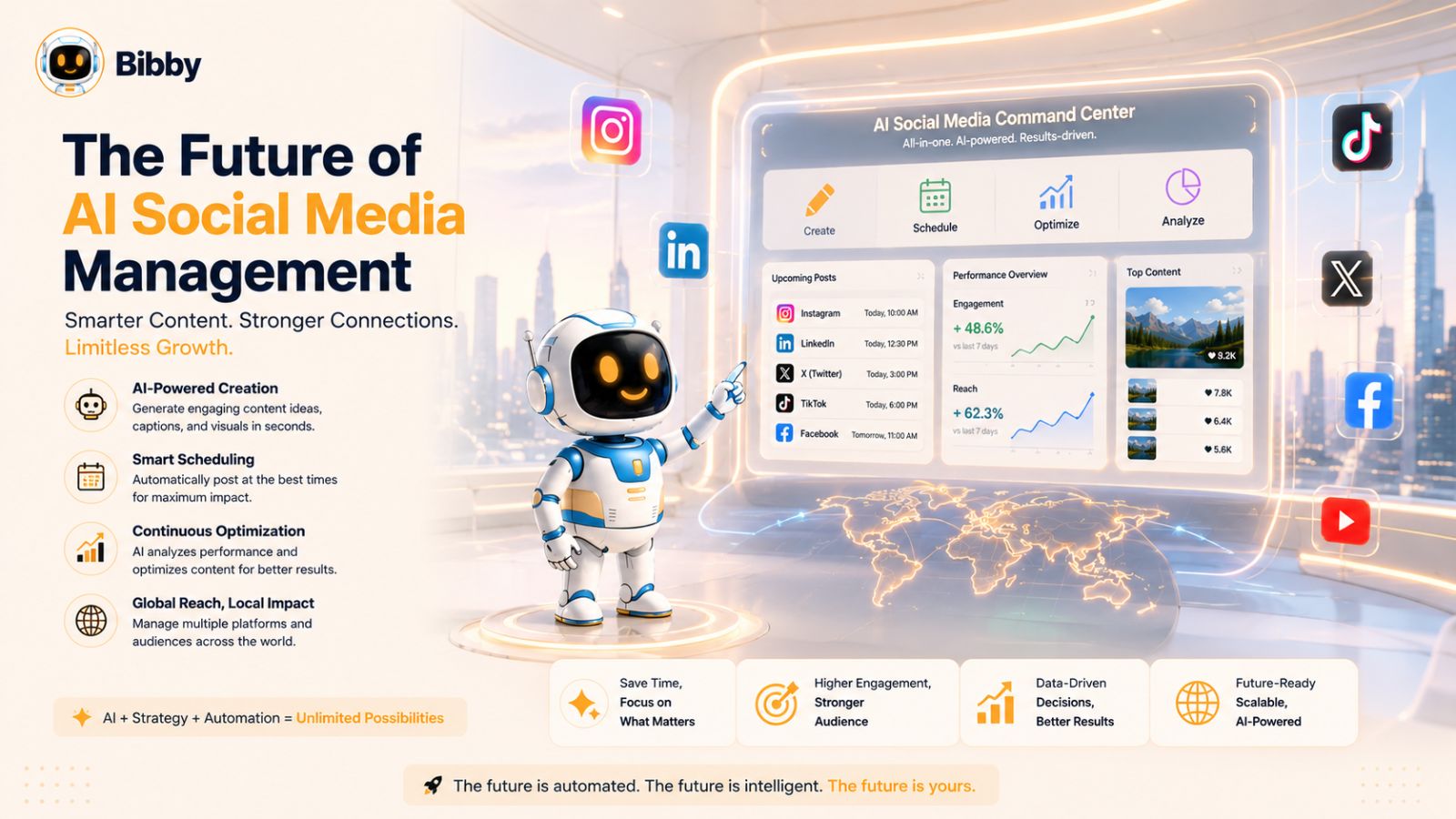
AI-Generated Content Will Become Mainstream
Artificial intelligence is expected to play an increasingly important role in content creation.
Businesses will rely more heavily on AI to generate:
- Captions
- Images
- Video concepts
- Content ideas
- Platform-specific variations
Rather than replacing marketers, AI will act as a productivity multiplier, helping teams create more content while maintaining quality and consistency.
Smart Scheduling Will Become More Intelligent
Posting at the right time will become increasingly automated.
Future scheduling systems will analyze audience behavior, engagement history, content type, and platform trends in real time to determine the best publishing opportunities.
This will help businesses maximize reach and engagement without manual testing.
Video-First Strategies Will Dominate
Video content is already a major driver of engagement, and its importance will continue to grow.
Businesses should expect greater emphasis on:
- Short-form videos
- Reels
- Shorts
- Stories
- Interactive video content
Brands that develop efficient video production workflows will have a significant competitive advantage.
Unified Content Workflows Will Replace Fragmented Systems
Businesses are increasingly seeking platforms that manage the entire content lifecycle in one place.
Instead of using separate tools for design, writing, scheduling, publishing, and analytics, companies will move toward unified solutions that streamline every stage of social media management.
This shift will reduce operational complexity and improve efficiency.
Analytics Will Become More Predictive
Future analytics platforms will do more than report past performance.
AI-driven systems will help businesses predict:
- Content performance
- Audience trends
- Engagement opportunities
- Growth potential
These predictive insights will enable marketers to make more proactive decisions and optimize campaigns before problems arise.
Automation Will Power Scalable Growth
As social media demands continue to increase, automation will become essential rather than optional.
Businesses will increasingly automate:
- Content creation
- Scheduling
- Publishing
- Reporting
- Workflow management
This will allow teams to scale their social media presence without proportionally increasing workload.
Personalization Will Increase Across Platforms
Audiences are demanding more relevant and personalized experiences.
Future social media strategies will focus on delivering highly targeted content based on user interests, behaviors, and engagement patterns. AI will play a critical role in helping businesses create and distribute personalized content at scale.
The Future Belongs to Businesses That Embrace AI
The future of multi platform social media management is centered on efficiency, automation, and intelligent decision-making.
Businesses that adopt AI-powered workflows today will be better equipped to manage growing content demands, improve audience engagement, and scale their marketing efforts effectively in the years ahead.
Frequently Asked Questions (FAQ)
What Is Multi Platform Social Media Management?
Multi platform social media management is the process of creating, scheduling, publishing, monitoring, and analyzing content across multiple social media platforms from a centralized workflow. It helps businesses maintain a consistent brand presence while reaching audiences on channels such as Facebook, Instagram, LinkedIn, TikTok, and YouTube.
Why Is Multi Platform Social Media Management Important?
Modern consumers use multiple social networks throughout their buying journey. Managing several platforms effectively allows businesses to increase visibility, engage different audience segments, strengthen brand recognition, and generate more leads and sales.
What Are the Biggest Challenges of Managing Multiple Social Media Platforms?
Common challenges include:
- Creating enough content consistently
- Managing multiple publishing schedules
- Finding optimal posting times
- Maintaining brand consistency
- Tracking analytics across platforms
- Managing videos, stories, and other content formats
- Scaling social media efforts efficiently
Using automation and AI-powered tools can help overcome many of these challenges.
How Does AI Help with Social Media Management?
AI can automate many time-consuming tasks, including:
- Caption generation
- Content ideation
- Image creation
- Smart scheduling
- Performance analysis
- Posting optimization
By reducing manual work, AI allows businesses to focus more on strategy, creativity, and audience engagement.
What Features Should a Social Media Management Tool Include?
The best social media management tools typically offer:
- Multi-platform scheduling
- AI-powered content creation
- Smart publishing optimization
- Analytics and reporting
- Video and story scheduling
- Team collaboration tools
- Workflow automation
These features help businesses manage social media more efficiently and scale their marketing efforts.
Can I Schedule Facebook, Instagram, LinkedIn, TikTok, and YouTube Posts from One Platform?
Yes. Many modern social media management tools allow users to schedule and publish content across multiple platforms from a single dashboard. This centralized approach saves time and simplifies content management.
How Does Bibby Simplify Social Media Management?
Bibby streamlines the entire social media workflow through a simple AI-powered process:
- Upload an image or generate one with AI.
- Choose a posting style.
- Generate captions automatically.
- Schedule content at AI-optimized times.
- Publish across multiple social media platforms.
- Track analytics from a centralized dashboard.
This helps businesses reduce manual work while maintaining a consistent and effective social media presence.
Can Bibby Schedule More Than Just Standard Posts?
Yes. In addition to image posts, Bibby supports various content formats, including videos, stories, reels, shorts, and other social media content types. This allows businesses to manage their entire content strategy from a single platform.
What Analytics Should Businesses Track?
Key social media metrics include:
- Reach
- Impressions
- Engagement rate
- Follower growth
- Video views
- Website traffic
- Click-through rate
- Lead generation
- Conversion metrics
Monitoring these metrics helps businesses understand performance and improve their content strategy over time.
Is Social Media Automation Worth It?
For most businesses, social media automation provides significant benefits. Automation reduces repetitive work, improves consistency, saves time, and enables teams to scale their marketing efforts without increasing workload. When combined with human creativity and engagement, automation can dramatically improve social media efficiency and results.
Conclusion
Managing multiple social media platforms no longer has to be a time-consuming and overwhelming process. With the right strategy, businesses can build a consistent presence across Facebook, Instagram, LinkedIn, TikTok, YouTube, and other channels while reaching more customers and generating better results.
Throughout this guide, we've explored three key takeaways: the importance of a structured multi platform social media management strategy, the growing role of AI and automation in simplifying content workflows, and how centralized tools can help businesses save time while improving performance.
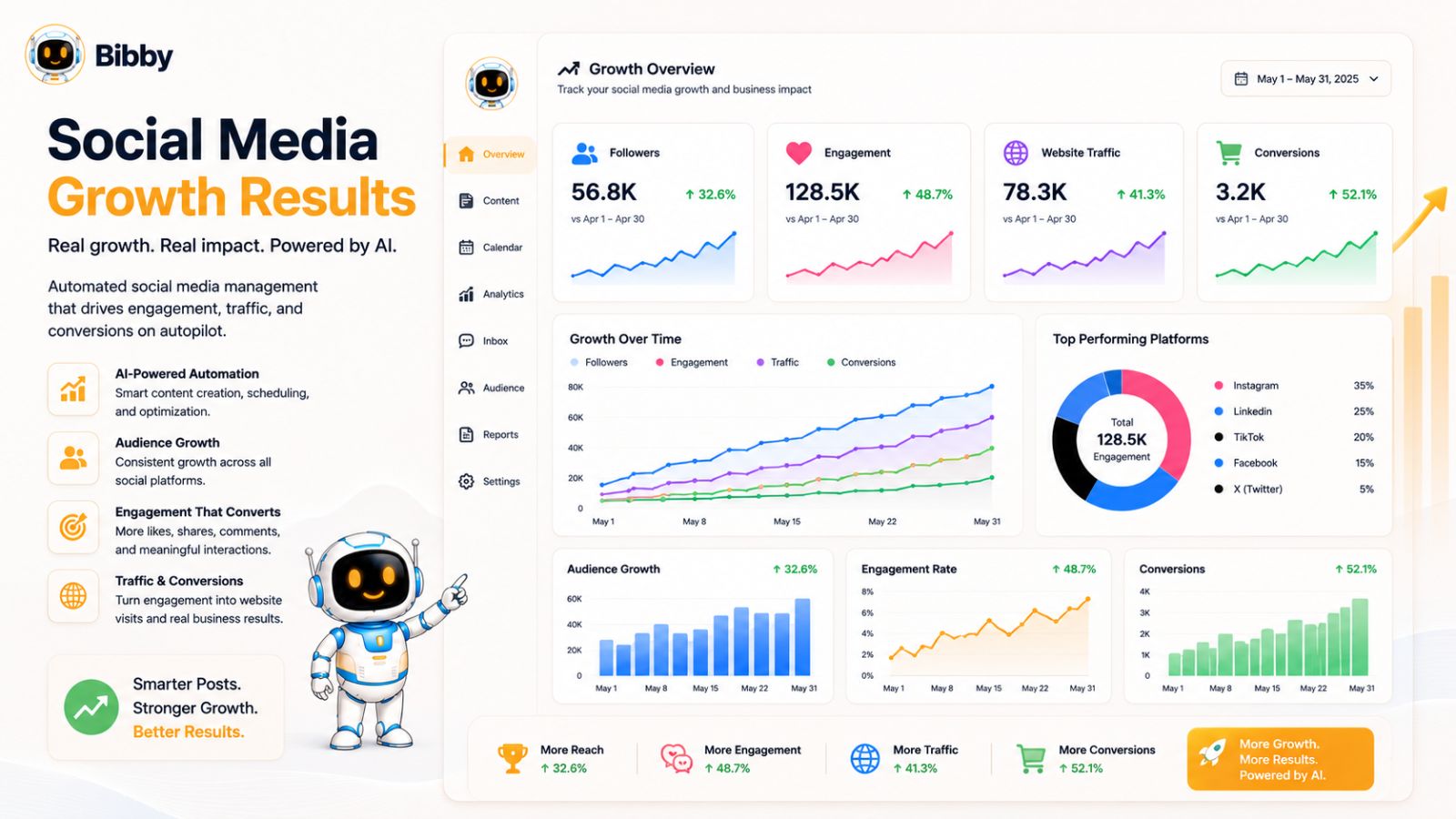
Platforms like Bibby represent the next generation of social media management by combining AI-powered content creation, caption generation, smart scheduling, multi-platform publishing, and analytics into one streamlined workflow. Instead of spending hours creating, scheduling, and tracking content manually, businesses can automate much of the process and focus on growth.
As social media continues to evolve, the businesses that embrace automation and intelligent workflows will be best positioned to scale efficiently. A natural next step is learning how to build an AI-powered content marketing system that generates consistent engagement, leads, and growth with minimal manual effort.