
AI can create a social media post in seconds, but that doesn’t mean the post is ready to publish. Before an AI-generated caption, image, carousel, video, or story goes live, a human still needs to check whether it is accurate, on-brand, platform-appropriate, and genuinely worth someone’s attention.
The goal of an AI content review isn’t to rewrite everything AI produces. It is to catch the mistakes AI can miss while preserving the speed and scale that make AI useful for social media marketing.
The result is a practical review process you can use whether you create every post manually or use tools such as Bibby to generate, organize, and schedule your social media content.
Why Human Review Still Matters for AI Social Media Content
AI has made social media content creation dramatically faster. A marketer can generate a caption, create an image, turn an idea into a carousel, and prepare multiple platform variations without starting every post from a blank page.
But speed creates a new problem: AI can produce content faster than a human can notice that something is wrong with it.
An AI-generated social media post may be grammatically perfect and still be unsuitable for publication. A caption can confidently include an incorrect fact. An image can contain an awkward visual detail. A post can sound nothing like the brand that is supposed to publish it. A LinkedIn post may feel too casual, while the same idea adapted for TikTok might need a completely different structure.
That is why the human role is changing from creating every word and asset to reviewing what AI creates before it reaches the audience.
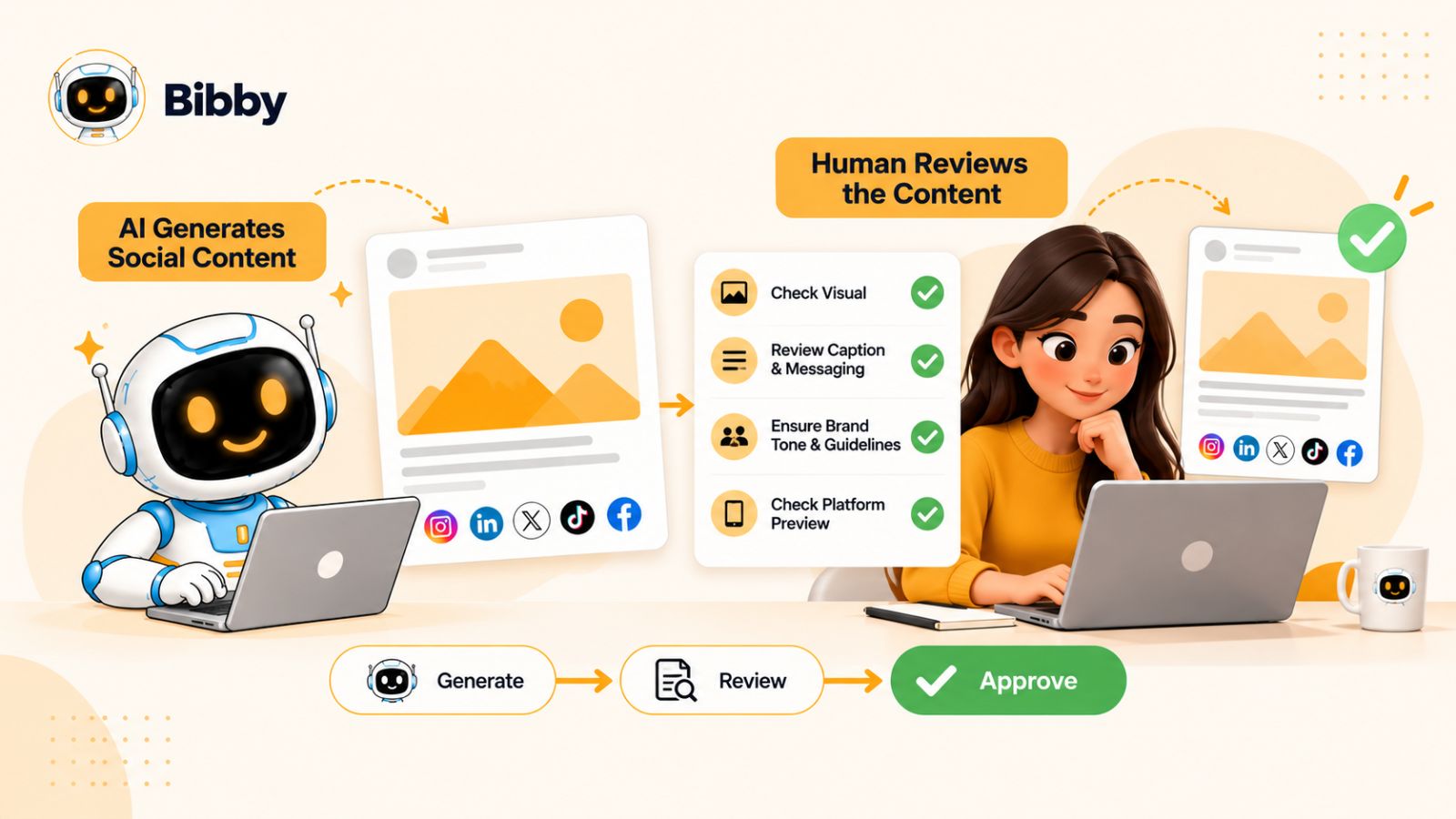
AI is good at production; humans provide judgment
AI is particularly useful for repetitive parts of social media production: generating variations, adapting ideas into different formats, suggesting hooks, writing captions, creating visuals, and preparing content for multiple publishing dates.
The human reviewer is responsible for questions AI cannot reliably answer on its own:
- Is this actually true?
- Does this sound like our brand?
- Would our audience care about this?
- Is the message clear?
- Does the visual communicate what the caption promises?
- Is anything misleading, insensitive, outdated, or unnecessarily risky?
- Does this version make sense for the specific platform?
- Would I be comfortable putting the company’s name behind this post?
This distinction becomes increasingly important as social media teams automate more of their workflow.
For example, a scheduling and automation platform such as Bibby can take a piece of media, generate captions based on a selected posting style, and schedule content across platforms at different times. That removes much of the repetitive execution work, but it doesn't eliminate the value of a final human check. In fact, when one workflow can prepare image posts, carousels, videos, and stories for several platforms, a consistent review process becomes even more useful.
The goal isn't to make AI content sound human
One common misconception is that human review means taking AI-generated content and rewriting it until nobody can tell AI was involved.
That isn't the right standard.
The better question is whether the finished post is useful, accurate, appropriate, and genuinely representative of the brand.
Sometimes the AI draft may require almost no changes. Other times, one factual correction or a stronger opening sentence can make the difference between a post that is ready to publish and one that should stay in drafts.
Human review should therefore be treated as a quality-control layer—not as a second round of content generation.
A simple rule for social media teams
Before publishing AI-generated content, ask:
“If AI had not told me this was ready, would I still choose to publish it?”
If the answer is yes, publish it.
If the answer is no, identify exactly what feels wrong and fix that specific issue rather than unnecessarily rewriting the entire post.
That mindset allows teams to keep the efficiency of AI while retaining the judgment that makes social media content trustworthy and effective.
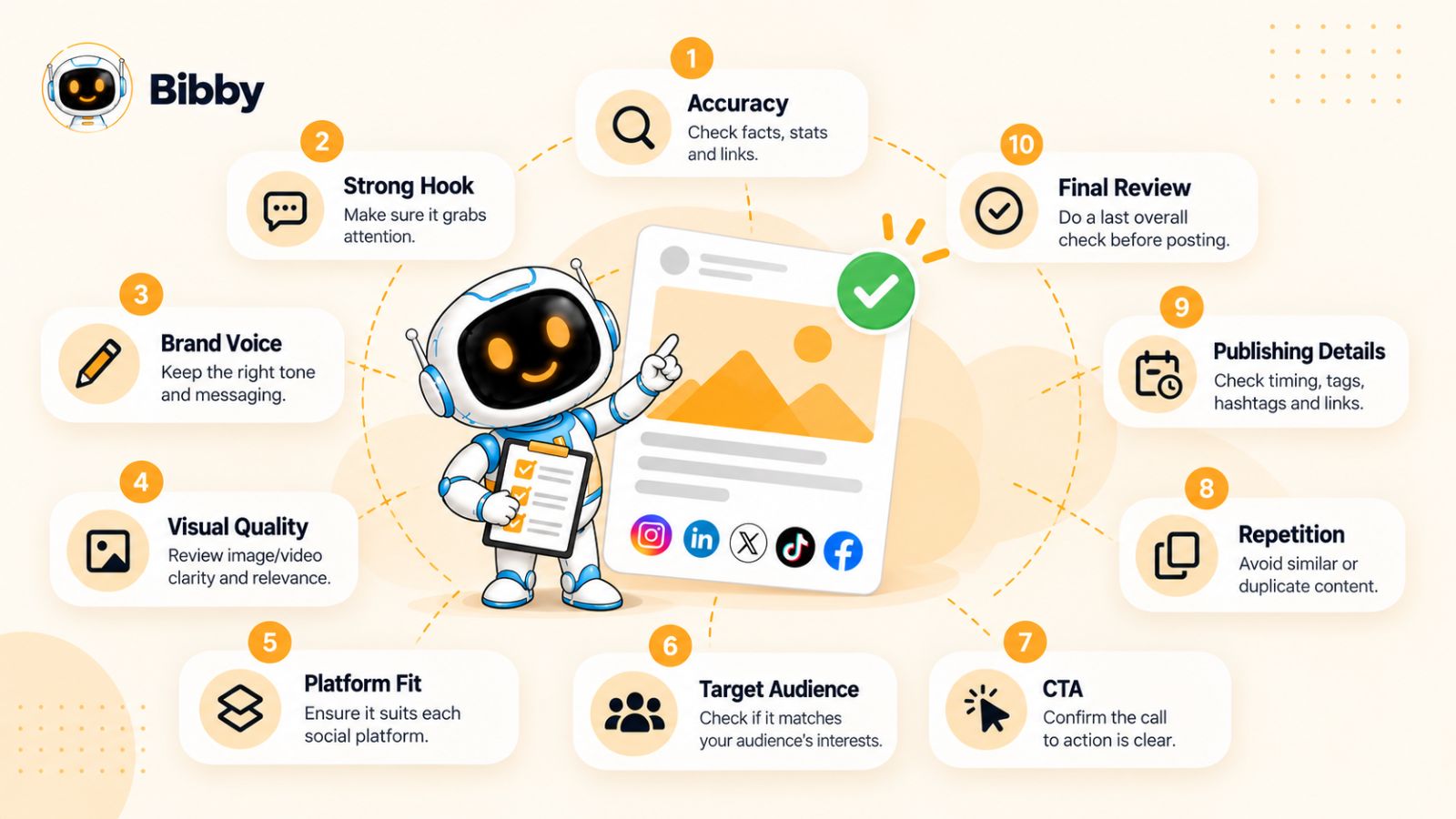
10 Things a Human Should Check Before an AI Social Media Post Goes Live
AI can get a social media post most of the way to publication, but the final review should still belong to a human. The fastest way to make that review practical is to check the post in a consistent order.
Here are the 10 checks that matter most.
1. Check the central claim
Start with the most important question: Is the post actually saying something true?
AI can generate plausible statements that sound authoritative without being accurate. This is particularly risky when a post contains statistics, dates, product claims, industry trends, quotes, research findings, or statements about people and companies.
Don't fact-check every adjective. Focus first on claims that could change how someone understands the subject.
If a post says, “80% of marketers are doing X,” for example, don't publish it simply because the number sounds reasonable. Find out where the number came from, whether the source is credible, and whether the statistic is still relevant.
For social media, factual accuracy matters even when the post is designed to be entertaining. A short caption can still spread misinformation quickly.
2. Check whether the post actually delivers on its hook
AI is very good at writing hooks.
It can produce lines such as:
“Nobody is talking about this…”
“Here's the secret to…”
“You’re making this mistake…”
The problem is that a dramatic hook creates an expectation.
Read the first sentence and then read the rest of the post. Does the content actually deliver what the opening promises?
A strong hook followed by generic advice creates a credibility problem. If the post promises three specific strategies, the body should provide three useful strategies. If the headline suggests a surprising finding, the post should explain what makes the finding surprising.
The human reviewer should check the promise-to-content match, not simply whether the opening sounds catchy.
3. Check the brand voice
AI can follow instructions about tone, but brand voice is more than choosing between “professional,” “friendly,” and “casual.”
Ask whether the post sounds like something the brand would actually say.
Look for:
- Words the brand normally uses
- Words the brand would never use
- Sentence length and rhythm
- Level of formality
- Humor and personality
- Industry terminology
- Opinions and points of view
- Repeated AI-style phrases
This is particularly important when generating dozens of social posts at once.
A tool can make the production process consistent while still producing content that feels strangely interchangeable from post to post. Human review is where you decide whether the content sounds like your brand, rather than simply sounding like competent AI-generated marketing copy.
4. Check the visual, not just the caption
Social media content is rarely text alone.
If AI generated the image, carousel, video, or story, inspect the actual creative separately from the caption.
Look for obvious problems such as:
- Incorrect text inside an image
- Strange objects or distorted details
- Incorrect logos
- Inconsistent product appearance
- Unintended people, symbols, or backgrounds
- Visual claims that don't match the caption
- Poor readability on mobile screens
There's also a more important question:
Does the visual communicate the intended idea within a few seconds?
A technically attractive image can still be the wrong image.
Human review should therefore evaluate the post as a complete package rather than approving the caption and creative independently.
5. Check the platform fit
A post that works on Instagram isn't automatically ready for LinkedIn, TikTok, Facebook, or YouTube.
The underlying idea can remain the same, but the presentation often needs to change.
For example, a professional insight might work as a text-led LinkedIn post, while the same idea could become a short demonstration or visual explanation for TikTok. An Instagram carousel may need a stronger first slide because users encounter the content differently from a text-heavy post.
Before approving a multi-platform post, ask:
“Does this feel native to the platform where it will appear?”
If the answer is no, adapt the format rather than assuming cross-platform automation has solved the publishing problem.
6. Check the audience relevance
AI can produce content that is technically correct but completely uninteresting to the intended audience.
Ask:
- Who is this post for?
- What problem does it address?
- What does the reader gain from it?
- Is the information appropriate for their level of knowledge?
- Is the post solving a real problem or simply filling the content calendar?
This check is especially important when using AI to generate content at scale.
A full calendar is not necessarily a useful calendar.
Ten mediocre posts scheduled automatically are still ten mediocre posts. The human review should protect the audience from content that exists only because there was an empty publishing slot.
7. Check the call to action
Not every post needs a CTA, but when one exists, it should make sense.
AI-generated CTAs often become repetitive:
“Let us know your thoughts!”
“Follow us for more!”
“Click the link to learn more!”
“Comment below!”
A human should ask whether the requested action naturally follows from the content.
If the post teaches the audience how to solve a problem, perhaps the logical next step is to save the post. If it introduces a discussion, a question may make sense. If it presents a product demonstration, visiting the product page might be appropriate.
The CTA should be connected to the reader's next logical action, not automatically attached to every post.
8. Check for unnecessary repetition
AI makes it easy to create variations, but variations aren't always genuinely different.
Review a batch of scheduled posts together rather than evaluating each post in isolation.
You may discover that:
- Five captions begin with nearly identical hooks.
- The same advice appears several times.
- Every post ends with the same CTA.
- The visual style barely changes.
- The content repeatedly makes the same point using different words.
This is why reviewing the content calendar as a whole can be more valuable than reviewing individual posts.
A single post may look perfectly acceptable. Twenty posts that all sound the same can make the entire social presence feel automated.
9. Check links, mentions, hashtags, and publishing details
Some of the most embarrassing social media mistakes have nothing to do with the writing itself.
Before publishing, verify practical details such as:
- Links work
- URLs lead to the intended page
- Mentions identify the correct account
- Hashtags are relevant
- Product names are spelled correctly
- Dates and times are correct
- Promotional terms are accurate
- The correct media asset is attached
- The correct account is selected
These checks are particularly important when content is scheduled across multiple platforms.
Automation reduces repetitive work, but it also means an error can potentially be prepared for multiple publishing destinations. A quick final verification can prevent a small mistake from becoming a multi-platform mistake.
10. Ask whether you would publish it yourself
Finally, stop reviewing the post as an editor and look at it as an audience member.
Would you stop scrolling?
Would you believe the claim?
Would you share or save it?
Does it teach, entertain, inform, or otherwise give you a reason to care?
And most importantly:
Does this post deserve to exist?
That final question is deliberately subjective. It is also the part of the process AI automation cannot completely replace.
The purpose of human review isn't to slow down content production. It is to make sure that increased production actually creates more valuable content rather than simply more content.
Once these ten checks become a repeatable process, AI can handle much more of the production and scheduling workload while humans remain responsible for the decisions that matter.
A Practical AI Content Review Workflow for Social Media Teams
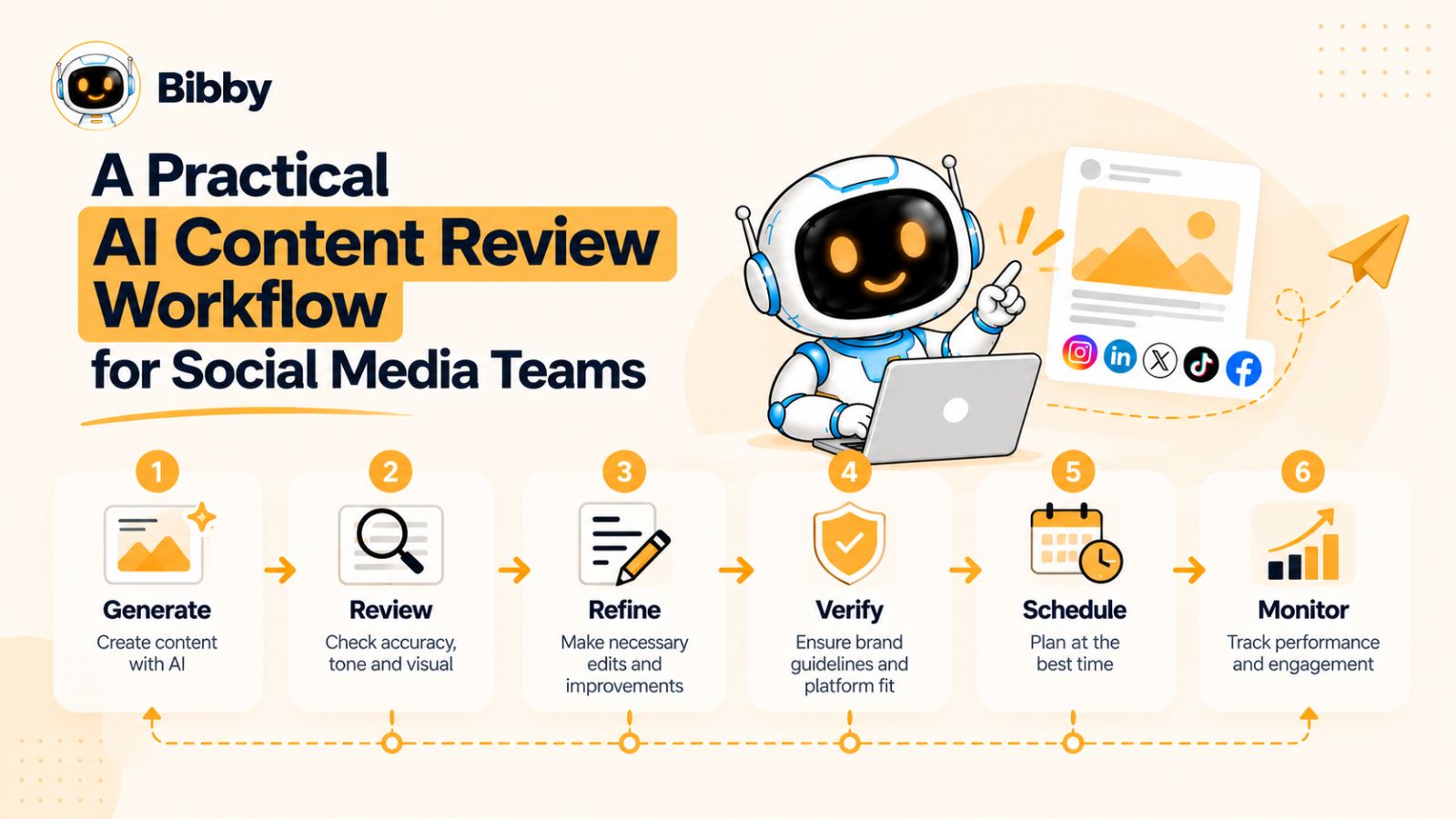
A checklist is useful, but checking every AI-generated post from scratch can quickly become another bottleneck. The better approach is to build human review into the social media workflow at specific points, with each review focused on a different type of risk.
A practical workflow looks like this:
Generate → Review → Refine → Verify → Schedule → Monitor
Step 1: Generate the first draft
Start by giving AI enough context to create something useful.
That context might include the topic, target audience, platform, campaign objective, brand voice, offer, visual direction, and desired format.
The more specific the input, the less time you may need to spend correcting the output later.
For example, instead of asking AI to “write an Instagram post about productivity,” a more useful brief might specify the audience, the problem being addressed, the desired tone, the key takeaway, and whether the post will be a carousel or a single image.
Tools built around social media workflows can reduce the amount of manual production involved here. For example, Bibby can take uploaded or AI-generated media, apply a selected posting style, generate captions, and prepare content for scheduling across multiple social platforms.
The important distinction is that generation is not approval.
Step 2: Perform a fast human quality check
Don't immediately start rewriting the AI output.
First, perform a quick scan.
Look at the post as a complete social media asset and ask:
- Is the idea clear?
- Is anything obviously wrong?
- Does it sound like the brand?
- Is the visual appropriate?
- Does the hook match the content?
- Would the target audience care?
If the post fails at this stage, fix the fundamental problem before spending time polishing individual sentences.
This prevents teams from wasting time editing content that should have been rejected or reworked in the first place.
Step 3: Review claims and sensitive information
The next pass should focus specifically on accuracy.
This is where you verify statistics, dates, names, product specifications, research references, quotations, pricing, claims, and other information that could materially affect the audience's understanding.
Not every social media post requires extensive research. A simple opinion or creative post may need very little factual verification.
But the more consequential the claim, the more carefully it should be checked.
A useful internal rule is:
The more confidently AI states something that could be wrong, the more carefully a human should verify it.
Step 4: Refine instead of rewriting everything
Once the post passes the basic quality and accuracy checks, make targeted edits.
You might:
- Replace a generic opening
- Remove unnecessary filler
- Add a specific example
- Simplify a complicated sentence
- Correct the brand terminology
- Strengthen the CTA
- Change the visual
- Adapt the post for the platform
This is where human expertise has the highest leverage.
You don't need to manually recreate an AI-generated post to make it good. You need to identify the parts where human judgment adds something AI didn't have.
Step 5: Review the content in context
A post can look excellent on its own and still be a poor addition to the content calendar.
Look at the surrounding posts.
Are you publishing the same topic three times this week? Are every other posts promotional? Has the brand been using the same format repeatedly? Are educational posts balanced with product, community, or entertainment content?
This is particularly important when AI is generating content in batches.
AI optimizes individual outputs remarkably well, but your audience experiences the entire feed, not individual AI prompts.
Step 6: Verify scheduling and platform details
Before scheduling, check the operational details.
Confirm the selected accounts, publishing dates, times, media assets, links, captions, mentions, hashtags, and platform-specific formatting.
If your workflow automatically distributes content across Facebook, Instagram, LinkedIn, YouTube, TikTok, or other channels, don't assume that one approval means every version is perfect.
The content may need small changes depending on where it appears.
Automation should remove repetitive work—not remove the final opportunity to catch an error.
Step 7: Monitor what happens after publication
Human review shouldn't necessarily end when the post is scheduled.
After publishing, look at what happens.
Did the audience understand the message? Did people ask questions that reveal confusion? Did a particular format generate meaningful engagement? Did the visual attract attention but the caption fail to explain the idea?
These observations can improve future AI-generated content.
Over time, the workflow becomes a feedback loop:
Create → Review → Publish → Observe → Learn → Create better content.
That is much more powerful than treating AI as a machine that produces finished posts independently.
Where chat-based AI tools fit into the workflow
The workflow becomes even more useful when social media management can happen through a conversational interface.
Instead of moving between separate tools to create a brand kit, plan a campaign, generate posts, regenerate captions, prepare visuals, and schedule content, a chat-based workflow can let a marketer manage several of those tasks through conversation.
Bibby, for example, now includes a chat interface that can be used for tasks such as creating a brand kit, creating campaigns, generating posts, and regenerating captions.
That doesn't change the principle of human review.
In fact, it makes the principle more important: the easier it becomes to create and schedule content, the more important it becomes to have a clear standard for what deserves to be published.
The objective isn't to put a human in the middle of every tiny production task. It's to put human judgment at the points where judgment actually matters.
That distinction is what allows social media teams to scale content production without turning their feeds into an endless stream of unchecked AI output.
How to Tell When AI Social Media Content Feels Generic
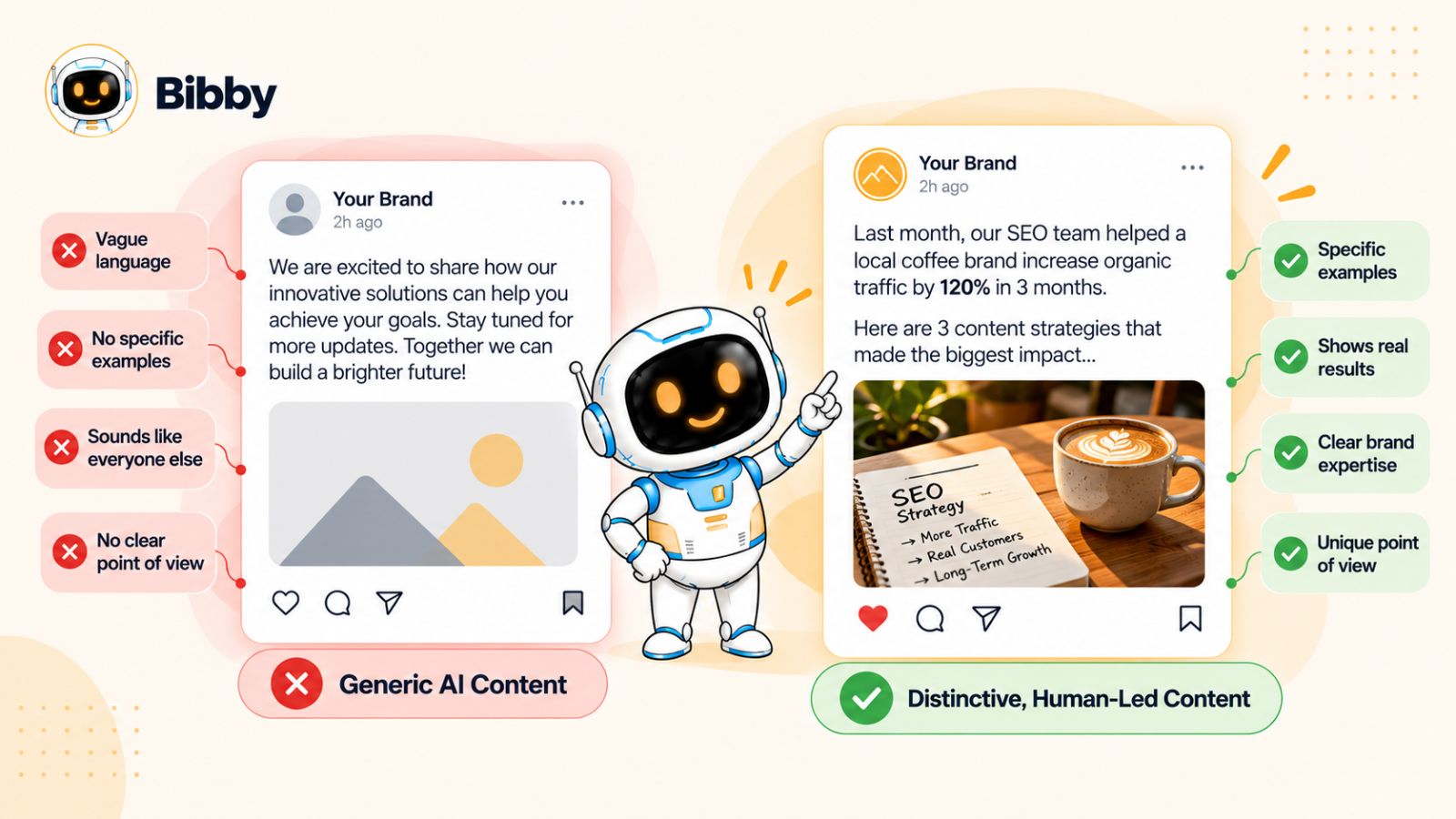
One of the hardest things to catch during an AI content review is not an obvious mistake. It is content that is technically correct, well-written, and completely forgettable.
AI can produce a polished social media post in seconds. But because the same underlying models are being used to generate content for millions of businesses, generic patterns can appear quickly: predictable hooks, familiar phrases, broad advice, excessive enthusiasm, and conclusions that could belong to almost any brand.
Human review should therefore go beyond asking, “Is this good writing?”
The better question is:
“Could another brand publish this exact post without changing anything?”
If the answer is yes, the content probably needs another layer of human input.
Look for generic claims
AI-generated social posts often make broad statements such as:
- “Consistency is the key to success.”
- “In today's fast-paced digital world…”
- “Here are some game-changing strategies…”
- “Your audience wants authentic content.”
- “It's time to take your social media to the next level.”
There is nothing inherently false about statements like these. The problem is that they rarely give the audience a reason to pay attention.
During review, replace broad advice with something concrete.
Instead of telling people that consistency matters, explain what consistency actually looks like for the audience you're targeting.
Instead of saying that businesses should “know their audience,” identify a specific audience problem and explain how to address it.
Specificity is one of the simplest ways to make AI-assisted content feel less generic.
Look for opinions that don't belong to anyone
AI can generate balanced, reasonable statements very easily.
That can also make social content sound like it has no point of view.
A strong brand often has preferences, principles, experiences, and things it believes are worth discussing.
Human reviewers can add those elements.
For example:
- What does the company believe customers misunderstand?
- What approach does the team disagree with?
- What has the company learned from experience?
- What would the founder or subject-matter expert say differently?
- What advice would the brand give that isn't obvious from a generic Google search?
AI can help express those ideas, but the underlying perspective should come from somewhere real.
Look for unnecessary enthusiasm
Another common signal is excessive enthusiasm.
Everything is “powerful,” “game-changing,” “exciting,” “amazing,” or “transformative.”
When every post uses superlatives, none of them feel particularly meaningful.
A human reviewer should ask whether the language matches the actual significance of the subject.
If the post is announcing a minor product update, it doesn't need to sound like the company has reinvented its industry.
Credibility often improves when the language becomes simpler and more restrained.
Look for repetitive structures
AI-generated content can also develop recognizable patterns.
For example, imagine reviewing a week's worth of posts and finding that most of them follow this structure:
Hook → three bullet points → motivational conclusion → “What do you think?”
Individually, each post might be acceptable.
Together, they make the account predictable.
Reviewing content in batches allows you to spot repetition that isn't obvious when looking at one post at a time.
Change the structure when appropriate:
- Use a short story
- Show a before-and-after example
- Explain a mistake
- Break down a process
- Share a customer question
- Demonstrate something visually
- Present an opinion
- Compare two approaches
- Answer a common objection
AI can generate all of these formats, but humans should decide which format best serves the idea.
Add information AI couldn't know
The easiest way to make AI-assisted social content more distinctive is to add information that wasn't available in the original prompt or general training data.
That might include:
- A company's internal experience
- A customer's actual question
- An original experiment
- A real performance result
- A product development decision
- A founder's opinion
- An industry-specific example
- A lesson learned from failure
This is where human expertise becomes a competitive advantage.
AI can help turn a rough insight into a polished post. But if the original insight is generic, better wording won't magically make it original.
Don't confuse “AI-sounding” with “bad”
It's also worth avoiding the opposite mistake.
Not every polished or structured sentence is evidence that a post needs to be rewritten.
The purpose of human review isn't to make AI-generated content artificially imperfect so that it “sounds human.”
If the writing is clear, useful, accurate, and appropriate for the brand, it may already be ready.
The reviewer should focus on value and fit, not on hunting for signs that AI was involved.
That distinction keeps the review process efficient.
The final test: could this have come from your brand alone?
Before approving a post, remove the company's logo and name mentally.
Read the content again.
Does it still contain enough perspective, specificity, experience, or useful information that someone could recognize what makes the brand different?
If not, don't automatically throw the post away.
Instead, add one or two pieces of information that only your brand, team, customers, or subject-matter experts could realistically provide.
That small addition can transform AI from a content generator into a much more useful writing and production assistant.
And that is ultimately the goal of human review: not to fight AI-generated content, but to make sure human expertise is still visible in the content AI helps create.
How to Review AI Content for Different Social Media Platforms
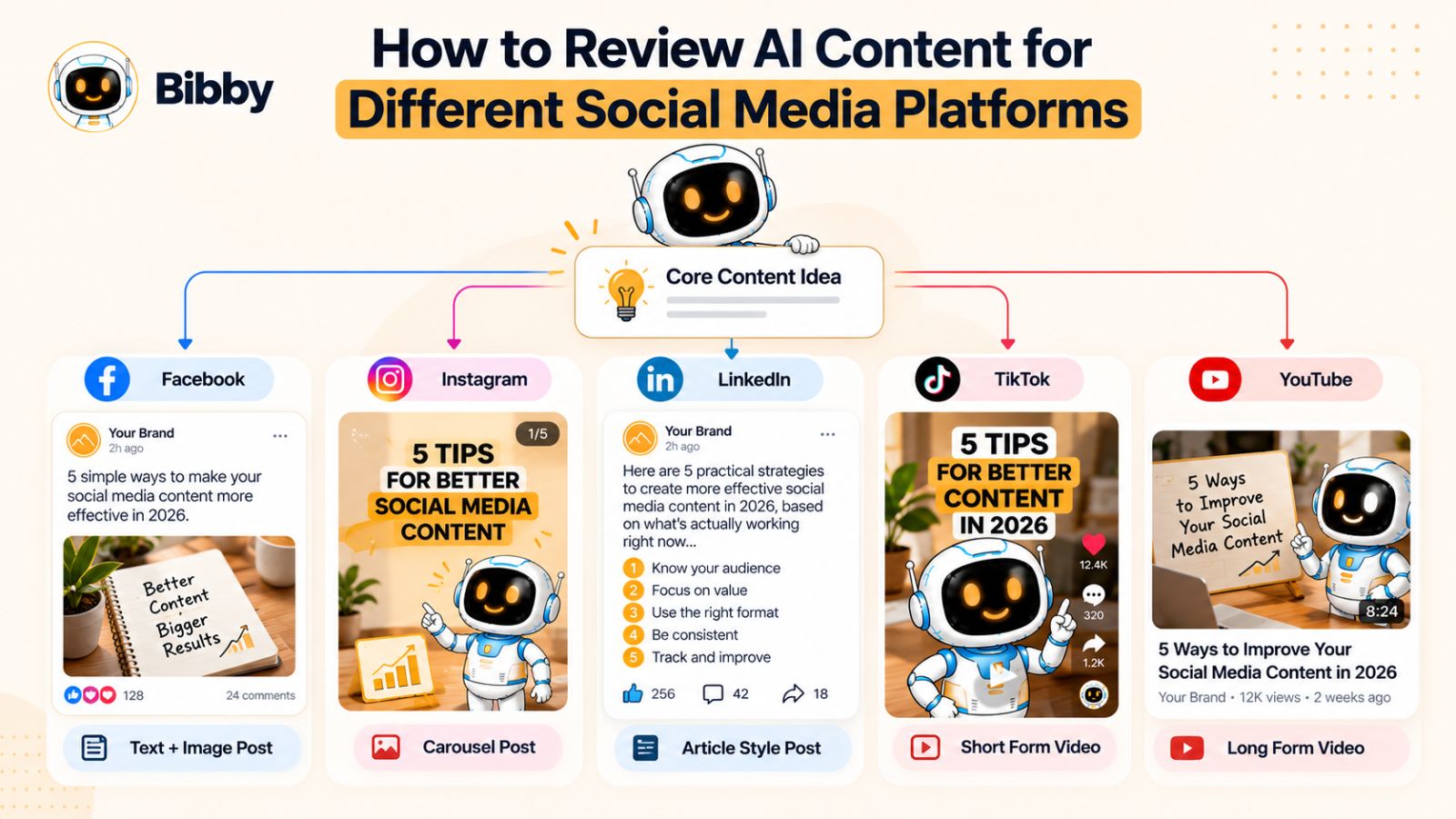
One AI-generated idea can be distributed across several social networks, but that doesn't mean one version should be published everywhere unchanged. Each platform has its own audience expectations, content formats, and publishing context.
A human review should therefore include one question that is easy to overlook:
“Is this the right version of this idea for this platform?”
The answer doesn't always require rewriting the entire post. Sometimes a small change in format, opening, length, visual, or CTA is enough.
Facebook: Check whether the post encourages genuine interaction
Facebook can support a wide range of content, from short updates and images to videos, links, and longer discussions.
When reviewing AI-generated Facebook content, look for context and conversational value.
Ask:
- Does the post give people something worth responding to?
- Is the opening understandable without additional context?
- Does the link or media support the message?
- Does the post sound like something a real person or organization would share?
Avoid adding a question at the end simply because AI-generated posts often do.
A question should contribute to the conversation rather than function as an automatic engagement prompt.
Instagram: Review the relationship between visual and caption
Instagram is particularly dependent on the creative asset.
A caption can be excellent and still fail if the image, carousel, or video doesn't communicate the idea quickly.
For an AI-assisted Instagram post, review:
- The first visual impression
- Carousel sequencing
- Text readability
- Image quality
- Caption structure
- Hashtag relevance
- CTA
- Overall visual consistency with the brand
For carousels, pay special attention to the first slide.
If the first slide doesn't make the viewer curious enough to continue, the quality of the remaining slides may not matter.
Also check that the caption adds something rather than simply repeating every point already shown in the creative.
LinkedIn: Check substance and professional context
AI can easily make a LinkedIn post sound professional without making it insightful.
That distinction matters.
Before publishing an AI-generated LinkedIn post, ask:
“What does the reader actually learn from this?”
Generic business advice is abundant on LinkedIn. Posts become more useful when they include a specific experience, observation, framework, example, result, or clearly stated point of view.
Also check whether the language sounds excessively corporate.
A post doesn't become more credible simply because it contains phrases such as “leverage,” “unlock potential,” “drive impact,” or “navigate the evolving landscape.”
Clear language usually communicates expertise better than corporate vocabulary.
TikTok: Check whether the idea works as a piece of content, not just text
TikTok requires a different review mindset because the content is often driven by video, pacing, and the first few seconds.
If AI helped generate a script, ask:
- Does the opening immediately establish the subject?
- Is the script natural when spoken aloud?
- Does the visual support the spoken message?
- Is there unnecessary setup?
- Does the video give the viewer a reason to continue?
- Does the ending feel natural rather than forced?
Read the script aloud.
This simple test catches problems that are difficult to notice when reading silently.
A sentence can look perfectly reasonable in a caption and sound unnatural when spoken.
YouTube: Check the promise, structure, and viewer expectation
For YouTube content, the review should extend beyond the caption or description.
If AI helped generate a video title, description, thumbnail concept, or script, make sure all of those elements make the same promise.
A title suggesting one topic while the video spends most of its time discussing another creates a poor viewer experience.
Check:
- Title accuracy
- Thumbnail clarity
- Opening section
- Script structure
- Factual claims
- Description accuracy
- Links
- Calls to action
The human reviewer should ensure the packaging attracts the right viewer rather than simply generating the most dramatic possible claim.
Don't force every idea onto every platform
Cross-platform scheduling can save enormous amounts of time, particularly when a social media workflow prepares content for several networks at once.
But automation shouldn't create an obligation to publish everything everywhere.
Sometimes the correct decision is to publish an idea on two platforms rather than six.
A human reviewer should be able to say:
“This is a good post, but it doesn't belong on this platform.”
That is not a failure of automation.
It is exactly the kind of judgment automation is supposed to leave with the human.
Review the adaptation, not just the original
When AI creates multiple platform versions of the same idea, compare them side by side.
Look for meaningful adaptation.
The versions should share the same core message when appropriate, but they shouldn't necessarily have identical openings, structures, captions, or CTAs.
For example, an idea might become:
Instagram: a visual carousel explaining the concept.
LinkedIn: a detailed perspective based on the same underlying lesson.
TikTok: a short demonstration or spoken explanation.
Facebook: a conversational post with supporting media.
YouTube: a longer explanation or tutorial.
The idea remains consistent. The experience changes.
That is the distinction human reviewers should protect when AI and automation are handling distribution.
The platform-fit question
Before approving any automated social media post, ask three simple questions:
- Would this format make sense on this platform?
- Would this audience understand and care about it here?
- Does this version use the platform's strengths rather than merely appearing on it?
If the answer to all three is yes, the post is much closer to being ready for publication.
The goal of multi-platform automation isn't to make every platform identical. It is to make it easier to distribute a strong idea while still giving each audience an appropriate version of it.
The AI Content Review Checklist: A 60-Second Pre-Publish Test
Not every social media post needs a 30-minute editorial review.
If the content is low-risk and straightforward, a human can often catch the most important issues in under a minute by using a consistent final check.
The key is to review the right things in the right order.
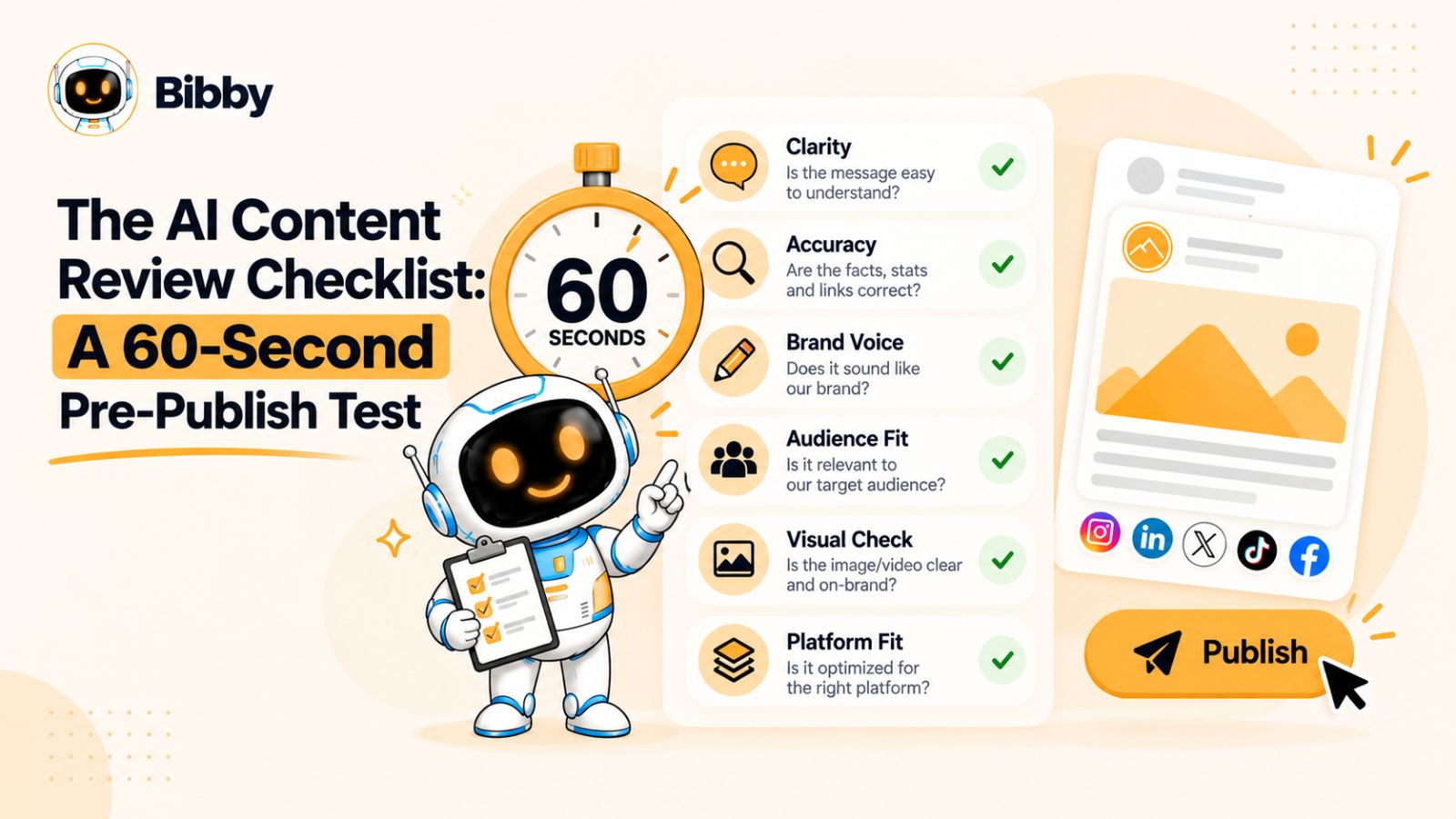
The 10-second clarity check
Read the post once without editing it.
Ask:
“What is this post trying to say?”
If you cannot answer in one sentence, the audience probably won't understand it either.
Look for an obvious central idea.
A post doesn't need to be short to be clear, but the reader shouldn't have to work out what the point is.
The 10-second accuracy check
Now look specifically for claims that could be wrong.
Check:
- Numbers
- Dates
- Names
- Quotes
- Statistics
- Product details
- Links
- Research references
- Comparisons
- Claims about results
If there are no meaningful factual claims, move on.
The goal isn't to turn every social post into an academic fact-checking exercise. It's to identify information where an AI mistake could damage credibility.
The 10-second brand check
Ask:
“Would our brand actually say this?”
Look beyond grammar.
Check the tone, vocabulary, perspective, humor, confidence level, and terminology.
If the post sounds like it could have been written for any company in the industry, add something more specific to the brand.
The 10-second audience check
Ask:
“Why should our audience care?”
There should be a recognizable benefit, insight, emotion, curiosity gap, useful information, entertainment value, or other reason for someone to spend time with the post.
If the answer is unclear, the problem may not be the caption.
The idea itself may need improvement.
The 10-second visual check
Look at the image, carousel, or video without reading the caption.
Does it make sense on its own?
Check for:
- Incorrect text
- Visual inconsistencies
- Poor cropping
- Difficult-to-read text
- Unexpected objects
- Incorrect branding
- Low-quality assets
- A mismatch between the creative and the message
For video, watch enough of the opening to make sure the actual published asset is the intended one.
The 10-second platform check
Finally, ask:
“Does this look like it belongs here?”
Check the format, length, opening, visual, CTA, and overall presentation.
A post that passes every other test can still feel out of place if it has simply been copied from another platform.
The final publish question
After these checks, ask one last question:
“Is there anything here that I would be embarrassed to discover after publishing?”
If the answer is yes, fix it before scheduling.
If the answer is no, publish.
This final question is useful because it shifts the review from abstract editing to real-world accountability.
A simple AI social media review checklist
For teams that want something they can copy into their workflow, the process can be reduced to this:
| Check | Question |
|---|---|
| Accuracy | Are the important claims, numbers, names, and links correct? |
| Clarity | Is the main point immediately understandable? |
| Brand voice | Does it sound like the brand? |
| Audience value | Is there a clear reason for the audience to care? |
| Visual quality | Does the creative look correct and support the message? |
| Platform fit | Does this version make sense for the specific platform? |
| Originality | Does it contain something specific rather than generic advice? |
| CTA | Does the requested action make sense? |
| Calendar fit | Is it repetitive or unnecessary compared with nearby posts? |
| Final approval | Would you be comfortable seeing this published under your name? |
This checklist is intentionally short.
A review system becomes less useful when it requires so many steps that people start skipping it.
The objective is to create a repeatable quality-control habit, not another complicated piece of marketing software or bureaucracy.
For a small team, that might mean one person spending a minute reviewing each scheduled post. For a larger team, it might mean assigning different levels of review depending on the risk and importance of the content.
Either way, the principle remains the same:
Let AI handle more of the production work, but keep humans responsible for the final publishing decision.
How to Review AI-Generated Social Media Content at Scale
The biggest advantage of using AI for social media isn't that it can write one caption faster. It is that it can help a team produce and organize a much larger volume of content.
That creates a new challenge.
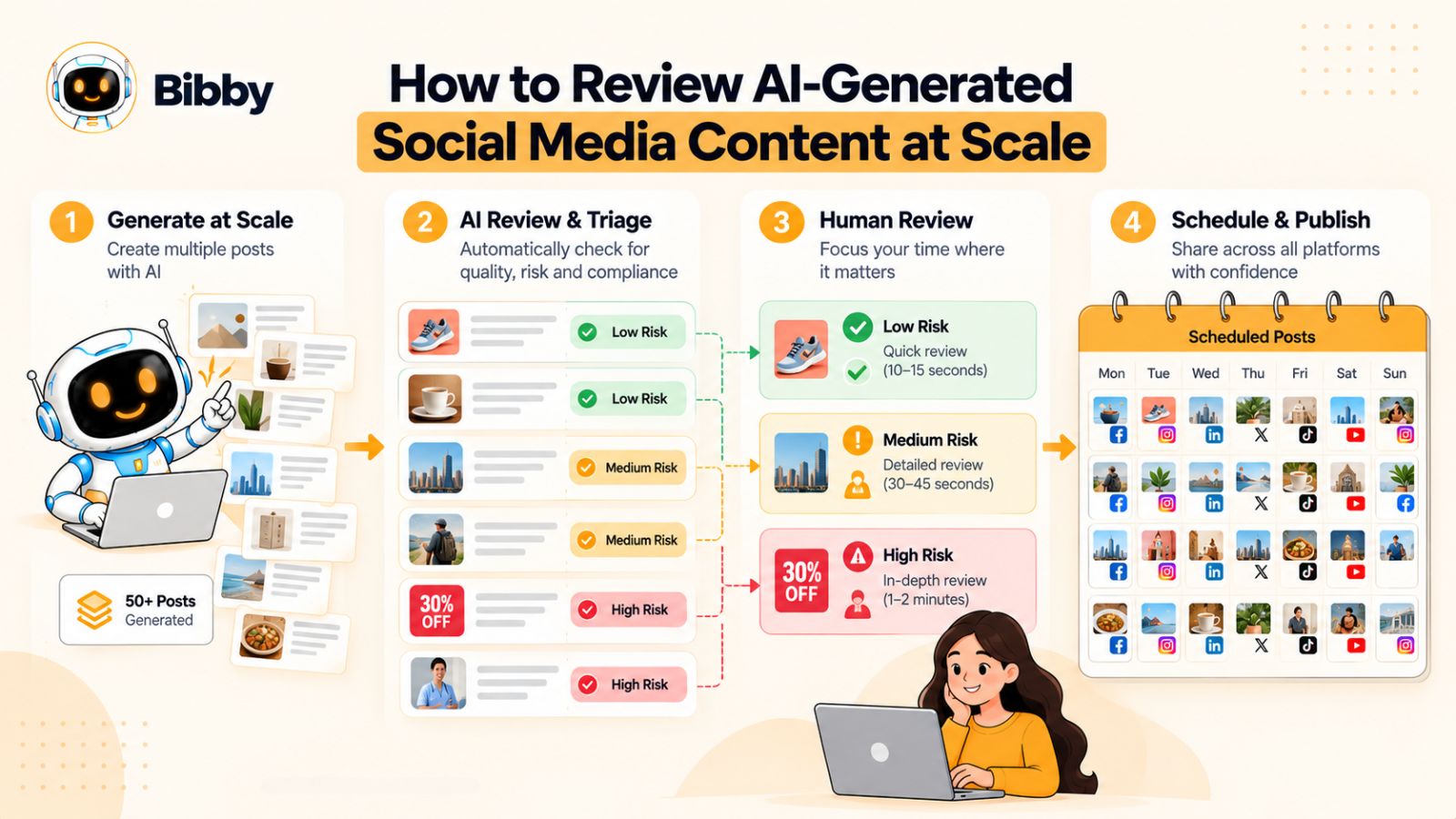
If your workflow goes from five posts a week to fifty, reviewing every post with the same level of attention isn't practical. The answer isn't to eliminate human review. It's to make human review more selective and systematic.
Not every post needs the same level of review
Start by separating content according to risk.
A simple system might have three levels.
Low-risk content includes straightforward educational posts, general tips, simple visual content, or evergreen ideas that contain few factual claims.
These can usually go through a quick human check.
Medium-risk content might include product information, statistics, industry claims, comparisons, or posts representing a stronger brand opinion.
These deserve a more deliberate review.
High-risk content can include sensitive topics, legal or financial claims, health-related information, controversial subjects, significant announcements, or anything where an incorrect statement could have serious consequences.
These should receive appropriate expert or senior human review before publication.
The important point is that AI involvement doesn't determine the level of review. Risk does.
Review batches, not just individual posts
When content is generated in bulk, reviewing posts one at a time can hide patterns.
Instead, periodically look at a group of posts together.
For example, review the next seven days of content and ask:
- Are we repeating the same idea?
- Are too many posts promotional?
- Are the hooks starting to sound identical?
- Are the visuals becoming repetitive?
- Are we talking about the topics our audience actually cares about?
- Is the content mix balanced?
- Does the overall calendar reflect our current priorities?
This is where humans can see something AI may not: the relationship between individual posts.
One post can be good.
Twenty posts that all feel like the same post are not necessarily good content strategy.
Create approval rules before you need them
A scalable review process should not depend entirely on one person's memory.
Create simple rules that everyone involved in publishing understands.
For example:
Every post must:
- Have a clear purpose
- Match the brand voice
- Use accurate factual claims
- Have an appropriate visual
- Be adapted to the intended platform
- Contain working links where applicable
- Pass a final human review
Certain posts must also:
- Be fact-checked against the original source
- Receive subject-matter review
- Receive legal or compliance review where appropriate
- Be approved by a campaign owner
The exact rules will depend on the organization.
The important thing is that the team knows what requires approval and what does not.
Use AI to assist with the review itself
Human review doesn't mean humans have to perform every part of the review manually.
AI can also help identify potential problems.
For example, an AI review step could flag:
- Claims that appear to require verification
- Potentially outdated information
- Missing context
- Repeated phrases
- Inconsistent terminology
- Tone differences
- Possible platform mismatches
- Missing CTAs
- Contradictions between the caption and creative
A human can then investigate the flagged items rather than searching for every possible issue from scratch.
This creates a useful division of labor:
AI identifies potential problems. Humans decide whether they are actually problems.
That is often a more efficient use of human attention.
Keep a library of real brand knowledge
One of the best ways to improve AI-assisted content is to give the system better source material.
Maintain a central collection of:
- Brand guidelines
- Product information
- Approved terminology
- Customer questions
- Case studies
- Original research
- Expert insights
- Common objections
- Past high-performing content
- Examples of preferred writing
- Topics the brand avoids
This gives AI more useful material to work with and gives human reviewers a reference point when evaluating the output.
It also reduces the temptation to make every new prompt from scratch.
Learn from approved edits
Your review process can become a source of useful data.
Suppose the same types of changes keep appearing:
AI captions are consistently too long.
Hooks are consistently too exaggerated.
Product descriptions repeatedly use outdated terminology.
CTAs are consistently too aggressive.
Those patterns shouldn't remain isolated editing tasks.
They should feed back into the content-generation process.
Update the brand guidelines, prompts, templates, knowledge base, or workflow so the same mistake becomes less likely next time.
The best AI content workflows improve through iteration.
Automation should reduce work, not remove accountability
Social media automation can handle many repetitive tasks: generating variations, organizing media, creating captions, scheduling posts, and distributing content across multiple platforms.
That can make a workflow dramatically more efficient.
But there is a critical distinction between automating execution and automating accountability.
A scheduler can decide when a post should be published.
A human still needs to decide whether that post deserves to represent the brand.
This is especially relevant when a platform can generate and schedule large quantities of content automatically. The more friction you remove from publishing, the more important it becomes to establish a clear approval standard.
Build a review threshold that your team can actually maintain
The perfect review system is useless if your team won't follow it.
Start small.
For example:
Every post: 60-second human review.
Every batch: 10-minute calendar review.
Higher-risk content: additional fact or expert review.
After publication: periodic performance and audience-feedback review.
That creates several layers of quality control without turning every social post into a lengthy editorial project.
The objective isn't to inspect every comma.
It is to make sure that AI increases the team's capacity without lowering the standard of what gets published.
When that balance works, AI becomes a production multiplier rather than a replacement for editorial judgment.
What AI Should Handle vs. What Humans Should Own
The most effective social media workflows don't ask whether AI or humans should create the content.
They ask a more useful question:
Which parts of social media production are better handled by AI, and which decisions require human judgment?
That distinction can make an enormous difference to both content quality and publishing speed.
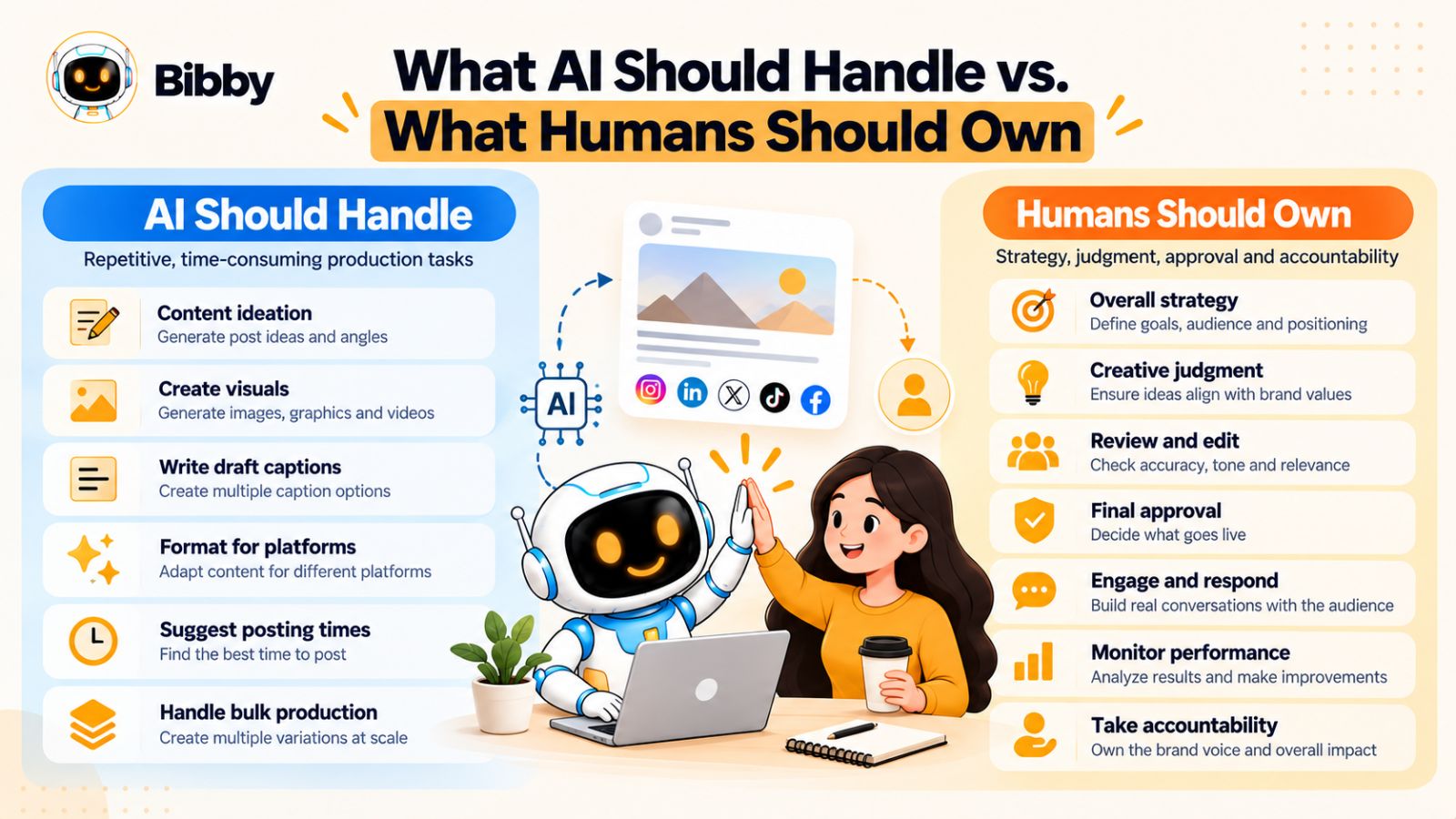
Let AI handle repetitive production work
AI is particularly useful when the task is repetitive, structured, and relatively easy to evaluate.
Depending on the workflow, that can include:
- Generating caption drafts
- Creating multiple variations
- Repurposing an idea into different formats
- Suggesting hooks
- Generating or adapting visual concepts
- Turning long-form material into social posts
- Organizing media
- Preparing platform variations
- Suggesting publishing times
- Scheduling approved content
For example, a social media automation workflow can take a piece of media, generate several caption variations, and prepare the content for different publishing dates and platforms.
This is exactly where tools such as Bibby can be useful. Instead of manually moving images, videos, captions, and publishing dates between multiple steps, a marketer can use one workflow to prepare content for channels such as Facebook, Instagram, LinkedIn, YouTube, and TikTok.
The value isn't that AI makes every decision perfectly.
The value is that it removes repetitive work that doesn't necessarily require a human to perform manually.
Keep strategy human-owned
Some decisions are fundamentally different.
A human should remain responsible for questions such as:
- What does the brand want to be known for?
- Who are we trying to reach?
- Which topics matter to our audience?
- What claims are we willing to make?
- What should the brand's position be?
- Which campaigns deserve priority?
- What content should never be published?
- What does success actually mean for this campaign?
AI can provide suggestions for these questions, but the underlying business judgment belongs to people.
A content generator can produce ten campaign ideas.
It doesn't automatically know which one makes sense for your business right now.
Keep final approval human-owned
The same principle applies to publication.
AI can prepare a post.
AI can generate the caption.
AI can create the visual.
AI can suggest the schedule.
But before the content represents the company publicly, a human should be able to review it and say:
“Yes, this accurately represents what we want to publish.”
That doesn't mean someone needs to rewrite every sentence.
It means someone owns the decision.
Use AI as a second set of eyes
There's also a useful middle ground between fully manual review and fully automated publishing.
AI can review AI-generated content before a human sees it.
For example, one system could flag potential factual claims, another could check brand terminology, and another could compare the post against platform requirements.
The human then gets a shorter list of things that deserve attention.
This creates a layered process:
AI creates → AI checks → human reviews → automation publishes → humans learn from results.
The human remains the final decision-maker, but doesn't have to manually perform every mechanical check.
The human role becomes more valuable as AI improves
It may seem like better AI should eventually eliminate the need for human review.
In practice, better generation can increase the importance of judgment.
If AI produces obviously poor content, nobody mistakes it for finished work.
But when AI can produce content that is grammatically correct, visually polished, factually plausible, and perfectly formatted, the remaining problems become harder to spot.
The question is no longer:
“Can AI create this?”
It increasingly becomes:
“Should we publish this?”
That is a fundamentally different question.
And it is one that requires context about the brand, audience, business, and consequences that cannot be reduced to whether the content is technically well-written.
A useful division of responsibility
A practical way to think about the workflow is:
| Task | AI can help with | Human should own |
|---|---|---|
| Ideas | Generate possibilities | Choose strategic direction |
| Captions | Draft and vary | Approve message and voice |
| Visuals | Generate concepts/assets | Check accuracy and suitability |
| Repurposing | Adapt formats | Decide whether adaptation works |
| Scheduling | Suggest and automate timing | Approve publishing plan |
| Fact-checking | Flag claims | Verify important claims |
| Brand voice | Follow guidelines | Define what the brand sounds like |
| Campaigns | Generate structures | Set objectives and priorities |
| Performance | Identify patterns | Decide what to change |
| Publishing | Execute approved workflow | Final accountability |
This is the model worth aiming for.
Automate the production. Preserve the judgment.
That approach gives social media teams the speed of AI without treating every AI output as automatically publishable.
Building a Human-in-the-Loop Social Media Workflow
The goal of AI-assisted social media isn't to remove humans from the content process. It is to remove the parts of the process where humans add the least value.
That means building a workflow where AI handles speed and repetition while humans provide context, judgment, and accountability.
A simple human-in-the-loop system can look like this:
1. Plan → 2. Generate → 3. Review → 4. Refine → 5. Schedule → 6. Monitor → 7. Improve
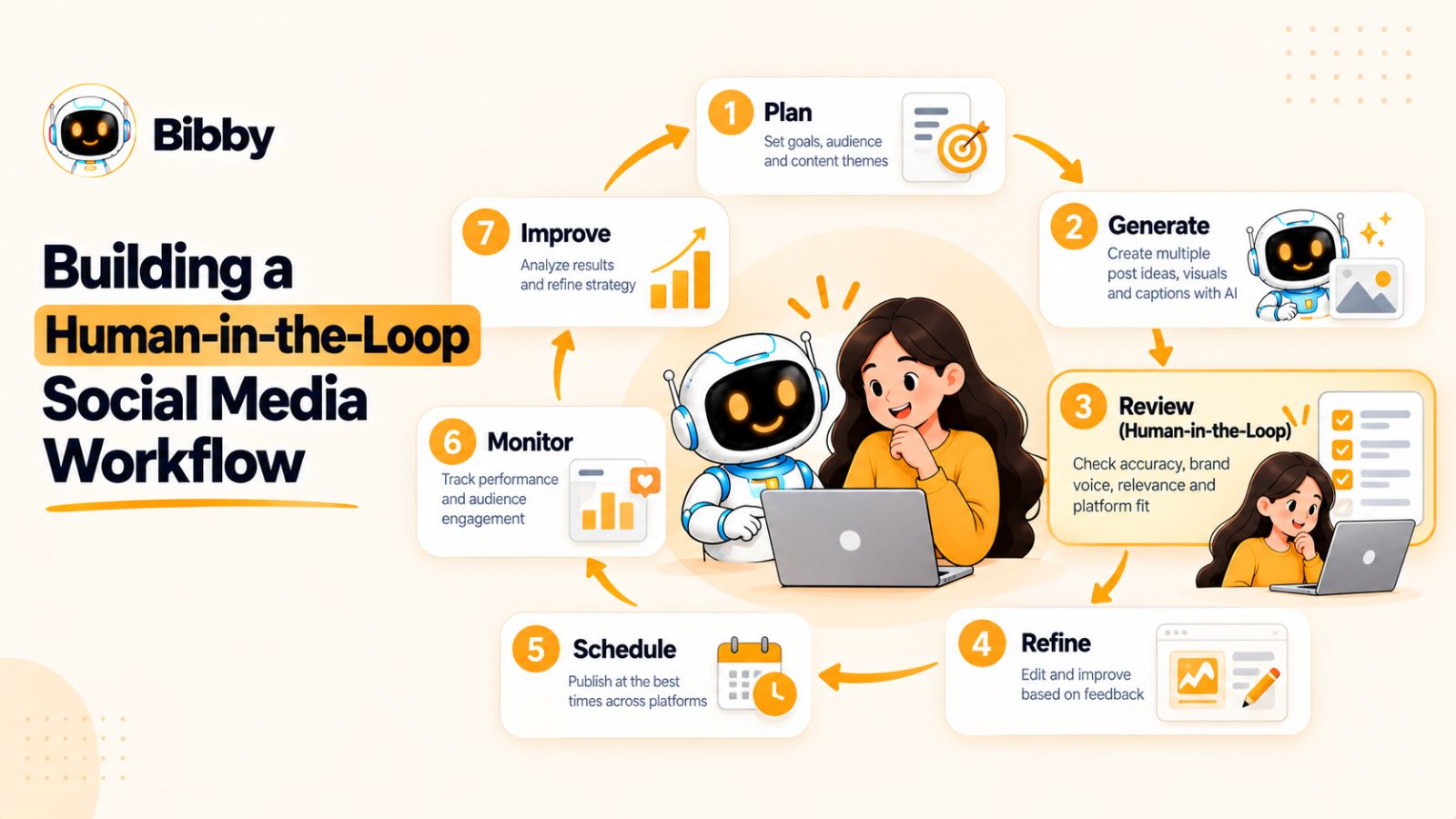
1. Plan the content before generating it
Start with the objective.
Every piece of content should have a reason for existing.
That reason might be to educate the audience, introduce a product, answer a common question, demonstrate expertise, generate awareness, support a campaign, or encourage a specific action.
The clearer the objective, the easier it becomes to evaluate the AI-generated result.
Instead of asking whether a post is “good,” you can ask whether it accomplishes what it was supposed to accomplish.
2. Let AI accelerate production
Once the direction is clear, let AI handle as much of the repetitive production as makes sense.
Generate captions, visual concepts, variations, platform adaptations, and publishing suggestions.
A workflow such as Bibby's can take uploaded or AI-generated media and turn it into scheduled social content, while its chat interface can also be used to manage tasks such as creating brand kits, campaigns, posts, and caption variations.
The important thing is to treat these capabilities as production infrastructure, not as a substitute for editorial judgment.
3. Give humans a defined review point
Don't make “someone should look at it” the entire quality-control system.
Define exactly when review happens.
For example:
Before scheduling: human checks the content.
Before publishing high-risk content: additional verification.
After publishing: performance and audience feedback are reviewed.
This makes responsibility clear.
4. Make review proportional to risk
A funny evergreen post about a simple topic probably doesn't need the same review process as a post containing a major product claim.
Use a simple principle:
Higher potential consequences = deeper human review.
This prevents your team from spending excessive time reviewing harmless content while still giving important content the attention it deserves.
5. Keep an approval record
For teams producing significant volumes of content, it can be useful to know who approved important posts and when.
This doesn't need to become complicated bureaucracy.
The purpose is simply accountability.
If something goes wrong, the team should be able to understand how the content moved from an idea to publication and where the review process failed.
6. Turn feedback into better prompts and systems
The review process should make the next batch of content better.
If reviewers repeatedly make the same corrections, update the system.
For example:
Problem: AI repeatedly uses an outdated product term.
System improvement: Add the approved terminology to the brand guidelines.
Problem: Captions are consistently too promotional.
System improvement: Update the brand voice instructions with examples.
Problem: Instagram carousel openings are too vague.
System improvement: Add a specific first-slide requirement.
The objective is not to repeatedly fix the same mistakes manually.
It's to make those mistakes less likely in the next generation cycle.
7. Review the content calendar, not just the content
Finally, zoom out.
A social media strategy is larger than individual posts.
At least periodically, review the entire calendar.
Ask:
- Are we publishing enough useful content?
- Are we relying too heavily on one format?
- Are we repeating ourselves?
- Are we talking about the audience's real problems?
- Are promotional posts balanced with educational or entertaining content?
- Are our campaigns connected?
- Are the platforms receiving appropriate versions?
- Are we learning from what audiences actually respond to?
This is where human strategic thinking matters most.
AI can help produce hundreds of pieces of content.
Humans still need to decide whether those hundreds of pieces add up to a coherent social media presence.
The simplest version of the system
If your team doesn't need a complicated process, start with three rules:
Rule 1: AI can create the draft.
Rule 2: A human approves what gets published.
Rule 3: Performance and feedback improve the next batch.
That's enough to establish the core human-in-the-loop principle.
As the volume of content increases, you can add more sophisticated checks, automation, approvals, and specialized reviews.
But the foundation stays the same.
AI should make it easier to create and distribute content. Human review should make sure that the content still deserves to be distributed.
That balance is what allows social media teams to scale without sacrificing the credibility, personality, and judgment that make a brand worth following.
Conclusion: AI Can Scale Social Media, But Humans Still Set the Standard
AI can dramatically change how quickly social media content gets created, adapted, and scheduled. But faster publishing does not automatically mean better publishing.
The most reliable approach is to let AI handle repetitive production while humans remain responsible for accuracy, brand voice, audience relevance, platform fit, and the final decision to publish. A simple review covering the claim, hook, visual, voice, audience, CTA, platform, and publishing details can catch many of the problems that polished AI output can hide.
The three most important takeaways are simple:
- AI-generated content still needs human judgment before publication.
- Review depth should match the content's risk and importance.
- Automation works best when humans own strategy and approval.
The next step is to turn these principles into a repeatable system. Instead of reviewing every post from scratch, build an AI-assisted social media workflow with clear brand guidelines, review checkpoints, approval rules, and feedback loops. That lets your team increase content volume without allowing quality control to disappear as publishing gets faster.
AI can handle more of the work.
Humans should still decide what is worth saying.