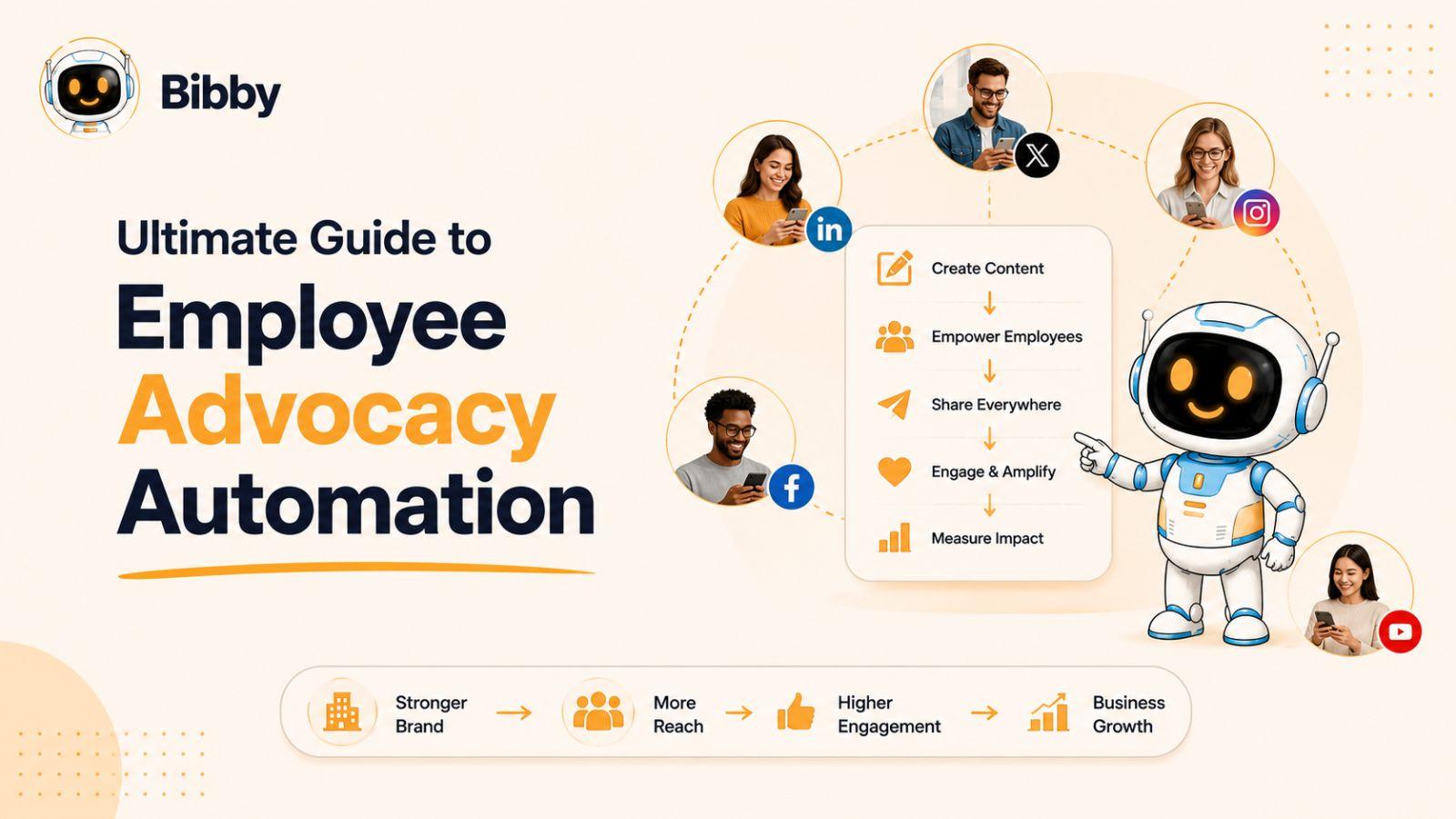

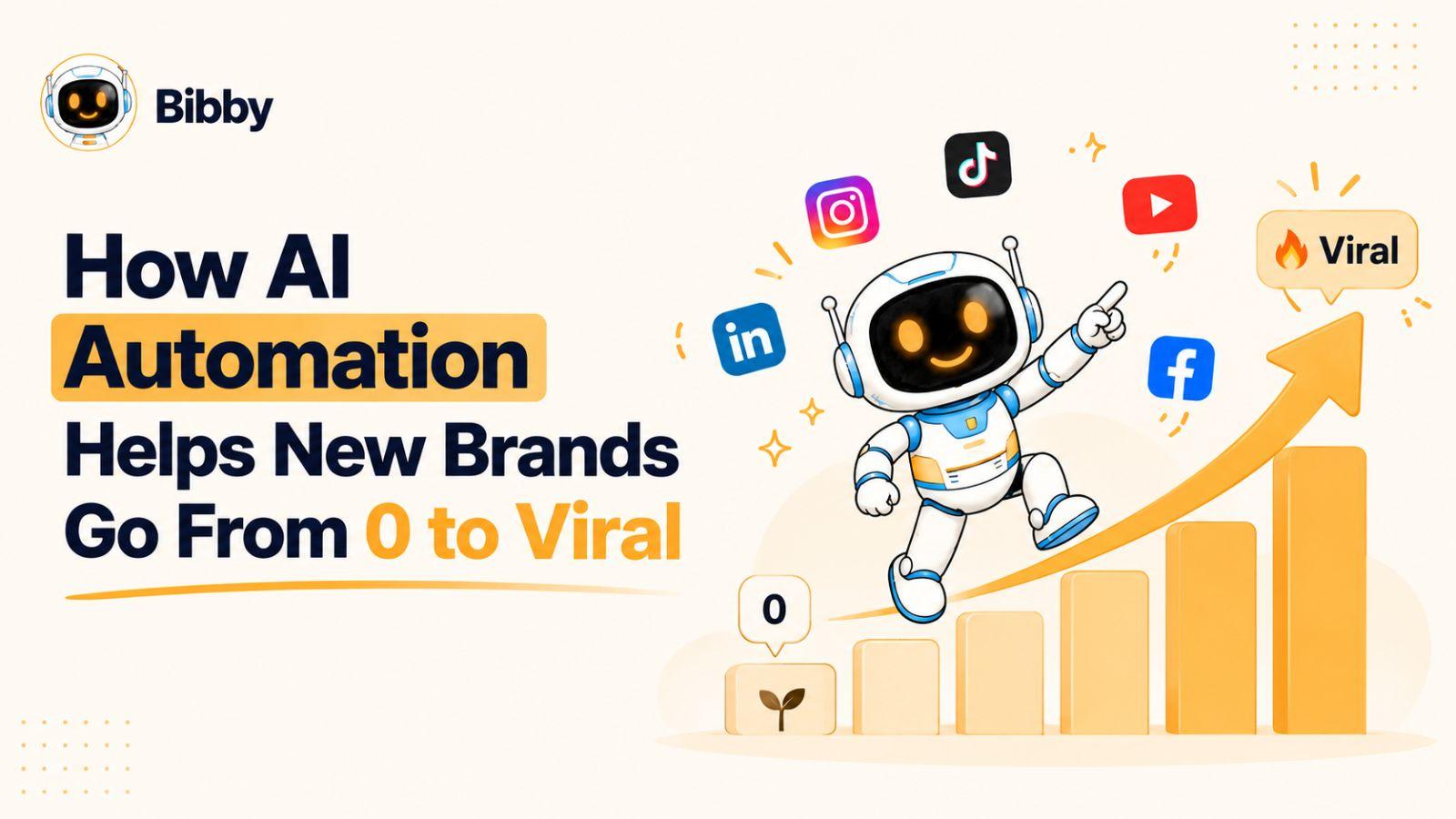
Starting a brand from zero is difficult enough without having to create, write, publish, and manage social media content every day.
AI social media automation is changing that equation by turning repetitive social media work into a repeatable growth system. Instead of spending hours creating individual posts and manually scheduling them, new brands can use AI to create content faster, generate captions, repurpose ideas, and publish consistently across multiple platforms.
The key is not to automate everything—it is to build a system where AI handles repetitive execution while your team focuses on ideas, creativity, and brand strategy.
Why New Brands Struggle to Get Attention on Social Media
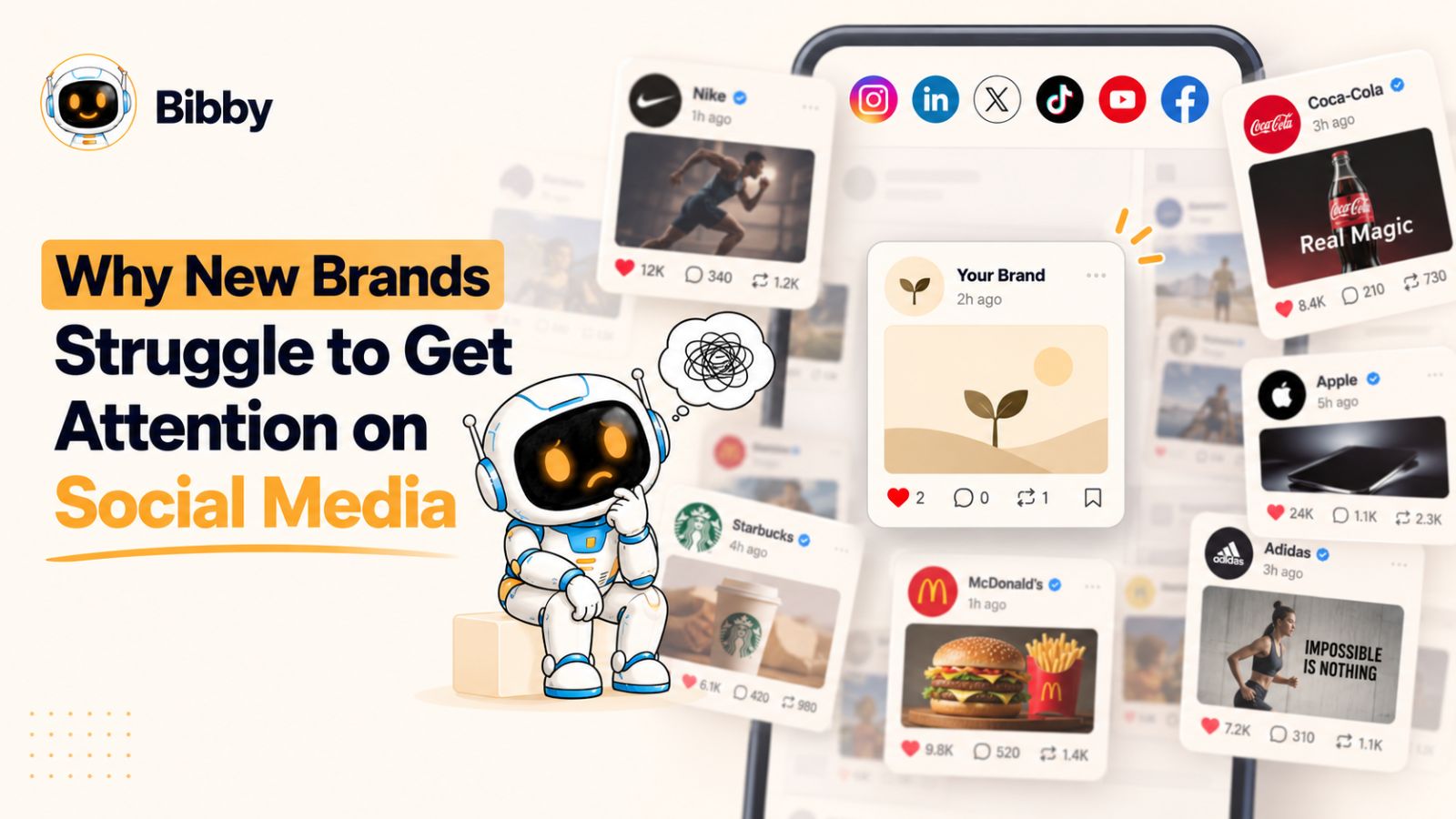
Launching a new brand on social media can feel like speaking into a crowded room where nobody knows who you are yet. You may have a strong product, a polished visual identity, and a clear idea of who you want to reach—but none of that guarantees people will see your content.
The biggest challenge is usually not creating one good post. It is creating enough good content consistently enough for the algorithm, your audience, and your brand to gain momentum.
Starting with zero means starting without distribution
Established brands often have an audience waiting for their next post. A new brand has to build that audience while simultaneously creating the content that attracts it.
That creates a difficult loop:
No audience → limited reach → limited engagement → little data → uncertainty about what to publish next.
Breaking that loop requires experimentation. A new brand may need to test different topics, hooks, visuals, formats, captions, and publishing times before discovering what consistently resonates with its audience.
The problem is that every experiment takes time.
Social media growth requires more content than most teams expect
A modern social media strategy is rarely just a few posts per month. Brands may need images, carousels, short-form videos, Stories, educational posts, product content, promotional campaigns, customer-focused content, and trend-based posts.
Each piece requires multiple decisions:
- What should the post say?
- Which visual should accompany it?
- What should the caption be?
- Which platform should receive it?
- Should the content be adapted for each platform?
- When should it be published?
- How should the next post build on this one?
Doing all of this manually creates a surprisingly large operational workload.
Consistency becomes the hidden competitive advantage
Social media algorithms are constantly changing, but one principle remains useful for new brands: you need enough consistent activity to create opportunities for discovery and learning.
That does not mean publishing meaningless content simply to hit a quota. It means building a sustainable system for regularly putting useful, entertaining, distinctive, or relevant ideas in front of potential customers.
A brand that can comfortably test 30 content ideas has more opportunities to learn than a brand that can only produce five.
This is where AI social media automation becomes particularly useful.
Instead of treating every post as a separate project, brands can build a workflow that handles repetitive parts of content production and distribution. AI can help generate variations, write captions, organize campaigns, and schedule content while the people behind the brand remain responsible for the ideas, positioning, and creative direction.
The result is not simply more automation.
It is more opportunities to create, test, learn, and improve—which is exactly what a brand starting from zero needs.
What Is AI Social Media Automation?
AI social media automation is the use of artificial intelligence to automate parts of the process of creating, managing, publishing, and optimizing social media content.
Traditional social media scheduling tools primarily solve one problem: when should a post be published?
AI social media automation goes further. It can help with what to publish, how to present it, what to write, where to publish it, and when to publish it.
That distinction matters for new brands because scheduling alone does not eliminate most of the work involved in running social media.
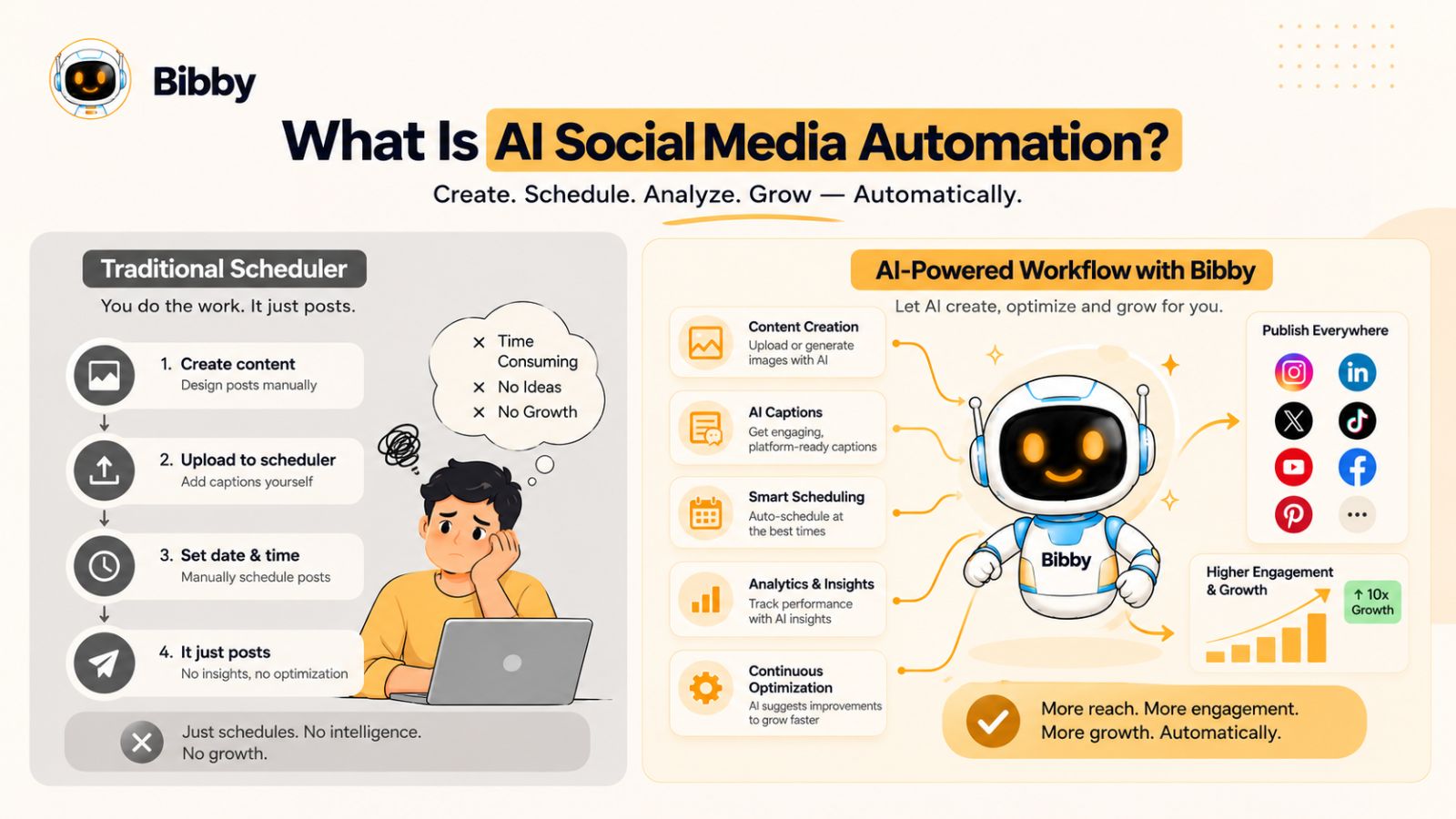
Traditional scheduling vs. AI automation
Imagine you have created an image for your brand.
With a traditional scheduler, you might still need to:
- Write the caption yourself.
- Choose the platforms.
- Adapt the post for each platform.
- Decide when it should be published.
- Create additional variations.
- Repeat the process for your next piece of content.
A scheduler automates the final step.
An AI-powered social media workflow can potentially assist with several of those steps at once.
You can start with an idea, an image, a video, or an existing piece of content and use AI to turn it into publishable social media content. Instead of simply moving a finished post onto a calendar, the system can become part of the content-production process itself.
AI makes content creation more repeatable
The biggest advantage isn't that AI can write a caption in a few seconds.
The bigger advantage is that AI can help turn social media from an occasional creative task into a repeatable production system.
For example, a brand might have one product image. AI can help create a caption around the product, generate alternative messaging, adapt the content for different platforms, and organize it into a broader publishing schedule.
The same principle can apply to campaigns.
A single campaign idea can become multiple posts with different angles, formats, and publishing dates. This gives a new brand more opportunities to discover which messages and creative approaches resonate with its audience.
Automation doesn't mean removing humans from the process
There is an important distinction between automating execution and automating judgment.
AI can be extremely useful for repetitive work: generating first drafts, creating variations, organizing content, scheduling posts, and maintaining a publishing workflow.
But a brand still needs people to decide what the brand stands for, who it serves, what makes it different, and what ideas are worth putting into the world.
The strongest approach is therefore not to let AI replace the brand's personality.
It is to use AI to give that personality a much larger distribution system.
AI social media automation is becoming a workflow, not a feature
This is why the category is evolving beyond simple AI caption generators and social media schedulers.
The emerging model looks more like:
Idea → Content → Caption → Platform adaptation → Scheduling → Publishing → Learning → New content
The more of this cycle a brand can manage efficiently, the more experiments it can run without proportionally increasing its workload.
For a brand starting with zero followers, that matters enormously. Growth is rarely the result of one automated post. It comes from building a system that makes it easier to consistently create, distribute, test, and improve content.
And that is where AI automation can change the economics of building a brand on social media.
How AI Automation Changes the 0-to-1 Brand Growth Process
Going from zero followers to a recognizable brand on social media is not one task. It is a sequence of hundreds of small tasks that have to happen repeatedly.
You need ideas. You need content. You need captions. You need different formats. You need to publish consistently. You need to test what works. Then you need to do it all again.
AI social media automation changes this process by reducing the amount of manual work required between having an idea and getting that idea in front of an audience.
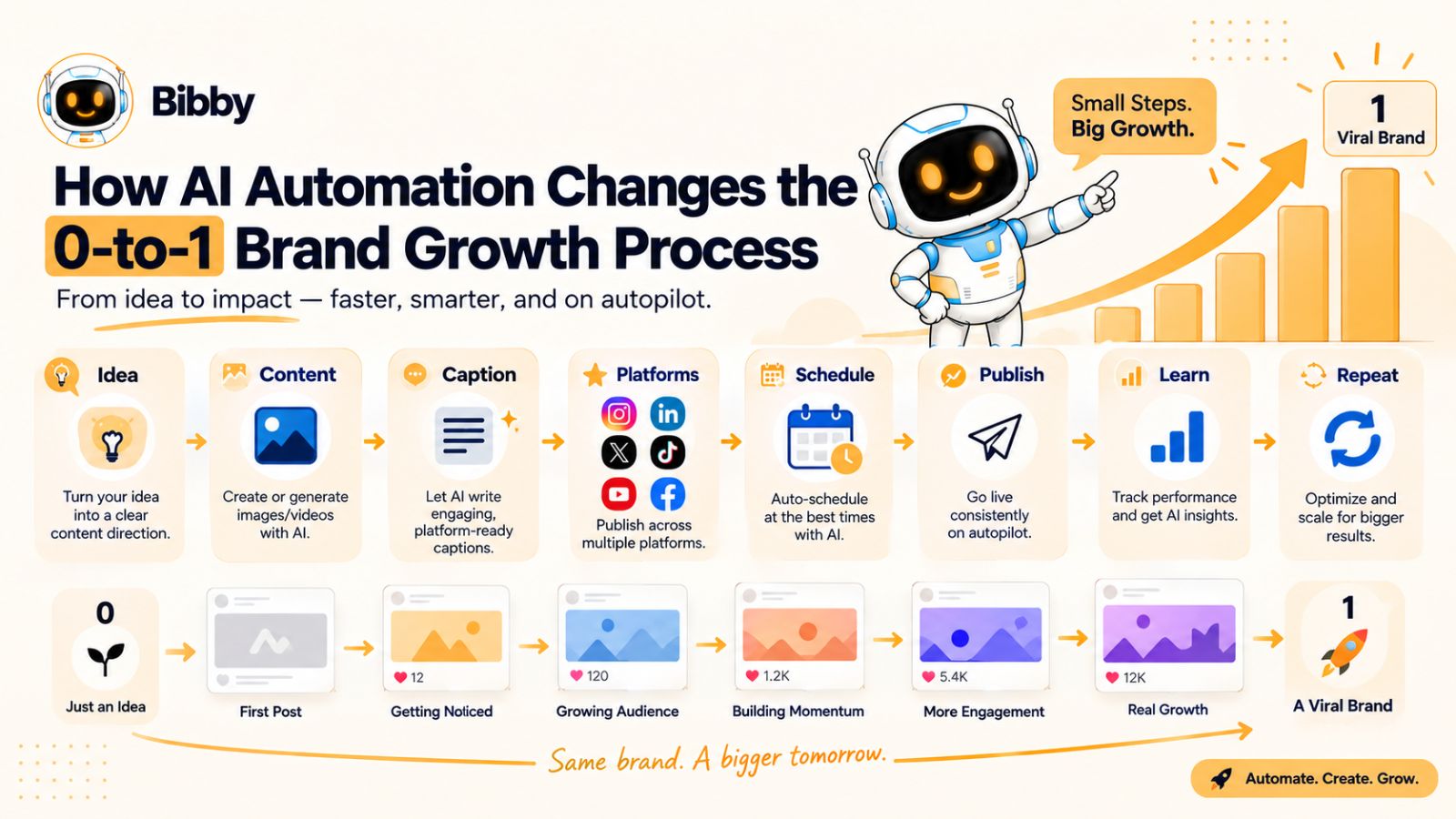
Turn one idea into multiple content opportunities
One of the biggest advantages of AI is its ability to expand a single concept.
Suppose a new skincare brand wants to educate customers about a particular ingredient. Instead of creating one post and moving on, that idea could become:
- An educational image
- A carousel explaining the ingredient
- A short-form video
- A product-focused post
- A Story
- A question designed to generate conversation
- A different angle aimed at a specific customer problem
The goal isn't to publish the same message everywhere.
The goal is to extract more useful content from ideas the brand has already invested in developing.
This gives a small team something that used to require significantly more time: content volume without proportionally increasing production effort.
Create content faster
For a new brand, speed matters because social media is partly an experimentation game.
You don't necessarily know which hook will perform best, which format your audience will prefer, or which topics will generate the most engagement.
AI can reduce the cost of testing those possibilities.
Instead of spending an hour writing every caption from scratch, a marketer can generate a starting point and refine it. Instead of manually creating variations of a campaign message, AI can produce multiple directions that a human can review.
The human still controls the final message.
AI simply reduces the distance between an idea and an executable piece of content.
Maintain consistency without constantly being online
One of the biggest operational problems with social media is that publishing is continuous even when the team is not.
A founder might have an excellent idea on Monday but be busy with product development on Tuesday. A marketing team might create ten pieces of content in one afternoon but forget to publish consistently throughout the following weeks.
Automation separates content creation from content distribution.
Content can be prepared in batches and scheduled ahead of time. That allows a brand to maintain a consistent publishing rhythm without requiring someone to manually open every platform every day.
For a small team, that can make social media considerably easier to manage.
Publish across multiple platforms
Every major social platform has its own audience, format preferences, and publishing environment.
A brand may want to maintain a presence on Instagram, Facebook, LinkedIn, YouTube, TikTok, or several of them simultaneously.
Manually managing each platform creates repetitive work.
AI-powered social media tools can bring more of that workflow into one place, allowing marketers to prepare content once and distribute it across selected channels rather than repeatedly rebuilding the same publishing workflow.
The important word here is adapt.
Cross-platform automation should not mean blindly copying identical content everywhere. Strong automation systems should make it easier to maintain the core brand message while adapting content to the context of each platform.
Increase the number of experiments
This is perhaps the most important change.
A new brand does not yet know exactly what its audience wants.
AI automation makes it cheaper and faster to test.
You can experiment with different hooks, topics, formats, visual styles, calls to action, and publishing schedules. Over time, those experiments generate information about what deserves more attention.
That creates a feedback loop:
Create → Publish → Measure → Learn → Improve → Create again.
AI does not guarantee that any particular post will go viral.
What it can do is make the experimentation cycle faster and more sustainable.
And when a brand can run more meaningful experiments without burning out its marketing team, it creates more opportunities to discover the content that eventually breaks through.
The Social Media Content Engine: From Idea to Published Post
The real value of AI social media automation becomes easier to understand when you look at the workflow from beginning to end.
Instead of thinking about social media as a collection of individual posts, think of it as a content engine. The engine takes an idea or creative asset at one end and turns it into consistently distributed social media content at the other.
A well-designed AI workflow can look like this:
Brand strategy → Content asset → Posting style → Caption → Platform selection → Scheduling → Publishing → Feedback
Each stage removes another piece of repetitive manual work.
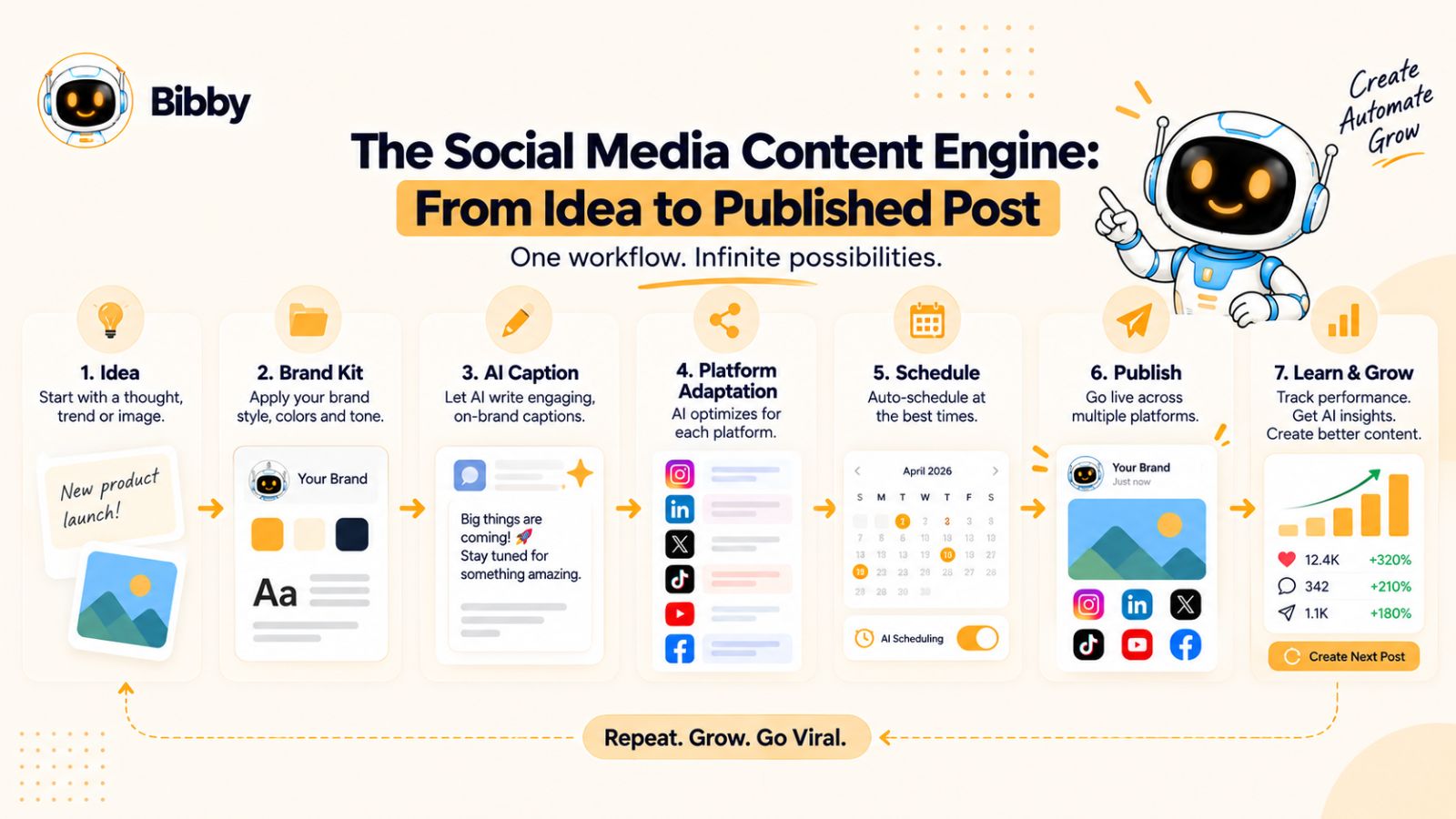
Step 1: Define the brand
Automation works best when the AI understands what it is actually representing.
Before producing content, a brand should establish fundamentals such as its visual identity, audience, positioning, tone of voice, and content themes.
This gives AI useful boundaries.
Without those boundaries, automated content can quickly become generic. With them, AI has a framework for producing content that feels more consistent with the brand.
Step 2: Build a brand kit
A brand kit gives the content engine a recognizable identity.
It can include elements such as brand colors, fonts, logos, visual preferences, messaging guidelines, and tone of voice.
This becomes especially important when a brand is publishing frequently. Consistency helps people recognize content as belonging to the same company even when individual posts cover different topics.
AI can make maintaining that consistency easier by using the brand information as context when generating or adapting content.
Step 3: Create or upload the visual asset
The process can begin with something as simple as an image.
A marketer might upload a product photograph, campaign creative, customer image, infographic, or other visual asset. Alternatively, AI can be used to generate an image when the required creative does not already exist.
The important shift is that the visual asset becomes the starting point for a larger content workflow rather than the finished product.
Step 4: Choose the posting style
Different brands communicate differently.
A luxury brand might want concise, sophisticated messaging. A startup might use an educational and conversational style. A creator-led business might prefer a more personal voice.
Selecting a posting style gives AI direction for the content it generates around the asset.
This is one of the areas where AI can save time without taking creative control away from the marketer.
Step 5: Generate the caption
Writing captions manually for every social post can become one of the most repetitive parts of social media management.
AI can generate a caption based on the visual, brand context, selected style, and intended message.
The best workflow treats the generated caption as a strong starting point rather than something that must be accepted blindly.
A marketer can review it, adjust the language, add a personal insight, change the call to action, or regenerate it entirely.
Step 6: Select the platforms
A brand may want to distribute its content across Facebook, Instagram, LinkedIn, YouTube, TikTok, or other channels.
Instead of separately uploading the same content to every platform, an automated workflow can centralize the distribution process.
This saves time and makes it easier to maintain a consistent publishing schedule across multiple channels.
Step 7: Schedule the content
Once the content is ready, scheduling turns it into a publishing plan.
Instead of deciding every morning what to publish, a brand can prepare content in batches and schedule it for future dates.
AI can also assist with choosing publishing times based on available signals and historical performance, reducing the need to manually guess when each post should go live.
Step 8: Publish, learn, and repeat
Publishing is not the end of the workflow.
The resulting performance provides information that can influence the next batch of content.
Which topics generated attention? Which formats received responses? Which hooks made people stop scrolling? Which ideas failed to resonate?
That information feeds back into the content engine.
The result is a system that becomes increasingly useful over time:
Create → automate → publish → learn → improve → repeat.
For a new brand, this is more valuable than simply having an AI tool that writes captions. The real advantage comes from connecting the entire workflow so that social media becomes easier to operate consistently.
That is exactly the problem modern AI-powered social media platforms are trying to solve.
How Bibby Automates the Social Media Workflow
The biggest limitation of many social media tools is that they automate only one part of the process.
One tool helps you create images. Another generates captions. A third schedules posts. Then you may need separate platforms to manage different social networks.
Bibby takes a more connected approach to social media automation by bringing content creation, AI-assisted writing, and publishing into a single workflow.
The basic process is straightforward: upload or generate your creative, choose how you want the post to sound, and let the AI help turn it into scheduled social content.
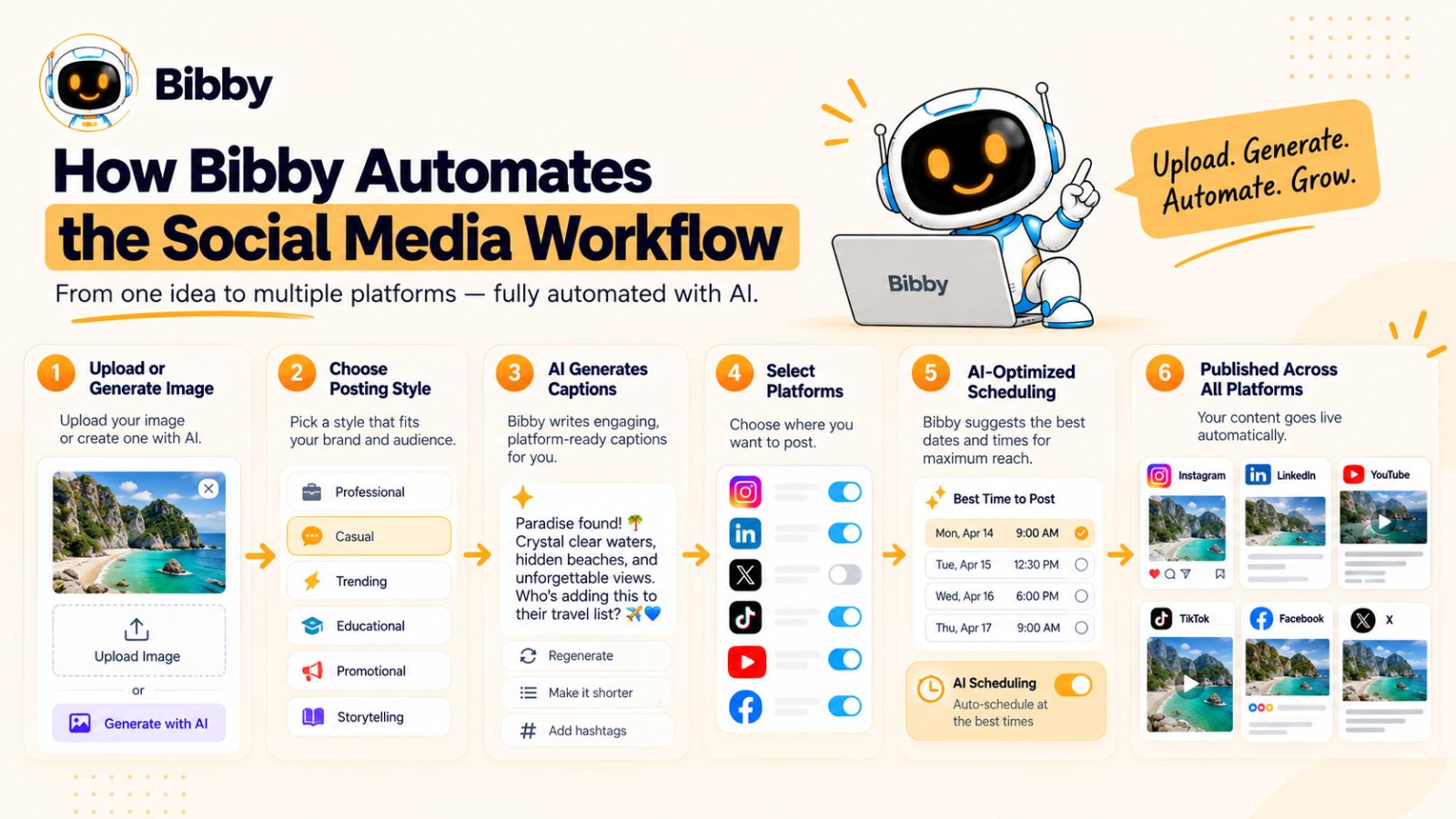
Start with an image—or generate one with AI
The workflow can begin with an asset you already have.
For example, a new fashion brand could upload a product photograph. A SaaS company could upload a product screenshot. A restaurant could upload a photograph of a new dish.
If the brand does not have the right visual yet, Bibby can also be used to generate an image with AI.
That makes the starting point flexible. You do not necessarily need to finish every part of the content manually before entering the automation workflow.
Choose a posting style
Once the visual is ready, the brand can choose the style it wants for the post.
This matters because the same image can communicate very different things depending on the intended audience and brand voice.
A product image could become an educational post, a promotional announcement, a conversational post, or a storytelling piece.
Giving AI that direction helps turn a generic visual asset into content with a specific purpose.
Let AI generate the caption
Instead of starting from a blank caption box, Bibby can automatically generate a caption based on the content and selected posting style.
If the first version isn't right, the caption can be regenerated.
That small capability becomes significant when multiplied across dozens or hundreds of posts. The goal isn't simply to save a few minutes on one caption. It is to reduce the repeated writing work involved in maintaining a consistent social media presence.
Schedule content across your social channels
Once the post is ready, Bibby can schedule it across selected social platforms at different dates and AI-optimized publishing times.
For a brand managing multiple channels, this removes one of the most tedious parts of social media management: repeatedly logging into different platforms and manually publishing the same content.
The workflow can cover platforms such as Facebook, Instagram, LinkedIn, YouTube, and TikTok, depending on the channels the brand selects.
That makes it possible to think in terms of a publishing calendar rather than individual uploads.
Manage different content formats
Social media isn't limited to single-image posts.
Brands increasingly need a mixture of:
- Image posts
- Carousels
- Videos
- Stories
- Campaign content
- Educational content
- Promotional content
Bibby supports these different content types within its social media workflow, allowing brands to build a broader content mix rather than relying on one repetitive format.
This is particularly useful for new brands because variety creates more opportunities to discover which formats resonate with their audience.
Manage social media through conversation
Bibby's newer chat interface pushes the automation concept another step further.
Instead of navigating through multiple menus to perform individual tasks, users can interact with the social media system conversationally.
Through the chat interface, users can work on tasks such as:
- Creating a brand kit
- Creating a campaign
- Creating social posts
- Regenerating captions
- Managing other parts of the social media workflow
That changes the mental model from “I need to operate a social media dashboard” to “I need to tell my AI social media assistant what I want done.”
For a small team or founder managing marketing alongside everything else involved in building a company, that distinction can be meaningful.
The bigger idea: fewer disconnected tools
The value of Bibby is therefore not just automated captions or automated scheduling in isolation.
It is the connection between the steps.
Create → write → adapt → schedule → publish.
When those steps live inside a connected workflow, a brand can spend less time moving content between tools and more time deciding what it actually wants to say.
For a brand starting from zero, that efficiency can translate into more consistent publishing, more experimentation, and more opportunities to find the content that gets noticed.
AI Social Media Automation Across Different Content Formats
A new brand should not build its entire social media strategy around one type of post.
Different formats give audiences different ways to discover and interact with a brand. An image can communicate a product quickly. A carousel can explain a concept. A video can demonstrate something in action. A Story can create a more immediate connection.
The challenge is that producing all these formats manually can quickly overwhelm a small marketing team.
This is where AI social media automation can help turn one content strategy into a broader mix of social media assets.
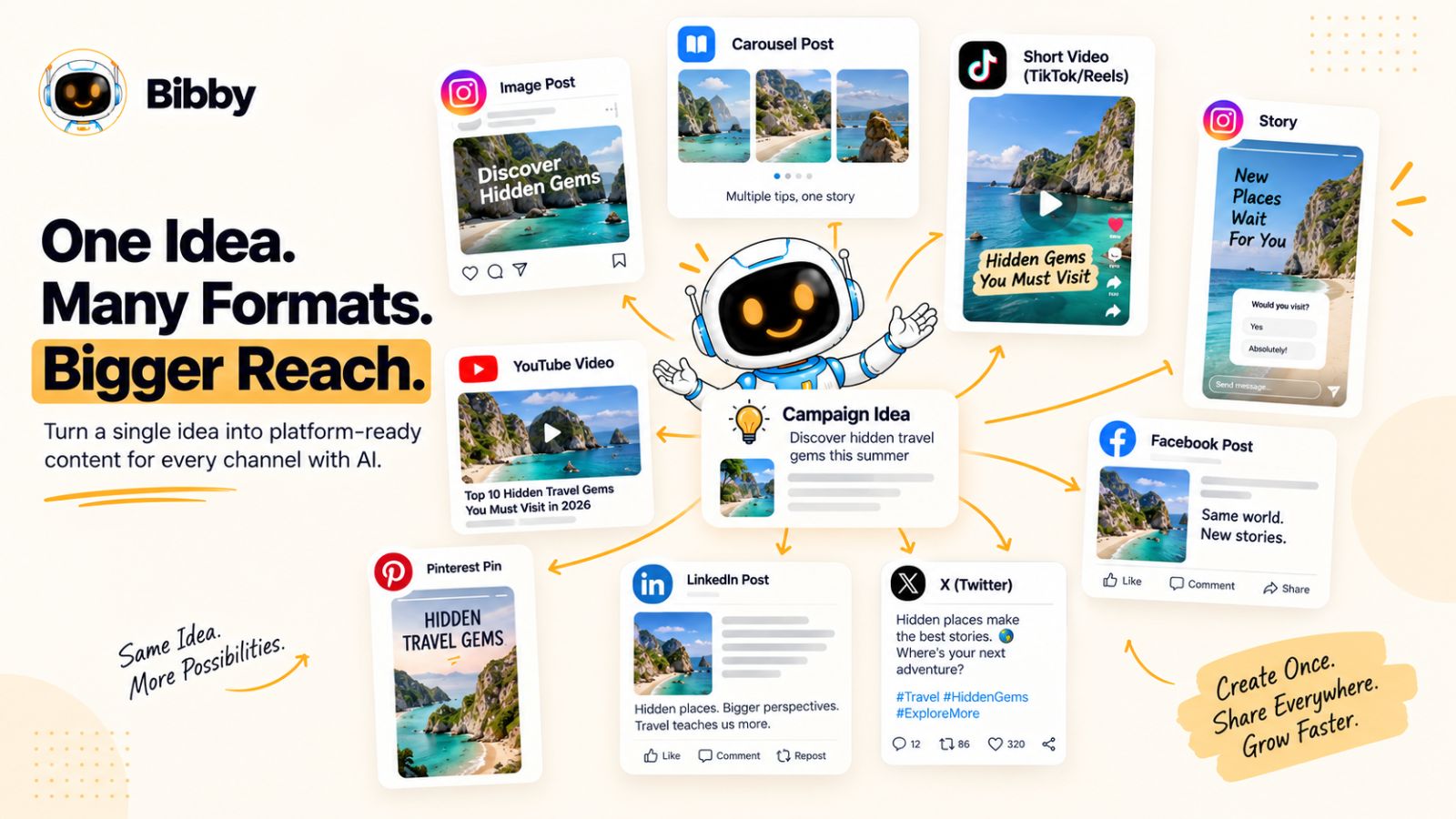
Static image posts
Images are often the simplest place for a new brand to start.
A strong product photograph, branded graphic, customer image, quote, statistic, or educational visual can become the foundation for a social post.
AI can assist with the supporting work—such as generating captions, adapting messaging, and scheduling the content—so the team doesn't have to manually repeat the same process for every image.
The important part is still the underlying idea. Automation can distribute a good concept efficiently, but it cannot make an uninteresting concept valuable simply by publishing it faster.
Carousel posts
Carousels are useful when a brand has more information to communicate than a single image can comfortably contain.
For example, a fitness brand could turn one topic into a sequence explaining five common training mistakes. A software company could break down a complex feature into several simple slides. An ecommerce brand could use a carousel to show different ways to use a product.
AI can help develop the supporting copy and structure around these ideas, while the brand controls the expertise and final message.
This creates another opportunity to transform one topic into a substantial piece of social content rather than stopping after a single post.
Video content
Video has become an important part of social media discovery, particularly on short-form platforms.
But video production can also be one of the most time-consuming formats.
AI automation can help with parts of the workflow surrounding video—such as content ideation, captions, descriptions, scheduling, and distribution—while human creators remain responsible for the creative direction and footage where appropriate.
This distinction matters.
The objective isn't to manufacture endless AI videos. It is to reduce the administrative work surrounding video so teams can spend more of their time producing content people actually want to watch.
Stories
Stories provide another publishing opportunity because they can communicate more immediate or behind-the-scenes content.
A brand might use Stories for:
- Product updates
- Questions and polls
- Limited-time announcements
- Behind-the-scenes moments
- Customer feedback
- Reminders about new content
- Promotional campaigns
Because Stories are often more frequent than feed posts, automation can be particularly helpful for maintaining a consistent publishing rhythm.
One idea can support an entire content series
The real opportunity appears when brands stop thinking about content as isolated posts.
Imagine a company has developed one useful insight about its target customer's biggest problem.
That single insight could become:
A carousel: explaining the problem.
A short video: demonstrating the solution.
An image post: highlighting the key takeaway.
A Story: asking followers whether they experience the problem.
A LinkedIn post: exploring the business implications.
A TikTok: presenting the idea through a short, attention-focused format.
The core idea remains the same, but the presentation changes.
This is what makes content automation powerful for small brands. Instead of constantly searching for completely new ideas, marketers can learn to extract multiple useful pieces of content from ideas they already know are relevant.
Avoiding the “automated content factory” problem
There is one important warning.
More content is not automatically better content.
If AI generates hundreds of nearly identical captions, recycled ideas, and generic posts, automation can make a brand look less distinctive rather than more visible.
The goal should be high-quality repetition of useful ideas, not meaningless repetition.
A strong AI social media workflow should therefore combine automation with human judgment:
Human strategy + AI production assistance + automated distribution + human review.
That combination gives new brands the efficiency of automation without forcing them to sacrifice the personality and originality that make people remember a brand.
AI-Powered Social Media Management Through Chat
The next evolution of AI social media automation is not simply making individual features smarter. It is making the entire workflow easier to control.
Traditional social media software often requires users to navigate through dashboards, calendars, settings, content libraries, and publishing screens. That works, but it can create friction when a marketer wants to move quickly.
A conversational interface changes the interaction.
Instead of asking, “Which menu do I need to open?” the user can ask, “What do I want my social media manager to do?”
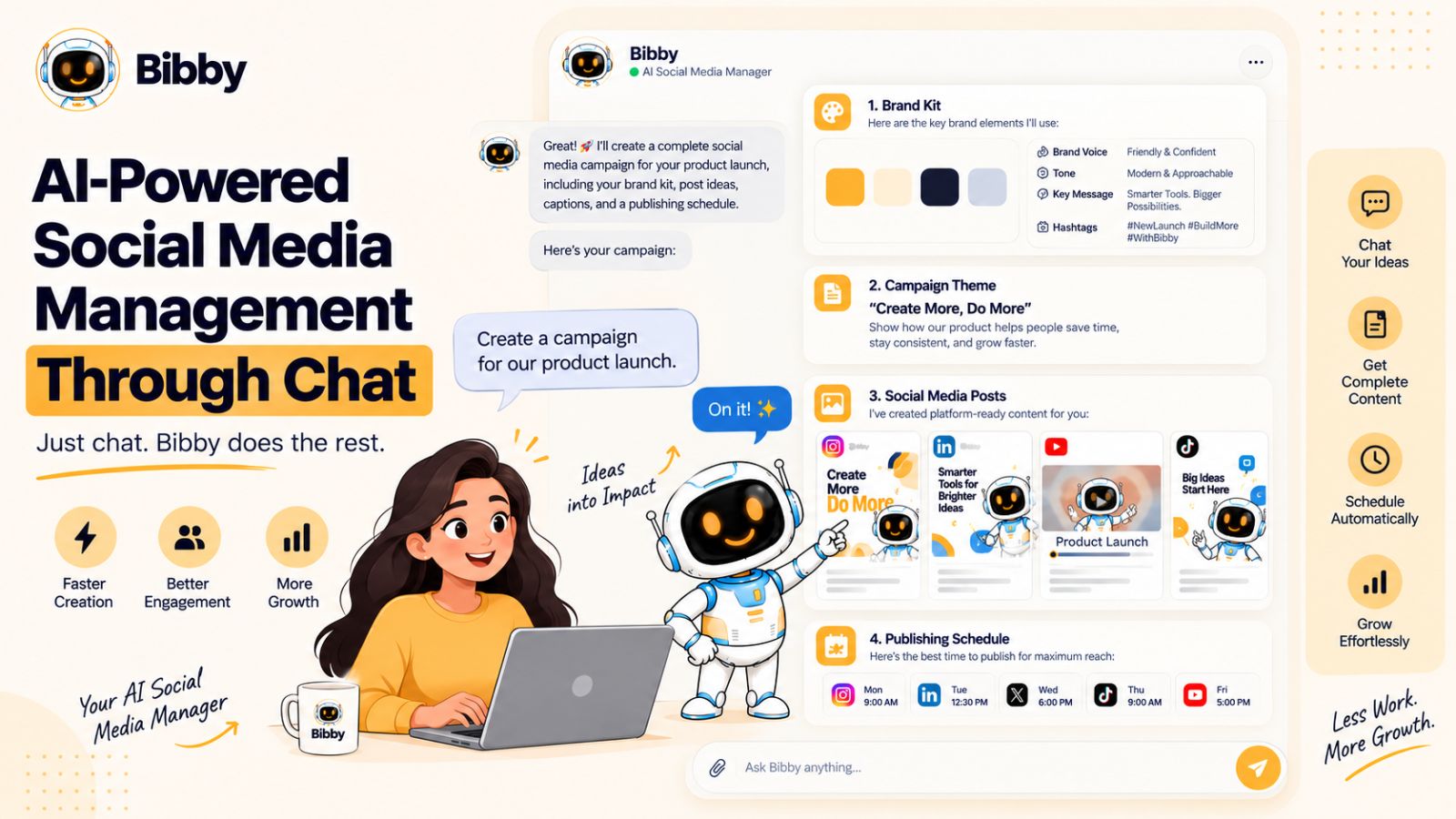
From operating software to giving instructions
Consider the difference between these two workflows.
In a traditional workflow, you might create a campaign, open the content section, select a template, upload an asset, write a caption, choose platforms, open the scheduler, select dates, and repeat the process for additional content.
With a conversational AI interface, the interaction can become much more direct.
You could describe what you want to accomplish and let the system help translate that request into social media actions.
The software becomes less like a dashboard you operate and more like an assistant you instruct.
Create a brand kit through conversation
A consistent brand presence starts with a clear identity.
Through Bibby's chat interface, users can create and work with a brand kit as part of the broader social media workflow.
That can help establish the context AI needs when generating future content.
Instead of repeatedly explaining the brand's style and positioning, the brand information can become part of the system it uses to produce content.
This is particularly useful for new businesses that are still building their visual and messaging identity.
Create campaigns without starting from scratch
Campaigns often require multiple pieces of content rather than a single post.
A product launch, seasonal promotion, educational series, or brand-awareness campaign may involve several assets published across multiple dates and platforms.
A conversational interface can simplify the starting point.
Instead of manually building every component individually, a marketer can describe the campaign and use AI to help turn that brief into a structured set of social content.
The marketer remains in control of the campaign's objectives and creative direction, while AI handles more of the repetitive execution.
Create and regenerate posts
The same conversational approach can be used for individual posts.
If a caption doesn't sound right, it can be regenerated.
If the angle needs to change, the user can ask for a different approach.
If a new post is needed around a particular topic, the user can describe the idea rather than building the post entirely from scratch.
This makes iteration much faster.
And iteration matters because the first version of a social media post is rarely the only version worth testing.
A social media manager that works through context
The broader significance of chat-based social media management is that users can interact with the system using natural language instead of learning every feature individually.
That is especially relevant for founders and small teams.
They may understand their customers and products extremely well without being experts in every social media platform or scheduling interface.
A conversational AI system can reduce that operational barrier.
The user can focus on the outcome:
“Create a campaign for our new product.”
“Turn this idea into five social posts.”
“Regenerate these captions in our brand voice.”
“Build a content plan around this launch.”
The AI handles more of the translation between the request and the underlying workflow.
But conversation doesn't replace strategy
There is still a fundamental limitation.
AI can execute a poorly defined strategy very efficiently.
If a brand doesn't know who it is targeting, what it stands for, or why someone should care, simply giving an AI more instructions won't solve the underlying problem.
The strongest use of conversational AI therefore starts with a clear human direction and uses automation to accelerate execution.
That combination can turn social media management from a collection of repetitive tasks into something closer to having an always-available operational assistant—one that can help turn a brand's ideas into an organized, consistent publishing system.
How New Brands Can Build a Viral Content System With AI
Every new brand wants the post that suddenly takes off.
One video gets shared thousands of times. A carousel reaches people outside the existing audience. A product post generates a wave of profile visits. Suddenly, a brand that nobody knew last week is appearing in people's feeds everywhere.
But there is an important distinction between creating viral content and creating the conditions for discovering content that can spread.
AI cannot guarantee that a post will go viral. No scheduling tool, caption generator, or automation platform can reliably predict which piece of content millions of people will choose to share.
What AI can do is make the experimentation required to find those opportunities significantly easier.
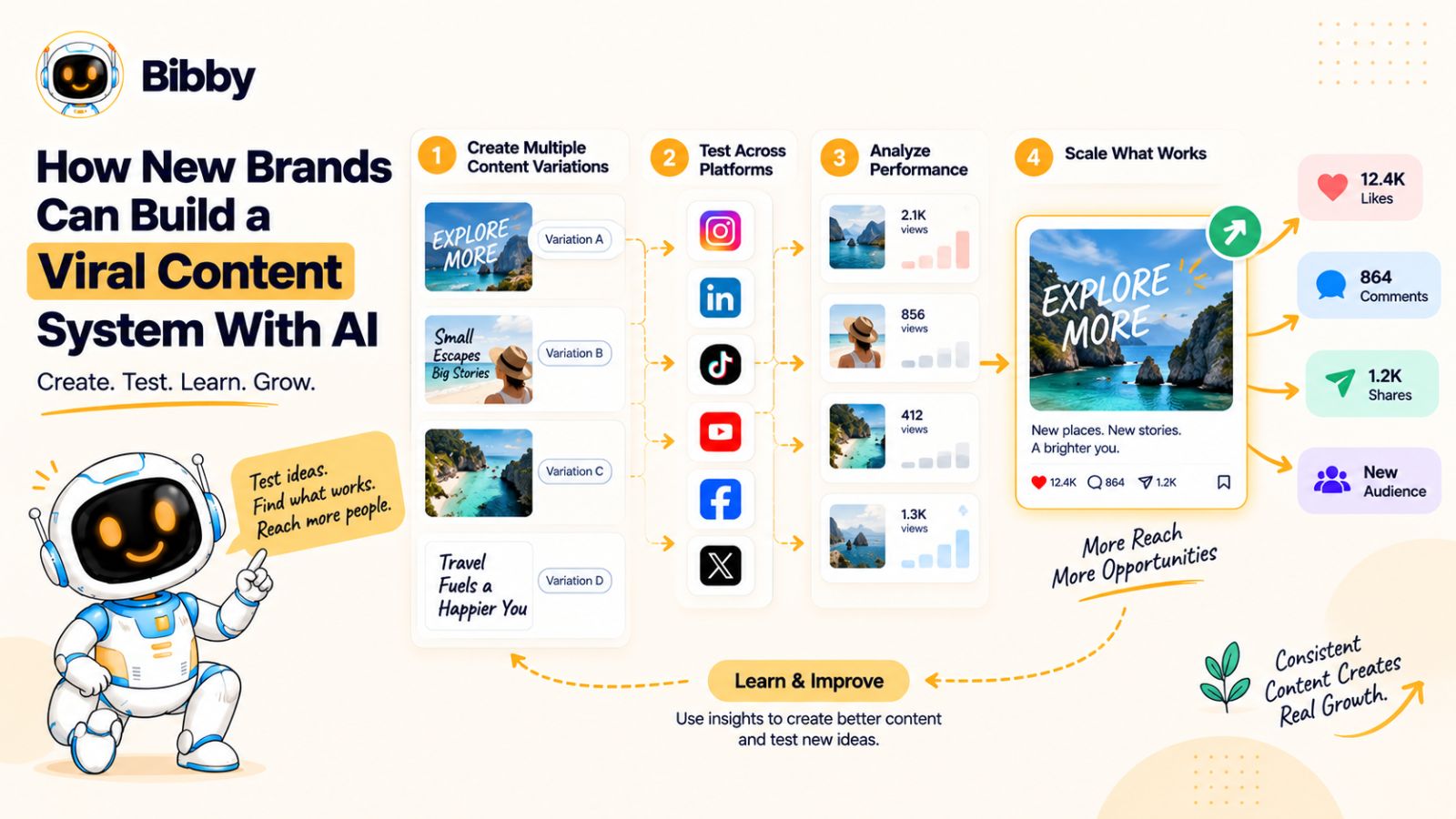
Don't chase virality—build for experimentation
A new brand has an information problem.
You don't yet know which topics your audience cares about most. You may not know which hooks stop people from scrolling, which formats generate the most engagement, or which messages make people curious enough to visit your profile.
The answer isn't to guess once.
It's to test.
For example, instead of creating one post about a product, a brand could test several different angles:
- A problem-focused hook
- An educational explanation
- A surprising fact
- A customer use case
- A product demonstration
- A common mistake
- A before-and-after story
The brand can then learn which themes deserve more attention.
AI automation makes producing those variations less labor-intensive.
Test more hooks
The first few words of a social post can determine whether someone keeps scrolling or stops to pay attention.
A single idea might therefore deserve multiple hooks.
For example, a productivity brand could approach the same topic with:
“You're probably wasting hours on this.”
Or:
“The simplest productivity system most people ignore.”
Or:
“Stop adding more tasks to your to-do list.”
The underlying subject can remain similar while the framing changes.
AI can help generate these variations quickly, giving marketers more material to evaluate rather than forcing them to commit to the first idea that comes to mind.
Test different formats
The same idea can perform differently depending on how it is packaged.
A detailed explanation might work well as a carousel. A visual demonstration could be better suited to short-form video. A provocative question might work as a simple text-led post.
AI social media automation makes it easier to transform ideas into multiple formats and schedule those experiments without manually rebuilding the workflow each time.
That gives brands more chances to discover their audience's preferred ways of consuming their content.
Turn winners into content series
Suppose a brand discovers that its audience consistently responds to a particular topic.
That shouldn't necessarily be treated as a one-time success.
The brand can investigate what made the post work and develop adjacent ideas.
One successful post could become:
Part 1: The original insight
Part 2: Common mistakes
Part 3: A practical example
Part 4: A deeper explanation
Part 5: A response to common questions
This creates a content series around demonstrated audience interest.
AI can help generate variations and organize the publishing workflow, allowing the team to spend more time developing the underlying ideas.
Build a feedback loop
A sustainable Social media growth system needs feedback.
The basic loop looks like this:
Publish → measure → identify patterns → create variations → publish again.
The objective isn't to obsess over every individual post.
Instead, look for recurring signals.
Which topics repeatedly attract attention? Which formats consistently generate interaction? Which hooks lead to stronger responses? Which content creates profile visits, conversations, or other meaningful actions?
Those observations can influence the next content batch.
Over time, the brand moves from guessing what its audience might like toward making increasingly informed creative decisions.
Increase your surface area for discovery
This is where AI automation can have a meaningful impact on a brand starting from zero.
More thoughtful experiments create more opportunities for a breakout post.
If a founder can manually produce five experiments a month but an AI-assisted workflow makes it practical to produce and distribute twenty well-considered experiments, the brand has created a larger surface area for learning and discovery.
That doesn't mean twenty mediocre posts are better than five excellent ones.
It means automation can make more high-quality experimentation possible.
And that is a much more realistic way to think about going from zero to viral.
Virality is an outcome a brand cannot command. But a brand can control how many good ideas it develops, how consistently it distributes them, how quickly it learns from audience response, and how efficiently it turns those lessons into the next round of content.
AI automation strengthens that system.
AI Social Media Automation vs. Hiring a Social Media Manager
When a new brand begins taking social media seriously, one question often appears: Should we hire someone to manage social media, or can AI automation handle it?
The answer depends on what the brand actually needs.
AI social media automation and a human social media manager are not necessarily substitutes. They solve different parts of the problem, and many brands can benefit from combining them.
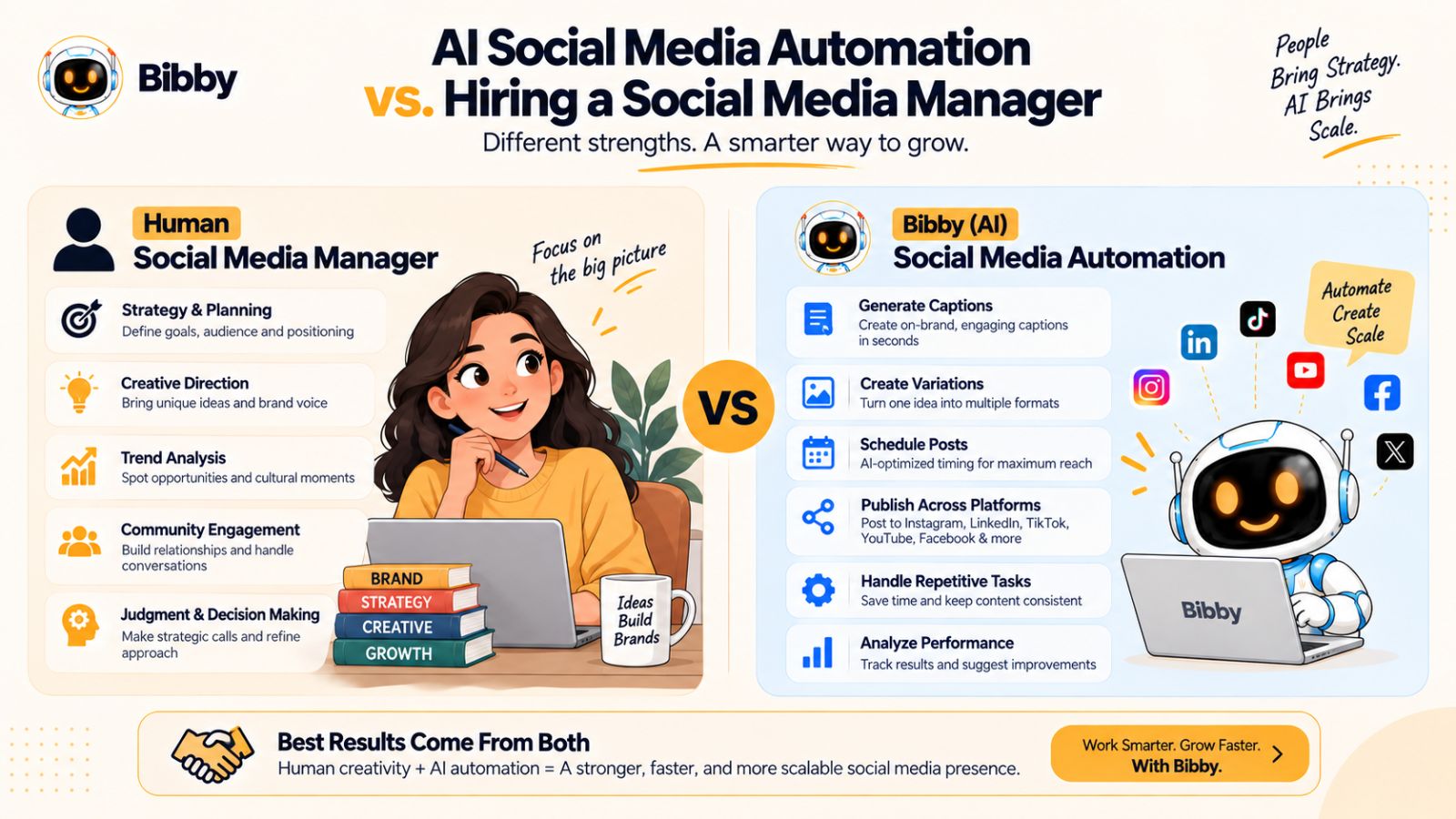
Where AI automation excels
AI is particularly useful when the work is repetitive, structured, and performed frequently.
That includes tasks such as:
- Generating caption drafts
- Creating content variations
- Organizing social media content
- Scheduling posts
- Publishing across multiple platforms
- Repurposing content
- Maintaining a publishing calendar
- Regenerating copy
- Supporting campaign workflows
These tasks can consume a surprising amount of time when performed manually.
For a small brand, automating them can allow the existing team to maintain a much larger social media operation without adding the same amount of administrative work.
Where humans remain essential
Social media is not only an execution problem.
Someone still needs to decide what the brand should say and why people should care.
Human judgment is particularly valuable for:
- Brand positioning
- Creative direction
- Original ideas
- Customer understanding
- Product expertise
- Cultural context
- Sensitive communications
- Community relationships
- Strategic decision-making
AI can generate ten campaign ideas quickly. A human still needs to recognize which idea actually fits the brand.
Likewise, AI can generate a polished caption that sounds convincing while completely missing an important nuance about the company's customers.
Automation makes execution faster. It doesn't eliminate the need for judgment.
The hybrid model
For many growing brands, the most practical approach is a hybrid system.
The human provides the strategy and creative direction.
AI assists with production and execution.
Automation handles distribution and repetitive operations.
The human then reviews performance and feeds new insights back into the strategy.
The workflow becomes:
Human strategy → AI-assisted creation → Automated distribution → Human analysis → Improved strategy
This can be particularly powerful for startups.
A founder might understand the customer better than anyone else in the company but have little time to manually manage five social media accounts. AI automation can help turn the founder's ideas into a consistent publishing workflow without requiring the founder to perform every operational step.
Why this matters for a brand starting at zero
Established brands often have dedicated marketing teams, content creators, designers, copywriters, and social media managers.
A new brand may have one founder and a small team doing all of those jobs at once.
AI automation can narrow that resource gap.
It doesn't magically give a startup the same creative expertise as a large marketing department. But it can reduce the amount of repetitive work required to operate a sophisticated social media workflow.
That means a small team can spend more of its limited time on the things AI cannot understand as deeply as the people building the brand: customers, products, positioning, experiences, and original ideas.
AI is most valuable when it amplifies people
The most useful question is therefore not:
“Can AI replace my social media manager?”
A better question is:
“Which parts of social media management should my team stop doing manually?”
If AI can remove hours of repetitive work every week, the team can redirect that time toward strategy, creativity, customer research, and better content.
That is the real opportunity.
AI social media automation is not about removing humans from marketing. It is about removing unnecessary friction between a good idea and the audience that needs to see it.
A Practical AI Social Media Automation Strategy for a Brand Starting at 0
Knowing that AI can automate social media is useful. Knowing how to actually build the system is more useful.
A new brand does not need hundreds of posts, a huge marketing team, or a complicated technology stack on day one. It needs a repeatable process that turns ideas into consistent publishing and uses audience feedback to improve the next round of content.
Here is a practical framework for building that system.
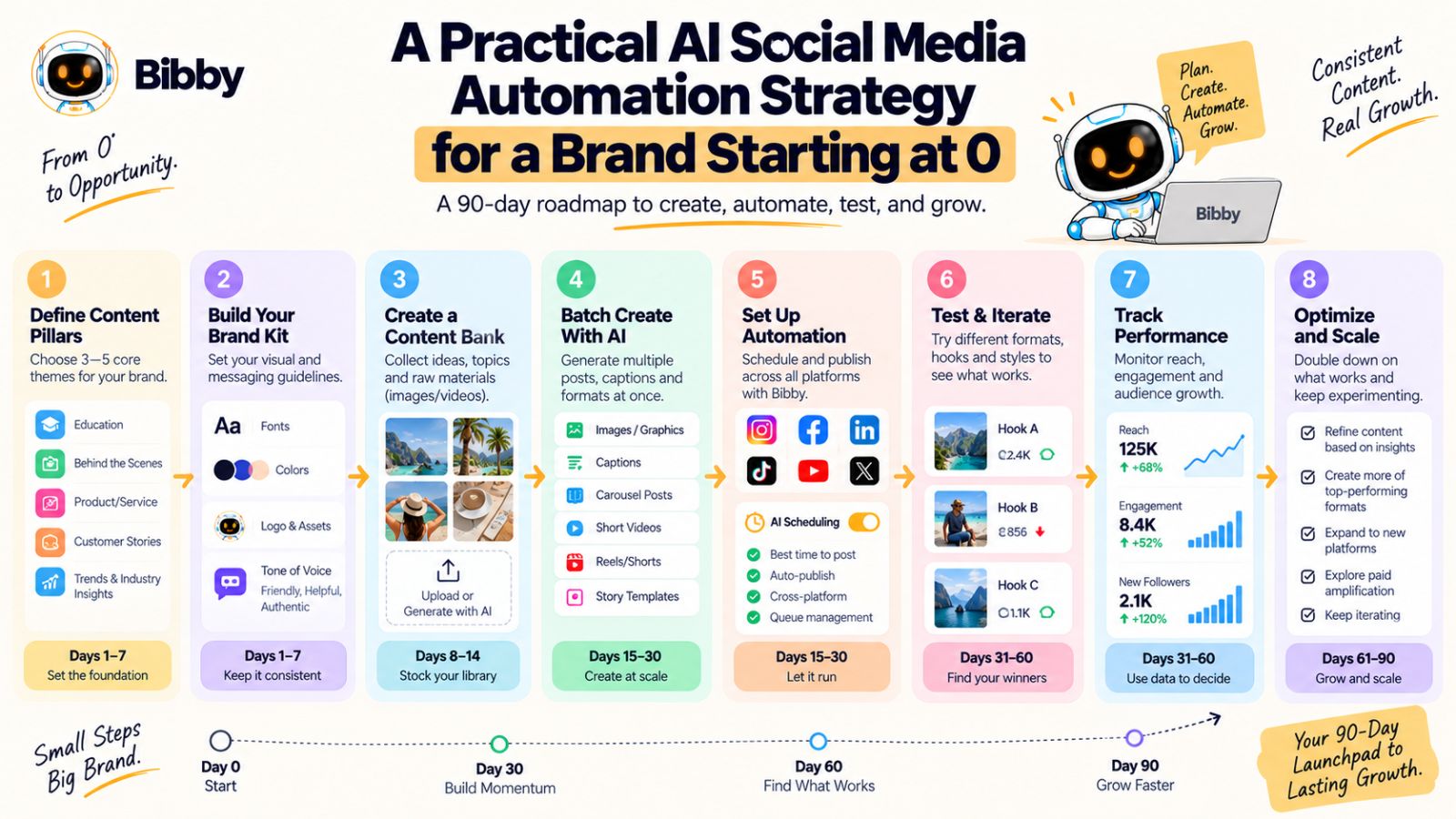
1. Establish three to five content pillars
Start by deciding what the brand should consistently talk about.
Content pillars might include:
- Educational content
- Product demonstrations
- Customer problems
- Industry insights
- Behind-the-scenes content
- Customer stories
- Founder perspectives
These pillars prevent the content calendar from becoming a random collection of unrelated posts.
They also give AI useful context when generating content ideas and variations.
2. Define the brand's voice and identity
Before automating content, establish the rules the content should follow.
Document the brand's:
- Tone of voice
- Visual identity
- Core messages
- Target audience
- Words and phrases it commonly uses
- Topics it wants to own
- Topics it wants to avoid
A brand kit can help centralize this information.
The more clearly the brand is defined, the easier it becomes to use AI without producing generic content.
3. Build a content bank
Don't wait until the day a post needs to be published to decide what to say.
Create a bank of ideas, images, videos, customer questions, product information, testimonials, statistics, and other useful assets.
This gives the AI workflow raw material to work with.
A content bank also reduces the pressure of constantly inventing something new from scratch.
4. Batch-create content
Instead of creating one post every day, create several pieces during dedicated content sessions.
An afternoon of focused work could produce enough raw material for multiple days or weeks.
AI can then help turn those raw assets into captions, variations, formats, and platform-specific posts.
This separates creative production from daily publishing.
5. Automate the repetitive parts
This is where a tool such as Bibby can become part of the workflow.
Upload or generate the creative, choose the desired posting style, generate captions with AI, select the platforms, and schedule the content.
Instead of repeating those steps separately across Facebook, Instagram, LinkedIn, YouTube, TikTok, and other selected channels, the workflow can be managed from one place.
The result is less time spent on publishing administration.
6. Test different angles
Don't publish the same idea once and immediately decide whether it worked.
Create variations.
Test different hooks, visual approaches, captions, formats, and calls to action.
The objective is to discover what your specific audience responds to—not to blindly copy whatever happens to be trending.
7. Study patterns instead of individual posts
One post performing poorly doesn't necessarily mean the topic is bad.
One successful post doesn't necessarily mean you have discovered a permanent formula.
Look for patterns across multiple pieces of content.
Over time, ask:
- Which topics consistently attract attention?
- Which formats generate meaningful interactions?
- Which hooks appear repeatedly in successful posts?
- Which content leads people to explore the brand further?
- Which ideas are worth developing into a series?
These observations should influence the next content cycle.
8. Double down on demonstrated interest
When a particular topic or format repeatedly resonates, create more around it.
A successful concept can become a recurring series, a campaign, or a larger content theme.
This is one of the most effective ways to move from random posting toward a recognizable content strategy.
9. Repeat the system
The goal isn't to build a perfect social media strategy once.
The goal is to build a system that gets better through repetition.
Plan → create → automate → publish → measure → learn → improve → repeat.
AI reduces the friction inside that loop.
As the brand grows, the workflow can become more sophisticated, but the underlying principle remains the same: create useful content consistently, distribute it efficiently, learn from the response, and use those lessons to make the next batch better.
For a brand starting at zero, that consistency can be more valuable than trying to manufacture a single viral moment.
Common AI Social Media Automation Mistakes
AI social media automation can dramatically reduce the amount of work required to run a content operation. But automation does not automatically produce good marketing.
Used without strategy, it can actually make a brand's social presence feel repetitive, generic, or disconnected from its audience.
Avoiding a few common mistakes can make the difference between automating a social media strategy and simply automating social media noise.
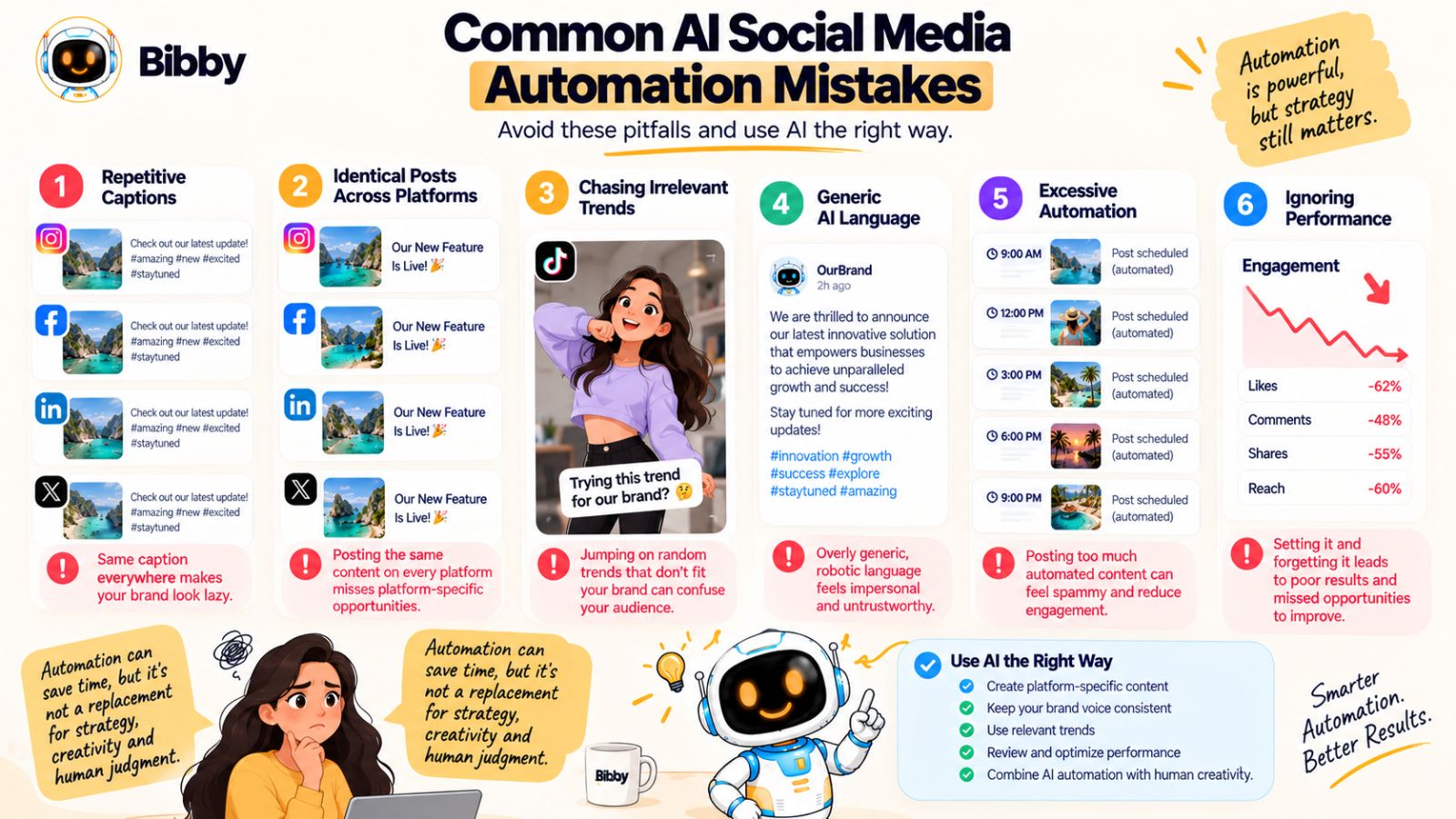
1. Automating low-quality content
The first rule is simple:
Automation should multiply quality, not compensate for its absence.
If the original idea is weak, generating ten variations of it doesn't make the idea stronger.
Before asking AI to produce more content, ask whether the underlying content is useful, interesting, entertaining, educational, or relevant to the audience.
A smaller library of strong ideas is usually more valuable than an endless stream of generic posts.
2. Publishing generic AI captions
AI-generated captions can save time, but accepting every generated caption without reviewing it can make a brand sound like everyone else using the same technology.
Look for language that feels vague, exaggerated, repetitive, or disconnected from the way real customers speak.
Add specific details.
Use real examples.
Include genuine opinions.
Give the AI enough brand context to produce something distinctive.
Then review the final version before publishing.
3. Treating every platform identically
Cross-platform automation is useful, but copying exactly the same content everywhere isn't always the best strategy.
A LinkedIn audience may respond differently to a topic than a TikTok audience. Instagram may favor a different presentation style from Facebook. YouTube may require more context than a short-form post.
The core idea can remain consistent while the execution changes.
Good automation should make adaptation easier—not eliminate the need for it.
4. Over-automating engagement
Publishing is one of the easiest parts of social media to automate.
Relationships are not.
A brand should be careful about automatically generating replies to customers, responding to sensitive comments, or interacting with people without appropriate human oversight.
A social media presence is ultimately a communication channel between people.
AI can help manage the workload, but genuine conversations still require judgment.
5. Ignoring the brand voice
A recognizable brand should sound like itself.
If every post is generated from a generic AI prompt, the brand can gradually lose its personality.
That is why brand context matters.
A clear brand kit, defined tone, consistent visual identity, and strong examples of preferred messaging can give AI a much better foundation.
The objective is not to make AI sound intelligent.
It is to make AI sound like your brand.
6. Publishing without a strategy
Automation makes publishing easier.
That can become a problem if the team starts publishing simply because it can.
Every content batch should have a purpose.
Are you educating potential customers? Building awareness? Demonstrating the product? Addressing objections? Generating conversations? Supporting a campaign?
A publishing calendar should connect back to the broader marketing strategy.
7. Chasing every trend
Trends can create opportunities, but not every trend is relevant to every brand.
A B2B software company doesn't necessarily need to participate in every viral meme. A luxury brand may damage its positioning by copying trends that don't fit its identity.
AI can help identify and develop ideas quickly, but humans still need to decide whether those ideas make sense for the brand.
Relevance is more valuable than simply being current.
8. Measuring vanity metrics alone
Likes and views are easy to see, but they don't always tell you whether the social strategy is helping the business.
Depending on the brand's goals, more meaningful signals might include:
- Profile visits
- Website traffic
- Leads
- Product inquiries
- Sign-ups
- Sales
- Meaningful conversations
- Returning audience engagement
The right metrics depend on what the brand is trying to accomplish.
AI automation becomes more valuable when it is connected to a learning process rather than simply a publishing process.
The goal is intelligent automation
The best AI social media workflows don't try to remove every human decision.
They remove unnecessary repetition.
Humans provide the strategy, expertise, creativity, and judgment. AI helps accelerate production. Automation handles distribution and repetitive operations.
That division of work creates something more sustainable than a fully automated content factory.
It creates a system where technology handles the repetitive work while people remain responsible for making the brand worth following.
What AI Social Media Automation Will Look Like Next
Social media automation started with a relatively simple idea: schedule a post now and publish it later.
AI is pushing that concept much further.
The next generation of social media tools is increasingly focused on helping brands manage the entire journey from an idea to a published campaign. Instead of requiring marketers to operate every individual feature, AI can increasingly understand the goal and help coordinate the steps required to achieve it.
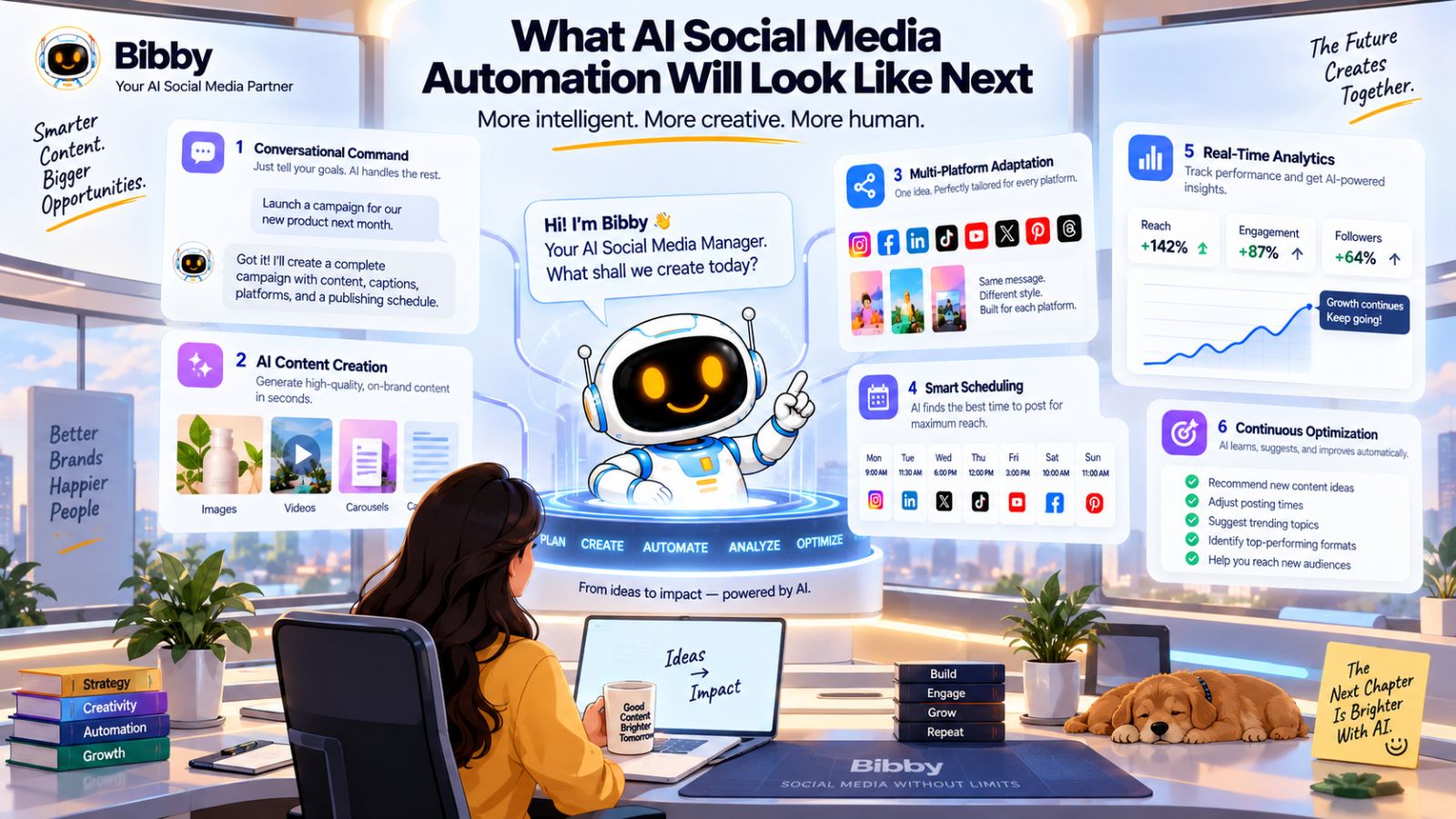
From scheduling posts to managing workflows
The traditional social media scheduler asks:
“When should this post go live?”
An AI-powered social media system can move toward questions such as:
“What are we trying to promote?”
“Who are we trying to reach?”
“What content should support this campaign?”
“Which platforms should we use?”
“How should we distribute the content?”
That represents a significant change in how marketers interact with social media software.
The technology becomes less about scheduling individual pieces of content and more about coordinating an ongoing publishing system.
Conversational marketing will become more important
Interfaces like Bibby's chat-based workflow point toward a more conversational model of social media management.
Instead of learning where every feature lives, marketers can describe what they want.
A request such as:
“Create a campaign around our new product and prepare social content for the next two weeks.”
can potentially become the starting point for a much larger workflow.
The AI can help break that objective into content, captions, formats, platforms, and publishing dates.
This doesn't mean the marketer disappears from the process.
It means the marketer spends less time operating software and more time directing it.
AI will make experimentation cheaper
One of the biggest long-term effects of AI automation may be the reduction in the cost of experimentation.
Creating ten variations of an idea used to require significant human effort.
AI can make the initial production of those variations much faster.
That allows brands to test more creative directions, learn more quickly, and develop a stronger understanding of what their audience responds to.
For new brands, this can be particularly valuable because they begin with limited historical data.
The faster they can create meaningful experiments, the faster they can gather their own audience insights.
Brand differentiation will become more important
There is an interesting consequence to easier content creation.
If everyone can generate more content, simply producing more content becomes less distinctive.
When AI makes captions, images, content ideas, and scheduling increasingly accessible, the scarce resource becomes original thinking.
Brands will need stronger opinions, better stories, more useful expertise, distinctive creative direction, and a clearer understanding of their audience.
AI can increase the amount of content a brand produces.
It cannot automatically make that content worth remembering.
The future is not “AI does everything”
The most useful future for social media automation is probably not a system where humans disappear entirely.
It is a system where the division of labor becomes clearer.
Humans decide:
What should we say?
Why does it matter?
Who are we speaking to?
What makes our perspective different?
AI helps answer:
How can we turn this idea into more content?
How can we adapt it?
How can we organize it?
How can we distribute it efficiently?
Automation handles:
When should it be published?
Where should it go?
How can we reduce repetitive execution?
That combination can give small brands something they historically struggled to achieve: a sophisticated social media operation without requiring a large team to perform every repetitive task manually.
The brands that benefit most will not necessarily be those that automate the most.
They will be the ones that use automation to create more room for better ideas, stronger creative decisions, and deeper relationships with their audiences.
Conclusion
Going from zero to a recognizable brand on social media isn't about finding one magical viral post. It is about building a system that consistently creates opportunities for discovery, learning, and growth.
AI social media automation can help make that system practical for even a small team. It can reduce repetitive content work, turn individual ideas into multiple social assets, and automate distribution across platforms so marketers can spend more time on strategy and creativity.
The three biggest takeaways are:
- AI increases the speed and volume of meaningful content experimentation.
- Automation makes consistent cross-platform publishing easier to maintain.
- Human strategy remains essential for distinctive, memorable brand content.
Tools such as Bibby illustrate where social media management is heading: toward connected workflows where content creation, captions, campaigns, scheduling, and publishing can be managed through an increasingly intelligent system.
But automation is only the engine. The ideas, positioning, expertise, and creativity behind the brand are still what give that engine somewhere worth going.
The natural next step is to turn this into a repeatable system: build an AI-powered social media content calendar that tells you what to publish, when to publish it, and how to keep improving it.